
Walking the ground of history’s great battles
Explore military history through detailed battle studies, original maps and primary sources — backed by firsthand exploration of battlefields from Thermopylae to Dien Bien Phu, and places few historians ever reach.
SHORTCUT BUTTONS
⚔️ Every battlefield I have walked — On one map
300+ battlefields explored · 30+ years of field research · Six continents · 2,500 years of warfare
 Red markers — Full Battlefield Study: original research, primary sources, ground I have walked myself. Hover to reveal. Click to open
 Green markers — Field Note: raw, first-hand ground truth, fresh from the battlefield. Free to read for 7 days, then part of the membership library.
 Blue markers — Still in draft: walked, photographed, researched — the next story waiting to be written.
Zoom, scroll, hover, or tap the icons to explore!


Trusted & Cited Worldwide
🌐 AI Research Tools — ChatGPT · Perplexity · Gemini · Copilot · Grokipedia (cited in 400+ articles)
📚 Academic & Reference — Wikipedia · World History Encyclopedia · Society for Military History (USA) · Duy Tan University, Vietnam · LibGuide Student Resource · Schoology student resources · app.packback.co student resources
🏛️ Museums & Heritage — Talana Museum (South Africa) · KwaZulu-Natal Battlefields Route (South Africa) · Dundee Battlefield Museum (South Africa) · Patay Victory Museum (France)
🎖️ Military & Institutional — Lithuanian Army Official Publication · Small Wars Journal (USA) · PCN-TV Documentary · 19FortyFive (USA) · Muzealnictwo Wojskowe (Polish Army Journal)
🌍 Global Media — La République (France) · Finnish Winter War Documentary · Hebrew Wikipedia · Czech, Spanish, Russian & Arabic language publications
⚔️ BattlefieldTravels: A Guide to the Site
300+ battlefields explored · 30+ years of field research · Six continents · 2,500 years of warfare
If you are looking for the best military history site for detailed battlefield research, BattlefieldTravels goes beyond the standard battle narrative — combining primary sources with firsthand exploration, terrain analysis, period maps and imagery.
Jump directly to the hub pages, or keep scrolling for an overview of the site’s features.
- ⚔️ Battlefield Studies → Firsthand studies and virtual tours of historic battles and campaigns
- 💡 Military Innovation & Adaptation → How armies solved battlefield problems — from the Greek phalanx to modern combined arms
- ❓ Military History Quizzes → Think you know military history? — Test your knowledge against these challenging quizzes!
- 🎧 Battlefield Travels Podcasts → Historic battle and campaign deep-dives brought to life in audio format
- 📝 Field Notes & ⚡Research Dispatches → Go behind the scenes into field notes, working analysis, primary sources, and unpublished material.
 Methodology → How BattlefieldTravels researches and explores historic battlefields
- 🏞 Micro-Terrain & Battlefield Decision-Making→ How terrain shapes combat decisions
- 🏛️ Weapons & Equipment → my personal collection of weapons and equipment used by soldiers over the past 500 years
- 📚 Reading Room → Curated books, memoirs, and primary sources on campaigns and battles
- 🔎 Research Hub → Explore battles by theme, operating environment, and analytical lens


Who is behind BattlefieldTravels?
I am Mick Prictor — retired Australian Army officer, Black Hawk pilot, paratrooper, and US Central Command planner. Over three decades I have explored more than 280 battlefields across six continents, from the frozen forests of Finland to the jungle-clad mountains of northern Vietnam, and the coral ridges of the Pacific Campaign.
Maps show the big picture. They rarely show the subtle terrain features, the dead ground, or the sight lines that decided the battle. Standing on the ground where history happened, you see what the commander saw — the micro-terrain that shaped decisions at Thermopylae, Leuthen, Spion Kop, Omaha Beach, Guadalcanal, Điện Biên Phủ, and hundreds of other battlefields studied firsthand on this site.
Every study draws on primary sources, GIS terrain analysis, and boots-on-the-ground exploration — informed by one of the world’s largest private collections of period military arms, uniforms, and equipment.
👉 About the author and BattlefieldTravels → │ 👉 Research Methodology →
🎧 The BattlefieldTravels Podcast
280+ battlefields. 2,500 years of conflict. All of it walked, researched, and analysed — now in audio.
Featured episodes. Tip: If Podbean overlay appears after pausing, click the × in the top-right corner to return to the player controls.
📝Go Beyond the Published Studies
Behind every battlefield study there is a vast body of research: field notes from the ground, period and contemporary imagery, working maps, primary sources, and evolving interpretations. These notes capture how the terrain was read, what stood out, and how conclusions were formed.
📝Explore all Field Notes (from the battlefield) →
⚡Explore Research Dispatches (behind the analysis) →
Latest Field Notes:
-

📝 🔒Field Note: Battle of Worcester, English Civil War, 3 September 1651
Cromwell’s final victory was fought across a battlefield divided by two rivers, defended bridges and commanding heights. On 3 September 1651, a vastly outnumbered Royalist army under Charles II made its last stand at Worcester. As Parliamentarian forces fought their way across the Severn and… Read more
-

📝 🔒Field Note: Guadalcanal – First Battle of the Matanikau, 18-19 August 1942
Matanikau Village site, August 2026. I am exploring the site of the First Battle of the Matanikau, 18-19 August 1942. The battle was the first major battle west of the Matanikau and bears many similarities with the other five or six battles (depending on how… Read more
-

📝 🔒Field Note: Guadalcanal – Goettge Patrol Incident, 12-13 August 1942
August 2026, at the mouth of the Matanikau River. I am exploring the sites associated with the ill-fated ‘Goettge Patrol’ of 12-13 August 1942. The action happened over a very small area on the beachline west of the Matanikau, near the old village of Matanikau,… Read more


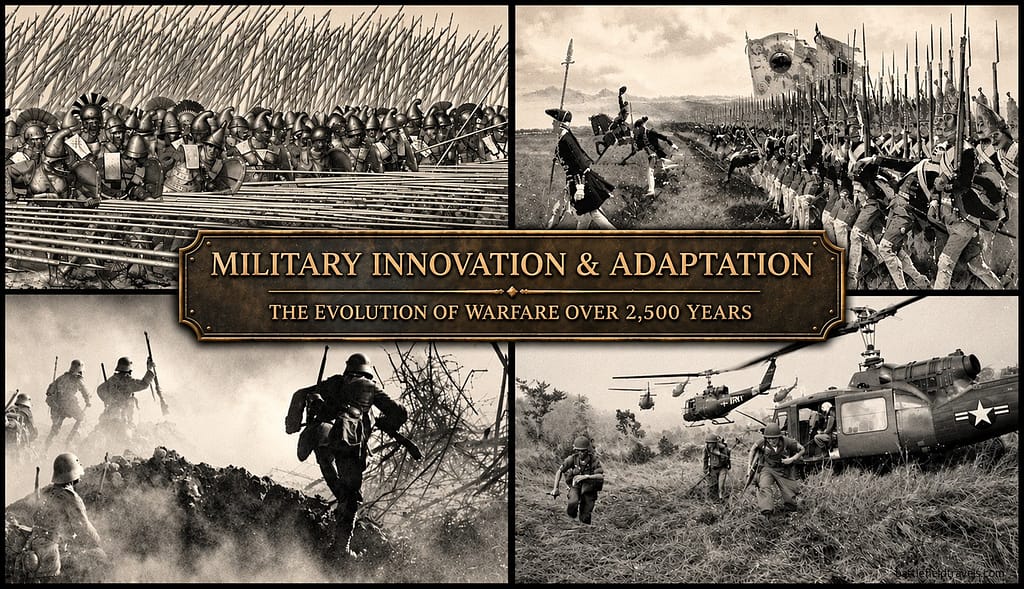
💡 Military Innovation & Adaptation
This section is an overview of the tactical innovations hub. Full access is on the Military Innovation & Adaptation page.
Throughout history, armies have adapted, improvised, and innovated in response to perceived threats, technological change, and terrain challenges. From the disciplined formations of the ancient world to the shock tactics of the Napoleonic era, from infiltration on the Western Front to air mobility in Vietnam and drone warfare in Ukraine, battlefield success has often depended on the ability to think differently.
🏛️ Weapons, Uniforms, and Equipment
This section is an overview of the museum. Full access is on the Weapons & Equipment page.
As part of my long-standing passion for military history, I have assembled a substantial private military collection. The Weapons & Equipment section draws directly on this collection, presenting genuine historical items that I have examined and handled firsthand, rather than images sourced second-hand or reproduced from the internet.
Organised by era and conflict, these pages include examples of uniforms, headgear, weapons, equipment, accoutrements, and original documents associated with warfare over the past five centuries, placing the historic items alongside the battles in which they were used.

📘Reading Room
This section is a brief introduction to the Reading Room. The full Reading Room, organised by era and conflict, is on the Reading Room page.
The Reading Room brings together the foundational theories, primary sources, and analytical works that have informed my battlefield research over decades. It is drawn from my personal military history library of more than a thousand volumes and decades of research. It reflects the works I rely on most heavily when analysing campaigns, battles, and command decisions. I have read every book listed here and own the vast majority of them.

🔍 Research Hub
This section is an overview. The full research capability is at the Research Hub.
The BattlefieldTravels Research Hub allows researchers to explore more than 250 battles and campaigns across six continents, covering 2,500 years of conflict. The hub enables thematic exploration — by army, conflict, operational method, environment, or commander — revealing patterns of warfare that recur across regions, technologies, and eras. Whether you are interested in sieges and raids, British encounter battles, Prussian oblique-order manoeuvres, or Viet Minh jungle ambushes, the Research Hub connects you directly to the relevant evidence-driven studies.

 BattlefieldTravels Methodology
 BattlefieldTravels Methodology
This section outlines the methods used across the site. A fuller explanation is available on the Methodology page.
Each battlefield study is grounded in the systematic analysis of primary sources, terrain, tactics, doctrine, and weapons, informed by firsthand exploration of historic battlefields. This approach reconstructs battles as they unfolded in time and space, linking decisions, movement, and terrain to outcomes. These methods reflect decades of battlefield exploration and research.

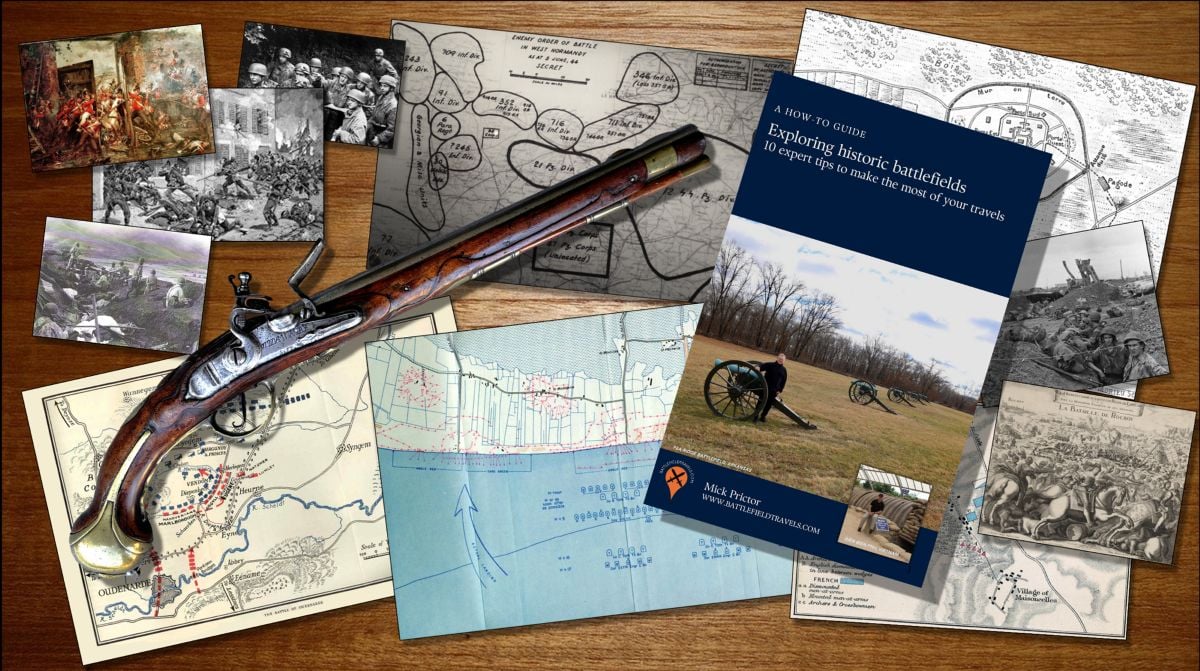
Subscribe to Battlefield Travels and receive a free E-Book Battlefield Guide
Unlock expert battlefield analysis, campaign reconstructions, and historical insights drawn from firsthand exploration and primary sources.
🗺️ You’ll receive:
🎖️ Exclusive historical insights you won’t find elsewhere
📘 A free eBook: 10 Tips for Exploring Historic Battlefields
📰 New battlefield studies straight to your inbox as they are published
⚔️ Go deeper — Members get exclusive access to the Deep Research Collection, Field Notes, and monthly Research Dispatches. Try membership free for 7 days, cancel anytime. From $9/month.
Latest posts
- 📝 🔒Bjerkvik, 13 May 1940 — The Foreign Legion’s amphibious assault at Narvik
 On the night of 12–13 May 1940, two battalions of the French Foreign Legion’s 13e Demi-Brigade (13e DBLE), supported by British warships and French light tanks, landed on the shores of Herjangsfjord at Bjerkvik, north of Narvik. Their objective was to outflank German positions blocking the Allied advance south from Gratangen, disrupt German communications and open the northern approaches to Narvik.
- 📝 🔒Field Note: Battle of Worcester, English Civil War, 3 September 1651Cromwell’s final victory was fought across a battlefield divided by two rivers, defended bridges and commanding heights. On 3 September 1651, a vastly outnumbered Royalist army under Charles II made its last stand at Worcester. As Parliamentarian forces fought their way across the Severn and Teme, Charles launched a bold counterattack against Cromwell’s weakened eastern flank. By day’s end, the Royalist army was destroyed, Charles was fleeing for his life, and the English Civil Wars were effectively over.
- ⚡🔒Research Dispatch, October 2026: England and NorwayOctober 2026 Research Dispatch: My initial findings from battlefield research in England and Norway, with a focus on Bosworth, Worcester and Narvik as the main research effort. A look ahead to how the ground reconnaissance contributes to new battlefield studies.
- ⚡🔒Research Dispatch September 2026: Narvik, Normans and VikingsSeptember 2026 Research Dispatch: recent Guadalcanal fieldwork, new Boer War and Tonkin Campaign studies, the Military Quiz Hub, research into Balibo and Rhodesian Fireforce operations, and upcoming battlefield fieldwork across Britain and Norway.
- ⚔️ Winston Churchill and the Armoured Train Incident: Chieveley, Natal, 15 November 1899On 15 November 1899, just south of Chieveley Station in Natal, a Boer force lured a British armoured train patrol into a well-placed ambush. On board was 24-year-old war correspondent Winston Churchill, along with about 120 British troops under Captain Aylmer Haldane. Churchill subsequently escaped from captivity and evaded Boer security forces in an extraordinary journey of some 400 kilometres.
- ⚔️🔒Battle of Hòa Mộc, Tonkin, 2-3 March 1885The Battle of Hòa Mộc Was the fiercest and most costly battle of the Sino-French War. The battle was fought just a few kilometres south of besieged Tuyên Quang, as Colonel Laurent Giovanninelli’s 3,400 man force made a 300 km forced march to relive the siege, and cleared the final Black Flag position between themselves and the Tuyên Quang defenders.
- ⚔️ D-Day: Ranville, Merville Battery and 6th Airborne Division, 6 June 1944British 6th Airborne Division’s role on D-Day was multi-faceted. In the opening minutes, glider-borne troops would seize the bridges over the Caen Canal and the River Orne. Soon afterwards, paratroopers would neutralise Merville Battery. Others would destroy key bridges over the Dives and prepare for German counterattacks. The mission was audacious, high risk, and critical to the success of the D-Day landings


I am so proud to have visited some of these battlefields with you. Your detailed information is amazing!
Thanks Craig, yes Black Jack and Pea Ridge, and I have placeholders for the ‘Dalton Raid on Coffeyville’ and ‘Quantrill’s Raid on Lawrence Kansas’! Coming soon!
At first glance, this looks absolutely fascinating! I’m looking forward to perusing through them all. Great work!
Thanks Conway, You should have months worth of perusing ahead of you! 20 battlefield posts loaded, 12 more in draft, another 150 yet to be started. I have to gather up my photos, notes, maps, data etc, write up a summary, and put it all together. Then there is all the future travels to be added!
Wish I’d known when you were in Coffeyville, Mick! We live near there in Springfield, Missouri. Cheers to you and your family!
Hey Jim, that visit was back in 2019 with some old friends from the 82d. We visited Coffeyville (amazing museum of the Dalton Raid!), Pea Ridge, Wilson’s Creek, Bentonville, and the Bonnie and Clyde house at Joplin. A lot going on in that four-state area! Mick
What a fantastic site you have put together – very informative and interesting! Keep up the great work!
Best regards from the Western Front & Canada,
Joe MacD
Thanks Joe, Great to get that feedback from our Canadian cousins! Just for you I have added a bunch more Canadian WW1 items from my personal collection to the ‘Virtual Museum’. Uniforms from 8th Battalion (Little Devils), 25th Battalion (Nova Scotia) and 27th Battalion (Winnipeg), CEF. https://battlefieldtravels.com/weapons-and-equipment/1914-18-world-war-one/.
Mick
Just came across your page about RC4, I’ve never read an English account of this battle so detailed. Thank you for sharing this!
Regards
Gene Fisher
Boise Idaho
USA
Gene,
Thanks for the feedback. I do not believe there are any other detailed accounts in English anywhere. Nearly 12,000 words in the article! Even Bernard Fall and Martin Windrow did not give it this level of analysis.
To put this study together, I walked the ground of the entire RC4 battlefield over several days, and drew on many firsthand accounts (all in French or Vietnamese) to pull together all the details.
Mick
Mick, bravo for your battlefield studies pages! I was especially excited and impressed by your pages on the Battle of Dien Bien Phu, RC4, Operation Hirondelle, and other events of the First Indochina War. I have a passion for this period of military history, and I’ve travelled to Vietnam once or twice a year for more than 15 years to do on-ground research, largely in the manner described in your booklet. I was totally gobsmacked by your photo of the paratroop DZ used for Operation Hirondelle in Lang Son–I’ve taken almost the same photo, and I thought I was the only person who would ever have been sufficiently interested to do it. I’m looking forward to reading these and other pages closely to gain your insights. Thanks again for all your efforts.
Tony, We have many common interests! And likewise, I am gobsmacked that someone else went out and tracked down the site of the Drop ZOne at Lang Son. Nice detective work! Mick
Wonderful site – Thanks!
Thanks Tom, Your support is greatly appreciated. BattlefieldTravels has been a long-term research project for me, and it is encouraging to know others value the work. Pleanty more to come. I am currently working on Operation DEADSTICK: Pegasus Bridge and Horsa Bridge, 6 June 1944, to complete the D-Day series off articles. Mick