The decisive battle that ended French rule in Indochina
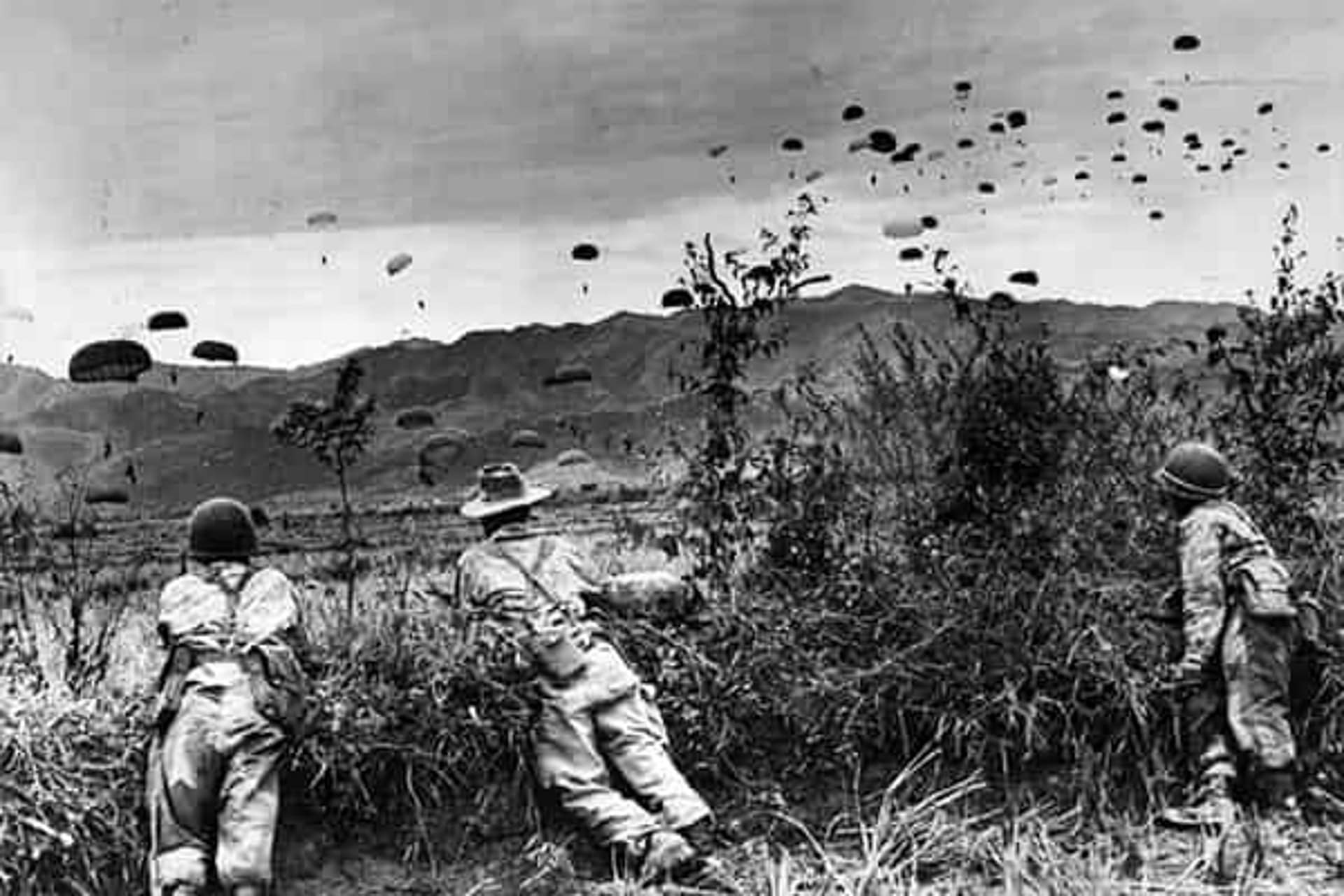
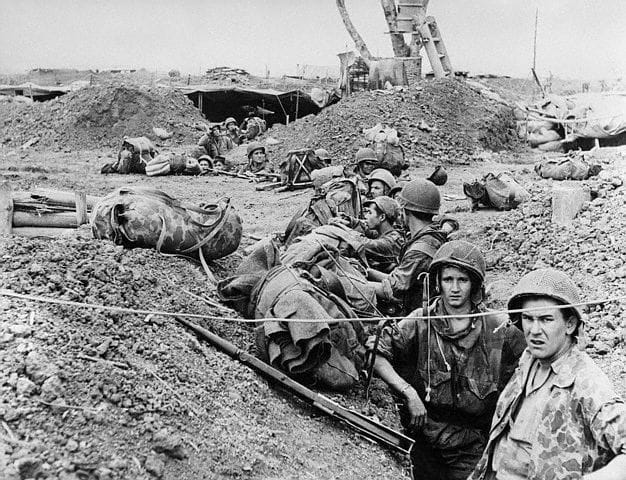
The Battle of Dien Bien Phu (13 March – 7 May 1954) was the climactic confrontation of the First Indochina War. In a remote valley of north-west Tonkin, French forces entrenched a fortified camp to block Viet Minh advances into Laos. General Võ Nguyên Giáp’s forces surrounded the position, bringing overwhelming artillery and manpower to bear in a siege that lasted 57 days. The fall of Dien Bien Phu destroyed French hopes of retaining Indochina, led directly to the Geneva Accords, and set the stage for American involvement in Vietnam.
Key facts
Google Earth map – location of the Dien Bien Phu battlefield
PART 1: THE BATTLE OF DIEN BIEN PHU
Background to the French Indo-China War
By 1953, the French Indo-China War had largely reached a stalemate, with neither side able to achieve a decisive result. Through 1951-52 the French preferred tactic was to draw the Viet Minh into attacking strong defensive positions around the Red River Delta and using airpower and artillery to destroy Viet Minh forces. Defensive battles at Vinh Yen, the Day River, and Na San seemed to prove the effectiveness of this tactic. The French commander, General Henri Navarre, devised a plan to seize and defend a position astride the Viet Minh supply routes into Laos, and force the Viet Minh to attack into strong defences and French firepower.
Why Dien Bien Phu?
With the benefit of hindsight, it is difficult to understand the French decision to insert a divisional-sized force into the remote highlands of northern Vietnam. Although the force comprised only about 5% of the French expeditionary forces in Indo-China, it was the best 5%, and ultimately included most of the available parachute battalions from the strategic reserve. The planning assumptions seem to have been that:
- A force operating from Dien Bien Phu could dominate the surrounding region through aggressive offensive operations and patrolling in force.
- Any attempt by General Giap’s forces to attack Dien Bien Phu could be defeated by a combination of the garrison’s artillery and French air power – as had happened at Na San and other defensive battles.
- The Viet Minh could not concentrate sufficient force in the highlands to defeat a 10,000+ plus French force.
- The Viet Minh had neither the available artillery, nor the means to move it, nor the skills to challenge French firepower.
- The force could be effectively supplied by air.
- The French government and military hierarchy were committed to success in Indo-China and general, and Dien Bien Phu in particular.
These planning assumptions were quickly disproven as Giap concentrated nearly 50% of available Viet Minh forces around Dien Bien Phu, including newly acquired artillery, mostly captured American equipment, made available by the end of the Korean War. Major offensive sorties by the garrison in early February 1954 ran into heavily defended Viet Minh positions within a few kilometres of the French perimeter. The French Tactical Air Force never generated sufficient sorties to meet the garrison’s needs, and the loss of the outer security positions, including Beatrice, Gabrielle, and Anne Maire, in the opening days of the Viet Minh offensive made the Dien Bien Phu airfield almost unusable.
For the French forces, the only real positive was the demonstration of tactical brilliance at the lower tactical levels, particularly by the Foreign Legion and Colonial paratrooper battalions. These forces were aggressive, hard-hitting combined arms units that consistently counter-attacked and inflicted disproportionate casualties on the Viet Minh.
For the Viet Minh, the impact was dramatic. They effectively pinned down and then destroyed the most capable forces in the French Far East Expeditionary Force. They proved themselves adept at handling large troop formations and in generating a massive logistic effort through terrain that western forces would consider impossible. They also grew a generation of leaders who within a few years were engaging US and allied forces in major ground combat operations, supported by an even more massive popular effort.
Opposing Forces at Dien Bien Phu
 French Order of Battle at Dien Bien Phu (major units)
 French Order of Battle at Dien Bien Phu (major units)
The French position was about 10km from north to south and 4km from east to west. The strongpoints were mostly based on dominating high ground, except those on the western side of the airfield and strongpoint Isabelle to the south, which were in flat terrain and rice paddies. Initial dispositions of French forces on the strongpoints:
- Headquarters North West Operation Group (Groupe d’Opération Nord-Ouest, GONO). Commander – Colonel Christian de Castries
- Group Mobile 6 (GM 6), Commander – Lieutenant Colonel André Lalande
- Group Mobile 9 (GM 9), Commander – Lieutenant Colonel Jules Gaucher
- Artillery, Colonel Charles Piroth
- Strongpoint Anne-Marie: 3rd T’ai Battalion, Major Léopold Thimonnier
- Strongpoint Beatrice: 3rd Battalion, 13th Foreign Legion Demi-Brigade, Major Major Paul Pégot
- Strongpoint Claudine: 1st Battalion/13th Foreign Legion Demi-Brigade, Major de Brinon
- Strongpoint Dominique: 3rd Battalion/3rd Algerian Rifle Regiment, Capitaine Jean Garandeau
- Strongpoint Eliane: 1st Battalion/4th Moroccan Rifle Regiment, commanded by Major Jean Nicolas
- Strongpoint Francoise platoon of Tai auxiliaries from 2nd T’ai Battalion
- Strongpoint Gabrielle: 5th Battalion, 7th Algerian Tirailleurs, Major Roland de Mecquenem
- Strongpoint Huguette: 1st Battalion/2nd Foreign Infantry Regiment, Major Clémençon
- Strongpoint Isabelle:
– 3rd Battalion/3rd Foreign Infantry Regiment Major Henri Grand d’Esnon
– 2nd Battalion/1st Algerian Rifle Regiment Capitaine Jean Sallot des Noyer - 2nd Airborne Brigade (GAP 2), Commander – Lieutenant Colonel Pierre Langlais
– 1st Foreign Parachute Battalion (1st BEP), Major Maurice Guiraud
– 8th Shock Parachute Battalion (8th BPC), Major Pierre Tourret - Armour. 3rd Squadron/1st Light Horse Regiment (3/1 RCC) M24 Chaffee tanks x 10, Capitaine Yves Hervouët
- Paratroop reinforcements post 13 March 1954
– 14 March 1954 – 5th Vietnamese Parachute Battalion (5th BPVN), Capitaine André Botella
– 16 March 1954 – 6th Colonial Parachute Battalion (6th BPC), Major Marcel Bigeard
– 1-4 April 1954 – 2nd Battalion/1st Parachute Chasseur Regiment (II/1RCP) Major Jean Bréchignac
– 9-10 April 1954 – 2nd Foreign Parachute Battalion (2nd BEP), Major Hubert Liesenfelt
– 2-4 May 1954 – 1st Colonial Parachute Battalion (1st BPC), Capitaine Guy Bazin de Bezon
Viet Minh Order of Battle at Dien Bien Phu (major units)
 Viet Minh Order of Battle at Dien Bien Phu (major units)
- Division 304 (Glory), commander – Nam Long
– Infantry Regiment 9, commander – Tran Thanh Tu
– Infantry Regiment 57, commander – Nguyen Can - Division 308 (Vanguard), commander – Vuong Thua Vu
– Infantry Regiment 36, commander – Pham Hong Son
– Infantry Regiment 88, commander – Nam Ha
– Infantry Regiment 102, commander – Nguyen Hung Sinh - Division 312 (Victory), commander – Lê Trọng Tấn
– Infantry Regiment 141, commander – Quang Tuyen
– Infantry Regiment 165, commander – Le Thuy
– Infantry Regiment 209, commander – Hoang Cam - Division 316, commander – Le Quang Ba
– Infantry Regiment 98, commander – Vu Lang
– Infantry Regiment 174, commander – Nguyễn Hữu An
– Infantry Regiment 176, commander – ?
Operation Castor – the French Plan
On 20 November 1953, in Operation CASTOR, French paratroopers seized the provincial centre of Dien Bien Phu, with its airstrip and key terrain in the valley. French and allied T’ai militia units began aggressive patrolling from Dien Bien Phu into the surrounding hills.
Meanwhile, the Viet Minh commander, General Vo Nguyen Giap, began withdrawing his forces from the Red River Delta and concentrating them around Dien Bien Phu.
By December 1953, the French patrols faced increasing resistance, and the French forces were forced back into their defensive positions around the town, the airfield, dominating terrain features, and several outlying security posts.
If the French had faced only an infantry-based enemy with light weapons, the Dien Bien Phu defences would have been tough to defeat. However, General Giap had concentrated more than a third of his army, and with the assistance of tens of thousands of local civilians, had massed artillery in the mountains surrounding Dien Bien Phu.
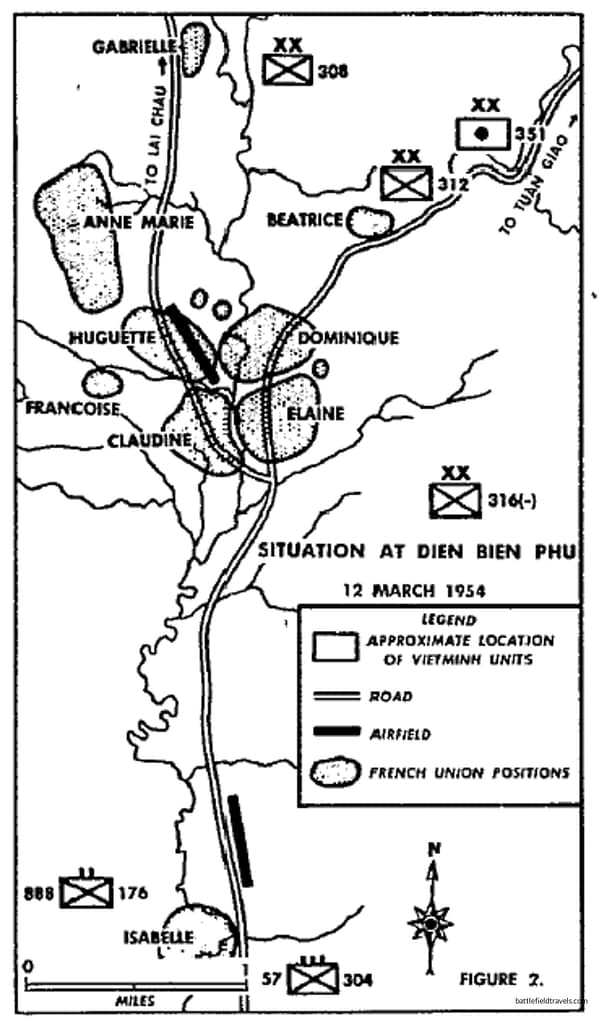
13-17 March: Fall of the French security outposts
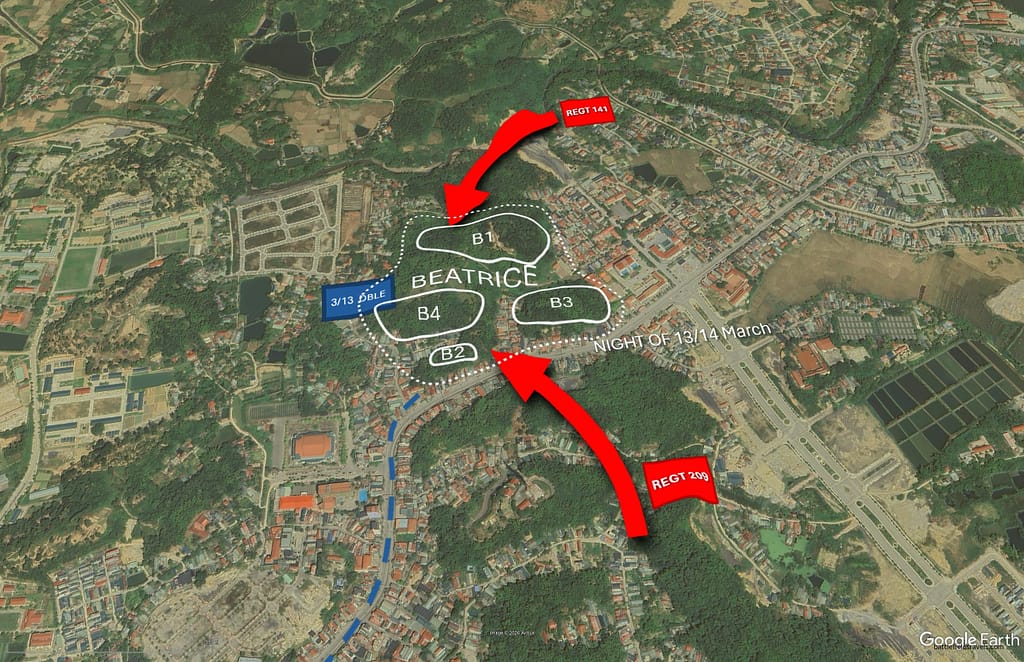
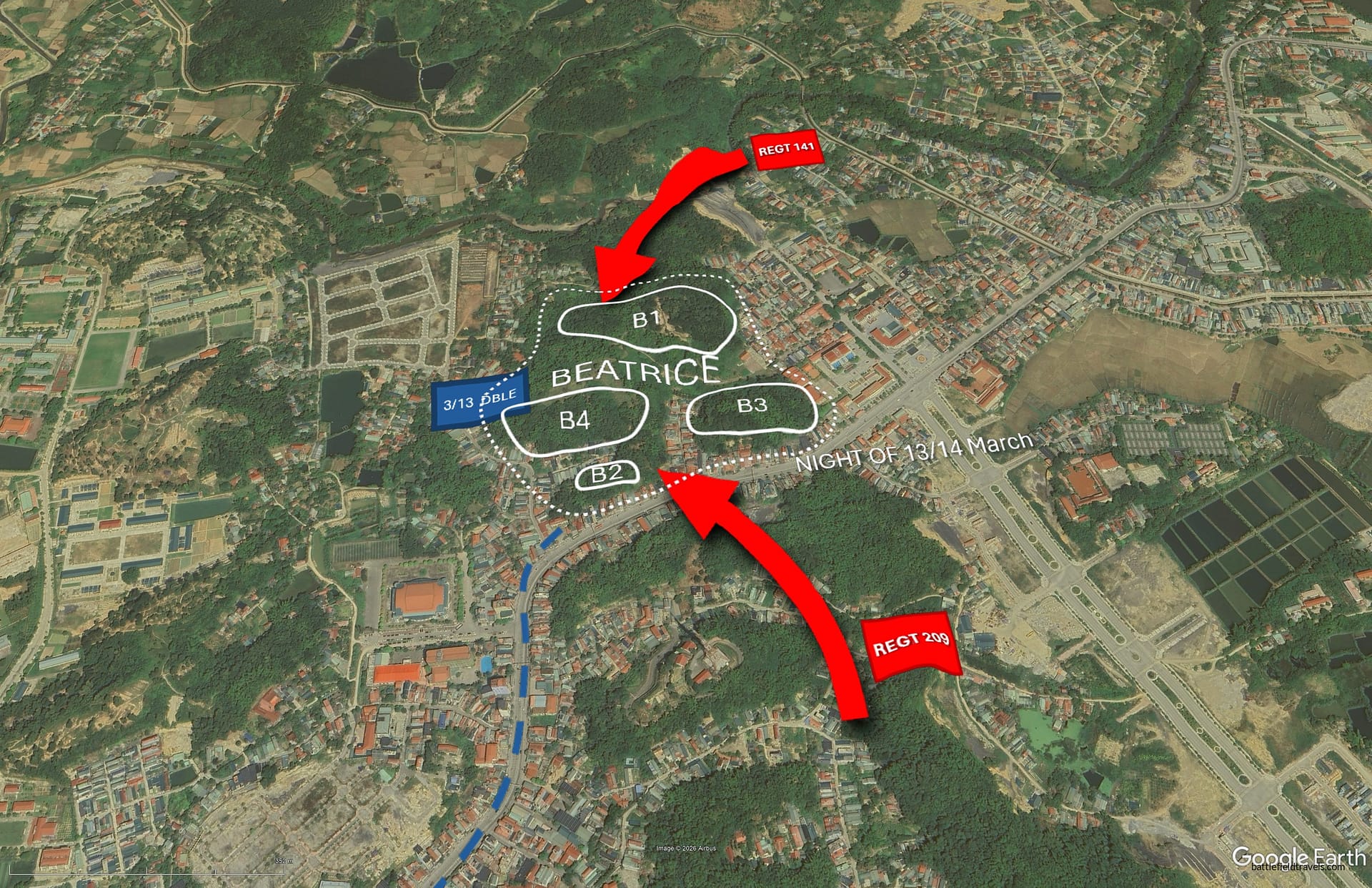
The siege began around 1730 hours on 13 March 1954, with the Viet Minh launching a massive artillery bombardment against strongpoint Beatrice, 2km to the northeast of the main position. Viet Minh artillery was dug into the hillsides and essentially fired over open sights (see the pictures below) into the French defences. Beatrice was defended by 3rd/13th Demi-Brigade of the Foreign Legion. Within hours, both the battalion commander and the sector commander were killed, and by 0100hrs on 14 March, Beatrice had fallen. An attempt to send reinforcements was defeated, and only about 100 Legionnaires were able to withdraw to the main position.
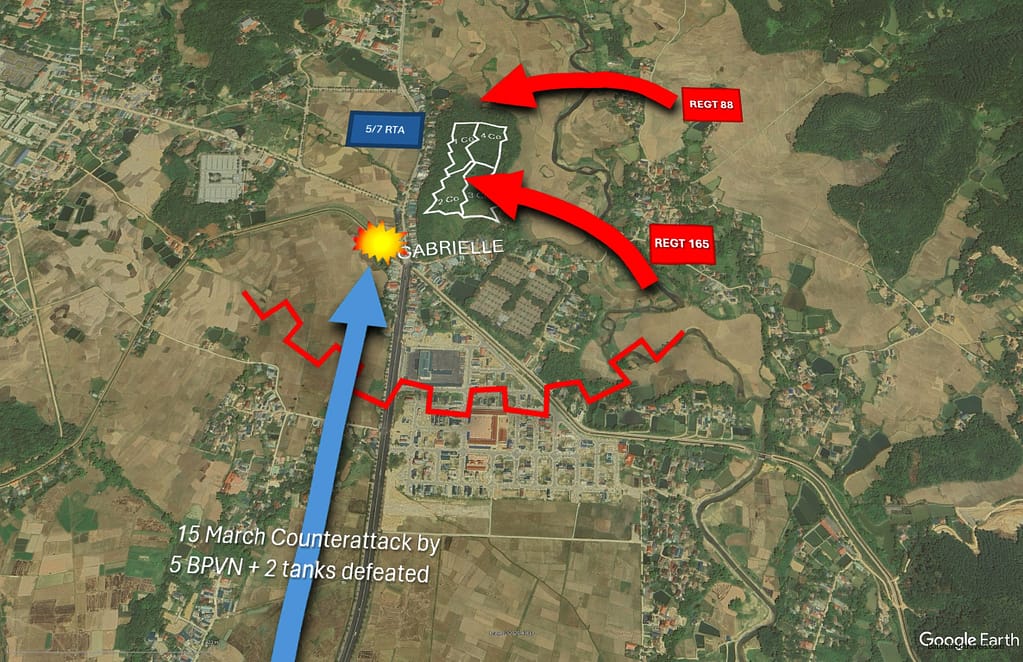
Strongpoint Gabrielle, held by 5th/7th Algerian Tirailleurs, fell the following night, 14 March. A counter-attack by 5th Vietnamese Parachute Battalion was unable to break through to the defenders. Gabrielle was critical as it dominated the flight path into Dien Bien Phu airfield.
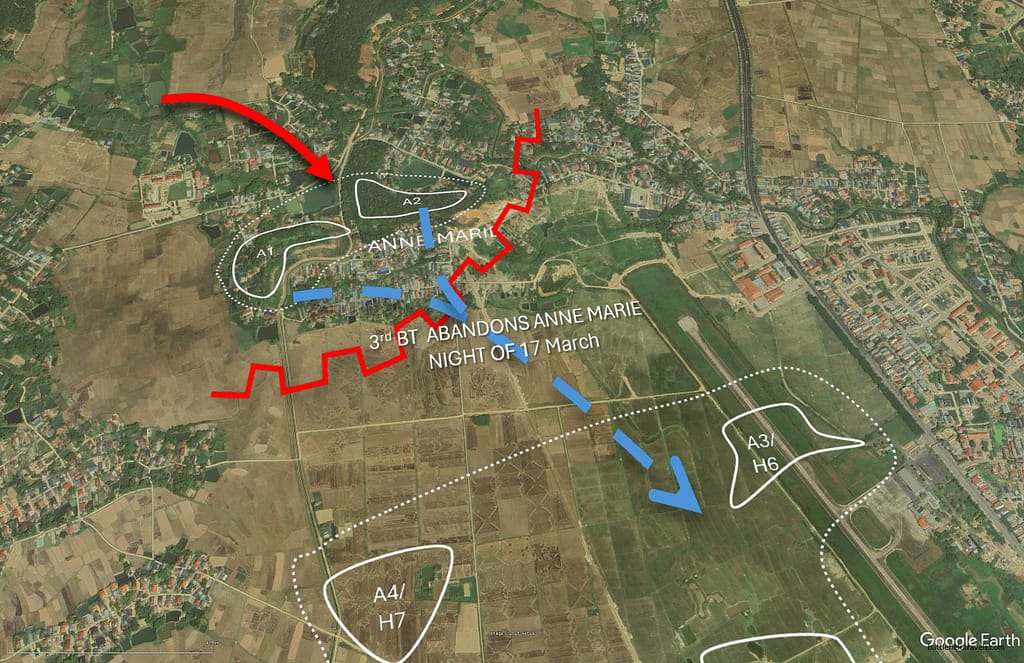
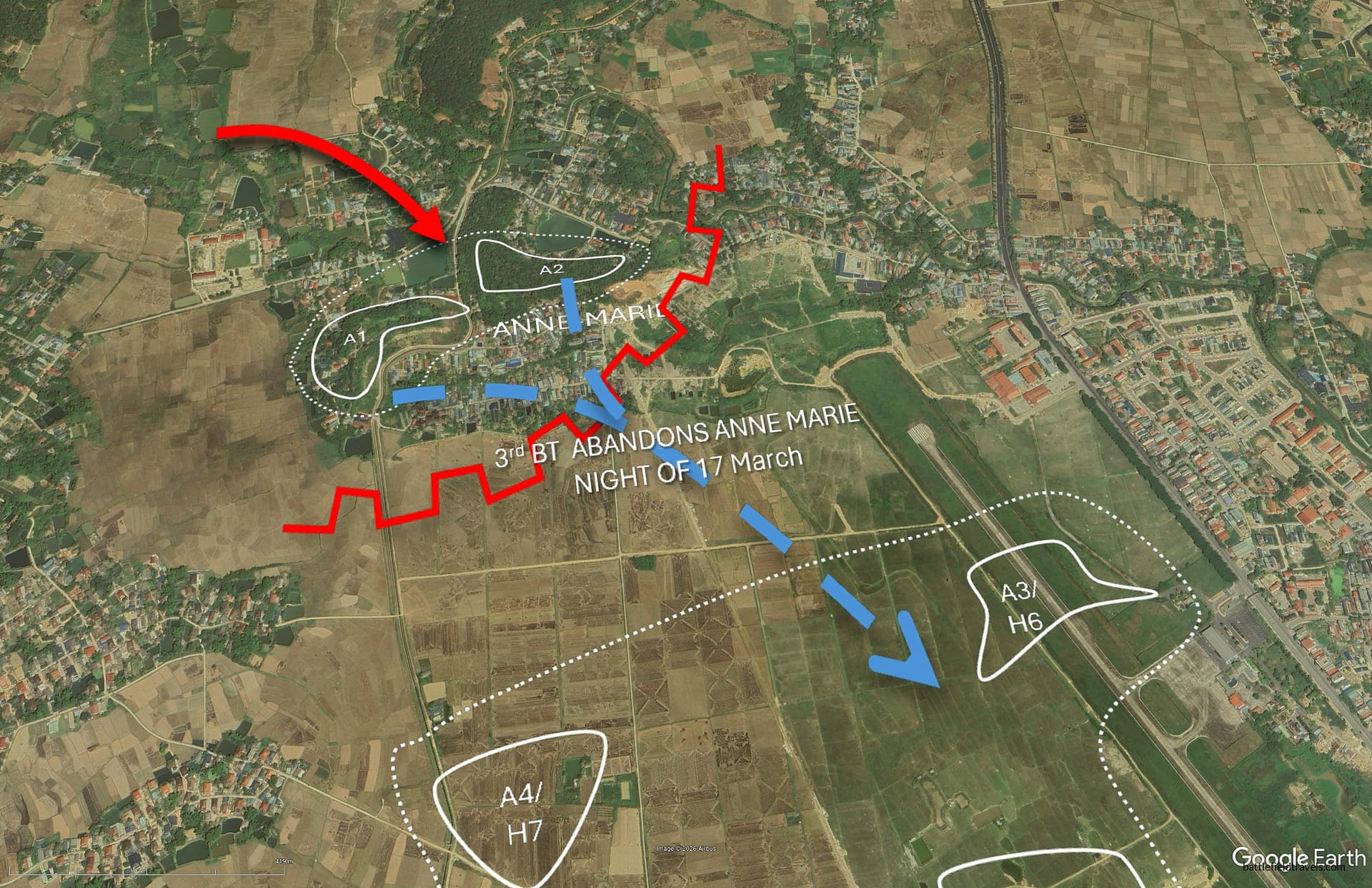
On 17 March, most of the T’ai militia on strongpoint Anne Marie, to the northwest of Dien Bien Phu, deserted the position, and the remaining garrison was forced to withdraw. With the loss of strongpoints Beatrice, Gabrielle and Anne-Marie in the first three days of the battle, the main position was exposed and the airfield severely compromised.
28 March: Bigeard’s attack in the west
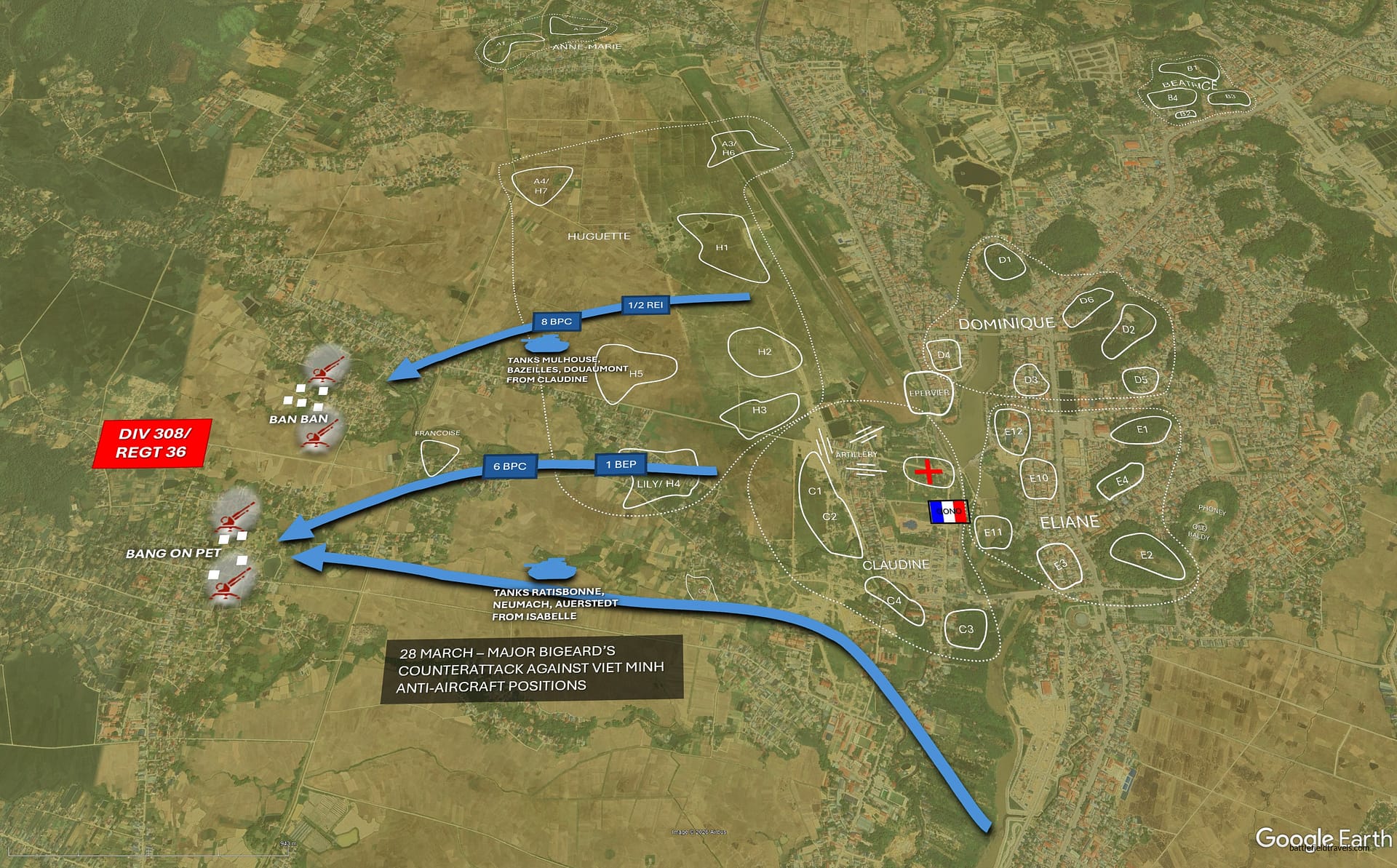
As the Viet Minh established anti-aircraft batteries around the valley, it became increasingly difficult to generate the resupply and close air support sorties that the garrison needed. Something needed to be done. Lieutenant Colonel Langlais ordered Major Marcel Bigeard to coordinate a multi-battalion attack to clear the anti-aircraft batteries from Ban On Pet and Ban Ban villages, about 1.5km west of the French positions. Using all the available air and artillery support, Bigeard led this attack on 28 March 1954. With five battalions under his control, it was effectively a brigade-sized attack being led by a Major.
The attack was highly successful and resulted in the destruction of at least two anti-aircraft batteries and about 1,000 Viet Minh soldiers.
30 March – 10 April: Battle for the five hills
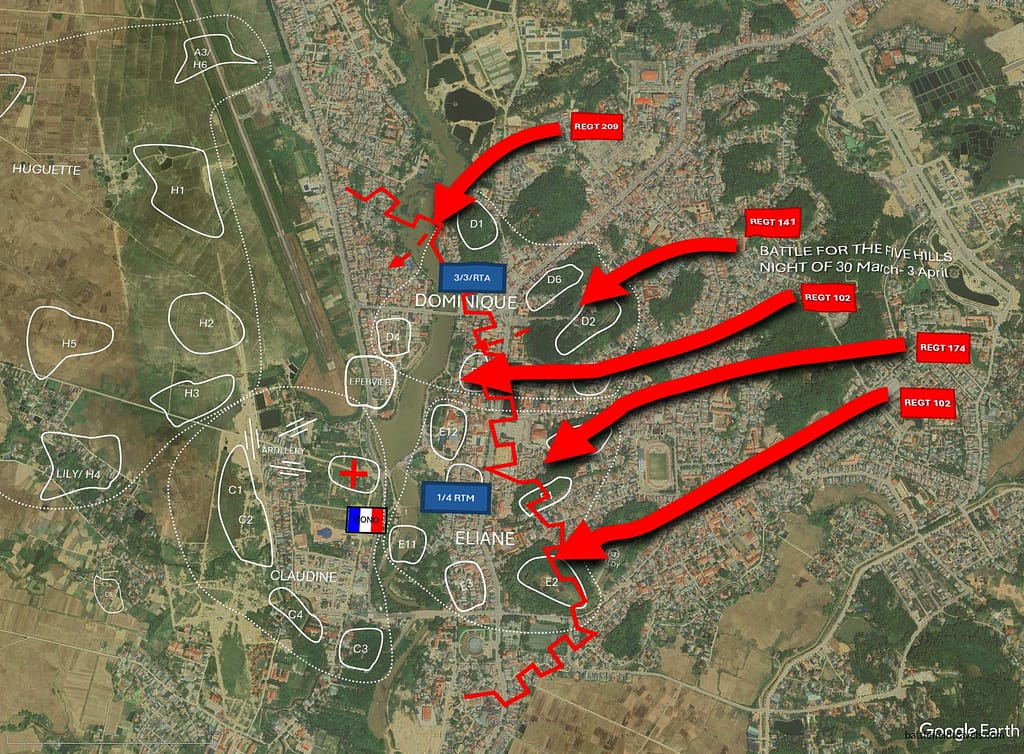
There was a lull in fighting from about 17-30 March as the Viet Minh dug approach trenches and moved their artillery forward. The next major attack was against strongpoints Dominique and Eliane on the eastern side of the Nam Yum River. Fierce fighting ensued as positions were lost and retaken in counterattacks. The Viet Minh attack was finally halted by French artillery firing over open sights from around Dominique 3.
The French immediately launched a counterattack to recover the massive Dominique 2 feature, and Eliane 1 and 2. They had some success, but ultimately lacked the troop strength to hold the hard-won gains. The French withdrew from Dominique 2 and Eliane 1.
With the enemy holding Eliane 1, the French positions on Eliane 4 and the low Dominiques were untenable. On 10 April, Marcel Bigeard coordinated another multi-battalion attack that secured Eliane 1.
11 – 23 April: Strangulation
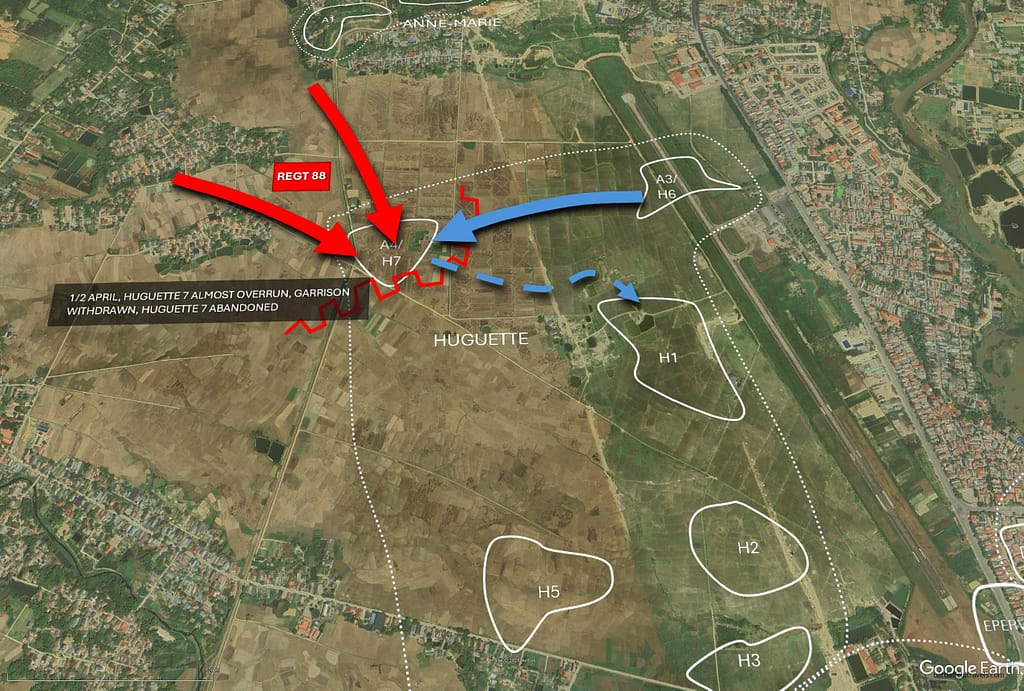
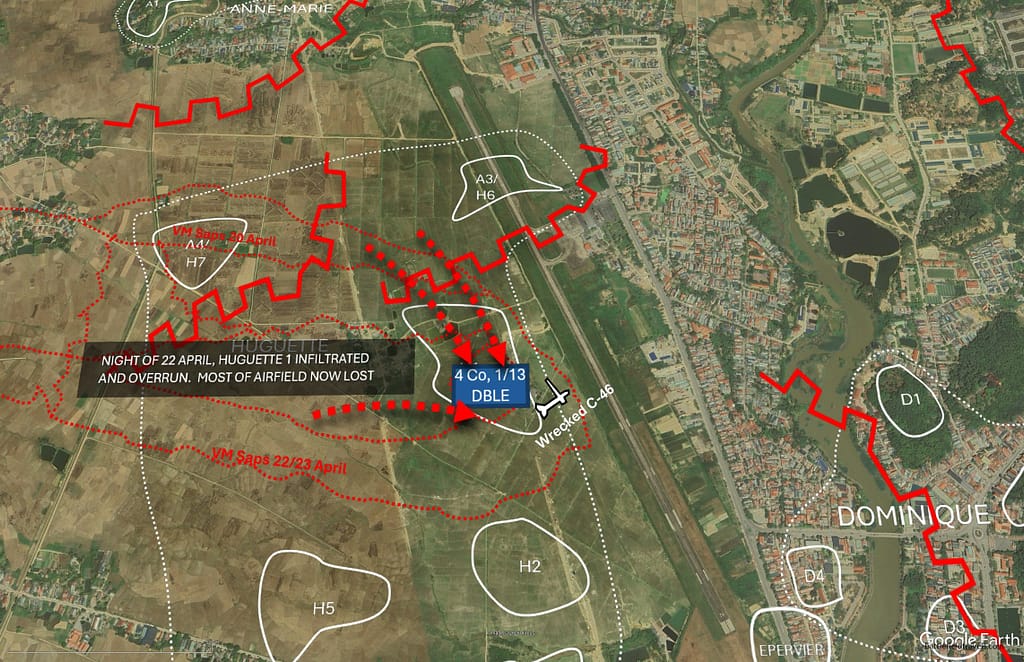
The next phase of the battle, from about 11-23 April, was around the Huguette positions that protected the airfield. This area is very flat and lacks cover, making resupply of the outlying French positions hazardous. The Viet Minh, having suffered enormous casualties in the battle for the five hills, adopted a more deliberate approach by digging sap and trenches across the open ground to get close enough for an assault. Fighting was particularly fierce for the outlying Huguette-6 position. By 23 April, most of the Huguette positions had fallen.
2-8 May: Fall of Dien Bien Phu
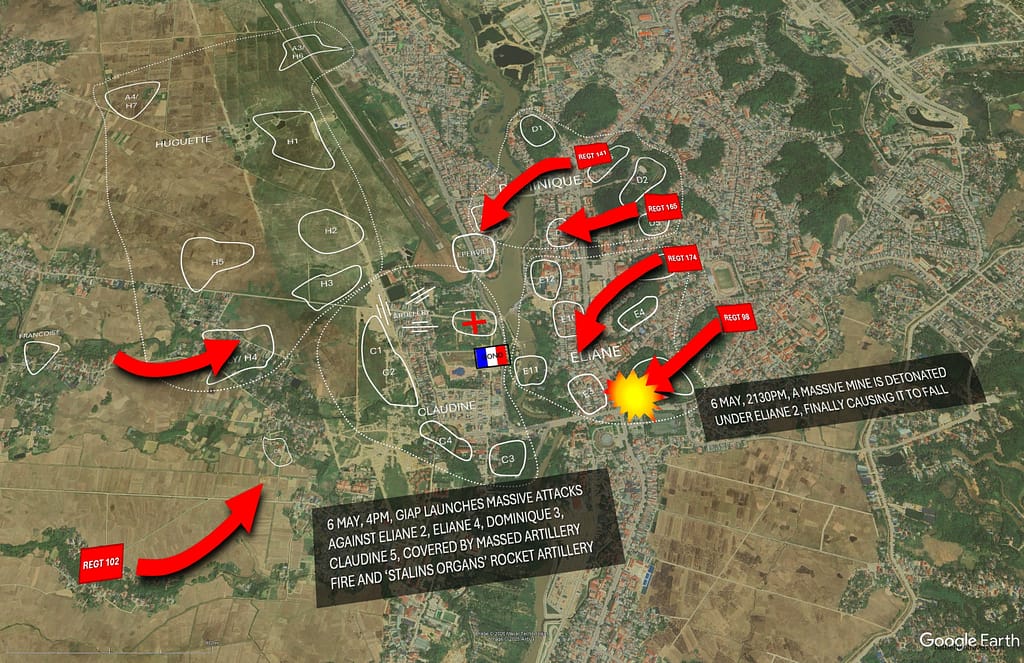
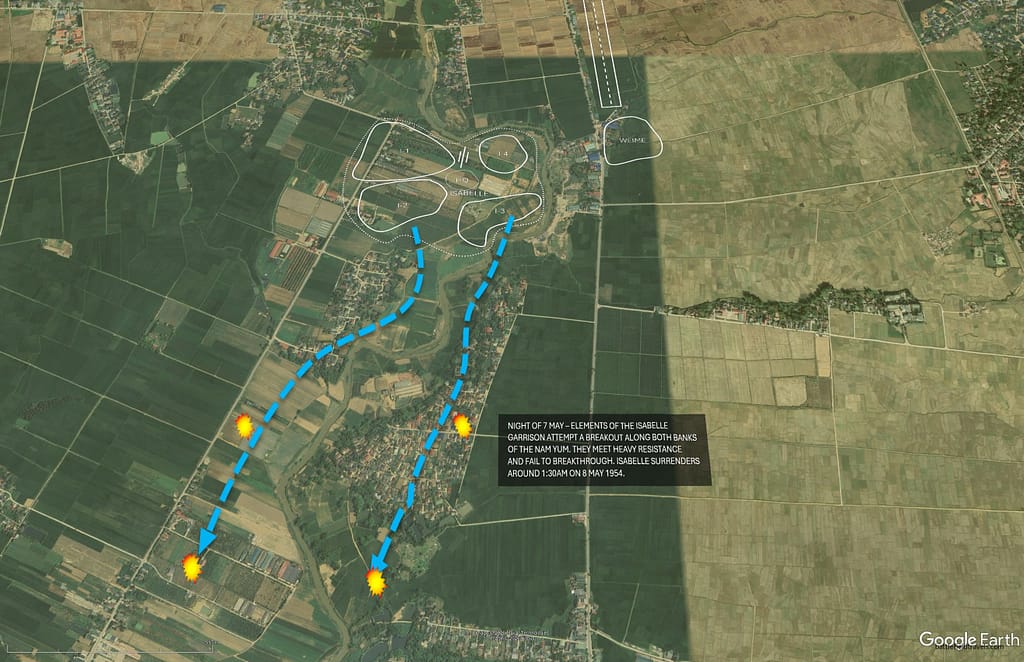
On 1 May, the Viet Minh launched their final massive assault against the remaining French positions on Dominique and Eliane, and the headquarters and artillery positions around Strongpoint Claudine. On 6 May, at about 19:30 hours, the Viet Minh fired, for the first time in the war, Chinese-made Type-506 102mm six barreled rocket launchers, similar to the Soviet ‘Katyusha’. At about 21:00 hours that night, the Viet Minh detonated a massive underground mine under Eliane-2. The much-reduced French positions were finally overrun on 7 May. The garrison of Isabelle attempted a breakout but only about 70 made it safely to French lines.
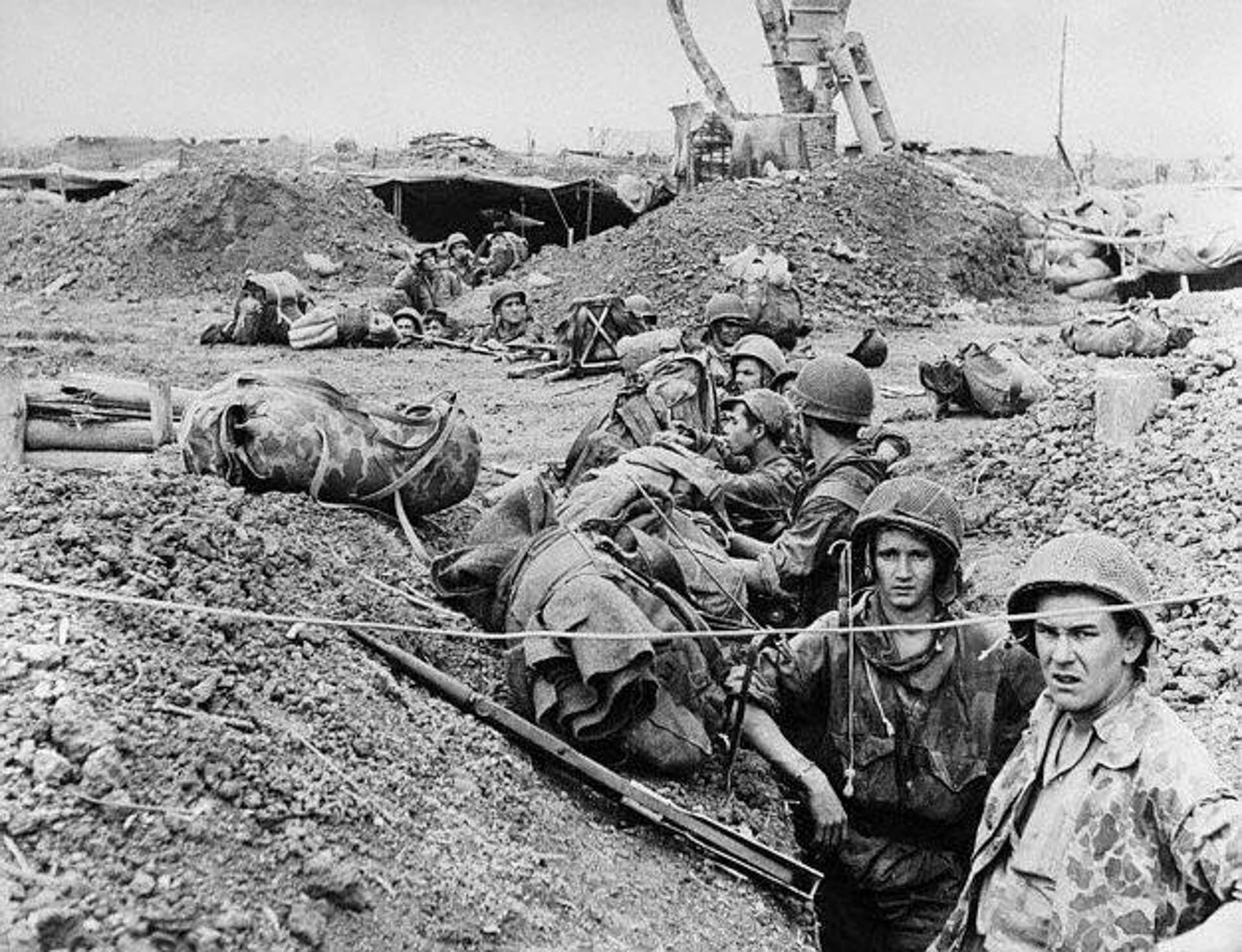
Even prior to the commencement of the siege, the French design for battle had failed. Patrols were unable to move ‘outside the wire’ and the garrison of 15,000+ of France’s best troops were effectively trapped in an ever-shrinking perimeter. Over the 56 days of the battle, approximately 2,200 French soldiers were killed and 11,621 were captured, of whom many were wounded. Viet Minh casualties were estimated at around 23,000.
The fall of Dien Bien Phu had profound implications for both the French and the broader geopolitical landscape. It marked the end of French colonial rule in Indochina and led to the Geneva Accords of 1954, which temporarily divided Vietnam at the 17th parallel, with the North controlled by the communist Viet Minh and the South by a pro-Western government. This division set the conditions for America’s involvement in Vietnam, as the United States sought to prevent the spread of communism in Southeast Asia.
Weapons tech: H6 – Chinese Type-506 102 mm Rocket Launcher
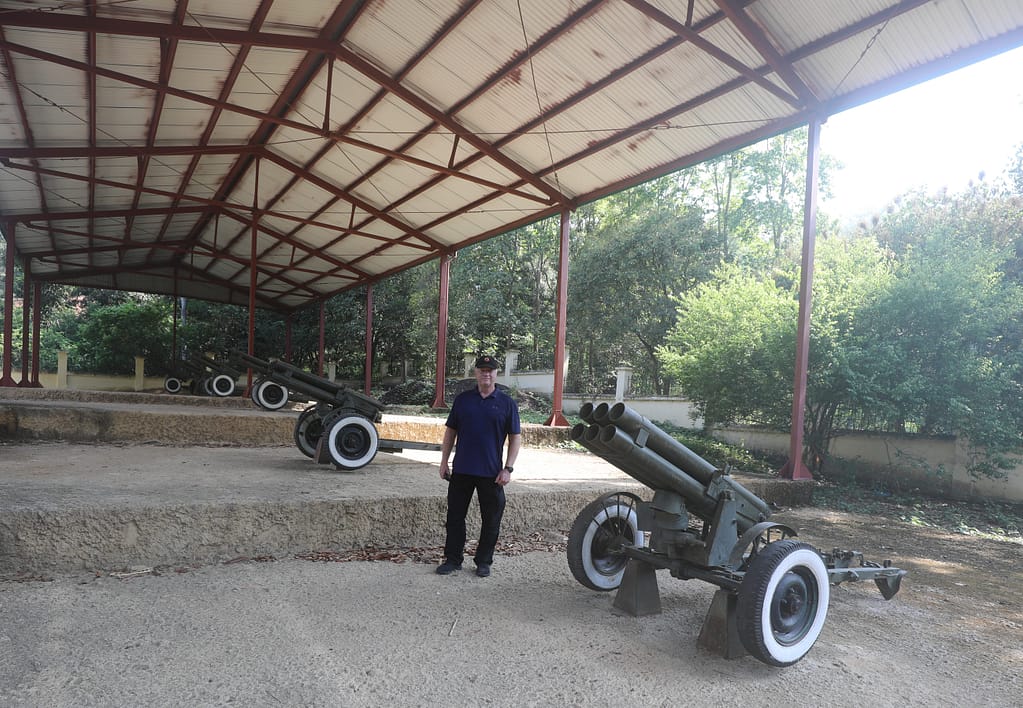
Often described in accounts of Điện Biên Phủ simply as a Katyusha, the Việt Minh H6 (Hỏa Tiễn 6 is the Vietnamese designation) was actually a Chinese-built six-tube 102 mm multiple rocket launcher, belonging to China’s early Type 505/506 family of indigenous rocket artillery. ‘Katyusha’ appears to have become a convenient generic description for the unfamiliar rocket artillery.
The launcher fired six 102 mm rockets from smooth tubular launchers mounted on a light two-wheeled carriage. Chinese sources identify the 505/506 as China’s first indigenous multiple rocket-launcher design, developed before the much better-known 107 mm Type 63. The system also saw service in Korea and Vietnam.
Twelve H6 launchers reached the Việt Minh during the final phase of the Điện Biên Phủ campaign. Vietnamese records state that the H6 battalion fired 836 rockets during the fighting. The Điện Biên Phủ Victory Museum describes the weapon as a six-tube 102 mm launcher and records its first major employment during the final attacks of 6–7 May 1954.
Calibre: 102 mm (nominal; 4-inch/101.6 mm)
Tubes: 6
Origin: China
Chinese family: Type 505/506
Vietnamese designation: H6
Rocket: Type 488 102 mm system
Maximum range: approximately 5 km
Điện Biên Phủ: 12 launchers; 836 rounds recorded as fired
Virtual tour of the Dien Bien Phu battlefield
⚔️ Go deeper — Members get exclusive access to the Deep Research Collection, Field Notes, and monthly Research Dispatches. Try membership free for 7 days, cancel anytime. From $9/month.
PART 2: EXPLORING THE DIEN BIEN PHU STRONGPOINTS
The battlefield today
Dien Bien Phu is a provincial centre about a one hour flight away from Hanoi. As you land at the airport (which is the same airstrip the French defenders used in 1954), you can see a destroyed M24 Chaffee tank ‘Mulhouse’ on the western side of the runway, basically in the same spot where it was damaged during the fight for Strongpoint Huguette. There is an excellent modern museum in the town, and all the strongpoints can be reached relatively easily. Few people speak English, so a guide is very useful, especially getting to more remote areas like Giap’s HQ, Strongpoint Anne-Marie, Strongpoint Isabelle and other key locations.
Link to the Vietnam Tourism Authority Dien Bien Phu Victory Museum website
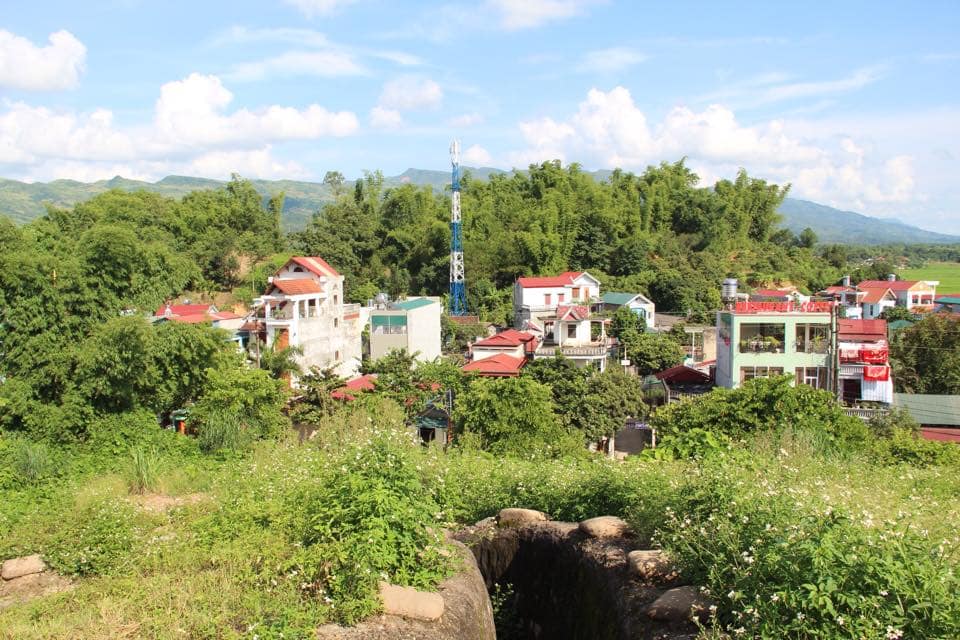
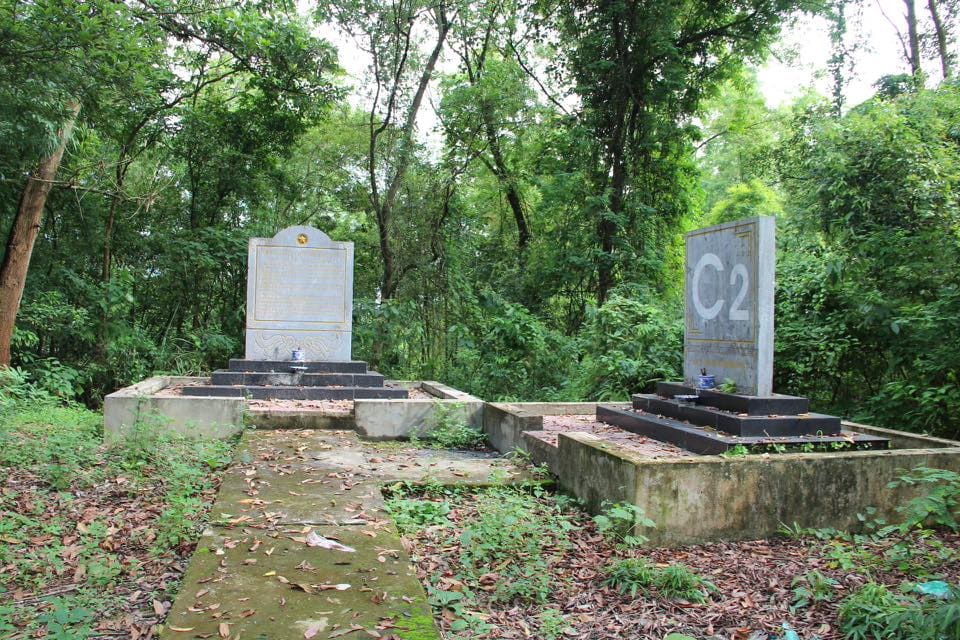
There is a huge Viet Minh victory monument on Dominique 2, and all the French strongpoints have at least a plaque describing what happened there. Strongpoint Beatrice was restored back in the 1990s, so the trenchlines etc are visible, as is one of the dug-in Viet Minh guns that fired directly into Beatrice. There is also some restoration around Eliane and Claudine, especially at Colonel de Castries’ command post. Other strongpoints like Gabrielle, Anne-Marie and Isabelle have entirely disappeared with only a plaque to mark them.
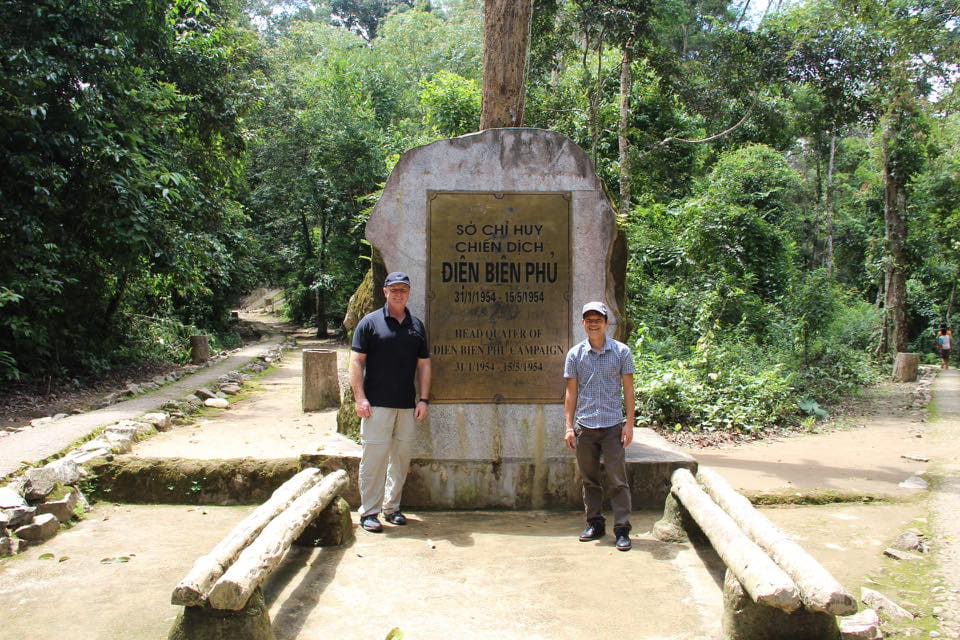
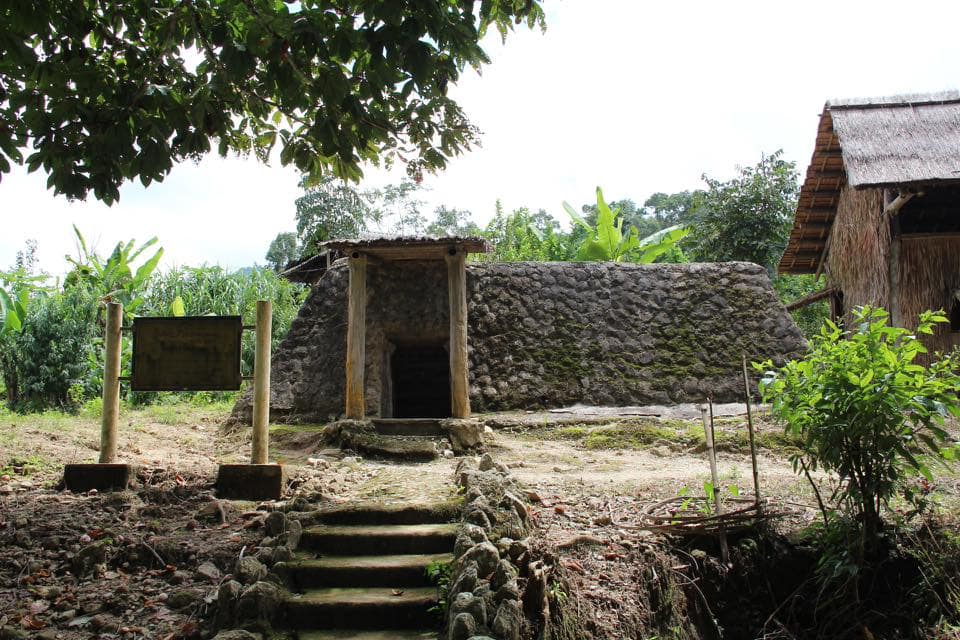
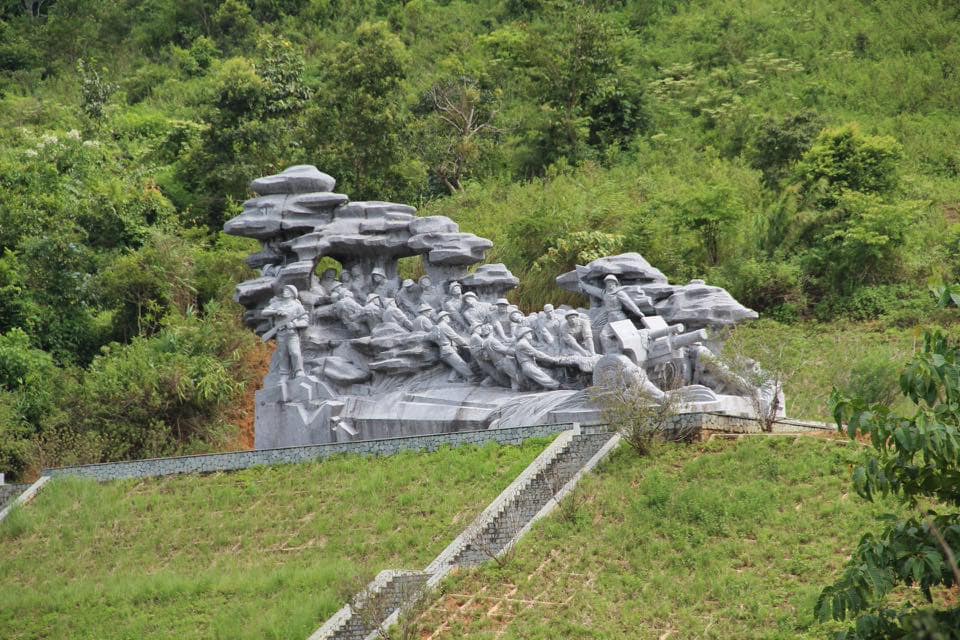
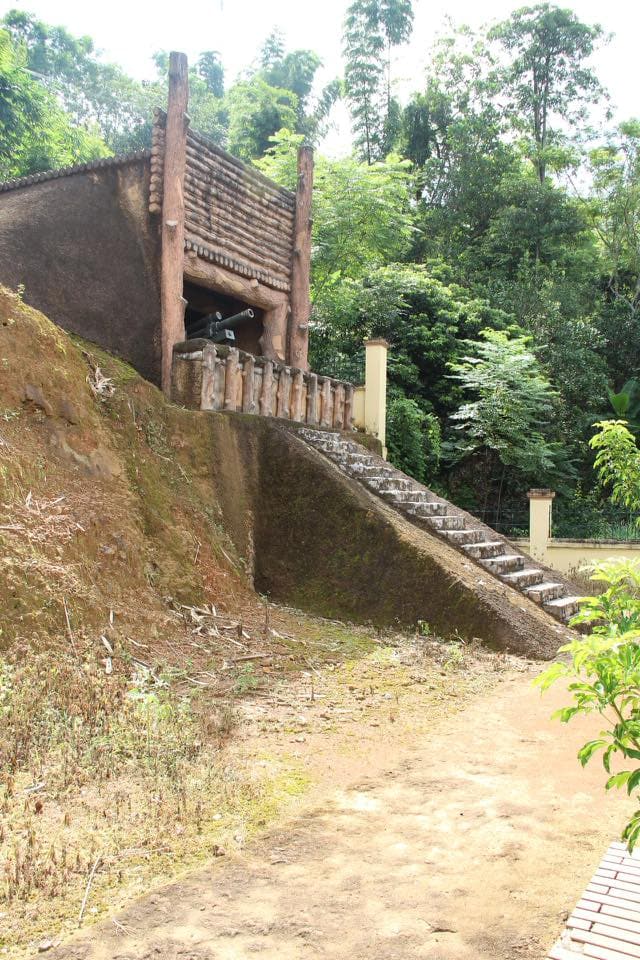
Definitely take a trip east into the mountains to visit Giap’s HQ complex, about 25km from Dien Bien Phu. On the way, you will see a massive monument to the soldiers and peasants who manhandled the artillery into the mountains around the valley that ultimately made victory possible for them.
As you explore Dien Bien Phu, you will clearly perceive the important role played micro-terrain (small scale terrain features that often do not appear on maps and can only be seen when you are standing on the ground). French positions were built on hills deliberately denuded of cover and concealment. In theory, this allowed them to observe and employ weapons at maximum range, while denying cover to the Viet Minh attackers. By contrast, the Viet Minh made use of, reverse slopes, folds in the ground, creeklines, and the cover provided by forest canopy to hide and shield their activities. The concept of exploiting small scale terrain features in battle is examined further in the Micro-Terrain and Battlefield Decision-Making research hub.
Strongpoint Beatrice
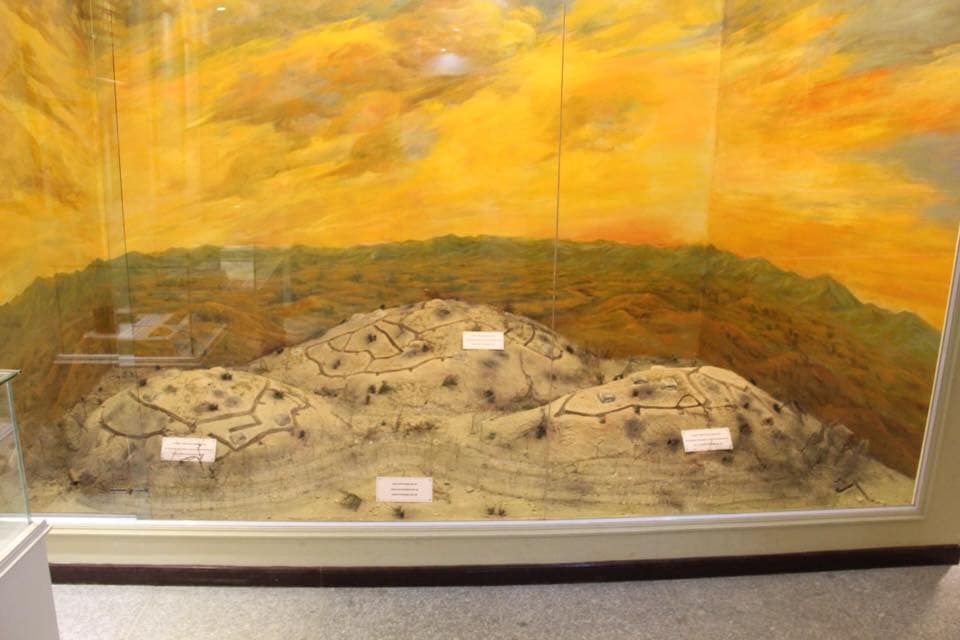
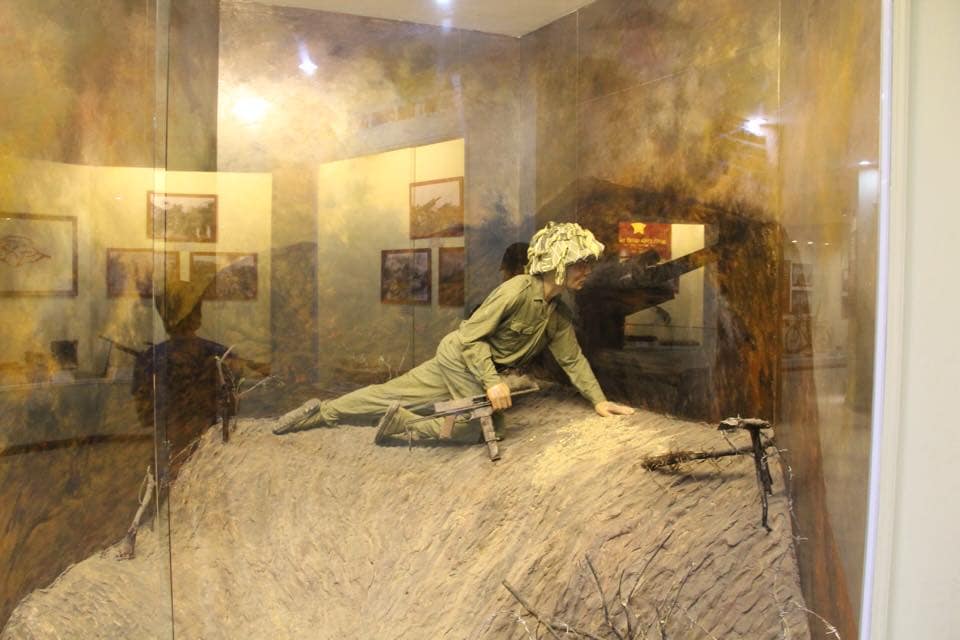
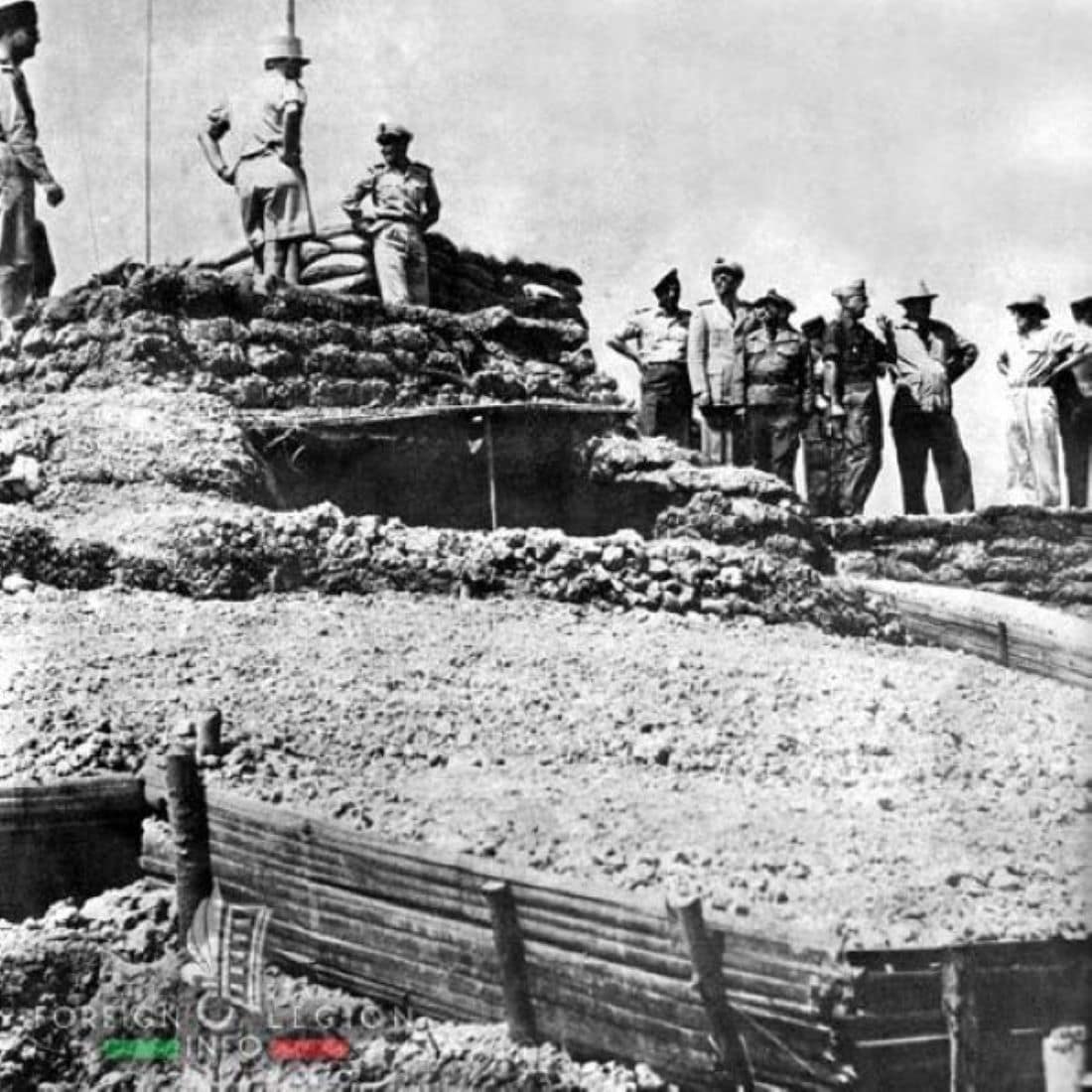
Strongpoint Beatrice lies about 2km northeast of the main position. It was held by 3rd Battalion, 13th Demi-Brigade of the French Foreign Legion with about 800 Legionnaires in four company strongpoints. At 1700hrs on 13 March 1954, the Viet Minh opened their attack on Dien Bien Phu here at Beatrice. They overran Beatrice in about five hours. Only about 150 Legionnaires survived and made their way back to the main position. This was the first strongpoint to fall.
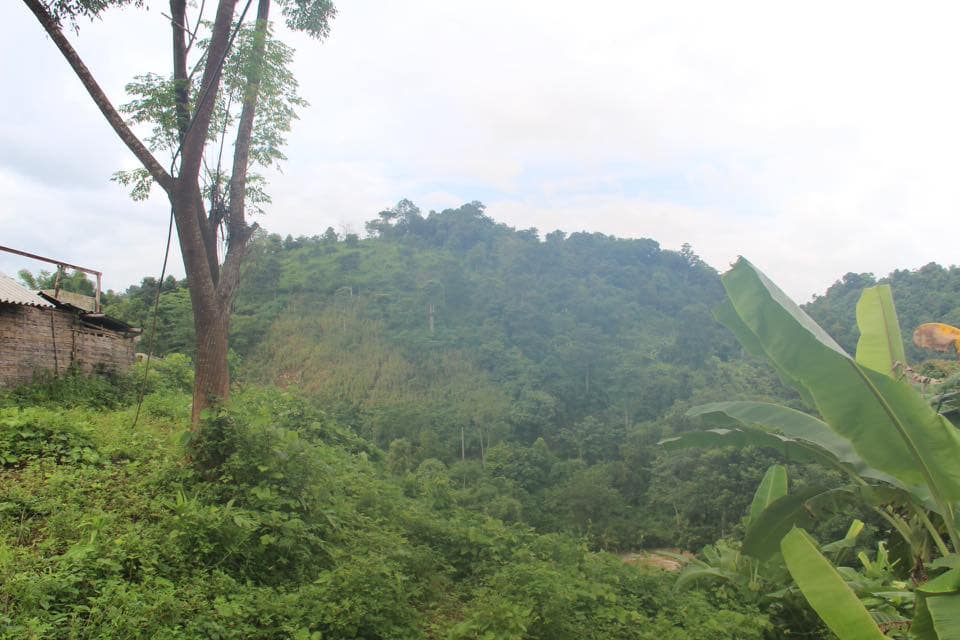
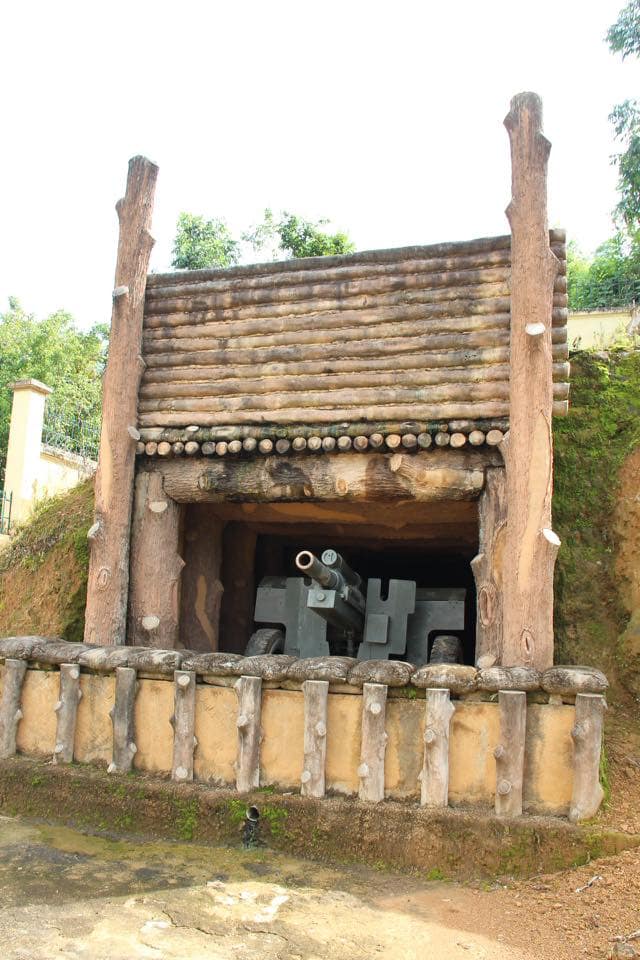
The Viet Minh did not have the sophisticated training or doctrine of the French artillerymen, so they just dug in the guns and fired them over open sights into the French bunkers that were in plain view. When French aircraft tried to attack them with airpower or artillery, the Viet Minh hauled them back inside the tunnels. These are American M2A1 howitzers, probably captured in Korea by the Chinese.
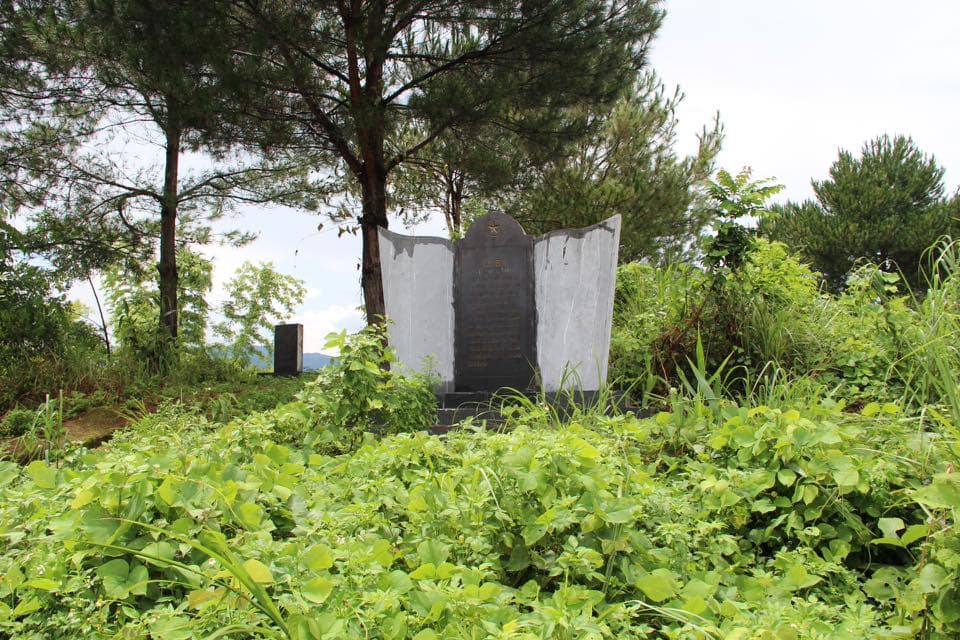
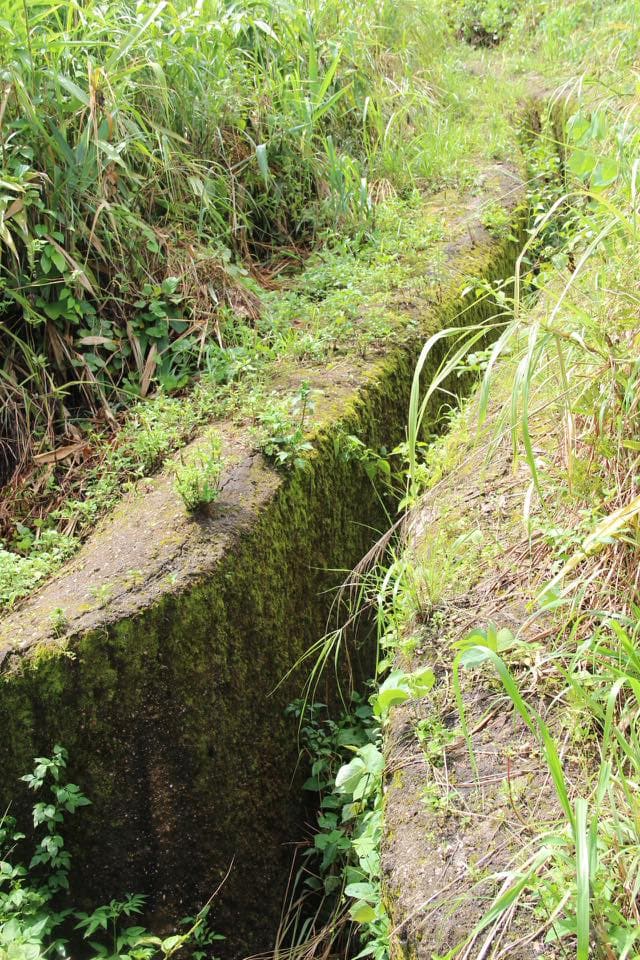
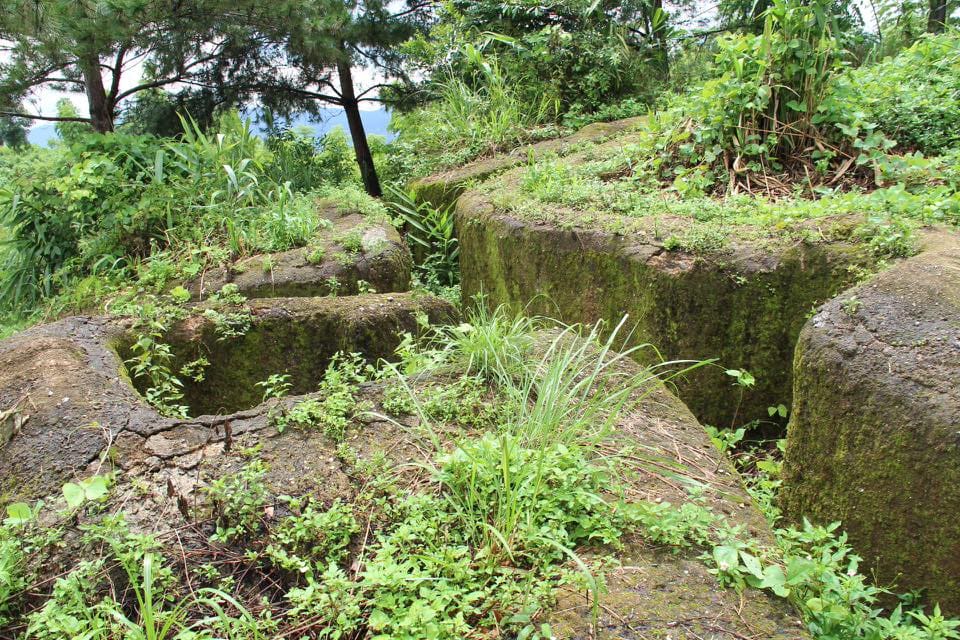
Beatrice is definitely the best preserved of the DBP strongpoints. At some time in the 1990s (I believe it was for the 40th anniversary in 1994), the Vietnamese excavated and concreted the trench lines and replaced the sandbags with concrete replicas, so it looks pretty much how it did for the battle, except the hill was completely denuded of vegetation in 1954.
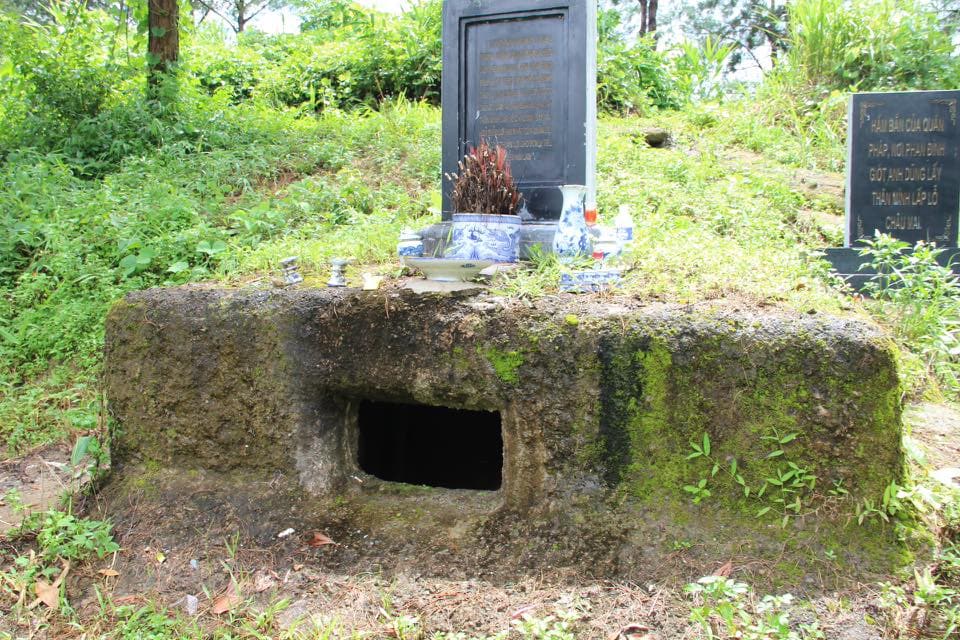
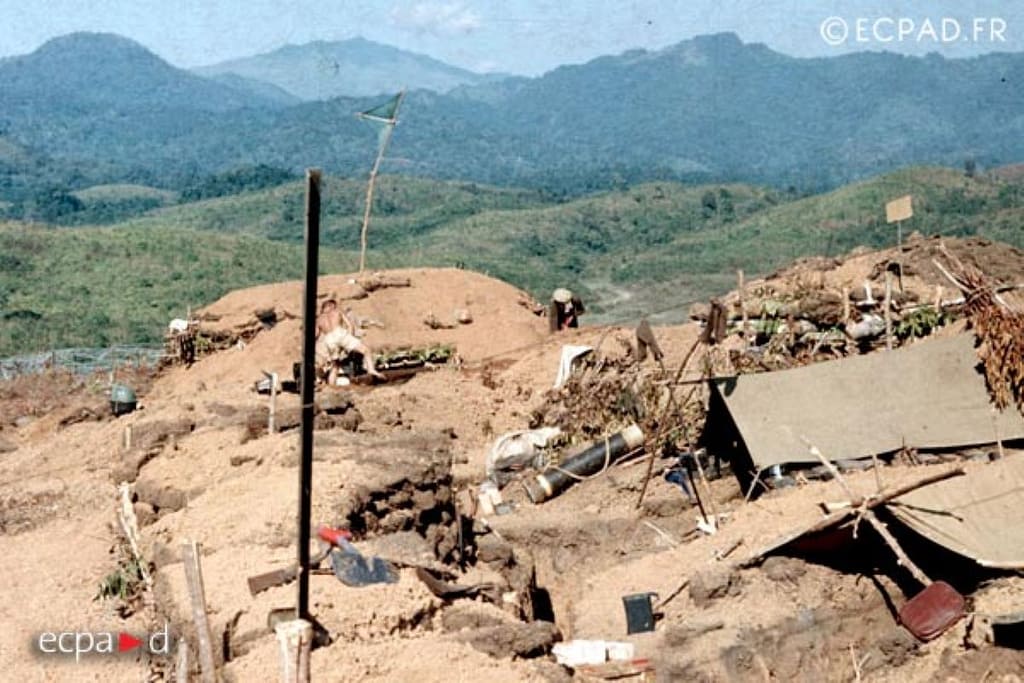
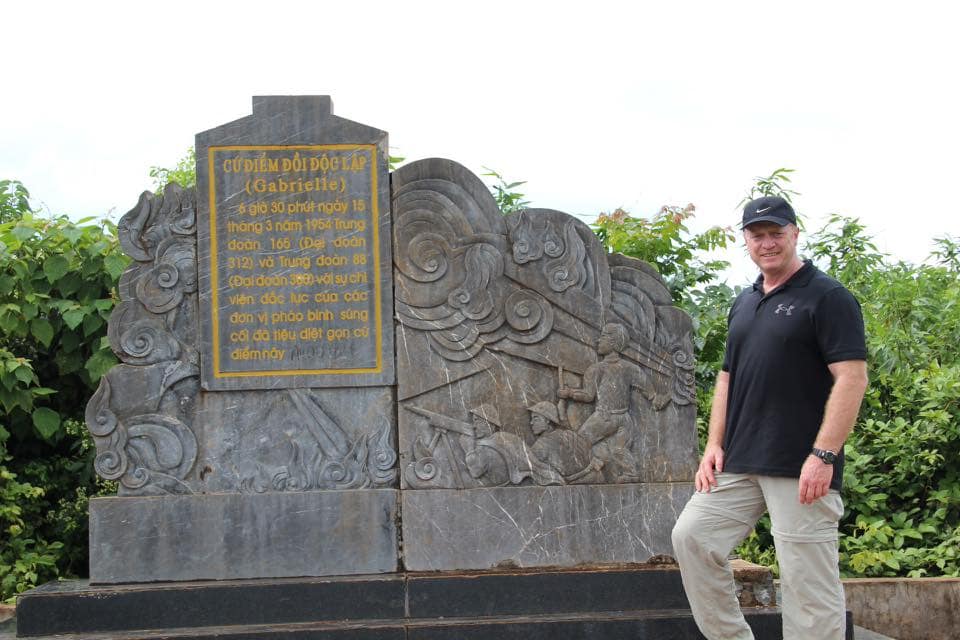
Strongpoint Gabrielle
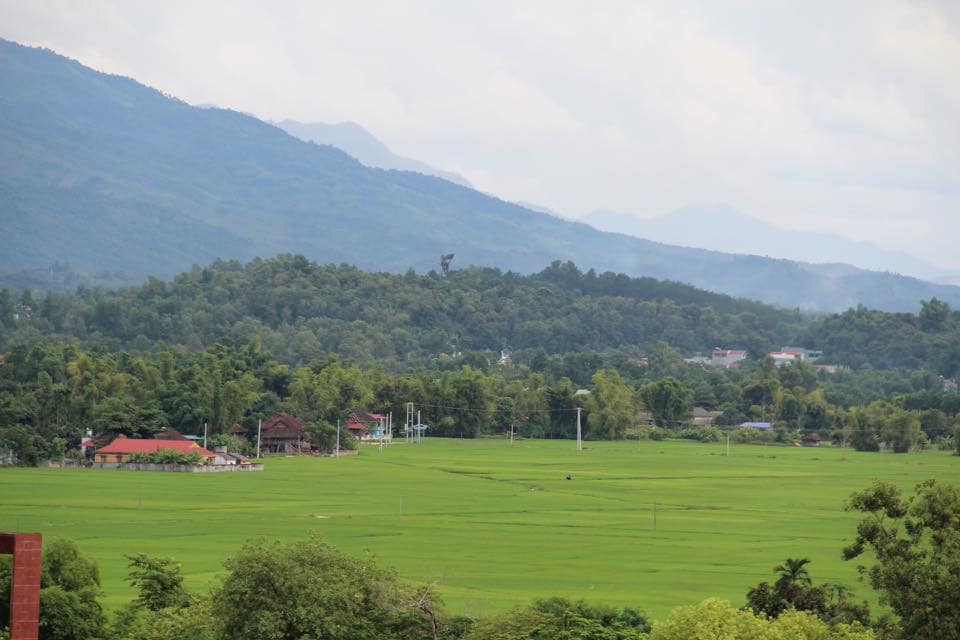
Strongpoint Gabrielle is about 3km north of the main position and was held by 5th Battalion, 7th Algerien Tirailleurs – about 500 Algerian soldiers led by both French and Algerian officers and NCOs. Gabrielle dominated the flight path into Dien Bien Phu airfield, so when it fell to the Viet Minh on March 15, 1954, (two days after the fall of Beatrice) it was disastrous for the DBP defence. Gabrielle was the second strongpoint to fall.
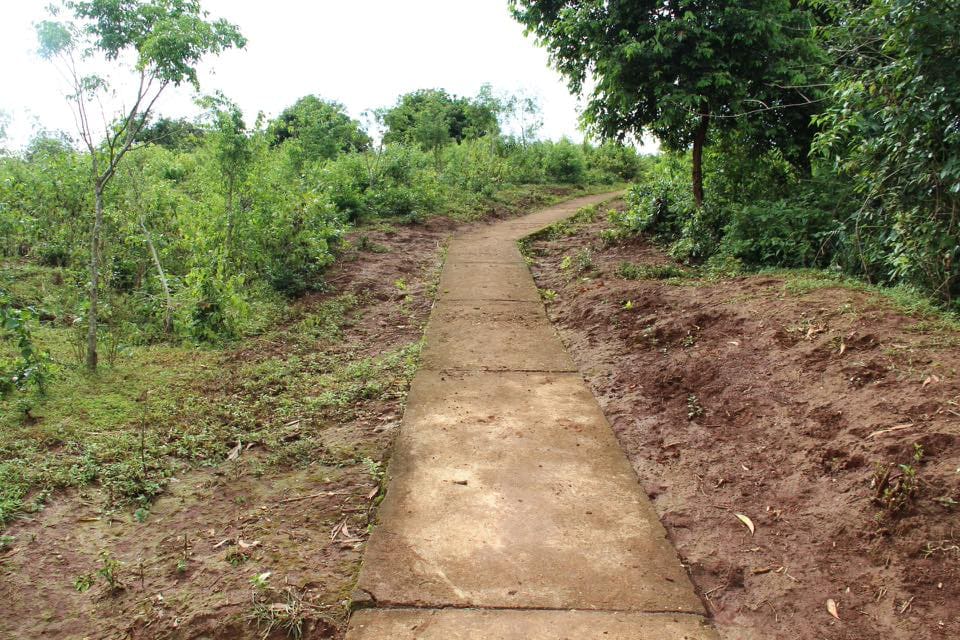
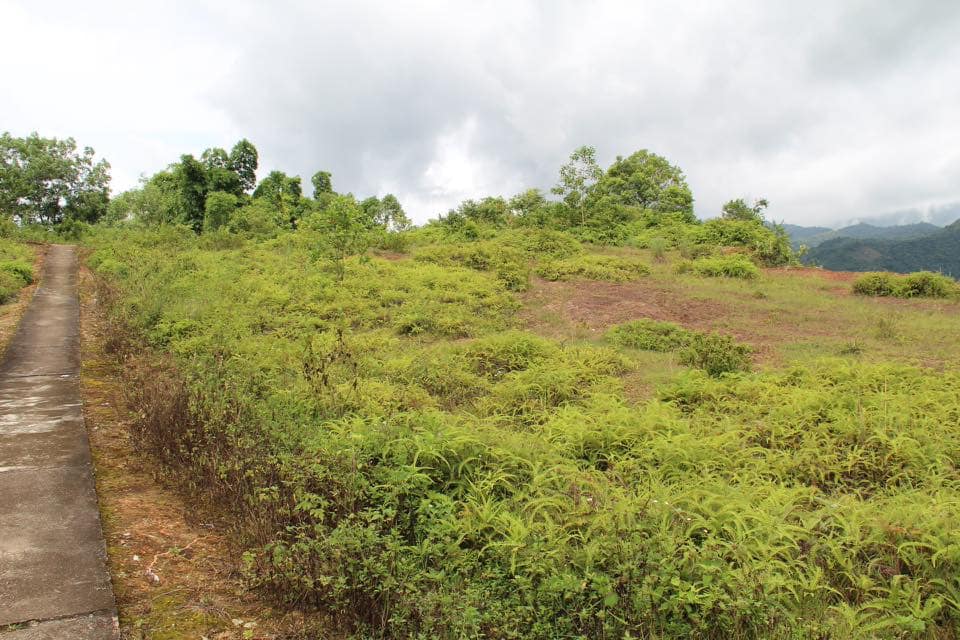
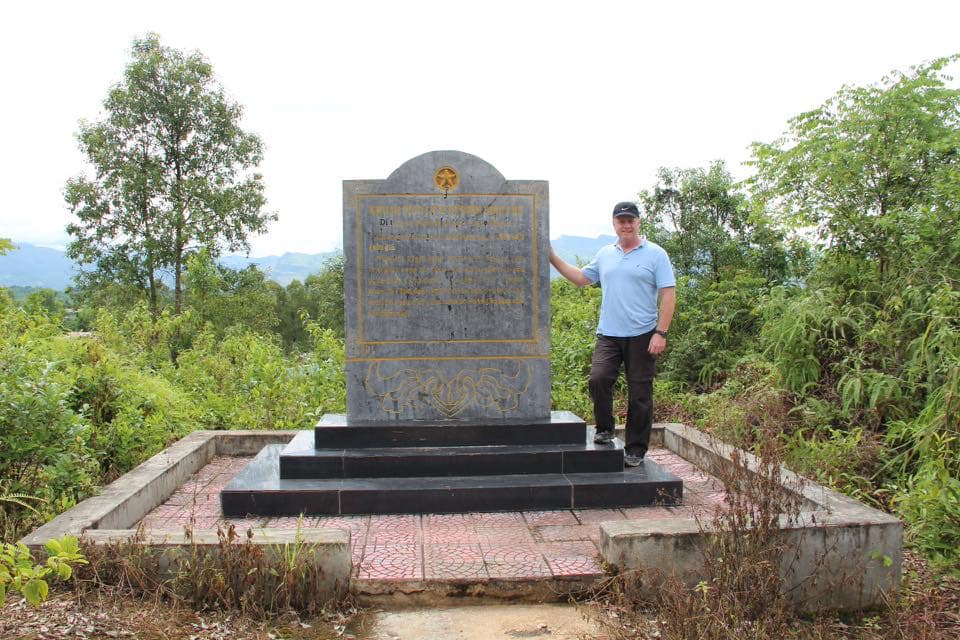
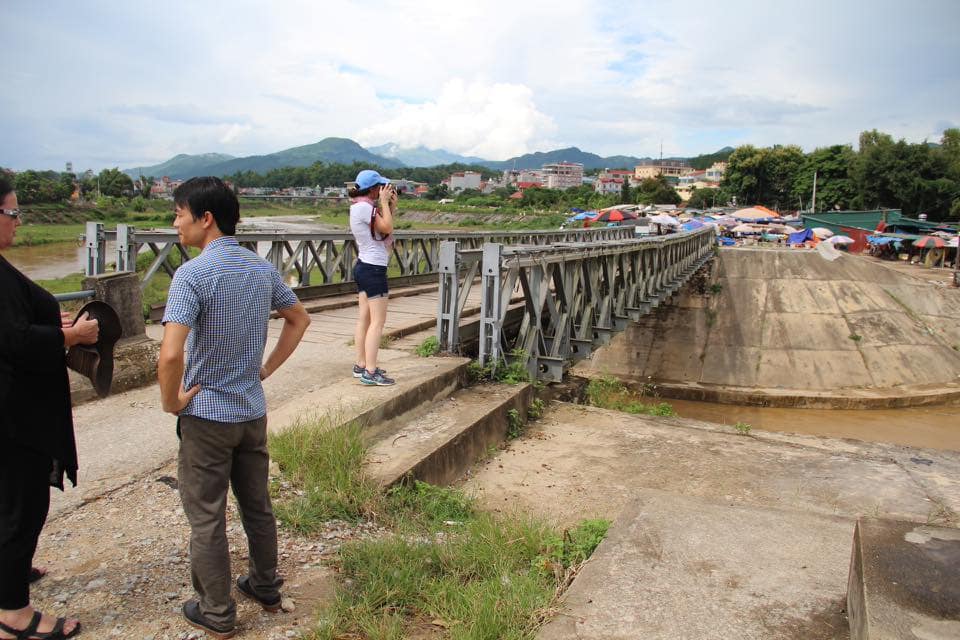
Today, Gabrielle is overgrown with scrub, and much of the western side of the strongpoint has been cut away to make room for a road and a small commercial area. There is a path to the monument on the top.
Strongpoint Anne-Marie
Strongpoint Anne-Marie is northwest of the airfield beyond the Huguettes. The area around it is all flat rice paddies and swamp, and you can see Anne-Marie as a couple of low mounds. Anne-Marie was held by 3rd T’ai Battalion, a unit recruited from local mountain tribes, under command of Major Léopold Thimonnier. The T’ai tribesmen were subjected to Viet Minh propaganda, and many fled the strongpoint. Anne-Marie was abandoned on 17 March 1954 and was the third strongpoint to fall. For the T’ais, it was not their war, and their homelands had already been overrun by the Viet Minh.
The strongpoint is quite remote from the main position, and has a few houses built on it. There is a small monument in one of the laneways between the houses.
Strongpoint Dominique
After the fall of the outlying strongpoints (Beatrice, Gabrielle, Anne-Marie), the Dien Bien Phu defensive layout was severely compromised and the runway was under constant threat. There was a lull in fighting from 17-30 March as the Viet Minh moved their artillery forward and dug assault trenches to get closer to the main position.
Strongpoint Dominique is by far the most dominant feature in the valley and was a key part of the French defensive position. It was held by the 3rd Battalion, 3rd Algerian Rifles and Dominique 1 and 2 fell to a massive Viet Minh assault on the night of 30 March 1954 during the battle for the five hills. French artillery around Dominique 3, close to the Nam Yum River engaged over open sights and finally halted the Viet Minh attack. Dominique 1 and 2 was the fourth major loss to the French.
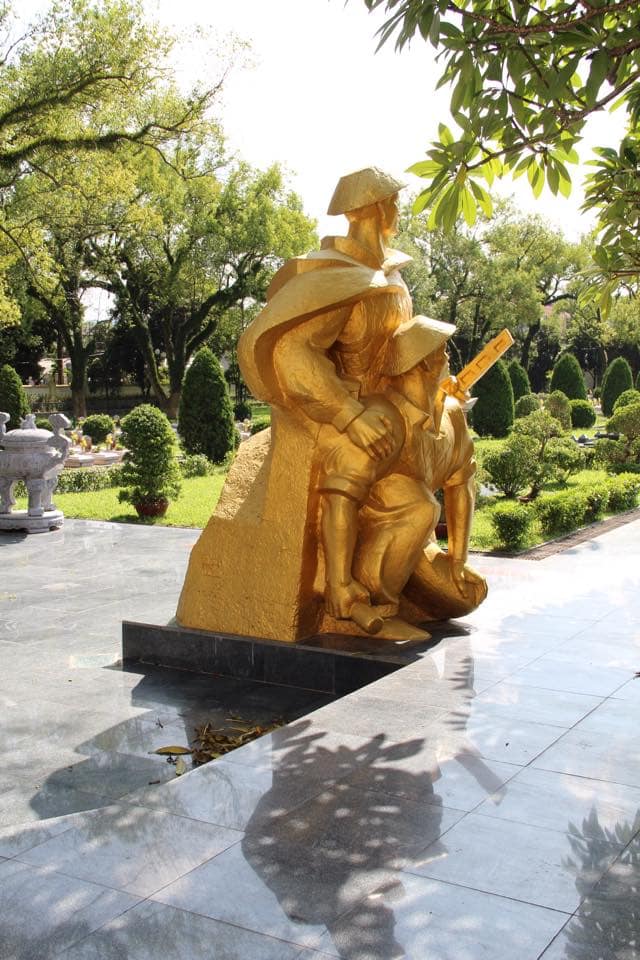
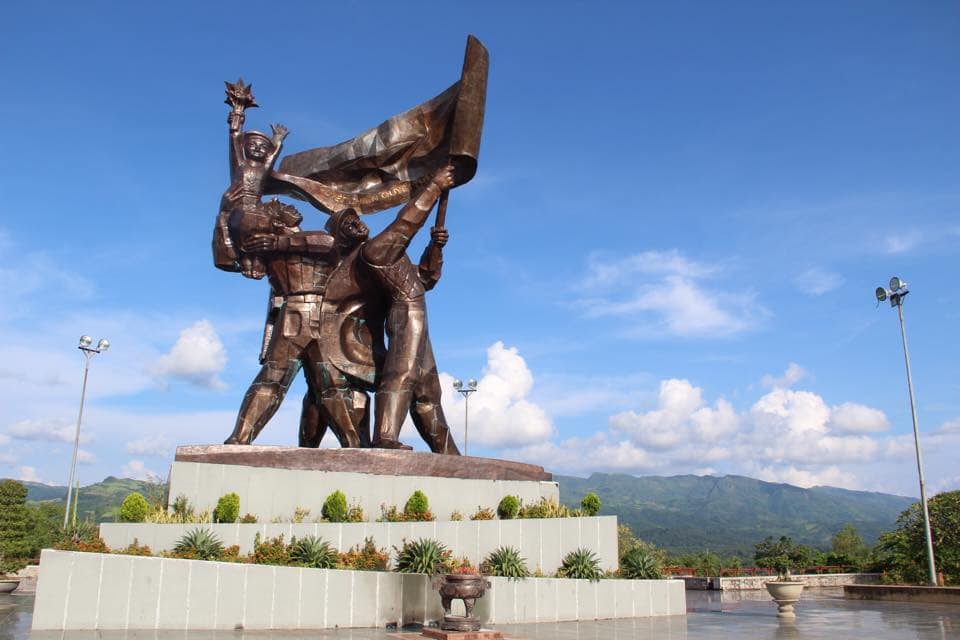
Today, Dominique 2 is the site of the monument to the Viet Minh victory at Dien Bien Phu.
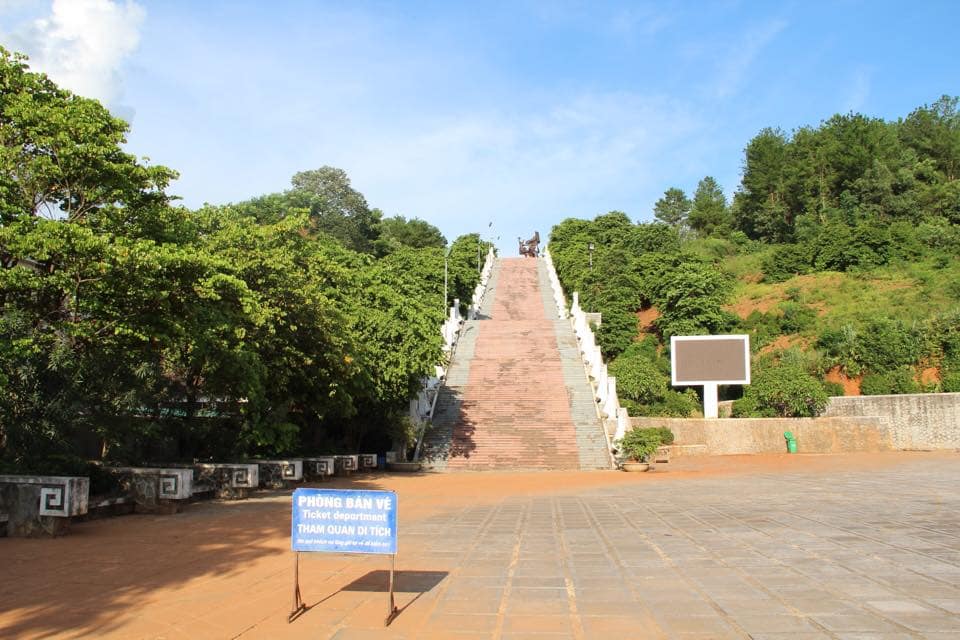
Strongpoint Eliane
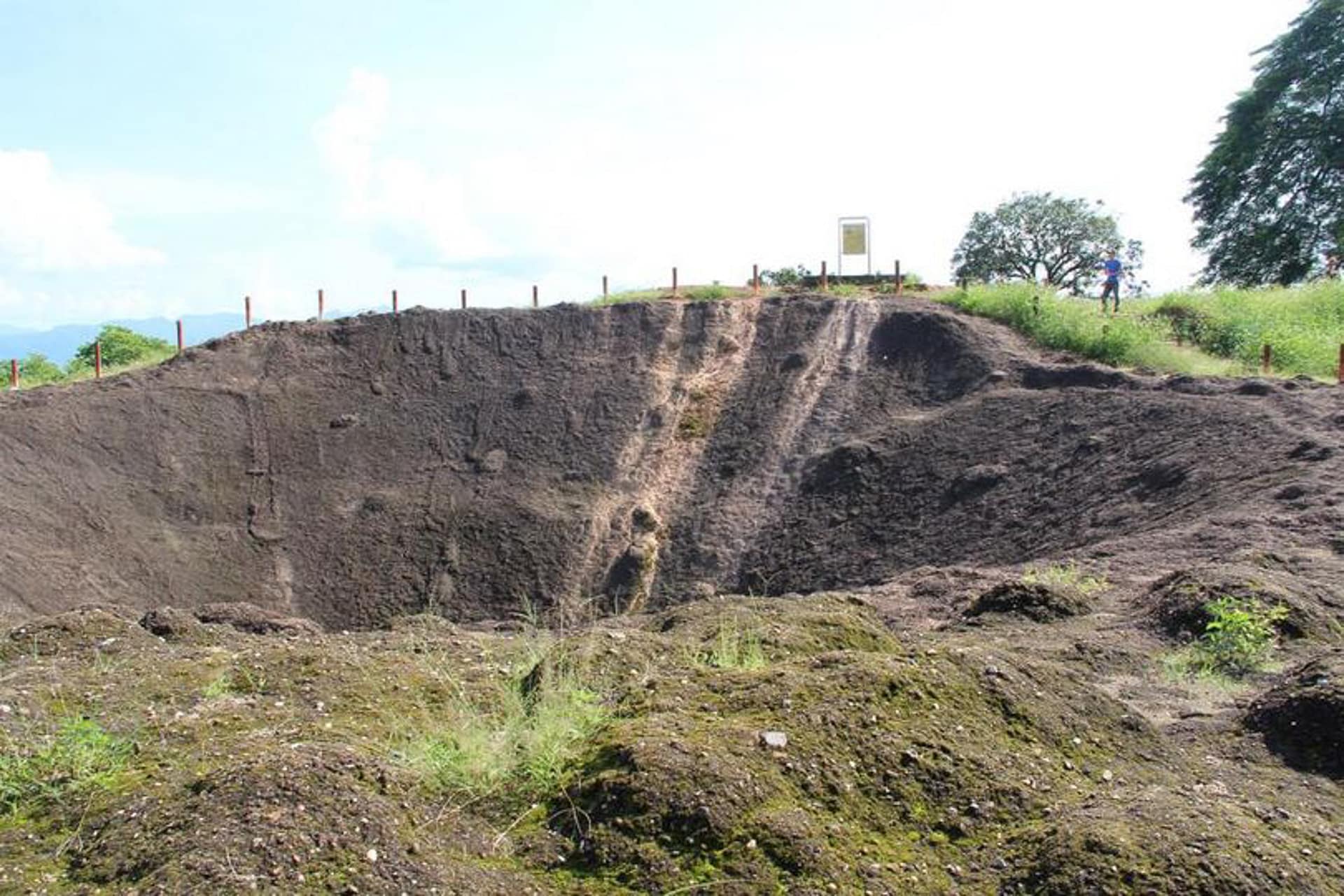
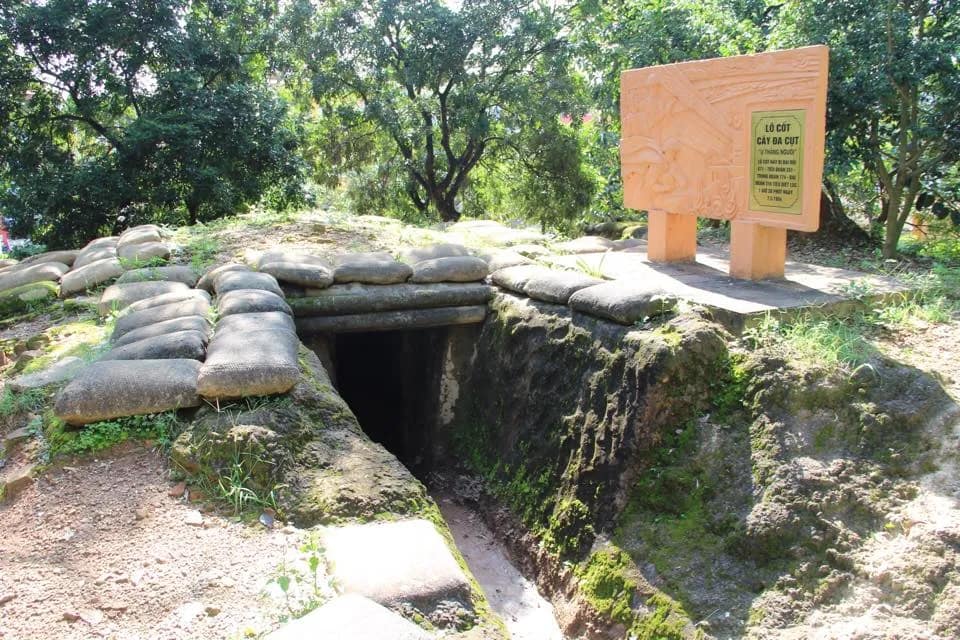
On 30 March 1954 at the same time as the assault on Dominique, the Viet Minh also attacked strongpoint Eliane, eventually capturing Eliane 1 and half of Eliane 2. Eliane was held by 1st Battalion, 4th Moroccan Rifles. Eliane was the site of some of the fiercest fighting in the battle as each side counter-attacked to regain critical ground. For their final attack on 6 May 1954, the Viet Minh dug a mine under Eliane 2 and detonated a massive quantity of explosives underneath it – the crater is still there today.
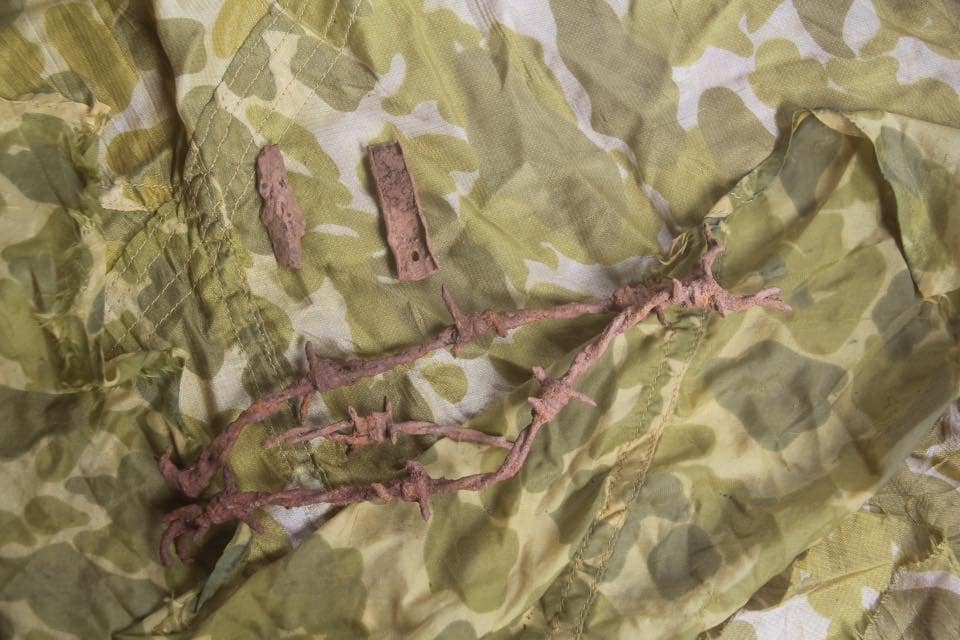
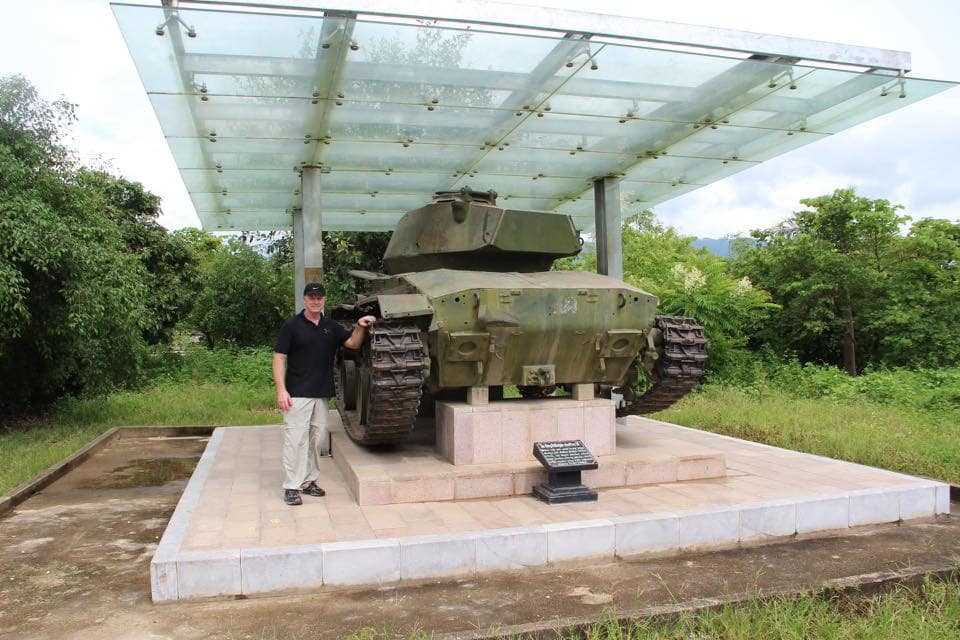
Today, Eliane is very well preserved, with several monuments, restored trenches and barbed wire, the crater, and the tank ‘Bazeilles’ which stands about where it was when it was destroyed by a bazooka round.
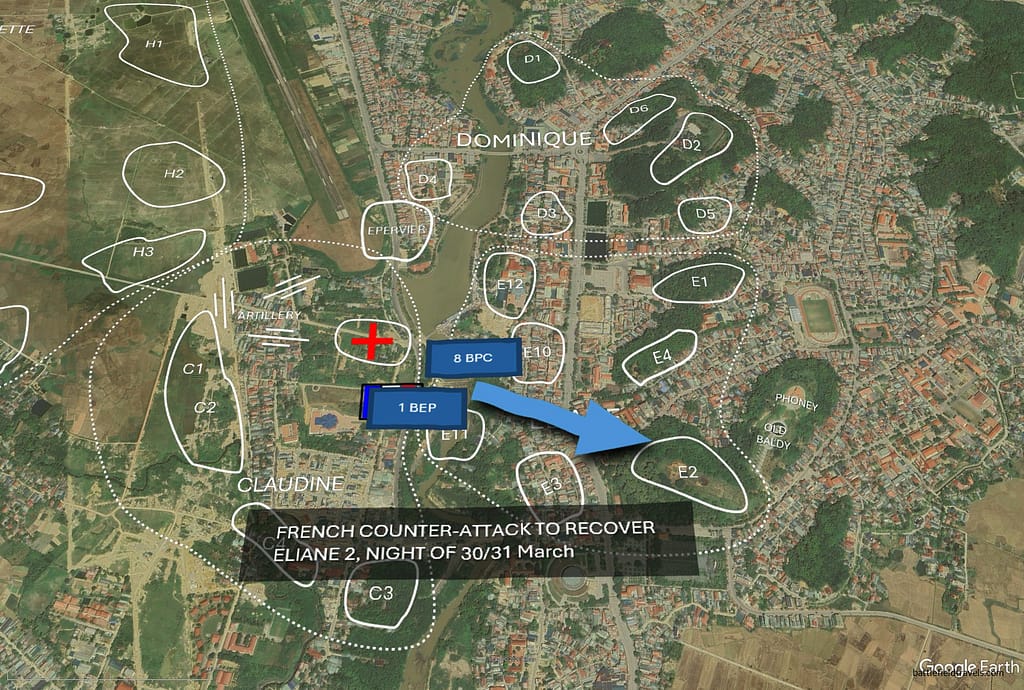
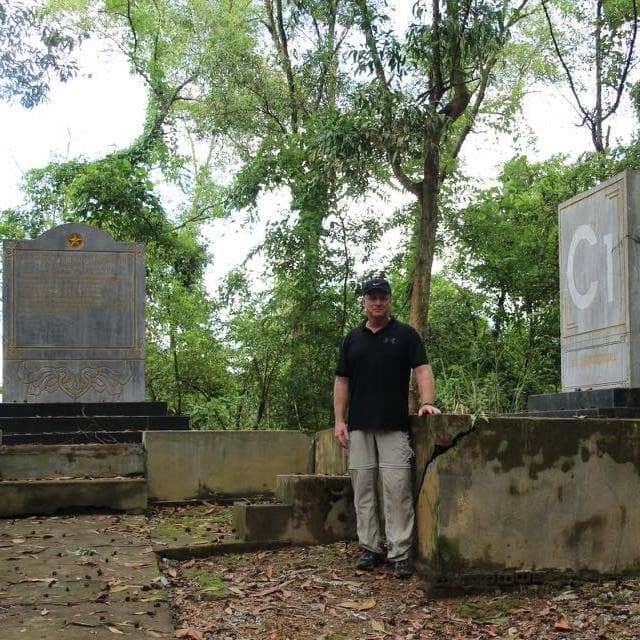
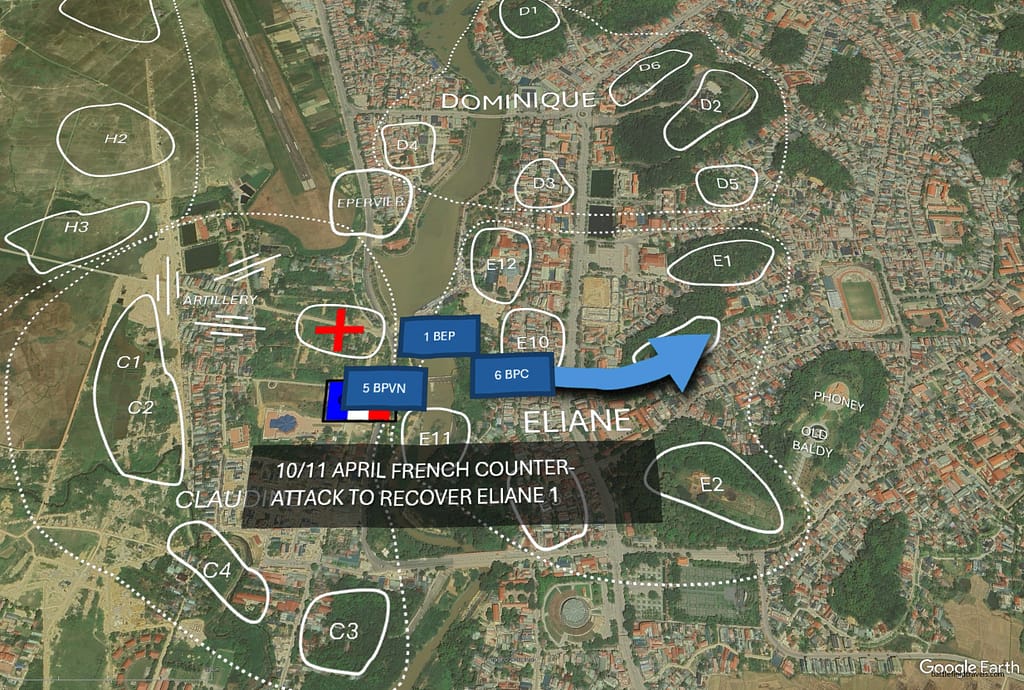
The Viet Minh captured Eliane 1 on the night of 30 March 1954. The strongpoint overlooks Eliane 4 and makes the French position untenable. A French counterattack on 10/11 April retook Eliane 4. Bernard Fall writes that as the French launched their night assault from Eliane 4 to recapture Eliane 1, the attack was conducted by Vietnamese and Foreign Legion paratroopers. The Legionnaires, many of whom were German, sang ‘Anne Marie’ the song of the Fallschirmjager, while the Vietnamese paratroopers sang ‘The Marseillaise’; a song that every Vietnamese child had learned in school.
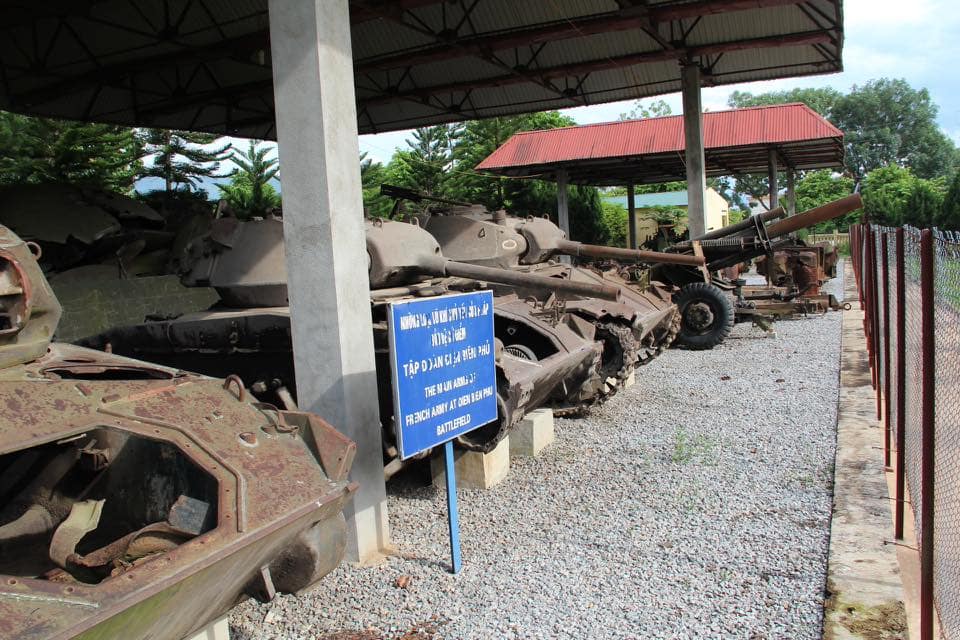
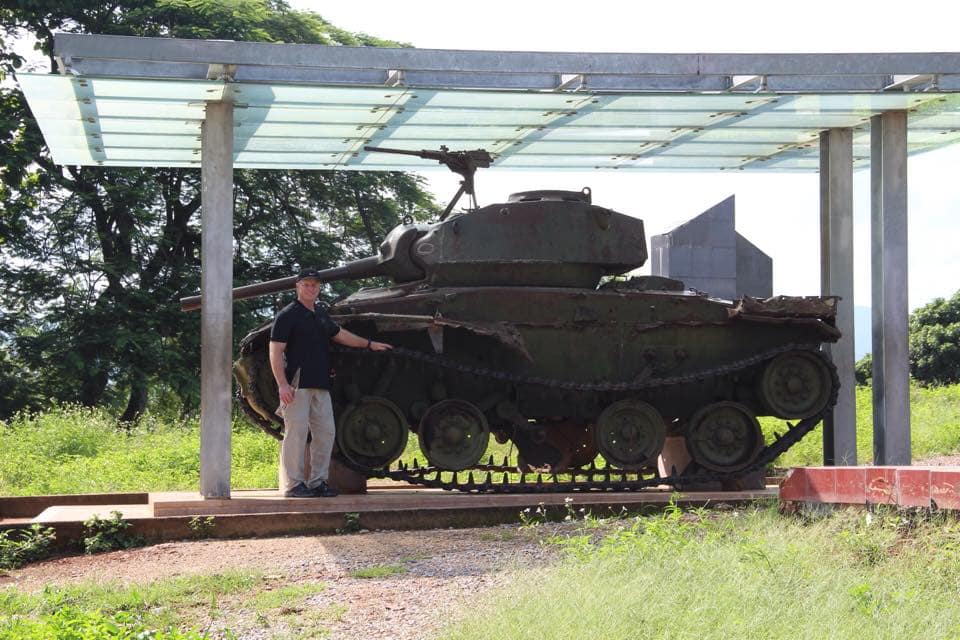
Strongpoint Eliane 2 was the vital ground in the French defensive position and was fought over for 38 days. It was initially held by 1st Battalion, 4th Moroccan Rifles, but later by the French Foreign Legion, Colonial Paratroopers and others. This M24 Chaffee tank is named ‘Bazeilles’, and is one of ten that were flown into DBP in pieces and manually reassembled – it is sitting in the same spot where it was disabled by a bazooka round in April 1954. These tanks played a critical role in the 56-day siege.
Strongpoint Huguette
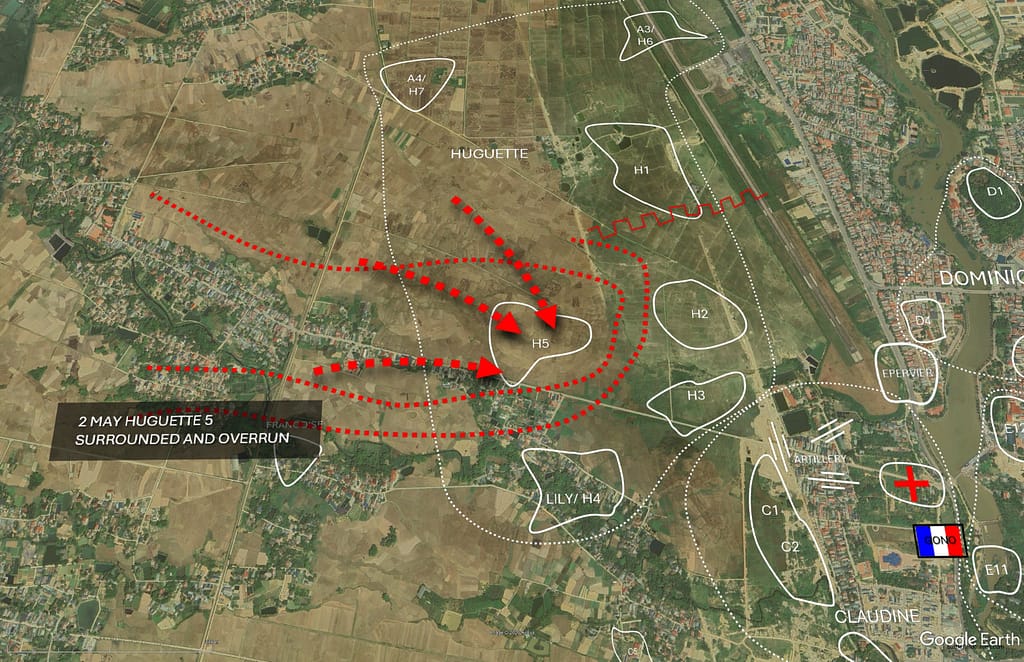
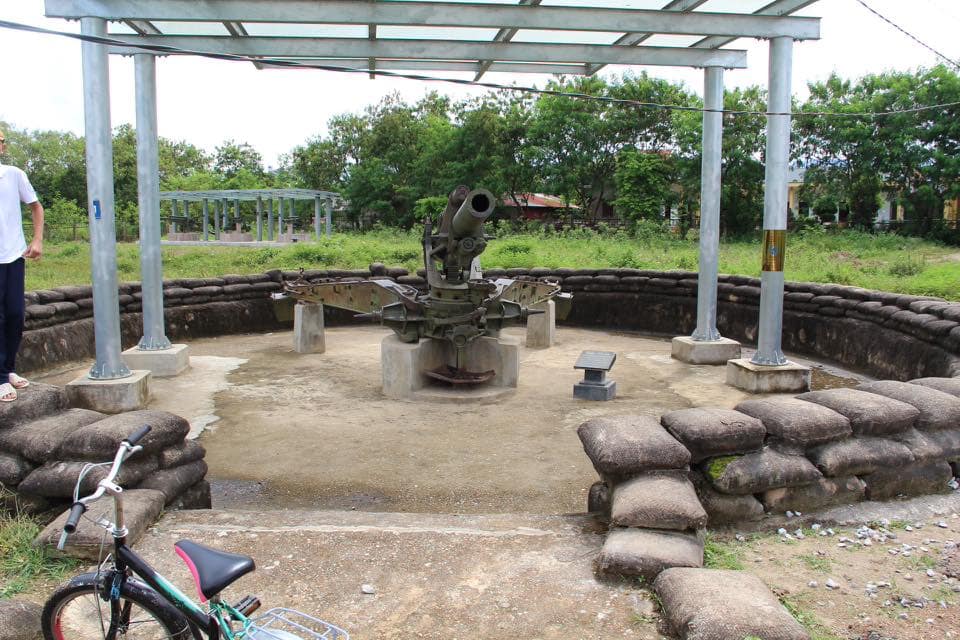
After the loss of much of the high ground on the eastern side of the Nam Yum River, the Viet Minh next focused on the Huguette series of strongpoints to the west and northwest of the airfield. Huguette was held by 1st Battalion/2nd Foreign Infantry Regiment, This phase lasted from about 11-22 April and ended with the loss of most of the airfield and the Huguette positions. There was fierce fighting over Huguette 6 and the Viet Minh took massive casualties, including from the M45 Quad .50cals at Strongpoint Sparrowhawk, which were able to cover the Huguette positions.
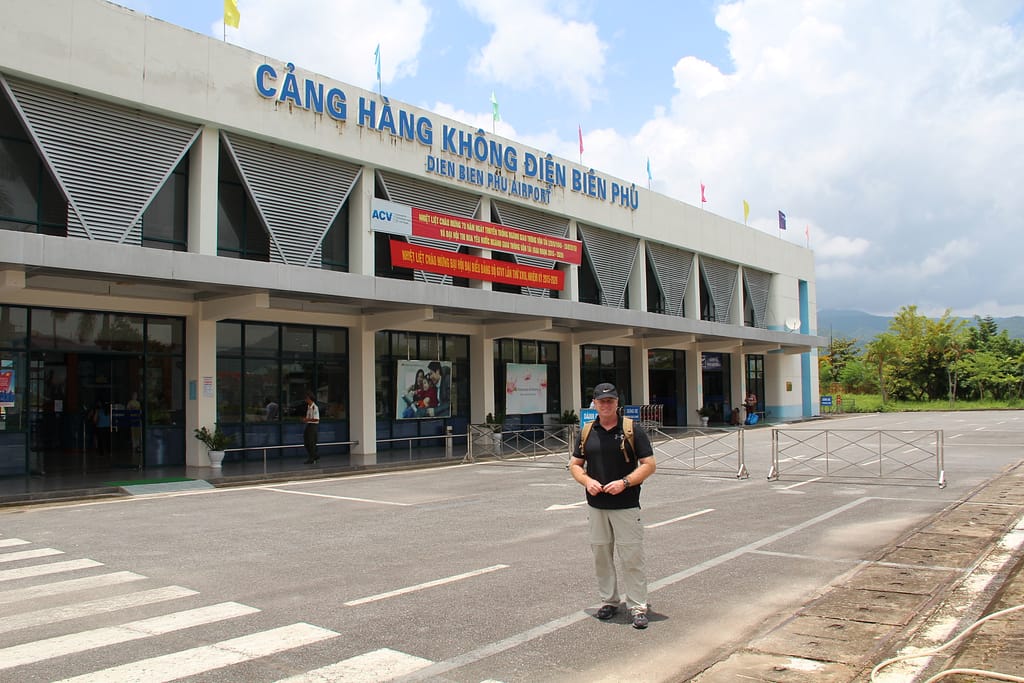
Today, the Huguette positions are partially covered by the extended airfield and Huguette 6 is covered by the tarmac area. The Huguette positions, like all the positions west of the airstrip were on flat swampy ground.
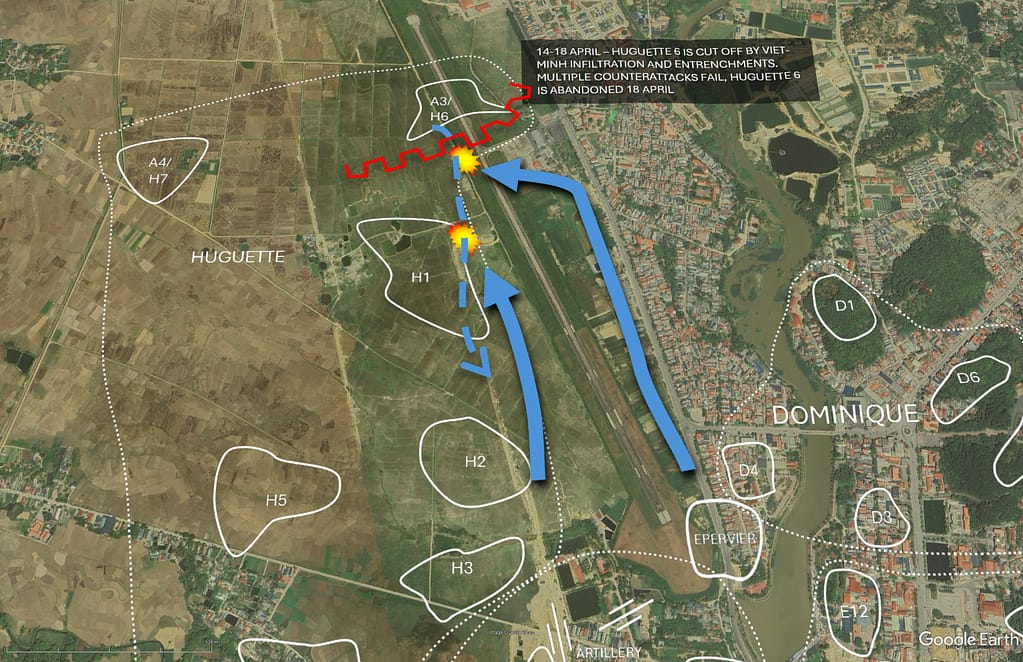
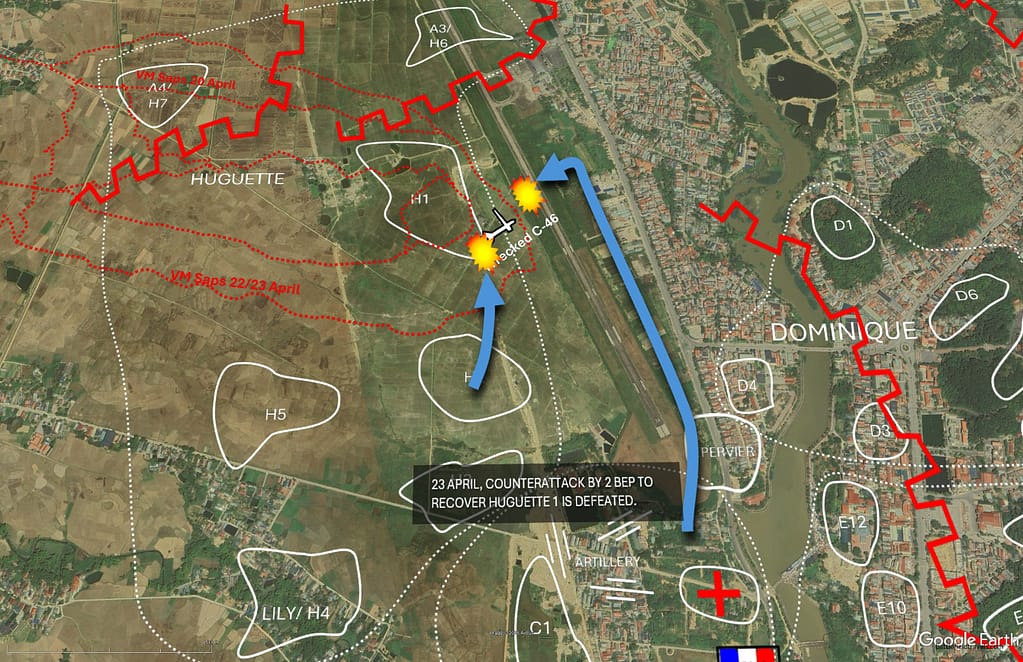
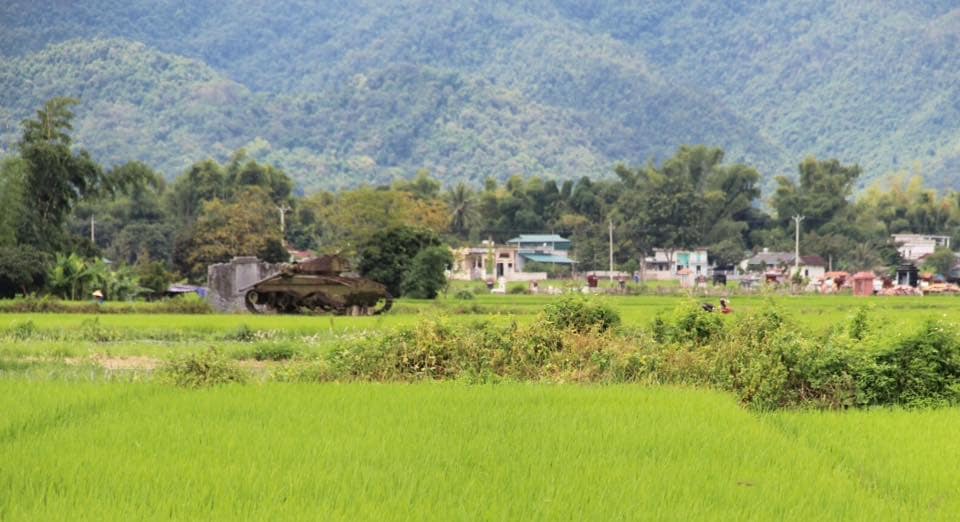
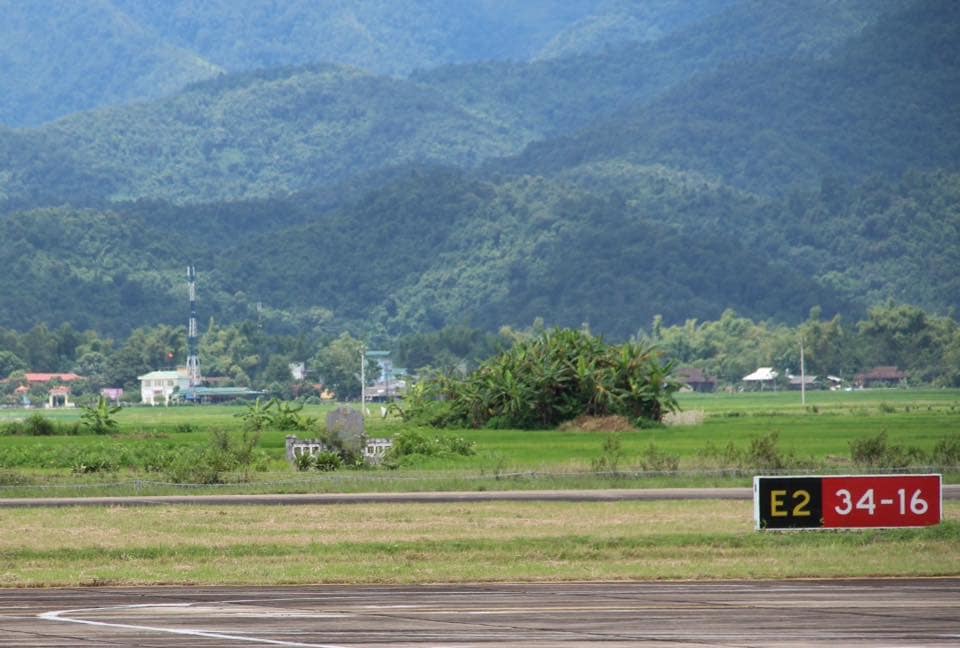
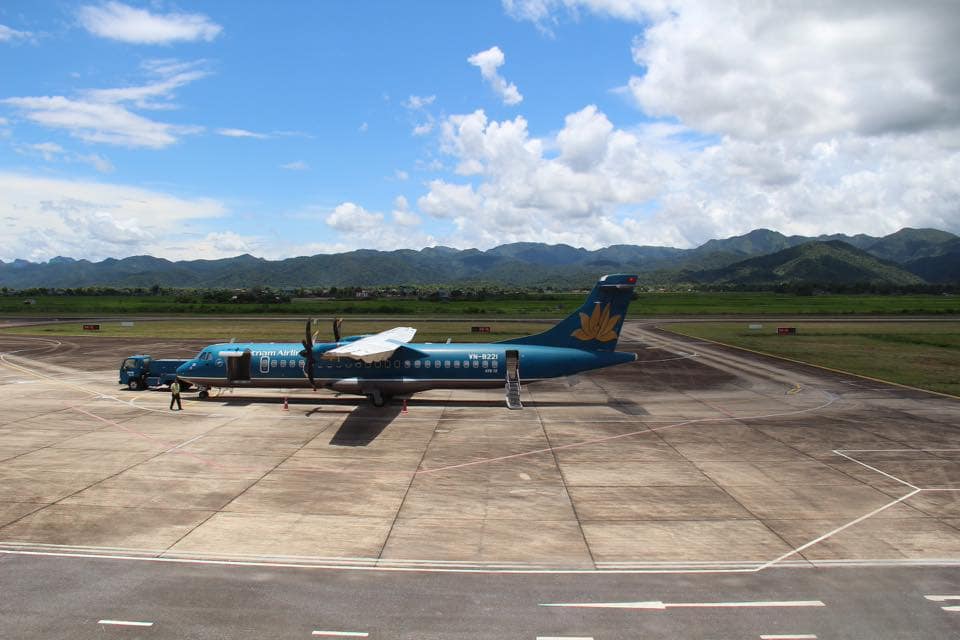
In March-May 1954, this area around the tarmac and the terminal was Strongpoint Huguette 6, which saw brutal combat for weeks on end. Huguette 6 protected the northern end of the runway (which was much shorter in 1954), and was primarily held by French Foreign Legion units.
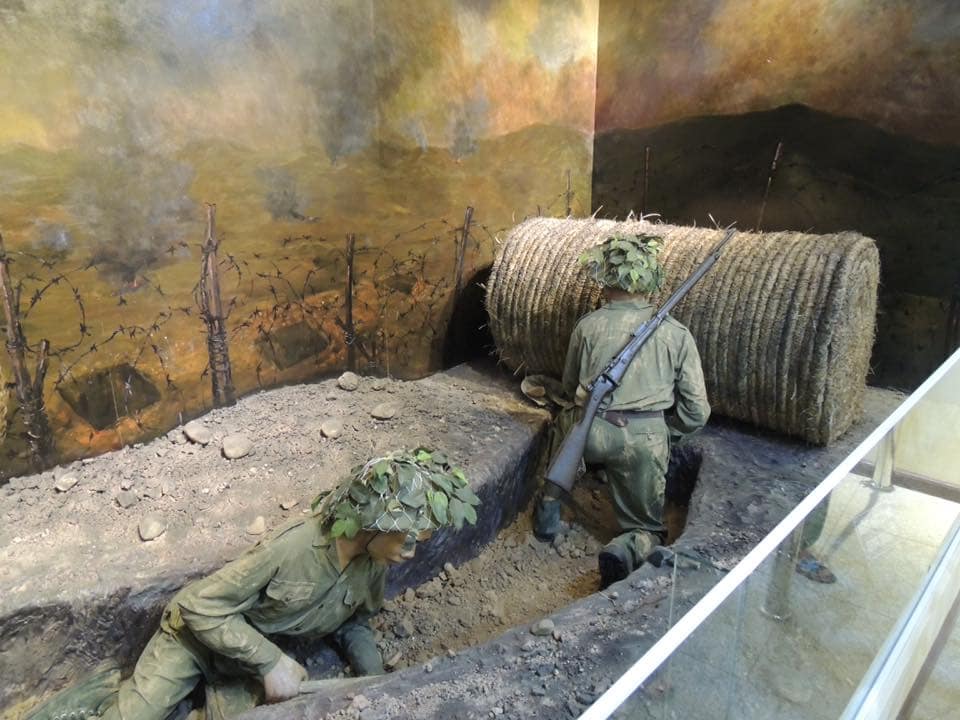
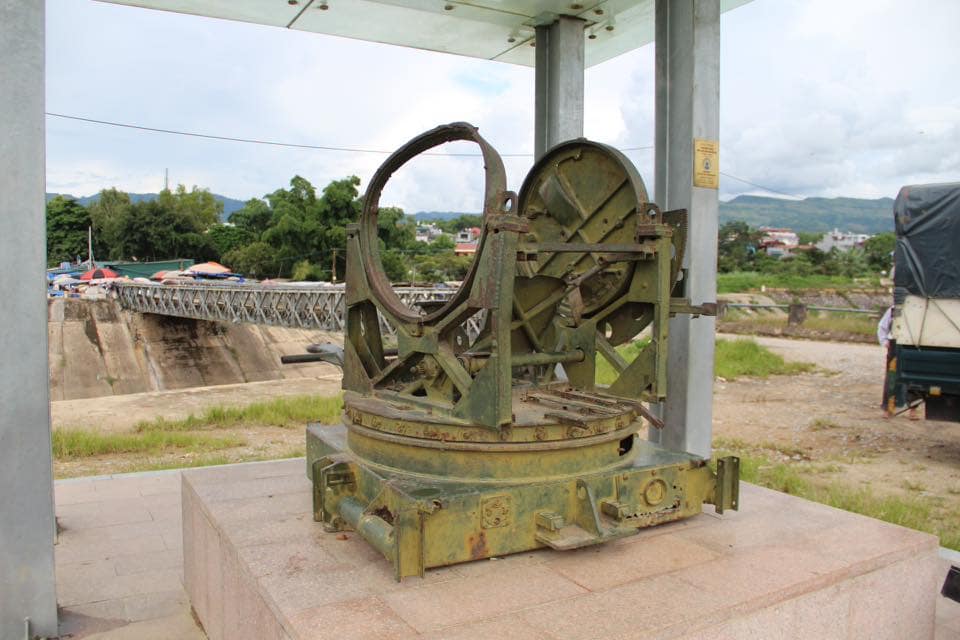
Strongpoint Claudine
By the end of April 1954, with the outer strongpoints lost, the airfield lost, most of Dominique and Huguette lost, and some of Eliane lost, the main French position had shrunk to a much smaller perimeter around Colonel de Castries’ headquarters at Strongpoint Claudine, and a few remaining strongpoints on the east side of the river. On the night of 1 May, the Viet Minh launched another massive assault and overran Eliane 1, Dominique 3, and Huguette 5. On 6 May, the Viet Minh made another attempt to seize Eliane 2, including the use of Soviet Katyusha rockets, and later that night detonated the mine under Eliane 2. On the following day, 7 May 1954, the final French positions were overrun, and de Castries surrendered the surviving garrison.
Strongpoint Claudine is quite well preserved, including de Castries headquarters bunker, the artillery firebase and several destroyed M24 Chaffee tanks.
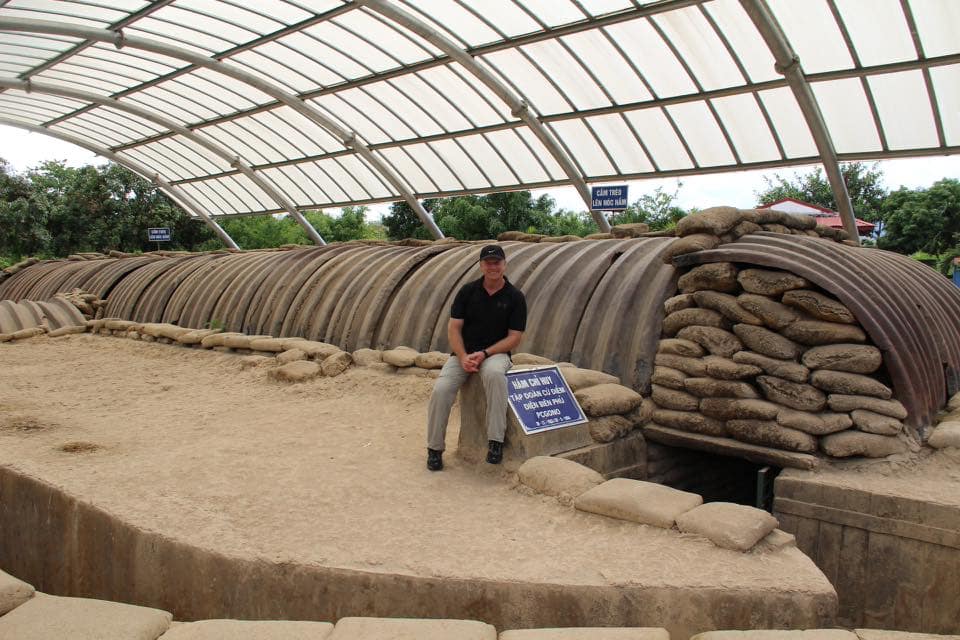
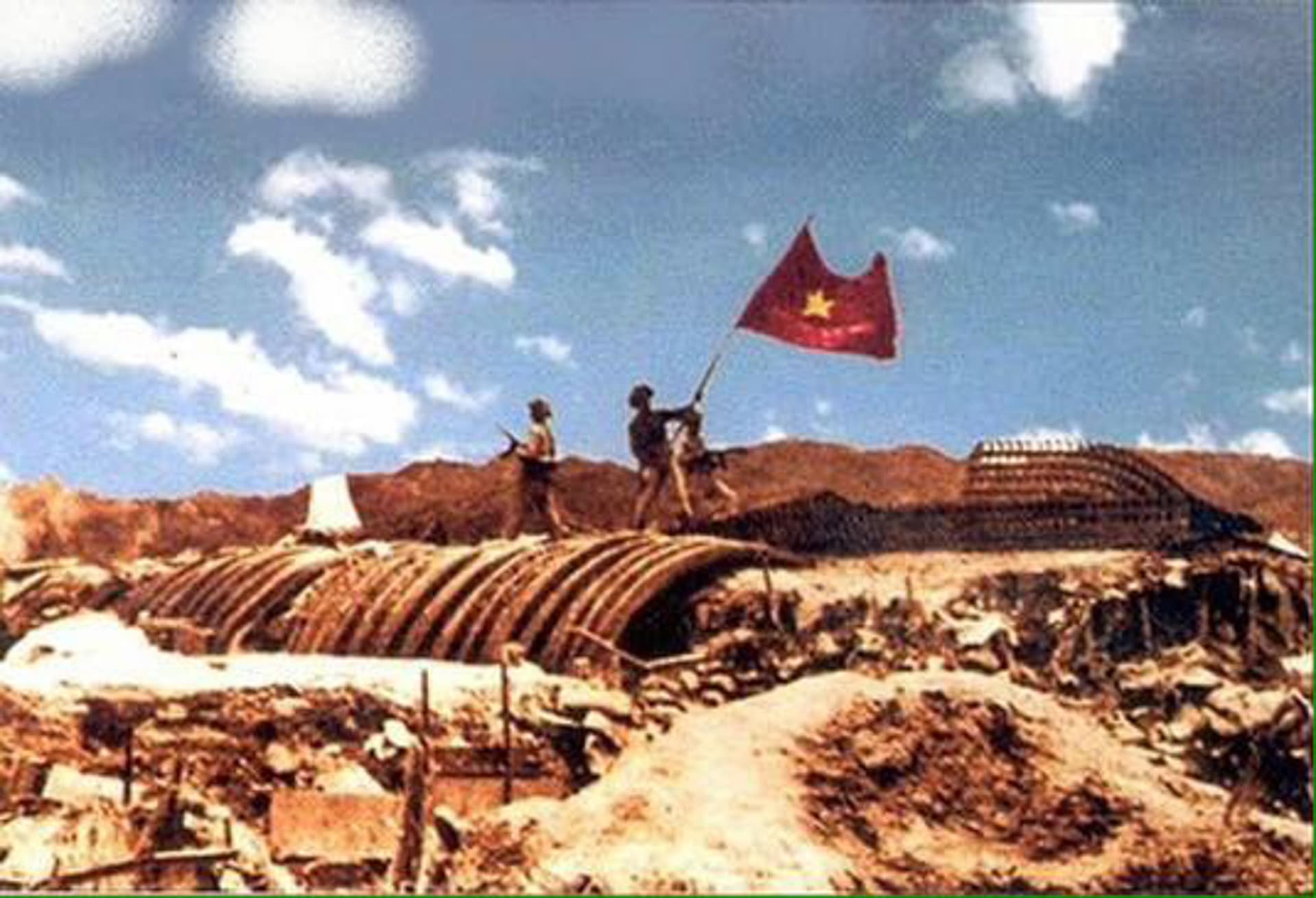
Strongpoint Isabelle
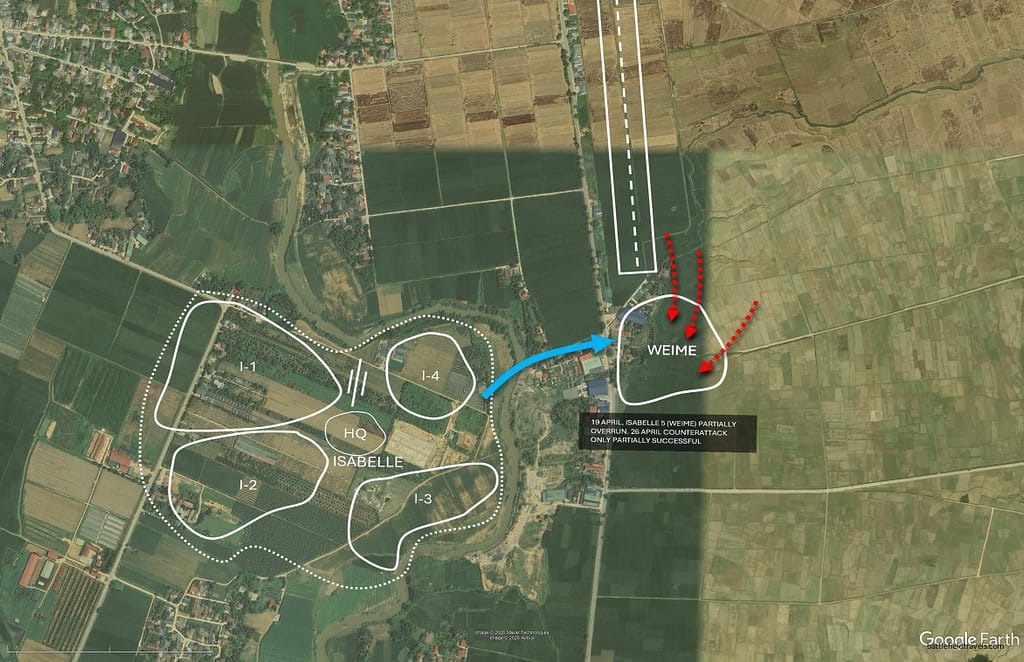
Strongpoint Isabelle, at the southern end of the valley, about 6km south of the main defensive position was sited as an artillery firebase to fire in support of the main defensive position. This was held by 3rd Battalion, 3rd Foreign Legion Infantry Regiment and held out until the very end. After the main defensive position surrendered, the garrison of Isabelle attempted a breakout, but only a few dozen avoided capture.
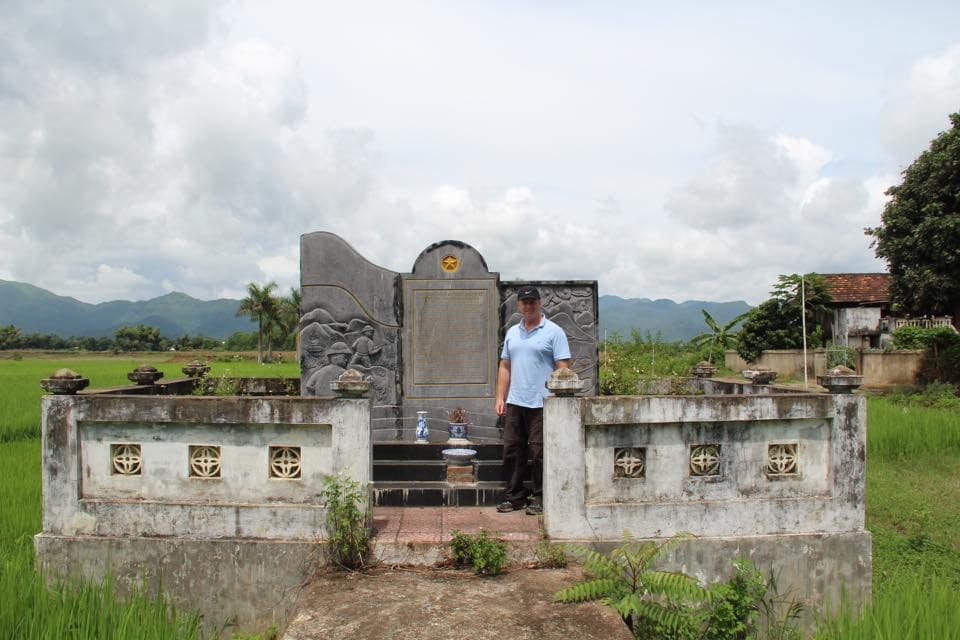
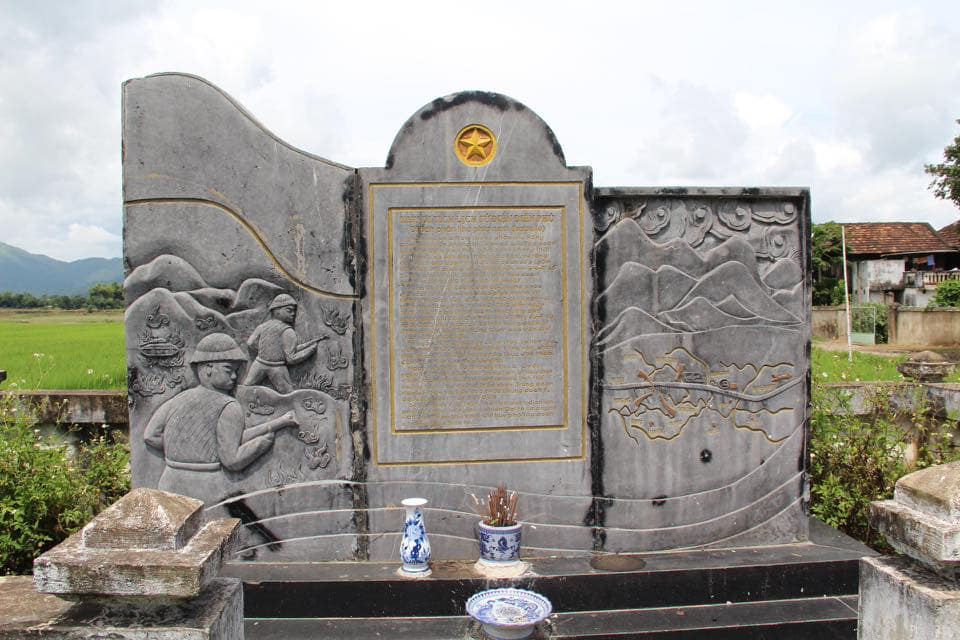
There is a monument at Isabelle, but the area is flat and mostly rice paddies and swamp.
Viet Minh positions
Found this useful? Buy me a coffee — it helps fund future battlefield research


Authored by Mick Prictor, a retired military officer with 40 years’ service, and a military historian specialising in terrain-focused analysis of tactics, doctrine, and command decision-making in land warfare. His work draws on extensive battlefield fieldwork—more than 280 sites worldwide—and one of the world’s largest private collections of historic military arms, uniforms, and equipment. About me
Sources
- Boylan, Kevin, and Olivier, Luc, 2018. Valley of the Shadow: The Siege of Dien Bien Phu, Osprey Publishing
- Giap, Vo Nguyen, 1988. How We Won the War, Recon Publications
- Fall, Bernard, 1966. Hell in a Very Small Place, Da Capo Press, New York
- Fall, Bernard, 1961. Street Without Joy: The Bloody Road to Dien Bien Phu, Stackpole Books, Mechanicsburg, Pennsylvania
- Roy, Jules, 1963. The Battle of Dien Bien Phu, Harper & Row, New York
- Windrow, Martin, 2004. The Last Valley, Da Capo Press, New York
- de Pirey, Philippe, 1954, Operation Waste, Arco Publications, London
📚 Further Reading
This battle study nests within the broader analytical framework explored in the Research Hub, where operational methods, operating environments, armies, commanders, and weapons are examined across conflicts and eras. The links below connect related studies across the wider body of battlefield analysis on the BattlefieldTravels site.
⚔️ Explore all battle studies from the French Indochina War 1946-1954
⚔️ Explore all battle studies involving the French Foreign Legion
🏛️Explore the museum of French Indochina War historic artefacts
🗞️ For updates on new battlefield studies and research insights, you can subscribe to the Newsletter.
Related Battle Studies, Museum Pieces u0026 Reading Resources
 ⚔️🔒Operation LÉA,
(Việt Bắc Campaign), Tonkin,
Oct–Nov 1947
 ⚔️🔒Operation HIRONDELLE, (Raid on Lạng Sơn), Vietnam,
17-21 July 1953
 ⚔️🔒Battle of Phủ Tông Hoá, Tonkin, 25 July 1948
 🏛️ French Indochina War (1946–1954) Weapons and Equipment
 ⚔️🔒Battle of Route Coloniale 4,
(Cao Bang Ridge Disaster),
16 Sep-18 Oct 1950
 📝🔒 Field Note: Battle of Nà Sản, Vietnam, 23 Nov – 10 Dec 1952
🧭 Battlefield Visit Guide: Dien Bien Phu (1954)
Getting There
- Location: Điện Biên Province, northwest Vietnam, about 300 km west of Hanoi.
- Transport: Daily flights connect Hanoi to Điện Biên Phủ Airport (≈1 hr). Road journey via Sơn La takes 10–12 hrs.
- Access: Battlefield sites are spread across the valley and surrounding hills; most are accessible by car or motorbike.
Site Orientation
- Key Landmarks: French HQ bunker (de Castries), Eliane hill complex (A1, A2, A3), Dominique and Gabrielle strongpoints, Muong Thanh airstrip.
- Walking Routes: Trails and marked paths link the main French positions; short climbs needed for Eliane hills and Viet Minh gun sites.
- Best Vantage Points: Victory Monument hill (Dominique 2) and Viet Minh artillery positions give commanding views of the valley.
Museums & Memorials
- Dien Bien Phu Museum: Exhibits on the siege, including maps, weapons, and a large battlefield diorama.
- French Command Bunker: Preserved underground HQ of Colonel de Castries, with displays and interpretation.
- Military Cemetery & Victory Monument: Memorials honouring Viet Minh soldiers; panoramic views of the valley.
On-Site Experience
- Terrain: Flat valley floor encircled by steep hills; bunkers, trenches, and artillery sites preserved.
- Time Required: At least one full day to cover major sites; 2+ days for detailed exploration.
- Wayfinding: Interpretive panels (Vietnamese/limited English) mark major strongpoints and memorials.
Practical Tips
- Best Time to Visit: October–April (dry season). Summer months can be hot and wet.
- Footwear: Sturdy shoes recommended for hill positions and trench walks.
- Language: Most signage is in Vietnamese; a local guide or reference material is helpful.
- Nearby: Local markets and ethnic Thai villages offer cultural side trips during a battlefield visit.
FAQ: Battle for Dien Bien Phu (1954)
A 57-day siege from March to May 1954 in which Viet Minh forces defeated the French garrison at Dien Bien Phu, effectively ending the First Indochina War.
To block Viet Minh movement into Laos and force a decisive battle under conditions favourable to French firepower.
They moved troops and equipment through the mountains, surrounded the valley, dragged artillery into the surrounding hills, and systematically reduced the French positions.
The French surrendered on 7 May 1954, leading to the Geneva Accords and the withdrawal of French forces from Indochina.
The battlefield is preserved with museums, bunkers, and memorials marking key positions.
Excellent explanations and photo-analysis, Mick. I love the way plenty of historical sites have been preserved there, and I learn something new every time I visit the region. Was the guy you bought the souvenirs from a local or French? One of my French friends who often spends weeks out of each year at Dien Bien Phu is like a human metal (and other materials) detector. He also once bought a length of pierced steel planking (Marston Matting) and had it cut up into manageable chunks to carry back to France.
I think you and other enthusiasts would also enjoy reading Valley of the Shadow by Kevin Boylan and Luc Olivier, which even Martin Windrow blurbs as “the most detailed analysis yet published”, as well as “Determined to Fight Determined to Win”: The combat experience of the People’s Army of Vietnam at Điện Biên Phủ, Dr. Peter Hunt’s PhD thesis, available on his website at https://www.dtfdtw.org
Thanks Tony,
I do need to do a major upgrade on the Dien Bien Phu study. This was the first major study I wrote, based on my 2015 visit. I was back ant DBP again early this year for a longer, more forensic exploration.
The artefacts were from an old Vietnamese guy who was scraping the earth on Elaine 2. Since 2015, the new runway has been built, so much of the Huguettes are gone, and Anne-Marie has been partially cut away. Glad I saw it 10 years ago!
Some outstanding recommendations of references! I downloaded Peter Hunt’s thesis and will look at ordering Valley of the Shadow. Windrow is the best account so far. Will be interesting to see these other perspectives.
Mick