Naval supremacy in the Caribbean: the Battle of Carlisle Bay!
The Battle of Carlisle Bay, on 30 April 1665, was a clash between a Dutch naval fleet led by Michiel de Ruyter and English coastal defences and navy ships around Bridgetown, Barbados. The battle was one of the opening clashes of the Second Anglo-Dutch War, as these two powerful maritime states sought to dominate trade routes. Although De Ruyter destroyed the English convoy in Carlisle Bay, his fleet was severely damaged and unable to lodge Dutch forces on Barbados.

Key facts
Google Earth map – location of Carlisle Bay, Barbados
Strategic context: the Second Anglo-Dutch War
In the mid-18th Century, England and the Dutch Republic were both powerful maritime trading nations with global interests. The Dutch had a larger merchant fleet and were outcompeting their English rivals in global trade. This rivalry led to the First Anglo-Dutch War 1652-54. Around 1500 Dutch ships and more than 400 English ships were lost in this war, and the Dutch were forced to make concessions in the Treaty of Westminster that ended the war. The English also developed and tested successful new ‘line-of-battle’ naval tactics.
In the years following the first war, each side expanded its fleets of major warships and incorporated the ‘line of battle’ doctrines into its respective fleet tactics. The Dutch resented the English-imposed 1651 Navigation Acts that unfairly advantaged English merchants, while the English resented Dutch trading monopolies and Dutch expansion into traditional Spanish and Portuguese trading areas.
In August 1664, an English fleet sailed into New Amsterdam Harbour (modern New York City) and demanded its surrender. The rising tensions led to the outbreak of the Second Anglo-Dutch War in March 1665. This war expanded from Europe to the Caribbean, eventually involving France, Denmark, and Norway on the Dutch side.
Charles Fort (Needham’s Fort)
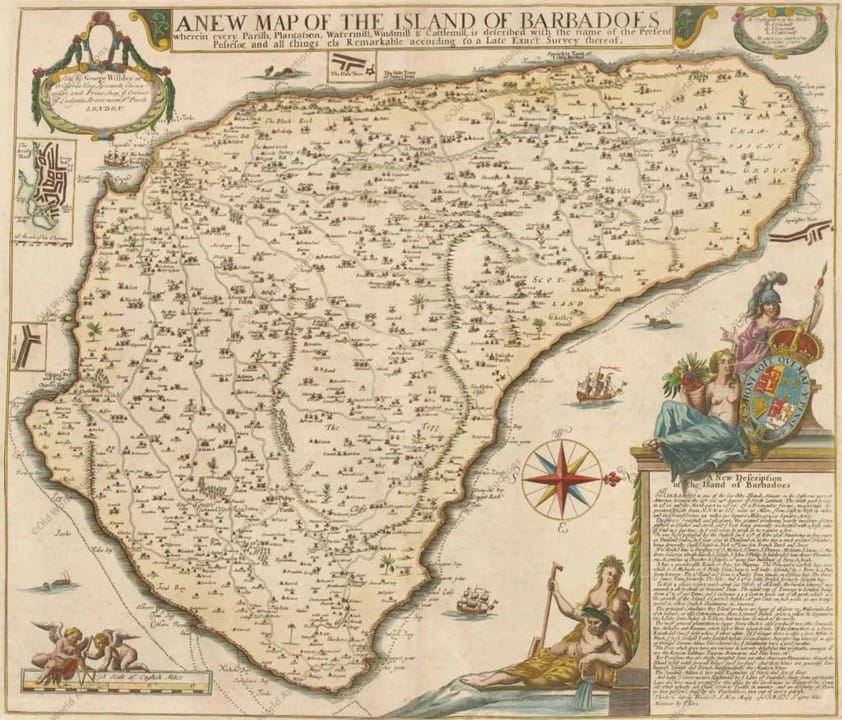
Needham’s Fort was constructed in 1650 as part of a system of ~40 fortifications protecting Bridgetown and the Barbados coast. Needham’s Fort was by far the largest of the fortifications. A French military map of the period shows Needham’s Fort as a 30-gun fort, while most other forts had only 6-12 guns. The fort’s original purpose was to defend Royalist-held Barbados against Cromwell’s Parliamentarian forces. When Charles II was restored to the English throne in April 1661, Needham’s Fort was renamed ‘Charles Fort’.
⚔️ Go deeper — Members get exclusive access to the Deep Research Collection, Field Notes, and monthly Research Dispatches. Try membership free for 7 days, cancel anytime. From $9/month.
Battle of Carlisle Bay
Admiral de Ruyter’s expedition
In response to the loss of New Amsterdam and constant English provocations, the Dutch prepared an expedition comprising twelve warships under the command of Admiral Michiel de Ruyter. This expedition targeted vulnerable English colonial possessions on the West African coast and in the Caribbean.
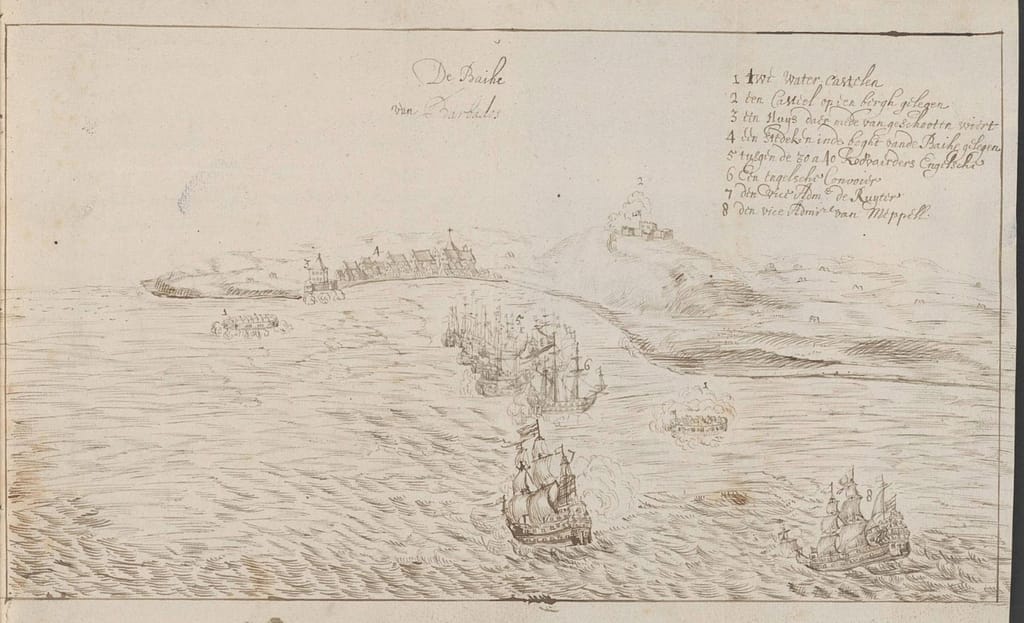
On 29 April 1665, de Ruyter’s fleet arrived off Barbados with the intent to land a military force near Bridgetown. Before the force could be landed, de Ruyter needed to neutralise the shore batteries and any English warships. On the morning of 30 April, the Dutch fleet rounded Needham’s Point (Charles Fort) and entered Carlisle Bay, which held 29 English merchant ships, most of which had some form of armament. The sketch below shows the Dutch fleet entering Carlisle Bay from the southern end, and sailing past Charles Fort.
Dutch fleet versus the shore batteries
Barbados Governor Francis Willoughby and the English forces in Barbados had adequate warning of a potential Dutch attack, so they were well prepared. As de Ruyter’s fleet entered the bay, the forts, shore batteries, and several armed merchants opened fire. The lightly armed merchant ships were no match for the Dutch ships-of-the-line, each of which carried 40-60 cannon. Many of the merchant ships were severely damaged or sunk. However, the 40-odd forts and shore batteries with their 24-pounder and 32-pounder cannon wreaked significant damage on de Ruyter’s fleet.
The battle lasted about 90 minutes, during which about half the English ships were sunk or badly damaged. De Ruyter’s warships also sustained significant damage, and more than 400 of his sailors were injured or killed. De Ruyter’s flagship Speigel suffered nine men killed and 22 wounded. Unable to breach the English defences and with his fleet badly damaged, de Ruyter broke off the attack and took his fleet to the neutral French colony of Martinique for repairs.
Consequences of the Battle of Carlisle Bay
The war in the Caribbean continued for the next two years with each side capturing and losing colonies. France’s entry into the war in 1666 shifted the advantage to the Dutch, allowing them to retake some of their lost possessions. The English colony of Tobago was lost to the Dutch in 1665 and retaken in 1667. The Dutch also seized the colony of Suriname from England in 1667. When the war ended with the Treaty of Breda in July 1667, the English kept New Amsterdam (New York) and the Dutch kept Suriname.
The battlefield today: exploring Charles Fort
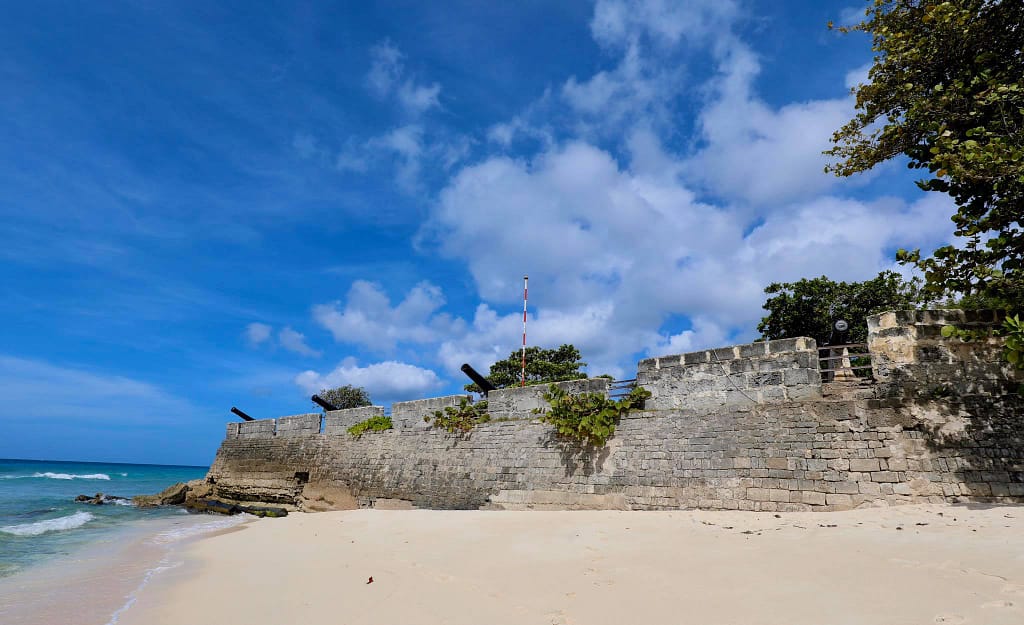
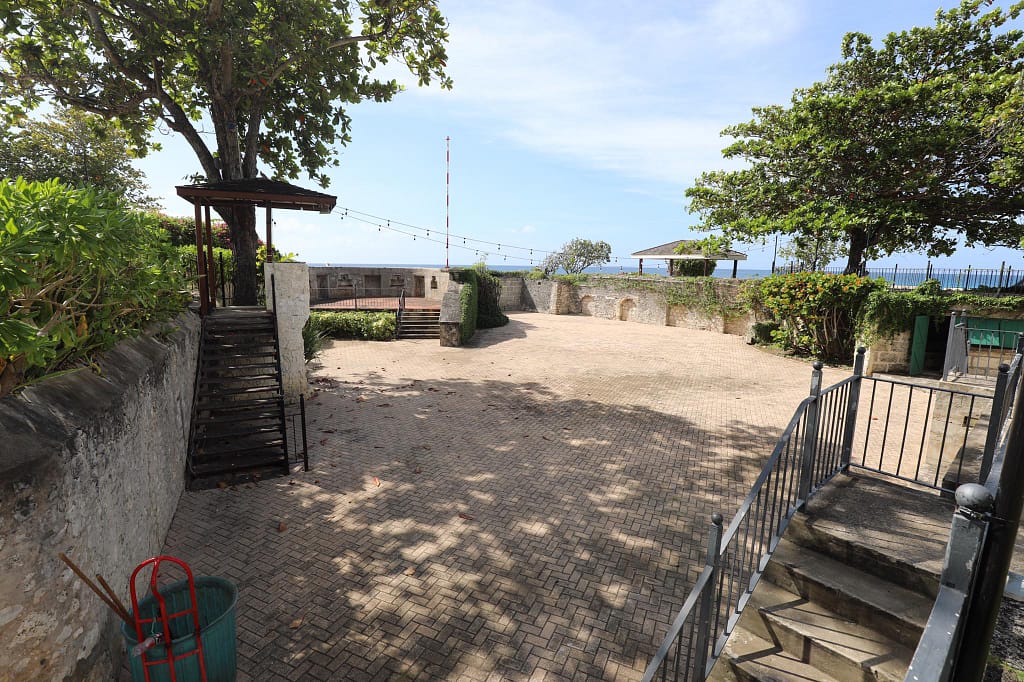
Charles Fort is now incorporated into the grounds of the Hilton Resort at Needham’s Point, Bridgetown. Some restorations are ‘unsympathetic’ to the original structure, particularly the brick battlements. As a result, parts of the fort grounds now serve as wedding reception and bar areas. However, incorporation into the Hilton complex means the fort gets some level of constant maintenance and investment, which is a good outcome.

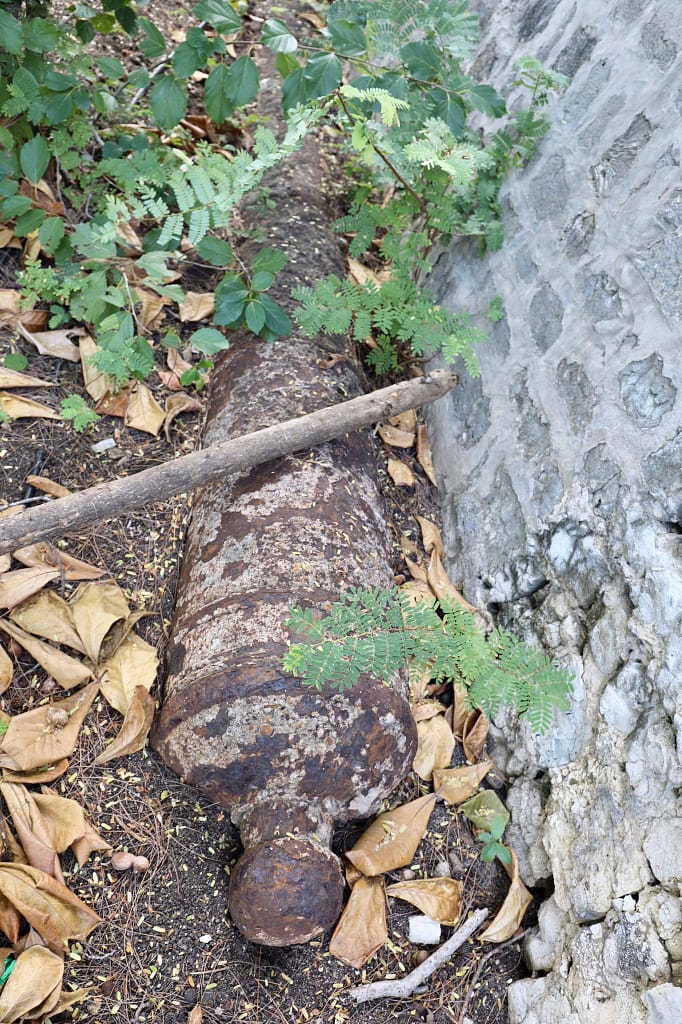
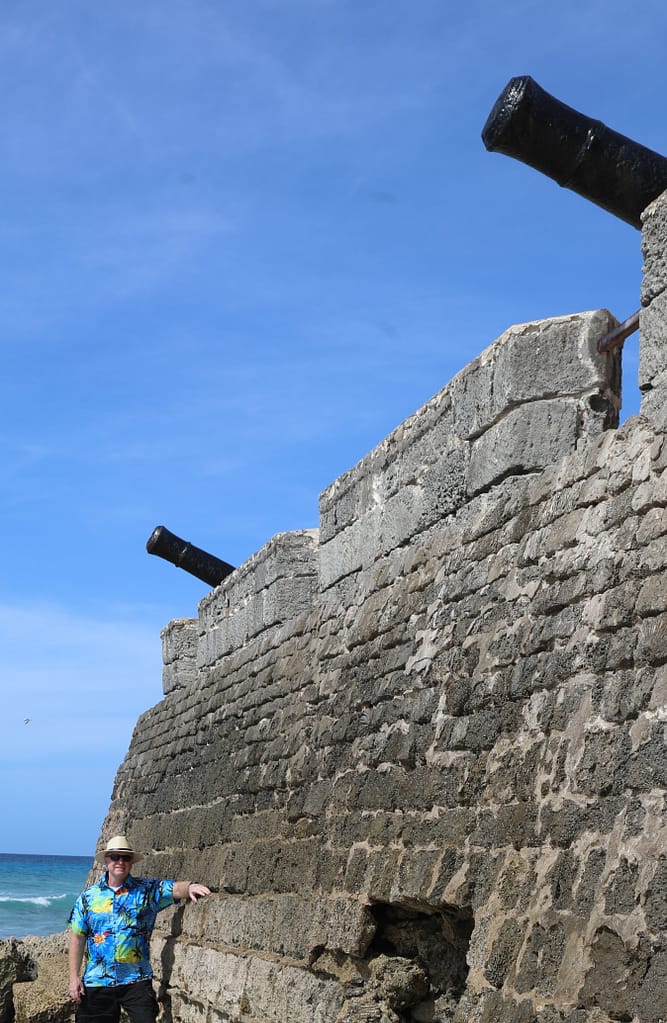
What is really interesting is the numerous cannon barrels that have been tossed into the sand and sea around the fort. Most are British 24-pounders and 32-pounders, dating back to the mid-1700s, so they were presumably heaved over into the ocean when the armaments were updated or when the fort was decommissioned. We counted at least 23 massive cannon barrels in the water and sand around the fort and the Hilton grounds.




Found this useful? Buy me a coffee — it helps fund future battlefield research


Authored by Mick Prictor, a retired military officer with 40 years’ service, and a military historian specialising in terrain-focused analysis of tactics, doctrine, and command decision-making in land warfare. His work draws on extensive battlefield fieldwork—more than 280 sites worldwide—and one of the world’s largest private collections of historic military arms, uniforms, and equipment. About me
📚 Further Reading: Anglo-Dutch Wars
This battle study nests within the broader analytical framework explored in the Research Hub, where operational methods, operating environments, armies, commanders, and weapons are examined across conflicts and eras. The links below connect related studies across the wider body of battlefield analysis on the BattlefieldTravels site.
⚔️ Explore all battle studies from the Anglo-Dutch Wars
🏛️Explore the museum of War of the Austrian Succesion artefact (1740s)
The book list for this conflict includes the leading campaign studies, memoirs, and operational analyses available on ancient warfare, selected specifically to complement this battlefield study.
📚Anglo-Dutch Wars – Recommended Reading
🗞️ For updates on new battlefield studies and research insights, you can subscribe to the Newsletter.
Related Battle Studies, Museum Pieces & Reading Resources


🧭 Battlefield Travel Guide: Carlisle Bay (30 April 1665)
Getting There
- Nearest City: Bridgetown, Barbados.
- Access: Carlisle Bay lies immediately south of Bridgetown; 15 km from Grantley Adams International Airport via the ABC Highway.
- Parking: Public parking available near Needham’s Point and along Carlisle Bay beachfront areas.
Site Orientation
- Key Landmarks: Charles Fort at Needham’s Point; Carlisle Bay beachfront (site of English anchorage); historic Bridgetown garrison area.
- Best Vantage Points: Needham’s Point for views over the bay and naval approaches; beachside vantage lines to visualise anchorage positions.
- Walking Routes: Garrison Savannah UNESCO World Heritage site connects Charles Fort, St Ann’s Fort, and colonial batteries.
Museums & Visitor Centres
- On-site: Charles Fort (remains incorporated into Hilton Barbados grounds); Garrison Savannah exhibits.
- Nearby: Barbados Museum & Historical Society (1 km inland) with collections on colonial and military history.
On-Site Experience
- Interpretive Signage: Heritage boards at Garrison Savannah; plaques at Charles Fort outline 17th–19th century defences.
- Atmosphere: Carlisle Bay today is a calm anchorage and beach, but the geography of the roadstead remains unchanged from 1665.
Nearby Points of Interest
- Related Sites: Needham’s Point coastal batteries; St Ann’s Fort (housing the National Armoury Collection).
- Local: Bridgetown UNESCO World Heritage Site, historic warehouses, and Careenage harbour district.
Practical Tips
- When to Visit: Dry season (December–April) for best coastal visibility and walking conditions.
- Facilities: Hotels, cafés, and visitor amenities at Carlisle Bay beachfront; Barbados Museum for historical context.
- Notes: Carlisle Bay is a popular swimming and diving site; several historic shipwrecks are accessible to snorkelers and divers.
Subscribe to Battlefield Travels and receive a free E-Book Battlefield Guide
Unlock expert battlefield analysis, campaign reconstructions, and historical insights drawn from firsthand exploration and primary sources.
🗺️ You’ll receive:
🎖️ Exclusive historical insights you won’t find elsewhere
📘 A free eBook: 10 Tips for Exploring Historic Battlefields
📰 New battlefield studies straight to your inbox as they are published

⚔️ Go deeper — Members get exclusive access to the Deep Research Collection, Field Notes, and monthly Research Dispatches. Try membership free for 7 days, cancel anytime. From $9/month.

Great post Mick, and nice shirt!
Thanks Boomer, Well it is the Caribbean, have to fit in with the locals!