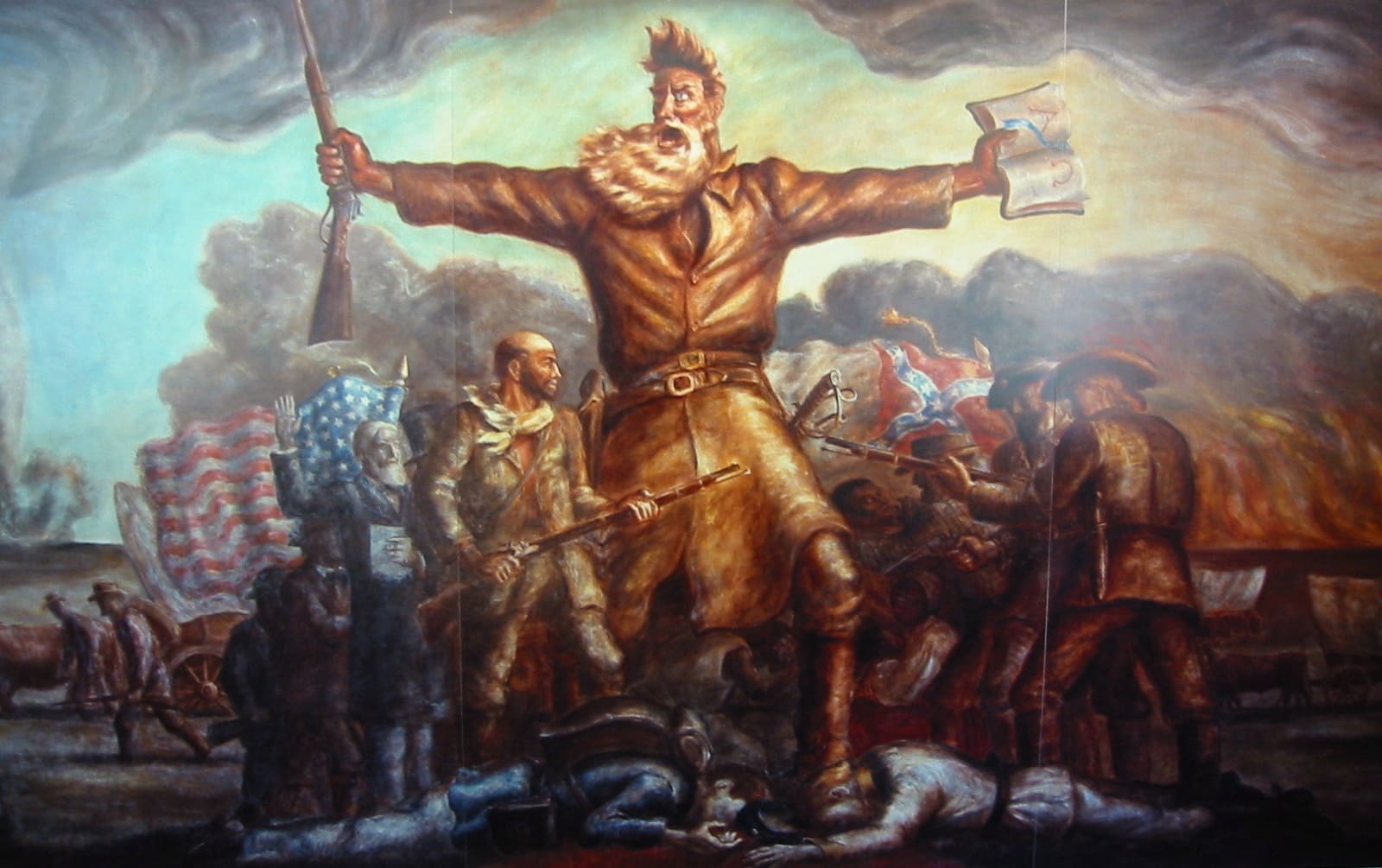
From Bleeding Kansas to Harpers Ferry: John Brown’s Warpath!
On 2 June 1856, John Brown’s abolitionist militia clashed with Henry Pate’s pro-slavery force at the Battle of Black Jack near Baldwin, Kansas. This fierce firefight in “Bleeding Kansas” is often called the first battle of the Civil War.
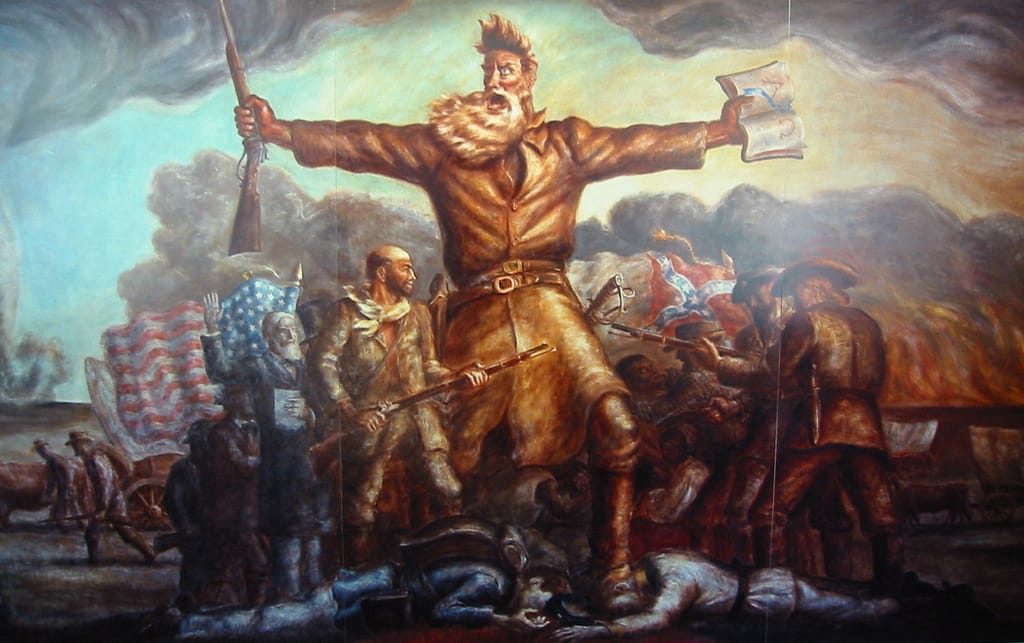
Key facts
🗺️ Battle of Black Jack, 2 June 1856, near Baldwin City, Kansas
⚔️ ‘Bloody Kansas’, the Kansas-Missouri Border War 1854-61 over whether Kansas would enter the Union as a free state or a slave John Brown with ~30 anti-slavery abolitionists vs Henry C. Pate with ~50 pro slavery supporters
🎯 Objective: Ideological driven conflict, and partly driven by revenge for earlier sleights
Visit my virtual museum of weapons, uniforms and equipment of the American Civil War
Google Earth map – Location of the Black Jack battlefield
🧭🥾 Walking the Battlefield
I visited the Black Jack battlefield in November 2019 as part of a broader exploration of historical sites in Kansas. The Black Jack battlefield, near Baldwin City, Kansas, remains a compact and evocative site. A large stone marker marks the camp of Pate’s pro-slavery militia, while another shows the approach taken by Brown’s men, alongside the old Santa Fe trail. You can still trace the ruts of the old Santa Fe Trail, which provided Pate’s men with cover during the firefight.
Strategic Context – Bleeding Kansas
Origins of the conflict
By the mid-1850s the United States was already sliding toward sectional conflict, and nowhere was this more apparent than along the Missouri–Kansas frontier. The Kansas–Nebraska Act of 1854 overturned the Missouri Compromise of 1820, leaving the status of slavery in new territories to be decided by popular sovereignty. On paper, this was meant to be a democratic solution. In practice, it became an open invitation to armed migration and political violence.
Almost at once, pro-slavery settlers from neighbouring Missouri, known to their enemies as “Border Ruffians,” crossed the line into Kansas to sway the vote by intimidation. New England abolitionist societies sponsored “Free State” settlers to move west with the same determination. Instead of peaceful ballots, rival camps brought their rifles, turning the prairie into a proving ground for the nation’s deepest divisions.

Escalation into violence
By 1855–56, the conflict had escalated far beyond rhetoric. Fraudulent elections were held at gunpoint; rival legislatures were set up in Topeka and Lecompton; and the territory slipped into outright civil war. Lawrence, Kansas, became the symbolic stronghold of Free State settlers. When pro-slavery forces sacked Lawrence in May 1856—burning buildings and destroying the presses of the Herald of Freedom newspaper—it sent shockwaves through the North. Abolitionists took it as proof that compromise was no longer possible.
Violence begat violence. Just days after the Lawrence raid, the fiery abolitionist John Brown and a small band of followers struck back in the infamous Pottawatomie Creek massacre, where five pro-slavery men were hacked to death with broadswords. To Brown, a man of deep Calvinist conviction, this was God’s judgement on the sin of slavery delivered by human hands. To his enemies, it was terrorism. To many contemporaries on both sides, it confirmed that the Kansas prairies had become the first battleground of America’s coming war.

The road to Black Jack
When Henry Clay Pate, a pro-slavery newspaperman turned militia captain, began raising a posse to hunt Brown down, the stage was set for another clash. What followed at Black Jack on 2 June 1856 was small in scale—fewer than a hundred men involved—but immense in symbolism. For the first time, armed pro-slavery and anti-slavery forces fought a pitched battle on American soil. Later generations would look back and call it “the first battle of the Civil War.”
Opposing Forces: anti-slavery vs pro-slavery
John Brown and the Free State Militia
John Brown was not a soldier by training, but he carried himself with the conviction of a man on a mission. At Black Jack, he commanded roughly thirty abolitionist fighters, many of them Free State settlers hardened by months of intimidation and raids along the Kansas frontier. They were not a uniformed militia, but rather a loosely organised band armed with rifles, shotguns, and whatever pistols or edged weapons they possessed.
John Brown’s leadership style was uncompromising and deeply personal. He believed he was an instrument of divine justice, and his men, many of them neighbours or kin, followed him out of loyalty and shared principle. Among them were several of his sons, whose imprisonment by pro-slavery forces gave the coming fight an additional edge of urgency. What they lacked in formal drill, they made up for in determination and intimate knowledge of the local ground.
Henry Clay Pate and the pro-slavery posse
Facing them was Henry Clay Pate, a Virginian by birth and a fervent pro-slavery advocate who had settled in Missouri. Pate was known as a newspaperman before turning militia leader, and he was one of many “Border Ruffians” who believed Kansas must be forced into the Union as a slave state. In late May 1856, Pate raised a posse of around fifty men, some volunteers, some opportunists, and marched into Kansas Territory.
They were better armed and more numerous than Brown’s company, with horses, revolvers, and the confidence of men accustomed to crossing the border at will. But they lacked cohesion and discipline. Pate’s men had camped near Black Jack Creek after raiding Free State settlements, expecting little more than another skirmish. They underestimated both the resolve and the tactical cunning of the abolitionist force that now closed in on their position.
The battlefield setting
A camp by Black Jack Creek
The Battle of Black Jack unfolded in a landscape typical of eastern Kansas in the mid-19th century: open prairie broken by ribbons of woodland and small creeks. Black Jack Creek itself, a modest watercourse feeding into the larger Ottawa Creek, provided a natural camp site with water, shade, and some cover.
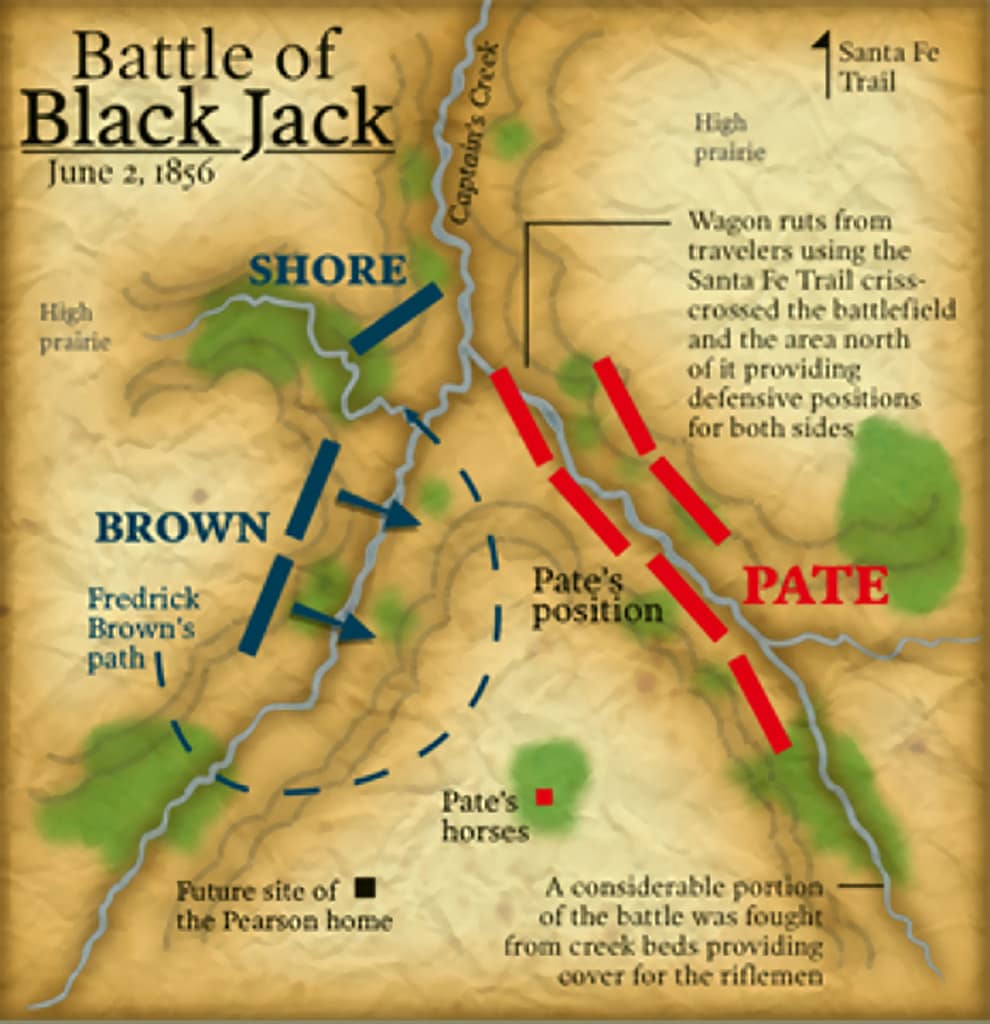
Henry Clay Pate and his men had pitched camp near the creek, not far from the well-travelled Santa Fe Trail. The trail, already decades old by 1856, ran close to the campsite. Its worn wagon ruts cut shallow trenches into the ground — a detail that would soon become tactically significant, as Pate’s men tried to use them as firing positions.
John Brown’s approach
John Brown’s force approached the site from the east, moving through woodland and using the dawn light to conceal their manoeuvre. The small clearing where Pate’s camp lay was enclosed on several sides, offering Brown the opportunity to catch his opponent in a crossfire. Though the ground was not extensive, its mix of cover, open lanes of fire, and the constraining presence of the trail and creek gave Brown a favourable field for a surprise assault.
Stealthy approach
At first light on 2 June 1856, John Brown and roughly thirty abolitionist fighters crept into position near the clearing where Henry Clay Pate and his pro-slavery militia were camped. Brown had planned the attack carefully. His men advanced from several approaches, using the woods and the undulations of the ground for cover. When they opened fire, the shock was immediate.

The surprise attack on Pate’s camp
Gunfire erupted from multiple directions, and the pro-slavery camp was thrown into confusion. Pate’s men scrambled for their weapons, some trying to rally behind the cover of wagons and tents, others dropping into the wheel ruts of the Santa Fe Trail, which cut across the site. The deep grooves left by decades of wagon traffic gave them some protection, but they also pinned them in place.
Brown’s men pressed the advantage, firing from the tree line and shifting positions to keep the defenders off balance. The exchange of shots was sharp and chaotic; reports suggest that several horses were quickly hit, limiting Pate’s mobility and adding to the confusion in the camp.
⚔️ Go deeper — Members get exclusive access to the Deep Research Collection, Field Notes, and monthly Research Dispatches. Try membership free for 7 days, cancel anytime. From $9/month.
A prolonged firefight
What Brown may have expected to be a quick rout turned into a five-hour gun battle. Pate’s men, though shaken by the surprise, did not flee. They returned fire doggedly, and for a time their superior numbers allowed them to hold out. Both sides suffered wounds, though remarkably few fatalities are recorded. The fighting became one of attrition, each side attempting to outlast the other in the heat of the morning sun.
The abolitionists gradually gained the upper hand. Brown moved his men with tactical awareness, tightening the noose and denying Pate any real chance of escape. Each attempt by Pate’s men to break out across the clearing was driven back with musket fire. Ammunition began to run low, and the lack of shelter in the camp added to their exhaustion.

Pate’s surrender
Finally, with several men wounded, their horses dead or scattered, and no prospect of relief, Henry Pate agreed to surrender. He handed over 28 of his men to Brown. Though Pate was a pro-slavery activist with far greater political connections, he found himself outmanoeuvred and humiliated by a force smaller in number but better led and more determined.
Brown agreed to release the prisoners on terms — he wanted the safe return of abolitionist prisoners held by pro-slavery forces, including two of his own sons. The deal was struck, and though the exchange was not immediate, the symbolic victory was undeniable.

Consequences and legacy of the Battle of Black Jack
Though small in scale, the Battle of Black Jack was far more than a frontier skirmish. For contemporaries, it marked a dangerous escalation of the “Bleeding Kansas” conflict. Until then, much of the violence had taken the form of raids, intimidation, and sudden ambushes. At Black Jack, however, two armed groups had fought a sustained firefight lasting five hours — a clash that more closely resembled the opening moves of a civil war than a local feud.

Symbolic victory for the Abolitionists
For John Brown, the engagement was a vindication of his uncompromising stance. He had met pro-slavery militia in open battle and forced their surrender. The victory carried an outsize moral weight among abolitionist circles, especially given Brown’s subsequent portrayal of the event as a righteous stand against tyranny. It was also one of the first times in American history that an anti-slavery militia had defeated a pro-slavery force in the field.
Impact on Henry Clay Pate
For Henry Clay Pate, the outcome was humiliating. He had raised a large force and camped with apparent confidence, only to be surprised and outmanoeuvred by a smaller band. Though Pate was released, his credibility suffered badly, and his defeat at Black Jack became a cautionary tale for pro-slavery militias operating in Kansas.
Escalation toward civil war
The fight also hardened attitudes on both sides. It proved that local disputes were escalating into something larger, something that could not be resolved without sustained bloodshed. The Kansas–Missouri border would remain aflame with reprisals, skirmishes, and atrocities for the next five years.
In the longer arc of history, Black Jack assumed an almost prophetic significance. Just three years later, in 1859, John Brown led the raid on Harpers Ferry, seizing a federal armoury in an attempt to spark a slave uprising. The raid was ended by a US Army assault led by Lieutenant Colonel Robert E. Lee. John Brown was hanged in December 1859. That raid, though unsuccessful, directly accelerated the sectional crisis and heightened Southern fears of armed abolitionist insurrection.
A prelude to the American Civil War
Historians have often described Black Jack as “the first battle of the Civil War.” While technically a local clash, it set a precedent for the kind of ideological, organised violence that would explode on a national scale in 1861. Brown’s actions at Black Jack revealed both his tactical skill and his unwavering willingness to use armed force to achieve abolition.
The Black Jack battlefield today
The Black Jack battlefield, near Baldwin City, Kansas, remains a compact and evocative site. A large stone marker marks the camp of Pate’s pro-slavery militia, while another shows the approach taken by Brown’s men, alongside the old Santa Fe trail. Visitors can still trace the ruts of the old Santa Fe Trail, which provided Pate’s men with cover during the firefight.

Because the clearing is small and bordered by woodland, it is relatively easy for modern visitors to visualise how the skirmish unfolded. Standing on the site, one can see why Brown’s surprise dawn attack was so effective, and how the confined terrain left Pate with little room to manoeuvre.
The site is now preserved and interpreted for the public, not just as a local curiosity but as a crucial moment in the nation’s path to Civil War. For those tracing the story of Bleeding Kansas, it is one of the most atmospheric and instructive battlefields to visit.

Found this useful? Buy me a coffee — it helps fund future battlefield research


Authored by Mick Prictor, a retired military officer with 40 years’ service, and a military historian specialising in terrain-focused analysis of tactics, doctrine, and command decision-making in land warfare. His work draws on extensive battlefield fieldwork—more than 280 sites worldwide—and one of the world’s largest private collections of historic military arms, uniforms, and equipment. About me
Sources & Further Reading
- David S. Reynolds (2006). John Brown, Abolitionist: The Man Who Killed Slavery, Sparked the Civil War, and Seeded Civil Rights. Vintage Press.
- Kansas Historical Society – Kansapedia – Frames the battle as the first armed conflict between pro- and anti-slavery forces, within Bleeding Kansas
- Civil War on the Western Border (Kansas State University) – Gives strength estimates, outcome details, and situates the conflict as a watershed moment leading toward the Civil War
- Kansas Sampler Foundation – “8 Wonders of Kansas History” – Provides modern battlefield details, visitor orientation, and preservation—showing how the site persists today
- Legends of America
- Kansas Memory – John Brown Collection – Archival material, including participant lists and casualty records tied to the battle
- National Park Service (Brown v. Board of Education NHS) – Discusses broader interpretation and commemoration of John Brown’s activities, including Black Jack, in the context of the abolitionist legacy
📚 Further Reading: America’s Old West
This battle study nests within the broader analytical framework explored in the Research Hub, where operational methods, operating environments, armies, commanders, and weapons are examined across conflicts and eras. The links below connect related studies across the wider body of battlefield analysis on the BattlefieldTravels site.
⚔️ Explore all battle studies from America’s Old West 1840-1912
🏛️ Explore the museum of America’s Old West historic weapons and equipment
The book list for this conflict includes the finest campaign studies, memoirs, and operational analyses available on America’s Old West, selected specifically to complement this battlefield study.
📚America’s Old West (1840-1912) – Recommended Reading
🗞️ For updates on new battlefield studies and research insights, you can subscribe to the Newsletter.
Related Battle Studies, Museum Pieces & Reading Resources


🧭 Battlefield Travel Guide: Black Jack
Getting There
- Nearest Town: Baldwin City, Kansas (approx. 3 miles west).
- Transport: Located just off U.S. Highway 56; easily reached by car from Lawrence (15 miles north) or Kansas City (50 miles east).
- Parking: Small gravel lot available at the Black Jack Battlefield & Nature Park entrance.
Site Orientation
- Key Landmarks: Interpretive signs marking the positions of John Brown’s Free State forces and Henry Pate’s pro-slavery militia; nearby stream and wooded ground that shaped the skirmish.
- Walking Routes: A short loop trail (about 0.5 miles) leads through the battlefield area, connecting to nature park trails.
- Best Vantage Points: Elevated ground along the trail offers clear views of the fields and woodlots where the action unfolded.
Museums & Visitor Centres
- Black Jack Cabin & Battlefield Trust: Local preservation group with interpretive materials and occasional events.
- Baker University Old Castle Museum (Baldwin City): Exhibits on Bleeding Kansas, John Brown, and early Kansas settlement.
- Watkins Museum of History (Lawrence): Broader context on the Kansas Free State struggle and territorial conflicts.
On-Site Experience
- Interpretive Signage: Clear panels explain troop positions and the course of the fight.
- Atmosphere: Quiet rural park with meadows and tree cover much like in 1856; evocative for reflection on the first true battle of the Civil War era.
- Guides & Tours: Volunteer-led tours available during events; otherwise, self-guided visits are straightforward.
Nearby Points of Interest
- Baldwin City: Historic downtown, Baker University campus, and local museums.
- Constitution Hall (Lecompton): Key site in the political struggle over Kansas statehood.
- Lawrence, KS: Site of the 1863 Quantrill’s Raid and Free State stronghold.
Practical Tips
- When to Visit: Spring and autumn are ideal; summer can be hot with little shade.
- Facilities: Minimal; bring water. Restrooms in Baldwin City.
- Special Considerations: The site is a mix of open ground and wooded terrain; trails are easy but may be uneven in places. Insect repellent is recommended in summer.
A skirmish on 2 June 1856 near Baldwin City, Kansas, in which Free-State guerrillas led by John Brown attacked a pro-slavery camp during the “Bleeding Kansas” conflict.
John Brown’s Free-State force of about 30 men, engaged about 50 pro-slavery militia commanded by Henry C. Pate.
After several hours of fighting, Brown’s men outmaneuvered and captured Pate and a number of his men, forcing a surrender.
It is often cited as an early foretaste—some say the first pitched battle—of the coming American Civil War, highlighting the intensity of the slavery dispute on the frontier.
Just east of present-day Baldwin City, Kansas, near the Santa Fe Trail crossing known as Black Jack.
Yes. The Black Jack Battlefield & Nature Park preserves the ground with trails and interpretive signage.
Subscribe to Battlefield Travels and receive a free E-Book Battlefield Guide
Unlock expert battlefield analysis, campaign reconstructions, and historical insights drawn from firsthand exploration and primary sources.
🗺️ You’ll receive:
🎖️ Exclusive historical insights you won’t find elsewhere
📘 A free eBook: 10 Tips for Exploring Historic Battlefields
📰 New battlefield studies straight to your inbox as they are published

⚔️ Go deeper — Members get exclusive access to the Deep Research Collection, Field Notes, and monthly Research Dispatches. Try membership free for 7 days, cancel anytime. From $9/month.