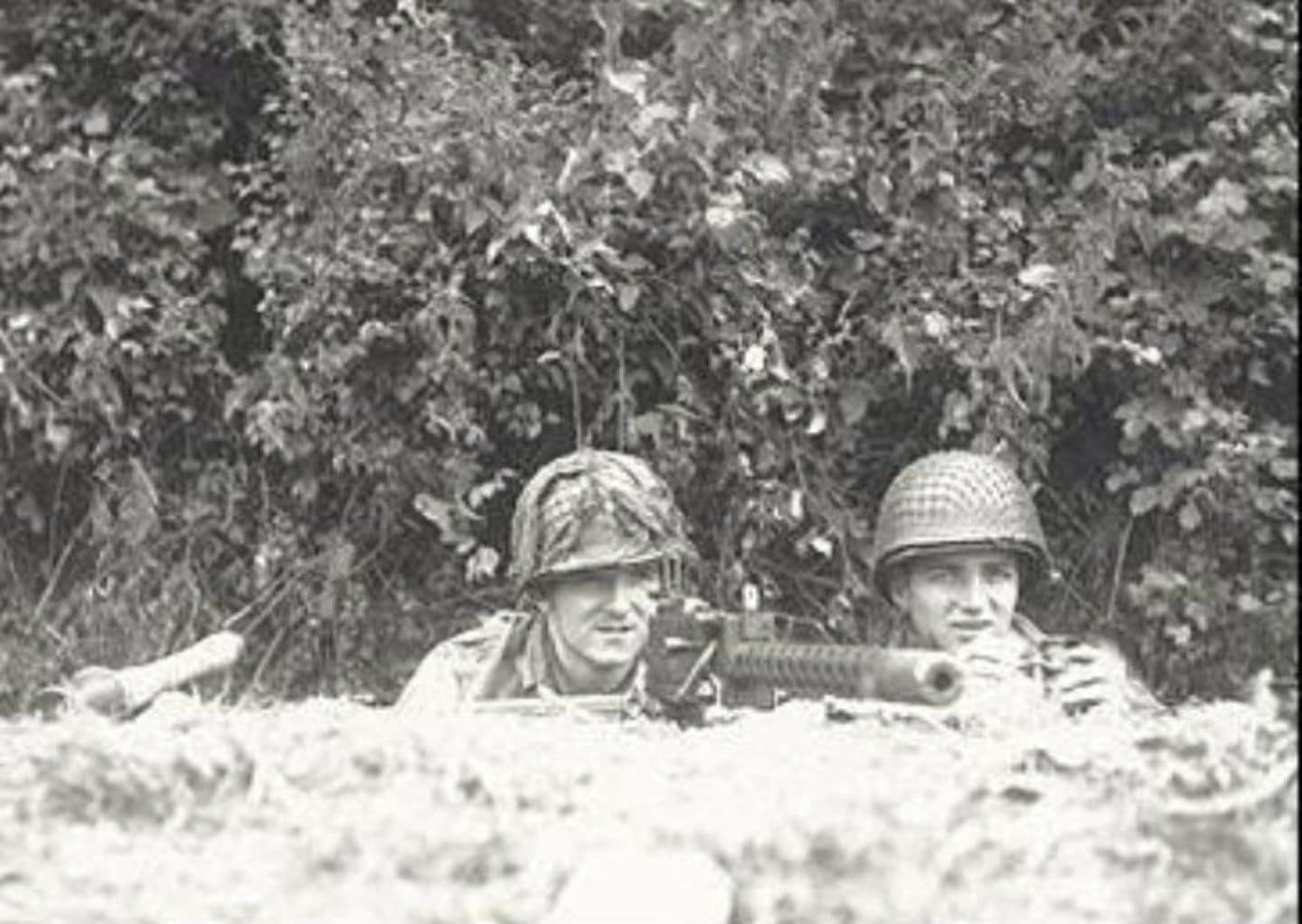
German armoured counterattack against Carentan
The Battle of Bloody Gulch was fought on 13 June 1944, just west of Carentan, Normandy. The battle followed immediately after 101st Airborne Division’s capture of Carentan on 12 June. Lightly armed American paratroopers from 506th (PIR) Parachute Infantry Regiment and 501st PIR faced a major armoured counterattack by the 17th SS Panzergrenadier Division and Fallschirmjäger-Regiment 6. The timely arrival of the American 2nd Armored Division saved the day and turned the battle into an American victory.
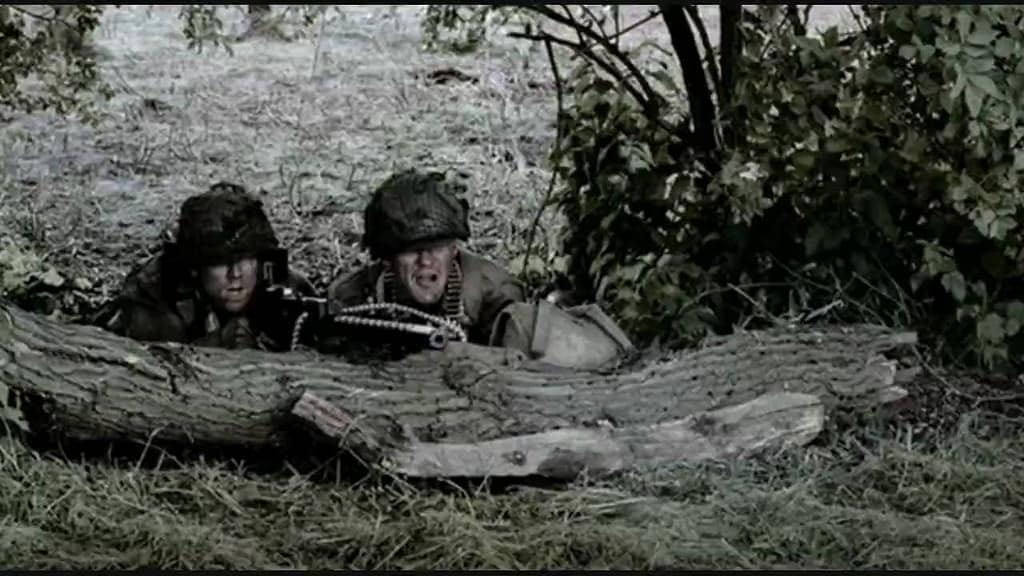
Bloody Gulch features in the Tom Hanks/Steven Spielberg production ‘Band of Brothers’ Episode 3 ‘Carentan’. The episode depicts the initial contact on the night of 12 June, preparations for an American dawn assault, the German armoured counterattack and, finally, the arrival of Combat Command A, 2nd Armored Division that ended the German counterattack.
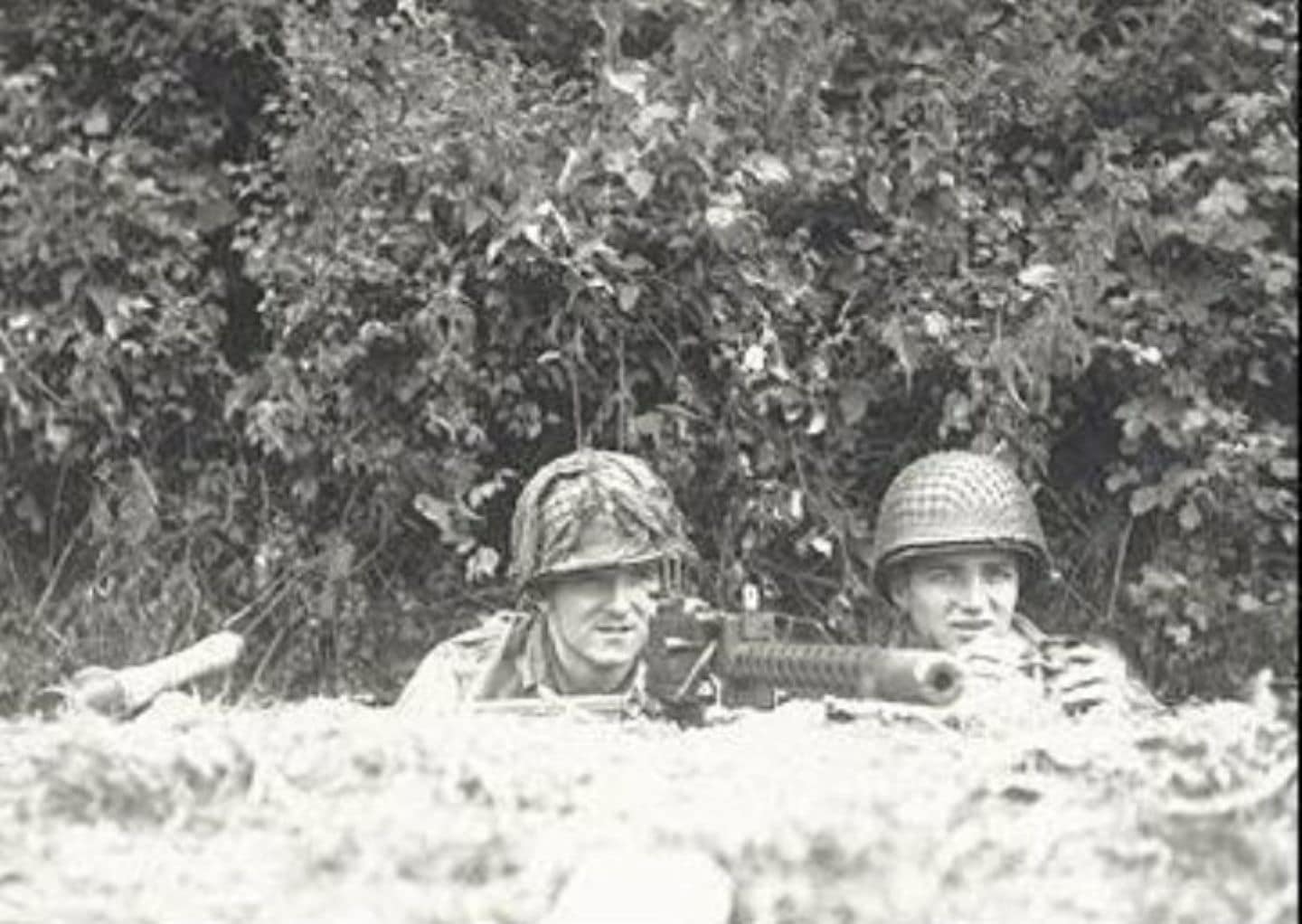
Key facts
Google Earth map – Location of Bloody Gulch battlefield
🧭🥾 Walking the Battlefield
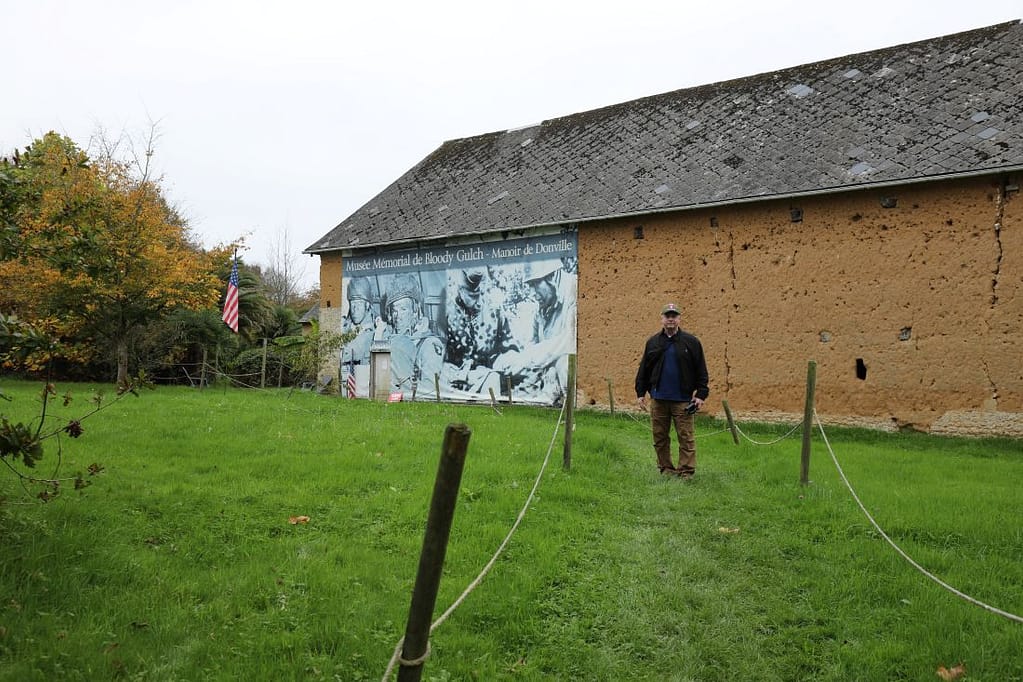
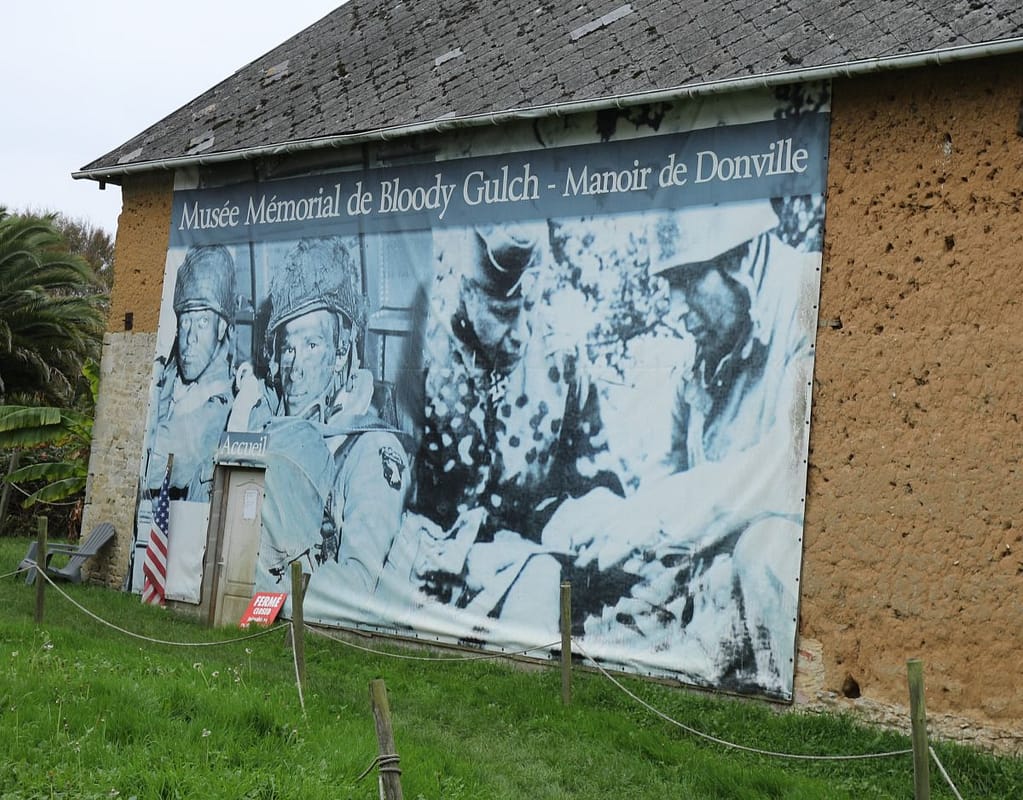
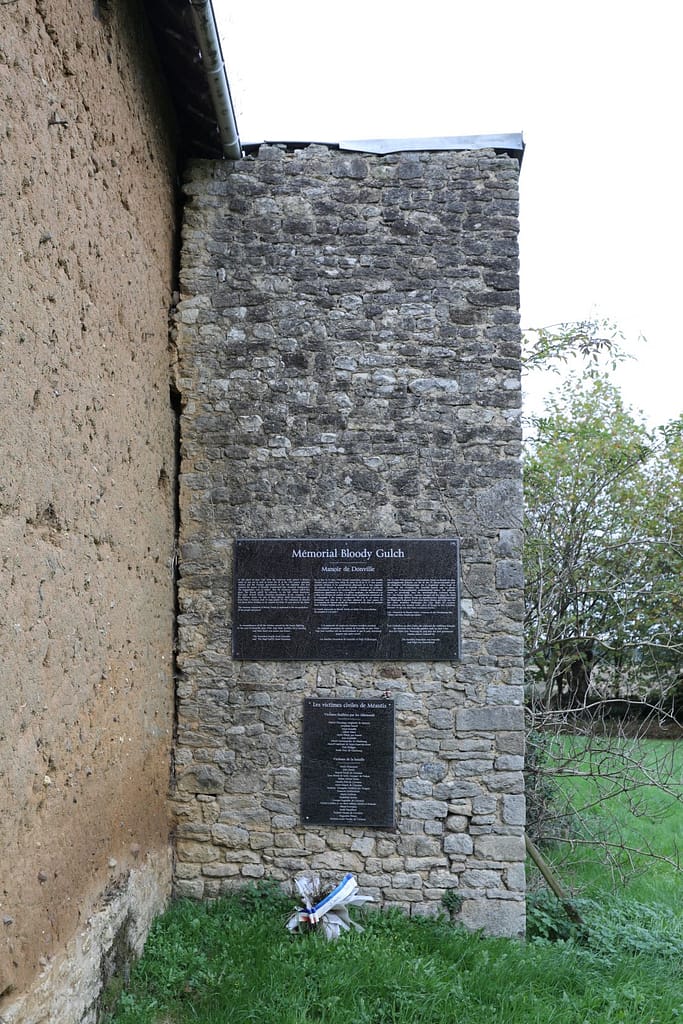
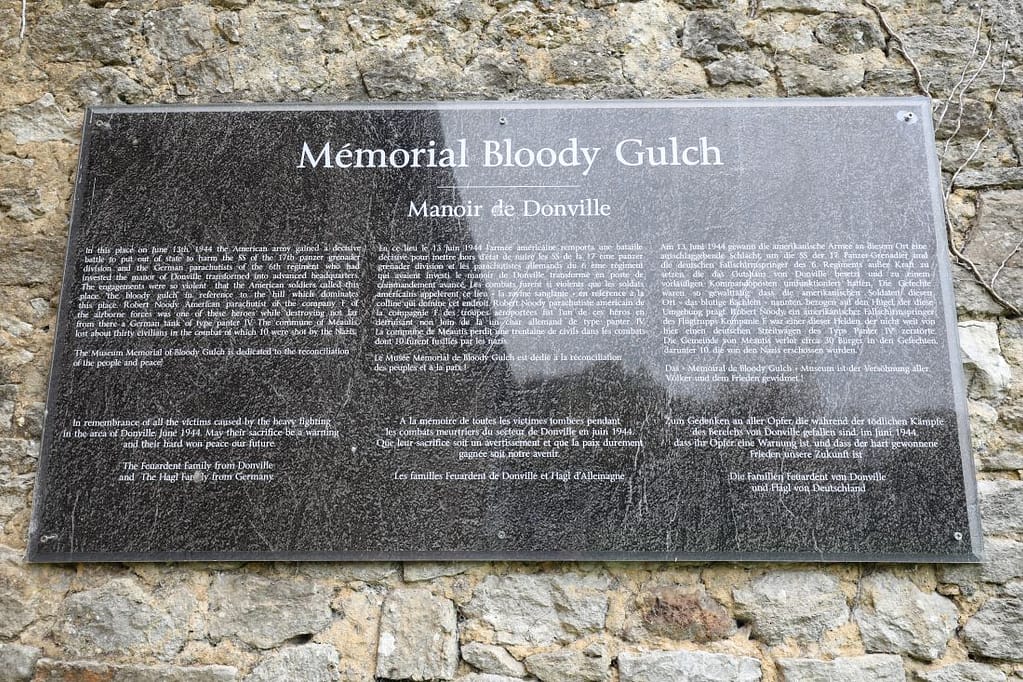
I visited the Bloody Gulch battlefield in November 2024, armed with unit histories, several memoirs by Easy Company members, maps, diagrams, photographs, and a detailed GIS analysis to help me precisely locate the battlefield events. Fortunately, much of the battlefield is largely untouched since 1945 and is very recognisable. The railroad track, roads and field boundaries are mostly as they were in 1945, making it quite easy to orient on the battlefield. Manoir Donville (headquarters for 17th SS Division during the battle) is now a small museum covering the events of 13 June 1944.
For those who prefer to listen, this article is also available as a 48 minute podcast
Tip: If Podbean overlay appears after pausing, click the × in the top-right corner to return to the player controls.
Normandy series of battlefield studies
This article is part of a series exploring the D-Day airborne and amphibious battlefields on 6 June 1944 and the immediate aftermath. Click on the hotlinks to open the battlefield study.
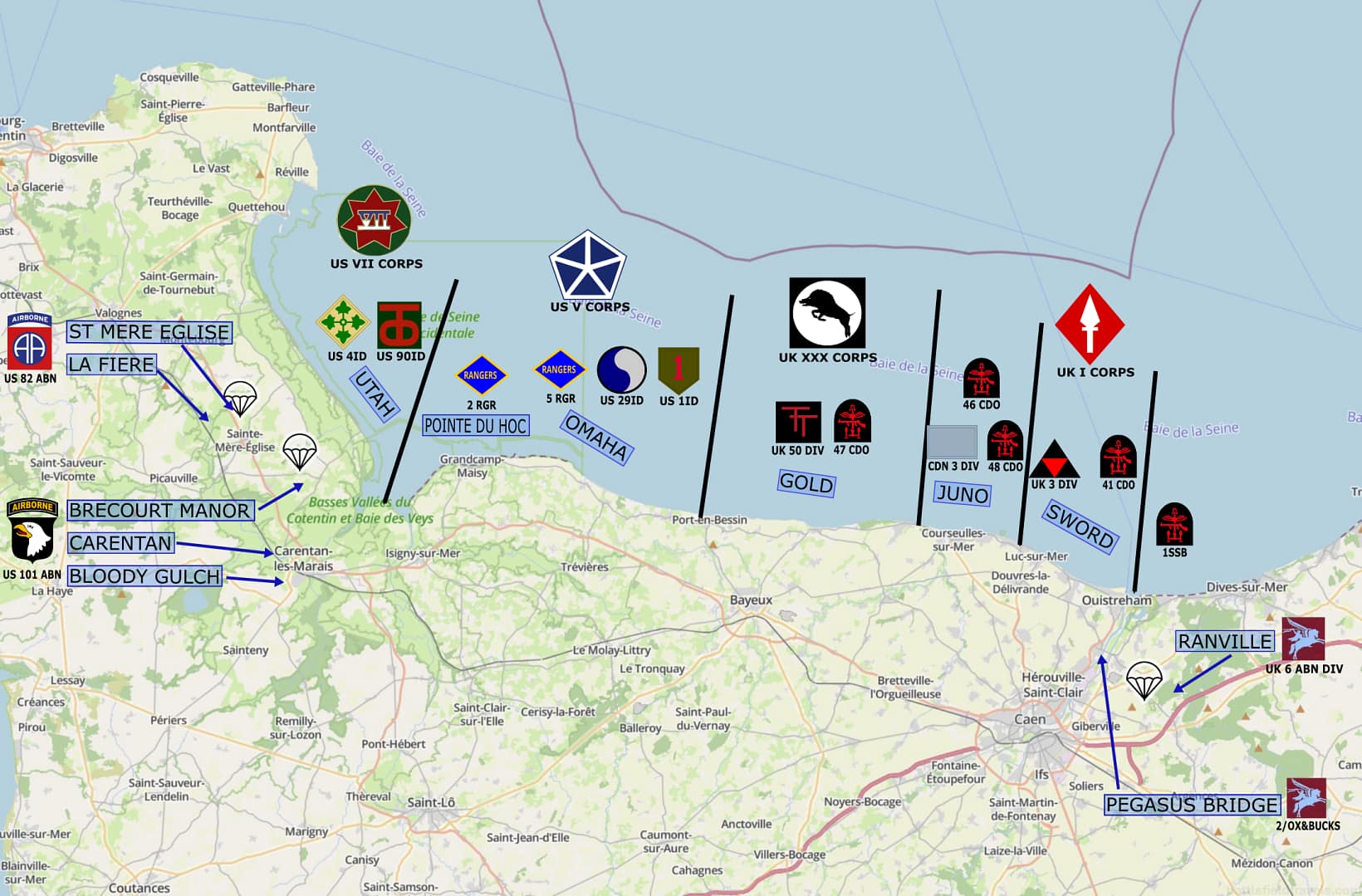
BATTLE OF BLOODY GULCH, 13 June 1944
Strategic Context: Why Carentan was critical to Operation OVERLORD
The Battle of Bloody Gulch was the closing act in a sequence of linked operations that began in the dark, chaotic hours before dawn on 6 June 1944. For the men of the U.S. 82nd and 101st Airborne Divisions, it was part of a continuous fight — from scattered landings in the flooded Norman fields, through the struggle for causeways and bridges, into the street fighting at Carentan — that had stretched for eight straight days.
D-Day – The American Airborne Mission
In the early hours of D-Day, two entire U.S. airborne divisions were dropped into the Cotentin Peninsula (see D-Day: US Airborne operations). Their objectives were ambitious:
- 82nd Airborne Division – Seize Sainte Mere Eglise and hold the Merderet River crossings. The 82nd’s task was to capture the key town of Sainte-Mère-Église with its vital road junctions, and to seize and hold key crossing points over the Merderet River, most famously the La Fière bridge and causeway. This fight — a brutal, four-day struggle — blocked German armour from counterattacking Utah Beach from the west and became one of the division’s defining actions. (See: Battle of La Fière Bridge)
- 101st Airborne Division – Open the causeways from Utah Beach. The 101st’s mission was to secure the four causeways leading inland from Utah Beach. The Germans had flooded the hinterland behind the beach, so the causeways were critical for getting the troops off Utah Beach. The 101st would then push south to block German movements toward the landing area. On the morning of 6 June, scattered paratroopers were already fighting to seize and hold these narrow exits across the flooded lowlands. That same day, a small force from Easy Company, 506th PIR, led by Lieutenant Richard Winters, famously eliminated a German battery at Brécourt Manor, silencing guns that were shelling the Utah Beach exits. (See: Brécourt Manor Assault).

The Road to Carentan
The town of Carentan was the key to linking the two U.S. beachheads at Omaha and Utah. Without it, the American lodgement in Normandy would remain split, and the Germans could concentrate against one beachhead at a time. Carentan’s road and rail links, plus its strategic location at the base of the Cotentin Peninsula, made it a prize neither side could afford to lose.
From 10 to 12 June, the 101st Airborne fought its way into Carentan. 502nd PIR fought its way in from the north across the Douve and Madeleine Rivers, while 327th GIR attacked from the west along the Isigny Road. After brutal fighting on the outskirts of Carentan, particularly along what would become known as ‘Purple Heart Lane’, the 101st broke into the town by the evening of 11 June.
The bulk of the German defenders, their ammunition almost exhausted, evacuated the town on the night of 11/12 June, leaving behind a two-company rearguard. On the morning of 12 June, 506th PIR and 1-401st GIR resumed the assault from the southwest and east, linking up in the town centre around 0730hrs. (See: D-Day: Battle of Carentan)
⚔️ Go deeper — Members get exclusive access to the Deep Research Collection, Field Notes, and monthly Research Dispatches. Try membership free for 7 days, cancel anytime. From $9/month.
The German Riposte
The German high command reacted immediately. The 17th SS Panzergrenadier Division Götz von Berlichingen, newly arrived from Thouars after a week of road movement under constant Allied air attack, linked up with the survivors of Fallschirmjäger-Regiment 6 to the west of Carentan. The combined force was short of tanks, but did have Sturmgeschütz assault guns and Marder self-propelled guns. The lightly armed American paratroopers would be completely overmatched.
The German mission was to retake Carentan and drive a wedge between the Omaha and Utah beachheads before they could be fully linked. The plan called for a concentrated thrust west of Carentan along the Baupte and Périers roads, hitting the lightly armed 101st Airborne before U.S. armoured reinforcements could arrive. The ground they would attack across was classic bocage — small fields bordered by tall, thick hedgerows — perfect for concealing infantry and channelling armour.
That thrust, and the American stand against it, would give the name “Bloody Gulch” to the sunken lanes just west of the town.
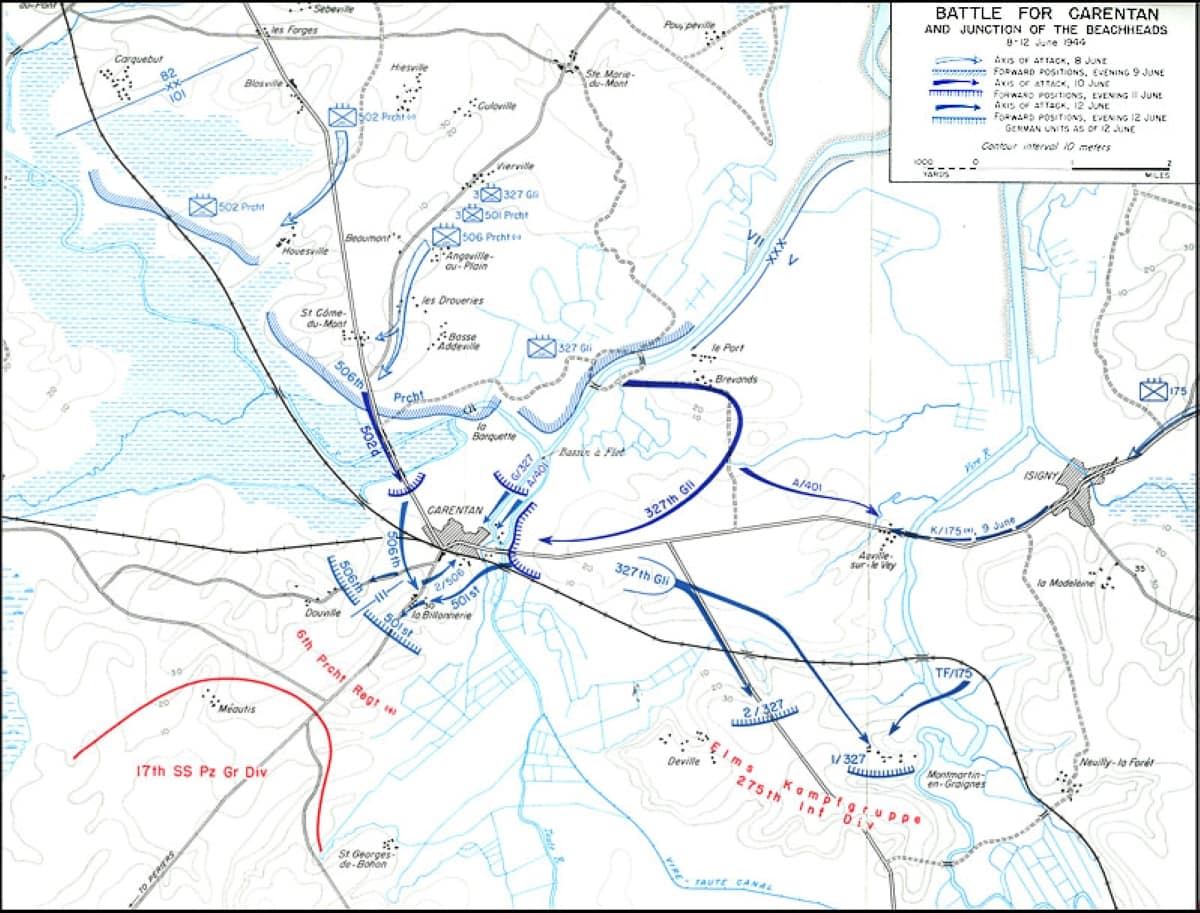
Opposing forces: 101st Airborne Division versus German SS Panzergrenadiers and Fallschirmjäger
 American
 American
Overall command. The U.S. forces at Bloody Gulch were part of Major General J. Lawton Collins‘ US VII Corps, which included the two airborne divisions and the forces landing at Utah Beach. On the ground, the key commander for the paratroopers was Brigadier General Anthony McAuliffe, acting as tactical coordinator in the Bloody Gulch sector.
Airborne infantry. The main defensive line around Bloody Gulch was held by the 506th Parachute Infantry Regiment (PIR), with 2nd Battalion forming the core of the defence west of Carentan.
- 2-506th PIR:
- Easy Company, anchored on the railway embankment north of the Baupte road.
- Dog Company, held the centre, with a forward platoon positioned near a small farmstead.
- Fox Company, extended the line toward the left flank, adjacent to the Carentan–Baupte road.
- 501st PIR – Positioned on the left flank toward Hill 30, blocking approaches from the southwest.
- Additional elements – Scouts and mortar sections from 502nd PIR were in depth, prepared to reinforce weak points.
Armoured Reinforcements. The armoured units that intervened decisively on 13 June 1944 were from Combat Command A, 2nd Armored Division – Held in reserve inside Carentan until mid-afternoon on 13 June. This force comprised:
- Two companies of M4 Sherman medium tanks.
- Armoured infantry in M3 halftracks.
- Self-propelled artillery and tank destroyers (notably M10s).
 German
 German
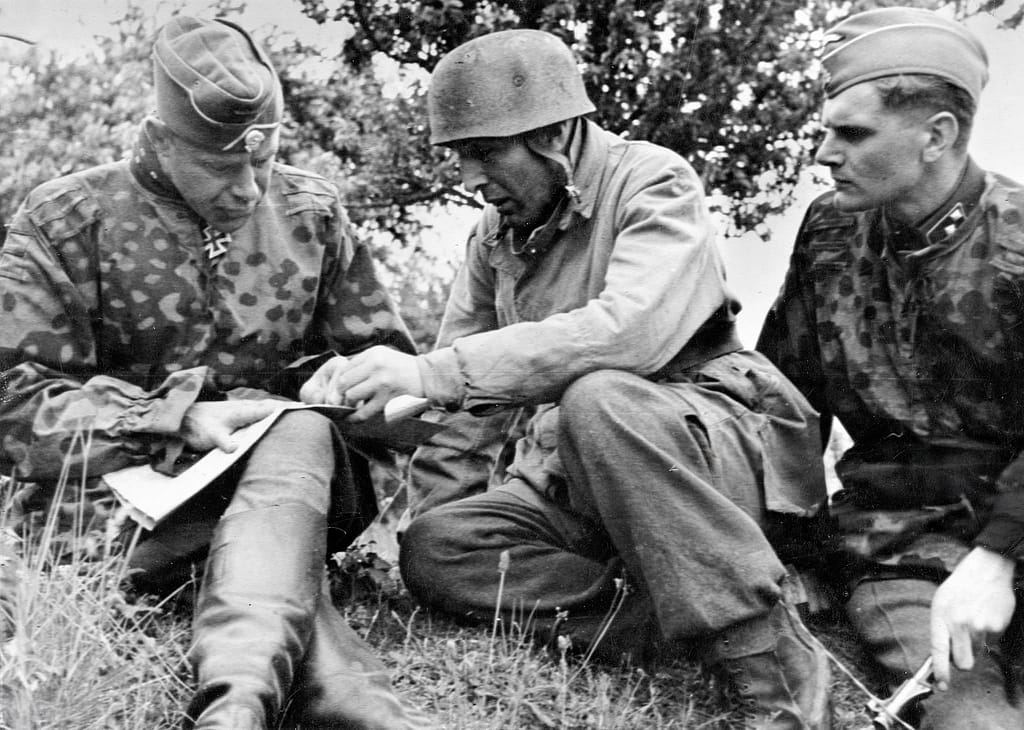
Overall Command. The attacking force was led by SS-Brigadeführer und Generalmajor der Waffen-SS Werner Ostendorf, commanding 17th SS Panzergrenadier Division ‘Götz von Berlichingen‘, working closely with Oberst Friedrich August Freiherr von der Heydte, commander of Fallschirmjäger-Regiment 6. The German force comprised:
- Fallschirmjäger-Regiment 6, which had been defending Saint-Come-du-Mont and Carentan largely on its own against the growing numbers of American forces. The Regiment had been battered over the previous week of constant fighting, but was still a tough, veteran unit.
- 17th SS Panzergrenadier Division was stationed around Thouars, west of Paris, and received orders to move to Normandy on 6 June. Short on transport, and harassed by allied airpower, the 17th SS Division took nearly a week to arrive. By 12 June it was massing west of Carentan and had linked up with Fallschirmjäger-Regiment 6. 17th SS Division had few tanks, but did have Sturmgeschütz assault guns and Marder self-propelled guns.
Evening of 12 June – Contact in the hedgerows
101st Airborne Division pushes out from Carentan
With Carentan in American hands by late afternoon on the 12th, McAuliffe pushed elements of the 506th PIR west and southwest to form a screen against any counterattack. This was not a strong defensive posture — the paratroopers were lightly armed, tired, and had been fighting almost continuously since the early hours of D-Day.
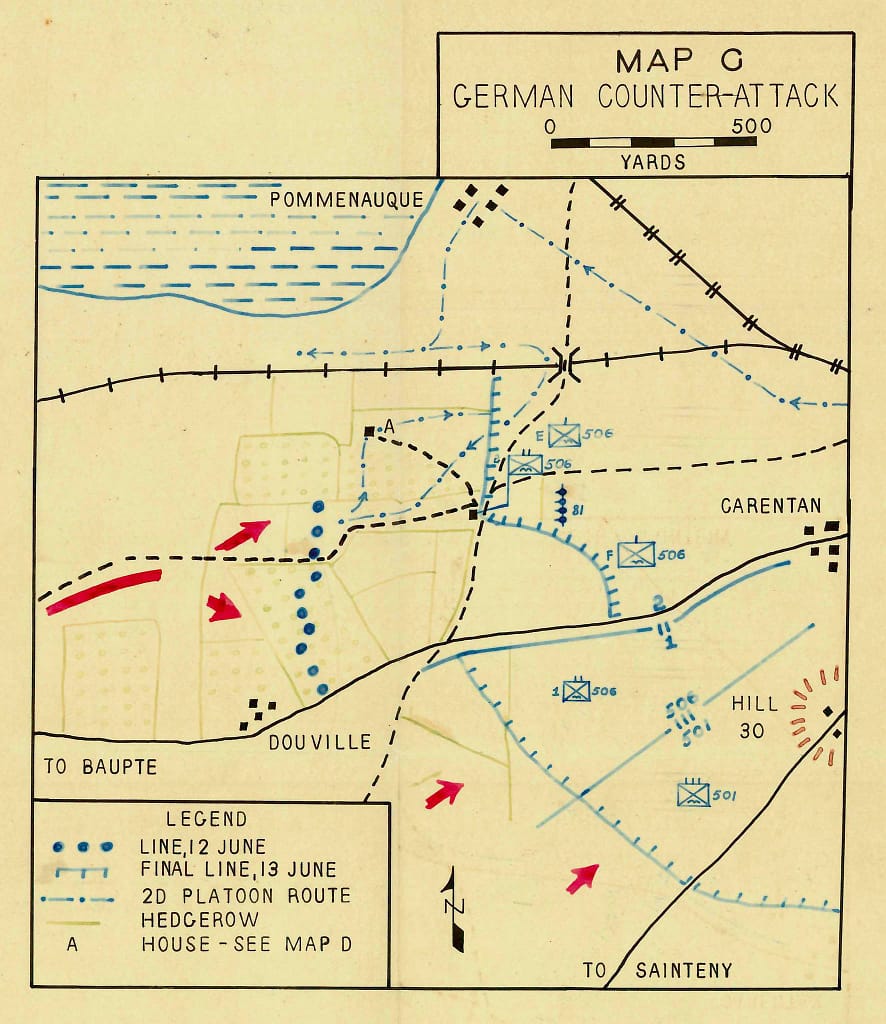
In the fading light, 2nd Battalion, 506th PIR took up positions along a rough north-south line west of the town. Easy Company held the right flank, their line running up to the railway embankment. Dog Company was in the centre, with one platoon pushed forward to a small farmstead. Fox Company occupied the left flank astride the Carentan–Baupte road. South of the Baupte Road, 1-506th PIR and 501st PIR extended the line around Hill 30, covering the southern approaches.
The ground they held was classic bocage country — narrow sunken lanes, hedgerows thick with bramble and hawthorn, small fields barely larger than a tennis court, and the occasional stone farm building offering a commanding view over the adjacent fields. The fields were mostly waist-high in summer growth, with drainage ditches in between. In daylight, it was hard to move unseen; at night, it was a defender’s paradise.

An uneasy night
After dark, the Germans tested the line. Reconnaissance patrols probed forward from Manoir de Donville — now serving as the headquarters for the 17th SS Panzergrenadier Division. The Americans replied in kind, sending their own patrols out to gauge the enemy’s positions. Flares illuminated the hedgerows in brief, harsh flashes of light, but there was no sustained fighting. Both sides were conserving their strength for the morning.
For the men in the line, it was an uneasy night. Occasional bursts of automatic fire or the distant thump of mortars punctuated the darkness. Orders came down for the battalion to be ready to attack at first light and push the perimeter further west. Ammunition was distributed, positions were improved as best they could be in the dark, and the paratroopers tried to rest where they could — cramped in foxholes, lying in the damp undergrowth, or leaning against the roots of hedgerow trees.
What none of them could know was that the Germans, too, were preparing to attack at dawn — and that their blow would fall first.
Morning of 13 June – The German Counterattack
Dawn armoured attack
At first light on 13 June, the Americans prepare to advance. Instead, it was the Germans who struck. Just after sunrise, the hedgerow line ahead of 2/506 erupted in the concussive thuds of incoming artillery. Mortar bombs and shell bursts tore into the American positions, throwing dirt and splinters into the air, cutting gaps in the hedgerow crowns, and showering foxholes with clods of earth.
Through the haze, Panzergrenadiers advanced in short rushes, moving from cover to cover, their movements masked by the bocage. German armour— Sturmgeschütz III assault guns and Marder self-propelled guns—nosed forward along the sunken lanes.
Fox Company falls back
The weight of the German assault fell on the seam between Fox and Dog Companies, where the Baupte road cut through the hedgerow. Fox Company, already stretched thin, began to take casualties from both artillery and the flat-trajectory fire of the assault guns. As the pressure mounted, the company commander gave the order to fall back to the next hedgerow. This withdrawal was made under fire, and though tactically sound, it left Dog Company’s left flank exposed.
Dog Company’s fight for the farmhouse
Dog Company now found itself fighting on two fronts — the Germans pressing them from the west while probing into their now open left flank. The forward Dog Company platoon at the farmstead was hit hard. German infantry used the farm’s outbuildings and stone walls as cover, forcing the paratroopers into close-range fighting. Grenades, automatic fire, and even bayonets were brought into play as both sides tried to secure the position.
In the centre, the assault guns worked forward methodically, using the cover of the lanes to close the distance before firing high-explosive rounds into suspected positions. Bazooka teams moved between gaps in the hedgerows, firing from close range and then melting away to avoid the return fire.
Easy Company’s left flank actions
On the American right flank, Easy Company under Lieutenant Richard Winters was anchored on the railway embankment. The embankment itself provided a natural breastwork, and its raised track bed allowed the men to fire down into the adjacent fields. When a German assault gun tried to advance through the low ground toward Easy’s open left, Lieutenant Harry Welsh and Private McGrath stalked it with a bazooka, closing to dangerously short range before knocking it out.
The German attack was coordinated and aggressive, but the bocage worked both ways. Every hedgerow was another defensive line, every gap a potential kill zone. The Americans were being pushed back, but they were exacting a toll. By mid-morning, the situation was deteriorating. Ammunition was running low in some sectors, the left was unstable, and the Germans were pressing steadily closer to Carentan.
In the command posts behind the line, radio messages reflected the rising urgency. McAuliffe knew that without reinforcement, the 101st’s perimeter could crack — and if it did, the Germans would have a clear run into Carentan itself.
13 June – Midday crisis and the call for support
By late morning on 13 June, the German attack had ground forward into dangerous proximity to Carentan. The pressure along the Fox–Dog seam had already forced withdrawals, and while Dog Company had fought stubbornly around the farmstead, the position was becoming untenable.
In the battalion CP, runners and radio operators relayed fragmentary reports: sections out of ammunition, bazooka teams reduced to scavenging rockets from the wounded or dead, and mortar crews firing their last rounds. The hedgerow lines still held, but only just — the Germans were exploiting every fold of ground to creep closer, supported by the accurate and devastating fire of their assault guns.

Situation at midday
Easy Company remained the most solid anchor, their embankment position allowing them to hold the right flank. But even here, casualties were mounting. On the American left, the situation was more fluid. Fox Company’s initial withdrawal had created a bend in the line, forcing Dog Company to swing back, and though both had been pushed forward again under orders, the cohesion was fragile. German infantry were pressing into the folds of ground between the hedgerows, close enough at times to hear shouted insults or grenade strikers being activated.
Call for reinforcements
It was at this point that McAuliffe, gauging the seriousness of the threat, decided to call for armour. The request went to the 2nd Armored Division — specifically to Combat Command A (CCA), which had been held in reserve in and around Carentan since the town’s capture. The request was to move immediately to the west of Carentan, link up with the 101st, and halt the German attack.
In the minutes after the call went out, the paratroopers in the line fought to buy time. Every hedgerow was defended as if it were the last. Bazooka teams hunted assault guns like quarry, waiting in the shadows for the telltale engine note. Mortar fire was walked onto German forming-up points whenever an observer caught sight of movement in the rear fields.
Soldiers recalled that the heat, the smoke, and the tension gave the hedgerows a claustrophobic, almost tunnel-like quality. For the men holding the line, there was no sense of the larger battle — only the immediate task of keeping the enemy from coming through their piece of bocage. Somewhere behind them, in Carentan’s narrow streets, the sound of tank engines was growing louder.
Afternoon of 13 June – American counterattack
Arrival of CCA/2nd Armored
Shortly after midday, the distant rumble of tank engines could be heard at Bloody Gulch. For the men of the 101st, pinned in their hedgerows, it was the most welcome sound they’d heard all day. Combat Command A of the 2nd Armored Division was on the move — Shermans, M10 tank destroyers, halftracks full of armoured infantry, and self-propelled artillery — clattering down the narrow streets of Carentan and out toward the fighting.
The leading elements reached the paratrooper positions around mid-afternoon. There was no time for detailed coordination. Instead, tank commanders took quick briefings from company and platoon leaders at the hedgerow edges, pointing out German firing points, assault gun locations, and the routes into the bocage lanes.

Counterattack
Shermans rumbled forward along the lanes, each one backed by a small escort of armoured infantry and often shadowed by a few paratroopers who knew the ground. Their 75mm guns fired high-explosive shells into suspected German positions, blowing gaps in hedgerows and knocking out machine-gun nests. The M10 Wolverine Tank Destroyers, with their high-velocity 3-inch guns, engaged the German assault guns head-on.
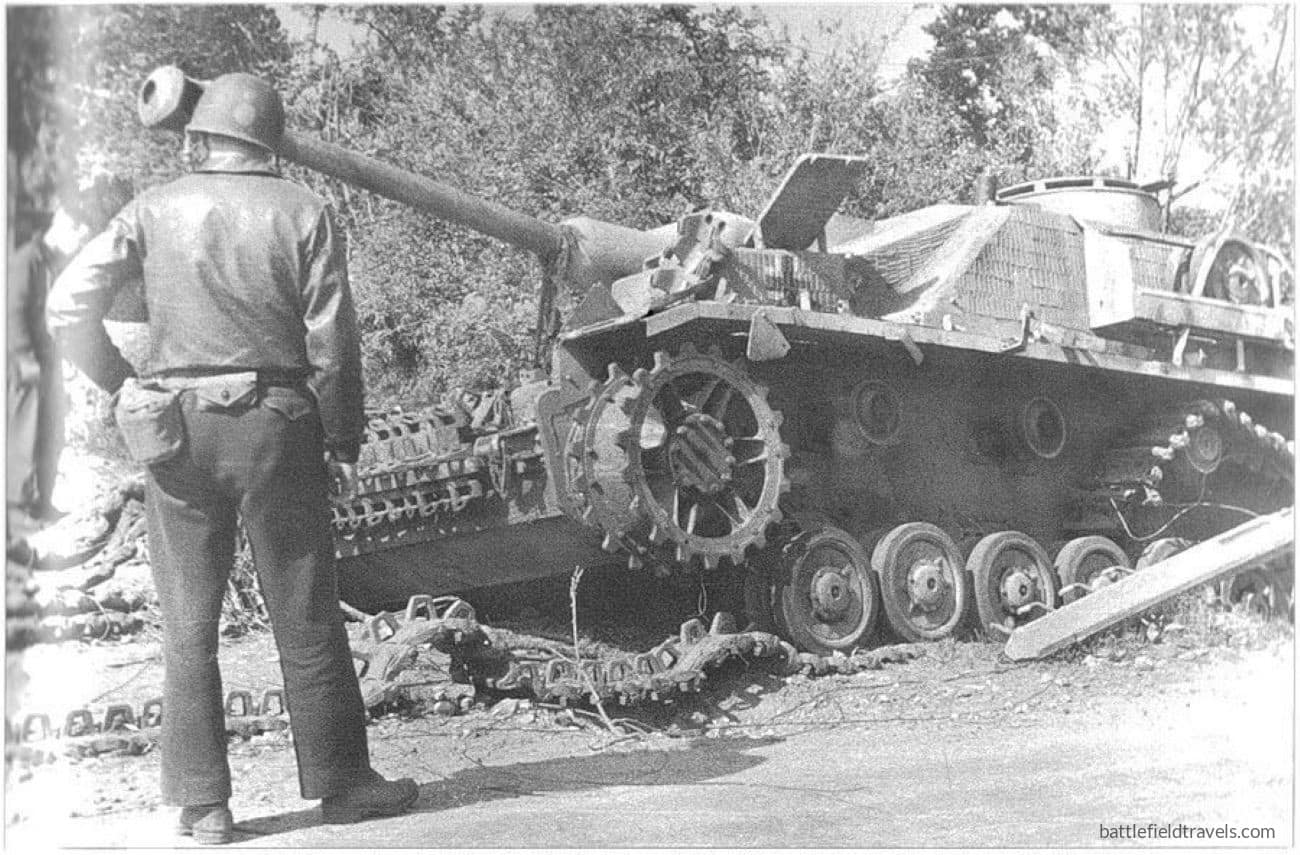
The Germans, already committed to their forward momentum, were caught off-balance by the sudden appearance of American armour. Panzergrenadiers began to pull back, harried by tank and artillery fire. Several Sturmgeschütz were destroyed in quick succession — one near the Baupte road, another immobilised and abandoned after taking a hit through its running gear.
In the centre, Dog Company’s survivors were able to reoccupy their forward hedgerow with the help of the tanks, clearing the farmstead that had been the scene of such bitter fighting earlier in the day. On the right, Easy Company pushed forward from the railway embankment, linking up with armoured infantry to secure the open ground toward Hill 30.
German retreat
By late afternoon, the momentum had shifted decisively. The German attack collapsed into a series of local withdrawals, covered by rearguard fire from machine guns and mortars. Allied fighter-bombers, alerted to the retreat, strafed and bombed suspected assembly areas to the west.
The counterattack didn’t just stop the German advance — it drove them back beyond the ground they had gained that morning. By evening, the bocage west of Carentan was quiet again, save for the occasional crack of a rifle or burst of automatic fire.
For the men of the 101st, the arrival of CCA had been nothing short of salvation. Without it, the morning’s hedgerow fighting might well have ended with German troops in the outskirts of Carentan, and the fragile link between the Utah and Omaha sectors severed before it had even been properly established.

Evening of 13 June – Consolidation and Aftermath
As the light began to fade on 13 June, the bocage around Bloody Gulch fell largely silent. Pockets of German resistance still clung to isolated hedgerows, sniping or firing a last few mortar rounds before slipping away westward under the cover of the thickening summer dusk. American tanks held their ground at the forward hedgerows, barrels pointed toward the west, while paratroopers picked their way through the lanes to confirm the enemy had truly gone.
The 2nd Armored Division halted rather than press too far into unfamiliar ground at night — an understandable caution in the labyrinth of hedgerows, where every field corner could conceal an anti-tank gun. Engineers began improving defensive positions, wiring gaps in the bocage and laying out sectors of fire. Medical teams moved forward to collect wounded who had lain out in the fields for hours, some hidden in ditches and shell holes since the first German assault.
Casualties and materiel losses
For the 101st Airborne, the day’s toll was heavy. Easy, Dog, and Fox Companies had each lost men — some to artillery, others in close-range firefights across hedgerow banks barely ten metres apart. Officers and NCOs had been killed or wounded at a rate that would strain any unit. Fox Company, already in the spotlight after its morning withdrawal, was down to a fraction of its strength. Even those physically unscathed were exhausted by the full day’s fight against an enemy who, until mid-afternoon, had seemed on the brink of breaking through.
German losses were also significant. Several Sturmgeschütz and Marder self-propelled guns lay wrecked in the fields west of Carentan, along with scattered halftracks and trucks abandoned during the retreat. Dead and wounded panzergrenadiers and fallschirmjager marked the line of their morning advance; others had been left behind in the farmstead that Dog Company retook in the afternoon. Allied intelligence estimated total German casualties for the day at around 200, roughly matching American losses, though the destruction of much of the attacking armour gave the Allies a greater tactical edge.
Operational Significance
The victory at Bloody Gulch was more than just a local defensive success. It secured the western approaches to Carentan at a point when the new link between the Utah and Omaha beachheads was most vulnerable. A German breakthrough that day could have split the American forces and delayed the full consolidation of the Normandy front by days, perhaps even weeks.
Moreover, the battle marked the first major combat for the 17th SS Panzergrenadier Division in Normandy. Their failure to break the paratroopers’ line — even before 2nd Armored’s arrival — hinted at the increasing difficulty German commanders would face when trying to mount counterattacks against the growing Allied build-up.
In the coming days, Carentan became the launch point for operations toward Saint-Lô and the eventual breakout from the bocage. For the veterans of the 101st, however, Bloody Gulch was remembered not as a stepping stone but as a day when they had stood in the hedgerows, outgunned and nearly outflanked, and still held long enough for help to arrive.
The Bloody Gulch battlefield today
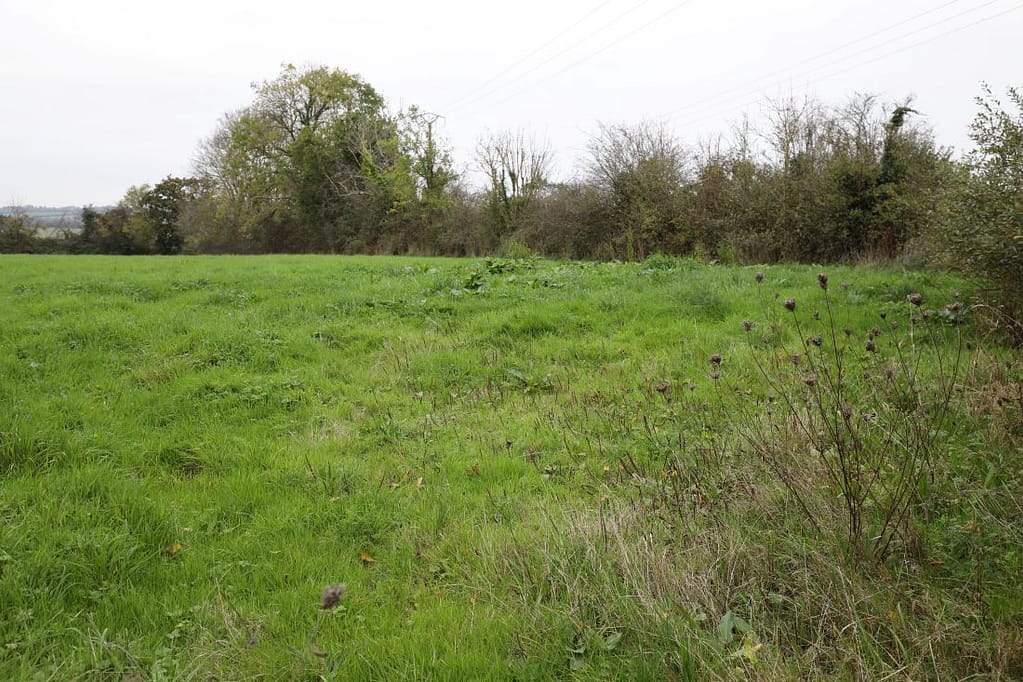
Standing in the lanes and fields west of Carentan, it is not difficult to imagine the morning of 13 June 1944. The sunken roads are still there, flanked by high bocage banks that block the view until you step right up to them. The field boundaries — so important in the fight — remain largely unchanged from 1944, an almost perfect overlay when plotted in GIS against period aerial photographs.
The impact of micro-terrain (small scale terrain features that often do not appear on maps and can only be seen when you are standing on the ground) at Bloody Gulch is striking. Commanders on both sides used the cover and concealment provided by hedgerows and shallow reentrants to move forces and achieve fire dominance. The channeling effect of the micro-terrain forced German armour down predictable avenues, or exposed vulnerable underbellies as vehicles crested the hedgerows. The concept of exploiting small scale terrain features in battle is examined further in the Micro-Terrain and Battlefieldd Decision-Making research hub.
Manoir Donville Museum and German assembly area
Manoir Donville, headquarters of 17th SS Panzergrenadier Division during the battle, is largely unchanged sincw 1944. Today it serves as a small private museum, with displays of weapons, uniforms, and maps from the battle. Just beyond its walls lay the assembly areas where German panzergrenadiers and paratroopers formed up before pushing east towards the American lines.
Link to the Manoir Donville, Museum of Bloody Gulch
Preserved bocage and the 506th PIR Positions
The position once held by Easy Company lies along a hedgerow near the railway line embankment. While access is limited — most of the land remains private farmland — the lanes leading up to it still offer much the same perspective the paratroopers had in 1944. The site of Dog Company’s farmhouse objective survives as a working farm, its outline recognisable despite post-war changes to the buildings.
The area defended by Fox Company has not fared as well. Modern development has covered much of the ground with a dairy factory complex, erasing most visible traces of the hedgerows they fought to hold. Yet even here, old aerial photos matched to modern satellite imagery show exactly where the lines once ran.
Visitor Access and Recommended Walking Routes
A short drive east into Carentan offers further context. The town’s road and rail junction — the prize both sides fought over — is easy to explore on foot. Easy Company’s attack on the Rue Holgate T-Junction on the morning of 12 June is easy to locate.
For those following the broader campaign, Sainte-Mère-Église, the La Fière bridgehead, Brécourt Manor gun position, and Utah Beach are all within short driving distance. Linking these sites together provides a complete picture of the 82nd and 101st Airborne’s first week in Normandy, from their scattered D-Day drops to the moment they secured Carentan’s approaches at Bloody Gulch.
Further reading on battlefieldtravels.com
- La Fière Bridge – 82nd Airborne’s fight for the Merderet crossings
- Carentan – The battle that set the stage for Bloody Gulch
- Brécourt Manor Assault – Silencing the guns firing on Utah Beach
- Normandy Methodology – How I research and map battlefields
Additional images of Bloody Gulch
506th Parachute Infantry Regiment (PIR) positions at Bloody Gulch
Manoir Donville
Battle of Bloody Gulch depicted in HBO’s ‘Band of Brothers’


Found this useful? Buy me a coffee — it helps fund future battlefield research


Authored by Mick Prictor, a retired military officer with 40 years’ service, and a military historian specialising in terrain-focused analysis of tactics, doctrine, and command decision-making in land warfare. His work draws on extensive battlefield fieldwork—more than 280 sites worldwide—and one of the world’s largest private collections of historic military arms, uniforms, and equipment. About me
❓ Test Your D-Day Knowledge
Twenty questions covering the airborne operations, invasion beaches, commanders, forces and fighting of 6 June 1944.
20 questions · 60% to pass · expect a challenge
📚 Sources – Battle of Bloody Gulch
Primary Sources
- Unit After-Action Reports – 101st Airborne Division, 506th PIR, 501st PIR, and 2nd Armored Division, June 1944. US National Archives & Records Administration (NARA).
- War Diary – 17th SS Panzergrenadier Division “Götz von Berlichingen” – German operational logs from June 1944. Bundesarchiv-Militärarchiv, Freiburg.
- Map, Carentan–Bloody Gulch Sector, 1:25,000 scale, GSGS 4250, 1944 edition.
- Air Reconnaissance Photos, Carentan area, June 1944. National Collection of Aerial Photography (NCAP).
Memoirs & Eyewitness Accounts
- Winters, Richard D., and Cole C. Kingseed. Beyond Band of Brothers: The War Memoirs of Major Dick Winters. Berkley Caliber, 2006.
- Guarnere, William, and Edward Heffron. Brothers in Battle, Best of Friends. Berkley Caliber, 2007.
- von der Heydte, Friedrich August Freiherr. Daedalus Returned. Helios, 1979 – reflections from the German paratroop commander at Carentan.
- Donald R. Burgett. Currahee!: A Screaming Eagle at Normandy. Presidio Press, 1967.
Secondary Histories
- Ambrose, S. E. (1999). D-day, June 6, 1944: the climactic battle of World War II. Thorndike.
- Ambrose, S. E. (1992). Band of Brothers: E Company, 506th Regiment, 101st Airborne from Normandy to Hitler’s Eagle’s Nest. Touchstone, Simon & Schuster.
- Beevor, Antony. (2009). D-Day: The Battle for Normandy. Penguin Books
- Ryan, Cornelius (1959). The Longest Day: June 6, 1944. Simon and Schuster, New York.
- Niklas Zetterling (2000). Normandy 1944: German Military Organisation, Combat Power and Organisational Effectiveness, Winnipeg: J.J. Fedorowicz.
- Stephen Zaloga. US Airborne Divisions in the ETO 1944–45 (Battle Orders, 25). Osprey Publishing, 2007.
Online & Digital Resources
- US Army Center of Military History – Normandy Campaign Overview – history.army.mil
- WW2Talk Forum – Bloody Gulch Thread – ww2talk.com – community discussions with map overlays and period photos.
- Carentan Historical Centre – regional museum site with archives of photographs and oral histories.
- Geo-referenced Google Earth Battle Map – custom overlay of positions and movements, Battlefield Travels.
Films & Documentaries
D-Day 360 (PBS, 2014) – for lidar and 3D mapping of bocage terrain similar to the Bloody Gulch battlefield.
Band of Brothers, Episode 3: Carentan (HBO, 2001) – dramatised depiction of the events at Bloody Gulch.
📚 Further Reading – Battle of Bloody Gulch
This battle study nests within the broader analytical framework explored in the Research Hub, where operational methods, operating environments, armies, commanders, and weapons are examined across conflicts and eras. The links below connect related studies across the wider body of battlefield analysis on the BattlefieldTravels site.
⚔️ Explore all battle studies from World War Two 1939-1945
⚔️ Explore all battle studies involving Easy Company ‘Band of Brothers’ 506th PIR
🏛️Explore the museum of World War Two historic artefacts
The book list for this conflict includes the finest campaign studies, memoirs, and operational analyses available on the D-Day landings, selected specifically to complement this battlefield study.
📚World War Two – Recommended Reading
🗞️ For updates on new battlefield studies and research insights, you can subscribe to the Newsletter.
Related Battle Studies, Museum Pieces & Reading Resources
 ⚔️ D-Day: Brecourt Manor assault, Easy Company, 506th PIR,
6 June 1944
 ⚔️ D-Day: Sword Beach landings,
6 June 1944
 ⚔️ D-Day: Utah Beach landings,
6 June 1944
 ⚔️ D-Day: Battle for La Fière Causeway,
6-9 June 1944
 📝 🔒Field Note: XXX Corps Orders, Leopoldsburg, Belgium, 15 Sep 1944
 ⚔️ D-Day: Omaha Beach landings,
6 June 1944
🧭 Battlefield Travel Guide: Bloody Gulch (Normandy, 1944)
Getting There
- Nearest Town: Carentan-les-Marais, Normandy, France.
- Transport: Site lies just southwest of Carentan near Hill 30; access via D974/D913. Best visited by car.
- Parking: Small lay-bys near memorial markers; broader parking in Carentan town centre.
Site Orientation
- Key Landmarks: “Bloody Gulch” roadside memorial, Hill 30 ridgeline, hedgerow lanes and farmsteads where the 101st Airborne fought.
- Walking Routes: Short explorations along public lanes only; fields are private bocage farmland.
- Best Vantage Points: Lanes around Hill 30 give the clearest sense of the German approach and U.S. defensive positions.
Museums & Visitor Centres
- D-Day Experience / Dead Man’s Corner (Saint-Côme-du-Mont): Airborne and armoured fighting around Carentan, including 13 June.
- Airborne Museum (Sainte-Mère-Église): Wider context on the 82nd/101st Airborne operations.
- Manoir Donville: Bloody Gulch Museum and teh site of 17th SS Panzergrenadier Division headquarters during the battle.
On-Site Experience
- Interpretive Signage: Modest roadside panels near the memorial explain the German counterattack and U.S. defence.
- Atmosphere: Quiet, working farmland; the enclosed bocage still channels movement the way it did in 1944.
- Guides & Tours: Local guides from Carentan/Sainte-Mère-Église often include Bloody Gulch on airborne-focused itineraries.
Nearby Points of Interest
- Carentan: Town centre and canal bridges tied to the link-up of Utah and Omaha sectors.
- La Fière Causeway: Key 82nd Airborne battle west of Sainte-Mère-Église.
- Saint-Côme-du-Mont: Strongpoint on the Carentan approaches with museums and memorials.
Practical Tips
- When to Visit: Early morning/late afternoon for quiet lanes and best light; around 6 June the area is busy with commemorations.
- Facilities: None at the site; cafés, restrooms, and lodging in Carentan.
- Special Considerations: Respect private property; stick to public roads/paths. Narrow lanes—use hazard lights if stopping briefly for photos.
FAQ: Battle of Bloody Gulch (13 June 1944)
A clash on 13 June 1944, near Carentan, Normandy, between U.S. airborne troops (506th, 501st PIR) supported by tanks of Combat Command A, 2nd Armored Division, and German SS Panzergrenadiers and Fallschirmjager attempting to retake Carentan.
The name comes from a sunken lane west of Carentan where fierce close-quarters fighting took place, leaving many casualties on both sides. ‘Bloody Gulch’ was featured in the 1939 Jimmy Stewart movie ‘Destry Rides Again’, so was a pop-culture icon during WW2.
U.S. paratroopers from the 101st Airborne Division, reinforced by Sherman tanks, fought against elements of the 17th SS Panzergrenadier Division “Götz von Berlichingen” and Fallschirmjäger-Regiment 6.
The German counterattack was repelled, securing Carentan and linking up the Utah and Omaha Beachheads — a key objective of Operation Overlord.
Yes. The ground is accessible by local roads. Memorials mark the site, and nearby museums (like Manoir Donville and Dead Man’s Corner Museum) interpret the battle.
Subscribe to Battlefield Travels and receive a free E-Book Battlefield Guide
Unlock expert battlefield analysis, campaign reconstructions, and historical insights drawn from firsthand exploration and primary sources.
🗺️ You’ll receive:
🎖️ Exclusive historical insights you won’t find elsewhere
📘 A free eBook: 10 Tips for Exploring Historic Battlefields
📰 New battlefield studies straight to your inbox as they are published

⚔️ Go deeper — Members get exclusive access to the Deep Research Collection, Field Notes, and monthly Research Dispatches. Try membership free for 7 days, cancel anytime. From $9/month.