“They have us surrounded, the poor devils,” Colonel Henri Bouquet
The Battle of Bushy Run, fought on August 5-6, 1763, was a major engagement during Pontiac’s War, a widespread Native American uprising against British postwar policies in the Great Lakes region following the French and Indian War. The war was named after Pontiac, an Ottawa chief who led a coalition of tribes dissatisfied with British policies and expansion into their territories.
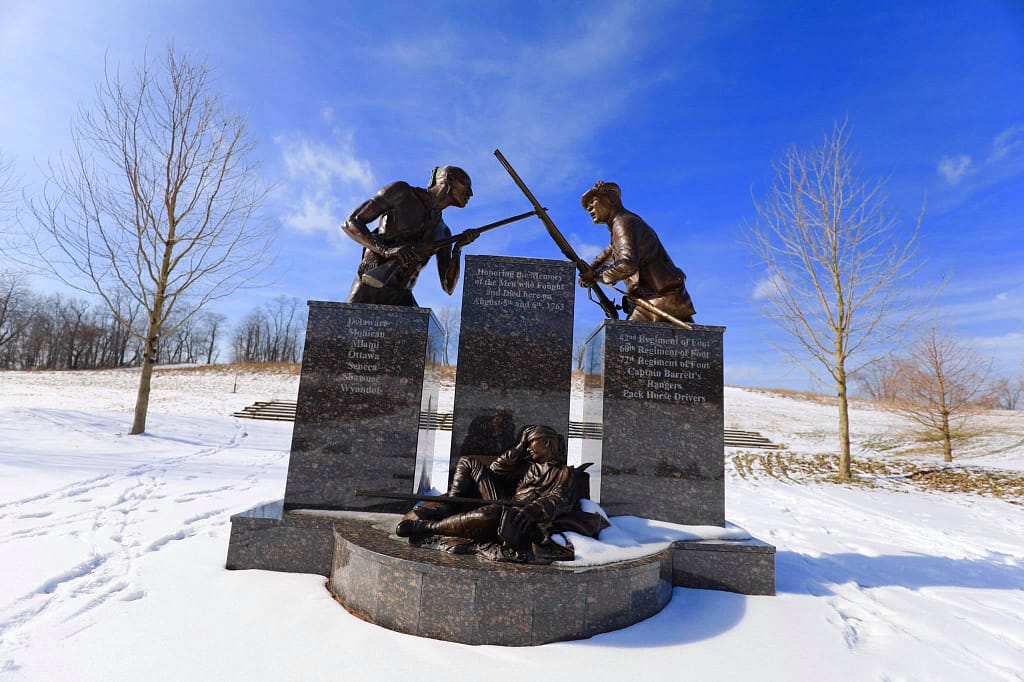
Key facts
Google Earth map – location of the Bushy Run battlefield
🧭🥾 Walking the Battlefield
I have been fortunate to visit the Bushy Run battlefield twice; the first time in June 1998, and the second time on 3 February 2019, on our way back from attending Groundhog Day at Punxsutawney PA, just a short drive away! I was armed with some good histories of the Seven Years War and Pontiac’s Rebellion, but also relied upon the local knowledge and records. Bushy Run, like most American battlefields, has an excellent visitor centre and the key sites on the battlefield are well signposted.
3D flythrough of the Bushy Run battlefield
3D Google Earth flythrough of the Bushy Run battlefield. Set to “Wha’ saw the 42nd?” Royal Regiment of Scotland Pipes and Drums. Click to play.
Strategic Context: Pontiac’s Rebellion
After the victory over France in the Seven Years War (known as the French and Indian War in North America) 1754-1763, the British Crown sought to tighten its control over former French territories, disregarding long-standing alliances and trade relations established by the French with various Native American tribes. This power shift led to widespread resentment among the tribes, culminating in coordinated attacks on British forts and settlements. The siege of Fort Pitt (modern-day Pittsburgh, Pennsylvania) by a confederation of Shawnee, western Delaware, Mingo and Seneca Indians became a focal point of the rebellion, prompting the British to dispatch a relief force to break the siege.
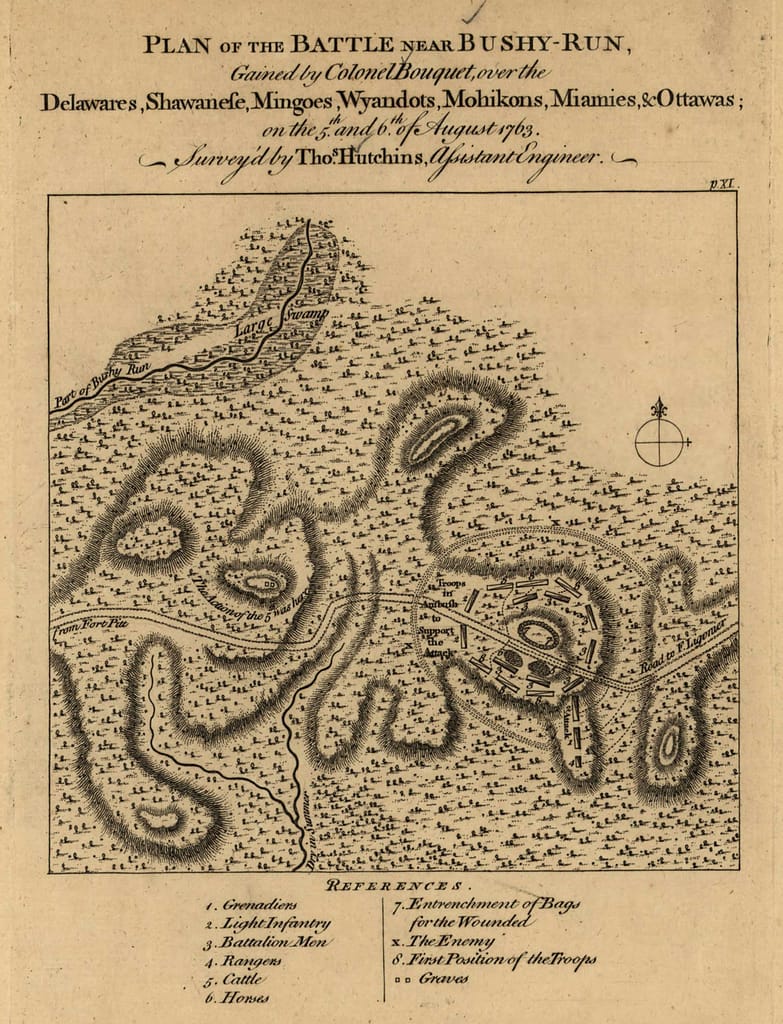
Opposing Forces at the Battle of Bushy Run
British Forces
The British relief column, led by Colonel Henry Bouquet, a former Swiss Mercenary, comprised about 500 soldiers from the 42nd Highlanders, 60th Royal Americans, and 77th Highlanders. These were experienced troops, many of whom had served during the French and Indian War. The British forces were well-armed with light infantry weapons (Brown Bess muskets and bayonets) but were constrained by the need to protect their column of 340 pack horses burdened with supplies for Fort Pitt. To lighten the load, Colonel Bouquet had left his light artillery pieces at Fort Ligonier a few days earlier.

Native American Forces
The Native American coalition comprised warriors from several tribes, including the Delaware, Shawnee, Mingo, and Huron. Estimates suggest there were between 300 and 500 warriors involved in the battle. These forces were highly mobile and adept at guerrilla tactics, using the dense forests and hilly terrain to their advantage. Their goal was to intercept and destroy the British relief force before it could reach Fort Pitt.
⚔️ Go deeper — Members get exclusive access to the Deep Research Collection, Field Notes, and monthly Research Dispatches. Try membership free for 7 days, cancel anytime. From $9/month.
The Battle of Bushy Run – Day One: August 5, 1763
Bouquet’s relief column departed Fort Ligonier on 2 August 1763, heading west towards Fort Pitt along the Forbes Road. The distance between the forts was about 50 miles. The Native American warriors besieging Fort Pitt learned of the column’s approach and most of the besiegers moved east to intercept Bouquet’s force.
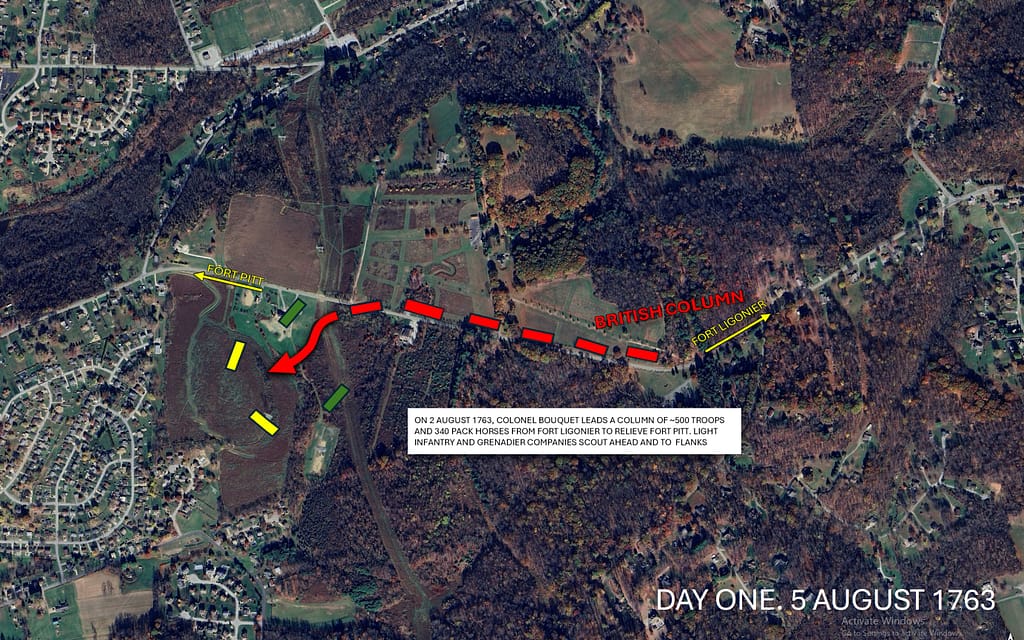
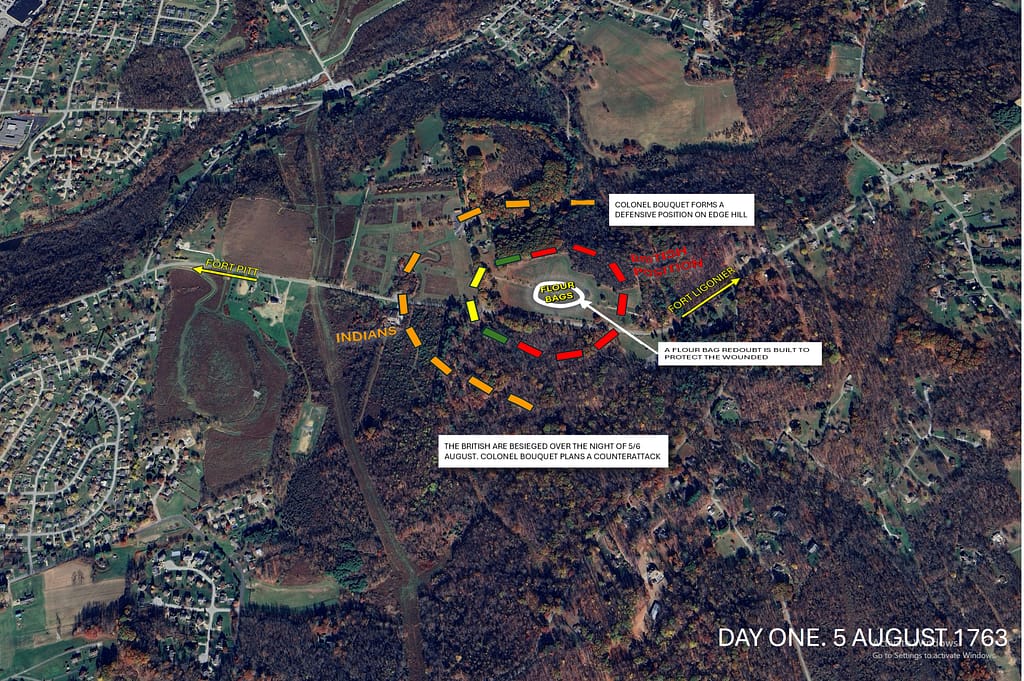
As Bouquet’s column advanced along the Forbes Road, they were ambushed to the east of Bushy Run Station. Of the 18-man British vanguard, 12 soldiers were killed or wounded in the first volleys. The Native American warriors attacked with ferocity, forcing the British into a defensive perimeter. The British light infantry companies screened the withdrawal at considerable cost in casualties. Bouquet ordered his men to form a defensive position on Edge Hill, protecting the pack horses, and used flour bags to build a redoubt for the wounded. The British held their ground throughout the day, repelling repeated assaults while suffering significant casualties.
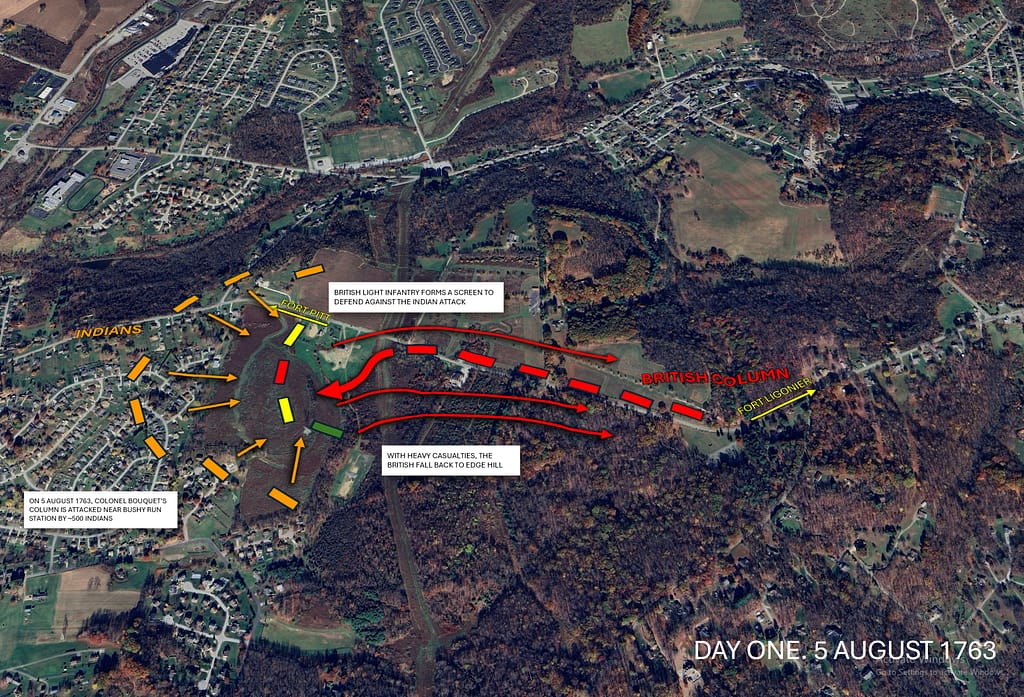
As night fell, Bouquet’s men fortified their position and tended to the wounded. The British troops, though weary and outnumbered, prepared for another day of fighting, knowing that failure would mean the loss of Fort Pitt and possibly the entire frontier region.
The Battle of Bushy Run – Day Two: August 6, 1763
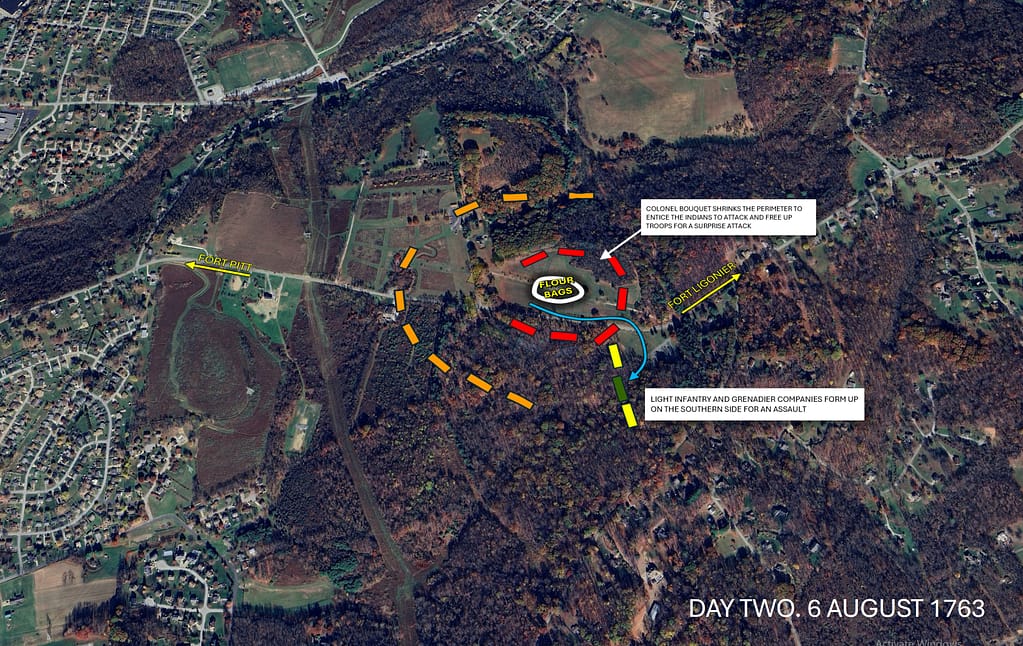
At dawn, the Native American forces renewed their attack, believing the British weakened and demoralized. However, Bouquet had devised a counterstrategy. He feigned a retreat from one side of the defensive perimeter, and reduced the perimeter to a smaller size. This lured the Native warriors into a premature and disorganized charge. The reduced perimeter also allowed him to create an assault force from his grenadier and light infantry companies, which formed up south of the position.
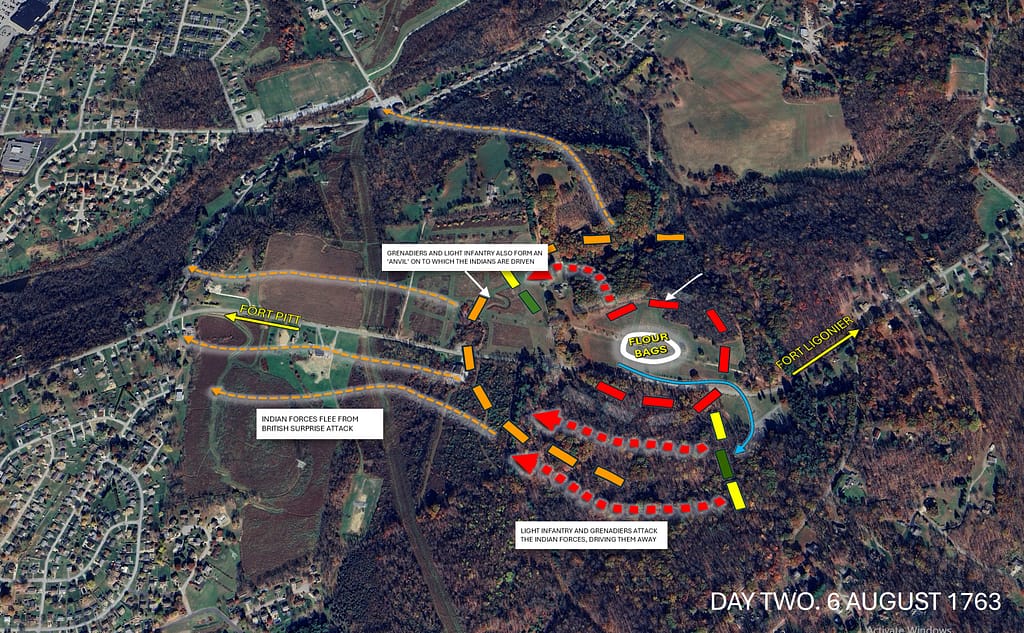
As the attackers advanced, Bouquet’s hidden forces launched a surprise counterattack from the flank and rear, catching the Native warriors by surprise. The British also deployed ambush forces to catch the Indian warriors as they were driven ahead of the assault force. The sudden British assault broke the spirit of the Native forces, who retreated in disarray. The British pursued them aggressively, securing a decisive victory. By midday, the battlefield was littered with the dead and wounded from both sides, but the British had successfully broken the siege of Fort Pitt.
Outcomes at Bushy Run
Consequence of the battle
The battle cost the lives of 50 British soldiers, including 29 of the 42nd Highlanders, seven of the 60th Royal Americans, six of the 77th Highlanders, and eight civilians and volunteers. The Native American force casualties are unknown but estimates range from 20-60 killed.
The Battle of Bushy Run was a significant victory for the British, marking a turning point in Pontiac’s War. The successful relief of Fort Pitt restored British control over the region and demonstrated their ability to project military power into the frontier. While the battle did not immediately end the conflict, it severely weakened the Native American coalition and disrupted their efforts to expel the British from the Great Lakes region. Colonel Bouquet’s victory at Bushy Run was celebrated by the British, even back in England. Church bells rang through the night in Philadelphia.
In securing the high ground for his defence and using dead ground and cover for his counterattack, Henri Bouquet had also demonstrated a masterful appreciation of micro-terrain—the small scale terrain features that often do not appear on maps and can only be seen when you are standing on the ground. The concept of exploiting small scale terrain features in battle is discussed further in the Micro-Terrain and Battlefield Decision-Making research hub.

Impact on the Native American coalition
For the Native American tribes, the defeat at Bushy Run was a devastating blow. It highlighted the fragility of their coalition and the challenges of confronting a well-armed and disciplined European military force. Over time, many tribes were forced to negotiate separate peace treaties with the British, leading to gradual erosion of their autonomy and territorial control.
The Bushy Run battlefield today
I have been fortunate to visit the Bushy Run battlefield twice; the first time in June 1998, and the second time on 3 February 2019, on our way back from attending Groundhog Day at Punxsutawney PA, just a short drive away!
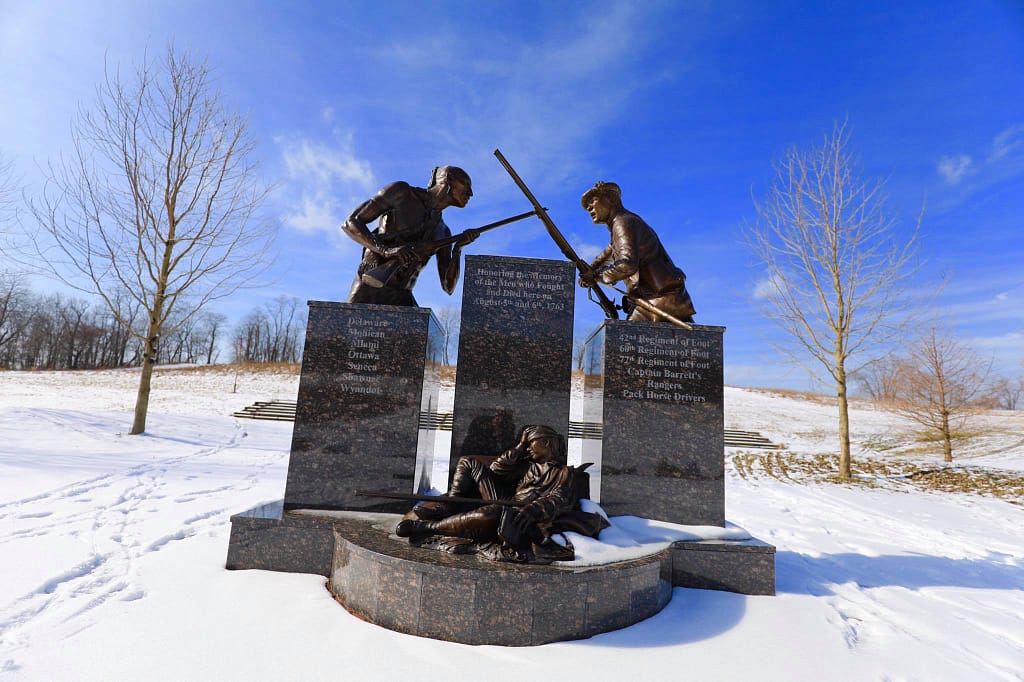
The site of the Battle of Bushy Run is preserved as Bushy Run Battlefield State Park in Pennsylvania. The park encompasses over 200 acres of the original battlefield and serves as a historical and educational site. Visitors can explore the walking trails, view historical markers, and visit the Bushy Run Battlefield Museum, which offers exhibits on the battle, Pontiac’s War, and colonial frontier life. To get a fuller picture of the French and Indian War and the siege of Fort Pitt, you can continue into Pittsburgh, visit Fort Pitt Museum and explore some of the remnants of the original Fort Duquesne/Fort Pitt.
The park also hosts annual reenactments of the battle, drawing history enthusiasts and providing a visual portrayal of the events that unfolded in 1763. These reenactments, along with guided tours and educational programs, help to keep the history of Bushy Run alive and accessible to future generations.
Images – Bushy Run battlefield

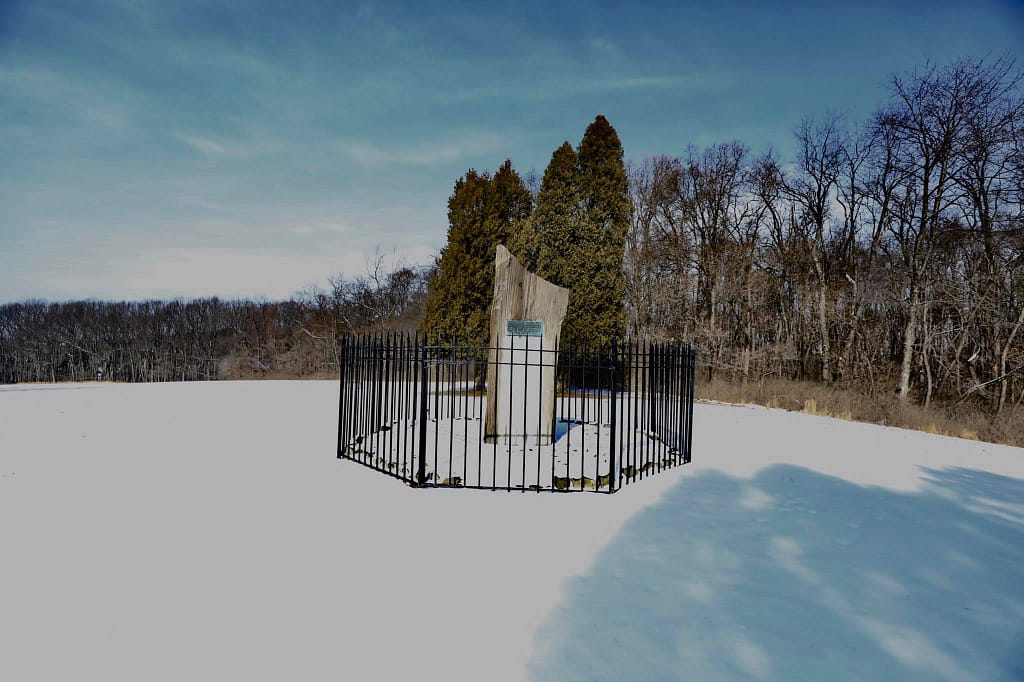
The Flour Bag Redoubt




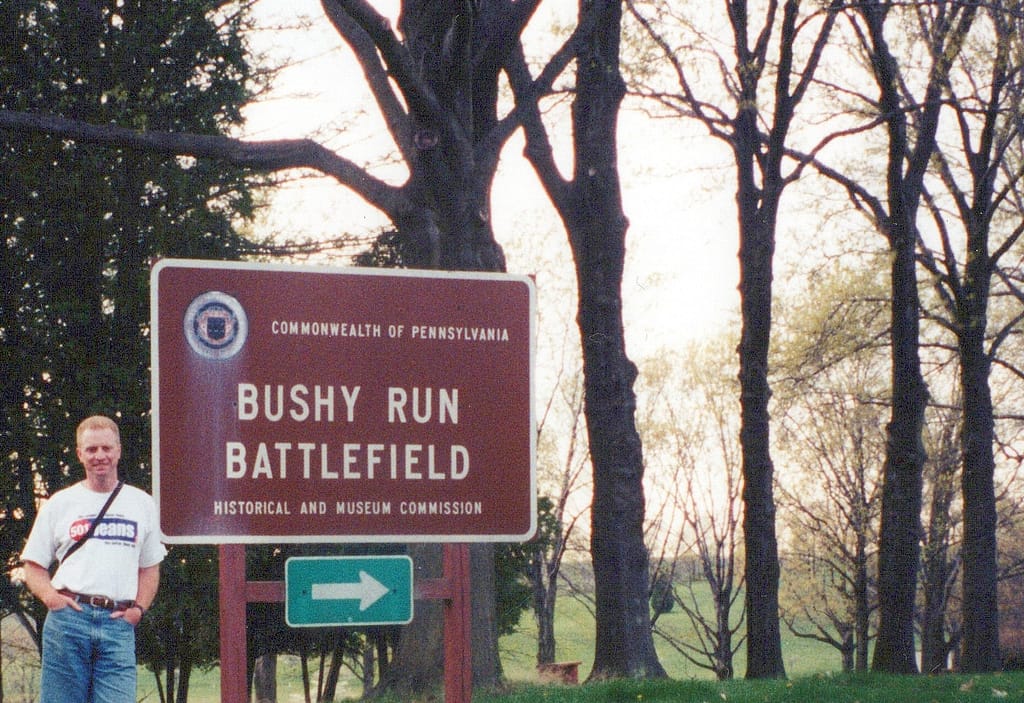
Bushy Run battlefield park


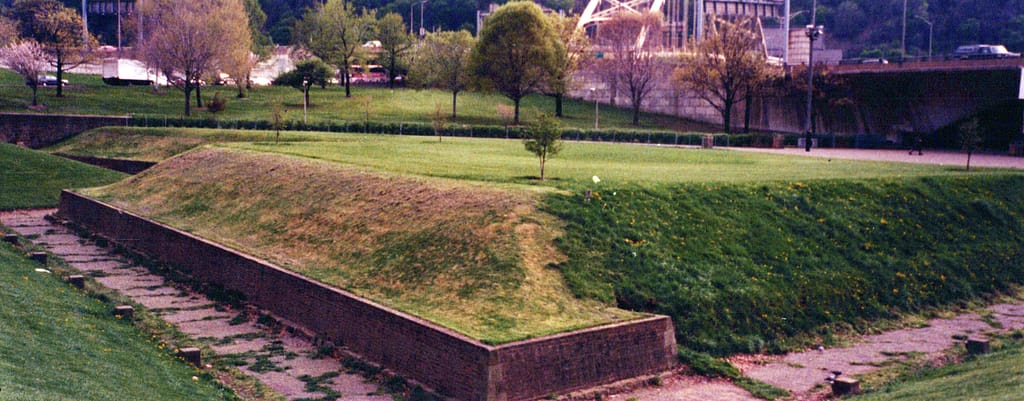
Fort Pitt

Found this useful? Buy me a coffee — it helps fund future battlefield research


Authored by Mick Prictor, a retired military officer with 40 years’ service, and a military historian specialising in terrain-focused analysis of tactics, doctrine, and command decision-making in land warfare. His work draws on extensive battlefield fieldwork—more than 280 sites worldwide—and one of the world’s largest private collections of historic military arms, uniforms, and equipment. About me
Sources
- Cort, Reverend Cyrus (1883). Colonel Henry Bouquet and his campaigns of 1763 and 1764, Steinmen and Hentsel, Lancaster, PA. Accessed online 5 April 2025
- Dixon, David (2005). Never Come to Peace Again: Pontiac’s Uprising and the Fate of the British Empire in North America. Norman: University of Oklahoma Press.
- Anderson, Fred (2000). Crucible of War: The Seven Years’ War and the Fate of Empire in British North America, 1754–1766. New York: Knopf
Link to the Bushy Run battlefield park website
📚 Further Reading: Seven Years War
This battle study nests within the broader analytical framework explored in the Research Hub, where operational methods, operating environments, armies, commanders, and weapons are examined across conflicts and eras. The links below connect related studies across the wider body of battlefield analysis on the BattlefieldTravels site.
⚔️ Explore all battle studies from the Seven Years War
🏛️Explore the museum of Seven Years War historic weapons and equipment
The book list for this conflict includes the leading campaign studies, memoirs, and operational analyses of the Seven Years’ War, selected specifically to complement this battlefield study.
📚 Seven Years War – Recommended Reading
🗞️ For updates on new battlefield studies and research insights, you can subscribe to the Newsletter.
Related Battle Studies, Museum Pieces & Reading Resources


🧭 Battlefield Visit Guide: Bushy Run
Getting There
- Location: Bushy Run Battlefield, 1253 Bushy Run Road, Jeannette, Pennsylvania, USA.
- Transport: ~25 miles east of Pittsburgh via US Route 30; straightforward access by car.
- Parking: On-site parking at the visitor centre; overflow during reenactment weekend.
Site Orientation
- Key Landmarks: Visitor Centre & museum complex; woodland trails; clearings marking the 1763 defensive stand and counterattack.
- Walking Routes: Marked loop trails through woods and open ground; wayfinding panels narrate the two-day action (5–6 Aug 1763).
- Best Vantage Points: Trail overlooks above the clearings give the clearest read of terrain and lines of advance.
Museums & Visitor Centres
- Bushy Run Visitor Centre: Exhibits on Pontiac’s War, the battle, artefacts and maps; check seasonal hours.
- Interpretive Panels On-Site: Ambush site, British defensive position, and final counterattack explained in situ.
- Events: Annual August reenactment weekend with living-history demonstrations.
On-Site Experience
- Trails: Mixed woodland and meadow; uneven ground in places—allow time to walk the full loop.
- Photography: Morning/late-afternoon light works best in the clearings; woodland can be low-light.
- Wayfinding: Numbered posts correspond to the printed/site maps for self-guided tours.
Nearby Points of Interest
- Fort Ligonier (≈20 mi E): Reconstructed 18th-century British fort; excellent museum.
- Fort Pitt Museum (Pittsburgh): Frontier history at the Forks of the Ohio.
- Braddock’s Battlefield History Center (North Braddock): 1755 campaign context.
Practical Tips
- When to Visit: Late spring–early autumn; reenactment weekend in August is the busiest and most immersive.
- Allow: 2–3 hours for museum and trails; a full day if attending the reenactment.
- Footwear & Weather: Sturdy shoes; bring water and sun protection in summer—some sections are exposed.
- Access: Visitor centre accessible; some trail segments are rough for wheelchairs/strollers.
- Check Ahead: Confirm hours/events on the official site before travel: bushyrunbattlefield.com.
Subscribe to Battlefield Travels and receive a free E-Book Battlefield Guide
Unlock expert battlefield analysis, campaign reconstructions, and historical insights drawn from firsthand exploration and primary sources.
🗺️ You’ll receive:
🎖️ Exclusive historical insights you won’t find elsewhere
📘 A free eBook: 10 Tips for Exploring Historic Battlefields
📰 New battlefield studies straight to your inbox as they are published

⚔️ Go deeper — Members get exclusive access to the Deep Research Collection, Field Notes, and monthly Research Dispatches. Try membership free for 7 days, cancel anytime. From $9/month.
Brilliant narrative and detail.
Thanks Dan, an interesting and important little battle near Pittsburgh. Some innovative tactics by Colonel Bouquet!