Paratroopers in Normandy – The 101st Airborne’s Battle for Carentan!
Carentan was the key to linking Utah and Omaha Beaches. In June 1944, the 101st Airborne fought house-to-house and hedgerow-to-hedgerow against elite German paratroopers to take the town. Its capture secured the beachheads and prepared the way for the breakout from Normandy.
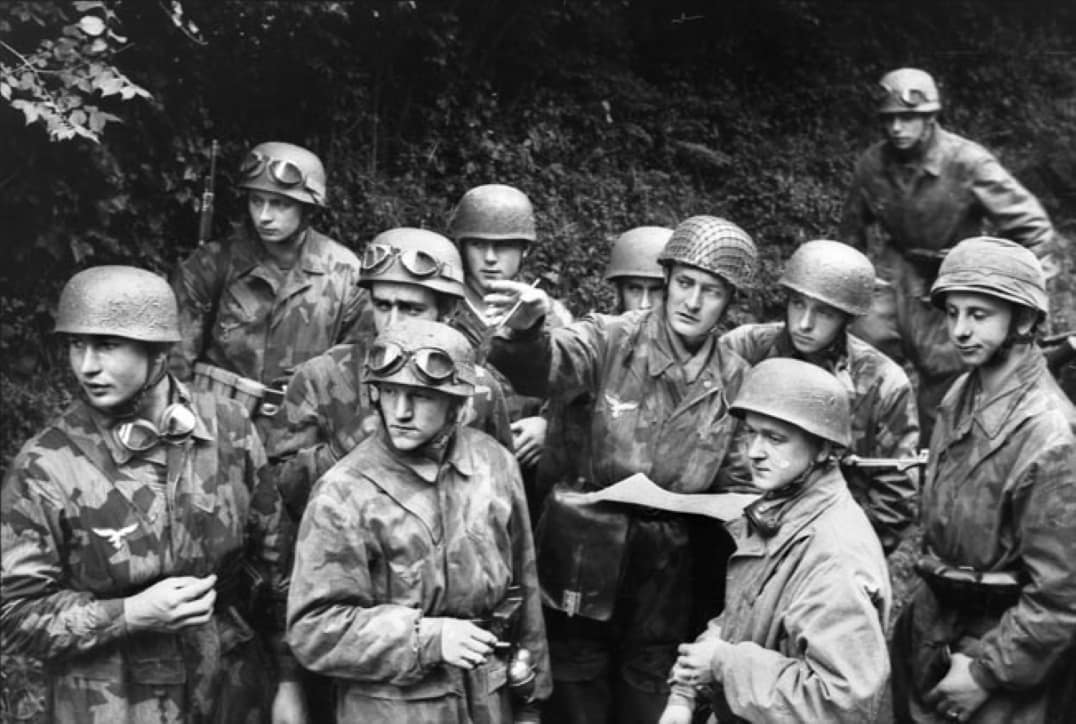
Key facts
Google Earth map – Location of the Carentan battlefield
🧭🥾 Walking the Battlefield
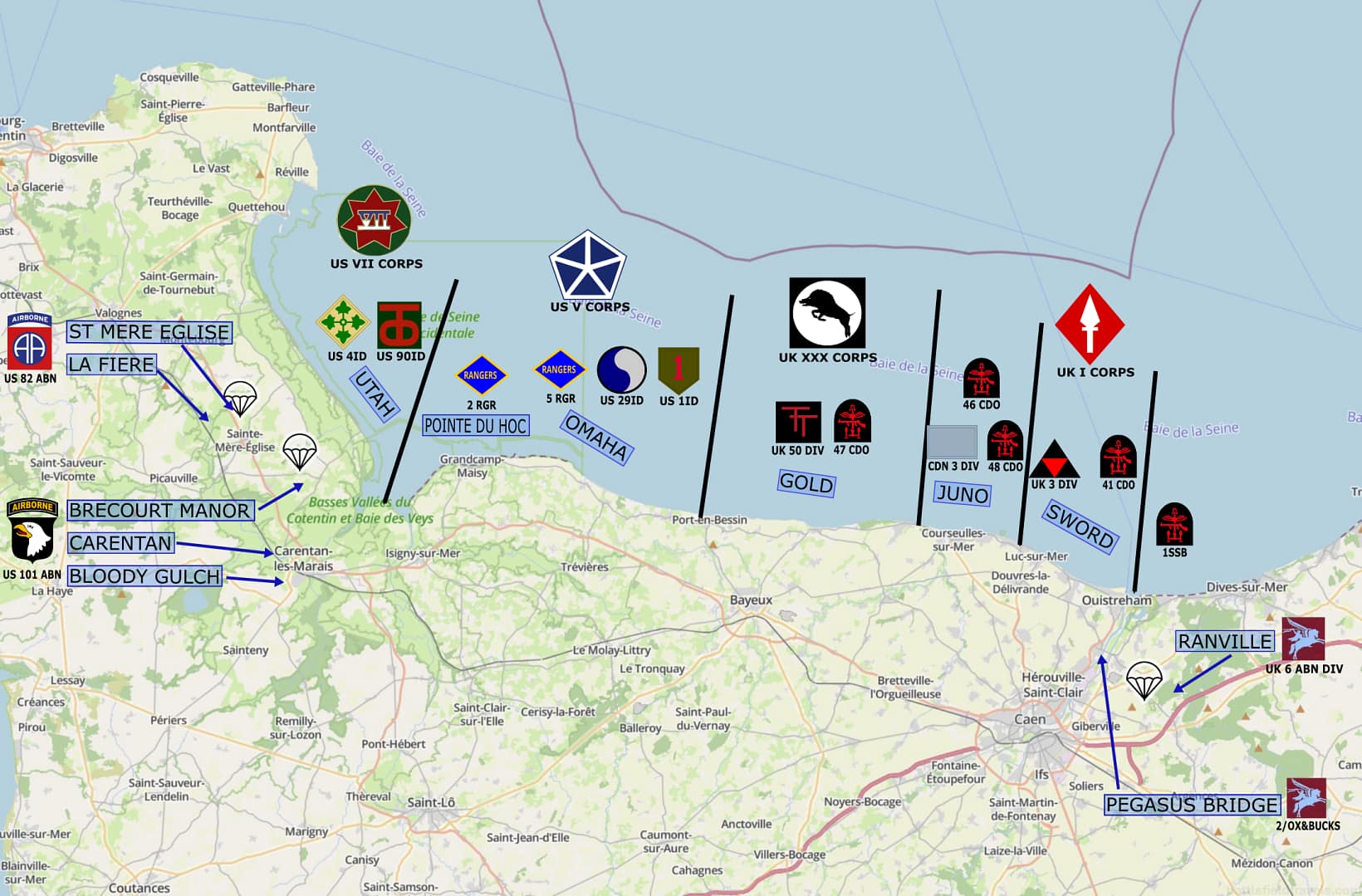
I walked the ground at Carentan in November 2024, following the battle from the 101st Airborne Division landings around Sainte-Marie-du-Mont, the opening attacks along Purple Heart Lane and the Douve River, through the final attack on 12 June 1944 and the subsequent German counterattack at Bloody Gulch on 13 June. Carentan is remarkably unchanged since 1944. The roads are the same and many of the buildings are still there.
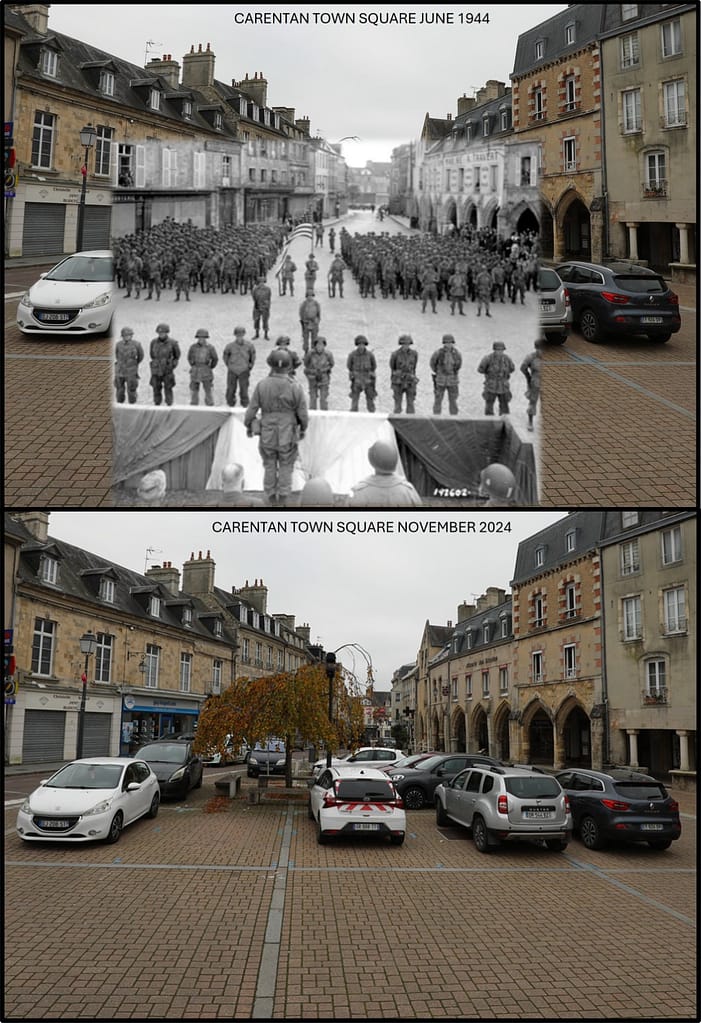
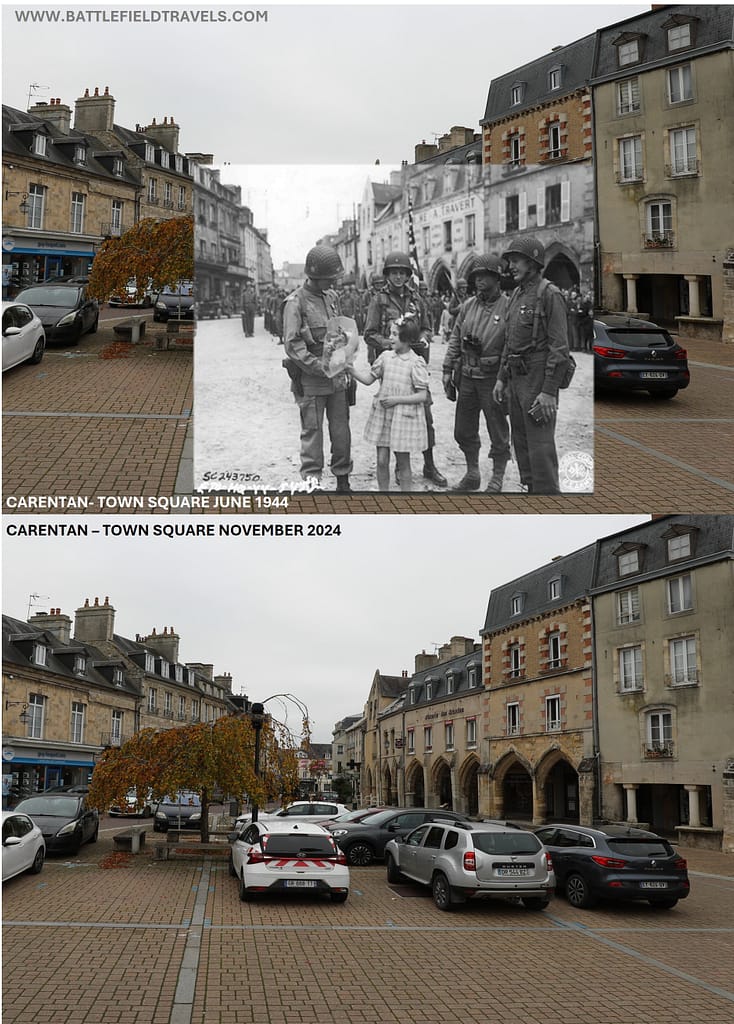
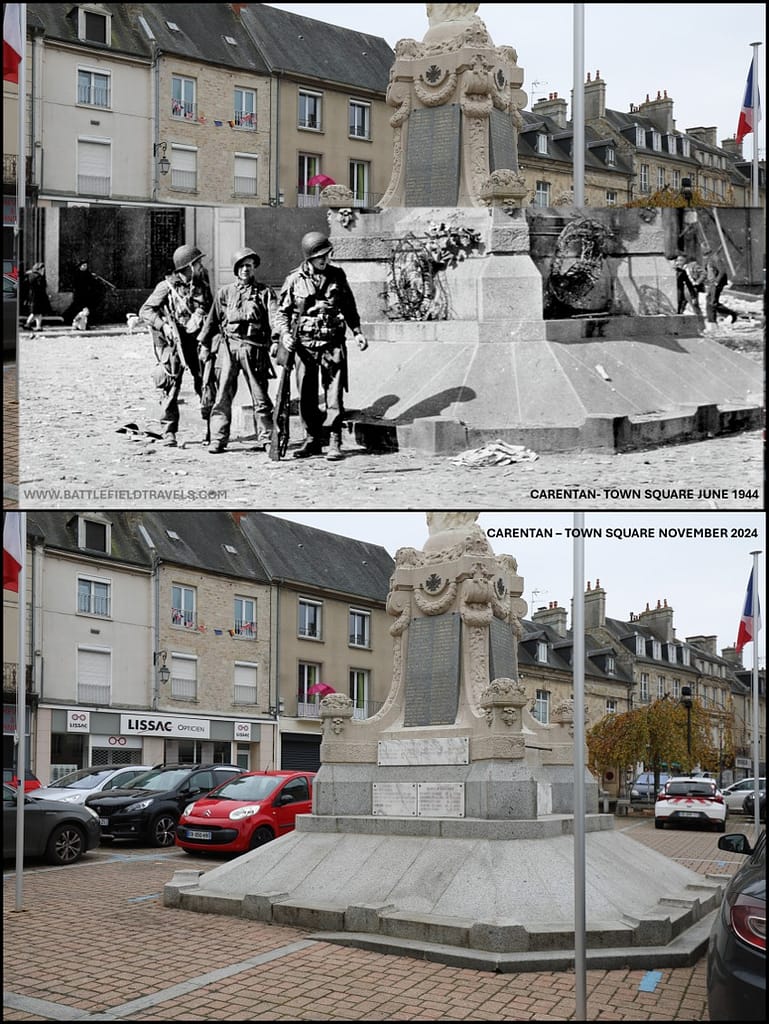
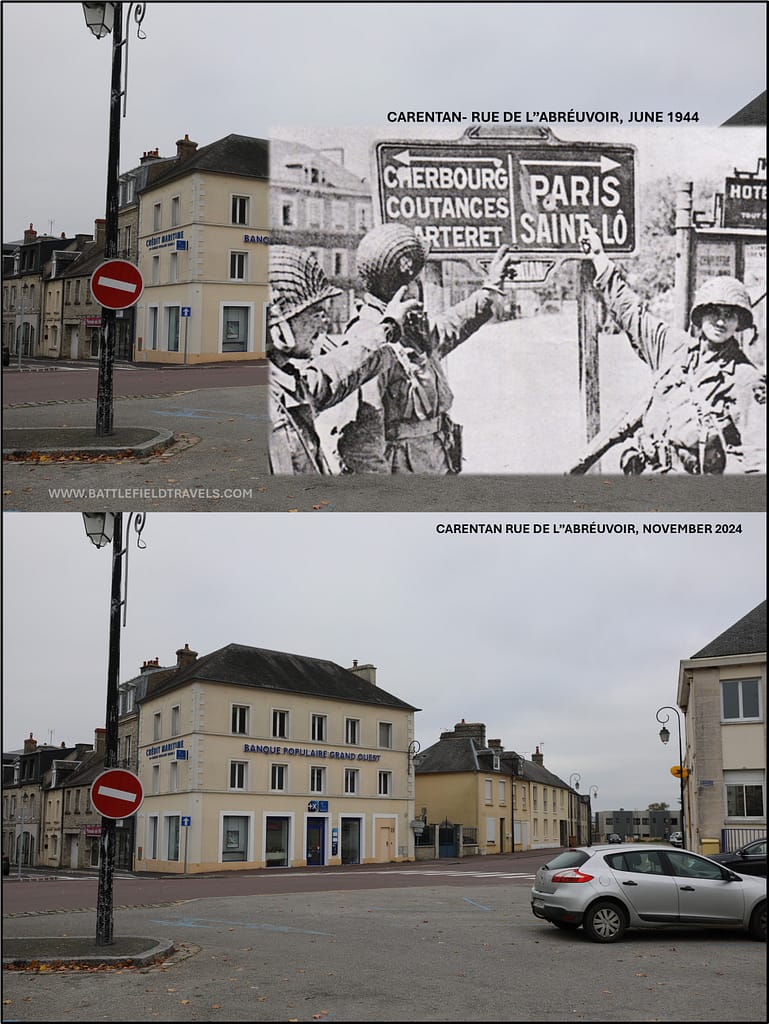
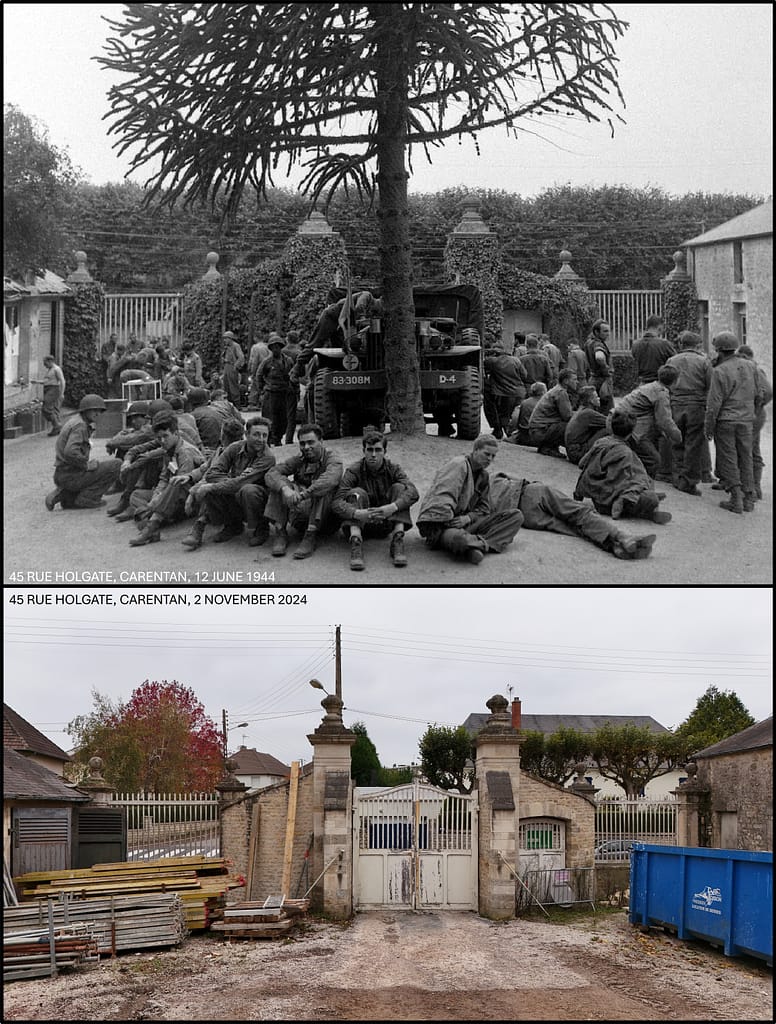
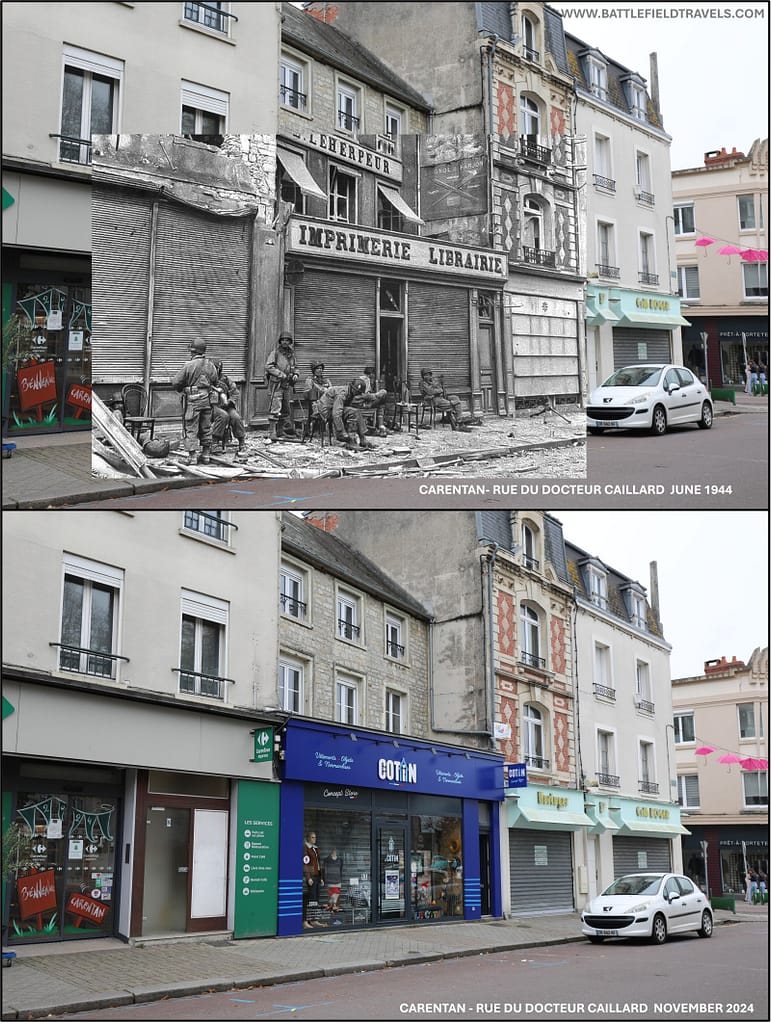
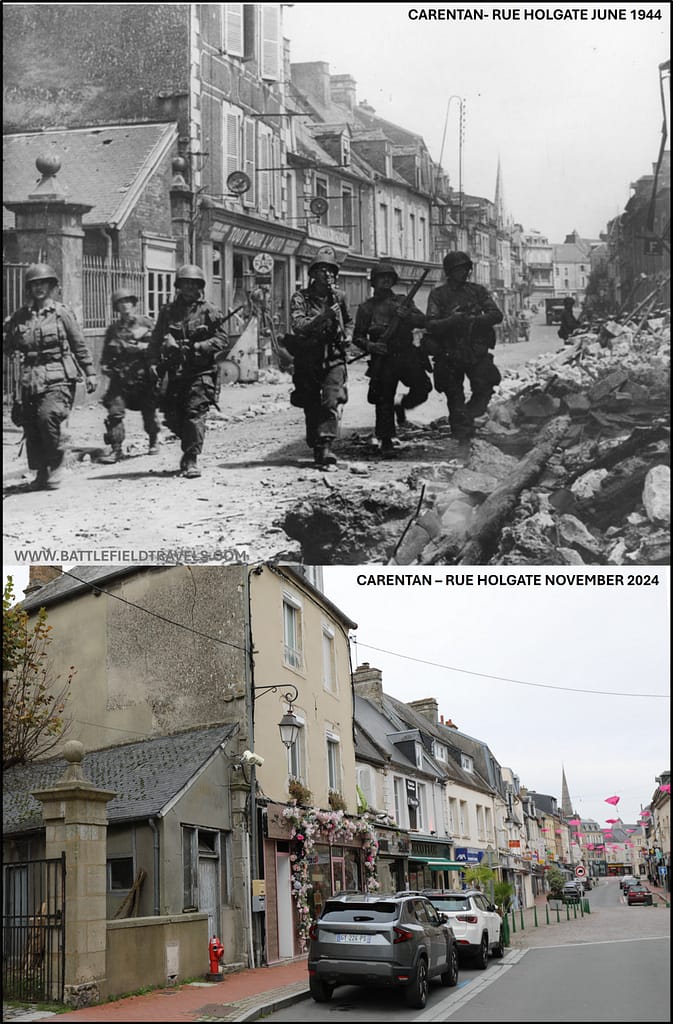
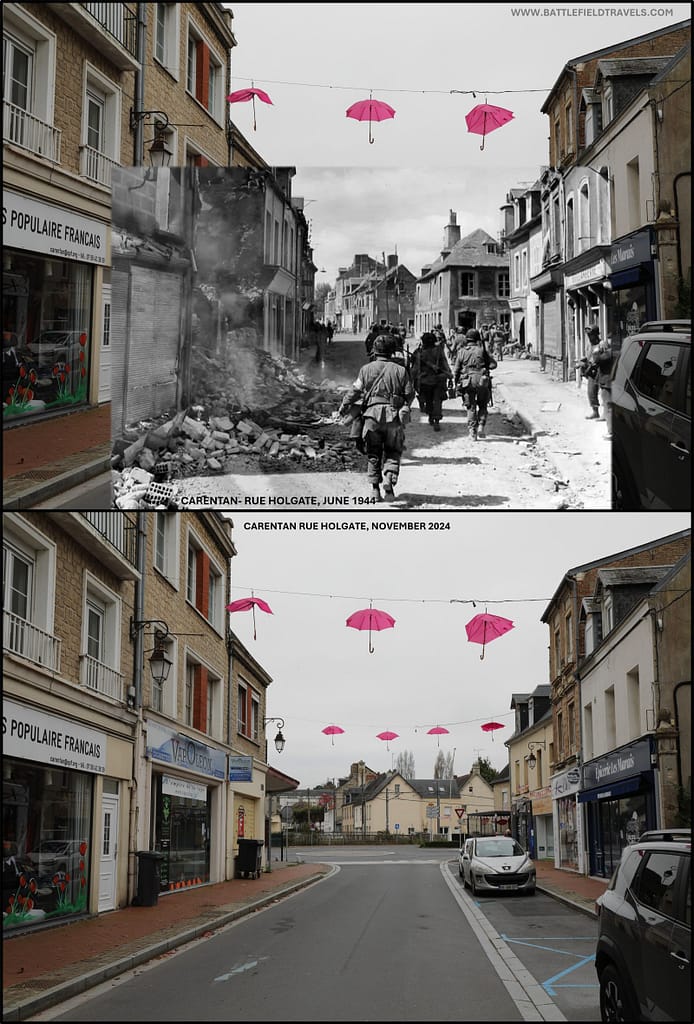
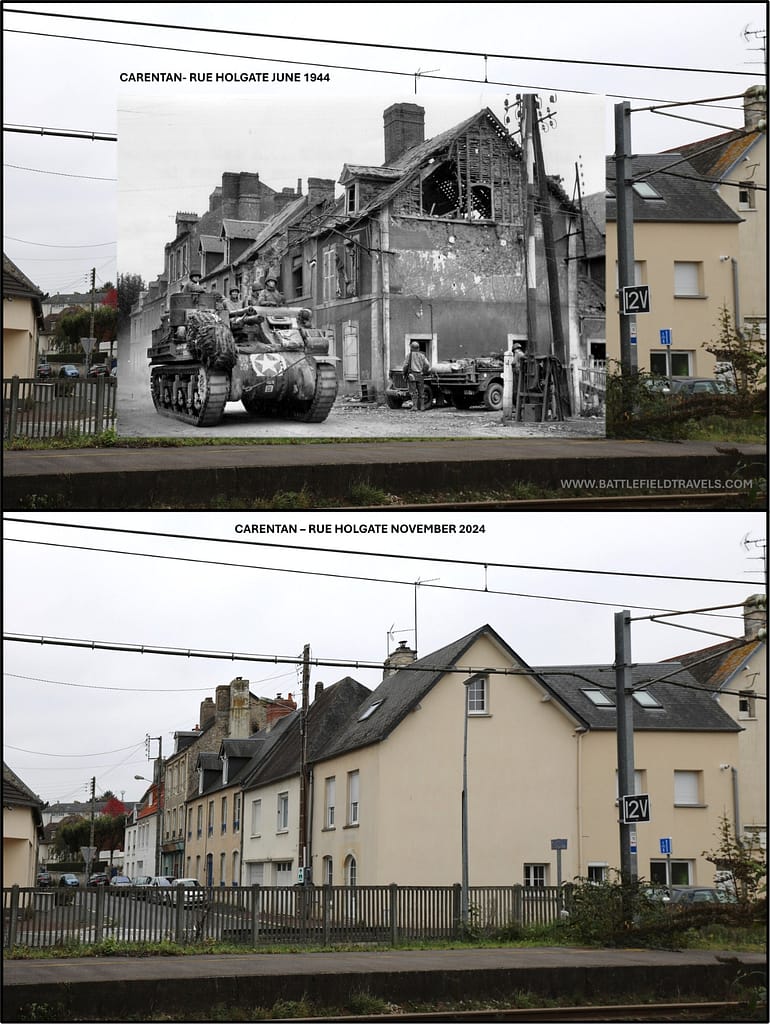
Many combat photographs were taken in Carentan both during and after the battle. In preparation for our visit, I spent many hours poring over WW2 vintage photos and Google Earth Pro Street View, trying to find the exact locations where the photos were taken. We then walked all over the streets of old Carentan until we stood on the exact location and exact angle for the shot. It has taken a while to match everything but here are just a few of them.
Normandy series of battlefield studies
This article is part of a series exploring the D-Day airborne and amphibious battlefields on 6 June 1944 and the immediate aftermath. Click on the hotlinks to open the battlefield study.
Subscribe to Battlefield Travels and receive a free E-Book Battlefield Guide
Unlock expert battlefield analysis, campaign reconstructions, and historical insights drawn from firsthand exploration and primary sources.
🗺️ You’ll receive:
🎖️ Exclusive historical insights you won’t find elsewhere
📘 A free eBook: 10 Tips for Exploring Historic Battlefields
📰 New battlefield studies straight to your inbox as they are published

BATTLE OF CARENTAN 10-13 June 1944
Strategic context: 101st Airborne Division operations
I have explored the US Airborne operations on D-Day in a separate post, so I won’t repeat the full background here.
After the successful D-Day landings on 6 June 1944, the Allies needed to link the Utah and Omaha beachheads, build up forces for the breakout, and prepare for the German counterattack they knew was coming. The key to all of that was the town of Carentan; a port city with major road and rail junctions.
The Battle of Carentan featured in Steven Spielberg/Tom Hanks mini-series ‘Band of Brothers’, Episode 3 ‘Carentan’, but only from the Easy Company 2-506 PIR perspective on 12 June 1944. In reality it was a multi-brigade, multi-day battle that commenced on 10 June 1944.
Carentan was defended by two battalions of German paratroopers from Fallschirmjäger-Regiment 6, and elements of 1058 Grenadier Regiment. The Germans destroyed the drainage system in the region, so the Douve River had flooded the plains around Carentan. Access from the north was along a narrow 2km long causeway, crossing several bridges over the Douve and La Madeleine Rivers.
Opposing Forces: American paratroopers versus German paratroopers
 American forces
 American forces
 101st Airborne Division (U.S. Army) – Commanded by Major General Maxwell Taylor.
- 502nd Parachute Infantry Regiment
- 506th Parachute Infantry Regiment (including Easy Company, 2/506)
- 327th Glider Infantry Regiment (attached)
- Supported by divisional artillery, including 65th and 377th Parachute Field Artillery Battalions.
- Reinforcements: elements of the 2nd Armored Division and 29th Infantry Division were committed in the days following to consolidate the town and repel counterattacks.
 101st Airborne Division (U.S. Army) – Commanded by Major General Maxwell Taylor.
 German forces
 German forces
- 6. Fallschirmjäger Regiment (6th Parachute Regiment), an elite Luftwaffe unit, recently re-formed and reinforced after earlier fighting in Normandy.
- elements of 1058 Grenadier Regiment (91. Luftlande-Division)
- Backed by elements of the 17. SS Panzergrenadier Division “Götz von Berlichingen”, which counterattacked from the south after Carentan had fallen to the Americans
- Defensive positions included strongpoints in the town, hedgerow lines to the east and west, and supporting artillery and mortars emplaced in the surrounding bocage.
The battle pitted lightly equipped U.S. airborne troops against veteran German paratroopers in close-quarters urban and hedgerow fighting, with both sides aware that control of Carentan was the hinge linking the Allied beachheads into a continuous front.
Divisional plan for the assault on Carentan
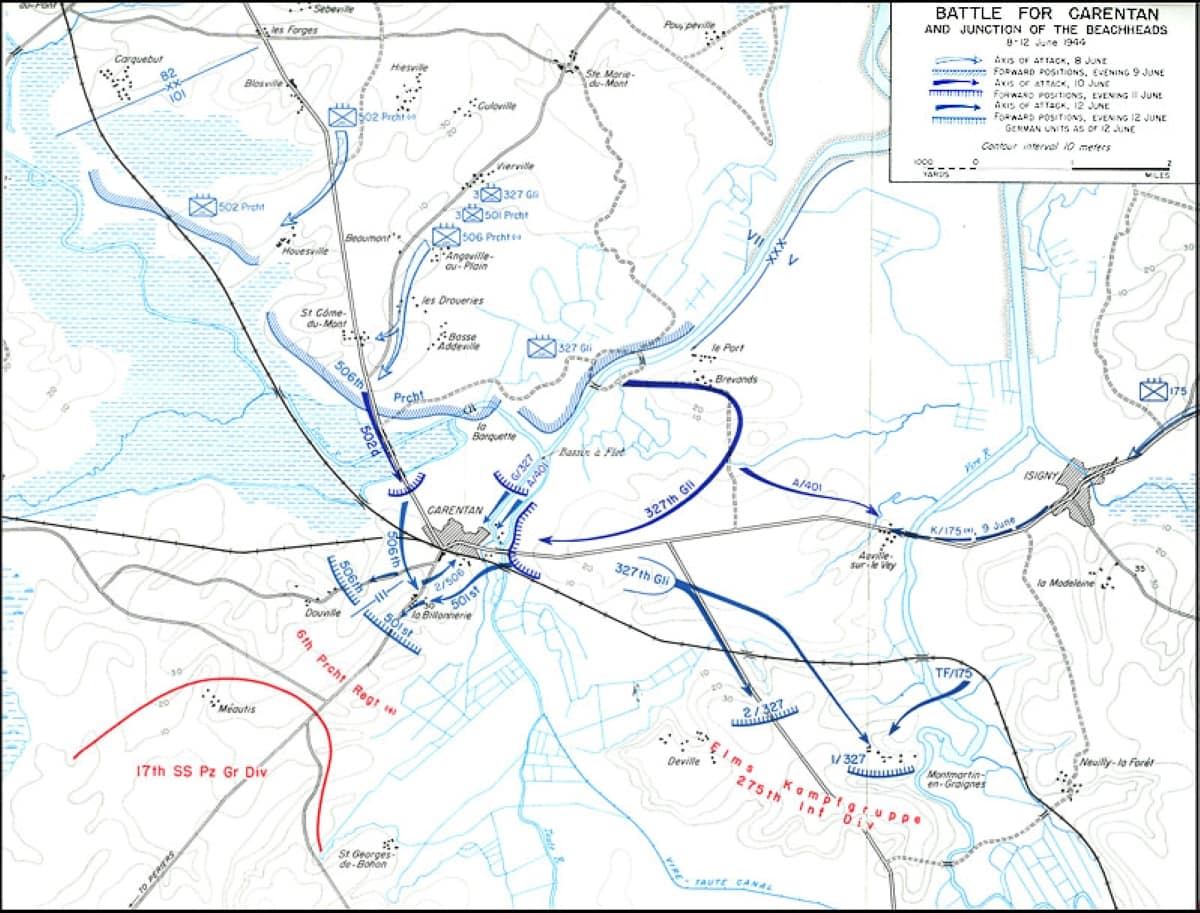
After securing Sainte-Côme-du-Monte on 9 June, the 101st Airborne Division planned for the seizure of Carentan. The attack would be a double envelopment. 502nd PIR (Parachute Infantry Regiment) would cross a series of bridges over the Douve River and attack from the north along the narrow causeway. 327 GIR (Glider Infantry Regiment) would cross the Douve River near Brevands, and attack from the east along the axis of the Isigny road.
Initial assault on 10 June 1944
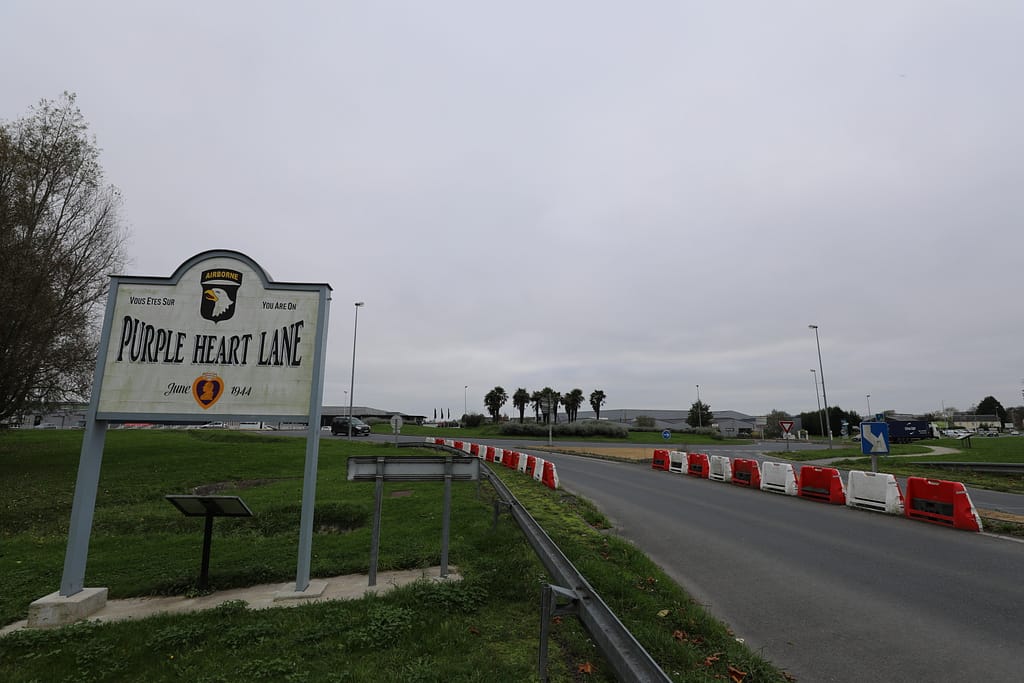
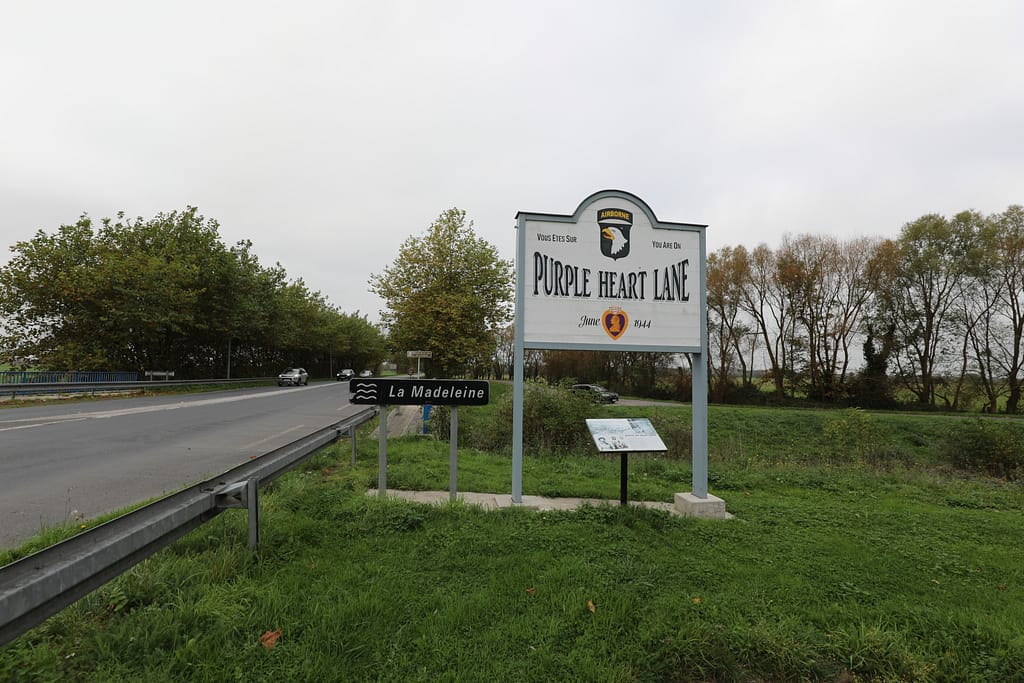
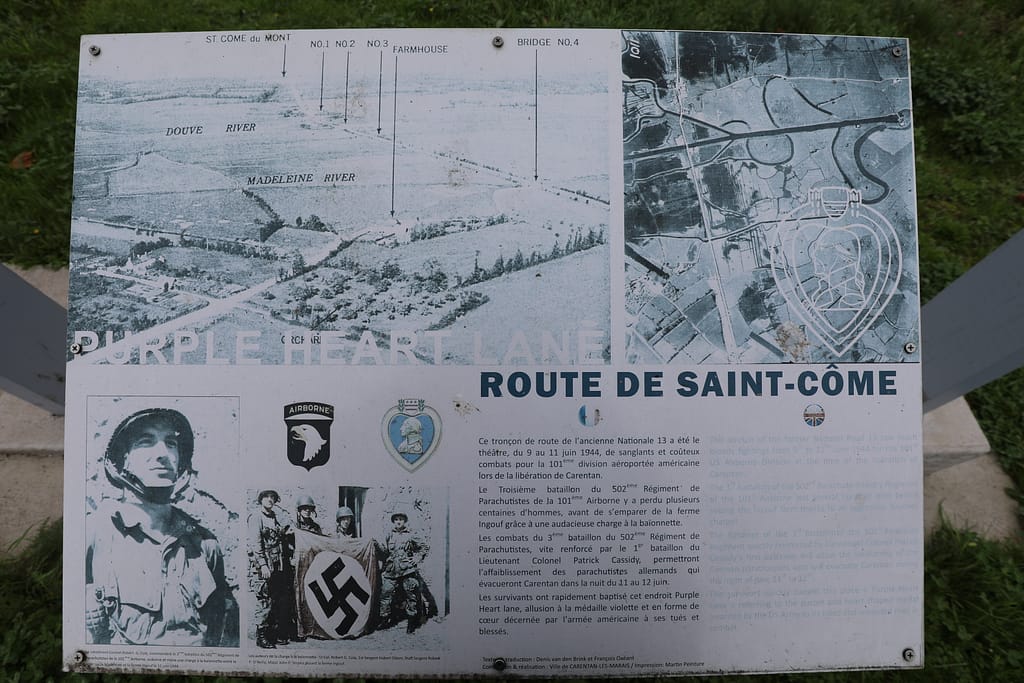
Purple Heart Lane
The attack began in the early hours of 10 June. Both units encountered heavy resistance. Lieutenant-Colonel Robert Cole’s 3-502 PIR led the attack from north across the bridges and the narrow causeway. At many points, the causeway constrained the Americans to attack in single-file. The troops were completely exposed as they crossed the causeway, and had to clear obstacles under fire. 3-502 PIR suffered so many casualties that the road from the north became known as Purple Heart Lane (The Purple Heart is a US Medal issued to those wounded in combat).
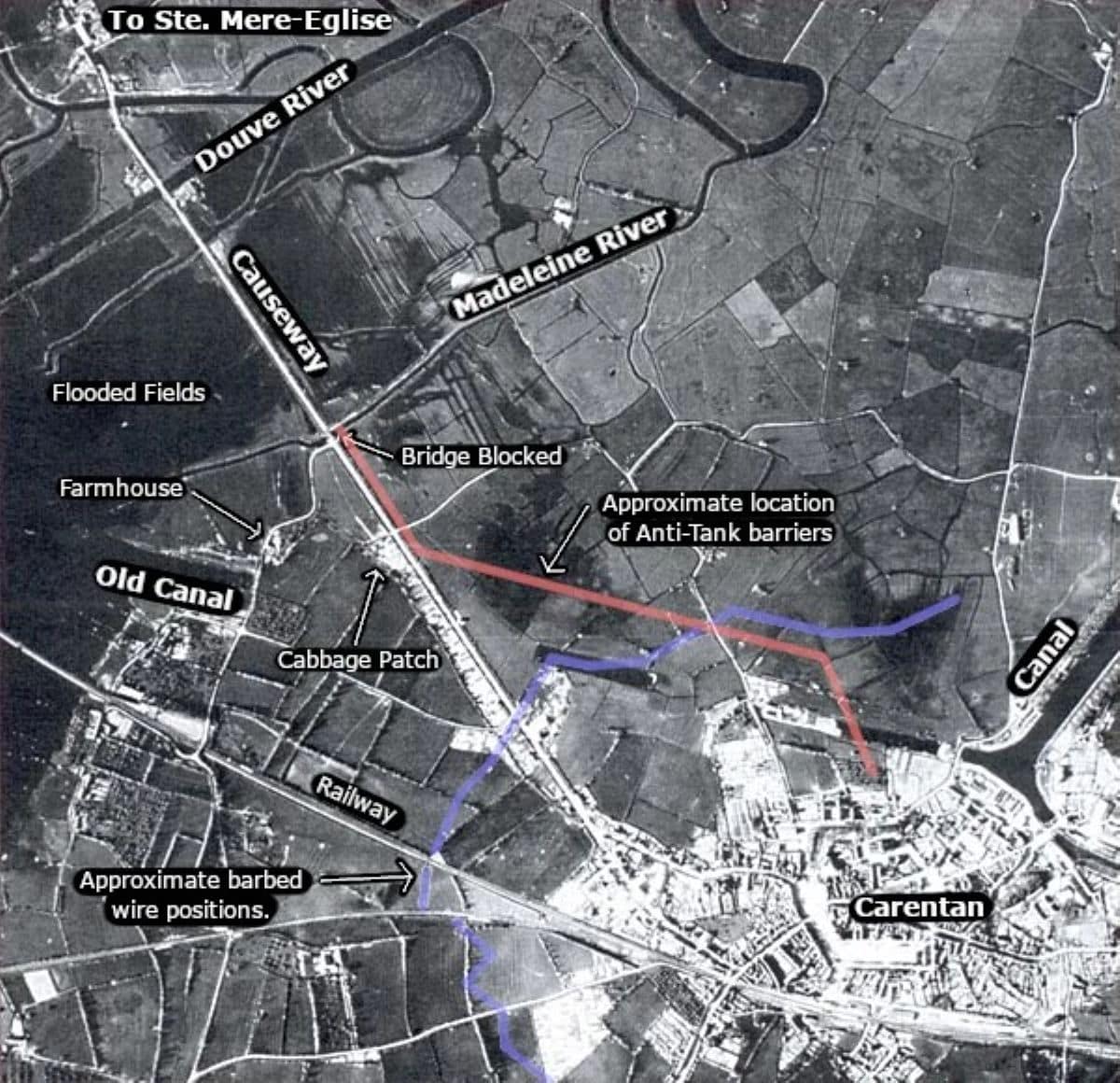
3-502 PIR eventually broke into the northern outskirts of Carentan, where they were pinned down by fire and unable to either advance or withdraw. With few options available to him, Cole ordered a bayonet charge to clear the German position. At first only a few soldiers followed Cole’s example, but others saw it and joined in. The bayonet assault soon overwhelmed the German position. For this action, Cole was later awarded the Medal of Honor.
327 GIR attack
In the east, 327 GIR successfully crossed the Douve River in the early hours of 10 June. They captured the town of Brevands, then advanced westwards along the Isigny Road on a two-battalion frontage. Elements of the 327 GIR also moved eastwards and successfully linked up with 29th Infantry Division elements advancing from Omaha Beach. Utah and Omaha beachheads were now connected.
On the afternoon of 11 June, 327 GIR crossed the Vire-Taute Canal to the east of Carentan. Elements of 3-401 GIR (attached as 327 GIR’s third battalion) fought southwards along the canal but were held up by the fierce German defence. On both axes, the attack was stalled along the outskirts of Carentan.
⚔️ Go deeper — Members get exclusive access to the Deep Research Collection, Field Notes, and monthly Research Dispatches. Try membership free for 7 days, cancel anytime. From $9/month.
Break-in to Carentan
By the evening of 11 June, the Americans had broken into the outskirts of Carentan at several points but were not strong enough to overwhelm the German defences. However, the Germans were also in bad shape and almost out of ammunition. During the night, Colonel Frederick von der Heydte, the German commander, withdrew most of his forces from the town. He left behind a two-company rear guard of paratroopers.
The Americans pounded the town through the night using Corps artillery, naval gunfire and unit mortars. Under cover of this bombardment, 1-401 passed through 327 GIR in preparation for a renewed assault from the east. Two battalions of 506 PIR passed through 502 PIR on the ‘Purple Heart Lane’ causeway and maneuvered around the western side of Carentan
Renewed assault on 12 June 1944
On the morning of 12 June, the American attack was renewed with 1-401 GIR from the north and 2-506 PIR from the southwest. Easy Company ‘Band of Brothers’ led the 506 PIR assault. This is the attack depicted in Episode 3 of Band of Brothers ‘Carentan’.
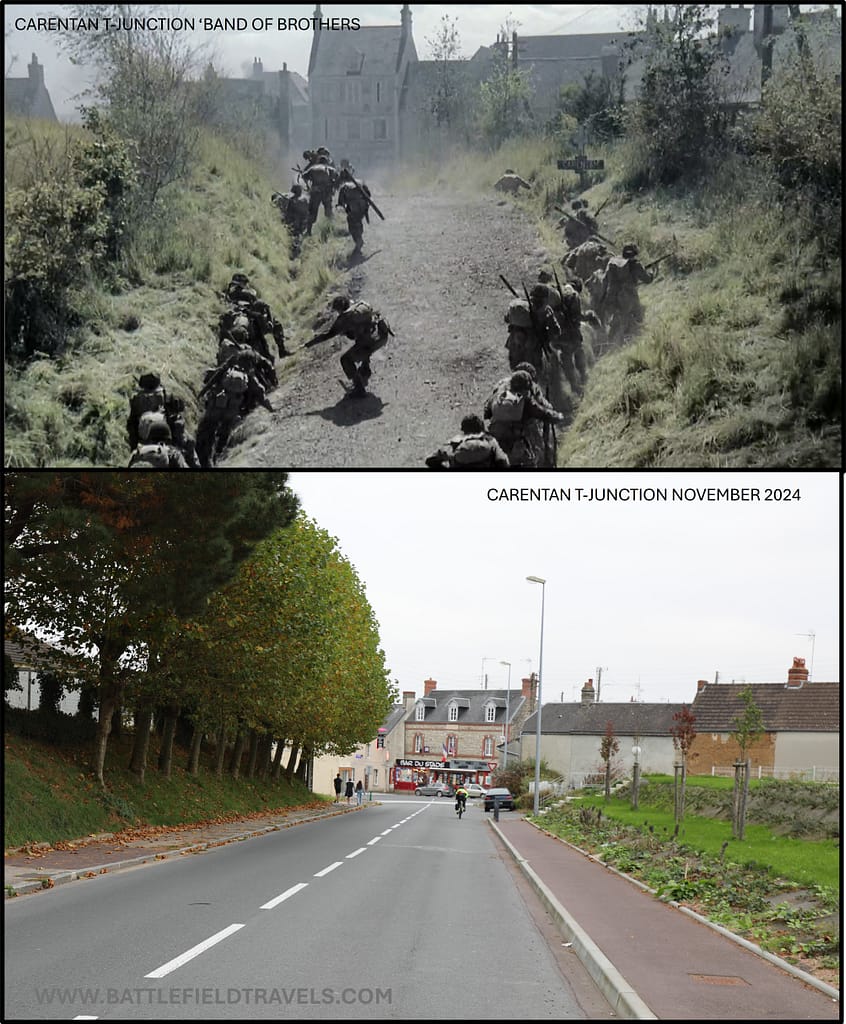
Easy Company met resistance at the T-Junction on Rue Holgate. An MG42 machine gun in the lower storey of the Cafe du Stade caused some casualties and disrupted the assault. Easy Company 1st Platoon Leader Lieutenant Harry Welsh took cover behind the Pharmacy and, under covering fire, silenced the German machine gun with grenades. 2-506 PIR continued the assault along Rue Holgate into the town.
The Germans shelled the town to cover the withdrawal of their rearguard. The last German paratroopers withdrew south and west to link up with the main German force. 2-506 PIR and 1-401 GIR met in the town centre at around 0730. Carentan was secured.
Aftermath of the Battle of Carentan
With Carentan secured, 506 PIR and 501 PIR were deployed west of the town, the direction of an expected German counterattack. The German armoured reserve, 17th SS Panzergrenadier Division ‘Götz von Berlichingen’, had been delayed by allied air power, but was now arriving west of Carentan to reinforce Fallschirmjäger-Regiment 6. As the American paratroopers moved west they contacted elements of this force in the hedgerows around Manoir Donville. On the following day, 13 June, this would be the site of the Battle of Bloody Gulch, the subject of a future post.
The fight for Carentan cost the 101st Airborne Division at least 400 killed in action and the Germans around 800.
Brigadier General Anthony C. McAuliffe, 101st Artillery;
LTC Julian L. Ewell, 501st PIR;
Lt. George Kraft, G/502nd PIR;
T/4 Webster, 327th GIR;
T/5 Robert E. Wright, Medic, 501st PIR;
Pvt. Rice A/501st PIR;
Pvt. Walter H. Sanderson, D/502nd PIR;
Pvt. David C. Gifford, D/502nd PIR;
S/Sgt. Bruno E Schroeder, HQ/506th PIR;
S/Sgt. Harry A. Clawson, H/506th PIR;
S/Sgt. Frederic A. Bahlau, H/506th PIR
photos 1944 and 2024
The Carentan battlefield today
The battlefield around Carentan is very recognisable. Most of the buildings in the old town centre are unchanged since 1944. The town’s suburbs have expanded, so some of the terrain has changed on the outskirts. ‘Purple Heart Lane’ is marked with a memorial to the 3-502 PIR. The road has been developed since 1944, so it is difficult to visualise the flooded plains and the importance of the raised 2km long causeway.
The railway line through town is now blocked by barriers that were not there in 1944, so the streets terminate at the rail line. This effectively divides the town in two. The T-Junction on Rue Auvers/Rue Holgate that features in Band of Brothers is still there, as is the ‘Bar du Stade’ – the building from where the German MG42 opened fire on Easy Company.
Additional images of Carentan battlefield
Purple Heart Lane – 3-502 PIR assault on the causeway
Easy Company ‘Band of Brothers’ assault at the T-Junction
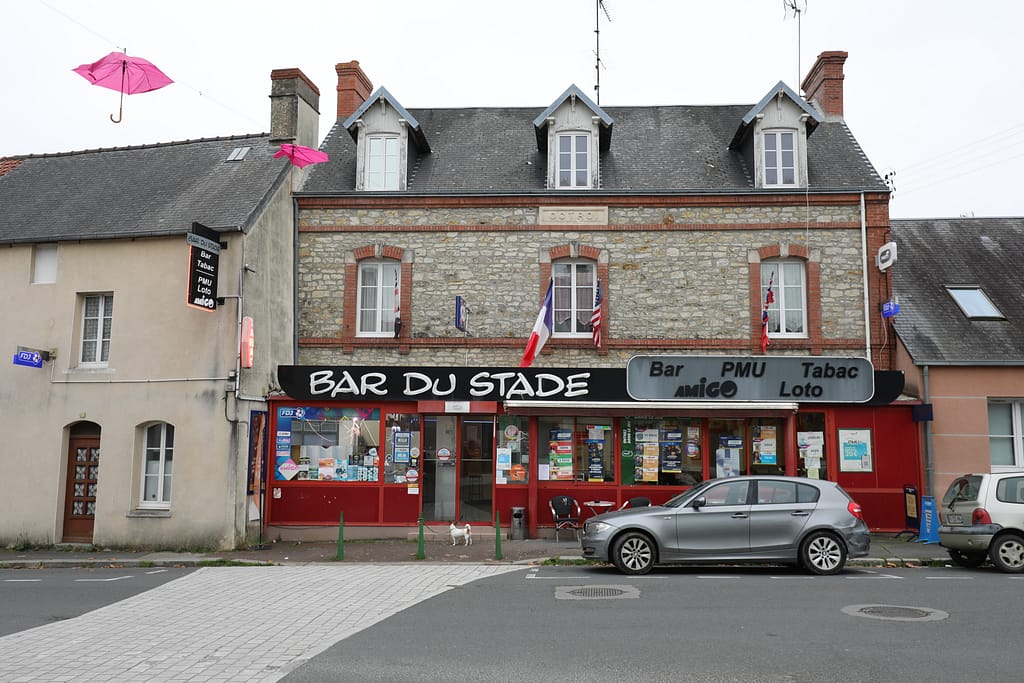
Talk through the Carentan T-Junction. The Germans had placed an MG42 in the lower floor of the ‘Cafe du Stade’ (now Bar du Stade) and engaged Easy Company as they approached along Rue Auvers
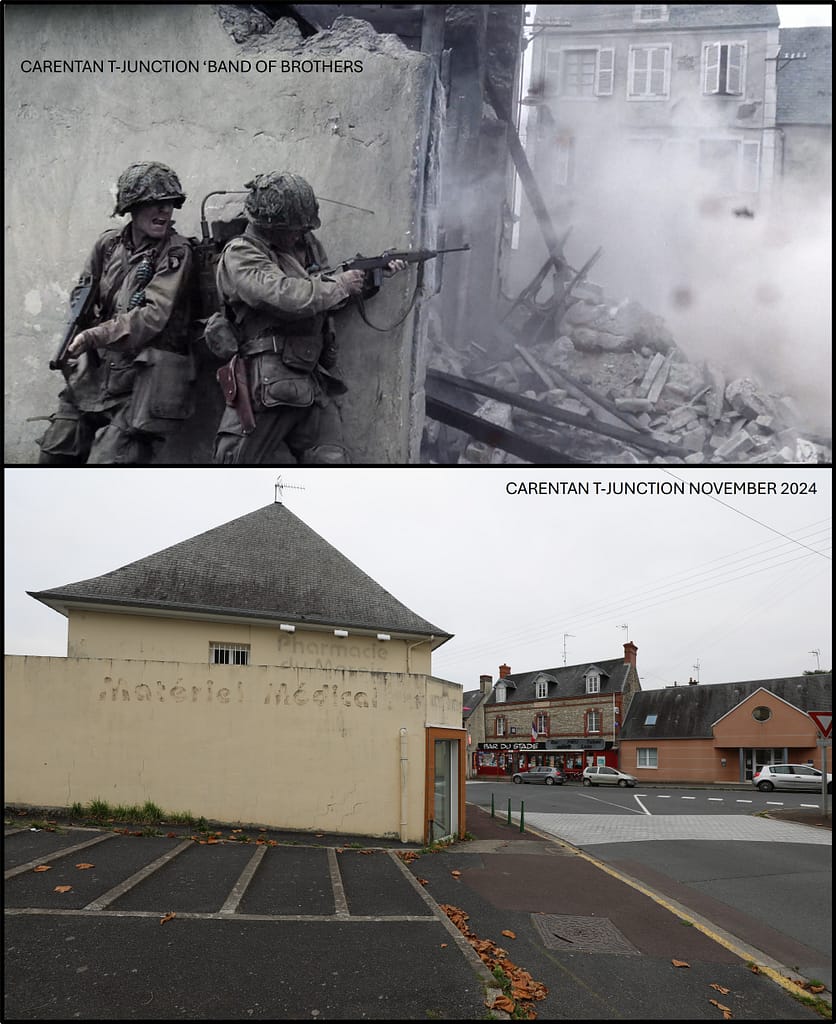
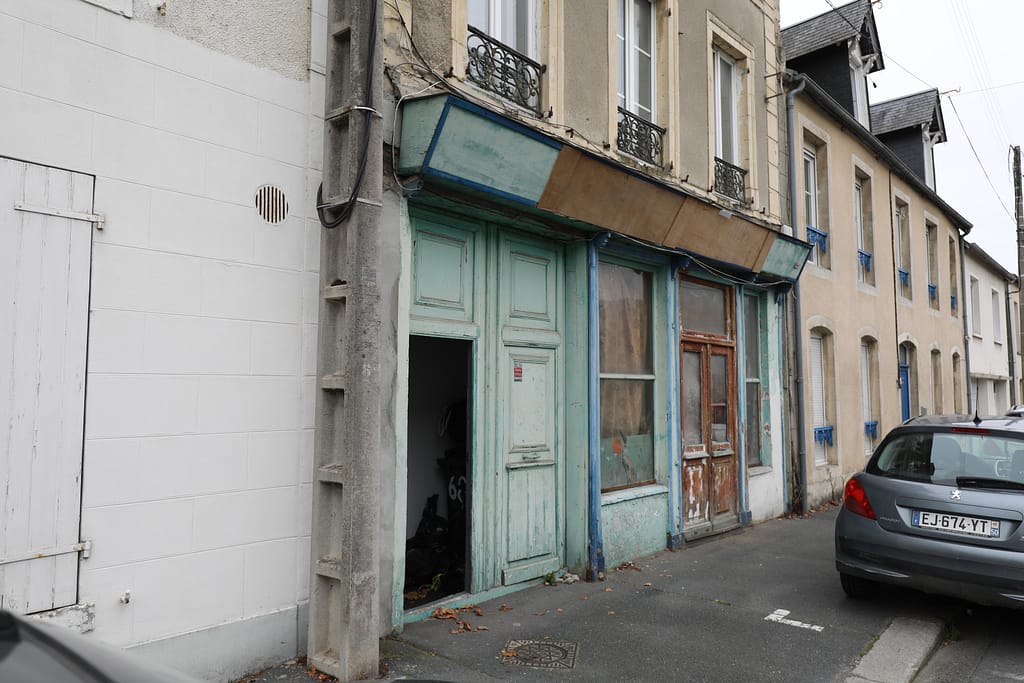
Carentan – ‘Then and Now’ 1944 and 2024 images
Link to Carentan’s ‘Dead Man’s Corner Museum’ website
Found this useful? Buy me a coffee — it helps fund future battlefield research


Authored by Mick Prictor, a retired military officer with 40 years’ service, and a military historian specialising in terrain-focused analysis of tactics, doctrine, and command decision-making in land warfare. His work draws on extensive battlefield fieldwork—more than 280 sites worldwide—and one of the world’s largest private collections of historic military arms, uniforms, and equipment. About me
❓ Test Your D-Day Knowledge
Twenty questions covering the airborne operations, invasion beaches, commanders, forces and fighting of 6 June 1944.
20 questions · 60% to pass · expect a challenge
Sources – Battle of Carentan
Memoirs & Eyewitness Accounts
- Winters, Richard D., and Cole C. Kingseed. Beyond Band of Brothers: The War Memoirs of Major Dick Winters. Berkley Caliber, 2006.
- Guarnere, William, and Edward Heffron. Brothers in Battle, Best of Friends. Berkley Caliber, 2007.
- von der Heydte, Friedrich August Freiherr. Daedalus Returned. Helios, 1979 – reflections from the German paratroop commander at Carentan.
- Donald R. Burgett. Currahee!: A Screaming Eagle at Normandy. Presidio Press, 1967.
Secondary Histories
- Ambrose, S. E. (1999). D-day, June 6, 1944: the climactic battle of World War II. Thorndike.
- Ambrose, S. E. (1992). Band of Brothers: E Company, 506th Regiment, 101st Airborne from Normandy to Hitler’s Eagle’s Nest. Touchstone, Simon & Schuster.
- Beevor, Antony. (2009). D-Day: The Battle for Normandy. Penguin Books
- Ryan, Cornelius (1959). The Longest Day: June 6, 1944. Simon and Schuster, New York.
- Niklas Zetterling (2000). Normandy 1944: German Military Organisation, Combat Power and Organisational Effectiveness, Winnipeg: J.J. Fedorowicz.
- Stephen Zaloga. US Airborne Divisions in the ETO 1944–45 (Battle Orders, 25). Osprey Publishing, 2007.
📚 Further Reading – Battle of Carentan
This battle study nests within the broader analytical framework explored in the Research Hub, where operational methods, operating environments, armies, commanders, and weapons are examined across conflicts and eras. The links below connect related studies across the wider body of battlefield analysis on the BattlefieldTravels site.
⚔️ Explore all battle studies from World War Two 1939-1945
⚔️ Explore all battle studies involving Easy Company ‘Band of Brothers’ 506th PIR
🏛️Explore the museum of World War Two historic artefacts
The book list for this conflict includes the finest campaign studies, memoirs, and operational analyses available on the D-Day landings, selected specifically to complement this battlefield study.
📚World War Two – Recommended Reading
🗞️ For updates on new battlefield studies and research insights, you can subscribe to the Newsletter.
Related Battle Studies, Museum Pieces & Reading Resources
 ⚔️ D-Day: Sword Beach landings,
6 June 1944
 ⚔️ D-Day: Utah Beach landings,
6 June 1944
 ⚔️ D-Day: 101st Airborne Division and the Battle of Bloody Gulch,
13 June 1944
 ⚔️ D-Day: Omaha Beach landings,
6 June 1944
 📝 🔒Field Note: XXX Corps Orders, Leopoldsburg, Belgium, 15 Sep 1944
 ⚔️ D-Day: US Airborne Operations, Sainte-Mere-Eglise,
6 June 1944
🧭 Battlefield Travel Guide: Carentan
Getting There
- Location: Carentan-les-Marais, Manche, Normandy, France.
- Transport: Easily reached by car via the N13 highway. Carentan railway station links to Paris and Bayeux.
- Parking: Free public parking in the town centre and near key memorials.
Site Orientation
- Key Landmarks: Town centre streets fought over in June 1944, Purple Heart Lane causeway, and Douve valley floodplain.
- Walking Routes: Explore Carentan town square and main avenues; short drives lead to Purple Heart Lane and Dead Man’s Corner.
- Best Vantage Points: Purple Heart Lane for the causeway fighting; town square for the airborne assault’s climax.
Museums & Memorials
- Dead Man’s Corner Museum (Saint-Côme-du-Mont): Dedicated to the 101st Airborne Division, with uniforms, weapons, and vehicles.
- Normandy Victory Museum (Catz): Large displays of vehicles, dioramas, and artefacts from the Normandy campaign.
- Local Memorials: Monuments throughout Carentan to the 101st Airborne, 502nd PIR, and other units.
On-Site Experience
- Interpretive Signage: Numerous plaques and memorial markers within the town and along Purple Heart Lane.
- Atmosphere: The compact town streets and surrounding bocage retain the feel of June 1944 combat.
- Tours: Guided tours available via local D-Day tour companies, often combining Sainte-Mère-Église, Utah Beach, and Carentan.
Nearby Points of Interest
- Sainte-Mère-Église: Famous Airborne drop zone and museum, a short drive north.
- Utah Beach: Landing beach and museum within 20 minutes’ drive.
- Bayeux: Offers the main Normandy War Cemetery and Battle of Normandy Museum, about 40 minutes away.
Practical Tips
- When to Visit: Summer anniversaries (early June) offer commemorations and re-enactments, but are busiest.
- Facilities: Carentan has cafés, hotels, and restaurants within walking distance of the battlefield areas.
- Special Considerations: Some battlefield approaches (hedgerows and farmland) are private; stay to public roads and marked sites.
FAQ: Battle of Carentan
Carentan linked the Utah and Omaha Beachheads. Its capture was vital to creating a continuous Allied front in Normandy.
The U.S. 101st Airborne Division, particularly the 502nd and 506th Parachute Infantry Regiments, attacked German paratroopers of the 6th Fallschirmjäger Regiment and elements of the 17th SS Panzergrenadier Division.
Fighting took place from 10 to 14 June 1944, immediately following the D-Day landings.
The Americans captured the town after fierce urban fighting. A German counter-attack on 13 June was repelled with support from U.S. armour.
The town of Carentan-les-Marais preserves key battle sites including the Dead Man’s Corner Museum, bridges over the Douve River, and Airborne memorials.
Subscribe to Battlefield Travels and receive a free E-Book Battlefield Guide
Unlock expert battlefield analysis, campaign reconstructions, and historical insights drawn from firsthand exploration and primary sources.
🗺️ You’ll receive:
🎖️ Exclusive historical insights you won’t find elsewhere
📘 A free eBook: 10 Tips for Exploring Historic Battlefields
📰 New battlefield studies straight to your inbox as they are published
⚔️ Go deeper — Members get exclusive access to the Deep Research Collection, Field Notes, and monthly Research Dispatches. Try membership free for 7 days, cancel anytime. From $9/month.
Outstanding work, Mick. We were there in July of ’23, but didn’t get to spend much time there.
Thanks Jim. It amazes me how little these towns have changed in 80 years. Very recognisable.
I also explored Bloody Gulch, the German counterattack by 17th SS Panzergrenadier Division after the fall of Carentan – working on that post now!