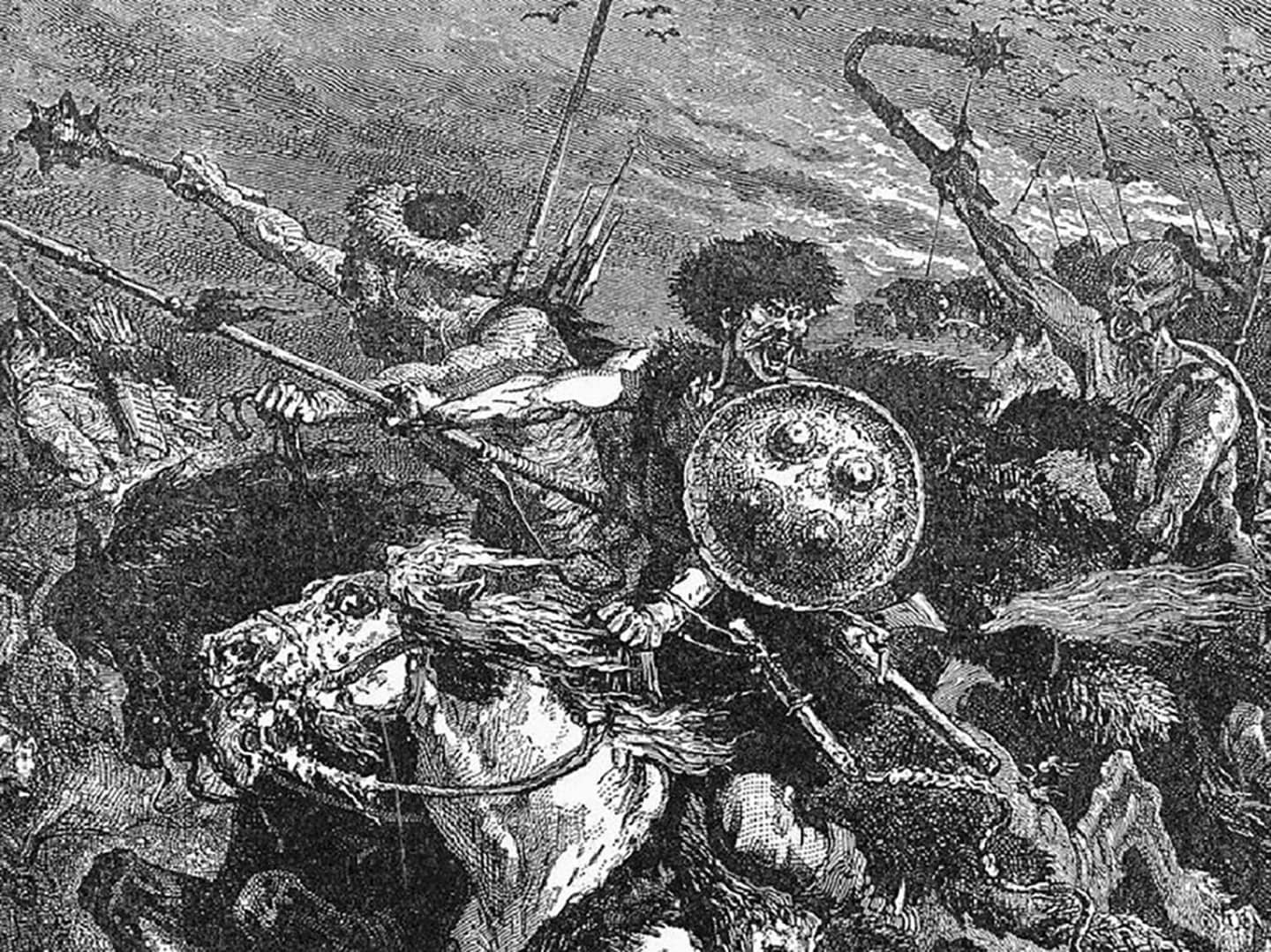
The decisive battle for the Western world!
First, a disclaimer: I cannot claim with absolute certainty to have explored the precise site of the 451 AD Battle of the Catalaunian Fields — also known as the Battle of the Catalaunian Plains. Although it was one of the truly decisive battles in history, contemporary sources are scarce. Our main account comes from Jordanes, a Byzantine Goth who wrote Getica around 551 AD, chronicling the history of the Gothic peoples.
Jordanes described the battlefield in some detail, placing it near the Catalaunian Plains, in the region of Châlons-en-Champagne or Troyes, in eastern France. Other writers of the period offer important corroborating clues. However, for the past 1500+ years the exact location of the battle has been the subject of much debate. I will discuss this further in ‘The battlefield today’ segment.
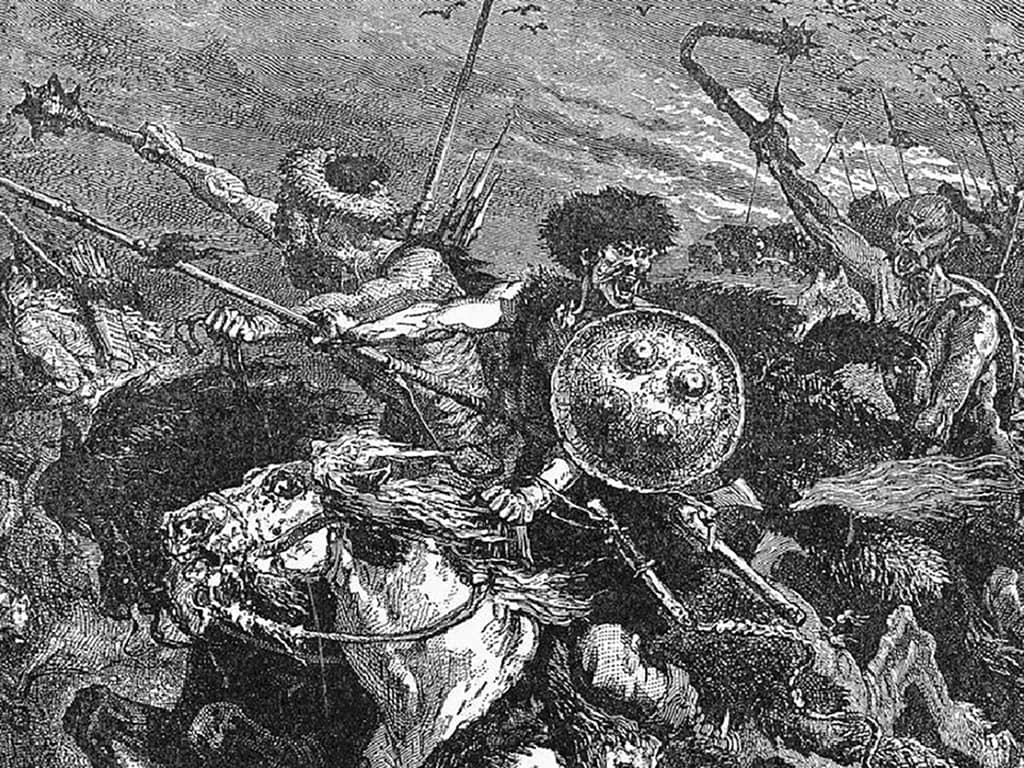
Key facts
Google Earth map – Probable location of the battle
“Pugnatum est in quinto milliario de Trecis loco nuncupante Maurica in Campania.” (The battle was fought near the five mile marker from Trecis (Troyes) on the field called Maurica in Campania (Champagne))
🧭🥾 Walking the Battlefield
I have been fortunate to visit several of the proposed sites for the Battle of the Catalaunian Fields. The first time was in June 2012 and the second was in November 2024. There are several sound theories about where the battle took place, but as I delved deeper, I became convinced that the site near Troyes was the most likely. Contemporary and near-contemporary sources described the location in sufficient detail, and the region’s folk memory and place names provide compelling evidence. When I walked the battlefield, I was armed with numerous Roman and Gothic accounts, 19th and 20th-century historical studies, maps, diagrams, and a detailed GIS analysis.
Table of Contents
- 3D Flythrough of the Catalaunian Fields battlefield
- The Roman Empire in 451AD
- The Huns arrive in Europe
- Prelude to war with the Western Roman Empire
- Casus belli for Attila’s invasion
- Hunnic invasion of Gaul
- 🔒Location of the ‘Catalaunian Fields’ (Catalaunian Plains)
- 🔒Phase I: First clash of forces
- 🔒Phase II: Fight for the high ground
- 🔒Phase III: Clash of the main forces
- 🔒Phase IV: Attila retreats to his camp
- 🔒Aftermath of the Battle of the Catalaunian Fields
- 🔒Strategic Consequences: Hun retreat
- 🔒The Catalaunian Fields battlefield today
- 🔒Le Camp d’Attila – ancient Celtic / Roman fortification
- 🔒Sources
- 📚 Further Reading – Roman Warfare
- 🧭 Battlefield Travel Guide: Catalaunian Fields (AD 451)
- FAQ: Catalaunian Plains
3D Flythrough of the Catalaunian Fields battlefield
Google Earth flythrough of Hun invasion of Gaul and the titanic clash at the Catalaunian Plains. Illustrated with some clips from old Attila and similar movies:
‘Attila’ 1954, directed by Pietro Francisci
‘Sign of the Pagan’ 1954, directed by Douglas Sirk
‘Genghis Khan’ 1965, directed by Harry Levin
‘Attila the Hun’ 2001, directed by Dick Lowry
‘Myn Bala’ 2011, directed by Akan Satayev
‘Barbarians Rising: Attila, King of the Huns’ 2016, History Channel
The Roman Empire in 451AD
By 451 AD, the Roman Empire was in serious decline. The 3rd Century AD had been wracked by Civil War (235-285 AD) and leadership turmoil (assassinations, coups, feeble emperors, infant emperors, etc). From around 376 AD, hundreds of thousands of Goths and other tribal groups from the Black Sea area began massing on the north side of the Danube, seeking sanctuary within the empire.
These migrations were driven by a new terror from the steppe — the Huns, who were devastating the plains of what is now southern Russia and Ukraine. Roman knowledge of the Huns came mostly from the refugees’ horrific stories of savagery and pillage. In 377 AD, the Goths were permitted to cross the Danube, but thanks to clumsy diplomacy and corrupt Roman administration, they rebelled, crushed the Eastern Roman field army, and killed Emperor Valens at the disastrous Battle of Adrianople (now Edirna, Turkey) in 378 AD.
The Huns arrive in Europe
Valens’ successor, Theodosius the Great, was the last Emperor to rule a unified empire. Upon his death in 395 AD, the Roman Empire was formally split in two, with the West ruled by Emperor Arcadius from his capital in Ravenna, Italy, and the East ruled by Emperor Honorius from his capital in Constantinople (modern Istanbul). At about the same time, the Eastern Roman Empire first came into direct contact with the Huns.
Origins and rise of the Huns
The Huns likely originated in Central Asia, perhaps the same confederation known to the Chinese as the Xiongnu who harried northern China from the 3rd century BC to the 2nd century AD. Driven westward by successive Chinese campaigns, they absorbed or allied with other tribes, arriving in Europe as a federation of ethnic Huns, conquered steppe peoples, and Germanic tribes.
The Hunnic empire
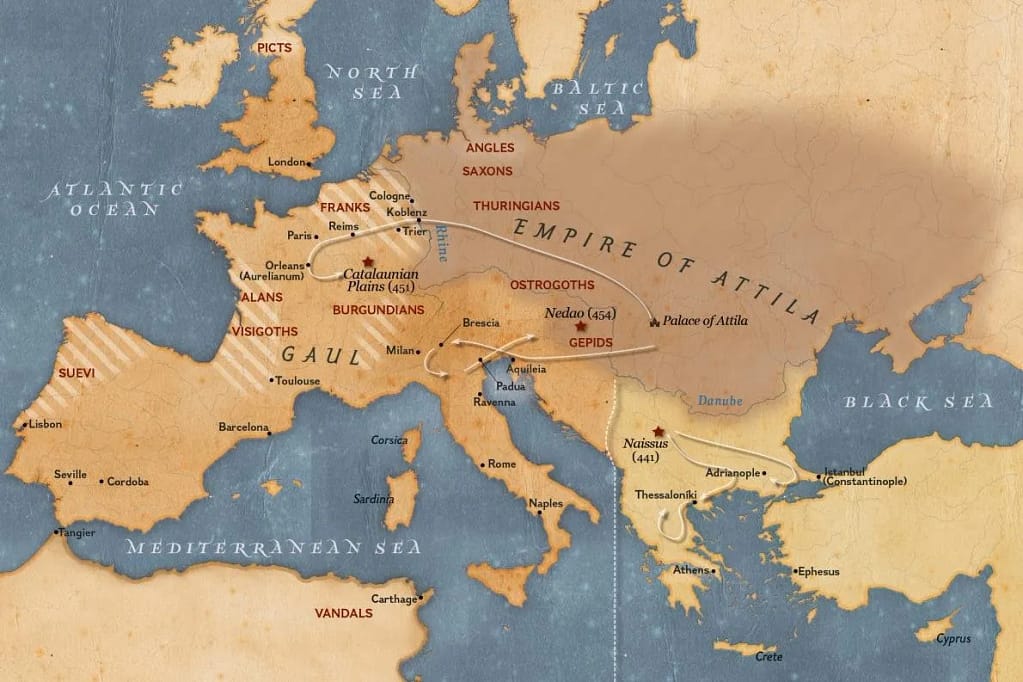
By the early 5th Century, the Hunnic empire was centred in the Hungarian Plain and covered most of what is now Hungary, Germany, Romania, Poland, Ukraine, Belarus and European Russia. In their weakened state, the Romans eventually adapted to having a large rival empire as their neighbour across the Danube. At various times during the early 5th century, the Huns allied with, or fought against, both the Eastern and Western Roman Empires. The Romans also had no problem employing Hun mercenaries in Roman armies to defeat other enemies.
Prelude to war with the Western Roman Empire
Throughout the 420s and 430s, under their King Rugila, the Huns regularly crossed into the Eastern Roman Empire, sacking towns, looting, and laying waste to the region south of the Danube (today’s Serbia, Bulgaria, Greece). Rugila died in ~435 AD and was succeeded by his two nephews, Bleda and Attila. Bleda died in 445, probably murdered, and Attila became the sole King of the Hunnic Empire. Attila inflicted a major defeat on the Eastern Roman Empire at the Battle of the Utus River in 447 AD, and was only stopped by the massive defences of Constantinople.
Casus belli for Attila’s invasion
Contemporary writers offer several reasons for Attila’s next move against the Western Roman Empire. With much of the Balkans devastated by previous Hun raiding, Attila now coveted the more prosperous province of Gaul (modern France). Around 449 AD, the Frankish (northern France) King Chlodio died, and there was a succession struggle between his two sons. The younger son was under the care of Roman General Flavius Aetius, and Rome supported his claim. The older son sought support for his claim from Attila and the Huns. At about the same time, Honoria, the sister of Western Roman Emperor Valentinian III, apparently made an offer to marry Attila, with an implication that the dowry would include half the western empire. Either or both of these provocations provided Attila with his casus belli.
Hunnic invasion of Gaul
Sack of Metz
In early 451 AD, Attila and an enormous force of Huns, with allied Ostrogths, Gepids, Thuringii, Franks, and Burgundians crossed into Roman Gaul. The Huns sacked Divodurum (Metz) and several other cities in eastern Gaul. Emperor Valentian tasked Roman General Flavius Aetius to raise a force to halt the Hunnic invasion.
Romans and Visigoths – an unnatural alliance
Aetius had lived for years as a hostage of the Huns, and had led armies of Hunnic mercenaries against rebellious tribes in Gaul, so he knew the Huns and Attila very well. He took with him a core element of Roman regular troops, gathered Roman border troops and garrison troops along the way, and was able to negotiate an unlikely alliance with traditional enemy Theodoric, King of the Visigoths. Contingents of Alans, Franks, Burgundians, and others also joined his coalition against the Huns.
Attila halted at Orleans
After sacking Metz, the Hun army next moved against the Alan-held city of Aurelianorum (Orleans). Aetius got there first with his Roman-Visigothic force and prevented the Huns from laying siege. Attila had not expected to face a combined force of Romans, Visigoths, and other traditional enemies. He was forced to consider withdrawal.
“Then Attila, king of the Huns, was taken aback by this event [the intervention of the Romano-Visigothic forces] and lost confidence in his own troops, so that he feared to begin the conflict. While he was meditating on flight—a greater calamity than death itself—he decided to inquire into the future through soothsayers.”
Jordanes 551 AD
The improbable alliance between Rome and the Visigoths changed the calculus for Attila and he began withdrawing westwards via the Roman roads through Sens and on to Troyes.
👉 Continue reading — this article is part of the BattlefieldTravels Deep Research Collection. The full 5,024-word analysis draws on primary and secondary accounts of the 451 AD Battle of the Catalaunain Plains, including 5th and 6th Century Gothic tests, GIS analysis and extensive fieldwork on the likely battlefield. Primary source examination, tactical conclusions, and notes & references that exist nowhere else in English. Try membership free for 7 days.
📚 Further Reading – Roman Warfare
This battle study nests within the broader analytical framework explored in the Research Hub, where operational methods, operating environments, armies, commanders, and weapons are examined across conflicts and eras. The links below connect related studies across the wider body of battlefield analysis on the BattlefieldTravels site.
⚔️ Explore all battle studies from the Ancient Roman era
🏛️Explore the museum of Ancient and Medieval historic artefacts
The book list for this conflict includes the finest campaign studies, memoirs, and operational analyses available on ancient warfare, selected specifically to complement this battlefield study.
📚 Ancient Warfare– Recommended Reading
🗞️ For updates on new battlefield studies and research insights, you can subscribe to the Newsletter.
Related Battle Studies, Museum Pieces & Reading Resources


🧭 Battlefield Travel Guide: Catalaunian Fields (AD 451)
Getting There
- Nearest Town: Châlons-en-Champagne, Grand Est, northeastern France.
- Transport: By car via A26/N44; rail from Paris–Est to Châlons-en-Champagne.
- Parking: Public parking in Châlons and nearby villages used to explore the plains.
Site Orientation
- Key Landmarks: The Champagne plain between Châlons and Troyes; proximity to the Marne valley. (Exact battlefield location remains debated.)
- Walking/Driving Routes: No formal trails; use rural lanes and D-roads to sample vantage points across the open fields.
- Best Vantage Points: Open farmland south and southeast of Châlons conveys the scale of the clash between Attila’s Huns and the Roman–Visigoth coalition.
Museums & Visitor Centres
- Musée de Châlons-en-Champagne: Regional archaeology, late Roman artefacts, and local history.
- Interpretive Material: Occasional heritage panels reference Attila’s 451 campaign; no dedicated battlefield museum.
- Nearby: Reims (Porte de Mars Roman arch) and Troyes (medieval/Romanesque collections) provide broader period context.
On-Site Experience
- Interpretive Signage: Limited due to scholarly debate on the precise site.
- Atmosphere: Wide, gently rolling fields under open skies — a landscape of manoeuvre rather than fixed points.
- Tours: Specialist guides occasionally offer late Roman battlefield itineraries; most visits are self-guided.
Nearby Points of Interest
- Châlons-en-Champagne: Medieval churches, riverside walks, and regional history centres.
- Troyes: Superb medieval core with timber-framed streets and Gothic churches.
- Reims: Cathedral of coronations and substantial Roman remains (including the Porte de Mars).
Practical Tips
- When to Visit: Spring–early summer for clear sightlines across cropped fields; harvest/autumn gives expansive views.
- Facilities: Full services in Châlons, Troyes, and Reims; none on the open plain.
- Special Considerations: Treat this as a landscape study; bring period maps/overlays to relate texts to terrain. Respect crops and private property.
FAQ: Catalaunian Plains
A major battle fought in 451 AD near Châlons-en-Champagne and Troyes, where Roman and Visigothic forces under General Flavius Aetius defeated Attila the Hun.
Latin chroniclers referred to the battle taking place on ‘Campi Catalauni’, which can be interpreted as ‘Catalaunian Plains’ or Catalaunian Fields’. It is also known as the Battle of Chalons or the Battle of Maurica.
A coalition of Romans, Visigoths, Franks, and allies faced Attila’s Huns and their subject tribes, including Ostrogoths and Gepids.
Attila was forced to retreat, halting his advance into Gaul and preserving Roman control for a time.
The exact site is debated, but it is generally placed near Troyes or Châlons-en-Champagne, France. The region has memorials and interpretive signage referencing the battle.
Subscribe to Battlefield Travels and receive a free E-Book Battlefield Guide
Unlock expert battlefield analysis, campaign reconstructions, and historical insights drawn from firsthand exploration and primary sources.
🗺️ You’ll receive:
🎖️ Exclusive historical insights you won’t find elsewhere
📘 A free eBook: 10 Tips for Exploring Historic Battlefields
📰 New battlefield studies straight to your inbox as they are published

⚔️ Go deeper — Members get exclusive access to the Deep Research Collection, Field Notes, and monthly Research Dispatches. Try membership free for 7 days, cancel anytime. From $9/month.