Lee’s greatest gamble: the Battle of Chancellorsville!
In May 1863, Robert E. Lee defied all military convention at Chancellorsville, dividing his much smaller Confederate army and sending Stonewall Jackson on a daring flank march. The result was one of Lee’s greatest victories — and one of the Union Army’s most demoralising defeats.

Key facts
🗺️ Battle of Chancellorsville, Virginia, 27 April – 6 May 1863
⚔️ American Civil War, 1861-65
🪖 134,000 man Army of the Potomac under General Joe Hooker vs 60,000 man Army of Northern Virginia under General Robert E. Lee
🎯 Bold and ambitious Union strategy defeated by an even bolder Confederate response
Visit the virtual museum of weapons, uniforms and equipment of the American Civil War
Google Earth map – Location of the Chancellorsville battlefield
🎧 Prefer to listen? This article is also available as a 33-minute podcast
Runtime: 33 minutes
In May 1863, Robert E. Lee defied all military convention at Chancellorsville, dividing his much smaller Confederate army and sending Stonewall Jackson on a daring flank march. The result was one of Lee’s greatest victories — and one of the Union Army’s most demoralising defeats.
Tip: If Podbean overlay appears after pausing, click the × in the top-right corner to return to the player controls.
🧭🥾 Walking the Battlefield
I visited the Chancellorsville battlefield in December 1997 and again in May 2019. On the second visit, I was equipped with several firsthand accounts of the battle, sketches, diagrams, maps and my digital GIS overlays. Like most North American battlefields, Chancellorsville is incredibly well preserved, with vast areas of this sweeping battle set aside to maintain the site as it was. Many of the original buildings or their foundations remain, and battery positions are marked with the original 12-pounder Napoleons. Perhaps the most significant site is the old Catharine Furnace Road, along which Stonewall Jackson’s Second Corps of the Army of Northern Virginia marched to get behind the Union Army and, against all the odds, achieve one of the most dramatic victories in military history.
Strategic context: From Fredericksburg to Chancellorsville
Aftermath of Fredericksburg
The Union defeat at Fredericksburg (13 December 1862) had left the Army of the Potomac demoralised and politically shaken. General Ambrose Burnside’s frontal assaults against the stone wall at Marye’s Heights resulted in nearly 13,000 Union casualties, compared to about 5,000 Confederates, and gained nothing. Public opinion turned bitterly against the Lincoln administration, and the army itself suffered a crisis of confidence in its leadership.
Lincoln appoints Hooker
In January 1863, President Abraham Lincoln replaced Burnside with Major General Joseph “Fighting Joe” Hooker. Lincoln’s letter of appointment was pointed, reminding Hooker that while he was brave and popular, he was also known for undermining his superiors. Hooker, however, was also recognised as an effective organiser.
He immediately set about restoring the Army of the Potomac:
- Improved rations, camp conditions, and medical services.
- Streamlined corps structures and reinforced cavalry into a more cohesive mounted arm.
- Rebuilt morale by issuing pay, furloughs, and enforcing discipline.
By spring 1863, the Union army was at its peak strength — over 134,000 men, well-fed, well-supplied, and confident under a commander who projected energy and competence.

Lee’s position in early 1863
Opposite Hooker stood General Robert E. Lee with the Army of Northern Virginia, numbering about 60,000 men. Lee’s army was still recovering from the strain of the Maryland Campaign (Antietam, September 1862) and the Fredericksburg battle. Supplies were limited, rations meagre, and Confederate soldiers suffered chronic shortages of shoes and clothing.
Yet morale remained high. Victory at Fredericksburg had reinforced Lee’s aura of invincibility, and his army had a hardened core of veteran units. His key lieutenants included:
- Lieutenant General Thomas “Stonewall” Jackson, commanding the Second Corps.
- Lieutenant General James Longstreet, commanding the First Corps (detached on independent duty in Virginia and North Carolina during the Chancellorsville campaign).
- Lieutenant General J.E.B. Stuart, leading the Confederate cavalry.
Lee’s strategic situation was precarious: vastly outnumbered, operating with stretched supply lines, and tasked with defending the approaches to Richmond. Yet he was willing to gamble, relying on the aggressiveness of his commanders and the poor coordination that had plagued Union offensives so far.
Hooker’s ambitious plan
Joe Hooker’s plan was aggressive, well-planned and, by conventional measures, should have succeeded. His goal was to cross the Rappahannock and Rapidan rivers upstream of Fredericksburg, swing behind Lee’s left flank, and crush the Army of Northern Virginia. To fix Lee in place, he left a strong detachment of 40,000 men opposite Fredericksburg, while manoeuvring over 90,000 through the Wilderness forest west of Fredericksburg
By late April 1863, the Union army was in motion. Hooker’s plan, on paper, promised overwhelming superiority — and Lincoln and his cabinet had every reason to believe a decisive victory was finally at hand.
Opposing forces: Hooker’s Army of the Potomac vs Lee’s Army of Northern Virginia
 Union Army of the Potomac
 Union Army of the Potomac
- Commander: Major General Joseph Hooker
- Strength: ~134,000 men
- Organisation: Seven infantry corps, one cavalry corps, and artillery reserve.
Corps breakdown:
- I Corps (John F. Reynolds): 3 divisions (~18,000) — veteran units from Antietam and Fredericksburg.
- II Corps (Darius Couch): 3 divisions (~18,000) — disciplined, strong artillery support.
- III Corps (Daniel Sickles): 2 divisions (~11,000) — aggressive, later central to counterattacks.
- V Corps (George Meade): 3 divisions (~15,000) — steady, led flanking movements.
- VI Corps (John Sedgwick): 6 divisions (~23,000) — the largest corps, key to Fredericksburg action.
- XI Corps (Oliver O. Howard): 3 divisions (~12,000) — largely German-American regiments, poorly deployed on 2 May.
- XII Corps (Henry Slocum): 2 divisions (~13,000) — steady and reliable.
- Cavalry Corps (George Stoneman): ~10,000, tasked with deep raids.
- Artillery Reserve (Henry J. Hunt): ~400 guns concentrated in batteries.

 Confederate Army of Northern Virginia
 Confederate Army of Northern Virginia
- Commander: General Robert E. Lee
- Strength: ~60,000 men at Chancellorsville
- Organisation: Two main infantry corps, plus cavalry and artillery.
Corps breakdown:
- First Corps (James Longstreet): Detached on foraging/defensive duties with two divisions in Suffolk, Virginia — not present.
- Second Corps (Thomas J. “Stonewall” Jackson): ~33,000 men in four divisions:
- A.P. Hill’s Division (~13,000)
- Robert E. Rodes’ Division (~8,000)
- Raleigh Colston’s Division (~7,000)
- D.H. Hill’s Division (under command of others, ~5,000)
- Fredericksburg Detachment (Jubal Early): ~12,000, left to hold Marye’s Heights and watch Sedgwick.
- Cavalry Corps (J.E.B. Stuart): ~10,000, providing reconnaissance and screening.
- Artillery Reserve (William Pendleton): about 200 guns distributed among divisions.
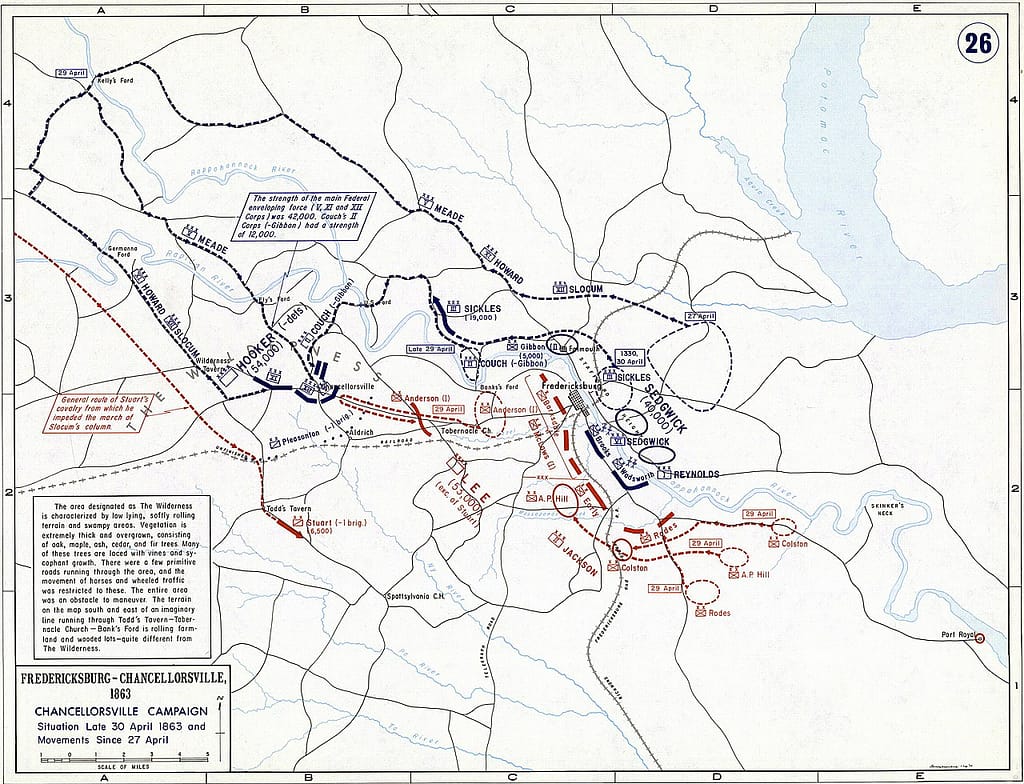
Hooker’s Plan in Motion: 27–30 April 1863
The river crossings
On 27 April 1863, Hooker launched his grand plan. Three Union corps — the V (Meade), XI (Howard), and XII (Slocum) — marched upstream to cross the Rappahannock and Rapidan Rivers at Kelly’s Ford and Germanna Ford. They were followed by Couch’s II Corps, forming a massive wing of nearly 70,000 men moving into Lee’s rear. At the same time, Sedgwick’s VI Corps, Reynolds’ I Corps, and Stoneman’s cavalry remained opposite Fredericksburg to fix Lee in place.
By 30 April, the manoeuvre was proceeding smoothly. The flanking force concentrated around the Chancellorsville crossroads, a large clearing in the heart of the dense Wilderness of Spotsylvania. Hooker, confident in his success, announced to his officers:
“ ..our enemy must either ingloriously fly, or come out from behind his defenses and give us battle on our own ground, where certain destruction awaits him.”
The Chancellorsville clearing
The Wilderness was a forbidding battleground: a tangle of second-growth forest, scrub, and thickets that negated the Union’s advantages in artillery and numbers. At its centre stood the Chancellor House, a large tavern that gave the crossroads its name. Hooker’s army was massed here, but the terrain blunted his ability to deploy effectively.
Instead of pushing aggressively eastward to cut Lee’s supply lines, Hooker lost momentum. He ordered his corps to take up defensive positions around Chancellorsville, waiting for Lee to react.
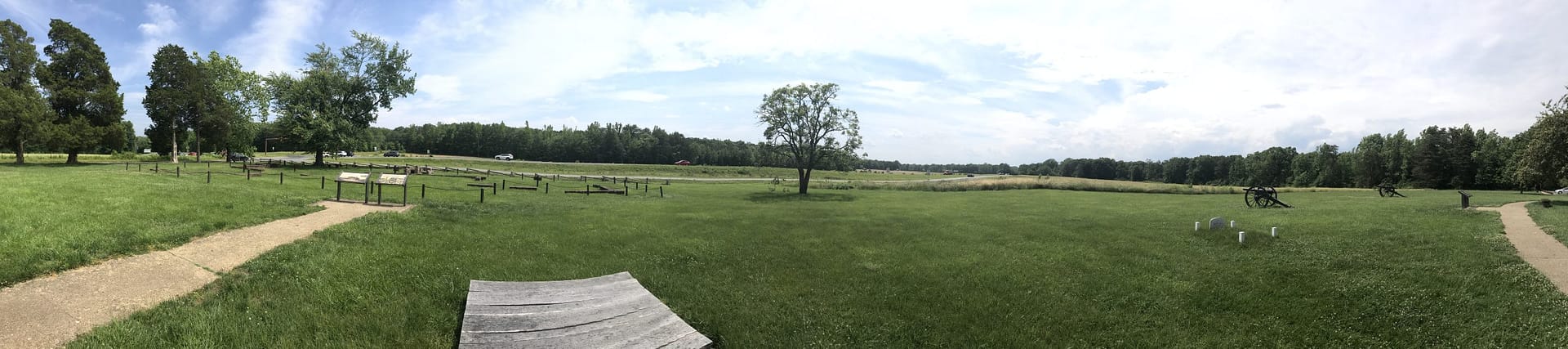
Looking northwest from the Chancellor family home. On 3 May 1863, looking in this direction, you would have seen Jackson’s 30,000 Confederate troops attacking towards this area. Some of the most intense fighting of the battle took place around here.
Lee reacts
Lee quickly realised he faced a major threat to his rear. Leaving Jubal Early with about 12,000 men to hold Fredericksburg, he marched west with roughly 40,000 men to confront Hooker. By 1 May, Lee was advancing directly into Hooker’s larger force.
On the morning of 1 May 1863, Union corps began moving east from Chancellorsville to exploit their advantage. However, when Confederate resistance stiffened along the Orange Turnpike, Hooker unexpectedly ordered a withdrawal back into his defensive perimeter at Chancellorsville. The decision baffled his corps commanders — Meade in particular argued they had gained ground and could push further. Hooker’s sudden caution ceded the initiative back to Lee.

The situation on 1 May 1863
By nightfall on 1 May, the stage was set:
- The Union army, 70,000 strong, was concentrated defensively at Chancellorsville, its commander suddenly hesitant.
- Lee, outnumbered two to one, faced his enemy in the tangled Wilderness — and began contemplating a series of audacious moves that would define his reputation as a battlefield gambler.

Jackson’s flank march and the attack on XI Corps, 2 May 1863
Lee’s gamble
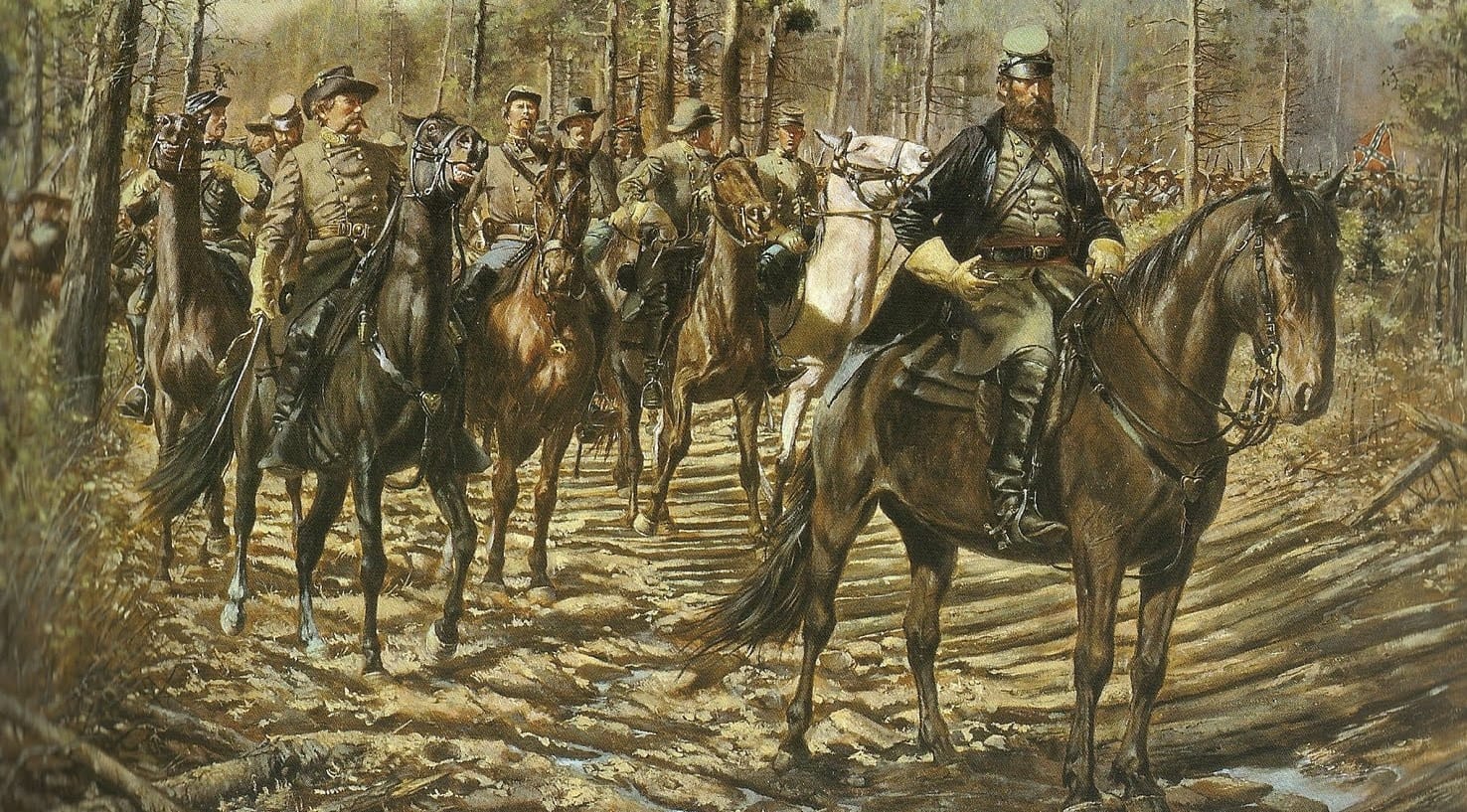
On the night of 1 May 1863, Lee and Jackson met in council of war near the Chancellorsville clearing. Facing Hooker’s much larger army, Lee made the extraordinary decision to divide his force yet again. He left about 10,000 men under Lafayette McLaws and Anderson to hold Hooker’s 70,000 in front, while sending Jackson with over 30,000 men on a wide flanking march through the Wilderness. The plan was to strike the exposed Union right, held by XI Corps (Howard).
This was a manoeuvre of immense risk. Jackson’s men would be marching within earshot of Union lines for much of the day. If detected and attacked, Lee’s divided army could be destroyed in detail.
Jackson’s flank march
At dawn on 2 May, Jackson’s column began moving along obscure farm tracks and logging roads south of the Union position. The march stretched nearly 12 miles (20 km) and lasted most of the day. Union patrols spotted dust clouds and columns, but Hooker dismissed the reports, believing Lee was retreating toward Gordonsville.

By late afternoon, Jackson’s divisions — Rodes, Colston, and A.P. Hill — were concealed in dense woods on Howard’s flank. The XI Corps, composed largely of inexperienced German-American regiments, was poorly posted, facing south instead of west, and unaware of the storm about to break.

The surprise attack
At 5:30 PM, Jackson unleashed his assault. Confederate troops burst from the woods in massed battle lines, taking XI Corps completely by surprise. Union soldiers were cooking dinner, playing cards, or resting when the Confederates struck. Panic spread instantly; many units fled without firing a shot. Howard’s corps was routed, losing cohesion in less than an hour.

Union artillery and fragments of other corps tried to stem the tide, but Jackson’s assault rolled eastward for nearly two miles, collapsing the Union right flank. Darkness and exhaustion finally slowed the advance.
Jackson’s wounding
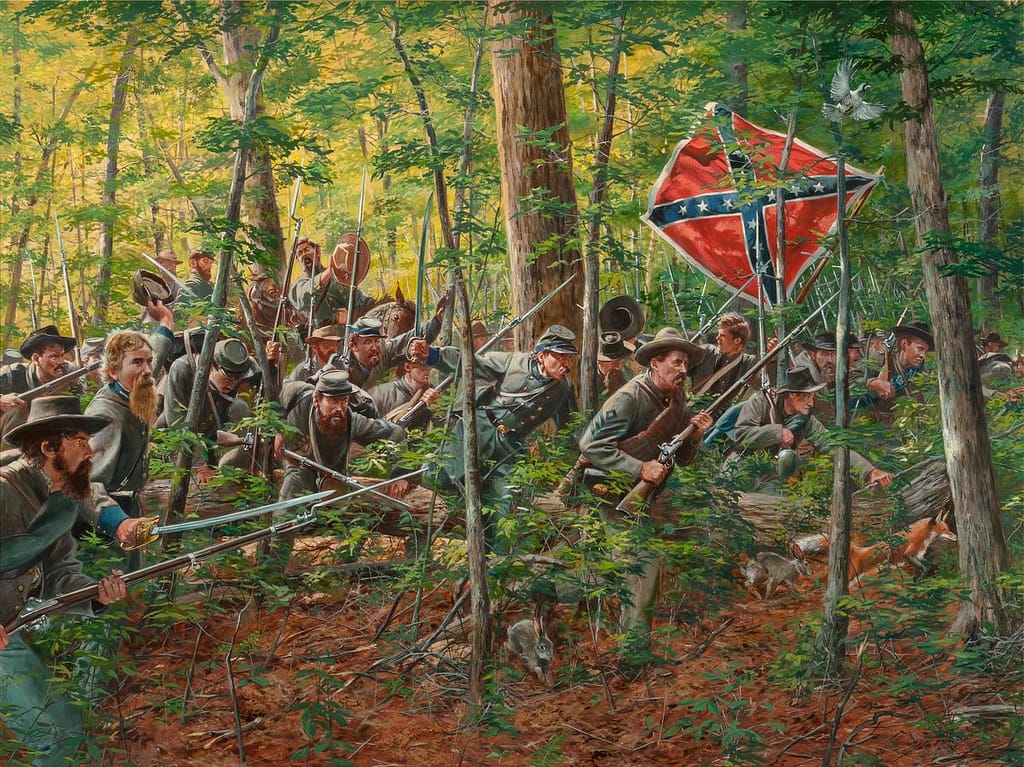
That night, Jackson personally reconnoitred ahead of his lines to prepare for renewing the attack at dawn. As he returned through the dark woods, his party was mistaken for Union cavalry by nervous Confederate pickets. They fired a volley, striking Jackson with three wounds. He was carried from the field, and his left arm was later amputated. General A.P. Hill took temporary command of Second Corps until he too was wounded, after which J.E.B. Stuart assumed control.
Jackson’s wounding was a devastating blow to Confederate morale and command capability. Although Lee pressed on with the plan, he later lamented:
“He has lost his left arm, but I have lost my right.”


3 May 1863: The bloodiest day
Lee presses the attack
With Jackson incapacitated, command of the Confederate Second Corps fell briefly to A.P. Hill, then to J.E.B. Stuart. Despite the disruption, Lee ordered a renewed assault at dawn on 3 May, determined to crush Hooker before the Union army could stabilise its lines.
At Hazel Grove, a vital clearing south of Chancellorsville, Union General Daniel Sickles had positioned artillery. During the night, however, Hooker inexplicably ordered Sickles to withdraw. Confederates quickly seized the ground and placed their own guns there, giving Lee a commanding artillery platform to enfilade the Union lines around the Chancellor House.

Hooker shrinks his perimeter
By mid-morning, a massive Confederate attack pressed Hooker’s shrinking defensive perimeter. Union troops fought stubbornly in the tangled Wilderness, but Confederate assaults gradually forced them back toward the crossroads. At around 9:30 AM, Hooker himself was stunned when an artillery shell struck a pillar of the Chancellor House he was standing against, knocking him unconscious for nearly half an hour. He resumed command later but was visibly shaken and indecisive.
By midday, the Chancellor House itself was in flames. Union staff had to evacuate the wounded under fire, including a dazed Hooker. Confederate infantry pushed hard, and by afternoon they had overrun the clearing, forcing Hooker to pull his army back into stronger defensive positions northeast of Chancellorsville.

Sedgwick at Fredericksburg
Meanwhile, to the east, Union VI Corps under John Sedgwick finally moved against the Confederate positions at Fredericksburg. Early that morning, his 23,000 men attacked Marye’s Heights, scene of the Union slaughter the previous December. This time, with only Jubal Early’s 12,000 Confederates defending, Sedgwick succeeded. By noon, Union troops had stormed the stone wall and driven the defenders off the heights — a symbolic reversal of Fredericksburg.

Sedgwick then marched west toward Chancellorsville, threatening Lee’s rear. At Salem Church, however, his advance was checked by McLaws’ Confederate division, reinforced through Lee’s daring redistribution of forces. By nightfall, Sedgwick’s corps was stalled, unable to link with Hooker.
A day of immense loss
The combined actions of 3 May 1863 — Chancellorsville, Hazel Grove, the burning of the Chancellor House, and Fredericksburg/Salem Church — produced over 21,000 casualties in a single day, making it the second bloodiest day of the entire war (after Antietam, 17 September 1862).
Union losses were heavy: thousands captured in the collapse of their positions; Confederate losses were also severe, with brigades decimated by the ferocious fighting. Despite this, Lee held the initiative, forcing Hooker into a defensive crouch while parrying Sedgwick’s advance from Fredericksburg.

4–6 May 1863: Culmination and Union withdrawal
Hooker’s paralysis
On the night of 3 May, the Army of the Potomac remained numerically strong — nearly 80,000 men were still under Hooker’s command around Chancellorsville. Yet Hooker himself, shaken by his injury and loss of confidence, chose not to renew the offensive. His generals, including Couch, Reynolds, and Meade, urged him to counterattack or reinforce Sedgwick, but Hooker refused. He entrenched his army instead, surrendering the initiative to Lee.

Sedgwick’s predicament
To the east, Sedgwick’s VI Corps, isolated after its breakthrough at Fredericksburg, faced a growing Confederate counter-concentration. McLaws, Anderson, and Early combined against him, forcing Sedgwick into a defensive posture near Banks’ Ford. On 4 May, Lee detached part of his force from Chancellorsville to assist in pressing Sedgwick. After sharp fighting, Sedgwick decided to withdraw across the Rappahannock under cover of night. By dawn on 5 May, his corps was back on the north bank.
⚔️ Go deeper — Members get exclusive access to the Deep Research Collection, Field Notes, and monthly Research Dispatches. Try membership free for 7 days, cancel anytime. From $9/month.
Final withdrawal of the Army of the Potomac
With Sedgwick driven off, Lee turned his full attention back to Hooker. On 5 May, Confederate probes tested the Union lines around Chancellorsville but found them strong. Heavy rain began to fall, swelling the rivers and turning roads to mud. Fearing his army would be trapped south of the Rappahannock, Hooker convened a council of war. Despite resistance from some of his corps commanders, he ordered a general withdrawal.
Overnight, 5–6 May, the Army of the Potomac recrossed the river at United States Ford, destroying pontoon bridges behind them. By the morning of 6 May 1863, Lee stood victorious on the field, having compelled the retreat of an enemy more than twice his size.

Cost of victory
Lee’s triumph came at a terrible price. Confederate casualties were around 13,000 out of 60,000 engaged — nearly 22% of his force. The Union lost about 17,000, fewer in proportion but still grievous. More damaging for the South than the numbers was the loss of Stonewall Jackson, who succumbed to pneumonia on 10 May 1863 after his wounding. His death deprived Lee of his most trusted lieutenant.
Strategic impact of the Battle of Chancellorsville
Lee’s greatest victory
Chancellorsville is widely considered Robert E. Lee’s masterpiece of battlefield command. Outnumbered more than two to one, Lee repeatedly divided his army in the face of a larger foe — an act most generals would have deemed reckless. Yet his calculated risks, reliance on rapid manoeuvre, and trust in his subordinates produced one of the most lopsided psychological victories of the war.
Lee had not destroyed the Army of the Potomac, but he had humiliated it. Hooker’s defensive posture and eventual retreat convinced Southerners that their commander was virtually unbeatable.
Both Lee and Jackson had again demonstrated their masterful appreciation of micro-terrain—the small scale terrain features that often do not appear on maps and can only be seen when you are standing on the ground. Lee’s economy-of-force defence of Marye’s Heights was anchored on the existing stone wall, while Jackson’s flank march exploited existing tracks and the concealment provided by the dense forest of the Wilderness. The concept of exploiting small scale terrain features in battle is discussed further in the Micro-Terrain and Battlefield Decision-Making research hub.
Union demoralisation and leadership crisis
For the Union, the defeat was devastating. The Army of the Potomac had gone into the campaign with superior numbers, better supply, and high morale. Hooker’s reorganisation had restored its confidence after Fredericksburg, but his sudden loss of nerve at the decisive moment squandered every advantage. President Lincoln remarked bitterly:
“My God, what will the country say?”
Within two months, Lincoln and his generals shifted their hopes to George G. Meade, who replaced Hooker on the eve of Gettysburg.
The death of Stonewall Jackson
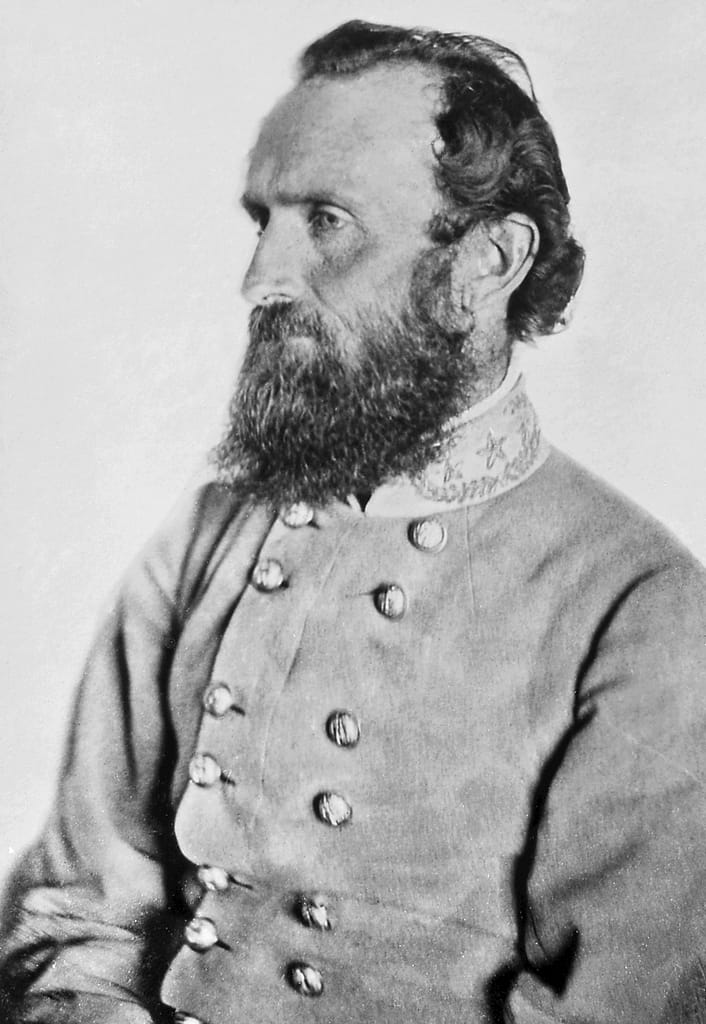
The Confederate victory came at terrible cost. The wounding and subsequent death of Thomas “Stonewall” Jackson deprived Lee of his most aggressive and reliable lieutenant. Lee knew it too, writing:
“He has lost his left arm, but I have lost my right.”
Jackson’s absence was keenly felt in the coming Gettysburg Campaign. His mastery of rapid movement, surprise, and relentless aggression had been critical to Confederate successes in 1862–63. Without him, Lee lacked a subordinate capable of executing independent manoeuvres with the same precision.

Setting the stage for Gettysburg
Buoyed by victory, Lee decided to launch a second invasion of the North. In June 1863, he led the Army of Northern Virginia into Pennsylvania, aiming to shift the war onto Union soil and force a political settlement. That gamble culminated in defeat at Gettysburg (1–3 July 1863).
Historians continue to debate whether Chancellorsville was a pyrrhic victory — a triumph that emboldened Lee into overreaching. In the short term, it was a dazzling Confederate success; in the long term, it set in motion the campaign that led to disaster.
“The Moral is to the Physical as Three to One” Napoleon Bonaparte
Napoleon’s maxim applied perfectly to Chancellorsville. Lee’s audacity and Jackson’s flank march crushed the Union army’s will to fight, even though Hooker retained overwhelming physical strength. Chancellorsville became a case study in the decisive role of leadership, morale, and initiative in battle.
Culture and legacy of Chancellorsville
Chancellorsville in literature
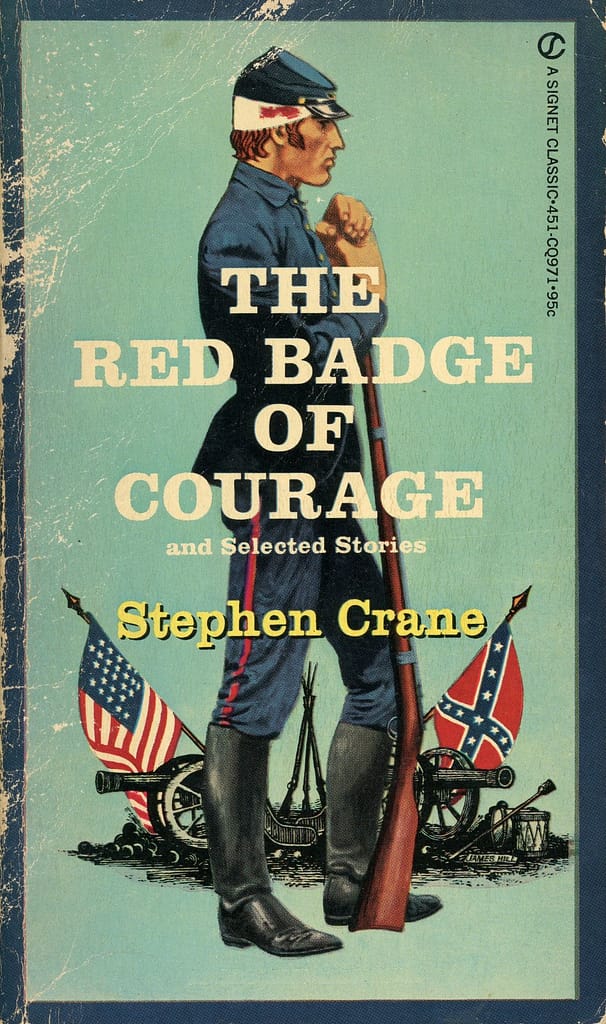
The most famous cultural echo of Chancellorsville is Stephen Crane’s 1895 novel, The Red Badge of Courage. Though written decades after the war and without Crane having seen combat himself, the novel captures the psychological turmoil of a young Union soldier during the battle. Its portrayal of fear, courage, and the chaos of combat transformed the way war literature was written. Many readers first encounter Chancellorsville through Crane’s narrative, which has remained a staple of American literature ever since.
The Jackson myth
Stonewall Jackson’s wounding and death gave rise to a romanticised legend of the Lost Cause. Southern writers and memorialists elevated Jackson as a martyr figure, his death symbolic of Confederate sacrifice. Lee himself encouraged this narrative, famously declaring Jackson to be his “right arm.” Monuments across Virginia, including the Chancellorsville marker and later memorials, enshrined Jackson’s memory as part of Confederate identity.
Military studies
For professional soldiers, Chancellorsville has long been a case study in bold generalship. Military academies often contrast Hooker’s timidity and poor command cohesion with Lee’s audacity and Jackson’s execution of manoeuvre. The campaign demonstrates how morale, leadership, and initiative can outweigh numbers and material advantage.
At the same time, many historians caution that Chancellorsville was a pyrrhic victory. Lee’s success reinforced his overconfidence, leading directly to the high-risk Gettysburg Campaign — undertaken without Stonewall Jackson. Thus, Chancellorsville is studied as both a brilliant tactical success and a strategic misstep.
The Battlefield Today: Exploring Chancellorsville
Preservation and terrain
The Chancellorsville battlefield is one of the best-preserved landscapes of the American Civil War, managed as part of the Fredericksburg & Spotsylvania National Military Park. The terrain — a mix of thick woods, clearings, and rolling ground — still conveys the confusion and close-range combat that defined the 1863 battle. Despite modern development in some areas, the heart of the battlefield around the Chancellor crossroads, Hazel Grove, and Catherine Furnace remains intact.
Key sites to visit
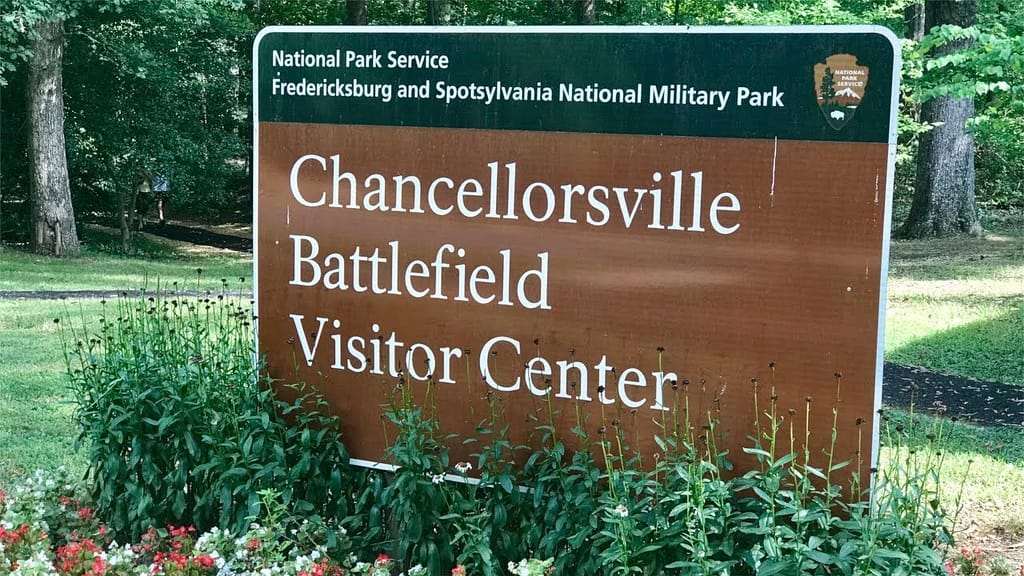
- Chancellorsville Visitor Center: Superb museum with original artefacts, interpretive films, and large-scale maps showing the battle phases.
- Chancellor House Site: Only the foundations remain; the house burned on 3 May 1863. Its clearing anchors the battlefield.
- Hazel Grove: Offers one of the best vantage points to understand the artillery fight of 3 May. Confederate guns here enfiladed Union lines and turned the battle.
- Catherine Furnace & Jackson’s Flank March Trail: Walking or running the 12-mile route of Jackson’s 2 May march gives a visceral sense of the daring manoeuvre. Catherine Furnace still stands as a landmark.
- Jackson’s Wounding Monument: A simple stone marker on a wooded lane, commemorating where friendly fire struck down Stonewall Jackson on the night of 2 May.
- Salem Church: A preserved brick church on Route 3 where Sedgwick’s corps was halted; still bears scars from the fighting.

Atmosphere on the ground
Much of Chancellorsville is still heavily wooded Wilderness terrain. Standing among the scrub and second-growth forest, it is easy to see how units lost cohesion, visibility was poor, and command and control nearly impossible. The dense undergrowth amplifies the “fog of war” — making the idea of Jackson’s 30,000 men moving undetected seem more plausible.
By contrast, the clearings such as Hazel Grove, Fairview, and the Chancellor House site allow visitors to visualise massed artillery and infantry manoeuvres. The juxtaposition of thick woods and sudden open ground is key to understanding why the battle unfolded as it did.
Monuments and memory
- Numerous Union and Confederate regimental monuments dot the field.
- The Stonewall Jackson Monument is one of the most visited, marking both his role in the flank march and his tragic wounding.
- Modern interpretive panels and walking trails provide context, linking Chancellorsville with nearby sites at Fredericksburg, Wilderness, and Spotsylvania Court House.

Practicalities
The battlefield is spread across multiple driving loops with well-marked stops. To do it justice requires at least a full day; combining with Fredericksburg, Spotsylvania or Wilderness extends the itinerary to several days.
Link to the National Park Service Chancellorsville Battlefield website
Found this useful? Buy me a coffee — it helps fund future battlefield research


Authored by Mick Prictor, a retired military officer with 40 years’ service, and a military historian specialising in terrain-focused analysis of tactics, doctrine, and command decision-making in land warfare. His work draws on extensive battlefield fieldwork—more than 280 sites worldwide—and one of the world’s largest private collections of historic military arms, uniforms, and equipment. About me
Sources
- Stephen W. Sears (1996). Chancellorsville. Houghton Mifflin Harcourt.
- John Bigelow Jr (1995). Chancellorsville. Smithmark.
- Chris Mackowski PhD and Kristopher D. White (2013). Chancellorsville’s Forgotten Front: The Battles of Second Fredericksburg and Salem Church. Savas Beatie.
- Stephen Crane (1895). The Red Badge of Courage.
📚 Further Reading – American Civil War
This battle study nests within the broader analytical framework explored in the Research Hub, where operational methods, operating environments, armies, commanders, and weapons are examined across conflicts and eras. The links below connect related studies across the wider body of battlefield analysis on the BattlefieldTravels site.
⚔️ Explore all battle studies from the American Civil War
🏛️ Explore the museum of American Civil War historic weapons and equipment
The book list for this conflict includes the leading campaign studies, memoirs, and operational analyses available on the American Civil War, selected specifically to complement this battlefield study.
📚American Civil War (1861-65) – Recommended Reading
🗞️ For updates on new battlefield studies and research insights, you can subscribe to the Newsletter.
Related Battle Studies, Museum Pieces & Reading Resources
 ⚔️ Battle of Franklin, Tennessee,
30 November 1864
 🏛️ American Civil War (1861–1865) Weapons and Equipment
 ⚔️ Battle of Wilsons Creek, Missouri,
10 August 1861
 ⚔️ Battle of Pea Ridge, Arkansas,
7-8 March 1862
 ⚔️ 1861–1865 American Civil War, Battle Studies
 📚 American Civil War (1861–1865),
Recommended Reading
🧭 Battlefield Travel Guide: Chancellorsville (27 April – 6 May 1863)
Getting There
- Location: Near Fredericksburg, Virginia, USA.
- Access: Easily reached by car from Washington DC (≈100 km) via I-95; Fredericksburg is the nearest major town.
- Parking: Multiple lots at the Visitor Center and preserved battlefield sites.
Site Orientation
- Key Landmarks: Chancellorsville crossroads, Catherine Furnace, Hazel Grove, Salem Church, Jackson’s wounding site.
- Best Vantage Points: Hazel Grove for artillery ground; Catherine Furnace to appreciate Jackson’s flank march.
- Walking Routes: Trails follow Jackson’s flank march and connect to Fredericksburg sector sites.
Museums & Visitor Centres
- On-site: Chancellorsville Visitor Center with museum exhibits, maps, and interpretive film.
- Nearby: Fredericksburg Visitor Center; Spotsylvania Court House battlefield; Wilderness battlefield.
On-Site Experience
- Interpretive Signage: Extensive plaques and markers for regiments, monuments to Hooker, Lee, and Jackson.
- Atmosphere: Wooded terrain and clearings recreate the confusion of the 1863 battle; preserved houses like the Chancellor House foundations give authenticity.
- Monuments: Stonewall Jackson wounding monument; multiple regimental memorials across the park.
Nearby Points of Interest
- Related Sites: Fredericksburg (Dec 1862); Wilderness (May 1864); Spotsylvania Court House (May 1864).
- Local: Fredericksburg town — historic churches, museums, and preserved Civil War buildings.
Practical Tips
- When to Visit: Spring and autumn offer best walking weather; May battle anniversary features ranger-led tours.
- Facilities: Visitor Center restrooms, bookshop, picnic areas. Trails vary from short loops to long marches.
- Notes: Allow a full day to cover Chancellorsville alone; combine with Fredericksburg and Wilderness for a multi-day tour.
Subscribe to Battlefield Travels and receive a free E-Book Battlefield Guide
Unlock expert battlefield analysis, campaign reconstructions, and historical insights drawn from firsthand exploration and primary sources.
🗺️ You’ll receive:
🎖️ Exclusive historical insights you won’t find elsewhere
📘 A free eBook: 10 Tips for Exploring Historic Battlefields
📰 New battlefield studies straight to your inbox as they are published

⚔️ Go deeper — Members get exclusive access to the Deep Research Collection, Field Notes, and monthly Research Dispatches. Try membership free for 7 days, cancel anytime. From $9/month.
Great stuff mate, Jim Robinette recommended your site. Wonderful idea. Keep up the work, Im enjoying it! Will repost on my blog and social media.
Thanks Kevin, I only started the site about six months ago, and I have decades worth of battlefield exploration to catch up. Only three Civil War battlefields up so far – Wilson’s Creek, Pea Ridge and Chancellorsville. Take a look at the battlefield list:
https://battlefieldtravels.com/destinations/
There are dozens more that I still need to write-up! Mick
Kevin – here is a link to the associated Facebook page. Lots of discussion on there!
https://facebook.com/61560808115305