Frederick the Great’s race against time!
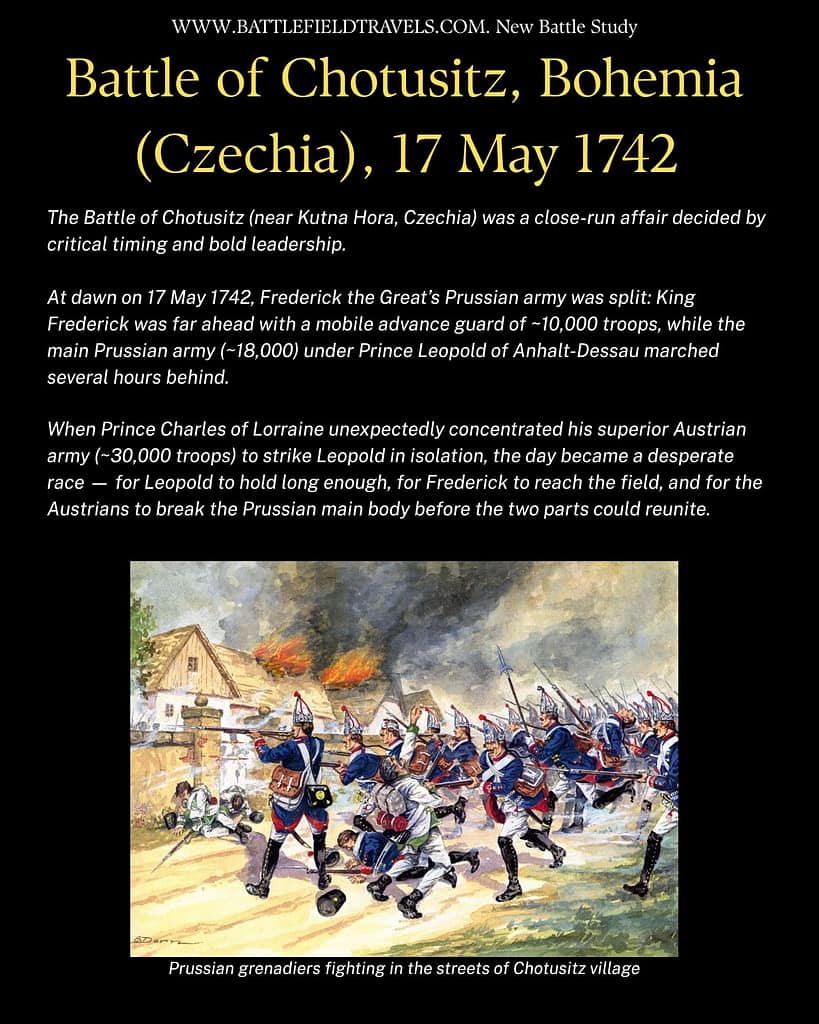
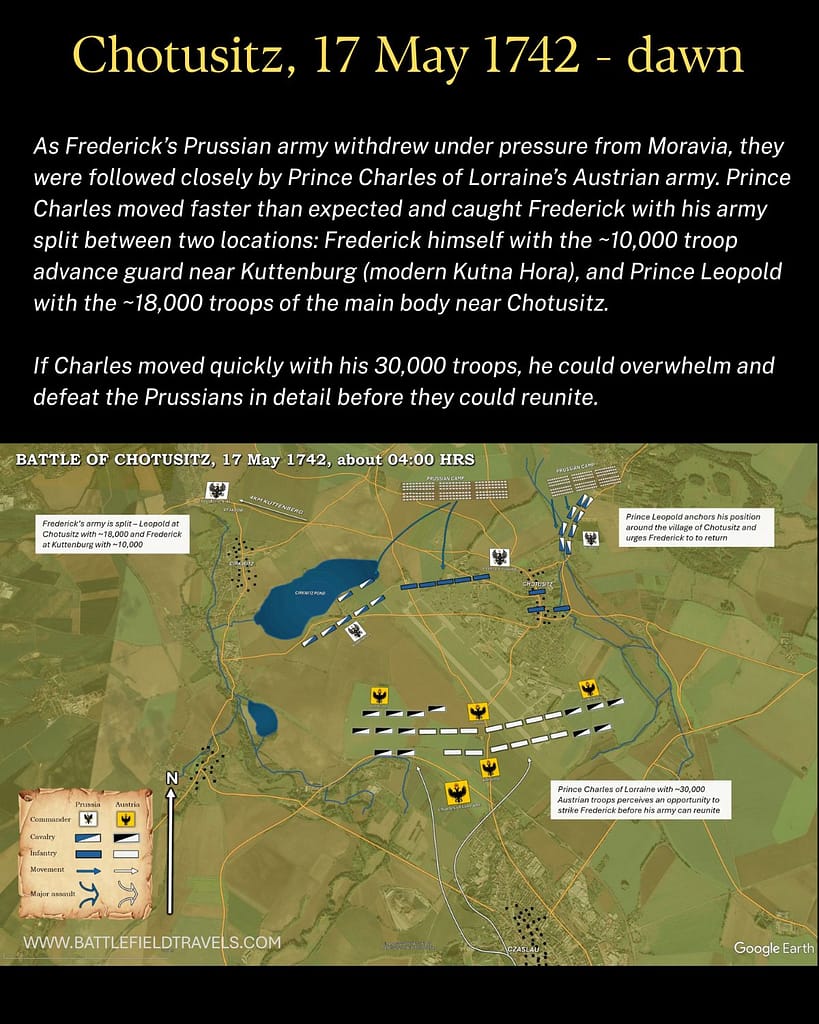
At Chotusitz (modern Chotusice, Czech Republic) on the morning of 17 May 1742, the Prussian army was dangerously divided. King Frederick II rode far ahead with a fast-moving advance guard, while the main body under Prince Leopold of Anhalt-Dessau trailed hours behind. When Prince Charles of Lorraine unexpectedly massed his superior Austrian army to strike Leopold in isolation, the battle became a race against collapse: could Leopold hold, could Frederick arrive in time, and could the Austrians destroy the Prussian centre before the army could reunite?

Key facts
🗺️ Battle of Chotusitz (Chotusice, Czech Republic), 17 May 1742
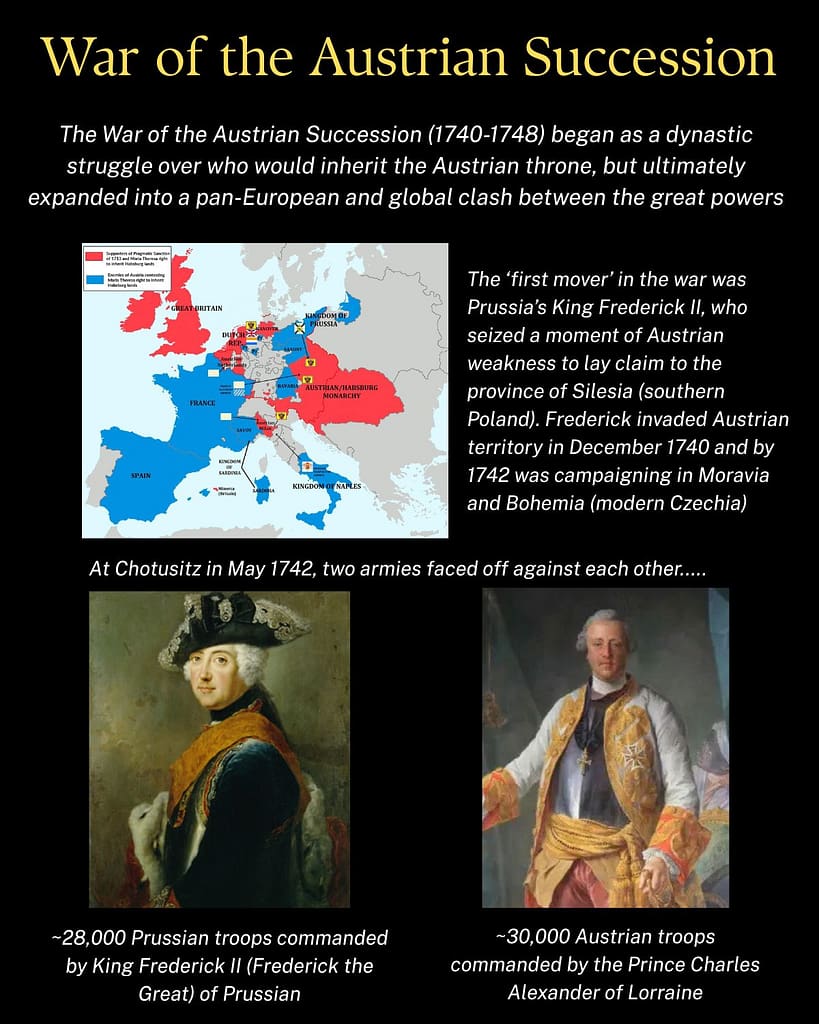
⚔️ War of the Austrian Succession, 1740-48 Prussia ~28,000 under Frederick II vs. Austria ~30,000 under Prince Charles of Lorraine
🎯 Objective: Prussia to retain Silesia; Austria to reclaim it
Visit my virtual museum of weapons, uniforms and equipment of the War of the Austrian Succession
Google Earth map – location of Chotusitz battlefield
🧭🥾 Walking the Battlefield
I visited the battlefield of Chotusitz in May 2017, armed with a range of primary and secondary accounts, some unit histories, diagrams, maps, and GIS overlays that I had prepared in Google Earth to locate key sites on the battlefield. In my collection, I also own many original weapons used by combatants in the War of the Austrian Succession, and some may well have been used here at Chotusitz!
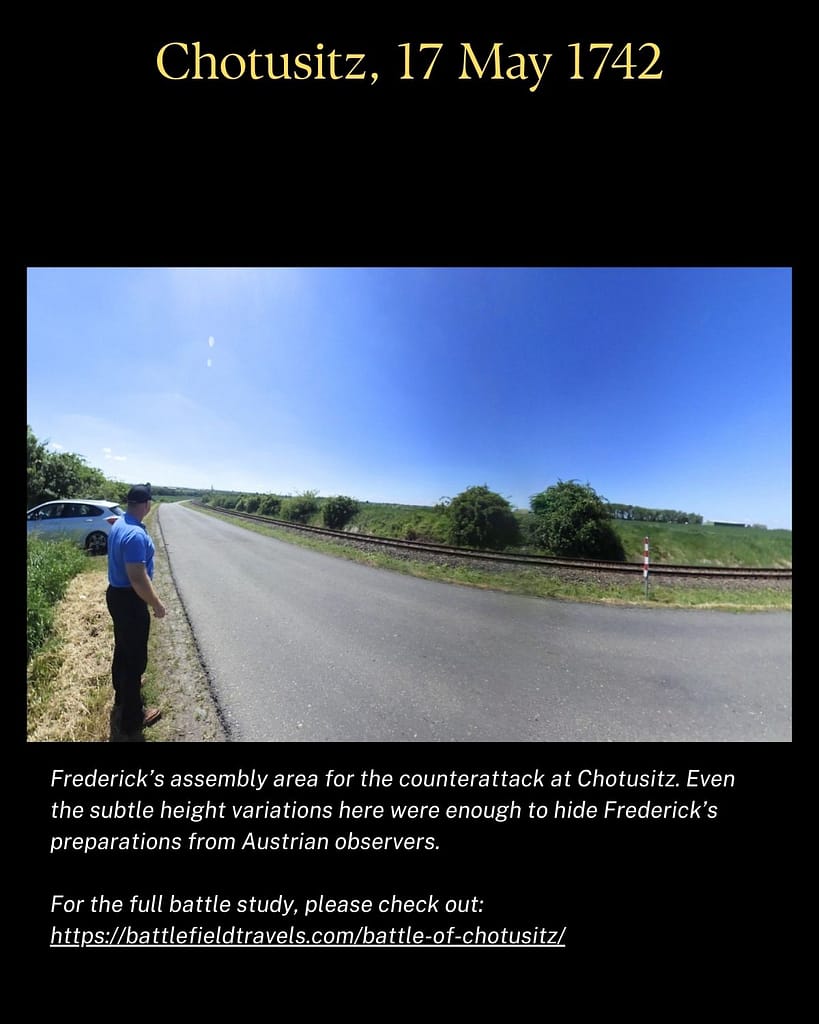
The battlefield periphery remains accessible, but the decisive area of Frederick’s oblique advance and the Austrian concentration against Chotusitz is now occupied by a Czech Air Force base. The Cirkwitz pond/marsh has disappeared, but its location can be traced by overlaying period maps on modern satellite imagery. This helps to orient the viewer, especially for the battle’s final stages. What I found fascinating at Chotusitz was that Frederick was able to use the barely perceptible undulations in the terrain to hide his 24-battalion counterattack force until he deemed the moment was right!
Table of Contents
- Overview of the Battle of Chotusitz in 9-slides
- Strategic Context: War of the Austrian Succession (1740–1748)
- Opposing forces at Chotusitz
- 🔒16 May 1742 (evening): The armies converge
- 🔒Why Prince Leopold chose to defend Chotusitz
- 🔒17 May 1742 (~04:30–06:00): Clash of cavalry at dawn
- 🔒17 May 1742 (~06:00–09:00): The fight for Chotusitz
- 🔒17 May 1742 (~09:00–10:30): Prussian discipline and Austrian overextension
- 🔒17 May 1742 (~10:30–12:00): Frederick’s oblique counterstroke
- 🔒17 May 1742 (after 12:00): Austrian retreat & limited Prussian pursuit
- 🔒Outcomes of the Battle of Chotusitz
- 🔒The Chotusitz battlefield today
- 🔒📚 Notes and References
- 📚 Further Reading
- 🧭 Battlefield Travel Guide – Chotusitz (Chotusice), 17 May 1742
Overview of the Battle of Chotusitz in 9-slides
(Trying something new – let me know in comments if you like it!)

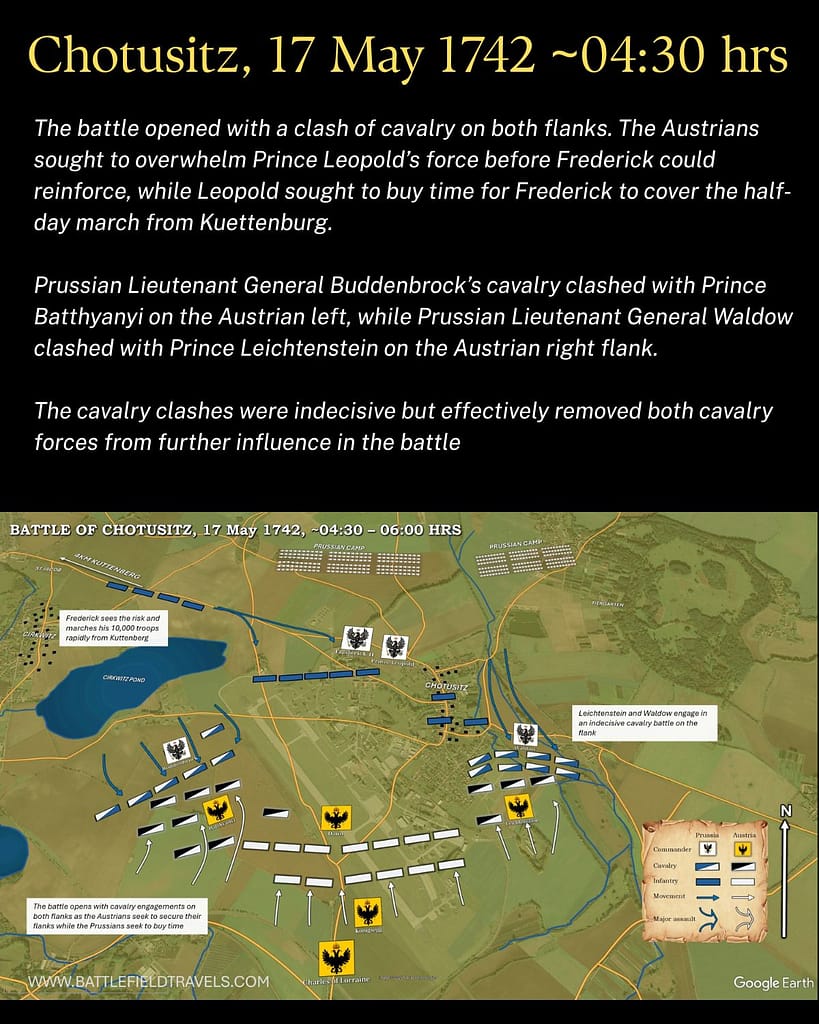
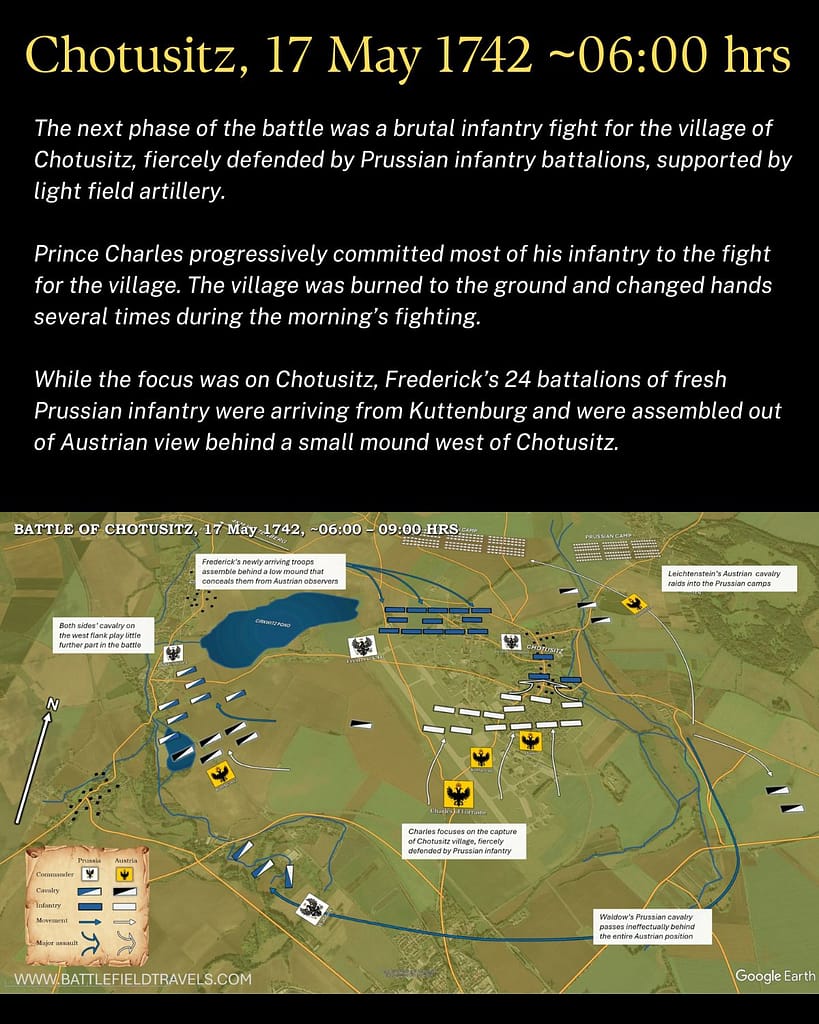
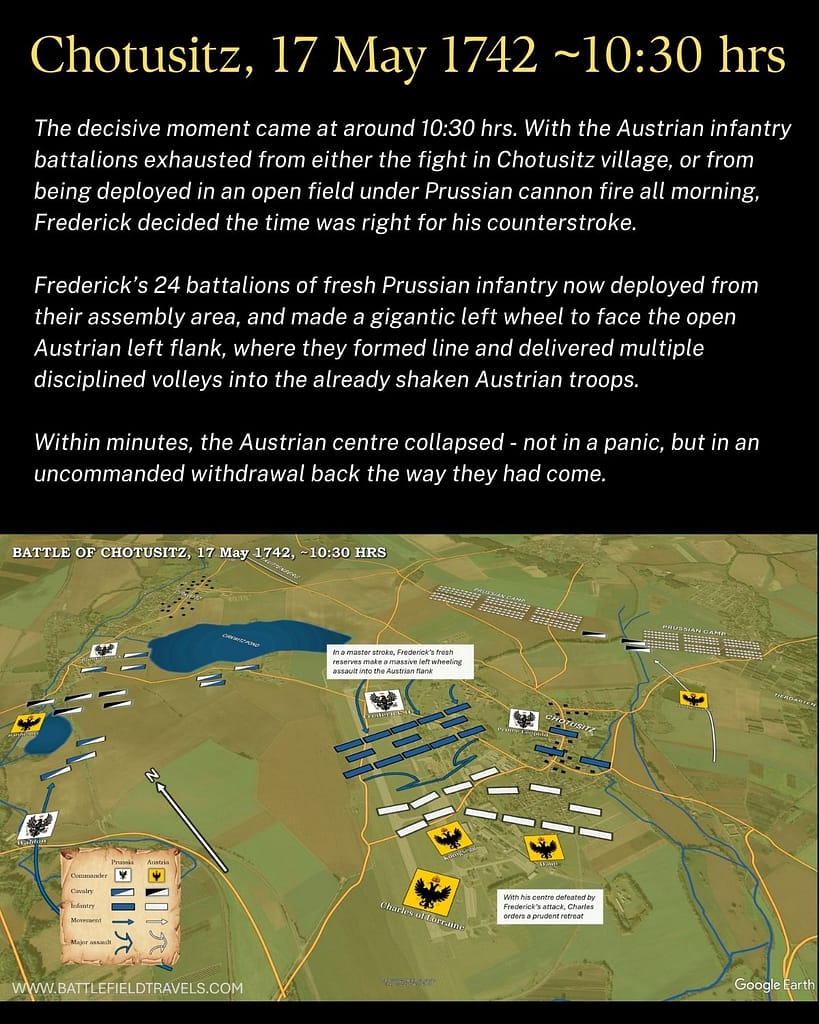
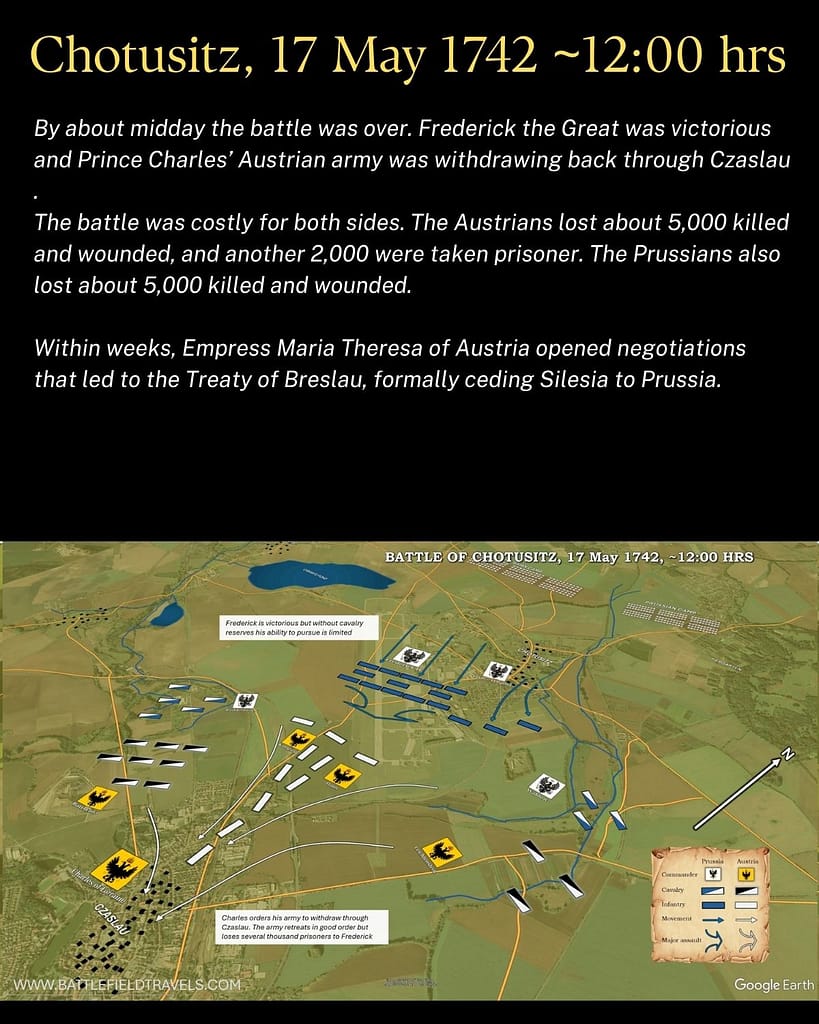
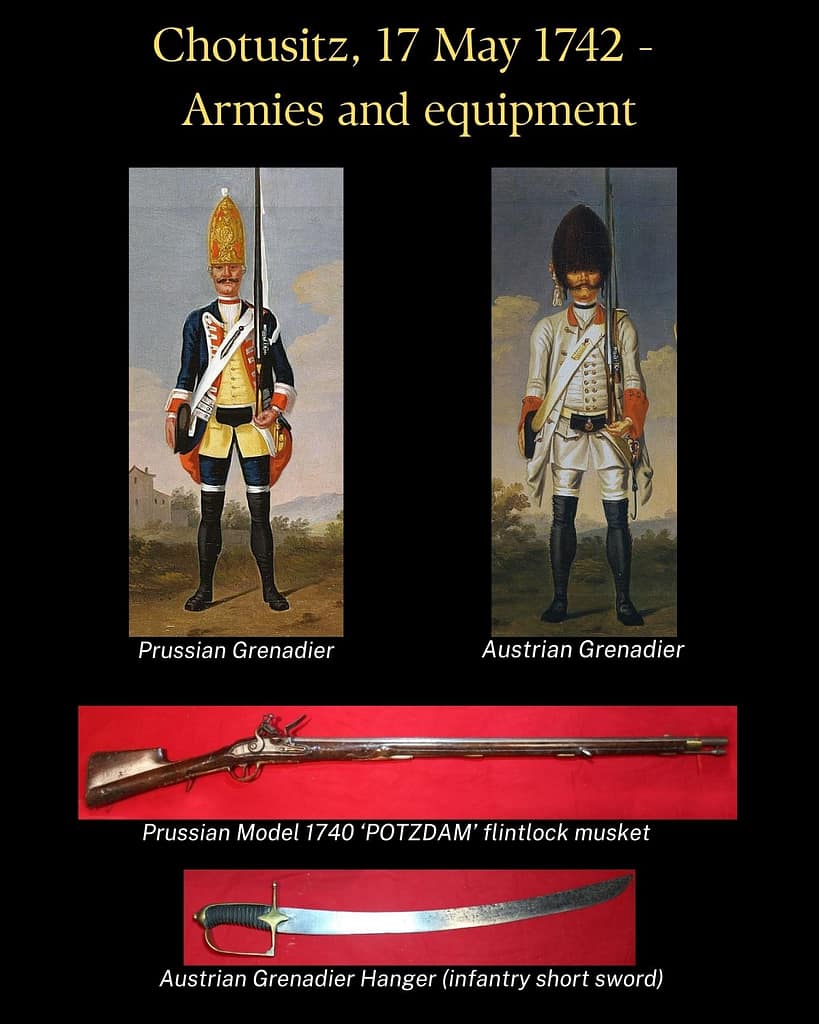
Battle of Chotusitz, 17 May 1742. Battle of Chotusitz, 17 May 1742. War of the Austrian Succession overview Battle of Chotusitz, 17 May 1742. Initial dispositions Battle of Chotusitz, 17 May 1742. Flanking cavalry actions Battle of Chotusitz, 17 May 1742. Fight for the village Battle of Chotusitz, 17 May 1742. Frederick’s oblique attack Battle of Chotusitz, 17 May 1742. Austrian withdrawal War of the Austrian Succession, weapons and equipment Battle of Chotusitz, 17 May 1742. The battlefield today
Strategic Context: War of the Austrian Succession (1740–1748)
Origins of the conflict
The War of the Austrian Succession (1740–1748) was a major pan-European conflict triggered by a dynastic dispute following the death of Holy Roman Emperor Charles VI.
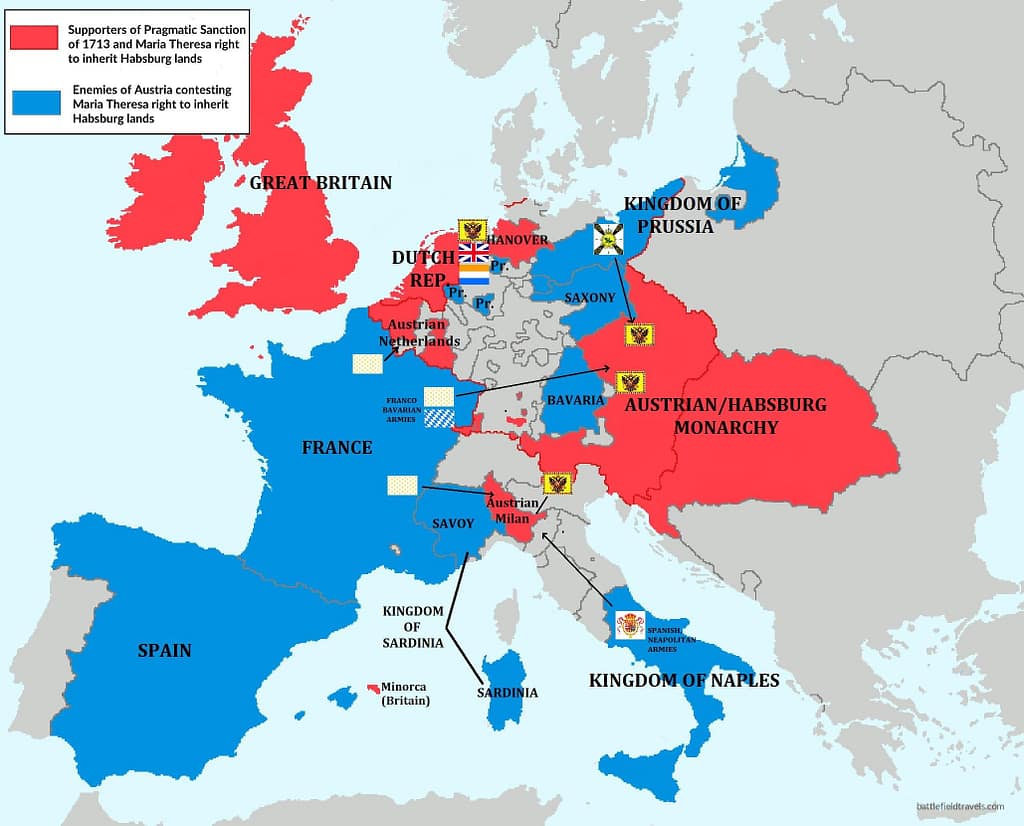
In 1713, lacking a male heir, Charles had issued the Pragmatic Sanction (a legal instrument intended to secure international recognition of female inheritance within the Habsburg domains) to ensure the right of succession for his daughter, Maria Theresa. Although many European powers had initially recognised the sanction, Charles’s death in 1740 presented an opportunity to challenge Habsburg power once Austria appeared diplomatically isolated and militarily vulnerable.
Frederick II (Frederick the Great) of Prussia was the first to act, seizing the opportunity to invade the rich Austrian province of Silesia (now southern Poland). His swift campaign upset the European balance and encouraged other powers to intervene.

The system of alliances in the War of the Austrian Succession
France, always keen to undermine Austrian power and limit British influence on the Continent, allied with Prussia and Bavaria. Britain, determined to uphold the balance of power and prevent French hegemony, supported Maria Theresa alongside the Dutch Republic and, eventually, Austria’s traditional rival—Saxony.
The war became a continent-spanning struggle with theatres of conflict in Silesia, Bohemia, Italy, the Low Countries, and overseas colonial possessions. While Silesia remained the key prize between Prussia and Austria, the Austrian Netherlands (roughly Belgium and Luxembourg) became the main arena of Anglo-French military rivalry. The French aimed to eject British and Dutch forces from their footholds there and secure a dominant position in northern Europe.
First Silesian War (1740-1742)
The Battle of Chotusitz, fought on 17 May 1742, was the decisive engagement of the First Silesian War, itself the opening military crisis of the War of the Austrian Succession (1740–1748).
King Frederick II of Prussia (Frederick the Great) had ascended the Prussian throne in May 1740 after the death of his father, King Frederick William I. Perceiving Austrian weakness after the death of Emperor Charles VI, Frederick cited dynastic claims to Silesia (now southern Poland) that were legally weak but politically convenient.
He was drawn by the province’s economic wealth and strategic position between Prussia, Saxony, and Bohemia. In December 1740, with Austria distracted and unsupported, Prussian forces crossed the Silesian frontier, initiating what became the First Silesian War.
Austrian resistance in the early stages was hesitant and fragmented. Frederick moved quickly to secure key fortresses and communications, culminating in his victory at Mollwitz in April 1741. That battle revealed the formidable discipline and firepower of the Prussian infantry, while also exposing weaknesses in cavalry handling and battlefield command—lessons that would shape the campaigns that followed.
Maria Theresa responds decisively
Maria Theresa responded decisively. By late 1741, she had stabilised her political position, secured British and Hanoverian support, and raised new armies. In early 1742, Austrian forces under Prince Charles of Lorraine, supported by Count Khevenhüller, launched counteroffensives in Bohemia that threatened Prussian lines of communication and raised the prospect of reversing Frederick’s gains.
The Campaign of 1742
Frederick attempted to seize the initiative once more by advancing into Moravia (today eastern Czech Republic) in early 1742, capturing Brünn (Brno) and pushing southeastward. This bold move overstretched his supply lines and exposed his army to Austrian pressure from multiple directions. With allied French and Bavarian efforts faltering elsewhere and the risk of encirclement growing, Frederick abandoned Moravia. He withdrew northwards in the spring, intending to concentrate his forces near Kuttenberg (now Kutná Hora).
Prince Charles’ Austrian army followed closely, intent on forcing a decisive battle before Frederick could disengage or negotiate from a position of strength. On 17 May 1742, near the small town of Chotusitz (modern Chotusice), Frederick turned to fight. The battle that followed would decide not only the outcome of the campaign but also whether Prussia would retain Silesia, or see its first bold gamble as a European power decisively checked.
Opposing forces at Chotusitz
 Prussian Army
 Prussian Army
At Chotusitz, Frederick II of Prussia commanded a force of approximately 28,000 troops, drawn from some of his most reliable infantry regiments, supported by a reformed cavalry arm (since its disastrous performance at Mollwitz the previous year) and a modest but increasingly effective artillery arm. Despite the physical strain imposed by the withdrawal from Moravia and a series of forced marches, the Prussian army arrived disciplined, cohesive, and responsive, clear evidence of the institutional legacy left by Frederick’s father, Frederick William I.
By 1742, the Prussian Army had begun to display the organisational characteristics that would later make it one of Europe’s most formidable fighting forces. Infantry remained its decisive arm. Regiments were drilled to deliver rapid, controlled volleys and to manoeuvre in close order with exceptional precision, allowing Frederick to rely on fire discipline rather than numerical superiority. The cavalry, whose poor performance at Mollwitz had nearly undone the Prussian victory there, had undergone urgent reform. While still uneven in quality, it was better led, more aggressively handled, and increasingly capable of decisive action. Prussian artillery was relatively light in numbers, but its crews demonstrated improving tactical employment and coordination with the infantry.
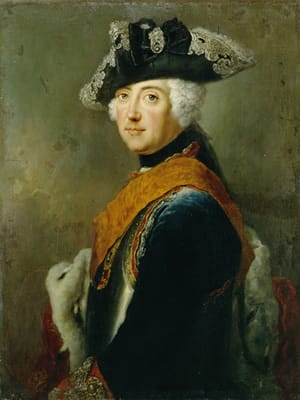
Frederick himself, only thirty years old, was still an evolving battlefield commander. Impulsive at times and prone to risk-taking, he nonetheless showed a growing appreciation of terrain, timing, and operational tempo. Chotusitz would test whether those qualities had matured since Mollwitz.
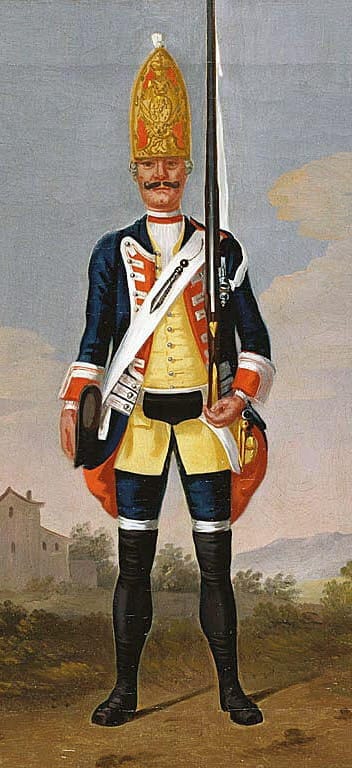
painting by David Morier c.1745
Order of Battle (Prussia)
- Commander-in-Chief: King Frederick II of Prussia
- Strength: ~28,000 troops
- Infantry: ~19,000
- Cavalry: ~8,000 (cuirassiers and dragoons)
- Artillery: ~80 field guns
- Notable Units:
- Infantry regiments von Dossow, von Kleist, von Saldern etc
- Dragoon regiments under Hans Joachim von Zieten
- Cuirassier regiments under Wilhelm Dietrich von Buddenbrock
- Grenadier battalions and independent fusilier companies
Senior Commanders:
- King Frederick II of Prussia (commander in chief)
- Prince Leopold II of Anhalt-Dessau (main body)
- Lieutenant General Wilhelm Dietrich von Buddenbrock (right wing cavalry)
- Lieutenant General Friedrich Sigmund von Waldow (left wing cavalry)

 Austrian Army
 Austrian Army
Opposing Frederick was a larger but hastily concentrated Austrian army of approximately 30,000 troops, commanded by Prince Charles of Lorraine. Following the Prussian withdrawal from Moravia, Austrian forces moved rapidly to shadow Frederick’s retreat and force a decisive engagement. The resulting concentration near Chotusitz, however, was imperfect. Units arrived in piecemeal fashion, many fatigued by forced marches and lacking the cohesion required for decisive manoeuvre.
The Austrian army’s traditional strength lay in its cavalry, particularly its cuirassiers and dragoons, supported by solid if comparatively inflexible line infantry. In theory, this composition was well suited to the open terrain around Chotusitz.
In practice, the Habsburg army of 1742 was still in transition. The reforms that would later strengthen the Austrian command-and-staff system had not yet taken hold, and the Austrian artillery arm that would dominate later battles was still fledgling.
Coordination between arms was inconsistent, and reconnaissance was limited. Prince Charles, while personally brave and experienced, lacked the decisiveness and tactical clarity required to exploit fleeting battlefield opportunities.
Austrian cavalry formed nearly a third of the army at Chotusitz and represented its most powerful striking arm. Poor reconnaissance and premature commitment, however, would prevent this numerical advantage from being used to full effect.
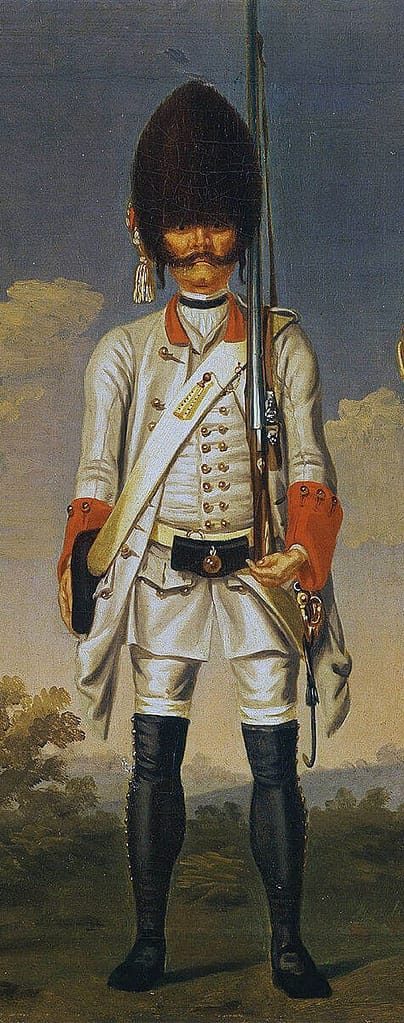
painting by David Morier c.1745
Order of Battle (Austria)
- Commander-in-Chief: Prince Charles of Lorraine
- Strength: ~30,000 troops
- Infantry: ~20,000
- Cavalry: ~10,000 (cuirassiers, dragoons, hussars)
- Artillery: ~60–70 guns
- Notable Units:
- Infantry regiments of Wallis, Hildburghausen, Württemberg
- Cuirassier regiments under Count Berlichingen
- Grenadier battalions and Hungarian line troops
Senior Commanders:
- Prince Charles of Lorraine (commander in chief)
- Prince Batthyányi (left wing cavalry),
- Prince Joseph Wenzel von Liechtenstein (right wing cavalry),
- Count Berlichingen (cavalry)
👉 Continue reading — this article is part of the BattlefieldTravels Deep Research Collection. The full analysis behind this 8,000 word article includes primary source examination, tactical conclusions, and notes & references that exist nowhere else in English. Try membership free for 7 days.
📚 Further Reading
This battle study nests within the broader analytical framework explored in the Research Hub, where operational methods, operating environments, armies, commanders, and weapons are examined across conflicts and eras. The links below connect related studies across the wider body of battlefield analysis on the BattlefieldTravels site.
⚔️ Explore all battle studies from the War of the Austrian Succession 1740-1748
🏛️ Explore the museum of War of the Austrian Succession historic artefacts
📚War of the Austrian Succession – Recommended Reading
🗞️ For updates on new battlefield studies and research insights, you can subscribe to the Newsletter.
You may also like


🧭 Battlefield Travel Guide – Chotusitz (Chotusice), 17 May 1742
Getting There
- Chotusice lies approximately 5 km south-east of Čáslav in the Central Bohemian Region of the Czech Republic.
- The most practical access is by car from Prague (about 90 minutes), via the D11 and regional roads toward Čáslav.
- Parking is available within Chotusice village and along local roads near the church and open fields.
Site Orientation
- The battlefield occupies gently rolling agricultural ground south and west of the village of Chotusice.
- A Czech Air Force Base covers much of the 1742 battlefield, including the Austrian centre and Frederick’s oblique attack.
- There is a small stone marker next to the church commemorating the, and another marker north of teh village commemorating a mass grave from the battle. There are no other formal battlefield markers or preserved fortifications; orientation relies on terrain reading.
- Key features include open fields, shallow rises, and drainage lines that influenced Prussian and Austrian deployment.
Museums & Visitor Centres
- There is no dedicated museum at Chotusice.
- The regional museum in Čáslav provides broader historical context for Bohemia during the War of the Austrian Succession.
- Interpretation on site must be self-guided using maps, period plans, and modern satellite imagery.
- Nearby Sedlec Ossuary is a must-see. The Church of Bones contains the bones of 40,000-70,000 people decorate this medieval church.
On-Site Experience
- The open nature of the terrain allows excellent appreciation of lines of advance, cavalry manoeuvre space, and artillery deployment.
- The lack of modern development over much of the field makes it easier to visualise 18th-century battle geometry.
- Walking the ground reveals how limited elevation differences still exerted tactical influence on fire and movement.
Nearby Points of Interest
- Čáslav – historic town with medieval core and regional museum.
- Kutná Hora – UNESCO World Heritage site with major medieval and early modern landmarks.
- Fields and villages associated with the wider Bohemian campaign of 1741–1742.
Practical Tips
- Best visited in late spring or early autumn when crops are low and sightlines are clearer.
- Expect no signage – bring printed maps or offline GPS overlays.
- Be respectful of agricultural land; remain on tracks and field margins where possible.
- Combine with Lobositz or Prague-area sites for a focused Frederick the Great battlefield itinerary.
The Battle of Chotusitz was fought on 17 May 1742 near the village of Chotusice, close to Čáslav in central Bohemia (modern-day Czech Republic). The battlefield consists mainly of open agricultural land with gentle rises and shallow drainage features.
The battle was fought between the Prussian army under King Frederick II (Frederick the Great) and the Austrian army commanded by Prince Charles of Lorraine during the War of the Austrian Succession.
Chotusitz was the decisive battle of the First Silesian War. Frederick’s victory forced Austria to negotiate, leading directly to the Treaty of Breslau, which confirmed Prussian control of Silesia.
Yes. There is a Czech Air Force Base overlaying the central battle area, but much of the area outside this remains largely undeveloped and can be explored freely, although there are few formal monuments or marked trails. Visitors must rely on maps, terrain reading, and historical sources.
Chotusitz shows Frederick still learning hard lessons about command and coordination. Unlike later victories such as Leuthen, the battle was messy and costly, but strategically decisive.
Subscribe to Battlefield Travels and receive a free E-Book Battlefield Guide
Unlock expert battlefield analysis, campaign reconstructions, and historical insights drawn from firsthand exploration and primary sources.
🗺️ You’ll receive:
🎖️ Exclusive historical insights you won’t find elsewhere
📘 A free eBook: 10 Tips for Exploring Historic Battlefields
📰 New battlefield studies straight to your inbox as they are published

⚔️ Go deeper — Members get exclusive access to the Deep Research Collection, Field Notes, and monthly Research Dispatches. Try membership free for 7 days, cancel anytime. From $9/month.
