The charge of the Wild Geese at Fontenoy: Myth, Memory, and Reality
Long before ‘Mad Mike’ Hoare formed his Wild Geese mercenary unit in the Congo, before Richard Burton starred in ‘The Wild Geese’ movie and Joan Armatrading sang its theme song ‘Flight of the Wild Geese’, the original ‘Wild Geese’ were a brigade of Irish exiles serving the King of France. Their most famous moment came at Fontenoy, where—bayonets fixed and colours flying—they turned the tide of battle and secured a French victory.
The Battle of Fontenoy, fought on 11 May 1745, was a major battle during the War of the Austrian Succession. A French army of ~50,000 under Marshal Maurice de Saxe against a coalition force of ~50,000 British, Dutch, Hanoverian, and Austrian troops led by the Duke of Cumberland (the same Duke of Cumberland who would lead the British forces at Culloden in April 1746). The result was a decisive French victory!.

Key facts
🗺️ Battle of Fontenoy, 11 May 1745
⚔️ War of the Austrian Succession, 1740-48 50,000 troops of the combined British/German/Dutch ‘Pragmatic Army’ vs 50,000 French and Irish troops
🎯 Objective: French defence of the frontier vs Allied breakthrough into Flanders
Visit my virtual museum of weapons, uniforms and equipment of the War of the Austrian Succession
Google Earth map – location of Fontenoy battlefield
🧭🥾 Walking the Battlefield
I visited the battlefield of Fontenoy in November 2024. I was armed with a range of primary and secondary accounts, some unit histories, diagrams, maps, and GIS overlays that I had prepared in Google Earth Pro to locate key sites on the battlefield. In my collection, I also own many original weapons that were used by the combatants of the War of the Austrian Succession, and some may well have been used here at Fontenoy!
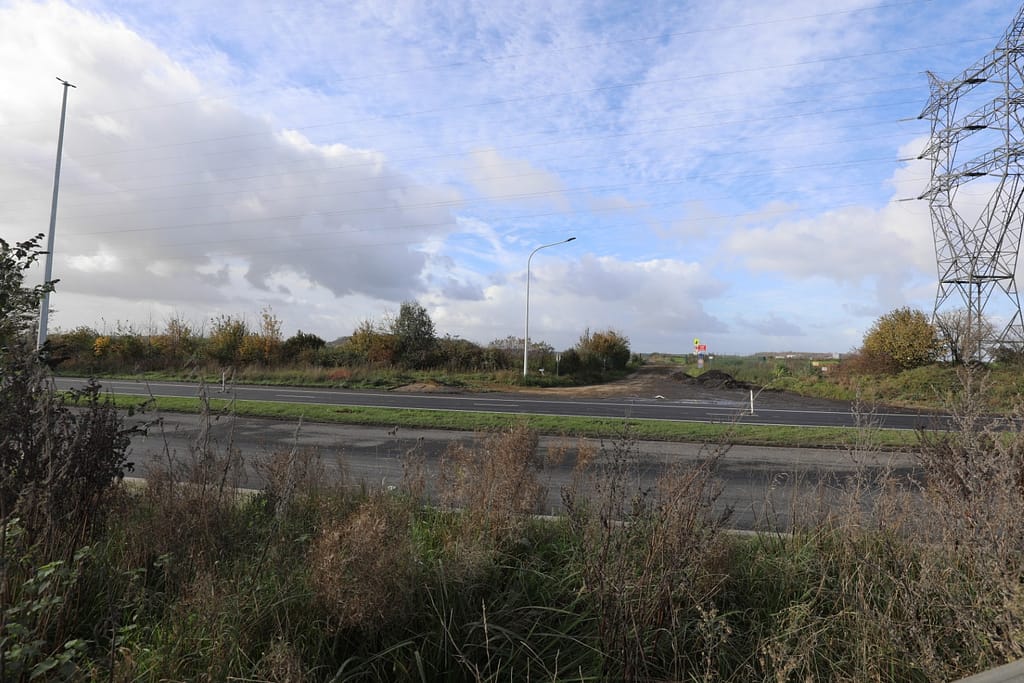
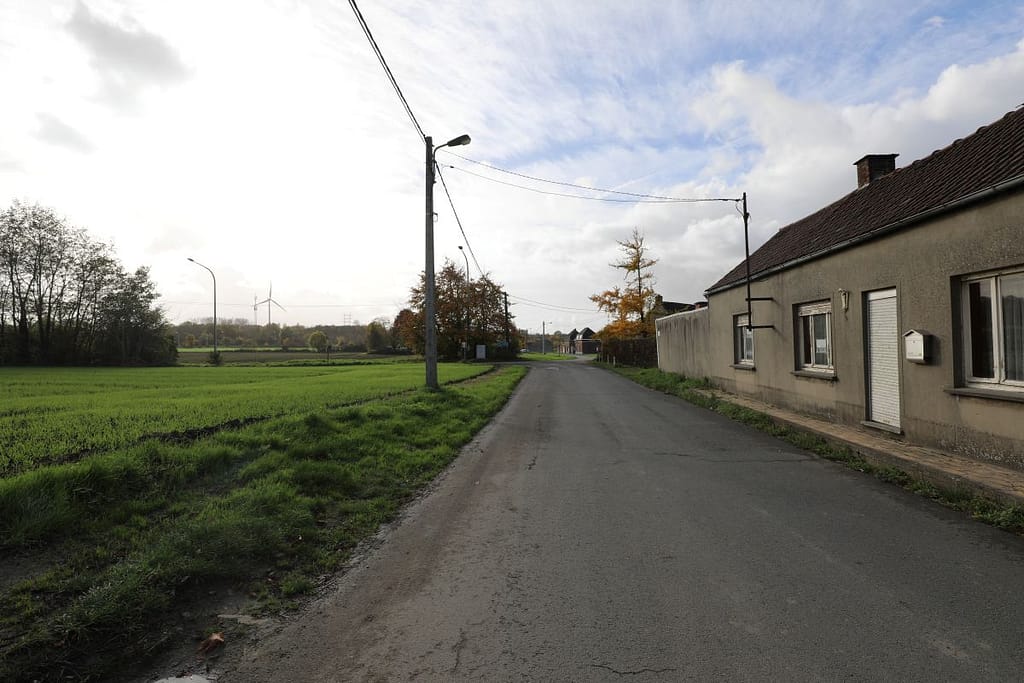
The eastern portions of the battlefield are relatively well preserved and very recognisable. Much of the French position, including the forward redoubts, has been altered by major roadways and intersections. The French rear areas are now the site of a gigantic open-cut mining area.
Overview of the Battle of Fontenoy in 8-slides
(Trying something new – let me know in comments if you like it!)
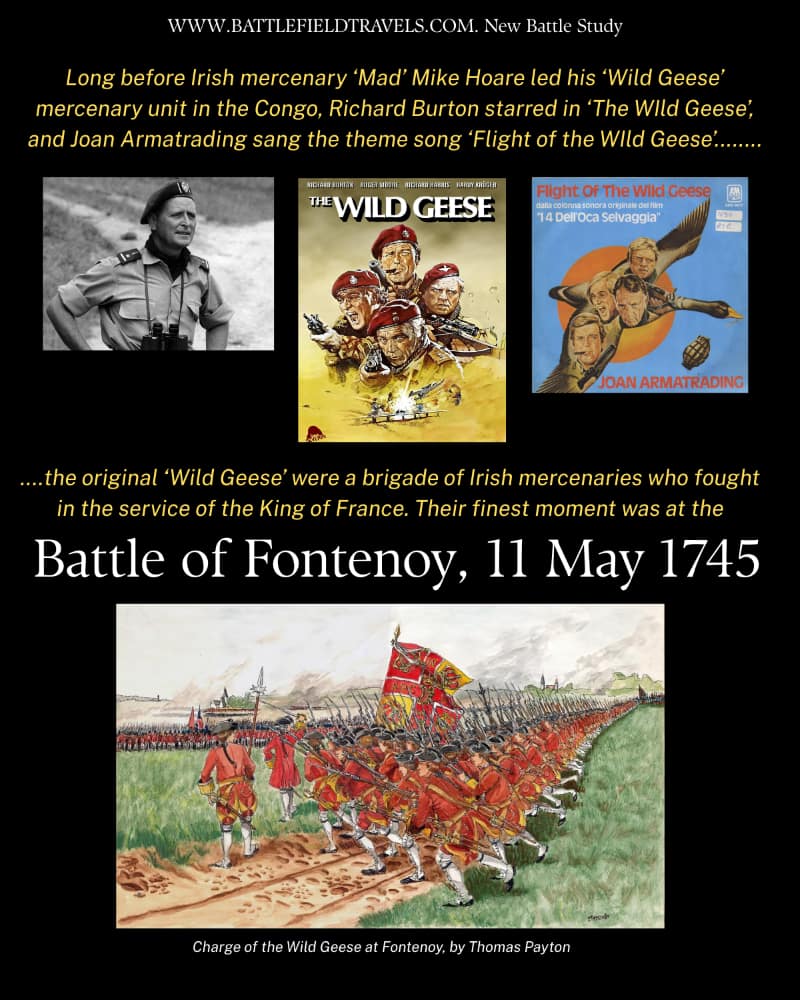
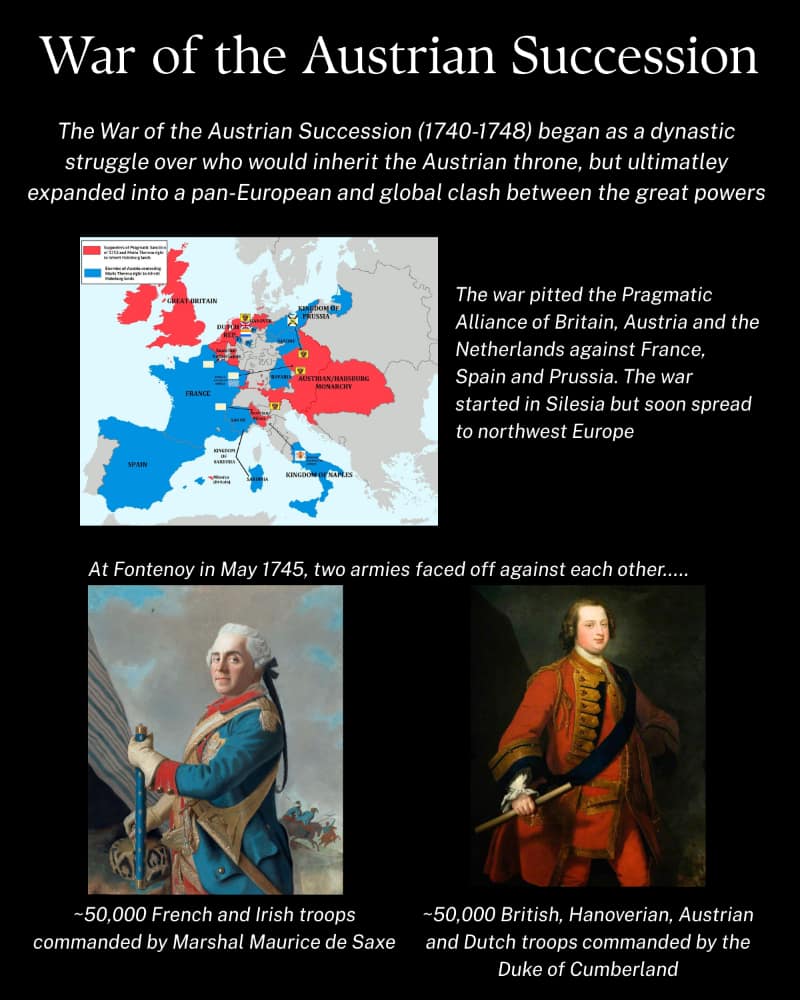
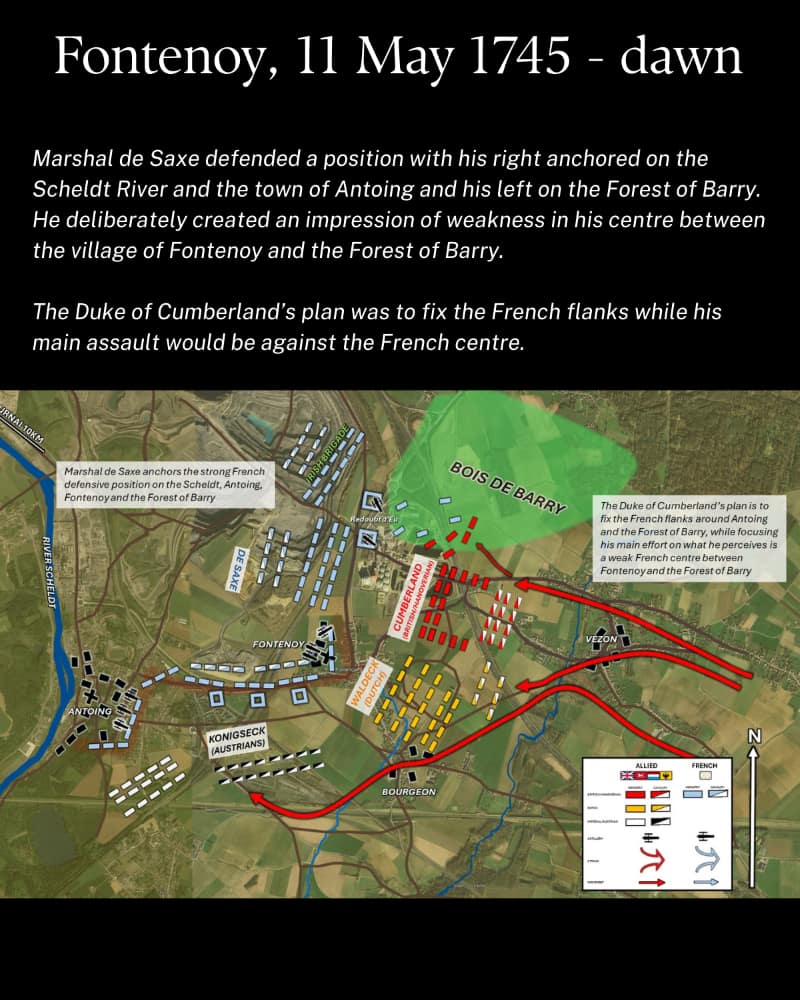
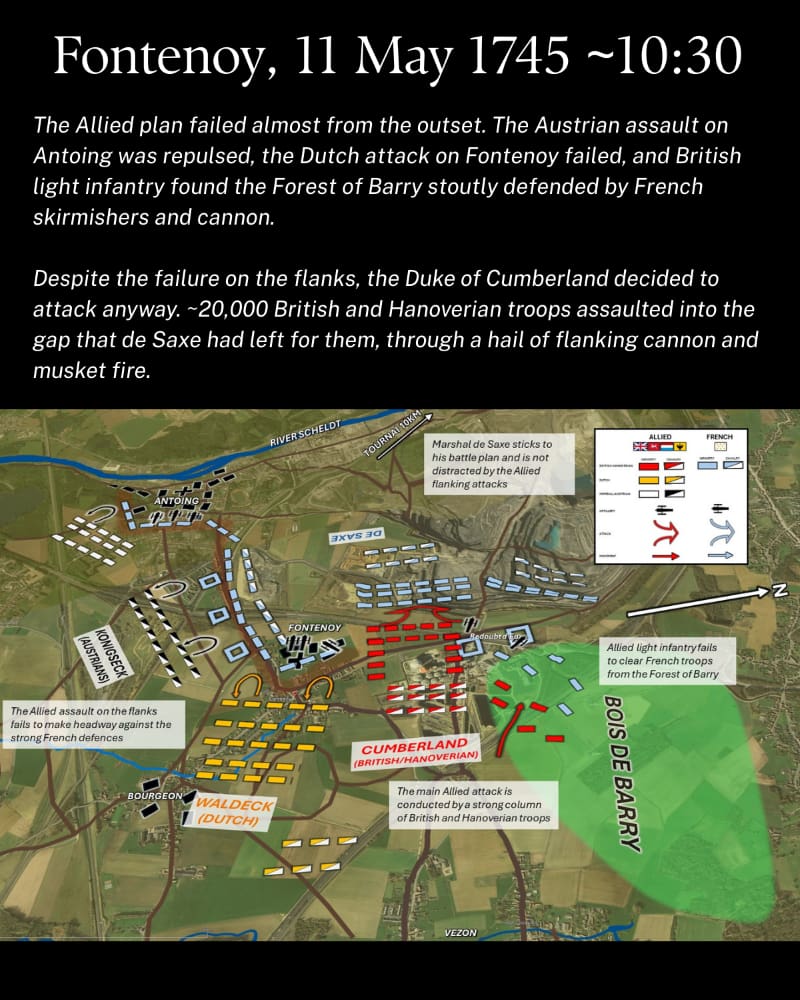
Strategic Context: The War of the Austrian Succession (1740–1748)
Origins of the conflict
The War of the Austrian Succession (1740–1748) was a major pan-European conflict triggered by a dynastic dispute following the death of Holy Roman Emperor Charles VI. Lacking a male heir, Charles issued the Pragmatic Sanction of 1713 to secure the right of succession for his daughter, Maria Theresa. Although many European powers had initially recognised the sanction, Charles’s death in 1740 presented an opportunity to challenge Habsburg power.
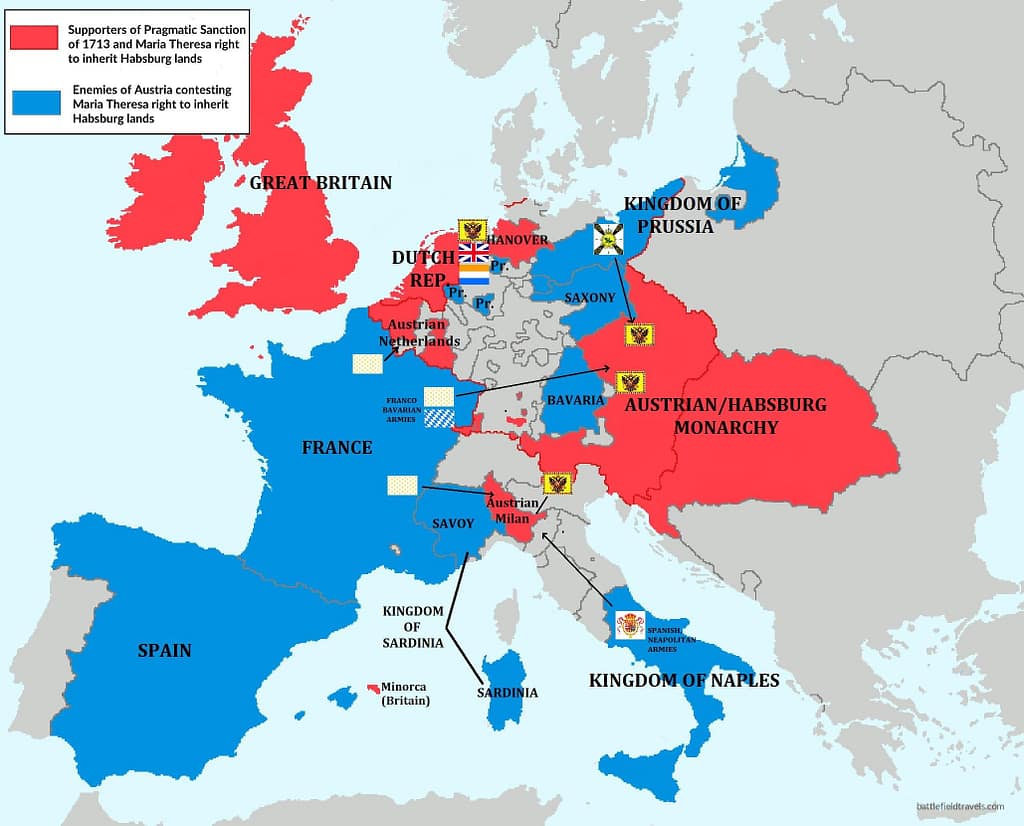
Major theatres of war
Frederick II (Frederick the Great) of Prussia was the first to act, seizing the opportunity to invade the rich Austrian province of Silesia (now southern Poland). His swift campaign upset the European balance and encouraged other powers to intervene. France, always keen to undermine Austrian power and limit British influence on the Continent, allied with Prussia and Bavaria. Britain, determined to uphold the balance of power and prevent French hegemony, supported Maria Theresa alongside the Dutch Republic and, eventually, Austria’s traditional rival—Saxony.
The war became a continent-spanning struggle with theatres of conflict in Silesia, Bohemia, Italy, the Low Countries, and overseas colonial possessions. While Silesia remained the key prize between Prussia and Austria, the Austrian Netherlands (roughly Belgium and Luxembourg) became the main arena of Anglo-French military rivalry. The French aimed to eject British and Dutch forces from their footholds there and secure a dominant position in northern Europe.
Situation in Flanders in 1745
By 1745, the Anglo-French contest in Flanders was escalating. French Marshal Maurice de Saxe, an experienced and charismatic commander, led an army into the Austrian Netherlands to pre-empt an expected Allied offensive. Opposing him was a coalition under the young Duke of Cumberland, son of Britain’s King George II, supported by Dutch, Hanoverian, and Austrian troops. Their objective was to relieve the French siege of the city of Tournai and halt French momentum.
Tournai was the keystone of the barrier fortresses defending the Austrian Netherlands. Its loss would unhinge the entire Dutch defence zone and open the route to Brussels and Antwerp. Cumberland had no political freedom to bypass it; the Dutch States General insisted on immediate relief, while British interests required maintaining the coalition’s cohesion. This political pressure explains why the Allies attempted a frontal assault on Fontenoy rather than seeking alternatives. For Saxe, forcing Cumberland to attack on ground of his choosing was the ideal scenario — a defensive battle where French discipline and fortifications could offset coalition numbers.

This set the stage for the Battle of Fontenoy in May 1745—a decisive encounter that would shape the course of the campaign and cement French dominance in the region. It would also mark the high point of the legendary Irish Brigade, The Wild Geese, whose well-timed intervention would prove decisive.
Opposing forces

 Allied Army


 Allied Army
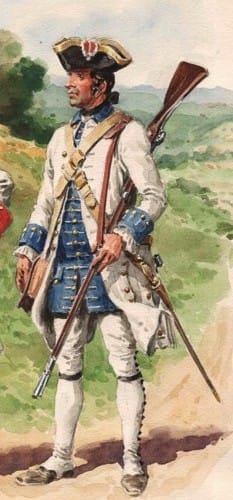
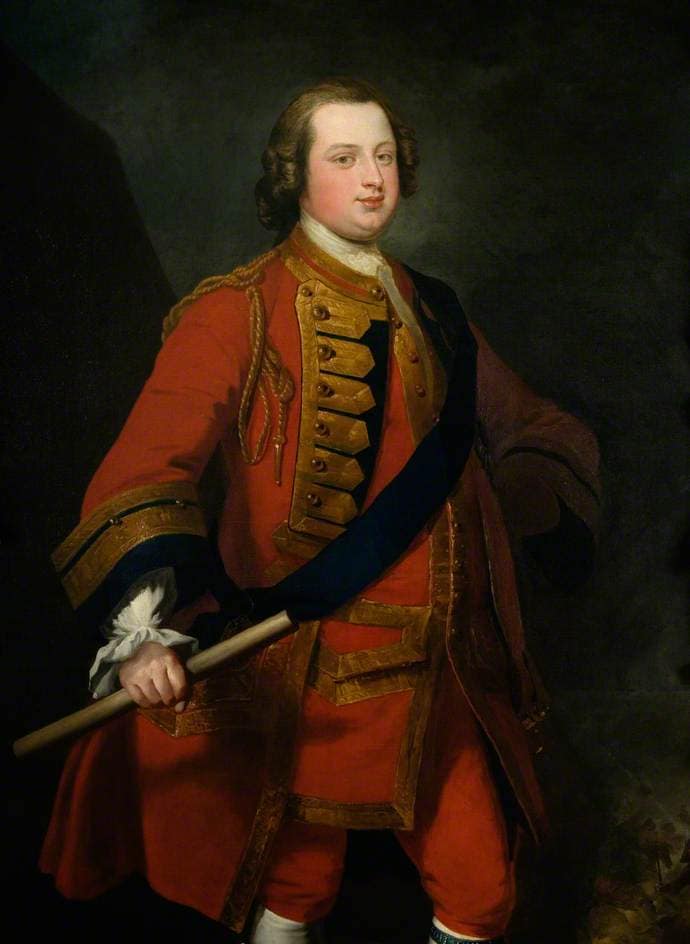
The Allied army at Fontenoy was an international coalition comprising British, Hanoverian, Dutch, and Austrian troops, collectively numbering around 50,000 men. The Allied Army was commonly referred to as the Pragmatic Army because it was formed under the terms of the Pragmatic Sanction of 1713—the imperial edict issued by Emperor Charles VI to ensure his daughter, Maria Theresa, could inherit his Habsburg domains. The Army was commanded by the 24-year old William Augustus, the Duke of Cumberland,
The core of the Allied strength lay in the disciplined British infantry regiments, including elite regiments such as the Coldstream Guards, Royal Welch Fusiliers, and the 1st Foot Guards, supported by Hanoverian, Dutch, and Austrian contingents. While tactically competent, the army was hampered by divided command structures and differences in training and doctrine between its national components. Cooperation between the Dutch and British was particularly problematic, and this disunity would prove a significant disadvantage during the battle.

 French Army
 French Army
Facing the allies was a slightly larger French army of approximately 52,000 men under the seasoned and charismatic Marshal Maurice de Saxe, a brilliant commander despite suffering from debilitating illness at the time (dropsy – an accumulation of fluid causing swelling of the limbs).
The French force included a strong core of regular infantry and cavalry, supported by well-sited artillery and an innovative defensive position anchored on the forest of Bois de Barry, the village of Fontenoy, and the town of Antoing. Notably, Saxe had constructed a series of redoubts and fieldworks forward of his main defensive position, including the formidable Redoubt d’Eu and Redoubt de Chambonas, to disrupt any Allied attack.
Among his troops were Irish exiles serving in the French army—famously the Irish Brigade, known as the ‘Wild Geese’—whose counterattack would become one of the most celebrated moments of the battle. The French army was cohesive, had none of the internal frictions of Cumberland’s allied army, and had the advantage of internal lines, whereby Saxe could redirect his troops to critical sectors far more easily than the allies could.
Allied plan of attack – ambitious but sound
Allied cooperation
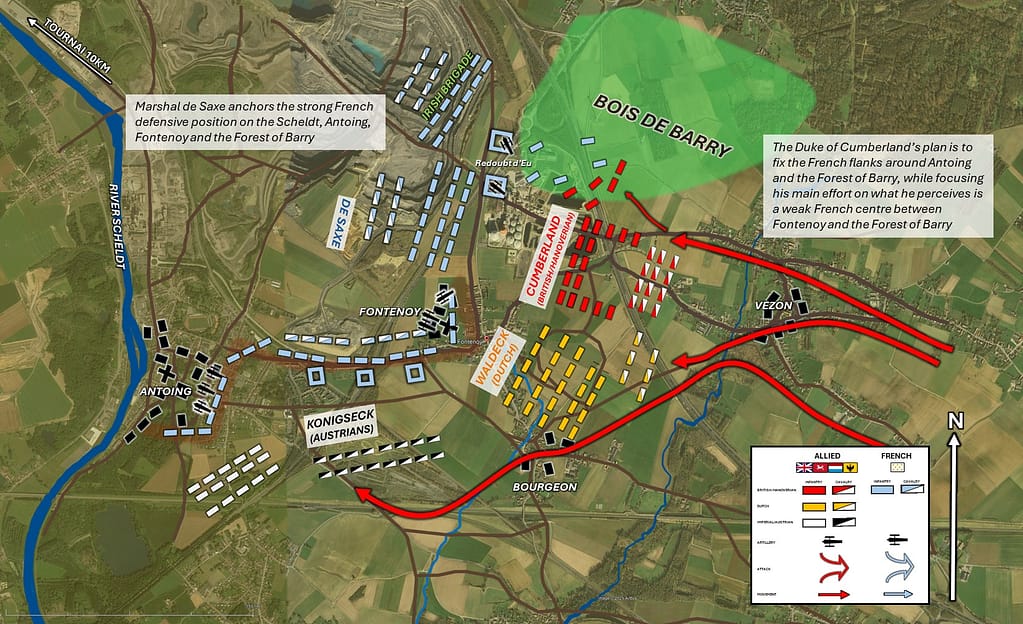
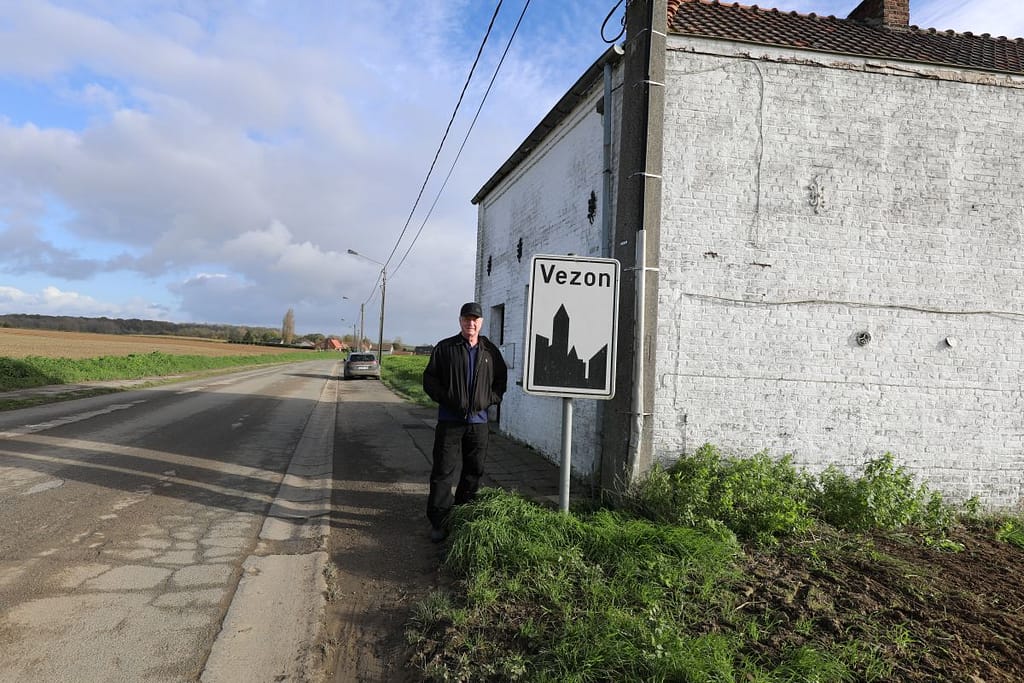
For the allies, dawn on 11 May 1745 revealed a French defensive position designed by Marshal de Saxe to channel, disrupt, and then defeat any Allied advance. The Allied army under the Duke of Cumberland assembled on gently rising ground around Vezon and oriented west towards Fontenoy.
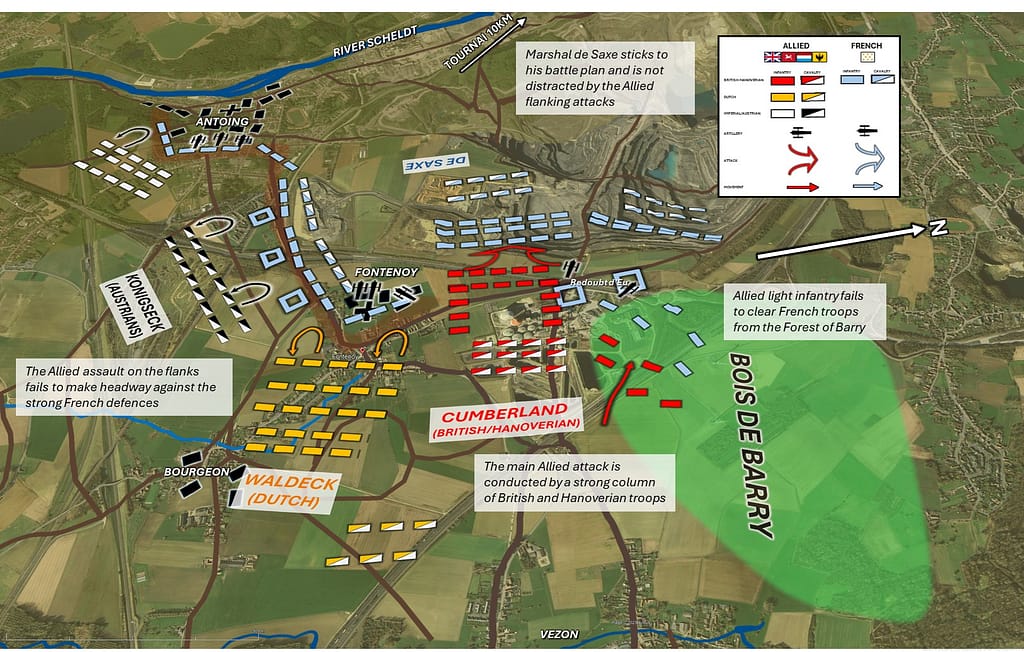
The allied plan—formulated the previous evening with Cumberland’s staff and senior Dutch and Hanoverian officers—was conceptually orthodox. The Allies would fix both French flanks with strong attacks to eliminate artillery emplacements that could interfere with the main attack. The main attack would then be launched against what Cumbeland perceived to be a weak French centre between the village of Fontenoy and the Forest of Barry.
The plan depended upon simultaneous pressure on both French flanks to force commitment of the French reserves and prevent any interference with the main Allied attack in the centre.
Fix the flanks, defeat the centre…
On the Allied left, the Dutch and Austrian contingents would attack the French right around Fontenoy, Antoing and the fortified works covering the Scheldt River. On the Allied right, British and Hanoverian light infantry plus supporting battalions would clear the Bois (Forest) de Barry on the French left. With the French flanks fixed, a powerful, compact central column of British and allied infantry would advance against the French centre between Fontenoy village and Bois de Barry. From the allied assembly area around Vezon, the French centre appeared the weakest point, but in reality, folds in the ground concealed several powerful French redoubts.
French design for battle
Marshal de Saxe showed only what he wanted the Allies to see…
Marshal de Saxe’s defensive design is key to understanding how the battle unfolded. He had arranged his main defensive line as a shallow concave frontage between Bois de Barry and Fontenoy. His right flank between Fontenoy and Antoing was ‘refused’ (bent backwards) and extremely strong. This design would channel an attacker into the gap between Bois De Barry and Fontenoy, where the bulk of his reserves and cannon were sited in depth. Forward strongpoints (Fontenoy village, redoubts) were postured to disrupt the initial allied thrusts and allow de Saxe to respond once the allied intentions became clear.
French artillery dispositions
French artillery (more than fifty effective field pieces and heavier guns) was distributed in small batteries rather than a single grand battery. Artillery pieces were sited with interlocking, enfilading arcs. The guns around Fontenoy could fire into the flanks of any force attempting to bypass the village. Redoubts and field batteries around Antoing could fire obliquely across the Allied axis of advance. Guns masked near the Bois de Barry were revealed only as the attackers closed.
Marshal de Saxe had made masterful use of the micro-terrain around Fontenoy to create hard shoulders and an enticing centre. The concept of exploiting small scale terrain features in battle is discussed further in the Micro-Terrain and Command Decision-Making research hub.
Keep a strong reserve!
Saxe himself, suffering from severe dropsy (swollen limbs), directed operations from a wicker litter moved behind the French centre-left, dispatching aides with detailed instructions to control French actions. He reportedly cautioned subordinates against premature countercharges that would break the integrity of his defensive design. Reserves—including the Irish Brigade and Maison du Roi cavalry—were placed where interior lines allowed a pivot either against the centre or to reinforce an endangered flank.
⚔️ Go deeper — Members get exclusive access to the Deep Research Collection, Field Notes, and monthly Research Dispatches. Try membership free for 7 days, cancel anytime. From $9/month.
The battle commences (~06:30)
Allied advance and failures on the flanks (06:30-09:30)
Allied coordination issues emerged before the first volleys were exchanged. Dutch troops (under Prince Waldeck) were slower forming, and their artillery park lagged behind the intended deployment line opposite Antoing. Reports filtering to Cumberland about the strength and trace of the French right—especially the batteries near the Redoubt de Chambonas and works covering the river crossing—induced caution. Simultaneously, forward Allied parties tasked with clearing the Bois de Barry discovered not a thin screen but a layered French presence: light troops, detached companies, and supporting infantry with prepared firing positions behind tree trunks and felled brush.
The cumulative effect was to desynchronise the allied attack: the Dutch pressure on Antoing and the clearing of the Bois de Barry wood were not fully developed prior to the main allied attack in the centre. Consequently, the main column under the Duke of Cumberland began its advance before the flank actions had achieved their desired results.
Forming the Allied central assault column (~10:00-10:30)
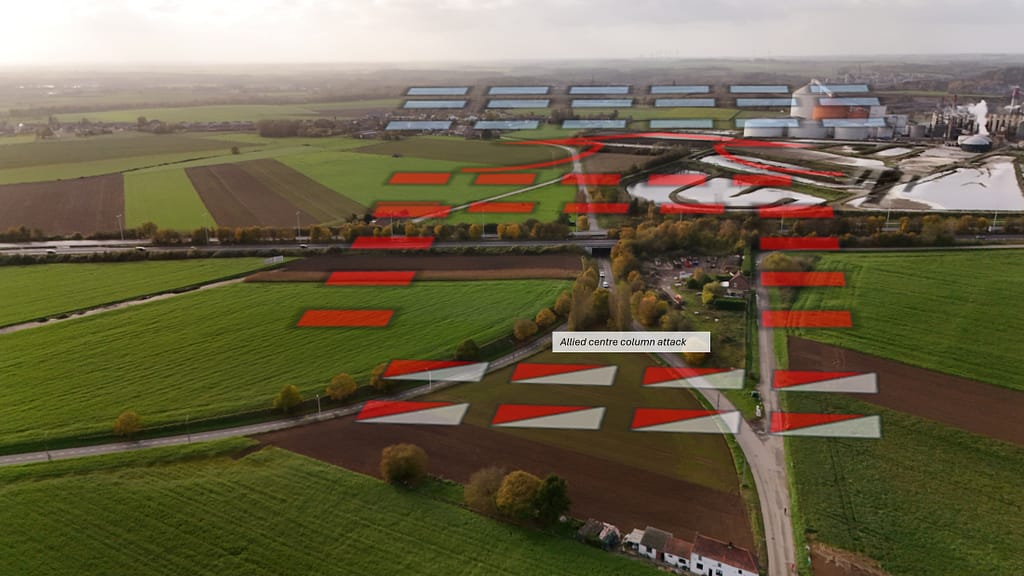
The central Allied assault column—often stylised in later accounts as a single monolithic block—was in reality a deep, composite line of multiple brigades, echeloned in depth to develop frontal firepower while maintaining secure flanks. British Foot Guards, regiments of the line (e.g. Royal Welch Fusiliers), and Hanoverian/Austrian battalions were deployed to deliver disciplined musketry against the French forces in front of them. Officers and NCOs dressed the ranks while the Regimental colours and drums provided unifying direction to the massed force.
The allied column was a mixed formation of line and column. Line formation was optimised to deliver frontal fire, while the column provided the depth in the assault to absorb the French flanking fires until the force had crossed the French killing grounds and was in range for volley fire and a final bayonet charge.

Delayed flanks exposed the Allied centre
By the time the British-led main body advanced (approximately mid-morning), the preparatory flank operations were already desynchronised. On the left, the Dutch guns were still being emplaced, and their infantry probes toward Antoing were rebuffed by round shot and canister. On the Allied right, attempts to clear the Bois de Barry progressed slowly. French infantry detachments fell back methodically from defensive line to defensive line, constantly firing and inflicting casualties, but never collapsing. The net effect was that French forces on the flanks remained intact and could concentrate their efforts on the Allied main attack in the centre.
The main allied advance (~10:30-11:30)
Centre column advances
The centre column advanced under persistent, converging fire from the front and both flanks. Round shot ploughed lanes through its leading files and the gaps were closed with drilled efficiency. At roughly 250–300 metres, canister shot tore into the allied ranks. Still, the Allied infantry pressed upward on gently rising ground to get within musket range of the French positions.
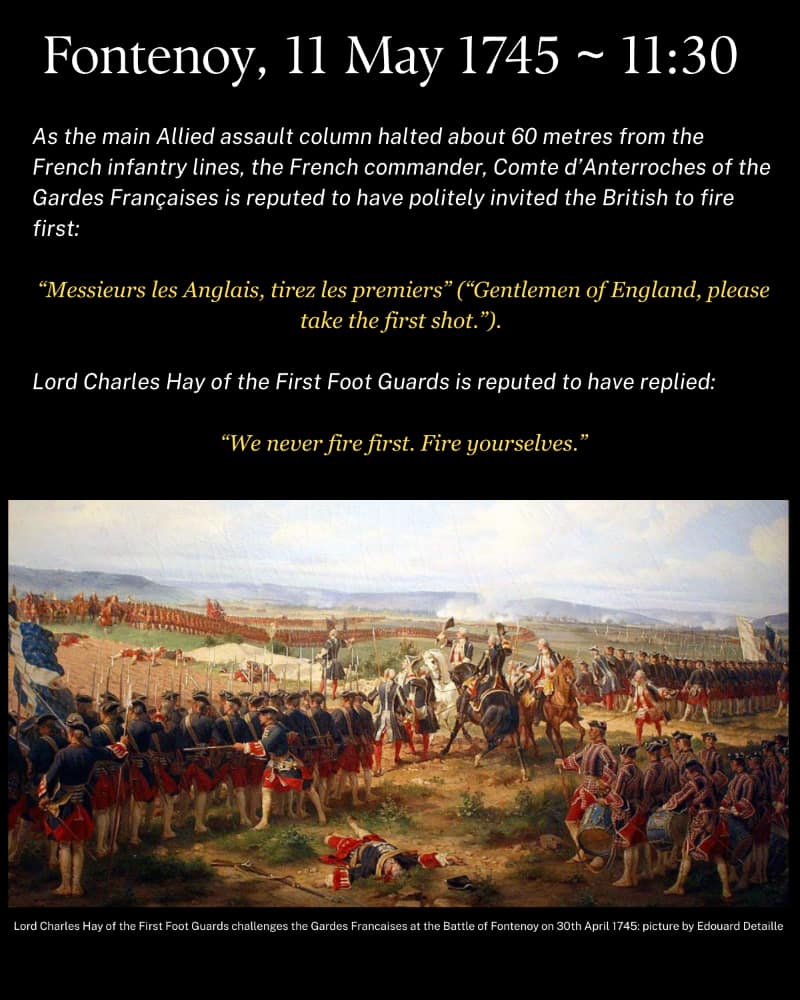
“Tirez les premiers” – fire discipline at the decisive point (~11:00)
“Messieurs les Anglais, tirez les premiers”
French commanding officer at Fontenoy
(“Gentlemen of England, please fire first”)
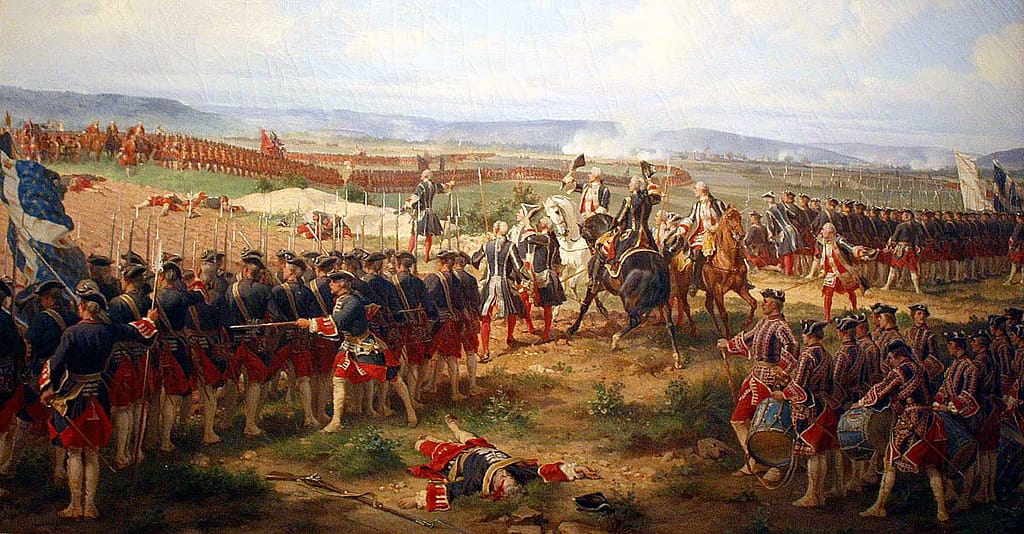
The close-range musketry fight began in earnest after the Allied line halted momentarily to redress ranks. As the British and Allied column advanced toward the French line near Fontenoy village, they encountered the elite Gardes Françaises.
As the opposing lines faced off at close range (60-80 metres), the French commander (possibly the Comte d’Anterroches) is said to have politely invited the British to fire first: “Messieurs les Anglais, tirez les premiers” (“Gentlemen of England, fire first.”). According to some British accounts, Lord Charles Hay of the First Foot Guards replied, “We never fire first. Fire yourselves.” This famed exchange epitomises the ‘Cabinet War Era’ (about 1648-1789 – an era of regular, limited, aristocratic, dynastic conflicts), even if the exact dialogue is uncertain.
Critical moment of the battle (~11:30-12:00)
Marshal de Saxe enforced controlled, disciplined fire. French frontline units, partly sheltered by hedgerows and slight embankments, waited to maximise the first-volley shock. When released, the initial French volleys struck an opponent already reduced by artillery fire. The Allied front ranks replied with measured platoon fire, a standard drill that enabled rapid, continuous fire while maintaining formation integrity. The combat zone rapidly became enveloped in dense white smoke.
The Allied advance did not lose momentum. The Allied regiments continued forward, closing the interval with the main French infantry line. Some French battalions bowed back. Elements of the British and Hanoverian column penetrated the French line between Fontenoy and the Bois de Barry wood. The breach was sufficient for French staff to perceive a genuine risk of defeat.
Marshal de Saxe’s response
Marshal de Saxe now demonstrated his operational prowess by sequencing the commitment of his reserves rather than making impulsive moves. He fed in battalions laterally from less-threatened sectors, stiffening sagging points, while keeping key reserves uncommitted. Officers from Champagne, Normandie, and other regiments stabilised the front by rotating fusilier companies out of the hottest zone momentarily to re-dress. Artillery crews shifted some guns by hand to improve enfilade angles on the Allied right flank.
Meanwhile, the Maison du Roi cavalry awaited the order to charge. Saxe calculated that premature cavalry commitment into an intact allied front would waste his cavalry for little impact. Instead, he looked for signs that the Allied flanks were losing cohesion from the massed musket and artillery fire.
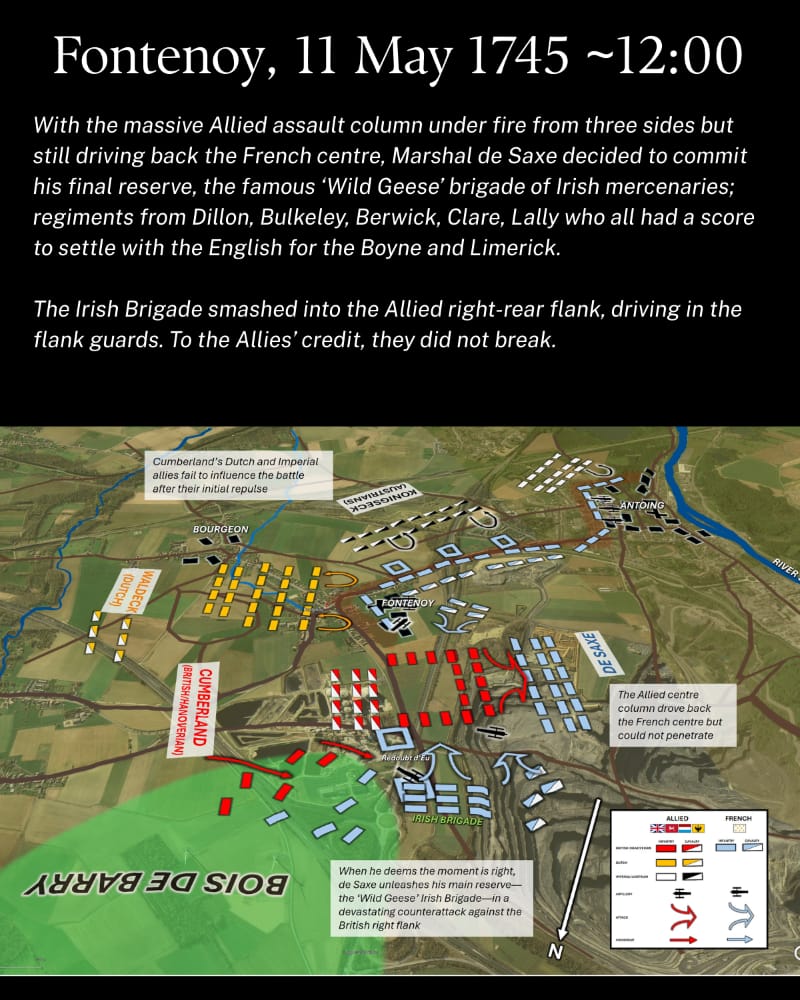
Marshal de Saxe commits his reserves (~12:00)
The ‘Wild Geese’ Irish Brigade
The decisive moment came with de Saxe’s order for the Irish Brigade, his main reserve force, to advance. The Brigade’s regiments—Dillon, Bulkeley, Berwick, Clare, Lally (and associated detachments)—were veterans of continental campaigning, accustomed to aggressive attack and close-quarter fighting, especially against English troops (the Irish were bitter about the Battle of the Boyne in 1690). Their cultural and regimental identity (rooted in exile after the Jacobite conflicts and the Treaty of Limerick) imbued them with an intense fighting spirit; battlefield observers repeatedly remarked on the ferocity of their assaults.
Charge of the ‘Wild Geese’
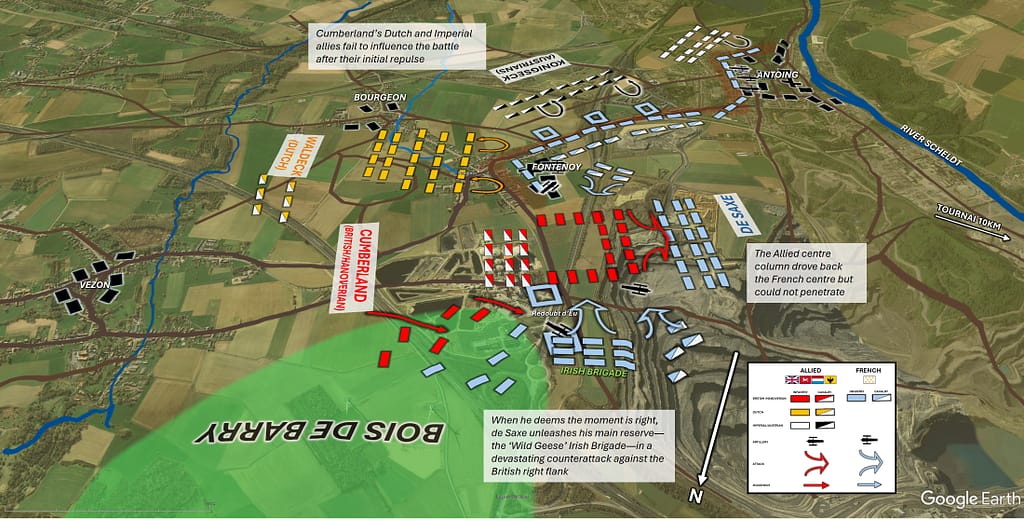
From their assembly area just west of Bois de Barry, the Irish Brigade attacked obliquely against the right rear of the advancing Allied centre column. The Irish moved through shallow folds and behind partial hedgelines that masked their approach until within musket range. Drummers beat the pas de charge; officers reportedly permitted or encouraged the use of Gaelic or Jacobite slogans—“Remember Limerick!”
The counterattack strikes the British flank
On contact, they delivered disciplined musket salvos into the more vulnerable right flanks / rear files of British and Hanoverian battalions already fixed frontally against the main French position. The Wild Geese then charged with the bayonet.
What made the Irish counterattack so dangerous was the battlefield geometry. The Allied column, compressed by fire from Fontenoy and Bois de Barry, had little room to manoeuvre laterally. When the Irish struck the right rear, they engaged units already advancing and could not readily reorient without exposing their flanks to French artillery. The Irish thus achieved disproportionate tactical effect despite facing some of the best infantry in Europe.
Cumberland ‘refuses’ his right flank
Cumberland’s officers recognised the developing crisis on their right flank. Orders were issued to ‘refuse the right flank’ or echelon certain battalions to create a defensive front against the Irish attack. Under ideal training conditions, a controlled change of orientation or a refused flank manoeuvre could have stabilised the flank. But conditions were far from ideal.
Dense smoke reduced command visibility and losses among NCOs and officers disrupted cohesion. Artillery fire from the French redoubts blasted canister shot diagonally into any attempted lateral redeployment. Some British Guards companies partially succeeded in forming a refused flank, delivering counter-volleys that checked the Irish advance.
French cavalry attacks against Cumberland’s column
With the Allied column’s right flank compromised, Saxe authorised limited cavalry exploitation. French squadrons (including Gendarmes de la Maison and other household or heavy cavalry elements) probed forward on the margins rather than plunging recklessly into intact infantry formations. The cavalry’s role was to threaten the allied flanks and rear, prevent the allies from shifting effort to Fontenoy.
Simultaneously, fresh French infantry units reinforced Fontenoy’s perimeter, ensuring the village strongpoint would not be turned in any Allied rearguard attempt. French artillery officers, now sensing the allied uncertainty, increased their rate of fire into the allied flanks. The battlefield geometry and perceptions had shifted: what had begun as a dangerous Allied penetration now appeared more like a vulnerable Allied salient.
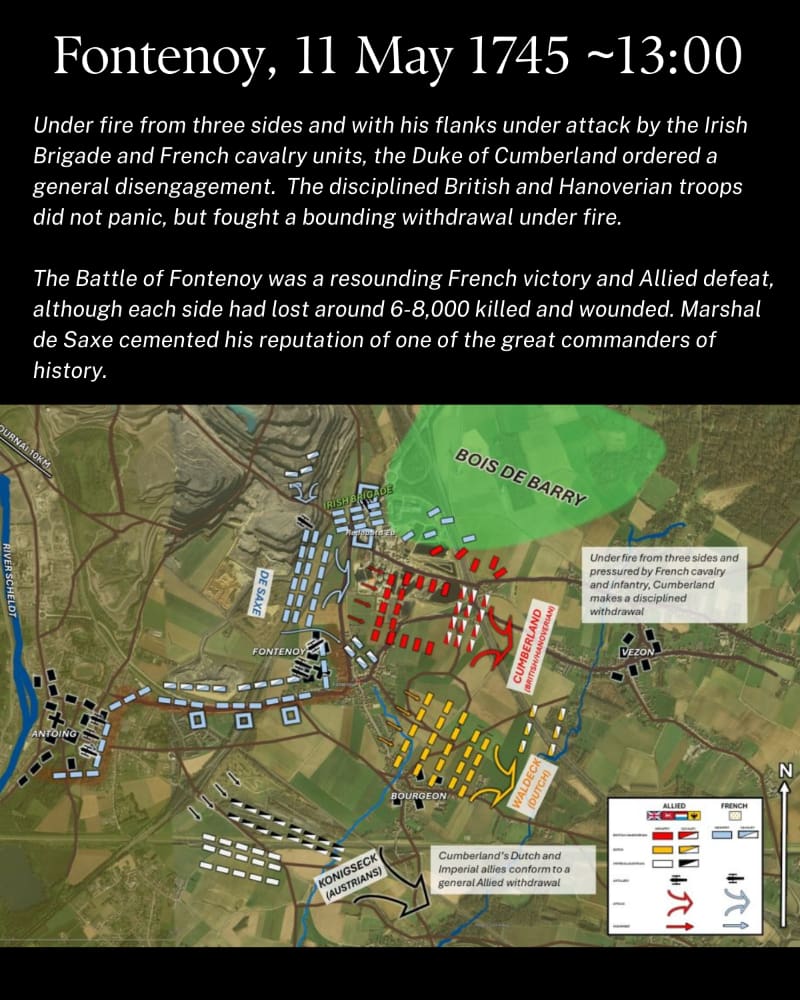
Cumberland’s withdrawal from Fontenoy (12:30-13:00)
Centre column retrogrades under fire
Recognising the deteriorating tactical situation—intact French forces on both flanks, and his centre under enfilade artillery fire—Cumberland chose preservation over the risk of annihilation. Orders were issued to retire by bounds while maintaining fire discipline and intact frontages.
The challenge was that rearward movement of a body of troops under fire always risks cascading disorder. Nevertheless, Allied battalions demonstrated commendable discipline, contracting and stepping back in controlled bounds. French cavalry reconnaissance did not detect a mass rout; instead, they observed a grudging disengagement. Saxe, mindful of his own army’s exhaustion and the dangers of over-extension beyond his defensive zone, limited his pursuit.
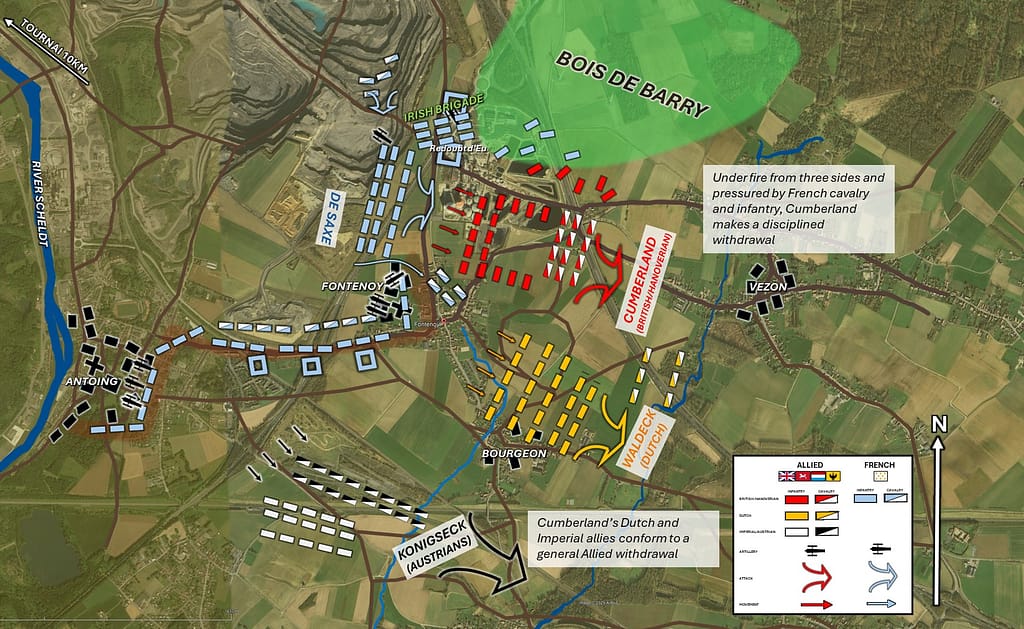
General allied disengagement (~13:00-14:00)
The closing phase (roughly early afternoon) witnessed a progressive, controlled retrograde operation rather than a panicked rout. Allied officers organised successive rearward bounds: front platoons firing, then stepping back through rear ranks, reforming a new line. French gunners, short of ammunition in some batteries, focused the remaining canister on denser clusters to expedite the disengagement; others conserved it for a potential late counterstroke, which Saxe ultimately judged unnecessary.
As the main British/Hanoverian centre column retrograded from the battlefield, the Austrian and Dutch forces on flanks conformed in a general withdrawal. The withdrawal was as disciplined and orderly as it could be under fire from both flanks and harassed by cavalry. Marshal de Saxe did not vigorously pursue the Allied army.
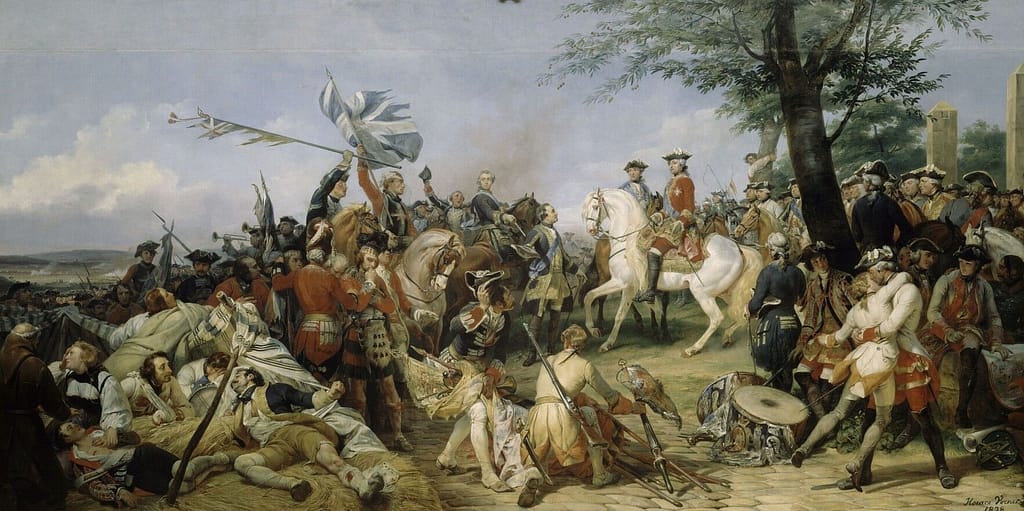
Battlefield clearance and reorganisation
Post-battle, French units re-dressed and tended wounded. Saxe maintained order. Looting or premature dispersal was discouraged to preserve operational readiness for follow-on movements tied to the siege of Tournai. The Irish Brigade garnered immediate acclaim; anecdotal exchanges between French line regiments praising“Les Irlandais” became part of the internal narrative memory. Allied medical detachments, under flags of truce, began negotiating the retrieval of wounded later that day and the following morning, a grim but customary postscript to battle.
The Battle of Fontenoy was over. It had lasted several hours and claimed the lives of thousands. French estimates put their own casualties at around 7,000 killed or wounded. Allied losses were comparable, although British accounts often reported higher figures. What was clear to all observers was that France had scored a decisive tactical victory, and one that would have strategic consequences across the Low Countries.
Consequences of the French victory
Operational consequences
The immediate result of the French victory at Fontenoy was the fall of Tournai, which capitulated to the French shortly after the battle. With the Allied field army withdrawing toward Ath and then Brussels, Saxe launched a rapid exploitation that captured Ghent, Bruges, and eventually Brussels itself. The 1745 campaign became one of near-continuous French success, enabled mainly by the destruction of Allied offensive capacity at Fontenoy.
Impact on the Pragmatic Alliance
The defeat shook the Dutch and made them increasingly defensive in their policy. British political leaders were furious at the scale of casualties suffered by elite regiments. Cumberland’s reputation never recovered, particularly after the disaster at Laeffelt the following year.
French prestige
For Louis XV, who was present on the field, the victory was a rare moment of personal military glory. Fontenoy became one of the most celebrated triumphs of the Ancien Régime and reinforced France’s dominance in the Low Countries for the next two years.
What went right or wrong at Fontenoy?
Maurice de Saxe – master tactician
Tactically, the battle demonstrated Marshal de Saxe’s mastery of the situation. His use of terrain (hedgerows, ridges, forest, urban areas) to disrupt, channel, and apply firepower against the Allied attack, proved decisive. His disciplined approach to firepower and use of reserves ensured they would only be employed when and where they would have a decisive effect. The French also had the advantage of interior lines, with their shorter lateral movement corridors behind their lines enabling rapid concentration.
Alliance coordination frictions
By contrast, the Allied army was unable to synchronise the activities on the flanks with the attack in the centre. The Dutch forces under Prince Waldeck never developed their attack against the French right, leaving those forces free to shift against Cumberland’s centre column. Consequently, the main Allied attack in the centre faced intact French defences and intense fire from three sides as it advanced. Multinational coordination friction—linguistic, doctrinal, and temperamental—surfaced precisely where timely coordination of effort was required.
Casualties
Casualty figures remain debated. Broadly, each side likely suffered in the 6,000–8,000 killed and wounded range, with the Allied central assault infantry absorbing disproportionate losses from converging artillery and musket fires in the final counterattack phase. French casualties clustered around front-line battalions in the centre and detachments screening the Bois de Barry
The Fontenoy battlefield today
The battle area
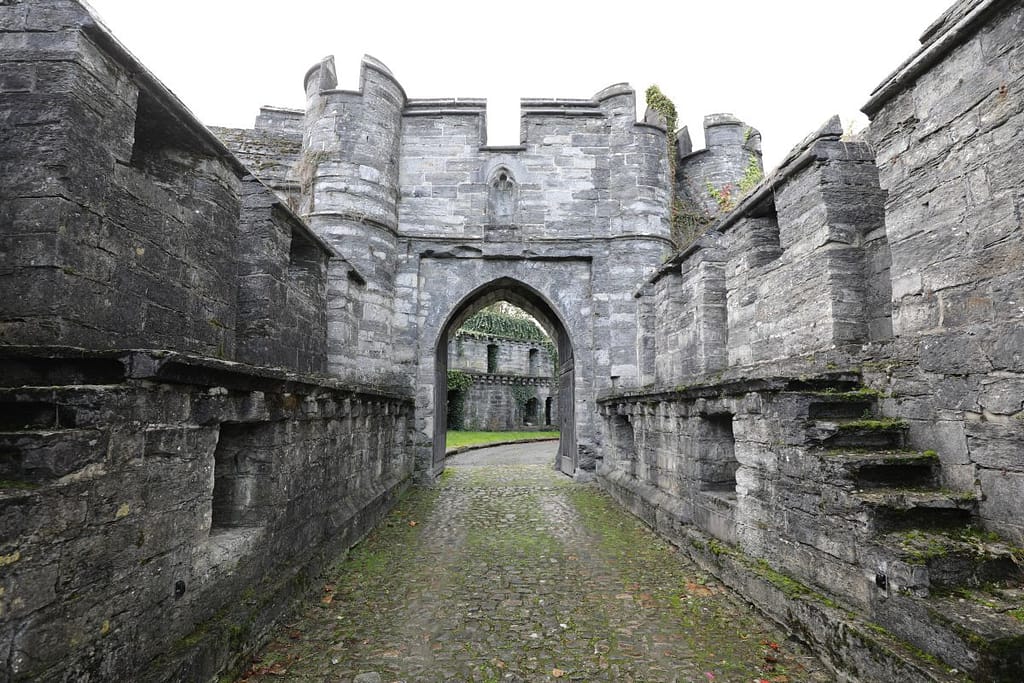
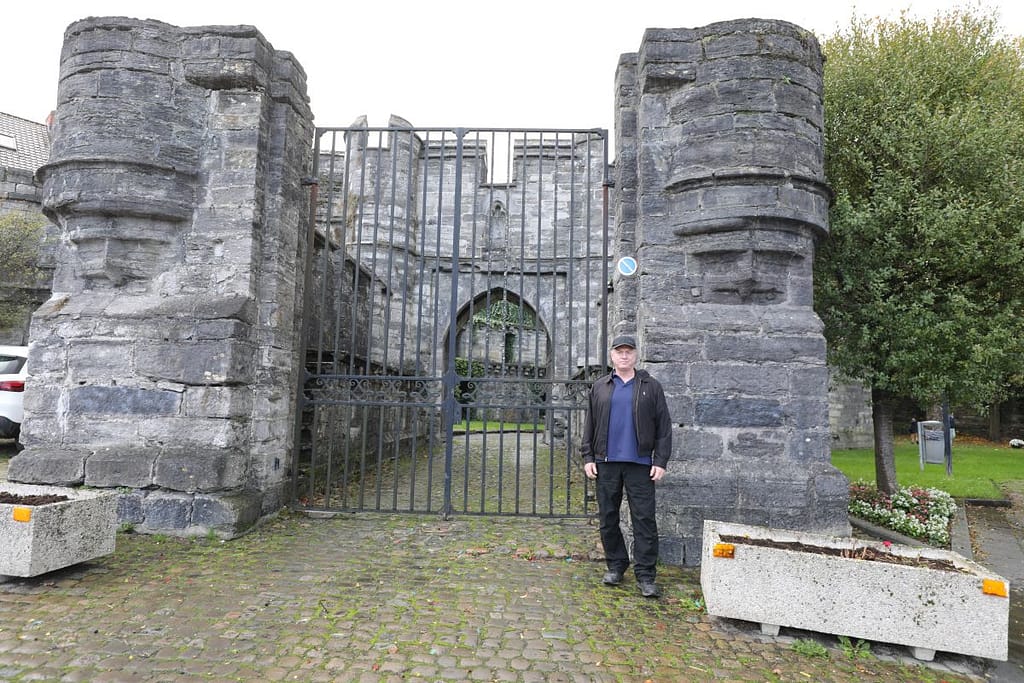
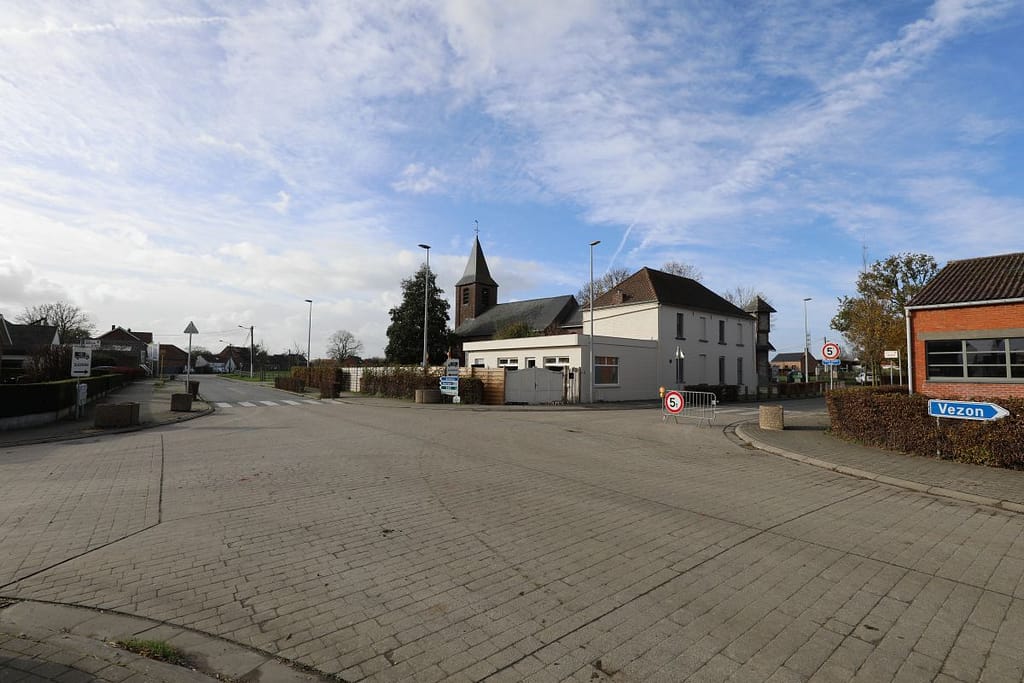
Much of the eastern portion of the battlefield around Fontenoy, Vezon, and Bourgeon remains relatively untouched and appears similar to its 1745 state. Chateau Antoing, which anchored the French right against the Scheldt River, remains largely intact and is viewable.
The area around Redoubt d’Eu and the Irish Brigade attack is now covered by a beet sugar production facility and numerous overpasses for the highway, so it takes some effort to visualise it as it was in 1745.
The French rear areas behind Fontenoy and Bois de Barry, including Marshal de Saxe’s headquarters, have been completely destroyed by a large open-cut mine pit. The pit has been in operation since 1897, originally mining chalk and now producing Portland Cement.
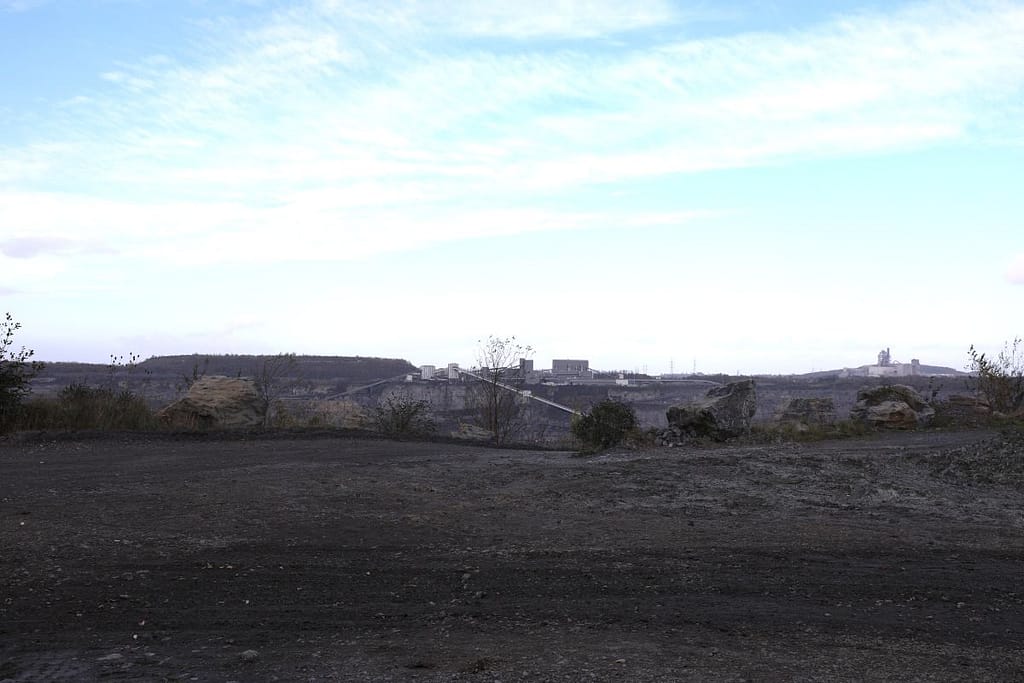
Fontenoy village
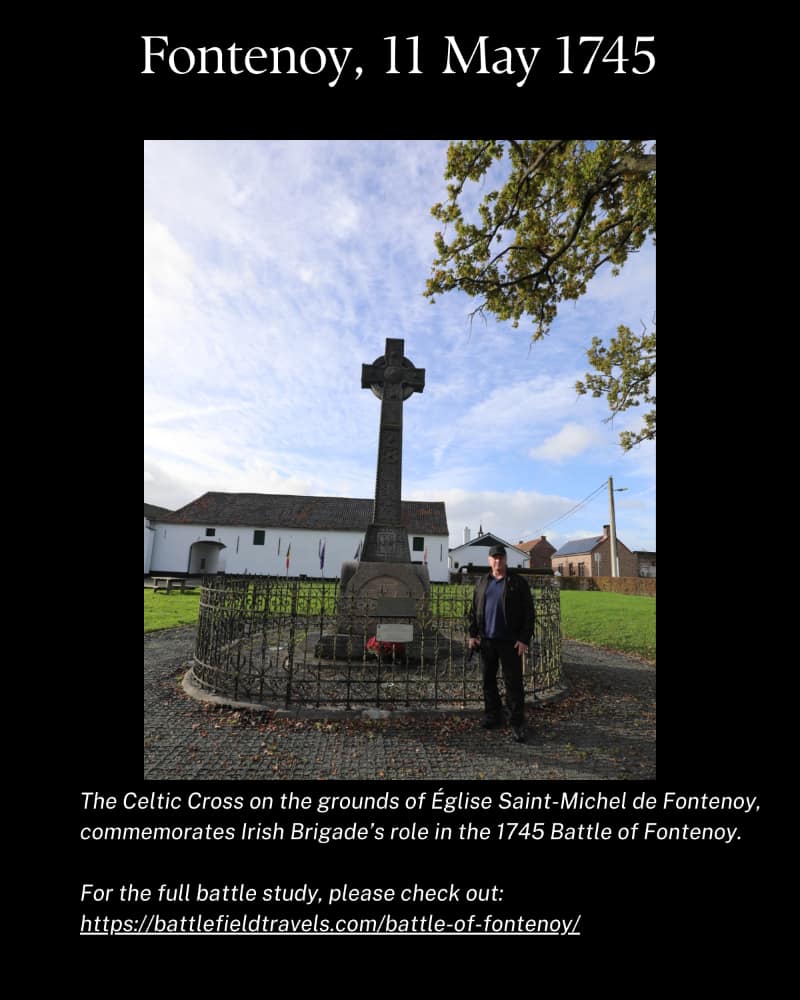
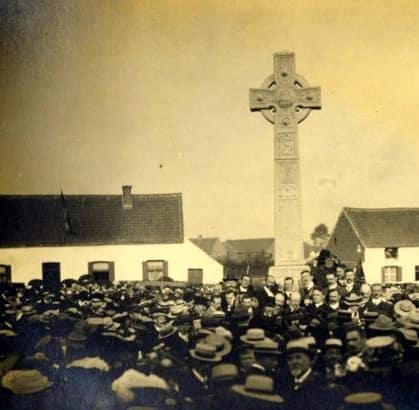
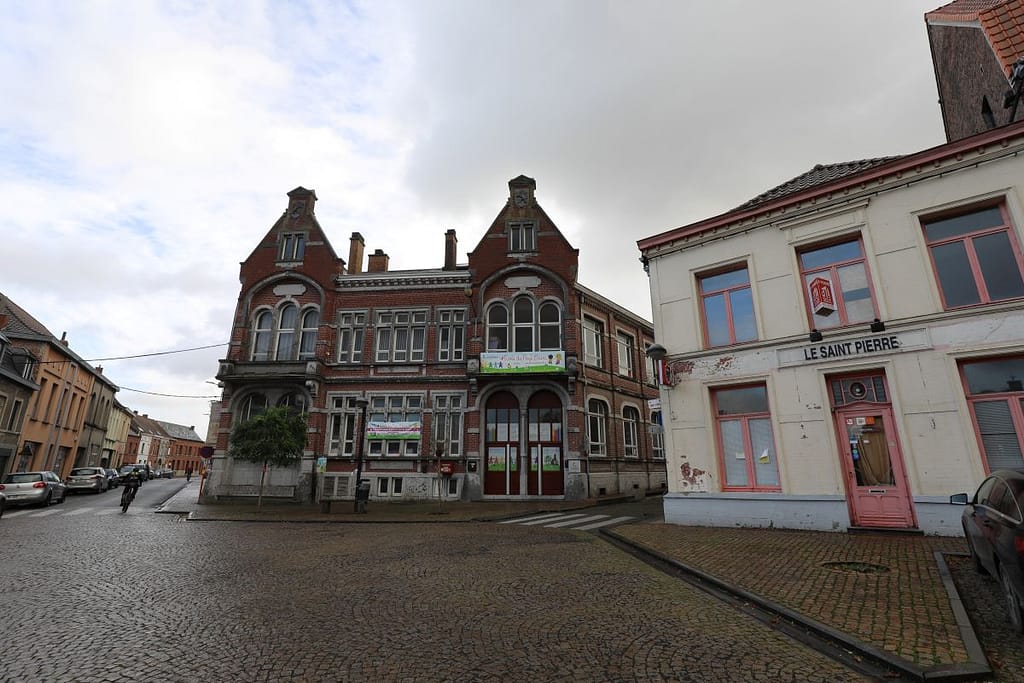
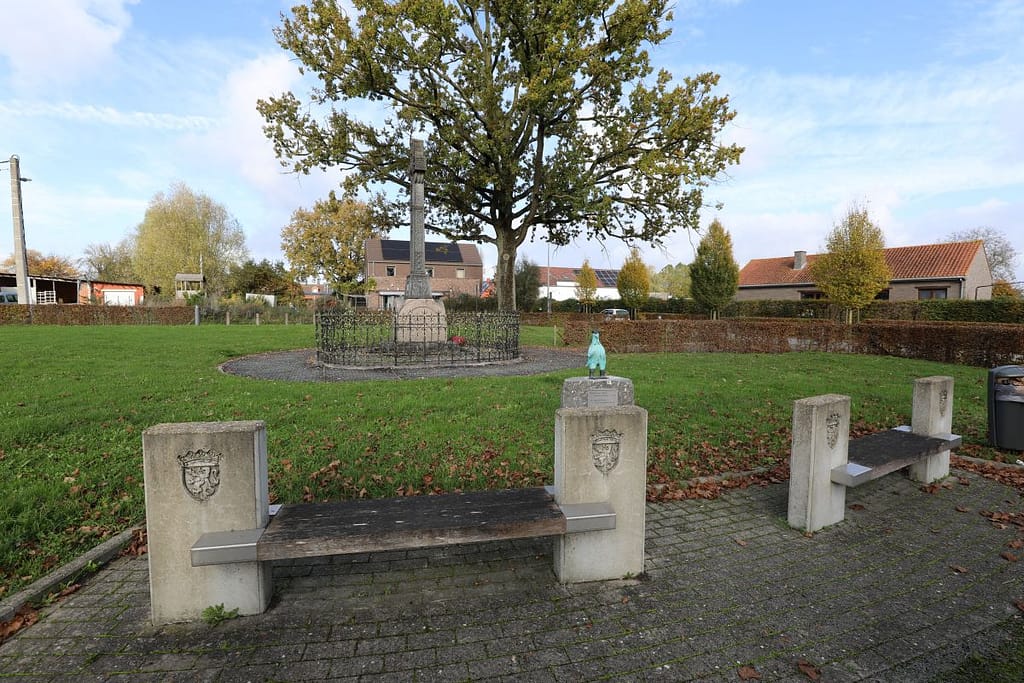
The best preserved area on the battlefield is around the old village centre of Fontenoy where at least some of the buildings date to the 18th century. One of the most evocative landmarks on the battlefield is the Celtic Cross memorial to the Irish Brigade, erected in 1907 by the Ancient Order of Hibernians. The commemorative cross is in the grounds of the Église Saint-Michel de Fontenoy and marks the Irish Brigade’s role in the battle, though their famous charge was launched further north, around the Bois de Barry. As is often the case, the monument serves symbolic remembrance rather than reflecting the precise terrain from which their assault began.
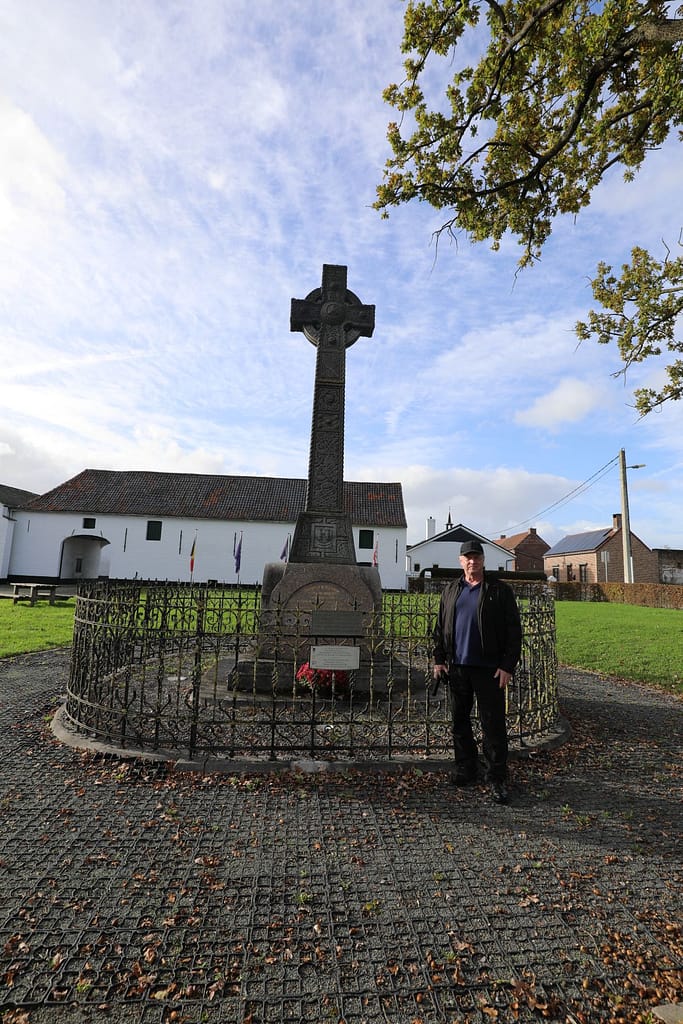
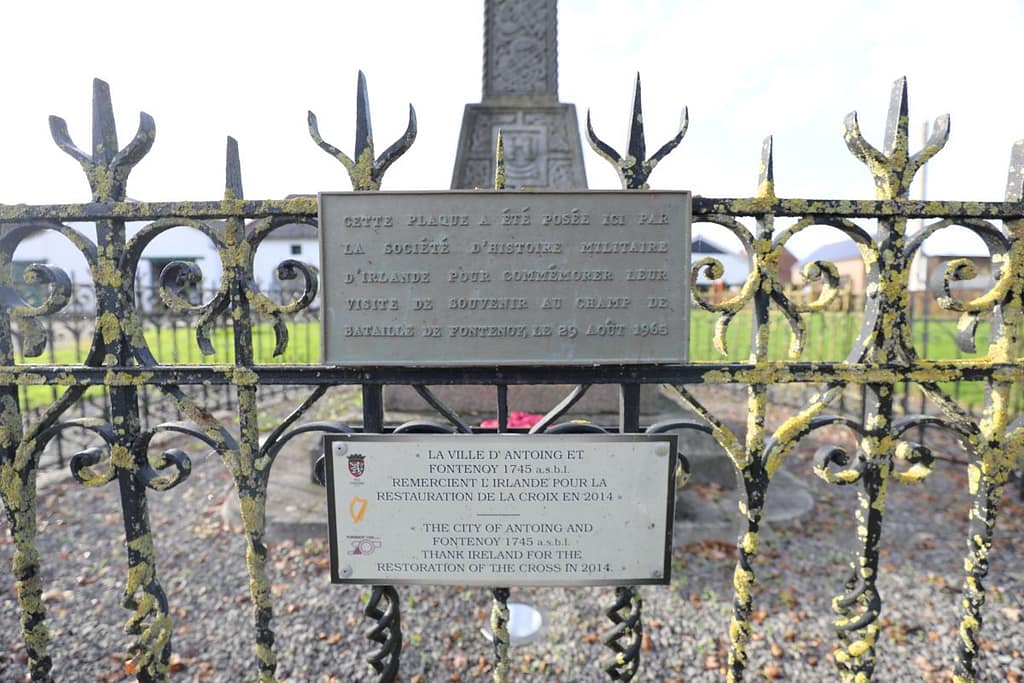
Visitors to the site today will find the monument well-maintained, flanked by Belgian and Irish flags. The surrounding village remains peaceful, with few signs of the ferocious battle that once unfolded here — but the symbolism of the cross remains powerful. As seen in the photo, taken in November 2024, the Celtic Cross memorialises the decisive role of the Irish ‘Wild Geese’ Brigade at Fontenoy.
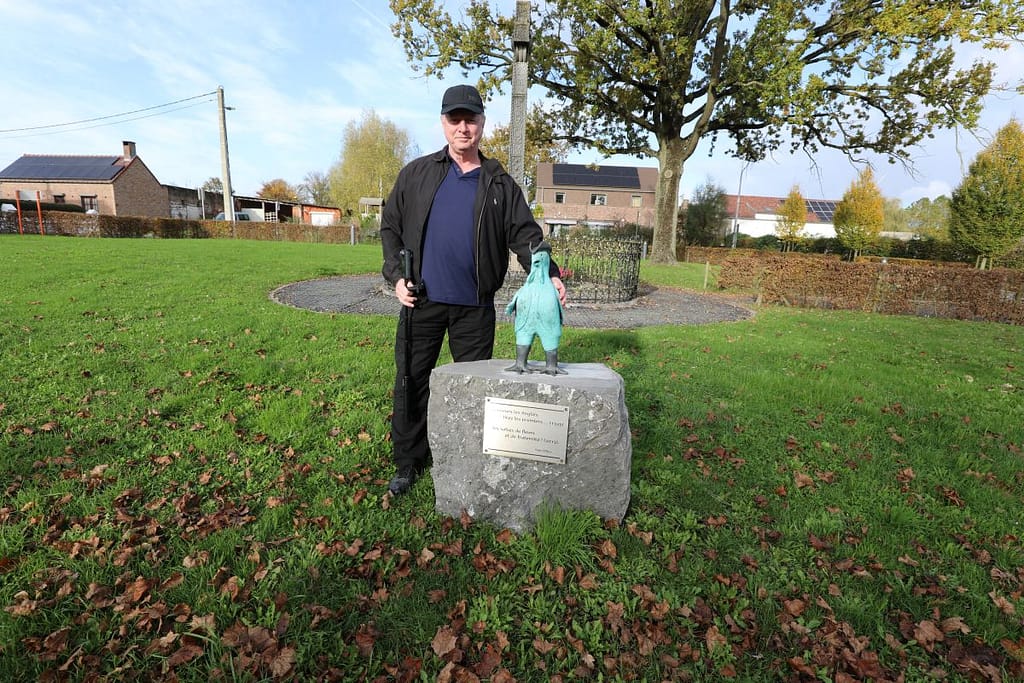
Right next to the Celtic Cross is another small monument featuring a whimsical statue of the Coq Gaulois, or Gallic Rooster—France’s unofficial national emblem. Dressed in an 18th-century uniform, the rooster commemorates the famous (if apocryphal) challenge attributed to the French commander during the battle: “Messieurs les Anglais, tirez les premiers” (“Gentlemen of England, fire first”). While the statue adds a note of humour and national pride, it stands some distance from the actual site of the events it recalls.
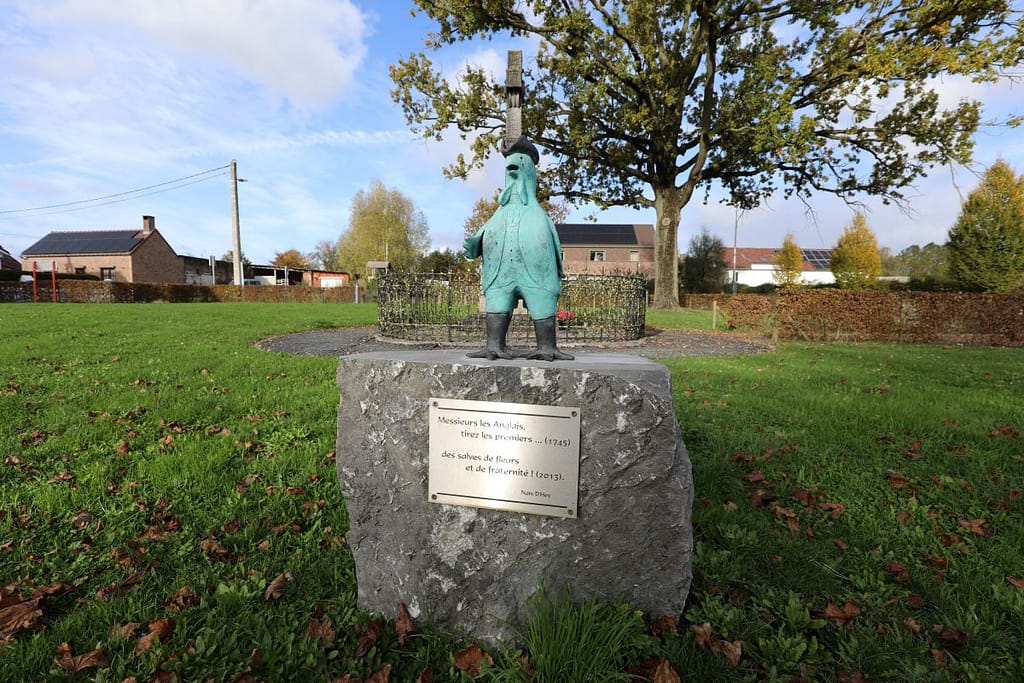
Battle of Fontenoy, additional images
Found this useful? Buy me a coffee — it helps fund future battlefield research


Authored by Mick Prictor, a retired military officer with 40 years’ service, and a military historian specialising in terrain-focused analysis of tactics, doctrine, and command decision-making in land warfare. His work draws on extensive battlefield fieldwork—more than 280 sites worldwide—and one of the world’s largest private collections of historic military arms, uniforms, and equipment. About me
📚 Notes and References
Google Earth Pro GIS overlay analysis by author (2025).
BritishBattles.com. “The Battle of Fontenoy 1745.” https://www.britishbattles.com/king-georges-war-austrian-succession/the-battle-of-fontenoy-1745/
Skrine, Francis H. Fontenoy and Great Britain’s Share in the War of the Austrian Succession 1741–1748. Edinburgh: Blackwood, 1906.
Browning, Reed. The War of the Austrian Succession. New York: Palgrave Macmillan, 1994.
McGarry, Stephen. Irish Brigades Abroad: From the Wild Geese to the Napoleonic Wars. Dublin: The History Press Ireland, 2013.
Chandler, David G. The Art of Warfare in the Age of Marlborough. Spellmount, 1990.
Fortescue, J.W. A History of the British Army, Vol. II. London: Macmillan, 1899.
Chartrand, Rene. Fontenoy 1745: Cumberland’s Bloody Defeat. Osprey Campaign Series 295. Oxford: Osprey Publishing, 2016.
Duffy, Christopher. The Military Experience in the Age of Reason. Routledge & Kegan Paul, 1987.
Battlefields Trust. “Fontenoy 1745.” https://www.battlefieldstrust.com/resource-centre/18th-century/battleview.asp?BattleFieldId=102
📚 Further Reading
This battle study nests within the broader analytical framework explored in the Research Hub, where operational methods, operating environments, armies, commanders, and weapons are examined across conflicts and eras. The links below connect related studies across the wider body of battlefield analysis on the BattlefieldTravels site.
⚔️ Explore all battle studies from the War of the Austrian Succession 1740-1748
🏛️ Explore the museum of War of the Austrian Succession historic artefacts
📚War of the Austrian Succession – Recommended Reading
🗞️ For updates on new battlefield studies and research insights, you can subscribe to the Newsletter.
You may also like


🧭 Fontenoy Battlefield Travel Guide
Getting There
- Fontenoy lies in western Belgium, approximately 10 km south of Tournai, close to the modern French border.
- The battlefield is best approached by car; public transport access is limited and does not cover the key terrain.
- Parking is generally possible along village roads near Fontenoy and Vezon, but visitors should be considerate of local residents.
Site Orientation
- The battlefield occupies gently rolling agricultural ground between the villages of Fontenoy, Vezon, and Antoing.
- Key features include the Fontenoy plateau, the village of Fontenoy itself, and the ground over which the Anglo-Allied infantry advanced in column.
- The battlefield is largely open farmland; modern development is limited, allowing the terrain to be read with relative clarity.
Museums & Visitor Centres
- There is no dedicated on-site battlefield visitor centre at Fontenoy.
- The city of Tournai offers museums and historical context relevant to the region and the War of the Austrian Succession.
- Interpretation on the battlefield itself is minimal, making prior study or a field guide highly advisable.
On-Site Experience
- Walking the battlefield allows visitors to appreciate the shallow rises, lines of advance, and limited cover that shaped the engagement.
- The scale of the Anglo-Allied infantry advance is best understood by traversing the ground between Vezon and Fontenoy.
- Hedgerows, field boundaries, and minor roads provide useful reference points when comparing the modern terrain to period maps.
Nearby Points of Interest
- Other War of the Austrian Succession and Low Countries battle sites can be visited within a short driving radius.
Practical Tips
- Much of the battlefield is privately owned farmland; remain on public roads and paths unless permission is granted.
- Visits are best made outside planting or harvest seasons to minimise disruption and improve visibility.
- Bring historical maps or a prepared field guide, as modern signage is limited.
Fontenoy is regarded as a major French victory because Marshal Saxe defeated a powerful Anglo-Allied army in a set-piece battle on open ground, preserving French control of the Austrian Netherlands. The battle demonstrated effective use of terrain, artillery, and reserves, and it shattered the myth of Anglo-Allied infantry invincibility during the War of the Austrian Succession.
The famous exchange—often rendered as polite battlefield etiquette—is likely exaggerated. While there may have been a brief pause or verbal exchange during the initial contact, the story was embellished in later accounts. The reality was a brutal, close-range firefight in which discipline and formation mattered far more than ceremony.
The Irish Brigade fought as part of the French Army and took part in decisive counter-attacks late in the battle. Their charge against the exposed flank of the Anglo-Allied infantry contributed to the collapse of the Allied advance and became a central element of the battle’s later mythology.
Yes. Much of the battlefield remains open agricultural land between the villages of Fontenoy and Vezon in modern Belgium. Although there is little formal interpretation on site, the terrain is still readable, making it well suited to informed battlefield exploration using maps and contemporary accounts.
Fontenoy illustrates the strengths and limits of linear infantry tactics, the importance of artillery positioning, and the decisive role of reserves. It shows how disciplined infantry could advance successfully—yet still fail—if unsupported or exposed on broken ground.
Subscribe to Battlefield Travels and receive a free E-Book Battlefield Guide
Unlock expert battlefield analysis, campaign reconstructions, and historical insights drawn from firsthand exploration and primary sources.
🗺️ You’ll receive:
🎖️ Exclusive historical insights you won’t find elsewhere
📘 A free eBook: 10 Tips for Exploring Historic Battlefields
📰 New battlefield studies straight to your inbox as they are published

⚔️ Go deeper — Members get exclusive access to the Deep Research Collection, Field Notes, and monthly Research Dispatches. Try membership free for 7 days, cancel anytime. From $9/month.
