Overmountain Men vs Ferguson’s Loyalists — the turning point in the South!
On 7 October 1780, a Patriot militia army of backwoods frontiersmen surrounded and destroyed Major Patrick Ferguson’s Loyalist force atop Kings Mountain, South Carolina. The hour-long clash of Americans fighting Americans was a decisive blow to British plans in the South and a turning point of the Revolutionary War.

Key facts
Google Earth map – location of the Kings Mountain battlefield
Strategic context: The Southern Campaign of 1780
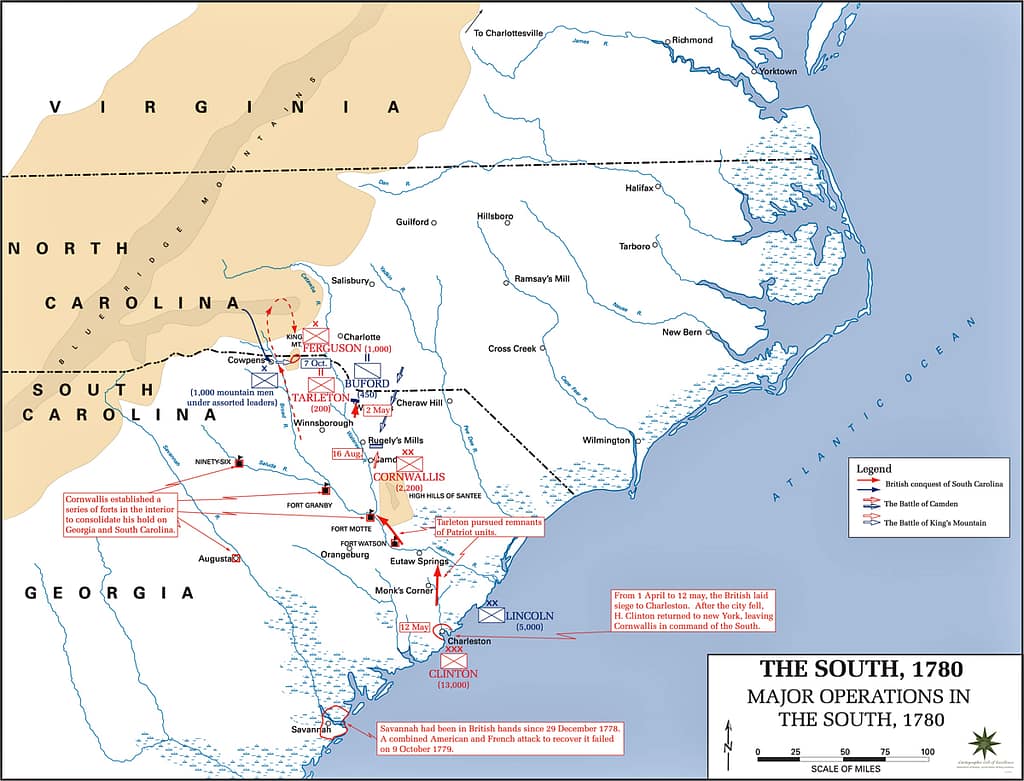
By late 1779, the Revolutionary War in the north had reached a stalemate. British forces held New York and some coastal enclaves but had failed to bring the rebellion to a successful conclusion. Believing the southern colonies contained stronger Loyalist sentiment, British strategists adopted a ‘Southern Strategy’: secure Georgia and the Carolinas, rally Loyalist militia, and then advance northward to crush the rebellion from its base.
British successes in early 1780
The campaign began well for Britain. In May 1780, Sir Henry Clinton captured Charleston, South Carolina, taking nearly 5,000 Patriot troops prisoner in the worst American defeat of the war. In August, Lord Cornwallis’s army defeated General Horatio Gates at Camden, scattering the main Continental force in the South. The victories appeared to confirm British expectations: the South could be pacified quickly with Loyalist support.
The role of Loyalists
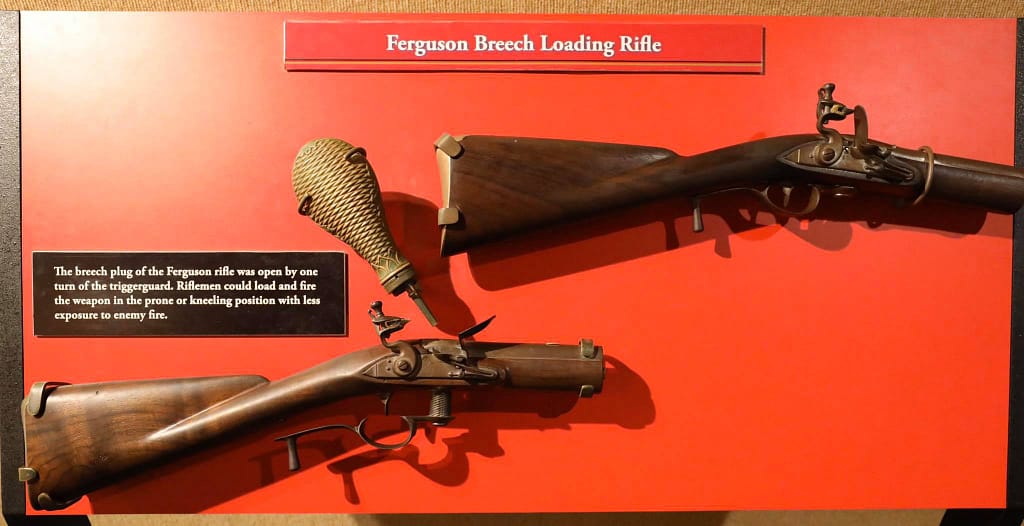
Central to this plan was the mobilisation of the American Loyalist militia. The British believed thousands of southern settlers would take up arms for King George once a British army secured their region. To organise them, Clinton and Cornwallis turned to Major Patrick Ferguson, a celebrated officer known for his invention of the breech-loading Ferguson rifle and his reputation as a crack shot.
In 1780 Ferguson was appointed Inspector of Militia for the Southern Department, tasked with raising, training, and leading Loyalist units. By autumn he commanded a force of about 1,100 Loyalist militia, mostly recruited from the Carolina backcountry. Ferguson was the only British regular at Kings Mountain; everyone else who fought was American.

Resistance in the backcountry
However, the British misjudged the character of the southern frontier. Harsh tactics by Loyalist militia and British detachments — burning farms, executing prisoners, punishing families of suspected rebels — bred deep resentment. Ferguson escalated tensions when he issued an ultimatum to the Appalachian settlers, threatening to “march his army over the mountains, hang their leaders, and lay waste to their country with fire and sword” if they did not submit.
Rather than intimidate, Ferguson’s ultimatum galvanised the frontier settlers, known as the Overmountain Men. Drawn from what is now Tennessee, Virginia, and western North Carolina, these self-reliant farmers and hunters resolved to march east, unite with Patriot militia in the Carolinas, and destroy Ferguson before he could bring his threats to life.
Why Kings Mountain mattered
The confrontation that followed was more than a backwoods skirmish. It pitted Patriot militia against Loyalist militia, neighbour against neighbour, in one of the most bitter internal clashes of the Revolution. For the British, defeat would mean the collapse of their hopes of building a Loyalist base in the South. For the Patriots, victory could reverse a year of crushing setbacks and keep alive resistance in the Carolinas.
Opposing forces: Patriots vs Loyalists
 Patriot “Overmountain Men” and Militia
 Patriot “Overmountain Men” and Militia
The Patriot army that confronted Ferguson was not a regular force but a coalition of backcountry militia, hardened by frontier life and accustomed to irregular warfare.
- Strength: About 900–1,000 men at Kings Mountain, though over 1,800 had assembled for the campaign (detachments were left behind to guard supplies and pursue Loyalist sympathisers).
- Commanders:
-Colonel William Campbell (Virginia) – overall command at Kings Mountain.
-Colonel Isaac Shelby (North Carolina/Tennessee frontier). - Composition: Settlers from Virginia, North Carolina, South Carolina, and the Appalachian frontier (“Overmountain” region).
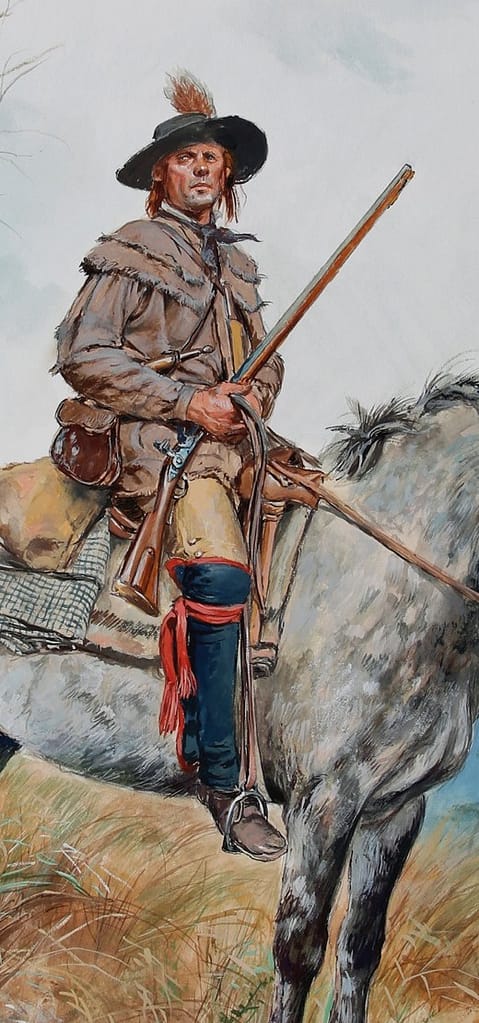
- Weapons and Tactics: Armed with long rifles (accurate but slow to reload), hatchets, and hunting knives. They fought in loose order, advancing tree to tree, firing deliberately, and relying on cover rather than close formations. Many were veterans of skirmishes against Native Americans and were adept at irregular, terrain-based combat.
- Strengths: Superb marksmanship, mobility, and high morale, driven by defence of their homes.
- Weaknesses: Lack of formal discipline, little artillery, and no centralised command structure.
 Loyalist Militia under Major Patrick Ferguson
 Loyalist Militia under Major Patrick Ferguson
Ferguson commanded a force of around 1,100 Loyalists, raised largely from North and South Carolina. Unlike the Patriots, they wore some semblance of uniform and fought under a British-trained officer, but they were still militia rather than regulars.
- Commander: Major Patrick Ferguson, Inspector of Militia for the Southern Department.
- Composition: Provincial Loyalist militia from the Carolina backcountry, with a few detachments of more organised provincial troops. Ferguson was the only British regular present.
- Weapons: Primarily muskets (less accurate than rifles but quicker to reload), bayonets, and a small number of Ferguson’s own breech-loading rifles.
- Tactics: Formed in line on the high ground of Kings Mountain, relying on volleys and bayonet charges to repel attackers. Ferguson drilled his militia as best he could, but cohesion remained limited.
- Strengths: Strong defensive position on the ridge; leadership of an experienced officer.
- Weaknesses: Poor morale among some militia; less accurate firepower compared to Patriot rifles; isolation from Cornwallis’s main army.

Comparative assessment
The battle pitted Patriot riflemen using guerrilla-style tactics against Loyalist militia in a fixed defensive position. The Patriots’ ability to fight individually, exploit cover, and shoot accurately contrasted with the Loyalists’ reliance on traditional musket volleys and bayonet charges. Leadership was also uneven: Ferguson was brave but isolated, while the Patriots benefited from multiple experienced frontier leaders coordinating a multi-pronged assault.
March to Kings Mountain
Gathering at Sycamore Shoals
In late September 1780, word of Ferguson’s ultimatum reached the frontier settlements west of the Appalachians. His threat to devastate their lands with “fire and sword” if they did not submit to the Crown was the final spark. The Overmountain Men, already suspicious of British intentions and fiercely protective of their independence, rallied at Sycamore Shoals (present-day Elizabethton, Tennessee).
On 25 September, approximately 900 militia members mustered under the leadership of Isaac Shelby, John Sevier, and William Campbell. Before the march began, Reverend Samuel Doak delivered a fiery sermon, urging the men to “go forth in the name of the Lord and make the wicked tremble.” The moment gave a sense of providential mission to what was essentially a frontier levy.
Crossing the Appalachians
The march eastward was arduous. The Patriots crossed the Blue Ridge and Appalachian ranges in autumn rain, enduring cold, mud, and swollen rivers. Despite the hardships, morale was high — the men believed they were carrying the war directly to the enemy threatening their homes.
Along the route they were joined by additional Patriot militia from North Carolina and South Carolina, swelling the combined force to around 1,800 men by early October. The column moved rapidly, covering nearly 200 miles in two weeks, a remarkable feat for irregular troops in rough terrain.
⚔️ Go deeper — Members get exclusive access to the Deep Research Collection, Field Notes, and monthly Research Dispatches. Try membership free for 7 days, cancel anytime. From $9/month.
Ferguson’s retreat
Meanwhile, Major Ferguson was moving northward through the Carolina backcountry. Recognising the threat posed by the converging Patriot force, he abandoned his advance into the frontier and sought a defensible position where he could await reinforcement from Cornwallis’s main army.
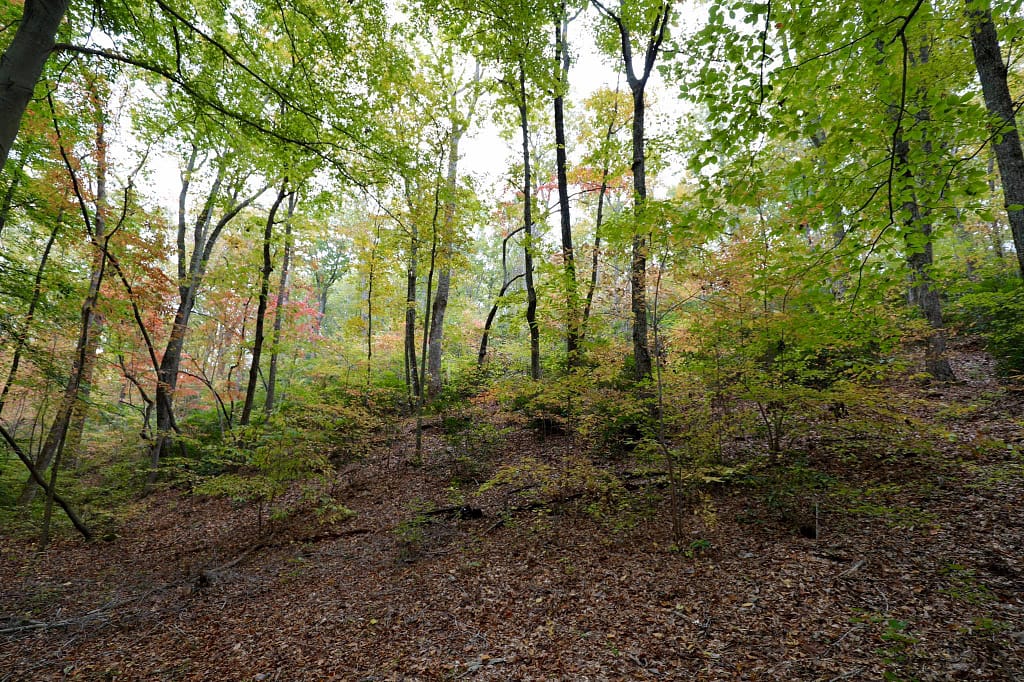
On 6 October 1780, Ferguson halted at Kings Mountain, a narrow, forested ridge straddling the border of North and South Carolina. The ridge rose about 60 feet above the surrounding land and was roughly half a mile long. Ferguson believed its slopes and open crest made it a natural fortress, where his 1,100 Loyalists could withstand attack until Cornwallis sent aid.
Patriot convergence
On the night of 6–7 October, Patriot scouts closed in on Ferguson’s camp. Early the next morning, about 900 riflemen advanced swiftly to encircle the ridge. Each militia contingent approached from a different direction, intending to surround and overwhelm the Loyalists by climbing the slopes from all sides.
The stage was set for a decisive clash on the wooded hilltop — Americans fighting Americans in a brutal test of endurance, leadership, and will.
The Battle of Kings Mountain, 7 October 1780
Encirclement of the ridge
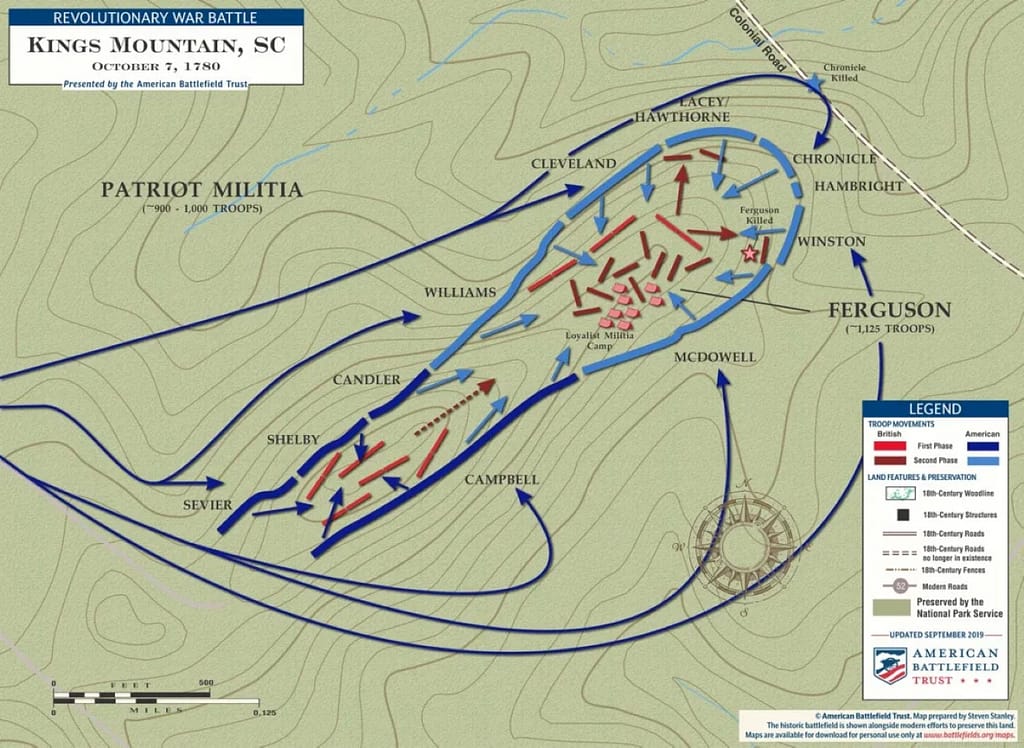
At about 3 p.m. on 7 October 1780, the Patriot columns arrived and quickly surrounded Kings Mountain. Roughly 900 riflemen were committed to the assault, with detachments advancing from every side. The wooded slopes provided natural cover, allowing the Patriots to fight as they preferred: individually, using trees and rocks as protection while delivering accurate fire from their long rifles.

Opening Engagements
The first volleys came as Shelby’s and Sevier’s men began climbing the western slope. Ferguson’s Loyalists fired disciplined musket volleys downhill, temporarily halting the attackers.
Using bayonet charges, they drove the Patriots back down the slope. But the Loyalists had little time to consolidate, as new Patriot detachments surged up from the north and south, keeping the defenders under constant pressure.
Patriot rifle tactics
The Patriots’ advantage lay in their long rifles, capable of accurate fire at greater distances than the Loyalist muskets. Though slower to reload, their deliberate, aimed fire inflicted steady casualties. Advancing in small groups, they would fall back from a Loyalist bayonet charge, then reoccupy the ground once the Loyalists returned to their crest positions. This constant ebb and flow gradually exhausted Ferguson’s men.

Ferguson’s leadership
Major Ferguson, conspicuous in a checkered duster and blowing a silver whistle to direct his units, rode along the crest on horseback, rallying his men again and again. His energy and defiance inspired the Loyalists, who repelled several Patriot pushes. Yet his visibility also made him a target.
Climax of the fight
As the battle wore on, pressure mounted from every side. Cleveland’s and Campbell’s men pressed hard on the northern slope, while Shelby and Sevier renewed their assault from the west. By around 4 p.m., the Loyalists were nearly encircled, their lines compressed onto the ridge crest. Ammunition was running low, casualties mounted, and every attempted bayonet charge left fewer men to hold the line.
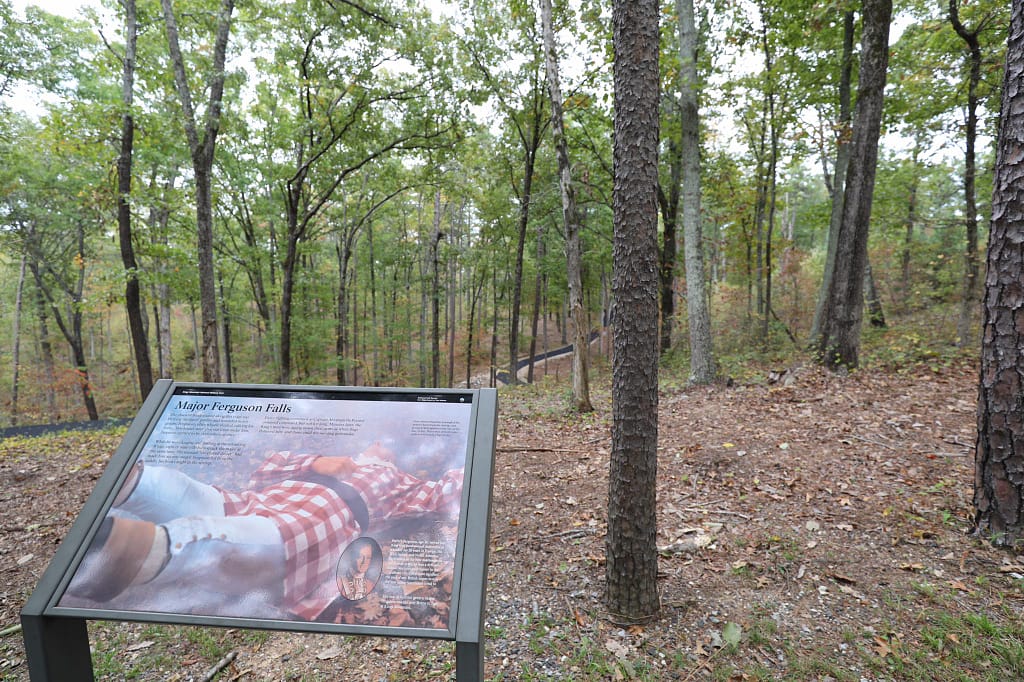
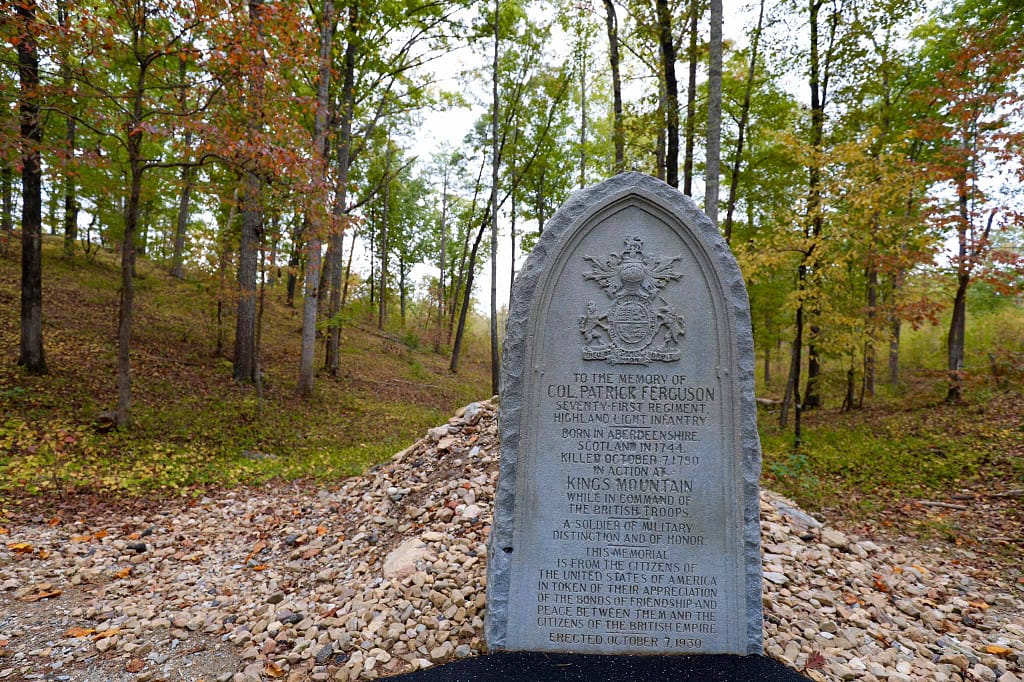
In a final bid to break free, Ferguson led a mounted sortie, attempting to cut through the encirclement. He was struck by multiple rifle balls and fell from his horse, mortally wounded. With their commander dead, the remaining Loyalists lost cohesion.
Surrender
Captain Abraham DePeyster, Ferguson’s second-in-command, raised a white flag to surrender. Some Patriots, furious at past Loyalist atrocities in the Carolinas, continued firing, causing additional casualties before the officers restored order. In all, the battle lasted little more than an hour — but it had destroyed Ferguson’s Loyalist force and delivered the Patriots a decisive victory.
Outcomes of the Battle of Kings Mountain
Casualties
The Patriots suffered relatively light losses: about 28 killed and 60 wounded.
The Loyalists were devastated: around 290 killed, 163 wounded, and more than 600 captured — more than three quarters of Ferguson’s force. The disparity underscored the effectiveness of the Patriots’ rifle tactics against militia armed primarily with muskets and bayonets.
Collapse of Loyalist influence in the backcountry
Kings Mountain destroyed Britain’s hope of building a strong Loyalist base in the Carolinas. Ferguson had been the only British regular officer leading provincial militia in the backcountry; with his death and the capture of his men, the Loyalist cause in the region collapsed. Hundreds of families who had taken up arms for the Crown now faced imprisonment, displacement, or retribution.
Boost to Patriot morale
Coming just weeks after the disastrous Patriot defeat at Camden (16 August 1780), Kings Mountain was a badly needed morale boost. It demonstrated that Loyalists could be beaten decisively, that the backcountry was not securely pro-British, and that American militia, when motivated and fighting on familiar terrain, could achieve a decisive victory without Continental Army support.
Strategic consequences
For Lord Cornwallis, the defeat was a severe setback. His army at Charlotte, North Carolina, lost its western flank and its main Loyalist support base. Cornwallis was forced to retreat southward into South Carolina to regroup. The defeat also emboldened Patriot partisans under leaders like Francis Marion, Thomas Sumter, and Andrew Pickens, who stepped up guerrilla activity against British detachments.
The Kings Mountain battlefield today
The Kings Mountain National Military Park, on the South Carolina–North Carolina border, preserves the site of the 1780 battle in remarkable condition. Unlike many Revolutionary War fields that have been lost to urban development, Kings Mountain remains wooded and secluded, giving visitors a strong sense of the terrain that shaped the fight.
Visitor Centre and Museum
The National Park Service maintains an excellent Visitor Centre with exhibits on the battle, the southern campaign, and the role of militia on both sides. Artefacts, maps, and multimedia displays help explain the context and significance of the clash.

Battlefield trail
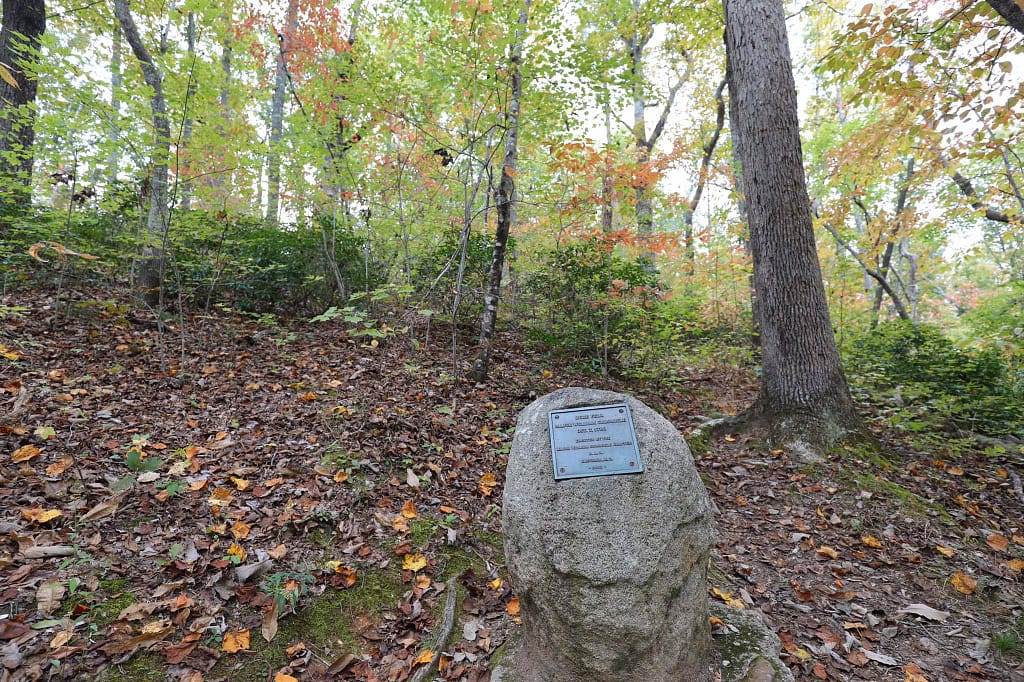
A 1.5-mile walking trail loops around the ridge where the battle took place. The path follows the Patriot advance routes, rising up the slopes where riflemen pressed the Loyalists. Along the trail, interpretive markers and plaques identify key positions, including the area where Major Ferguson fell. The climb up the slopes vividly illustrates how the wooded ridges allowed riflemen to close in under cover.
Memorials
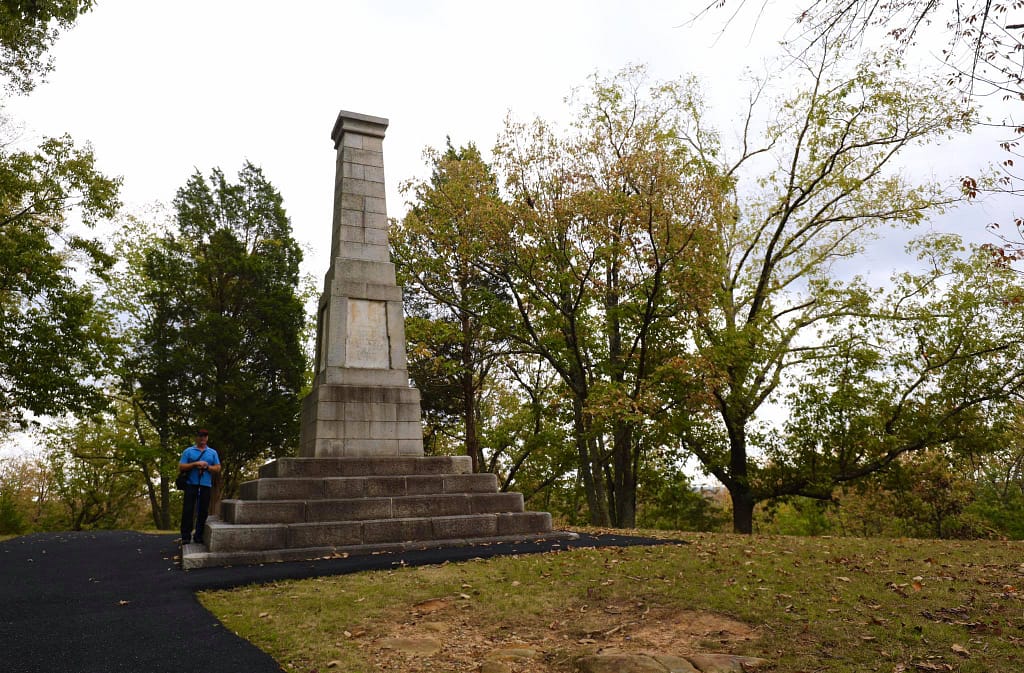
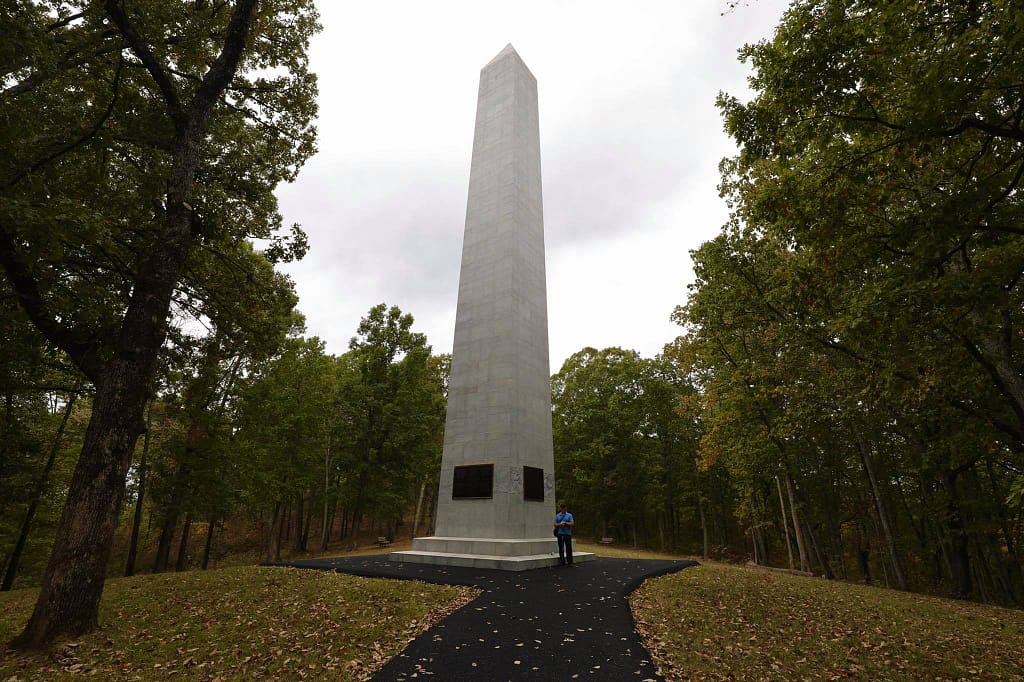
At the summit stands a large obelisk monument, erected in the 19th century to commemorate the victory. Additional plaques honour both Patriot and Loyalist dead, recognising the civil war character of the battle — Americans fighting Americans. A U.S. Presidential monument, placed in 1930, also highlights the national significance of the site.
Preservation
The field remains largely as it was in 1780 — a wooded ridge with steep slopes and a narrow crest. Walking the ground makes clear why Ferguson believed it defensible, and why the Patriots’ tree-to-tree rifle tactics proved so effective. The relative isolation of the park adds to the atmosphere, conveying both the harshness of frontier warfare and the intimacy of a short, brutal fight fought at close quarters.
Link to the National Park Service Kings Mountain visitor center
Images of Kings Mountain battlefield



Found this useful? Buy me a coffee — it helps fund future battlefield research


Authored by Mick Prictor, a retired military officer with 40 years’ service, and a military historian specialising in terrain-focused analysis of tactics, doctrine, and command decision-making in land warfare. His work draws on extensive battlefield fieldwork—more than 280 sites worldwide—and one of the world’s largest private collections of historic military arms, uniforms, and equipment. About me
Sources
- Robert W. Brown Jr. (2009). Kings Mountain and Cowpens: Our Victory Was Complete. The History Press.
- David Smith (Author), Graham Turner (Illustrator) (2025). Kings Mountain 1780: The Tide Turns in the South (Campaign, 427). Osprey Publishing
- Ricky Roberts and Bryan Brown (2011). Every Insult and Indignity: The Life Genius and Legacy of Major Patrick Ferguson. CreateSpace Independent Publishing Platform.
📚 Further Reading – American Revolutionary War
This battle study nests within the broader analytical framework explored in the Research Hub, where operational methods, operating environments, armies, commanders, and weapons are examined across conflicts and eras. The links below connect related studies across the wider body of battlefield analysis on the BattlefieldTravels site.
⚔️ Explore all battle studies from the American Revolutionary War
🏛️Explore the museum of American Revolutionary War historic weapons and equipment
The book list for this conflict includes the leading campaign studies, memoirs, and operational analyses available on the American Revolutionary War, selected specifically to complement this battlefield study.
📚 American Revolutionary War 1775-1783 – Recommended Reading
🗞️ For updates on new battlefield studies and research insights, you can subscribe to the Newsletter.
Related Battle Studies, Museum Pieces & Reading Resources


🧭 Battlefield Travel Guide: Kings Mountain (7 October 1780)
Getting There
- Location: Kings Mountain National Military Park, near Blacksburg, South Carolina, on the NC–SC border.
- Access: Easily reached by car via I-85; about 45 minutes from Charlotte, NC, and 1 hour from Greenville, SC.
- Parking: Ample parking at the Visitor Centre.
Site Orientation
- Key Terrain: Wooded ridge about half a mile long; slopes on all sides replicate Patriot advance routes.
- Battlefield Trail: 1.5-mile loop walking trail with interpretive markers and monuments at key points.
- Notable Spots: Marker for Major Ferguson’s death site; large obelisk commemorating the battle; multiple plaques to Patriot and Loyalist units.
Museums & Visitor Centres
- On-site: Kings Mountain Visitor Centre — museum with artefacts, maps, and displays explaining the southern campaign and the battle.
- Nearby: Kings Mountain State Park (adjacent) offers additional walking trails and camping facilities.
On-Site Experience
- Interpretation: Clear NPS signage and plaques throughout the trail; audio guides and ranger talks available seasonally.
- Atmosphere: Wooded and relatively secluded; terrain still conveys the intimacy of close-quarters combat on the ridge.
- Photography: Best opportunities along the ridge crest and memorial obelisk.
Nearby Points of Interest
- Revolutionary War Sites: Cowpens National Battlefield (~20 miles west) and Guilford Courthouse (~90 miles northeast).
- Local: Blacksburg, SC, and Shelby, NC, offer food and accommodation options close to the park.
Practical Tips
- When to Visit: Autumn (October) is ideal — anniversary events and cooler weather.
- Time Required: 4–6 hours to walk the trail, visit the museum, and study the ground thoroughly.
- Facilities: Restrooms, gift shop, and picnic areas at the Visitor Centre.
Subscribe to Battlefield Travels and receive a free E-Book Battlefield Guide
Unlock expert battlefield analysis, campaign reconstructions, and historical insights drawn from firsthand exploration and primary sources.
🗺️ You’ll receive:
🎖️ Exclusive historical insights you won’t find elsewhere
📘 A free eBook: 10 Tips for Exploring Historic Battlefields
📰 New battlefield studies straight to your inbox as they are published

⚔️ Go deeper — Members get exclusive access to the Deep Research Collection, Field Notes, and monthly Research Dispatches. Try membership free for 7 days, cancel anytime. From $9/month.
