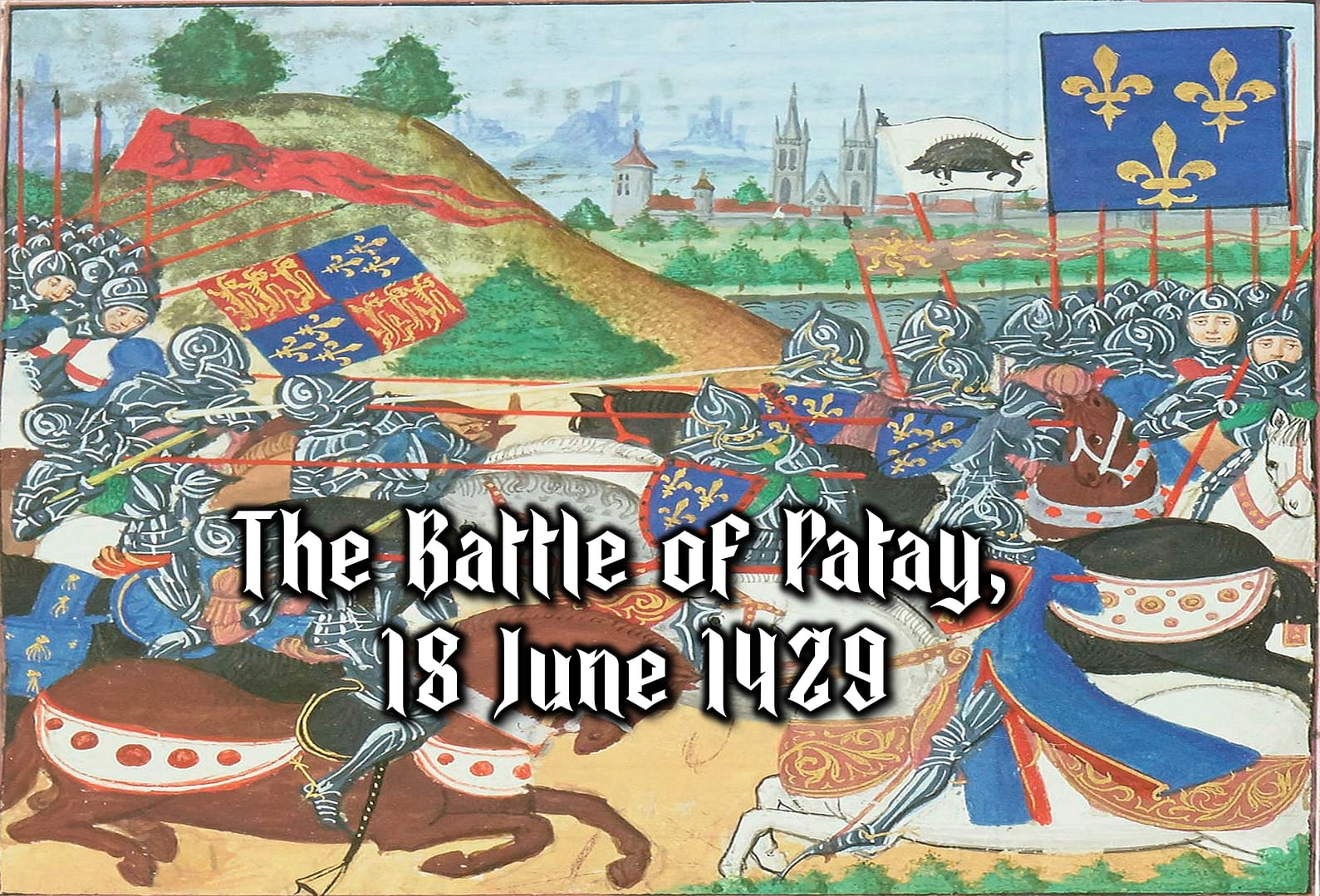
The climactic culmination of Jeanne d’Arc’s Loire Campaign!
On 18 June 1429, the French army under Joan of Arc and Captain La Hire turned the tide of the Hundred Years’ War at Patay. Exploiting English missteps, the French cavalry smashed through the longbowmen before they could establish a staked firing line, securing a decisive victory that lifted national morale and opened the road to Reims.
Key facts
🗺️ Battle of Patay, near Orleans, 18 June 1429
⚔️ Hundred Years War 1337-1453 About 5,000 English troops under Lord John Talbot and Sir John Fastolf versus about 4,000 French troops under Jeanne d’Arc, Captain La Hire, Jean Poton de Xaintrailles, the Duke of Alencon, and the Count de Richemont
🎯 French pursuit and destruction of the English Army after the Loire Campaign
Visit my virtual museum of weapons, uniforms and equipment of the Ancient and Medieval World
Google Earth map – Location of the Patay battlefield
🧭🥾 Walking the Battlefield
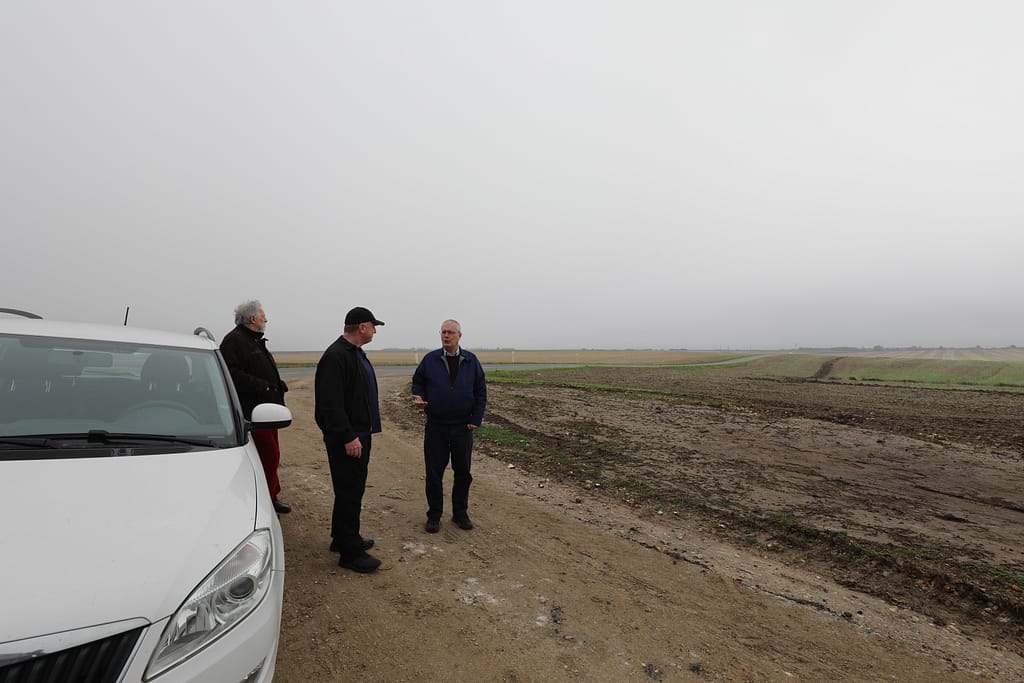
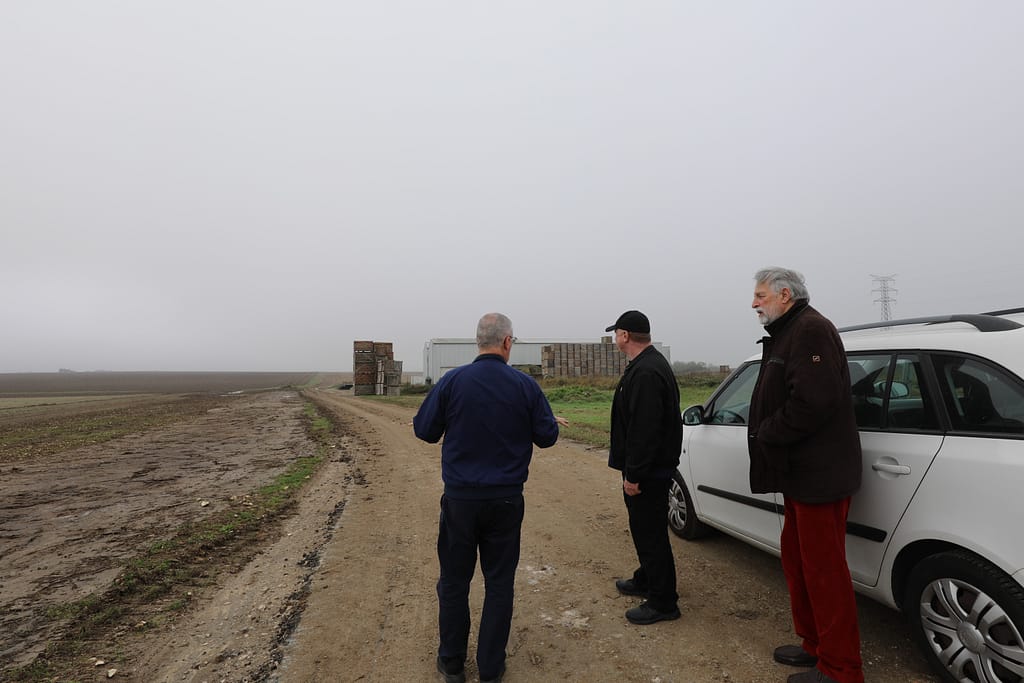
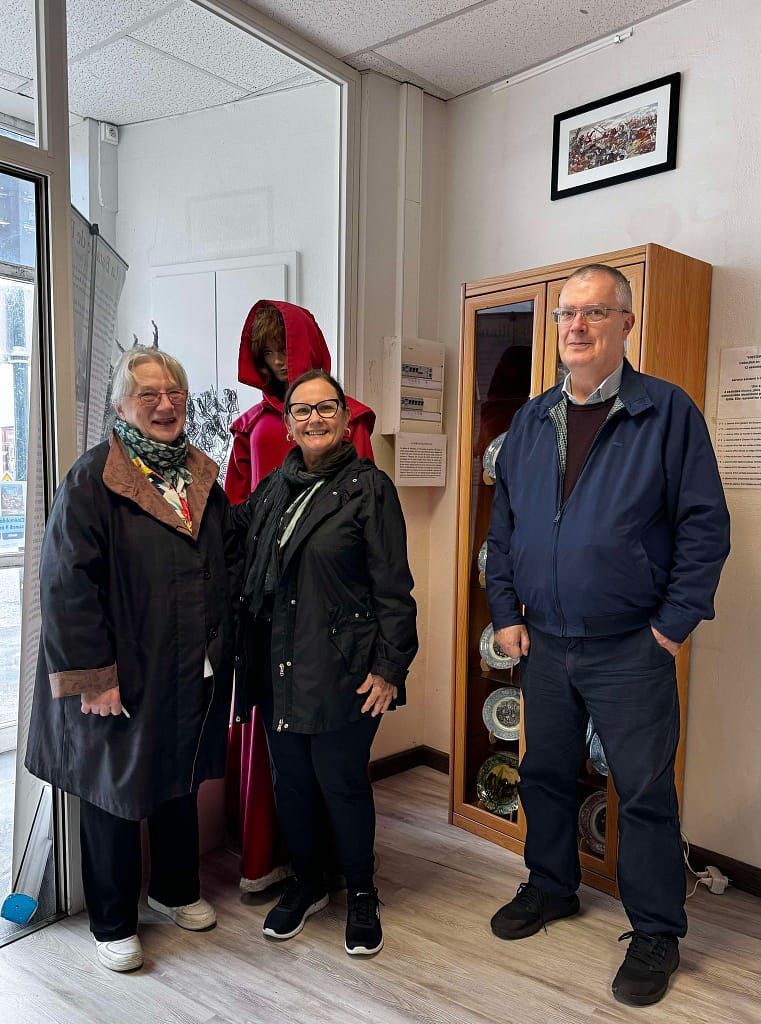
I visited the battlefield of Patay in October 2024, equipped with some excellent secondary sources and my own digital mapping. I was accompanied by Rene and Regina from the Effet de Cerf (The Stag Effect) museum in Patay, and Dr Olivier Bouzy, one of the world’s foremost authorities on Joan of Arc and the Hundred Years War. The Battle of Patay has been far less researched than other Hundred Years War battlefields, but thanks to my companions, there is more being uncovered every year. We walked the battlefield and the associated sites around Patay, gaining an understanding of how the terrain and the newly aggressive spirit of the French forces under their superb combat leaders like Captain La Hire and Jeanne d’Arc, allowed them to win this one-sided victory over the English force.
Judged by results, Patay’s place is with the few supremely great and imposing battles that have been fought since the peoples of the world first resorted to arms for the settlement of their quarrels. So judged, it is even possible that Patay has no peer among that few just mentioned, but stands alone, as the supremest of historic conflicts.
Mark Twain, Personal Recollections of Joan of Arc, 1896
3D fly through of the Loire Campaign and Battle of Patay
Background – the Hundred Years War
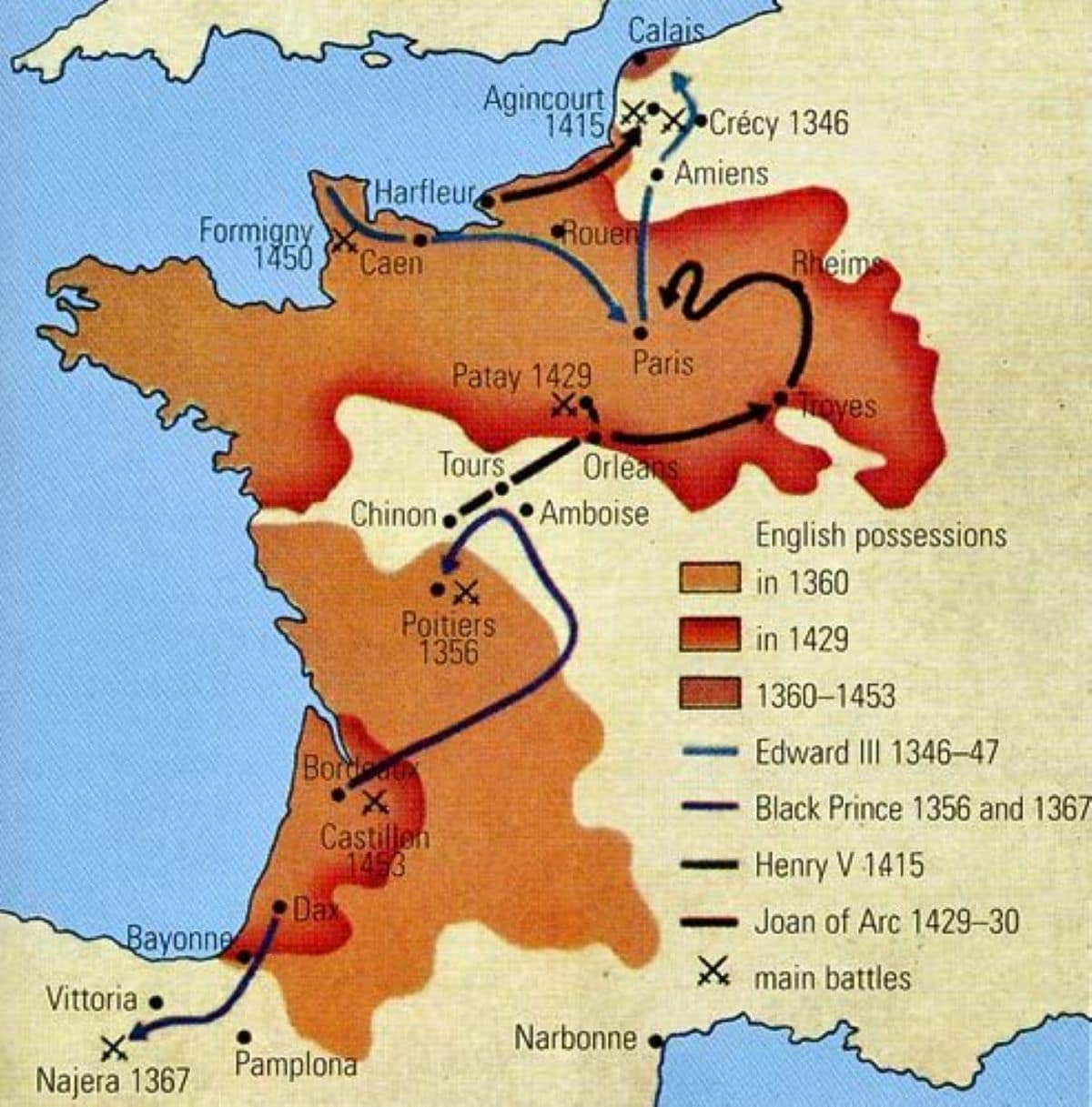
In 1417, two years after his resounding victory at the Battle of Agincourt, Henry V launched an even more ambitious expedition. His goal was to unite the English and French crowns. This was the peak period of violence in the Hundred Years War as the English King, French King, and the Duke of Burgundy competed for influence and possessions.
By 1428, the English controlled most of France north of the Loire River, including most of the major crossing points over the Loire. On 12 October 1428, the English army laid siege to Orléans. The French armies in the field were demoralised after a string of defeats against the English. They also struggled with an ongoing civil war between the Armagnac faction and the Burgundians.
A turning point came in the spring of 1429. Jeanne d’Arc, a peasant girl from the village of Domremy in northeastern France, presented herself to Charles VII in Chinon. She convinced him she was divinely inspired to lead the French army to victory.
Jeanne d’Arc and the Loire Campaign
Whether Jeanne d’Arc was divinely inspired or not doesn’t really matter. The French Armagnac troops believed she was, and the English troops were also superstitious about ‘the Maid’. Napoleon Bonaparte once said that ‘the moral is to the physical as three is to one’, and it was a moral effect that Jeanne had on the demoralised French army.
Jeanne d’Arc did not command the Armagnac forces at any time. Formal military commanders led the troops and made tactical decisions. Through her words and actions, Jeanne inspired the troops with a vision for victory. She forcefully advocated for an aggressive campaign and then argued, cajoled, and convinced the military commanders to follow her lead. At times, through demonstrations of sheer selfless courage, she shamed them into action.
Lifting the siege of Orleans
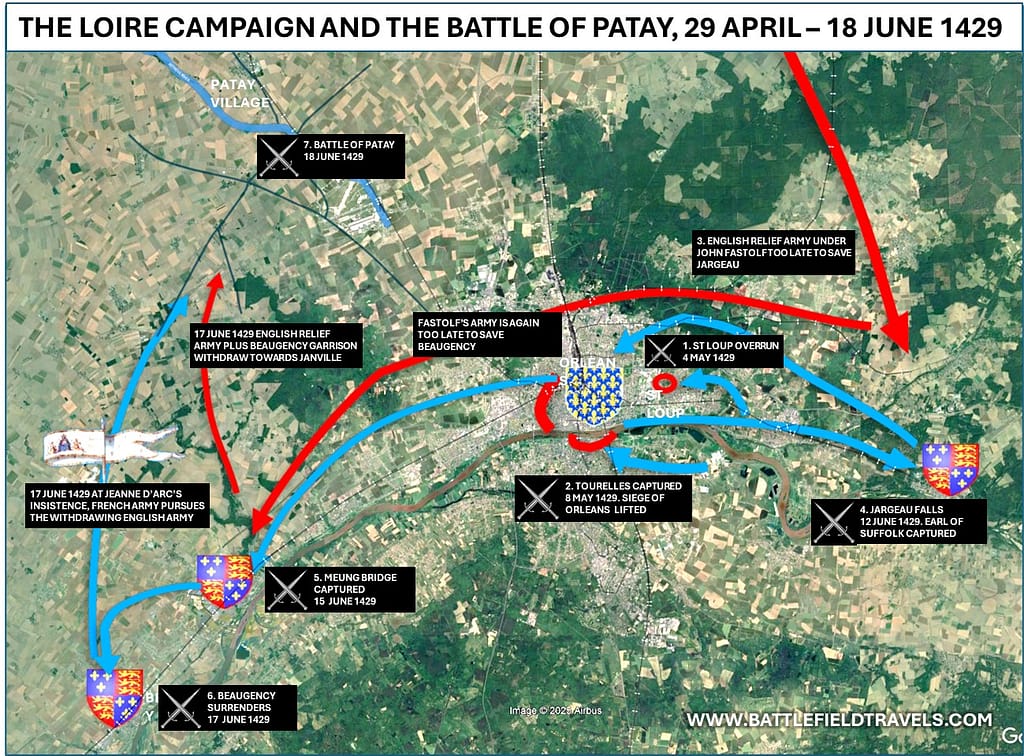
On 4 May 1429, she led the French army to victory over the English outpost at Saint Loup. This was just a few days after her arrival at Orleans. The French army followed this victory by capturing the heavily fortified les Augustins monastery on 6 May. On 7 May 1429, she led a victorious assault on the main English stronghold, the Tourelles fortress. The siege of Orléans was lifted. Inspired by Jeanne, who pushed for an aggressive campaign, the French army then moved rapidly against the other English strongholds along the Loire.
Campaign along the Loire
On 12 June 1429, the French overwhelmed the English-held town of Jargeau. They put the garrison to the sword and took the Earl of Suffolk as a prisoner. Next, in a surprise move, they bypassed the town of Meung-sur-Loire and seized its bridge on 15 June. They then moved rapidly against the English garrison at Beaugency and drove out the English force under John Talbot. Meanwhile, another English force under John Fastolf had departed Paris to reinforce the English garrison at Beaugency. Enroute, they linked up with Talbot’s fleeing garrison. With the Loire River strongholds now irretrievably lost, the English force began to retrace its path back to Paris and safety.
In the seven weeks between Jeanne’s arrival at Orleans on 29 April and the English surrender of Beaugency on 17 June 1429, the war had shifted dramatically in France’s favour. Orleans was relieved, the English strongholds on the Loire were lost, and the senior English commander, the Earl of Suffolk, was a prisoner. Only the remnants of the English field army under John Fastolf and John Talbot remained as a campaign objective.
English withdrawal to Patay
English dispositions at Patay
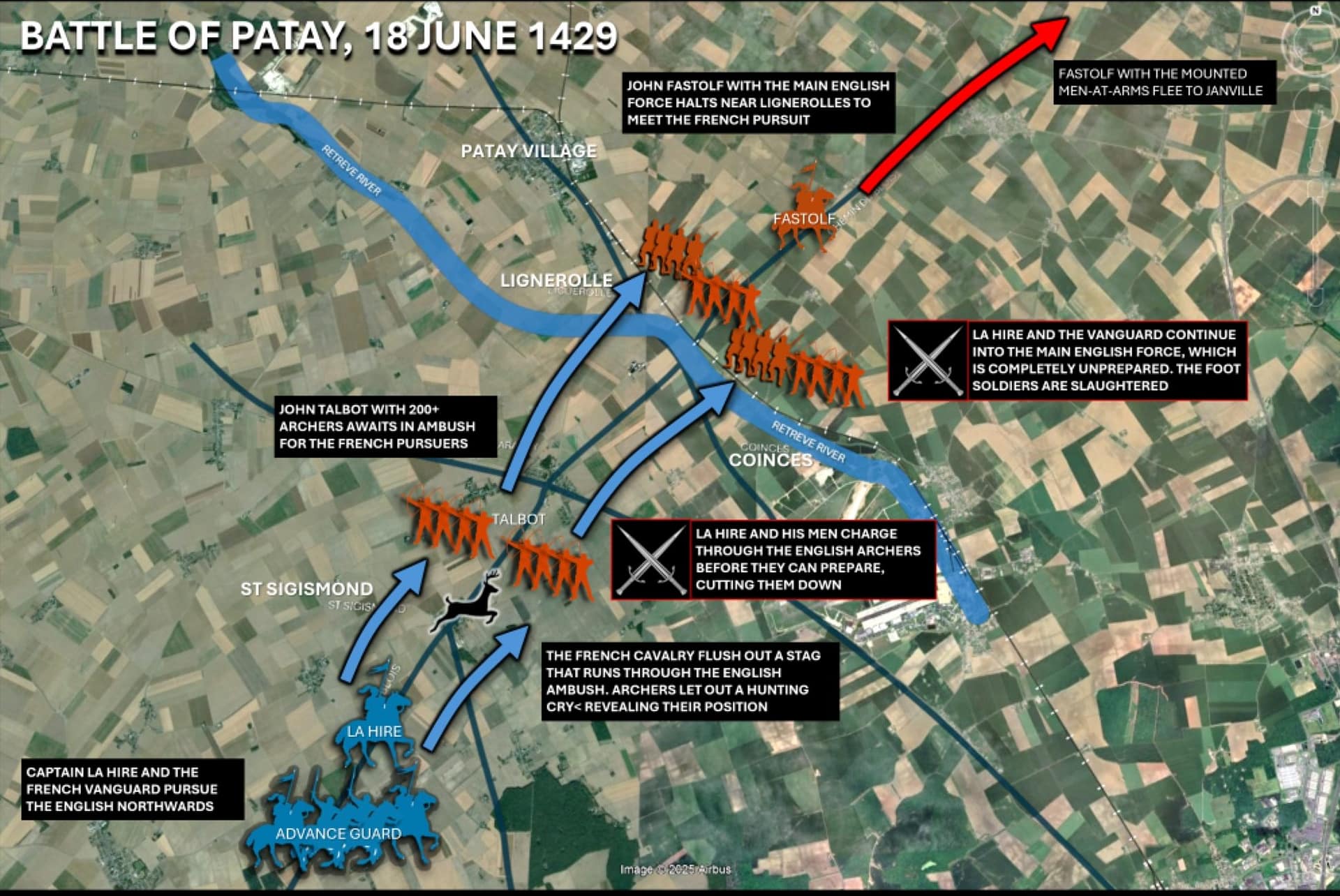
The English leaders knew they could not outrun the pursuing French army. They selected a location for battle on the ‘Chemin de Blois’ near the village of Patay. The ground they chose would force the French to cross the shallow Retrève River and fight uphill towards the English longbowmen, as they had at Crecy and Agincourt. To buy time for the English preparations, John Talbot deployed forward with about 200 archers to ambush the French vanguard.
The English plan was for John Talbot’s force of archers to destroy the French vanguard. This would impose delay and force the French to deploy the main body of their army. The English would then receive any French attack from a fixed position with secure flanks. French cavalry attacks would be disrupted by ‘cheval-de-frise‘; sharpened wooden stakes driven into the ground in front of the archers. Essentially the same tactic they had used so effectively at Crecy, Poitiers and Agincourt.
⚔️ Go deeper — Members get exclusive access to the Deep Research Collection, Field Notes, and monthly Research Dispatches. Try membership free for 7 days, cancel anytime. From $9/month.
French pursuit of the English Army
The French were initially hesitant in their pursuit. For the previous 80 years, the English had been largely unbeatable in open combat. This time, however, Jeanne d’Arc provided the moral imperative. She provoked the French leader, the Duke of Alencon, into action by asking him, “Do you have spurs?” Jeanne exclaimed, “In the name of God, we must fight them… because God has sent us to punish them.” The Duke of Alencon decided to attack.
The French vanguard comprised about 180 mounted men-at-arms, led by Captain La Hire, Poton de Xaintrailles and Marshal de Boussac. These were the very best of the Armagnac army. Chroniclers of the era described this French vanguard as fighting in such tight formation that they could be covered by a single tablecloth. The main body of the French force was led by the Duke of Alençon and Jean Dunois ‘The Bastard of Orléans’. The rearguard was led by Count de Richemont, the Constable of France, and was accompanied by Jeanne d’Arc.
The Battle of Patay, 18 June 1429
English ambush compromised – by a stag!
As the French vanguard approached Patay, it flushed out a stag that ran through the English ambush site. The English archers either shouted a hunting cry or shouted to drive the stag away. Either way, they compromised the ambush. La Hire and his mounted troops immediately charged through the unprepared English archers, cutting them down as they rode through. Lord John Talbot, the legendary English commander, was captured in this assault.
Captain La Hire’s pursuit
Captain La Hire’s vanguard did not stop. They continued through the English archers and into Fastolf’s main English position on the Chemin du Blois. The English position was not prepared for this aggressive action. The archers were not arrayed and the ‘cheval-de-frise‘ was not yet staked against French cavalry action.
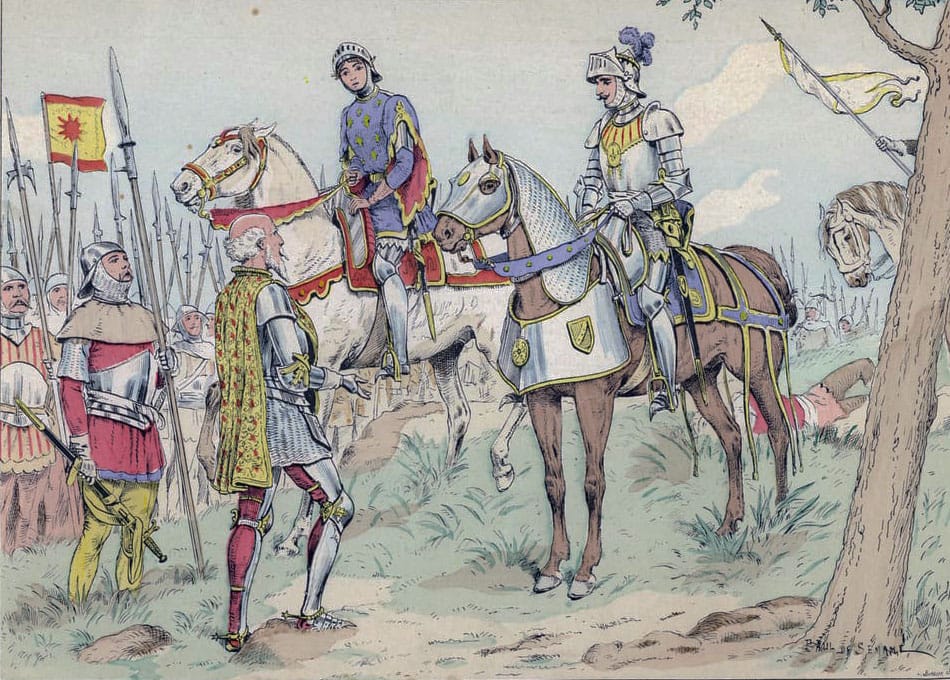
The 180 French cavalry of the vanguard could not defeat an English force of 5,000 troops. They did, however, fix the English force in place until the French mainguard arrived a few minutes later. The unprepared English force was routed and the lightly-armoured archers were slaughtered by the French cavalry – revenge for Agincourt.
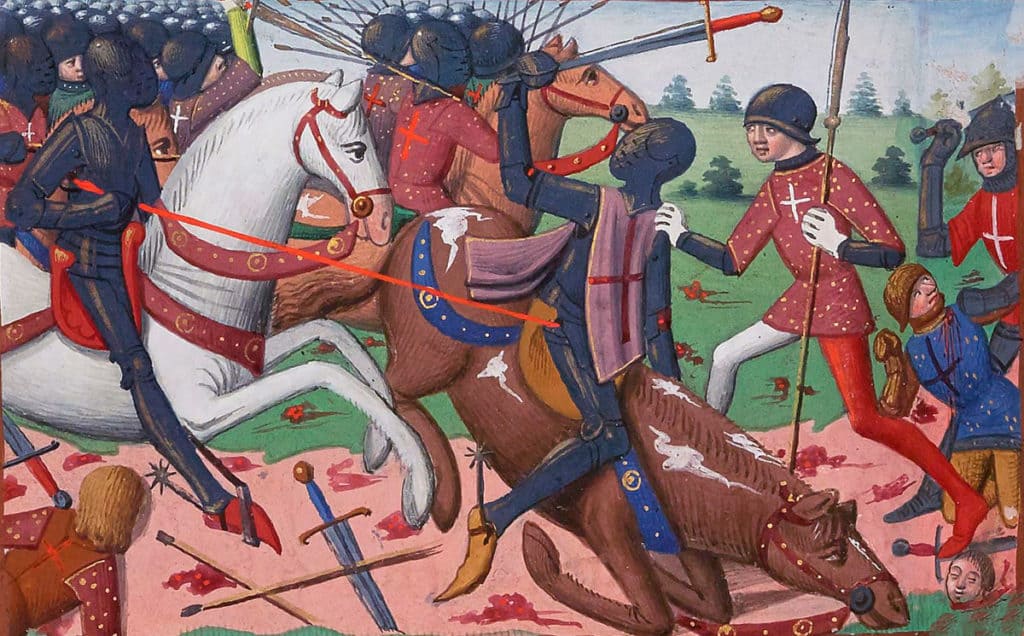
The chronicler Jean de Wavrin, who accompanied John Fastolf, recorded that the main French force struck the English as if from a great height. This observation probably describes the French cavalry cresting the low ridge west of the Retrève River. Fastolf attempted to rally his force but to no avail. When the English soldiers saw him moving rearwards they broke and ran. Most of the English force was either slaughtered or taken prisoner. Chroniclers describe the French mounted men-at-arms scouring the plain hunting down fleeing individuals.
Sir John Fastolf and some of his mounted men-at-arms made it to safety at Janville, but the citizens of Janville closed thier gates and forced the survivors to flee further to Étampes and Melun. Fastolf may well have determined that the battle was lost and that the English foot soldiers could not be saved. John Talbot accused him of cowardice and blamed him for the English defeat. Fastolf’s reputation was severely damaged by the incident and he was stripped of his honours. He was later reinstated after further investigation.
Outcomes of the Battle of Patay
Jeanne d’Arc was held back with the French rearguard during the battle of Patay. However, her presence, and her demands for aggressive action, provided the moral impetus for the one-sided French victory at Patay. After the spectacular successes of the Loire Campaign and the victory at Patay, the French army rode on to Reims. The ride was significant as it crossed previously hostile Burgundian territory. On 17 July 1429, at Reims cathedral, Charles VII was crowned King of France, as Jeanne had predicted.
More than 2,000 English troops, mostly archers, were killed in the battle, and several hundred were captured. By contrast, the French seem to have lost fewer than 100 troops; a decidedly one-sided victory. With the loss of so many senior commanders and so many archers, the English were never again able to raise an offensive army during the Hundred Years war. Over the next 24 years, the English presence in France was gradually beaten down as the Armagnac army reconquered the north.
The battlefield of Patay today
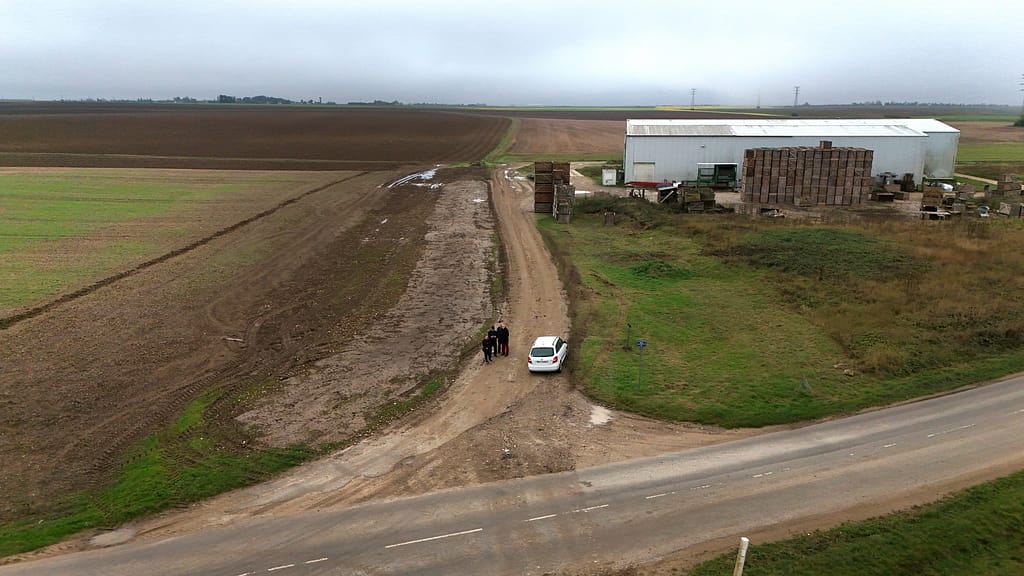
For centuries, there was uncertainty about where the battle actually occurred. However, recent studies of primary sources, archaeological excavations, and terrain studies have now placed the site with reasonable certainty. Studies by Dr Olivier Bouzy have placed the battle at the old Chemin de Blois crossroads, while the site of John Talbot’s compromised ambush is several kilometres to the southwest.
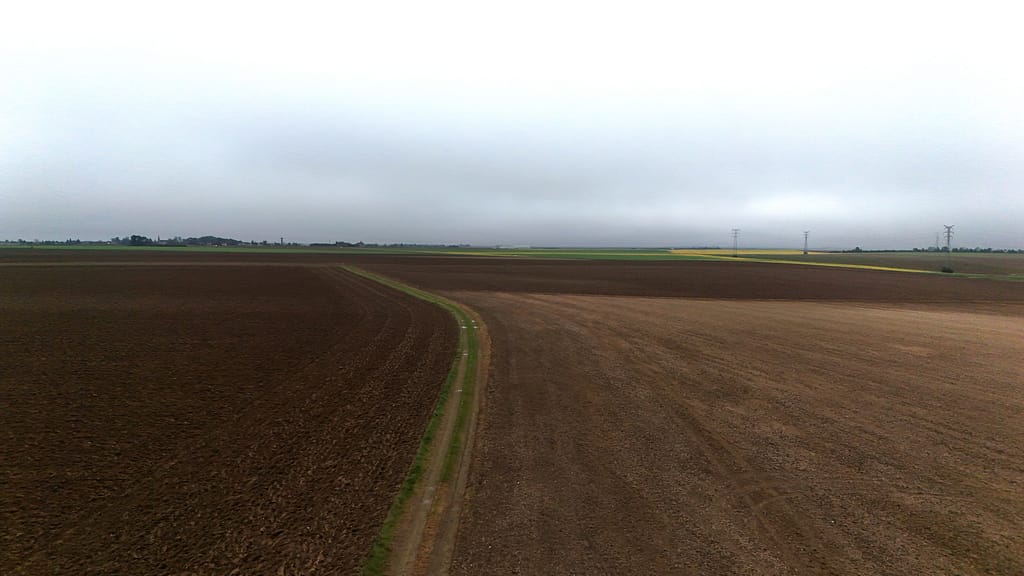
Although the precise location of the battlefield is still being debated, the general area is now settled. Micro-terrain (small scale terrain features that often do not appear on maps and can only be seen when you are standing on the ground) at Patay effected decision-making and combat on both sides. John Talbot attempted to use the concealment and cover provided by forest to anchor the rearguard but the position was exposed and overrun. Likewise, Fastolf sought to create a defensive position on rising ground behind a small river, but this proved to be no obstacle to La Hire’s fast moving cavalry. The concept of exploiting small scale terrain features in battle is examined further in the Micro-Terrain and Battlefield Decision-Making research hub.

Period descriptions versus the actual terrain
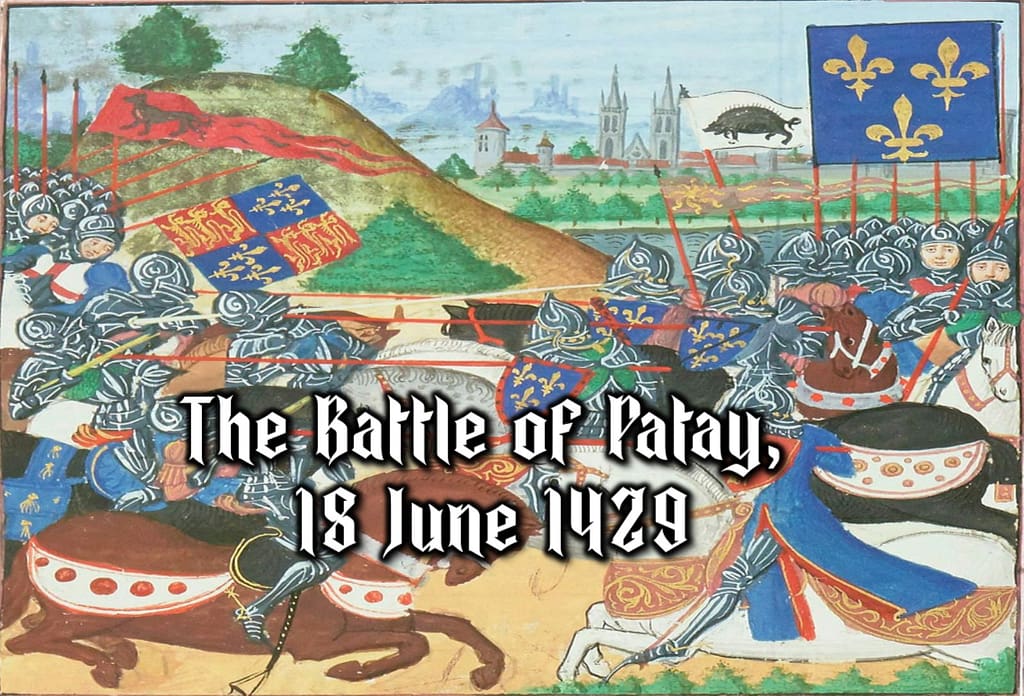
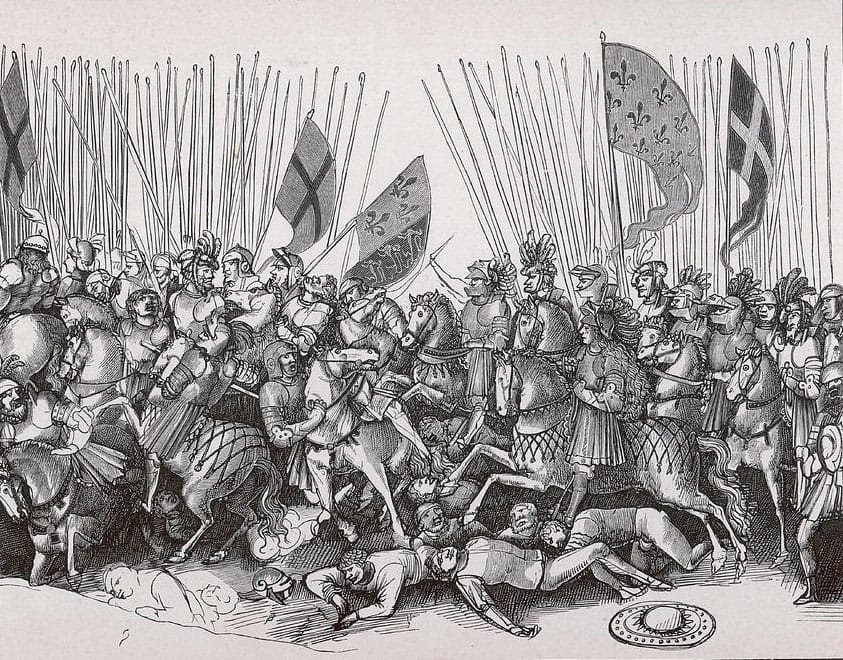
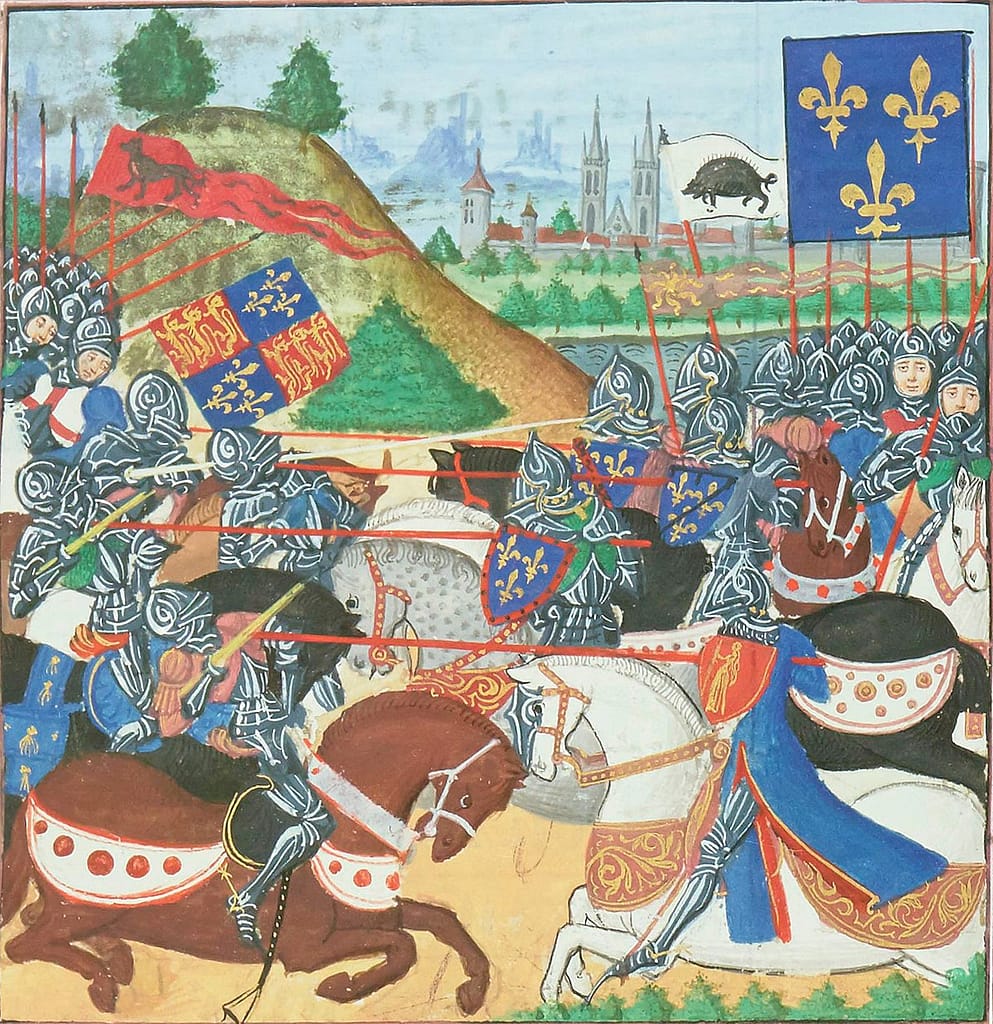
Period artists depict a large conical shaped hill at Patay, based on Jean de Wavrin’s description of the French cavalry descending from height. This is not an accurate depiction of the terrain and is more based on misunderstood second-hand descriptions. The actual terrain is a long, low ridgeline that falls into the Retrève River – now silted over but still flowing during periods of heavy rain.
Monuments
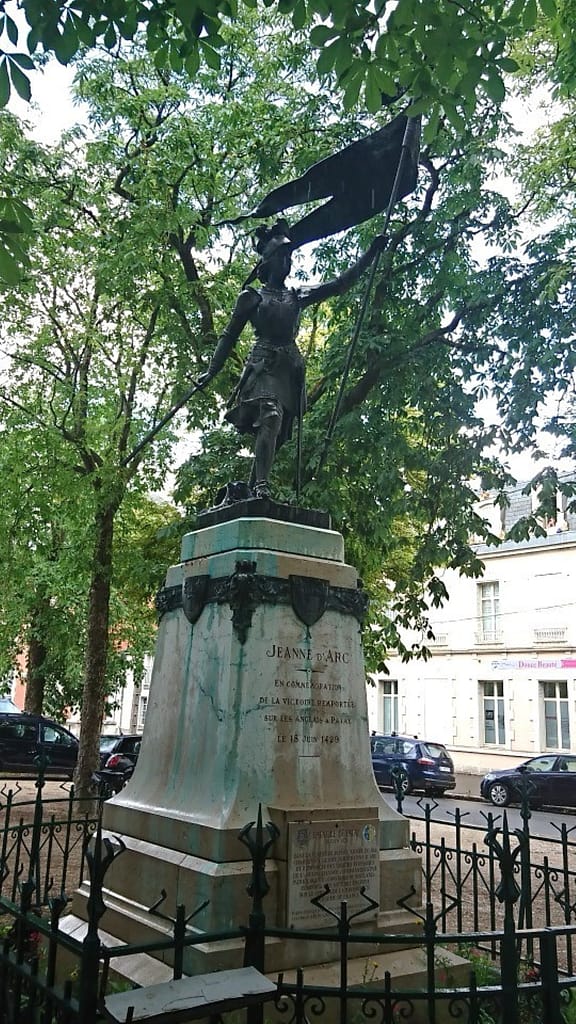
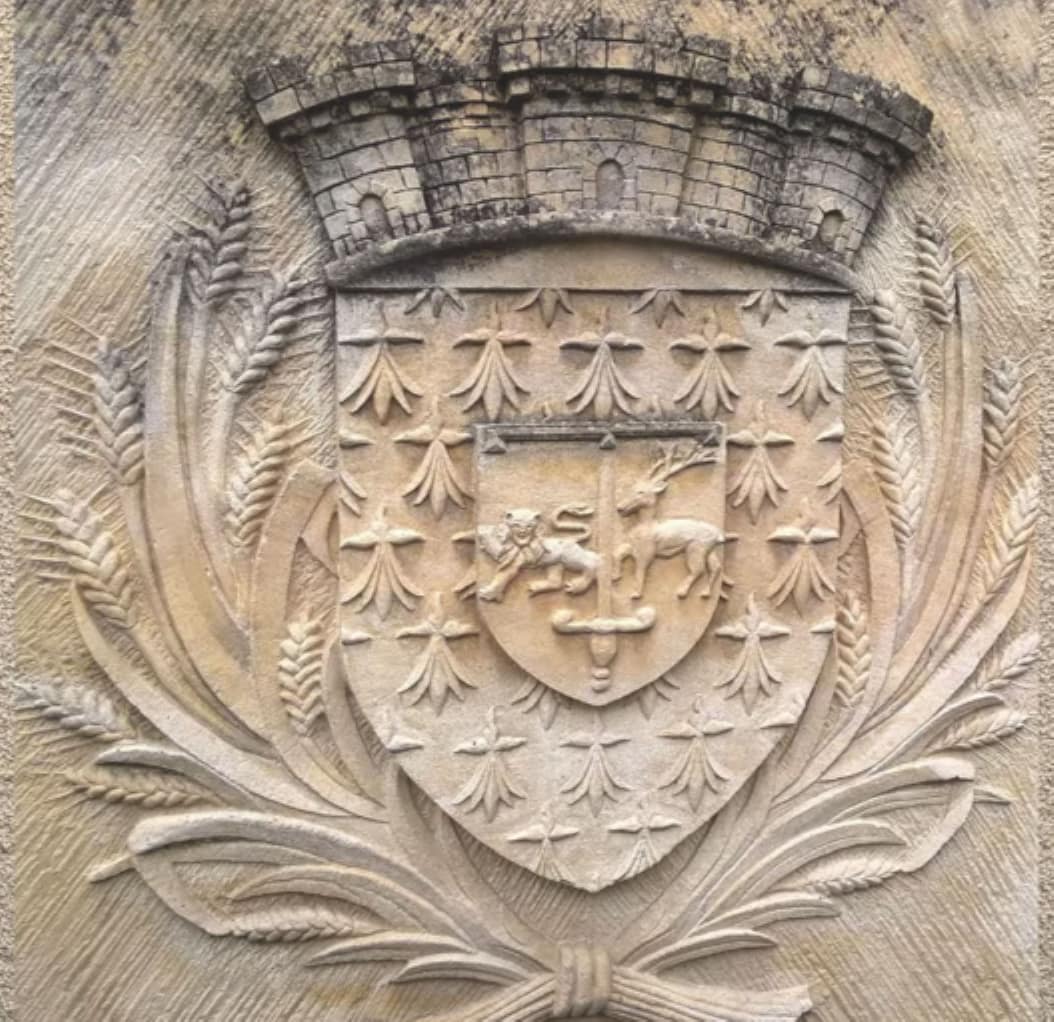
There is a 3.5 metre statue of Jean d’Arc in Patay, and a small museum run by the Association Effet de Cerf. The museum is titled ‘Effet de Cerf’ (The Stag Effect) in honour of the stag that ran through the English lines and compromised the ambush. The symbol of the village of Patay is also a stag. The museum exhibits include many artefacts from the region, and a collection of Battle of Patay and Jeanne d’Arc related literature and artwork. Museum website: https://www.effetdecerf.fr.
The Saint-André church in Patay contains many Battle of Patay and Jeanne d’Arc symbols, including statues and the stained-glass window depiction of Jeanne tending to a dying English soldier. Regina pointed out that any artwork that depicts Jeanne with a saint’s halo is post-1920, the year of Jeanne’s canonisation.
There is also an information board describing the battle on the southern outskirts of Lignerolles, near the old mill. The board provides some useful map orientation of the battle.

Patay symbolism
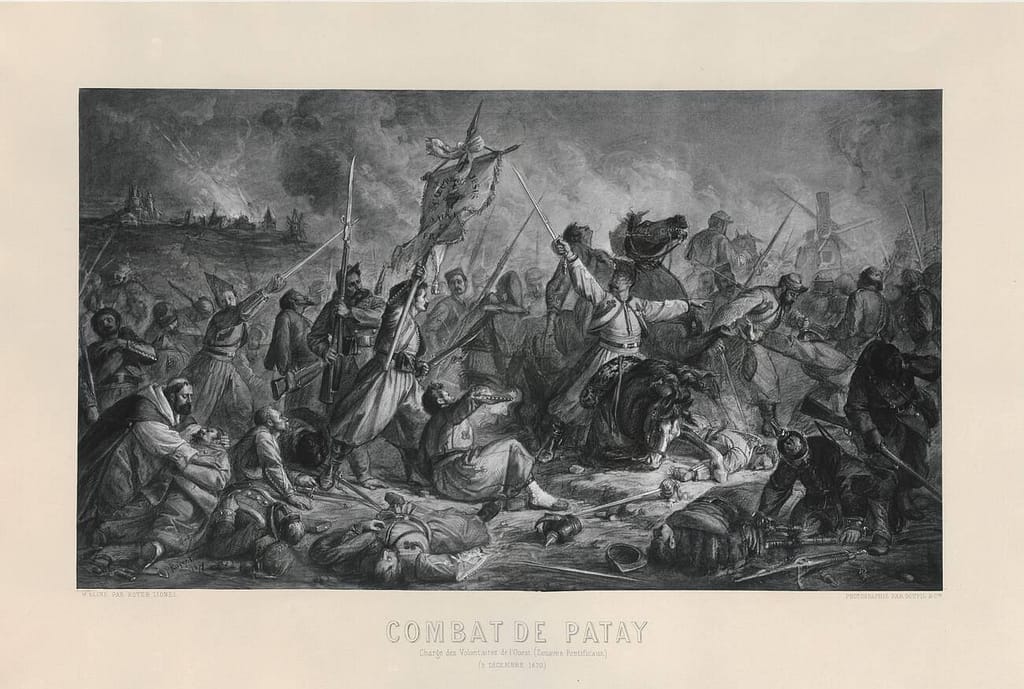
Interestingly, Regina showed me a period woodcut depicting the Franco-Prussian Battle of Loigny, 2 December 1870. The battle took place about 13km northeast of Patay, near Loigny-la-Bataille. The woodcut depicts the Papal Zouaves fighting under a banner very similar to Jeanne d’Arc’s banner, and the woodcut is titled ‘Battle of Patay’. The artist was clearly trying to tap into the patriotism and optimism of the 1429 victory in the dark days of 1870.
Additional images of Patay battlefield
Patay battle site
Panorama view across the main English position at Patay

Looking north along the Retrève RIver in flood – the large white shed is visible in the middle-distance. John Fastolf’s force was arrayed on the slopes to the right and the French attacked across the low ridgeline on the left of the image. Image provided by Regina at Effet de Cerf museum.
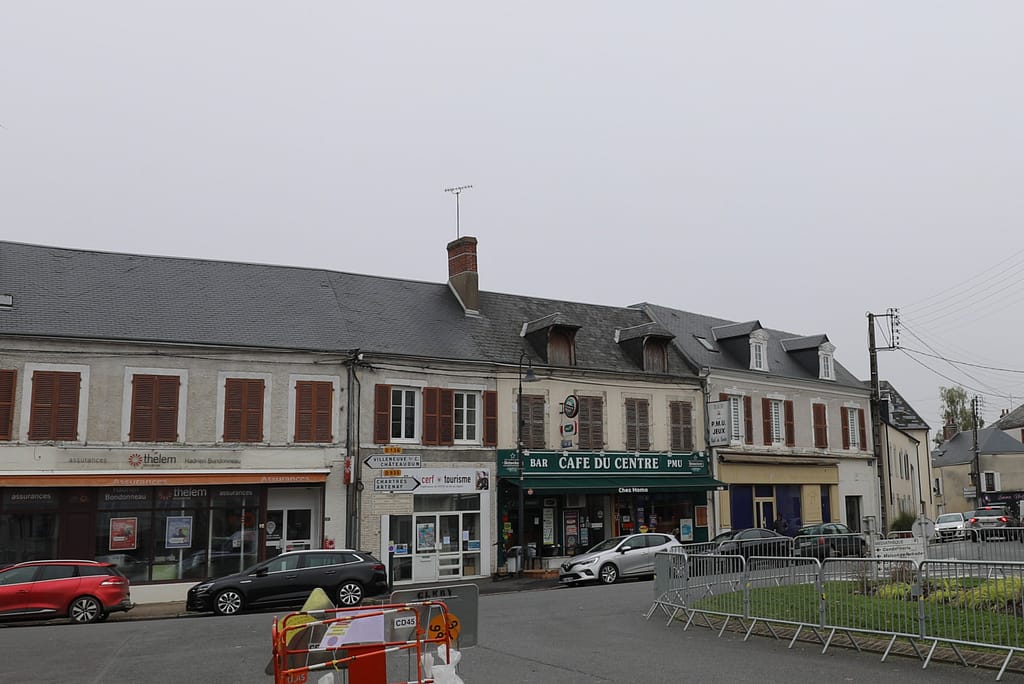
Patay Village

Found this useful? Buy me a coffee — it helps fund future battlefield research


Authored by Mick Prictor, a retired military officer with 40 years’ service, and a military historian specialising in terrain-focused analysis of tactics, doctrine, and command decision-making in land warfare. His work draws on extensive battlefield fieldwork—more than 280 sites worldwide—and one of the world’s largest private collections of historic military arms, uniforms, and equipment. About me
Sources:
- Discussions with Rene and Regina at Effet de Cerf Museum in Patay
- Dr Olivier Bouzy, 1999. Jeanne d’Arc, mythes et réalités (French Edition). Atelier de l’Archer.
- David Nicolle, 2005. Orleans 1429: France Turns the Tide. Praeger.
- Mark Twain 1896, Personal Recollections of Joan of Arc
- Marc Charpy (général), 1990, Patay. Brillant dénouement d’une campagne exemplaire, Connaissance de Jeanne d’Arc, Chinon, no 20,
- David Nicolle, 2000. French Armies of the Hundred Years War : 1328-1429. Osprey Publishing
📚 Further Reading – Hundred Years War
This battle study nests within the broader analytical framework explored in the Research Hub, where operational methods, operating environments, armies, commanders, and weapons are examined across conflicts and eras. The links below connect related studies across the wider body of battlefield analysis on the BattlefieldTravels site.
⚔️ Explore all battle studies from the Hundred Years War
🏛️Explore the Ancient and Medieval warfare weapons and equipment
The book list for this conflict includes the finest campaign studies, memoirs, and operational analyses available on the medieval warfare, selected specifically to complement this battlefield study.
📚Medieval Warfare – Recommended Reading
🗞️ For updates on new battlefield studies and research insights, you can subscribe to the Newsletter.
Related Battle Studies, Museum Pieces & Reading Resources


🧭 Battlefield Travel Guide: Battle of Patay (1429)
Getting There
- Nearest Town: Patay, Loiret, Centre–Val de Loire (≈25 km northwest of Orléans).
- Transport: By car via A10/A71 then D routes toward Patay; rail to Orléans, then regional bus/taxi to Patay.
- Parking: Street parking in Patay town; lay-bys along rural lanes near memorials and viewpoints.
Site Orientation
- Key Landmarks: Memorials in and around Patay; open fields toward Saint-Péravy-la-Colombe marking the clash zone of French vanguard and English archers.
- Walking/Driving Routes: Use the minor D roads radiating from Patay to sample vantage points across the plain; short walks along field edges (respect crops).
- Best Vantage Points: Slight rises south/west of Patay give clear views over the approaches where French cavalry struck the unprepared English line.
Museums & Visitor Centres
- Maison de Jeanne d’Arc (Orléans): Exhibits on Joan of Arc and the Loire campaign following the relief of Orléans.
- Effet de Cerf (The Stag Effect): Small museum and visitor centre in Patay, focussed on Joan of Arc and the Battle of Patay.
- Local Heritage: Patay town information panels and memorials provide brief context on the battle; no dedicated battlefield museum on site.
On-Site Experience
- Interpretive Signage: Limited; bring a sketch map of the French pursuit from Meung/Beaugency to Patay to orient the action.
- Atmosphere: Wide, open grain fields and gentle undulations mirror the terrain that exposed English archers to rapid French cavalry attack.
- Guides & Tours: Orléans-based guides sometimes offer Joan of Arc itineraries linking Orléans, Meung, Beaugency, and Patay; most visitors self-guide by car.
Nearby Points of Interest
- Orléans: Cathedral and Jeanne d’Arc sites tied to the campaign’s opening phase.
- Meung-sur-Loire & Beaugency: Castles and bridges captured by the French in the days before Patay.
- Jargeau: Earlier Loire victory (June 1429) that set the pursuit in motion.
Practical Tips
- When to Visit: Late spring–summer for open crop lines and long light; mornings/late afternoons are best for photography.
- Facilities: Basic amenities in Patay; wider options in Orléans (food, lodging, rail hub).
- Fieldcraft: This is a dispersed field with few markers—use GPS pins and period maps/overlays; stay on public roads/paths and respect private farmland.
FAQ: Battle of Patay (1429)
Fought on 18 June 1429, Patay was a major French victory during the Hundred Years’ War, following Joan of Arc’s success at Orléans.
French forces led by La Hire and Jean Poton de Xaintrailles surprised an English force commanded by Sir John Fastolf.
French cavalry struck before the English could deploy their defensive stakes, overwhelming the longbowmen.
It marked the collapse of English supremacy in open battle, and opened the road to Reims, enabling the coronation of Charles VII.
Yes, there are markers, a memorial, and information panels in the village. The surrounding open fields still reflect the original terrain.
Subscribe to Battlefield Travels and receive a free E-Book Battlefield Guide
Unlock expert battlefield analysis, campaign reconstructions, and historical insights drawn from firsthand exploration and primary sources.
🗺️ You’ll receive:
🎖️ Exclusive historical insights you won’t find elsewhere
📘 A free eBook: 10 Tips for Exploring Historic Battlefields
📰 New battlefield studies straight to your inbox as they are published

⚔️ Go deeper — Members get exclusive access to the Deep Research Collection, Field Notes, and monthly Research Dispatches. Try membership free for 7 days, cancel anytime. From $9/month.