The battle that secured Missouri for the Union!
On 7–8 March 1862, Union and Confederate forces clashed in the Battle of Pea Ridge, Arkansas. The Union victory secured Missouri for the North and marked a decisive moment in the Civil War’s western theatre.

Key facts
Google Earth map – location of the Pea Ridge battlefield
Strategic context: Why Pea Ridge decided control of Missouri
The Battle of Pea Ridge, fought on 7–8 March 1862 in northwestern Arkansas, was the largest Civil War engagement west of the Mississippi River. Its outcome determined whether Missouri — a border state of vital strategic importance — would remain under Union control or fall into Confederate hands.

Missouri in 1861–62
Missouri was deeply divided at the outbreak of war. While a convention voted against secession, Governor Claiborne Jackson and elements of the state militia leaned strongly toward the Confederacy. The early months of the war saw skirmishes across the state, culminating in the Battle of Wilson’s Creek (10 August 1861), where Union Brigadier General Nathaniel Lyon was killed and his outnumbered army forced to retreat. Wilson’s Creek emboldened secessionists, but the Union quickly reinforced Missouri with new regiments, many composed of German immigrants in St. Louis and across the Midwest.
By late 1861, Major General Sterling Price’s Missouri State Guard had been driven into southwestern Missouri, then across the border into Arkansas. To consolidate the Federal position, Brigadier General Samuel R. Curtis assumed command of the newly organised Army of the Southwest, numbering around 10,500 men. Curtis advanced into Arkansas in early 1862, pushing Price further south and establishing a secure foothold.
Confederate response
The Confederate high command recognised that losing Missouri would be a major strategic blow. To restore momentum, they appointed Major General Earl Van Dorn to take charge of Confederate forces west of the Mississippi. Van Dorn, an ambitious and aggressive officer, quickly conceived an offensive: he would march north with about 16,000 men, envelop Curtis, sever his supply lines, and retake Missouri for the Confederacy.
Van Dorn’s army was a composite force: Price’s Missourians, Brigadier General Ben McCulloch’s Arkansas and Texas regiments, and Brigadier General Albert Pike’s brigade of around 1,000 Cherokee and other Native American allies. It was large on paper but plagued by poor supply, divided command structures, and the difficulties of coordinating disparate units.
The road to Pea Ridge
Curtis halted near the Arkansas border, entrenching along Little Sugar Creek, a strong defensive line covering the approaches into Missouri. Van Dorn, unwilling to attack such a position head-on, launched an ambitious wide march through the rugged Ozark hills to strike Curtis from the rear. His men endured freezing weather, inadequate rations, and exhausting forced marches. By the time Van Dorn brought his force into contact, many Confederates were already worn down.
The stage was thus set for a decisive confrontation. The Union army, smaller but well-positioned, aimed to protect Missouri at all costs. The Confederates, larger but weary and divided, sought a bold manoeuvre that, if successful, might shift the balance of the entire Trans-Mississippi theatre.
Opposing forces: Curtis’ Union Army vs Van Dorn’s Confederates
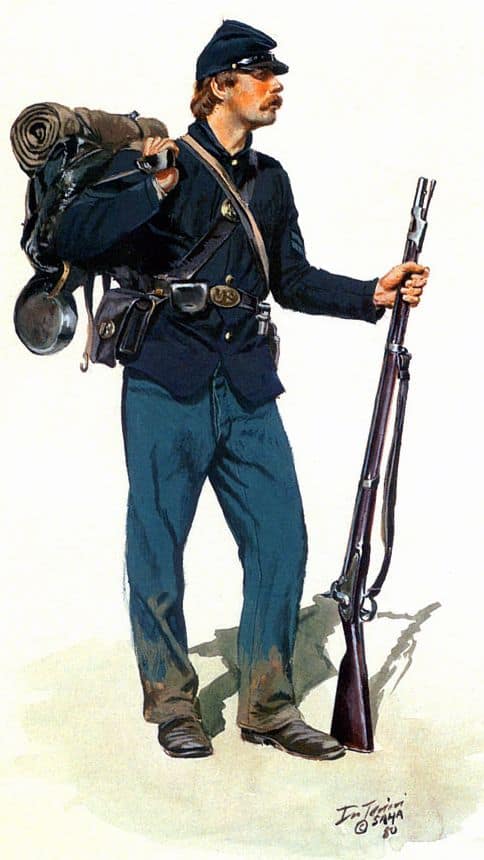
 The Union Army of the Southwest
 The Union Army of the Southwest
Brigadier General Samuel R. Curtis commanded the Army of the Southwest, numbering about 10,500 effectives. The force was divided into four divisions:
- 1st and 2nd Divisions: under Colonel Franz Sigel, a German-born officer and veteran of the 1848 revolutions. His divisions contained many German-American volunteers from Missouri, Illinois, and Ohio — men who fought with determination to prove their loyalty to their adopted country.
- 3rd Division: under Colonel Jefferson C. Davis (no relation to the Confederate president), composed of Midwestern regiments from Indiana, Illinois, and Missouri.
- 4th Division: under Colonel Eugene Carr, largely drawn from Iowa and Illinois units.
Curtis’ army also included a strong artillery contingent: about 50 guns, including batteries of 6- and 12-pounder field pieces. These were well-served and would prove decisive. The men were seasoned by months of campaigning, relatively well supplied, and entrenched along Little Sugar Creek before Van Dorn’s march.
 The Confederate Army of the West
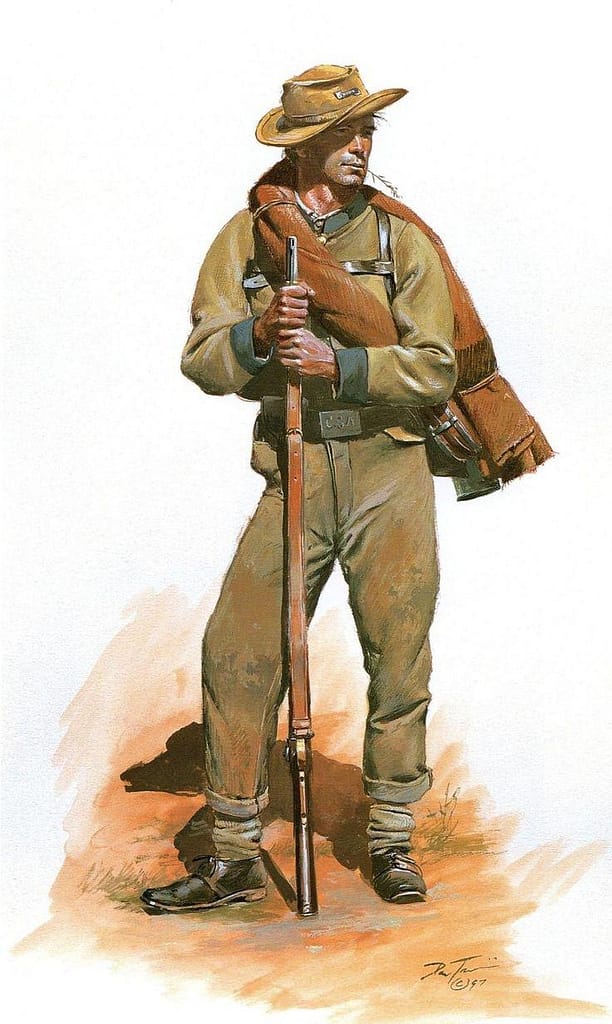
 The Confederate Army of the West
Major General Earl Van Dorn assembled a larger but less cohesive force of about 16,000 men. His army combined three distinct commands:
- Missouri State Guard: under Major General Sterling Price, roughly 7,000 men. Many were veterans of Wilson’s Creek, but their equipment was mixed and discipline uneven.
- McCulloch’s Division: about 8,000 men, including Arkansas, Texas, and Louisiana regiments, commanded by Brigadier General Ben McCulloch, a Mexican War veteran. Brigadier General James McIntosh led the cavalry.
- Native American Brigade: about 1,000 Cherokee, Creek, and Choctaw warriors under Brigadier General Albert Pike. This contingent was the only large-scale Native force to fight in a major Civil War battle.
On paper, Van Dorn’s force outnumbered Curtis almost 3-to-2. But coordination was poor: Price and McCulloch distrusted each other, their troops were camped separately, and supply shortages plagued the entire force. Van Dorn pushed his men hard, leaving supply wagons behind during the long march to Pea Ridge — a decision that would cripple the army once the fighting began.
Day One (7 March 1862) – Confederate assault
The Confederate flanking march
Van Dorn’s ambitious plan began badly. Instead of striking Curtis frontally along Little Sugar Creek, he attempted a wide night march through the rugged Ozark Plateau, intending to fall on the Union rear. The march was long, exhausting, and disorganised. Confederate supply wagons lagged behind, leaving troops short of rations and ammunition. By dawn on 7 March, Van Dorn’s army was strung out on the roads north of the Union positions, weary before the battle even began.
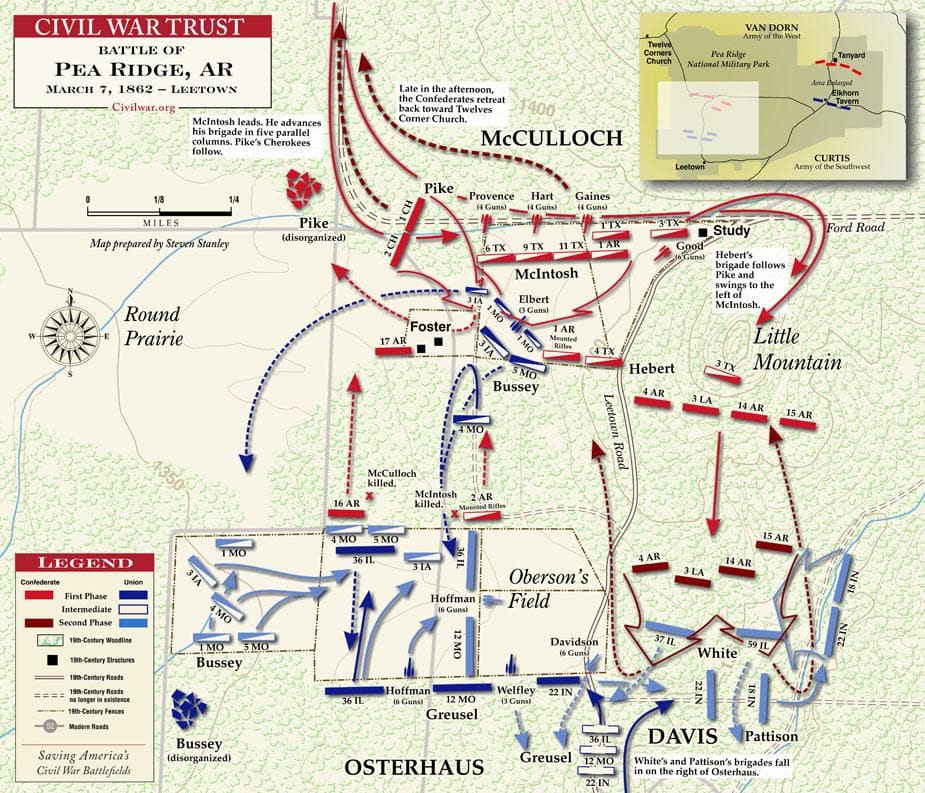
Van Dorn then split his force: Sterling Price’s Missourians moved east to assault Union positions at Elkhorn Tavern, while Ben McCulloch’s division advanced west toward Leetown to envelop Curtis’ left. It was a bold plan — but one that relied on coordination between commands that seldom trusted each other.

Day One (7 March): McCulloch’s assault at Leetown
At Leetown, McCulloch’s Confederates pushed against Union skirmishers. The fighting quickly intensified in the wooded terrain. Confederate cavalry under Brig. Gen. James McIntosh attempted bold charges, initially driving back Union outposts. But Union artillery and reinforcing infantry stiffened the line.
In the confusion of battle, McCulloch rode forward to reconnoitre. He was shot dead by a Union sharpshooter. Within minutes, McIntosh, attempting to restore momentum with another mounted attack, was also killed. Their near-simultaneous deaths left Confederate units at Leetown leaderless and disorganised. Command devolved to Colonel Hébert, who was soon captured. Without direction, the assault faltered. By mid-afternoon, Union counterattacks drove the disjointed Confederate brigades back in disorder. The western prong of Van Dorn’s offensive had collapsed.
Day One (7 March): Price’s assault at Elkhorn Tavern
Meanwhile, on the opposite flank, Sterling Price pressed his Missourians and Arkansas troops against Union defenders near Elkhorn Tavern, a key road junction. The ground was broken and wooded, and the fighting was fierce and confused. Confederate troops launched repeated assaults, forcing Union lines back toward the tavern itself.

Some accounts describe hand-to-hand combat in the thickets, with bayonets and musket butts used in desperate fighting. Union Colonel Eugene Carr’s division bore the brunt of the attack, stubbornly holding despite heavy losses. Reinforcements from other Union divisions trickled in, stabilising the line as night fell. By evening, Price’s troops had gained ground and held the field near the tavern, but their attacks had stalled. Ammunition was running low, and with Van Dorn’s supply wagons far to the rear, resupply was impossible.

Day Two (8 March 1862) – Union counterattack
Curtis’ counterattack
Overnight, Curtis regrouped his scattered divisions. At dawn on 8 March, he concentrated his artillery — more than 50 guns — on the high ground facing Elkhorn Tavern. The Union barrage opened with devastating effect, shaking Confederate formations already weakened by hunger and fatigue.

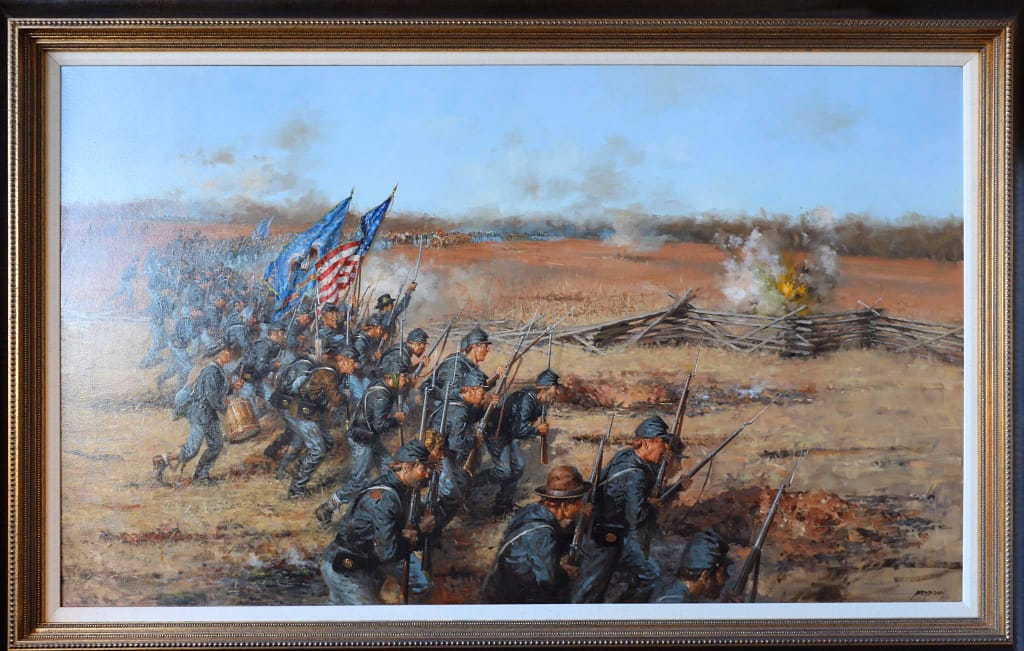
Once the barrage had softened the enemy, Curtis ordered a general advance by the entire Union army. Union infantry surged forward in coordinated lines, supported by artillery firing over their heads. Price’s exhausted troops resisted as best they could, but with ammunition nearly gone, many fell back under the relentless pressure. Van Dorn attempted to rally his men, but by mid-morning it was clear the Confederate position was untenable.
The Confederate retreat
Van Dorn ordered a withdrawal southward. The retreat was chaotic: men abandoned weapons, units disintegrated, and the army streamed back through the mountains. Union cavalry harried the withdrawal but could not cut it off entirely. Within hours, the Confederate offensive was in full collapse.
Pea Ridge was over. In two days of hard fighting, the Union Army of the Southwest had not only survived a larger Confederate force but had driven it from the field, securing Missouri for the Union cause.
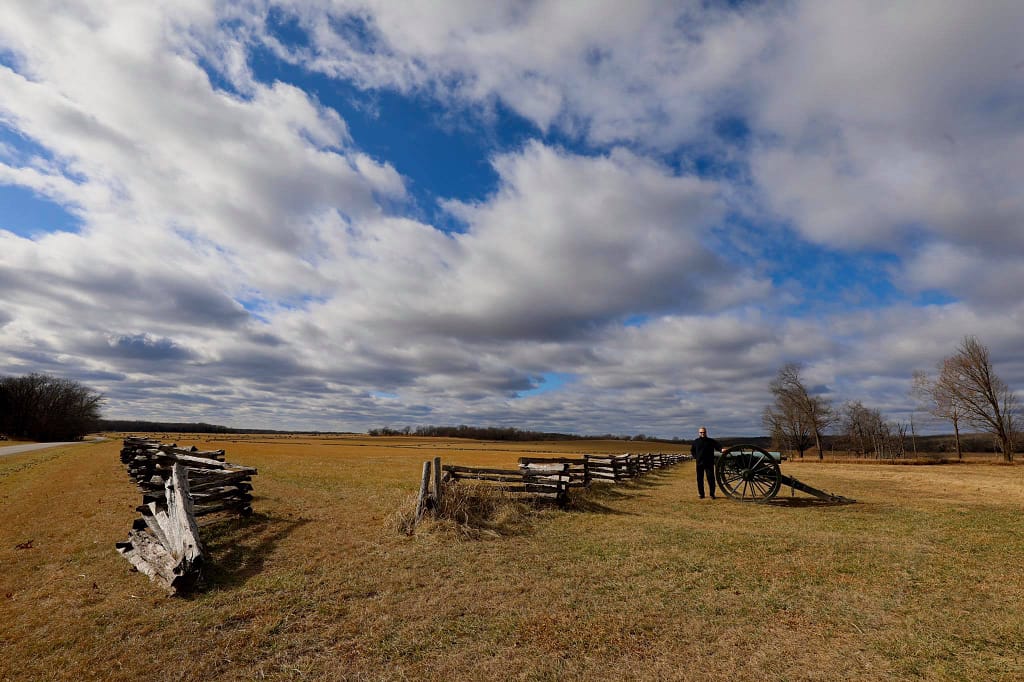
Outcomes: casualties, consequences, and the Union’s grip on Missouri
Casualties and losses
The fighting at Pea Ridge was among the bloodiest west of the Mississippi to that point in the war.
- Union casualties: approximately 1,384 (203 killed, 980 wounded, 201 missing).
- Confederate casualties: estimated at about 2,000 (300 killed, 1,000 wounded, 700 missing).
These losses represented nearly one-fifth of Curtis’ smaller army and more than a tenth of Van Dorn’s larger force. The disproportionate Confederate losses reflected the collapse of McCulloch’s division after its leaders were killed and the exhaustion of Price’s men under Curtis’ artillery barrage.
⚔️ Go deeper — Members get exclusive access to the Deep Research Collection, Field Notes, and monthly Research Dispatches. Try membership free for 7 days, cancel anytime. From $9/month.
Leadership and command
The sudden deaths of Confederate Generals Ben McCulloch and James McIntosh on 7 March were devastating blows to Confederate command cohesion. Without experienced leadership on the Leetown front, their troops became directionless and vulnerable to counterattack. Colonel Hébert’s capture only deepened the confusion. By contrast, Curtis and his subordinates maintained steady coordination, with Franz Sigel and Eugene Carr both playing decisive roles in holding the line and regrouping for the counterattack.
Logistics and operational lessons
Van Dorn’s decision to leave his supply trains behind during the rapid march into northwest Arkansas proved disastrous. His troops entered the battle already fatigued, short of food, and low on ammunition. By the second day, many Confederate soldiers were unable to sustain fire, rendering them helpless against Curtis’ concentrated artillery and infantry assault. The engagement demonstrated that bold manoeuvre could not substitute for logistics — a lesson repeatedly reinforced throughout the war.
Strategic consequences
The Union victory at Pea Ridge secured Missouri for the remainder of the Civil War. Confederate hopes of reclaiming the state collapsed with the defeat. Van Dorn was forced to withdraw his battered army across the Mississippi to reinforce the Confederate eastern theatre, leaving the Trans-Mississippi region thinly defended.
The battle also curtailed Confederate influence among Native American allies. Although Brig. Gen. Albert Pike’s Cherokee and other Native troops fought at Pea Ridge, reports of atrocities against Union dead — and the subsequent Confederate retreat — undermined their role in the wider conflict.
Political impact
Pea Ridge boosted Union morale in the West, demonstrating that Federal forces could decisively defeat larger Confederate armies. It reassured Washington that Missouri, with its key rivers and resources, would remain in Union hands. For the Confederacy, the defeat underscored the difficulty of sustaining major operations west of the Mississippi, where resources, infrastructure, and reinforcements were scarce.
The Battlefield Today: Visiting Pea Ridge National Military Park
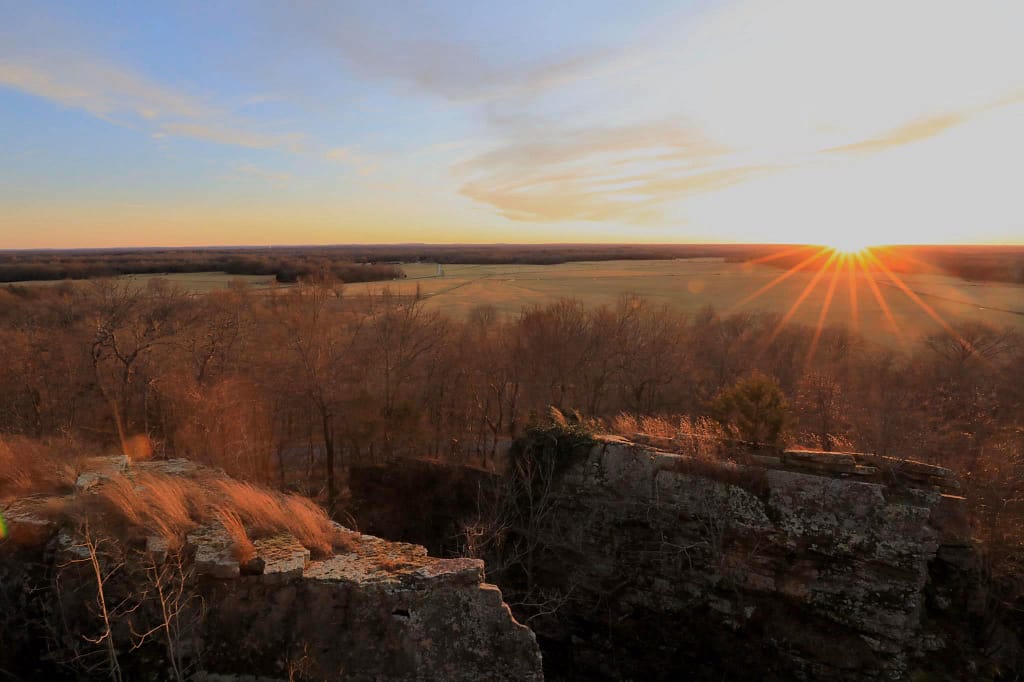
The Pea Ridge National Military Park, established in 1956, preserves over 4,300 acres of battlefield ground — making it one of the most intact Civil War sites in the United States. Unlike many eastern battlefields, Pea Ridge has escaped urban encroachment. The open ridges, wooded areas, and treelines remain much as they were in 1862, allowing visitors to visualise the battle with remarkable clarity.
Key sites to explore
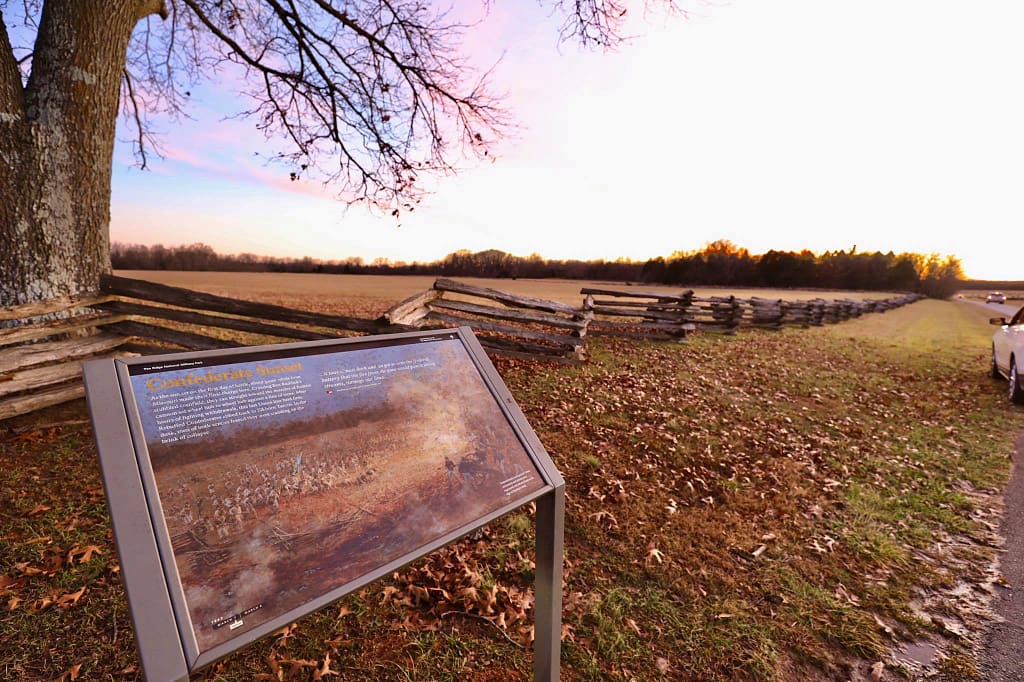
- Elkhorn Tavern: the focal point of fighting on 7–8 March, reconstructed and preserved. Interpretation panels and ranger talks explain the chaotic assaults and Union counterattack.
- Leetown: site of McCulloch’s failed attack and the deaths of both McCulloch and McIntosh. Trails and signage allow visitors to walk the ground where their division collapsed.
- Federal Artillery Positions: commanding ridges where Curtis massed over 50 guns for his decisive bombardment on 8 March.
Visitor Centre and interpretation
The visitor centre contains exhibits, maps, and artefacts from the campaign. Rangers offer guided talks and living history programs, especially during the battle anniversary in early March. The seven-mile tour road connects major battle sites with pull-offs, trails, and wayside exhibits.
Link to the National Park Service Battle of Pea Ridge visitor center website

Preservation of the battlefield
The park has gone to great lengths to maintain the landscape as it was in 1862. Treelines are preserved in their historic positions, and the rolling ridges and woodlots still frame the battlefield exactly as Union and Confederate soldiers would have seen them. Walking the ground provides a sense of isolation and clarity that many better-known battlefields have lost.
Modern connections
Pea Ridge lies about 22 km northwest of Bentonville, Arkansas, just off U.S. Route 62. Bentonville today is home to Walmart’s corporate headquarters, a striking reminder of how this once-rural corner of the Ozarks has become a hub of global commerce and technology. The juxtaposition of Bentonville’s modern corporate world with the preserved battlefield at Pea Ridge highlights both continuity and transformation in the American landscape.
Additional images: Leetown area

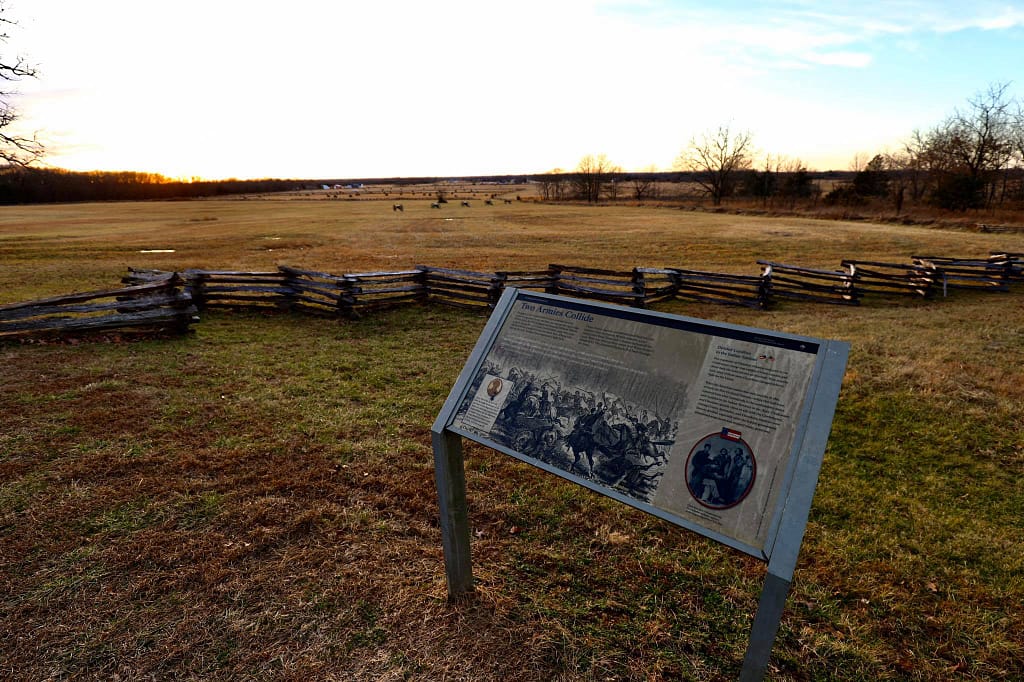


Additional images: Elkhorn Tavern area


Additional images: 8 March 1862, Union counterattack

Found this useful? Buy me a coffee — it helps fund future battlefield research


Authored by Mick Prictor, a retired military officer with 40 years’ service, and a military historian specialising in terrain-focused analysis of tactics, doctrine, and command decision-making in land warfare. His work draws on extensive battlefield fieldwork—more than 280 sites worldwide—and one of the world’s largest private collections of historic military arms, uniforms, and equipment. About me
Sources
Primary Sources
- Official Records of the War of the Rebellion, Series I, Vol. VIII (reports of Curtis, Van Dorn, Sigel, and Price).
- Memoirs of Union officers in the Army of the Southwest.
- Confederate reports from the Missouri State Guard and Cherokee regiments.
Secondary Sources
- William L. Shea & Earl J. Hess, Pea Ridge: Civil War Campaign in the West (1992).
- Edwin C. Bearss, The Battle of Pea Ridge (1964).
- William Garrett Piston & Richard W. Hatcher, Wilson’s Creek: The Second Battle of the Civil War (2000) — for campaign context.
- NPS Pea Ridge National Military Park guides and interpretive material.
📚 Further Reading – American Civil War
This battle study nests within the broader analytical framework explored in the Research Hub, where operational methods, operating environments, armies, commanders, and weapons are examined across conflicts and eras. The links below connect related studies across the wider body of battlefield analysis on the BattlefieldTravels site.
⚔️ Explore all battle studies from the American Civil War
🏛️ Explore the museum of American Civil War historic weapons and equipment
The book list for this conflict includes the leading campaign studies, memoirs, and operational analyses available on the American Civil War, selected specifically to complement this battlefield study.
📚American Civil War (1861-65) – Recommended Reading
🗞️ For updates on new battlefield studies and research insights, you can subscribe to the Newsletter.
Related Battle Studies, Museum Pieces & Reading Resources
 ⚔️ Battle of Franklin, Tennessee,
30 November 1864
 🏛️ American Civil War (1861–1865) Weapons and Equipment
 ⚔️ Battle of Chancellorsville, Virginia,
27 April – 6 May 1863
 ⚔️ Battle of Wilsons Creek, Missouri,
10 August 1861
 ⚔️ 1861–1865 American Civil War, Battle Studies
 📚 American Civil War (1861–1865),
Recommended Reading
🧭 Battlefield Travel Guide: Pea Ridge (7–8 March 1862)
Getting There
- Nearest Towns: Pea Ridge and Rogers, Arkansas; Bentonville lies 22 km to the southwest.
- Access: Battlefield entrance on US Route 62; about 30 minutes drive from I-49 (Fayetteville to Joplin corridor).
- Parking: Free parking at the visitor centre and major stops along the 7-mile tour road.
Site Orientation
- Key Landmarks: Elkhorn Tavern, Leetown, and Federal artillery ridge positions.
- Best Vantage Points: High ground artillery sites for perspective on the Union counterattack; Elkhorn Tavern yard for understanding Confederate assaults.
- Walking Routes: Short trails at Leetown and Elkhorn Tavern; additional loops connect skirmish sites and gun positions.
Museums & Visitor Centres
- On-site: Pea Ridge Visitor Center — exhibits, maps, and artefacts; interpretive films and ranger-led talks.
- Nearby: Museum of Native American History (Bentonville) and Crystal Bridges Museum of American Art for broader cultural context.
On-Site Experience
- Interpretive Signage: Panels at all major stops explain troop movements and battle phases.
- Atmosphere: Battlefield landscape preserved with historic treelines; open ridges and woodlots retain their 1862 appearance.
Nearby Points of Interest
- Related Sites: Wilson’s Creek National Battlefield (Missouri, 1861); Prairie Grove Battlefield State Park (Arkansas, 1862).
- Local: Bentonville (Walmart Museum and HQ); Rogers Civil War historical markers.
Practical Tips
- When to Visit: Spring and autumn for best hiking conditions; anniversary events in early March include reenactments and talks.
- Facilities: Visitor centre with restrooms, bookshop, and picnic areas; driving tour road suitable for cars and bicycles.
- Notes: Battlefield is exposed — bring sun and weather protection; plan 4-5 hours for full tour road and trails.
Subscribe to Battlefield Travels and receive a free E-Book Battlefield Guide
Unlock expert battlefield analysis, campaign reconstructions, and historical insights drawn from firsthand exploration and primary sources.
🗺️ You’ll receive:
🎖️ Exclusive historical insights you won’t find elsewhere
📘 A free eBook: 10 Tips for Exploring Historic Battlefields
📰 New battlefield studies straight to your inbox as they are published

⚔️ Go deeper — Members get exclusive access to the Deep Research Collection, Field Notes, and monthly Research Dispatches. Try membership free for 7 days, cancel anytime. From $9/month.
