The first Viet Minh attack on a fortified French outpost!
The Battle of Phủ Tông Hoá was a small but significant milestone in the French Indochina War. For the French Foreign Legion, it was yet another heroic but costly defence of an isolated outpost against overwhelming odds. The battle entered Legion folklore alongside legendary stands like Camerone and Bir Hakeim. Although the Legion retained control of the post, it was abandoned a few months later as part of a broader strategic withdrawal.
For the Viet Minh, however, Phủ Tông Hoá held even greater significance. It marked the first time they had attempted a coordinated assault on a fortified French position.

Key facts
Google Earth map – location of Phu Tong Hoa
Table of Contents
- Strategic Context: the Indochina War and the road to Phủ Tông Hoá
- Opposing Forces: Foreign Legion vs Viet Minh
- 🔒Prelude to the Battle of Phủ Tông Hoá
- 🔒Viet Minh battle plan
- 🔒25 July 1948, 1930hrs – Opening barrage
- 🔒25 July 1948, attack on Phủ Tông Hoá fort
- 🔒26 July 1948 – clearance of the battlefield
- 🔒27 July 1948 – evacuation of the wounded
- 🔒28 July 1948 – The relief column arrives!
- 🔒Outcomes: a successful French defence and vital experience for the Viet Minh
- 🔒The battlefield today: exploring Phủ Tông Hoá
- 🔒Walking the ground at Phủ Tông Hoá
- 🔒Sources & Further Reading
- 📚 Further Reading
- Le Boudin, march song of the Legion!
- 🧭 Battlefield Travel Guide: Phủ Tông Hoá
- FAQ: Battle of Phu Tong Hoa (July 1948)
Strategic Context: the Indochina War and the road to Phủ Tông Hoá
Outbreak of hostilities
Following the defeat of Japan in 1945, and the subsequent declaration of independence by the Viet Minh, the French sought to reestablish their colonial presence in Indochina. However, shifting popular sentiment, sparse infrastructure, mountainous terrain, and chronic under-resourcing made their task challenging. Seething tensions between the returning French colonial powers and the Viet Minh led to an outbreak of hostilities on 19 December 1946. The fighting was mostly guerilla attacks against French convoys and small outposts, but the Viet Minh lacked the experience, training and equipment to take on larger fortified posts.
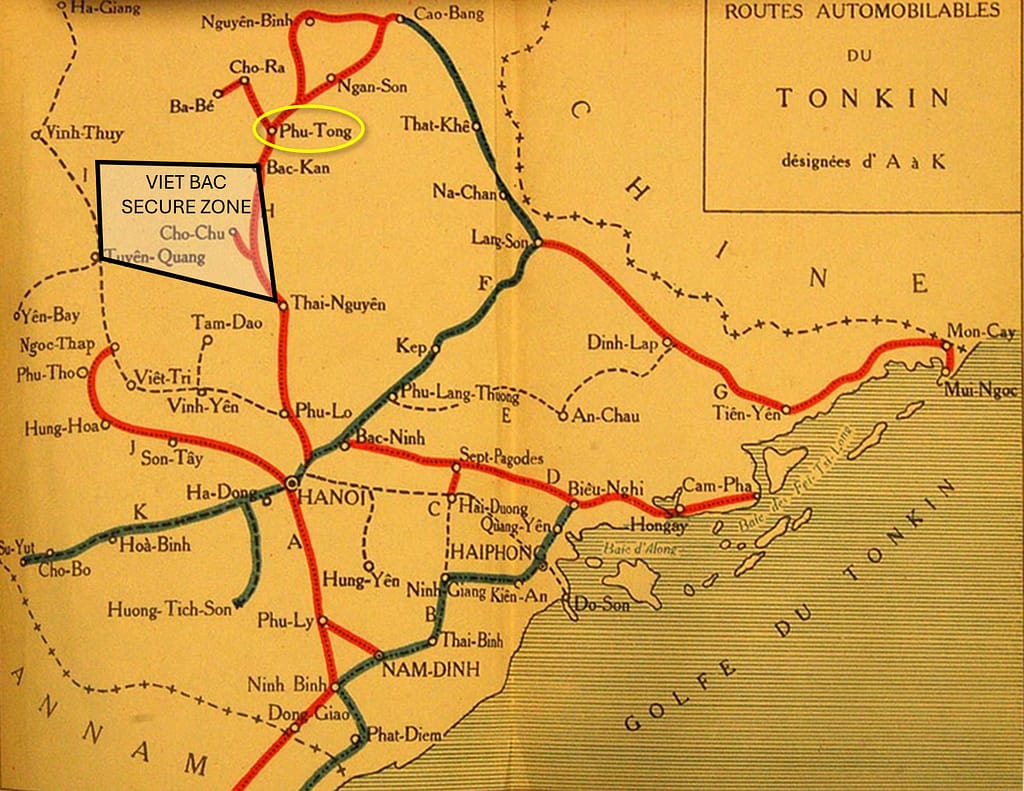
The Battle of Phủ Tông Hoá took place during a critical phase in the First Indochina War as the French colonial authorities sought to reassert control over remote northern regions of Tonkin, particularly along the routes of strategic communication such as Route Coloniale No. 4 (RC4) and Route Coloniale No. 3 bis (RC3 bis).
From guerilla force to taking on French fortifications
At this stage of the war, the Viet Minh remained primarily a guerrilla force, lacking the experience, doctrine, training, and equipment to storm fortified outposts. French forts posed daunting challenges: how do you attack uphill against interlocked machine-gun fire? How do you breach minefields, barbed wire entanglements and belts of sharpened bamboo stakes while under fire? What combination of tactics and weapons can neutralise a concrete machine-gun bunker, while exposed to fire from multiple other bunkers?
Although the Viet Minh failed to take the position, the battle proved a vital training ground. The lessons learned at Phủ Tông Hoá would bear fruit two years later in the devastating set-piece assaults along Cao Bang Ridge.
French seizure of the border region
In October 1947, during Operation LEA, the French had attempted a bold strike against the Viet Bac secure area. The operation was an attempt to eliminate Viet Minh strongholds, kill or capture the Viet Minh leaders, and end the war in one bold stroke. Operation LEA included a parachute operation into the Viet Bac (Viet Minh sanctuary area), a riverine assault along the Black River, and a bold mechanised advance along Route Coloniale No. 4 to reestablish control along the Chinese border.
To secure these territorial gains, the French established several major posts, including Lang Son, That Khe and Cao Bang, and dozens of smaller platoon and company-sized posts along RC4. The road from Cao Bang to the Viet Minh heartland was along RC 3 Bis (extension), which connected Cao Bang with Bac Kan. Phủ Tông Hoá was one of the posts along RC3 Bis.
Opposing Forces: Foreign Legion vs Viet Minh
Phủ Tông Hoá village and fort
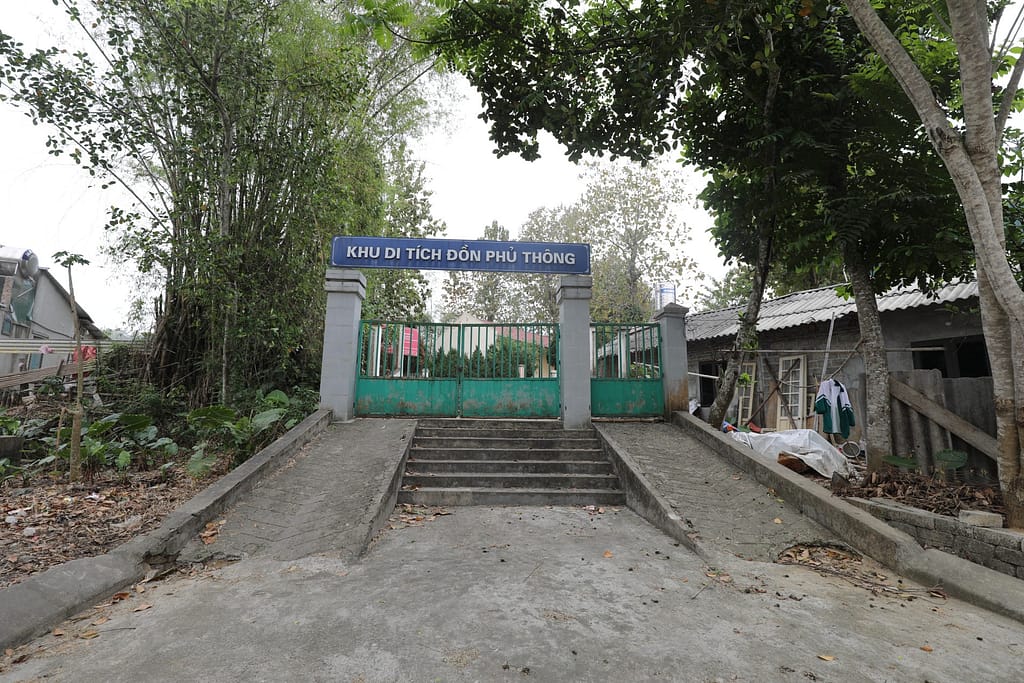
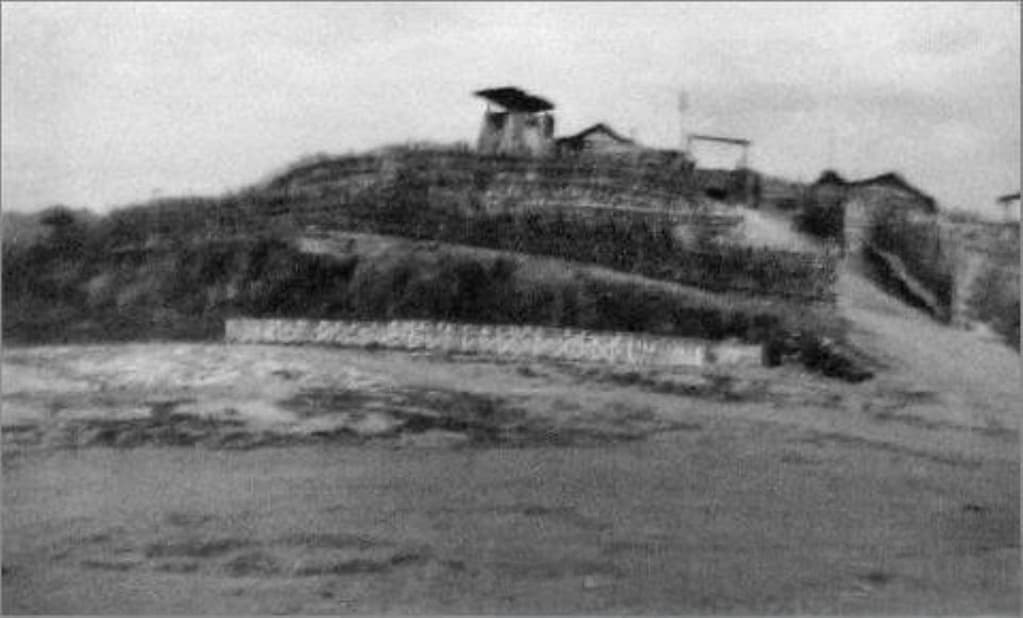
The village of Phu Tong Hoa was on Colonial Route 3 bis (RC3 bis), about 20km northeast of Bac Kan. The village lay at the bottom of a jungle-lined basin, and comprised Chinese-style houses and surrounding rice paddies. On a spur overlooking the village, the French Foreign Legion’s 2nd Company of the 1st Battalion, 3rd Foreign Infantry Regiment, reinforced by gunners from the 69th RAA, manned a small fortification — a timber-and-earth post surrounded by four concrete blockhouses (designated I, II, III, IV), mines, hedges of sharpened bamboo stakes, and barbed wire. Despite its strong defensive layout, the post was dominated by several surrounding heights, providing any attacker with a full view of the interior. The garrison was isolated in hostile territory, with limited support and resupply options.
 French forces
 French forces
- Units. Primarily from 2nd Company, 1st Battalion, 3rd Foreign Infantry Regiment (I/3 REI – Régiment Étranger d’Infanterie) and 69th African Artillery Regiment (69 RAA – Régiment d’Artillerie d’Afrique)
- Commander. Captain Hervé Cardinal
- Strength. Approximately 107 troops, including officers and non-commissioned officers
- Support weapons. Two artillery pieces (3.7 inch mountain gun and a 37mm infantry gun), manned by personnel from the 69th African Artillery Regiment. One 81mm mortar and two 60mm mortars.
- Nearest reinforcements. Company-sized post at Bac Kan, 20km to the southwest, even deeper in hostile territory! 3 REI Regimental headquarters and at least two companies at Cao Bang, 100km to the northeast

 Viet Minh Forces
 Viet Minh Forces
- Three Viet Minh battalions participated in the attack on Phủ Tông Hoá:
- Battalion 11 of Regiment 141 conducted the assault on Phu Tong Hoa fort. The battalion was commanded by Vu Yen and comprised approximately 1,200 soldiers in four companies:
– 120th Assault Company, commanded by Captain Trinh Thuan
– 122nd Assault Company, commanded by Captain Dang Van Kien
– 124th Assault Company, commanded by Captain Thai Xuan Mai
– 126th Combat Support Company, commanded by Captain Thung - Battalion 55 of Regiment 72 was deployed to block enemy reinforcements from Ngan Son and Na Phac
- Battalion 54 of Regiment 308 ambushed and attacked the French relief column moving from Bac Kan on 26 July
- Battalion 11 of Regiment 141 conducted the assault on Phu Tong Hoa fort. The battalion was commanded by Vu Yen and comprised approximately 1,200 soldiers in four companies:
- Strength. Estimates range from 2,000 to 3,000 troops
- Artillery. A battery of two Japanese 75mm howitzers positioned on a hill southwest of the fort, a 37mm infantry gun positioned to the north, and several mortars and heavy machine guns
👉 Continue reading — this article is part of the BattlefieldTravels Deep Research Collection. The full 5,100 word analysis draws on eyewitness accounts of the 1948 Battle of Phủ Tông Hoá, GIS terrain analysis, firsthand fieldwork on the battlefield, and engagement with the community of Phủ Tông. Primary source examination, tactical conclusions, and notes & references that exist nowhere else in English. Try membership free for 7 days.
📚 Further Reading
This battle study nests within the broader analytical framework explored in the Research Hub, where operational methods, operating environments, armies, commanders, and weapons are examined across conflicts and eras. The links below connect related studies across the wider body of battlefield analysis on the BattlefieldTravels site.
⚔️ Explore all battle studies from the French Indochina War 1946-1954
⚔️ Explore all battle studies involving the French Foreign Legion
🏛️Explore the museum of French Indochina War historic artefacts
📚French Indochina War 1946-54 – Recommended Reading
🗞️ For updates on new battlefield studies and research insights, you can subscribe to the Newsletter.
Related Battle Studies, Museum Pieces & Reading Resources
 ⚔️🔒Operation LÉA,
(Việt Bắc Campaign), Tonkin,
Oct–Nov 1947
 ⚔️🔒Battle of Route Coloniale 4,
(Cao Bang Ridge Disaster),
16 Sep-18 Oct 1950
 ⚔️🔒Operation HIRONDELLE, (Raid on Lạng Sơn), Vietnam,
17-21 July 1953
 ⚔️ Battle for Dien Bien Phu, Vietnam,
13 March – 7 May 1954
 🏛️ French Indochina War (1946–1954) Weapons and Equipment
 📚 Best Books on the French Indochina War (1946–1954),
Recommended Reading
Le Boudin, march song of the Legion!
🧭 Battlefield Travel Guide: Phủ Tông Hoá
Getting There
- Nearest City: Cao Bang 100km, Bac Kan 20km
- Access: Close to the centre of the village of Phu Tong
- Tickets: no requirement
Site Orientation
- Key Landmarks: Remnants of the old fort, preserved site, Viet Minh memorial plinths
- Walking Routes: It is relatively easy to walk the site of the fort. All the Viet Minh positions are now deep in farmland or people’s properties, making them more challenging to access.
- Best Vantage Points: From the fort site, you can look outwards to the high ground where the Viet Minh placed their guns.
Museums & Visitor Centres
- On-site: Interpretive Visitor Centre run by Mr Hau. Complete with a full diorama and many rare images (Vietnamese/English).
- Nearby: Viet Bac sites, including sites associated with Ho Chi Minh and key meetings and decisions during the war.
On-Site Experience
- Interpretive Signage: Only a small site, so between the visitor centre and some pre-reading, the battlefield is easy to understand.
- Atmosphere: Peaceful and contemplative. The battle was important for the Viet Minh, and the Vietnamese treat it with the reverence other countries would treat small but significant battles like the Alamo, Bunker Hill, Le Hamel, etc.
Nearby Points of Interest
- Related Sites: Cao Bang, Bac Kan, Viet Bac
- Broader Interest: Pac Bo on the Chinese border, site of Ho Chi Minh’s sanctuary during WW2 and beyond, and the link point between the Viet Minh and the Chinese Communists.
Practical Tips
- When to Visit: You may need to check opening hours as they are irregular. The caretaker/curator is very helpful and engaging but he is not always there.
- Facilities: Restrooms at the entrance; food/water best bought in the village.
FAQ: Battle of Phu Tong Hoa (July 1948)
A small Foreign Legion outpost on RC3 Bis was attacked by a much larger Viet Minh force. The Legionnaires suffered many casualties but successfully defended the post.
The post guarded key approaches to Thai Nguyen and blocked Viet Minh access to the Chinese border.
The post was defended by 2nd Company, 1st Battalion, 3rd Foreign Infantry Regiment (I/3 REI – Régiment Étranger d’Infanterie) and 69th African Artillery Regiment. The Viet Minh attacking force was primarily Battalion 11 of Regiment 141, supported by Battalion 55 of Regiment 72, and Battalion 54 of Regiment 308.
The French successfully defended the post but broke the siege and withdrew the garrison. The Viet Minh gained vital experience in attacking fortified positions.
The location is remote but accessible by road. The terrain remains largely unchanged and still shows traces of fortifications.
Subscribe to Battlefield Travels and receive a free E-Book Battlefield Guide
Unlock expert battlefield analysis, campaign reconstructions, and historical insights drawn from firsthand exploration and primary sources.
🗺️ You’ll receive:
🎖️ Exclusive historical insights you won’t find elsewhere
📘 A free eBook: 10 Tips for Exploring Historic Battlefields
📰 New battlefield studies straight to your inbox as they are published

⚔️ Go deeper — Members get exclusive access to the Deep Research Collection, Field Notes, and monthly Research Dispatches. Try membership free for 7 days, cancel anytime. From $9/month.
