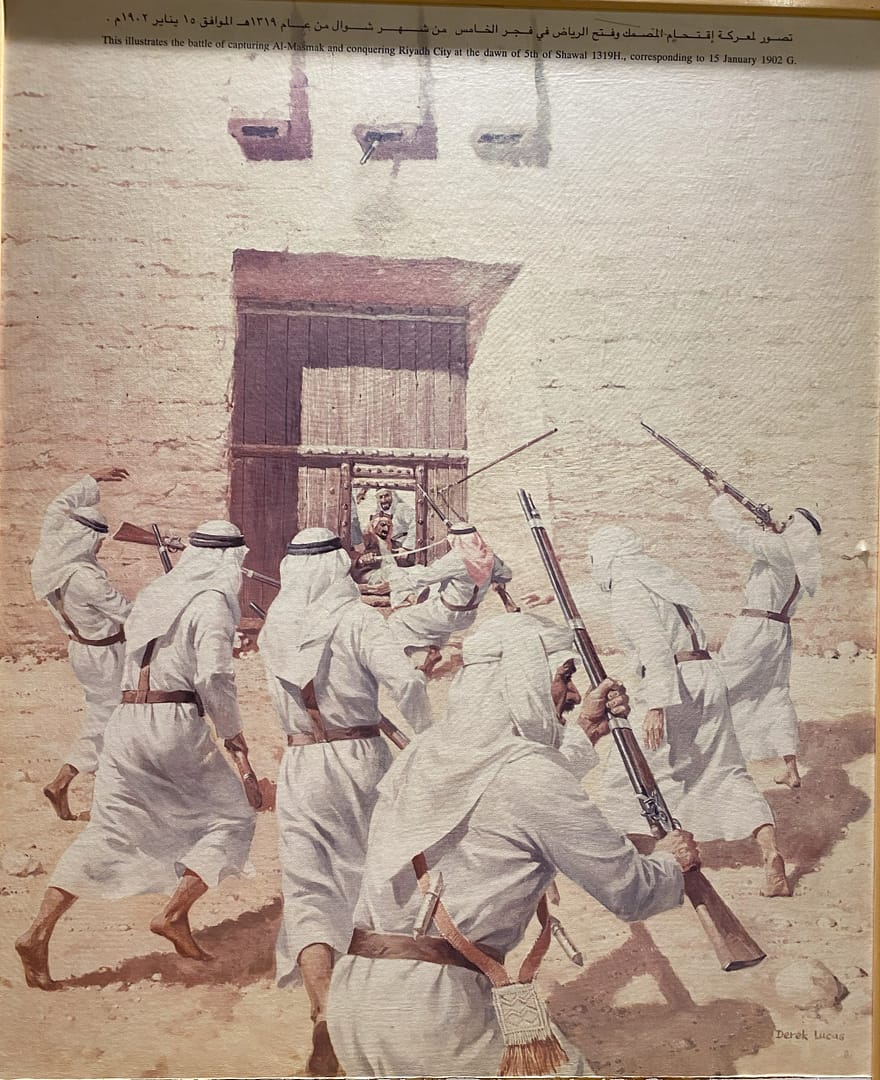
Battle of Riyadh 1902 – Ibn Saud’s capture of Al Masmak Fort!
In January 1902, Abdulaziz Ibn Saud, with just a small band of followers, stormed Al Masmak Fort in Riyadh. The surprise dawn attack killed the Rashidi governor and returned the Al Sauds to their ancestral capital — the first step in a 30-year struggle that forged the modern Kingdom of Saudi Arabia.
Key facts
Google Earth map – location of Al Masmak fortress
🧭🥾 Walking the Battlefield
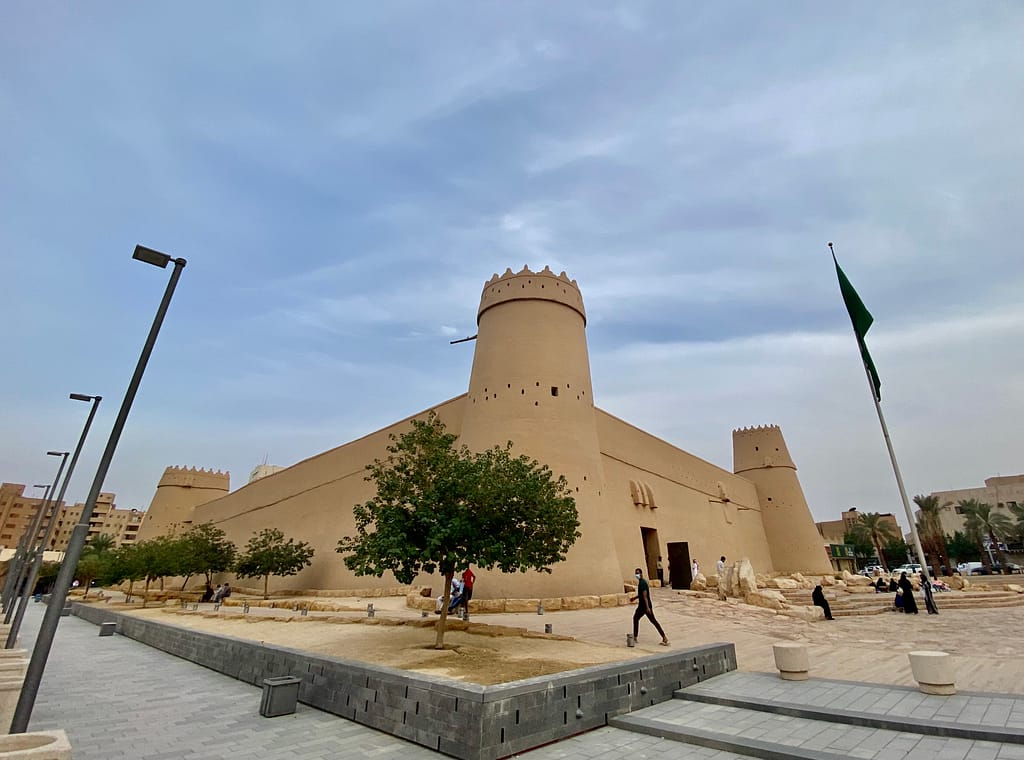
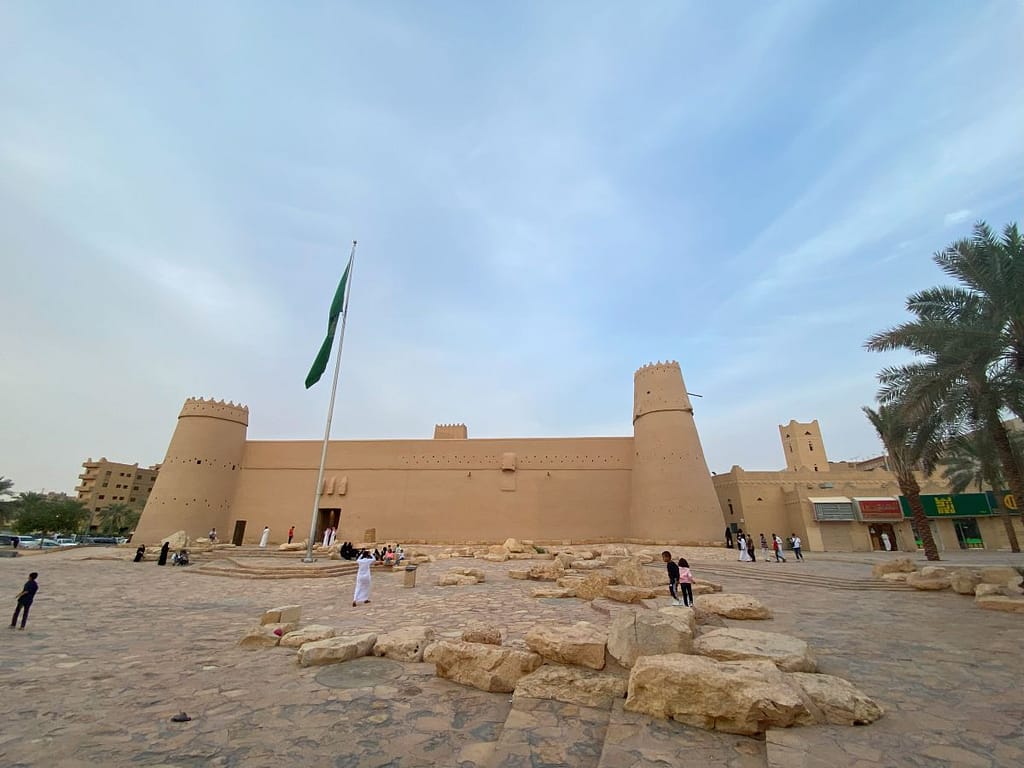
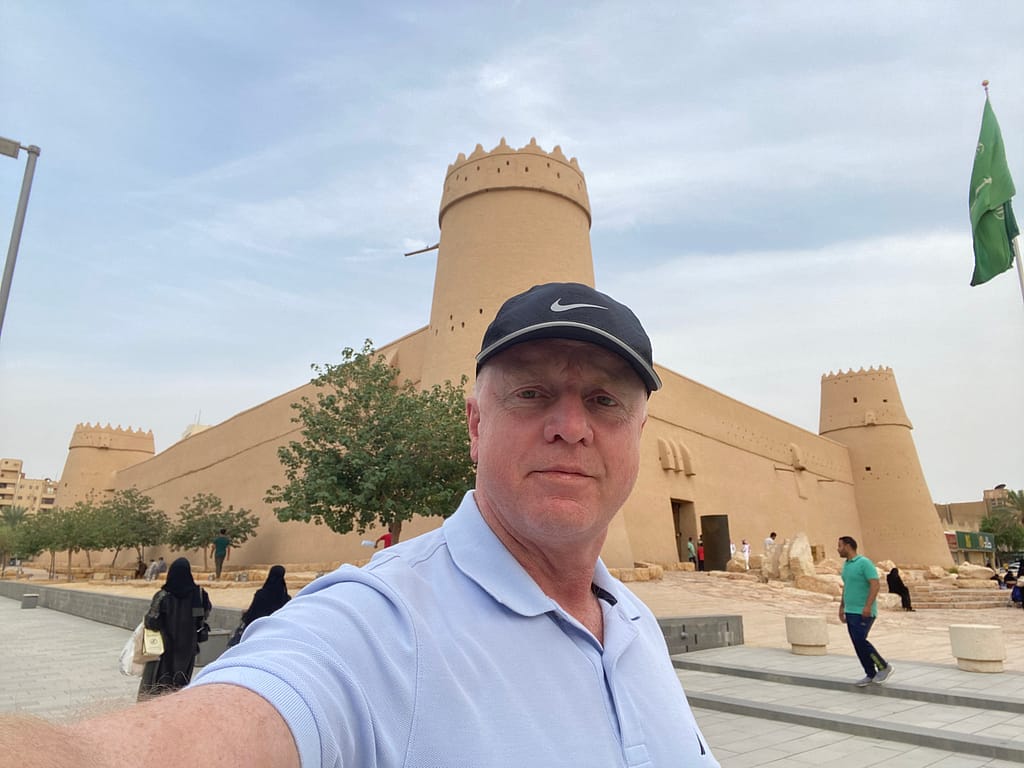
I visited Al Masmak fortress in October 2021 and again in January 2025 as it was undergoing a major refurbishment. The best place to start exploring is the Saudi National Museum on King Saud Road. This provides an overview of Arabian history, including the First and Second Saudi Kingdoms, the Ottoman period, and the Wars of Saudi Unification (1902-1932).
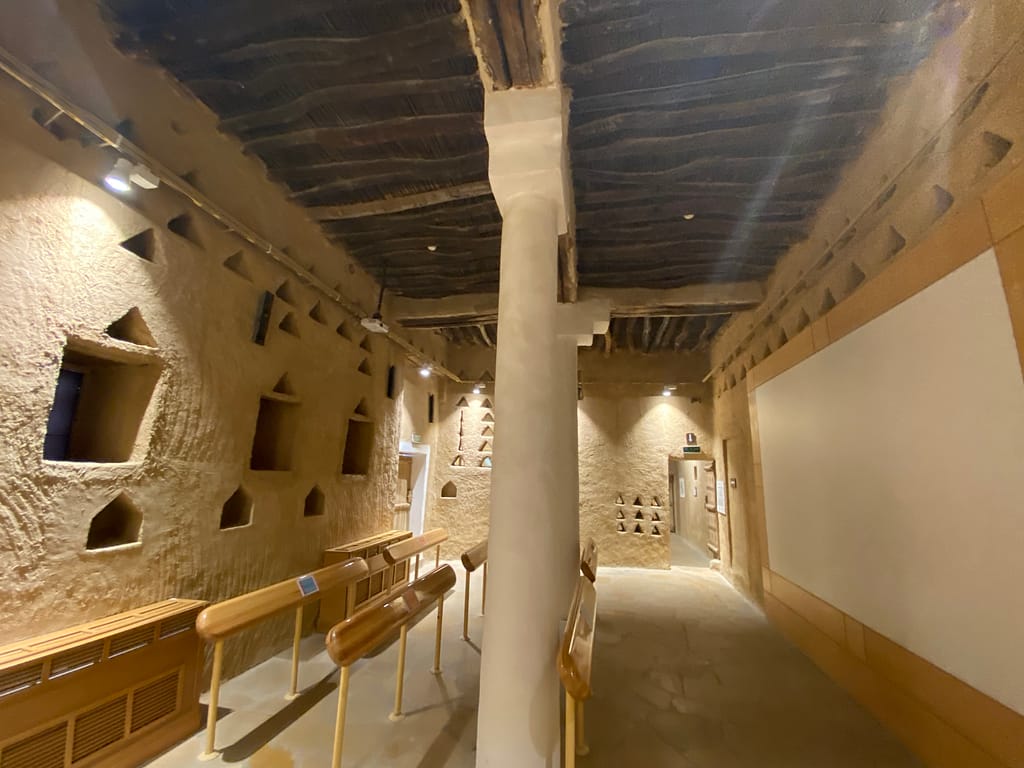
Al Masmak fort is made of mud brick and clay, similar to the construction of Afghan Qualas. My Saudi friends tell me that Afghan craftsmen are sometimes brought in to assist with traditional building techniques. The mud brick and clay construction erodes rapidly with weather and rain (not that there is much rain in Riyadh), so requires protection and constant maintenance. When I visited in 2025, the fort was covered for maintenance.
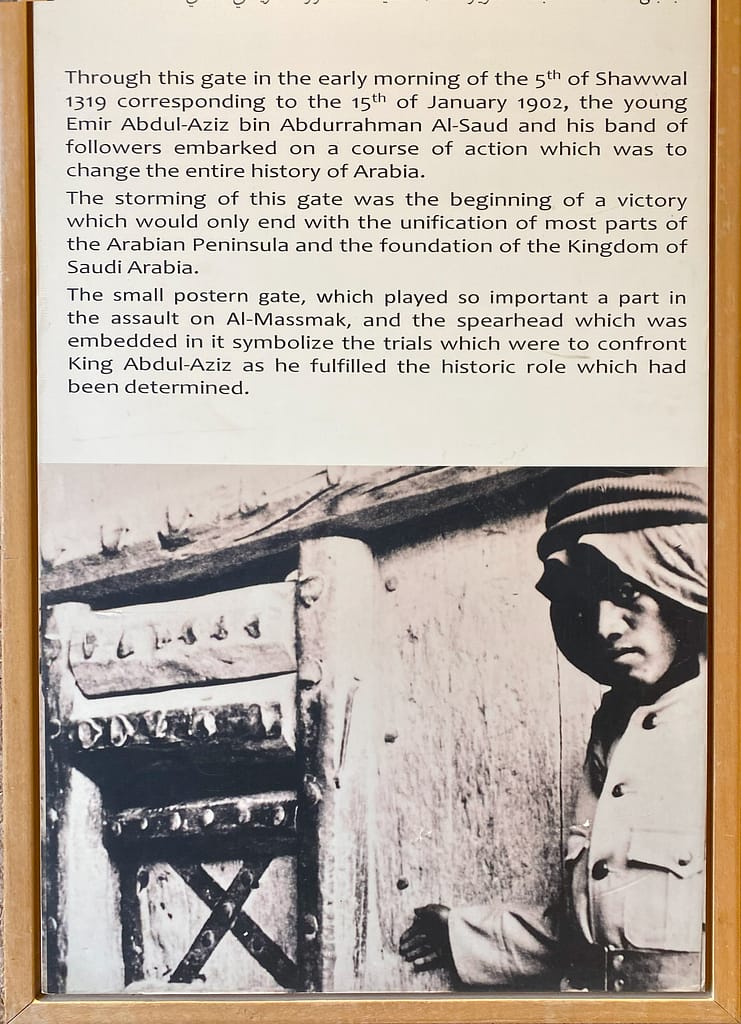
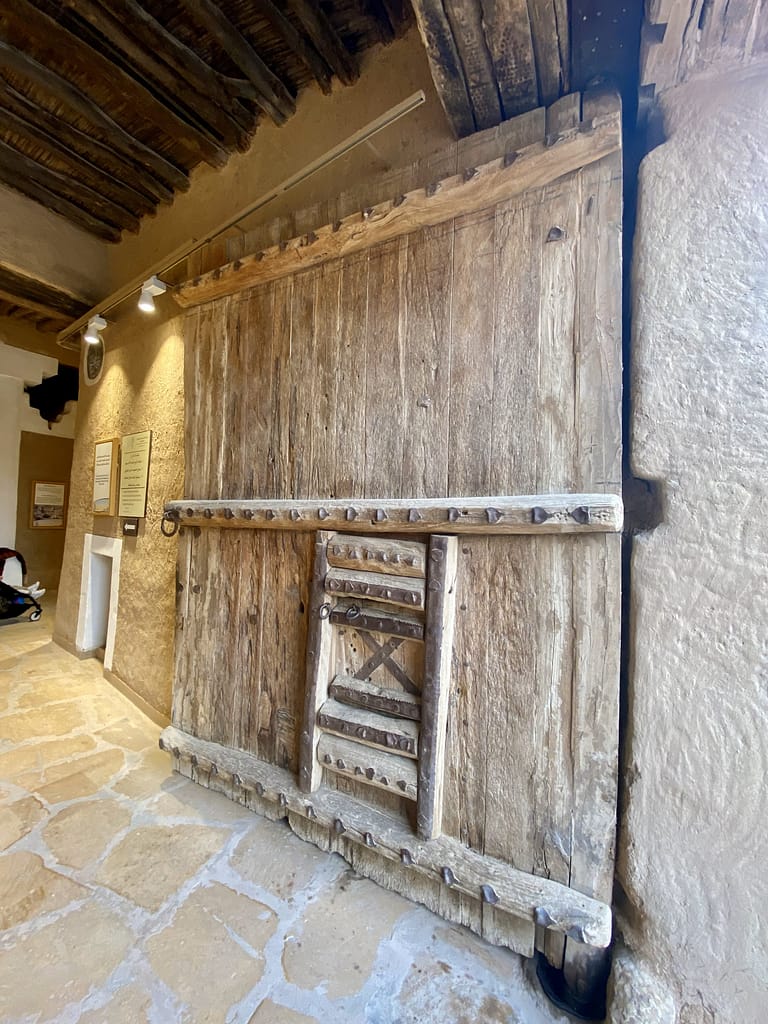
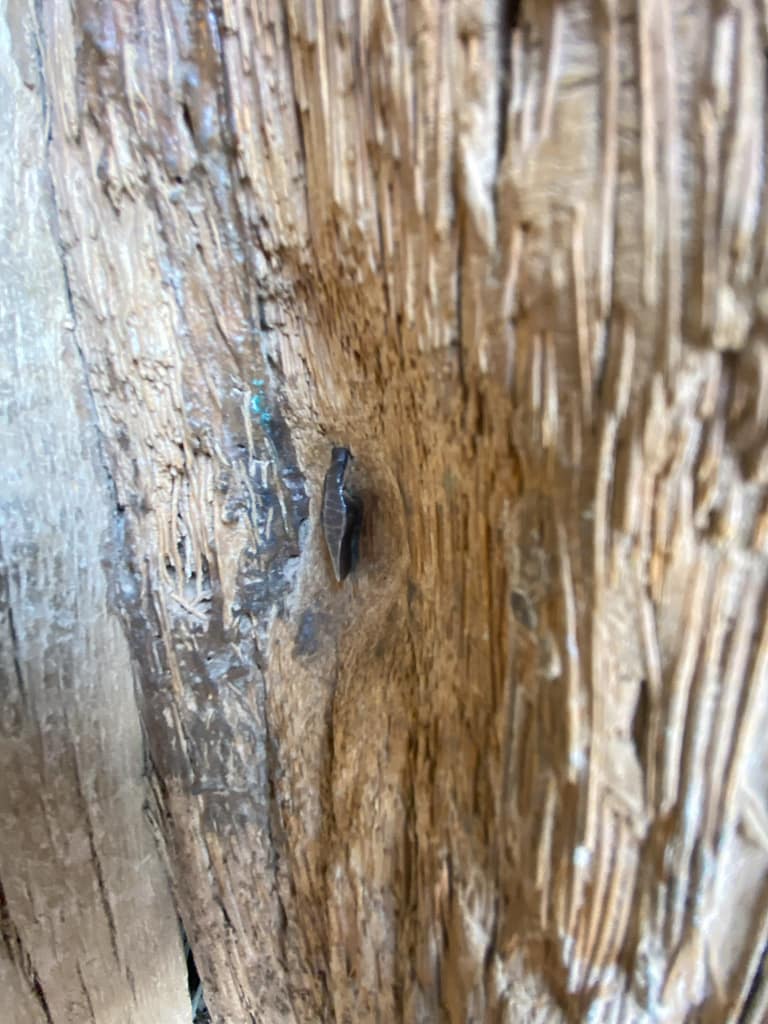
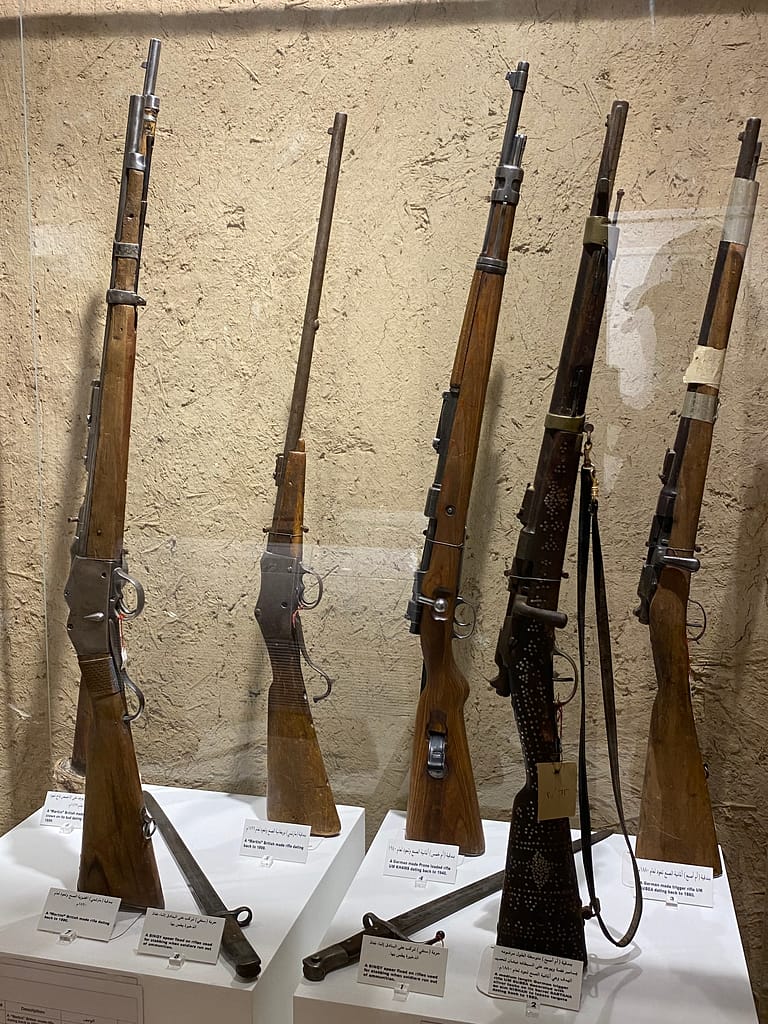
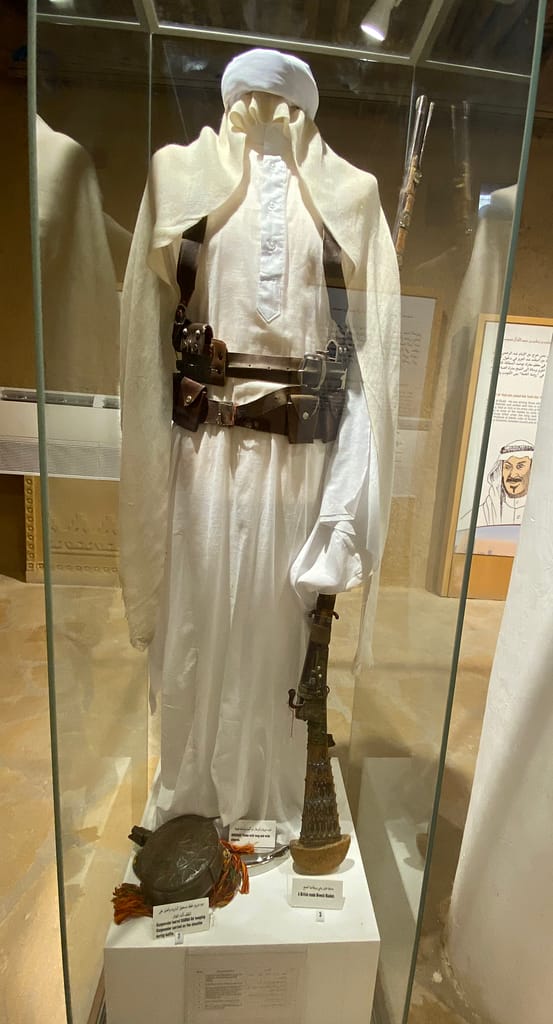
Of great interest, and one of the fort’s feature exhibits, is the original palm-log main gate, with the tip of Ibn Jalawi’s spear still embedded from the 1902 battle. The fort also houses an excellent museum with antique uniforms,
History of the Saudi states
The Battle of Riyadh in January 1902 was a critical moment in the history of the Kingdom of Saudi Arabia. The Al Saud family had previously established two states centered on the Diriyah/Riyadh area of Arabia, each of which was destroyed by rival powers. The re-capture of Riyadh in 1902 was the first in a series of conquests and wars that led to the proclamation of the third Saudi state in 1932; the modern Kingdom of Saudi Arabia. As with the origin stories of many of our countries, the factual events of the period have been overlaid with decades or centuries of storytelling and mythologising, so it can be difficult to distill out the timeline of events, especially across language barriers.
First Saudi State 1802-1818
The First Saudi State, the Emirate of Diriyah, was established in 1727, with its capital in the town of Diriyah (on the outskirts of Riyadh – currently being restored). Under the leadership of the Emir of Diriyah, Muhammad bin Saud, and cleric Muhammad ibn Abd al-Wahhab the Saudi State conquered most of what is now Saudi Arabia, including the capture of Mecca and Medina in 1802.
From 1811, the Ottoman Empire undertook a series of campaigns to recapture Mecca and Medina and crush the Saudi state. The Saudis achieved some early successes, but the Ottomans recaptured Medina in 1812 and Mecca in 1813. The campaign of 1817-18 ultimately besieged, captured, and destroyed the Al Saud capital of Diriyah. The Saudi Emir, Abdullah I, was captured and later executed in Constantinople.

Second Saudi State 1824-1891
In 1824, a second Saudi state was established in Riyadh by Muhammad ibn Saud’s grandson Turki bin Abdullah Al Saud. The second state lasted until the Battle of Mulayda in 1891, where the Al Saud forces were soundly defeated by the forces of Muḥammad ibn Abd Allāh al-Rashīd. The Saudi leader, Abdulrahman, fled into exile in Kuwait.

Battle of Riyadh – strategic context
The events at Riyadh in January 1902 cannot be understood in isolation. They were the product of almost a century of struggle between the House of Saud and its rivals, shaped by the interplay of tribal loyalties, Wahhabi religious revival, Ottoman imperial interests, and the emergence of the Rashidi dynasty as a dominant power in central Arabia. For Abdulaziz Ibn Saud, still in his early twenties, the recapture of Riyadh was as much a symbolic act of dynastic legitimacy as it was a military operation.
The Rashidi ascendancy
By the late nineteenth century, the Rashidi rulers of Ha’il had become the most powerful force in central Arabia. Under Muhammad ibn Abd Allah al-Rashid (r. 1869–1897), their state extended influence across Najd and into Al-Hasa. The Rashidis were supported by the Ottomans, who saw them as a counterweight to the Saudis and to the Wahhabi religious current that had twice disrupted imperial authority in the Holy Cities. This alliance gave the Rashidis a measure of external legitimacy and occasional military support, particularly in the form of arms and subsidies.
For the Al Saud, the Rashidi occupation of Riyadh in 1891 was both a personal and political disaster. Abdulrahman bin Faisal Al Saud, the last ruler of the Second Saudi State, was forced into exile following defeat at the Battle of Mulayda. His household, including his young son Abdulaziz, took refuge first among sympathetic tribes and then in Kuwait. Riyadh, once the family’s seat of power, now served as a Rashidi garrison town, commanded by Ibn Ajlan as the Rashidi governor.
Ibn Saud exile in Kuwait
Kuwait provided Ibn Saud with both sanctuary and opportunity. The ruling al-Sabah family had its own reasons to shelter the exiled Saudis, partly from kinship ties and partly from a desire to keep a balance of power in the Gulf. While in Kuwait, Ibn Saud absorbed lessons in politics and strategy from both his hosts and from the wider Gulf environment, where British influence was strong. He grew up in an atmosphere of tension between Ottoman authority, Rashidi power inland, and British influence along the coast.
By the turn of the century, the young Ibn Saud had developed a clear determination to restore his family’s fortunes. He understood that to rally tribal support, he needed a dramatic success that would establish both his personal leadership and the legitimacy of the Al Saud cause. Recapturing Riyadh — the symbolic heart of the family’s authority and a defensible urban base — was the obvious first step.
The plan to recapture Riyadh
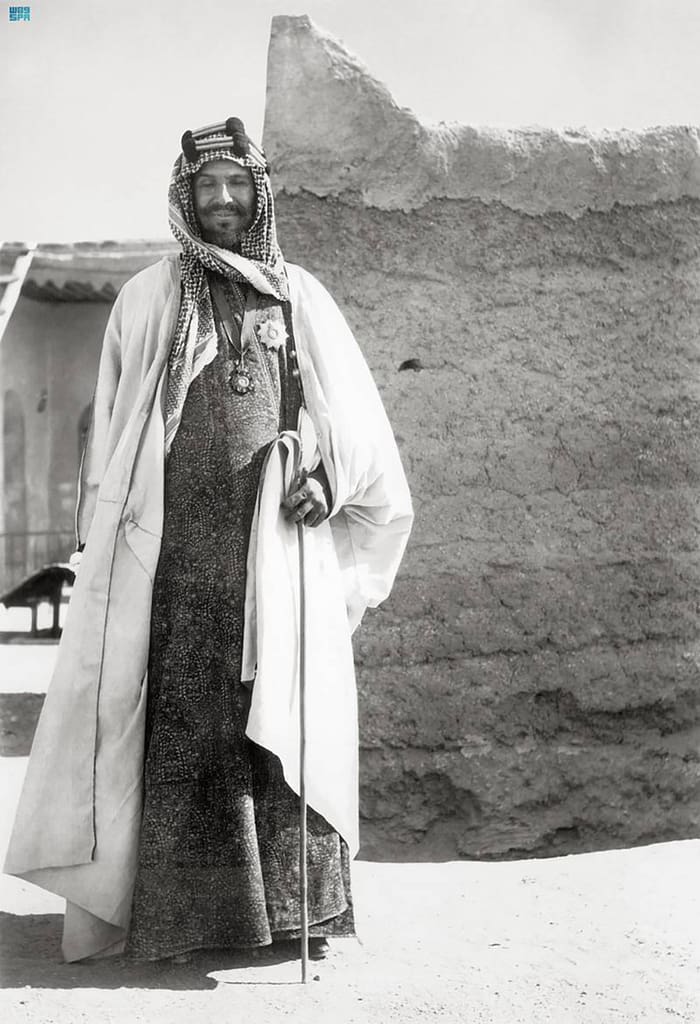
By late 1901, Ibn Saud had gained the support of the Emir of Kuwait, Mubarak al-Sabah, who provided men, horses, and supplies. The expedition that set out numbered only about fifty to sixty followers, many of them relatives or close companions who had shared the family’s exile. This was a small force for what was, in effect, an attempt to overthrow the Rashidi hold on central Arabia, but Ibn Saud calculated that speed, surprise, and local sympathisers inside Riyadh would compensate for numbers.
The force moved initially through the Al-Hasa region, carrying out raids that both provided supplies and signalled to tribes that the Al Saud were once more active. These skirmishes had a dual purpose: they hardened Ibn Saud’s men through action, and they created an impression that the Saudis were a force on the rise again. For tribal society, where strength often equated to legitimacy, these early successes were critical.
⚔️ Go deeper — Members get exclusive access to the Deep Research Collection, Field Notes, and monthly Research Dispatches. Try membership free for 7 days, cancel anytime. From $9/month.
Riyadh as the Objective
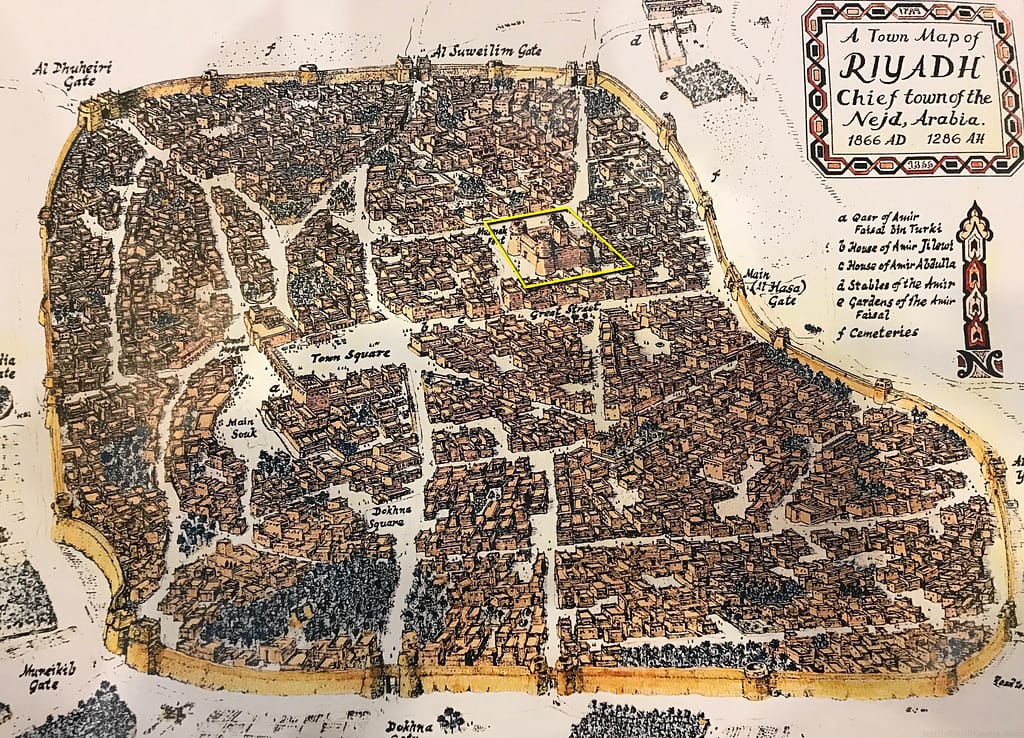
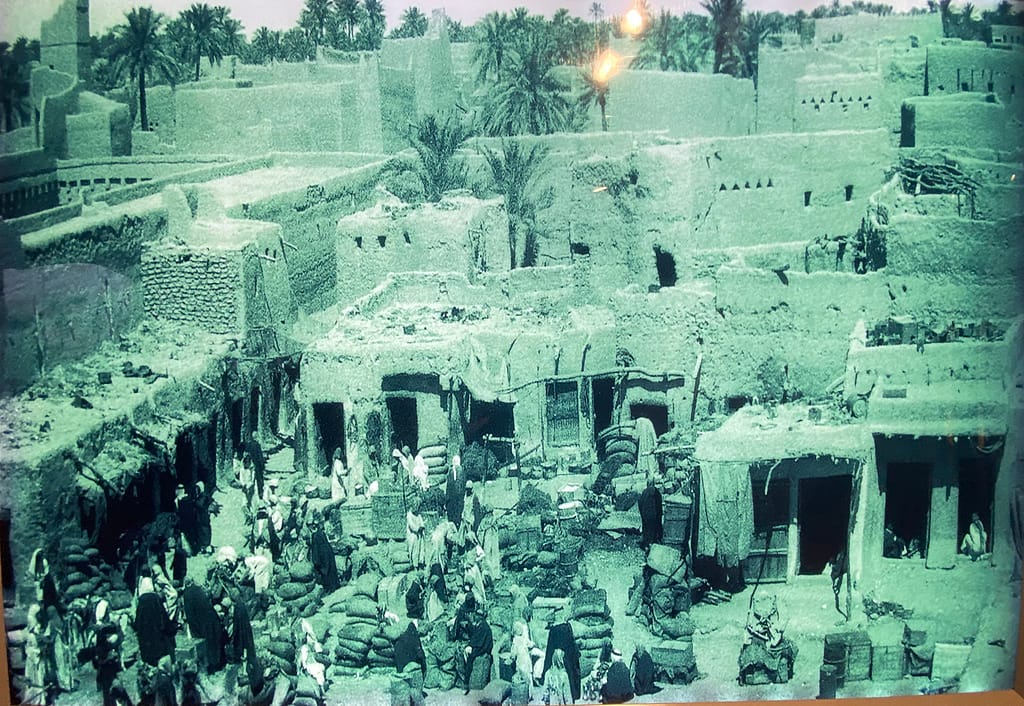
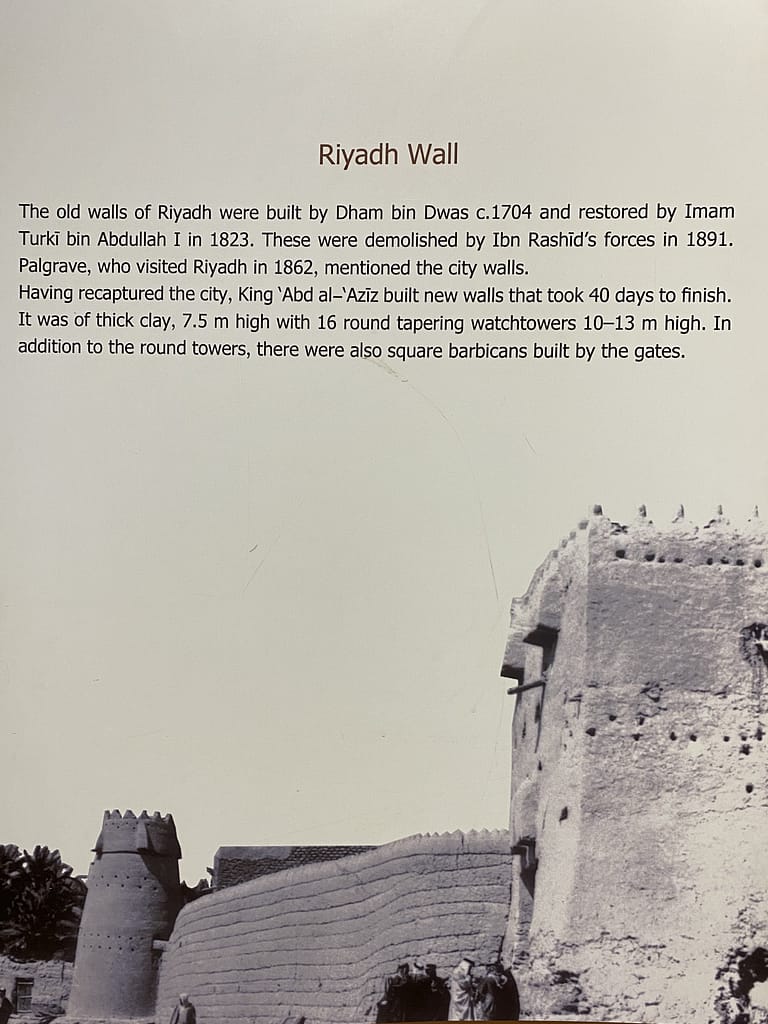
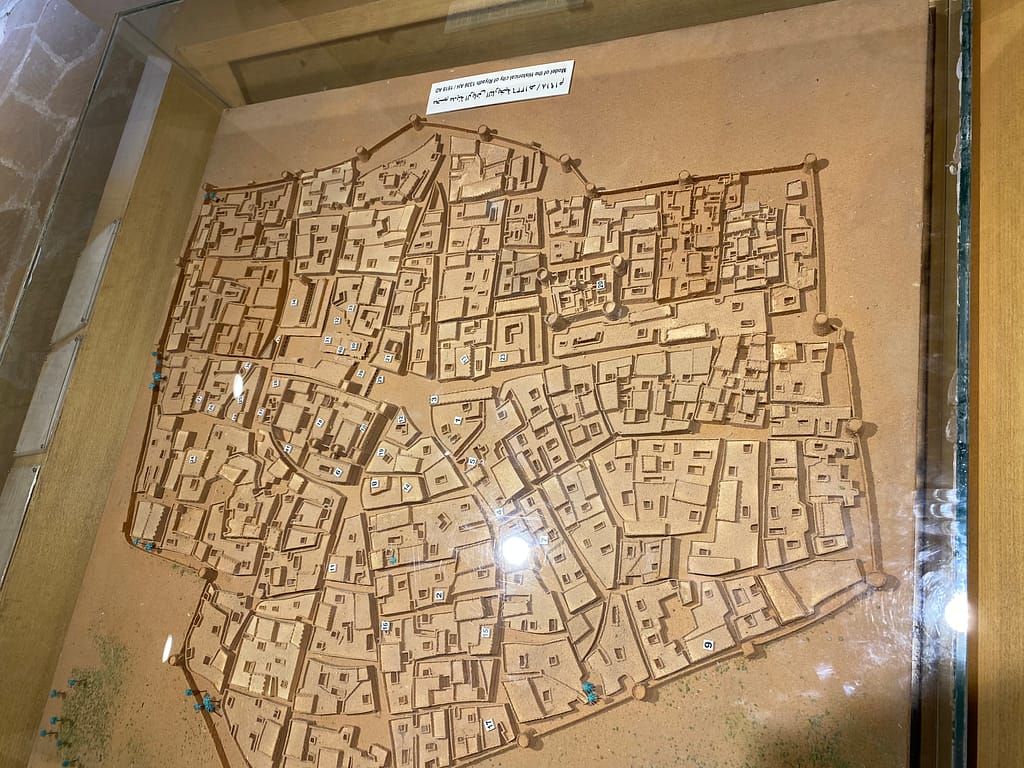
By mid-January 1902, Ibn Saud’s force approached Riyadh. The choice of target reflected both strategy and symbolism. They knew that the key to Riyadh was the Al Masmak fort, a mud brick fort constructed in 1865, which housed the town garrison and dominated Riyadh. Abdulaziz‘s plan was to capture Al Masmak and kill Ibn Ajlan, the Rashidi’s Chief of Riyadh. Riyadh’s mud-brick walls and the Al Masmak fortress within represented not only a defensible stronghold but also the visible embodiment of Rashidi control. Striking directly at the town offered the chance to decapitate the Rashidi presence in Najd, rally supporters, and restore the Saudis to their ancestral centre.
The plan was based on local intelligence and inside assistance. Ibn Saud knew that Ibn Ajlan, the Rashidi governor, spent much of his time inside Al Masmak. He also knew that the main gate was routinely opened at dawn for patrols. The operation would therefore rely on infiltrating the town covertly, positioning men near the gate, and seizing the opportunity to eliminate the Rashidi leader when he emerged.
For Abdulaziz, this was not simply a tactical gamble. Success would mean the restoration of the Al Saud name in its traditional heartland, a base for further campaigns, and the beginning of what he hoped would become a third Saudi state. Failure, however, would almost certainly mean death in battle or capture by his enemies. The small band that rode with him understood that the stakes were existential, not only for themselves but for the survival of their dynasty.
Ibn Saud approach to the City
On the night of 14–15 January 1902, Abdulaziz Ibn Saud and his small band of followers rode silently toward Riyadh. The party had been whittled down from their original fifty or so men to barely forty loyalists, the rest having drifted away during the long march through Najd. Exhaustion and the sheer risk of the enterprise had taken their toll, but those who remained were deeply committed. Among them were his half-brothers, cousins, and lifelong companions, men who understood that failure would mean the end of the Al Saud line.
The group halted at Diriyah, the ruined ancestral seat of the Saudis, only a few kilometres from their target. There, Ibn Saud reminded his men of the stakes: this was more than a raid — it was a bid to restore their dynasty. Some accounts say he invoked divine sanction, portraying their mission as both a family duty and a religious act to revive Wahhabi leadership in Najd. After prayers, they pressed on under cover of darkness.
Splitting the Force
At dawn, Ibn Saud divided his men into two groups. Roughly thirty were left hidden in nearby palm groves outside the city walls, while a strike force of seven to ten men accompanied him toward the town itself. The plan was simple yet audacious: infiltrate Riyadh through contacts inside, seize the Al Masmak fortress, and kill the Rashidi governor, Ajlan ibn Muhammad. Once Ajlan was eliminated, Ibn Saud hoped the local townsfolk — many of whom resented Rashidi dominance — would rally to his banner.
Local sympathisers had provided critical intelligence. The Masmak’s gates were known to be opened at dawn for patrols. Ibn Saud counted on this routine, as well as on the element of surprise. If Ajlan could be eliminated quickly, the Rashidi garrison might collapse without a protracted fight.
Entering Riyadh
As planned, the gate opened in the early morning. Ibn Saud and his party slipped into the town, guided by supporters who had awaited them. They made their way through narrow alleys to a house close to the Masmak, reportedly belonging to one of Ibn Saud’s relatives. From this vantage point, they could observe movements in and out of the fortress.
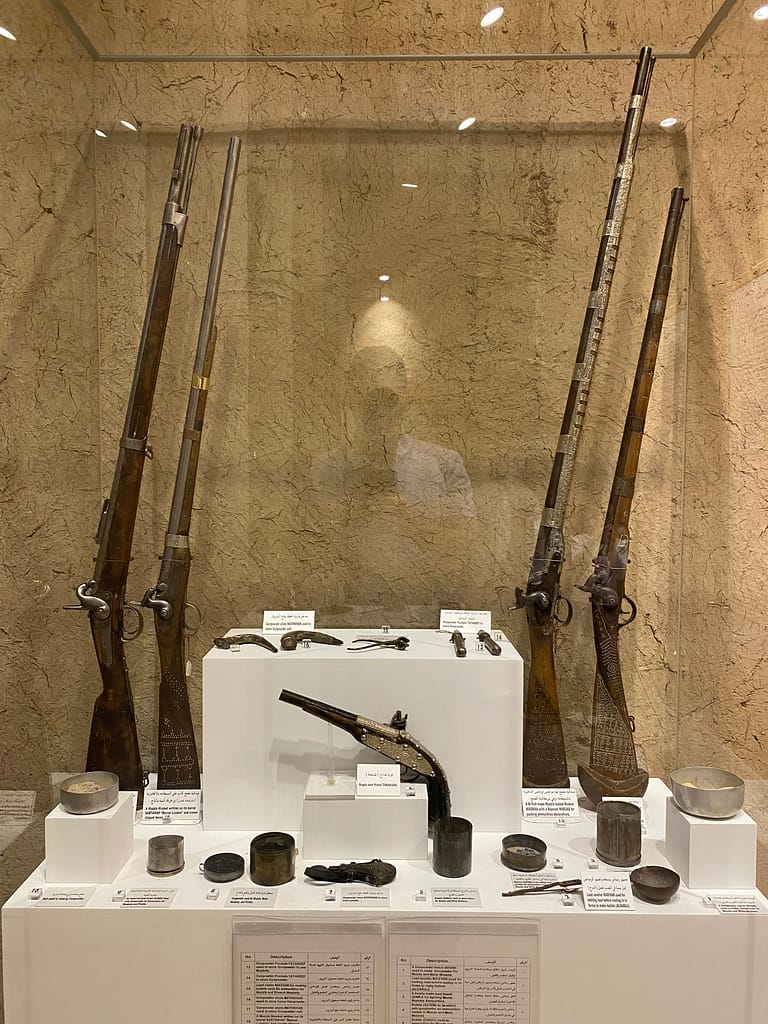
Here, they lay in wait. Ibn Saud, sword and rifle at his side, kept his eyes fixed on the gate. His companions checked their weapons — old rifles, swords, and spears — knowing that they faced a better-armed garrison. The atmosphere was tense, every creak of wood or bark of a dog threatening to betray their presence.
Battle for Al Masmak fortress
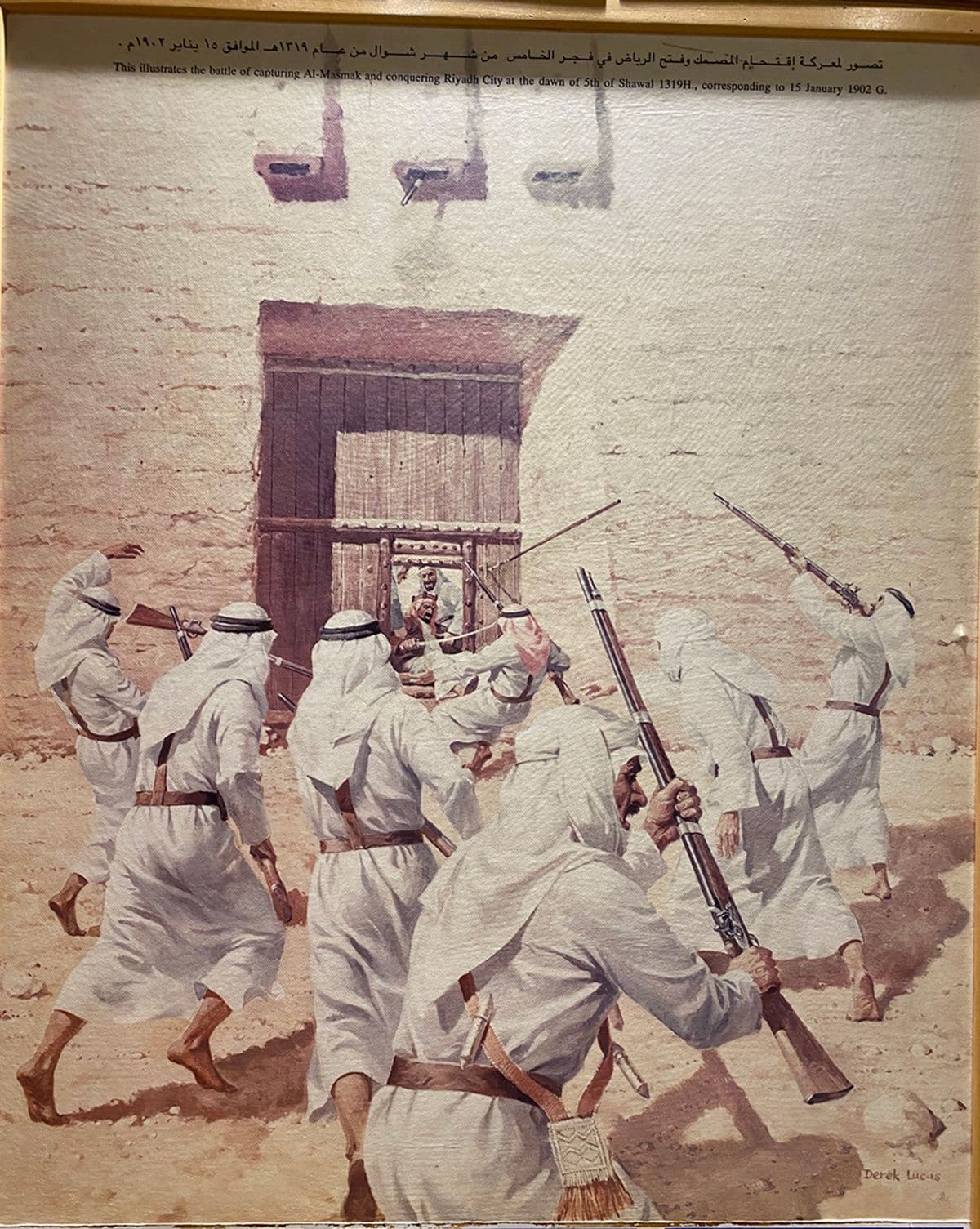
When Ajlan emerged from the fortress — some accounts say to inspect the morning patrol, others to walk to his home nearby — Ibn Saud and his men launched their ambush. Shots rang out in the still morning air. Ajlan attempted to flee back toward the fortress, but Ibn Saud gave chase. In the narrow lane, he hurled his spear, striking Ajlan and bringing him down. Tradition holds that Ajlan was finished off with swords, though other reports suggest a brief melee in which multiple Saudis closed in to ensure his death.
The sudden violence threw the Rashidi garrison into confusion. Ibn Saud’s men pressed the attack, storming toward the gate. A chaotic firefight broke out as guards tried to close the entrance, but the attackers surged through. With Ajlan dead and the element of surprise shattered, the advantage shifted rapidly toward Ibn Saud.
Securing Al Masmak fort
Fighting raged within and around the fortress courtyard. Ibn Saud reportedly shouted to his men that retreat was not an option: “The time of flight has gone — now is the time of victory or death.” His determination stiffened the resolve of his small band. Inside Al Masmak, the defenders wavered. Some tried to mount a stand; others, seeing their leader cut down, fled or surrendered.
One famous detail recounted in Saudi tradition is that Ibn Jalawi’s spear became lodged in the wooden gate of the fortress after being thrown at Ajlan. Visitors today can still see what is claimed to be the notch left behind, a physical reminder of the battle’s turning point. Whether literal or symbolic, the story reinforces the drama of the moment — the decisive act of the young emir reclaiming his heritage.
Rallying Riyadh to the Al Saud cause
With Al Masmak seized, Ibn Saud quickly moved to consolidate control. He ordered proclamations in the streets, calling on the people of Riyadh to rally to the Al Saud cause. The spectacle of Ajlan’s body — and the reality of Rashidi defeat — carried enormous psychological weight. Many townsfolk, long resentful of Rashidi taxation and garrisons, now openly supported Ibn Saud. Others, calculating the risks, held back, but the balance of power had unmistakably shifted.
The Rashidi garrison, demoralised by the loss of its governor, offered little further resistance. Some survivors fled toward Ha’il; others were absorbed into the new order. By the end of the day, Riyadh was effectively under Saudi control once more.
Immediate Aftermath
For Abdulaziz Ibn Saud, the victory was total and transformative. What had begun as a desperate gamble with fewer than fifty men ended with control of Riyadh, the symbolic heart of his dynasty. He installed his father, Abdulrahman, as the formal emir, while he himself exercised real authority. The recapture of Riyadh became the foundation upon which the Third Saudi State was built.
Yet the risks were not over. The Rashidis still commanded superior forces in Ha’il and enjoyed Ottoman support. Ibn Saud knew that his victory would invite retaliation. Nonetheless, the success electrified supporters across Najd. Tribes began to drift toward the rising star of the Saudis, encouraged by the boldness and apparent divine favour that had enabled such an improbable triumph.
Sources and Perspectives
Accounts of the battle vary, reflecting both oral tradition and later nationalist historiography. Some emphasise Ibn Saud’s personal heroism in spearing Ajlan, others stress the collective bravery of his companions. Rashidi perspectives are scant, recorded mostly through hostile Ottoman correspondence that framed the event as a bandit raid. What is clear is that the small action had consequences far beyond its scale, reshaping the politics of Arabia in the early twentieth century.
The Riyadh raid has since been immortalised in Saudi national memory, taught as the moment of rebirth for the Al Saud. For historians, it stands as a striking case study of how symbolic victories, when executed with daring and precision, can alter the course of regional history.
Aftermath and Strategic Consequences
Immediate Impact in Najd
The recapture of Riyadh in January 1902 sent shockwaves across central Arabia. For the Al Saud family, who had spent nearly a decade in exile in Kuwait, it was nothing less than a resurrection. For Ibn Saud personally, it was the first step in transforming himself from a fugitive chieftain into a statesman and conqueror.
In the immediate aftermath, Ibn Saud restored his father, Abdulrahman ibn Faisal, as the nominal emir of Riyadh. Yet even at this early stage, Abdulaziz was clearly the real power, directing both diplomacy and military affairs. He began by reorganising the city’s defences, stockpiling supplies, and securing alliances with clans inside Riyadh. The message was clear: the Saudis were back, and this time they intended to stay.
For the people of Riyadh, the change of regime brought relief. The Rashidis had governed through military occupation and heavy taxation, extracting grain and levies while showing little concern for local welfare. By contrast, Ibn Saud immediately invoked his family’s historic alliance with the Wahhabi clerics, portraying his rule as both just and religiously sanctioned. His swift establishment of order helped cement legitimacy at a time when survival depended as much on perception as on force.
Rashidi Response
The Rashidi emirate in Ha’il, backed by Ottoman subsidies and prestige, was still the dominant power in Najd. The loss of Riyadh was a humiliation but not, at first glance, a mortal blow. Ajlan’s death deprived the Rashidis of an experienced governor, but Emir Abdulaziz al-Rashid (then ruling from Ha’il) believed he could reassert control.
Within months, Rashidi forces gathered for a counterattack. Yet the speed of Ibn Saud’s consolidation meant that Riyadh was already braced for siege. Sources suggest that Ibn Saud skilfully used both fortifications and diplomacy to stave off immediate defeat. By rallying local clans and leveraging religious rhetoric, he ensured that the Rashidis could not simply march in and overwhelm the city. Instead, Najd descended into a cycle of raids, sieges, and shifting alliances, a war of attrition in which Ibn Saud proved remarkably adept.
Building a Power Base
From 1902 onwards, Ibn Saud’s energies were directed at expanding his fragile foothold into a durable state. His approach combined tribal diplomacy, religious authority, and military innovation:
- Tribal Alliances: He courted key Najdi tribes through marriage ties, gifts, and the promise of autonomy under his protection. By positioning himself as a defender of local interests against Rashidi exploitation, he won gradual support.
- Religious Legitimacy: With Wahhabi clerics endorsing his cause, Ibn Saud presented his wars as jihad against illegitimate rulers. This ideological framing helped to mobilise fighters and justify expansion.
- Military Reorganisation: Though starting with a tiny core of companions, Ibn Saud gradually assembled a loyal fighting force. His later creation of the Ikhwan militia (from the 1910s) owed much to the initial lessons of Riyadh: the need for committed, ideologically driven soldiers who would fight beyond tribal loyalties.
The Riyadh victory thus acted as a nucleus around which Ibn Saud could build a state apparatus.
Broader Regional Consequences
For the Ottomans, the loss of Riyadh was worrying. Though the Rashidis remained their principal allies in Arabia, the re-emergence of a Saudi emirate threatened to destabilise the balance of power. In practice, Ottoman control of Najd was always tenuous, limited to subsidies and token oversight, but the symbolism of a revived Wahhabi-Saudi movement unsettled Istanbul.
For other Arabian powers — notably the Sharif of Mecca and the tribal confederations of al-Hasa and Qasim — Ibn Saud’s rise introduced a new competitor. At first, many treated him as a local upstart. Yet over the next two decades, as his influence spread across Najd and beyond, they would be forced to reckon with him as the architect of a new Arabian order.
Long-Term Strategic Outcomes
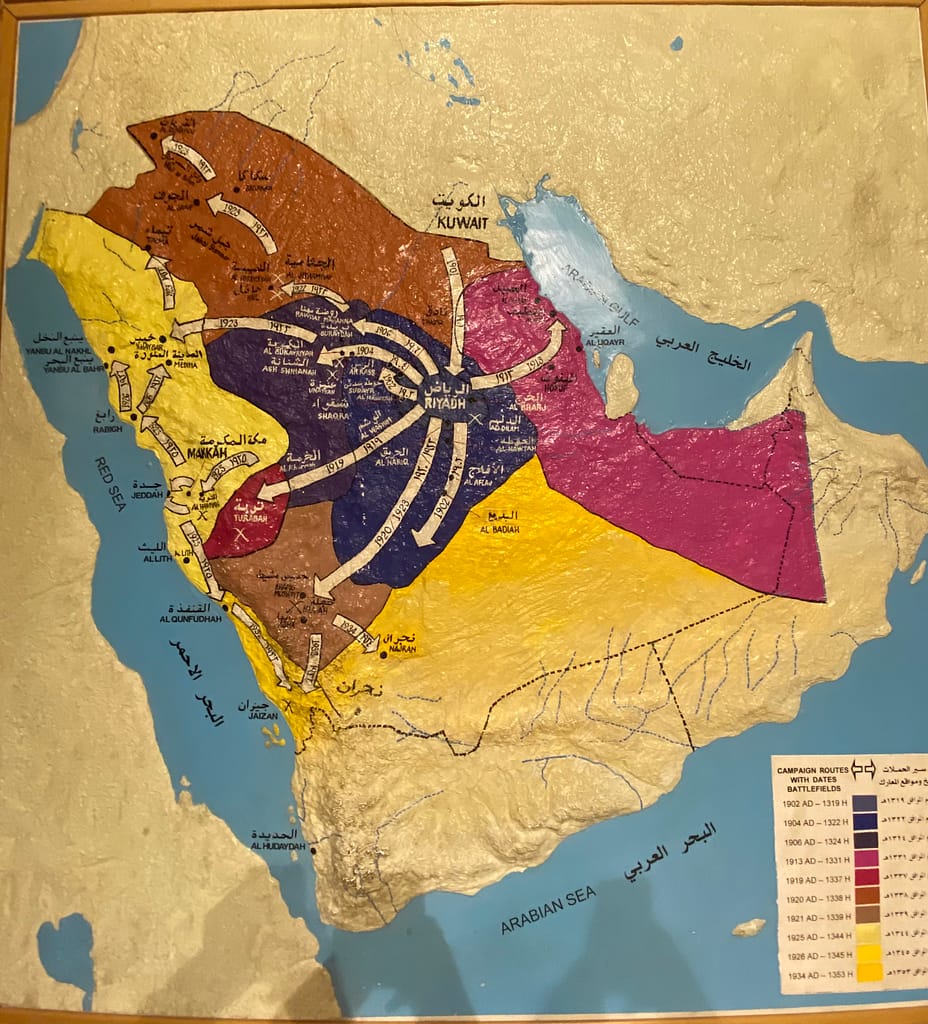
In hindsight, the Riyadh raid was clearly the watershed moment in the history of the Al Sauds. Without it, the Al Saud family might have languished in obscurity, remembered only as exiles from Najd. With it, Abdulaziz gained both a base and a founding legend for the Third Saudi State. From Riyadh he would:
- Expand across Najd in the 1900s.
- Defeat the Rashidis decisively by 1921.
- Incorporate al-Hasa in 1913, extending his reach to the Gulf coast.
- Leverage alliances and warfare to dominate central Arabia.
- Eventually unify the Kingdom of Saudi Arabia in 1932.
Every later conquest — from Hasa to the Hejaz — traced back to Riyadh as the starting point. In strategic terms, the raid showed that bold action, executed with precision and symbolic resonance, could substitute for numerical inferiority. It was a lesson Ibn Saud never forgot, and one that underpinned the expansion of his power across Arabia.
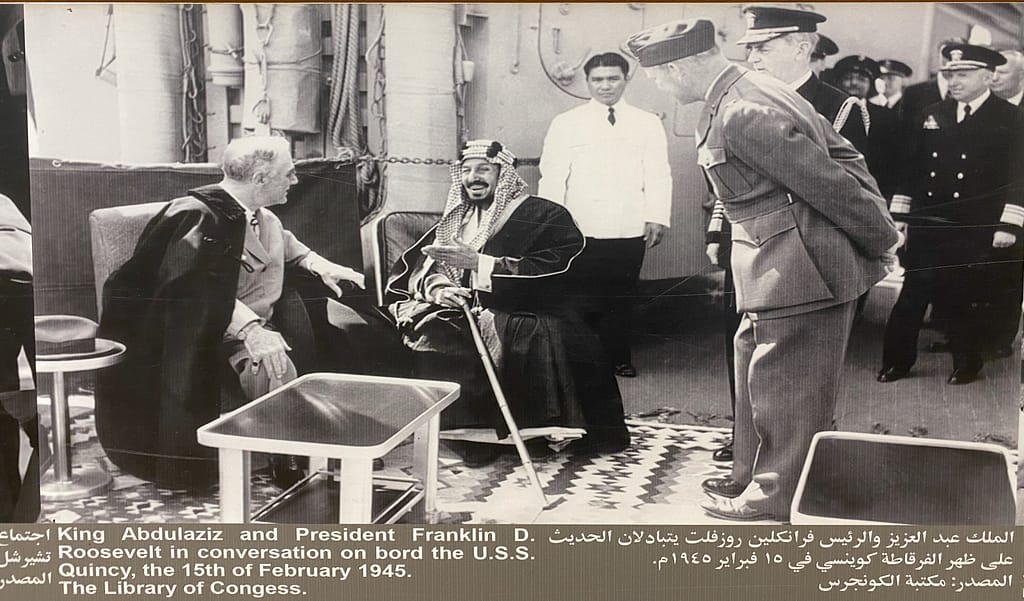
On 23 September 1932, Abdulaziz proclaimed the union of his dominions into the Kingdom of Saudi Arabia. The 28 tribes that allied with Abdulaziz for the unification wars continue to be influential in Saudi politics.
Al Masmak fort today
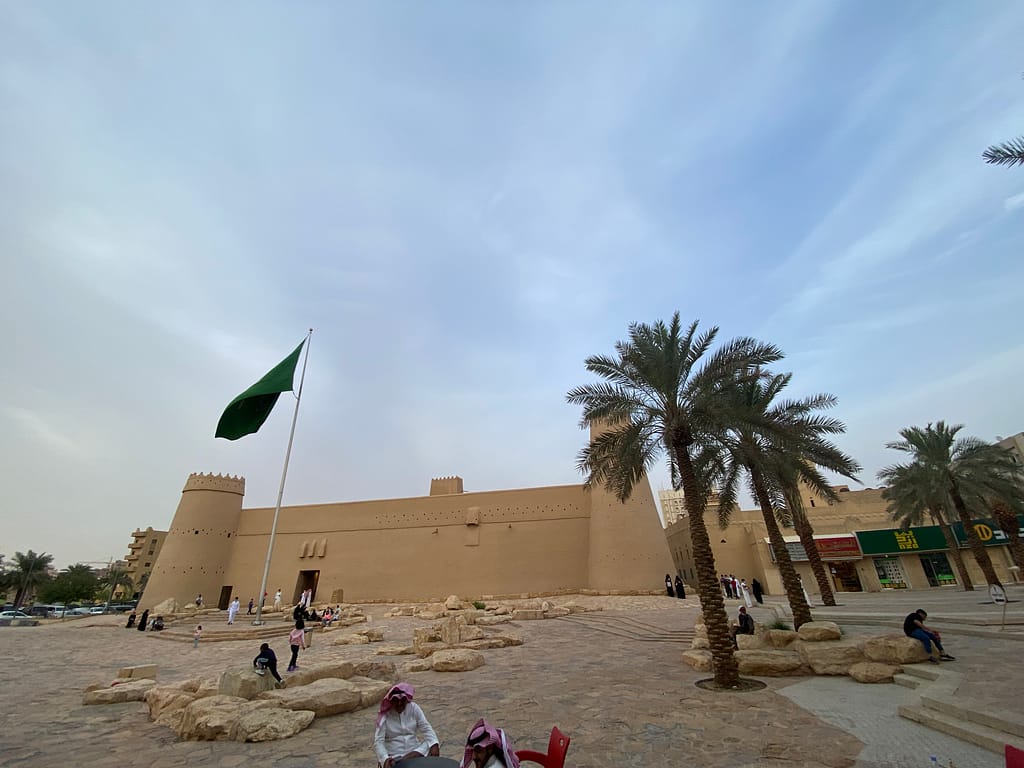
Following the unification of Saudi Arabia, Al Masmak fort continued to house the Riyadh garrison and later served as an armaments store. In 1979, the Riyadh Governor, Prince Salman bin Abdulaziz Al Saud (now King of Saudi Arabia) directed the fort’s restoration and it was opened as a museum in the 1990s. It was eventually incorporated into the ‘King Abdulaziz Historical Centre’, which includes several restored Riyadh districts and a superb National Museum that tells the story of Arabia from earliest times to the present.
Link to the Visit Saudi Al Masmak Palace website
The fort is made of mud brick and clay, similar to the construction of Afghan Qualas. My Saudi friends tell me that Afghan craftsmen are sometimes brought in to assist with traditional building techniques. The mud brick and clay construction erodes rapidly with weather and rain (not that there is much rain in Riyadh), so requires constant maintenance.
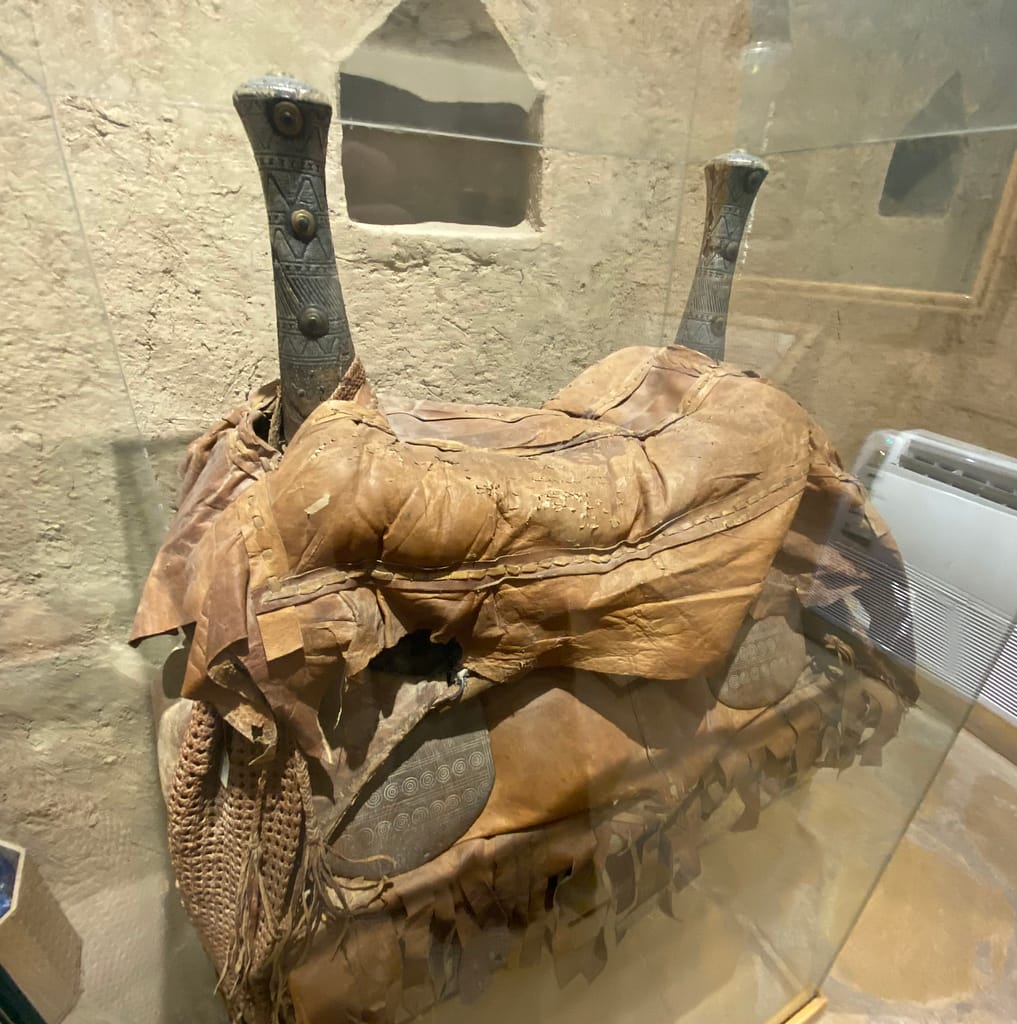
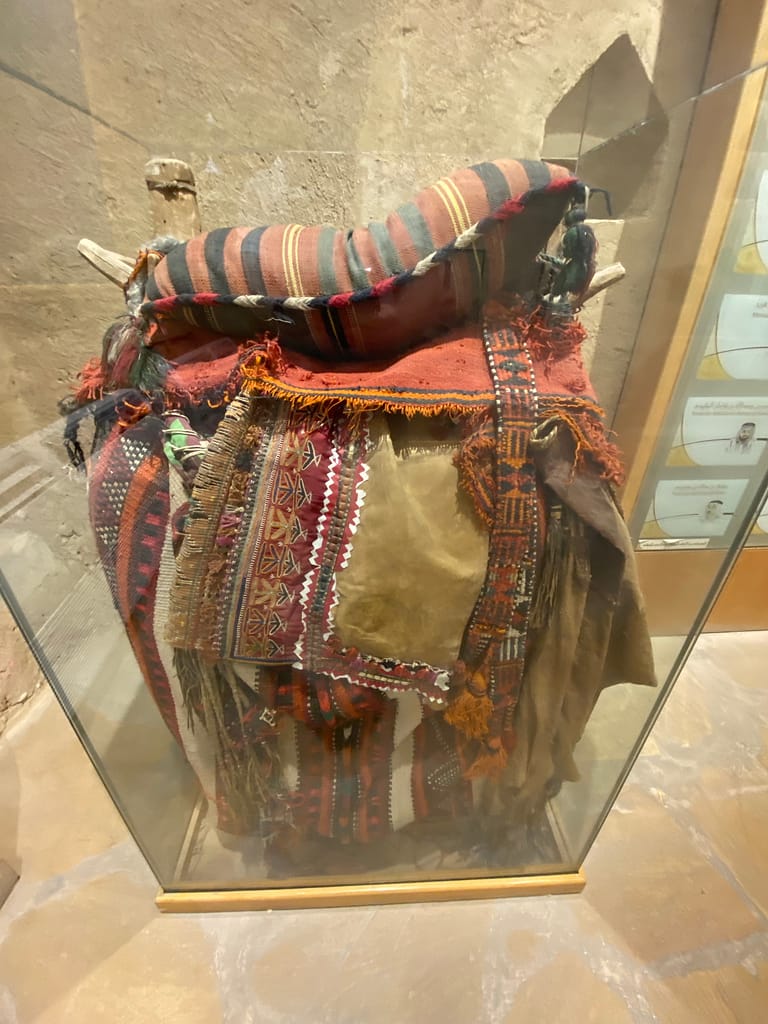
Of great interest, and one of the fort’s feature exhibits, is the original palm-log main gate, with the tip of Ibn Jalawi’s spear still embedded from the 1902 battle. The fort also houses an excellent museum with antique uniforms, traditional dress, weapons, photos and artefacts from the period. The fort precinct includes a park that is very popular with the locals, and is also surrounded by the Old City markets, where you can buy clothes, abayas, and souvenirs. And there are some very nice little antique stores – antique coffee pots and decorative daggers are a big thing.
Found this useful? Buy me a coffee — it helps fund future battlefield research


Authored by Mick Prictor, a retired military officer with 40 years’ service, and a military historian specialising in terrain-focused analysis of tactics, doctrine, and command decision-making in land warfare. His work draws on extensive battlefield fieldwork—more than 280 sites worldwide—and one of the world’s largest private collections of historic military arms, uniforms, and equipment. About me
Sources & Further Reading


📚 Further Reading – Saudi Wars of Unification
This battle study nests within the broader analytical framework explored in the Research Hub, where operational methods, operating environments, armies, commanders, and weapons are examined across conflicts and eras. The links below connect related studies across the wider body of battlefield analysis on the BattlefieldTravels site.
⚔️ Explore all battle studies related to the Saudi States
🏛️ Explore the museum of World War One historic weapons and equipment
🗞️ For updates on new battlefield studies and research insights, you can subscribe to the Newsletter.
Related Battle Studies, Museum Pieces & Reading Resources


🧭 Battlefield Travel Guide: Riyadh & Al Masmak Fort (1902)
Getting There
- Nearest City: Riyadh, capital of Saudi Arabia.
- Transport: Fly into King Khalid International Airport; taxis and ride-hailing (Uber/Careem) to the historic centre.
- Location: Al Masmak Fort sits in the Al Dirah district (old Riyadh).
- Parking: Public parking lots and street parking around the fort/souq area.
Site Orientation
- Key Landmark: Al Masmak, a 19th-century mud-brick citadel central to Ibn Saud’s recapture of Riyadh in January 1902.
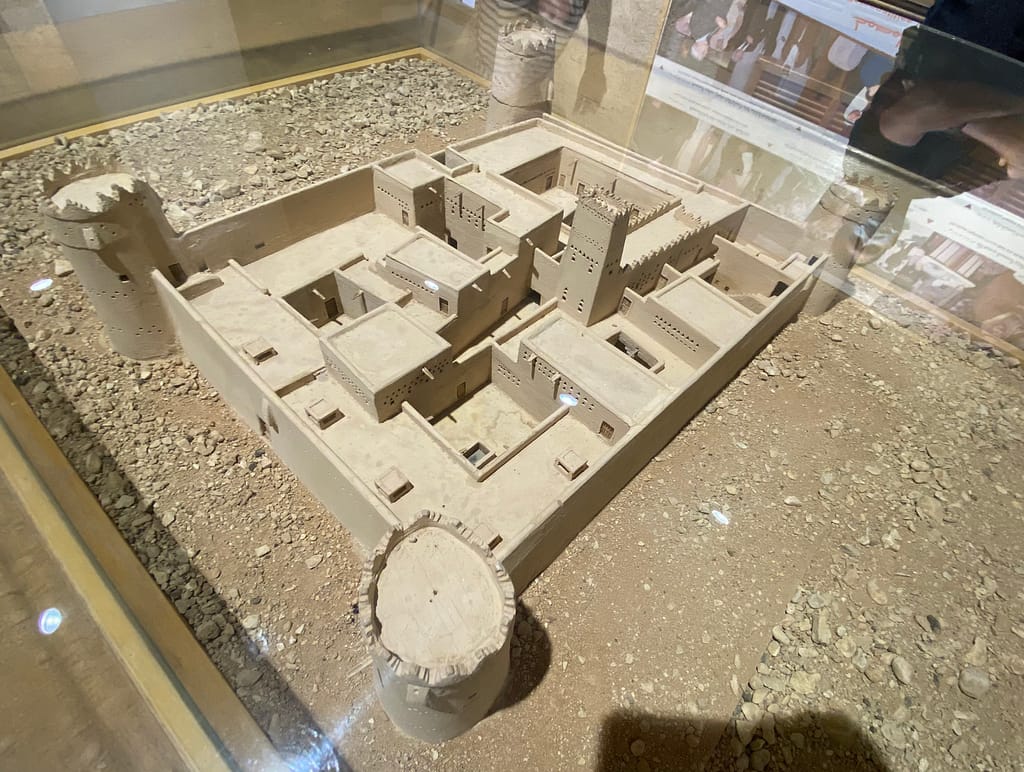
- Layout: Square plan with four corner towers, central courtyard, prayer room, galleries, and a massive palm-wood gate.
- Best Vantage Points: The main gate (site of the assault) and the courtyard/battlements for overall orientation.
Museums & Visitor Centres
- Al Masmak Fortress Museum: Exhibits on the 1902 raid, unification of Saudi Arabia, period weapons, clothing, and photographs.
- Interpretive Media: Bilingual panels (Arabic/English) and short films recount the operation.
- Nearby: National Museum of Saudi Arabia & King Abdulaziz Historical Center (broader context, 10–15 min drive).
On-Site Experience
- Interpretive Signage: Clear indoor/outdoor panels; staff often provide extra context.
- Atmosphere: Restored mud-brick architecture within the old souq precinct gives strong period feel.
- Guides: Museum staff and licensed guides available; English materials provided.
Nearby Points of Interest
- Al Dirah (Deira) Souq: Traditional market adjacent to the fort.
- Diriyah (At-Turaif): UNESCO World Heritage site, birthplace of the first Saudi state (north-west of Riyadh).
- Murabba Palace: Early 20th-century royal complex within the King Abdulaziz Historical Center.
Practical Tips
- When to Visit: Evenings (cooler, lively souq); check local holidays for opening times.
- Facilities: Restrooms, small gift shop; cafés and restaurants within walking distance.
- Etiquette: Modest dress required; be mindful when photographing people. Security rules may limit tripods/drones.
FAQ: Battle of Riyadh (1902)
Ibn Saud and a small band of followers stormed the Al Masmak Fort in Riyadh, capturing it from the Rashidi garrison.
It marked the beginning of the unification of Arabia under the House of Saud.
Ibn Saud’s force launched a surprise attack when the Al Masmak gate was open, killed the Rashidi governor, and secured control of Riyadh.
A restored heritage site and museum dedicated to the founding of the Saudi state.
Yes, the fort is open to the public in Riyadh, with exhibits on the 1902 raid and Saudi history.
Subscribe to Battlefield Travels and receive a free E-Book Battlefield Guide
Unlock expert battlefield analysis, campaign reconstructions, and historical insights drawn from firsthand exploration and primary sources.
🗺️ You’ll receive:
🎖️ Exclusive historical insights you won’t find elsewhere
📘 A free eBook: 10 Tips for Exploring Historic Battlefields
📰 New battlefield studies straight to your inbox as they are published

⚔️ Go deeper — Members get exclusive access to the Deep Research Collection, Field Notes, and monthly Research Dispatches. Try membership free for 7 days, cancel anytime. From $9/month.