Washington’s crossing and the victory at Trenton!
On the morning of 26 December 1776, General George Washington’s army struck across the Delaware River and defeated a Hessian garrison at Trenton. The surprise victory revived the American cause at a moment of crisis.

Key facts
Google Earth map – location of key sites for the Battle of Trenton
Strategic context: the 1776 campaign
The Battle of Trenton on 26 December 1776 was a much-needed victory for General George Washington and the Continental Army.
The 1776 campaign had gone poorly for Washington and his army. General Howe’s British forces had driven the Continentals out of New York and New Jersey, and the Americans were plagued by low morale and falling enlistments. As the campaigning season ended, Howe’s army settled into winter garrison quarters throughout New Jersey, including a force comprised of German mercenaries at Trenton, New Jersey.
Opposing forces: Hessian mercenaries versus Americans
 American forces
 American forces
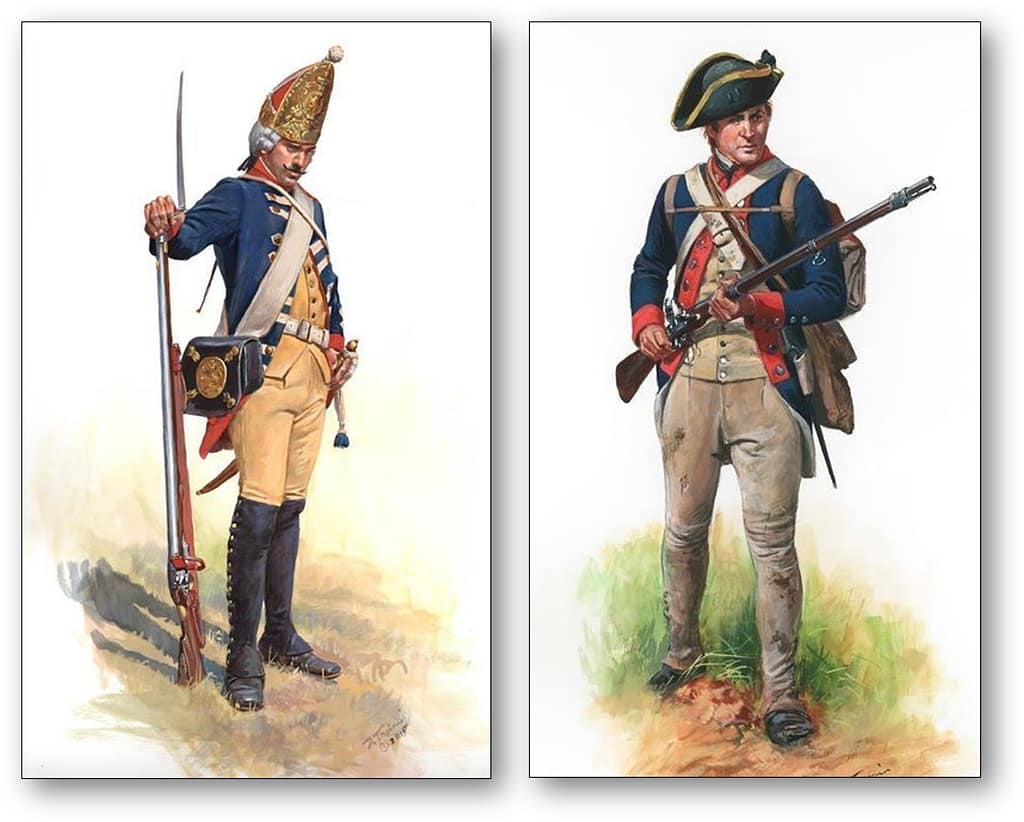
General George Washington commanded a total force of about 7,000 troops before Trenton. The Continental Army contingent was divided into two divisions: Major General Nathanael Greene’s Division and Major General John Sullivan’s Division. Colonel Henry Knox commanded Washington’s artillery. Brigadier General John Cadwalader and Brigadier General James Ewing commanded militia brigades. Due to difficulties crossing the icy Delaware River, only about 2,400 troops of Green’s and Sullivan’s Divisions were engaged at Trenton. Washington’s troops had experienced a series of defeats in the 1776 campaign season and suffered from the harsh winter conditions and limited logistic support.
 Hessian forces
 Hessian forces
The ‘Hessians’ were German mercenaries serving under British command. They were generically referred to as ‘Hessians’ and, while the majority were provided by the German principalities of Hesse-Kassel and Hesse-Hanau, many were also supplied by other German states. At its peak, the ‘Hessian’ contingent of German mercenaries comprised up to 25% of the British Army’s total strength in North America.
At Trenton, the Hessian force comprised about 1,400 troops under the command of Colonel Johann Rall. These troops were from three regiments: Rall, Lossberg, and Knyphausen Regiments, each named after its commander. The Hessian mercenaries were well-trained and experienced, but they were caught off guard by the American surprise attack, partly due to a false sense of security and the belief that the Continental Army was incapable of mounting offensive operations.
The Battle of Trenton
Washington’s plan
To regain the initiative after the defeats in the 1776 campaign season, Washington planned a surprise attack against the Hessian garrison at Trenton. The attack comprised three force elements:
- a diversionary attack by General Cadwalader against the small British force at Bordentown 9km downstream from Trenton,
- a crossing of Assunpink Creek opposite Trenton by General Ewing with about 700 troops, and
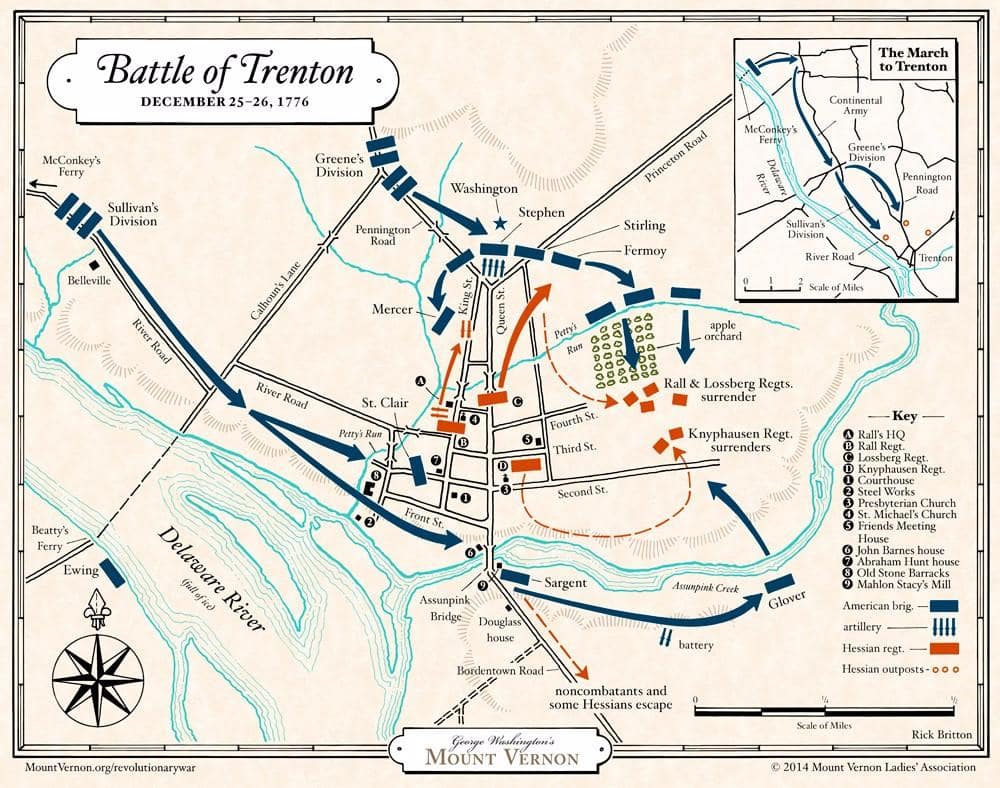
- the main attack by General Washington with about 2,400 troops who would cross the Delaware 14km north of Trenton.
Crossing the Delaware
Icy conditions on the Delaware prevented Cadwalader and Ewing from making their crossings, but Washington was successful and had his force across the Delaware by about 0300hrs on 26 December 1776. Washington’s force split into two elements and made a rapid approach march against Trenton. The 1,400-man Hessian garrison was complacent in its security posture and failed to detect the approaching American forces.

The surprise attack on Trenton
Double pincer attack
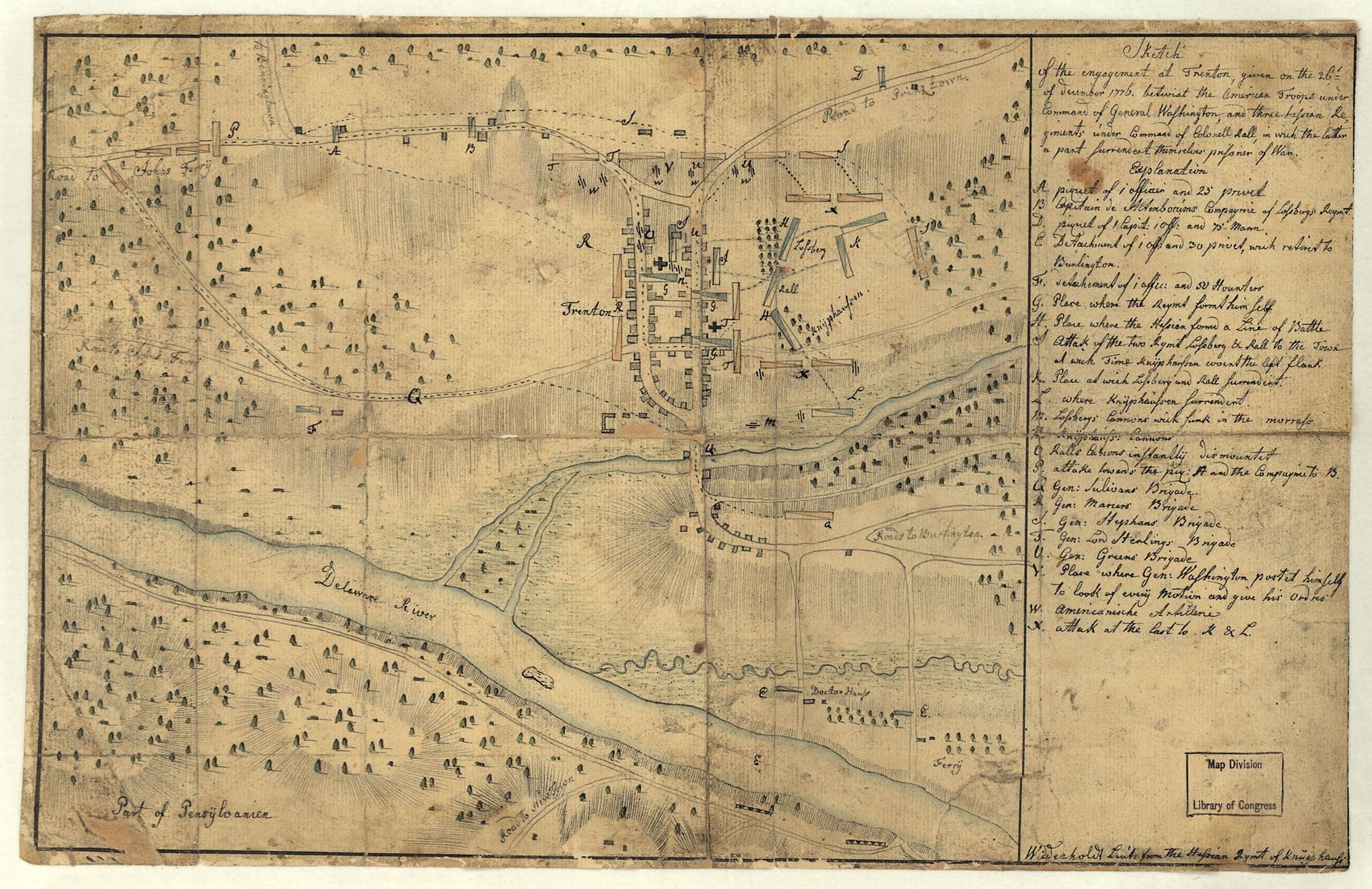
By about 0800hrs, Washington’s force launched its attack from both the north under General Greene and from the south under General Sullivan. First contact was with a Hessian outpost about a mile northwest of Trenton. The Hessian commander, Lieutenant Andreas Wiederholdt, sounded the alarm, and Hessian troops rushed into the street. Both sides exchanged volleys, and the Hessians realised they were outnumbered and at risk of being surrounded. The Hessians began a fighting retreat into Trenton, gaining some reinforcements as they fell back to the main position.
⚔️ Go deeper — Members get exclusive access to the Deep Research Collection, Field Notes, and monthly Research Dispatches. Try membership free for 7 days, cancel anytime. From $9/month.
Fighting on the streets of Trenton
At about this time, the American southern column under General Sullivan broke into Trenton and cut off the Hessian withdrawal routes. Sullivan’s force rapidly drove out the Hessian outposts. The main Hessian forces in the town now formed for battle, with the Rall Regiment and Lossberg Regiment positioned on lower King Street and the Knyphausen Regiment positioned on Queen Street. American artillery on the far bank now began firing into the massed Hessian ranks. The Hessians managed to get some light infantry guns into action, but the American artillery rapidly neutralised these.
The Hessian Rall Regiment attempted an assault on Greene’s force but was beaten back with heavy losses. Colonel Rall was mortally wounded in the attempt. With American troops on all sides, all of their senior commanders either dead or wounded, their artillery destroyed, and losses mounting, the Hessian resistance rapidly collapsed. The Hessian force surrendered.

Outcomes of the Battle of Trenton
Losses
The Hessian commander, Colonel Johann Rall, was mortally wounded in the fighting, along with several of his regimental commanders and about 20 others. Nearly 1,000 Hessians were captured as prisoners of war. The prisoners were held in prisoner-of-war camps, and many eventually settled in America rather than return to a fairly brutal life in their German homelands.
Battle of Princeton
A week later, British reinforcements under Lieutenant Colonel Cornwallis gathered from around the state and attacked Washington’s army in Trenton, but the two forces fought to a draw. Washington then made a surprise march around Cornwallis’ Army to launch an attack on 3 January 1777 against the small British force at Princeton NJ, 12 miles to the north. Princeton was another significant victory for Washington. Although these were both relatively small battles, they revived the morale of the Continental Army and prepared it for greater efforts in the 1777-78 campaigns.
The Trenton battlefield today
The battlefield is in and around the urban area of Trenton NJ. ‘The Old Barracks’ in Trenton is a restored 1758-vintage military barracks, and is now home to an excellent visitor centre and museum. Some of the Hessian troops used the barracks during the battle. Washington’s crossing site, 9-miles (14 km) north of Trenton, is well-marked and is home to several monuments to Washington’s crossing and the American victory.

The site of the Battle of Trenton is preserved and commemorated through various historical landmarks and museums. The Trenton Battle Monument, erected in 1893, is a tribute to the American victory and the soldiers who fought there. The monument marks the spot where Washington’s artillery was positioned during the battle.
Annual reenactments and commemorative events are held to honour the battle and its impact on American history. These events allow the public to engage with the history of the Revolution and appreciate the sacrifices made.
Link to the Trenton Revolutionary War battle sites website

Additional images of Trenton battlefield


Found this useful? Buy me a coffee — it helps fund future battlefield research


Authored by Mick Prictor, a retired military officer with 40 years’ service, and a military historian specialising in terrain-focused analysis of tactics, doctrine, and command decision-making in land warfare. His work draws on extensive battlefield fieldwork—more than 280 sites worldwide—and one of the world’s largest private collections of historic military arms, uniforms, and equipment. About me
Sources & Further Reading
- Richard M. Ketchum (1991). The Winter Soldiers. Anchor Press.
- David Hackett Fischer (2006). Washington’s Crossing (Pivotal Moments in American History). Oxford University Press.
📚 Further Reading: American Revolutionary War
This battle study nests within the broader analytical framework explored in the Research Hub, where operational methods, operating environments, armies, commanders, and weapons are examined across conflicts and eras. The links below connect related studies across the wider body of battlefield analysis on the BattlefieldTravels site.
⚔️ Explore all battle studies from the American Revolutionary War
🏛️Explore the museum of American Revolutionary War historic weapons and equipment
The book list for this conflict includes the finest campaign studies, memoirs, and operational analyses available on the American Revolutionary War, selected specifically to complement this battlefield study.
📚 American Revolutionary War 1775-1783 – Recommended Reading
🗞️ For updates on new battlefield studies and research insights, you can subscribe to the Newsletter.
Related Battle Studies, Museum Pieces & Reading Resources


🧭 Battlefield Travel Guide: Trenton (26 December 1776)
Getting There
- Nearest City: Trenton, New Jersey, USA.
- Access: By road via I-295 or US-1; rail connections from New York and Philadelphia to Trenton Transit Center.
- Parking: Public parking near the Old Barracks Museum and Trenton Battle Monument.
Site Orientation
- Key Landmarks: Trenton Battle Monument (Broad & Warren); Old Barracks Museum; Assunpink Creek line (Second Trenton); interpretive panels downtown.
- Best Vantage Points: Monument plaza for approach routes; Assunpink Creek bridges for terrain appreciation; Old Barracks interior for garrison perspective.
- Walking Routes: Downtown heritage trails linking the Monument, Barracks, and street-fighting locations.
Museums & Visitor Centres
- On-site: Old Barracks Museum — Hessian quarters, Revolutionary War exhibits, guided tours. The museum website is not currently working and the notice says that the museum is undergoing renovation.
- Nearby: Washington Crossing Historic Park (≈14 km NW) preserving the crossing site and visitor facilities.
On-Site Experience
- Interpretive Signage: Panels throughout central Trenton identify unit positions and 26 December street actions.
- Atmosphere: Modern streets overlay the battlefield but retain scale; Old Barracks interiors convey 18th-century conditions.
Nearby Points of Interest
- Related Sites: Princeton Battlefield State Park (follow-on action); Morven Museum & Garden (Princeton); Monmouth Battlefield (campaign context).
- Local: New Jersey State Museum and State House; Delaware River waterfront walks.
Practical Tips
- When to Visit: Anniversary reenactments late December; spring and autumn offer best walking conditions.
- Facilities: Visitor amenities at Old Barracks and Washington Crossing; cafés and restaurants in downtown Trenton.
- Notes: Urban traffic/parking can be busy — allow time to move between sites; Trenton and Princeton can be combined in one day.
Subscribe to Battlefield Travels and receive a free E-Book Battlefield Guide
Unlock expert battlefield analysis, campaign reconstructions, and historical insights drawn from firsthand exploration and primary sources.
🗺️ You’ll receive:
🎖️ Exclusive historical insights you won’t find elsewhere
📘 A free eBook: 10 Tips for Exploring Historic Battlefields
📰 New battlefield studies straight to your inbox as they are published

⚔️ Go deeper — Members get exclusive access to the Deep Research Collection, Field Notes, and monthly Research Dispatches. Try membership free for 7 days, cancel anytime. From $9/month.
