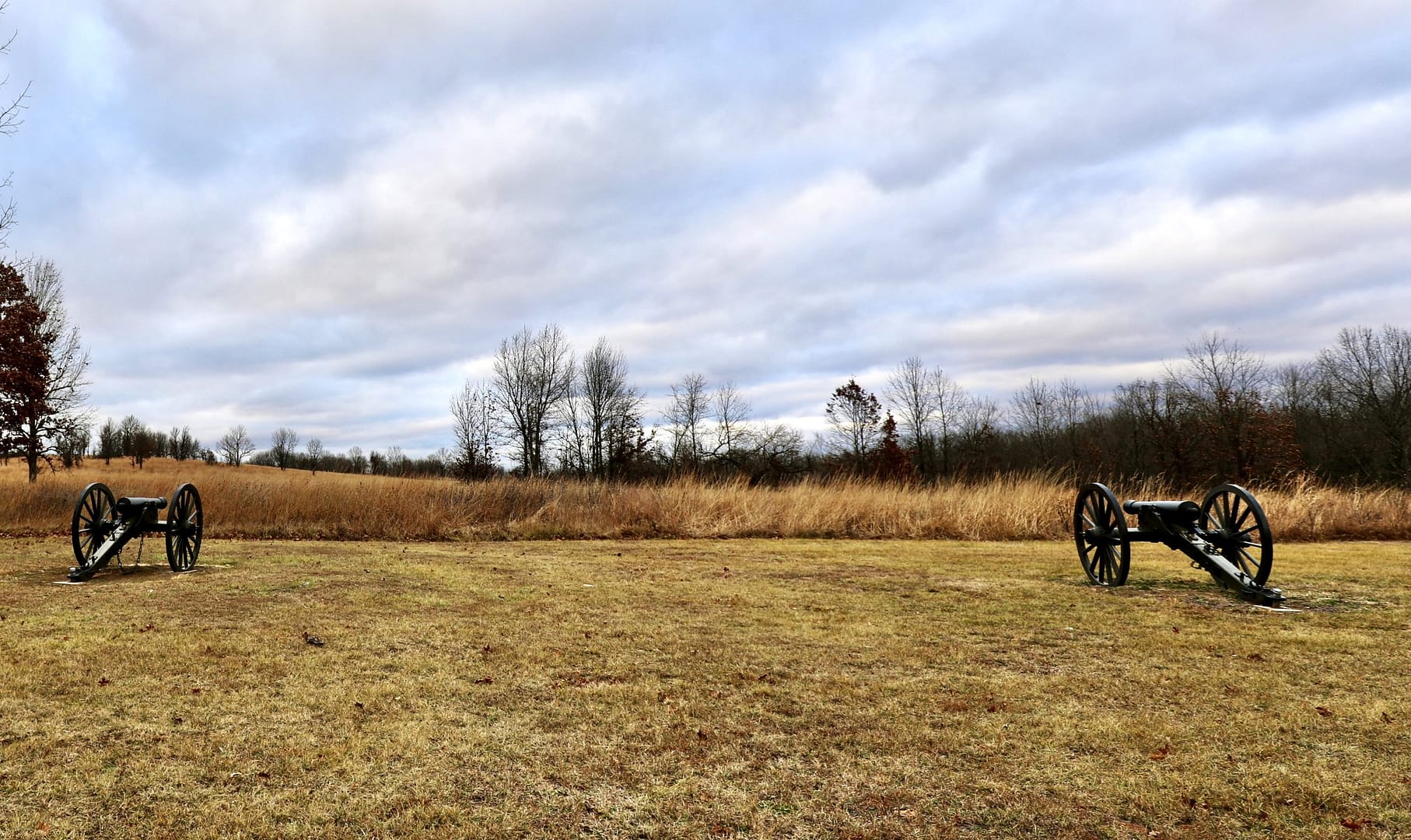
Wilson’s Creek: First major battle west of the Mississippi!
On 10 August 1861, Union and Confederate forces clashed at Wilson’s Creek near Springfield, Missouri. Often called the “Bull Run of the West,” the battle marked the first major Civil War engagement west of the Mississippi.
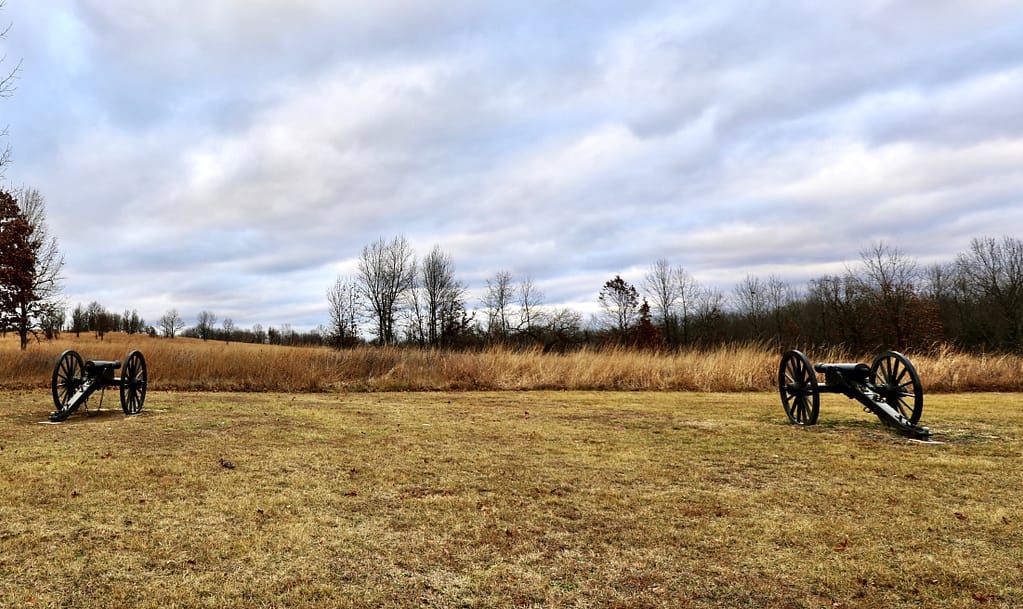
Key facts
Google Earth map – Location of the Wilson’s Creek battlefield
🧭🥾 Walking the Battlefield
I explored the Wilson’s Creek battlefield in December 2019. I was armed with several excellent accounts and my own digital mapping products. Our first stop was the small museum and visitor centre at Wilson’s Creek, where we received an excellent orientation on the battlefield. The battlefield is relatively small but incredibly insightful. The Union’s operational plan and the tactics employed here were highly innovative for a mid-19th-century battle, indicating to me that Brigadier General Nathanial Lyon was a student of Antoine-Henri Jomini and his writings on operational art. Double envelopment, penetrating attacks, operating on arcs – it was all there in Lyon’s approach.
Why Wilson’s Creek mattered in the Civil War
The Battle of Wilson’s Creek, Missouri, on 10 August 1861, was the second major battle of the American Civil War (after 1st Bull Run) and the first major battle west of the Mississippi. After a decade of conflict between pro-slavery and anti-slavery factions along the Kansas-Missouri border, there was already a long history of enmity, conflict and atrocity in this theater. In this sparsely populated area, the armies were smaller, less well equipped, and operated on more tenuous supply lines than other theaters.
In August 1861, a small Union army of about 5,400 troops under Brigadier General Nathaniel Lyon was actively campaigning to keep Missouri from going over to the Confederacy. Lyon was a bold and aggressive leader. A mixed Confederate force of about 12,500 troops under Major General Sterling Price was looking for him. They met at Wilson’s Creek, near Springfield Missouri, on 10 August 1861.
Battle of Wilson’s Creek – the Bull Run of the West
A deeply divided region
At the outbreak of the Civil War in April 1861, Missouri was a deeply divided border state. The state government, led by pro-Southern Governor Claiborne Fox Jackson, leaned toward secession. However, a significant portion of the population, particularly in the northern and central parts of the state, supported the Union. The federal government, recognizing Missouri’s strategic importance due to its location and control over the Mississippi River and key railroads, was determined to keep it within the Union.
Brigadier General Nathaniel Lyon, a fervent Unionist and commander of the Union forces in Missouri, took decisive action to secure the state. In June 1861, Lyon’s forces successfully drove the pro-Confederate Missouri State Guard, led by Major General Sterling Price, out of Jefferson City, the state capital. Missouri Governor Claiborne Jackson was also forced to flee. Price and Jackson retreated to southwest Missouri, gathering support and preparing to challenge Union control.
By August 1861, the Missouri State Guard had joined forces with Confederate troops under Brigadier General Benjamin McCulloch and Arkansas State troops, creating a combined force of approximately 12,500 men. Lyon, with around 5,400 Union soldiers, decided to take the offensive and confront the larger Confederate force near Wilson’s Creek, southwest of Springfield.
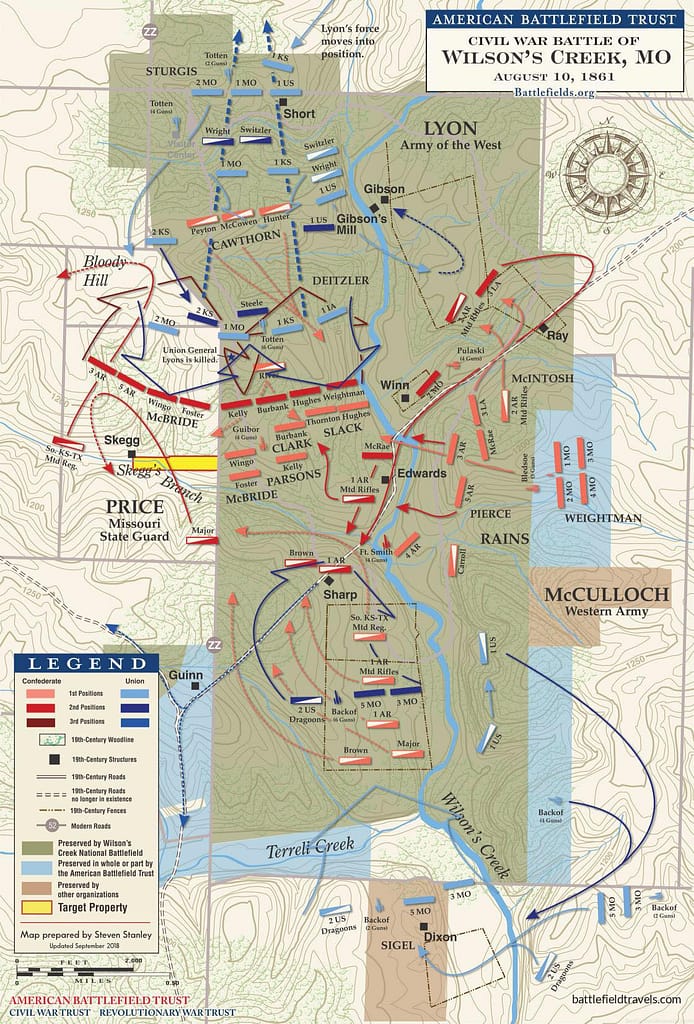
Brigadier-General Lyon’s double-envelopment
Lyon took the initiative with a bold plan that would definitely get you an ‘A Pass’ at Staff College. On the night of August 9, 1861, Lyon devised a plan to surprise the Confederate forces. He split his army into two columns: one led by himself and the other by Colonel Franz Sigel. Lyon’s force would attack the Confederate camp from the north, while Sigel’s column would strike from the south, hoping to catch the enemy in a pincer movement.
At dawn on August 10, Lyon’s troops launched their attack, surprising the Confederate camp and initially driving them back. The fierce fighting centred around a ridge that would later be known as “Bloody Hill.” The Union attack was halted but the Union troops held their ground despite being outnumbered, engaging in vicious combat with Price’s Missouri State Guard and McCulloch’s Confederate troops.
Colonel Sigel’s attack defeated
Meanwhile, Sigel’s column successfully attacked from the south, initially causing confusion among the Confederate ranks. However, Sigel’s troops mistakenly identified a Confederate regiment dressed in similar gray uniforms as friendly forces. This error allowed the Confederates to launch a counterattack, forcing Sigel’s men to retreat in disarray.

Brigadier-General Lyon killed
Back on Bloody Hill, Lyon continued to rally his troops, even after being wounded twice. His leadership inspired his men to hold their positions against repeated Confederate assaults. General Lyon was killed in action while leading a charge, thus becoming the first Union general to die in the Civil War. Command of the Union forces fell to Major Samuel D. Sturgis.

Despite Lyon’s death and mounting casualties, the Union forces continued to resist the Confederate attacks. However, by mid-morning, the Union troops were exhausted, low on ammunition, and facing overwhelming numbers. Sturgis, recognizing the untenable situation, ordered a retreat to Springfield. The Confederates, equally battered and disorganized, did not pursue aggressively, allowing the Union forces to withdraw in relatively good order.

Aftermath and Significance
The Battle of Wilson’s Creek resulted in about 1,317 Union and 1,222 Confederate casualties, making it one of the bloodiest of the early Civil War battles. While the Confederate forces technically won the battle by forcing the Union to retreat, the victory was not decisive enough to secure Missouri for the Confederacy.
The death of General Lyon was a significant blow to the Union cause, but his aggressive actions had succeeded in disrupting Confederate plans to seize control of Missouri. The battle also demonstrated the challenges of commanding mixed forces with varying degrees of training and loyalty, as seen in the coordination difficulties between McCulloch’s Confederate troops and Price’s Missouri State Guard.
Following the battle, the Confederate forces, plagued by supply issues and internal disagreements, failed to capitalize on their victory. They eventually withdrew from Missouri, allowing Union forces to reassert control over much of the state. The Union’s ability to retain Missouri was crucial for maintaining control of the Mississippi River and securing the western territories.
⚔️ Go deeper — Members get exclusive access to the Deep Research Collection, Field Notes, and monthly Research Dispatches. Try membership free for 7 days, cancel anytime. From $9/month.
Casualties, consequences, and Missouri’s Civil War
The Battle of Wilson’s Creek had far-reaching strategic and political implications. The Union loss at the Battle of Wilson’s Creek convinced President Lincoln that more resources were required in the west. He sent more troops out west, leading to another confrontation at the Battle of Pea Ridge, Arkansas in March of 1862. The Union’s control over Missouri provided a critical base for future campaigns in the Mississippi Valley and the Trans-Mississippi region.
The battlefield today: visiting Wilson’s Creek National Battlefield
The battlefield is located about 20km southwest of Springfield Missouri on 2433 acres of National Park. As with most American battlefields it is superbly preserved and has an active trust that seeks to keep it that way. There is a small visitors centre and museum with self-guided tour maps. All the major events are well signposted. The battle was relatively small (5400 Union and 12000 Confederate troops engaged) but it was the first major engagement west of the Mississippi, and gave the Confederacy temporary control of southwest Missouri.
Link to the NPS Battle of Wilson’s Creek website
Additional images of Wilson’s Creek battlefield


Battle of Wilson’s Creek. Pan across the area where Sigel attacked.


Found this useful? Buy me a coffee — it helps fund future battlefield research


Authored by Mick Prictor, a retired military officer with 40 years’ service, and a military historian specialising in terrain-focused analysis of tactics, doctrine, and command decision-making in land warfare. His work draws on extensive battlefield fieldwork—more than 280 sites worldwide—and one of the world’s largest private collections of historic military arms, uniforms, and equipment. About me
Sources
Primary Sources
- Official Records of the War of the Rebellion (Series I, Volume III) — battle reports from Union and Confederate commanders.
- Brig. Gen. Nathaniel Lyon’s final dispatches, July–August 1861.
- Gen. Sterling Price’s report on Missouri State Guard operations, 1861.
- Personal accounts in John F. Reynolds, Sketches of the First Missouri Volunteers.
Secondary Sources
- NPS Wilson’s Creek National Battlefield website and interpretive materials.
- Edwin C. Bearss, The Battle of Wilson’s Creek (National Park Service, 1961; updated edition 1985).
- William Garrett Piston & Richard Hatcher, Wilson’s Creek: The Second Battle of the Civil War and the Men Who Fought It (2000).
- Shea, William L. & Hess, Earl J., Pea Ridge: Civil War Campaign in the West (1992) — for wider campaign context.
- Christopher Phillips, Missouri’s Confederate: Claiborne Fox Jackson and the Creation of Southern Identity (2000).
📚 Further Reading – American Civil War
This battle study nests within the broader analytical framework explored in the Research Hub, where operational methods, operating environments, armies, commanders, and weapons are examined across conflicts and eras. The links below connect related studies across the wider body of battlefield analysis on the BattlefieldTravels site.
⚔️ Explore all battle studies from the American Civil War
🏛️ Explore the museum of American Civil War historic weapons and equipment
The book list for this conflict includes the leading campaign studies, memoirs, and operational analyses available on the American Civil War, selected specifically to complement this battlefield study.
📚American Civil War (1861-65) – Recommended Reading
🗞️ For updates on new battlefield studies and research insights, you can subscribe to the Newsletter.
Related Battle Studies, Museum Pieces & Reading Resources
 ⚔️ Battle of Franklin, Tennessee,
30 November 1864
 🏛️ American Civil War (1861–1865) Weapons and Equipment
 ⚔️ Battle of Chancellorsville, Virginia,
27 April – 6 May 1863
 ⚔️ Battle of Pea Ridge, Arkansas,
7-8 March 1862
 ⚔️ 1861–1865 American Civil War, Battle Studies
 📚 American Civil War (1861–1865),
Recommended Reading
🧭 Battlefield Travel Guide: Wilson’s Creek (10 August 1861)
Getting There
- Nearest City: Springfield, Missouri, USA.
- Access: Wilson’s Creek National Battlefield is about 12 miles (19 km) southwest of Springfield via US-60 and MO-FF.
- Parking: Free parking at the visitor centre and at major stops along the tour road.
Site Orientation
- Key Landmarks: Bloody Hill (main Union position); Ray House (used as field hospital); Sharp’s Cornfield; Edwards Cabin site.
- Best Vantage Points: Overlooks on Bloody Hill for terrain appreciation; Ray House porch offers a preserved 19th-century view.
- Walking Routes: Short trails at Bloody Hill and Ray House; extended hiking loops connect multiple battle sites.
Museums & Visitor Centres
- On-site: Wilson’s Creek Visitor Center — exhibits on the battle, uniforms, weapons, and General Lyon’s artefacts.
- Nearby: Springfield National Cemetery (Union and Confederate graves); History Museum on the Square in Springfield.
On-Site Experience
- Interpretive Signage: Panels at all major stops explain troop movements, positions, and battle phases.
- Atmosphere: Rolling fields and wooded ridges retain their 19th-century character, giving strong visual context to the 1861 action.
Nearby Points of Interest
- Related Sites: Pea Ridge National Military Park (Arkansas, 1862); Battle of Carthage State Historic Site (1861).
- Local: Springfield’s Civil War markers; Nathan Boone Homestead State Historic Site.
Practical Tips
- When to Visit: Anniversary events in August; spring and autumn for best hiking weather.
- Facilities: Visitor centre, restrooms, picnic areas; auto tour road is suitable for cars and bicycles.
- Notes: Battlefield is open terrain with limited shade — bring water, hat, and sun protection in summer.
Subscribe to Battlefield Travels and receive a free E-Book Battlefield Guide
Unlock expert battlefield analysis, campaign reconstructions, and historical insights drawn from firsthand exploration and primary sources.
🗺️ You’ll receive:
🎖️ Exclusive historical insights you won’t find elsewhere
📘 A free eBook: 10 Tips for Exploring Historic Battlefields
📰 New battlefield studies straight to your inbox as they are published

⚔️ Go deeper — Members get exclusive access to the Deep Research Collection, Field Notes, and monthly Research Dispatches. Try membership free for 7 days, cancel anytime. From $9/month.