Reconstructing Austro-Prussian War battlefields through terrain analysis, primary sources and on-site research
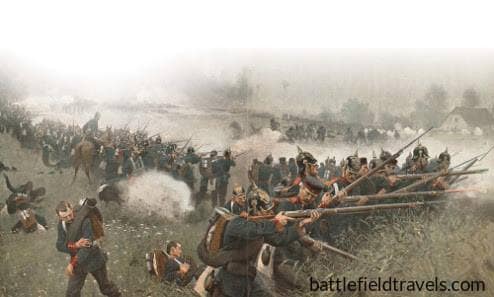
Walking the battlefields of the Austro-Prussian War 1866
Causes of the war
The Austro-Prussian War was a short, decisive campaign that reshaped the political map of Central Europe. Fought over just six weeks, it resolved the long-standing contest between Austria and Prussia for leadership of the German states.
The war was not simply a clash of armies, but a test of competing systems. Prussia brought to the field a modern General Staff, efficient mobilisation based on railways, and a flexible command philosophy that allowed subordinate commanders to act within intent. Austria fielded a large, experienced army with strong artillery and a long military tradition, but struggled to match Prussia’s speed of concentration and coordination.
The Seven-Week War
The campaign unfolded across Bohemia, where multiple Prussian armies advanced on converging axes against Austrian forces under Field Marshal Ludwig von Benedek. Early engagements such as Trautenau and Jičín revealed both the strengths and limitations of each side. Austrian forces could fight effectively and inflict heavy losses, but found it increasingly difficult to maintain coherence against Prussian operational tempo.
The war culminated in the Battle of Königgrätz (3 July 1866), one of the largest battles of the 19th century. Here, the Prussians combined pressure from multiple directions, using coordinated movement and flexible command and the breech-loading Dreyse needle gun to break the Austrian position. The arrival of the Prussian Second Army on the Austrian flank proved decisive, turning a contested battle into a general defeat.
The battlefields today
For the battlefield visitor, the Austro-Prussian War offers a landscape defined by scale and subtlety. Broad agricultural ground, shallow rises, villages, and wooded areas such as the Svíb Forest combine to shape movement and visibility across an enormous battlefield. These are not dramatic landscapes, but they reward close observation. The decisive features are often small, local, and easily overlooked.
The conflict also marks a transition point in warfare. Linear tactics, massed artillery, and traditional formations met emerging systems of command, mobility, and firepower. The result was not an immediate revolution, but a clear indication of the direction in which European warfare was moving.
Field Notes: Austro-Prussian War
Below are all current BattlefieldTravels studies for the Austro-Prussian War, covering key battles, campaign phases and associated sites. New studies are added as further battlefields are walked and analysed.
-
📝🔒Field Note: Battle of Königgrätz, Czech Republic, 3 July 1866 — the fight for Chlum

June 2017. Chlum Village, just outside modern Hradec Králové, Czech Republic. I visited Chlum during my exploration of the Königgrätz battlefield in 2015 and again in 2017. I explored Sadowa, Rozběřice, Chlum, the Svíb Forest, and the southern sector around Nechanice. The modern battlefield is quiet, agricultural, and deceptively open. It takes some effort to…
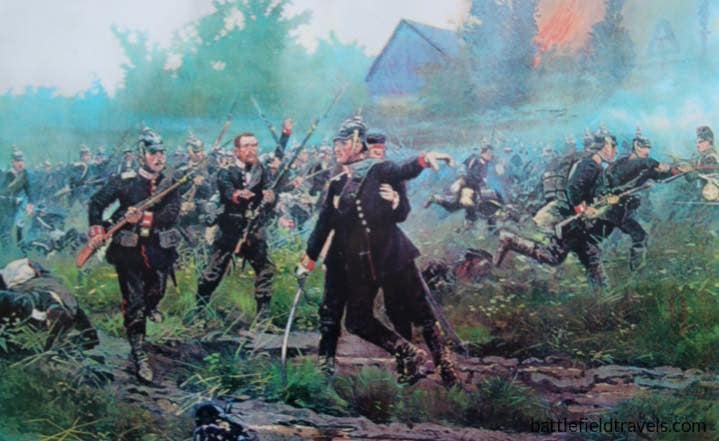
Tactical Innovations: Austro-Prussian War
Below are all current BattlefieldTravels tactical innovations for the Austro-Prussian War, covering technology, tactics and warfighting philosophies that fundamentally changed warfare. New studies are added as further battlefields are walked and analysed.
-
💡1866: Königgrätz, the Dreyse Needle-Gun and the Dawn of Mission Command

At the tactical level, Prussia’s victory over Austria at the Battle of Königgrätz can be attributed to: a weapons revolution, a command philosophy revolution, and innovative tactics. Together, they formed a tactical innovation with profound implications for the future of warfare. As recently as 1859, the Austrian shock tactic doctrine had been the dominant tactical…

Authored by Mick Prictor, a retired military officer with 40 years’ service, and a military historian specialising in terrain-focused analysis of tactics, doctrine, and command decision-making in land warfare. His work draws on extensive battlefield fieldwork—more than 280 sites worldwide—and one of the world’s largest private collections of historic military arms, uniforms, and equipment. About me
⚔️ Go deeper — Members get exclusive access to the Deep Research Collection, Field Notes, and monthly Research Dispatches. Try membership free for 7 days, cancel anytime. From $9/month.
Explore Related Themes
Armies: Prussian Army • Austrian Army • Saxon Army
Commanders: Helmuth von Moltke • Field Marshal Ludwig von Benedek
Methods: Mounted warfare • Siege warfare • Encounter battle
Environments: Forest Warfare • Mountain Warfare
Further Study: Franco-Prussian War Reading List
Related Battle Studies, Museum Pieces & Reading Resources


The war of 1866 was the decisive clash in the struggle for supremacy over the German states — a rivalry between Austria and Prussia that had simmered since the Frankfurt Parliament of 1848. The immediate trigger was a dispute over the administration of Schleswig-Holstein, seized jointly from Denmark in 1864, but the deeper cause was Bismarck’s calculated determination to exclude Austria from German affairs and establish Prussian dominance over a unified German state.
The campaign unfolded across the rolling farmland, river crossings, and wooded ridgelines of Bohemia — modern Czech Republic. The Prussian ability to concentrate three armies rapidly through mountain passes and converge on the Austrian position before it could be reinforced made terrain management a decisive factor. At Königgrätz the Bistritz stream and the Svib Forest anchored the Austrian left and centre, while the Prussian Guard’s advance through the Maslowed forest on the Austrian right flank proved catastrophic for Austrian fortunes.
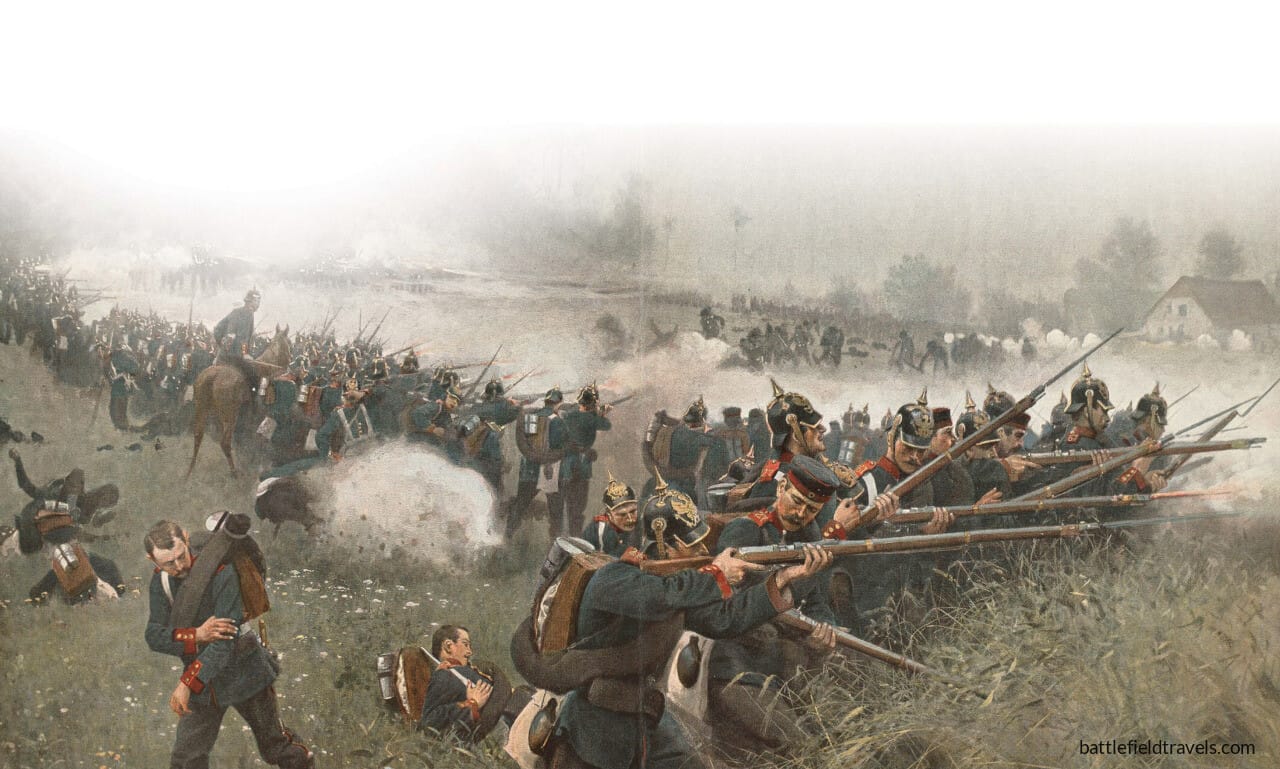
Prussian success in 1866 rested on three decisive advantages — the needle gun, staff work, and command philosophy. The Dreyse needle gun allowed Prussian infantry to fire prone and at a rate of fire Austrian muzzle-loaders could not match. Moltke’s staff system enabled three separate armies to converge on a single point with unprecedented coordination. And a command culture that encouraged initiative at every level — Auftragstaktik in its early form — allowed Prussian commanders to exploit opportunities faster than Austrian headquarters could respond.
Königgrätz — fought on 3 July 1866 — was one of the most consequential battles of the nineteenth century. The destruction of the Austrian Army of the North in a single day ended Austrian influence over German affairs, paved the way for the North German Confederation, and set the conditions for the Franco-Prussian War four years later. It demonstrated that modern staff work, rapid concentration, and superior infantry firepower could defeat a numerically comparable enemy in a single decisive engagement.
Yes — which is why it is sometimes called the Seven Weeks War. From the Prussian invasion of Bohemia on 15 June 1866 to the armistice of 22 July, the campaign lasted 38 days of active operations. The speed of Prussian mobilisation, concentration, and decisive battle left Austria no time to recover or bring its full resources to bear. The brevity of the campaign shocked European observers and fundamentally changed how continental armies thought about war.
The Peace of Prague excluded Austria from the new German political order and ceded Venetia to Italy. Internally, defeat accelerated the constitutional crisis that produced the Ausgleich of 1867 — the compromise that transformed the Austrian Empire into the Austro-Hungarian dual monarchy. Austria turned away from German affairs and towards the Balkans, setting in motion the geopolitical shifts that eventually led to 1914.
Yes. Field research has covered the major engagements of the Bohemian campaign including Königgrätz, Jičín, Trautenau, and Nachod. Additional studies covering the Italian theatre and the secondary German campaign — where Prussian allies fought Austrian-aligned states including Bavaria, Hanover, and Saxony — will be added as research progresses.
Subscribe to Battlefield Travels and receive a free E-Book Battlefield Guide
Unlock expert battlefield analysis, campaign reconstructions, and historical insights drawn from firsthand exploration and primary sources.
🗺️ You’ll receive:
🎖️ Exclusive historical insights you won’t find elsewhere
📘 A free eBook: 10 Tips for Exploring Historic Battlefields
📰 New battlefield studies straight to your inbox as they are published

⚔️ Go deeper — Members get exclusive access to the Deep Research Collection, Field Notes, and monthly Research Dispatches. Try membership free for 7 days, cancel anytime. From $9/month.