Reconstructing French Revolutionary & Napoleonic War battlefields through terrain analysis, primary sources and on-site research
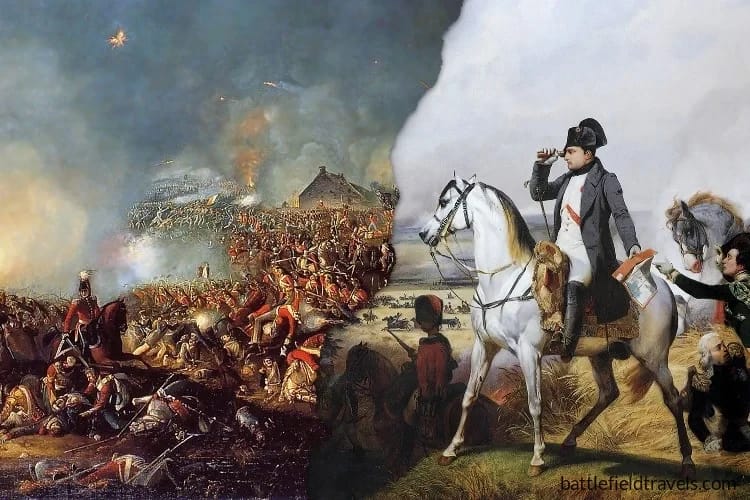
Walking the battlefields of the French Revolutionary Wars and Napoleonic Wars (1792–1815)
Origins of the wars
The French Revolutionary Wars (1792-1802), and the Napoleonic Wars (1803-1815) that followed immediately afterwards, were the culmination of the upheaval unleashed by the French Revolution, fought across Europe between Revolutionary and Napoleonic France and successive coalitions of Britain, Austria, Prussia, and Russia. These campaigns reshaped the political map of Europe and marked a decisive shift in the scale and conduct of warfare. Mass conscription, rapid manoeuvre, and the concentration of force allowed armies to operate with a tempo and reach not previously seen, culminating in a series of battles that remain central to the study of military history.
Campaigns and battles
From the plains of Austerlitz and Wagram to the ridges of Waterloo and the brutal campaigns of the Peninsular War, the conflict was fought across a wide range of terrain. These battlefields reveal how commanders interpreted ground, deployed their forces, and sought to gain advantage through movement, timing, and positioning. Many of the decisive moments in these campaigns were shaped not by grand strategy alone, but by how terrain was read and exploited at the point of contact.
The Napoleonic Wars also generated a lasting intellectual legacy. The experience of mass warfare and decisive battle prompted a generation of soldiers and thinkers to reflect on the nature of war itself. The works of Clausewitz and Jomini, along with the reforms of Scharnhorst and Gneisenau, emerged directly from this period and continue to influence military thought today.
Battle studies and field notes
This section brings together battlefield studies, terrain analysis, and related field notes from across the Napoleonic campaigns. Each study combines historical narrative with on-the-ground observation, examining how terrain, command decisions, and tactical execution interacted to shape the outcome of battle.
Battle Studies in the French Revolutionary and Napoleonic Wars
Below are all current BattlefieldTravels studies for the French Revolutionary and Napoleonic Wars, covering key battles, campaign phases and associated sites. New studies are added as further battlefields are walked and analysed.
-
📝🔒 Field Note: Waterloo, Belgium, 18 June 1815

October 2024. Waterloo, Belgium. I have been here before, but this visit was far more comprehensive. Standing on the Mont-Saint-Jean ridge, the key feature is the reverse slope. From the French side, you don’t see much of Wellington’s position. The crest blocks your view, and everything behind it disappears. That’s where the bulk of the…


Authored by Mick Prictor, a retired military officer with 40 years’ service, and a military historian specialising in terrain-focused analysis of tactics, doctrine, and command decision-making in land warfare. His work draws on extensive battlefield fieldwork—more than 280 sites worldwide—and one of the world’s largest private collections of historic military arms, uniforms, and equipment. About me
⚔️ Go deeper — Members get exclusive access to the Deep Research Collection, Field Notes, and monthly Research Dispatches. Try membership free for 7 days, cancel anytime. From $9/month.
Explore Related Themes
Armies: French Army • British Army • Prussian Army
Commanders: Napoleon Bonaparte • Wellington • Blucher
Methods: Oblique Order • Envelopment • Siege
Environments: Forest Warfare • Mountain Warfare • Desert Warfare • Arctic Warfare
Further Study: Revolutionary and Napoleonic Wars Reading List
Related Battle Studies, Museum Pieces & Reading Resources


FAQ: French Revolutionary & Napoleonic Wars
Key battles include Austerlitz (1805), Jena-Auerstedt (1806), Wagram (1809), Borodino (1812), and Waterloo (1815). Each illustrates different aspects of Napoleonic warfare, from operational manoeuvre and decisive battle to attrition and coalition pressure.
Napoleon combined speed of movement, concentration of force, and flexible corps organisation to defeat opponents in detail. His ability to read the battlefield and exploit terrain at critical moments allowed him to achieve local superiority even when outnumbered strategically.
Over time, coalition forces adapted. They improved coordination, logistics, and command structures, and learned to avoid decisive defeat while applying sustained pressure. The scale of the war, combined with campaigns such as Russia in 1812, gradually eroded French strength.
Terrain shaped deployment, movement, and timing. Reverse slopes, ridgelines, villages, and roads influenced how armies fought and how commanders made decisions. Many decisive moments occurred at a very local level, where small terrain features determined visibility, protection, and the ability to manoeuvre.
Subscribe to Battlefield Travels and receive a free E-Book Battlefield Guide
Unlock expert battlefield analysis, campaign reconstructions, and historical insights drawn from firsthand exploration and primary sources.
🗺️ You’ll receive:
🎖️ Exclusive historical insights you won’t find elsewhere
📘 A free eBook: 10 Tips for Exploring Historic Battlefields
📰 New battlefield studies straight to your inbox as they are published

⚔️ Go deeper — Members get exclusive access to the Deep Research Collection, Field Notes, and monthly Research Dispatches. Try membership free for 7 days, cancel anytime. From $9/month.