Reconstructing the battles of the Saudi States and Arabian Peninsula Wars through terrain analysis, primary sources and on-site research

Walking the battlefields of the Saudi States (1744–1932)
The rise of the Saudi States was one of the most significant political and military transformations in the modern Middle East. Across nearly two centuries, from the alliance of Muhammad ibn Saud and Muhammad ibn Abd al-Wahhab in the mid-18th century to the proclamation of the Kingdom of Saudi Arabia in 1932, control of the Arabian Peninsula was contested through tribal alliances, shifting loyalties, raids, sieges and mobile desert warfare. The campaigns that shaped the First, Second and Third Saudi States unfolded across an environment defined by long distances, scarce water, fortified oasis towns and narrow caravan routes — a landscape that determined strategy, logistics and the tempo of conflict.
The First Saudi State (1744–1818) emerged around Diriyah, its political and religious centre. Expanding across Najd, the eastern oases of al-Ahsa and eventually into the Hijaz, the state grew through a combination of tribal diplomacy and military raids. Fortified settlements, wells and wadi systems became focal points of power. The Ottoman-backed Egyptian campaign of 1816–1818 brought this period to an end, culminating in the Siege and Sack of Diriyah, where urban defences, interconnected compounds and narrow streets shaped a brutal fight for control of the Saudi heartland.
The Second Saudi State (1824–1891) centred on Riyadh and was characterised by recurrent civil wars, shifting tribal allegiances and struggles against the rival Rashidi dynasty of Hail. These conflicts were fought across central Arabia’s open plains and oases, where mobility, rapid raids and control of wells and grazing grounds were often more important than holding traditional frontlines. Small fortress towns, watchtowers and settlement walls played recurring roles in battles for influence across Najd.
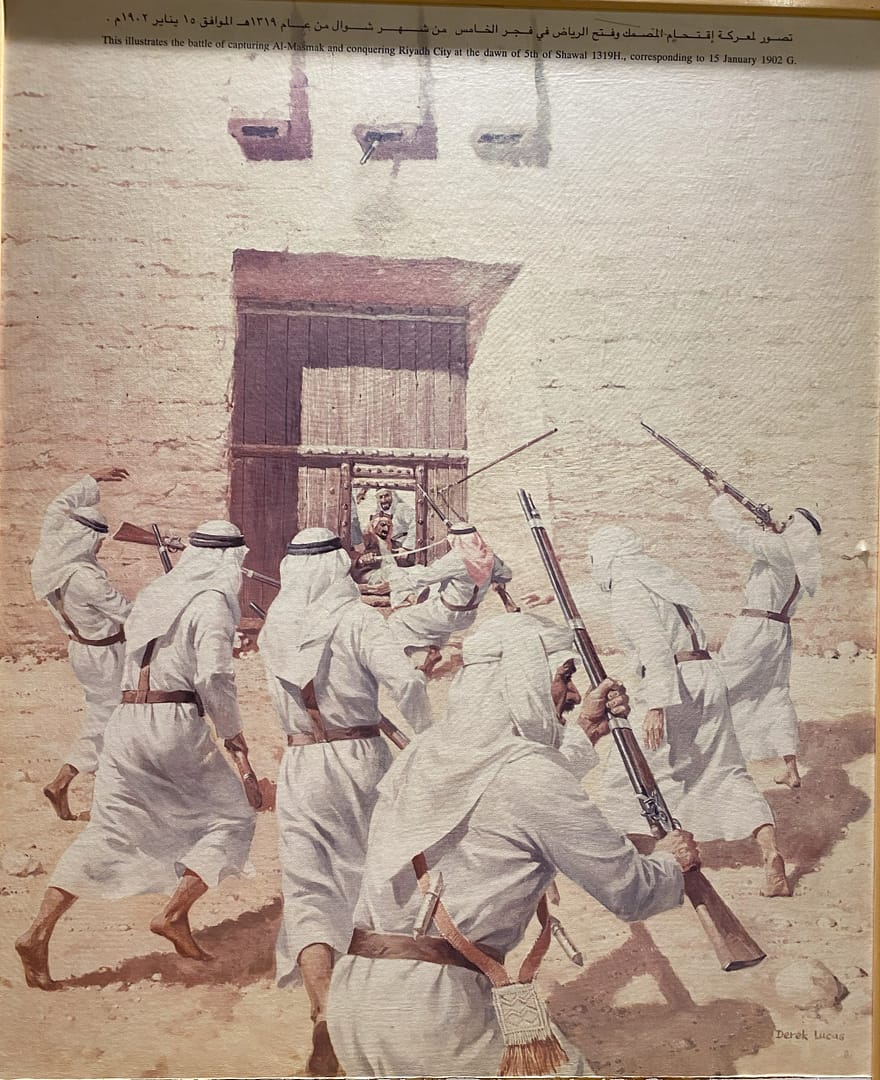
The Third Saudi State (1902–1932) began with the dramatic 1902 raid on Riyadh, in which Ibn Saud and his followers seized the Masmak Fort in a close-quarters urban assault. Over the next three decades, campaigns across Najd, al-Ahsa, Hail and the Hijaz combined camel-mounted warriors, the Ikhwan religious militia and later modern weaponry to achieve dominance across the peninsula. Battles for key oases, desert fortresses and pilgrimage routes ultimately culminated in the conquest of the Hijaz and the unification of Arabia under Saudi rule.
This collection of battlefield studies examines these conflicts through contemporary accounts, Ottoman and Saudi sources, historical maps and on-ground terrain analysis — revealing how leadership, alliances and the demanding landscapes of Arabia shaped the rise of the Saudi States.
Battle Studies in the Arabian Peninsula
Below are all current BattlefieldTravels studies for the rise of the Saudi States, covering key battles, campaign phases and associated sites. New studies are added as further battlefields are walked and analysed.
-
⚔️ Battle of Riyadh – Al Masmak Fortress, Saudi Arabia,
16 January 1902
The Battle of Riyadh in January 1902 was a critical moment in the history of the Kingdom of Saudi Arabia. The Al Saud family had previously established two states centered on the Diriyah/Riyadh area of Arabia, each of which was destroyed by rival powers. The capture of Riyadh in 1902 was the first in a…

Authored by Mick Prictor, a retired military officer with 40 years’ service, and a military historian specialising in terrain-focused analysis of tactics, doctrine, and command decision-making in land warfare. His work draws on extensive battlefield fieldwork—more than 280 sites worldwide—and one of the world’s largest private collections of historic military arms, uniforms, and equipment. About me
⚔️ Go deeper — Members get exclusive access to the Deep Research Collection, Field Notes, and monthly Research Dispatches. Try membership free for 7 days, cancel anytime. From $9/month.
Explore Related Themes
Armies: Saudi Army • Ottoman Army • Arab Army
Methods: Raids • Mounted Warfare • Encounter Battle • Ambush • Siege operations
Environments: Desert Warfare
Further Study: World War One Reading List
Related Battle Studies, Museum Pieces & Reading Resources

This landing page spans the First (1744–1818), Second (1824–1891) and Third Saudi States (1902–1932), outlining their major military campaigns and conflicts.
Published studies include the 1902 raid on Riyadh. Planned studies include the 1818 Sack of Diriyah and selected battles and sieges from the First and Second Saudi States.
Water sources determined lines of movement, sustainment and the location of fortified towns. Control of wells often equated to control of entire regions.
Early conflicts relied on fast tribal raiding and fortified settlements, while later campaigns incorporated religious militias, camel-mounted forces and eventually modern rifles, motor transport and more structured operations.
Yes. Locations such as Diriyah, Riyadh’s Masmak Fort and several Najdi and Hijazi towns preserve historic architecture and recognisable terrain integral to these conflicts.
Subscribe to Battlefield Travels and receive a free E-Book Battlefield Guide
Unlock expert battlefield analysis, campaign reconstructions, and historical insights drawn from firsthand exploration and primary sources.
🗺️ You’ll receive:
🎖️ Exclusive historical insights you won’t find elsewhere
📘 A free eBook: 10 Tips for Exploring Historic Battlefields
📰 New battlefield studies straight to your inbox as they are published

⚔️ Go deeper — Members get exclusive access to the Deep Research Collection, Field Notes, and monthly Research Dispatches. Try membership free for 7 days, cancel anytime. From $9/month.