Reconstructing the Tonkin Campaign battlefields through terrain analysis, primary sources and on-site research

Walking the battlefields of the Tonkin Campaign and Sino-French War
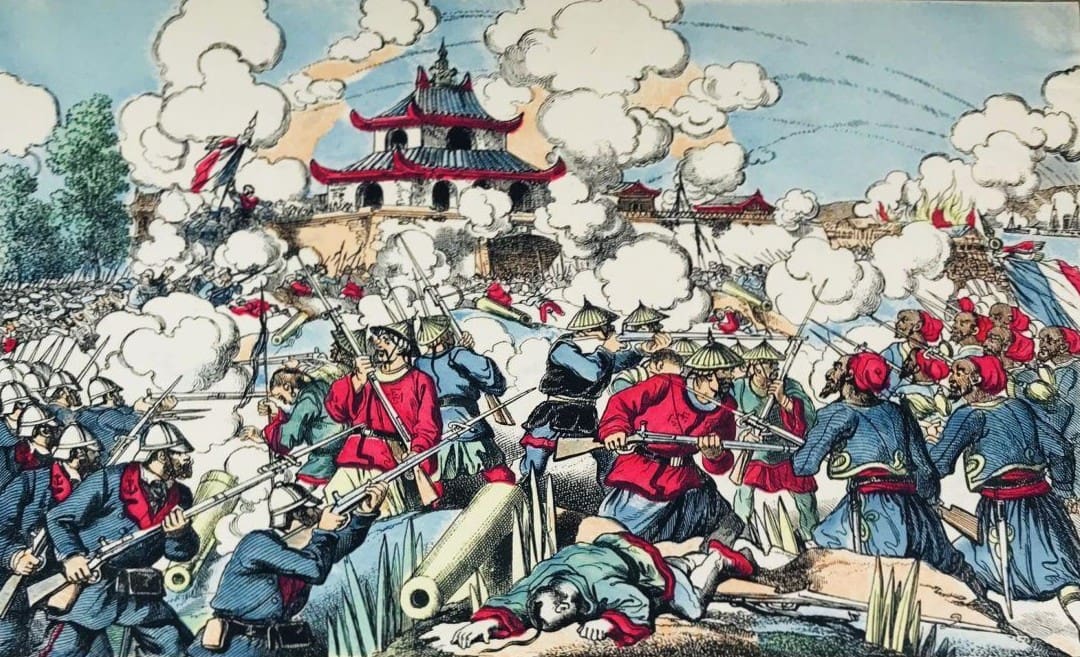
The Tonkin Campaign was the dramatic opening phase of France’s conquest of northern Vietnam, fought across the Red River Delta, the upland valleys of the Thái and Nùng peoples, and the rugged borderlands near Lạng Sơn and Cao Bằng. What began as a limited intervention to secure French commercial interests quickly escalated into a multi-year struggle involving regular French troops, colonial units, naval fusiliers, Foreign Legion companies, Tonkinese auxiliaries, the Black Flag Army, and the Qing dynasty’s southern frontier forces.
Early operations and the push into the Delta
After the seizure of Hanoi in 1882 and the battles at Gia Cuc (March 1883) and Paper Bridge (May 1883), France sought to break the power of Liu Yongfu’s Black Flag Army. Actions at Phủ Hoài (August 1883) and Sơn Tây (December 1883) showed how difficult this would be. Dense villages, paddy fields, dikes, canals and fortified hamlets created a defensive landscape in which the Black Flags fought with determination and deep local knowledge. The siege and assault on Sơn Tây marked one of the hardest battles of the early campaign. Ominously, these actions increasingly drew in regular Chinese forces from the Guangxi and Yunnan Armies.
The Lạng Sơn campaign and clashes with China
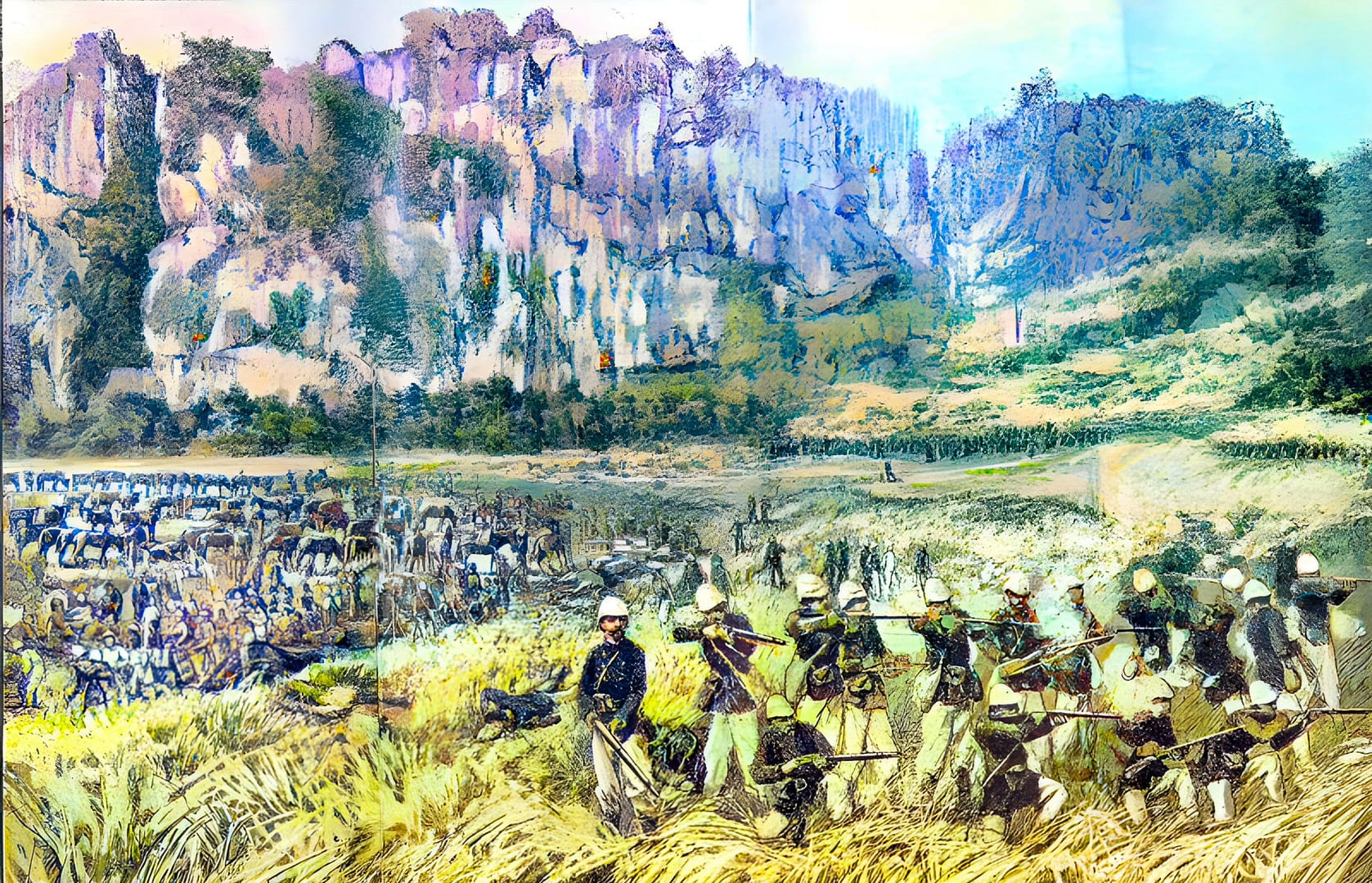
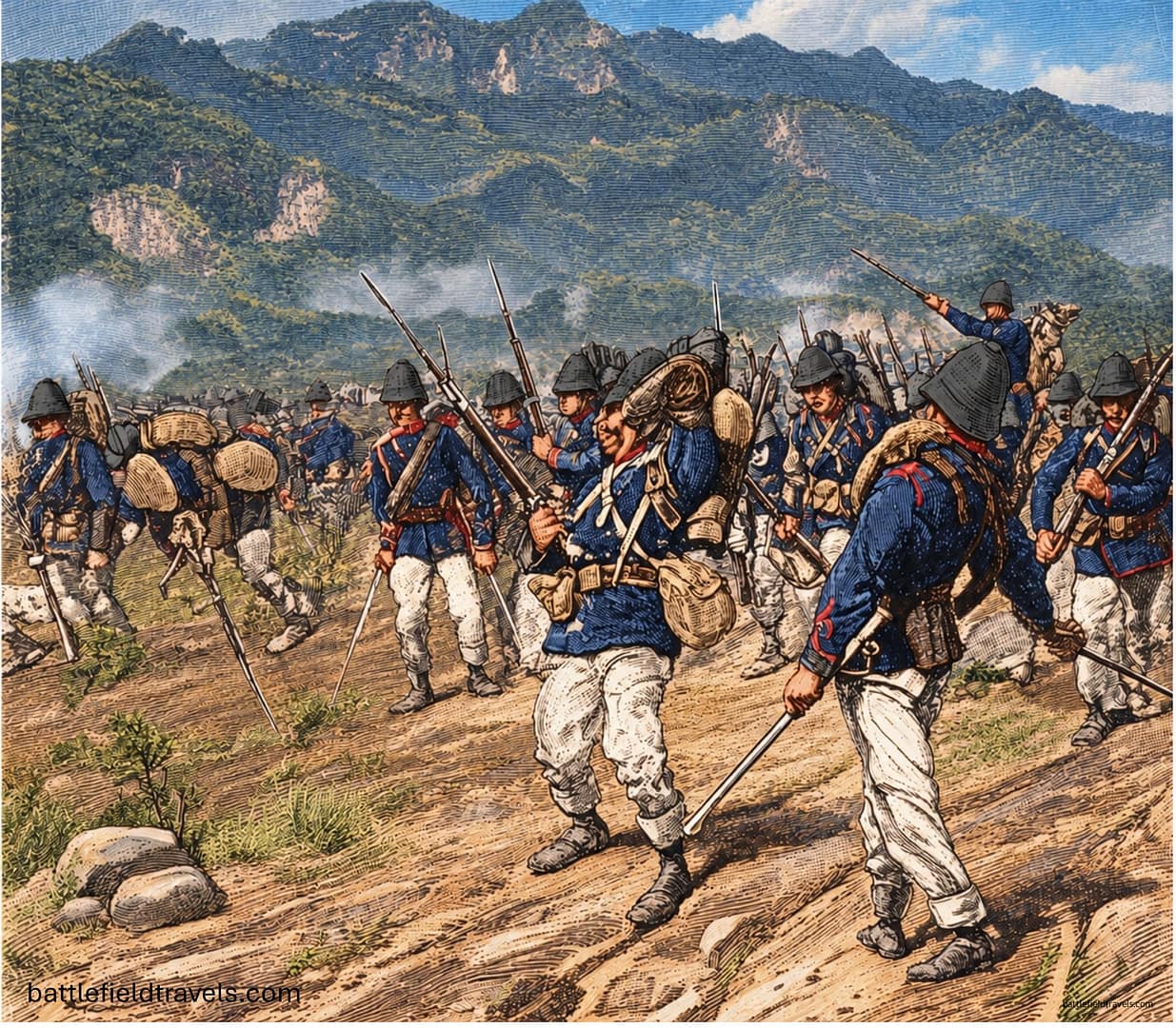
The Ambush at Bac Le in June 1884 breached the treaty between France and China, leading to a major escalation. A French garrison was besieged by Black Flag and Yunnan Army forces at Tuyen Quang, while the bulk of French forces advanced on Lạng Sơn to secure the border region. The Siege of Tuyen Quang was lifted after Colonel Laurent Giovanninelli’s 1st Brigade conducted a 300km march and fought a brutal battle at Hoa Moc, just south of Tuyen Quang. The campaign saw French troops advancing through jungle-clad ridges and steep passes toward the border fortress at Đồng Đăng. While the capture of Lạng Sơn strengthened French control of the frontier, defeats and miscommunication during the retreat from Lạng Sơn triggered the political crisis known as the Tonkin Affair.
Methodology
BattlefieldTravels analyses the Tonkin Campaign through firsthand terrain-focused fieldwork, period maps, Qing and French archival sources, and detailed study of the campaign’s operational routes—including Sơn Tây, Bắc Lệ, Hòa Mộc, Lạng Sơn, Đồng Đăng and the Red River corridor. The emphasis is on understanding how terrain, command culture, firepower, fortifications and local forces shaped this pivotal colonial war.
Battle Studies in the Tonkin Campaign
Below are all current BattlefieldTravels studies for the Tonkin Campaign, covering key battles, campaign phases and associated sites. New studies are added as further battlefields are walked and analysed.
-
⚔️🔒Son Tay Campaign, Tonkin,
11-17 December 1883
The Son Tay Campaign in December 1883 was part of a series of escalatory conflicts between Chinese and French colonial forces in Tonkin (northern Vietnam) over teh period 1873-1885. For the French, the main protagonist was Liu Yongfu’s Black Flag Army, although Chinese regular forces played an increasing role as the conflict developed. Vietnamese forces…
-
⚔️🔒Ambush at Bắc Lệ, Tonkin,
23-24 June 1884
In June 1884, a French column under Lieutenant Colonel Alphonse Dugenne, comprised of about 465 French troops and 284 Tonkinese auxiliaries, with a supply column of local ‘coolies’ and baggage mules, was attacked by a much larger Chinese regular force near Bắc Lệ, on the road from Phu-Lang-Thuong to Lang Son. The attack was the…
-
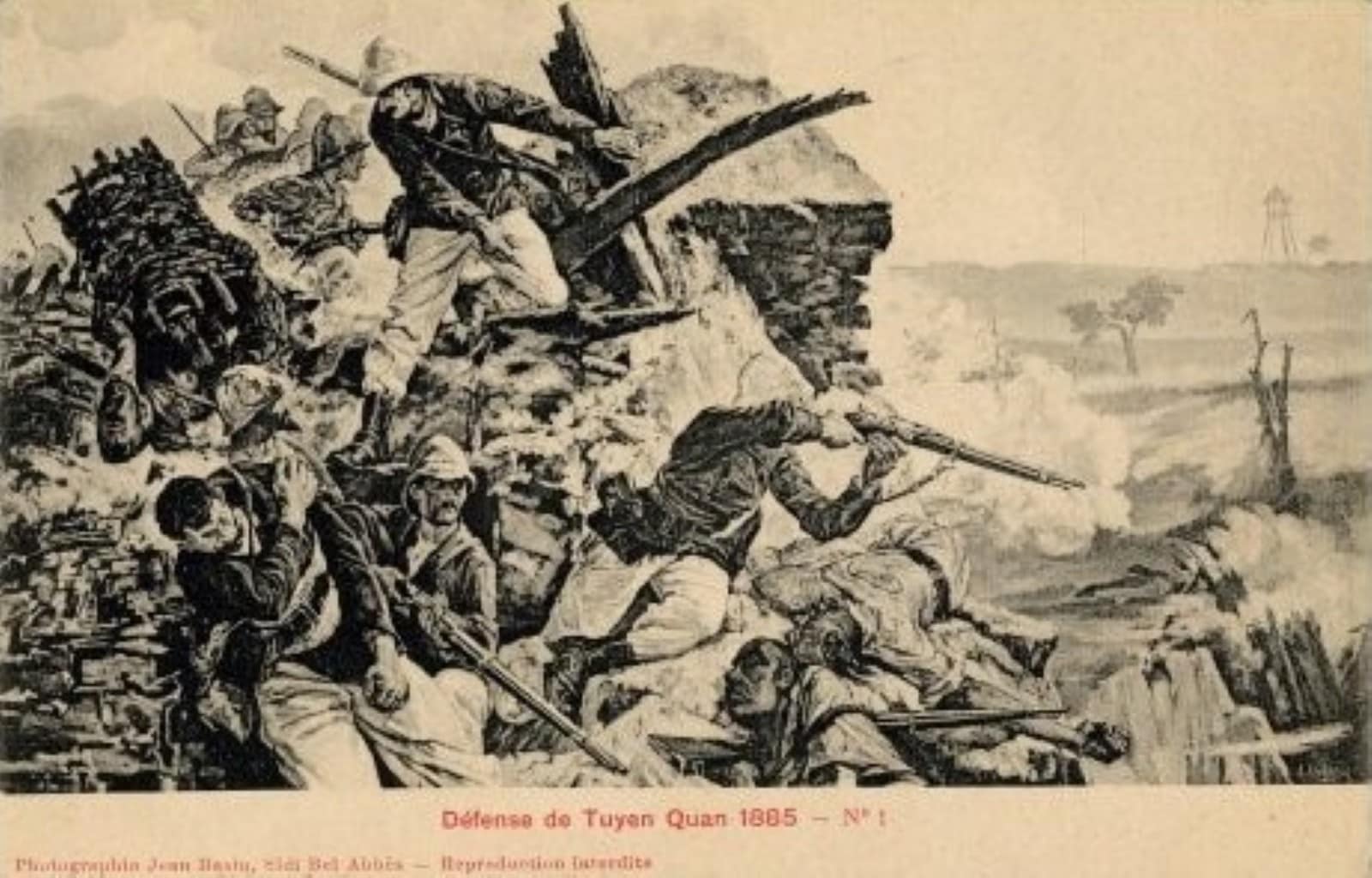
⚔️🔒Siege of Tuyên Quang, Tonkin, 24 Nov 1884 – 3 March 1885

From November 1884 to March 1885, 630 French troops of the Foreign Legion, Marines and Tonkinese Riflemen, held the citadel of Tuyên Quang against a force of 15,000 Chinese and Black Flag Army troops. Their endurance, and Colonel Giovanninelli’s epic relief march, made the siege one of the Foreign Legion’s most legendary battles.
-
⚔️🔒Battle of Hòa Mộc, Tonkin, 2-3 March 1885

The Battle of Hòa Mộc Was the fiercest and most costly battle of the Sino-French War. The battle was fought just a few kilometres south of besieged Tuyên Quang, as Colonel Laurent Giovanninelli’s 3,400 man force made a 300 km forced march to relive the siege, and cleared the final Black Flag position between themselves…

Authored by Mick Prictor, a retired military officer with 40 years’ service, and a military historian specialising in terrain-focused analysis of tactics, doctrine, and command decision-making in land warfare. His work draws on extensive battlefield fieldwork—more than 280 sites worldwide—and one of the world’s largest private collections of historic military arms, uniforms, and equipment. About me
⚔️ Go deeper — Members get exclusive access to the Deep Research Collection, Field Notes, and monthly Research Dispatches. Try membership free for 7 days, cancel anytime. From $9/month.
Explore Related Themes
Armies: French Army • Black Flag Army • Foreign Legion • Troupes de Marine
Commanders: Liu Yongfu • General de Negrier
Methods: Ambush • Envelopment • Raid • Airborne • Riverine
Environments: Forest Warfare • Mountain Warfare
Further Study: Tonkin Campaign further reading
Related Battle Studies, Museum Pieces & Reading Resources
 ⚔️🔒Ambush at Bắc Lệ, Tonkin,
23-24 June 1884
 ⚔️🔒Son Tay Campaign, Tonkin,
11-17 December 1883
 🏛️ French Colonial Wars (1830–1940 ) Weapons and Equipment
 ⚔️🔒Battle of Hòa Mộc, Tonkin, 2-3 March 1885
 ⚔️🔒Siege of Tuyên Quang, Tonkin, 24 Nov 1884 – 3 March 1885
 ⚔️ French Foreign Legion Campaigns, Battles, and Legacy
The Tonkin Campaign was France’s military conquest of northern Vietnam, involving battles against the Black Flag Army, Vietnamese forces and, later, the Qing dynasty’s southern frontier troops.
Many were experienced in combat from the Taiping War, and they exploited dense delta terrain—villages, hedgerows, canals, dikes and fortified hamlets—combined with strong local support and a talent for ambush and defensive warfare.
Major actions include Phủ Hoài, Palan, Sơn Tây, Bắc Ninh, Bắc Lệ, Hòa Mộc, Lạng Sơn and Đồng Đăng.
Qing troops covertly supported the Black Flags and later entered the war openly, leading to pitched battles along the frontier during 1884–85.
Through GIS terrain modelling, period French and Qing maps, on-site reconnaissance and comparative study of French, Vietnamese and Chinese primary sources.
Subscribe to Battlefield Travels and receive a free E-Book Battlefield Guide
Unlock expert battlefield analysis, campaign reconstructions, and historical insights drawn from firsthand exploration and primary sources.
🗺️ You’ll receive:
🎖️ Exclusive historical insights you won’t find elsewhere
📘 A free eBook: 10 Tips for Exploring Historic Battlefields
📰 New battlefield studies straight to your inbox as they are published

⚔️ Go deeper — Members get exclusive access to the Deep Research Collection, Field Notes, and monthly Research Dispatches. Try membership free for 7 days, cancel anytime. From $9/month.