Reconstructing the War of the Spanish Succession battlefields through terrain analysis, primary sources and on-site research
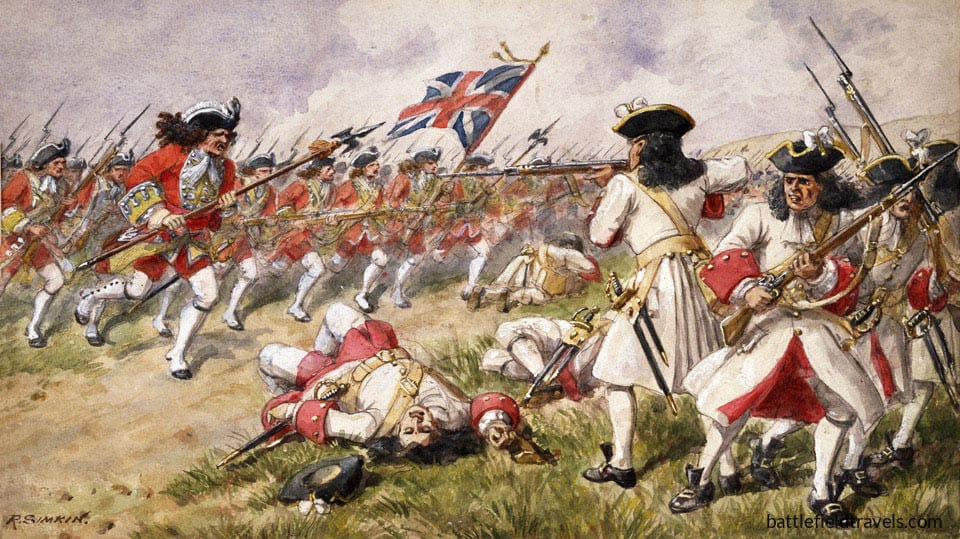
Walking the battlefields of the War of the Spanish Succession, 1701–1714
Origins: Dynastic crisis and the balance of power
The War of the Spanish Succession emerged from one of the most consequential succession crises in European history. The death of the childless Spanish king Charles II in 1700 triggered a struggle over the inheritance of the vast Spanish Empire, which extended across Europe and the Americas.
At stake was not simply who would wear the Spanish crown, but whether the Bourbon monarchy of France could unite the resources of both kingdoms under a single dynasty. Such an outcome threatened to overturn the European balance of power.
In response, a Grand Alliance formed—led by Britain, the Dutch Republic, and the Holy Roman Empire—to resist French expansion and prevent strategic domination of Western Europe.
Western Europe: The Decisive Theatre
The war’s decisive campaigning unfolded in the Low Countries, where French forces confronted Allied armies under commanders such as the Duke of Marlborough and Prince Eugene of Savoy.
At Ramillies, Marlborough exploited terrain and timing to unhinge the French line. At Oudenaarde, rapid manoeuvre and aggressive engagement disrupted French deployment before it could stabilise. Malplaquet, by contrast, demonstrated the deadly resilience of prepared defensive positions, where Allied victory came at enormous cost.
Coalition Warfare
Allied armies combined British, Dutch, Austrian, and German contingents, each with differing priorities, command structures, and operational constraints. The ability of commanders such as Marlborough to coordinate these forces, to align movement, timing, and intent, was as decisive as battlefield execution.
French command, by contrast, often struggled with rigidity, slower decision cycles, and an inability to adapt once engaged.
A Global War
Although the principal campaigns took place in Europe, the conflict extended far beyond it. Fighting spread to Spain and the Mediterranean, the German states, Italy, and North America, where it formed part of Queen Anne’s War. This wider struggle reflected the increasingly global nature of European power competition in the early 18th Century.
War of the Spanish Succession – Field Notes
Short-form observations, terrain insights, and working interpretations from the field. Some posts require access.
-
📝🔒 Field Note: Battle of Ramillies, Belgium, 23 May 1706

November 2025, Ramillies, Belgium. I am exploring the battlefield of Ramillies. Here on 23 May 1706, an Allied Army under John Churchill, the Duke of Marlborough, defeated a French army under Marshall Villeroi. The ground here is open, gently rolling country, cut by small streams and defined by long field boundaries—terrain that enables movement and…

Authored by Mick Prictor, a retired military officer with 40 years’ service, and a military historian specialising in terrain-focused analysis of tactics, doctrine, and command decision-making in land warfare. His work draws on extensive battlefield fieldwork—more than 280 sites worldwide—and one of the world’s largest private collections of historic military arms, uniforms, and equipment. About me
⚔️ Go deeper — Members get exclusive access to the Deep Research Collection, Field Notes, and monthly Research Dispatches. Try membership free for 7 days, cancel anytime. From $9/month.
Explore Related Themes
Armies: Prussian Army • Austrian Army • French Army • British Army
Commanders: Duke of Vendôme• Marshal Villars • Duke of Marlborough • Eugene of Savoy
Methods: Oblique Order • Envelopment
Environments: Forest Warfare
Further Study: War of the Spanish Succession Reading List
Related Battle Studies, Museum Pieces & Reading Resources


FAQ – War of the Spanish Succession
The War of the Spanish Succession (1701–1714) was a major European conflict triggered by a dispute over who would inherit the Spanish Empire after the death of Charles II. It became a wider struggle over the balance of power, with France supporting a Bourbon claimant and a Grand Alliance of Britain, the Dutch Republic, and the Holy Roman Empire opposing French expansion.
The war reshaped the balance of power in Europe and prevented the unification of the French and Spanish crowns. It also marked the rise of Britain as a major military and financial power, and demonstrated the growing importance of coalition warfare, operational coordination, and battlefield decision-making.
Key battles include Ramillies (1706), Oudenaarde (1708), and Malplaquet (1709), fought primarily in the Low Countries. These engagements highlight the interaction between terrain, timing, and command decisions, and are among the most studied battles of early 18th-century warfare.
The most prominent Allied commanders were the Duke of Marlborough and Prince Eugene of Savoy, who coordinated multinational forces across multiple campaigns. French armies were led by commanders such as Marshal Villars and the Duke of Vendôme, whose performance varied depending on terrain, timing, and strategic context.
The principal theatre was the Low Countries (modern Belgium), but fighting also took place in Spain, Italy, the German states, and overseas. In North America, the conflict formed part of Queen Anne’s War, reflecting the global nature of early 18th-century rivalry.
Subscribe to Battlefield Travels and receive a free E-Book Battlefield Guide
Unlock expert battlefield analysis, campaign reconstructions, and historical insights drawn from firsthand exploration and primary sources.
🗺️ You’ll receive:
🎖️ Exclusive historical insights you won’t find elsewhere
📘 A free eBook: 10 Tips for Exploring Historic Battlefields
📰 New battlefield studies straight to your inbox as they are published

⚔️ Go deeper — Members get exclusive access to the Deep Research Collection, Field Notes, and monthly Research Dispatches. Try membership free for 7 days, cancel anytime. From $9/month.