From Six-Shooter to M16!
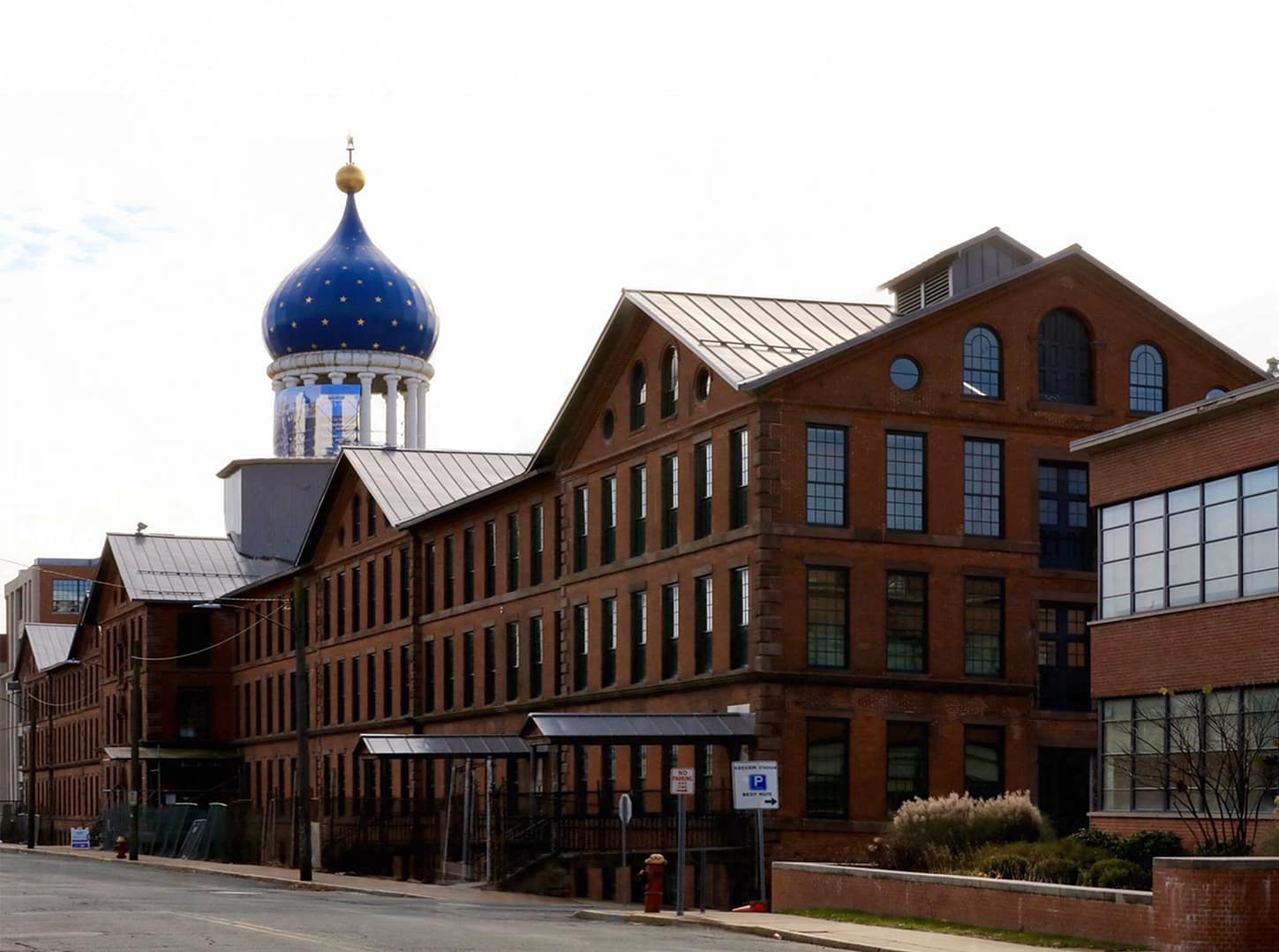
Beneath the gleaming blue dome crowned with a rearing colt, Hartford’s Colt Armory became a symbol of American industry — blending precision engineering, mass production, and a dash of showmanship.

Key facts
🗺️ ‘Coltsville’, Samuel Colt’s arms manufacturing facility in Hartford, Connecticut,1855-1994 Colt firearms manufacturing
 Weapons production estimated at 10-12 million
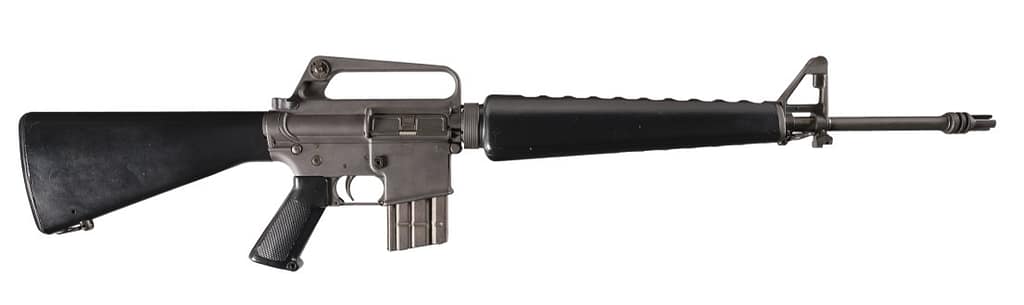
🎯 Colt revolvers, M1911 pistols, Colt-Browning machine guns, AR-15/M-16 variants
Visit the virtual museum of weapons, uniforms and equipment
Google Earth map – Location of the old Colt Factory
🧭🥾 Walking the Battlefield
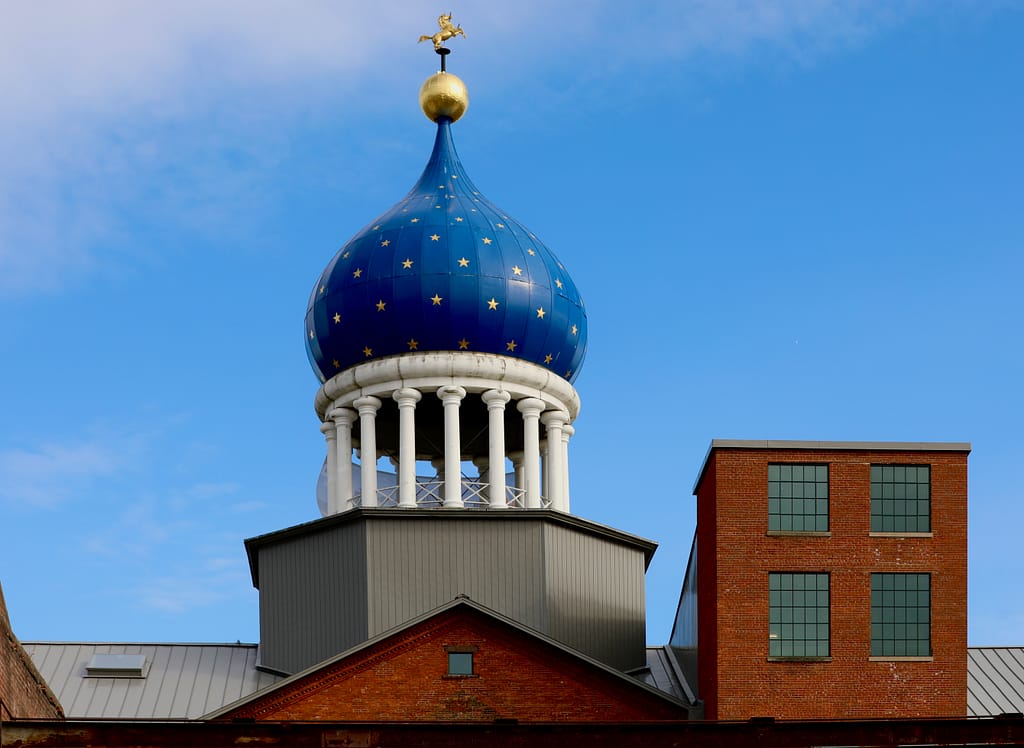
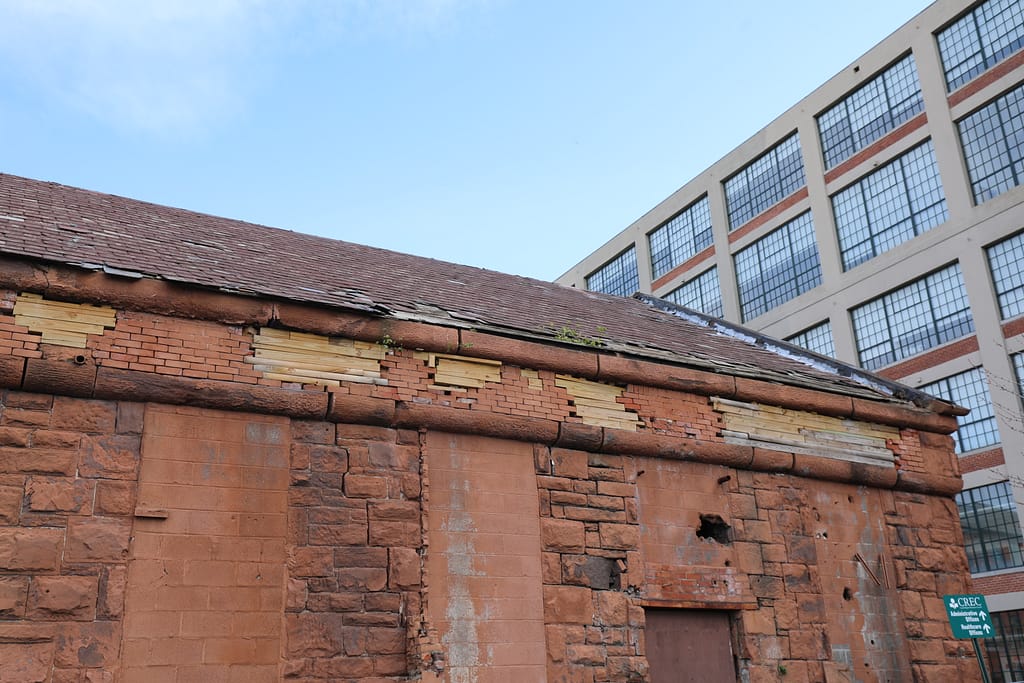
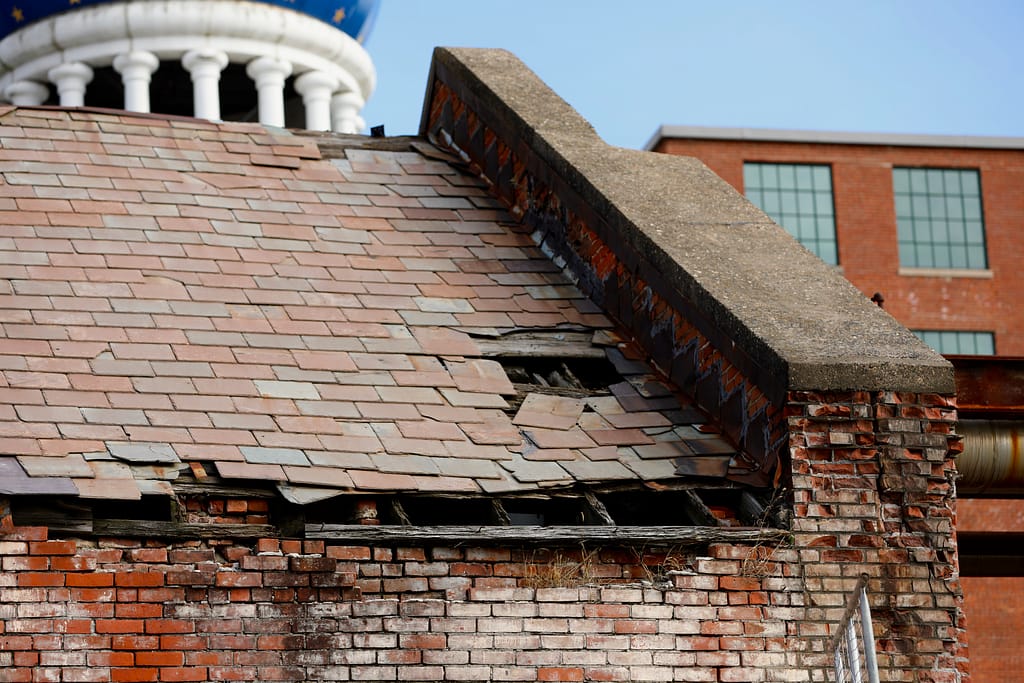
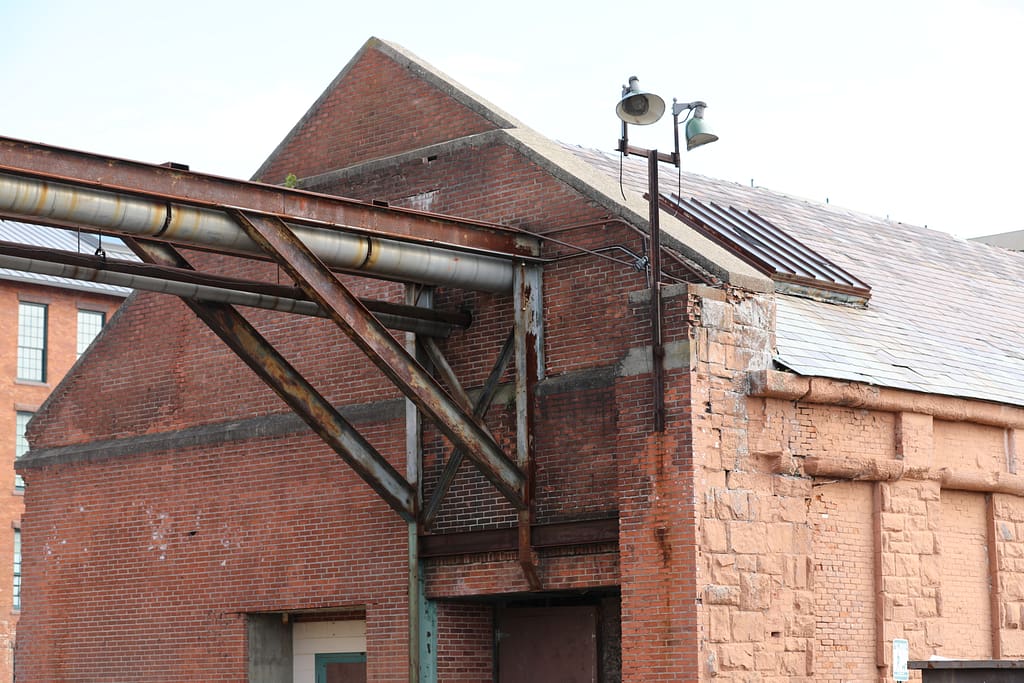
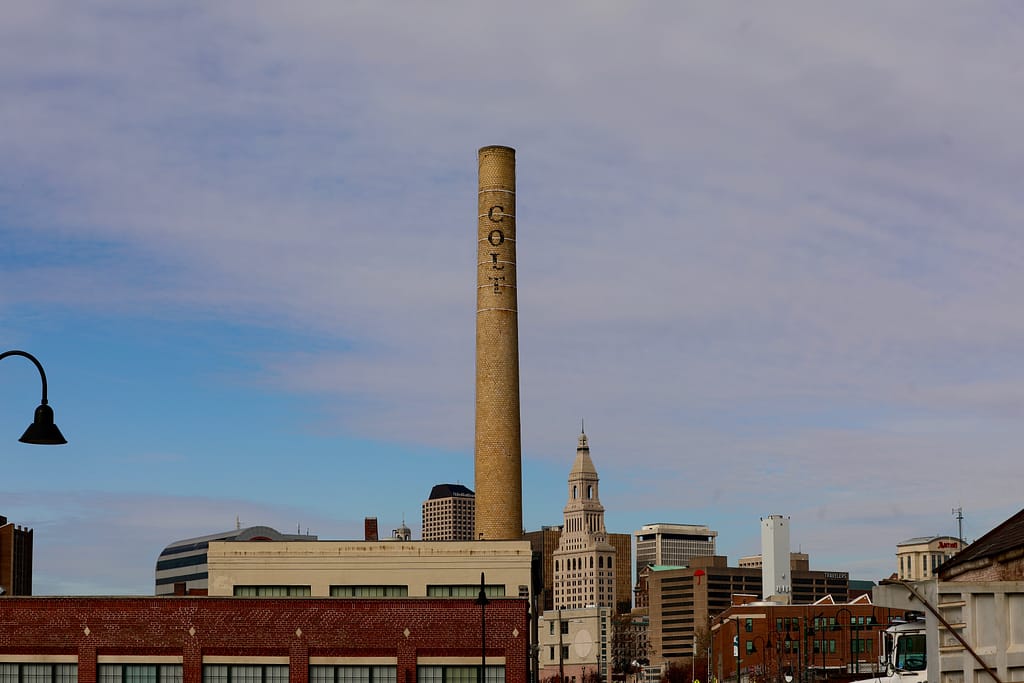
I visited ‘Coltsville’ in 2019. The building is still spectacular, but it has not yet transformed into a museum. The main building with the blue onion dome was built by Samuel Colt in 1855, severely damaged in 1864, and rebuilt to the same form in 1867. Some of the buildings are in good shape and have been repurposed. We saw an insurance company, an arts college, and Connecticut Senator Chris Murphy’s offices all located in the old Colt buildings. Other parts of the old factory are deteriorating and need preservation work. There are also 10 out of the 20 original workers’ cottages still standing and still serving as homes.
Even in decline, the scale of the complex is impressive, a reminder of a time when Hartford was a global capital of firearms innovation.
Samuel Colts invention
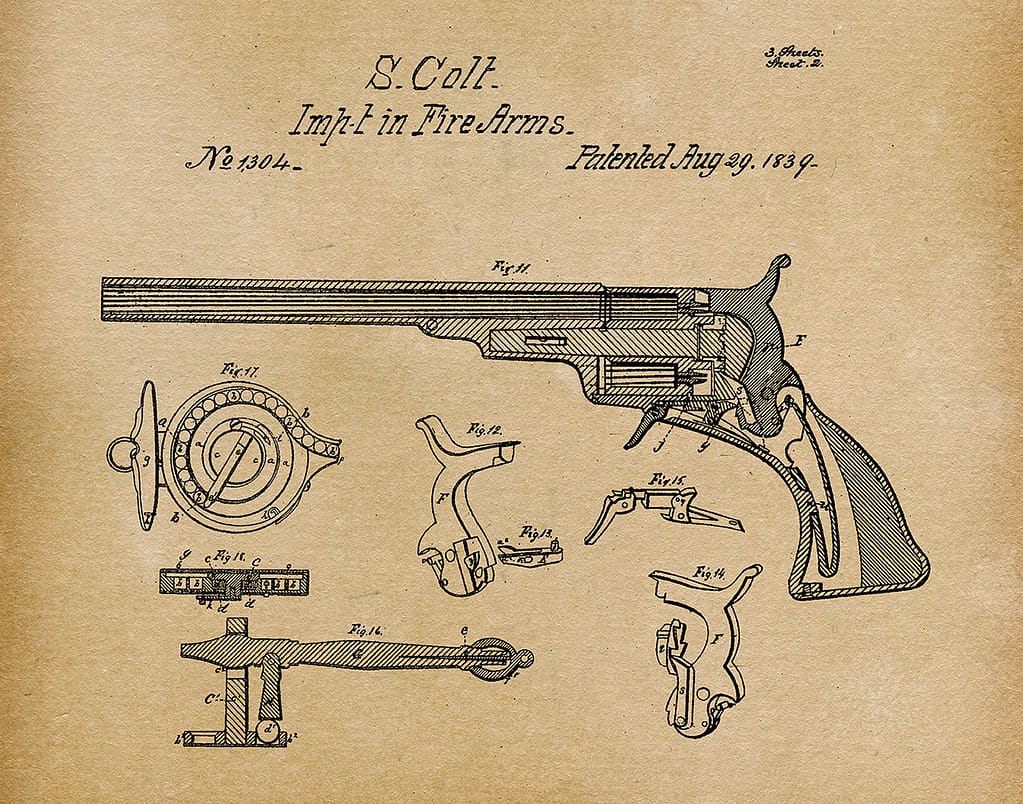
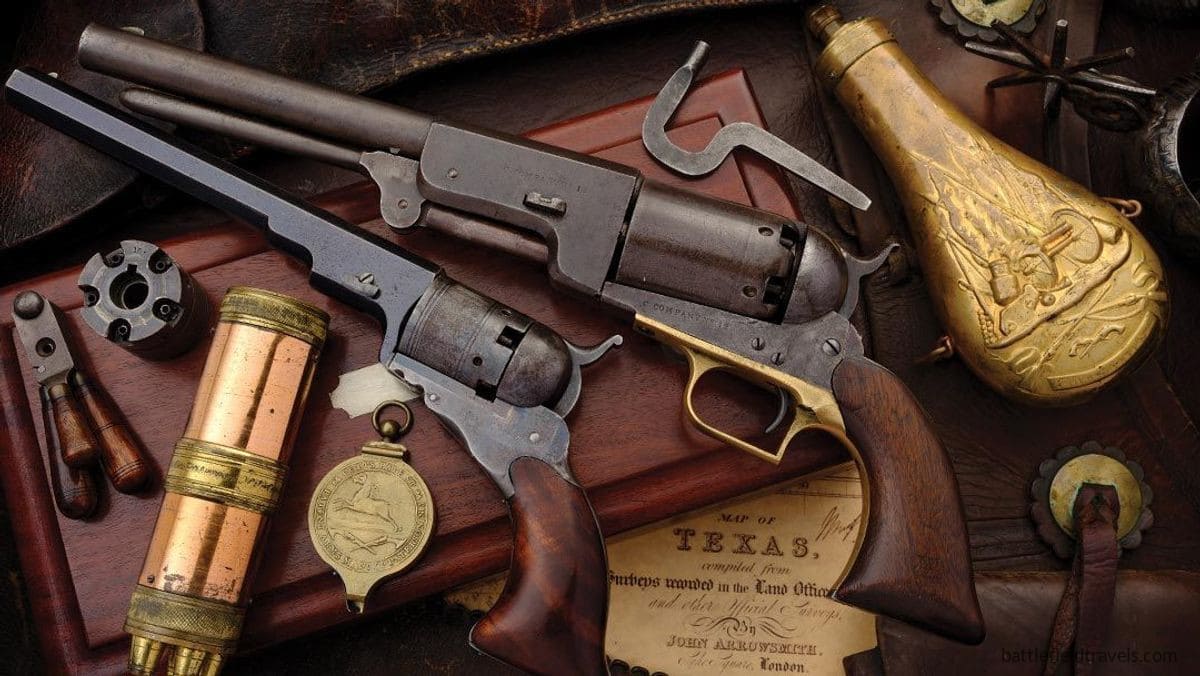
Samuel Colt (1814-1862) was an American inventor and industrialist renowned for revolutionising repeating firearms with his invention of the Colt revolver. In 1836, Colt patented his first revolver design, the Colt Paterson, which featured a rotating 5-round cylinder and single-action cocking. In 1839, he added a lever-actuated rammer to assist with loading. He then partnered with Texas Ranger Captain Samuel Walker to produce the immensely powerful ‘Colt Walker’ .44″ calibre revolver, which gained great popularity during the Mexican-American War, 1847-48.
His 1848 Colt Dragoon incorporated lessons learned in combat from the Colt Walker and was adopted by the US Military. His 1851 Colt Navy, 1860 Colt Army, 1849 Colt Pocket Revolvers, and 1873 Colt Single Action Army revolvers became legendary and are synonymous with America’s frontier era. Samuel Colt’s business acumen and innovative manufacturing techniques, including the use of interchangeable parts, contributed significantly to modern industrial production methods.
Origins and Context: Hartford and the birth of a firearms empire
In the mid-19th century, the Connecticut River Valley was more than a geographic corridor — it was the beating heart of American precision manufacturing. The river provided not only a reliable transport route from the Canadian border to Long Island Sound, but also the waterpower to drive a chain of mills, foundries, and machine shops along its banks. Towns like Springfield, Windsor Locks, Hartford, and New Haven became synonymous with finely machined goods — sewing machines, clocks, typewriters, and, above all, firearms.
The industrial culture of the valley was shaped by a network of machine-tool makers, inventors, and entrepreneurs who exchanged ideas as freely as they traded components. The so-called “American System of Manufacture” — standardised, interchangeable parts made with specialised machinery — found perhaps its clearest and most enduring expression in the arms factories that lined the river. The Springfield Armory, just upriver in Massachusetts, had pioneered the concept for muskets; Hartford, New Haven, and other Connecticut towns carried it forward into the revolver and repeating rifle age.
Precision manufacturing techniques developed in the Connecticut River Valley by the Springfield Armory, and private firms such as Pratt & Whitney, and Robbins & Lawrence, were later adopted around the world.
Note: In 1909, the Australian government contracted US firm Pratt & Whitney, also of Hartford Connecticut, to deliver the Lithgow Small Arms Factory, including the tooling, equipment, management systems and production practices.
Samuel Colt’s rise
Samuel Colt was not an immediate beneficiary of this manufacturing revolution — in fact, his first venture was a spectacular failure. Born in Hartford in 1814, he showed an early fascination with machinery and explosives, reportedly dismantling farm equipment to study its workings. While still a teenager, he began sketching ideas for a revolving-cylinder firearm, allegedly inspired by the ratchet mechanism of a ship’s capstan.
His first company, the Patent Arms Manufacturing Company in Paterson, New Jersey, produced innovative revolvers in the late 1830s but failed to find a steady market. American military doctrine still favoured single-shot pistols, and civilian sales were limited. By 1842, the Paterson venture had collapsed, and Colt was bankrupt.
The Mexican–American War (1846–48) transformed his fortunes. Captain Samuel Walker of the Texas Rangers, impressed with the Paterson revolver, collaborated with Colt to design a heavier, more powerful model suited to mounted combat. The resulting Colt Walker revolver, built under contract at Eli Whitney Jr.’s factory in Whitneyville, Connecticut, won Colt a renewed reputation and badly needed revenue. With the proceeds, he established a permanent manufacturing base in Hartford in 1847.
Hartford’s Advantage
The choice of Hartford was no accident. The city offered deepwater access to the Connecticut River, allowing steamers to carry goods directly to New York. Just as important, it lay at the centre of a skilled labour market shaped by the Springfield Armory and dozens of smaller precision workshops. Local suppliers could produce barrels, springs, screws, and stocks to exact tolerances, while Hartford’s machine shops could build or adapt the specialised tooling Colt required.
By the early 1850s, demand for Colt’s revolvers was soaring. The California Gold Rush, westward expansion, and rising tensions along the frontiers created a steady market among civilians and state militias. The Crimean War and unrest in Europe opened new export opportunities. Colt’s advertising — lavish, colourful, and carefully cultivated — helped make his firearms as much a status symbol as a weapon.
⚔️ Go deeper — Members get exclusive access to the Deep Research Collection, Field Notes, and monthly Research Dispatches. Try membership free for 7 days, cancel anytime. From $9/month.
A Factory Like No Other
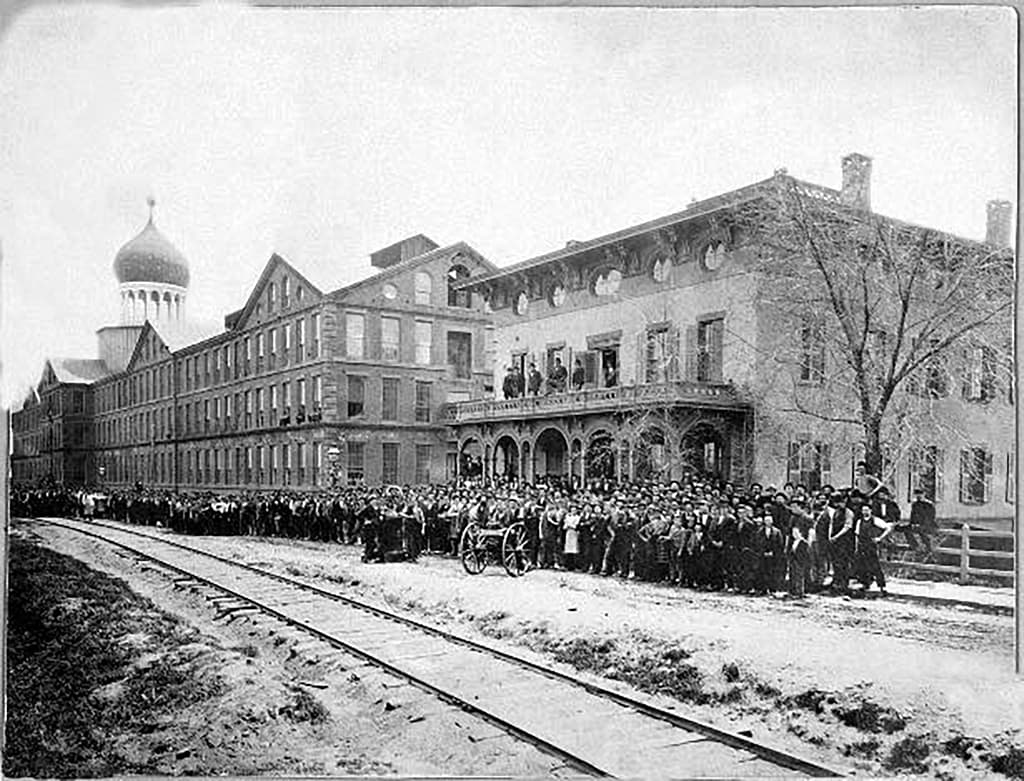
In 1855, with sales at their peak, Colt began construction of an armoury in Hartford’s South Meadows that would be unlike anything the industrial world had yet seen. This was not simply a workshed or a brick mill in the New England style, but a sprawling, steam-powered factory complex crowned with a blue onion dome decorated with gold stars, inspired by Russian architecture. The building’s exotic silhouette, visible to ships approaching Hartford from downriver, was both a landmark and a statement: Colt was not merely making guns; he was building an empire
When the factory opened, it brought together under one roof a fully integrated manufacturing process — from raw steel bars to finished revolvers. Steam engines powered lines of lathes, milling machines, and drill presses; specialised gauges ensured absolute interchangeability of parts; and each department worked to precise schedules dictated by Colt’s overseers. In an age before mass production became a given, the Colt Armory was a showpiece for industrial modernity.

The Factory: architecture, technology, and the American system of manufacture
When it opened in 1855, the Colt Armory was more than a workplace — it was a declaration of industrial ambition. Stretching over 500 feet along the riverbank, the main building was built of red brick in the Italianate style, with long rows of arched windows to flood the production floors with natural light. The centrepiece was the distinctive blue onion dome topped with a rearing, gilded Colt stallion, visible for miles in every direction. The dome was said to have been inspired by Samuel Colt’s travels in Russia in 1835, and its presence atop a New England factory was both striking and calculated. Colt wanted his works to be instantly recognisable, a brand in brick and steel.

Inside the Armory
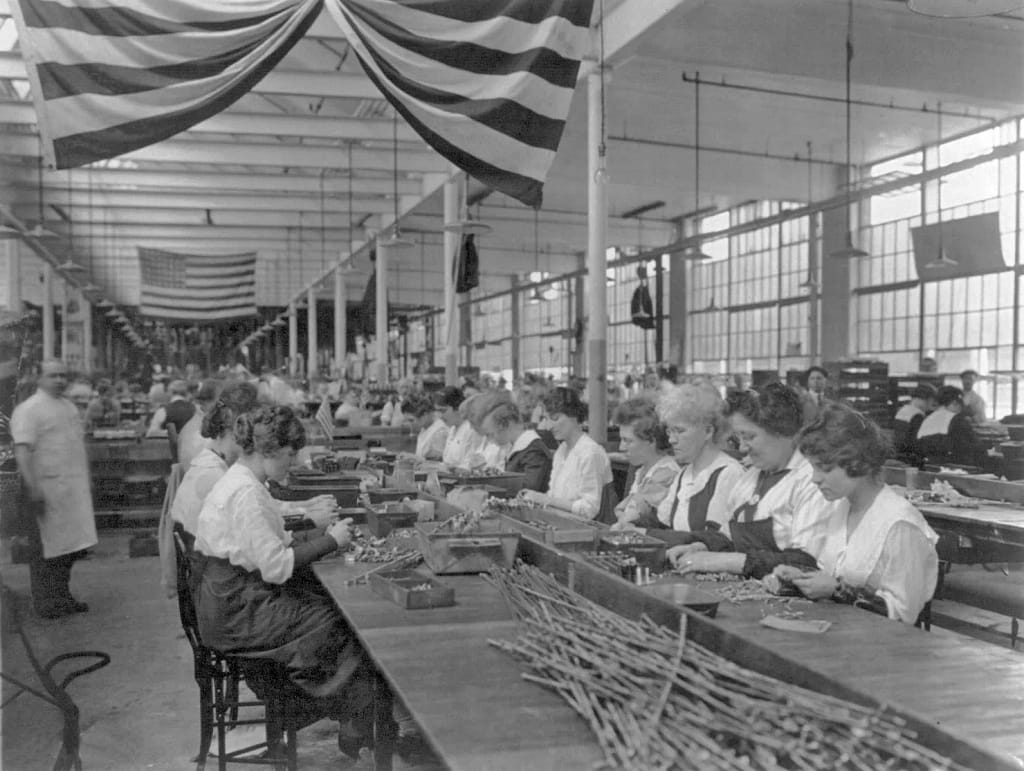
The interior was organised along highly rational, almost military lines. The main floor housed heavy machinery — lathes, milling machines, and barrel-turning equipment — powered by a central steam engine whose massive flywheels and belts transmitted motion to every corner of the building. The upper floors contained assembly benches where skilled workers — many of them trained in the “armory practice” pioneered at Springfield — fitted together the thousands of parts that made up a revolver.
The process was divided into dozens of specialised operations, each assigned to a particular department. The barrel shop produced rifled barrels to tolerances measured in thousandths of an inch. The cylinder department bored and chambered each cylinder before passing it to the polishing room. The lock shop machined and tempered the intricate springs and triggers. Final fitting and bluing took place in the finishing rooms, where each revolver was inspected and test-fired on-site.

The American system in action
The Colt Armory was a showpiece of the American System of Manufacture — the production of interchangeable parts using precision machinery. Colt invested heavily in custom-built gauges, fixtures, and jigs to ensure that any part from any revolver of a given model would fit any other without hand-fitting. This system not only increased output but also allowed Colt to train workers in specific tasks without requiring them to be master gunsmiths.
Many of the machines in the armory were built by Pratt & Whitney, a Hartford firm whose founders were themselves veterans of the Springfield Armory’s machine shop. In turn, Colt’s exacting standards drove innovation in the local machine-tool industry, reinforcing Hartford’s role as a hub of precision engineering.
Colt also understood that efficient production was only half the equation — presentation mattered. He employed skilled engravers and stock checkers to offer deluxe versions of his revolvers, appealing to officers, dignitaries, and wealthy civilians. The armory even had its own electroplating department for nickel finishes and gilt embellishments.
The Colt Factory fire of 1864
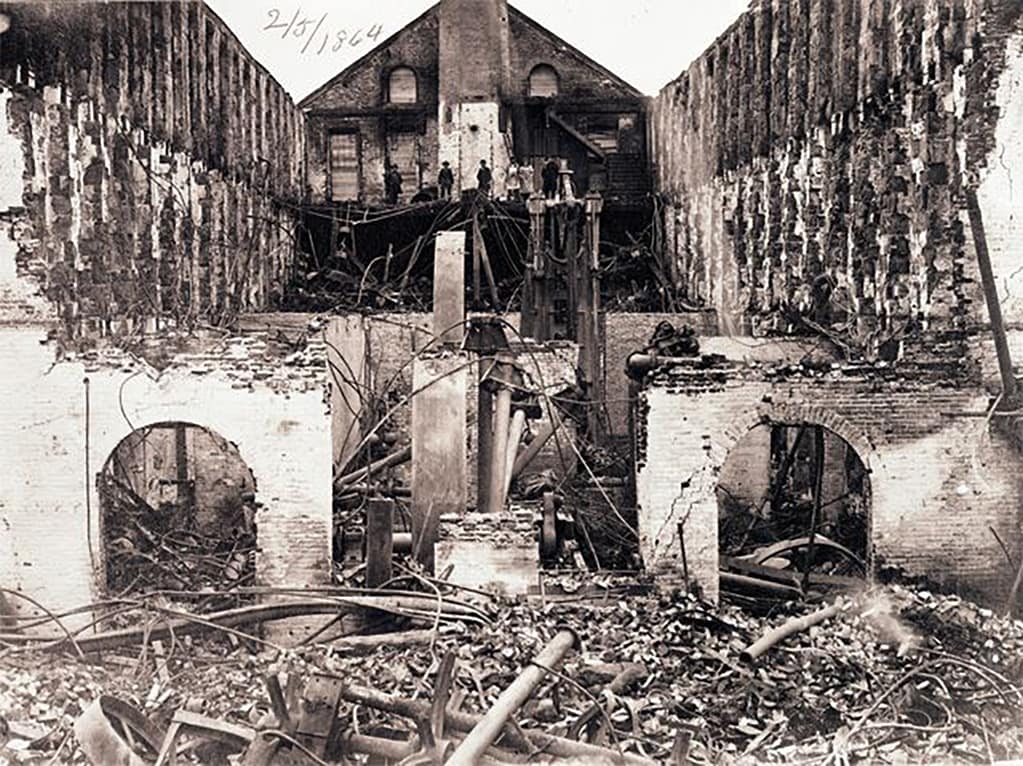
On the night of 4 February, 1864, disaster struck. A fire broke out in the main building, reportedly starting in the polishing room, and quickly spread through the oil-soaked floors and wooden roof beams. Despite efforts to contain it, the blaze consumed much of the armory, including the iconic dome.
For most manufacturers, such a catastrophe would have spelled ruin. But the Colt Armory was in the midst of peak wartime demand, producing thousands of revolvers for the Union Army during the American Civil War. Within days, temporary workshops were in place, and Samuel Colt’s widow, Elizabeth Colt — who had inherited the company after his death in 1862 — ordered a full rebuild. By 1867, the armory stood restored, complete with a new blue dome and improved facilities.
A self-contained industrial village
The armory was not an isolated plant. Colt created a company town known as Coltsville, complete with worker housing, a church (the Church of the Good Shepherd, built in memory of Samuel Colt), and recreational spaces. This paternalistic approach was common among 19th-century industrialists, blending genuine concern for workers’ welfare with a desire to control their environment and loyalty. Coltsville became a community with its own rhythms, tied directly to the production cycles of the armory.

Wartime Output, Innovation, and Legacy
From the moment the first machinery began to turn in 1855, the Colt Armory was more than just a factory — it was a keystone in America’s industrial and military supply chain. The plant’s output not only armed frontiersmen and lawmen but also supplied militaries across the world.
Civil War Production
By the outbreak of the American Civil War in 1861, Colt’s reputation for reliable, mass-produced sidearms was firmly established. The Union Army became the company’s largest single customer almost overnight. Contracts poured in for Colt Model 1860 Army revolvers, a streamlined .44-calibre design that became the war’s most widely issued handgun.
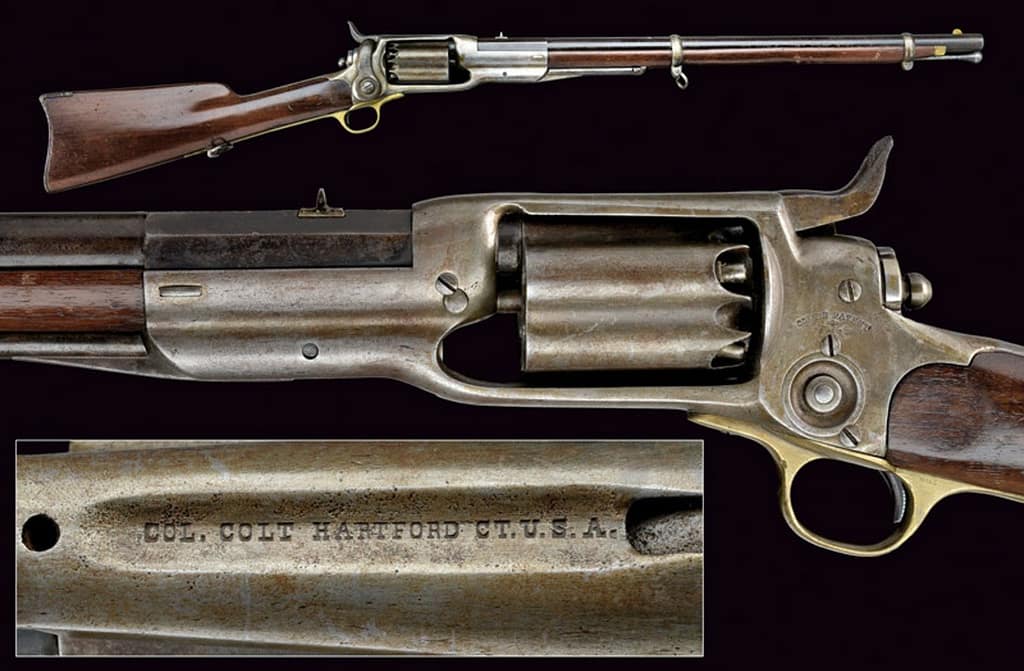
At peak wartime output, the armory turned out over 150 revolvers per day, each the product of a carefully choreographed sequence of machining, inspection, and finishing. Government inspectors were stationed on-site to ensure quality standards. The factory also produced carbines, including the Colt revolving rifle — innovative but prone to gas leakage that discouraged widespread adoption.
Colt’s wartime sales extended beyond the Union. Through third parties and international agents, his weapons found their way into the hands of foreign armies, including Britain, Russia, and France, cementing Hartford’s place in global arms commerce.
The Peacemaker Era
After the war, Colt’s focus shifted toward the American West. In 1873, the company introduced what would become its most iconic product: the Colt Single Action Army revolver, nicknamed the “Peacemaker.” Chambered in .45 Colt, it became the sidearm of choice for U.S. cavalry units, sheriffs, and outlaws alike.
The Peacemaker was built in the same armory that had supplied the Union — by many of the same workers — but represented a new design philosophy: rugged simplicity combined with powerful stopping power. Production methods honed during the Civil War ensured that parts were still interchangeable, and the armory’s machine tools could turn out thousands of revolvers without deviation.
Innovation Beyond Firearms
The Colt Armory also became a laboratory for mechanical innovation. In the 1880s and 1890s, the plant produced double-action revolvers, self-cocking mechanisms, and early semi-automatic pistols. Colt engineers developed precision forging techniques, improved heat-treatment methods, and experimented with new alloys.
This spirit of innovation fed back into the Hartford manufacturing ecosystem — machine-tool companies, gauge makers, and precision engineers all benefited from Colt’s technical demands, reinforcing the Connecticut River Valley’s role as the “Silicon Valley of precision engineering” in the 19th century.
Decline and Preservation
The factory continued to manufacture weapons for private use and for military contracts through the Civil War, Indian Wars, the World Wars and the Vietnam War. During WW2, at its peak of production, the factory employed 16,000 people.
By the mid-20th century, the Hartford armory faced mounting challenges: rising labour costs, international competition, and the expense of modernising its ageing plant. Much of the manufacturing footprint was gradually reduced, with production shifting to other facilities. The onion dome, once a glittering emblem of industrial might, became a weathered relic overlooking the Connecticut River.
The end of the Cold War in 1991 dramatically reduced demand for military contracts and a series of strikes at the Colt Armory led to financial difficulties. Colt Firearms Company filed for bankruptcy in 1992. In 1994, Colt vacated the Hartford complex and consolidated operations at their other facility in West Hartford.
The plant closed in stages, and large portions fell into disrepair — a process visible in the broken windows and crumbling brickwork you saw in 2019. Yet preservationists recognised the site’s historical significance. In 2008, Coltsville — including the armory, worker housing, and church — was designated a National Historic Landmark District. Plans to turn it into a full-fledged National Historical Park have advanced, though restoration funding and adaptive reuse remain ongoing challenges.
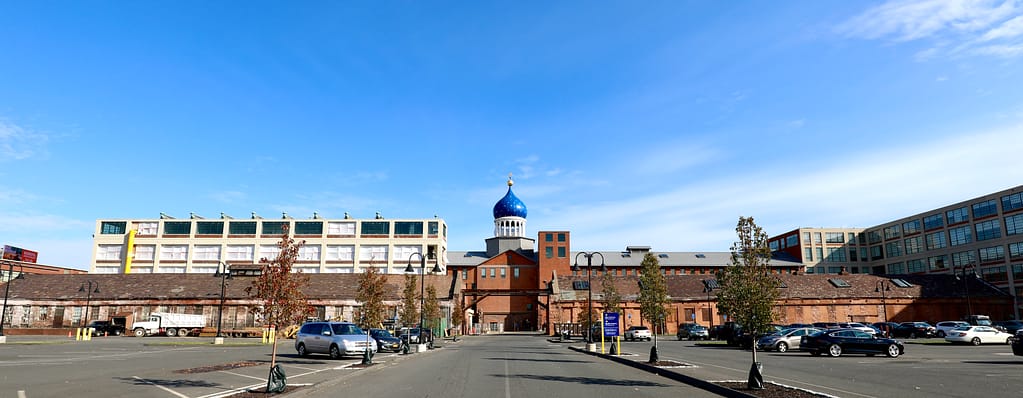
The Colt Armory today
The main building with the blue onion dome was built by Samuel Colt in 1855, severely damaged in 1864, and rebuilt to the same form in 1867. Some of the buildings are in good shape and have been repurposed. We saw an insurance company, an arts college, and Connecticut Senator Chris Murphy’s offices all located in the old Colt buildings. Other parts of the old factory are deteriorating and need preservation work. There are also 10 out of the 20 original workers cottages still standing and still serving as homes.
The Complex has been designated a national historic site and is being developed by the National Parks Service, but as of 2019 was not yet ready. The Colt Armory highlights several planning and preservation dilemmas for local communities and governments. When a massive manufacturing facility like this ceases to operate, what do you do with it? Clearly it needs to be preserved, but who pays for it? Can it be repurposed – all of it or only part of it? Or do you only preserve representative elements of the facility? Who is responsible for maintaining the now 160-year old brick building – the local community? state government? federal government?
If you are not familiar with Samuel Colt’s claim to fame – you have probably seen his products in just about every western movie ever made. Colt revolvers were ubiquitous across the American West. Wyatt Earp carried a long-barrelled ‘Buntline’ Colt. Colt 1911 pistols equipped the US Army from 1911 to about 1990. Throughout the Civil War, World Wars, Korea and Vietnam, Colt was a major supplier of weapons to the US military.
Colt products in popular culture


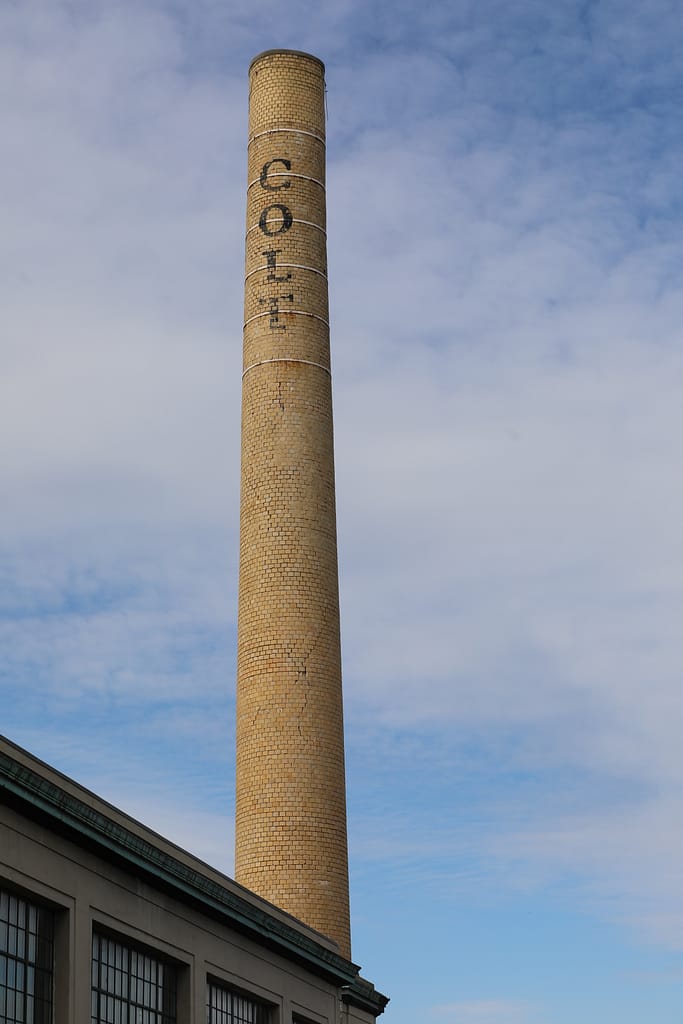
Additional images of the Colt factory
Colt Armory, Hartford Connecticut


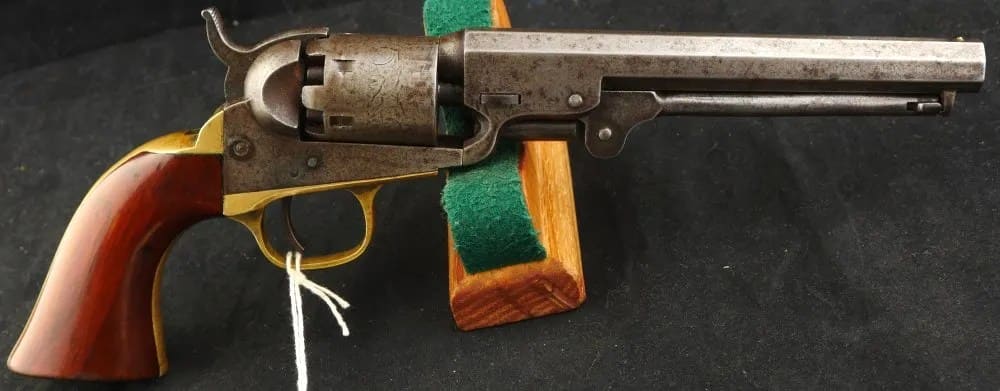
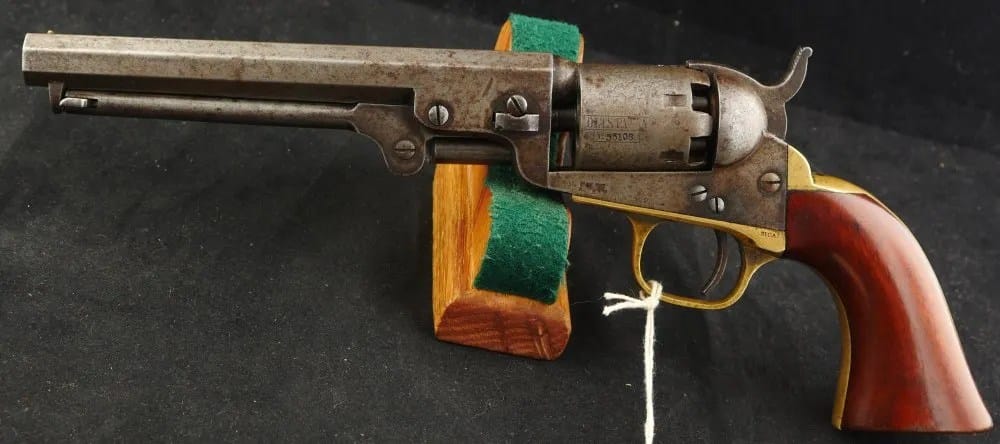
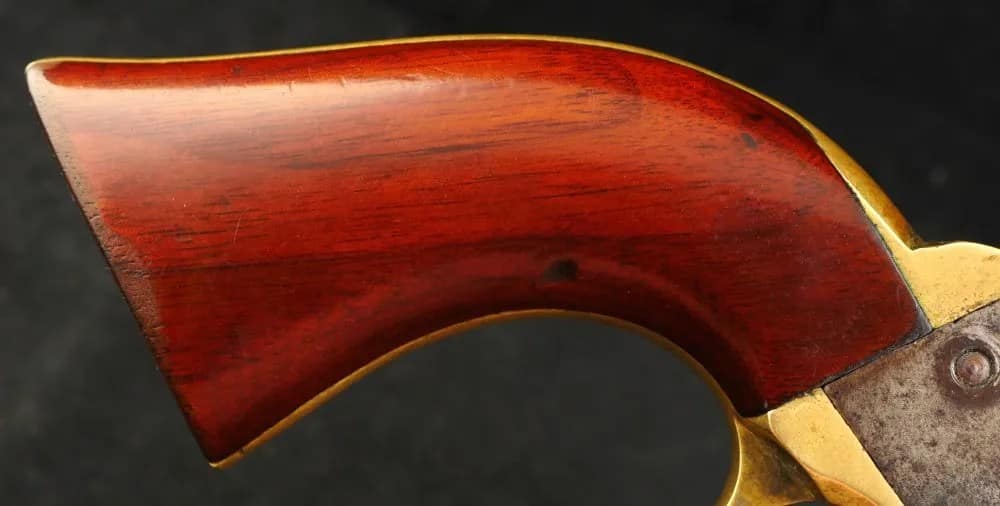
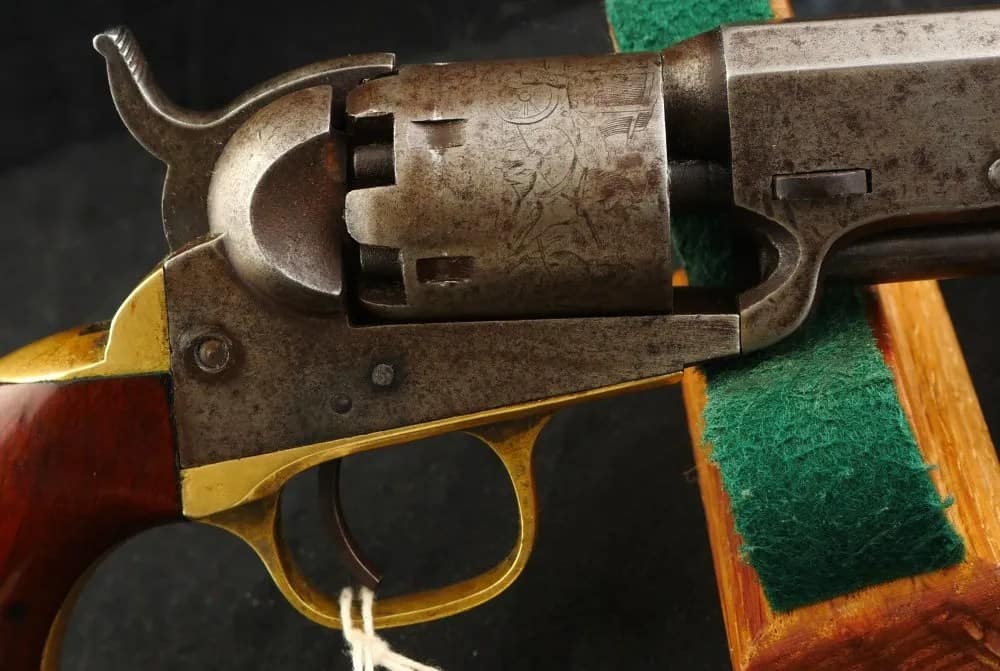
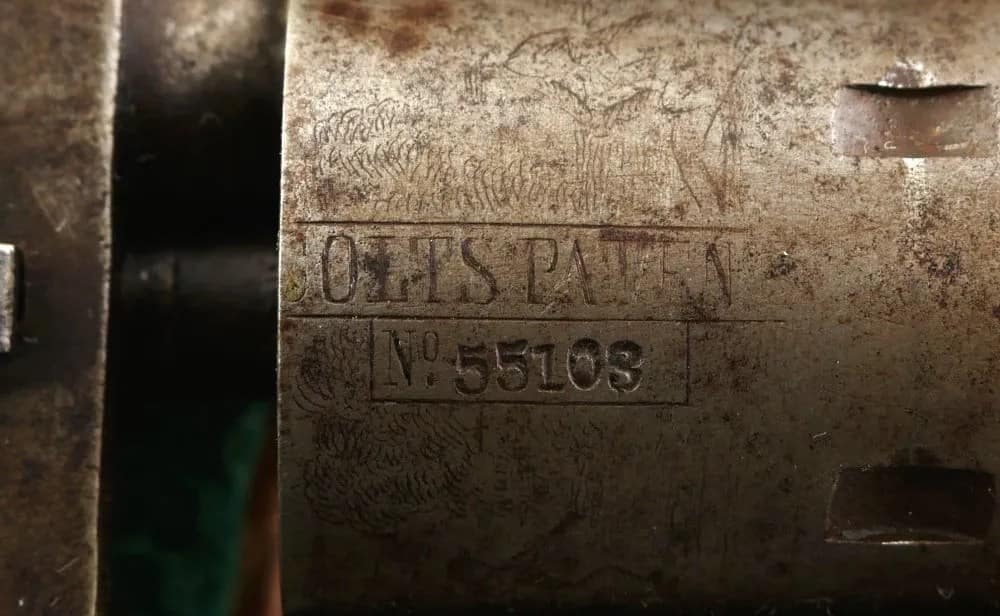
Colt 1849 Pocket Revolver, 0.31″ caliber, six-shot, single-action, from my personal collection
This is an example of an early blackpowder percussion-action Colt revolver. This was before the era of self-contained cartridges. To load one of these early colts, each cylinder is charged with a measure of black powder, then a wad, then a tightly fitted lead ball, and finally a thumb-load of grease to seal the cylinder. Each cylinder is then ‘capped’ with a fulminate of mercury-filled copper cap. To fire the pistol you have to cock the hammer every time, which also rotates the cylinder to align the next loaded chamber with the barrel. Then as fast as you can cock the hammer and pull the trigger, you can get away six shots. It may look low-tech now, but in an era of single-shot muzzle-loading weapons, it was revolutionary!
Found this useful? Buy me a coffee — it helps fund future battlefield research


Authored by Mick Prictor, a retired military officer with 40 years’ service, and a military historian specialising in terrain-focused analysis of tactics, doctrine, and command decision-making in land warfare. His work draws on extensive battlefield fieldwork—more than 280 sites worldwide—and one of the world’s largest private collections of historic military arms, uniforms, and equipment. About me
Sources & Further Reading


📚 Further Reading: Military Arms Manufacturers
This battle study nests within the broader analytical framework explored in the Research Hub, where operational methods, operating environments, armies, commanders, and weapons are examined across conflicts and eras. The links below connect related studies across the wider body of battlefield analysis on the BattlefieldTravels site.
⚔️ Explore all Historic Arms factory studies
🏛️ Explore the Military Museum of historic weapons and equipment
The book list for this category includes the best available books on the Springfield Armory, Colt Firearms, Lithgow Small Arms, Winchester, the Confederate States Armory Richmond, and many more
📚Military Arms Manufacturers – Recommended Reading
🗞️ For updates on new battlefield studies and research insights, you can subscribe to the Newsletter.
Related Battle Studies, Museum Pieces & Reading Resources


🏭 Heritage Travel Guide: Colt Armory, Hartford
Getting There
- Location: Hartford, Connecticut, USA.
- Access: Near I-91 and downtown; easiest by car, parking in/near Colt Park.
- Rail/Bus: Hartford Union Station (Amtrak & buses) ≈10 minutes by car.
Site Orientation
- Key Landmark: The blue onion dome of the East Armory.
- Surroundings: Colt Park (gifted by the Colt family) forms the wider heritage landscape.
- Best Views: Founders Bridge riverwalk for a panorama of the former factory complex.
Museums & Visitor Centres
- Museum of Connecticut History: Major Colt firearms collection (Paterson, Walker, Navy/Army models).
- Wadsworth Atheneum: Exhibits on Hartford’s 19th-century culture and Colt legacy.
- On-site: The armory grounds are not a full museum; plaques/markers provide context.
On-Site Experience
- Interpretive Signage: Limited; combine with museum visits for depth.
- Atmosphere: Industrial heritage setting with mixed redevelopment and parkland.
- Tours: Local history walks occasionally include Colt Park and exterior views.
Nearby Points of Interest
- Mark Twain House: Hartford’s best-known Gilded Age home/museum.
- Connecticut Riverfront: Trails/riverwalk with views toward the armory site.
- Springfield Armory NHS: ~1 hour north; ideal comparative visit.
Practical Tips
- When to Visit: Spring/autumn for best weather; community events often in Colt Park on summer weekends.
- Facilities: Limited on site; full amenities downtown.
- Special Considerations: Best paired with museum stops (Museum of CT History, Wadsworth) for a complete experience.
FAQ: Colt Armory, Hartford Connecticut
Samuel Colt built his first major armory complex at Hartford, Connecticut, in 1855 to mass-produce revolvers using precision machining and interchangeable parts.
The armory pioneered assembly-line methods, standardised gauges, and steam-powered machinery that set the model for later U.S. industrial manufacturing.
By the late 1860s, the armory employed over 1,000 workers, producing large quantities of Colt percussion and cartridge revolvers for both civilian and military use. At its peak during WW2, the factory employed around 16,000 workers.
Colt supplied the Union Army with thousands of Model 1851 and 1860 Army revolvers and other small arms, supporting the war’s massive industrial demand.
The restored blue-dome Colt Armory stands as a National Historic Landmark in Hartford. The surrounding complex now houses apartments, offices, and museum exhibits on firearms innovation.
Subscribe to Battlefield Travels and receive a free E-Book Battlefield Guide
Unlock expert battlefield analysis, campaign reconstructions, and historical insights drawn from firsthand exploration and primary sources.
🗺️ You’ll receive:
🎖️ Exclusive historical insights you won’t find elsewhere
📘 A free eBook: 10 Tips for Exploring Historic Battlefields
📰 New battlefield studies straight to your inbox as they are published