How a minor change to the government army’s bayonet drill defeated the Highlander’s battle tactics— and why the critics who dismissed it were asking the wrong question.

🎧 Prefer to listen? This article is also available as a 36-minute audio-podcast.
Table of Contents
- The Culloden bayonet drill: why the critics have asked the wrong question
- The problem: How to stop a ‘Highland charge’?
- The standard British bayonet drill
- How do you stop the army breaking again?
- Aberdeen, March-April 1746: six weeks to innovate
- Cumberland instructs the army to adopt a new bayonet technique
- The mechanics of the new bayonet drill
- Evidence in support of the new bayonet drill
- The November 1746 Retraction
- The critic’s arguments examined
- Why the critics have asked the wrong question
- Conclusion
- 📚 Notes and References
- 📚 Further Reading: The 1745 Jacobite Rising
- FAQ: the Culloden bayonet drill
This article explored the tactical innovation of the new bayonet drill at Culloden. For the full Battle of Culloden study, please visit: 1746 Battle of Culloden Moor, Scotland
The Culloden bayonet drill: why the critics have asked the wrong question
April 2019, walking the ground at Culloden
I explored Culloden battlefield in April 2019 and published a full Battle of Culloden study in early 2025. One question from the historiography stayed with me long after the article was finished: the story of the ‘new bayonet drill’. The more carefully I examined the evidence, the more interesting the question became. Numerous scholars claimed to have definitively resolved the debate, but they had never asked the right questions. Nor had they examined all the available evidence.

The Debate over the ‘new bayonet drill’
The historiography debate goes something like this:
The April 1746 edition of The Scots Magazine published a letter stating that a new and very effective new bayonet drill had been introduced in preparation for Culloden. The idea was that each British soldier, rather than thrusting at the targe-protected front of the Highlander directly opposite him, would instead thrust obliquely at the unprotected right side of the Highlander to his front right. In November 1746, the same magazine published a retraction stating there was no basis for the April account. Nobody has yet found a general order for a new bayonet drill in Cumberland’s papers. For many historians, the November retraction nullified the April claim. End of debate.
This argument is flawed and has failed to engage with the available evidence. The November 1746 retraction addresses one source only. There are at least six other independent contemporary accounts confirming that there was a new drill, published across several of the most widely-read periodicals in Britain both before and after the battle. The tactical problem the new bayonet drill addressed was publicly documented in 1745, and a proposed solution was publicly circulated in January 1746, three months before the Battle of Culloden. The application of the new drill was confirmed immediately after the battle in several sources. Several of the sources explicitly state that Cumberland himself directed the implementation of the new bayonet drill. None of this has previously been assembled and examined. This article will present the evidence.
The problem: How to stop a ‘Highland charge’?
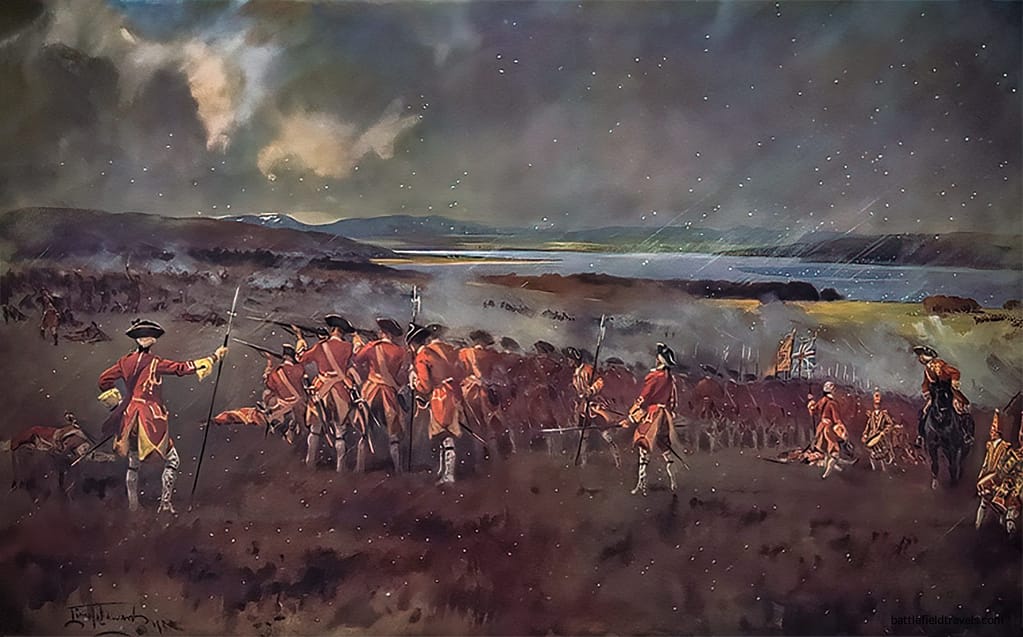
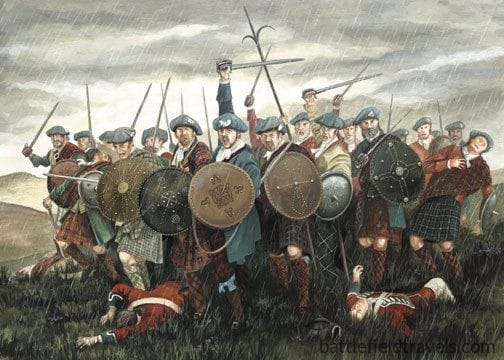
By the time of Culloden, Charles Edward Stuart’s Jacobite army had seized Edinburgh, defeated John Cope’s army at Prestonpans, invaded England, and inflicted another defeat at Falkirk Muir. The standard Jacobite tactic was to find a vulnerable flank and then launch an aggressive ‘Highland charge’. The Highlanders were generally armed with a musket, a pair of pistols, a basket-hilt claymore sword, and a round wooden shield known as a ‘targe’. A typical Highlander was better armed than a British government soldier.
The Highland charge was problematic for the British government Army. This passage is from the Gentlemen’s Magazine Vol XV, October 1745, so post-Prestonpans and pre-Falkirk. The Highlander’s combination of musket, targe, and broadsword were used in a very effective battle drill sequence for which the government army had no immediate solution.
To the Militia or Soldiery of England. The arms of the Highlanders are a musket, and a broad-sword and target; the manner of fighting is to fire at about 30 yards distance, then fling down their muskets, and run in upon the enemy with their swords and targets, and I think their weapons have much the advantage of our musket and bayonet, after we have discharged, as they take the point of the bayonet upon their target, and cut at the same time with their broad-swords.1The Gentleman’s Magazine (1746). Vol. XV. p.527 (The Gentleman’s Magazine (1746). Vol. XV.)
Facing a shield-equipped enemy
The British Army of the mid-eighteenth century was a formidable instrument of linear warfare. Its soldiers were trained for volley fire at regulation distances, for the advance in line, for the platoon firing sequences that could deliver controlled musketry against similarly organised European opponent. The British government army at Culloden was largely composed of veterans of the War of the Austrian Succession in Flanders, brought back from the continent to deal with the Jacobite uprising.
They had never been tested against a shield-equipped enemy.
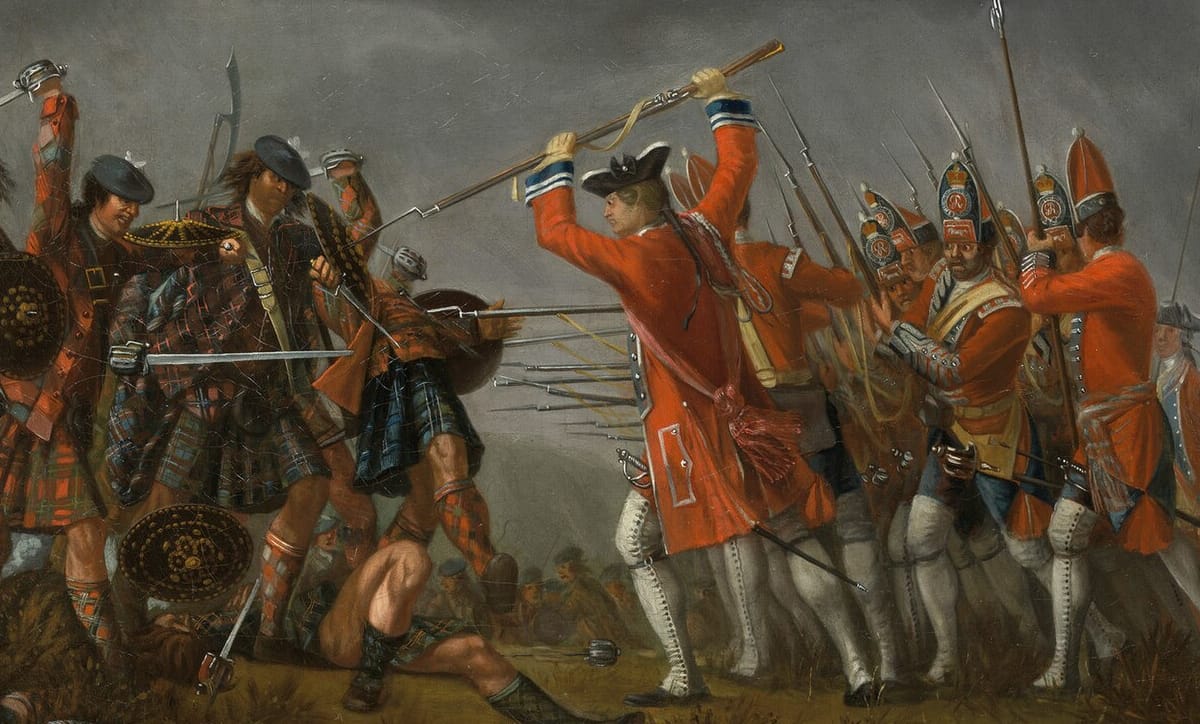
The Highland targe was a small round shield worn on the left forearm, it covered the Highlander’s front and left side as he advanced. A government soldier thrusting his bayonet straight ahead was thrusting at a man whose targe was already moving to deflect the bayonet point. The thrust would be swept aside. The sword arm, unobstructed, uninhibited, would be free to strike.
The last time British infantry had faced an enemy carrying shields into close combat was somewhere in the distant medieval past. The targe and broadsword combination that the Highland charge brought to Prestonpans and Falkirk was outside the experience of every officer and soldier in Cumberland’s army. It was also outside their doctrine.
The standard British bayonet drill
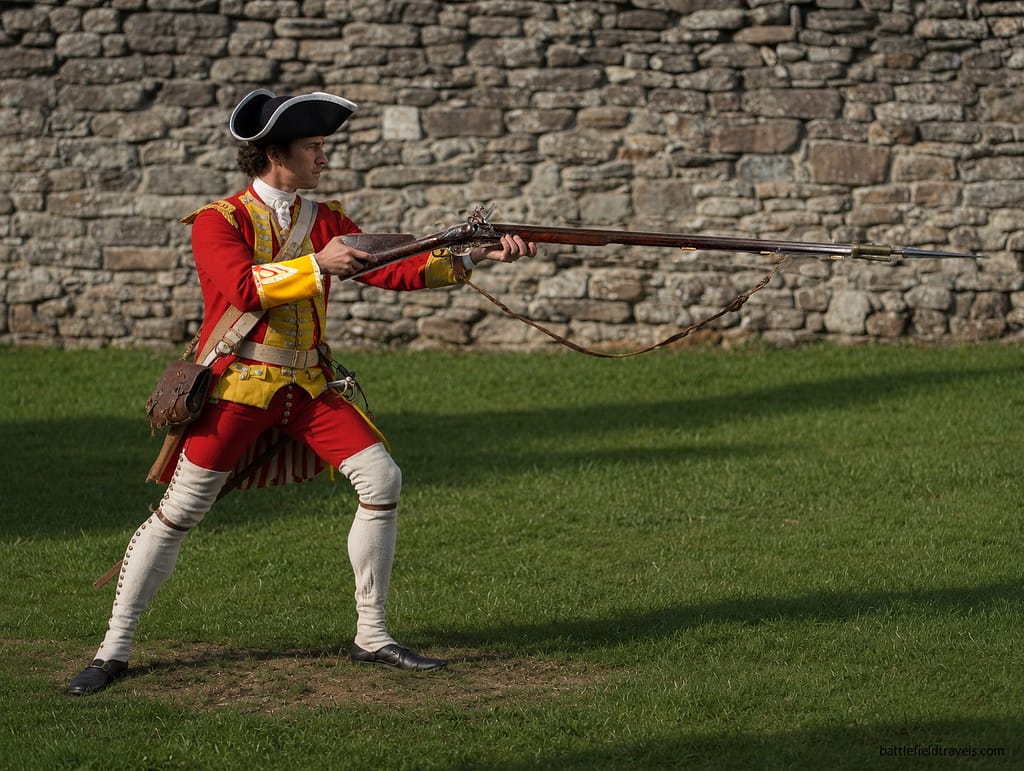
Major-General Humphrey Bland’s Treatise of Military Discipline, the authoritative British infantry manual, fifth edition 1743, prescribed the standard bayonet drill in detail: straight thrust, breast high, into the man directly opposite.2Bland, H. (1743). A Treatise of Military Discipline. 5th ed. Dublin: M. Rhames. pp.29-30 That drill was designed for an enemy soldier who also carried a musket and bayonet. Against a man who carried a targe on his left arm and a broadsword in his right hand, it was the wrong technique.
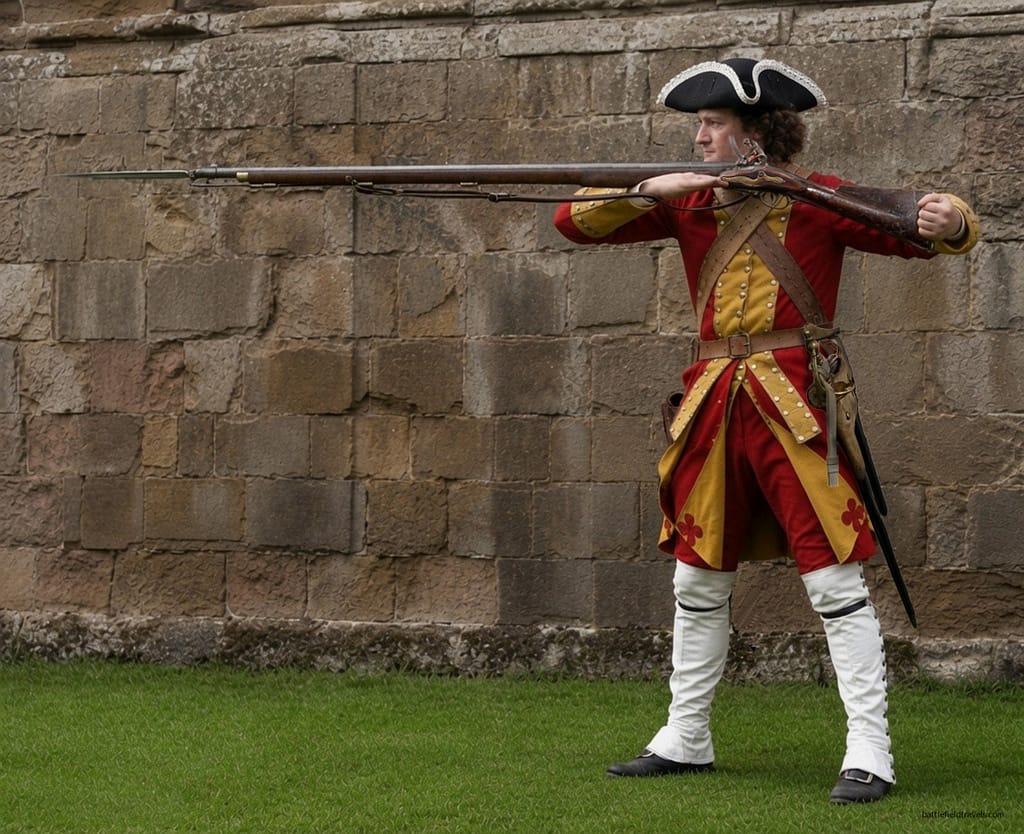
XL. Charge your Bayonets Breast high. 3 Motions.
…hold the Firelock fast with the left Hand, and clap the Palm of the right on the Butt-end, the Thumb and Barrel pointing to the Right. … fall back with the right Foot a moderate Pace, and in a direct Line behind the left, and at the same time come to your Charge, by bringing down the Firelock to a Level, and supporting it with your left Arm by raising up your Elbow from your Body, the Stock lying between the left Thumb and Fore-finger, and the Butt-end in a full right Hand, the Thumb on the upper Part of it with the Barrel upwards, and the Bayonet pointing directly to the Front about Breast high. 3Bland, Treatise, pp.29–30
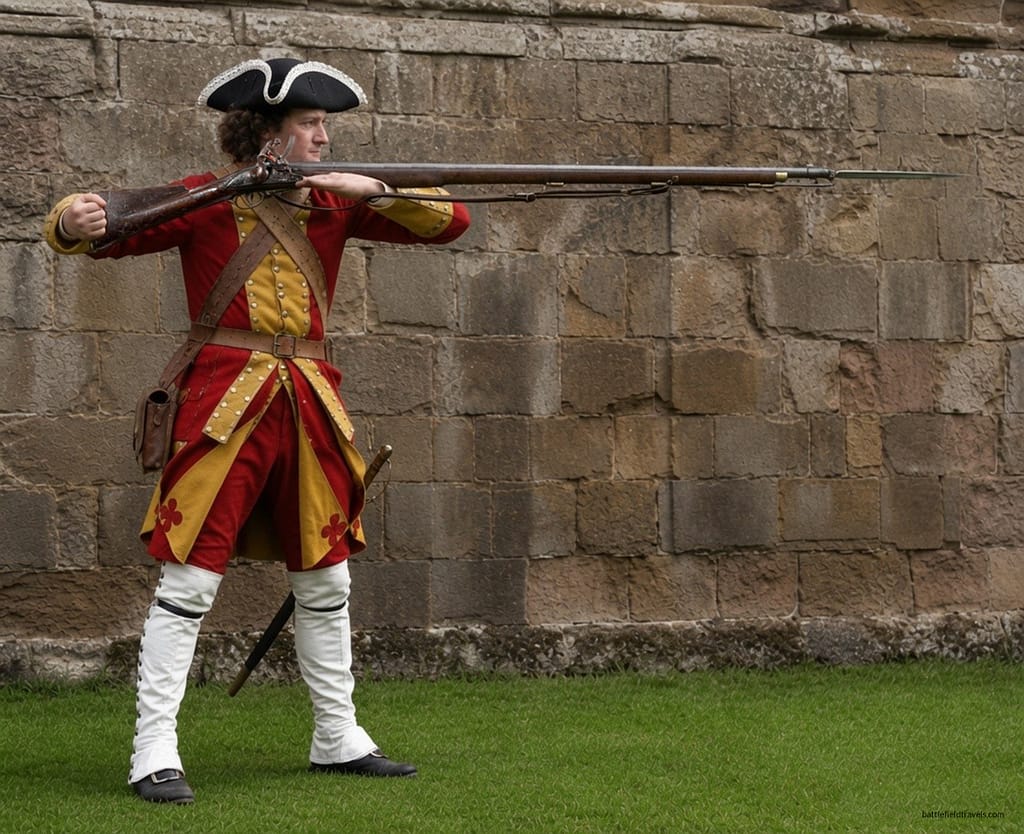
Image: Prictor, M. (2025). BattlefieldTravels.com. Please cite if reproducing.
XLI. Push your Bayonets. 2 Motions.
Push your Firelock with both Hands straight forward, without raising or sinking the Point of the Bayonet, bringing the Butt-end before the left Breast ; then … bring it back to its former Place.4Bland, Treatise, pp.29–30
(Bland, H. (1743). A Treatise of Military Discipline.)
How do you stop the army breaking again?
Defeats at Prestonpans and Falkirk
At the Battle of Prestonpans on 21 September 1745, the government army of Sir John Cope disintegrated as a fighting force in about ten minutes. The Jacobite army crossed a drainage ditch considered impassable, formed up in darkness on the government’s eastern flank, and charged at first light in a thick mist. Cope’s infantry fired a single ragged volley and broke. The dragoons wheeled and fled without engaging. The Jacobites lost perhaps thirty men. The government army lost around three hundred killed and wounded, with another fifteen hundred taken prisoner.
The Battle of Falkirk Muir on 17 January 1746 produced a second catastrophe. Three of Lieutenant General Henry Hawley’s infantry regiments broke and fled immediately when the Highland charge descended the ridge. The battle was lost. The Duke of Cumberland was dispatched north to take command.
Two battles. Two collapses. The core question was not tactical. It was psychological:

Restoring confidence
How do you stop your men from running away when confronted by a wild Highlander charge? You restore their confidence in their own weapons, their tactics and their leaders.
A new technique, practised until it became automatic, drilled until it could be executed under the terror of a Highland charge, serves a function beyond its mechanical effectiveness. It gives men something to do when the musket balls are flying and the Highlanders are charging. Having a well-practiced drill transforms an apparently overwhelming threat into a solvable problem with a known solution. The preparation required was not primarily technical. It was psychological. Before Cumberland’s infantry could face the Highlanders again, they had to be confident that disciplined men with muskets and bayonets could stand their ground against Highlanders armed with shields and swords.
That was the problem Cumberland took to Aberdeen. It was acute, personal, and urgent. It demanded a solution.
Aberdeen, March-April 1746: six weeks to innovate
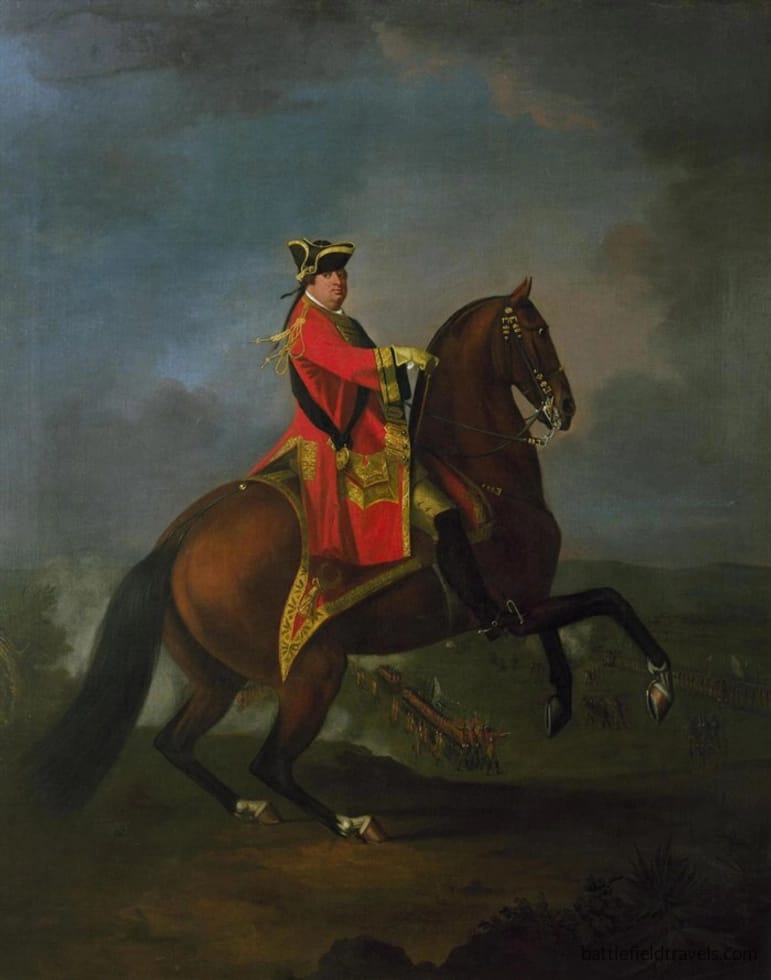
The Duke of Cumberland takes over
Cumberland arrived in Edinburgh on 30 January 1746, two weeks after the Battle of Falkirk. He moved the army north to Aberdeen, where it would spend six weeks in intensive preparation before the final advance into the Highlands.
The documented innovations at Aberdeen operated at two levels. At Army level, Cumberland introduced a modified platoon firing sequence designed to maximise controlled fire during the critical seconds of a Highland approach. His order to the Royal Scots Fusiliers on 2 April 1746 to practice “the motions of alternate firings by platoons from ye right and left to ye centre reserving fire of ye front rank and Grenadiers”, was designed to break the charge with sustained musketry before it reached the line.5Blackmore, D. (2012). Destructive and Formidable: British Infantry Firepower 1642–1765. PhD thesis. Nottingham Trent University.
But fire discipline alone was not sufficient. At Falkirk, the weather had rendered the many of the government army muskets unserviceable and the Highland charge again sent most of the government units fleeing in panic. If the Highland charge closed through the fire, the government troops still needed the confidence to remain steady and face them.
Restoring moral steel in the spine of the army
A grenadier in Barrell’s regiment later recalled the training at Aberdeen and Strathbogie, recorded in an 1802 pamphlet responding to Home’s history and cited by Ritchie, that “the grenadiers attack the battalion, in exercising, with their broad swords, to convince the men of the superiority of the bayonets.”6Anon. (1802). Observations on Mr Home’s Account of the Battle of Culloden. Exeter. Cited in Ritchie, N.S. (15 February 2025). ‘Did the Duke of Cumberland introduce a new bayonet drill before Culloden?’ Jacobite Wars. Original not independently verified by this author — held at National Library of Scotland, Aberdeen University Library, and British Library The purpose was explicit and psychological. Cumberland was demonstrating through repetitive practice and exposure that a steady infantry armed with musket and bayonet could defeat a wild charge by men armed with targe and broadsword.
An officer writing from Inverness in the days after Culloden recorded Cumberland’s approach directly:
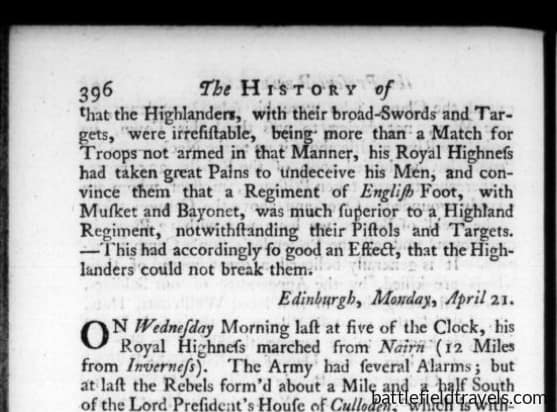
“his Royal Highness had taken great Pains to undeceive his Men, and convince them that a Regiment of English Foot, with Musket and Bayonet, was much superior to a Highland Regiment, notwithstanding their Pistols and Targets. This had accordingly so good an Effect, that the Highlanders could not break them.”7Marchant, J. (1746). The History of the Present Rebellion. London: Printed for the author. p.396.
(Marchant, J. (1746). The History of the Present Rebellion.)
The battle was won in Aberdeen before it was won at Culloden.
Cumberland instructs the army to adopt a new bayonet technique
Cumberland’s personal role in the bayonet instruction is recorded by John Marchant, writing in 1746:
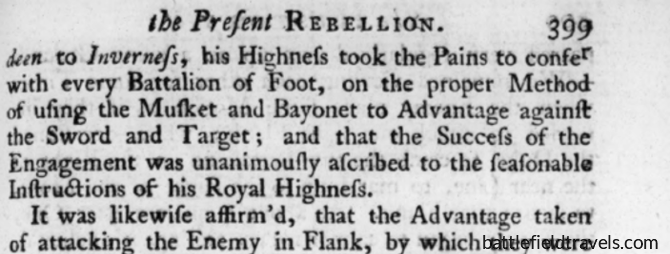
“his Highness took the pains to confer with every Battalion of Foot, on the proper Method of using the Musket and Bayonet to Advantage against the Sword and Target; and that the Success of the Engagement was unanimously ascribed to the seasonable Instructions of his Royal Highness.”8Marchant, History of the Present Rebellion, p.399.
(Marchant, J. (1746). The History of the Present Rebellion)
This is not the language of a written general order issued through the chain of command. It is the language of a commanding general personally directing his regiments in a specific technique. The absence of a written order in Cumberland’s papers is therefore not evidence that no instruction was given. It is evidence that the instruction was delivered personally and orally, precisely the kind of transmission that leaves no documentary trace at headquarters level but is recorded by a contemporary observer who knew what had happened.
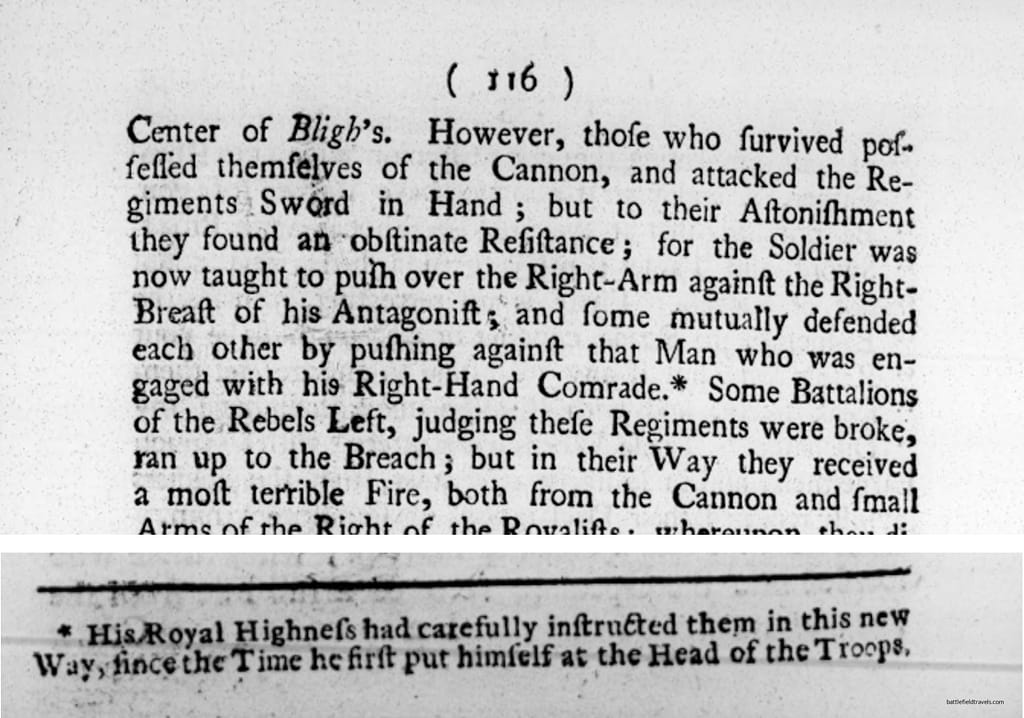
Henderson, A. (1752). History of the Rebellion. 3rd ed. p.116 and footnote.
“… attacked the Regiments Sword in Hand; but to their Astonishment they found an obstinate Resistance; for the Soldier was now taught to push over the Right-Arm against the Right Breast of his Antagonist; and some mutually defended each other by pushing against that Man who was engaged with his Right-Hand Comrade.”9Henderson, A. (1752). History of the Rebellion. 3rd ed. p.116
His Royal Highness had carefully instructed them in this Way, since the Time he first put himself at the Head of the Troops.”10Henderson, History of the Rebellion. 3rd ed. footnote to p.116.
Henderson, A. (1752). History of the Rebellion. 3rd ed
The mechanics of the new bayonet drill
A consistent theme: thrust into the unprotected right side
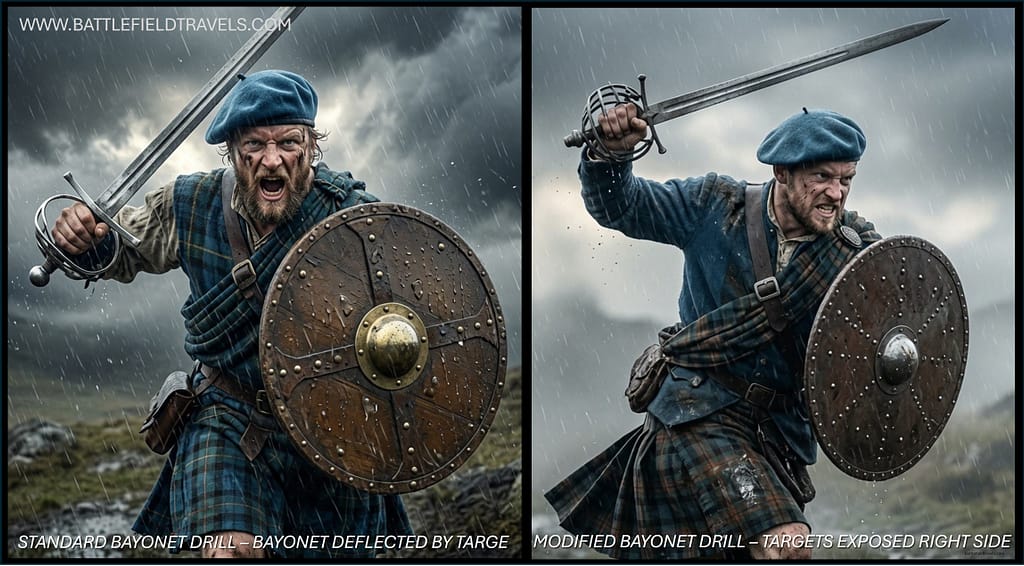
The precise mechanics of the modified drill are described imprecisely across the sources. The April 1746 Scots Magazine correspondent (p. 192-193) provides the most comprehensive description of the new bayonet drill: “The alteration was mighty little, but of the last consequence. Before this, the bayonet-man attacked the sword-man right fronting him: now the left-hand bayonet attacked the sword fronting his next right-hand man.’” Henderson describes the thrust as pushing ‘over the Right-Arm against the Right Breast.’11Henderson, A. (1753)Henderson, History of the Rebellion, p.116. The Gentleman’s Magazine Vol. XVI (1746) records that soldiers were instructed to “…direct their bayonets, each to his right-hand man of the enemy.” 12The Gentleman’s Magazine Vol. XVI (1746, p.244) The consistent feature in the sources is that the new drill used an oblique thrust to bypass the targe, and direct the bayonet thrust to the unprotected right side of the attacking Jacobite.
A reversed stance?
In his 2012 PhD Thesis, David Blackmore proposes a complete reversal of the standard firing position: right hand under the chin, left hand on the butt, body facing left. This technique could be inferred from the sources, but it is not explicitly described. To execute the drill this way, a soldier would need to reverse his stance, switch his hand positions, and use the weapon in a way that defies his years of habit, service, and training. However, there is one visual source that suggests this may have been the Culloden bayonet drill.13In my discussion with David Blackmore in June 2026, he provided me with a link to this additional and critical visual source: Augustin Heckel’s 1747 engraving. We will get to that in a moment.
An imaginative solution
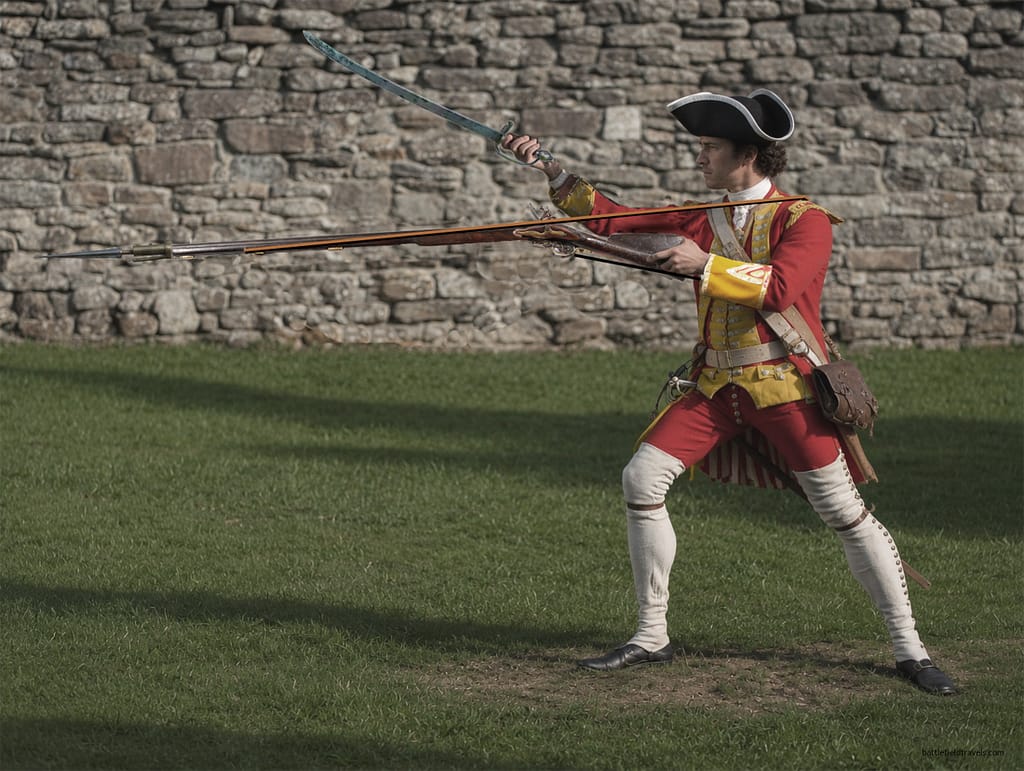
The Gentleman’s Magazine Vol. XVI of January 1746 describes a pre-battle proposal by a Scottish merchant who has aspirations of raising his own regiment trained in a new technique. The merchant describes the musket supported on a lengthened sling and driven by the left hand while the right hand wields a hanger (short sword). Whatever its theoretical merits, the sling technique requires single-handed control of an unwieldy six-foot long weapon against an opponent moving at speed, while simultaneously wielding sword in the other hand. This is not a technique that would survive in close combat. It is a civilian thinking about a soldier’s problem.14The Gentleman’s Magazine Vol. XVI of January 1746 (p.31)
Visual evidence: Augustin Heckel’s 1747 Engraving
The National Gallery of Scotland holds a black and white engraving by Augustin Heckel, titled ‘The Battle of Culloden, April 16th 1746’. Heckel was originally from Augsburg Germany but retired to London around 1746 where he continued his artwork. The Royal Academy or Arts website claims the engraving was created in 1747. The engraving proved popular and coloured versions were produced for the popular market, including the version depicted below.
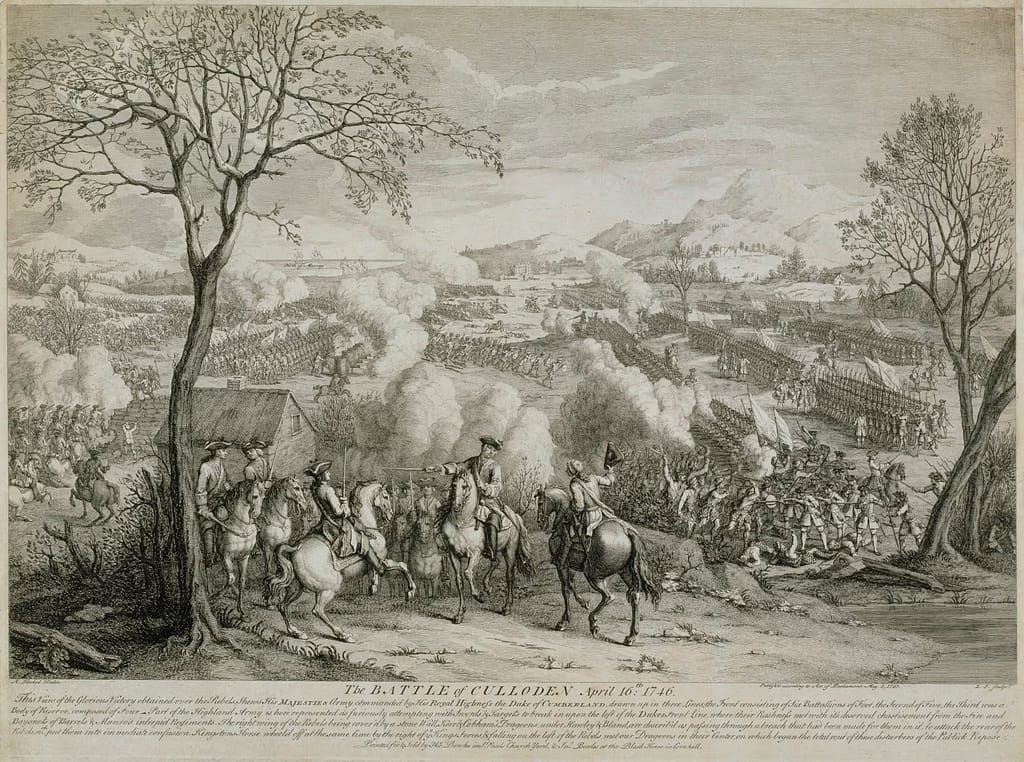
In the foreground of the image, Barrel’s Regiment can be seen engaged in intensive hand to hand combat with the Jacobite army. Barrel’s Regiment can be seen in a reversed bayonet stance – right foot forward, left foot back, right hand forward, left hand pushing against the buttplate. The next block of soldiers, presumably Monroe’s Regiment is in the regulation Bland bayonet stance with left foot forward. This is an artist’s depiction, not a photograph or drill manual, so care must be taken with how much evidentiary weight this carries.
This engraving was created about one year after the battle. Heckel clearly had access to knowledgeable advisors who could describe to him the layout of the battlefield, the boggy ground that forced the Highland charge into the British left, the intense hand to hand combat on the British left, the position of Leanach Cottage, and other features of the battlefield. And clearly the advisers either told him that Barrel’s Regiment used a reverse stance, or he inferred it from the description of the new bayonet drill. And he knew the difference because he has depicted Monroe’s Regiment in the regulation bayonet stance as described by Bland. An engraver who depicted two adjacent units in demonstrably different stances, one year after the battle, was recording a distinction that mattered to the people who briefed him.
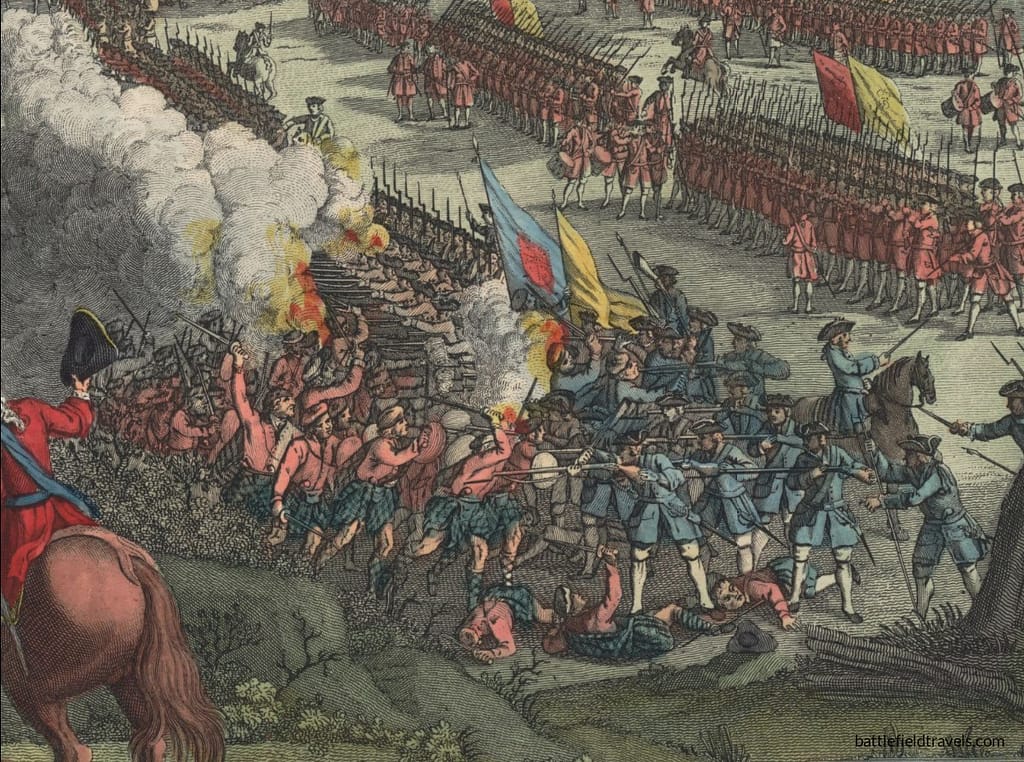
Comparing the standard bayonet drill with the new bayonet drill
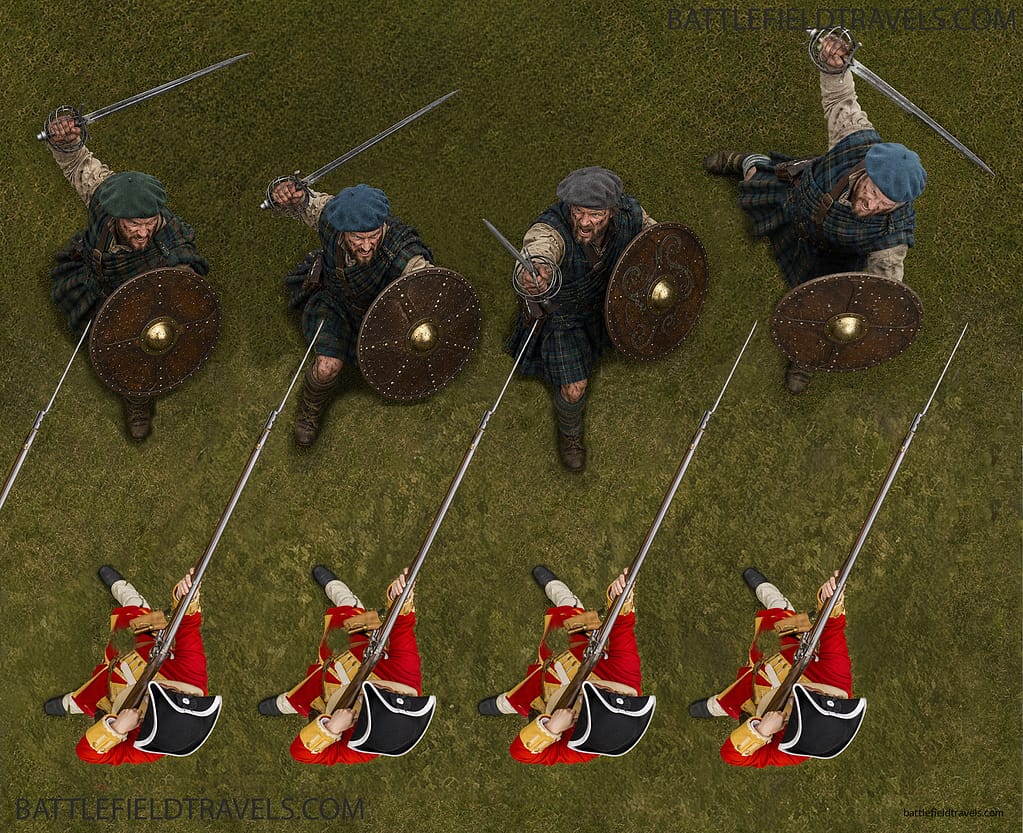
Six weeks of drilling a small alteration to an existing technique is feasible. Six weeks of drilling a complete reversal of the standard fighting position, and producing reliable execution under the terror of a Highland charge, is more problematic but not impossible. What Cumberland needed was a new bayonet drill that worked because it was simple enough to survive contact with the enemy.
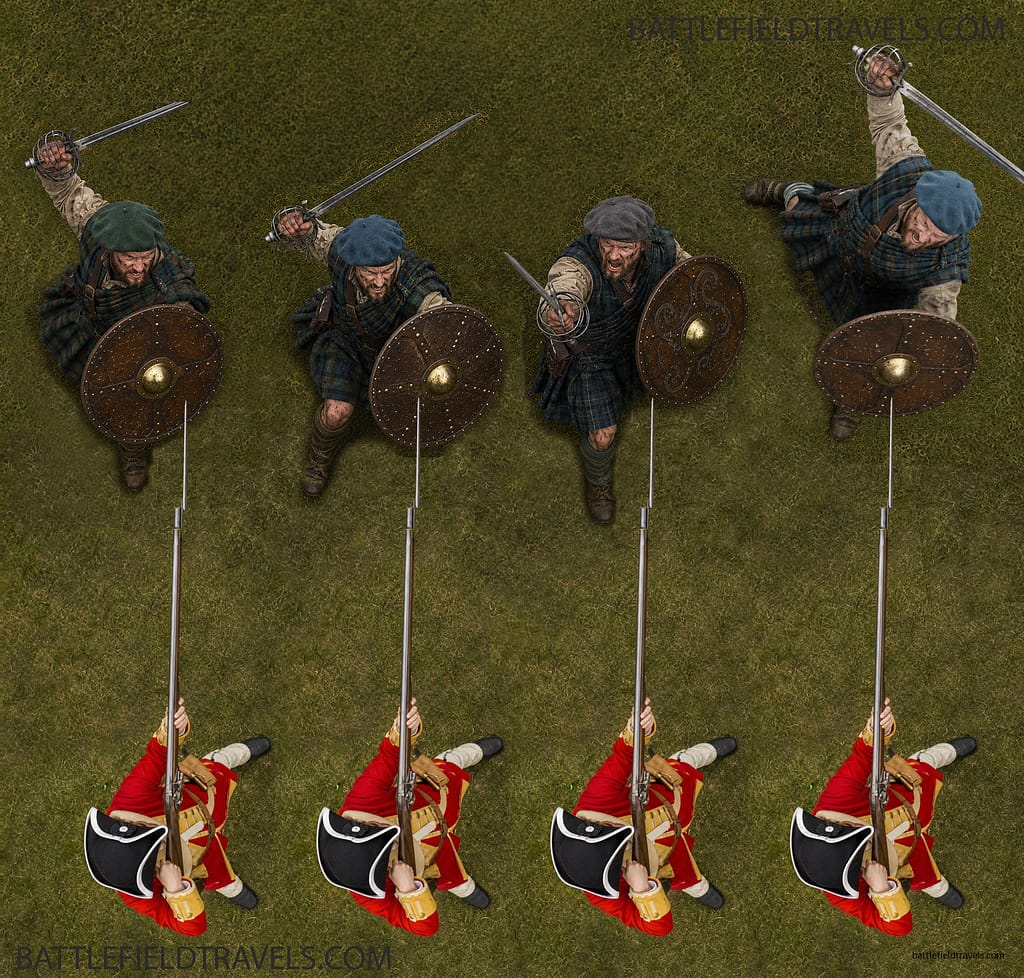
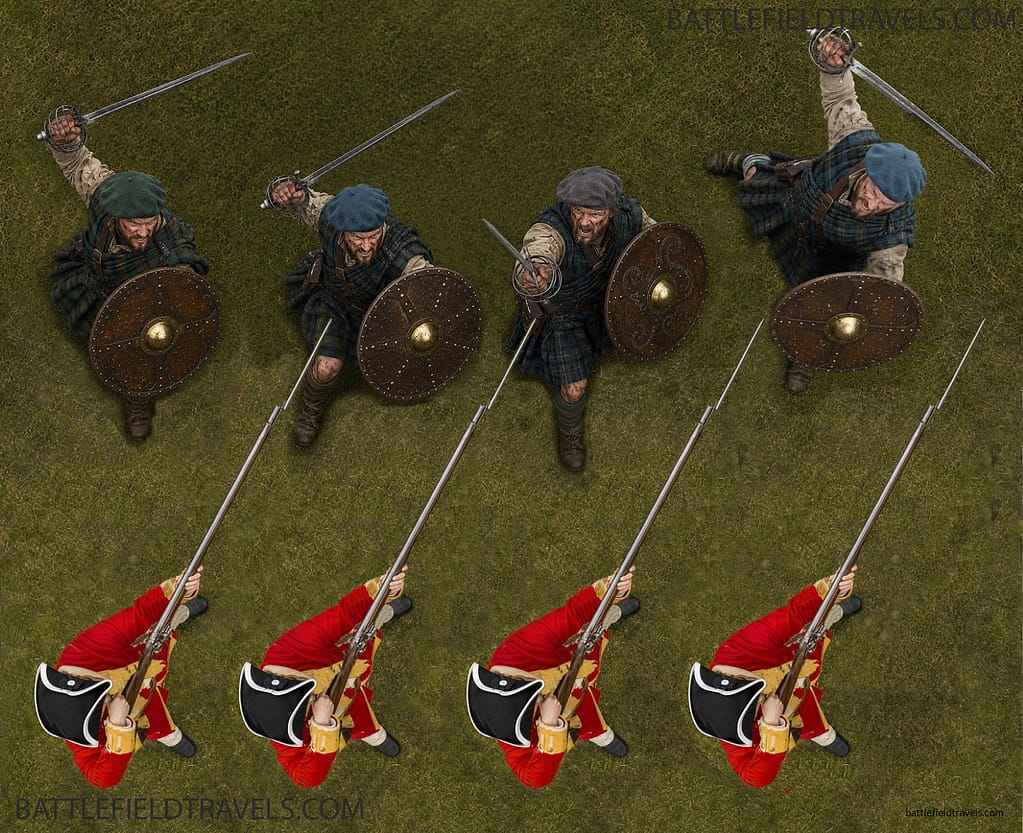
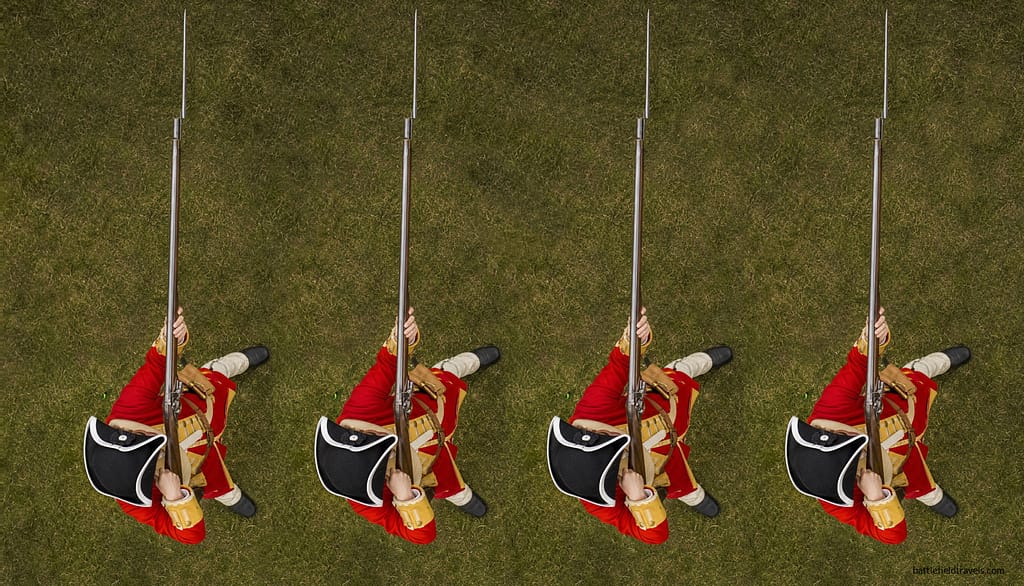
If Augustin Heckel’s depiction is correct, the new bayonet drill would look something like the image below. The clear advantage with this method is that the soldiers do not turn their backs to the charging Highlanders. The disadvantage is that, as a soldier, you have a master eye and a master hand that you use to operate a weapon. Every drill you have performed in your years of service, and every battle you have just fought in Flanders has involved firing and bayonet work with the left foot forward, left hand forward, right hand back. Changing that habit is hard. At Culloden, these soldiers will have just delivered several volleys at 50-60 yards and maybe another at 20 yards, and they now have to reverse their stance and change the position of their hands on the weapon. Feasible – Yes. Awkward – definitely.
⚔️ Go deeper — Members get exclusive access to the Deep Research Collection, Field Notes, and monthly Research Dispatches. Try membership free for 7 days, cancel anytime. From $9/month.
Evidence in support of the new bayonet drill
The case for the modified bayonet drill rests on multiple independent contemporary and near-contemporary sources, considered together here for the first time. No previous treatment of this debate has assembled and examined all of them.
The Scots Magazine, April 1746: two independent accounts
The Scots Magazine for April 1746 devoted sixteen of its forty-eight pages to the Battle of Culloden and contemporary events. Of those sixteen pages, covering every aspect of the engagement, two letters reference a new bayonet practice.
If Cumberland had issued a general order for a modified drill to his entire army, the record across sixteen pages of letters from officers and men from many regiments would probably reflect this instruction. It does not. There are two letters, and both appear to be from members of Barrell’s Regiment that bore the weight of the Highland charge.
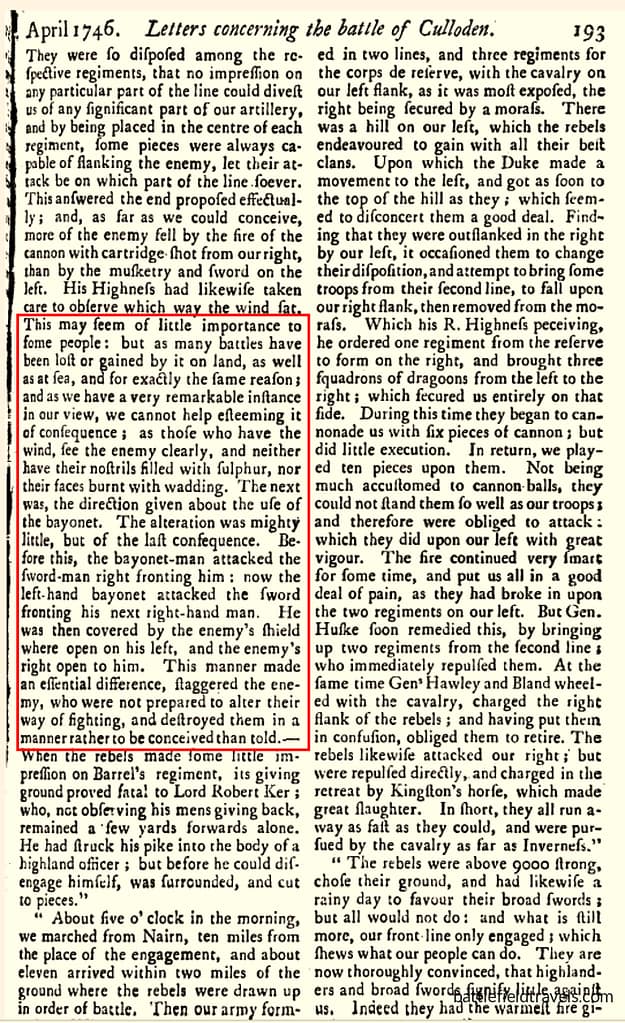
The long letter on pages 192-193 identifies three tactical innovations the correspondent believes explain Cumberland’s victory at Culloden: Cumberland’s artillery placement, selection of the position to gain advantage from the prevailing wind, and the new bayonet drill. The first two are verifiable and unquestioned. The correspondent’s credibility is established before he reaches the bayonet passage:
“The next was the direction given about the use of the bayonet. The alteration was mighty little, but of the last consequence. Before this, the bayonet-man attacked the sword-man right fronting him: now the left-hand bayonet attacked the sword fronting his next right-hand man. He was then covered by the enemy’s shield where open on his left, and the enemy’s right open to him. This manner made an essential difference, staggered the enemy, who were not prepared to alter their way of fighting, and destroyed them in a manner rather to be conceived than told.”15The Scots Magazine (April 1746), p.192-193. (The Scots Magazine, April 1746)
A second letter on page 192 provides independent operational corroboration from a different observer:
“The battle was now entirely fought between swords and bayonets. Our soldiers, by a new practice of using the latter, became much too hard for the swords; and the rebels, as they pushed forward, fell on certain death. Ours at least killed ten men to their one in this kind of fighting, besides what fell by the musketry and cannon. The rebels finding their only manner of fighting obviated, and those who supported their front cut off, they at first made a short pause, retreated a little, and then turning short round, fled with the utmost precipitation.”16Scots Magazine, April 1746, p.192. (The Scots Magazine, April 1746)
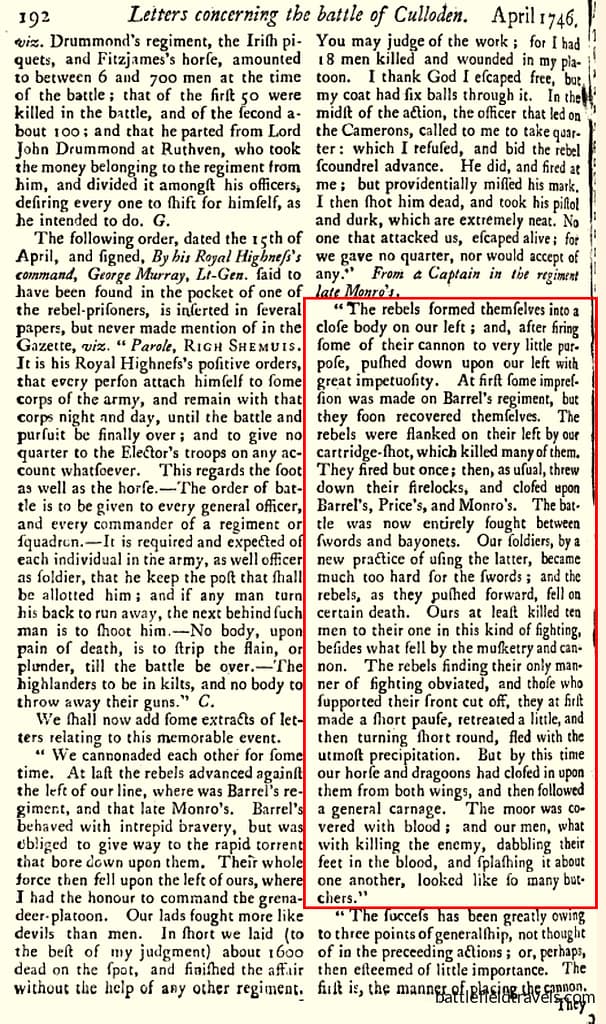
‘A new practice.‘ The second correspondent does not describe the mechanism, he describes the effect: a ten to one exchange ratio in close-quarter combat, the rebels’ only manner of fighting rendered void, psychological collapse and flight.
Two independent eyewitnesses with letters published in the Scots Magazine of April 1746. One explains the mechanics. The other describes the outcome. The London Gazette, published the same week, confirms the killing rate from the official record without explaining it.
The Gentlemen’s Magazine Volume XVI, January 1746
The Gentleman’s Magazine of 1746 has extensive coverage of the Battle of Culloden, including the concept of a new bayonet drill. This passage from January 1746 that indicates that the idea of an oblique bayonet thrust drill to bypass the targe and thrust into the vulnerable right side of the Highlander was a topic of discussion three months prior to Culloden, and that a similar method had been used at the Battle of Sheriffmuir on 13 November 1715.17The attribution to the Duke of Argyle using a similar technique at Sheriffmuir in 1715 has not been confirmed from Argyle’s own papers or from contemporary accounts of the battle. It is cited here as evidence that the concept was publicly associated with British military experience before Culloden, not as a confirmed historical precedent.
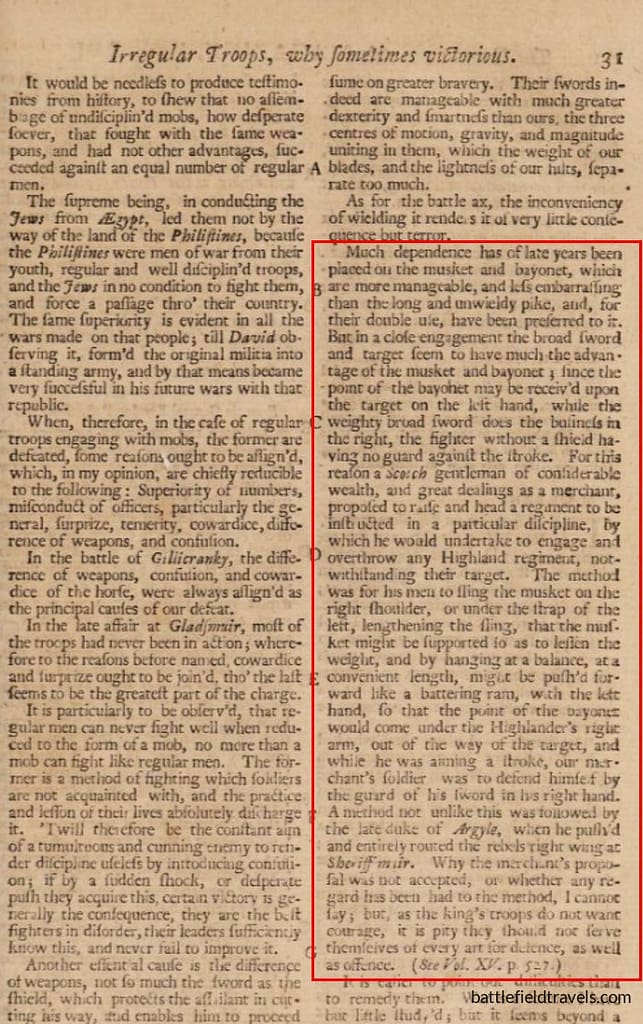
The ‘Scotch gentleman’ appears to be describing a drill whereby the soldier uses his musket sling to bear the weight of the weapon, while he pushes the musket with the left hand to thrust into the unprotected right side of a charging Highlander. Concurrently, the soldier is using his hanger (short sword) in the right hand to defend himself. The physical mechanics of wielding an 11-pound, 6-foot long musket+ bayonet with one hand while wielding a sword in the other hand are complex. This seems to be a civilian devising a novel but impractical close-combat solution.
“For this reason, a Scotch gentleman of considerable wealth, and great dealings as a merchant, proposed to raise and head a regiment to be instructed in a particular discipline, by which he would undertake to engage and overthrow any Highland regiment, notwithstanding their target. The method was for his men to sling the musket on the right shoulder, or under the strap of the left, lengthening the fling, that the musket might be supported so as to lessen the weight, and by hanging at a balance, at a convenient length, might be pushed forward like a battering ram, with the left hand, so that the point of the bayonet would come under the Highlander’s right arm, out of the way of the target, and while he was aiming a stroke, our merchant’s soldier was to defend himself by the guard of his sword in his right hand. A method not unlike this was followed by the late Duke of Argyle , when he pushed and entirely routed the rebels right wing at Sheriffmuir.”18Essay on Regular and Irregular Forces’ (1746). The Gentleman’s Magazine. Vol. XVI, p.31
(The Gentleman’s Magazine (1746). Vol. XVI)
The Gentlemen’s Magazine Volume XVI, April 1746
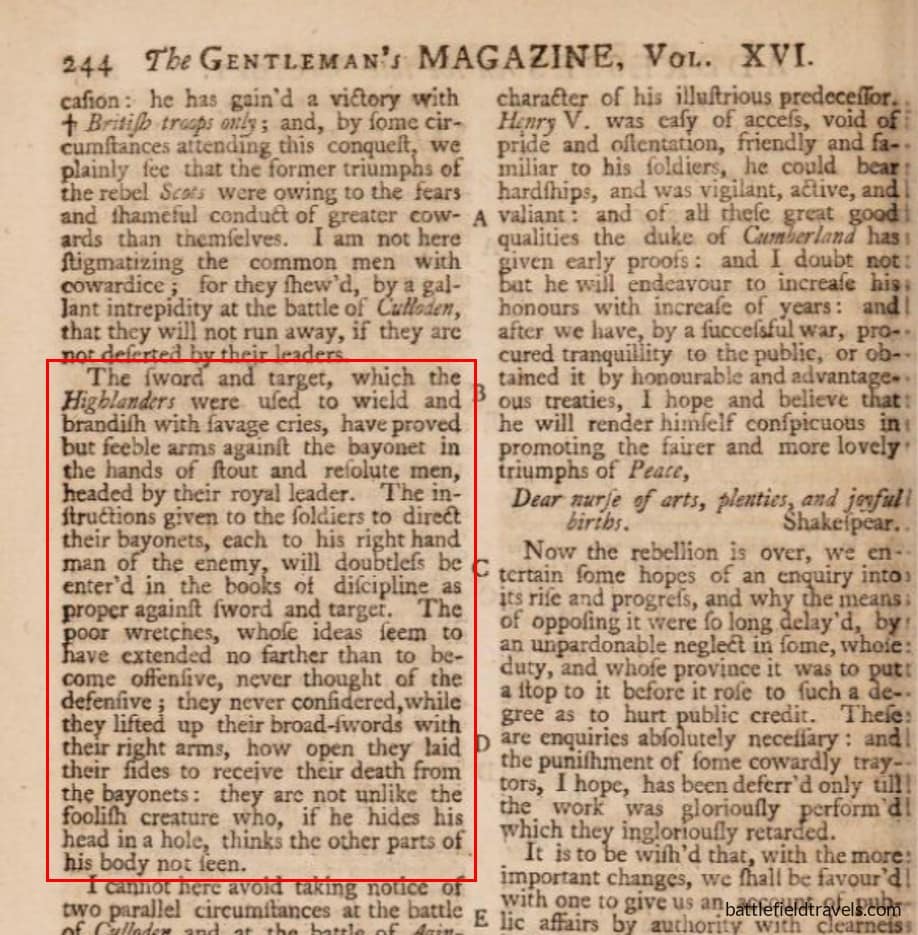
This passage from around 21 April 1746 clearly describes the new bayonet drill and confirms that it was given as an instruction to the troops. It also makes clear, as does the Scots Magazine passage, this this was a battle-winning technique that neutralised any advantage the Highlanders believed they possessed with the targe and broadsword combination.
“The instructions given to the soldiers to direct their bayonets, each to his right-hand man of the enemy, will doubtless be entered in the books of discipline as proper against sword and target. The poor wretches, whose ideas seem to have extended no farther than to become offensive, never thought of the defensive ; they never considered, while they lifted up their broad-swords with their right arms, how open they laid their sides to receive their death from the bayonets : they are not unlike the foolish creature who, if he hides his head in a hole, thinks the other parts of his body not seen.”19Gentleman’s Magazine, Vol. XVI. p.244
(The Gentleman’s Magazine (1746). Vol. XVI)
Richard Rolt’s Memoirs of William Augustus, Duke of Cumberland (1767)
Richard Rolt’s 1767 biography of Cumberland, drawing on sources independent of The Scots Magazine, states:
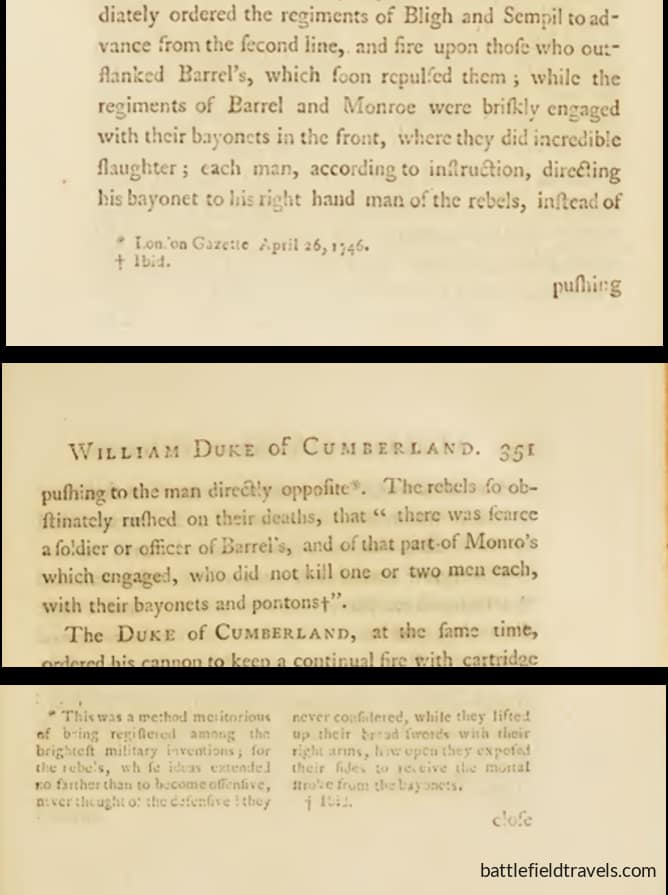
“each man, according to instruction, directing his bayonet to his right hand man of the rebels, instead of pushing to the man directly opposite.”
“while they lifted up their broad swords with their right arms, how open they exposed their sides, to receive the mortal stroke from the bayonets”20Rolt, R. (1767). Memoirs of William Augustus, Duke of Cumberland. p.351-352
(Rolt, R. (1767). Memoirs of William Augustus, Duke of Cumberland)
The word instructed is critical. Not improvised. Not spontaneously adopted in the chaos of contact. Properly instructed. Rolt’s footnote at this passage does not cite The Scots Magazine. It cites an independent observation about how the Jacobite use of the sword creates a vulnerability for the bayonet. Rolt is a genuinely independent source, twenty-one years after the battle, confirming a formal instruction in a new bayonet method.
The London Gazette, 26 April 1746
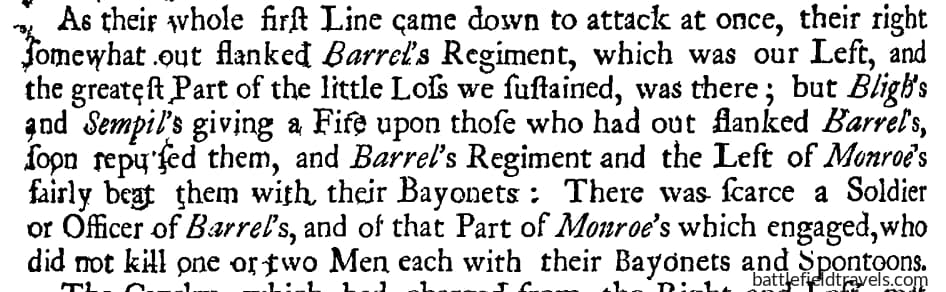
The official government account of the battle was published ten days after Culloden. Cumberland’s dispatch, written from Inverness on 18 April 1746, describes the close-quarter fighting on the government left:
“Barrel’s Regiment and the Left of Monroe’s fairly beat them with their Bayonets; There was scarce a Soldier or Officer of Barrel’s, and of that Part of Monroe’s which engaged, who did not kill one or two Men each with their Bayonets and Spontoons.”21The London Gazette, No.8531, 26 April 1746, p.2.
(The London Gazette, No.8531, 26 April 1746)
The Gazette records an extraordinary outcome: a close-quarter killing rate unprecedented in this campaign. The Gazette does not attempt to explain why the bayonet was so effective and so deadly in this particular battle, by comparison with previous battles in the campaign. However, given the multiple independent sources that cite the effectiveness of the new drill, this appears to be further evidence.
Conclusions from the evidence
The Aberdeen training period was Cumberland’s opportunity to reverse the deficiencies in his army that had led to defeats at Prestonpans and Falkirk and prepare them for the next decisive battle. Henderson, writing in 1753 from within living memory of the events, records that Cumberland “had carefully instructed them in this Way, since the Time he first put himself at the Head of the Troops.” Marchant, writing in 1746, records that Cumberland “took the pains to confer with every Battalion of Foot, on the proper Method of using the Musket and Bayonet to Advantage against the Sword and Target.” The absence of a written general order in Cumberland’s papers is not evidence that the instruction did not happen. It is evidence that Cumberland delivered it personally and orally, which is precisely what three independent contemporary and near-contemporary sources record him doing.
The November 1746 Retraction
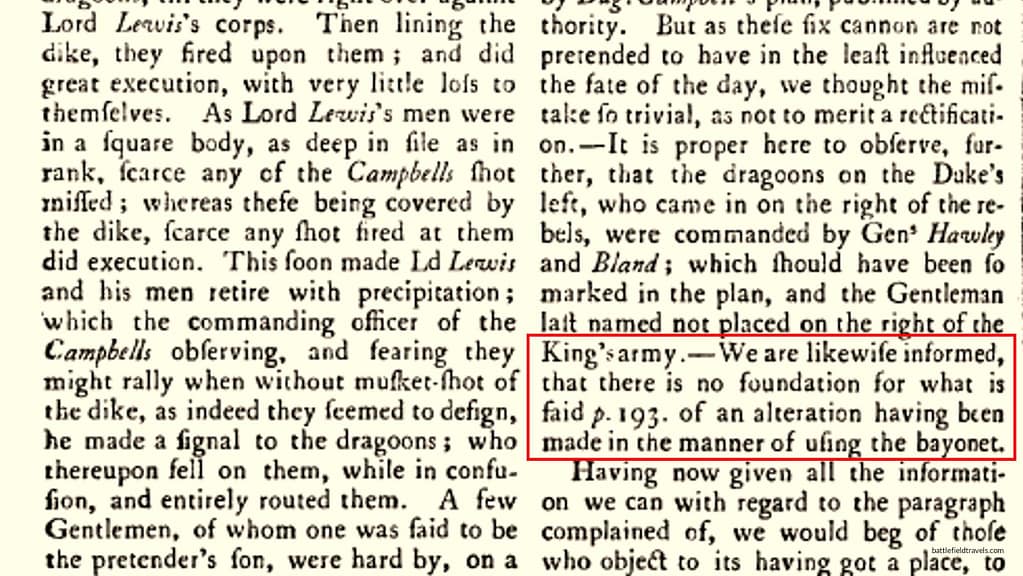
Seven months after the April accounts appeared, The Scots Magazine published a retraction of the previous claim, without attributing the retraction to any individual or agency:
“We are likewise informed that there is no foundation for what was said p.193. of an alteration having been made in the manner of using the bayonet.”22The Scots Magazine (November 1746), p.524.
(The Scots Magazine, November 1746.)
This retraction has been treated by subsequent historians as settling the question. A one sentence anonymous retraction does not necessarily counter the multiple eyewitnesses who claimed not only that there was a new bayonet drill, but that if was a battle-winning innovation directed by Cumberland himself.
“We are likewise informed”. By whom? The source is unnamed, their authority unspecified, their basis of knowledge unknown. “There is no foundation”. For what, precisely? For the claim that an alteration was made across the entire army as a matter of general order? Or for the claim that any alteration was made anywhere? The retraction does not specify.
Note what the retraction references: p.193. It addresses the second letter that ran across pages 192-193 whose bayonet passage continued onto p.193. It does not reference the first letter on p.192, the page on which independent corroboration appeared, using the words a “new practice.” The retraction engages with one of two contemporary accounts in the Scots Magazine. It ignores the other entirely.
The critic’s arguments examined
Across various sources, mostly of recent publication, the critic’s general arguments follow these broad lines.
Critic Argument #1. Cumberland’s papers contain no general order, therefore there was no new bayonet drill
The skeptics are right to establish this. I have also examined Cumberland’s papers and cannot find a specific reference to a new bayonet drill amongst the thousands of pages of handwritten script. That doesn’t mean it never existed. It only means that nobody has yet found a written document from Cumberland. Rolt, Marchant and Henderson certainly noted Cumberland’s direct and active role in promulgating the new bayonet drill.
Critic Argument #2. Fewer than 190 broadswords were recovered from 1,500 Jacobite casualties, therefore there was no need for a drill against targe and sword armed attackers
This argument is temporally inverted and fails at the first test. Cumberland’s army was not training in March 1746 in response to weapons found on the field in April 1746. They were training in response to Prestonpans in September 1745 and Falkirk in January 1746, where the targe and broadsword combination had broken formed infantry. Whether most Jacobites carried muskets at Culloden is irrelevant to training decisions made three weeks before the battle. The argument should not have been advanced as serious evidence.
Critic Argument #3. The Morier painting shows standard drill, therefore the troops at Culloden were using standard bayonet drill
David Morier’s An Incident in the Rebellion of 1745, painted in 1753 and commissioned by Cumberland, shows grenadiers thrusting breast-high in the standard Bland (1743) bayonet drill. Morier’s painting is not a photograph of the battle! The painting only demonstrates that Cumberland was proud of his infantry’s bayonet work. It does not prove what technique they used. Morier was painting a commemoration, not a training manual. The “mighty little” alteration, a shift in the angle of the thrust, would be invisible in a painted composition designed to convey disciplined courage, not anatomical precision.
Critic Argument #4. No soldier would willingly expose his front to thrust at a flanking target and trust his own protection to his neighbour
This objection has never been made by anyone who has served in close combat. The entire logic of linear infantry tactics is that the individual soldier does not fight as an individual. He fights as part of a formation in which each man’s protection depends on his neighbours. The soldier who breaks to protect himself destroys the line.
Three thousand years of infantry doctrine contradicts this objection. Thucydides, writing more than 2100 years before Culloden, identified the universal principle: each man trusts his neighbour to shield his unprotected side, and the formation holds because each man makes that trust reciprocal. Modern machine gun theory is based on mutual support and enfilade fire. The entire Western Front in the First World War was based on the same principle.

Critic Argument #5. The drill required geometric precision impossible under combat conditions
This assumption underlies all the skeptical treatments without being stated explicitly. It imagines two neat formations meeting in orderly fashion, with each Highlander neatly paired with his opposite number, each British soldier pivoting at a precise angle. The Highland charge that arrived at the British line was not a dressed formation. It was a ragged, attenuated stream, thinned by the approach through volley fire and canister shot, arriving at the government ranks as individuals rather than as a formed body.
A Highlander raising his broadsword exposed his right side. He did not need to be standing at thirty degrees to his opposite number. He needed only to raise his arm. The geometry took care of itself. The modified drill was not a geometric system. It was a psychological one, a principle simple enough to survive the noise and terror of actual contact. Tactical innovations that work under fire are always simple at their core. Simplicity survives contact with the enemy, complexity does not.
Why the critics have asked the wrong question
What the critics have asked
The historiographical debate has been conducted, on the critic’s side, as a search for documentary proof of a general order. There is no such proof, or at least none has yet been found. There is also no such claim in the original evidence. The April 1746 Scots Magazine correspondent says “the direction given,” not “the general order issued.”
The question they should have asked
The question the evidence actually invites is different. Given the threat environment, the training context, the intellectual foundations available to Cumberland’s officers, and the nature of tactical adaptation at unit level, is it more likely that nobody in the army was looking for a solution? or that that someone in that army devised and drilled a modification to the standard bayonet drill?
The army quartered at Aberdeen in the spring of 1746 had been broken twice by the Highland charge. Its officers had experienced firsthand the failure of the standard drill against targe and sword. They had six weeks of intensive training, a command culture actively seeking solutions, and the full intellectual apparatus of a classical education. Thucydides had told them that all armies expose their right side. Vegetius had told them that the right side is the anatomical vulnerability. Bland had given them the baseline for modification.
The November 1746 retraction by a single unnamed source of unspecified authority, addresses only the letter on page 193 of the April 1746 Scots Magazine. Against this are five independent sources confirming a new bayonet method: two eyewitness letters in April 1746, Henderson in 1753, Richard Rolt in 1767, plus Augustin Heckel’s 1747 engraving. Multiple other sources confirm that the Duke of Cumberland instructed a new bayonet method without detailing precisely how the method worked.
Against this convergence of probability stand the skeptical arguments, each of which, examined on its own terms, proves less than has been claimed. The Cumberland Papers argument proves only the absence of a general order, not the absence of unit-level innovation. The weapons recovery argument is temporally inverted. The painting argument mistakes commemorative art for tactical documentation. The implausibility arguments are contradicted by three millennia of infantry doctrine and have never been made by anyone with close combat experience.
Conclusion
The weight of evidence establishes beyond reasonable doubt that Cumberland’s army trained in and used a new bayonet drill at Culloden, and that the drill was directed personally by Cumberland in the Aberdeen training period. None of the documentary evidence describes the precise mechanics of the drill explicitly.
A coloured engraving attributed to Augustin Heckel, produced soon after the battle and now held in the National Gallery of Scotland, depicts Barrell’s regiment in a reversed bayonet stance — right arm forward, left hand on the butt, facing left — while Monro’s regiment immediately adjacent maintains the conventional Bland position. This visual evidence, identified by Blackmore in his 2012 thesis and shared with the author in June 2026, is the only contemporary source that depicts the specific mechanics of the modified drill. The reversed stance is therefore possible, probably even likely, but it rests on a single visual source.
The documentary evidence is consistent with both a reversed stance and a minimal rightward pivot. What it confirms unambiguously is the tactical principle: the thrust targeted the open right side of the Highlander to the front right rather than the targe-covered front of the man directly opposite. Until a documentary source is found that explicitly describes the mechanics, that is where the evidence lands.
Found this useful? Buy me a coffee — it helps fund future battlefield research


Authored by Mick Prictor, a retired military officer with 40 years’ service, and a military historian specialising in terrain-focused analysis of tactics, doctrine, and command decision-making in land warfare. His work draws on extensive battlefield fieldwork—more than 280 sites worldwide—and one of the world’s largest private collections of historic military arms, uniforms, and equipment. About me
📚 Notes and References
Footnotes
- 1The Gentleman’s Magazine (1746). Vol. XV. p.527 ↩︎
- 2Bland, H. (1743). A Treatise of Military Discipline. 5th ed. Dublin: M. Rhames. pp.29-30 ↩︎
- 3Bland, Treatise, pp.29–30 ↩︎
- 4Bland, Treatise, pp.29–30 ↩︎
- 5Blackmore, D. (2012). Destructive and Formidable: British Infantry Firepower 1642–1765. PhD thesis. Nottingham Trent University. ↩︎
- 6Anon. (1802). Observations on Mr Home’s Account of the Battle of Culloden. Exeter. Cited in Ritchie, N.S. (15 February 2025). ‘Did the Duke of Cumberland introduce a new bayonet drill before Culloden?’ Jacobite Wars. Original not independently verified by this author — held at National Library of Scotland, Aberdeen University Library, and British Library ↩︎
- 7Marchant, J. (1746). The History of the Present Rebellion. London: Printed for the author. p.396. ↩︎
- 8Marchant, History of the Present Rebellion, p.399. ↩︎
- 9Henderson, A. (1752). History of the Rebellion. 3rd ed. p.116 ↩︎
- 10Henderson, History of the Rebellion. 3rd ed. footnote to p.116. ↩︎
- 11Henderson, A. (1753)Henderson, History of the Rebellion, p.116. ↩︎
- 12The Gentleman’s Magazine Vol. XVI (1746, p.244) ↩︎
- 13In my discussion with David Blackmore in June 2026, he provided me with a link to this additional and critical visual source: Augustin Heckel’s 1747 engraving. ↩︎
- 14The Gentleman’s Magazine Vol. XVI of January 1746 (p.31) ↩︎
- 15The Scots Magazine (April 1746), p.192-193. ↩︎
- 16Scots Magazine, April 1746, p.192. ↩︎
- 17The attribution to the Duke of Argyle using a similar technique at Sheriffmuir in 1715 has not been confirmed from Argyle’s own papers or from contemporary accounts of the battle. It is cited here as evidence that the concept was publicly associated with British military experience before Culloden, not as a confirmed historical precedent. ↩︎
- 18Essay on Regular and Irregular Forces’ (1746). The Gentleman’s Magazine. Vol. XVI, p.31 ↩︎
- 19Gentleman’s Magazine, Vol. XVI. p.244 ↩︎
- 20Rolt, R. (1767). Memoirs of William Augustus, Duke of Cumberland. p.351-352 ↩︎
- 21The London Gazette, No.8531, 26 April 1746, p.2. ↩︎
- 22The Scots Magazine (November 1746), p.524. ↩︎
Bibliography
Primary Sources
- Anon. (1802). Observations on Mr Home’s Account of the Battle of Culloden. Exeter: s.n. [32pp. Held at National Library of Scotland, Aberdeen University Library, and British Library. Original not independently verified by this author. Cited through Ritchie (2025).]
- Bland, H. (1743). A Treatise of Military Discipline. 5th ed. Dublin: M. Rhames.
- Cumberland, W.A., Duke of. Order to the Royal North British Fuzileers, 2 April 1746. In: Appointments, commissions and military papers including the Book of Military Orders by HRH the Duke of Cumberland, during his campaign in Scotland in 1745 and 1746. Document Reference Ga 12789-12835. Nottingham University Library. Cited in Blackmore (2012).
- ‘Essay on Regular and Irregular Forces’ (1746). The Gentleman’s Magazine. Vol. XVI.
- The Gentleman’s Magazine (April 1746). Vol. XVI.
- The Gentleman’s Magazine (April 1746). Vol. XVI,
- The Gentleman’s Magazine (1745). Vol. XV.
- Heckel, A. (1747). ‘The Battle of Culloden, April 16th 1746.’ Engraving. National Gallery of Scotland, Edinburgh. [Coloured version (1797) held at the Anne S.K. Brown Military Collection, Brown University. Available at: https://repository.library.brown.edu/studio/item/bdr:238351/ Identified by Blackmore, D. Personal communication, June 2026.]
- Henderson, A. (1752). History of the Rebellion. 3rd ed.
- The London Gazette, No.8531, 26 April 1746.
- Marchant, J. (1746). The History of the Present Rebellion. London: Printed for the author.
- Rolt, R. (1767). Memoirs of William Augustus, Duke of Cumberland. London.
- The Scots Magazine (April 1746). Vol. 8.
- The Scots Magazine (November 1746). Vol. 8.
- Thucydides. History of the Peloponnesian War. Trans. Thomas Hobbes (1723).
- Vegetius, F.R. De Re Militari. Trans. Lieutenant John Clarke (1767). London: W. Griffith.
- Willson, B. (1909). The Life and Letters of James Wolfe. London: Heinemann.
Secondary Sources
- Blackmore, D. (2012). Destructive and Formidable: British Infantry Firepower 1642–1765. PhD thesis. Nottingham Trent University.
- Blackmore, D. Personal communication, June 2026.
- Duffy, C. (2003). The ’45: Bonnie Prince Charlie and the Untold Story of the Jacobite Rising. London: Cassell.
- Pittock, M. (2016). Culloden. Oxford: Oxford University Press.
- Reid, S. (2002). Culloden Moor 1746: The Death of the Jacobite Cause. Oxford: Osprey.
- Ritchie, N.S. (15 February 2025). ‘Did the Duke of Cumberland introduce a new bayonet drill before Culloden?’ Jacobite Wars. Available at: https://www.jacobitewars.com/articles/did-duke-of-cumberland-introduce-new-bayonet-drill-before-culloden/. Accessed 14 June 2026.
📚 Further Reading: The 1745 Jacobite Rising
This battle study nests within the broader analytical framework explored in the Research Hub, where operational methods, operating environments, armies, commanders, and weapons are examined across conflicts and eras. The links below connect related studies across the wider body of battlefield analysis on the BattlefieldTravels site.
⚔️ Explore all battle studies from the 1745 Jacobite Rising
🏛️Explore the museum of the War of the Austrian Succession for contemporary weapons and equipment
📚 Explore recommended reading on the 1745 Jacobite Rising
🗞️ For updates on new battlefield studies and research insights, you can subscribe to the Newsletter.
You may also like


FAQ: the Culloden bayonet drill
No written general order for a modified bayonet drill has been found in Cumberland’s papers. However, the absence of a written order does not mean no instruction was given. John Marchant, writing in 1746, records that Cumberland personally conferred with every battalion of foot on the proper method of using the musket and bayonet against sword and target. Andrew Henderson, writing in 1752, records that Cumberland had carefully instructed his troops in the new method since he first took command. Personal oral instruction from a commanding general to every battalion leaves no documentary trace at headquarters level — which is precisely what the sources describe.
The standard Bland bayonet drill instructed each soldier to thrust straight ahead at the man directly opposite him. Against a Highlander armed with a targe on his left arm, this thrust was easily caught on the shield, leaving the soldier exposed to the broadsword. The modification, described in multiple contemporary sources as a mighty little change, instructed each soldier to thrust at the unprotected right side of the Highlander attacking his neighbour to the right, rather than the man directly opposite. The Highlander’s right side was exposed because his sword arm was raised to strike, and his targe covered only his front and left. Each soldier trusted his neighbour to deal with the man to his own front while he protected his neighbour’s right. The principle of mutual support, three thousand years old in infantry doctrine, was the foundation of the drill.
The sources credit Cumberland with directing the instruction. However, the tactical principle, targeting the exposed right side of a shield-bearing opponent, was not new. Thucydides recorded it in the fifth century BC. Vegetius codified it in the fourth century AD. In January 1746, three months before Culloden, a Scottish merchant proposed a variant of the same technique in The Gentleman’s Magazine, and noted that a similar method had been used at the Battle of Sheriffmuir in 1715. Whether Cumberland independently derived the technique or drew on existing knowledge is not established by the sources. What is established is that he directed its implementation personally and systematically across every battalion of his army at Aberdeen.
The evidence is substantial and comes from multiple independent sources. Two eyewitness letters published in The Scots Magazine in April 1746 describe the drill and its effect — one explaining the mechanics, the other recording a ten to one exchange ratio in close-quarter combat. The Gentleman’s Magazine of April 1746 records that instructions were given to soldiers to direct their bayonets each to his right-hand man of the enemy. Richard Rolt, writing in 1767 from sources independent of The Scots Magazine, confirms that troops were properly instructed in a new method. Andrew Henderson in 1752 records that soldiers were taught to push over the right arm against the right breast of their antagonist. The London Gazette of 26 April 1746, the official government record, confirms an extraordinary bayonet killing rate in Barrell’s and Monro’s sectors without explaining it. Finally, a 1747 engraving by Augustin Heckel, held in the National Gallery of Scotland, depicts Barrell’s regiment in what appears to be a reversed bayonet stance while the adjacent regiment maintains the conventional Bland position.
The November 1746 retraction states that there is no foundation for what was said on page 193 about an alteration in the manner of using the bayonet. It is problematic as evidence for several reasons. The source is unnamed and their authority is unspecified. The retraction addresses only the letter on page 193 — it does not engage with the independent corroborating letter on page 192, nor with the Gentleman’s Magazine accounts, nor with Marchant, Henderson, or Rolt. It was published seven months after the battle by a single unnamed informant whose basis of knowledge is unknown. A one-sentence anonymous retraction does not outweigh six independent contemporary and near-contemporary sources, all confirming the same thing.
This question remains partially open. The documentary sources describe the tactical principle clearly, thrust at the right side of the Highlander attacking your neighbour, but none of them explicitly describe the precise body position or hand placement. One source describes the alteration as mighty little, which suggests a minimal change rather than a complete reversal of stance. A 1747 engraving by Augustin Heckel appears to show Barrell’s regiment in a fully reversed stance — right foot forward, left foot back, right hand forward, left hand on the buttplate — while the adjacent regiment maintains the conventional Bland position. This visual evidence supports a complete reversal of stance, but it is an artist’s depiction rather than a drill manual. The weight of evidence confirms the drill existed and was effective. The precise mechanics, on the current documentary evidence, remain indeterminate.
Subscribe to Battlefield Travels and receive a free E-Book Battlefield Guide
Unlock expert battlefield analysis, campaign reconstructions, and historical insights drawn from firsthand exploration and primary sources.
🗺️ You’ll receive:
🎖️ Exclusive historical insights you won’t find elsewhere
📘 A free eBook: 10 Tips for Exploring Historic Battlefields
📰 New battlefield studies straight to your inbox as they are published

⚔️ Go deeper — Members get exclusive access to the Deep Research Collection, Field Notes, and monthly Research Dispatches. Try membership free for 7 days, cancel anytime. From $9/month.
Fascinating account! Thanks!
Thanks Tom,
There are a lot of under-informed accounts out there that have never done this level of research. Most refer only to the April and November 1746 editions of the Scots Magazine. In my research, I found another six eyewitness accounts from 1746-1767 that said not only was there a new bayonet drill, but it was a decisive factor in the battlefield. Mick