
This Field Note is part of the growing GUADALCANAL CAMPAIGN battlefield series, as I capture my July/August 2026 exploration of the battlefields. Explore the full series: Beach Red landings 7 Aug 42 ◊ Battle for Tulagi Island 7-8 Aug 42 ◊ Battle for Gavutu & Tanambogo Islands 7-9 August 1942 ◊ Goettge Patrol Incident, 12-13 August 1942 ◊ First Battle of the Matanikau, 18-19 August 1942 ◊ Battle of the Tenaru (Alligator Creek), 21 August 1942 ◊ Battle of Edson’s Ridge (Bloody Ridge), 12-14 September 1942 ◊ Second Battle of the Matanikau, 23-27 September 1942
Table of Contents
- Beach Red today
- Operation WATCHTOWER
- 🔒Situation and Terrain
- 🔒Forces and Commanders
- 🔒The Beach Red landing
- 🔒Terrain-decision assessment
- 📚 Further Reading – World War Two
Beach Red today
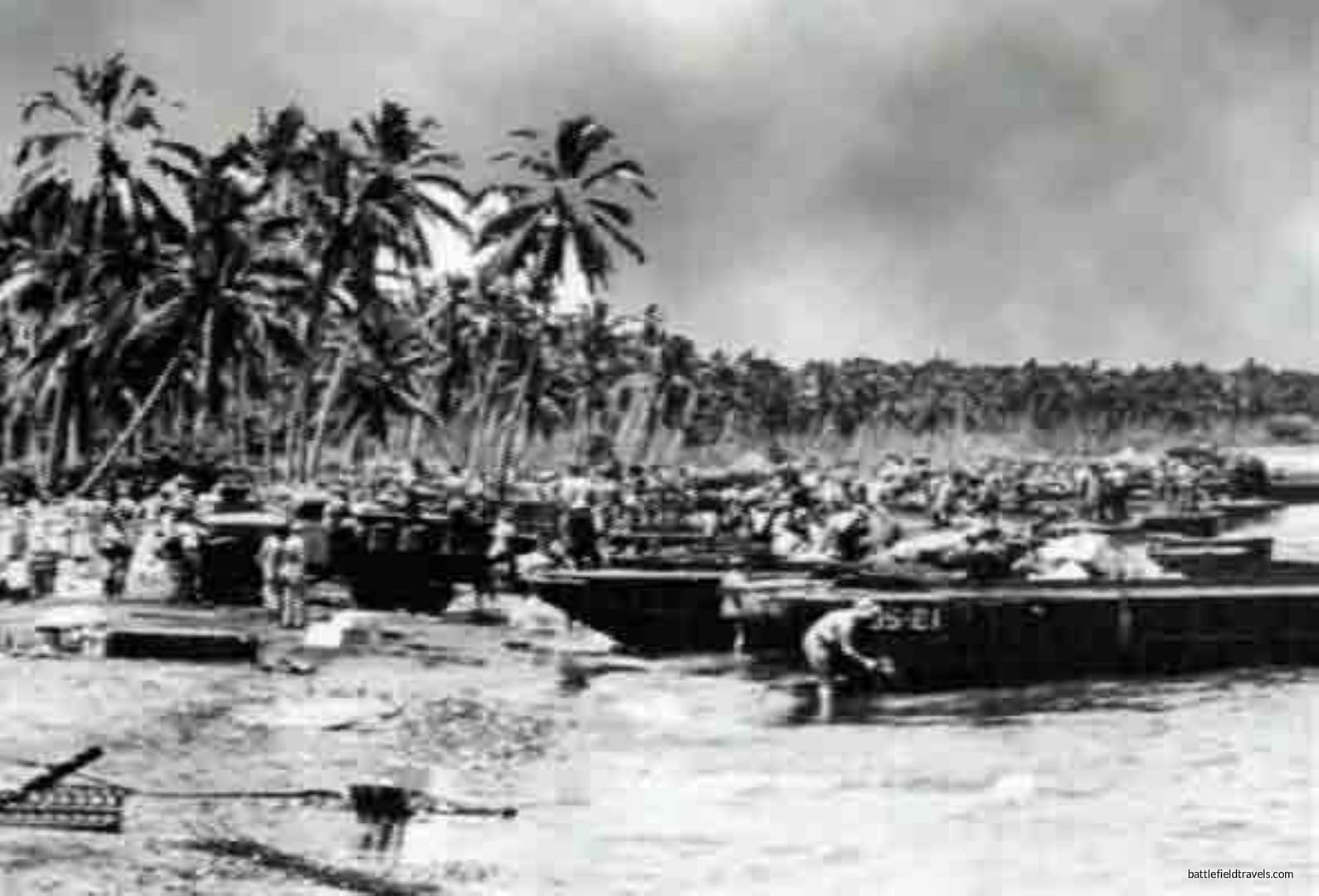
August 2026, Beach Red, Guadalcanal, I am walking the ground at Beach Red, site of the 1st Marine Division landings on 7 August 1942. Compared to many other WW2 sites on the island, Beach Red is little changed since 1942. The beach is about four kilometres east of Henderson Field and curves from the Tenaru River Delta in the west to Koli Point in the east. Immediately behind the beach, there are now scattered houses where the Lever Brothers coconut plantation used to be.

There was no fighting on this stretch of sand in 1942, so there is none of the wreckage or scarring you find elsewhere on the island. A Japanese memorial at the eastern end of the beach is part of a pattern of Japanese memorials across Guadalcanal that express a desire for peace. It seems that there are more small Japanese memorials commemorating individual actions around the island than American memorials. There used to be an American memorial here, but Guadalcanal historian Dave Holland says that it was removed during the Solomon Islands troubles of the 2000s and repositioned to another section of the beach. I did not see it on my visit to Beach Red.

Operation WATCHTOWER
The Allied operation to seize the Japanese bases in the southern Solomon Islands was known as Operation WATCHTOWER. The intent was to eliminate the Japanese seaplane base on Tulagi and the twin Islands of Gavutu-Tanambogo as a first step, with the ultimate aim of eliminating the major Japanese at Rabaul in New Britain. During the initial planning, the main island of Guadalcanal was not even an objective. The focus was Tulagi, Gavutu-Tanambogo and Florida Islands. However, when aerial reconnaissance and the Coastwatchers began reporting on the construction of a new Japanese airfield at Lunga Point, Guadalcanal was added as an objective.

👉 Continue reading — full Field Notes include terrain analysis, additional imagery, and working interpretations beyond the published study. Try membership free for 7 days.

Authored by Mick Prictor, a retired military officer with 40 years’ service, and a military historian specialising in terrain-focused analysis of tactics, doctrine, and command decision-making in land warfare. His work draws on extensive battlefield fieldwork—more than 280 sites worldwide—and one of the world’s largest private collections of historic military arms, uniforms, and equipment. About me
📚 Further Reading – World War Two
This battle study nests within the broader analytical framework explored in the Research Hub, where operational methods, operating environments, armies, commanders, and weapons are examined across conflicts and eras. The links below connect related studies across the wider body of battlefield analysis on the BattlefieldTravels site.
⚔️ Explore all battle studies from World War Two 1939-1945
🏛️Explore the museum of World War Two historic artefacts
The book list for this conflict includes the finest campaign studies, memoirs, and operational analyses available on the D-Day landings, selected specifically to complement this battlefield study.
📚World War Two – Recommended Reading
🗞️ For updates on new battlefield studies and research insights, you can subscribe to the Newsletter.
Subscribe to Battlefield Travels and receive a free E-Book Battlefield Guide
Unlock expert battlefield analysis, campaign reconstructions, and historical insights drawn from firsthand exploration and primary sources.
🗺️ You’ll receive:
🎖️ Exclusive historical insights you won’t find elsewhere
📘 A free eBook: 10 Tips for Exploring Historic Battlefields
📰 New battlefield studies straight to your inbox as they are published

⚔️ Go deeper — Members get exclusive access to the Deep Research Collection, Field Notes, and monthly Research Dispatches. Try membership free for 7 days, cancel anytime. From $9/month.
Great read! “Members continue here” above has no hot link but I can get to follow articles another way – different page.