A daring French paratrooper raid deep behind enemy lines!
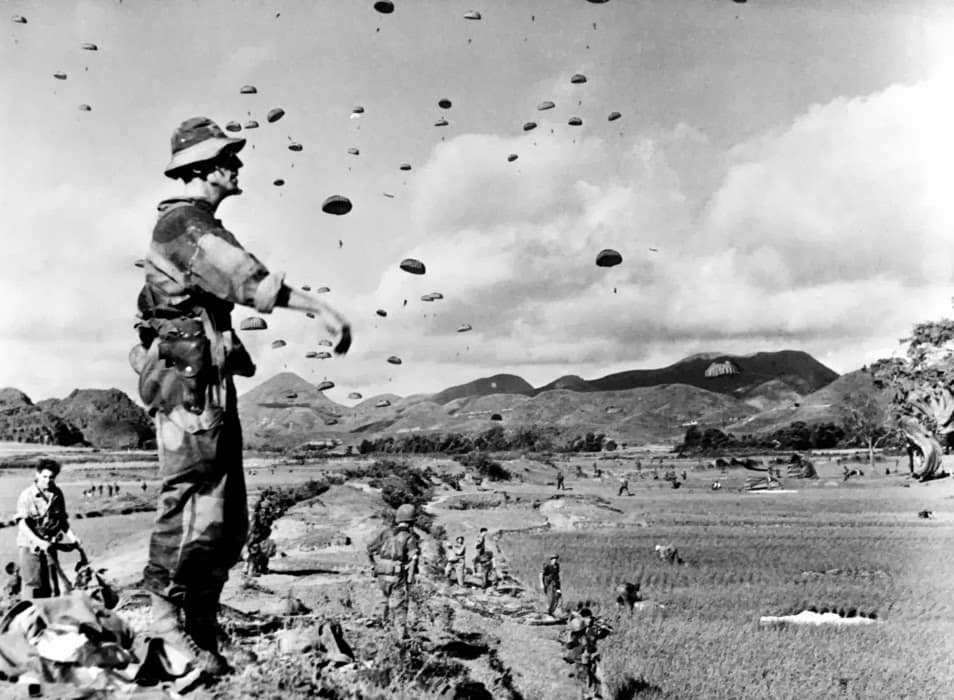
While I was in Lạng Sơn, I explored the sites of one of the most audacious operations in the Indo-China War – Operation HIRONDELLE. The French Indo-China War is often remembered for the French operations that went horribly wrong (Cao Bằng Ridge, Điện Biên Phủ, GM 100 etc). However, there were some moments of brilliance and Operation HIRONDELLE (SWALLOW) – the raid on Lạng Sơn – was one of them.
Many countries have had airborne (parachute) forces but I do not believe that any have used them with the boldness, aggressiveness and frequency that the French did in Indo-China. The Legion, Colonial, Metropolitan and Vietnamese parachute battalions made 160+ combat jumps, including some directly onto tactical objectives.
The French High Command in Indo-China, acting on time-sensitive intelligence, projected 2000+ paratroopers more than 100km behind enemy lines and destroyed a major Viet Minh logistic hub. They then deployed another parachute battalion, a mechanised brigade, and a naval task force to extract them again. All in the space of 72 hours. The operation did not change the course of the war, but demonstrated the decisiveness, agility and tactical excellence of the French Far East Expeditionary Corps in Indochina.
Key facts
Google Map location of Operation HIRONDELLE
🎧 Prefer to listen? This article is also available in a 43-minute podcast
Tip: If Podbean overlay appears after pausing, click the × in the top-right corner to return to the player controls.
🧭🥾 Walking the Battlefield
I visited the Operation HIRONDELLE drop zone, Lạng Sơn Citadel, and the Kỳ Lừa caves in April 2025. The drop zone is farmland now, as it was in 1953. The old Citadel dates back to the 18th century, and its outline is very clear in the street structure of Lạng Sơn, but only portions of the walls have survived. The Viet Minh supply depot was hidden inside the limestone caves of the Kỳ Lừa cave complex, just north of Lạng Sơn. These stunning limestone caves are now a major tourist destination.
The battlefield today
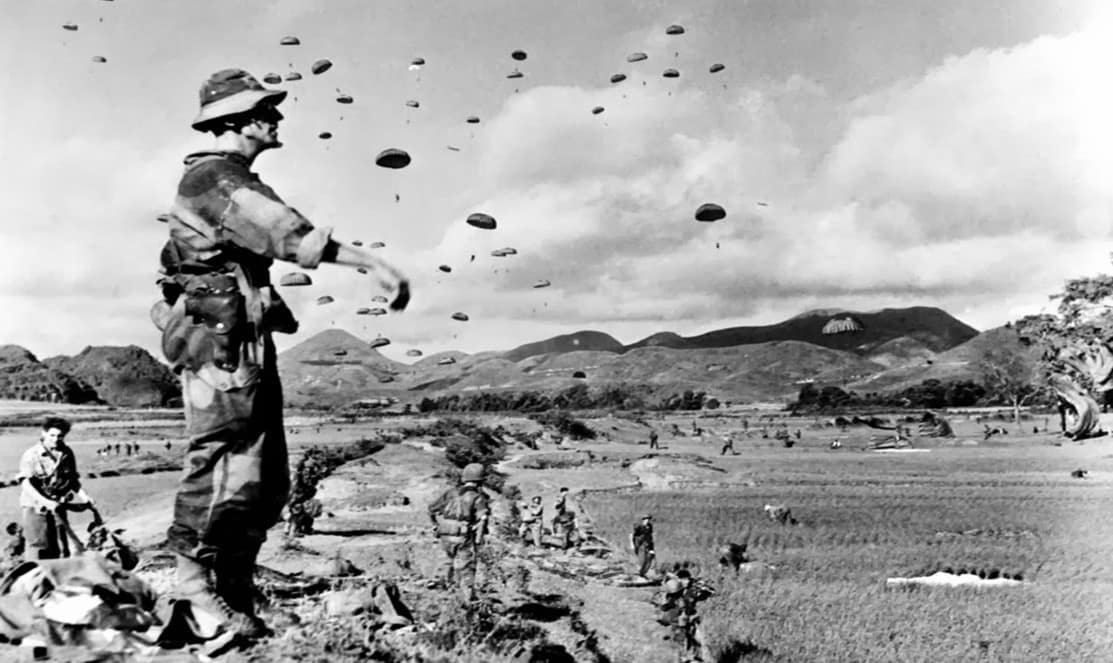
Reference sources on Operation HIRONDELLE are scarce. I found the unit histories of the modern successor units (8e RPIMa, 6e RPIMa, 2e REP, 5e REI) to be the most fruitful sources. I could not find any maps or diagrams of the actual parachute drop zone, but I did have some very good photos of the drop with a clear view of the horizon in the background.
By testing the horizon view from various locations in Google Earth Pro, I was able to find the exact locations where those photos were taken, and hence the exact location of the drop zone.
Image on the right. Then and Now. Image of 6 BPC drop zone near Kỳ Lừa taken on the morning of 17 July 1953. My photo of the same location was taken in April 2025.
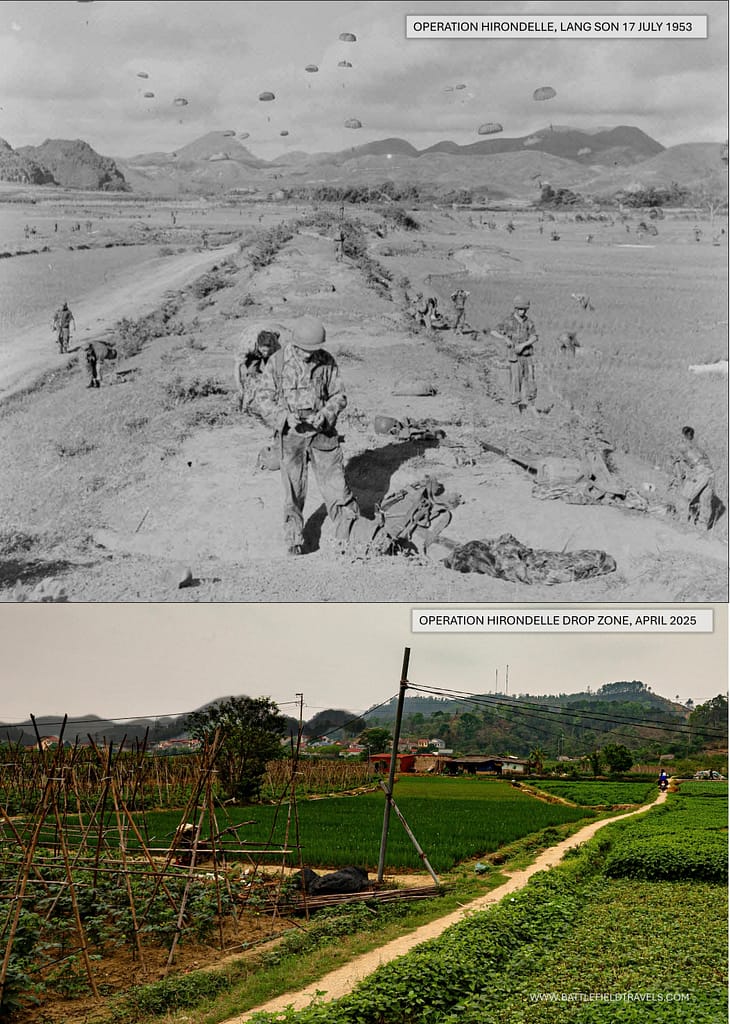
Table of Contents
- Situation: Indochina War in July 1953
- The French plan for Operation HIRONDELLE
- 🔒The Raid on Lạng Sơn
- 🔒Withdrawal of the HIRONDELLE raid force
- 🔒Extraction of the HIRONDELLE force
- 🔒Assessment of Operation HIRONDELLE
- 🔒Operation HIRONDELLE battlefield today
- 🔒Kỳ Lừa cave complex
- 🔒Sources
- 📚 Further Reading: French Indochina War
- 🧭 Battlefield Travel Guide: Operation Hirondelle (1953)
- FAQ: Operation Hirondelle Airborne Raid (1953)
Situation: Indochina War in July 1953
T’ai highlands and northern Laos
By mid-1953, the war in Indo-China had reached a critical juncture. The Viet Minh Northwest Campaign (Vietnamese – Chiến thắng Tây Bắc) in late 1952 had overrun much of the T’ai highlands and the Laos border area. The French responded with Operation LORRAINE, the largest French operation of the war. It started with optimism but ended in a desperate fighting withdrawal through the Chân Mường Pass. The only bright spot in 1952 was the defence of the Aeroterrestre (Air-Land) base at Na San in November-December 1952.
In early 1953, the Viet Minh continued advancing into northern Laos with offensives against the Plain of Jars and the Laotian royal city of Luang Prabang. The border town of Điện Biên Phủ and its small garrison were overrun. Many small French outposts in the T’ai highlands and northern Laos fought desperate defensive battles and fighting retreats. Many were overrun and their garrisons wiped out.
General Navarre replaces General Salan
On 27 May 1953, General Henri Navarre replaced Raoul Salan as commander of the French forces in Indochina. Navarre and his staff, who were new to Indo-China, were to provide fresh ideas and solutions to the Indo-China problem. The losses in 1952 had fundamentally shifted French policy from trying to win the war outright to creating favourable military conditions for peace negotiations.
A fleeting opportunity
The town of Lạng Sơn, on Route Coloniale 4 near the Chinese border, was a major Viet Minh supply base. The entire border region had been under Viet Minh control for nearly three years, since the Cao Bang Ridge Disaster of October 1950. The French had abandoned Lạng Sơn on 17 October 1950, leaving behind thousands of tons of weapons, ammunition and supplies. Then, in mid-July 1953, General Henri Navarre’s Deuxième Bureau (Intelligence Department) in Hanoi learned that the Viet Minh division securing the Lạng Sơn area would depart on the morning of 16 July 1953, but its relief would not arrive for another two days. This gap in Viet Minh security precautions presented a brief window of opportunity to strike into the Viet Minh rear areas.
The French plan for Operation HIRONDELLE
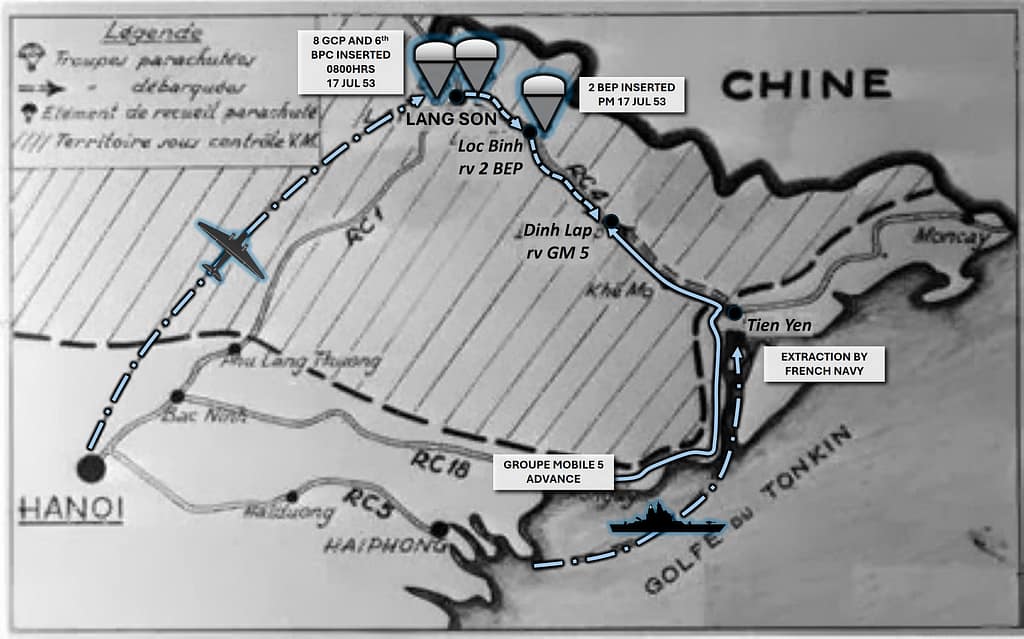
General Navarre’s staff rapidly developed a plan for Operation HIRONDELLE (Swallow), an audacious airborne raid aimed at the Viet Minh’s logistical network in Lạng Sơn province, especially the supplies stored in the limestone caves at Kỳ Lừa, just north of the town of Lạng Sơn.
The raid force
The raid force would be led by Lieutenant-Colonel Paul Durcournau, Commander of the Northern Airborne Troops (TAPN – Troupes Aéroportées Parachutistes du Nord).
- Two parachute battalions and an engineer platoon would drop on Lạng Sơn:
– Major Marcel Bigeard’s 6th Colonial Parachute Battalion (6e BPC – 6e Bataillon Parachutiste Coloniaux)
– Captain Pierre Tourret’s 8th Parachute Commando Group (8e GCP – 8e Groupement des Commandos Parachutistes)
– Parachute Engineer Section (SGP – Section de Génie Parachutiste) - To support the withdrawal after completion of the raid, Captain Albert Merglen’s 2nd Foreign Legion Parachute Battalion (2e BEP – 2e Bataillon Étranger de Parachutistes) would parachute into Lộc Bình, 20km southeast of Lạng Sơn. 2e BEP would secure the town of Lộc Bình and hold Route Coloniale 4 while 8e GCP and 6e BPC withdrew on foot from Lạng Sơn.
- Groupe Mobile 5 (GM5), commanded by Lieutenant-Colonel Jean Raberin, and comprised of the 2nd and 3rd Battalions of the 5th Foreign Legion Infantry Regiment (5 REI – 5e Régiment Étranger d’Infanterie) plus armour and artillery units, would move by road along the coast to Tiên Yên, then turn northwest to advance on RC4 to Lộc Bình, marry-up with the paratroopers and transport them back to the coast, where they would be extracted by sea.
- As a strategic reserve, Major Jean Bréchignac’s 1st Regiment of Parachute Light Infantry (1er RCP – 1er Régiment de Chasseurs Parachutistes) was on 30 minutes notice to move to support the HIRONDELLE raid force.
👉 Continue reading — this article is part of the BattlefieldTravels Deep Research Collection. The full 3,640 word analysis draws on eyewitness accounts of the 1953 Operation HIRONDELLE, operational reports, GIS terrain analysis, firsthand fieldwork on the battlefields, and engagement with the community of Lạng Sơn. Primary source examination, tactical conclusions, and notes & references that exist nowhere else in English. Try membership free for 7 days.
📚 Further Reading: French Indochina War
This battle study nests within the broader analytical framework explored in the Research Hub, where operational methods, operating environments, armies, commanders, and weapons are examined across conflicts and eras. The links below connect related studies across the wider body of battlefield analysis on the BattlefieldTravels site.
⚔️ Explore all battle studies from the French Indochina War 1946-1954
⚔️ Explore all battle studies involving the French Foreign Legion
🏛️Explore the museum of French Indochina War historic artefacts
📚French Indochina War 1946-54 – Recommended Reading
🗞️ For updates on new battlefield studies and research insights, you can subscribe to the Newsletter.
🧭 Battlefield Travel Guide: Operation Hirondelle (1953)
Getting There
- Nearest City: Lạng Sơn, about 100km north of Hanoi, Vietnam.
- Transport: Easily reached by road from Hanoi; the highway to Lạng Sơn takes about 2.0-2.5 hours.
- Access Points: The drop zones used in 1953 were around Lạng Sơn, Kỳ Lừa Caves.
Site Orientation
- Main Battlefield: The French airborne landings were focused on Lạng Sơn, where commandos struck at Viet Minh bases and supply depots.
- Key Features: The Kỳ Lừa limestone caves were an important Viet Minh supply depot and were almost impervious to aerial bombing.
- Best Vantage Points: Village edges and raised dikes provide perspectives on how parachutists landed and maneuvered.
Museums & Visitor Centres
- Vietnam Military History Museum (Hanoi): Holds exhibits on the French Indochina War, including airborne operations.
- Local War Memorials: Monuments to Viet Minh resistance can be found in surrounding villages.
On-Site Experience
- Interpretive Signage: None specific to Hirondelle; background knowledge is essential.
- Atmosphere: Rice fields and rural landscapes remain much as they were in 1953, giving insight into airborne landings.
- Walking Routes: Paths through Lạng Sơn town and surrounding countryside reflect the movement corridors used by both sides.
Nearby Points of Interest
- Hanoi: Base for broader research into the French Indochina War and home to key archives and museums.
Practical Tips
- When to Visit: Cooler, drier months (Nov–Mar) are ideal for walking rural terrain.
- Facilities: Full amenities available in Lạng Sơn and Hanoi.
- Special Considerations: Since little is marked, carrying maps of Operation Hirondelle and reading campaign accounts in advance is highly recommended.
Related Battle Studies, Museum Pieces & Reading Resources
 ⚔️🔒Operation LÉA,
(Việt Bắc Campaign), Tonkin,
Oct–Nov 1947
 ⚔️🔒Battle of Route Coloniale 4,
(Cao Bang Ridge Disaster),
16 Sep-18 Oct 1950
 ⚔️🔒Battle of Phủ Tông Hoá, Tonkin, 25 July 1948
 ⚔️ Battle for Dien Bien Phu, Vietnam,
13 March – 7 May 1954
 🏛️ French Indochina War (1946–1954) Weapons and Equipment
 📚 Best Books on the French Indochina War (1946–1954),
Recommended Reading
FAQ: Operation Hirondelle Airborne Raid (1953)
Operation Hirondelle was a French airborne raid conducted in July 1953 against the Viet Minh stronghold at Lạng Sơn. The aim was to destroy supply depots in the Kỳ Lừa caves and disrupt enemy logistics in the northern border region.
The main assault was carried out by the 8e Groupement de Commandos Parachutistes (8e GCP) and the 6e Bataillon de Parachutistes Coloniaux (6e BPC). Supporting actions included 2e Bataillon Étranger de Parachutistes (2e BEP) at Lộc Bình, and a thrust by Groupe Mobile No. 5 toward Đình Lập. Extraction was conducted by the French Navy.
The operation focused on Lạng Sơn, near the Chinese border in Tonkin, with the principal objective being the Viet Minh supply depot hidden in the Kỳ Lừa caves.
The French forces successfully destroyed the Kỳ Lừa depot, captured or killed significant numbers of Viet Minh, and withdrew with relatively light casualties. The raid demonstrated the reach and coordination of French airborne and mobile forces.
Lạng Sơn and the Kỳ Lừa caves can still be visited today. While there are no formal battlefield markers, the caves and surrounding terrain remain accessible and provide insight into the scale of the operation.
Subscribe to Battlefield Travels and receive a free E-Book Battlefield Guide
Unlock expert battlefield analysis, campaign reconstructions, and historical insights drawn from firsthand exploration and primary sources.
🗺️ You’ll receive:
🎖️ Exclusive historical insights you won’t find elsewhere
📘 A free eBook: 10 Tips for Exploring Historic Battlefields
📰 New battlefield studies straight to your inbox as they are published

⚔️ Go deeper — Members get exclusive access to the Deep Research Collection, Field Notes, and monthly Research Dispatches. Try membership free for 7 days, cancel anytime. From $9/month.
Enjoyed this very much!
Thanks Tom, The French were extremely bold in their employment of airborne troops. And this one worked! Did you read how I located the dropzone? I had one photo of the paratroopers landing and moved around in Google Earth Pro until I matched the horizon view, then fine tuned from ground features. Mick