Panmunjom: The front line of the Cold War in Korea
At the Joint Security Area – Panmunjom, on the edge of the Korean Demilitarised Zone, a single concrete line divides two hostile armies. Here, in the JSA, armed guards stand face to face across the world’s last Cold War frontier — a place where diplomacy, history, and the constant threat of renewed conflict coexist in uneasy balance.

Key facts
Google Earth map – location of JSA Panmunjom
Two Koreas
The Korean War, lasting from 25 June 1950 to 27 July 1953, was a major conflict in the early Cold War period. From 1910 to 1945, Korea was occupied as a Japanese colony. Following Japan’s defeat in August 1945, US forces deployed into the southern part of the Korean peninsula, while Soviet troops occupied the northern part. The US and the Soviet Union agreed that Korea would be divided at the 38th parallel into two occupation zones, and managed by an international trusteeship until it was ready to assume self-government as a unified Korea.
The Korean War 1950-53
This division led to the establishment of two separate governments, each claiming to be the legitimate government of all Korea. On June 25, 1950, North Korean forces, supported by the Soviet Union and later China, crossed the 38th parallel, invading South Korea. This aggression prompted the United Nations, with significant influence from the United States, to intervene militarily to repel the invasion.
The early stages of the war saw rapid advances and retreats by both sides. Initially, North Korean forces pushed deep into South Korea, capturing Seoul. However, a successful amphibious landing at Inchon by UN forces in September 1950 turned the tide, pushing North Korean forces back across the 38th parallel.
Despite Chinese warnings, the victorious UN forces continued to push northwards to the Yalu River, which marked the border with China. In October 1950, the initiative shifted again as Chinese troops entered the conflict, leading to a UN retreat, a UN counter-offensive and, eventually, a protracted stalemate around the 38th parallel.
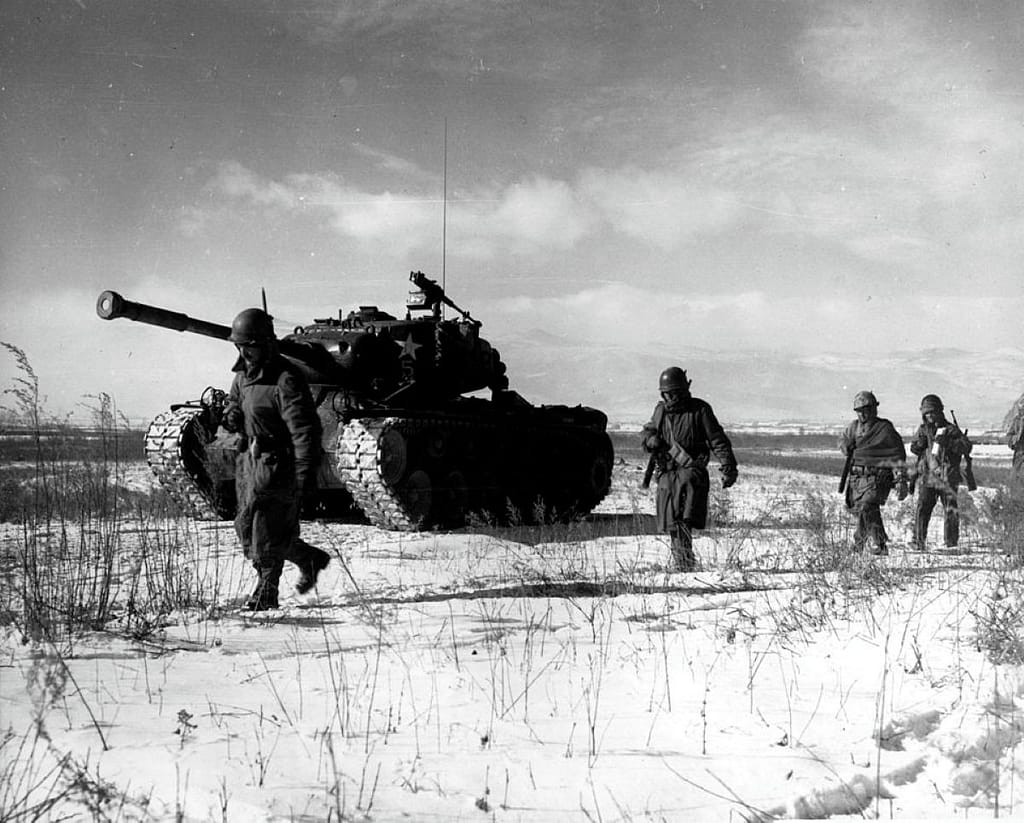
Ceasefire negotiations at Panmunjom
July 1951 – Negotiations commence
As the war dragged on with no decisive victory in sight, both sides began to consider the possibility of a negotiated settlement. This led to the initiation of peace talks in July 1951 at the village of Panmunjom, located near the 38th parallel. The negotiations at Panmunjom were some of the most protracted and contentious in modern history, lasting more than two years and marked by numerous deadlocks and interruptions.

Repatriation of POW
One of the primary issues was the repatriation of prisoners of war (POWs). The UN insisted that Korean prisoners of war should be allowed to choose whether they wanted to return to their homeland or not, while the Communist side demanded that all prisoners be repatriated regardless of their wishes. This disagreement led to a deadlock that took months to resolve. Eventually, a compromise was reached where a Neutral Nations Repatriation Commission (NNRC) was established to oversee the process.
⚔️ Go deeper — Members get exclusive access to the Deep Research Collection, Field Notes, and monthly Research Dispatches. Try membership free for 7 days, cancel anytime. From $9/month.
Establishment of a DMZ
Another contentious issue was the establishment of the Demilitarised Zone (DMZ), which would act as a buffer between the two Koreas. The negotiations eventually settled on a roughly 4-kilometre-wide DMZ along the existing front line, which generally followed the 38th parallel. This demarcation has remained the de facto border between North and South Korea to this day.
The negotiations at Panmunjom were also characterised by intense psychological pressure as both sides engaged in propaganda efforts to gain a favourable negotiating position. The talks were often marked by heated exchanges and walkouts, reflecting the deep mistrust and animosity between the opposing sides.

Korean Armistice Agreement
Despite these challenges, the Panmunjom negotiations ultimately led to the signing of the Korean Armistice Agreement on 27 July 1953. The agreement effectively ended the hostilities and established the DMZ, but it was not a peace treaty. Consequently, North and South Korea technically remain at war, as no formal peace treaty has been signed.
The Korean War and the negotiations at Panmunjom had lasting impacts. The war solidified the division of Korea, with distinctly different political and economic systems on each side of the border, and an entrenched ‘cold’ conflict that persists to this day. The armistice agreement also set a precedent for Cold War-era negotiations, demonstrating the challenges of achieving peace in a bipolar world marked by ideological divisions. The DMZ remains one of the most heavily fortified borders in the world.

JSA Panmunjom since 1953
JSA Panmunjom has been the site of numerous incidents since the Armistice was signed in 1953. Significant incidents include:
- 18 August 1976. When a UN team attempted to trim a tree that was blocking their line of sight, they were attacked by about 25 North Korean soldiers. Two US soldiers were killed- Captain Arthur Bonifas and First Lieutenant Mark Barrett – and another four U.S. soldiers and five South Korean soldiers were injured
- 23 November 1984. Soviet citizen Vasily Matuzok, a translator at the Soviet embassy in Pyongyang, attempted to defect by suddenly dashing across the Military Demarcation Line (MDL) into South Korea. Three North Korean soldiers and one South Korean soldier were killed, and one American soldier wounded in the ensuing firefight.
- 13 November 2017. North Korean soldier Oh Chong-song defected by driving a vehicle to the MDL, and then sprinting into the South Korean side. Oh was shot five times by other North Korean soldiers and was later recovered by JSA security forces.

Joint Security Area – Panmunjom today
It has been a couple of decades since I visited Panmunjom, so my observations may be a little dated. When I was there, the key leaders were North Korean President Kim Jong Il, US President Bill Clinton, and South Korean President Kim Young-sam.
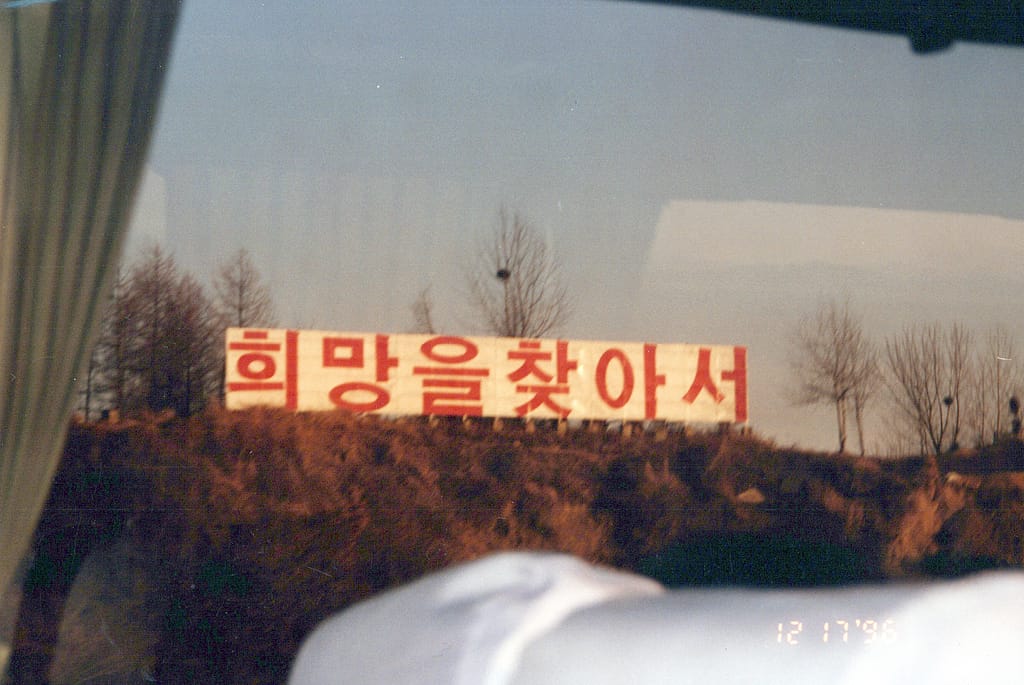
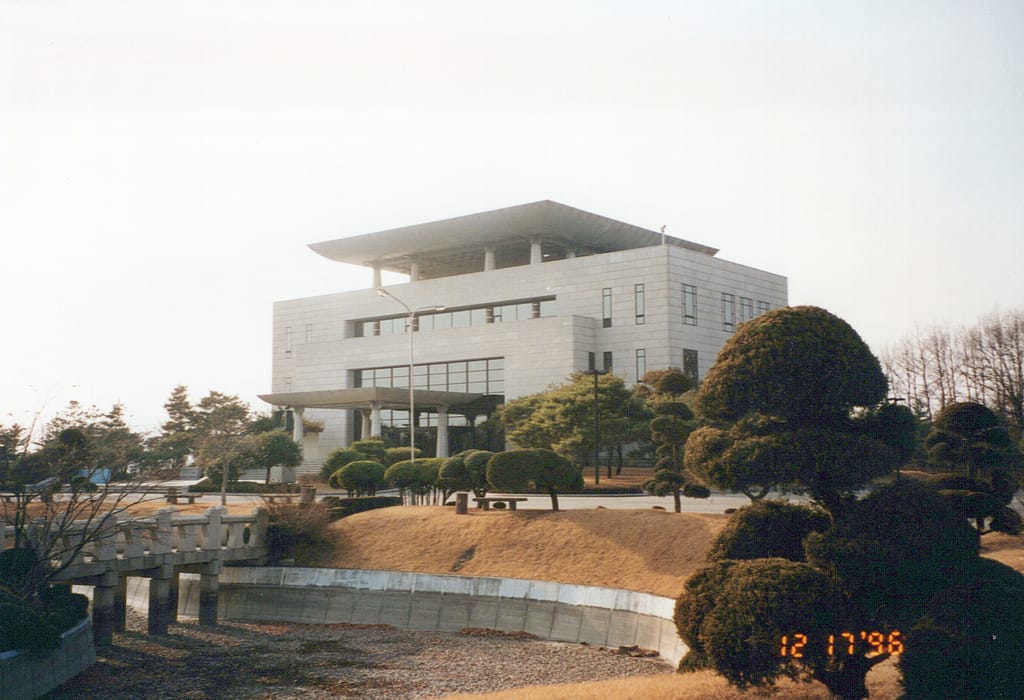
The old Freedom House on the South Korea side where my tour commenced has since been demolished and was rebuilt in 1998. The UN-blue buildings are still the preferred venue for negotiations between North and South. When President Trump met with Kim Jong Un, it was at Panmunjom, and President Trump symbolically stepped over those old concrete humps that mark the border between North and South.
The DMZ is a strange place – on both sides of the border. The classic communist propaganda billboards and loudspeakers are still employed, but those techniques are also used by the south. On all the approaches to the DMZ there are signs of defensive works and barriers in preparation against an attack from the north. Each side has a showcase village at Panmunjom: Kijong-dong (Peace Village) on the North Korean side, and Daeseong-dong (Freedom Village) on the South Korean side. Each is designed to showcase the virtues and advantages of its competing political and economic system.

Within the Joint Security Area, there are strict rules on dress and behaviour. The South Korean Military Police guards are the biggest South Koreans you will see, and they can stand in the aggressive ‘ROK Ready’ Taekwondo stance for several hours at a time. The North Korean guards seem far more relaxed and wander around the area, slouching against buildings. Nobody smiles. The atmosphere is tense.
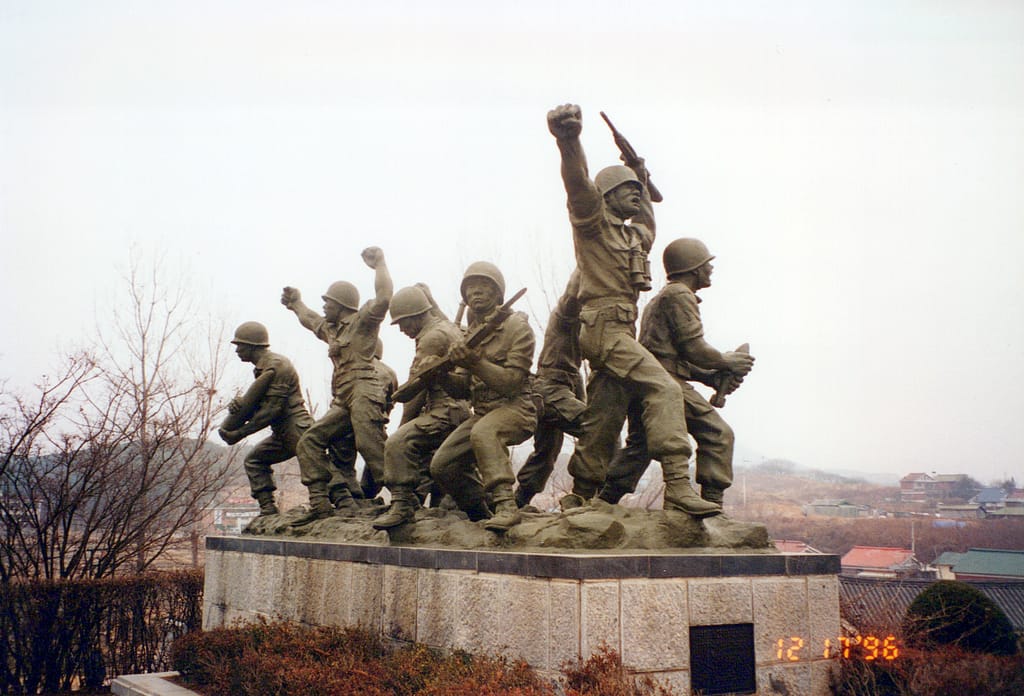


Found this useful? Buy me a coffee — it helps fund future battlefield research


Authored by Mick Prictor, a retired military officer with 40 years’ service, and a military historian specialising in terrain-focused analysis of tactics, doctrine, and command decision-making in land warfare. His work draws on extensive battlefield fieldwork—more than 280 sites worldwide—and one of the world’s largest private collections of historic military arms, uniforms, and equipment. About me
📚 Further Reading
This battle study nests within the broader analytical framework explored in the Research Hub, where operational methods, operating environments, armies, commanders, and weapons are examined across conflicts and eras. The links below connect related studies across the wider body of battlefield analysis on the BattlefieldTravels site.
⚔️ Explore all battle studies from the Korean War 1950-1953
🏛️Explore the museum of Korean War weapons and equipment
The book list for this conflict includes the leading campaign studies, memoirs, and operational analyses available on the Korean War, selected specifically to complement this battlefield study.
📚Korean War (1950-1953) – Recommended Reading
🗞️ For updates on new battlefield studies and research insights, you can subscribe to the Newsletter.
Related Battle Studies, Museum Pieces & Reading Resources


🧭 Battlefield Travel Guide: Joint Security Area, Panmunjom
Getting There
- Nearest City: Seoul, approx. 50 km south of the DMZ.
- You must go with an organised tour. There are several companies running tours from Seoul. Here are a couple of examples. There are more! http://www.panmunjomtour.com/index.asp, https://hanatour.trekksoft.com/en/activity/320592/jsa-tour
- Access: The JSA can only be visited on an authorised guided tour, booked in advance through approved tour companies or the USO.
- Requirements: Visitors must bring a passport; strict dress codes and security checks apply. Tours are subject to last-minute cancellation if tensions rise.
Site Orientation
- Key Landmarks: The blue United Nations Command conference huts straddling the Military Demarcation Line (MDL), the South Korean Freedom House, and the North Korean Panmungak building opposite.
- Best Vantage Points: From the South Korean side of the MDL, visitors can see the North Korean guards and Panmungak directly across the line.
- Restricted Movement: Visitors remain under escort at all times; photography is only allowed in designated zones.
Museums & Visitor Centres
- On-site: No public museum within the JSA itself. Briefings are provided by UN Command soldiers before entering the zone.
- Nearby: The DMZ tour usually includes stops at the Third Tunnel of Aggression, Dora Observatory, Dorasan Station, and the Imjingak Peace Park with its Freedom Bridge and memorials.
On-Site Experience
- Interpretive Briefings: UN soldiers provide background on the Korean War, the Armistice of 1953, and current security arrangements.
- Atmosphere: The site remains tense and highly militarised, with armed guards on both sides. Visitors often remark on the surreal contrast between the calm setting and its global significance.
Nearby Points of Interest
- Related Sites: Other DMZ sections including Cheorwon’s “Iron Triangle,” Infiltration Tunnels, and observation posts.
- Broader Interest: The War Memorial of Korea in Seoul provides an in-depth background to the Korean War, complementing the JSA visit.
Practical Tips
- When to Visit: Tours operate year-round but can be cancelled at short notice due to security conditions.
- Dress Code: No torn jeans, sandals, or military-style clothing. Smart casual attire is enforced.
- Facilities: Limited. Basic amenities at Imjingak Park before entering the JSA. No cafés or shops inside the zone.
FAQ: Joint Security Area Panmunjom
The Joint Security Area is the central meeting point within the Korean Demilitarised Zone (DMZ) where officials from North and South Korea, and the United Nations Command, conduct negotiations and liaison activities.
The JSA was created following the Korean Armistice Agreement signed on 27 July 1953. It was built on the site of Panmunjom, the village where the armistice talks were held.
The area lies within the DMZ and is jointly overseen by the United Nations Command and the Korean People’s Army. The Military Demarcation Line (MDL) runs through the middle of the compound, dividing it between North and South.
Yes. The most serious incident was the 18 August 1976 “Axe Murder Incident,” when two U.S. officers were killed by North Korean troops while trimming a tree inside the neutral zone. The area was subsequently reorganised with tighter control measures.
Access is possible only through organised military-escorted tours from South Korea. Visitors can enter conference buildings where the MDL runs through the centre of the room and observe North Korean guards across the line.
Panmunjom remains the only point of direct contact between the two Koreas and a visible symbol of the unresolved Korean conflict. It has hosted several high-level meetings, including inter-Korean summits in 2018.
Subscribe to Battlefield Travels and receive a free E-Book Battlefield Guide
Unlock expert battlefield analysis, campaign reconstructions, and historical insights drawn from firsthand exploration and primary sources.
🗺️ You’ll receive:
🎖️ Exclusive historical insights you won’t find elsewhere
📘 A free eBook: 10 Tips for Exploring Historic Battlefields
📰 New battlefield studies straight to your inbox as they are published

⚔️ Go deeper — Members get exclusive access to the Deep Research Collection, Field Notes, and monthly Research Dispatches. Try membership free for 7 days, cancel anytime. From $9/month.

Sadly, the JSA is still closed until further notice. In May 2025, we did a tour that took in the Cheorwon-gun part of the Civilian Control Zone. THe tour included the Cheorwon Peace Observatory (loudspeakers were blaring from the South Korean side) and Woljeong-ri Station, and we walked down about 500 m into the Second Tunnel. Hopefully the JSA will reopen one day.
I think the JSA would extremely sensitive to the geopolitical situation at any moment in time. I was there in 1996, Clinton era, just before the Sunshine Policy era of President Kim Dae-jung, so a relative detente. Still tense as hell!
Tony, Mang Yang Pass and GM 100 is on my to-do list for a future Vietnam trip in the Central Highlands. Fall covered it well in ‘Street Without Joy’. Just a horror story of a battle.
There’s an interesting crossover between the Korean War and the French Indochina War. The French Bataillon de Corée that distinguished itself in Korea left the country in October 1953 to campaign in Indochina as part of Groupe Mobile 100 (reconstituted as the Korea Regiment, consisting of two battalions of 834 men each). The regiment was practically annihilated by Viet Minh troops in a series of ambushes on RC19 and in the Chu Dreh Pass.