How industrialised firepower changed the battlefield
When the first machine guns were introduced on the battlefield, they were viewed as an improved form of infantry rifle fire. British strategist Major-General J. F. C. Fuller called the machine gun the ‘concentrated essence of infantry’, in that it put into the hands of one man “the firepower formerly wielded by forty”.1Keegan, J. (1976) The Face of Battle. London: Jonathan Cape. p. 232.
However, a more revolutionary interpretation soon emerged. The characteristics of machine gun fire made the machine gun a wholly new capability that could be employed in ways not possible even for large numbers of individual riflemen.

This article explains how machine guns are employed on the battlefield, including the key concepts of cone of fire, beaten zone, grazing fire, enfilade fire, and mutually supporting machine-gun positions. The article forms part of the Tactical Innovations in Warfare series.
A brief history of the machine gun
The idea of rapidly firing multiple rounds from a single weapon has existed for centuries. Early designs employed multiple barrels fired in sequence, or multiple charges that could be fired mechanically through a single barrel.
Manually operated machine guns
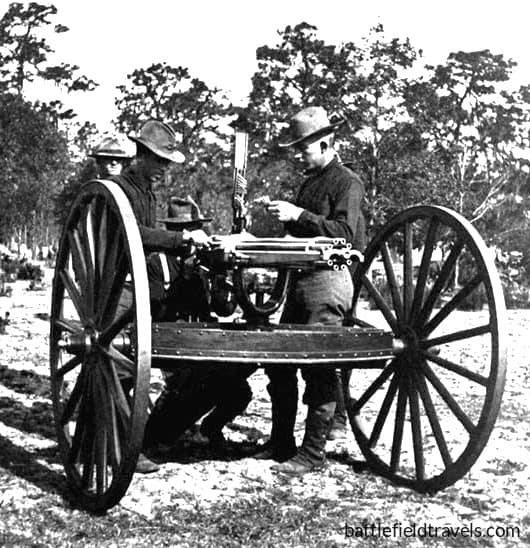
The 1861 Gatling gun was the first system to offer sequential firing and mechanical loading with self-contained cartridges. Other rapid-fire weapons included the Nordenfelt, the Mitrailleuse and the Gardner gun.
Most featured multiple barrels and fed from a hopper or reloadable cartridge plate, and were operated with either a reciprocating or rotating hand crank.
Manually operated machine guns were rapidly adopted by armies and served in many of the colonial campaigns of the late 19th century. Navies also adopted these weapons, usually in heavier calibres, as a countermeasure against fast-moving torpedo boats.
Automatic machine guns
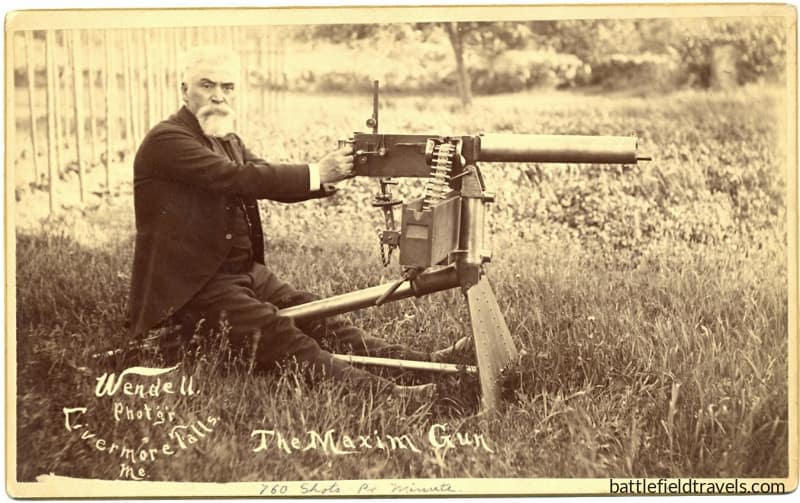
The first practical automatic machine gun was patented by Hiram Maxim in 1884. Maxim’s design harnessed the recoil of each shot to automatically load and fire the next round. For the first time, a single weapon could sustain continuous fire at rates previously impossible with manually operated arms.
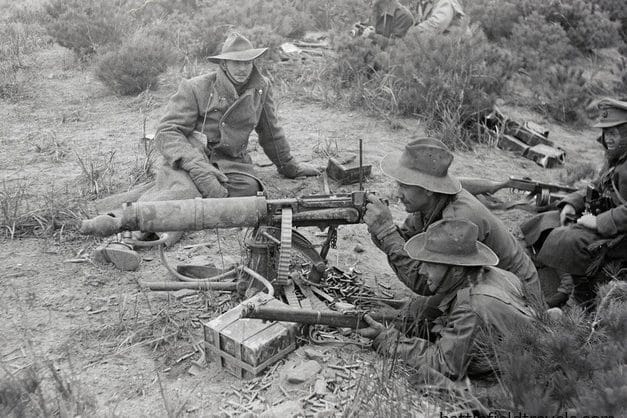
By the early twentieth century, most major armies had adopted machine guns such as the Maxim, Vickers, Browning and Schwarzlose. These weapons were heavy and normally mounted on tripods, but they were capable of delivering sustained fire across hundreds of metres of battlefield.
Evolution or revolution?
At first, many commanders treated the machine gun simply as a more powerful rifle. Experience quickly demonstrated that it was something entirely different. When properly sited and supported, a machine gun could dominate the ground in front of it and deny movement across key approaches.
This realisation led armies to develop formal doctrines for the employment of machine guns — doctrines that described how to site the weapon, control its fire, and integrate it into defensive systems. Concepts such as the cone of fire, beaten zone, grazing fire, and mutual support emerged from this effort to understand and exploit the weapon’s unique capabilities.
The machine gun was therefore not merely a new weapon. It was a true tactical innovation.
The machine gun in popular culture
Hollywood often portrays the machine gun firing from exposed positions, traversing frontal fire against advancing waves of enemy troops. In reality, this method, while sometimes necessary, is usually the least efficient employment of the machine gun.
By the early twentieth century, armies had developed a sophisticated theory of machine gun employment. Heavy machine guns such as the Vickers were carefully sited and employed according to doctrinal principles designed to maximise their tactical effect.
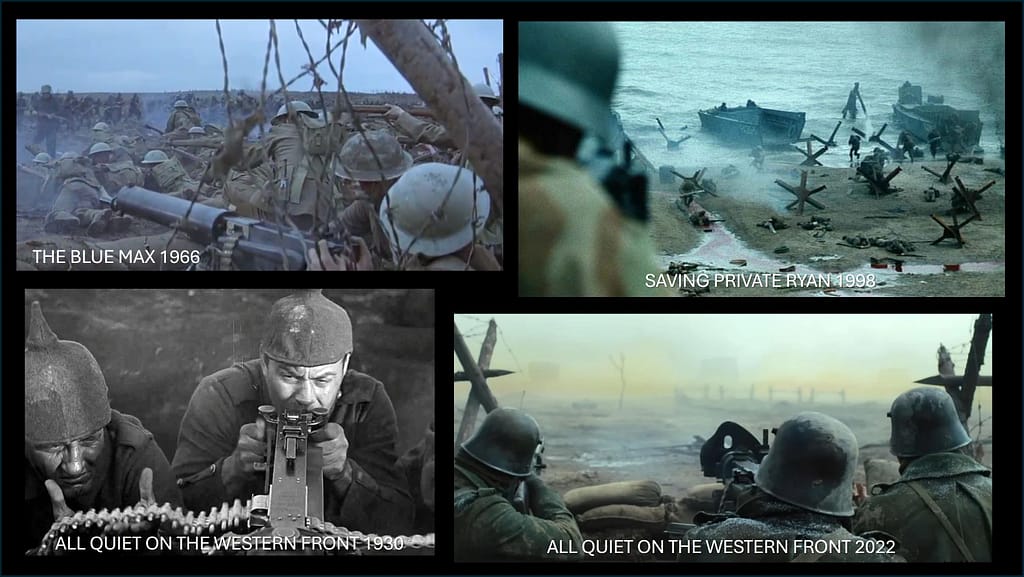
A new scientific method and vocabulary were developed for the machine gun. European armies developed a series of concepts—cone of fire, beaten zone, grazing fire, enfilade fire, and defilade positions—that allowed for the most efficient and effective employment of the new weapon.
The Tactical Problem
Before the introduction of automatic weapons, infantry firepower depended largely on individual soldiers firing muskets or rifles under the direction of officers and non-commissioned officers. When infantry tactics were based on formed ranks and volley fire, this firepower was relatively controllable by commanders.
As the standard infantry weapon evolved from smoothbore muskets to rifled weapons, breech-loaders, and repeating rifles, the battlefields became more lethal, and infantrymen were forced to disperse and seek cover in the ground. Consequently, control of infantry firepower became more disaggregated and more susceptible to the whims, fears, and priorities of the individual infantryman.
The machine gun transformed this situation. A single weapon could deliver sustained firepower equivalent to dozens of riflemen. The machine gun was, in fact, a machine. It required resources (ammunition, water for cooling, oil for lubrication), maintenance and supervision. But when properly employed, it could perform its assigned tasks efficiently and continuously.
However, the effectiveness of the machine gun depended not simply on its rate of fire but on how its fire was distributed across the battlefield. Military doctrine, therefore, developed a set of concepts to describe how machine guns should be employed.
Machine gun fire characteristics
The Cone of Fire
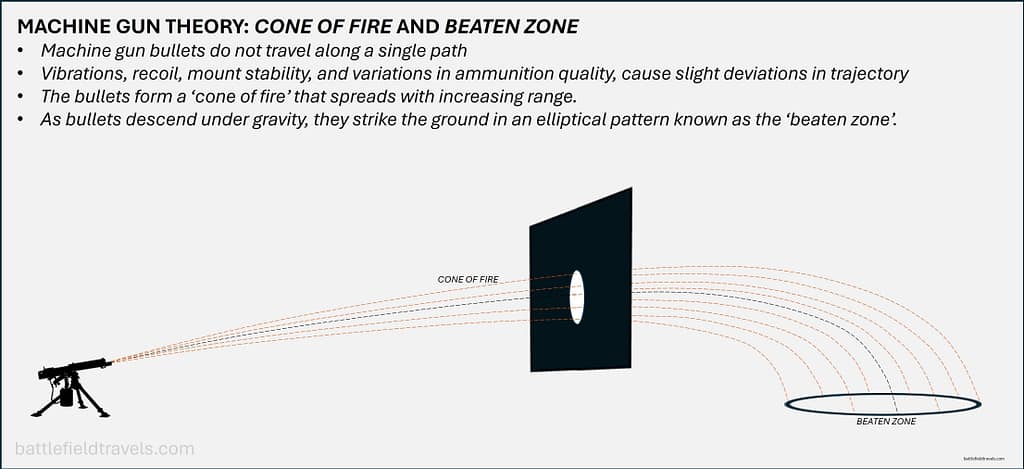
When a machine gun fires a burst, the bullets do not travel along a single path. Vibration, recoil, stability of the mount, and minor variations in ammunition cause individual bullet trajectories to diverge slightly above, below, left and right of the mean. This dispersion forms a cone of fire extending outward from the muzzle.
The cone of fire represents the three-dimensional volume through which the bullets travel as they leave the weapon. At shorter ranges, the cone is relatively narrow. As the range increases, the cone progressively widens due to bullet dispersion.
This slight dispersion of projectiles underpins all other aspects of machine gun theory.
The Beaten Zone
Where the cone of fire intersects the ground, it creates a pattern of bullet impacts known as the beaten zone.
The beaten zone typically appears as an elongated oval area on the ground. Its shape varies depending on:
• range to the target
• slope of the ground relative to the bullet trajectory
• stability of the machine gun firing platform
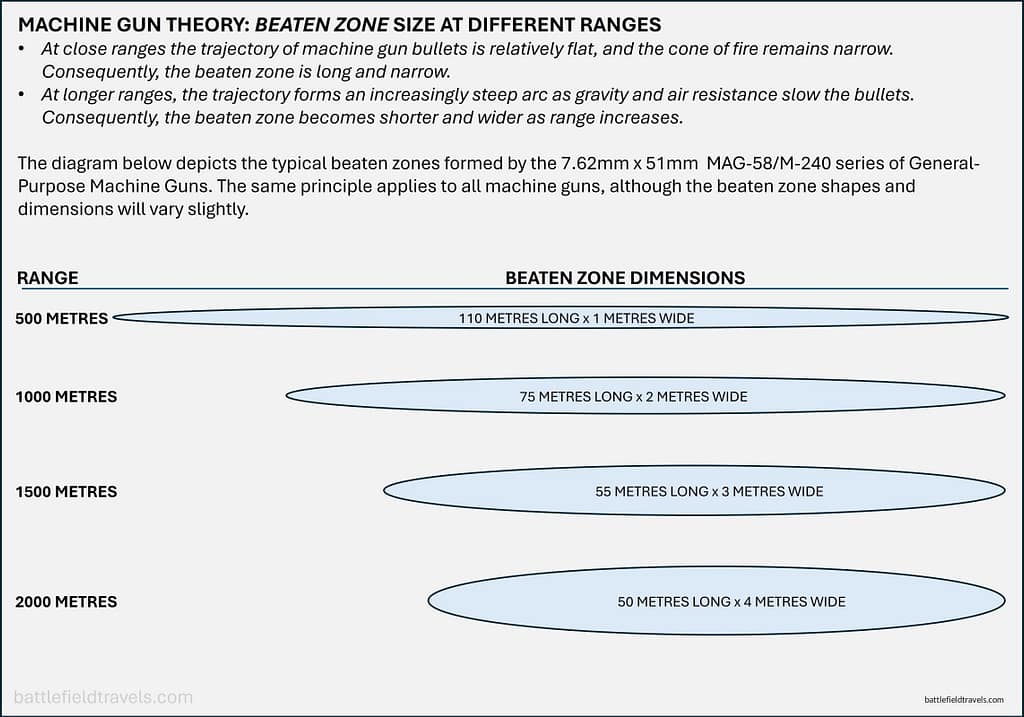
On level ground, at ranges out to around 600 metres, the beaten zone forms a very long, narrow elliptical shape. At longer ranges, as the barrel is elevated for increased range, the bullets travel in a more pronounced arc. The beaten zone becomes progressively shorter and wider as the range increases.2U.S. Marine Corps (2018) Machine guns and machine gun gunnery. MCTP 3-01C. Washington, DC: Department of the Navy.
Grazing Fire
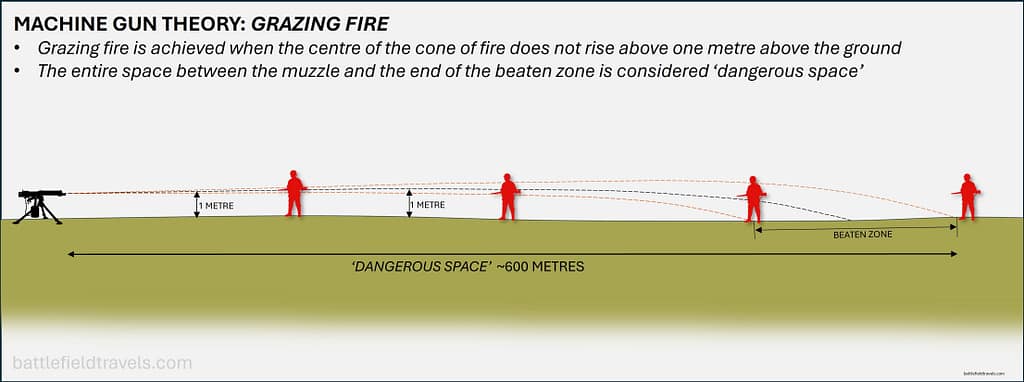
Grazing Fire is achieved when the machine gun projectiles travel approximately parallel to the ground, and where the centre of the cone of fire does not rise above one metre from the ground.
British doctrine defined grazing fire as fire in which the bullets do not rise more than about the height of a man along their path. Close to the muzzle, the bullet will be close to the ground. It will rise over several hundred metres to its apex, no higher than about 1.8 metres (six feet), and then descend under gravity until it strikes the ground.
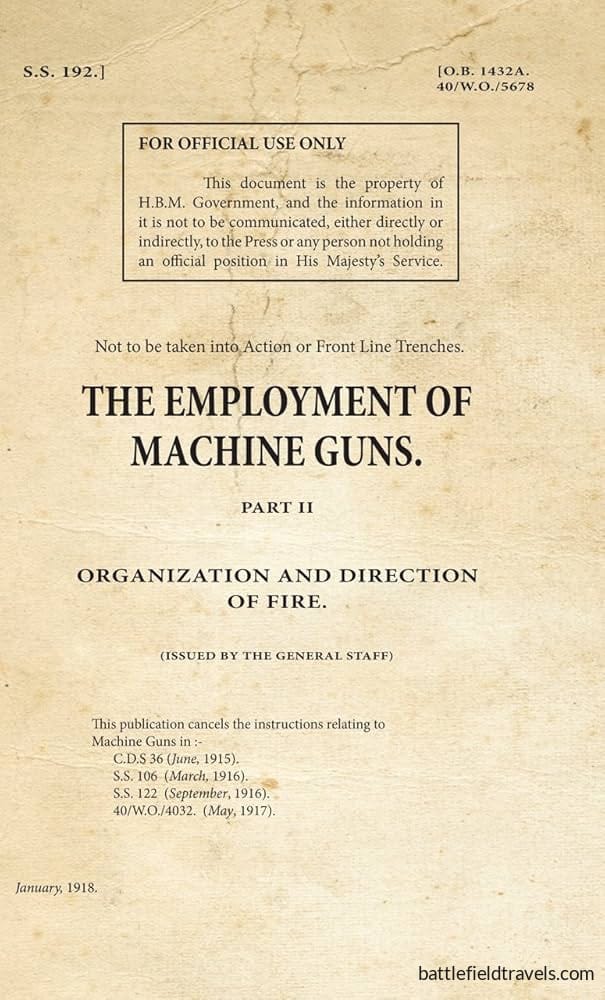
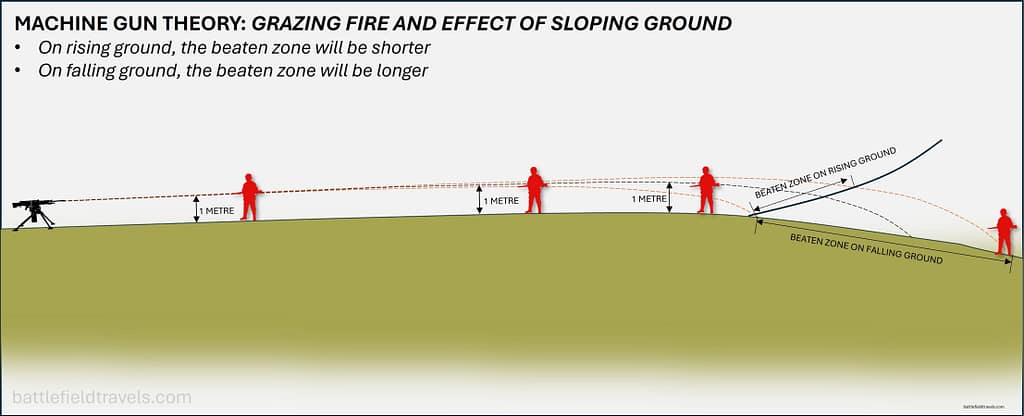
With the weapons and ammunition types of the 20th and early 21st centuries, grazing fire could be achieved out to around 600 metres on flat ground. On terrain that formed a gentle convex arc, the grazing fire zone would be longer. On convex terrain, the grazing fire zone would be shorter.3General Staff (1918) The employment of machine guns. Part II: Organization and direction of fire. S.S. 192. London: War Office.
Types of Machine-Gun Fire
With an understanding of the cone of fire, the beaten zone, and grazing fire, the next consideration is how machine-gun fire is applied relative to a target. Commonwealth doctrine distinguished between various applications of machine-gun fire depending on the direction of fire relative to the enemy formation.
Frontal Fire
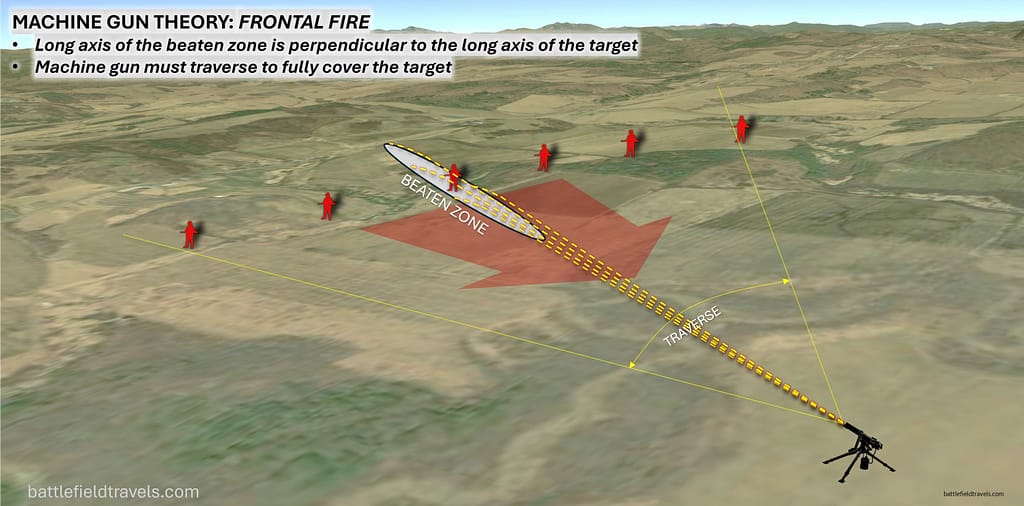
Frontal fire occurs when the beaten zone is applied perpendicular to the long axis of the target. In practice, a machine gun applying frontal fire to a body of enemy troops needs to shift or traverse to each target.
This is the familiar ‘Hollywood’ depiction of machine-gun use and is usually the least efficient way to employ a machine gun.
Enfilade Fire
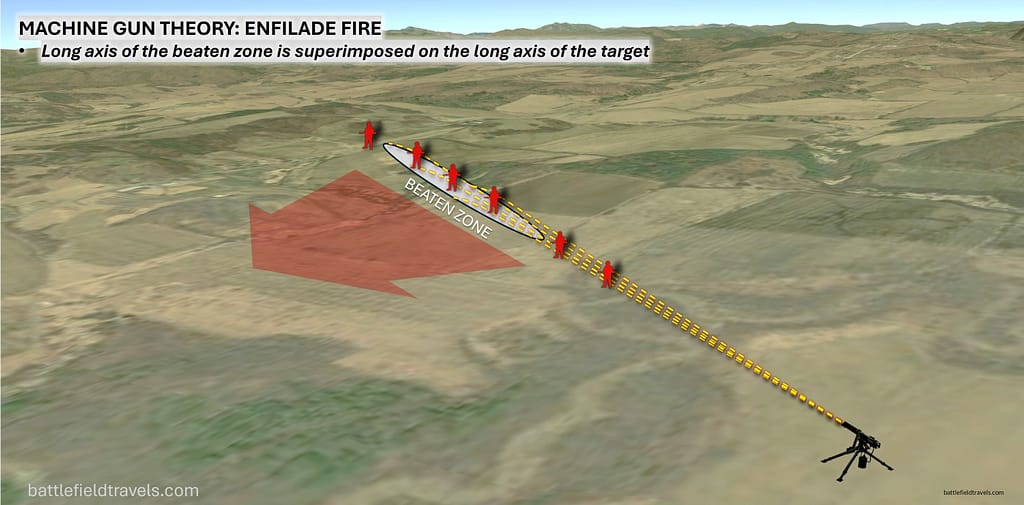
Enfilade fire is achieved when the long axis of the beaten zone is superimposed over the long axis of the target.
This type of fire is far more effective than frontal fire because each bullet passes through the entire depth of the enemy formation.4Klaar, F. (1907) Der gute Kamerad: A training and reading book for the instruction of German infantry soldiers. Berlin: Verlag der Liebelschen Buchhandlung.
For example, a machine gun firing along the length of a trench could potentially strike multiple defenders with each burst. A machine gun firing from the flank of an assault force creates a zone of fire through which the attacking force must pass.
Ideally, machine guns are sited to achieve enfilade grazing fire on potential enemy approaches.
Oblique Fire
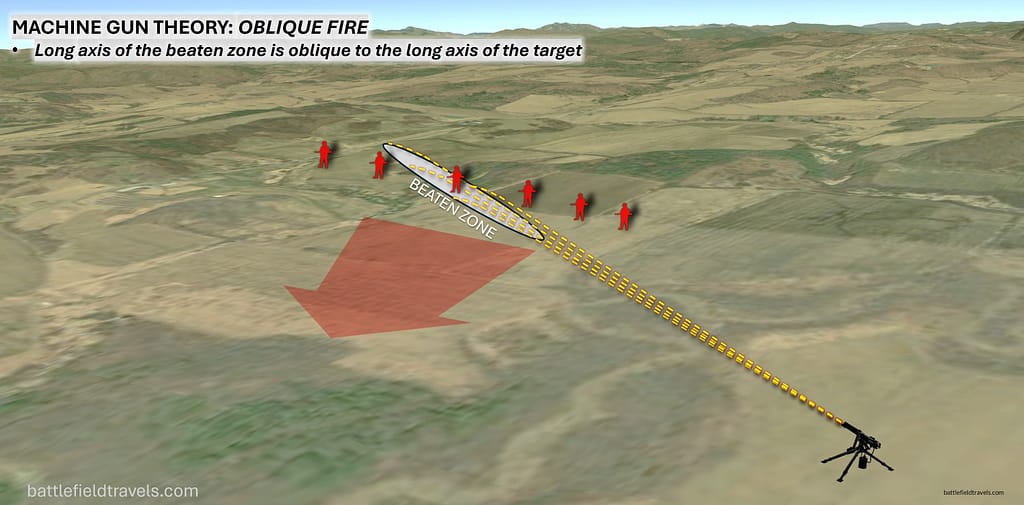
Oblique fire is achieved when the beaten zone of the machine gun is applied diagonally to the long axis of the target, anywhere between parallel and perpendicular. While not as effective as enfilade fire, oblique fire is still more efficient than frontal fire, and will usually be the best that can be achieved.
Plunging Fire
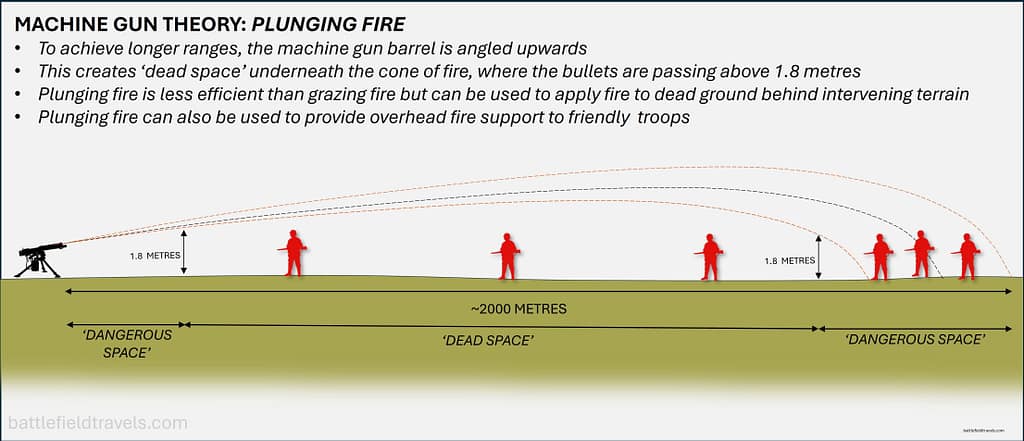
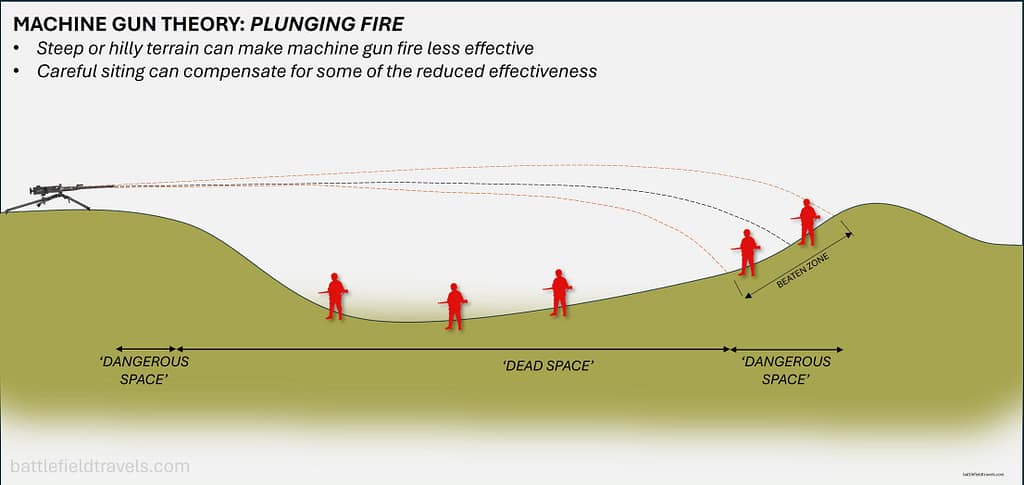
Plunging fire occurs when bullets descend steeply onto the target area. The resulting beaten zone is generally short and wide.
Plunging fire usually occurs at longer ranges where the high trajectory of the bullets causes them to arrive on the target at a steep angle, or when firing from elevated positions. Plunging fire is usually less efficient than grazing fire because the zone between the muzzle of the machine gun and the target will not be covered by grazing fire. However, plunging fire can be particularly effective when employed against targets located behind cover, such as trenches or reverse slopes.
Between the muzzle of the machine gun and the beaten zone, there will be a dead space where the bullets are travelling more than about 1.8 metres above the ground. Troops—both enemy and friendly—can move within the dead space without being struck by machine gun bullets.
Defilade Positions
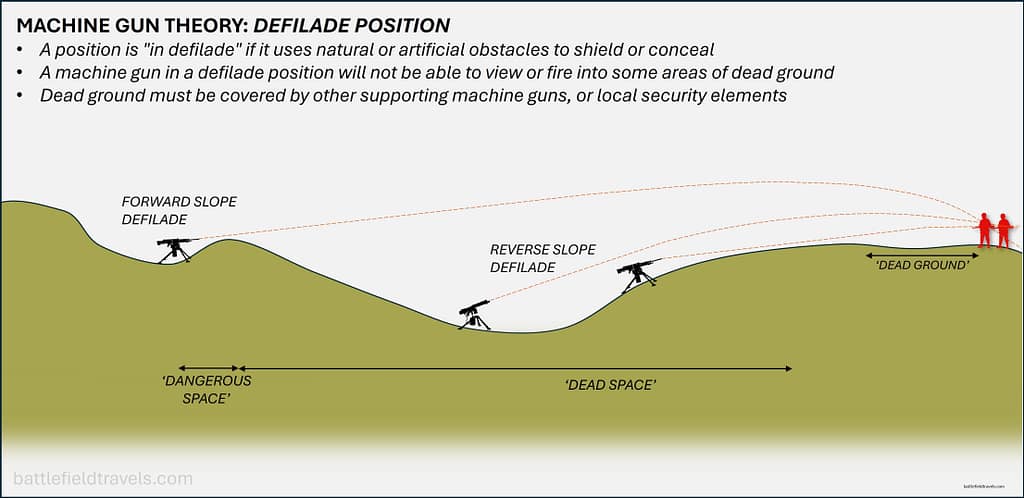
A defilade position is one in which terrain shields the weapon from direct observation and fire, particularly to the immediate front.
Because a machine gun is best sited to apply enfilade grazing fire, it will generally not be sited to cover the approaches to its own immediate front.
Types of defilade position
Common defilade locations include:
• reverse slopes
• shallow depressions
• positions behind ridgelines.
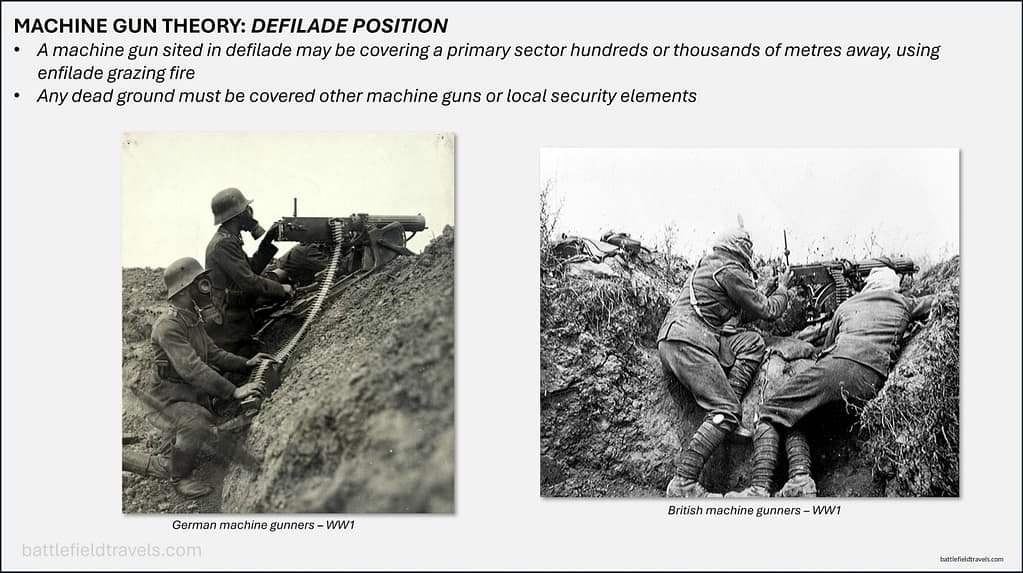
From these concealed positions, machine guns can fire across exposed ground while remaining difficult for the enemy to detect or engage. Defilade greatly increases the survivability of machine-gun crews and allows them to maintain fire in their assigned sectors.
Defilade also creates dead ground relative to the machine gun, which cannot be observed or engaged from that position. This dead ground is generally covered by fire from other machine guns and local security elements, such as rifle squads.
Mutual Support
Machine guns are rarely sited in isolation. Early machine-gun doctrine emphasised the principle of mutual support, in which multiple machine guns were positioned to cover ground that neighbouring guns could not.
A machine gun is ideally sited to apply enfilade grazing fire from a defilade position, thereby dominating potential enemy approaches while remaining concealed from direct observation. However, a gun firing from defilade cannot easily defend itself against attack from the front, because the terrain that creates defilade also limits the crew’s field of view.
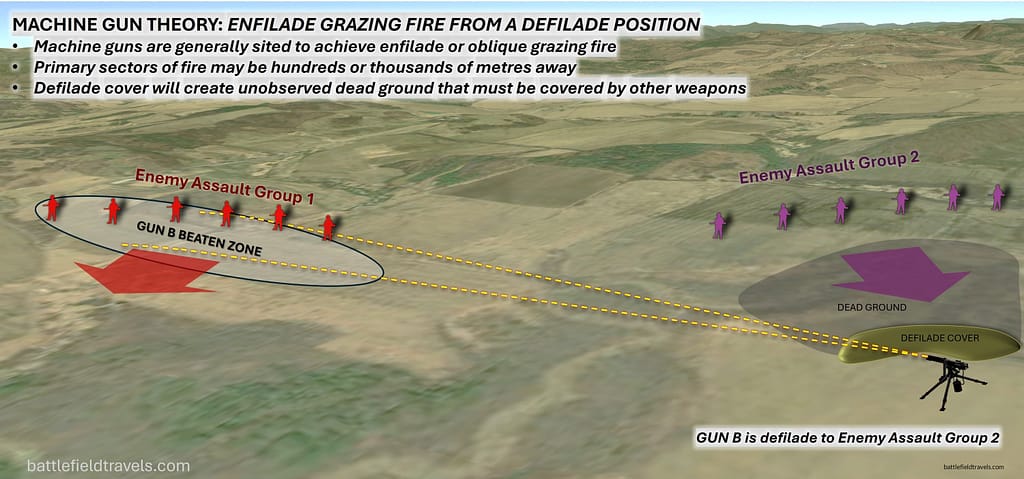
Machine guns are sited to cover each other’s blind spots and to cover the same sectors from different angles. These overlapping fields of fire ensure that if attackers attempt to assault one gun position, they will be brought under fire from neighbouring guns.5Australian Army (1980) Manual of Land Warfare. Part 2: Corps Doctrine – Infantry Training. Volume 4: Infantry Small Arms. Pamphlet No. 7: The General Purpose Machine Gun GPMG, 7.62 mm, M60 (All Corps). Canberra: Australian Army.
Through this system of mutual support, machine-gun positions form a defensive network in which each weapon both dominates its assigned sector and protects adjacent positions.
Mutually supporting machine guns therefore ensure that an enemy cannot attack one position without being subjected to fire from neighbouring weapons.

Machine gun barrage tactics
Predictive machine gun fire
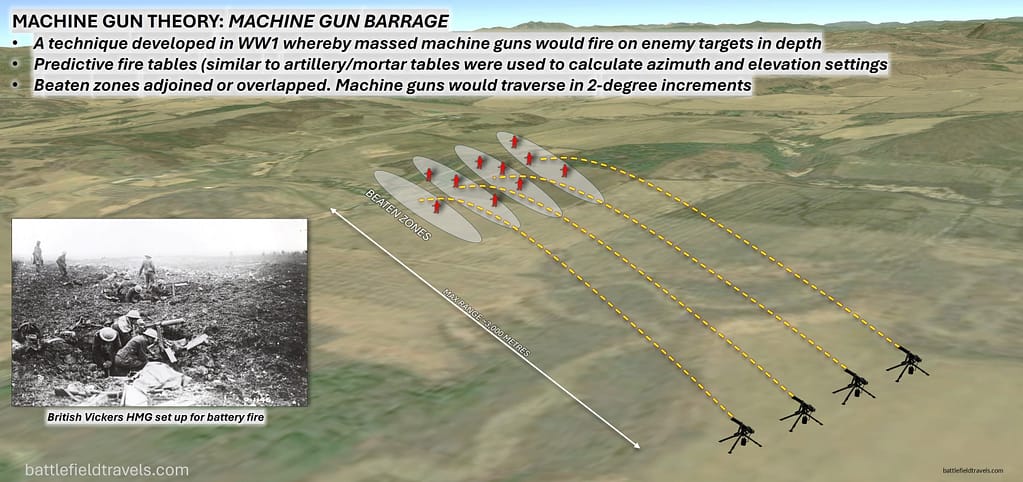
When machine guns are fired from stable platforms, their effective range, trajectories, and beaten zone characteristics can be accurately calculated over several thousand metres. Consequently, by the First World War, machine gun theory included the ability to employ predictive and indirect fire.
By 1917, all the British and Commonwealth contingents were making extensive use of predictive machine gun fire and machine gun barrages. The Canadian Corps, in particular, became a leader in this development.6Library and Archives Canada (1917) WD – GOC RA, Canadian Corps, April 1917, Appendix I, BGGS. RG9-III-D-3, Vol. 4957, File 503. Ottawa: Library and Archives Canada.
Machine gun barrage
When sited at a surveyed, known location with accurate elevation data, a machine gun can be laid with precision onto a distant target using maps, range tables, and firing data. Multiple machine guns are usually sited to fire these predictive missions so that each machine gun’s beaten zone covers a sector and overlaps with a neighbouring gun’s beaten zone.
Predictive and indirect fire generally employs long bursts (20 rounds or more) to achieve full coverage of the beaten zone. Fire may be adjusted by observers watching the fall of shot.7Australian Army (1980) Pamphlet No. 7: The general purpose machine gun GPMG, 7.62 mm, M60.
Predicted fire barrages can be directed at depth targets like:
- road junctions
- assembly areas
- communication trenches
- likely reinforcement routes.
Heavy machine guns, such as the water-cooled Vickers or Maxim, can sustain fire for long periods, allowing them to perform a role similar to that of light artillery in suppressing enemy movement.
⚔️ Go deeper — Members get exclusive access to the Deep Research Collection, Field Notes, and monthly Research Dispatches. Try membership free for 7 days, cancel anytime. From $9/month.
Case Study: Machine-Gun Barrage at High Wood, 1916
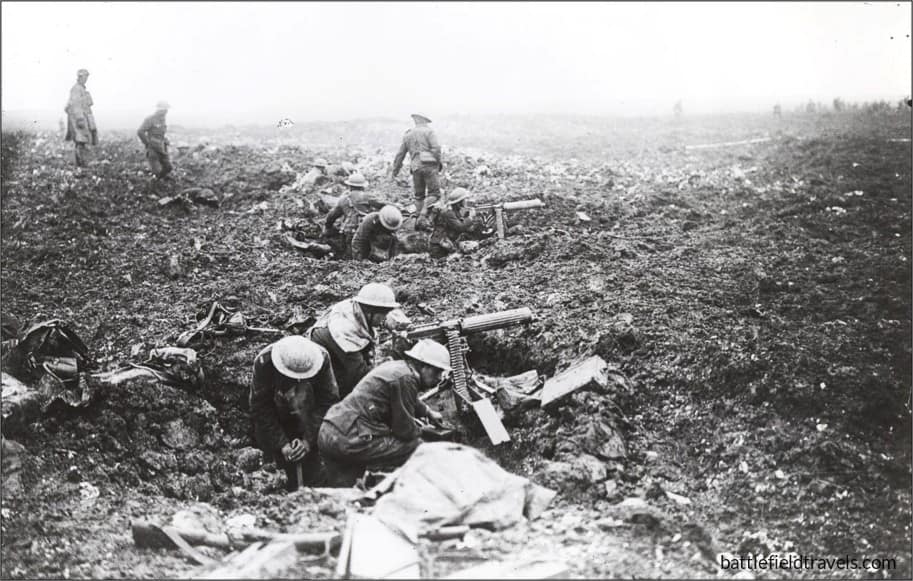
During the First World War, the British Army rapidly expanded its use of machine guns. In 1915, it created the Machine Gun Corps, grouping Vickers guns into specialist companies trained to employ the weapon in coordinated fire plans. One of the new techniques was the machine-gun barrage, in which guns fired indirectly over long distances using range tables and map data to suppress enemy movement, much like artillery. The tactic was designed to deny reinforcement routes, harass enemy positions, and support attacking infantry even when the gunners could not see their targets.
The technique was dramatically demonstrated during the Battle of the Somme in August 1916. At High Wood, seven Vickers guns of the 100th Machine Gun Company fired a sustained barrage against German positions more than 2,500 yards away. Over roughly twelve hours, the guns fired nearly one million rounds, maintaining continuous indirect fire to suppress German reinforcements and cover the British infantry attack. The Vickers guns ran so hot that their crews replenished the cooling jackets with water from their own bottles. Although the infantry assault ultimately failed to break the German line, the action demonstrated the extraordinary endurance of the Vickers gun and the potential of the machine-gun barrage as a form of long-range suppressive fire.8Members of the Battalion. History and Memoir of the 33rd Battalion Machine Gun Corps and of the
19th, 98th, 100th and 248th M.G. Companies (London: Waterlow Brothers & Layton Limited, 1919), 7-8
(Note. The original claim of one million rounds fired at High Wood was made in the History of the 33rd Battalion, Machine Gun Corps (1919). In a 2018 journal article, authors Richard Fisher & Richard Willis calculated the logistics behind this achievement and produced evidence that the actual number of rounds fired during the High Wood machine gun barrage was 99,500.9Fisher, R., & Willis, R. (2018). One million rounds fired in 12 hours? An analysis of the account of six guns of the 100th Brigade Machine Gun Company at High Wood in August 1916. First World War Studies, 9(3), 313–327. https://doi.org/10.1080/19475020.2019.1651667)
Machine gun positions and arcs (sectors of fire)
Sectors of fire
Every machine gun will be allocated a primary and a secondary sector of fire (arc of responsibility). If tripods are available, the machine guns are set up on the tripods to cover their primary sector and can be repositioned to cover the secondary sector when directed.
If tripods are not available, the machine gun’s traverse can be limited using stakes, and its elevation can be controlled using a horizontal log or board. In this way, the machine gun can fire in its primary and secondary sectors under all lighting and visibility conditions.
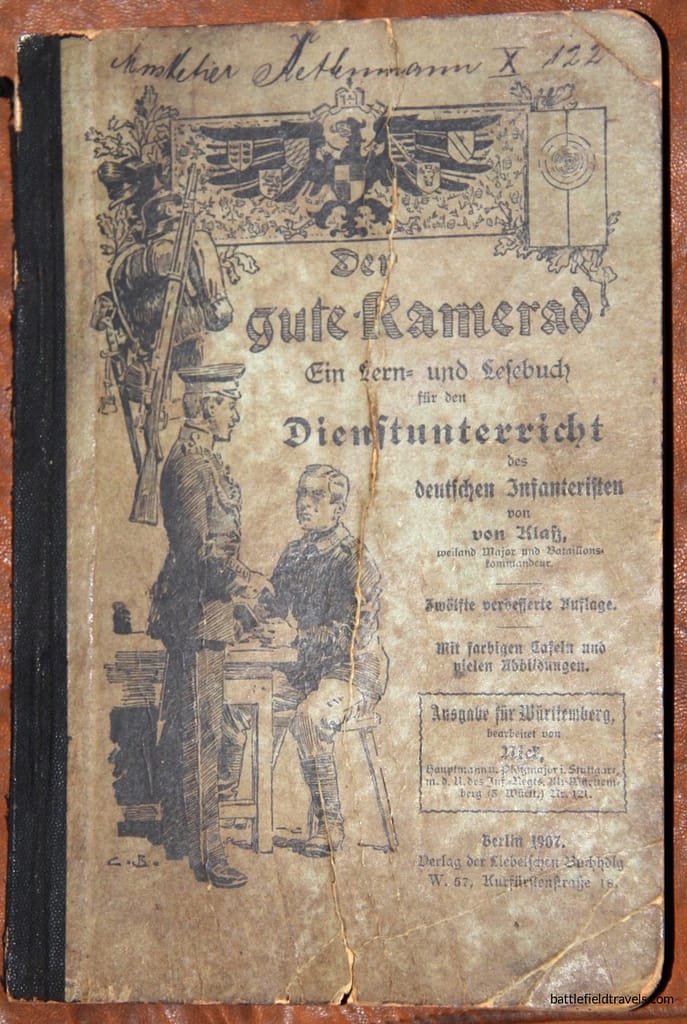
Most armies produced ‘soldiers’ handbooks’ with handy tips on siting machine guns and improvisation techniques for staking and limiting arcs of fire. Der gute Kamerad (1907) was the German soldier’s handbook in the First World War. As an Australian Army infantryman in the 1980s, I carried a very similar handbook, known colloquially as the ‘Blue Book’.
Fighting positions
Every machine gun should have three positions: primary, alternate, and supplementary, from which it can achieve its assigned fire tasks. If time permits, each position will be fully developed with a dug-in fighting bay and overhead protection. Range cards will be produced for each position, and tripods and/or stakes will be configured to support the assigned fire tasks.10French Army (1909) Instruction sur la mitrailleuse Hotchkiss montée sur affût-trépied de campagne. Paris: Henri Charles-Lavauzelle.
Employment of machine guns in the defence
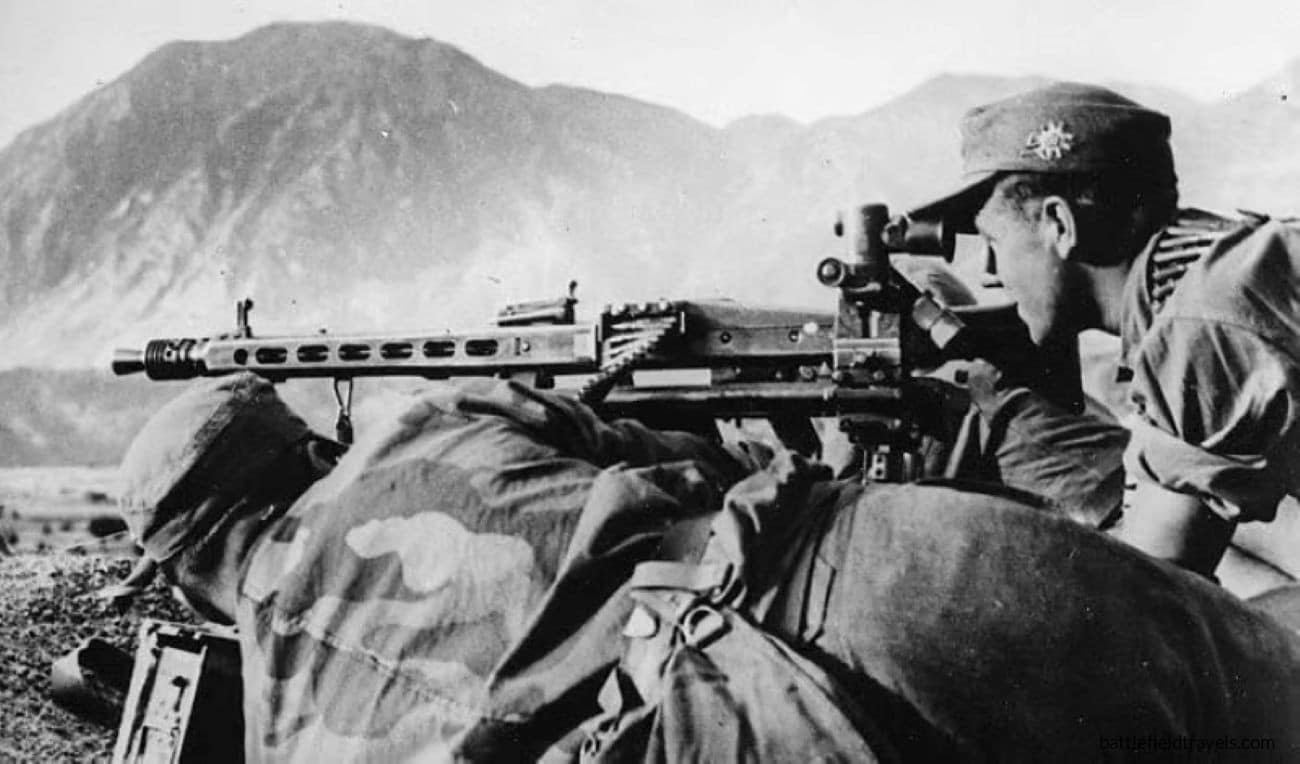
When machine guns are correctly sited within an integrated defensive system, they can be centrally coordinated across an entire defensive sector in concert with defensive artillery fire.
Machine guns are generally controlled at a higher level, such as battalion or brigade level (especially for mutual support between units). Authority to fire machine guns is generally held at higher levels to ensure that machine gun positions are not exposed until absolutely necessary. Conversely, an enemy force will seek to provoke the machine gunners into firing so that their positions can be identified and suppressed or destroyed.
Fire sectors and interlocking arcs provide commanders with the control measures they need to apply machine gun fire where required. Machine gun fire can be applied to a threatened sector by one or more weapons sited to fire into that sector, even when the gun crews themselves cannot see the targets they are firing upon.
Closing thoughts on the machine gun
The theoretical principles governing the employment of the machine gun were understood surprisingly early in the twentieth century. First World War field manuals from the French, British, and German armies describe the geometry of fire in almost mathematical terms: cones of fire, beaten zones, grazing fire, enfilade fire, and mutually supporting positions.
Twenty-first-century doctrine still describes these concepts in almost identical language. While the weapons themselves have evolved, from water-cooled Maxims and Vickers guns to modern general-purpose machine guns, the underlying principles have changed very little.
The effectiveness of the machine gun is strongly dependent on the ground over which it is fired. Slight rises, shallow depressions, hedgerows, walls, and folds in the terrain determine whether grazing fire can be achieved or whether dead ground will shelter an attacker. The machine gun, therefore, sits at the intersection of weapons, doctrine, and terrain. A well-sited gun can dominate an entire battlefield sector; a poorly sited gun can be bypassed in seconds. Understanding how machine guns are sited and employed is essential to understanding how historic battles unfolded, and to reading the ground on the battlefields where they were fought.
The machine gun remains what J. F. C. Fuller described as the “concentrated essence of infantry”: a weapon whose true power lies not only in its cyclic rate of fire, but in the disciplined and coordinated application of fire on the battlefield.
Found this useful? Buy me a coffee — it helps fund future battlefield research


Authored by Mick Prictor, a retired military officer with 40 years’ service, and a military historian specialising in terrain-focused analysis of tactics, doctrine, and command decision-making in land warfare. His work draws on extensive battlefield fieldwork—more than 280 sites worldwide—and one of the world’s largest private collections of historic military arms, uniforms, and equipment. About me
📚 Notes and References
Notes
- 1Keegan, J. (1976) The Face of Battle. London: Jonathan Cape. p. 232. ↩︎
- 2U.S. Marine Corps (2018) Machine guns and machine gun gunnery. MCTP 3-01C. Washington, DC: Department of the Navy. ↩︎
- 3General Staff (1918) The employment of machine guns. Part II: Organization and direction of fire. S.S. 192. London: War Office. ↩︎
- 4Klaar, F. (1907) Der gute Kamerad: A training and reading book for the instruction of German infantry soldiers. Berlin: Verlag der Liebelschen Buchhandlung. ↩︎
- 5Australian Army (1980) Manual of Land Warfare. Part 2: Corps Doctrine – Infantry Training. Volume 4: Infantry Small Arms. Pamphlet No. 7: The General Purpose Machine Gun GPMG, 7.62 mm, M60 (All Corps). Canberra: Australian Army. ↩︎
- 6Library and Archives Canada (1917) WD – GOC RA, Canadian Corps, April 1917, Appendix I, BGGS. RG9-III-D-3, Vol. 4957, File 503. Ottawa: Library and Archives Canada. ↩︎
- 7Australian Army (1980) Pamphlet No. 7: The general purpose machine gun GPMG, 7.62 mm, M60. ↩︎
- 8Members of the Battalion. History and Memoir of the 33rd Battalion Machine Gun Corps and of the
19th, 98th, 100th and 248th M.G. Companies (London: Waterlow Brothers & Layton Limited, 1919), 7-8 ↩︎ - 9Fisher, R., & Willis, R. (2018). One million rounds fired in 12 hours? An analysis of the account of six guns of the 100th Brigade Machine Gun Company at High Wood in August 1916. First World War Studies, 9(3), 313–327. https://doi.org/10.1080/19475020.2019.1651667 ↩︎
- 10French Army (1909) Instruction sur la mitrailleuse Hotchkiss montée sur affût-trépied de campagne. Paris: Henri Charles-Lavauzelle. ↩︎
Primary doctrine sources
Australian Army (1980) Manual of land warfare. Part 2: Corps doctrine – infantry training. Volume 4: Infantry small arms. Pamphlet No. 7: The general purpose machine gun GPMG, 7.62 mm, M60 (all corps). Canberra: Australian Army, issued by command of the Chief of the General Staff.
French Army (1909) Instruction sur la mitrailleuse Hotchkiss montée sur affût-trépied de campagne. Paris: Henri Charles-Lavauzelle.
General Staff (1918) The employment of machine guns. Part II: Organization and direction of fire. S.S. 192. London: War Office.
Klaar, F. (1907) Der gute Kamerad: A training and reading book for the instruction of German infantry soldiers. Berlin: Verlag der Liebelschen Buchhandlung.
Library and Archives Canada (1917) WD – GOC RA, Canadian Corps, April 1917, Appendix I, BGGS. RG9-III-D-3, Vol. 4957, File 503. Ottawa: Library and Archives Canada.
Members of the Battalion (1919). History and Memoir of the 33rd Battalion Machine Gun Corps and of the
19th, 98th, 100th and 248th M.G. Companies. London: Waterlow Brothers & Layton Limited.
U.S. Marine Corps (2018) Machine guns and machine gun gunnery. MCTP 3-01C. Washington, DC: Department of the Navy.
Secondary sources
Ellis, J. (1975). The Devil’s Paintbrush: Sir Hiram Maxim’s Gun. London: Corgi Books.
Fisher, R., & Willis, R. (2018). One million rounds fired in 12 hours? An analysis of the account of six guns of the 100th Brigade Machine Gun Company at High Wood in August 1916. First World War Studies, 9(3), 313–327. https://doi.org/10.1080/19475020.2019.1651667
Ford, R. (1999). The Grim Reaper: The Machine Gun and Its Impact on the Battlefield. London: Arms and Armour Press.
Keegan, J. (1976). The Face of Battle. London: Jonathan Cape.
Myrvang, F. (2002). The German Machine Gun, Vol. I: MG34 and MG42. Cobourg, Ontario: Collector Grade Publications.
📚 Further Reading: 20th Century World Wars
This battle study nests within the broader analytical framework explored in the Research Hub, where operational methods, operating environments, armies, commanders, and weapons are examined across conflicts and eras. The links below connect related studies across the wider body of battlefield analysis on the BattlefieldTravels site.
⚔️ Explore all battle studies from the First World War 1914-1918
⚔️ Explore all battle studies from the Second World War 1939-1945
🏛️Explore the museum of First World War historic artefacts
🏛️Explore the museum of Second World War historic artefacts
🗞️ For updates on new battlefield studies and research insights, you can subscribe to the Newsletter.
FAQ – Machine Gun Theory
The beaten zone is the area on the ground where the bullets from a burst of machine-gun fire strike. Because each bullet follows a slightly different trajectory, the impacts form an elongated oval pattern rather than a single point. The shape of the beaten zone depends on range, terrain, and the stability of the firing platform.
Grazing fire occurs when machine-gun bullets travel roughly parallel to the ground and do not rise higher than the height of a standing soldier along their trajectory. This type of fire allows a machine gun to cover the maximum length of ground and is one of the most effective ways to deny movement across open terrain.
Enfilade fire occurs when the beaten zone runs along the length of an enemy formation rather than across its front. Because each bullet passes through the full depth of the target, enfilade fire can strike multiple soldiers with each burst, making it far more efficient than frontal fire.
A defilade position is one where terrain shields a machine gun from direct observation and fire, usually from the front. By firing from behind a ridge, reverse slope, or shallow depression, a machine gun can apply grazing or enfilade fire across exposed ground while remaining difficult for the enemy to detect.
Mutual support occurs when multiple machine guns are positioned so that each weapon covers ground that neighbouring guns cannot see or engage. This overlapping system of fire ensures that if one position is attacked, the attackers will be exposed to fire from adjacent machine guns.
Yes. During the First World War, heavy machine guns mounted on stable tripods could be used for predictive or indirect fire. Using maps, range tables, and known firing data, machine guns could deliver sustained fire onto distant targets such as roads, assembly areas, or communication trenches, sometimes acting in a role similar to light artillery.
Early twentieth-century armies discovered that machine guns, when correctly sited and mutually supporting, could dominate large areas of ground with sustained fire. Combined with barbed wire and field fortifications to channel and slow an enemy force, machine guns made frontal assaults extremely costly, and forced armies to develop new tactics such as creeping barrages and infiltration attacks.
Subscribe to Battlefield Travels and receive a free E-Book Battlefield Guide
Unlock expert battlefield analysis, campaign reconstructions, and historical insights drawn from firsthand exploration and primary sources.
🗺️ You’ll receive:
🎖️ Exclusive historical insights you won’t find elsewhere
📘 A free eBook: 10 Tips for Exploring Historic Battlefields
📰 New battlefield studies straight to your inbox as they are published

⚔️ Go deeper — Members get exclusive access to the Deep Research Collection, Field Notes, and monthly Research Dispatches. Try membership free for 7 days, cancel anytime. From $9/month.
