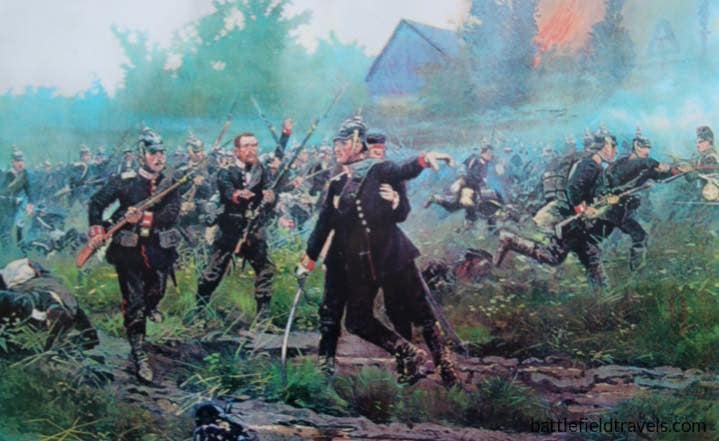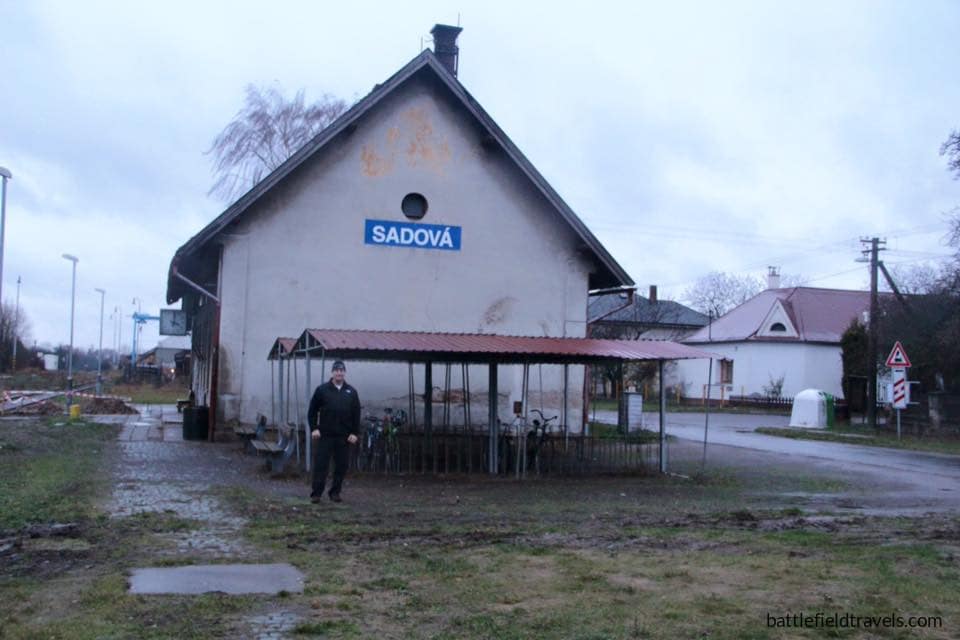
Battle of Königgrätz, 3 July 1866, Czech Republic – the fight for Chlum
Walking the ground at Königgrätz
June 2017. Chlum Village, just outside modern Hradec Králové, Czech Republic. I visited Chlum during my exploration of the Königgrätz battlefield in 2015 and again in 2017. I explored Sadowa, Rozběřice, Chlum, the Svíb Forest, and the southern sector around Nechanice. The modern battlefield is quiet, agricultural, and deceptively open. It takes some effort to reconstruct the scale of what happened here.
This was the largest land battle in history prior to Mukden (Russo-Japanese War) in 1905: 250,000 Prussian troops against some 260,000 Austrian and Saxon troops—roughly twice the size of Gettysburg exactly three years earlier.
Chlum is one of those battlefield villages whose importance is not immediately obvious until you begin to move around it. It is not a dramatic hilltop fortress or a naturally impregnable position. It is a small Czech village on gently rising ground, surrounded by open fields, scattered monuments, and the long views that characterise much of the Königgrätz battlefield.
And yet, on 3 July 1866, this ground became the centre of the Austrian position and one of the decisive points of the Austro-Prussian War.
Overview of the battle
This was the final battle of a six-week war between Austria and Prussia that would decide which German-speaking power would dominate Central Europe. Austria had held that position for centuries; Prussia intended to replace it. The result was decisive. Within five years, Prussia and its allies would defeat both Austria and France and create a unified German state. The consequences of that shift led directly to the conflicts of the twentieth century.
👉 Continue reading — full Field Notes include terrain analysis, additional imagery, and working interpretations beyond the published study. Try membership free for 7 days.

Authored by Mick Prictor, a retired military officer with 40 years’ service, and a military historian specialising in terrain-focused analysis of tactics, doctrine, and command decision-making in land warfare. His work draws on extensive battlefield fieldwork—more than 280 sites worldwide—and one of the world’s largest private collections of historic military arms, uniforms, and equipment. About me
📚 Further Reading: Austro-Prussian War
This battle study nests within the broader analytical framework explored in the Research Hub, where operational methods, operating environments, armies, commanders, and weapons are examined across conflicts and eras. The links below connect related studies across the wider body of battlefield analysis on the BattlefieldTravels site.
⚔️ Explore all Austro-Prussian War battlefield studies
The book list for this conflict includes the leading campaign studies, memoirs, and operational analyses, selected specifically to complement this battlefield study.
📚 Austro-Prussian War – Recommended Reading
🗞️ For updates on new battlefield studies and research insights, you can subscribe to the Newsletter.
Subscribe to Battlefield Travels and receive a free E-Book Battlefield Guide
Unlock expert battlefield analysis, campaign reconstructions, and historical insights drawn from firsthand exploration and primary sources.
🗺️ You’ll receive:
🎖️ Exclusive historical insights you won’t find elsewhere
📘 A free eBook: 10 Tips for Exploring Historic Battlefields
📰 New battlefield studies straight to your inbox as they are published

⚔️ Go deeper — Members get exclusive access to the Deep Research Collection, Field Notes, and monthly Research Dispatches. Try membership free for 7 days, cancel anytime. From $9/month.