
Long Tan, 18 August 1966 — D Company’s stand in the rubber plantation
Ground observations
August 2015, Long Tan Rubber Plantation, Baria-Vung Tau Province, Vietnam. I am standing at the Long Tan Cross memorial to the 18 Australian soldiers killed here during the Battle of Long Tan, 18 August 1966.
Across the Long Tan battlefield, there is very little apparent relief in the terrain. The ground is largely flat and agricultural, with sections planted in rubber trees at varying stages of growth or left fallow.

Overview of the battle
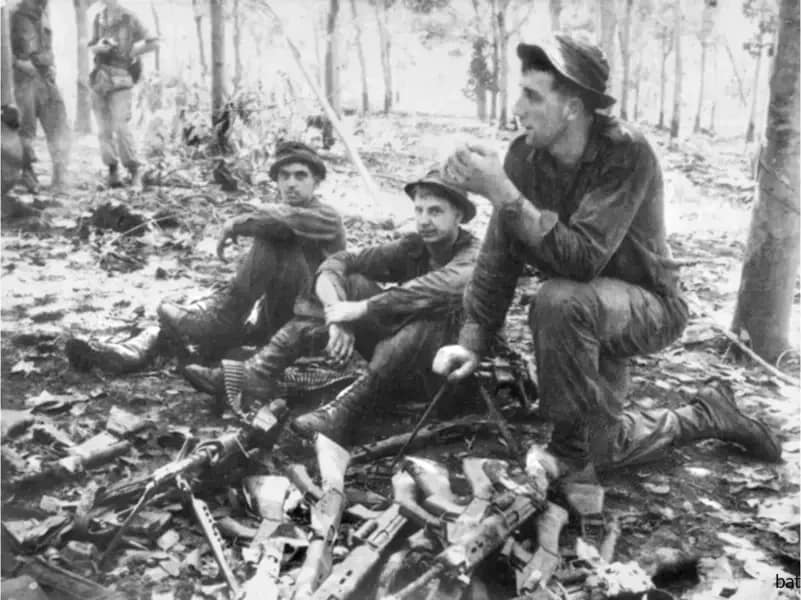
On 18 August 1966, Delta Company, 6th Battalion, Royal Australian Regiment (6 RAR), was patrolling this area in an attempt to locate and destroy Viet Cong mortar positions that had fired on the Australian base at Nui Dat the previous night.
At approximately 15:15 hours, as the patrol entered the plantation, Lieutenant Gordon Sharp’s 11 Platoon made contact with a small group of Viet Cong. Sharp deployed into an extended line and began sweeping forward through the trees in pursuit. At around 15:40 hours, the platoon encountered a much larger Viet Cong force and was immediately pinned down under heavy fire and subjected to an aggressive VC assault.
👉 Continue reading — full Field Notes include terrain analysis, additional imagery, and working interpretations beyond the published study. Try membership free for 7 days.

The Officer Commanding D Company, Major Harry Smith, rapidly moved to reinforce 11 Platoon. By approximately 17:00, the entire company was at risk of being surrounded. Only continuous artillery fire prevented the Viet Cong force—outnumbering the Australians by about 20 to 1—from closing with and overwhelming the position.
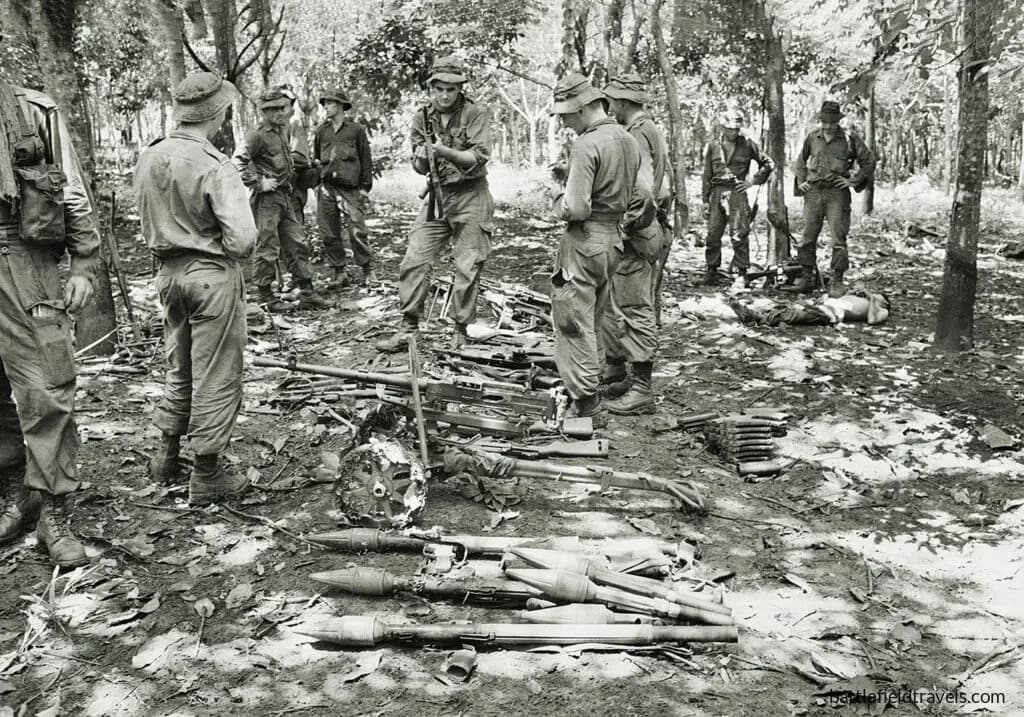
Shortly before last light, at around 19:00, A Company, 6 RAR, mounted in M113 Armoured Personnel Carriers, attacked into the flank of the Viet Cong force. This action disrupted the attack, and the Viet Cong began to break contact, thereby ending the engagement.
Micro-terrain
What is striking on the ground is how any of the D Company soldiers survived at all. Under grazing fire and shrapnel across what appears to be flat terrain, there seems to be no cover. In reality, the ground is not completely flat. Subtle undulations around irrigation lines, shallow depressions, and the root structures of the rubber trees create just enough protection for a soldier lying prone.
These micro-features are not visible on maps and are barely perceptible at a distance, but they are sufficient to reduce exposure at the critical margin between survival and casualty. When Lieutenant Gordon Sharp raised his head to direct artillery fire, he exposed himself above this minimal cover and was shot and killed.

Artillery support
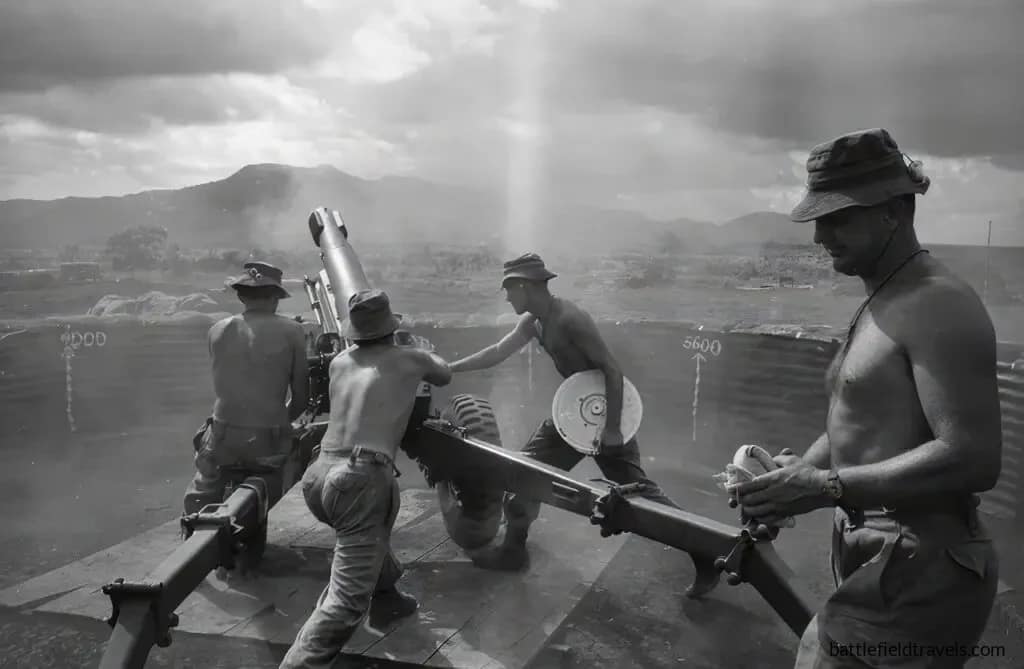
In the absence of significant terrain advantage, fire support became decisive. Artillery from Nui Dat played a critical role in D Company’s survival. The attached forward observer party, led by Captain Maurice Stanley of the Royal New Zealand Artillery, coordinated fire from multiple units, including 161st Battery (RNZA), 1st Field Regiment (RAA), and US 2/35th Artillery Battalion 155 mm guns.
Using defensive fire tasks, the artillery created a barrier around the Australian position that the Viet Cong had to penetrate in order to close. Over approximately three and a half hours, more than 3,000 rounds were fired, often landing just metres in front of Australian troops.
At Long Tan, where terrain offered only marginal protection, survival depended on the combination of micro-terrain and precisely controlled fire support.
The Long Tan Cross
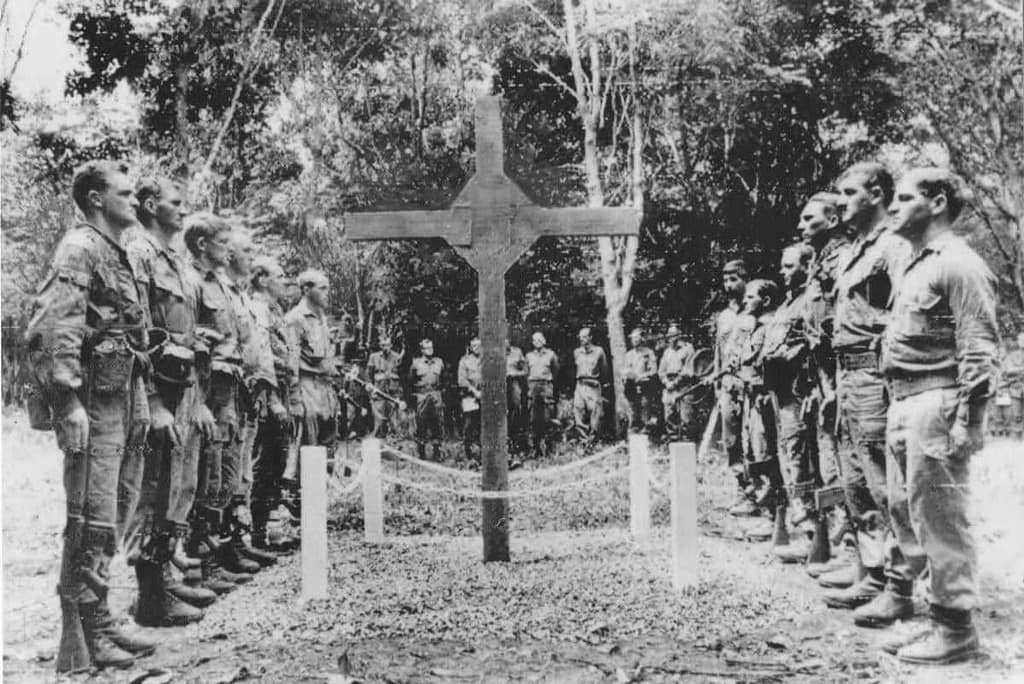
There are only two foreign military memorials in Vietnam. There is a small French veterans’ memorial at Dien Bien Phu, near de Castries’ old headquarters at Strongpoint Claudine. And there is the Australian memorial at Long Tan, the Long Tan Cross.
The Long Tan Cross was erected on the battle site by members of 6 RAR on 18 August 1969, the third anniversary of the battle. The Vietnamese later removed the cross and repurposed it as a memorial to a priest. In 1984, it was recovered and placed in the museum at Bien Hoa. A replica cross was erected on the battlefield in the 1980s.
After many years of veteran groups lobbying the Vietnamese government, the original cross was loaned to the Australian War Memorial in 2012, and finally gifted by the Vietnamese government in 2017. It is now on display at the Australian War Memorial in Canberra.
Full Battlefield study to follow!

Authored by Mick Prictor, a retired military officer with 40 years’ service, and a military historian specialising in terrain-focused analysis of tactics, doctrine, and command decision-making in land warfare. His work draws on extensive battlefield fieldwork—more than 280 sites worldwide—and one of the world’s largest private collections of historic military arms, uniforms, and equipment. About me
📚 Further Reading: Vietnam War 1955-1975
This battle study nests within the broader analytical framework explored in the Research Hub, where operational methods, operating environments, armies, commanders, and weapons are examined across conflicts and eras. The links below connect related studies across the wider body of battlefield analysis on the BattlefieldTravels site.
⚔️ Explore all battle studies from the Vietnam War 1955-1975
⚔️ Explore all battle studies from the French Indochina War 1946-1954
🏛️Explore the museum of Vietnam War historic artefacts
🗞️ For updates on new battlefield studies and research insights, you can subscribe to the Newsletter.
Subscribe to Battlefield Travels and receive a free E-Book Battlefield Guide
Unlock expert battlefield analysis, campaign reconstructions, and historical insights drawn from firsthand exploration and primary sources.
🗺️ You’ll receive:
🎖️ Exclusive historical insights you won’t find elsewhere
📘 A free eBook: 10 Tips for Exploring Historic Battlefields
📰 New battlefield studies straight to your inbox as they are published

⚔️ Go deeper — Members get exclusive access to the Deep Research Collection, Field Notes, and monthly Research Dispatches. Try membership free for 7 days, cancel anytime. From $9/month.
Looking forward to this study!
Thanks Tom, I need to get this one right!