
Manco Inca’s army defeats Pizarro and his Indian allies in the terraces of Ollantaytambo.
The battleground at Ollantaytambo
February 2020, Ollantaytambo, Sacred Valley, Peru. I am exploring the site of a 1537 battle between Manco Inca’s indigenous forces and the Spanish Conquistadors and their allied native contingents under Hernando Pizarro. Part of the Spanish conquest of the New World.
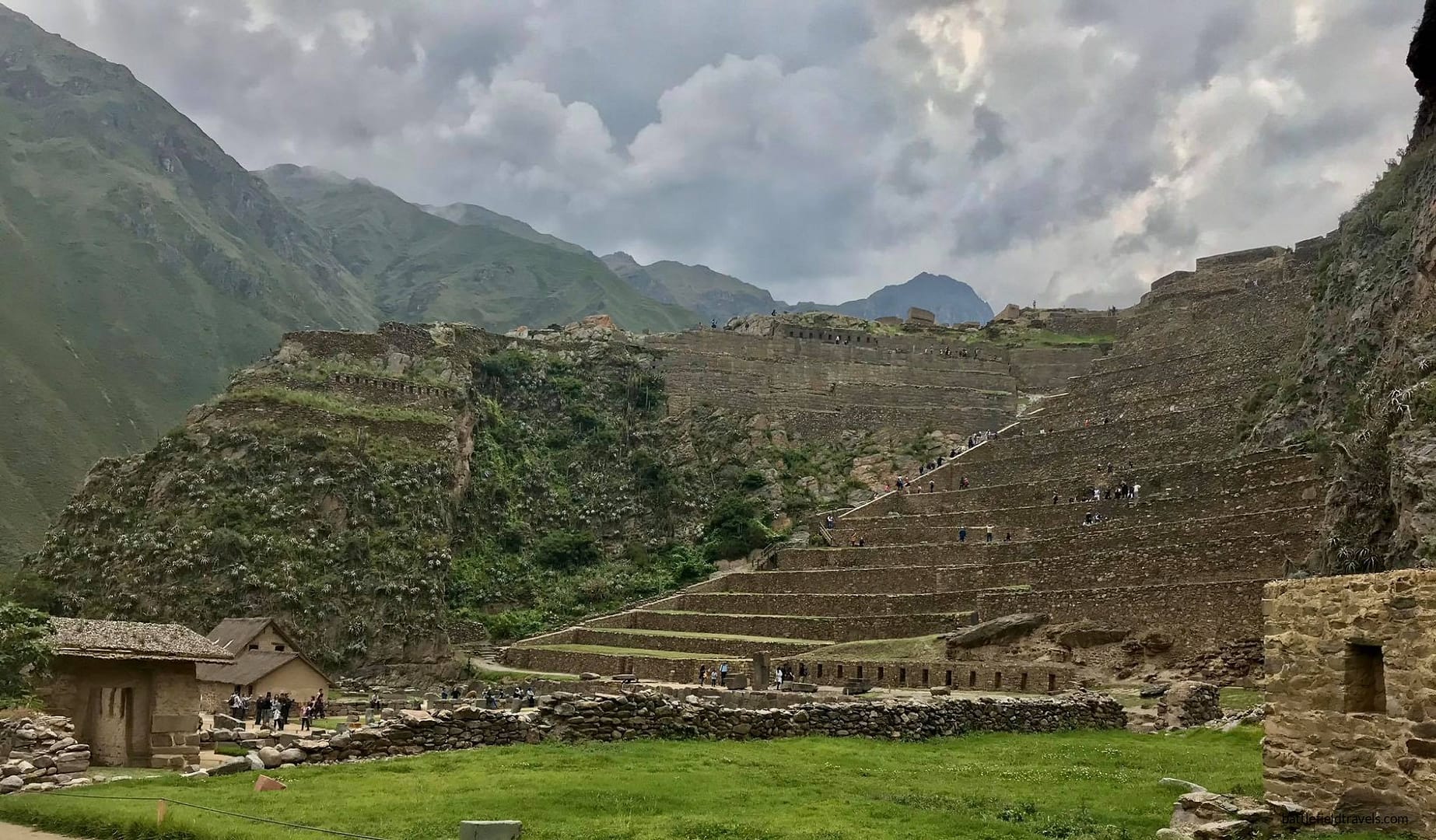
Ollantaytambo lies about 75 kilometres northwest of Cusco, set within the narrow confines of the Sacred Valley. Standing in the town and looking up at the surrounding slopes, the scale of the Inca construction is breathtaking. Enormous terraces rise steeply against the mountainsides, forming tier after tier of agricultural platforms, while above and around them are the remains of fortifications and elite structures associated with Inca rule. The entire landscape is engineered, shaped over centuries into a combination of productive ground, living space, and defensible position.
What stands out on the ground is how completely the terrain has been engineered. Movement through the valley is channelled along narrow approaches, while the terraces dominate the floor from above. Any force advancing towards the town is exposed throughout its approach and, once at the base of the terraces, faces a steep, stepped ascent under observation. Ollantaytambo is a marvel of defensive engineering.

👉 Continue reading — full Field Notes include terrain analysis, additional imagery, and working interpretations beyond the published study. Try membership free for 7 days.

Authored by Mick Prictor, a retired military officer with 40 years’ service, and a military historian specialising in terrain-focused analysis of tactics, doctrine, and command decision-making in land warfare. His work draws on extensive battlefield fieldwork—more than 280 sites worldwide—and one of the world’s largest private collections of historic military arms, uniforms, and equipment. About me
📚 Further Reading: Spanish conquest of the New World
This battle study nests within the broader analytical framework explored in the Research Hub, where operational methods, operating environments, armies, commanders, and weapons are examined across conflicts and eras. The links below connect related studies across the wider body of battlefield analysis on the BattlefieldTravels site.
⚔️ Explore all battle studies from the Spanish conquest of the New World
🏛️Explore the museum of Spanish conquest of the New World artefacts
The book list for this conflict includes the finest campaign studies, memoirs, and operational analyses available on the Spanish conquest of the New World, selected specifically to complement this battlefield study.
📚Spanish Conquest of the New World– Recommended Reading
🗞️ For updates on new battlefield studies and research insights, you can subscribe to the Newsletter.
Subscribe to Battlefield Travels and receive a free E-Book Battlefield Guide
Unlock expert battlefield analysis, campaign reconstructions, and historical insights drawn from firsthand exploration and primary sources.
🗺️ You’ll receive:
🎖️ Exclusive historical insights you won’t find elsewhere
📘 A free eBook: 10 Tips for Exploring Historic Battlefields
📰 New battlefield studies straight to your inbox as they are published
⚔️ Go deeper — Members get exclusive access to the Deep Research Collection, Field Notes, and monthly Research Dispatches. Try membership free for 7 days, cancel anytime. From $9/month.
Great read and photos! Looks formidable. I was in Cuzco in 1971 with Grandaddy – Wish we’d traveled to this battle site.
With Robert W. Grow? What an honor to travel with that great man. Did you explore the Sacsayhuaman fortress above Cuzco? Another battle fought there. I have also published an article on that one.