Battle for the Tourelles, May 1429
The Tourelles site
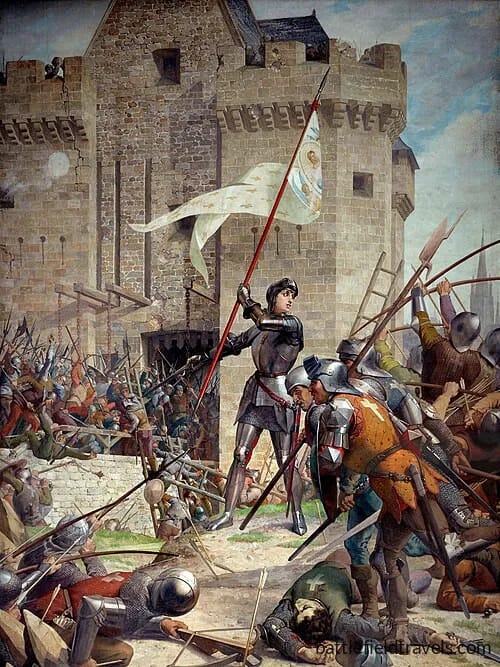
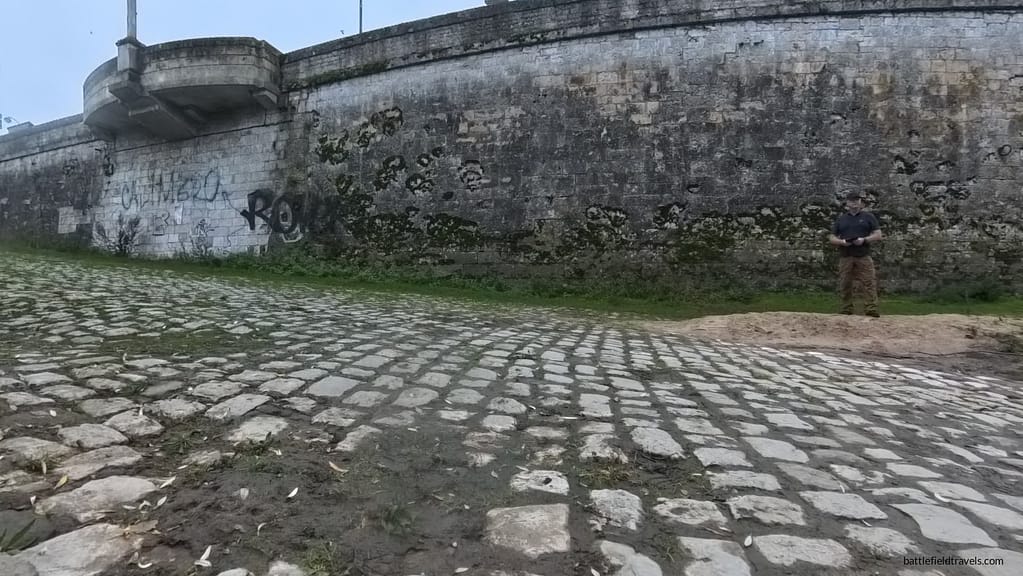
October 2024, Orléans, south side of the Loire River. I am exploring the Hundred Years War battle locations around the city of Orléans. On this site on 7 May 1429, a French Army led by Count John Dunois, ‘The Bastard of Orléans’, and Captain La Hire, and inspired by Jeanne d’Arc, a 17-year old French peasant girl from Domremy, defeated a strong English force defending the ‘Tourelles’ fortress on the southern bank of the Loire River. The Tourelles controlled access across the Pont bridge into the French-held city of Orléans.
The Tourelles is not an obvious battlefield when you first see it. There is no fortress there now, no dramatic ruin dominating the riverbank. The structure that once stood here was demolished in the eighteenth century to make way for the modern bridge. Today, the site is marked by a small monument and a statue of Jeanne d’Arc, set among the embankment infrastructure and suburbs on the south side of the Loire.
And yet this was one of the decisive points of the Hundred Years’ War.
The Siege of Orléans
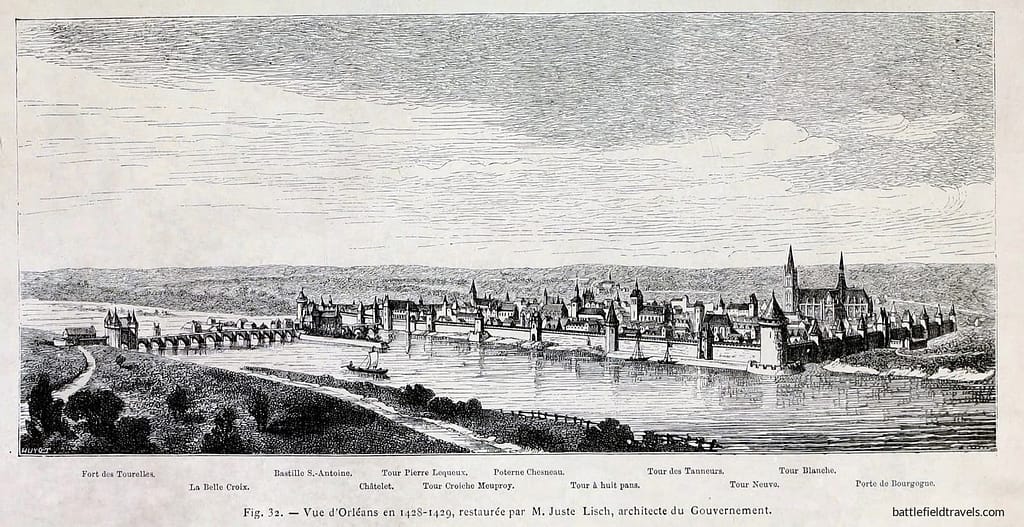
The river here is broad, forming a substantial barrier between the English-held southern approaches and the French-held city of Orléans on the north bank. A medieval stone bridge once crossed at this point, and its line is still visible when the water level is low. On the far side lies the city of Orléans, enclosed in the fifteenth century by walls, fragments of which still survive, including the Tour Blanche and other sections around the modern city.
The Tourelles was a stone fort at the southern end of the bridge, separated from the riverbank by a drawbridge. Any traffic across the bridge had to pass through the Tourelles. As part of the Orléans defences, the French had developed a series of outerworks around the Tourelles, including a series of ditches and palisades known as the ‘Boulevart’. Immediately south of the Boulevart was an old friary that had also been turned into a fortified outpost known as ‘les Augustins’. The English army captured the Tourelles in October 1428, and the French immediately blew up several bridge spans to prevent the English from crossing into the city.
👉 Continue reading — full Field Notes include terrain analysis, additional imagery, and working interpretations beyond the published study. Try membership free for 7 days.

Authored by Mick Prictor, a retired military officer with 40 years’ service, and a military historian specialising in terrain-focused analysis of tactics, doctrine, and command decision-making in land warfare. His work draws on extensive battlefield fieldwork—more than 280 sites worldwide—and one of the world’s largest private collections of historic military arms, uniforms, and equipment. About me
📚 Further Reading – Hundred Years War
This battle study nests within the broader analytical framework explored in the Research Hub, where operational methods, operating environments, armies, commanders, and weapons are examined across conflicts and eras. The links below connect related studies across the wider body of battlefield analysis on the BattlefieldTravels site.
⚔️ Explore all battle studies from the Hundred Years War
🏛️Explore the Ancient and Medieval warfare weapons and equipment
The book list for this conflict includes the finest campaign studies, memoirs, and operational analyses available on the medieval warfare, selected specifically to complement this battlefield study.
📚Medieval Warfare – Recommended Reading
🗞️ For updates on new battlefield studies and research insights, you can subscribe to the Newsletter.
Subscribe to Battlefield Travels and receive a free E-Book Battlefield Guide
Unlock expert battlefield analysis, campaign reconstructions, and historical insights drawn from firsthand exploration and primary sources.
🗺️ You’ll receive:
🎖️ Exclusive historical insights you won’t find elsewhere
📘 A free eBook: 10 Tips for Exploring Historic Battlefields
📰 New battlefield studies straight to your inbox as they are published

⚔️ Go deeper — Members get exclusive access to the Deep Research Collection, Field Notes, and monthly Research Dispatches. Try membership free for 7 days, cancel anytime. From $9/month.