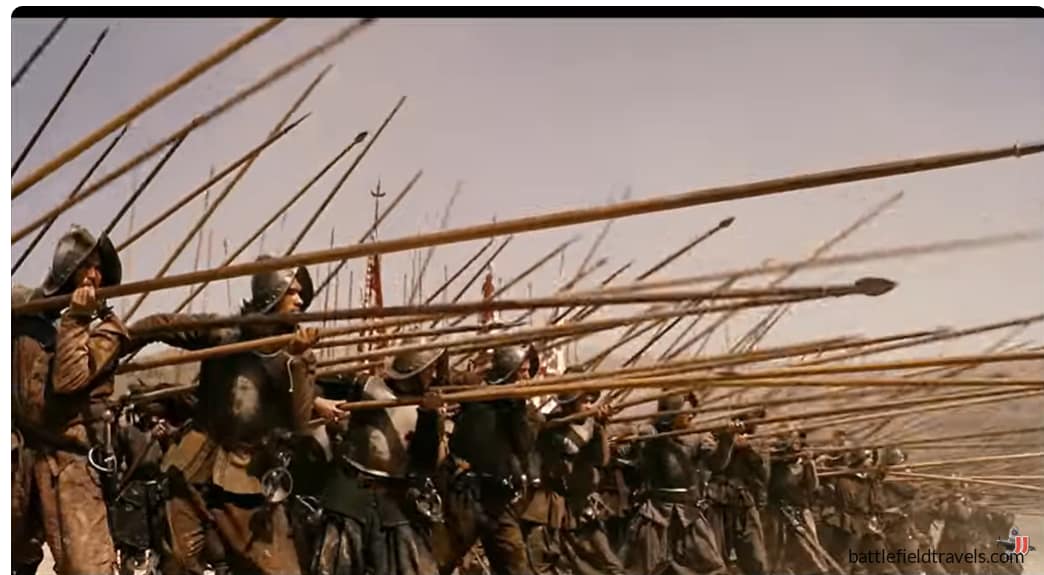
Pike and Shot Warfare: The Dominant Tactical System of the 16th and 17th Centuries
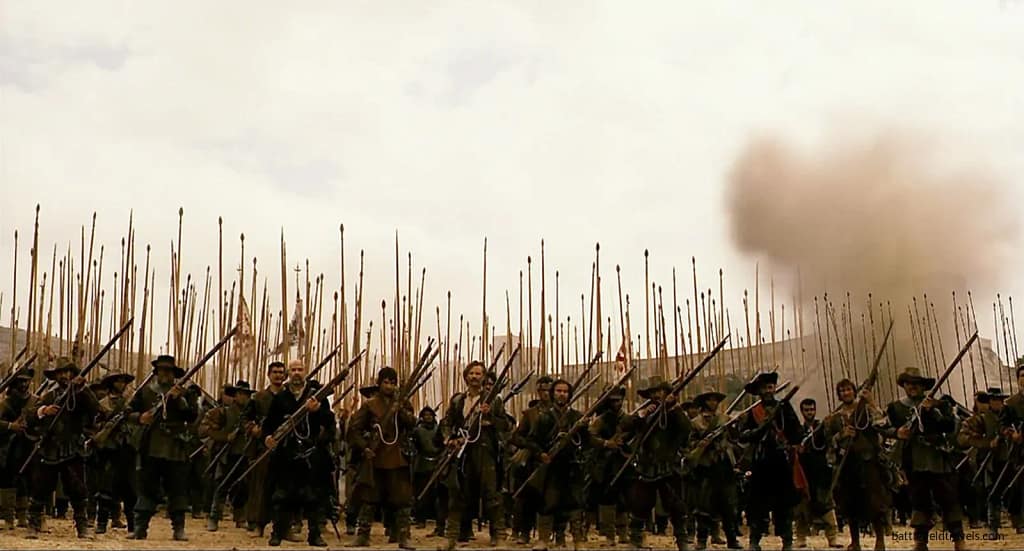
What problem did Pike & Shot solve?
The eclipse of infantry: 5th to 14th-centuries
From about the 5th century AD, the disciplined infantry formations that had built and defended the Roman Empire began to be eclipsed by horse cavalry. This shift was driven partly by declining numbers of trained Roman legionaries and increasing reliance on auxiliary mounted forces provided by allies and foederati. Cavalry equipped with stirrups, lances, and composite bows offered superior mobility, shock power, and range over slow-moving infantry. In the period often called the Dark Ages, successive waves of mounted barbarian peoples (Huns, Avars, Magyars, and later Vikings and Normans) overran much of Europe. These horsemen eventually became the dominant military and social class, and European warfare shifted from primarily infantry-based to heavy cavalry-based. Nobles provided the armoured knights, while feudal levies supplied basic foot soldiers.
Infantry renaissance from the 14th-century onwards
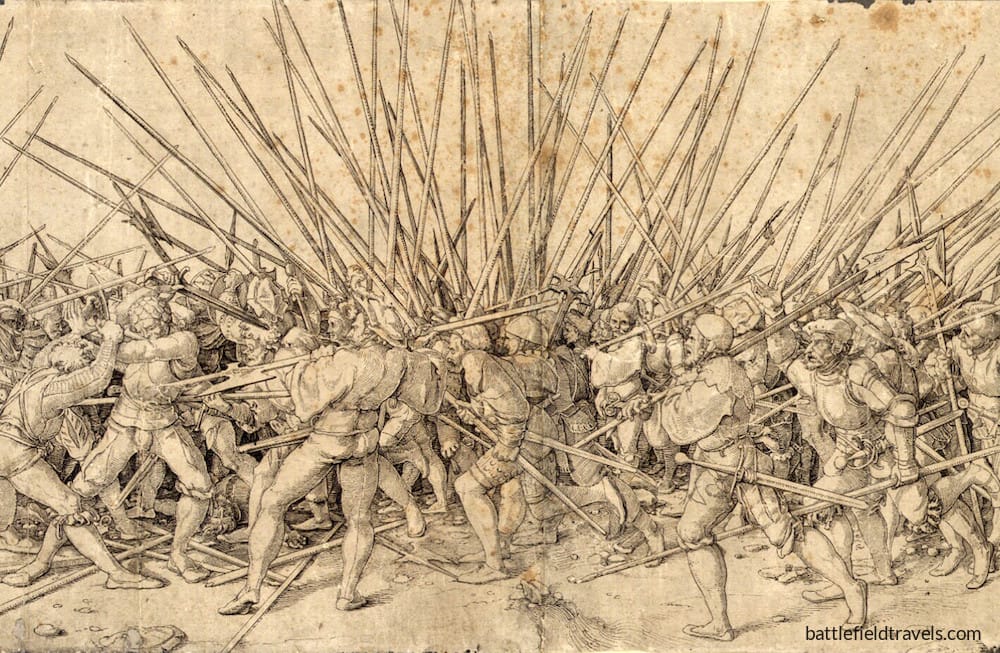
From the mid-14th century, disciplined infantry began a remarkable renaissance. Battles such as Bannockburn (1314), Crécy (1346), and Agincourt (1415) demonstrated that well-organised foot soldiers armed with spears, longbows, or pikes could defeat even the most formidable cavalry armies. The Swiss took this trend to a new level in the late 14th century with their dense pike formations. Initially fighting for their own independence against Habsburg overlords, the Swiss later hired themselves out as highly sought-after mercenaries across Europe. Their tightly packed pike blocks were virtually invulnerable to cavalry charges and, when used aggressively, could break almost any opposing infantry formation.
Decline of pike-armed infantry
The Swiss model was quickly emulated across Europe and dominated land warfare for the next two hundred years. However, by the early 16th century, the widespread introduction of firearms had fundamentally altered the battlefield once again. European armies entered a transitional phase in which the old pike-dominated formations had to adapt to the growing power of gunpowder weapons. It was this transition that gave rise to the classic pike-and-shot formation — the tactical solution that would dominate European battlefields for the next 150 years.
Influence of firearms on the battlefield
New advantages and vulnerabilities
The widespread adoption of firearms by European armies created a new tactical dilemma. Cavalry no longer relied solely on the medieval lance; instead, they carried pistols, carbines, and swords. New cavalry tactics, including the caracole, now allowed cavalry to engage dense pike formations without having to breach the wall of pikes. The cavalry would ride towards the largely static pike formations, discharge their wheellock pistols at 20-50 metres, then peel away to allow the following riders to discharge theirs.
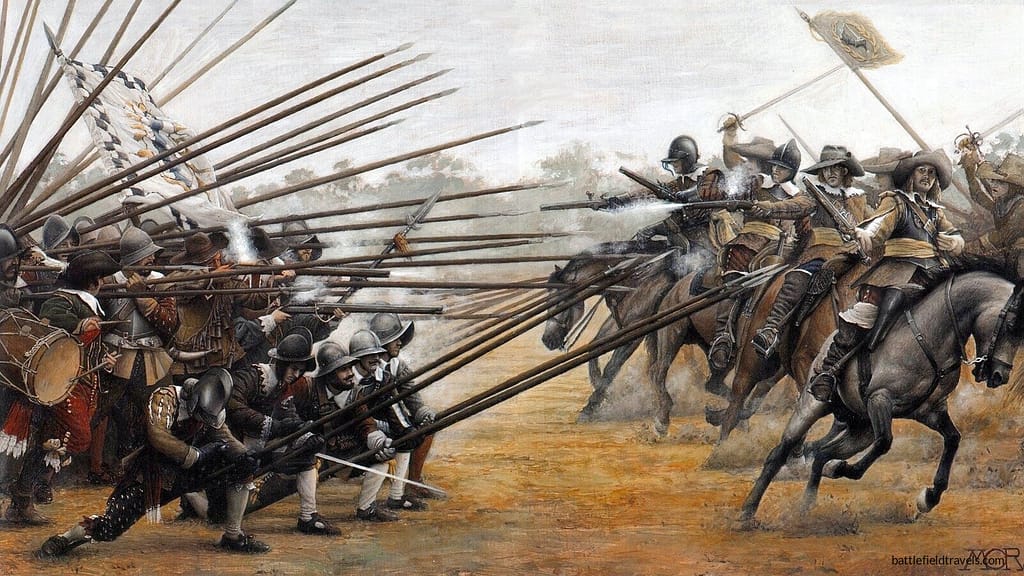
Musket-armed infantry faced an even greater challenge: the new handheld firearms (arquebuses and later matchlock muskets) were powerful but extremely slow to reload, inaccurate at range, and left the shooter highly vulnerable once the enemy closed. A charging horseman could cover the distance between maximum musket range and the musketeer himself in the time it took to reload.
Artillery of the era was heavy, crude, and difficult to move once emplaced. However, if the dense pike formations found themselves within range of artillery, the solid shot could inflict enormous casualties as they ploughed through the massed ranks.
What was needed was a combined-arms system in which the relative advantages of the musket, pike, cavalry, and artillery could cover each other’s vulnerabilities. Think of it like a four-way game of rock-paper-scissors.
16th-century combine arms: Pike + musket + cavalry + artillery
The solution that emerged was the pike and shot system — a pragmatic, battle-tested marriage of the ancient pike and the relatively new gunpowder weapon. It combined the defensive solidity of a forest of steel points with the offensive potential of massed musket fire. By the early 1600s, virtually every major European army had adopted some version of this combined-arms formation. It was not an elegant theoretical construct but a practical response to the realities of the battlefield. The system combined:
– slow-firing, weather-sensitive firearms to deliver ranged fire;
– solid blocks of pikemen who could protect the musketeers against enemy cavalry;
– relatively immobile, but devastatingly effective artillery;
– and a cavalry arm that could still close quickly with either firearms or sword.
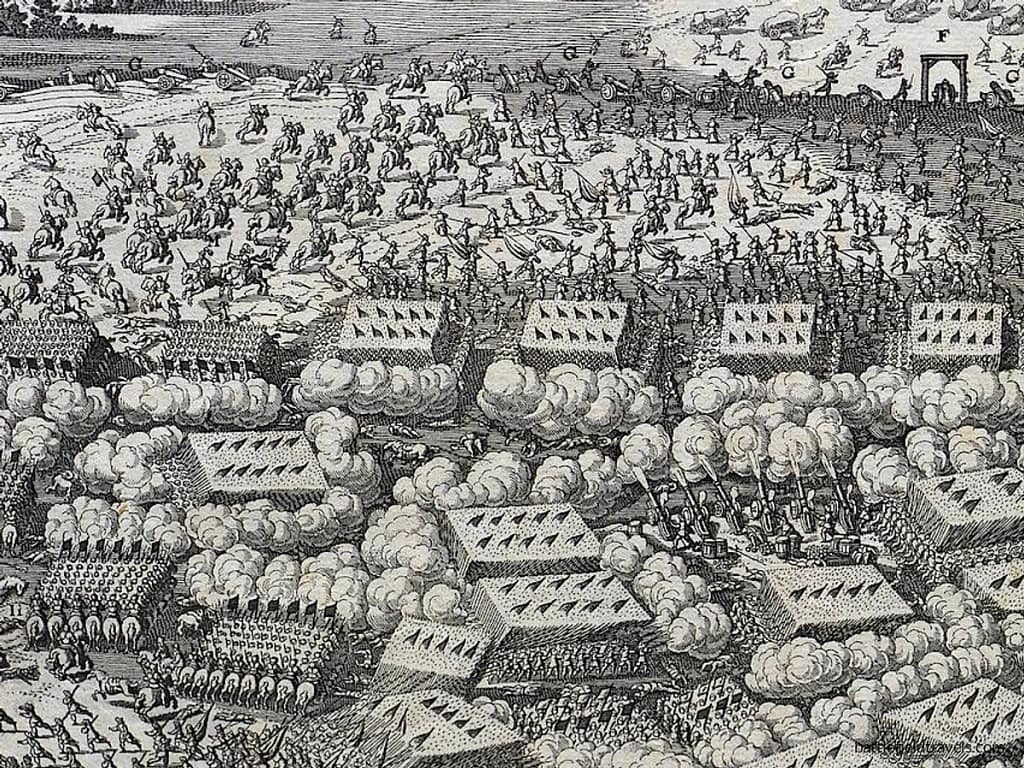
How the System Worked (Pike + Musket Integration)
Organisation
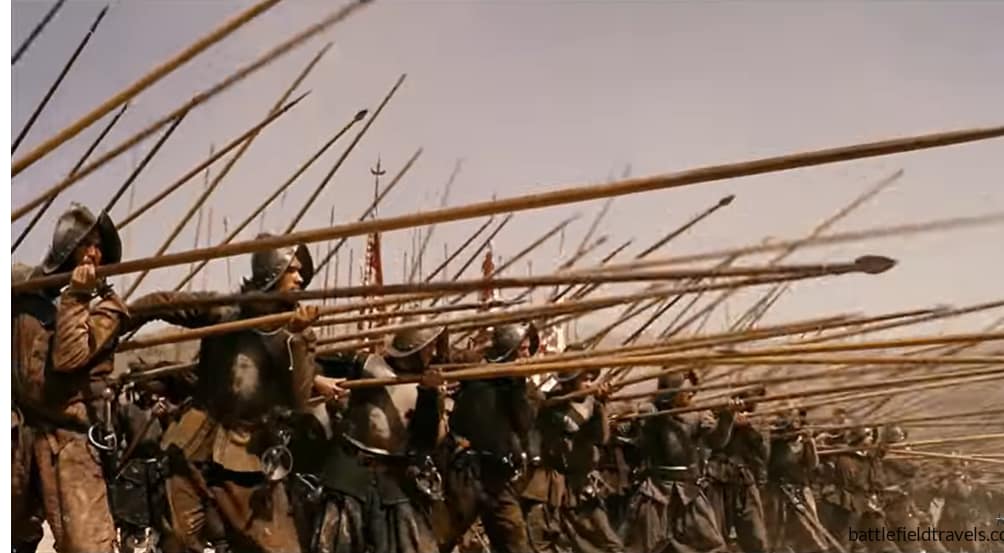
The basic tactical unit was the infantry battalion. At its heart stood a solid block of pikemen, usually the tallest and strongest soldiers, armed with 15–18-foot-long pikes. These pikes were made of ash or oak, tipped with steel heads, and reinforced with metal plates along the forward four feet to prevent them from being cut in half. The butt end was sharpened so it could be planted firmly into the ground. Pike formations ranged from 10 (Swedish) to 30 (Spanish Tercio) ranks in depth
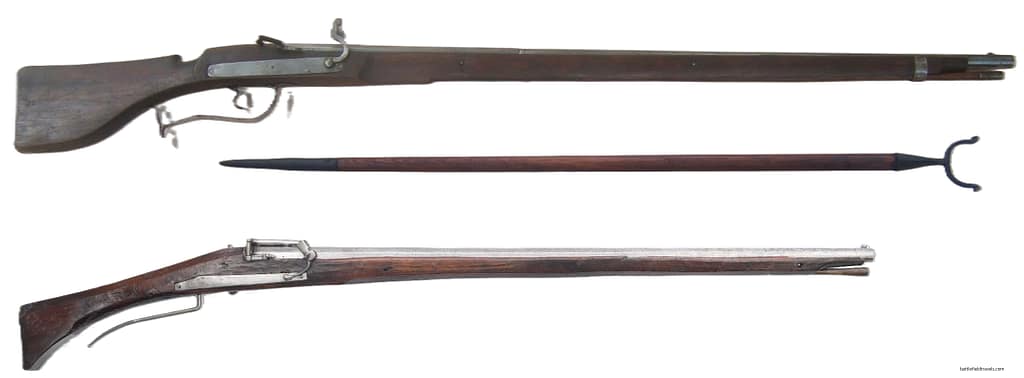
Flanking the central pike block on both sides were “sleeves” of musketeers equipped with heavy matchlock muskets weighing 14–20 pounds and roughly five feet long. These weapons were muzzle-loading and fired by a crude mechanism: a slow-burning match (fuse) attached to a pivoting cock that was lowered into the priming pan when the trigger was pulled. The process was cumbersome. The Exercise of Foot (1690) listed forty-four separate movements to load and fire, and the effective rate of fire was only about one shot per minute under ideal conditions. Musketeer formations were wider and less deep than pike formations, and were usually arrayed 6-10 ranks deep.
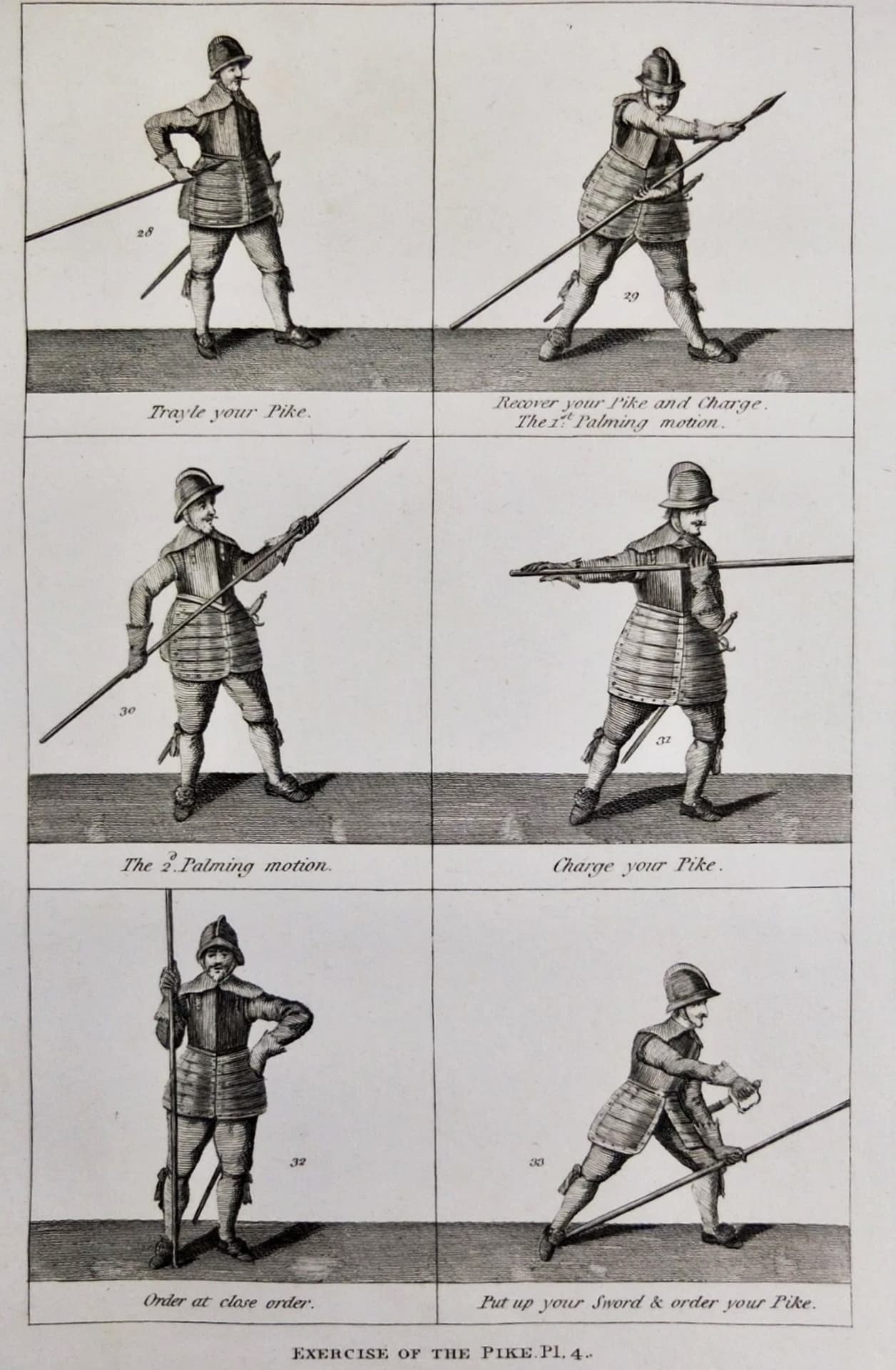
Relationship between Pikemen and Musketeers
To generate continuous fire, musketeers employed the caracole system. Ranks fired in sequence, then retired through gaps to the rear to reload while the next rank stepped forward. When threatened by cavalry, the musketeers simply ran behind the protective hedge of pikes. There, several musketeers would shelter between each pair of pikes, reload, and continue firing from relative safety. The pikemen, when threatened, lowered their weapons and planted the butt-spikes, creating an outward-facing wall of steel points that horses would not charge.
This integration gave the formation both staying power and offensive punch. The pikes protected the musketeers; the musketeers provided the firepower that could disorder the enemy before the final “push of pike.”
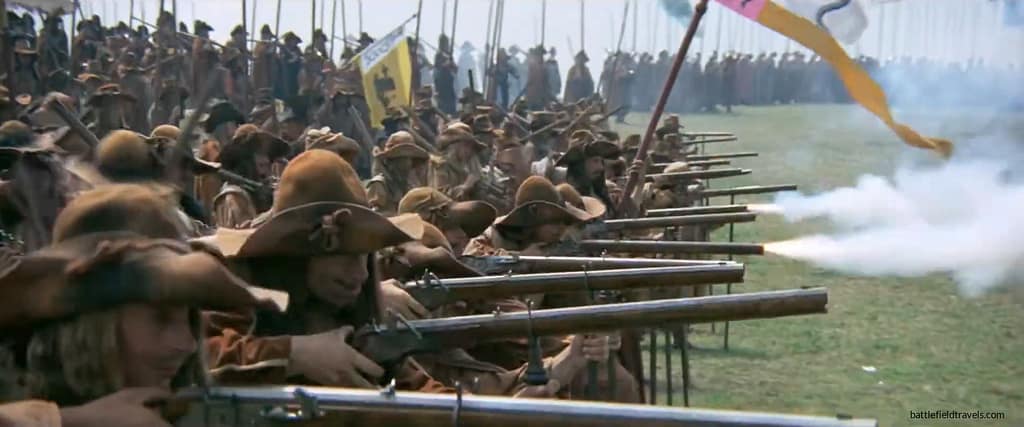
How terrain affected Pike and Shot tactics
Pike-and-shot formations were highly terrain-sensitive. They performed best on open, relatively flat ground where the deep blocks could maintain cohesion and the musketeers could deliver massed volleys without obstruction. Rough, broken, wooded, or hilly terrain quickly disrupted the system. Long pikes became awkward to manoeuvre, ranks and files lost alignment, and the formation’s slow movement became a liability.
Weather was equally critical. The slow-burning match of the matchlock musket was extremely vulnerable to wind and rain; a sudden shower could extinguish dozens of matches and render entire companies ineffective. Mud also slowed reloading and movement. Commanders, therefore, sought open plains for decisive battles, which explains why many of the great engagements of the Thirty Years’ War were fought on relatively flat fields.
Strengths and Limitations
Depth for momentum versus width for firepower
The pike-and-shot system had significant strengths. It gave infantry a credible defence against cavalry while still allowing the musketeers to generate offensive firepower. Massed volleys created both physical damage and powerful psychological shock. The system was also relatively forgiving of imperfectly trained troops; drill and formation discipline could compensate for individual weapon limitations.
Yet the limitations were equally pronounced. The formations were ponderous and difficult to manoeuvre quickly. Deep ranks (often 8–30 deep) meant that only a fraction of the muskets could fire at any one time. The matchlock’s high misfire rate (up to 50% in battle conditions), slow rate of fire, and dependence on dry weather were serious weaknesses. The massive, slow-firing smooth-bore artillery pieces of the period were difficult to reposition once battle was joined and contributed little after the opening phase of the battle. The entire system was therefore best suited to set-piece battles on chosen ground rather than fluid or pursuit operations.
Mini Case Study: The Battle of Breitenfeld, 17 September 1631
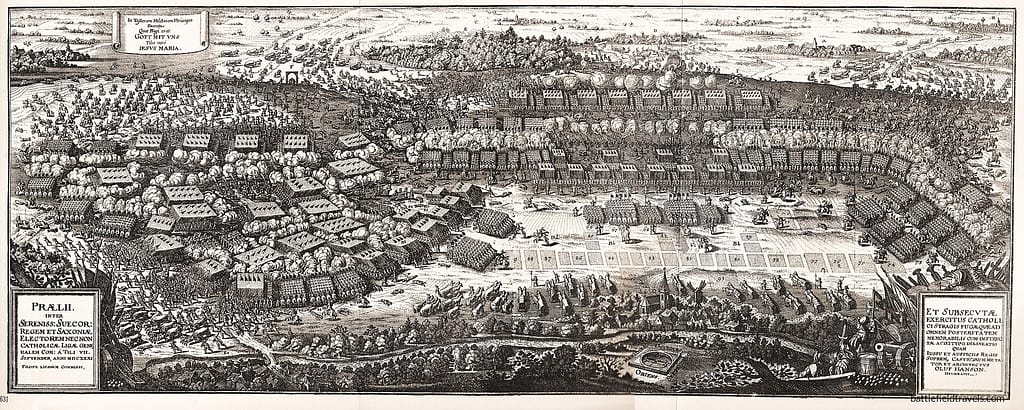
The Battle of Breitenfeld during the Thirty Years’ War provides a classic illustration of the pike-and-shot system in action, and its vulnerabilities. The Imperial commander, Count Tilly, deployed his army of 31,000 troops in the traditional Spanish-style tercios: massive, deep formations of approximately 1,500 men each, roughly 50 men wide and 30 ranks deep. These ponderous blocks were grouped in an arrowhead formation designed to crash into the enemy through sheer weight and the “push of pike.”
Opposing him was the Swedish army of about 40,000. The Swedes had already begun moving toward more linear, more flexible formations influenced by the Dutch school. When the two armies clashed, the Imperial tercios initially held their own. The deep pike blocks proved extremely difficult to break, and the massed musket fire from the flanking sleeves delivered devastating volleys at close range.
However, the Swedish artillery and more rapid musket fire (facilitated by paper cartridges introduced by Gustavus) began to tell. The Swedish infantry, deployed in wider, shallower formations, could bring a greater proportion of their muskets to bear simultaneously. As the battle progressed, the ponderous Imperial tercios struggled to manoeuvre or redeploy. When the Swedish cavalry and infantry exploited gaps, the deep Imperial formations began to disintegrate. Tilly’s army ultimately suffered a catastrophic defeat.
Breitenfeld demonstrated both the continuing strength of the classic pike-and-shot tercio and the growing limitations of its extreme depth and lack of mobility when faced with more modern, flexible tactics.
What Replaced It and Why?
Flintlock system + socket bayonet
By the late seventeenth century, the pike-and-shot system was in terminal decline. The introduction of the flintlock musket (far more reliable in all weather conditions and faster to load) combined with the socket bayonet (which turned every musketeer into his own pikeman) rendered the separate pike obsolete. Pre-loaded paper cartridges further increased the rate of fire.
These innovations allowed armies to deploy in much wider, thinner, linear formations that maximised firepower while retaining anti-cavalry capability. The pike finally disappeared from European battlefields during the War of the Spanish Succession (1701–1714). The linear infantry battalion that replaced it would dominate European warfare for the next 150 years.
Transition to linear tactics
The pike-and-shot era thus represented a transitional but remarkably successful phase. It was a pragmatic solution that bridged the gap between medieval shock tactics and the firepower-dominated linear warfare of the eighteenth century. The era also introduced an embryonic combined-arms approach, whereby each element of the force brought both advantages and vulnerabilities to the battle. The best commanders were able to maximise the advantages while shielding the vulnerabilities.
Found this useful? Buy me a coffee — it helps fund future battlefield research


Authored by Mick Prictor, a retired military officer with 40 years’ service, and a military historian specialising in terrain-focused analysis of tactics, doctrine, and command decision-making in land warfare. His work draws on extensive battlefield fieldwork—more than 280 sites worldwide—and one of the world’s largest private collections of historic military arms, uniforms, and equipment. About me
Secondary sources
The Thirty Years War


📚 Further Reading: Thirty Years’ War
This battle study nests within the broader analytical framework explored in the Research Hub, where operational methods, operating environments, armies, commanders, and weapons are examined across conflicts and eras. The links below connect related studies across the wider body of battlefield analysis on the BattlefieldTravels site.
⚔️ Explore all battle studies from the Thirty Years War 1618-1648
🏛️Explore the museum of Ancient and Medieval historic artefacts
🗞️ For updates on new battlefield studies and research insights, you can subscribe to the Newsletter.
You may also like


FAQ: Pike and Shot Warfare
Pike and shot was an infantry system used in the 16th and 17th centuries that combined musketeers for firepower with pikemen for protection and shock action. It was designed to overcome the limitations of early firearms, particularly their slow rate of fire and vulnerability to cavalry.
Early musketeers could not defend themselves effectively at close range, especially against cavalry. The pike provided a physical barrier and close-combat capability. Without pikemen, musketeers could be overrun before they had time to reload or reposition.
Musketeers were arranged in multiple ranks and fired in rotation. One rank would fire and then move back to reload while another stepped forward. This created a steady volume of fire rather than isolated, ineffective shots.
Terrain was critical. Pike and shot formations worked best on open ground where units could maintain cohesion and control their fire. Broken terrain, woods, or confined spaces disrupted formations and reduced their effectiveness.
As firearms improved, they became faster to reload and more reliable. The introduction of the bayonet allowed musketeers to defend themselves without separate pikemen. This led to fully musket-armed infantry and the linear tactics of the late 17th and 18th centuries.
Subscribe to Battlefield Travels and receive a free E-Book Battlefield Guide
Unlock expert battlefield analysis, campaign reconstructions, and historical insights drawn from firsthand exploration and primary sources.
🗺️ You’ll receive:
🎖️ Exclusive historical insights you won’t find elsewhere
📘 A free eBook: 10 Tips for Exploring Historic Battlefields
📰 New battlefield studies straight to your inbox as they are published

⚔️ Go deeper — Members get exclusive access to the Deep Research Collection, Field Notes, and monthly Research Dispatches. Try membership free for 7 days, cancel anytime. From $9/month.