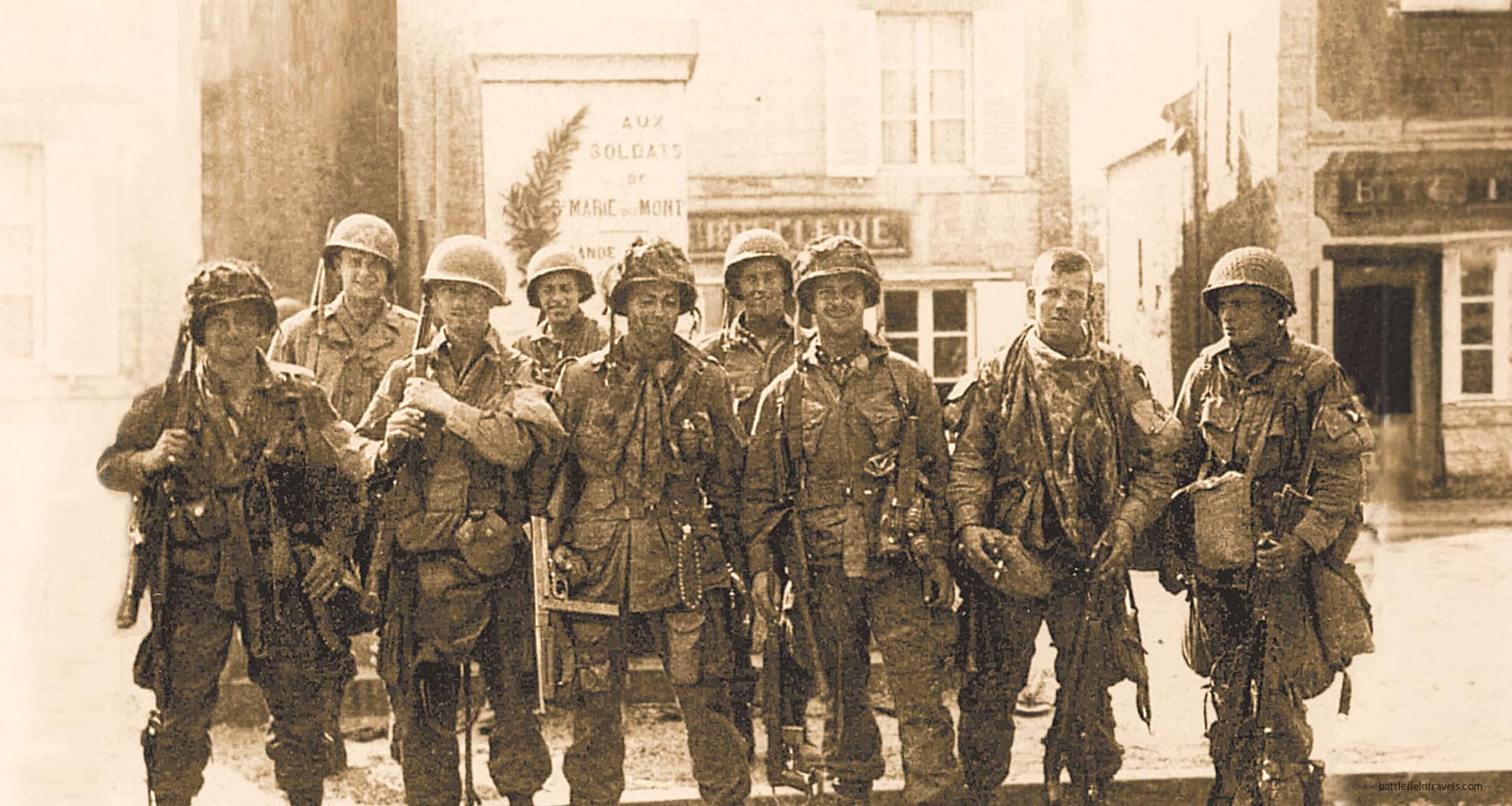
How well do you know the real Easy Company, 506th PIR ‘Band of Brothers’?
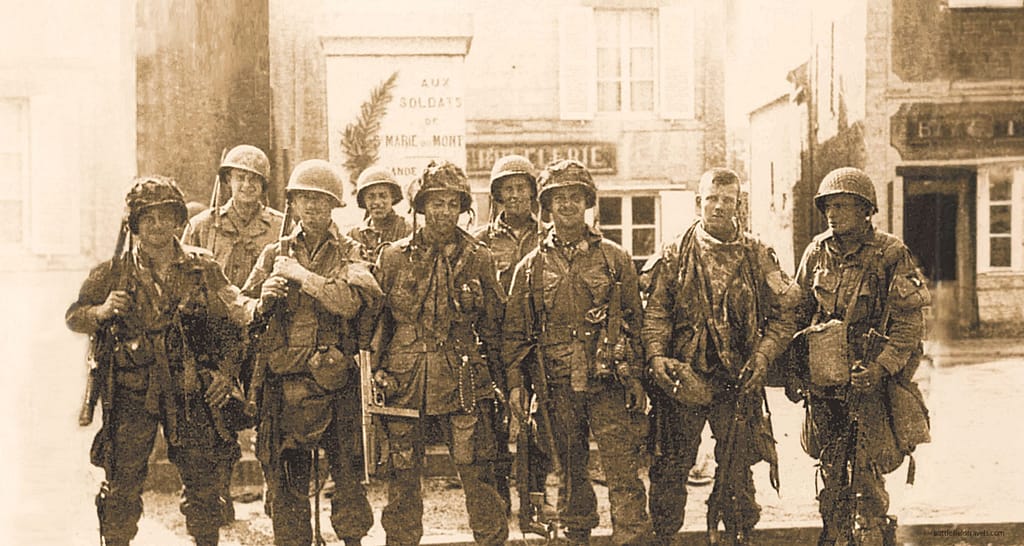
Easy Company Quiz: Test Your Band of Brothers Knowledge
Easy Company, 2nd Battalion, 506th Parachute Infantry Regiment, fought from Normandy to the Netherlands, Bastogne and the final advance into Germany and Austria. Its story became famous through Stephen Ambrose’s Band of Brothers and the HBO series, but the history extends well beyond the screen.
Test your knowledge with 20 questions randomly selected from a bank of 60, covering the men, battles, commanders and campaigns of the real Easy Company — from Toccoa and D-Day to Market Garden, Bastogne, Foy and Berchtesgaden. Every attempt will be different.
Score 60% to pass — and expect a challenge.
Explore Band of Brothers: [Battle Studies] · [Quiz]
Explore World War II: [Weapons & Equipment] · [Recommended Reading]


#1. At which camp was Easy Company, 506th Parachute Infantry Regiment, activated and trained in 1942?
Easy Company was activated at Camp Toccoa, Georgia, in 1942 as part of the newly formed 506th Parachute Infantry Regiment. The demanding training there became central to the regiment’s identity.
#2. Easy Company was part of which battalion of the 506th Parachute Infantry Regiment?
Easy Company belonged to 2nd Battalion, 506th Parachute Infantry Regiment. The battalion would fight with the 101st Airborne Division from Normandy to the end of the war in Europe.
#3. Which US airborne division did the 506th Parachute Infantry Regiment belong to during the Second World War?
The 506th PIR served as part of the 101st Airborne Division. Easy Company therefore fought within the division’s campaigns in Normandy, the Netherlands, the Ardennes and Germany.
#4. Who was Easy Company’s original commanding officer during its training at Camp Toccoa?
Captain Herbert Sobel was Easy Company’s original commander at Toccoa. His demanding training regime helped forge the company physically, although his leadership later became a source of serious friction.
#5. Which mountain did Easy Company repeatedly run during training at Camp Toccoa?
Currahee Mountain dominated training at Toccoa. Repeated runs up and down the mountain became one of the defining experiences of the men of the 506th PIR.
#6. What did the word ‘Currahee’ come to symbolise for the 506th PIR?
#7. Where did Easy Company complete parachute jump training after Camp Toccoa?
After Toccoa, Easy Company completed parachute training at Fort Benning, Georgia, earning the jump wings that marked them as qualified US Army paratroopers.
#8. Where was Easy Company based in England before D-Day?
Before D-Day, Easy Company was based at Aldbourne in Wiltshire. From England the company prepared for the airborne assault into Normandy.
#9. Who replaced Herbert Sobel as commander of Easy Company before D-Day?
First Lieutenant Thomas Meehan replaced Herbert Sobel as Easy Company commander before D-Day. Meehan was killed when his C-47 was shot down during the Normandy airborne operation.
#10. Who commanded the 506th Parachute Infantry Regiment during Easy Company’s wartime campaigns?
Colonel Robert Sink commanded the 506th Parachute Infantry Regiment throughout its wartime campaigns. His regiment served with the 101st Airborne Division from Normandy into Germany.
#11. How many rifle platoons formed the main combat element of Easy Company?
Easy Company’s principal infantry strength was organised into three rifle platoons. These platoons provided the company’s main manoeuvre and fighting elements.
#12. Which officer served as Easy Company’s executive officer before D-Day and became its acting commander after Thomas Meehan was lost?
Richard Winters was Easy Company’s executive officer before D-Day. With Thomas Meehan missing after the airborne drop, Winters became the company’s acting commander.
#13. On what date did Easy Company parachute into Normandy?
Easy Company jumped into Normandy in the early hours of 6 June 1944. The scattered airborne landings placed many paratroopers well away from their planned drop zones.
#14. Easy Company’s D-Day drop formed part of which Allied operation?
The airborne assault into Normandy was part of Operation OVERLORD, the Allied invasion of Normandy. The airborne divisions landed ahead of the amphibious forces.
#15. What happened to the C-47 carrying Easy Company commander Thomas Meehan and members of company headquarters on D-Day?
Meehan’s C-47 was hit during the airborne operation and crashed near Beuzeville-au-Plain. Meehan, the Easy Company men aboard and the aircraft crew were killed.
#16. Near which Normandy town did Dick Winters land after his scattered D-Day drop?
Richard Winters landed outside Sainte-Mère-Église, separated from much of his unit. Like many airborne leaders that night, he began gathering whatever paratroopers he encountered.
Read more: D-Day airborne operations at Sainte-Mère-Église
#17. After landing on D-Day, Winters and a small group of paratroopers fought a German convoy near which town?
After landing, Winters and a small group of paratroopers encountered and attacked a German wagon-drawn convoy east of Sainte-Mère-Église before moving towards the 506th rally area.
#18. Near which village was the 506th PIR rally point towards which Winters moved on D-Day?
Winters moved south towards the 506th PIR rally point near Sainte-Marie-du-Mont. From this area Easy Company was drawn into its first major D-Day action at Brécourt Manor.
#19. What was the principal target of Easy Company’s assault at Brécourt Manor?
The target at Brécourt Manor was a German artillery battery. Its guns were positioned in prepared emplacements connected by trenches.
Read more: Brécourt Manor assault
#20. What calibre were the German field howitzers attacked by Easy Company at Brécourt Manor?
The battery at Brécourt Manor consisted of 105 mm field howitzers. The position threatened the American forces moving inland from Utah Beach.
Read more: Brécourt Manor assault
#21. Approximately how many paratroopers ultimately took part in Winters’ assault at Brécourt Manor?
About 23 paratroopers ultimately participated in the assault led by Winters at Brécourt Manor, attacking a German force substantially larger than their own.
Read more: Brécourt Manor assault
#22. Why was the German battery at Brécourt Manor an urgent target on D-Day?
The Brécourt guns were firing towards the Utah Beach exits, making the battery an immediate threat to troops and vehicles trying to move inland from the beachhead.
Read more: Brécourt Manor assault
#23. Which feature of the Brécourt position did Winters’ men use to move between the German gun pits?
The German gun positions were linked by a trench system. Winters’ men exploited that layout, fighting along the position from one emplacement to the next.
Read more: Brécourt Manor assault
#24. Why is the Brécourt Manor assault still studied by military organisations?
Brécourt is widely studied as an example of aggressive small-unit tactics: reconnaissance, fire and manoeuvre, initiative and the systematic reduction of a larger defensive position.
Read more: Brécourt Manor assault
#25. Which Normandy town did Easy Company help capture after the D-Day landings?
Easy Company later fought in the battle for Carentan. The town was a key objective in consolidating the American lodgement in Normandy.
Read more: Battle of Carentan
#26. Why was Carentan operationally important to the Allies?
Carentan was vital because its capture helped link the Utah and Omaha beachheads. It also sat astride important road and rail communications at the base of the Cotentin Peninsula.
Read more: Battle of Carentan
#27. At the Carentan T-junction, what German weapon opened fire on Easy Company from the Café du Stade?
At the Carentan T-junction, an MG42 firing from the Café du Stade area caught Easy Company in a dangerous position during the fight into the town.
Read more: Battle of Carentan
#28. Which Easy Company officer crossed Rue Holgate and used grenades against the German machine-gun position at Carentan?
Harry Welsh crossed Rue Holgate and attacked the German machine-gun position with grenades, helping overcome the obstacle during Easy Company’s advance through Carentan.
Read more: Battle of Carentan
#29. The Battle of Bloody Gulch was fought immediately after Easy Company helped capture which town?
Bloody Gulch followed immediately after the capture of Carentan. The Germans counterattacked west of the town in an effort to reverse the American success.
Read more: Battle of Bloody Gulch
#30. On what date was the Battle of Bloody Gulch fought?
The Battle of Bloody Gulch was fought on 13 June 1944, the day after Carentan had fallen to the 101st Airborne Division.
Read more: Battle of Bloody Gulch
#31. Which German formation participated in the counterattack at Bloody Gulch?
The 17th SS Panzergrenadier Division ‘Götz von Berlichingen’ participated in the German counterattack west of Carentan, confronting lightly armed American airborne troops.
Read more: Battle of Bloody Gulch
#32. Which US armoured formation helped stop the German counterattack at Bloody Gulch?
Elements of the US 2nd Armored Division intervened at Bloody Gulch, bringing tanks and heavier firepower that helped stop the German counterattack.
Read more: Battle of Bloody Gulch
#33. After Normandy, Easy Company returned to England before taking part in which major operation?
After returning to England from Normandy, Easy Company next entered combat in Operation MARKET GARDEN, the Allied airborne-ground offensive in the Netherlands.
#34. On what date did Easy Company parachute into the Netherlands during Operation Market Garden?
Easy Company parachuted into the Netherlands on 17 September 1944. MARKET GARDEN sought to seize a chain of bridges and open a route towards the Rhine.
#35. Which Dutch city lay on the 101st Airborne Division’s Market Garden axis and was entered by Easy Company during the campaign?
Eindhoven lay on the 101st Airborne Division’s axis during MARKET GARDEN. Easy Company passed through the city as the airborne and ground forces attempted to keep the corridor open.
#36. Which bridge on the 101st Airborne Division’s route was destroyed by the Germans before it could be secured intact?
The bridge at Son was destroyed by the Germans before it could be secured intact. Engineers then had to bridge the obstacle so the ground advance could continue.
#37. At which Dutch village did Easy Company encounter German armour and infantry and suffer a reverse during Market Garden?
#38. Which Easy Company soldier became separated from the company during the fighting around Nuenen?
At Nuenen, Easy Company encountered German armour and infantry and was forced back after a sharp fight. The action showed how vulnerable lightly armed airborne troops could be against armour.
#39. The area between which two rivers became known to the Allies as ‘The Island’?
‘The Island’ was the low-lying area between the Waal and Rhine rivers. Its dikes, waterways and exposed fields shaped the fighting after MARKET GARDEN.
Read more: Easy Company at Randwijk Crossroads
#40. Which officer led Easy Company’s celebrated action at the Randwijk Crossroads on 5 October 1944?
Richard Winters led Easy Company’s action at the Randwijk Crossroads on 5 October 1944, a small-unit fight on ‘The Island’ that became one of the company’s best-known actions.
Read more: Easy Company at Randwijk Crossroads
#41. In which country did the Randwijk Crossroads action take place?
The Randwijk Crossroads action took place in the Netherlands, east of Randwijk in the area between the Waal and Rhine known to the Allies as ‘The Island’.
Read more: Easy Company at Randwijk Crossroads
#42. During the Holland campaign, Richard Winters was promoted out of direct command of Easy Company to become what?
During the Holland campaign Winters moved up to become executive officer of 2nd Battalion. The promotion took him out of direct command of Easy Company.
#43. Which officer commanded Easy Company during much of its time around Bastogne?
Norman Dike commanded Easy Company during much of the Bastogne period. His command ended during the January 1945 attack on Foy.
#44. Easy Company fought around Bastogne during which German offensive?
The German Ardennes offensive was codenamed Wacht am Rhein. The offensive created the ‘Bulge’ and brought the 101st Airborne Division into the defence of Bastogne.
#45. In which country is Bastogne located?
Bastogne is in Belgium. Its road network made the town operationally important during the German Ardennes offensive of December 1944.
#46. Which wooded area near Bastogne is particularly associated with Easy Company’s defensive positions?
Easy Company’s Bastogne positions are particularly associated with the Bois Jacques, the woods overlooking Foy where the company endured cold, artillery fire and prolonged defensive fighting.
#47. Which Easy Company medic is particularly associated with the fighting around Bastogne?
Medic Eugene Roe is particularly associated with Easy Company’s Bastogne experience. Company medics worked under severe conditions with limited supplies during the encirclement and winter fighting.
#48. Which two Easy Company soldiers were killed together when their foxhole received a direct artillery hit near Foy?
Warren ‘Skip’ Muck and Alex Penkala were killed when an artillery round struck their position near Foy. Their deaths became one of the company’s most remembered losses of the Ardennes fighting.
#49. Which Easy Company officer was relieved during the attack on Foy?
Norman Dike was relieved during Easy Company’s attack on Foy when the assault stalled under fire.
#50. Who took over the attack on Foy after Norman Dike was relieved?
Ronald Speirs took over during the attack on Foy and drove the assault forward. He subsequently remained in command of Easy Company.
#51. Which Belgian village did Easy Company capture during the January 1945 fighting north of Bastogne?
Easy Company captured Foy during the January 1945 fighting north of Bastogne. The village was overlooked by the company’s earlier defensive positions in the Bois Jacques.
#52. Which senior Easy Company NCO played a major leadership role during the Bastogne and Foy fighting and later received a battlefield commission?
First Sergeant Carwood Lipton provided important leadership during the Bastogne period and was later commissioned as an officer.
#53. After the Ardennes fighting, Easy Company was sent to which Alsatian town on the front line?
After the Ardennes campaign, Easy Company moved to Haguenau in Alsace, where the front had stabilised along the river line.
#54. What type of mission did Easy Company conduct across the river at Haguenau?
At Haguenau, Easy Company conducted a patrol across the river intended to gather intelligence and take prisoners. It was a limited mission rather than a major assault.
#55. Who commanded Easy Company for the remainder of the war after taking over during the attack on Foy?
Ronald Speirs remained Easy Company commander after taking over during the attack on Foy and led the company through the final stages of the war.
#56. Which Bavarian town associated with Hitler’s mountain retreat was reached by the 506th PIR near the end of the war?
Berchtesgaden in Bavaria lay in the Nazi leadership’s Alpine heartland. The 506th PIR reached the area as the Third Reich collapsed.
#57. What famous site above Berchtesgaden is strongly associated with Easy Company’s final wartime journey?
The Eagle’s Nest, or Kehlsteinhaus, above Berchtesgaden became one of the symbolic locations associated with Easy Company’s final wartime journey.
#58. After Germany surrendered, Easy Company moved into which country for occupation duty?
After Germany surrendered, Easy Company moved into Austria for occupation duty while the future employment and demobilisation of the unit were decided.
#59. Which officer, later promoted to command 2nd Battalion, is the best-known wartime leader associated with Easy Company?
Richard Winters became Easy Company’s best-known wartime leader and later rose to command 2nd Battalion, 506th PIR.
#60. Which Easy Company member was a Harvard literature graduate and recorded his memoirs, which were later assembled in a book ‘Parachute Infantry’
David Kenyon Webster was a Harvard-educated literature student who served in Easy Company. His wartime writings were later published as ‘Parachute Infantry’, an important first-person account of the unit.
Enjoyed the challenge? Stay connected with BattlefieldTravels for new battlefield studies, field research and more military history quizzes.
📚 Further Reading – Easy Company 506th PIR
This battle study nests within the broader analytical framework explored in the Research Hub, where operational methods, operating environments, armies, commanders, and weapons are examined across conflicts and eras. The links below connect related studies across the wider body of battlefield analysis on the BattlefieldTravels site.
⚔️ Explore all battle studies from World War Two 1939-1945
⚔️ Explore all battle studies involving Easy Company ‘Band of Brothers’ 506th PIR
🏛️Explore the museum of World War Two historic artefacts
The book list for this conflict includes the finest campaign studies, memoirs, and operational analyses available on the D-Day landings, selected specifically to complement this battlefield study.
📚World War Two – Recommended Reading
🗞️ For updates on new battlefield studies and research insights, you can subscribe to the Newsletter.
Subscribe to Battlefield Travels and receive a free E-Book Battlefield Guide
Unlock expert battlefield analysis, campaign reconstructions, and historical insights drawn from firsthand exploration and primary sources.
🗺️ You’ll receive:
🎖️ Exclusive historical insights you won’t find elsewhere
📘 A free eBook: 10 Tips for Exploring Historic Battlefields
📰 New battlefield studies straight to your inbox as they are published

⚔️ Go deeper — Members get exclusive access to the Deep Research Collection, Field Notes, and monthly Research Dispatches. Try membership free for 7 days, cancel anytime. From $9/month.