How well do you really know your military history?

Great battles like Agincourt, Waterloo and Stalingrad are remembered for their outcomes. But how well do you understand the decisions, tactics and circumstances that determined them?
Across millenia, commanders have confronted remarkably similar problems: how to exploit terrain, concentrate force, overcome superior numbers, adapt to new ideas, and recognise opportunities before their opponents. The technologies and doctrines have changed, but many of the fundamental challenges of command have endured.
Test your understanding with 20 questions randomly selected from a bank of 112, spanning the ancient world to modern warfare. Beyond the familiar names and events, the questions explore the operational and tactical decisions, military innovations and battlefield conditions that shaped the course of history.
Score 60% to pass — and expect a challenge.
Want to explore the battles in greater depth? Visit the Battle Studies collection, combining historical research with firsthand examination of battlefield terrain. Or explore how armies developed and adapted their methods of warfare in Military Innovation & Adaptation.
Results
Congratulations, Commander! You’ve successfully navigated the Macedonian Phalanx, Mongol Horde, survived the Shah-i-Kot Valley, and made it through Mali and Ukraine.
The Joint Chiefs are impressed. Your next promotion is under consideration, subject to budget approval and the usual paperwork.
Well, Commander, that didn’t quite go according to plan. Your intelligence was questionable, your navigation suspect, and the enemy appears to have read your operations order.
Higher Headquarters has described the mission as a “valuable learning experience”.
Regroup, revise your battle plans and launch another offensive!


HD Quiz powered by harmonic design
#1. At the Battle of Fredericksburg in 1862, what gave Confederate defenders at Marye’s Heights a major advantage?
The Sunken Road and stone wall below Marye’s Heights gave Confederate infantry strong cover, while batteries on the heights commanded the Union approaches. Repeated Federal frontal attacks across open ground failed at terrible cost. Learn more: https://battlefieldtravels.com/note-fredericksburg/
#2. Why was the Saxon position at the Battle of Maldon in 991 strategically difficult after the Vikings crossed the causeway?
The causeway at Maldon gave Byrhtnoth’s Saxons an opportunity to restrict the Viking crossing. Once the Vikings were permitted to cross and deploy, the Saxons lost much of that terrain advantage and had to fight on less favourable terms.
#3. At Eylau in 1807, what did the fighting demonstrate about Napoleonic warfare?
Snow, poor visibility and intense combat at Eylau produced enormous losses without a clear battlefield decision. Murat’s great cavalry charge helped stabilise the French situation, illustrating both the power and limitations of Napoleonic combined arms.
#4. Which Iraqi formation played a leading role in the difficult advance through eastern Mosul, suffering heavy casualties before the subsequent battle for western Mosul?
Iraq’s Counter-Terrorism Service spearheaded much of the fighting in eastern Mosul and suffered substantial casualties. Federal Police, Peshmerga and Popular Mobilisation formations also participated in the wider campaign, but their principal roles differed.
#5. At the Battle of Amiens in August 1918, what helped achieve surprise?
The Amiens attack used carefully prepared combined-arms methods and avoided a prolonged preliminary bombardment that would disclose the offensive. Tanks, guns, infantry, aircraft and deception contributed to the shock achieved on 8 August 1918.
#6. At Gaugamela in 331 BC, why did Darius III prepare and level parts of the battlefield?
Darius chose comparatively level ground and ordered obstacles removed to favour Persian cavalry and scythed chariots. Alexander nevertheless created an opening in the Persian line and led his Companion cavalry towards the exposed centre.
#7. What made the Russian position on the western bank of the Dnipro increasingly difficult to sustain during Ukraine’s Kherson offensive in 2022?
Ukrainian precision strikes against bridges, supply infrastructure and crossings degraded Russia’s ability to sustain its forces west of the Dnipro. This contributed to the Russian decision to withdraw from Kherson in November 2022. The difficulty of maintaining an army across a major river was a defining operational problem of the campaign.
#8. At the Battle of the Chosin Reservoir in 1950, what added to the difficulties faced by United Nations forces?
UN troops around the Chosin Reservoir faced extreme cold, steep mountain roads and repeated Chinese attacks on extended formations. The fighting became a difficult withdrawal towards Hungnam while units struggled to protect their supply routes.
#9. At Rocroi in 1643, what most directly enabled the French to defeat the Spanish army?
At Rocroi, the Duke of Enghien’s cavalry manoeuvres defeated the Spanish wings and ultimately surrounded the veteran Spanish infantry. The victory damaged the reputation of Spanish military invincibility, although it neither ended the Thirty Years’ War nor made the infantry tercio obsolete overnight. Learn more: https://battlefieldtravels.com/battle-of-rocroi/
#10. Why was control of the Quatre Bras crossroads operationally important during Napoleon’s 1815 campaign?
Quatre Bras was the junction of two strategically important roads: the north–south route from Charleroi to Brussels and the east–west route from Nivelles to Namur. Napoleon’s campaign plan depended on separating Wellington’s Anglo-Allied army from Blücher’s Prussians and defeating them individually. Marshal Ney was ordered to seize Quatre Bras, thereby threatening the connection between the allied armies and opening the road towards Brussels. The crossroads remained in Allied hands following the battle on 16 June 1815. Although Napoleon defeated the Prussians at Ligny that day, Ney’s failure to secure Quatre Bras frustrated the French plan to separate the two armies decisively. The other options reflect genuine operational concerns of the campaign, including French communications through Charleroi, the Prussian withdrawal towards Wavre and Wellington’s subsequent defensive position at Mont-Saint-Jean. However, none captures the immediate significance of controlling Quatre Bras.
#11. During Operation Desert Storm in 1991, what was the principal operational purpose of the Coalition’s sweeping “Left Hook” manoeuvre?
The western envelopment bypassed Iraq’s principal defences facing Saudi Arabia and enabled Coalition forces to attack Iraqi formations from an unexpected direction. The frontal offensive into Kuwait, amphibious deception and Wadi al-Batin feint were genuine elements of the wider campaign, but not the purpose of the Left Hook
#12. At the Battle of Colenso in 1899, what hindered the British attempt to cross the Tugela River?
The Tugela crossings were covered by well-concealed Boer riflemen and artillery, while navigation, reconnaissance and command failures disrupted the British attack. The battle illustrated the difficulty of attacking across exposed ground against dispersed modern rifle positions.
#13. At Belleau Wood in 1918, what made the fighting particularly demanding?
Marines and other American troops fought through heavily defended woods with restricted visibility, machine-gun positions and close-range engagements. Belleau Wood became emblematic of the US Marine Corps’ fighting in the First World War. Learn more:
Belleau Wood, France, June 1918 — Close terrain and small-unit combat
#14. At the Battle of Bannockburn in 1314, how did the Scottish army counter the English cavalry?
Robert the Bruce’s schiltrons were cohesive formations of spearmen capable of resisting mounted attacks. Their effectiveness was enhanced by restrictive ground and a disciplined advance that increasingly compressed the English army.
#15. At the Battle of Omdurman in 1898, what gave the Anglo-Egyptian army its decisive firepower advantage?
At Omdurman, Anglo-Egyptian forces combined modern rifles, machine guns and artillery to impose devastating losses on Mahdist attacks. The result demonstrates the lethality of industrial firepower, although manoeuvre, organisation and subsequent cavalry actions also shaped the battle.
#16. At the Battle of Antietam in 1862, why did the fighting around the Sunken Road become so costly?
Confederate troops used the deeply worn farm lane as a sheltered firing position, and repeated Union attacks produced exceptionally heavy casualties. When the defensive line broke, the lane became known as Bloody Lane; the fighting was separate from the actions at Burnside’s Bridge and the Cornfield.
#17. At Gallipoli in 1915, why did the terrain favour the Ottoman defenders?
The Gallipoli peninsula’s steep ridges, narrow gullies and limited routes made movement and reinforcement difficult for attackers coming ashore. Ottoman defenders used observation from higher ground and successive defensive positions to contain Allied lodgements.
#18. At the Battle of Worcester in 1651, which operational advantage helped Cromwell’s Parliamentarian army?
Cromwell coordinated pressure on both sides of the Severn and Teme, using bridges of boats to connect operations across the rivers. Royalist attempts to exploit his divided deployment were ultimately overcome as Parliamentarian forces shifted and reinforced threatened sectors.
#19. At Nà Sản in 1952, what defensive technique was central to the French design for battle?
At Nà Sản, French troops established an air-supplied fortified base with mutually supporting hilltop strongpoints. Concentrated artillery and mobile reserves helped repel Viet Minh assaults, although the later attempt to replicate aspects of the model at Điện Biên Phủ encountered very different conditions. Learn more: https://battlefieldtravels.com/note-na-san/
#20. At the Battle of Loos in 1915, which new weapon did the British employ on a large scale for the first time?
The British used chlorine gas on a large scale at Loos in September 1915. Variable winds and inadequate delivery created problems for their own forces, demonstrating that a new weapon did not automatically solve the challenges of trench warfare.
Explore the Ideas Behind the Quiz
The battles are only part of the story. Explore the battles through prmary source analysis and firsthand exploration of the battlefields, or see how ideas about firepower, manoeuvre, command, adaptation and technology were tested on the battlefield.
⚔️ Battlefield Studies: 300+ Battles Across 2,500 Years

BattlefieldTravels.com documents more than 300 battlefields personally explored across Europe, Asia, Africa, the Americas, and Australasia. Each site has been walked, photographed, and studied using original maps, orders, and contemporary accounts to understand how terrain, weapons, and command decisions shaped events. Together, they form one of the most comprehensive field-based studies of battlefields spanning more than 25 centuries.
📚The Reading Room

A curated reading collection exploring how soldiers, commanders and theorists have understood the nature and conduct of war. From Sun Tzu, Frederick the Great, Jomini and Clausewitz to modern theories of manoeuvre, air power, counterinsurgency and Deep Battle, explore the books and ideas that have shaped military thought across more than two millennia.
💡 Military Innovation & Adaptation Hub
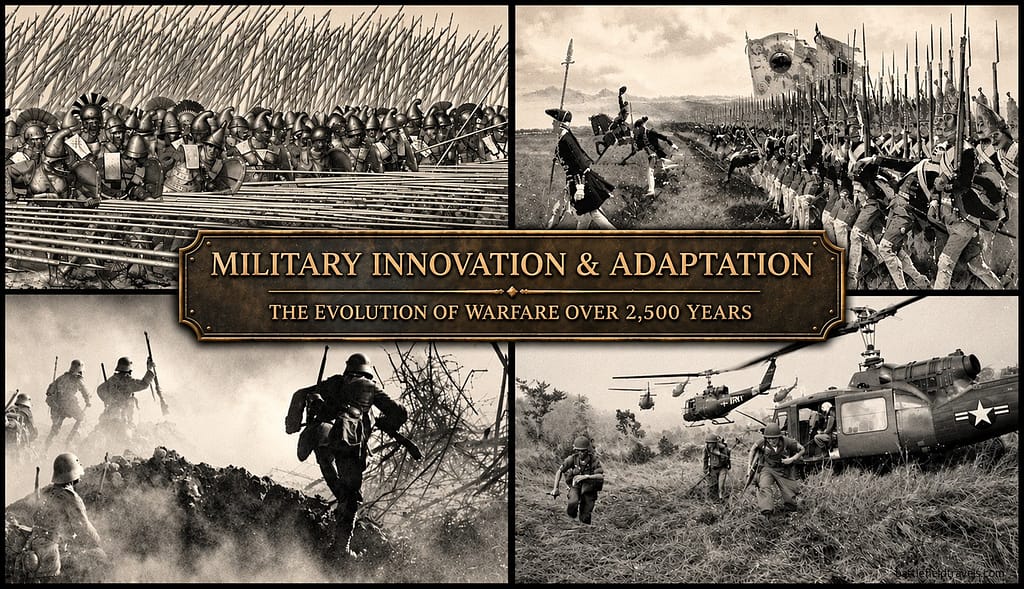
Throughout history, armies have faced the same fundamental challenge: how to defeat an enemy who is trying to do exactly the same thing to them. Weapons change, technology evolves, but the fundamental problems of the battlefield remain remarkably consistent. Changes appeared when a commander recognised a new way to combine weapons, terrain, and manoeuvre.
Subscribe to Battlefield Travels and receive a free E-Book Battlefield Guide
Unlock expert battlefield analysis, campaign reconstructions, and historical insights drawn from firsthand exploration and primary sources.
🗺️ You’ll receive:
🎖️ Exclusive historical insights you won’t find elsewhere
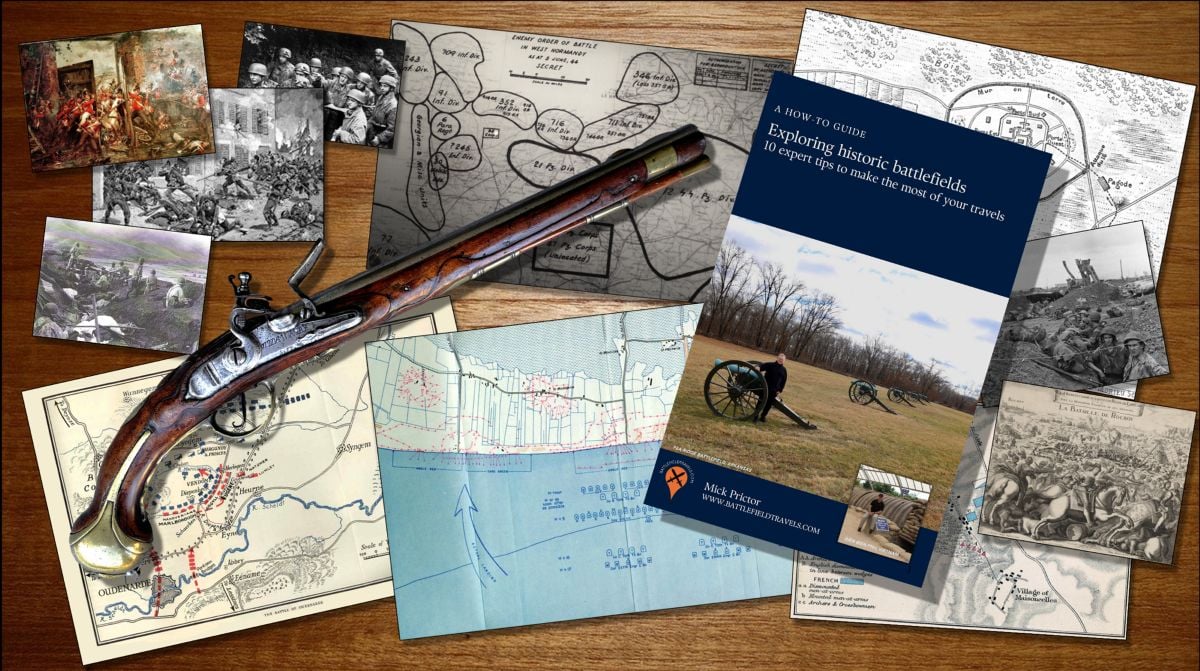
📘 A free eBook: 10 Tips for Exploring Historic Battlefields
📰 New battlefield studies straight to your inbox as they are published
⚔️ Go deeper — Members get exclusive access to the Deep Research Collection, Field Notes, and monthly Research Dispatches. Try membership free for 7 days, cancel anytime. From $9/month.
