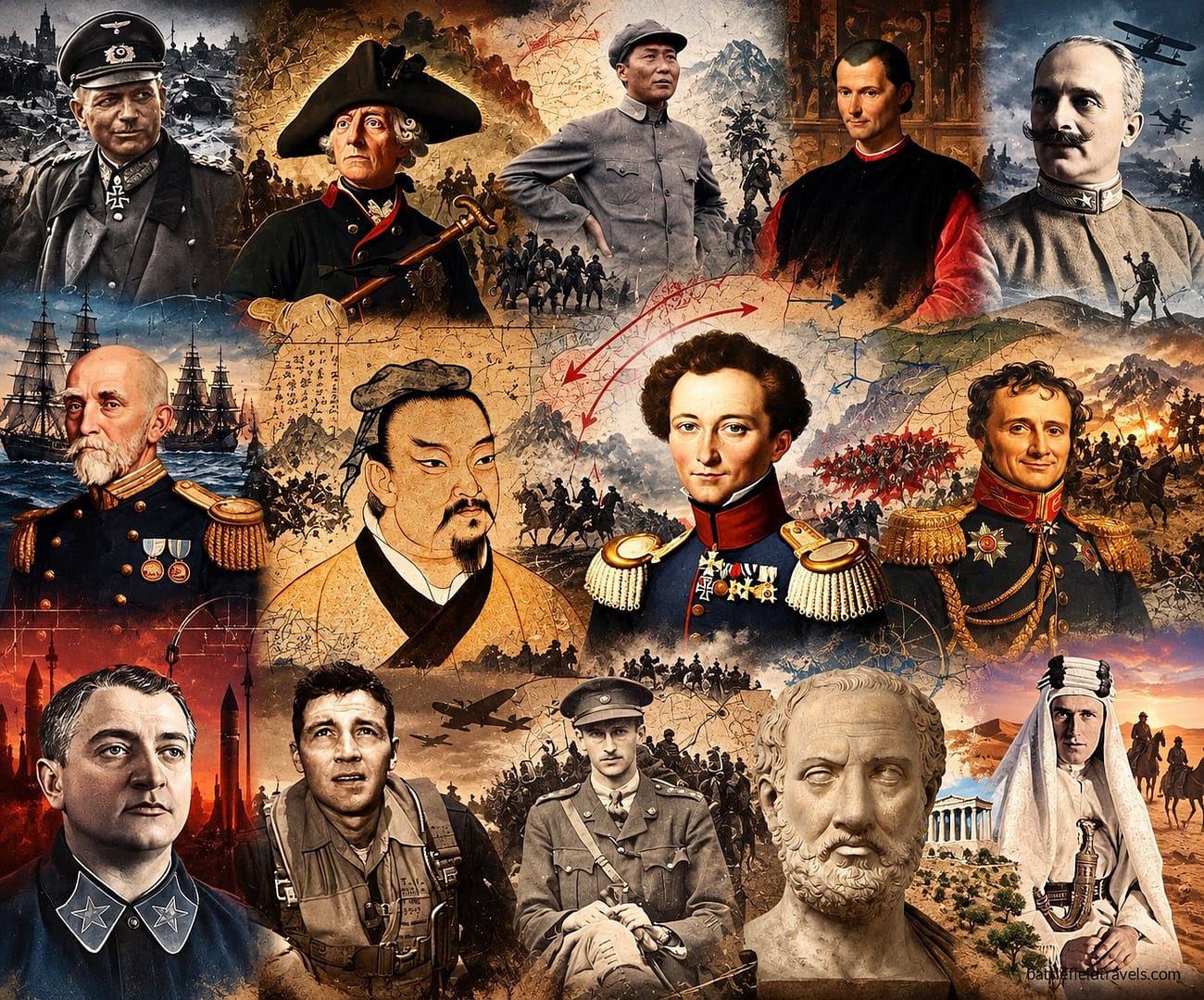
How well do you really know the great theorists and strategists of history?
Every student of military history knows Clausewitz and Sun Tzu. But how deep does your knowledge really go?
For more than two thousand years, soldiers, commanders and theorists have wrestled with the nature of war — how armies should fight, how commanders make decisions, and how technology, politics and society reshape the battlefield.
Test your knowledge with 20 questions randomly selected from a growing bank spanning thinkers and innovators from the ancient world to the atomic age. This is not just a test of famous names: many questions explore the ideas, theories and concepts themselves.
Score 60% to pass — and expect a challenge.
Want to explore the thinking behind the questions? Visit the Reading Room: War, Strategy & Military Theory. Or see how military ideas were translated into battlefield practice in Military Innovation & Adaptation.
Results
The theory survived contact with the quiz!
You know your military thinkers. From Sun Tzu and Clausewitz to Mao, Schelling and Boyd, you’ve demonstrated a strong understanding of the ideas that have shaped military thought across more than two thousand years.
Think you can do better? Try again — every attempt draws a different set of questions.
Back to the staff college!
Military thought spans more than two thousand years of argument about strategy, command, technology and the nature of war, so this was never going to be easy.
Try again — every attempt draws a different set of questions. Score 60% to pass.


HD Quiz powered by harmonic design
#1. Which concept is most closely associated with Clausewitz?
Clausewitz argued that war cannot be understood separately from the political purposes that give rise to it. His formulation connecting war and politics remains one of the most frequently discussed propositions in military theory.
#2. Mao Zedong’s concept of protracted war envisaged revolutionary warfare developing through the following broad progression:
Mao conceived protracted war as a changing relationship of strength rather than permanent guerrilla warfare. A weaker revolutionary force could survive and expand, move towards equilibrium, and eventually develop the strength required to take the strategic offensive.
#3. Ardant du Picq argued that success in battle depended fundamentally on which factor?
In Battle Studies, du Picq examined how soldiers actually behaved in combat, emphasising morale, cohesion, fear and discipline. He argued that weapons and formations could not be understood without considering the human beings who had to employ them under battlefield stress.
#4. In Mao’s conception of revolutionary warfare, guerrilla operations were ultimately intended to achieve what?
For Mao, guerrilla warfare was part of a broader political-military struggle rather than an end in itself. Revolutionary forces could use it to survive, mobilise support and accumulate strength before progressively adopting more conventional forms of warfare.
#5. Which British military thinker proposed the “indirect approach” as a means to dislocate an opponent, rather than attacking the enemy’s strength?
Liddell Hart argued that successful strategy should dislocate an opponent psychologically and physically rather than simply attack strength directly. His formulation of the “indirect approach” became one of the best-known concepts in twentieth-century strategic writing.
#6. Alfred von Schlieffen’s strategic thinking sought to solve Germany’s problem of fighting powerful enemies on more than one front primarily through what strategic approach?
Schlieffen’s thinking emphasised envelopment and the concentration of overwhelming strength against one opponent to obtain a rapid decision. It reflected Germany’s strategic problem of potentially facing France and Russia simultaneously.
#7. In Clausewitz’s writing, what did coup d’œil describe?
Clausewitz used coup d’œil for the commander’s ability to perceive the important truth of a military situation despite uncertainty and incomplete information. It was closely connected to judgement and resolution rather than simply good eyesight or reconnaissance.
#8. Basil Liddell Hart’s “indirect approach” sought to create favourable conditions for decisive action primarily through what?
Liddell Hart argued that striking directly against an opponent’s established strength was often wasteful. Manoeuvre and surprise should instead dislocate the enemy physically and psychologically, creating circumstances in which resistance became substantially more difficult.
#9. The German concept of Auftragstaktik sought to preserve subordinate initiative by giving commanders primarily what?
Auftragstaktik developed around the idea that subordinates needed sufficient freedom to respond to circumstances that higher commanders could not foresee. Understanding the purpose of the mission allowed them to adapt their actions while continuing to serve the higher commander’s intent.
#10. Which Soviet theorist developed ‘The Nature of the Operations of Modern Armies’ in response to his observations of the First World War, and provided a theoretical foundation for Soviet Deep Battle?
Triandafillov examined the scale, depth and continuity of operations in modern industrial warfare. His work became an important intellectual foundation for the Soviet development of Deep Battle and Deep Operations during the interwar period.
#11. Edward Luttwak’s idea of the “paradoxical logic of strategy” suggested that an apparently inefficient military action sometimes succeed because:
Luttwak argues that strategy often operates according to a paradoxical logic: an obvious and efficient course attracts preparation and opposition, potentially making a less direct course advantageous. Strategy is therefore interactive rather than simply a search for technical efficiency.
#12. In Boyd’s thinking, why is operating inside an opponent’s OODA loop potentially advantageous?
Boyd’s idea was more sophisticated than simply “making decisions faster”. Rapid and unexpected changes can disrupt an opponent’s orientation, making their decisions increasingly inappropriate to the situation they are actually confronting.
#13. F. W. Lanchester’s mathematical models of combat attempted to explain what relationship?
Lanchester developed mathematical models describing attrition between opposing forces. His famous square-law model suggested that, under particular assumptions for aimed fire, combat power could increase with the square of the number of combatants rather than simply in direct proportion to numbers.
#14. The concept of “centre of gravity” in Clausewitz’s On War refers broadly to what?
Clausewitz used the physical metaphor of a centre of gravity to describe concentrations of strength and cohesion whose effects extended through the enemy system. Later military doctrine has developed and formalised the concept considerably beyond Clausewitz’s original discussion.
#15. William S. Lind and other advocates of manoeuvre warfare argued that success should focus primarily on what?
Modern manoeuvre-warfare advocates emphasised tempo, initiative, surprise and attacks against vulnerabilities to create systemic disruption. The objective was not necessarily to destroy every enemy formation but to make the opposing force unable to function coherently.
#16. Charles E. Callwell’s Small Wars examined the particular military problems created by what kind of warfare?
Callwell attempted to derive principles from nineteenth-century British and other colonial campaigns. Small Wars examined operations against irregular and non-European opponents, although many of its assumptions and language reflect the imperial attitudes of its period.
#17. Thomas Schelling’s theory of coercion emphasised that military power could be used not simply to destroy an enemy, but to do what?
Schelling examined violence as a form of bargaining as well as destruction. The threatened or limited use of force could be intended to alter an opponent’s behaviour, making coercion and deterrence fundamentally interactive political processes.
#18. Jacques-Antoine-Hippolyte de Guibert argued for military reforms that anticipated which development of the Revolutionary and Napoleonic era?
Guibert’s Essai général de tactique examined both military organisation and the relationship between armies and society. He anticipated the potential power of a state able to mobilise its population, foreshadowing aspects of the mass warfare that emerged during the French Revolution.
#19. Võ Nguyên Giáp’s approach to war against materially stronger opponents relied heavily upon what relationship?
Giáp treated political mobilisation and military action as interconnected elements of a prolonged struggle. Vietnamese forces developed from guerrilla and regional forces towards increasingly capable regular formations able to undertake major conventional operations.
#20. Bernard Brodie argued that nuclear weapons fundamentally changed the purpose of military power in what way?
Brodie was among the earliest strategists to recognise the revolutionary implications of nuclear weapons. He argued that the overriding purpose of military power in the nuclear age increasingly became preventing catastrophic war through deterrence.
Explore the Ideas Behind the Quiz
The theorists are only part of the story. Explore their original works and the wider literature of military thought, or see how ideas about firepower, manoeuvre, command, adaptation and technology were tested on the battlefield.
📚Best books on War Theory & Strategy
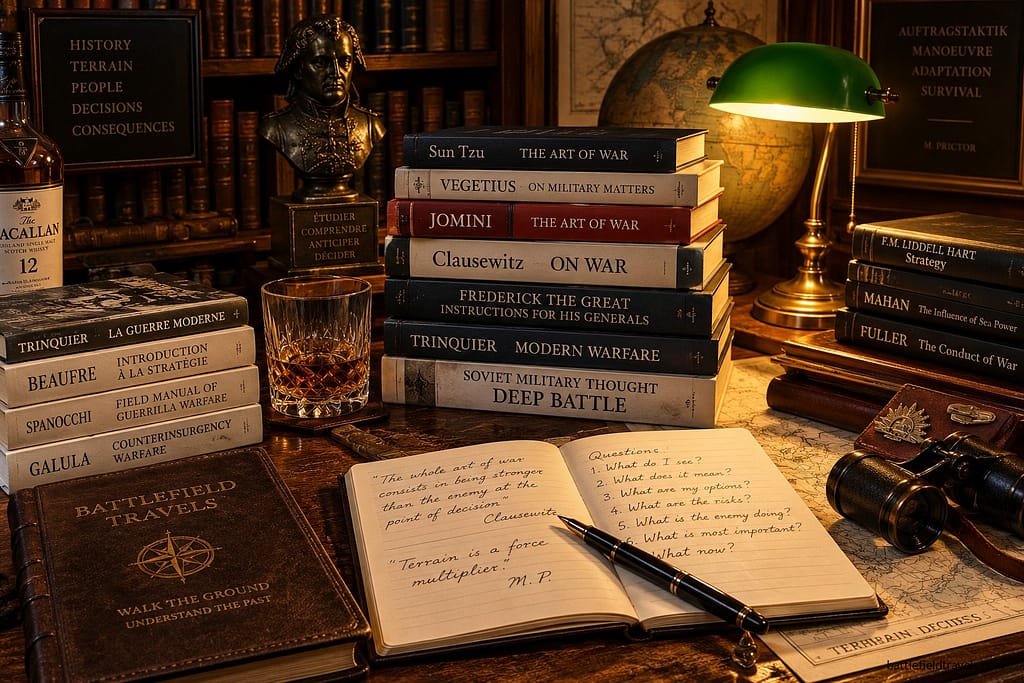
A curated reading collection exploring how soldiers, commanders and theorists have understood the nature and conduct of war. From Sun Tzu, Frederick the Great, Jomini and Clausewitz to modern theories of manoeuvre, air power, counterinsurgency and Deep Battle, explore the books and ideas that have shaped military thought across more than two millennia.
💡 Military Innovation & Adaptation Hub
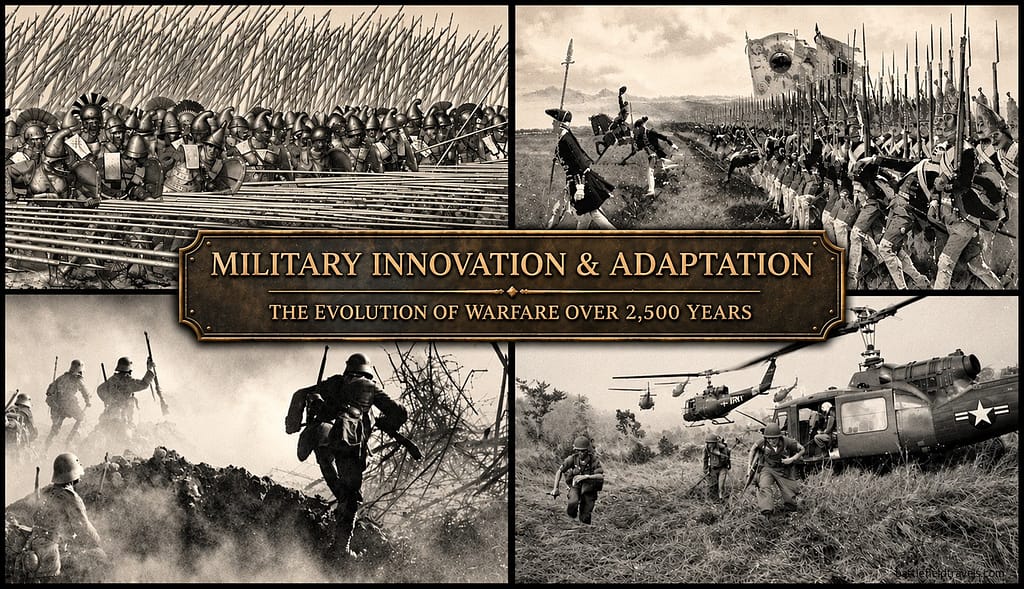
Throughout history, armies have faced the same fundamental challenge: how to defeat an enemy who is trying to do exactly the same thing to them. Weapons change, technology evolves, but the fundamental problems of the battlefield remain remarkably consistent. Changes appeared when a commander recognised a new way to combine weapons, terrain, and manoeuvre.
Subscribe to Battlefield Travels and receive a free E-Book Battlefield Guide
Unlock expert battlefield analysis, campaign reconstructions, and historical insights drawn from firsthand exploration and primary sources.
🗺️ You’ll receive:
🎖️ Exclusive historical insights you won’t find elsewhere
📘 A free eBook: 10 Tips for Exploring Historic Battlefields
📰 New battlefield studies straight to your inbox as they are published

⚔️ Go deeper — Members get exclusive access to the Deep Research Collection, Field Notes, and monthly Research Dispatches. Try membership free for 7 days, cancel anytime. From $9/month.