How well do you really know the Second World War?

EXPLORE WW2: BATTLES | WEAPONS & EQUIPMENT | READING | QUIZ
From Dunkirk and Stalingrad to Midway, Normandy and the Pacific, the Second World War was fought across continents and oceans. But how well do you understand the decisions, tactics and circumstances that shaped its outcome?
Between 1939 and 1945, the world was engulfed in the largest conflict in history. Military forces fought across vast distances on land, at sea and in the air, from deserts and jungles to mountains, oceans and frozen wastes. Military technology and doctrine evolved rapidly as nations fought for survival, conquest or liberation. Victory depended not simply on superior numbers or technology, but on the ability to combine strategy, intelligence, logistics, terrain and battlefield decision-making.
Test your knowledge of the Second World War with 20 questions randomly selected from a bank of 100, covering the major campaigns and battles. Beyond familiar commanders and famous victories, the questions explore the operational and tactical decisions, military innovations and battlefield conditions that determined success or failure. With four historically plausible answers to each question, you’ll need more than a passing familiarity with the war.
Score 60% to pass — and expect a challenge.
Want to explore the fighting in greater depth? Visit the 1939-1945 World War Two Battle Studies collection, combining historical research with firsthand examination of battlefield terrain. Or explore how weapons, tactics and doctrine evolved in Military Innovation & Adaptation.
Results
Excellent work, Commander! You’ve successfully navigated six years of global warfare, overcome some formidable opposition, and demonstrated that your grasp of military history extends well beyond Saving Private Ryan and Band of Brothers.
Your promotion has been approved by SHAEF. The paperwork may take a while.
Mission accomplished!
A TEMPORARY SETBACK ON ALL FRONTS!
Your offensive has stalled, your intelligence estimates were optimistic, and High Command is demanding an explanation.
Fortunately, this is a war of manoeuvre, not annihilation. Regroup, review the intelligence, consult your maps and prepare for another offensive.
The war isn’t over. You’ve merely lost the opening campaign!


HD Quiz powered by harmonic design
#1. Why did attacks on Japanese airfields become central to the Allied advance along New Guinea’s northern coast?
Allied operations in New Guinea combined amphibious manoeuvre, ground advances and airpower to bypass or isolate Japanese garrisons. Airfields extended fighter coverage, enabled attacks on shipping and bases, and supported further operations. The campaign repeatedly linked geography to operational reach.
#2. Why did Soviet operations around Rzhev in 1942–43 remain costly despite repeated offensives?
Fighting around the Rzhev salient involved difficult terrain, fortified positions and repeated Soviet attacks that often failed to produce decisive penetrations. German defence, reserves and operational conditions inflicted heavy losses. The salient was finally evacuated by German forces in March 1943 under Operation Büffel.
#3. What did Allied attacks on German petroleum production and fuel distribution most directly threaten in 1944–45?
Attacks on oil refineries, synthetic-fuel plants and distribution systems compounded Germany’s petroleum shortages. Fuel scarcity restricted training, flight operations and mechanised movement, even when aircraft or tanks existed on paper. This illustrates how attacks on an industrial system can weaken combat effectiveness without destroying each weapon at the front.
#4. What made the RAF integrated air-defence system particularly effective during the Battle of Britain?
The Dowding System integrated Chain Home radar, the Observer Corps, plotting and group and sector operations rooms. It directed scarce fighters towards approaching raids, avoiding the need to keep every squadron continuously airborne. The decisive innovation was the integrated information-and-control system, not radar in isolation.
#5. Which Allied commander led the British Fourteenth Army during its advance through Burma?
General William Slim commanded the British Fourteenth Army, whose multinational forces included substantial Indian and African contingents. Its 1944–45 operations in Burma relied on air supply, manoeuvre and increasingly effective jungle warfare. Auchinleck, Alexander and Wavell held other senior commands.
#6. Which two opposing commanders led the principal ground armies at the Second Battle of El Alamein?
The Second Battle of El Alamein began in October 1942. General Bernard Montgomery commanded the British Eighth Army and Field Marshal Erwin Rommel commanded the German-Italian Panzer Army Africa, although Rommel was absent during part of the opening period. The battle followed an extended contest over resources, positioning and the limits of Axis supply.
#7. What operational problem did German forces face in the final phase of the Ardennes offensive even where they had penetrated Allied positions?
German plans depended on rapidly reaching the Meuse and splitting Allied armies, but restricted roads, disrupted timetables, Allied defensive strongpoints and inadequate fuel undermined momentum. Tactical penetrations did not translate into the intended operational rupture. The episode shows the limits of surprise without sustainable exploitation.
#8. What did the US advance across the Hürtgen Forest in 1944 illustrate about fighting in difficult wooded terrain?
The Hürtgen Forest restricted armour, communications, observation and evacuation while favouring concealed defensive positions and artillery effects. The costly fighting illustrated how a numerically and materially superior force could struggle when terrain constrained its advantages and obscured tactical awareness.
#9. Which German army group was principally responsible for the drive towards Leningrad in Operation Barbarossa?
Army Group North, commanded initially by Field Marshal Wilhelm von Leeb, advanced through the Baltic states towards Leningrad in 1941. Army Group Centre moved towards Smolensk and Moscow, while Army Group South operated towards Ukraine. Their competing objectives and logistical demands were central to German planning.
#10. Which battle in late 1941 halted a direct German advance on the Soviet capital?
The German assault towards Moscow, Operation Typhoon, lost momentum in the autumn and early winter of 1941. Soviet defence and counteroffensives beginning in December forced German formations back. The outcome reflected attrition, logistics, Soviet reserves and severe weather rather than weather alone.
#11. Why was the Allied campaign to reopen the Burma Road strategically important to China?
Japanese occupation and operations in Burma disrupted an important route supplying China. Allied air transport over the Hump and later ground advances and road construction helped restore supply links. The Burma campaign therefore had strategic significance beyond the immediate battlefield.
#12. What was the principal tactical difficulty faced by many US infantry units advancing through the Normandy bocage in June and July 1944?
Normandy’s hedgerows, banks and enclosed fields compartmentalised the battlefield. They favoured concealed defenders and complicated infantry-tank coordination. Allied units adapted with close infantry-armour cooperation, engineer methods and tank-mounted hedgerow cutters. The problem was tactical use of terrain, not a simple shortage of tanks.
Learn more:
D-Day and the Normandy Campaign 1944
#13. Which Japanese city was struck by the second atomic bomb used in warfare, on 9 August 1945?
The second atomic bomb was dropped on Nagasaki on 9 August 1945, three days after Hiroshima. Kokura had been the primary target for the second mission, but weather and visibility led the aircraft to its secondary target. Japan announced its acceptance of surrender terms on 15 August.
#14. Which major Soviet city endured a prolonged German and Finnish encirclement beginning in September 1941?
The siege of Leningrad began in 1941 and continued until January 1944, when Soviet operations lifted the siege. Supply over Lake Ladoga sustained the city under extreme hardship. Kiev, Odessa and Kharkov also saw major operations, but not the same protracted encirclement.
#15. Why could the Japanese Tokyo Express not fully sustain its army on Guadalcanal despite repeated successful night runs?
Japanese destroyer runs exploited night-fighting proficiency but carried only limited quantities of food, ammunition and personnel, often under difficult unloading conditions. They could not replace a dependable flow of slower cargo vessels. Allied air superiority around Henderson Field and attrition at sea made sustained reinforcement increasingly difficult.
Learn more:
Guadalcanal Campaign 1942-43
#16. What was the principal operational vulnerability of the Allied ground advance during Operation Market Garden?
XXX Corps advanced along a narrow corridor that depended on bridges held by airborne forces and was exposed to German attacks against its flanks and supply route. Delays at bridges, resistance along the road and the distance to Arnhem prevented the intended rapid link-up. The plan combined ambitious timing with vulnerable communications and movement routes.
Learn more:
Field Note: Achterste Brug, 17 September 1944 — Armour on a Single Axis
#17. Why did German armoured operations in France in 1940 achieve more decisive results than many early Allied tank counterattacks?
German armoured formations benefited from concentration, radio communications, command arrangements and a plan focused on deep exploitation after crossings at the Meuse. Allied forces fielded capable tanks and mounted counterattacks, but often lacked the same operational coordination and timing. Equipment quality alone does not explain the result.
#18. Why did the German attempt to relieve Stalingrad in December 1942 fail?
Operation Winter Storm advanced towards Stalingrad but failed to link up with Paulus’s encircled Sixth Army. Soviet operations elsewhere threatened the relief force’s flanks and lines of communication, and the Sixth Army did not attempt an effective breakout. The failed relief left the pocket dependent on inadequate air supply.
#19. What enabled German defenders at Omaha Beach to inflict particularly heavy casualties on the initial American assault?
German positions on the bluffs commanded the beach and its limited exits. Obstacles, strongpoints, surviving guns and disrupted initial assault formations compounded American difficulties. Small groups eventually penetrated through gaps and gullies and attacked positions from flanks or rear. Terrain was central to the outcome.
Learn more:
#20. Where did Allied forces land during Operation Torch in November 1942?
Operation Torch began on 8 November 1942 with Anglo-American landings in French Morocco and Algeria. The operation opened an Allied front west of Axis forces fighting in Egypt and Libya, followed by a drive towards Tunisia. Some Vichy French units initially resisted the landings.
Explore the Ideas Behind the Quiz
The battles are only part of the story. Explore the battles through prmary source analysis and firsthand exploration of the battlefields, or see how ideas about firepower, manoeuvre, command, adaptation and technology were tested on the battlefield.
⚔️ World War Two Battle Studies

Explore the battles and campaigns that shaped the Second World War, from the deserts of North Africa and the Eastern Front to Normandy and the Pacific. Combining historical research, firsthand battlefield exploration and terrain analysis, these studies examine the commanders, tactics and decisions that determined victory or defeat.
📚World War Two Reading Room

Explore a curated collection of military histories, firsthand accounts, commanders’ memoirs and authoritative campaign studies covering the Second World War. From the Eastern Front and North Africa to Normandy and the Pacific, discover the books and primary sources that illuminate the strategies, decisions and experiences of those who fought the war.
💡 Military Innovation & Adaptation Hub
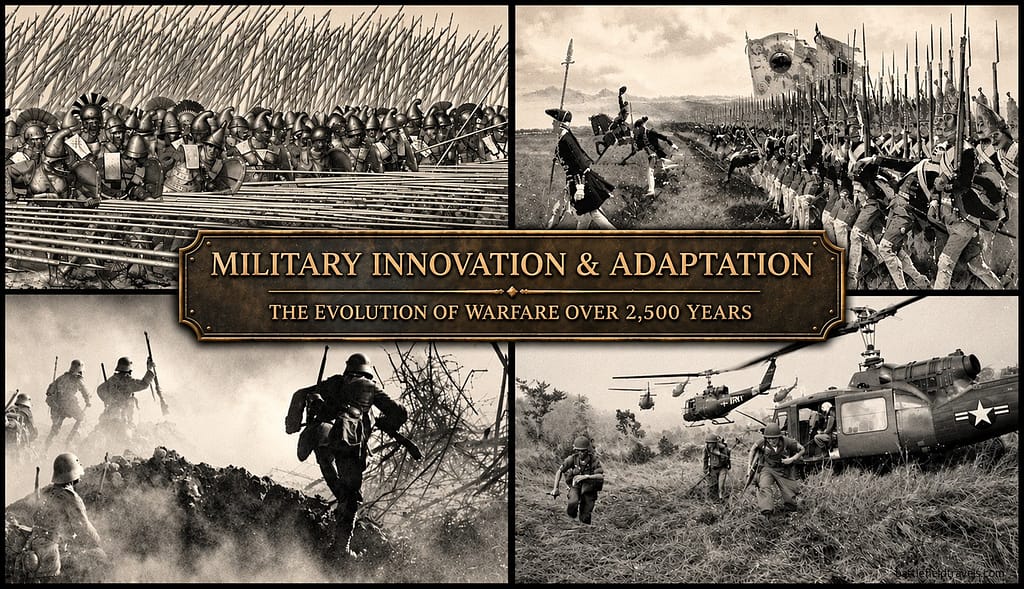
Throughout history, armies have faced the same fundamental challenge: how to defeat an enemy who is trying to do exactly the same thing to them. Weapons change, technology evolves, but the fundamental problems of the battlefield remain remarkably consistent. Changes appeared when a commander recognised a new way to combine weapons, terrain, and manoeuvre.
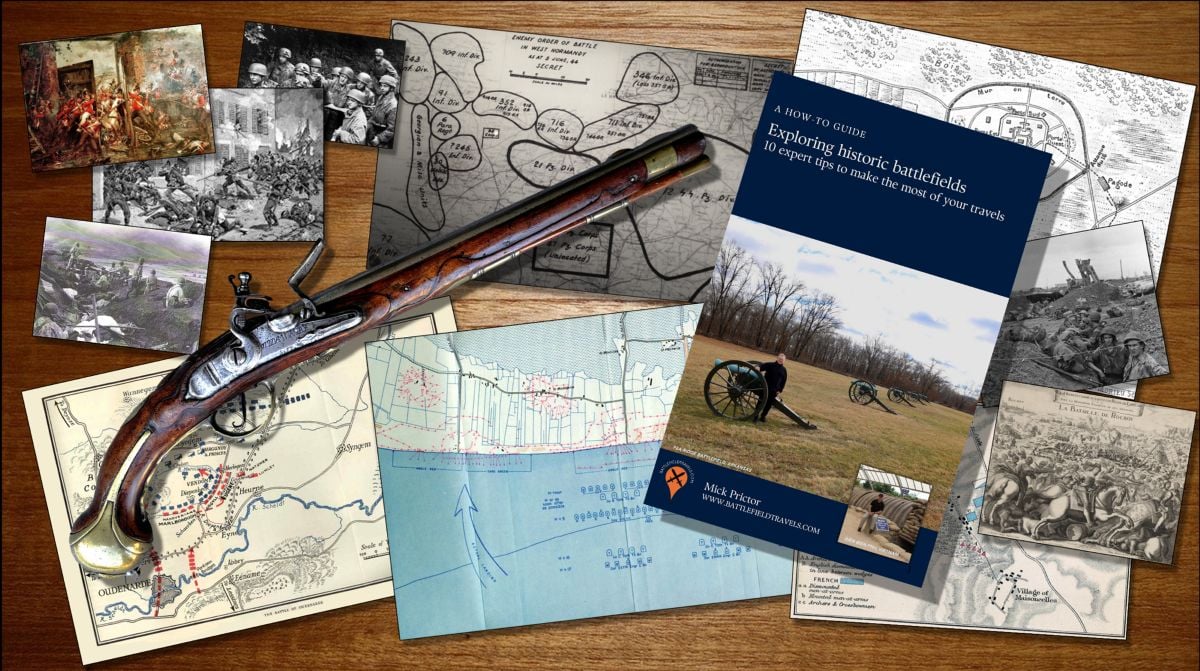
Subscribe to Battlefield Travels and receive a free E-Book Battlefield Guide
Unlock expert battlefield analysis, campaign reconstructions, and historical insights drawn from firsthand exploration and primary sources.
🗺️ You’ll receive:
🎖️ Exclusive historical insights you won’t find elsewhere
📘 A free eBook: 10 Tips for Exploring Historic Battlefields
📰 New battlefield studies straight to your inbox as they are published
⚔️ Go deeper — Members get exclusive access to the Deep Research Collection, Field Notes, and monthly Research Dispatches. Try membership free for 7 days, cancel anytime. From $9/month.
