Selected works on America’s Old West
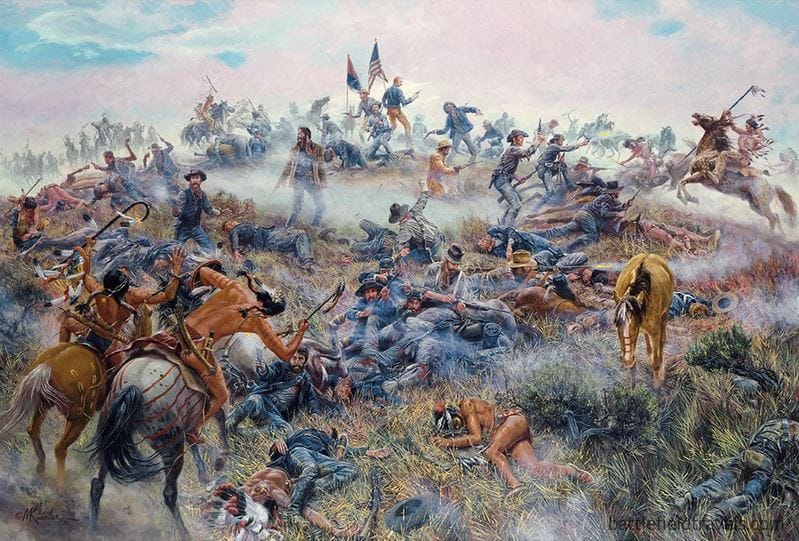
Overview of America’s Old West
The American Indian Wars spanned nearly three centuries of conflict between European colonial powers, the United States, and the Indigenous nations of North America. Beginning with early struggles between settlers and native confederacies in Virginia and New England, warfare evolved alongside the frontier. Each generation saw renewed contest for land, trade, and sovereignty — from King Philip’s War (1675–76) and Pontiac’s Rebellion (1763–64) to the complex alliances of the War of 1812.
During the nineteenth century, expansion across the Great Plains and the Southwest brought the U.S. Army into protracted campaigns against highly mobile tribal forces. Leaders such as Tecumseh, Cochise, and Sitting Bull commanded warrior societies whose mastery of terrain and small-unit tactics challenged conventional military practice. Battles at the Little Bighorn, the Washita, and Sand Creek reflected both resistance and tragedy as federal policy turned to forced relocation and reservation confinement.
By the end of the century, the frontier had closed. The 1890 engagement at Wounded Knee marked the symbolic end of organised armed resistance, though its legacy endures in memory and identity. The Indian Wars significantly influenced U.S. military doctrine, frontier logistics, and perceptions of irregular warfare — a protracted, bitter conflict that paralleled the development of the modern American state.
Related Battle Studies, Museum Pieces & Reading Resources
 ⚔️ Fort Bowie, Apache Pass, Cochise and Geronimo,
1862-1894
 ⚔️ Dalton Gang Raid on Coffeyville, Kansas,
5 October 1892
 🏛️ America’s Old West (1840s–1912) Weapons and Equipment
 ⚔️🔒Battle of the Little Bighorn, Montana Territory,
25-26 June 1876
 ⚔️ Battle of Black Jack, Kansas,
2 June 1856
 📚 Anglo-Afghan Wars War (1839–1919),
Recommended Reading
The Amazon links on the Reading Room pages are powered by AAWP

Reading
The reference collection below includes the key books and references I have used in preparing for and undertaking studies of America’s Old West battlefields.
American Indian Wars


Bleeding Kansas

- Kansas Historical Society – Kansapedia – Frames the battle as the first armed conflict between pro- and anti-slavery forces, within Bleeding Kansas
- Civil War on the Western Border (Kansas State University) – Gives strength estimates, outcome details, and situates the conflict as a watershed moment leading toward the Civil War
- Kansas Sampler Foundation – “8 Wonders of Kansas History” – Provides modern battlefield details, visitor orientation, and preservation—showing how the site persists today
- Legends of America
- Kansas Memory – John Brown Collection – Archival material, including participant lists and casualty records tied to the battle
- National Park Service (Brown v. Board of Education NHS) – Discusses broader interpretation and commemoration of John Brown’s activities, including Black Jack, in the context of the abolitionist legacy
Outlaws and Lawmen


Authored by Mick Prictor, a retired military officer with 40 years’ service, and a military historian specialising in terrain-focused analysis of tactics, doctrine, and command decision-making in land warfare. His work draws on extensive battlefield fieldwork—more than 280 sites worldwide—and one of the world’s largest private collections of historic military arms, uniforms, and equipment. About me
FAQ – America’s Old West Reading Room
This reading list is curated to prioritise works that examine frontier warfare through military operations, command decision-making, terrain, logistics, and adaptation. Emphasis is placed on studies grounded in primary sources and serious historical analysis rather than romanticised or purely popular accounts.
No. The list includes works that address both U.S. military forces and Indigenous opponents, recognising that these conflicts can only be understood by examining how different societies interpreted terrain, mobility, logistics, and combat in radically different ways.
Terrain was often decisive. Plains, river valleys, badlands, forests, deserts, and mountain ranges shaped movement, visibility, supply, and tactical options. Indigenous forces frequently exploited micro-terrain—ravines, ridgelines, river crossings, and concealment—to offset numerical or technological disadvantages.
The list includes a mix of accessible overviews and more specialised campaign- and battle-focused studies. Readers new to the topic may wish to begin with the general works before moving on to detailed analyses of specific conflicts or regions.
No. This is a selective reading list intended to guide serious study rather than provide exhaustive coverage. Additional works may be added as scholarship evolves and new perspectives emerge.
Subscribe to Battlefield Travels and receive a free E-Book Battlefield Guide
Unlock expert battlefield analysis, campaign reconstructions, and historical insights drawn from firsthand exploration and primary sources.
🗺️ You’ll receive:
🎖️ Exclusive historical insights you won’t find elsewhere
📘 A free eBook: 10 Tips for Exploring Historic Battlefields
📰 New battlefield studies straight to your inbox as they are published

⚔️ Go deeper — Members get exclusive access to the Deep Research Collection, Field Notes, and monthly Research Dispatches. Try membership free for 7 days, cancel anytime. From $9/month.