Selected works on the American Revolution
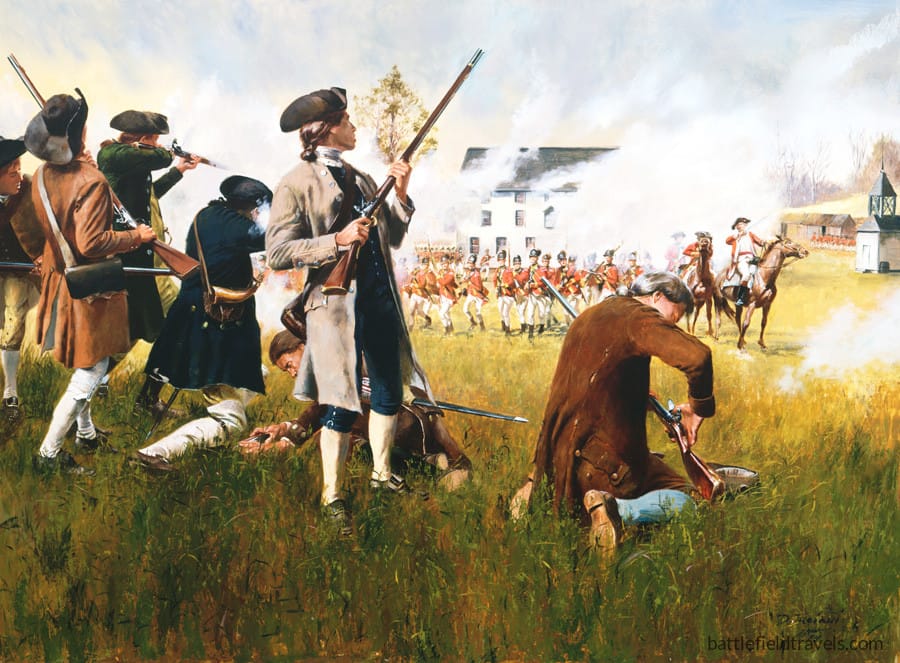
Overview of the American Revolutionary War
The American Revolution (1775–1783) was both a colonial uprising and an international war. What began as a dispute over taxation and representation between Britain and its American colonies escalated into a struggle for independence that drew in the major European powers. By 1778, France, Spain, and the Dutch Republic had entered the war, transforming a rebellion into a global conflict.
In North America, the fighting ranged from New England to the Carolinas. In the north, battles such as Bunker Hill (1775), Trenton (1776), and Saratoga (1777) showcased both the resilience of the Continental Army under George Washington and the value of European alliances. As the war moved south, it pitted American against American and drew in European allies, in battles such as Kings Mountain (1780), Cowpens (1781), and Yorktown (1781). The war was not only fought with muskets and bayonets but also through blockades, privateering, and naval actions that stretched across the Atlantic.
The Revolution was a proving ground for new military ideas. American militias, Continental regulars, British redcoats, Hessian auxiliaries, and French expeditionary forces all clashed, their uniforms and weapons reflecting the diversity of 18th-century armies. Artillery, flintlock muskets, and the beginnings of light infantry tactics played a crucial role in shaping campaigns.
Related Battle Studies, Museum Pieces & Reading Resources
 🏛️ American Revolutionary War (1775–1783) Weapons and Equipment
 🏛️ Seven Years War (1756-1763 ) Weapons and Equipment
 ⚔️ Battle of Cowpens, South Carolina,
17 January 1781
 🏛️ War of the Austrian Succession (1740-48) Weapons and Equipment
 ⚔️ Battle of Trenton, New Jersey,
26 December 1776
 📚 Jacobite Rising (1745–1746),
Recommended Reading
The Amazon links on the Reading Room pages are powered by AAWP

Reading
The reference collection below includes the key books and references I have used in preparing for and undertaking studies of the battlefields of the American Revolutionary War.
Northern Theatre


Southern Theatre


Authored by Mick Prictor, a retired military officer with 40 years’ service, and a military historian specialising in terrain-focused analysis of tactics, doctrine, and command decision-making in land warfare. His work draws on extensive battlefield fieldwork—more than 280 sites worldwide—and one of the world’s largest private collections of historic military arms, uniforms, and equipment. About me
FAQ – American Revolutionary War Reading Room
This reading list is curated to prioritise works that examine the war through operations, command decision-making, terrain, logistics, and adaptation. Emphasis is placed on studies grounded in primary sources that explain how armies fought, manoeuvred, and learned over the course of the conflict.
No. While major battles and senior commanders are included, the list also features works that address small-unit actions, militia warfare, logistics, and the interaction between regular and irregular forces—areas where terrain often proved decisive.
Terrain was central to the conduct of the war. Forests, rivers, road networks, towns, and broken ground shaped movement, supply, and tactical options. American forces frequently exploited local knowledge and micro-terrain to offset British advantages in training and firepower.
The list includes a mix of accessible overviews and more specialised operational and campaign studies. Readers new to the subject may wish to begin with the general histories before progressing to detailed analyses.
No. This is a selective reading list intended to guide serious study rather than provide exhaustive coverage. Additional works may be added as research priorities and scholarship continue to develop.
Subscribe to Battlefield Travels and receive a free E-Book Battlefield Guide
Unlock expert battlefield analysis, campaign reconstructions, and historical insights drawn from firsthand exploration and primary sources.
🗺️ You’ll receive:
🎖️ Exclusive historical insights you won’t find elsewhere
📘 A free eBook: 10 Tips for Exploring Historic Battlefields
📰 New battlefield studies straight to your inbox as they are published

⚔️ Go deeper — Members get exclusive access to the Deep Research Collection, Field Notes, and monthly Research Dispatches. Try membership free for 7 days, cancel anytime. From $9/month.