Selected works on the Anglo-Dutch Wars

Overview of the Anglo-Dutch Wars
The Anglo-Dutch Wars (1652–1674) were a series of fiercely contested naval conflicts between two rising maritime powers: the Dutch Republic and the Kingdom of England. Fought across three major wars, they reflected a struggle for dominance in global trade, sea lanes, and colonial expansion at a time when naval strength determined national prosperity. The conflicts brought together some of the greatest admirals of the age — Tromp, De Ruyter, Blake, and Rupert — whose battles shaped the evolution of modern naval tactics.
These wars witnessed the transition from melee-style boarding actions to disciplined line-of-battle sailing, the rise of specialised fighting ships, and the first formal codification of naval doctrine. Engagements such as the Battle of Scheveningen, the Four Days’ Battle, the Battle of Carlisle Bay, and the Raid on the Medway showcased both strategic daring and logistical sophistication.
This section gathers the essential reading on the naval, political, and economic dimensions of these pivotal 17th-century wars.
Related Battle Studies, Museum Pieces & Reading Resources


The Amazon links on the Reading Room pages are powered by AAWP

Reading
The reference collection below includes the key books and references I have used in preparing for and undertaking studies of battlefields of the Anglo-Dutch Wars.
The Anglo-Dutch Wars

The Anglo-Dutch Wars of the Seventeenth Century by Prof J.R. Jones
This study of the Anglo–Dutch Wars (1652-54, 1665-67, 1672-74) sets them in their naval, political and economic contexts. Competing essentially over trade, both governments were crucially influenced by mercantile interests and by the representative institutions that were central to England and the Dutch Republic. Professor Jones compares the effectiveness of the governments under pressure – English with Dutch, Commonwealth with restored monarchy, Republican with Orangist – and the effects on their economies; and examines the importance of the wars in accelerating the formation of a professional officer corps and establishing battle tactics that would endure throughout the age of sail.

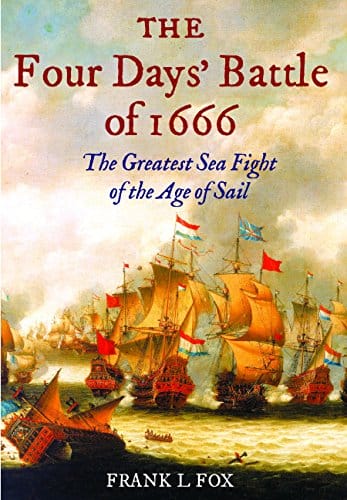
Four Days’ Battle of 1666 by Frank Fox
On 1st June 1666, during the second Anglo-Dutch War, a large but outnumbered English Fleet engaged the Dutch off the mouth of the Thames in a colossal battle that was to involve nearly 200 ships and last four days. False intelligence had led the English to divide their fleet to meet a phantom fleet from France and although the errant squadron rejoined on the final day of the battle, it was not enough to redress the balance. More than 1,500 English sailors were killed, 2,000 taken prisoner and two vice admirals killed. The battle ended when the English escaped into a fog bank, both fleets by this time having expended their ammunition.

Warships of the Anglo-Dutch Wars 1652–74 (New Vanguard, 183) by Angus Konstam (Author), Peter Bull (Illustrator)
This study of the Anglo-Dutch Wars (1652-54, 1665-67, 1672-74) sets them in their naval, political and economic contexts. Competing essentially over trade, both governments were crucially influenced by mercantile interests and by the representative institutions that were central to England and the Dutch Republic. Professor Jones compares the effectiveness of the governments under pressure – English with Dutch, Commonwealth with restored monarchy, Republican with Orangist – and the effects on their economies; and examines the importance of the wars in accelerating the formation of a professional officer corps and establishing battle tactics that would endure throughout the age of sail.

Authored by Mick Prictor, a retired military officer with 40 years’ service, and a military historian specialising in terrain-focused analysis of tactics, doctrine, and command decision-making in land warfare. His work draws on extensive battlefield fieldwork—more than 280 sites worldwide—and one of the world’s largest private collections of historic military arms, uniforms, and equipment. About me
FAQ – Anglo-Dutch Wars (1652–1674)
A: This reading list is curated to highlight works that examine the Anglo-Dutch Wars through the lenses of naval operations, command decision-making, doctrine, and the interaction between fleets, geography, and maritime infrastructure. Priority is given to studies that draw on primary sources and provide operational or analytical depth rather than purely narrative accounts.
A: While naval warfare is central to the Anglo-Dutch Wars, the list also includes works that address strategic context, logistics, ship design, and the relationship between maritime power, commerce, and state policy. Where relevant, coastal operations and amphibious considerations are also included.
A: The list includes a mix of introductory overviews and more specialised studies. Readers unfamiliar with seventeenth-century naval warfare may wish to begin with the broader syntheses before progressing to campaign- or commander-focused works.
A: The Anglo-Dutch Wars were formative in the development of professional navies, fleet tactics, command structures, and maritime doctrine. They illustrate how technology, training, and geography shaped decision-making at sea, and how control of key maritime spaces influenced strategic outcomes.
A: No. This list is selective rather than exhaustive. It is intended to guide serious readers toward influential and analytically useful works, and may be expanded as additional relevant studies are identified.
Subscribe to Battlefield Travels and receive a free E-Book Battlefield Guide
Unlock expert battlefield analysis, campaign reconstructions, and historical insights drawn from firsthand exploration and primary sources.
🗺️ You’ll receive:
🎖️ Exclusive historical insights you won’t find elsewhere
📘 A free eBook: 10 Tips for Exploring Historic Battlefields
📰 New battlefield studies straight to your inbox as they are published

⚔️ Go deeper — Members get exclusive access to the Deep Research Collection, Field Notes, and monthly Research Dispatches. Try membership free for 7 days, cancel anytime. From $9/month.