Selected works on the Franco-Prussian War
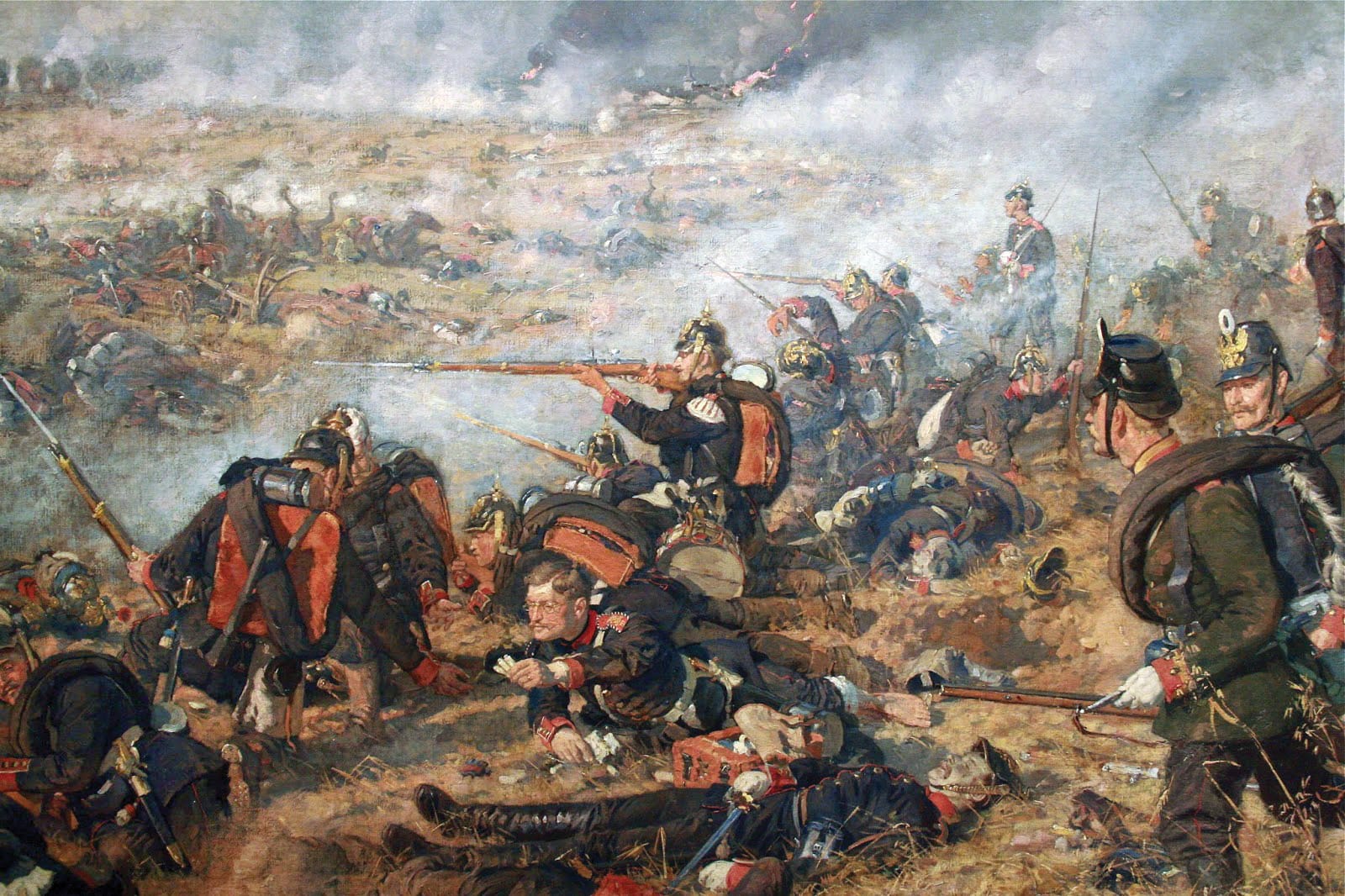
Overview of the Franco-Prussian War
The Franco-Prussian War was a decisive conflict that unified Germany and brought an end to the French Second Empire. Bismarck’s manipulation of the Ems Dispatch in July 1870 provoked Napoleon III into declaring war on Prussia. Within days, the contrast between the two systems became clear: France’s smaller but very experienced army struggled with mobilisation and outdated tactics, while the much larger Prussian-led German forces, guided by Moltke the Elder and the General Staff, achieved rapid mobilisation through rail networks and efficient planning. This was also the first major clash between armies universally armed with breech-loading weapons: the Prussian Dreyse and French Chassepot. Command cultures and doctrine would also clash in this war.
German forces advanced through Alsace and Lorraine in August 1870, winning successive victories at Wissembourg, Spicheren, and Wörth. Marshal Bazaine’s army fell back to Metz where, despite desperate battles at Mars-la-Tour and Gravelotte, it was encircled. MacMahon’s attempt to relieve it led to the decisive defeat at Sedan on 1 September, despite a brave stand by the Marines at Bazeilles, forcing the surrender of both the army and Napoleon III. The fall of the Empire led to the proclamation of the Third Republic, but the new government was unable to reverse the events.
German armies besieged Paris in September, defeating several provincial relief efforts during the winter. The capital surrendered in January 1871, and the Treaty of Frankfurt in May confirmed the annexation of Alsace-Lorraine, imposing a heavy indemnity on France. The war demonstrated the effectiveness of German staff planning, railway logistics, and modern artillery, reshaping Europe’s balance of power and planting the roots of French revanchism that would endure into the next century.
Related Battle Studies, Museum Pieces & Reading Resources


The Amazon links on the Reading Room pages are powered by AAWP

Reading
The reference collection below includes the key books and references I have used in preparing for and undertaking Franco-Prussian War battlefield studies.
Franco-Prussian War


Authored by Mick Prictor, a retired military officer with 40 years’ service, and a military historian specialising in terrain-focused analysis of tactics, doctrine, and command decision-making in land warfare. His work draws on extensive battlefield fieldwork—more than 280 sites worldwide—and one of the world’s largest private collections of historic military arms, uniforms, and equipment. About me
FAQ – Franco-Prussian War (1870–1871) Reading Room
This reading list is curated to prioritise works that examine the war through operational analysis, command decision-making, terrain, doctrine, and mobilisation. Emphasis is placed on studies grounded in primary sources that explain how the opposing armies planned, manoeuvred, and fought in practice.
While major engagements are represented, the list also includes works that address manoeuvre, rail-based mobilisation, staff planning, and the cumulative effects of terrain and logistics on operations across the campaign.
Terrain played a significant role in shaping movement, deployment, and combat. Rivers, ridgelines, villages, and road networks influenced both tactical engagements and operational tempo, often interacting closely with emerging artillery and infantry firepower.
The list includes a mix of accessible overviews and more specialised operational studies. Readers new to the conflict may wish to begin with the general histories before progressing to detailed analyses of specific battles or command systems.
No. This is a selective reading list intended to guide serious study rather than provide exhaustive coverage. Additional works may be added as scholarship and archival research continue to evolve.
Subscribe to Battlefield Travels and receive a free E-Book Battlefield Guide
Unlock expert battlefield analysis, campaign reconstructions, and historical insights drawn from firsthand exploration and primary sources.
🗺️ You’ll receive:
🎖️ Exclusive historical insights you won’t find elsewhere
📘 A free eBook: 10 Tips for Exploring Historic Battlefields
📰 New battlefield studies straight to your inbox as they are published

⚔️ Go deeper — Members get exclusive access to the Deep Research Collection, Field Notes, and monthly Research Dispatches. Try membership free for 7 days, cancel anytime. From $9/month.