Selected works on the Jacobite Rising
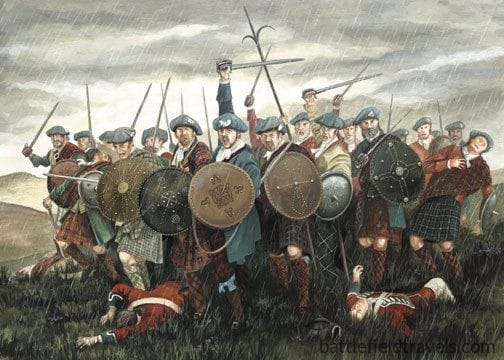
Overview of the Jacobite Rising, 1745-46
The Jacobite Rising of 1745 was the final attempt to restore the exiled Stuart dynasty to the British throne. Launched during the War of the Austrian Succession, it reflected both dynastic ambition and lingering Highland loyalty to the House of Stuart. Prince Charles Edward Stuart — “Bonnie Prince Charlie” — landed in the Hebrides in July 1745 with a handful of supporters and quickly gathered a Highland army under Lord George Murray.
The Jacobites seized Edinburgh and defeated Sir John Cope’s government forces at Prestonpans, securing control of much of Scotland. In November, the army advanced south into England, reaching as far as Derby, but the lack of widespread English support and the threat of converging Hanoverian forces forced a withdrawal. Pursued north, the Jacobites fought a series of rearguard actions before their final stand at Culloden on 16 April 1746. The government army under the Duke of Cumberland, disciplined and heavily supported by artillery, destroyed the Jacobite force in less than an hour.
Culloden marked the end of two centuries of dynastic conflict in Britain. The aftermath brought harsh repression, the abolition of the clan system, and the disarmament of the Highlands. Militarily, the rising demonstrated the contrast between irregular clan warfare and the professional army of the Enlightenment era — a clash between tradition and modernity that marked the close of the Stuart cause.
Related Battle Studies, Museum Pieces & Reading Resources
 🏛️ American Revolutionary War (1775–1783) Weapons and Equipment
 🏛️ Seven Years War (1756-1763 ) Weapons and Equipment
 🏛️ War of the Austrian Succession (1740-48) Weapons and Equipment
 ⚔️ Battle of Culloden, Scotland,
16 April 1746
 ⚔️ Battle of Prestonpans, Scotland,
21 September 1745
 💡The Culloden Bayonet Drill: How Cumberland’s army broke the Highland charge
The Amazon links on the Reading Room pages are powered by AAWP

Reading
The reference collection below includes the key books and references I have used in preparing for and undertaking studies of the Jacobite Rising battlefields.
Jacobite Rising


Authored by Mick Prictor, a retired military officer with 40 years’ service, and a military historian specialising in terrain-focused analysis of tactics, doctrine, and command decision-making in land warfare. His work draws on extensive battlefield fieldwork—more than 280 sites worldwide—and one of the world’s largest private collections of historic military arms, uniforms, and equipment. About me
FAQ – Jacobite Rising (1745-46) Reading Room
This reading list is curated to prioritise works that examine the Jacobite risings through military operations, command decision-making, terrain, and force employment. Emphasis is placed on studies grounded in primary sources and critical historiography rather than romantic or purely political interpretations.
No. While the 1745–46 campaign is central, the list also includes works addressing earlier risings, regional operations, logistics, and the evolving military capabilities of both Jacobite and government forces.
Terrain was decisive. Highlands, glens, river crossings, road networks, and limited infrastructure shaped movement, supply, and tactical options. Jacobite forces frequently exploited local terrain knowledge, while government forces increasingly sought to control terrain through roads, forts, and disciplined deployment.
The list includes a mix of accessible overviews and more specialised operational studies. Readers new to the subject may wish to begin with general histories before progressing to detailed campaign and battle analyses.
No. This is a selective reading list intended to guide serious study rather than provide exhaustive coverage. Additional works may be added as new scholarship and archival research continue to develop.
Subscribe to Battlefield Travels and receive a free E-Book Battlefield Guide
Unlock expert battlefield analysis, campaign reconstructions, and historical insights drawn from firsthand exploration and primary sources.
🗺️ You’ll receive:
🎖️ Exclusive historical insights you won’t find elsewhere
📘 A free eBook: 10 Tips for Exploring Historic Battlefields
📰 New battlefield studies straight to your inbox as they are published

⚔️ Go deeper — Members get exclusive access to the Deep Research Collection, Field Notes, and monthly Research Dispatches. Try membership free for 7 days, cancel anytime. From $9/month.