Paratroopers in the night: The 82nd and 101st Airborne at Sainte-Mere-Eglise!
In the early hours of D-Day, American paratroopers of the 82nd and 101st Airborne Divisions dropped around Sainte-Mere-Eglise, tasked with seizing bridges, blocking German counterattacks, and linking the Utah Beach landings to the interior. Despite scattered drops and heavy fighting, Sainte-Mère-Église became the first French town liberated on 6 June 1944.

Key facts
Google Earth map – location of Sainte-Mere-Eglise battlefield
Normandy series of battlefield studies
This article is part of a series exploring the D-Day airborne and amphibious battlefields on 6 June 1944 and the immediate aftermath. Click on the hotlinks to open the battlefield study.
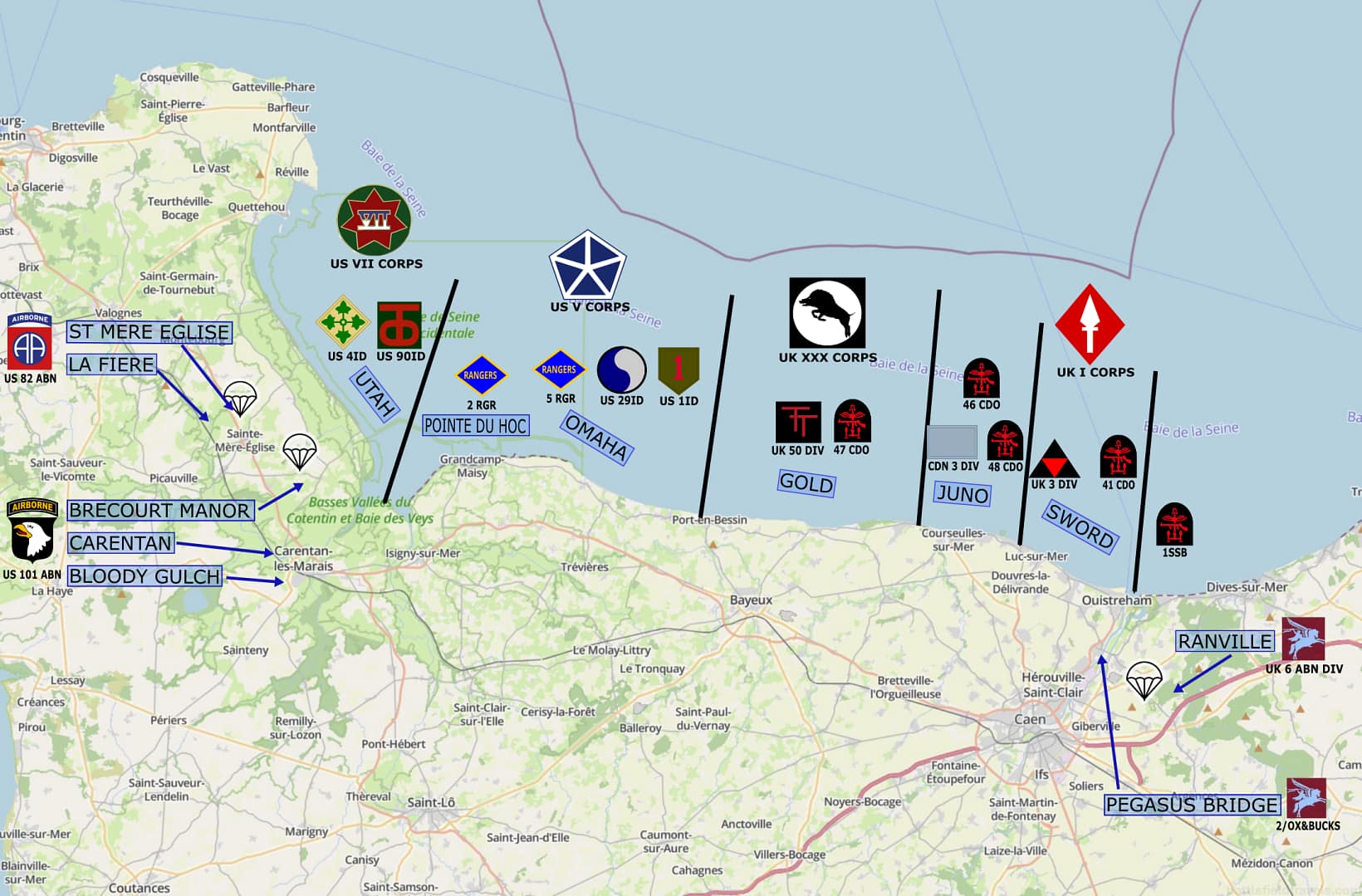
Strategic Context: Why airborne operations were critical for the success of the D-Day landings
Sainte-Mere-Eglise as a critical objective
In the early hours of 6 June 1944, ahead of the Normandy Beach landings, the US 82nd and 101st Airborne Divisions parachuted into this area. The 82nd was to seize the crossings over the Merderet River and the major road junction at Sainte-Mere Eglise, while the 101st was to seize several key towns and the four beach exits in support of the landings at Utah Beach.
D-Day airborne operations
On 6 June 1944, the U.S. airborne forces played a critical role in the Normandy landings. The 82nd and 101st Airborne Divisions were tasked with securing key terrain behind enemy lines to facilitate the amphibious landings on Utah Beach. Their objectives included disrupting German defenses, securing vital roadways and bridges, and establishing a defensive perimeter to protect the Utah Beach landings .
The US airborne forces landed in the early hours of 6 June 1944, ahead of the main D-Day beach landings. The operation involved more than 13,400 paratroopers, 925 aircraft, and hundreds of gliders. The parachute drop faced significant challenges, including dense anti-aircraft fire, poor weather, and navigational difficulties. Consequently, many paratroopers were dropped far from their designated drop zones.

Opposing Forces: US Airborne vs German Defenders
 Allied Forces: US Airborne Divisions
 Allied Forces: US Airborne Divisions
- Commander, US VII Corps (seaborne): Lt. Gen. J. Lawton Collins
- Airborne Force Commander: Maj. Gen. Matthew B. Ridgway (82nd Airborne Division)
- Supporting Division: Maj. Gen. Maxwell D. Taylor (101st Airborne Division)
- Strength: Approx. 13,000 paratroopers from each division, plus glider elements.
 82nd Airborne Division (Ridgway)
 82nd Airborne Division (Ridgway)
- 505th Parachute Infantry Regiment (Col. James M. Gavin) — tasked with seizing Sainte-Mère-Église and La Fière causeway.
- 507th & 508th PIRs — assigned to secure Merderet River crossings and block German counterattacks from the west.
- 325th Glider Infantry Regiment — planned to reinforce once landing zones secured.
 101st Airborne Division (Taylor)
 101st Airborne Division (Taylor)
- 502nd PIR (Col. George Van Horn Moseley Jr.) — tasked with causeway exits north of Pouppeville.
- 506th PIR (Col. Robert Sink) — tasked with securing causeways further south and Brécourt gun battery.
- 501st PIR (Col. Howard Johnson) — securing road junctions and blocking routes from Carentan.
 German Forces: 91st Infantry Division and Coastal Units
 German Forces: 91st Infantry Division and Coastal Units
- Commander: Lt. Gen. Wilhelm Falley (killed on 6 June by paratroopers of the 82nd).
- Strength: Approx. 8,000–9,000 troops in the Cotentin Peninsula.
Key Elements
- 91st Luftlande Infantry Division: German “air-landing” division, poorly equipped and under-strength, manning much of the Cotentin interior.
- Fallschirmjäger-Regiment 6 (elite paratroopers): elements present, adding veteran capability.
- Static coastal units: Grenadier battalions manning strongpoints around Utah Beach.
- Local reserves: Kampfgruppen assembled ad hoc from service and training units once the drops began.
Balance of Forces
The US airborne forces enjoyed the advantage of surprise and determination, but were widely scattered by poor drops and flak fire. Their initial operations relied on small groups improvising in the dark to achieve objectives. German forces were numerically inferior and fragmented, but fought from familiar ground and were reinforced through local counterattacks. The clash around Sainte-Mère-Église, the Merderet causeways, and Carentan thus became a contest between elite US paratroopers fighting piecemeal versus dispersed German defenders attempting to contain them until heavier units could arrive.
101st Airborne Division operations ‘Operation ALBANY’
D-Day mission
The 101st Airborne Division was tasked with securing the four causeways leading inland from Utah Beach, destroying bridges over the Douve River to hinder German counterattacks, and capturing the town of Carentan. The Germans had flooded the area behind the beaches, so the causeways were critical to getting troops off Utah Beach.
Despite being widely dispersed, little groups of paratroopers (abbreviated to LGOP in airborne culture) rallied under officers and non-commissioned officers, and successfully achieved many objectives. One notable achievement was the capture of Exit 4 from Utah Beach, allowing the seaborne forces to rapidly advance.
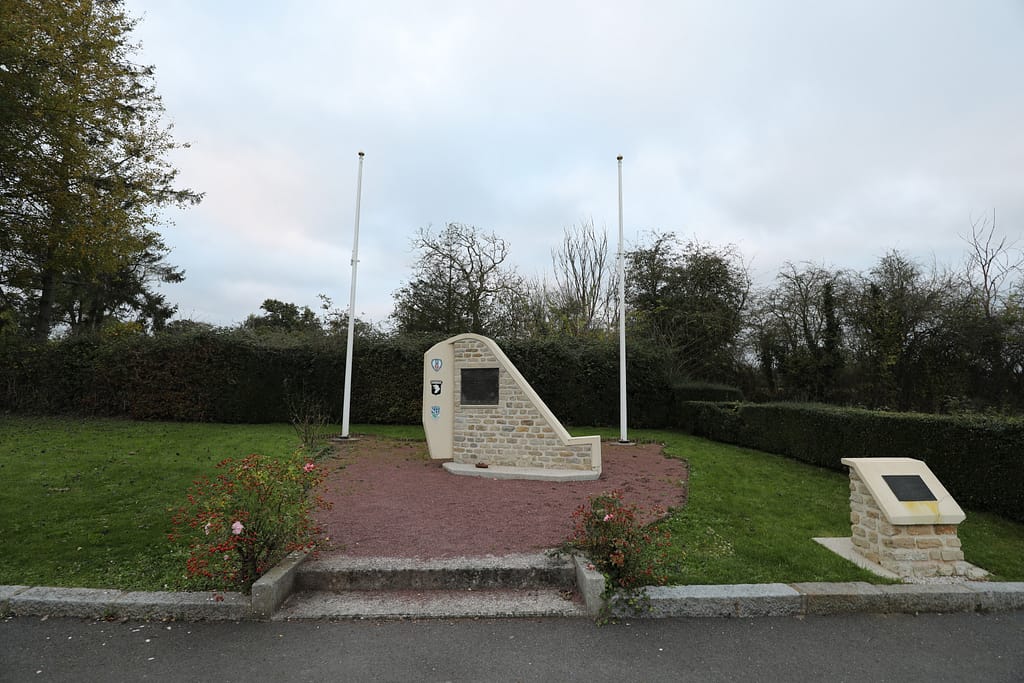
Post D-Day
At Brecourt Manor near Saint-Marie-du-Mont, elements of Easy and Dog Companies 2-506 PIR, under Lieutenant Richard Winters, eliminated a German artillery battery that was firing on Exit 2 from Utah Beach. This action was depicted in the Tom Hanks/Steven Spielberg production ‘Band of Brothers’. I had the opportunity to explore the Brecourt Manor battlefield and this is the subject of a separate post.
In the days following D-Day, the 101st Airborne was able to concentrate around Saint-Marie-du-Mont and undertook a division-level assault to seize the town of Carentan. This action is the subject of a separate post, as is the counterattack by 17th SS ‘Götz von Berlichingen’ Panzergrenadier Division at Bloody Gulch on 13 June 1944.
⚔️ Go deeper — Members get exclusive access to the Deep Research Collection, Field Notes, and monthly Research Dispatches. Try membership free for 7 days, cancel anytime. From $9/month.
82nd Airborne Division operations ‘Operation BOSTON’
D-Day mission
The 82nd Airborne Division aimed to seize key bridges over the Merderet River and establish a defensive position west of Sainte-Mère-Église around Amfreville and Cauquigny. The division also encountered chaotic landings, with some troops landing miles from their designaed Drop Zones.
505 PIR (Parachute Infantry Regiment) landed in and around the town of Sainte-Mere-Eglise. As the paratroopers descended, the townspeople and the German garrison were turned out to fight a fire in the house of Madame Pommier on the church square. Madame Pommier’s house site is now the site of the Airborne Museum. Private John Steele, 2-505 PIR, famously became hung up on the church steeple by his parachute for several hours. The fighting for Sainte-Mere-Eglise was brutal but within a few hours the town was secure.
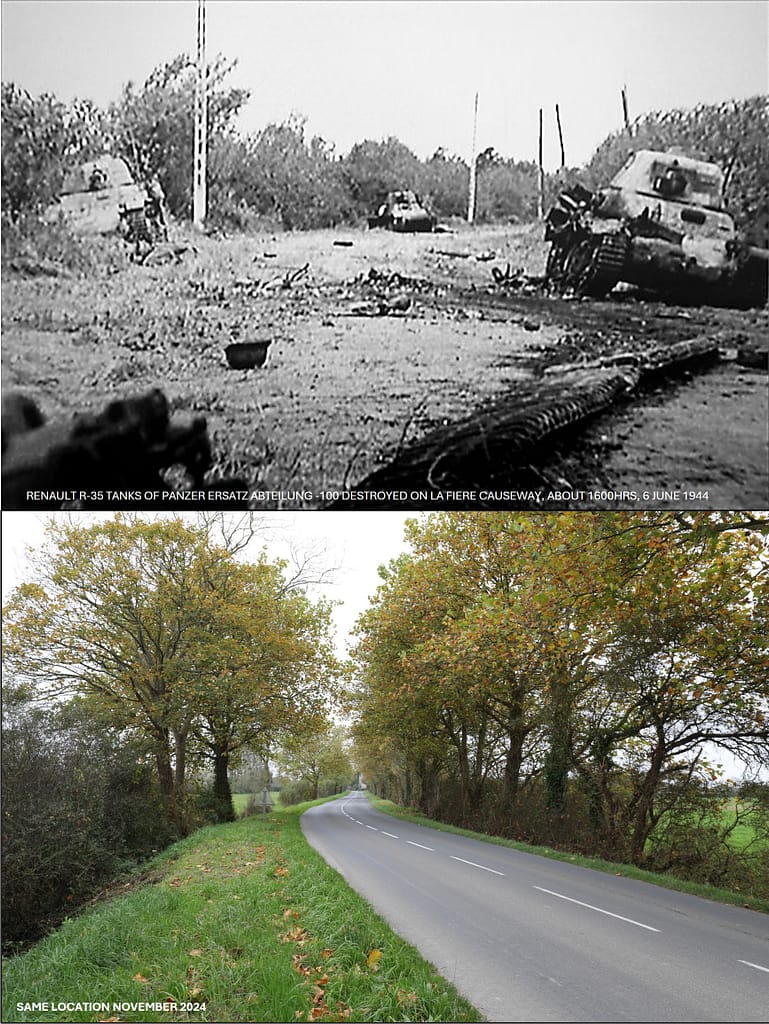
Post D-Day
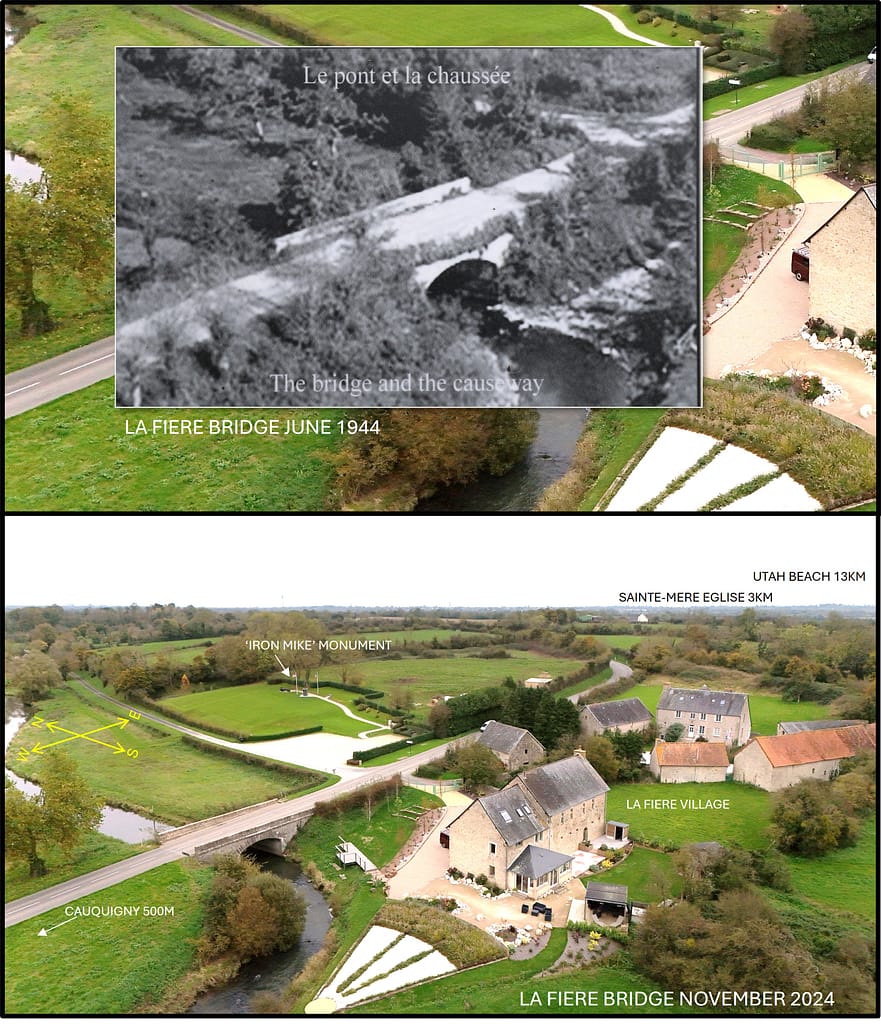
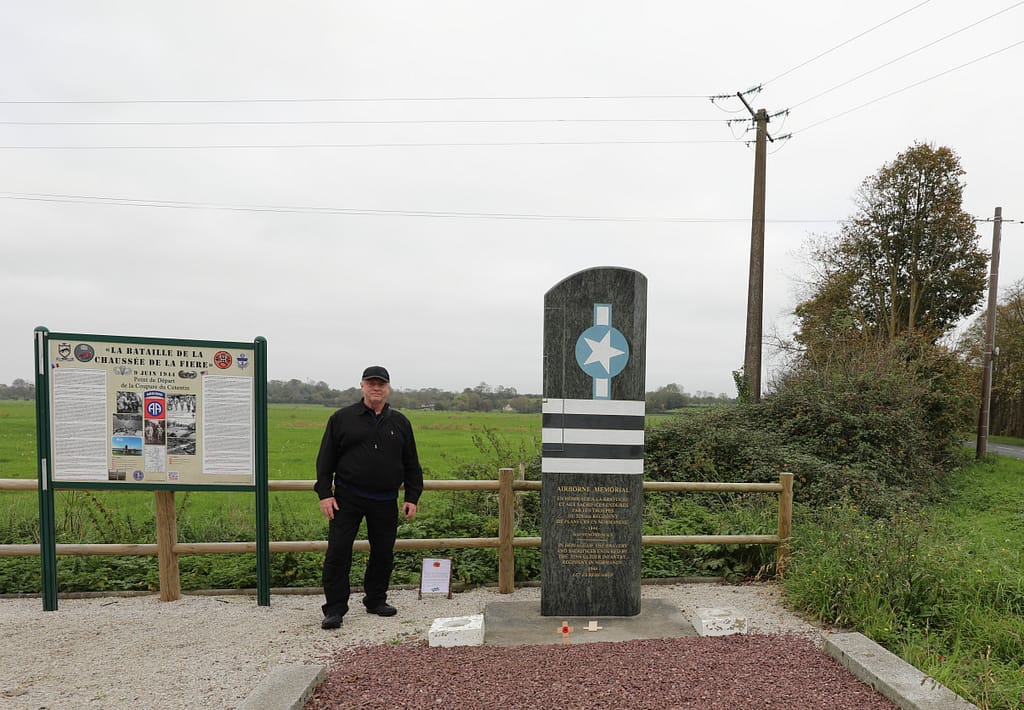
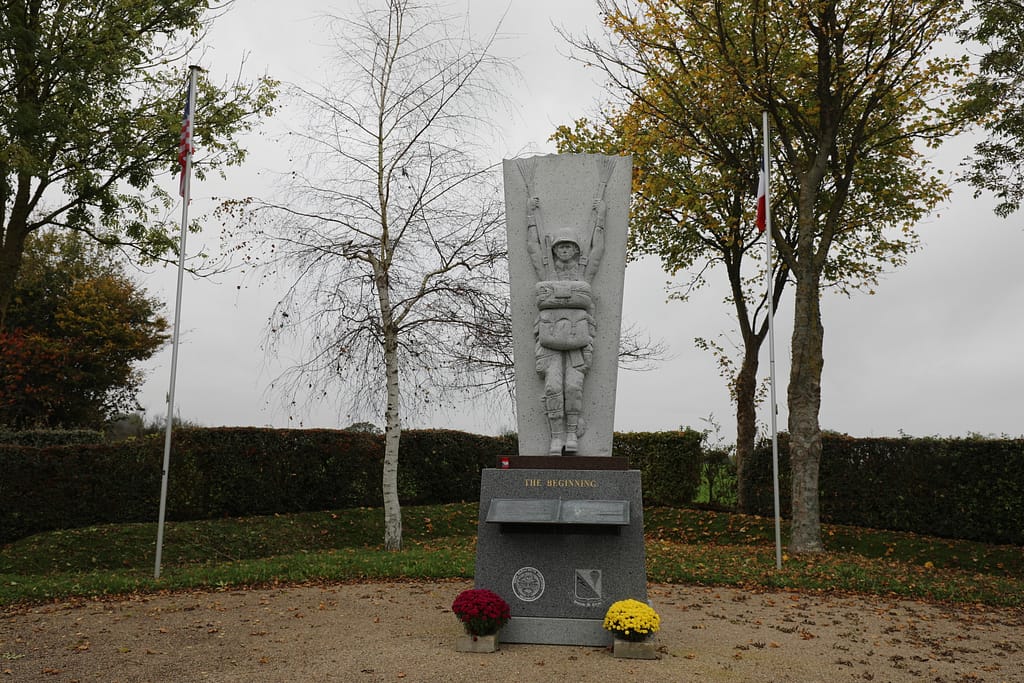
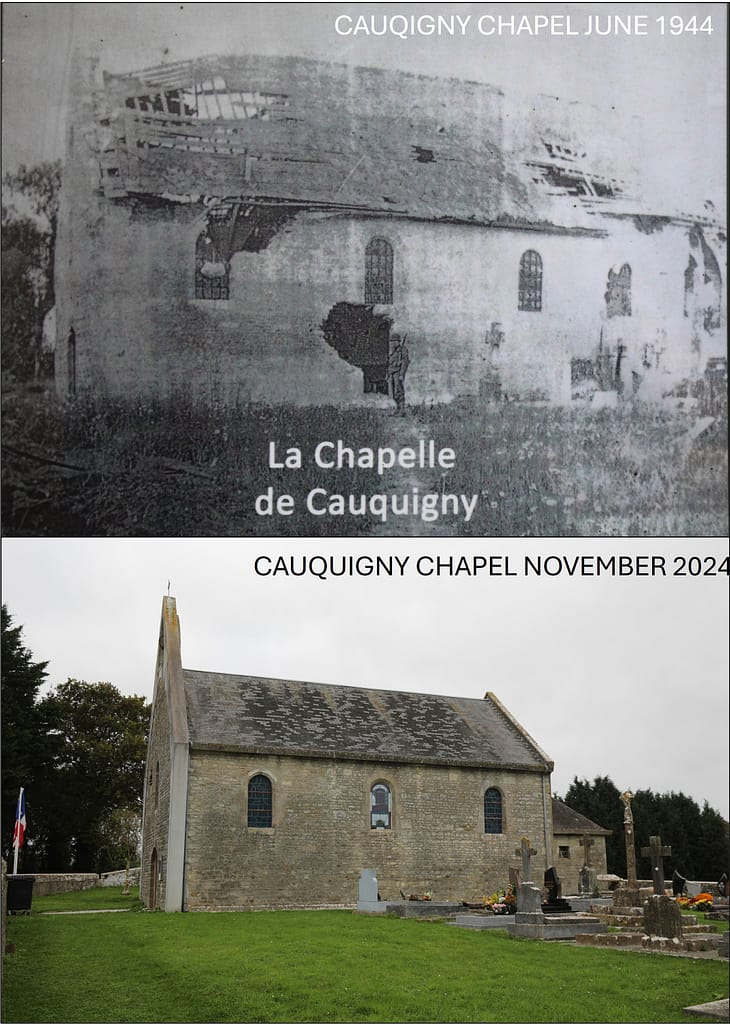
Elements of 505 PIR, 507 PIR and 325 GIR (Glider Infantry Regiment) fought a major action to secure the causeway over the flooded Merderet River at La Fiere and Cauquigny. The paratroopers rapidly secured the causeway but were then subjected to aggressive German armoured counterattacks. I have posted separately on the Battle for La Fiere. The Battle for La Fiere was the basis for the final act of Tom Hanks/Steven Spielberg production ‘Saving Private Ryan’ in which a mixed group of paratroopers defend a bridge over the Merderet River at the fictional town of ‘Ramelles’.
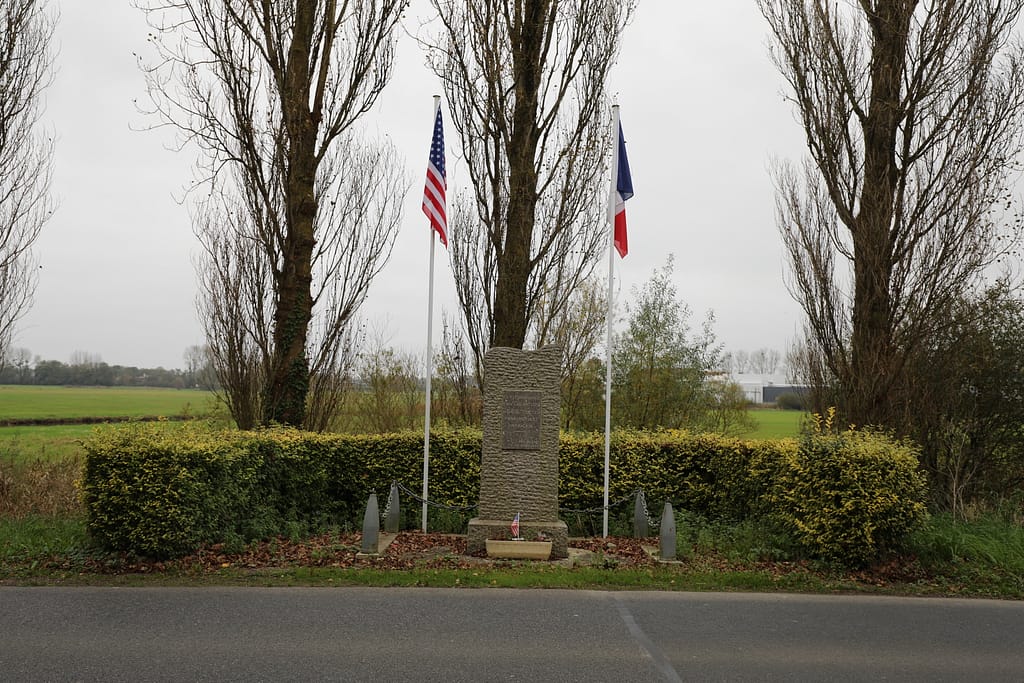
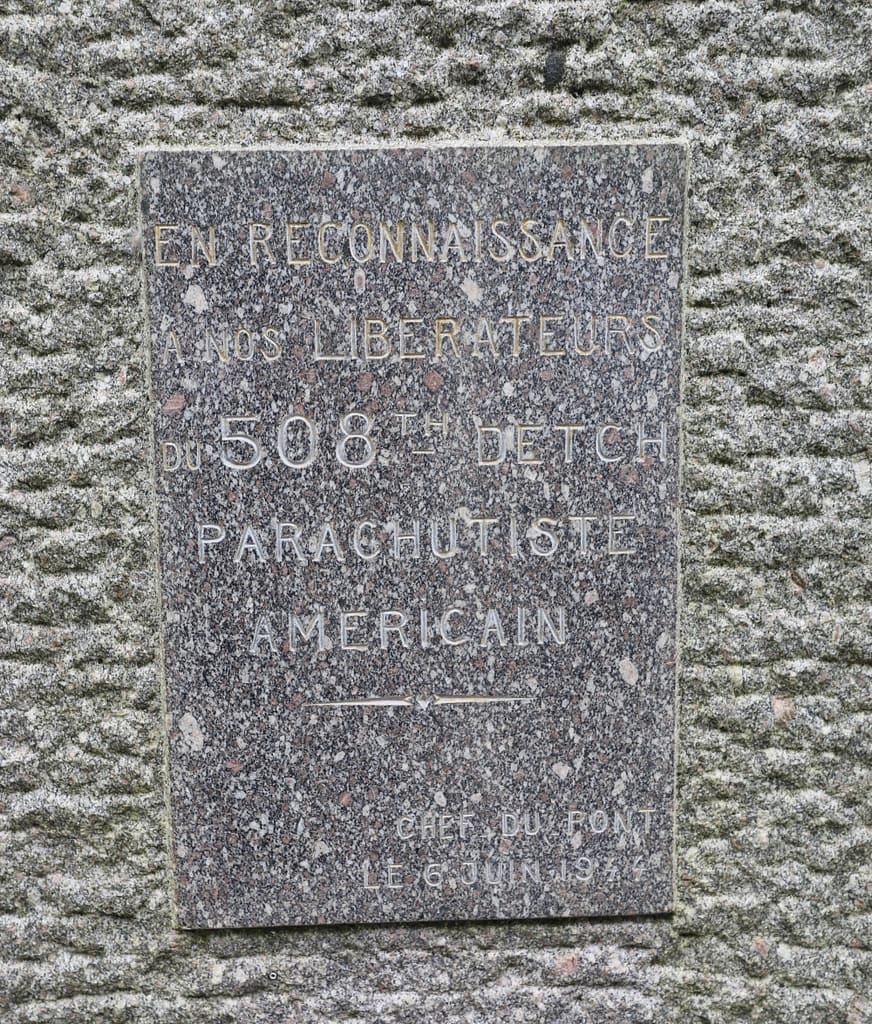
508 PIR and elements of 505 and 507 PIR fought a separate action at Chef du Pont Bridge over the Merderet River. Commander 1-507 PIR, LTCOL Edwin Osterberg, led an aggressive rush to seize the bridge but was wounded and several of his men killed. The American forces were able to secure the town but German resistance at the bridge was initially too strong for the lightly armed paratroopers. With reinforcements from the 325 GIR, the Americans seized the west bank of the Merderet on 9 June.
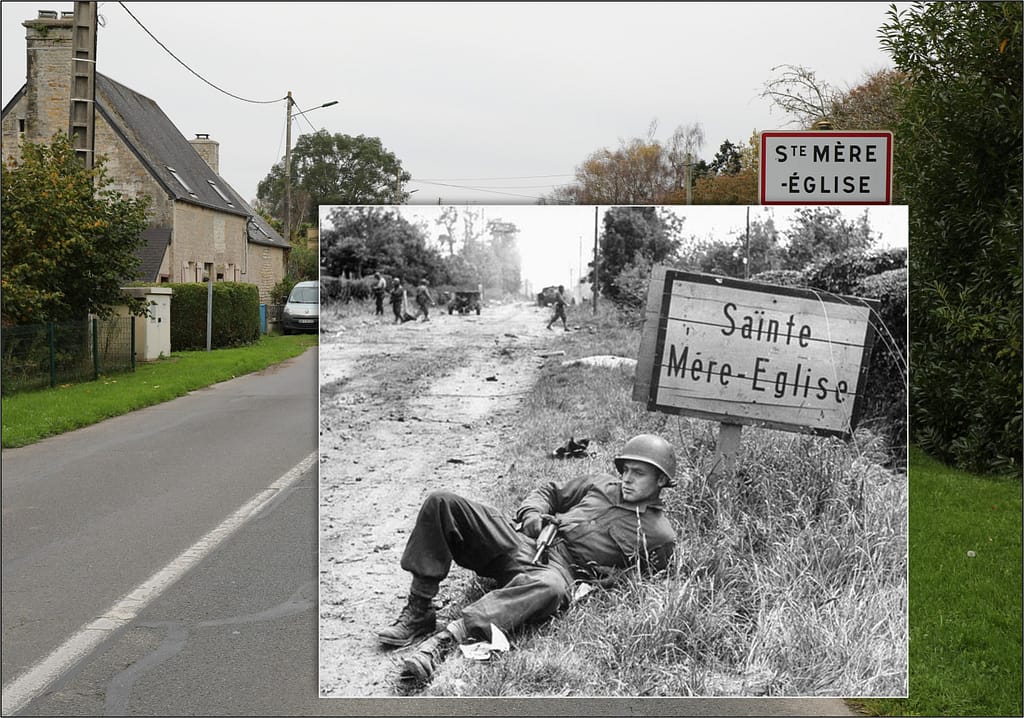
Strategic impact of the US airborne operations on D-Day
The US airborne landings on D-Day were a high-risk/high-payoff operation that largely achieved their objectives. Despite the paratroopers being widely dispersed from their planned drop zones, junior leaders were able to gather up little groups of paratroopers and cause havoc behind the German lines. With so many small unit actions happening at the same time, the German ability to understand the situation was severely compromised. Consequently, the German response was delayed, spread too thin, and was too late to halt the allied lodgement.
The American landings at Utah Beach were the least costly of all the D-Day amphibious landings, partly due to the effectiveness of the airborne forces interdicting all German activity behind the beach.
Sainte-Mère-Église was the first town in France to be liberated by the Allies. The US airborne operations in this area, like the British airborne operations at Pegasus Bridge and Ranville created the conditions for the successful landing of 150,000 allied troops on D-Day, 6 June 1944.
Sainte-Mere-Eglise battlefields today
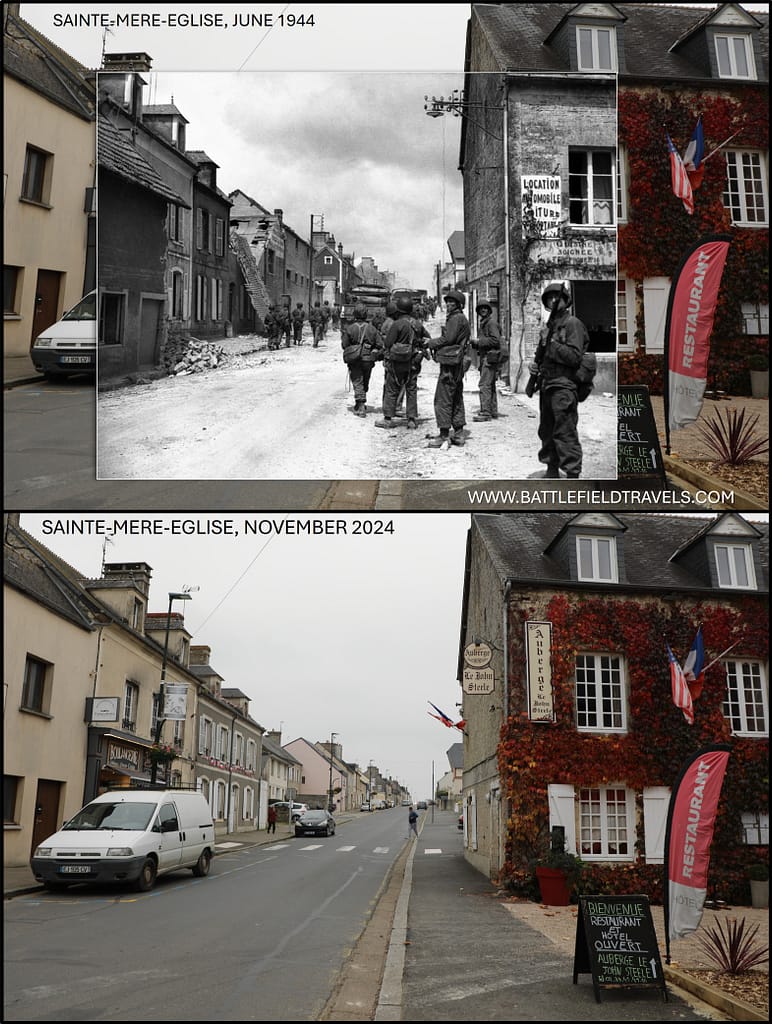
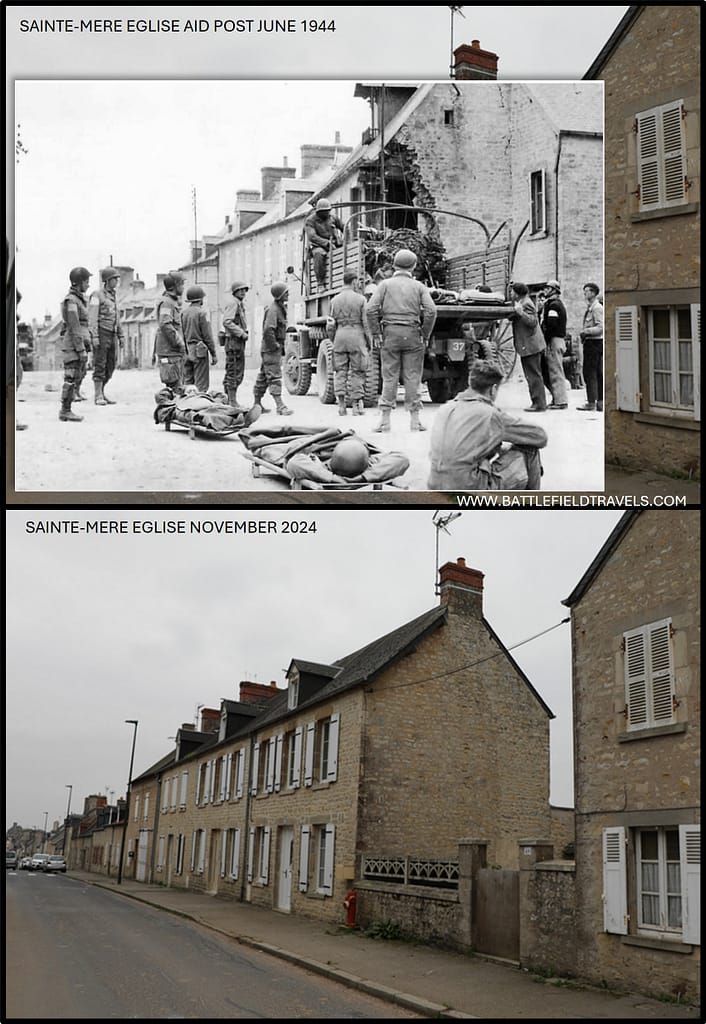
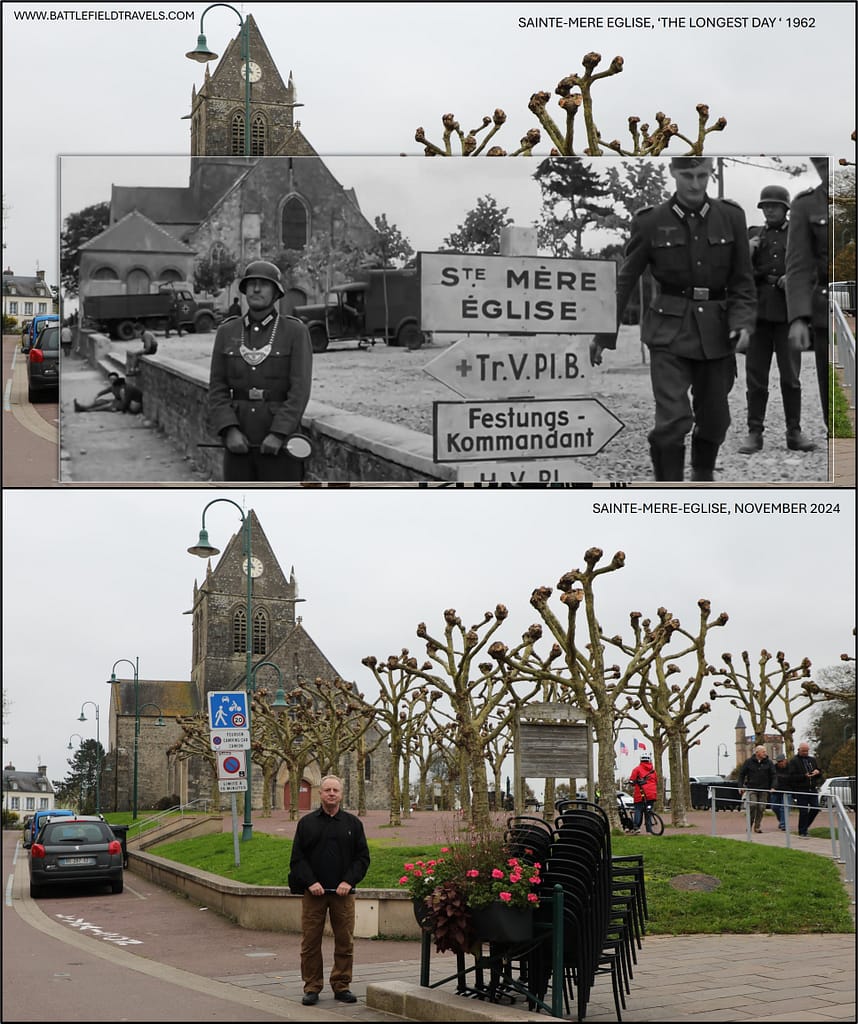
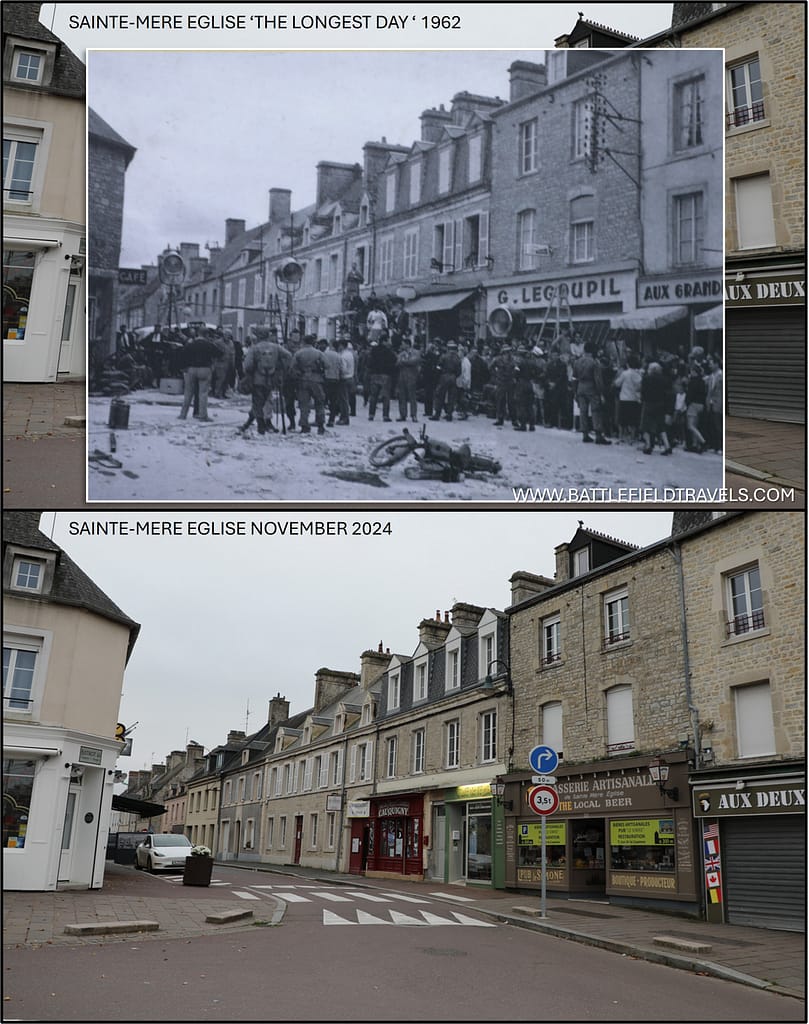
Sainte-Mere-Eglise has remained largely unchanged since 1944. The church and the houses around the main square are beautifully preserved and feature in many WW2-vintage photos. On the church steeple there is still an effigy of a paratrooper hanging by his parachute, to commemorate Private John Steele’s experience on D-Day.
The Airborne Museum in Sainte-Mere-Eglise has an incredible range of original artefacts, including a Waco Glider, a C-47 Dakota, an 88mm anti-aircraft gun, and many items of personal equipment used by both sides.
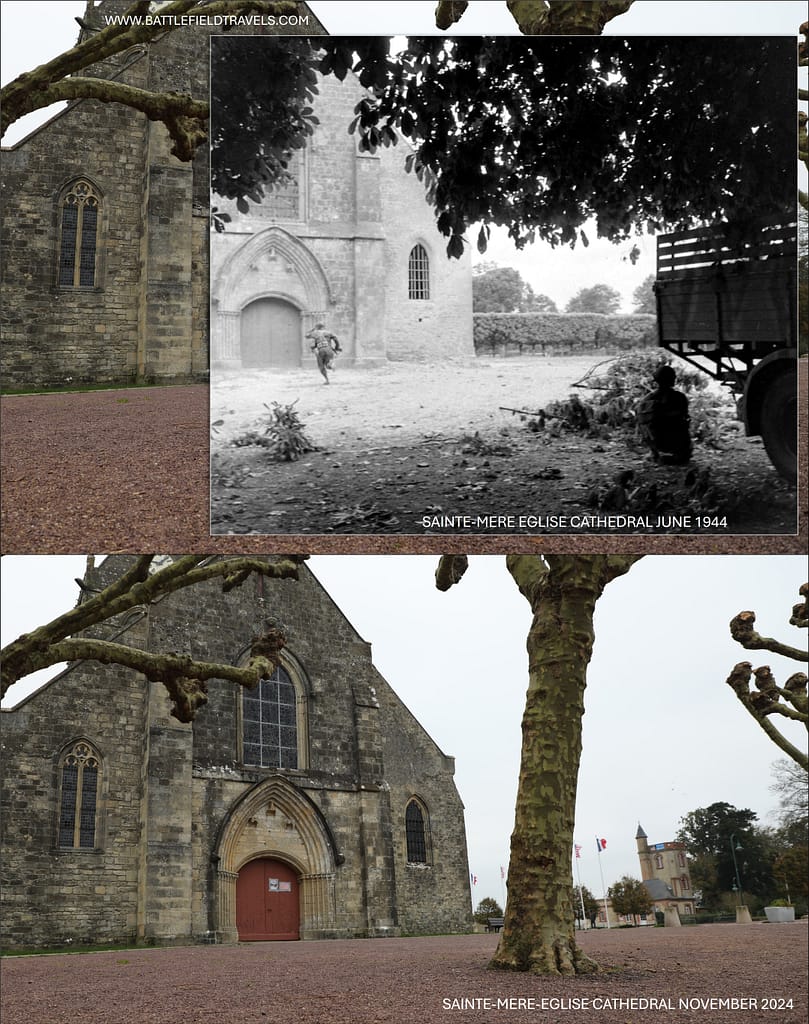
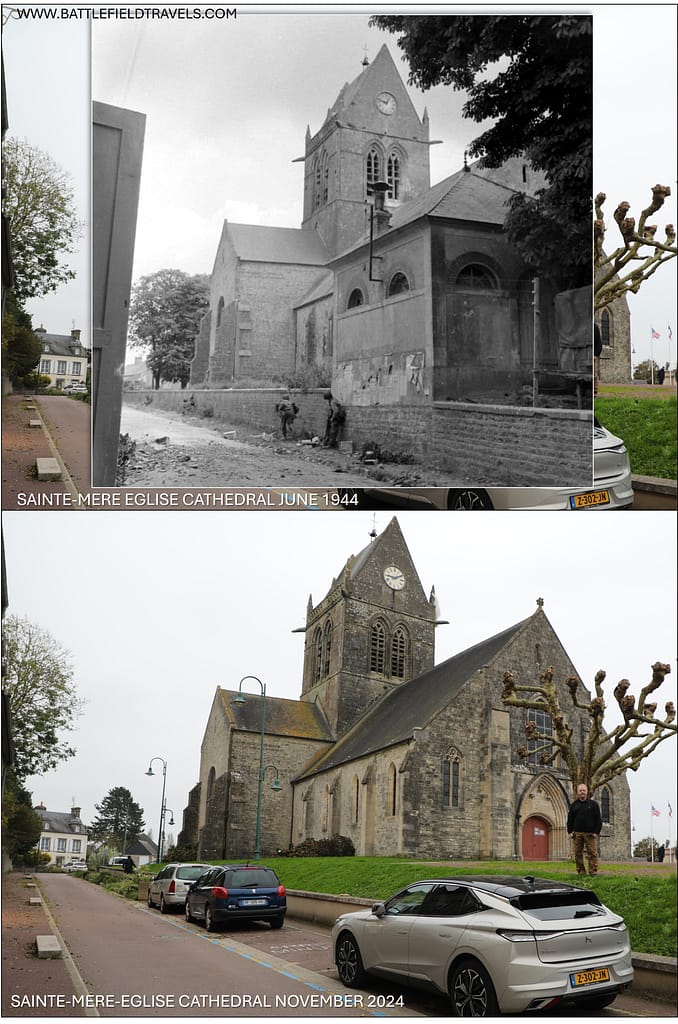
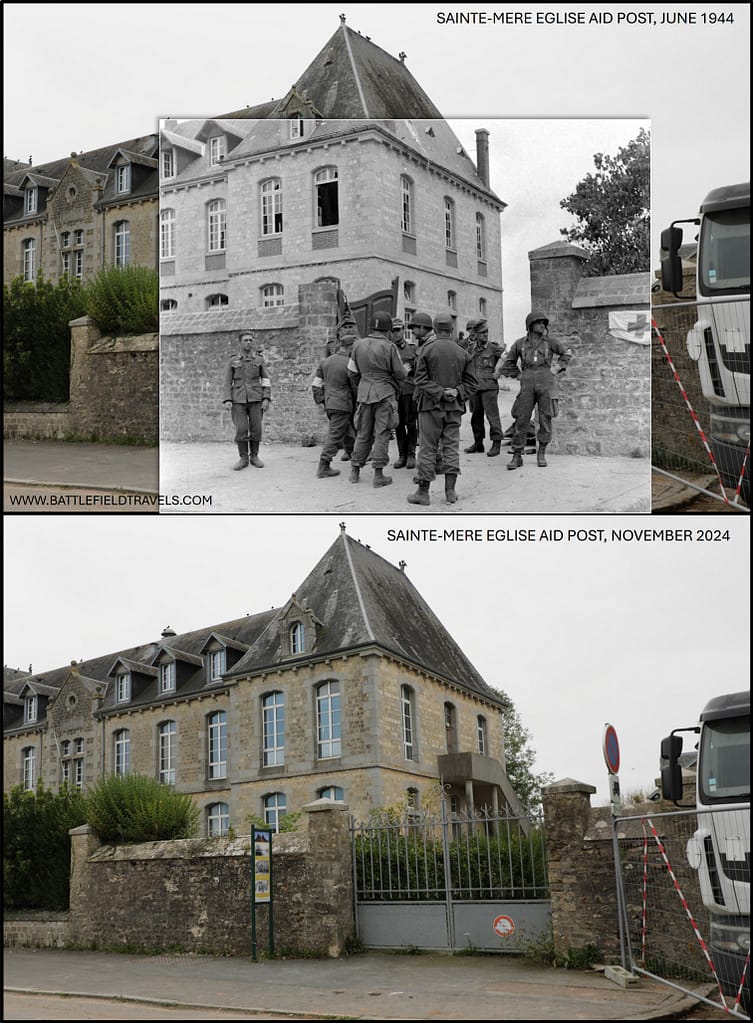
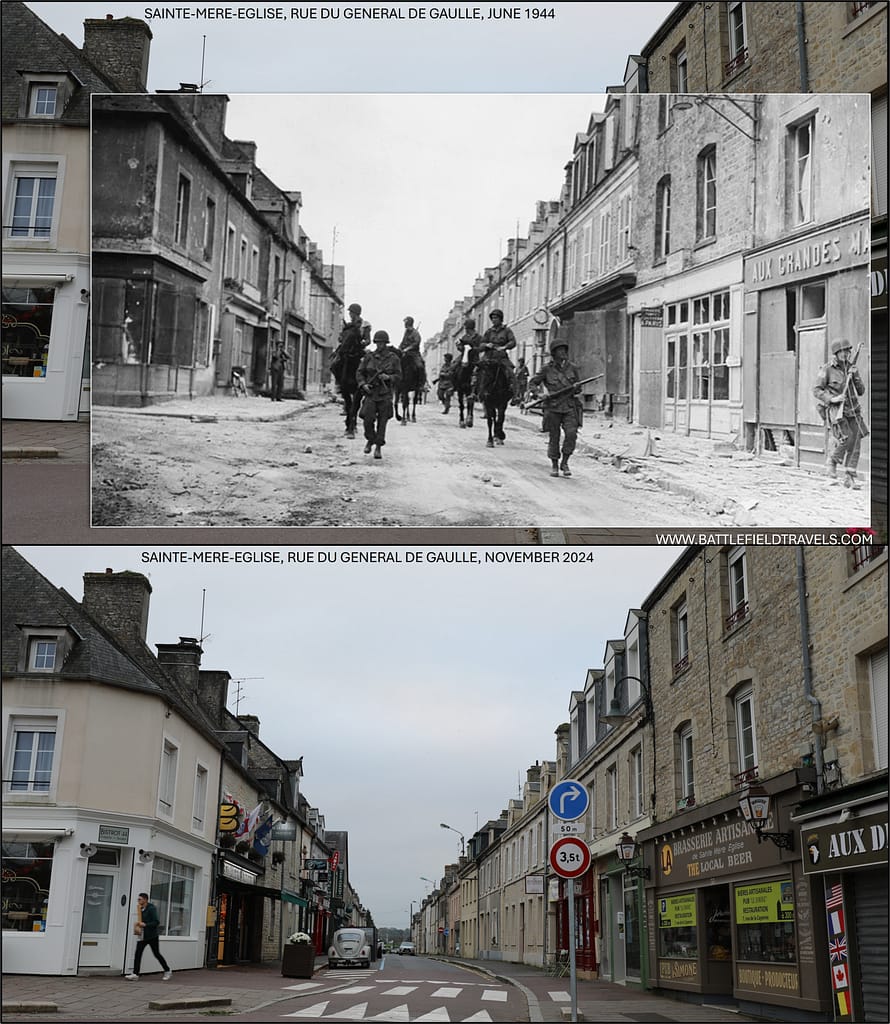
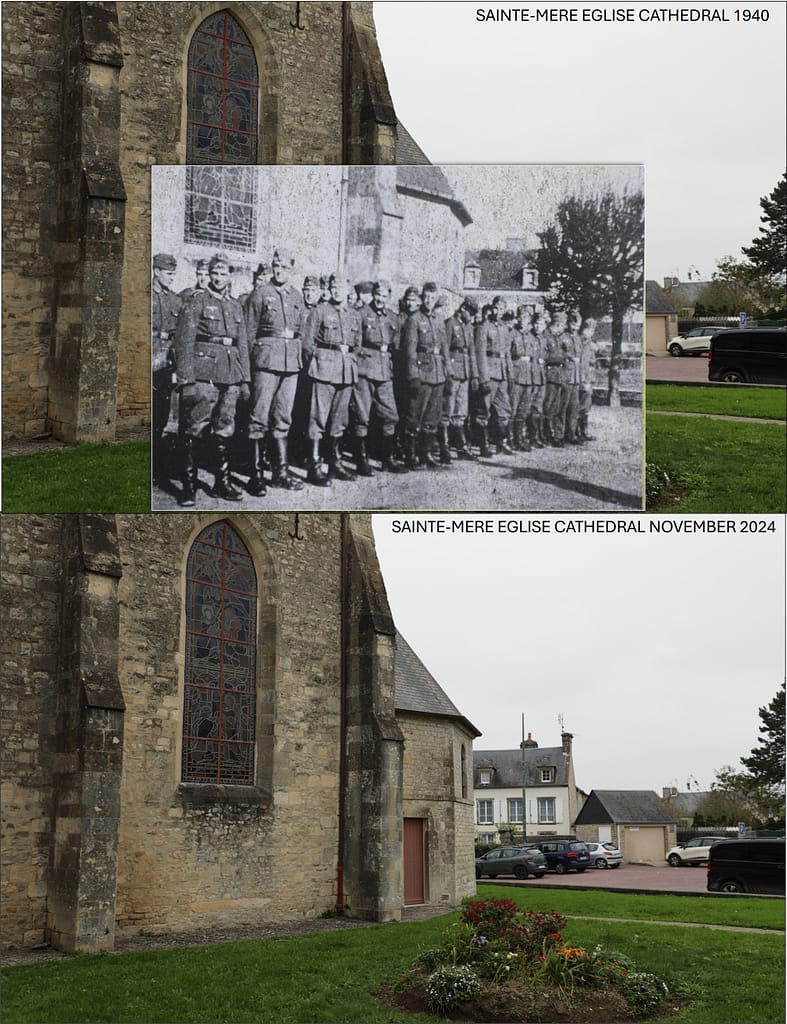
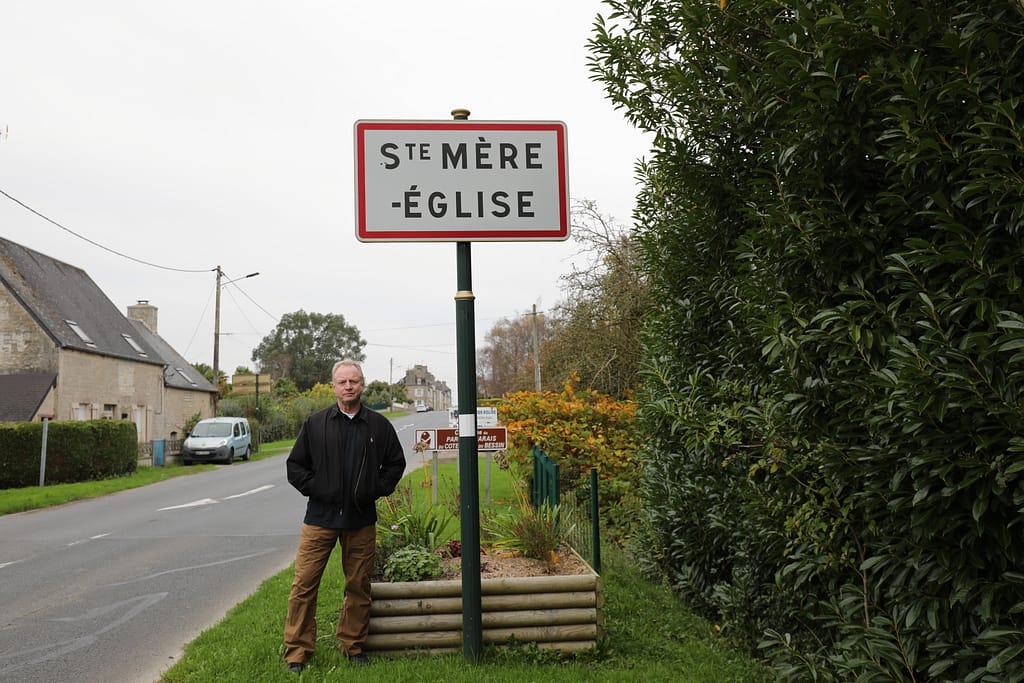
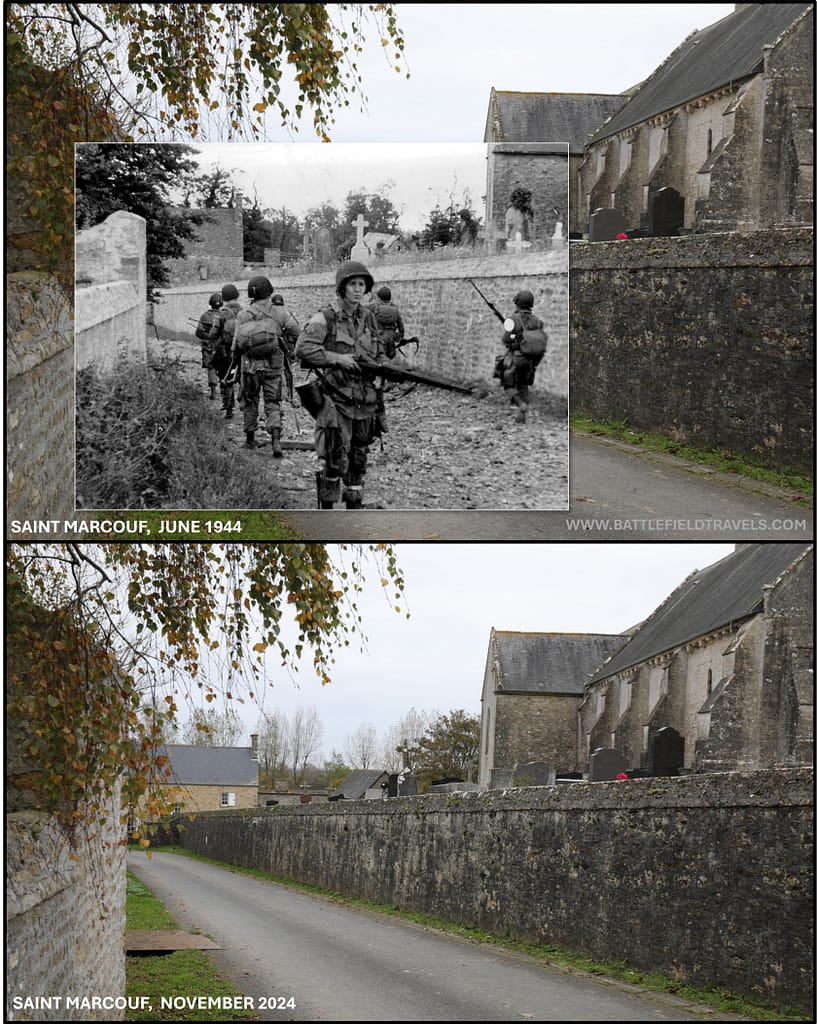
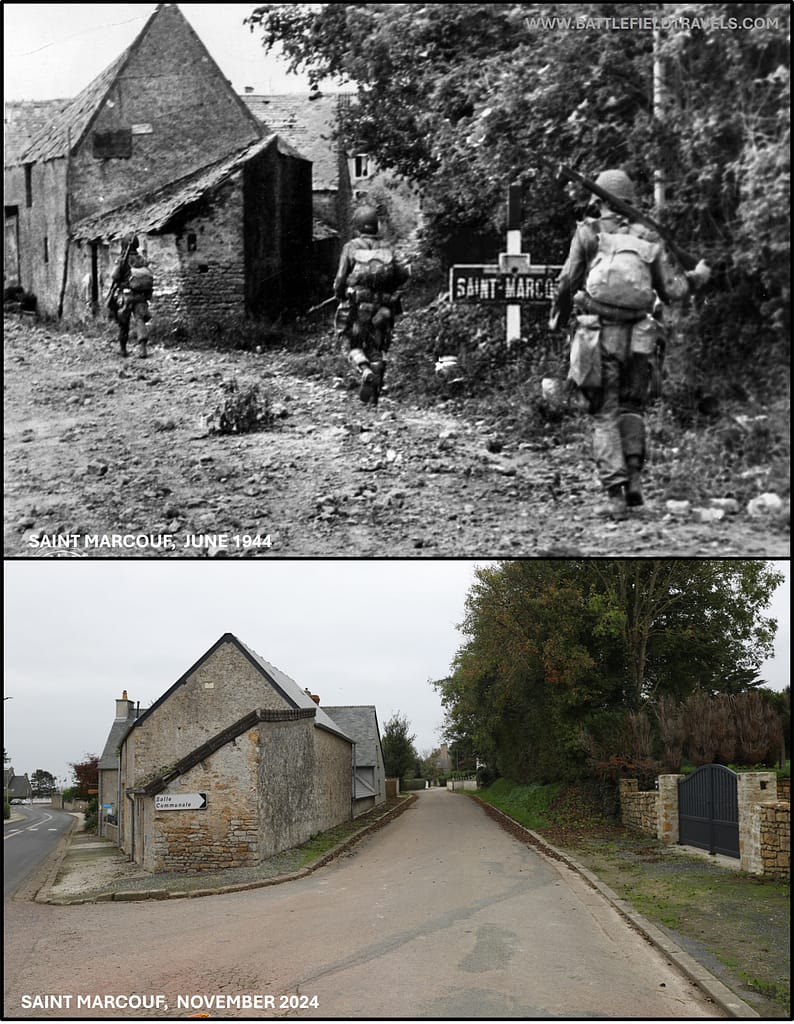
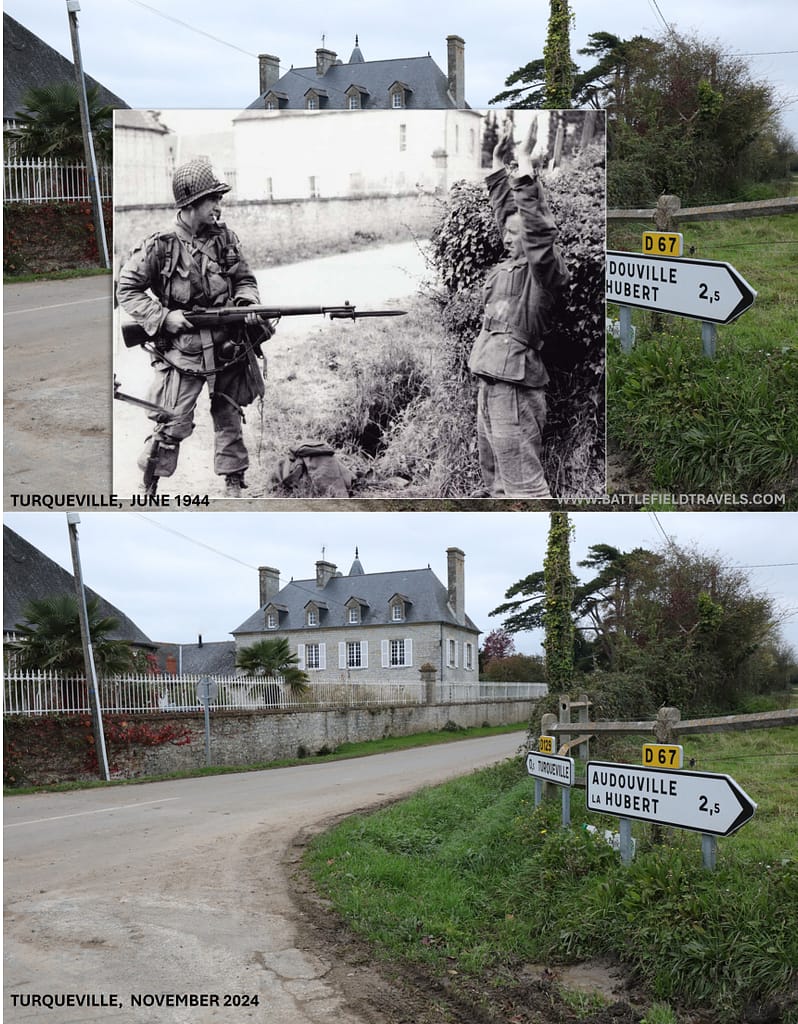
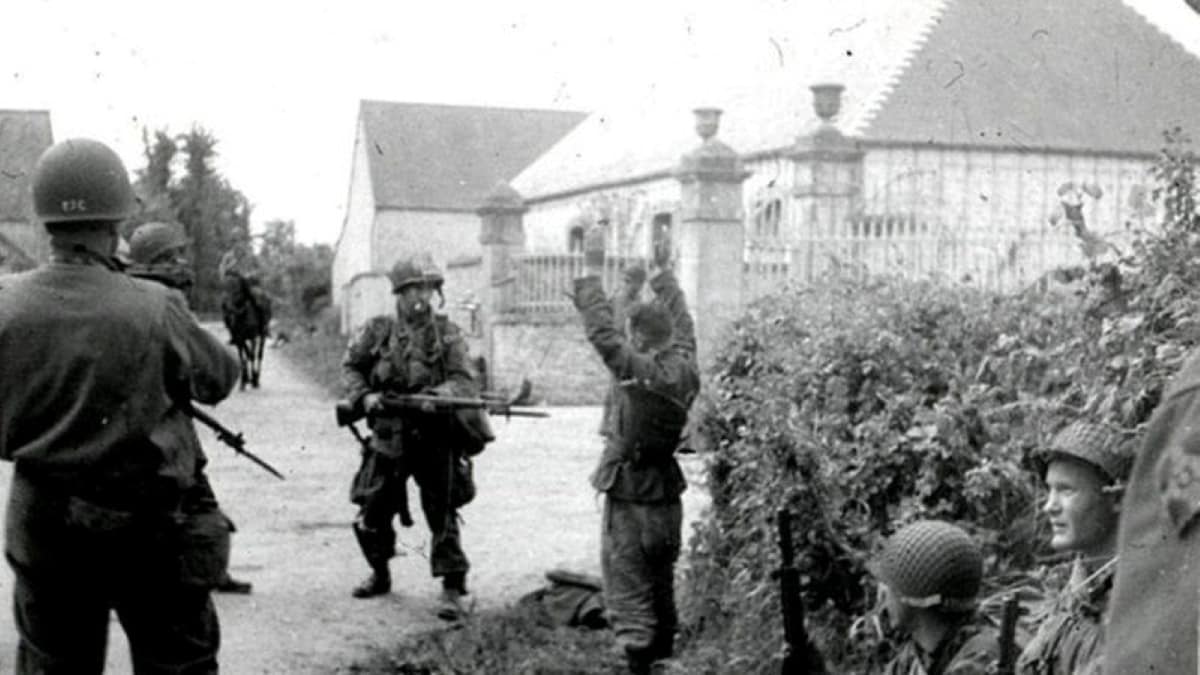
In the weeks leading up to our trip to France, I pored over old WW2 photographs and Google Earth Pro street view to find the exact locations where those photos were taken in June 1944. On arrival in Sainte-Mere-Eglise, we then tracked down all those photo sites to capture the same shots from the same angles. Here are just a few!
Sainte-Mere-Eglise
Sainte-Mere=Eglise was one of the D-Day objectives for the 82nd Airborne Division and was the first French town to be liberated by the allies.

Sainte-Mere Eglise cathedral. Paratroopers from the 505th Parachute Infantry Regiment, 82nd Airborne Division, landed all over this area. Private John Steele landed on the roof of the cathedral and his parachute caught in the eaves. 
Sainte-Mere Eglise cathedral. Paratroopers from the 505th Parachute Infantry Regiment, 82nd Airborne Division, landed all over this area. Private John Steele landed on the roof of the cathedral and his parachute caught in the eaves. 
Sainte-Mere Eglise cathedral. Paratroopers from the 505th Parachute Infantry Regiment, 82nd Airborne Division, landed all over this area. Private John Steele landed on the roof of the cathedral and his parachute caught in the eaves. Sainte-Mere Eglise cathedral. Paratroopers from the 505th Parachute Infantry Regiment, 82nd Airborne Division, landed all over this area. Private John Steele landed on the roof of the cathedral and his parachute caught in the eaves. 
Sainte-Mere Eglise cathedral. Paratroopers from the 505th Parachute Infantry Regiment, 82nd Airborne Division, landed all over this area. Private John Steele landed on the roof of the cathedral and his parachute caught in the eaves.
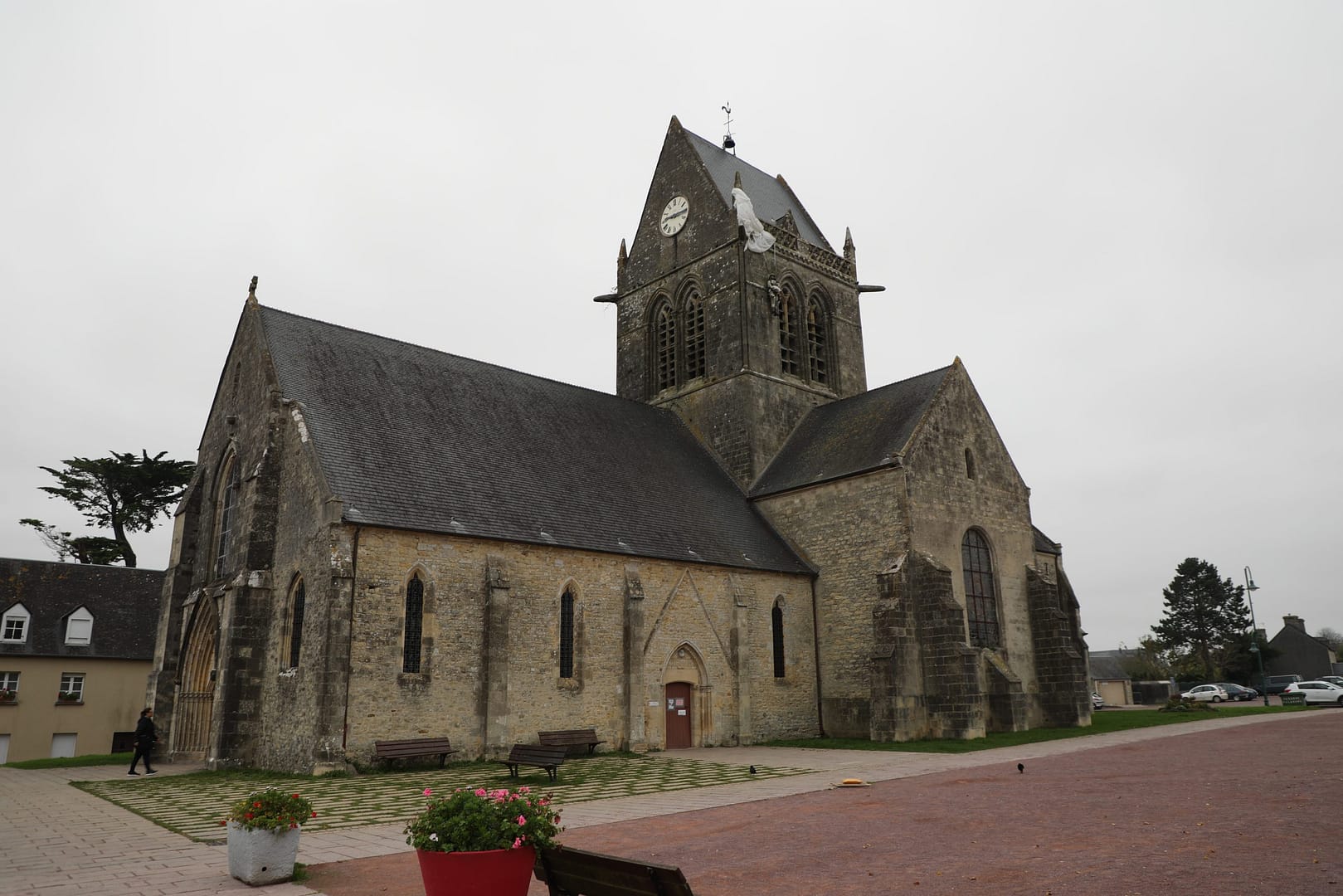
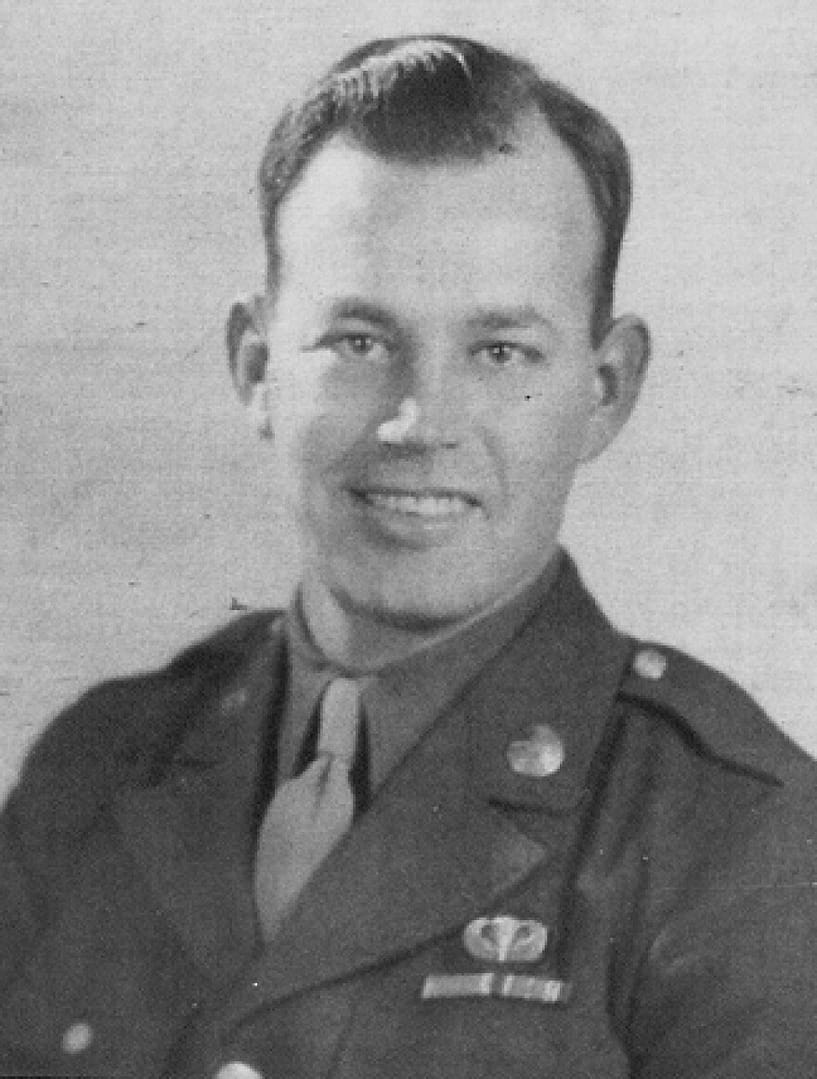
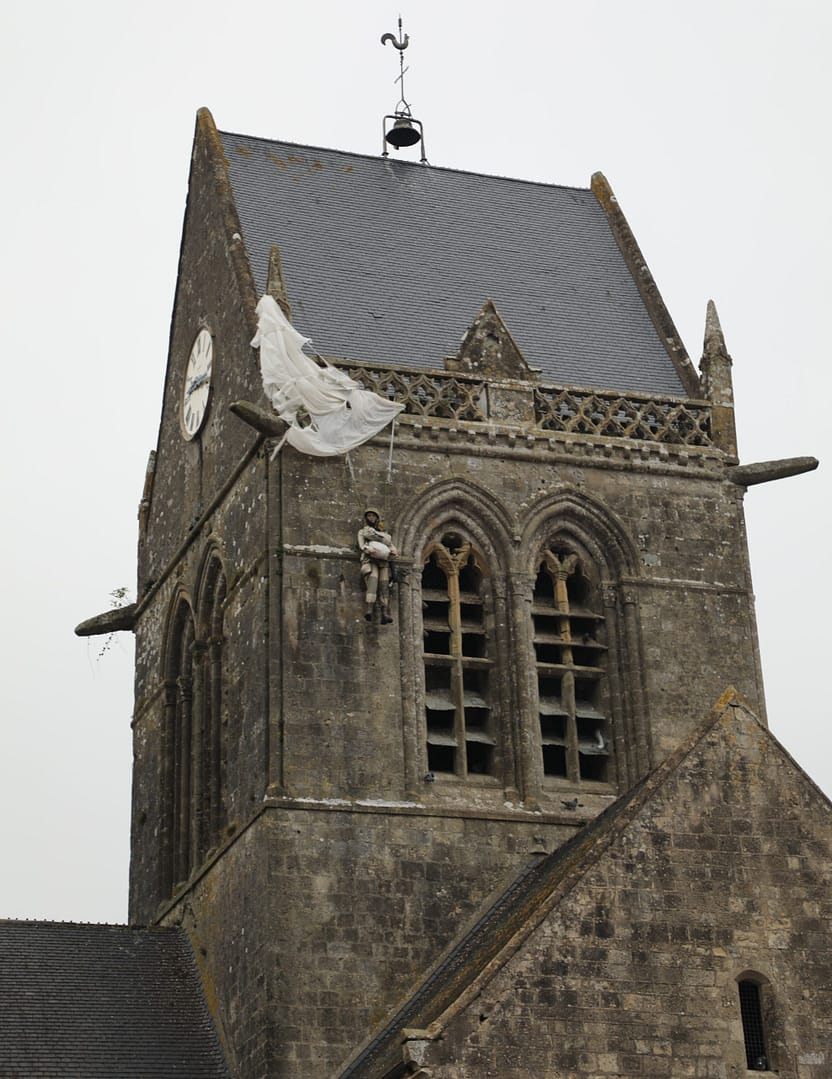
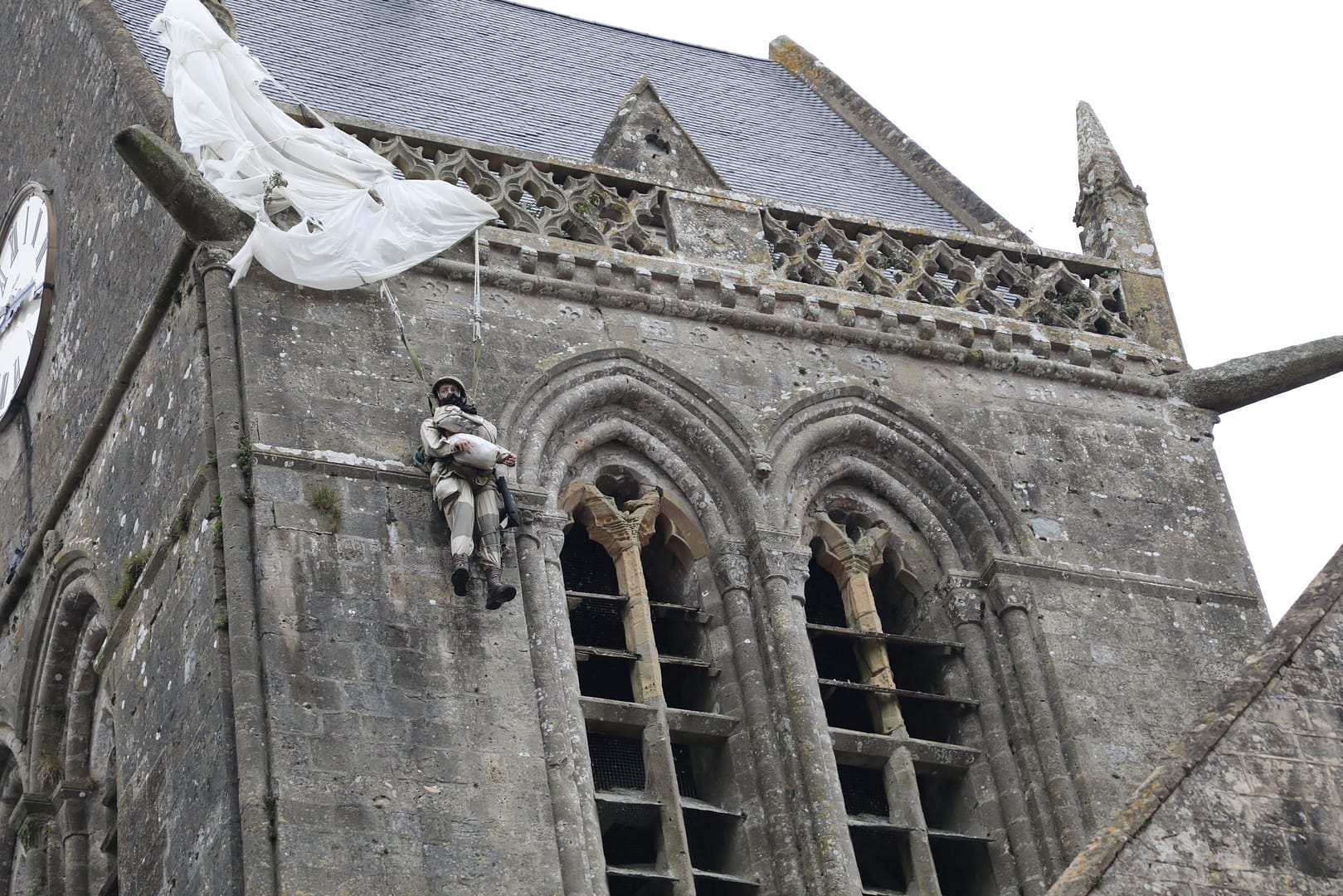

Sainte-Mere Eglise cathedral. Paratroopers from the 505th Parachute Infantry Regiment, 82nd Airborne Division, landed all over this area. Private John Steele landed on the roof of the cathedral and his parachute caught in the eaves. He hung up there for more than four hours. To this day, there is an effigy of Private Steele hanging on the cathedral roof. Red Buttons played Private John Steele in the 1962 movie ‘The Longest Day’

Saint Marcouf
Turqueville
Ravenoville
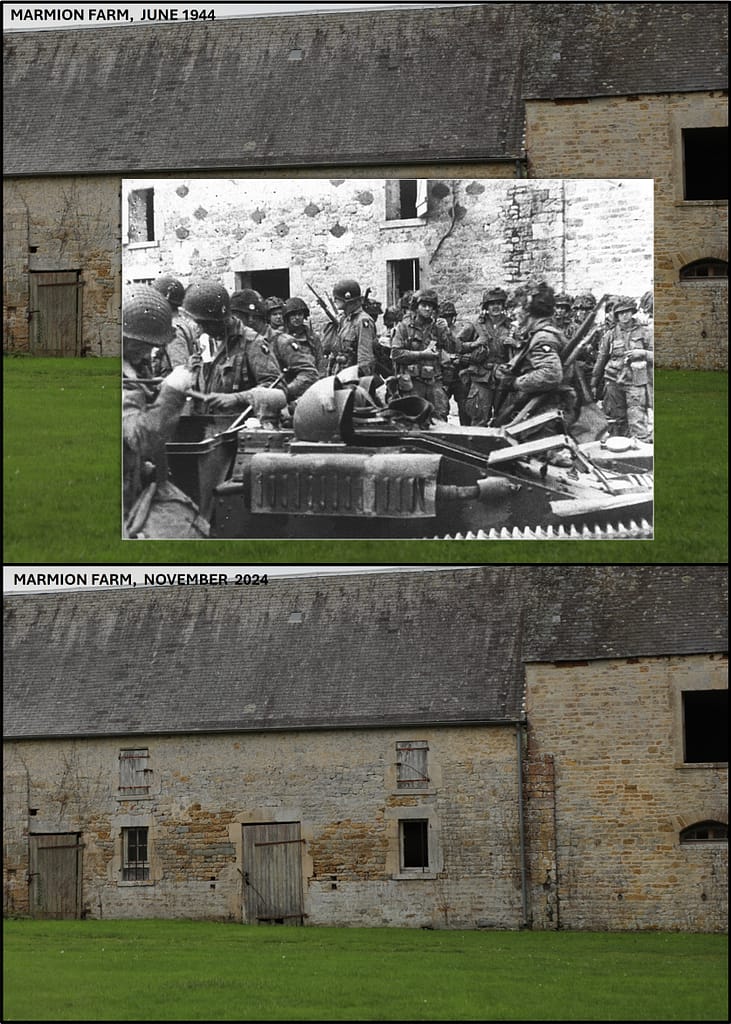
Easy Company ‘Band of Brothers’ 2-506 PIR sites around Sainte-Mere-Eglise
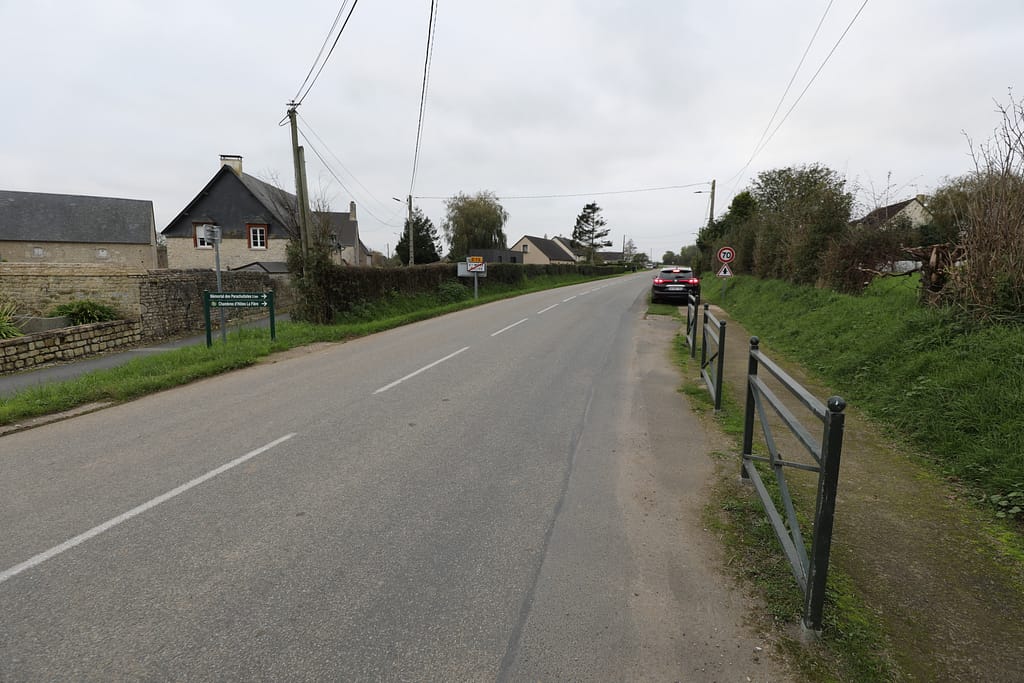
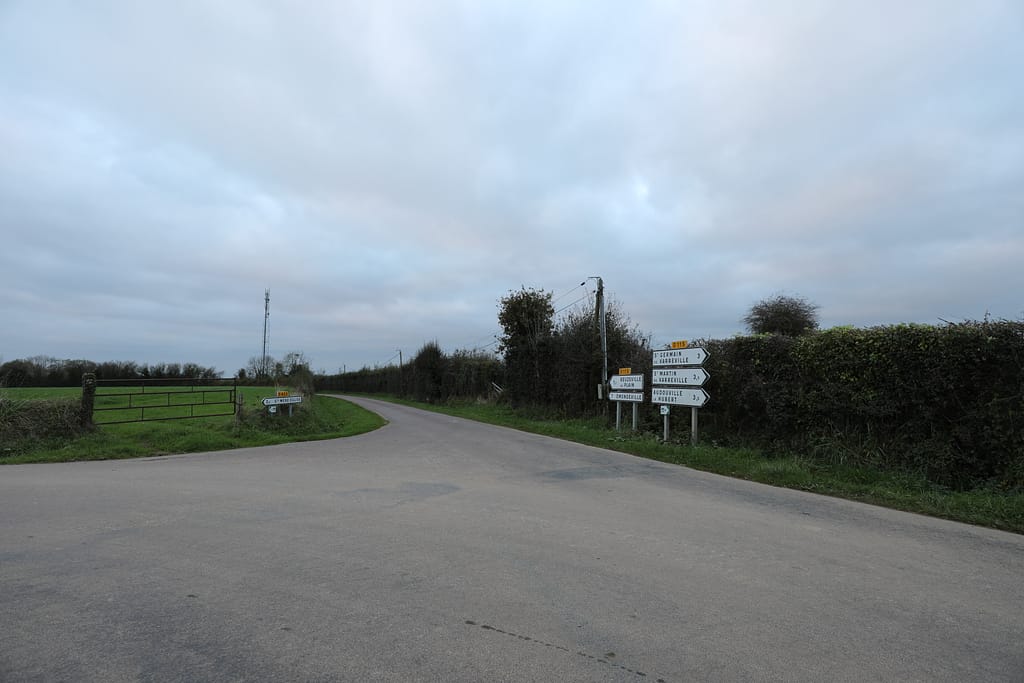
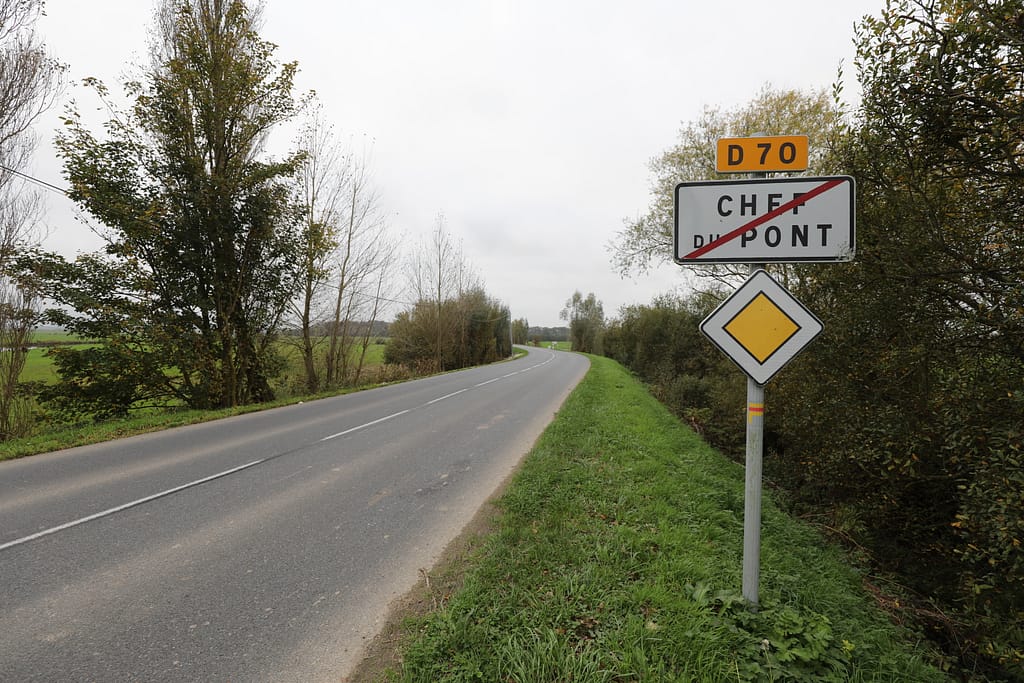
Chef du Pont Bridge
Chef du Pont was one of two bridges (along with La Fiere Bridge) designated as objectives for the 82nd Airborne DIvision on D-Day. These two bridges and causeways over the flooded Merderet River were crucial for getting the US forces off Utah Beach
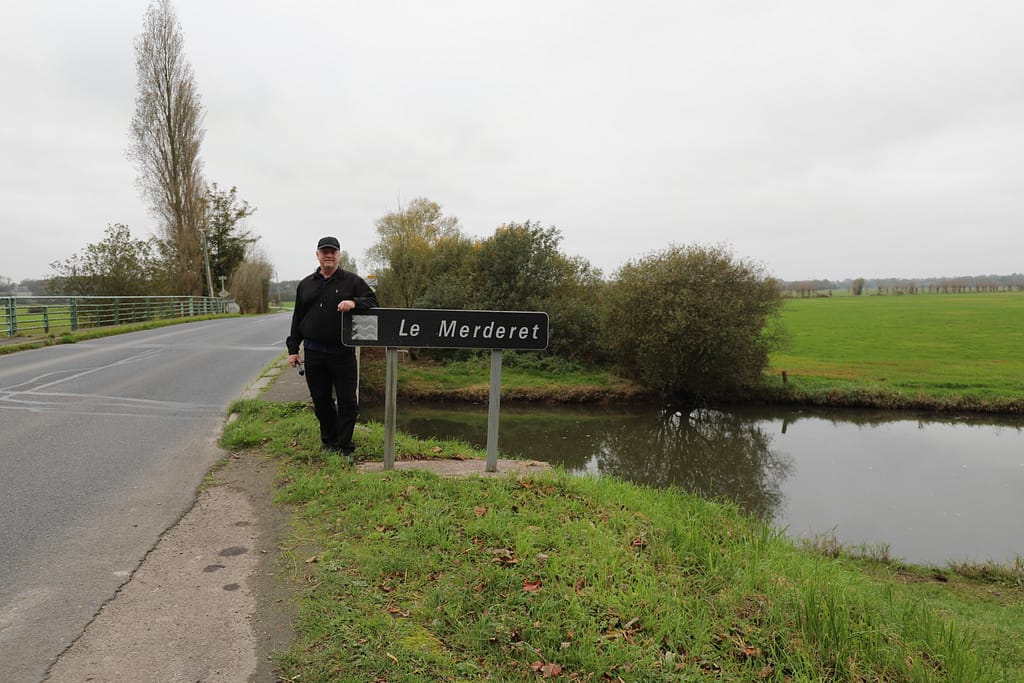
La Fiere Causeway
The Battle for La Fiere Bridge is covered in a separate, more detailed post
Cauquigny
Beuzeville au Plain
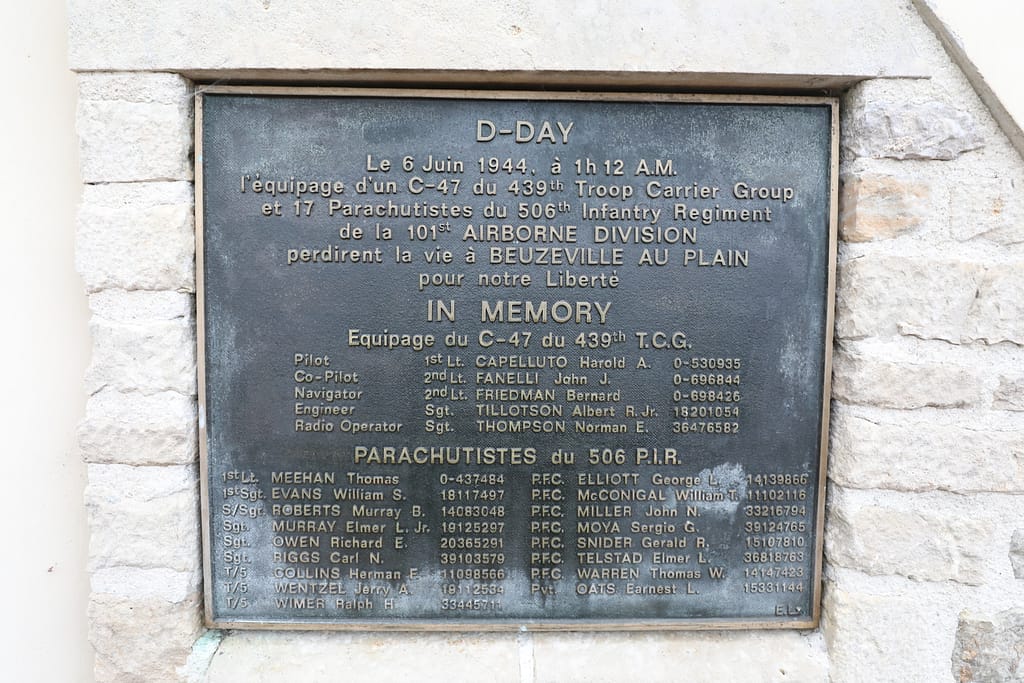
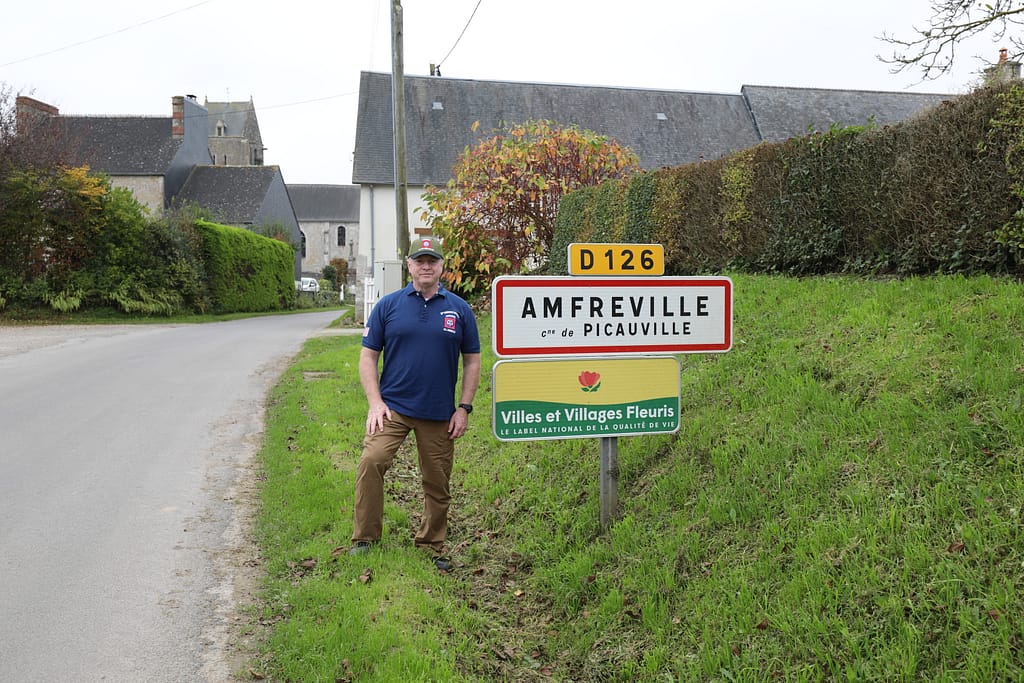
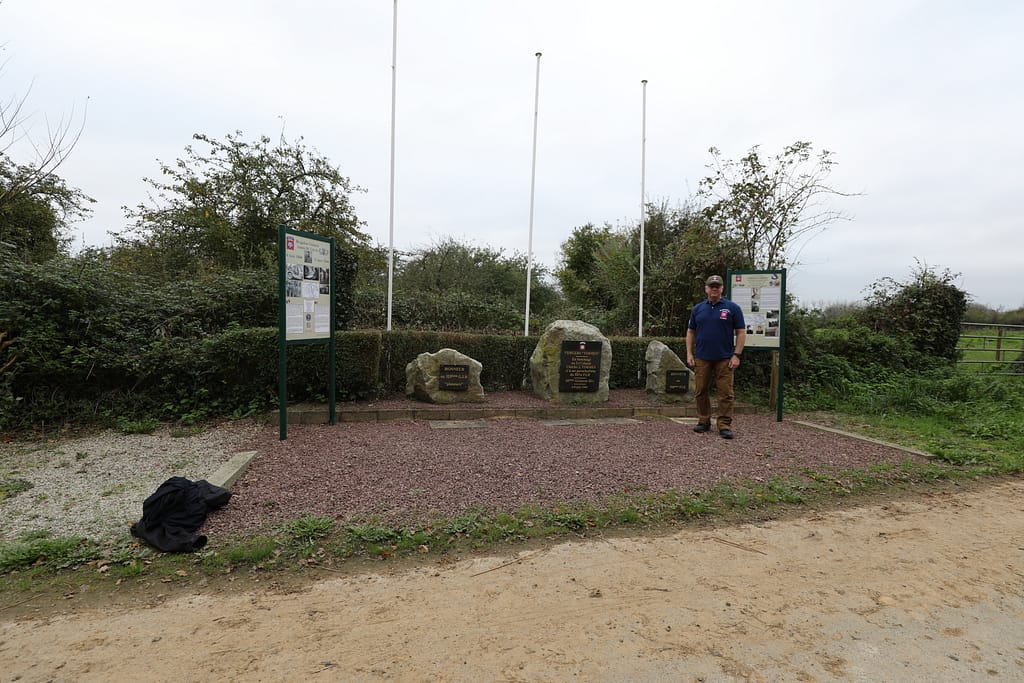
Amfreville
Darryl F. Zanuck’s ‘The Longest Day’ 1962
Link to the Sainte-Mere Eglise Airborne Museum website
Found this useful? Buy me a coffee — it helps fund future battlefield research


Authored by Mick Prictor, a retired military officer with 40 years’ service, and a military historian specialising in terrain-focused analysis of tactics, doctrine, and command decision-making in land warfare. His work draws on extensive battlefield fieldwork—more than 280 sites worldwide—and one of the world’s largest private collections of historic military arms, uniforms, and equipment. About me
❓ Test Your D-Day Knowledge
Twenty questions covering the airborne operations, invasion beaches, commanders, forces and fighting of 6 June 1944.
20 questions · 60% to pass · expect a challenge
Sources – D-Day airborne operations
- Ambrose, S. E. (1999). D-day, June 6, 1944: the climactic battle of World War II. Thorndike.
- Ambrose, S. E. (1992). Band of Brothers: E Company, 506th Regiment, 101st Airborne from Normandy to Hitler’s Eagle’s Nest. Touchstone, Simon & Schuster.
- Beevor, Antony. (2009). D-Day: The Battle for Normandy. Penguin Books
- Ryan, Cornelius (1959). The Longest Day: June 6, 1944. Simon and Schuster, New York.
- Hastings, Max (1984). Overlord : D-Day and the battle for Normandy. Simon and Schuster, New York.
- Robert M. Murphy (2011). No Better Place to Die: Ste-Mere Eglise, June 1944―The Battle for la Fiere Bridge. Casemate
- Niklas Zetterling (2000). Normandy 1944: German Military Organisation, Combat Power and Organisational Effectiveness, Winnipeg: J.J. Fedorowicz.
📚 Further Reading – US Airborne Operations on D-Day
This battle study nests within the broader analytical framework explored in the Research Hub, where operational methods, operating environments, armies, commanders, and weapons are examined across conflicts and eras. The links below connect related studies across the wider body of battlefield analysis on the BattlefieldTravels site.
⚔️ Explore all battle studies from World War Two 1939-1945
⚔️ Explore all battle studies involving Easy Company ‘Band of Brothers’ 506th PIR
🏛️Explore the museum of World War Two historic artefacts
The book list for this conflict includes the finest campaign studies, memoirs, and operational analyses available on the D-Day landings, selected specifically to complement this battlefield study.
📚World War Two – Recommended Reading
🗞️ For updates on new battlefield studies and research insights, you can subscribe to the Newsletter.
Related Battle Studies, Museum Pieces & Reading Resources
 ⚔️ D-Day: Brecourt Manor assault, Easy Company, 506th PIR,
6 June 1944
 ⚔️ D-Day: Utah Beach landings,
6 June 1944
 ⚔️ D-Day: Sword Beach landings,
6 June 1944
 ⚔️ D-Day: 101st Airborne Division and the Battle of Bloody Gulch,
13 June 1944
 ⚔️ D-Day: Omaha Beach landings,
6 June 1944
 📝 🔒Field Note: XXX Corps Orders, Leopoldsburg, Belgium, 15 Sep 1944
🧭 Battlefield Travel Guide: Sainte-Mère-Église (6 June 1944)
Getting There
- Location: Manche department, Normandy, France — about 12 km inland from Utah Beach.
- Access: Well signposted from Carentan and Sainte-Marie-du-Mont; ~35 km west of Bayeux via N13.
- Parking: Free parking near the church square and Airborne Museum.
Site Orientation
- Key Landmarks: Church of Sainte-Mère-Église with paratrooper effigy, Airborne Museum, La Fière causeway, Drop Zone sites.
- Best Vantage Points: Church square for the liberation scene; La Fière bridge for causeway fighting.
- Walking Routes: Trails along the Merderet River and causeways; driving loops connect to Utah Beach and Carentan.
Museums & Visitor Centres
- On-site: Airborne Museum — immersive exhibits on the 82nd & 101st Airborne landings, gliders, and equipment.
- Nearby: Dead Man’s Corner Museum at Carentan; Utah Beach Museum for the seaborne link-up.
On-Site Experience
- Interpretive Signage: Plaques mark drop zones, resistance sites, and battle actions across the commune.
- Atmosphere: The preserved church square, quiet lanes, and Merderet causeways capture the scale of the 1944 fighting.
- Monuments: Iron Mike statue at La Fière bridge; paratrooper memorials throughout the drop zones.
Nearby Points of Interest
- Related Sites: Utah Beach, Carentan, Pointe du Hoc, Pegasus Bridge (east).
- Local: Sainte-Marie-du-Mont, Carentan, and the preserved bocage countryside of the Merderet valley.
Practical Tips
- When to Visit: 6 June anniversaries draw large commemorations; quieter visits in spring/autumn give more reflective atmosphere.
- Facilities: Airborne Museum café/bookshop; restaurants and hotels in town; trail maps available from tourist office.
- Notes: Allow half a day for Sainte-Mère-Église and La Fière; add another day to connect with Utah Beach and Carentan.
Subscribe to Battlefield Travels and receive a free E-Book Battlefield Guide
Unlock expert battlefield analysis, campaign reconstructions, and historical insights drawn from firsthand exploration and primary sources.
🗺️ You’ll receive:
🎖️ Exclusive historical insights you won’t find elsewhere
📘 A free eBook: 10 Tips for Exploring Historic Battlefields
📰 New battlefield studies straight to your inbox as they are published

⚔️ Go deeper — Members get exclusive access to the Deep Research Collection, Field Notes, and monthly Research Dispatches. Try membership free for 7 days, cancel anytime. From $9/month.