America’s arsenal from the Revolution to Vietnam!
In the heart of Massachusetts, the Springfield Armory produced the weapons that armed America’s soldiers from the Revolution to Vietnam. Founded in 1794, it became the birthplace of U.S. precision manufacturing — a model for armouries worldwide. Today, the historic complex houses Springfield Technical Community College, carrying forward the legacy of industry, innovation, and craftsmanship that began here and spread across the globe. The old Main Arsenal building preserves original machinery and an outstanding collection of historic weapons.

Key facts
🗺️ United States Armory and Arsenal at Springfield, Massachusetts, United States. 1777-1968 United States government weapons manufacturer and precision manufacturing pioneer
 Weapons production in excess of 7.5 million
🎯 Model 1795, Model 1842, Model 1861, Model 1873, 1892 Krag–Jørgensen, Model 1903, M1 Garand, M14
Visit the virtual museum of weapons, uniforms and equipment
Google Earth map – location of Springfield Armory
🧭🥾 Walking the ground
Whenever I am in Massachusetts, I make a point of visiting the Springfield Armory, with four visits so far (1997, 2011, 2018, and 2019). Much of the original complex now serves as Springfield Technical Community College, but the historic administrative building survives as the Springfield Armory National Historic Site and museum.
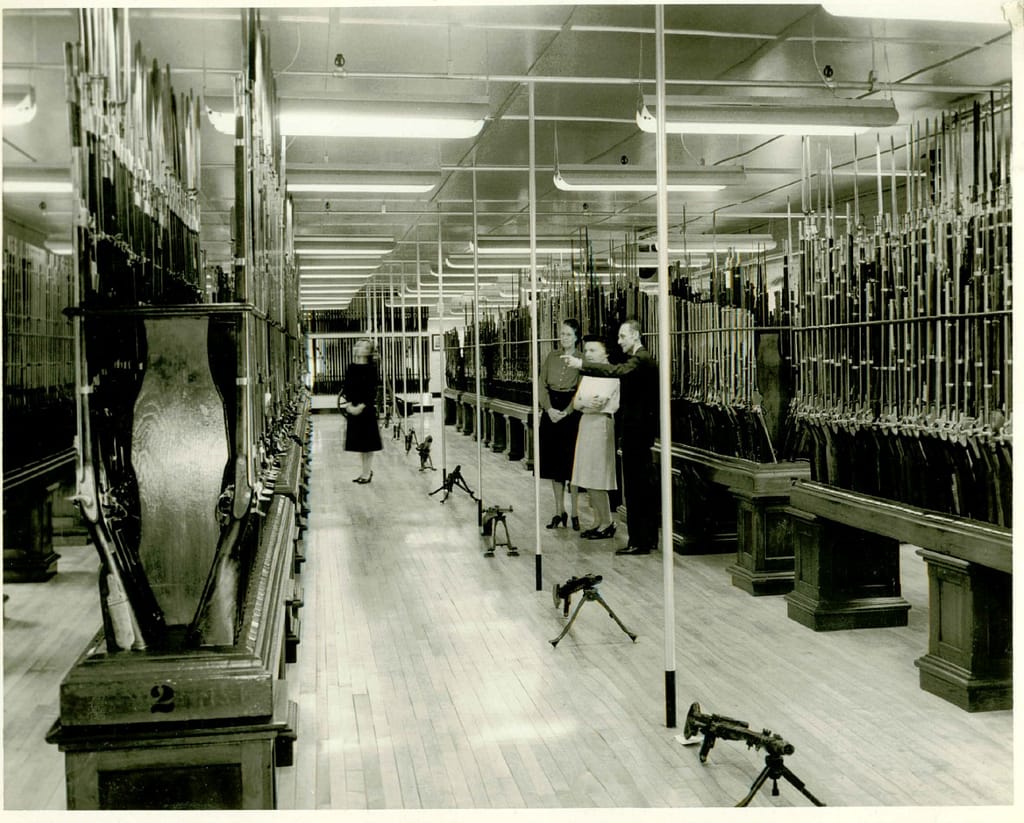
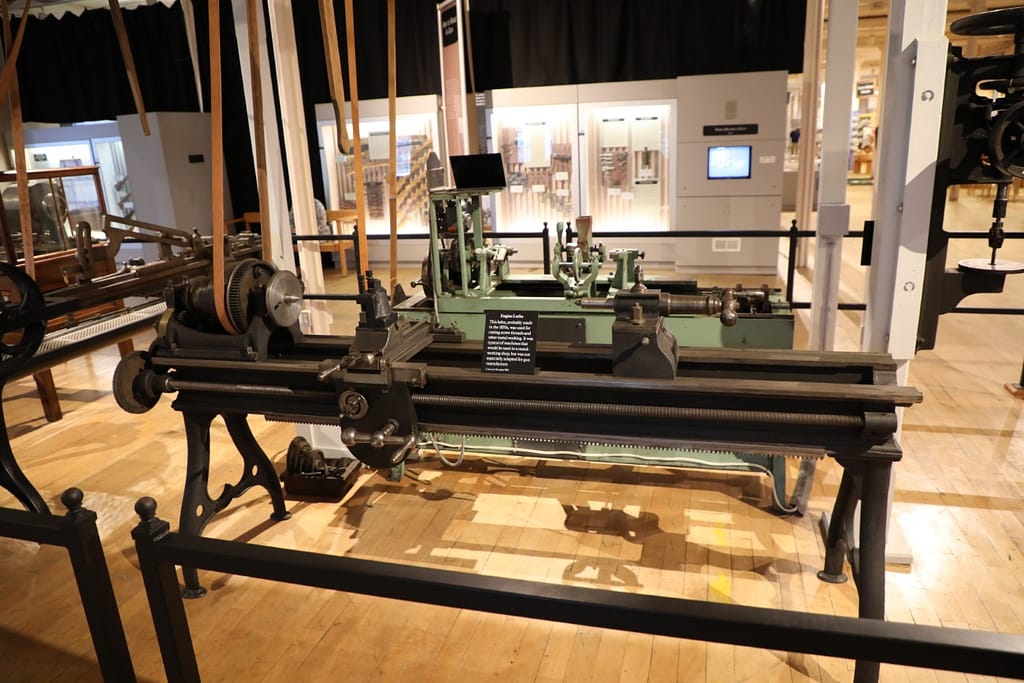
The museum’s centrepiece is the famous “Organ of Muskets” — more than 1,100 Civil War-era Model 1861 and 1863 Springfield rifle-muskets displayed in tiered racks. Other highlights include the pioneering 1819 Blanchard Lathe, which revolutionised interchangeable-parts production, and extensive displays of rare small arms, tooling, and machinery from every era of the Armory’s operation.
Strategic context and founding
A young nation’s arsenals
When the United States secured its independence in 1783, it gained liberty but inherited vulnerability. The new republic had no standing army of consequence, no secure domestic arms industry, and no reliable source of armaments beyond those captured or imported during the Revolution. Relying on European suppliers was costly and was a strategic risk that could leave the young nation defenceless in a crisis.
President George Washington, who had endured chronic shortages in the field, recognised that military self-sufficiency was essential. His solution was bold for such a young country: establish permanent, government-operated armouries capable of designing and manufacturing the nation’s own weapons.

Springfield Armory and Harper’s Ferry Armory
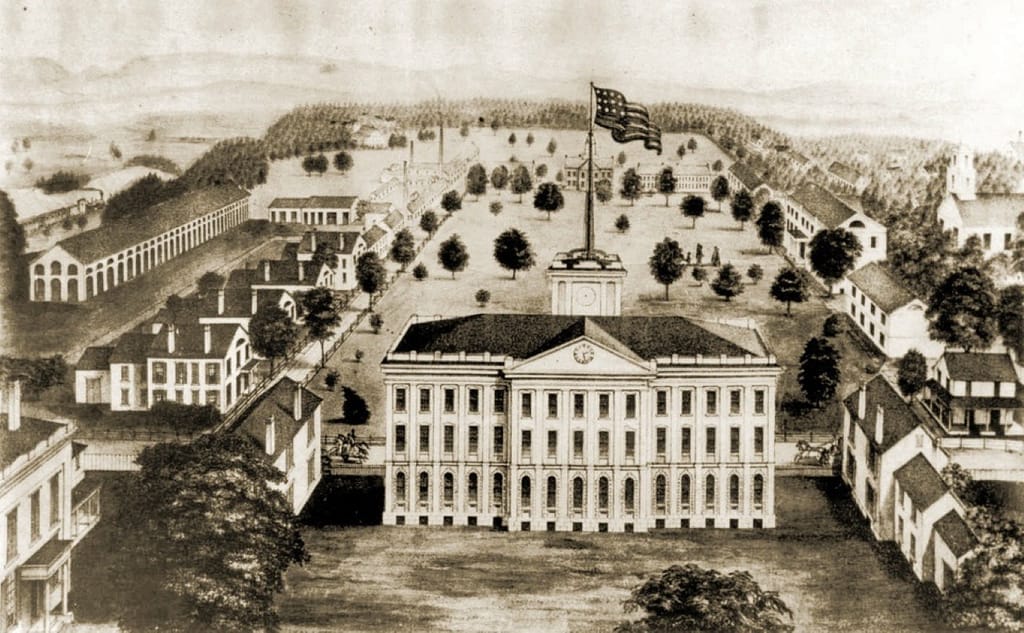
In 1794, Congress authorised two such facilities: one at Harpers Ferry, Virginia, and the other at the existing arsenal at Springfield, Massachusetts. Springfield’s selection was based on both strategic and symbolic considerations. During the Revolutionary War, it had served as a major Continental Army storage arsenal and repair depot. Its position on a bluff above the Connecticut River placed it inland, safe from naval attack, yet accessible via river transport and the Boston Post Road.
The site also carried a powerful domestic association. In 1787, during Shays’ Rebellion, armed veterans protesting economic hardship had attempted to seize the Springfield arsenal. The state militia’s defence of the storehouse underscored its importance to national stability, and foreshadowed the armoury’s future as both an industrial asset and a symbol of federal authority.
More than a workshop
From the outset, Springfield was intended as more than a traditional gunmaking facility. It would serve as a national laboratory for arms production, and a proving ground where the United States could experiment with ways to match, and perhaps surpass, the arms-making traditions of Europe.
In its earliest years, skilled armourers produced muskets patterned on the French Charleville Model 1763/66 that had equipped the Continental Army during the Revolution. Every lock, barrel, and stock was shaped and fitted by hand in the tradition of European artisan gunmakers. These weapons were dependable, but no two were precisely alike, and damaged parts had to be hand-fitted in the field. Even in these early years, Springfield’s leaders began searching for ways to build faster, more consistently, and more efficiently than their Old-World counterparts.

Revolution in manufacturing: the American system
From craftsmanship to precision
In the 1790s, Springfield’s methods still mirrored those of Europe: each musket was a one-off creation, with parts individually filed to fit that weapon alone. The result was reliability at the cost of interchangeability. A broken lockplate or trigger guard could not simply be swapped with another; it required adaptation by a regimental armourer. In wartime, that meant costly delays.
By the early 19th century, Springfield’s engineers were pursuing a radical departure from traditional gun-making. Drawing inspiration from French engineer Honoré Blanc’s late 18th-century experiments with standardised musket parts, they refined the idea with American ingenuity and persistence. Their ambition was to create firearms whose components were so precisely machined that any part would fit any musket of the same model, without the hand-fitting that had defined armourers’ work for centuries.
The ‘American system’
This concept, later known as the American System of Manufacture, rested on three interrelated principles:
- Interchangeable Parts – Every lock, stock, barrel and component produced to exact master gauges, ensuring universal fit.
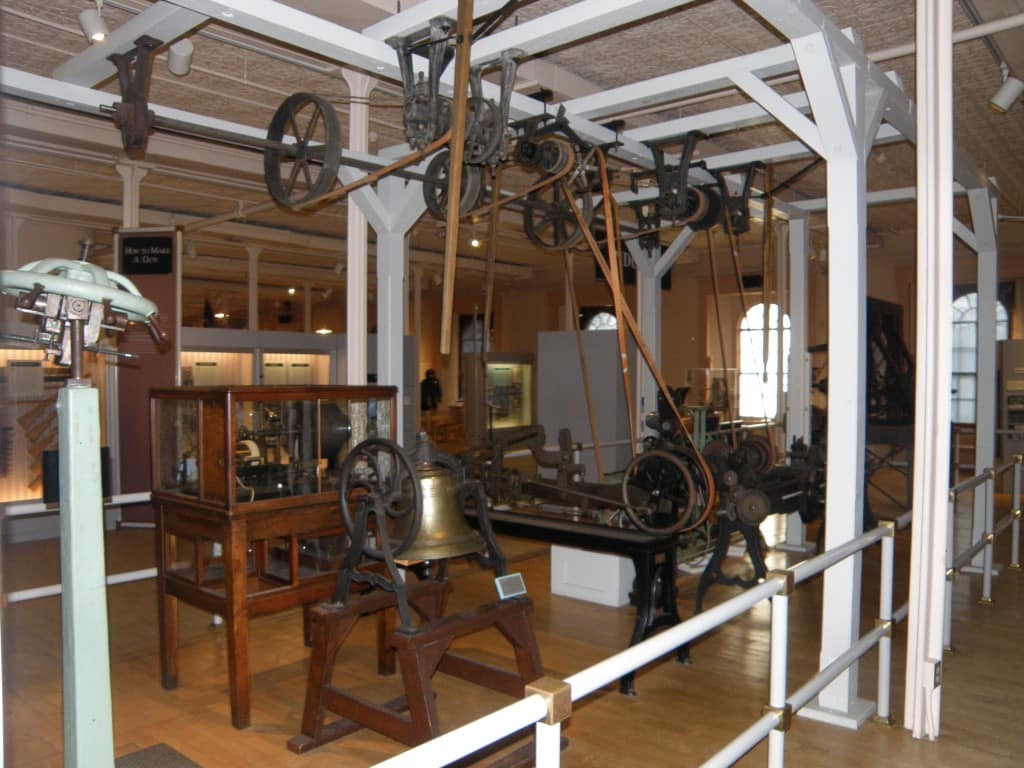
- Specialised Machine Tools – Purpose-built machinery, driven first by waterwheels and later by steam, replaced slow, labour-intensive handwork.
- Division of Labour – Instead of a single craftsman building an entire weapon, each worker specialised in one task, producing speed, consistency, and a workforce that could be trained quickly.
Springfield Armory: an industrial pioneer
While Harpers Ferry also experimented with these ideas, Springfield became the proper proving ground. By the 1820s, it was producing muskets with parts so precisely interchangeable that visiting European ordnance officers were astonished. Anecdotally, one British visitor recorded: “The lock of the weapon I was shown was removed and replaced with one taken indiscriminately from a heap upon the floor. It fitted as if made for it — a feat not possible in our own armouries without the filing of a craftsman’s hand.”
The most celebrated breakthrough was the introduction of Thomas Blanchard’s lathe in 1819. Capable of reproducing complex curves directly from a master pattern, it transformed gunstock production from hours of hand-tool labour to minutes of machine work. The Blanchard lathe’s influence spread well beyond firearms, shaping everything from wheel spokes to shoe lasts.
⚔️ Go deeper — Members get exclusive access to the Deep Research Collection, Field Notes, and monthly Research Dispatches. Try membership free for 7 days, cancel anytime. From $9/month.
The ‘American System’ in practice: The Springfield Armory Stocking Room
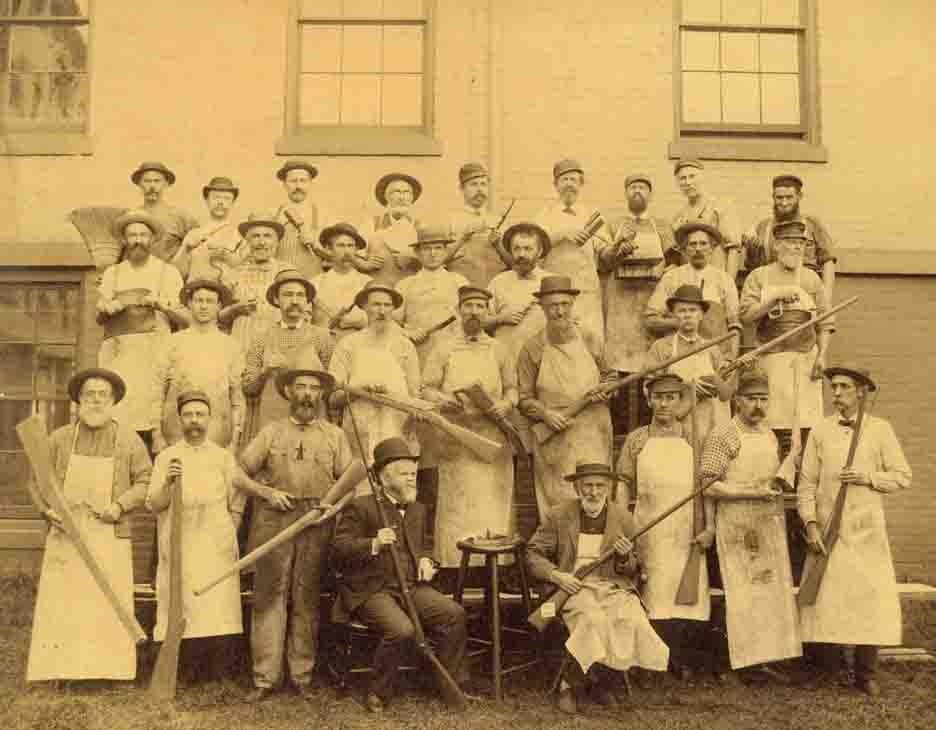
The Stocking Room (where the wooden stocks were made), is a microcosm of the American System in action. In the European traditions, stock-making was done by rough-cut machinery, then finished by master craftsmen using hand tools, and checked against officially approved gauge sets. At Springfield, stock-making was an ever-evolving process, using automation wherever possible to improve precision, speed the process, and ensure interchangeability.
‘Division of labour’ concepts allowed each worker to be an expert in a single stage of the process on a single machine, rather than be a master craftsman in the old world tradition. Division of labour and standardised training, allowed the American system to rapidly upscale and expand. The old world reliance on experienced master craftsmen did not allo rapid upscaling.
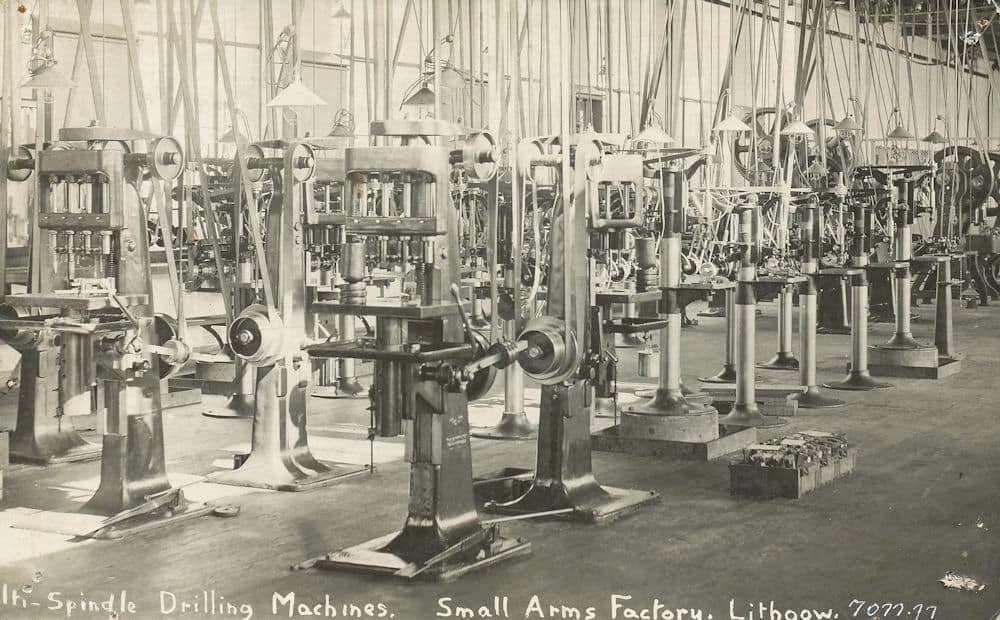
When Australia, without a tradition of precision manufacturing at scale, explored options to create its own small arms production facility at Lithgow NSW, it was the American system that beat out the competition. One of the appealing factors was the ability to scale-up a workforce through specialised training, rather than relying on a vastly experienced workforce that did not exist in Australia in 1912.
The most beautiful machinery in the whole establishment is that in the stocking room. The machinery here is operated by 20 men and consists of 14 machines…..Rough forms of gun stocks, sawed out of black walnut plank … first pass through the widely celebrated Blanchard turning machine … and are then passed from one machine to another, in rapid succession, receiving every depression for the reception of the lock and mounting, the grooving for the breech-pin, barrel and ramrod, holes for the reception of screws, turning etc, until the stock is complete.
Bessey’s Springfield Guidebook for 1851-52


⚙️ Innovation Spotlight: The Blanchard Lathe
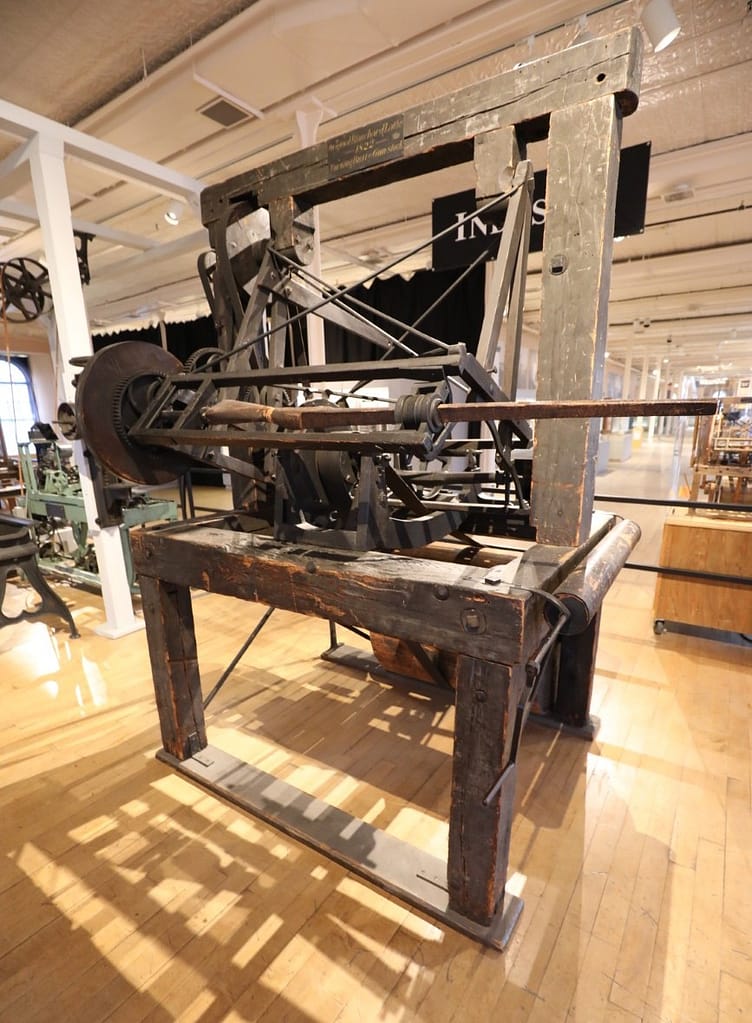
Patented in 1819 by Thomas Blanchard at the Springfield Armory, the Blanchard lathe was one of the most transformative tools of the early industrial age. At its core, it was a two-axis duplicating lathe. One axis held a master stock, the other a blank piece of wood. As both rotated together, a wheel or follower traced the contours of the master, while cutting blades reproduced the same shape in the blank.
The brilliance of the invention lay in its simplicity and precision. For the first time, gunstocks could be turned out by the hundreds with near-identical form, reducing reliance on highly skilled hand carvers. The result was a radical increase in efficiency, consistency, and interchangeability.
Equally important was how the lathe influenced design. Because undercuts and ornate carving could not be reproduced mechanically, stock patterns evolved toward smooth curves and functional simplicity. The tool and the product co-evolved, shaping the look and feel of military firearms for generations.
Visitors to Springfield today can still see the preserved Blanchard lathes at the museum — ingenious machines that bridged the worlds of craft and industry.
The “Organ of Muskets” and the industrial landscape
A striking symbol of precision
For 19th-century visitors, no sight at Springfield Armory was more memorable than the “Organ of Muskets” — a rack of more than 1,100 gleaming Model 1861/63 Springfield Rifle-Muskets stored vertically in tiered rows, their barrels catching the light like the polished pipes of a church organ. Henry Wadsworth Longfellow immortalised an earlier display in his 1840 poem The Arsenal at Springfield, casting the display as both a warning and a hope for peace. The Organ of Muskets is still on display at Springfield Armory and every time I have seen it I have marvelled at the sight.
This is the Arsenal. From floor to ceiling,
Like a huge organ, rise the burnished arms;
But from their silent pipes no anthem pealing
Startles the villages with strange alarms.
Henry Wadsworth Longfellow
The Organ was more than an impressive spectacle. It was a physical demonstration of Springfield’s achievement: every musket in the display was built to identical specifications, with parts interchangeable across the entire rack. It was precision rendered visible, an industrial ideal turned into an architectural feature.
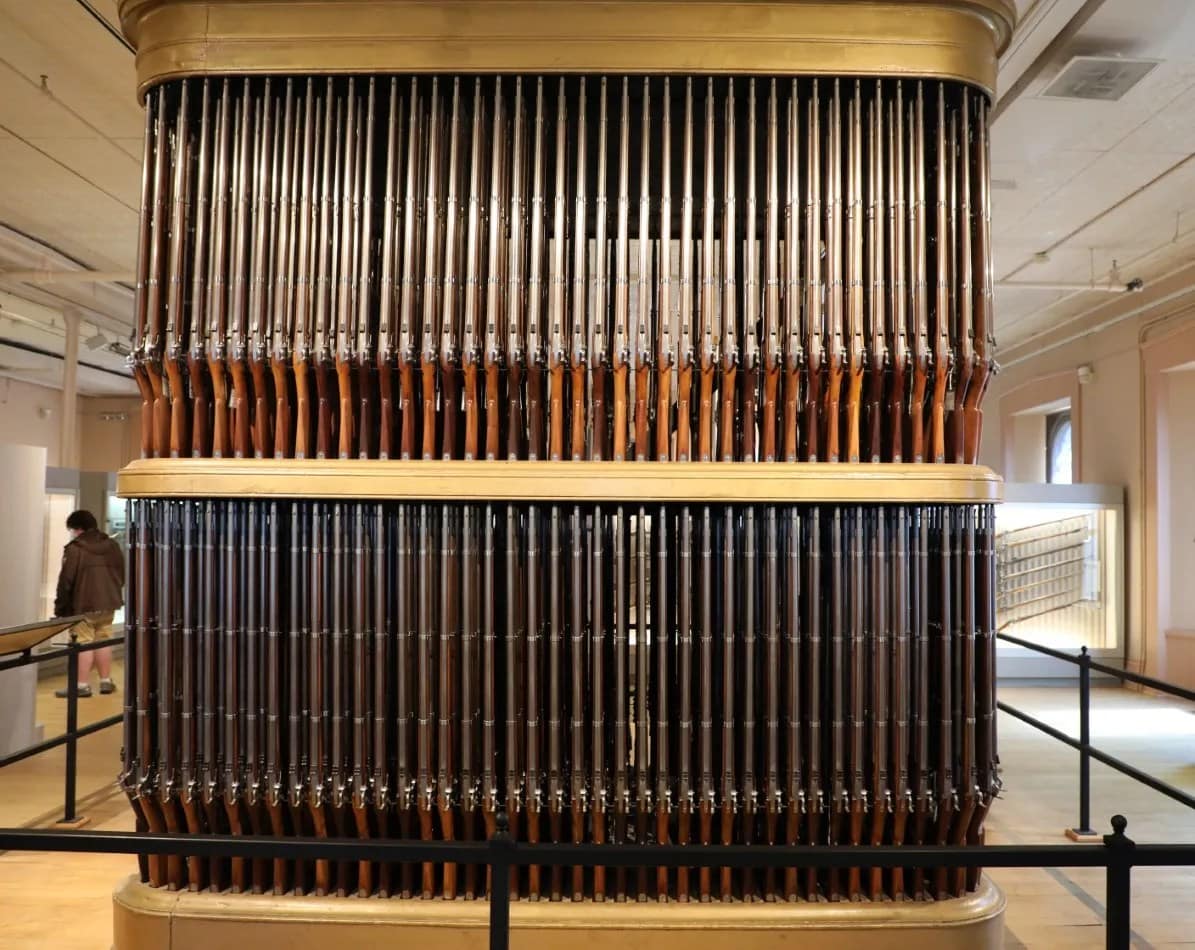
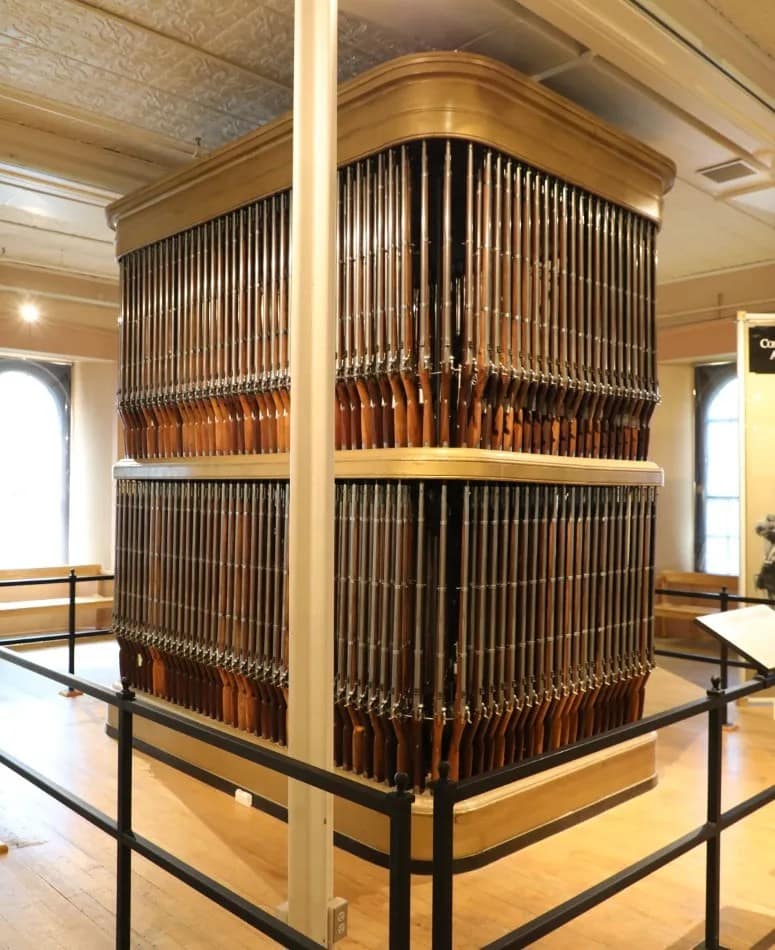
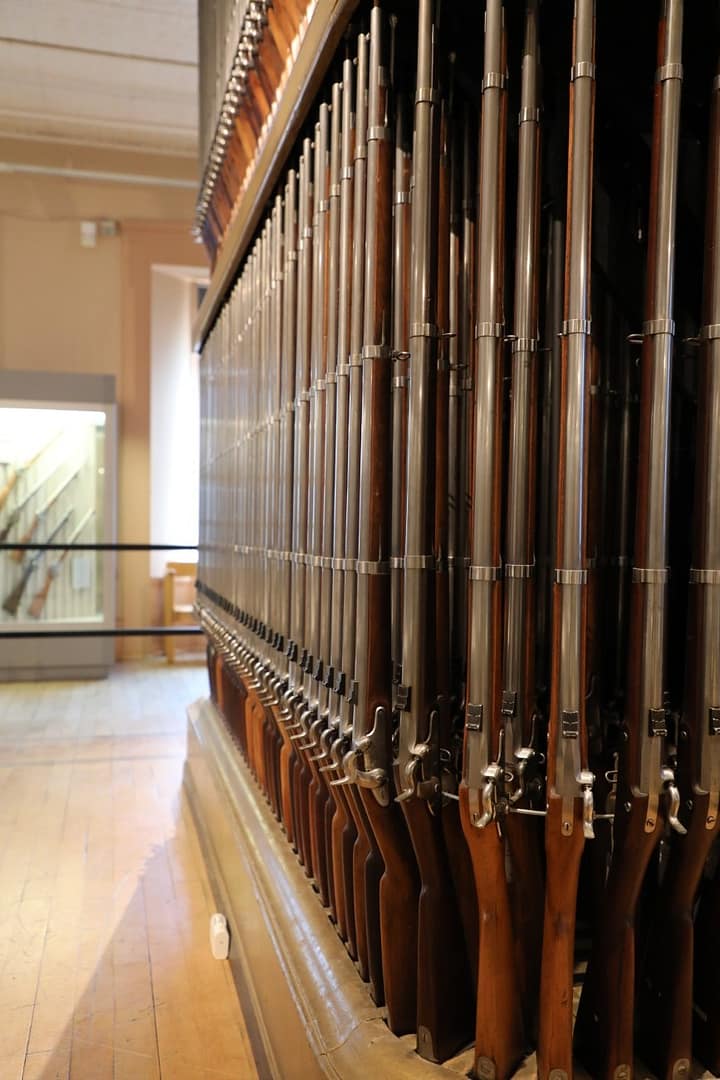
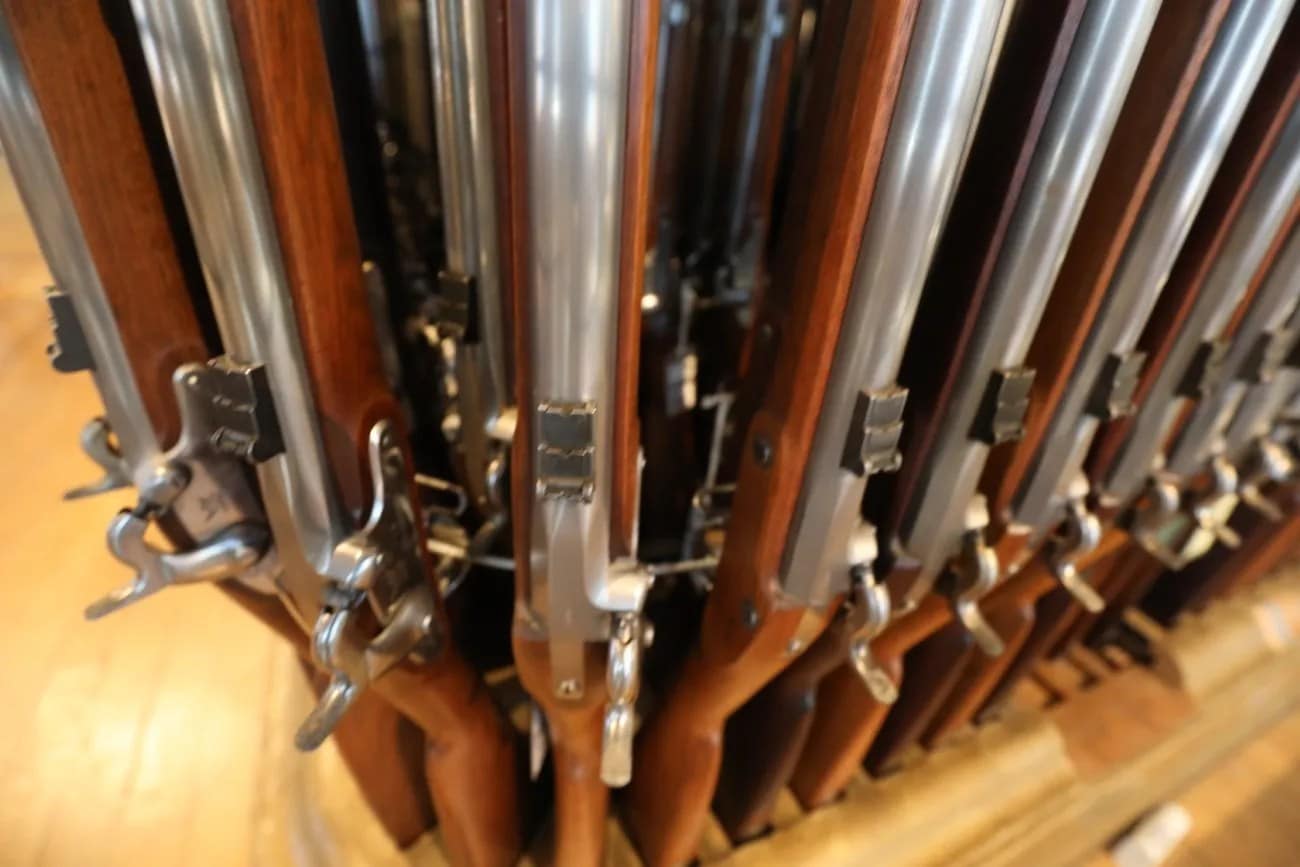
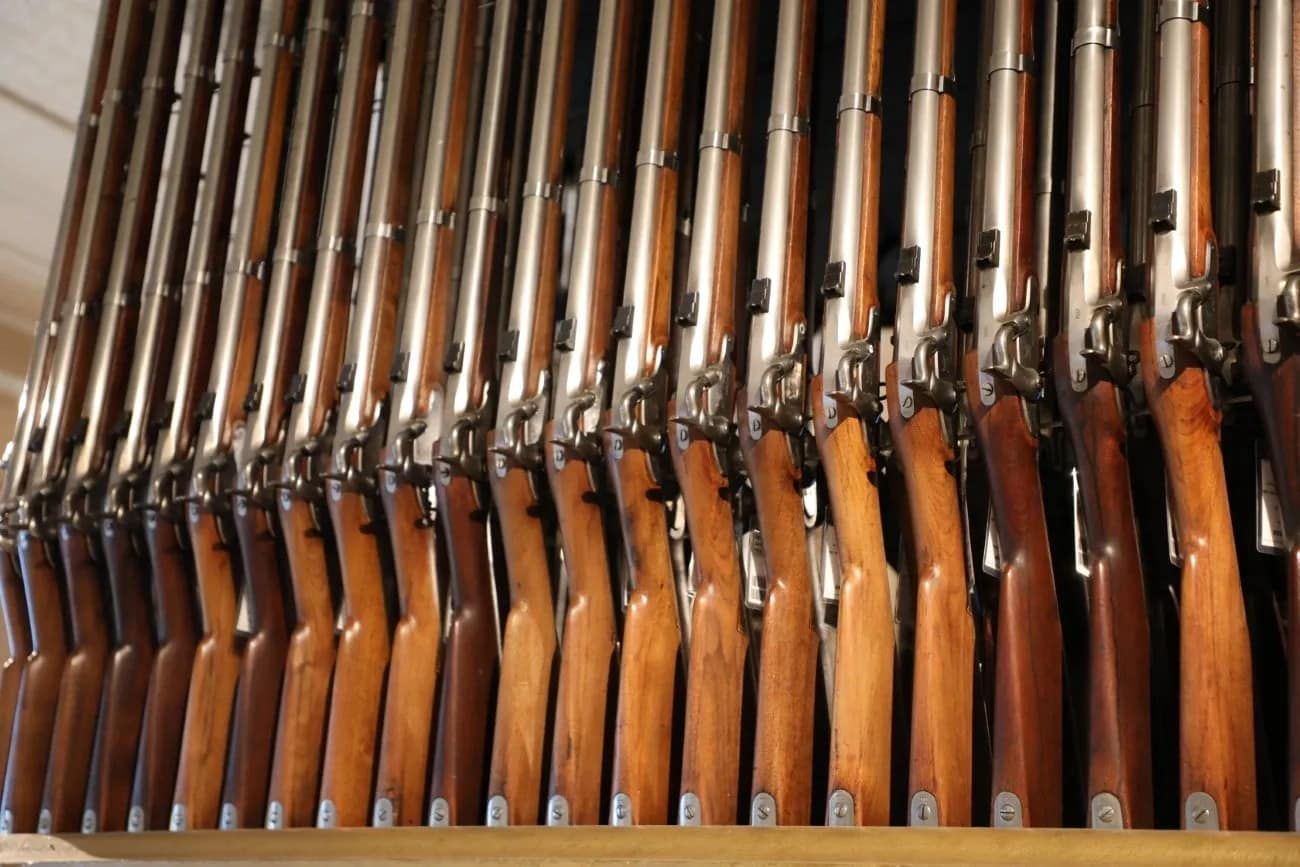
The ‘Organ of Muskets’ at Springfield. 1100+ never-issued Springfield Model 1861 Percussion Rifle-Muskets
Springfield Armory and ‘Precision Valley’
Springfield’s location placed it at the heart of what became known as the Precision Valley — an interconnected industrial corridor along the Connecticut River. The river’s water power drove the early machinery. At the same time, nearby towns like Chicopee, Windsor Locks, and Hartford became home to a dense network of arms manufacturers, machine-tool makers, parts suppliers, and skilled tradesmen.
Arms designers and manufacturers in the Connecticut River Valley included Samuel Colt, Robbins & Lawrence, Oliver Winchester, Horace Smith and Daniel Wesson, Eli Whitney, Eliphalet Remington, Ambrose Burnside, Dr. Edward Maynard, and Christian Sharps.
Here, innovation flowed quickly. A gauge maker from Springfield might later design tooling for a sewing machine factory; a machinist trained on a Blanchard lathe could just as easily adapt his skills to bicycle hubs or typewriter mechanisms. The result was a cross-pollination of talent that made the Connecticut River Valley one of the world’s foremost precision manufacturing regions.
A national showcase of manufacturing capability
By the mid-19th century, Springfield had become more than a production centre. It was a national symbol of manufacturing capability. Foreign military delegations regularly visited to study not just the rifles, but also the machines, processes, and quality-control systems that produced them. What they saw was an industrial discipline that could be applied to almost any manufactured product, from a rifle bolt to a sewing-machine shuttle.

The Springfield system spreads to other industries and countries
By mid-century, Springfield’s methods were being adopted far beyond the armoury gates. Precision gauging, specialised tooling, and interchangeable parts found their way into clockmaking, sewing machines, bicycles, and eventually automobiles. Springfield’s shop floors became both a factory and a classroom for the industrial age — the same American system that, a century later, would be consciously adopted at Lithgow in Australia.
From flintlock musket to M1 Garand: Springfield at war
Peacetime discipline, wartime surge
In peacetime, Springfield’s output was steady but deliberate, a rhythm of design refinement, tooling upgrades, and workforce training. In wartime, it transformed into a strategic engine, capable of scaling to meet urgent demand without sacrificing quality.
War of 1812

The young republic entered its first major conflict since the Revolution with a small regular army and a patchwork of militia. Springfield’s Model 1795 muskets, patterned on the French Charleville, armed many of these troops. The war’s supply challenges underscored the need for full interchangeability, accelerating investment in gauging and specialised machinery.
Mexican–American War (1846–1848)

By the 1840s, Springfield was producing the Model 1842 — the first U.S. percussion-cap service musket and the first fully interchangeable arm produced at the armory. Production during this war was measured rather than frantic, but it confirmed Springfield’s ability to deliver precision weapons on a predictable timetable.
American Civil War (1861–1865)
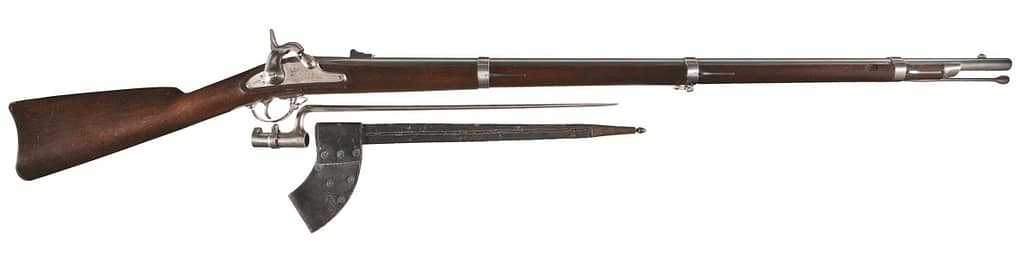
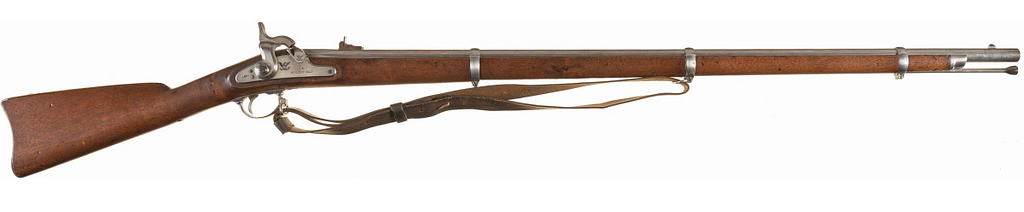
The Civil War was Springfield’s defining 19th-century test. Producing the Model 1861 rifled musket and its variants, the armory turned out hundreds of thousands of rifles for Union forces. Employment surged, drawing in skilled and semi-skilled workers from surrounding towns, with women taking on inspection and small-parts assembly roles.
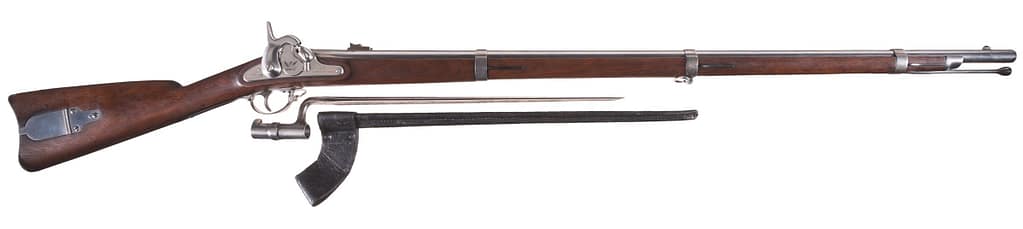
The plant’s long, straight production lines became an industrial symphony: the hiss of steam-driven machinery, the steady thump of trip-hammers shaping forgings. Parts travelled down the line in bins and racks, and each stage was checked against master gauges before moving on. The soundscape was constant — the rasp of files, the click of gauges closing on metal, and the distant crack of proof-firing echoing from the range.
Appomattox to WW1
After the Civil War, the Armory had massive stocks of muzzle-loading rifle-muskets (Model 1861/1863). The priority became converting these into more modern breech-loaders. Springfield engineers, led by Erskine Allin, developed the “Trapdoor Springfield” system (hinged breechblock). Existing muskets were converted first (the Model 1865 “First Allin Conversion”), then new production was standardised as the Model 1873 Springfield, .45-70.
From 1873, the .45-70 Government Trapdoor Springfield became the standard U.S. infantry weapon.

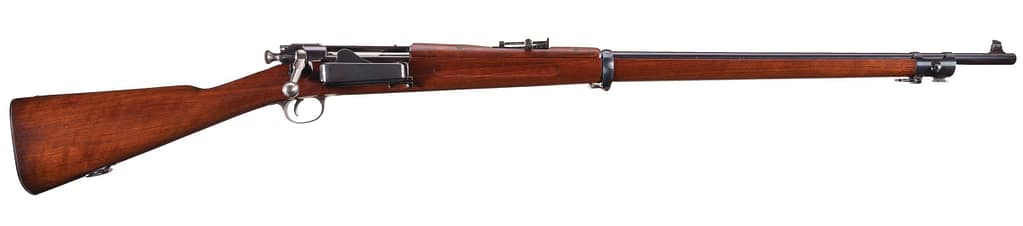
Springfield conducted experimental trials with bolt-action and magazine-fed designs, including Krag–Jørgensen, Lee, and Mauser systems. The Trapdoor remained in service longer than ideal, partly because Congress underfunded new weapons. In 1892, after exhaustive trials, the U.S. adopted the Krag–Jørgensen rifle, chambered in .30-40 Krag. Manufactured exclusively at Springfield, it represented a huge technological leap, with smokeless powder, a five-round side-loading magazine, and bolt action.
World War One
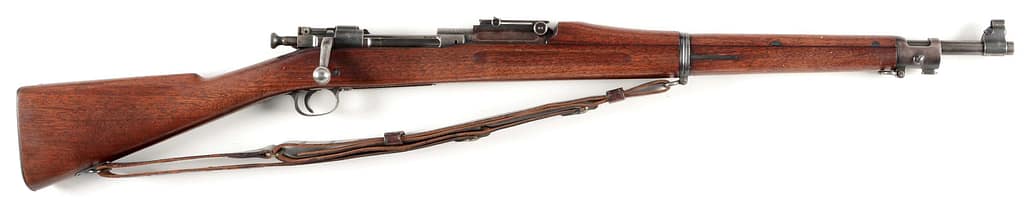
By 1917, Springfield was producing the M1903 Springfield rifle, a bolt-action weapon renowned for accuracy. The war demanded rapid expansion, with private contractors supplementing the armory’s output. The M1903’s tolerances were tight, its machining exact — a testament to Springfield’s century-long refinement of its craft.
World War Two
Springfield’s wartime peak came with the M1 Garand, designed by Canadian-born John C. Garand. Praised by General George S. Patton as “the greatest battle implement ever devised,” the M1 was a semi-automatic leap forward in infantry firepower.
Between 1936 and 1945, Springfield produced more than 3.5 million M1 rifles, along with bayonets, spare parts, and tooling for subcontractors. At the height of production, more than 14,000 workers filled the plant. Electric-powered milling machines and presses replaced the old line-shaft drives, but the rhythm was familiar — parts moving from rough forging to final assembly with a disciplined precision unchanged from the 19th century.

Post World War Two
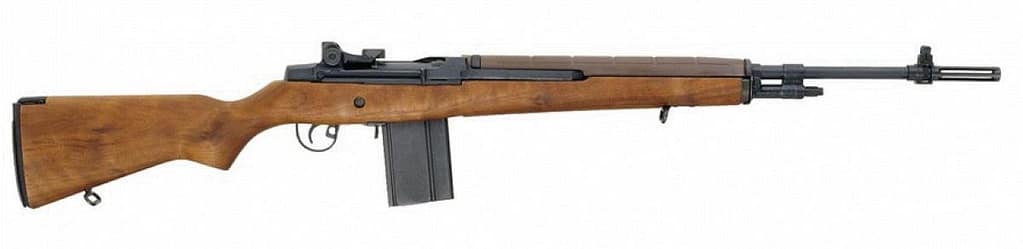
The M14 rifle was the last in a long line of battle rifles developed at Springfield Armory — a select-fire weapon that bridged the gap between the World War 2–era Garand and the emerging world of modern infantry rifles. Adopted by the U.S. military in 1957, it fired the powerful 7.62mm NATO cartridge. It retained the familiar wood stock but added a detachable box magazine and automatic fire capability. Though soon overshadowed by the lighter M16 in Vietnam, the M14 left its mark as a rugged, accurate rifle still prized by marksmen and ceremonial units.
Cultural and technological legacy
Beyond firearms
Springfield Armory was more than just a rifle factory; it was a finishing school for American precision manufacturing. Generations of toolmakers, machinists, and gauge inspectors learned their trade here, absorbing an ethos of accuracy, repeatability, and efficiency. Many went on to work in, or establish, private enterprises that carried these principles into other industries.
The American System of Manufacture proved so effective at Springfield that its core methods spread effortlessly to other products. Clockmakers in Connecticut used armory-style gauging to ensure flawless gear meshing. Typewriter firms borrowed their small-parts assembly techniques. Bicycle makers adapted barrel-turning and rifling processes to frame tubing and wheel hubs. The lineage from Springfield’s shop floors to America’s consumer goods industry is direct and unmistakable.
A model for the world: from Springfield to Lithgow
Springfield was a priority destination for foreign ordnance officers and engineers. In the 19th century, British and French visitors came to study its production methods. In the early 20th, Japanese engineers examined its systems during their own military-industrial modernisation. The lesson was the same: a disciplined combination of standardised methods, jigs, fixtures, master gauges, and trained specialists could produce precision articles faster and more reliably than traditional craftsmanship.
When Australia decided in 1909 to build its own rifle factory at Lithgow, its delegation inspected plants in Britain and the United States. It was Springfield’s philosophy — precision tooling, gauging discipline, and interchangeable parts — that they chose to adopt. Through Pratt & Whitney of Hartford, that system was transplanted almost intact to the Southern Hemisphere. Lithgow’s first SMLE rifles were, in a very real sense, the industrial descendants of Springfield’s muskets and rifles.
Decline, closure, and preservation
Shifting priorities
By the 1960s, Springfield Armory’s long-term future was in question. Under Secretary of Defense Robert S. McNamara, the U.S. military was increasingly turning to private contractors for small-arms production, and centralised procurement in the Department of Defense reduced the role of government-run factories. The armory faced rising labour costs, expensive modernisation needs, and stiff competition from firms like Colt and Harrington & Richardson.
The M14 rifle, Springfield’s successor to the M1 Garand, had only a short production run before being replaced by the lighter, selective-fire M16, manufactured by private contractors. Without a major contract and with no immediate replacement weapon in the pipeline, Springfield’s operational rationale weakened.
The end of an era
In 1968, after 174 years of continuous operation, the federal government closed Springfield Armory. The decision stunned the local community. For generations, the armory had been Springfield’s largest employer and a symbol of its identity. Skilled workers, many from families who had been at the plant for decades, now had to take their talents elsewhere.
Preserving the legacy
Rather than dismantle the site, the federal government transferred it to the National Park Service. In 1974, it reopened as Springfield Armory National Historic Site, preserving its 19th-century arsenal buildings and housing one of the largest collections of U.S. military firearms in the world.
Today, visitors can walk the same long assembly bays where rifles once moved from forging to final inspection. The “Organ of Muskets” still commands attention, while the tool rooms and inspection stations remain a living study in the evolution of manufacturing, from waterwheel-powered lathes to electrically driven CNC machines.
Springfield’s preservation is a recognition that industrial heritage is as culturally significant as battlefields or monuments. It stands as both a memorial to American ingenuity and a classroom for the next generation of engineers, historians, and craftsmen.

Personal impressions and significance
Walking through history
Step inside Springfield Armory and the scale strikes you first. The main arsenal building’s tall windows flood the space with natural light, the same light that 19th-century inspectors relied on to catch the smallest imperfection in polished steel or finely inletted wood. It is easy to imagine the constant hum of machinery, the clatter of metal on metal, and the quiet concentration of hundreds of craftsmen at their benches.
The famous “Organ of Muskets” still dominates the main hall, but the quieter corners also offer valuable insights. The toolroom benches worn smooth by decades of use, the drawers still labelled in precise handwriting. The master gauges that once defined perfection for a particular model of rifle are still on display. A gauge for an 1840s musket and one for a 1940s Garand may differ in form, but they embody the same principle: absolute interchangeability.

A community of precision
Like Lithgow, Coltsville, and Harpers Ferry, Springfield was more than just a workplace. It was a community tied together by a culture of precision. Families worked here across generations, passing down both technical skills and a pride in exacting standards. Whether shaping a lock plate or polishing a bolt lug, the armory’s craftsmen were part of a tradition that valued doing things exactly right, every time.
A national industrial story
Springfield’s history mirrors America’s industrial coming-of-age. From its beginnings as an experiment in 1794, it grew into the world’s foremost champion of interchangeable manufacture — proving that volume and precision could be achieved together. Its methods spread outward through U.S. industry, crossed oceans to Australia’s Lithgow plant, and became part of the global manufacturing vocabulary.
Springfield by the numbers
- Founded: 1794 (as a federal armory)
- Closed: 1968
- Peak wartime workforce: ~14,000 (World War II)
- Notable products: Model 1795 musket, Model 1842 percussion musket, Model 1861 rifled musket, M1873 ‘Trapdoor’, Krag-Jorgensen, M1903 Springfield, M1 Garand, M14 rifle
- Key innovations: Interchangeable parts, Blanchard lathe, precision gauging, division of labour in arms manufacture
- Status today: National Historic Site, home to the world’s largest U.S. military small arms collection

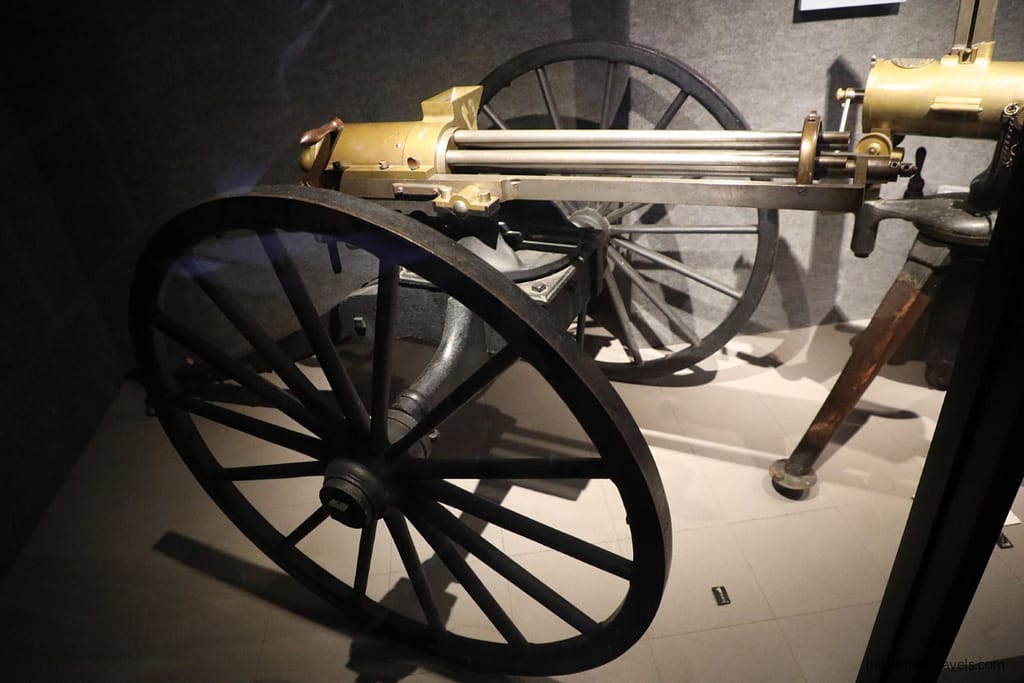
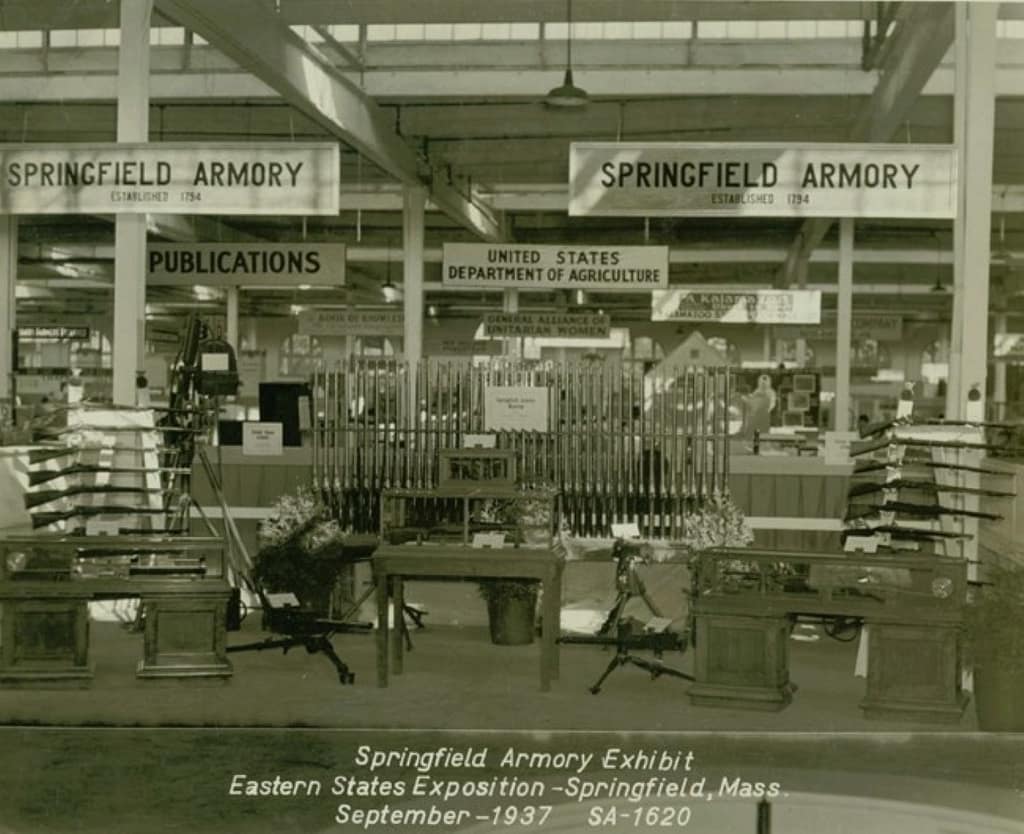
Springfield Armory additional images
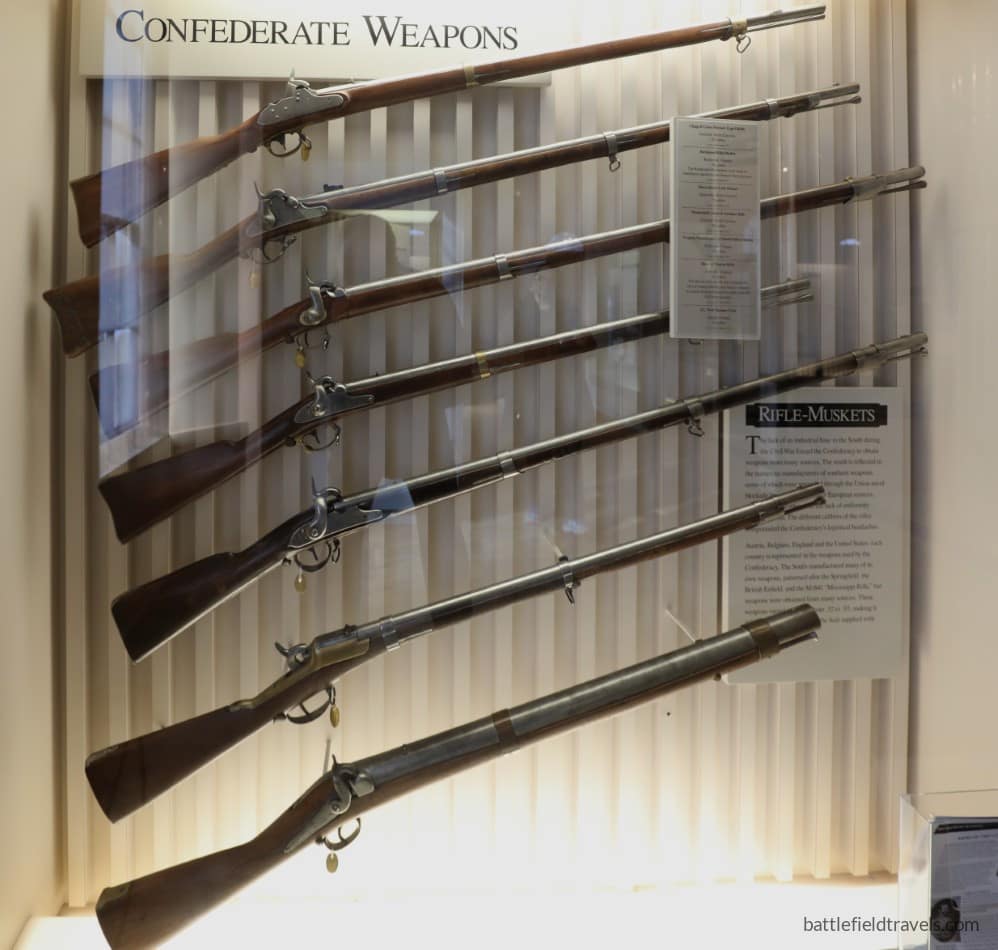
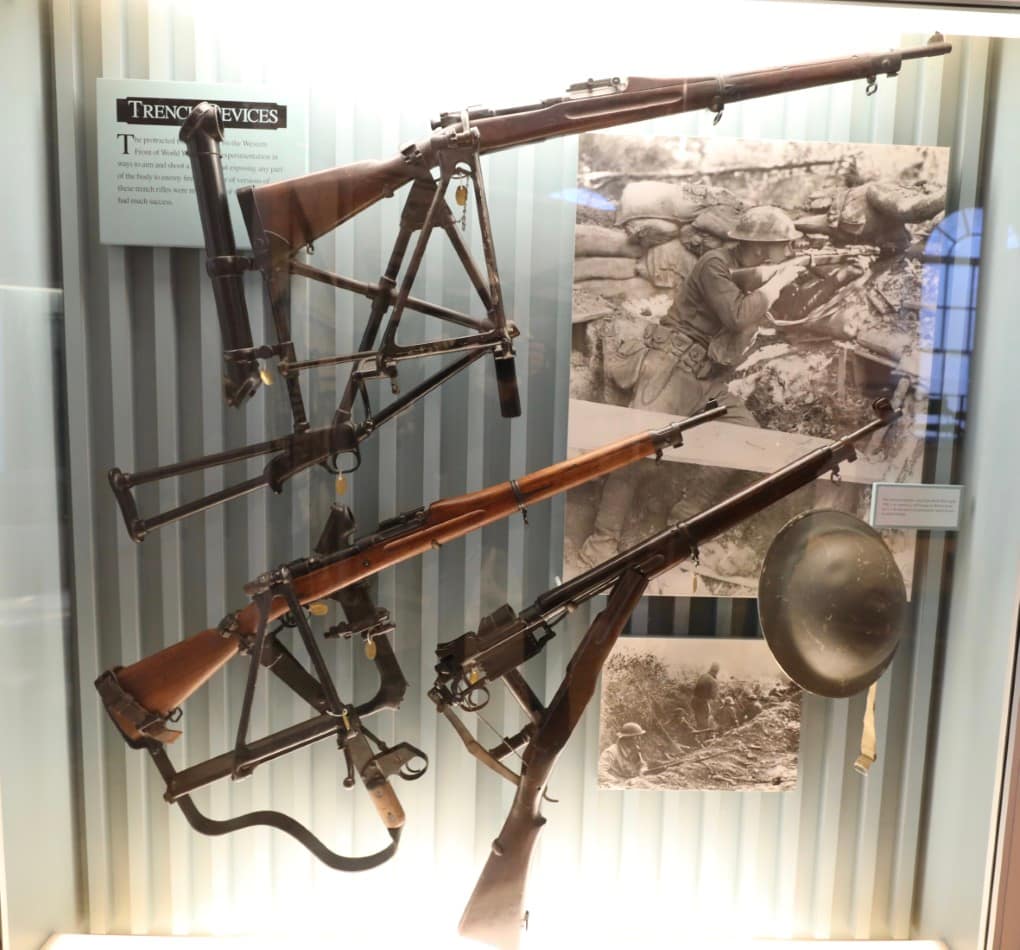
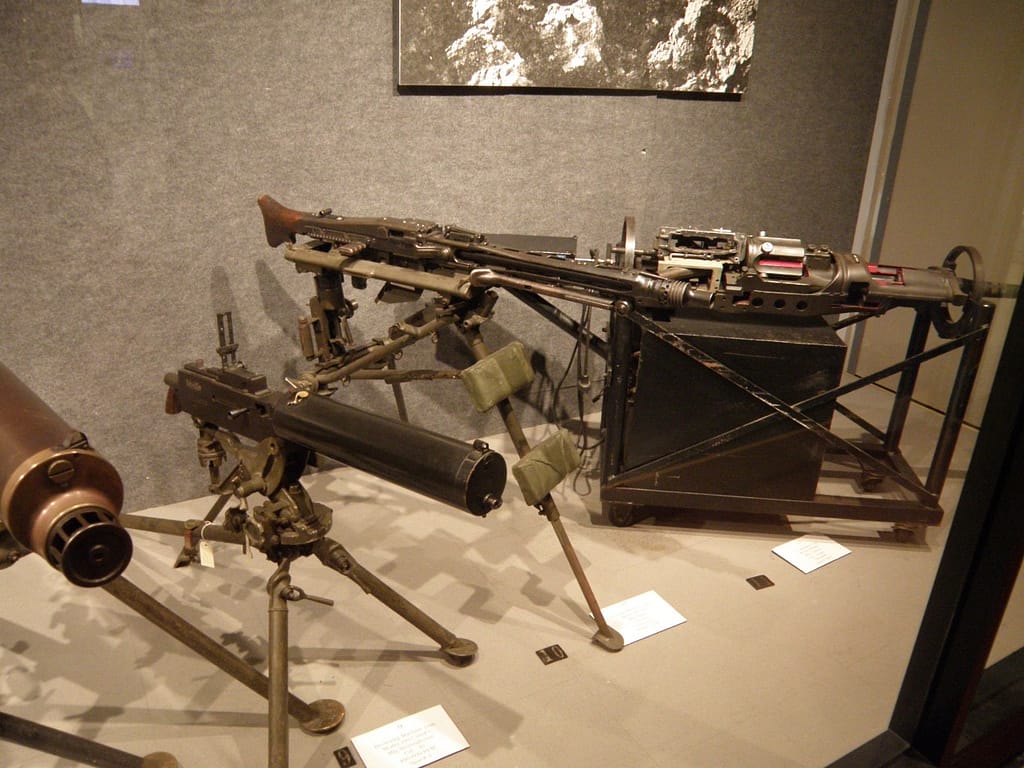
Found this useful? Buy me a coffee — it helps fund future battlefield research


Authored by Mick Prictor, a retired military officer with 40 years’ service, and a military historian specialising in terrain-focused analysis of tactics, doctrine, and command decision-making in land warfare. His work draws on extensive battlefield fieldwork—more than 280 sites worldwide—and one of the world’s largest private collections of historic military arms, uniforms, and equipment. About me
Sources & References
- Chinn, George M. The Machine Gun, Vol. I. Washington, D.C.: U.S. Government Printing Office, 1951.
- Ball, Robert W.D. Springfield Armory Shoulder Weapons 1795-1968, Antique Trader Books, 1997.
- Hartzler, Daniel D., and Whisker, James B. The Northern Arsenal: A Study of the United States Armory at Springfield, Massachusetts, 1795-1859: Old Bedford Press, 1996
- Hosmer, Charles B. Preservation Comes of Age: From Williamsburg to the National Trust, 1926–1949. Charlottesville: University Press of Virginia, 1981. (Context on the Armory’s preservation as a National Historic Site.)
- Brophy, William S. The Springfield 1903 Rifles. Mechanicsburg, PA: Stackpole Books, 1985.
- Poyer, Joe. The M1 Garand 1936–1957. Tustin, CA: North Cape Publications, 1995.
- Springfield Armory National Historic Site. National Park Service. Official site: https://www.nps.gov/spar
- U.S. War Department. Reports of the Chief of Ordnance. Annual reports, 19th–20th centuries. Washington, D.C.: Government Printing Office.
📚 Further Reading: Military Arms Manufacturers
This battle study nests within the broader analytical framework explored in the Research Hub, where operational methods, operating environments, armies, commanders, and weapons are examined across conflicts and eras. The links below connect related studies across the wider body of battlefield analysis on the BattlefieldTravels site.
⚔️ Explore all Historic Arms factory studies
🏛️ Explore the Military Museum of historic weapons and equipment
The book list for this category includes the best available books on the Springfield Armory, Colt Firearms, Lithgow Small Arms, Winchester, the Confederate States Armory Richmond, and many more
📚Military Arms Manufacturers – Recommended Reading
🗞️ For updates on new battlefield studies and research insights, you can subscribe to the Newsletter.
Related Battle Studies, Museum Pieces & Reading Resources


⚙️ Heritage Travel Guide: Springfield Armory (National Historic Site)
Getting There
- Location: Springfield, Massachusetts, USA (near downtown).
- Access: Minutes from I-91; regional rail/bus serve downtown Springfield.
- Parking: Free visitor parking at the NHS lot (signposted).
Site Orientation
- Key Landmarks: Main Arsenal (museum), Commanding Officer’s House, parade ground/green.
- Walking Routes: Compact campus; short stroll connects buildings and panels.
- Best Vantage Points: Across the green for classic Arsenal façade views.
Museums & Visitor Centres
- Springfield Armory Museum: U.S. small arms collection (flintlocks → M1 Garand), tooling, gauges, machinery.
- Exhibits: Interchangeable parts, Civil War output, WWII production.
- Nearby: Local history museums downtown; Hartford (Colt context) ~1 hr south.
On-Site Experience
- Interpretive Signage: Clear outdoor orientation; detailed indoor labels.
- Atmosphere: Historic arsenal architecture around a collegiate green.
- Programs: Ranger talks & periodic demos (check schedule).
Nearby Points of Interest
- Hartford, CT: Colt Armory site; Museum of Connecticut History; Wadsworth Atheneum.
- Local: Naismith Memorial Basketball Hall of Fame; Connecticut River walkways.
Practical Tips
- When to Visit: Weekdays are quieter; verify seasonal hours.
- Facilities: Visitor amenities on site; cafés in downtown Springfield.
- Special Notes: Plan 1–2 hours for museum + grounds; photography allowed in most galleries.
FAQ: Springfield National Armory
The Springfield Armory in Massachusetts served as the primary centre for U.S. military small arms production from 1794 until its closure in 1968. It developed and produced rifles that equipped American forces for nearly two centuries.
The Armory produced iconic weapons including the Model 1795 Musket, the Springfield Rifled Musket used in the Civil War, the M1903 Springfield rifle, the M1 Garand, M14 Rifle, and experimental arms during the Cold War.
Yes. The former Armory is now the Springfield Armory National Historic Site, operated by the National Park Service. Visitors can explore exhibits on American arms manufacturing, historic weapons, and the industrial history of the site.
The Armory pioneered mass production techniques, interchangeable parts, and advanced weapon designs. It was a cornerstone of U.S. military readiness from the Revolutionary era through the Vietnam War.
Subscribe to Battlefield Travels and receive a free E-Book Battlefield Guide
Unlock expert battlefield analysis, campaign reconstructions, and historical insights drawn from firsthand exploration and primary sources.
🗺️ You’ll receive:
🎖️ Exclusive historical insights you won’t find elsewhere
📘 A free eBook: 10 Tips for Exploring Historic Battlefields
📰 New battlefield studies straight to your inbox as they are published


Great article, Mick. It would also be interesting to bring in the connection to Eli Whitney, with his contributions to interchangeability, especially through his relationship with Springfield Superintendent Roswell Lee – also Simeon North, and John Hall at Harper’s Ferry. The way Lee kept searching for innovations that he could bring in to the Armory and its methods is impressive, especially as it was before the days of telecommunications and rapid travel. Another couple of good references are “The Enfield inch & the Lithgow .303 : a tale of metrology from Australian firearm folklore” by Tony Griffiths (on the Lithgow connection); and “Hatcher’s Notebook’ by MajGen Julian Hatcher (CO of Springfield just after the First World War).
Boomer,
It is a fascinating subject and such an enormous influence on the modern world of manufacturing. I can update and add to the article as much as I want. I have Hartzler & Whisker ‘The Northern Armory’, and the companion book on Harpers Ferry. I had some correspondence with James Whisker back in the day, about 1841 Mississippi Rifle I think
I wrote about the ‘Enfield Inch’ in the Lithgow article.