Skip to content
Home » Defensive stands

Defensive stands

Marines of the Mahias Battalion assault the formidable Black Flag defences at Hòa Mộc, 2 March 1885

⚔️🔒Battle of Hòa Mộc, Tonkin, 2-3 March 1885

The Battle of Hòa Mộc Was the fiercest and most costly battle of the Sino-French War. The battle was fought just a few kilometres south of besieged Tuyên Quang, as Colonel Laurent Giovanninelli’s 3,400 man force made a 300 km forced march to relive the siege, and cleared the final Black Flag position between themselves and the Tuyên Quang defenders.

Exhausted survivors of the battle greet Lieutenant Colonel Jean Simon (wearing the 'bonnet de police' and shorts) and his relief column on the evening of 28 July 1948

⚔️🔒Battle of Phủ Tông Hoá, Tonkin, 25 July 1948

The Battle of Phủ Thông Hoá was a small but significant milestone in the French Indochina War. For the French Foreign Legion, it was yet another heroic but costly defence of an isolated outpost against overwhelming odds. The battle entered Legion folklore alongside legendary stands like Camerone and Bir Hakeim. Although the Legion retained control of the post, it was abandoned a few months later as part of a broader strategic withdrawal.

For the Viet Minh, however, Phủ Thông Hoá held even greater significance. It marked the first time they had attempted a coordinated assault on a fortified French position.

The French defensive square at Bắc Lệ, about 150 metres long on each side. The Nuï-Dong-Naï cliffs are in the background. The mules and baggage can be seen in the centre of the square.

⚔️🔒Ambush at Bắc Lệ, Tonkin,
23-24 June 1884

In June 1884, a French column under Lieutenant Colonel Alphonse Dugenne, comprised of about 465 French troops and 284 Tonkinese auxiliaries, with a supply column of local ‘coolies’ and baggage mules, was attacked by a much larger Chinese regular force near Bắc Lệ, on the road from Phu-Lang-Thuong to Lang Son. The attack was the catalyst for the Sino-French war of 1884-85 that saw French forces of the Tonkin Expeditionary Corps engaged in combat with Chinese forces across northern Vietnam, mainland China, and Formosa (now Taiwan).

Strasse im zerstoerten Bazeilles 1870 copy

⚔️ Battle of Bazeilles, France,
31 August – 1 September 1870

For the French Marines, Bazeilles is their sacred ground. Like the Alamo to Americans or ANZAC Cove to Australians. The French Army of Chalons under Marshal MacMahon, accompanied by Emperor Napoleon III, was attempting to relieve another French army besieged at Metz. The Prussian Army moved rapidly and now also threatened to encircle the Army of Chalons. The village of Bazeilles was critical to preventing the encirclement .

Against All Odds - 82nd Airborne Division at La Fière, by James Dietz

⚔️ D-Day: Battle for La Fière Causeway,
6-9 June 1944

The final act of Steven Spielberg’s 1998 movie ‘Saving Private Ryan’ is set in the fictional French town of Ramelles, as a mixed group of paratroopers defends a bridge over the Merderet River against German armoured counter-attacks. That scene is based on real events that happened right here at La Fiere Bridge. I was a paratrooper in the 82nd Airborne Division 1996-99, so this place is somewhat of a pilgrimage for me.

Medieval depiction of the Battle of Agincourt

⚔️ Battle of Agincourt, France,
25 October 1415

The Battle of Agincourt is one of the most famous battles in history. A small English force is trapped by a much larger French force but prevails against the odds. Shakespeare wrote about it and Hollywood continues to make movies about it. The battle reinforced the legend of the sturdy English longbowmen, equipped with the famous longbow, wreaking havoc on waves of heavily armoured French cavalry. So many of the French nobles were killed at Agincourt, it took years to recover.

Alphonse de Neuville The defence of Rorke's Drift 1879 Google Art Project

⚔️ Battle of Rorkes Drift, South Africa,
22-23 January 1879

The Battle of Rorke’s Drift, 22-23 January 1879, was fought in the opening phase of 1879 Anglo-Zulu War. 139 British soldiers and colonial auxiliaries successfully defended a small mission station on the Natal-Zululand border against 3,000-4,000 Zulu warriors. The battle followed immediately after the Battle of Isandlwana, in which King Cetshwayo’s Zulu Army destroyed a British force of more than 1,200 soldiers.

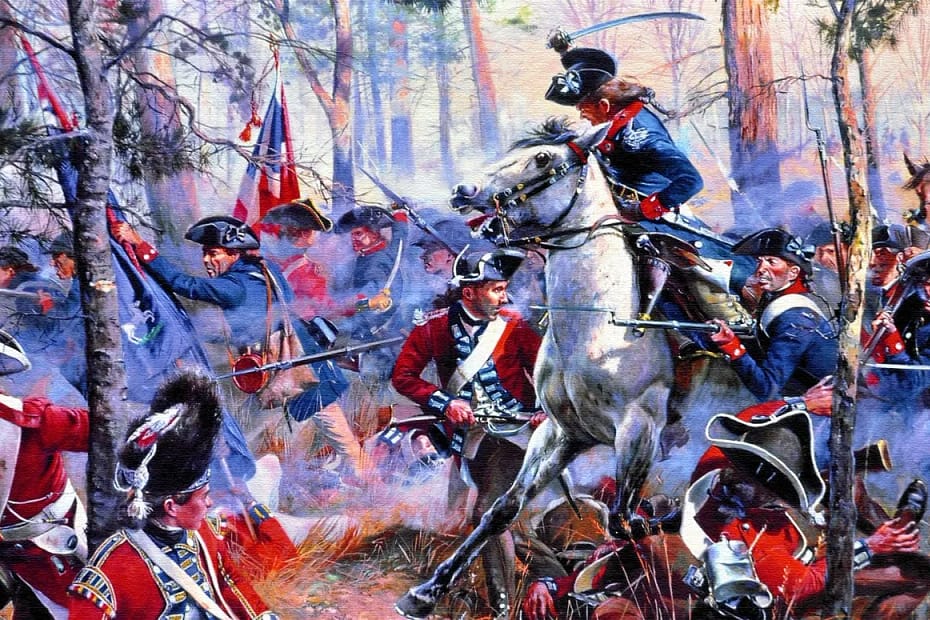
'The Battle of Cowpens' by Don Troiani

⚔️ Battle of Cowpens, South Carolina,
17 January 1781

The Battle of Cowpens, South Carolina, was a relatively small engagement in the American Revolutionary War, but had outsized impact on the trajectory of the war. The American commander, Brigadier-General Dan Morgan, also employed tactical innovations that were adopted for future campaigns.