Easy Company 506th PIR is one of the most documented units of WWII, made famous by Stephen Ambrose’s book and the HBO television series. The unit offers a granular view of airborne combat through Normandy, Holland and Bastogne. Their story enriches tactical and human-terrain understanding.
Easy Company, 506th Parachute Infantry Regiment, fought from Normandy to the Netherlands, Bastogne and the final advance into Germany and Austria. Its story became famous through Stephen Ambrose’s Band of Brothers and the HBO series, but the history extends well beyond the screen. Test your knowledge with 20 questions covering the men, battles, commanders and campaigns of the real Easy Company.
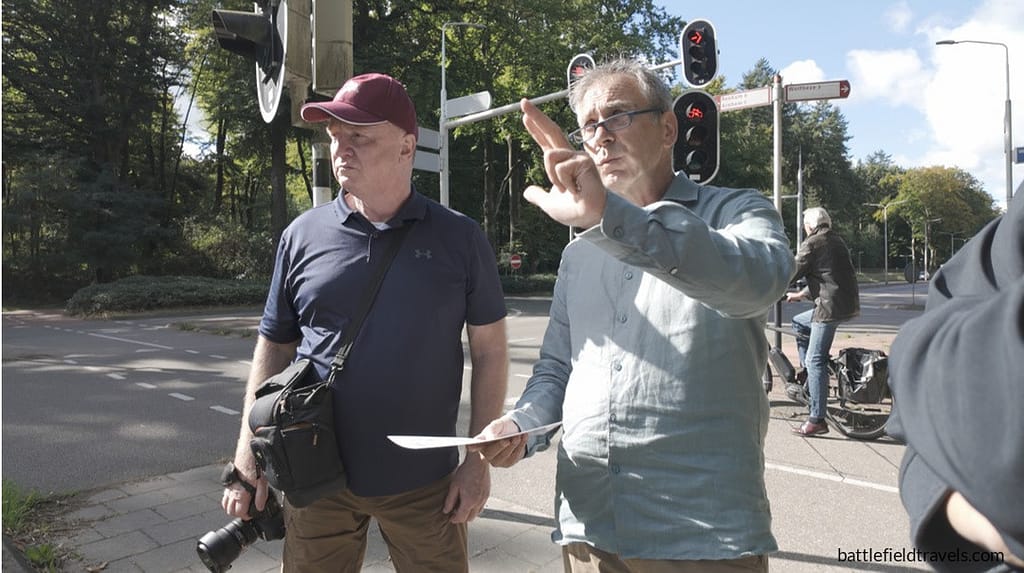
September 2025, Randwijk, Netherlands. I am standing at the “Crossroads” made famous in Band of Brothers Episode 5: Crossroads. On 5 October 1944, a brief battle took place here, east of the village of Randwijk, in the area between the Rhine and the Waal known as “The Island.”
Firsthand battlefield analysis of the campaigns and battles involving the legendary Easy Company, 506th PIR ‘Band of Brothers’
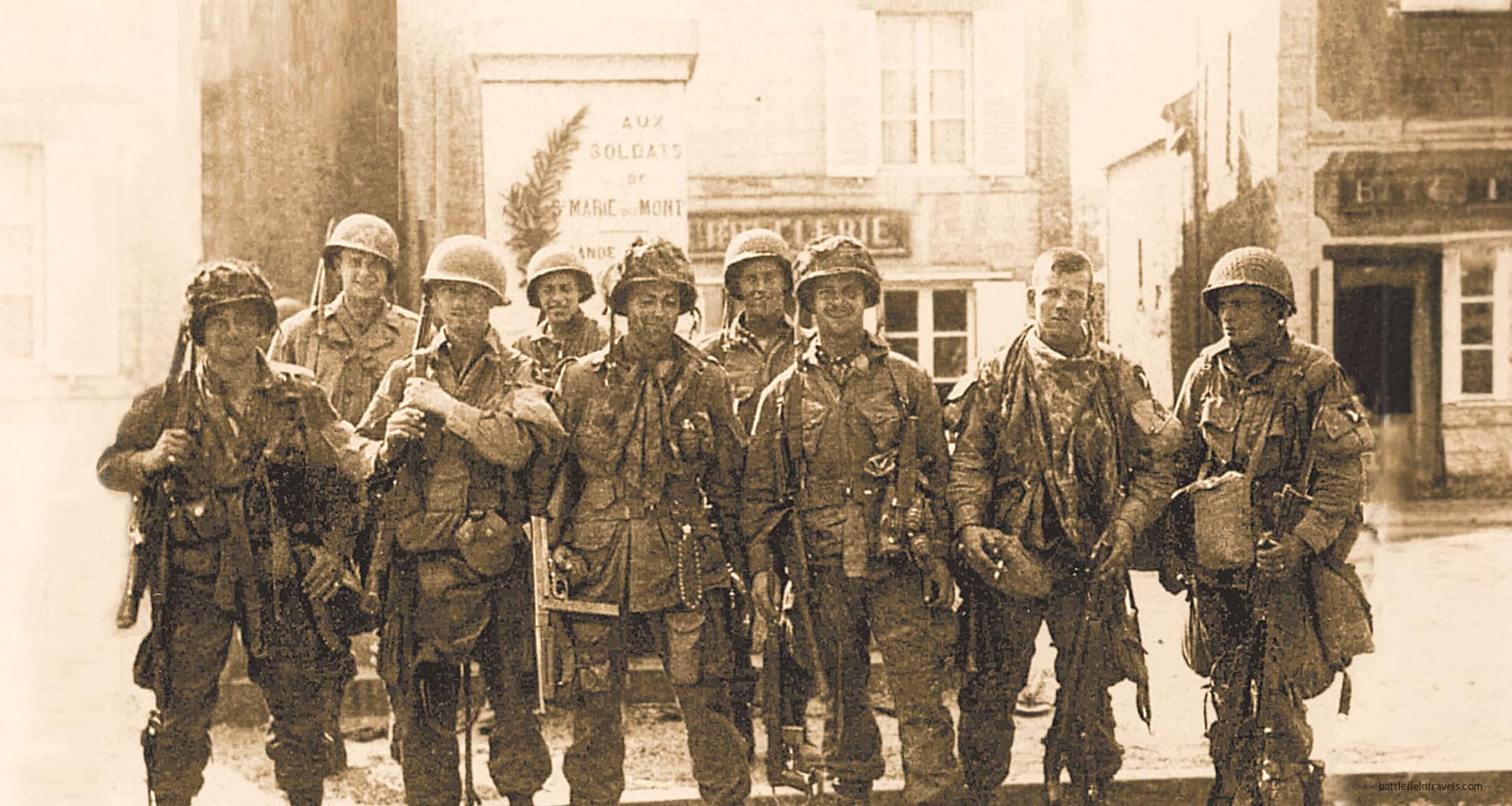
Members of Easy Company, 506th PIR ‘Band of Brothers’ in the main square of Sainte Marie du Mont on D-Day, 6 June 1944
Walking the battlefields of Easy Company 506th PIR ‘Band of Brothers’ (1944-45)
Easy Company, 2nd Battalion, 506th Parachute Infantry Regiment, 101st Airborne Division, immortalised by Stephen Ambrose and the HBO miniseries Band of Brothers, fought its way through some of the most consequential battles of the Northwest European theatre. Easy Company’s combat history formed part of the much larger World War Two battlefield campaigns examined across Battlefield Travels. Its first combat operations began during the D-Day and Normandy landings, before the company later fought in the Netherlands, the Ardennes and Germany.
This collection of battlefield studies goes beyond the screen. I have walked every battlefield in Easy Company’s combat journey, from the hedgerows of Normandy and the bridges of Holland to the frozen woods around Bastogne and the mountain approaches of Bavaria, combining first-hand fieldwork, terrain analysis, period maps and primary accounts to reconstruct how these battles actually unfolded on the ground.
Normandy
Easy Company’s war began around Sainte-Mère-Église in the early hours of 6 June 1944. Dick Winters landed outside the town, not far from where the aircraft carrying Easy’s commander, Lieutenant Thomas Meehan, crashed, killing all on board. Winters and a Little Group of Paratroopers clashed with a German convoy just east of Sainte-Mère-Église before moving south to the 506th PIR rally point near Sainte-Marie-du-Mont. Easy Company’s first major actions were the celebrated assault on the Brecourt Manor gun batteryand the subsequent push towards Carentan, where Easy Company fought through the causeways and streets to link the Utah and Omaha beachheads. The defensive battle at Bloody Gulch immediately afterwards tested them again as they held the line against German counterattacks.
Holland
Three months later, the 101st Airborne dropped into the Netherlands for Operation Market Garden, where Easy Company fought a very different campaign — a fast-moving, canal-lined, village-to-village battle across Eindhoven, Son Bridge, Helmond, Nuenen, Koevering and the defended dikes of ‘The Island’, fighting a small unit action against overwhelming odds at the Randwijk Crossroads. The terrain shifted again: open fields, raised roads, waterways, soft ground and long sightlines that favoured ambushes and defensive fire. At Son Bridge, Nuenen, and Koevering, I walked in the footsteps of Private David Webster, who so vividly described these actions in his memoir Parachute Infantry.
Ardennes
In December 1944, Easy Company entered the Ardennes to hold the line around Bastogne. Here, in the frozen woods of Bois Jacques overlooking Foy, they endured one of their harshest tests — days of bombardment, extreme cold, limited supplies and trench fighting under constant threat of German assault. Their advance into Foy in January 1945 became one of the 101st Airborne Division’s most lauded actions.
Bavaria and Austria
The final chapter carried Easy Company into Germany and Austria, through the collapsing Nazi heartland and ultimately to the symbolic heights of the Eagle’s Nest at Berchtesgaden.
This collection of Easy Company battlefield studies traces their combat path through detailed terrain analysis, field reconnaissance, period maps and first-hand accounts. I have walked the ground on every one of these battlefields, allowing readers to follow, step by step, one of the most celebrated combat journeys of the Second World War. New battlefield studies—from Bastogne and Foy to Nuenen, Veghel, Son Bridge, Koevering and Eagle’s Nest—will continue to expand the collection as they are completed.
🏛️Weapons & Equipment: World War Two
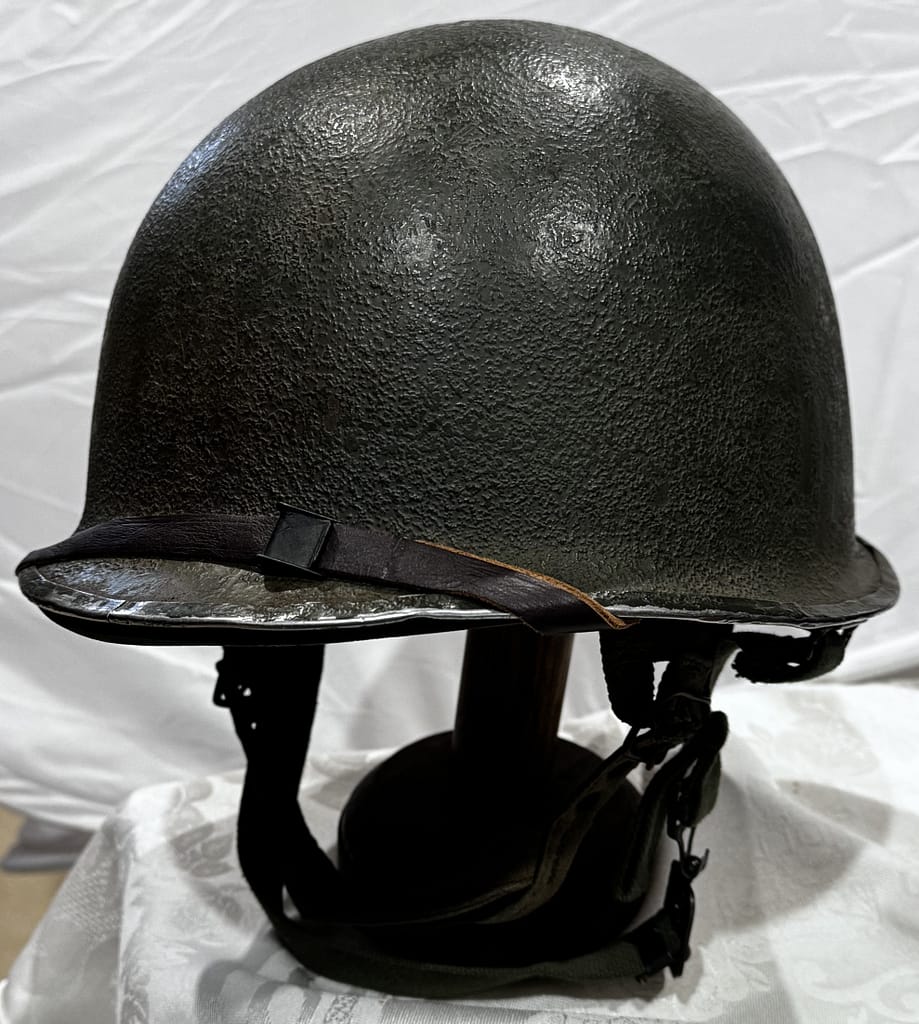
Explore original weapons and equipment from the Second World War, drawn from my personal collection.
Uniforms, helmets, headgear, weapons, equipment from Australia, Britain, United States, Soviet Union, Germany, Japan, Italy, Romania, — personally handled, photographed and examined by me.
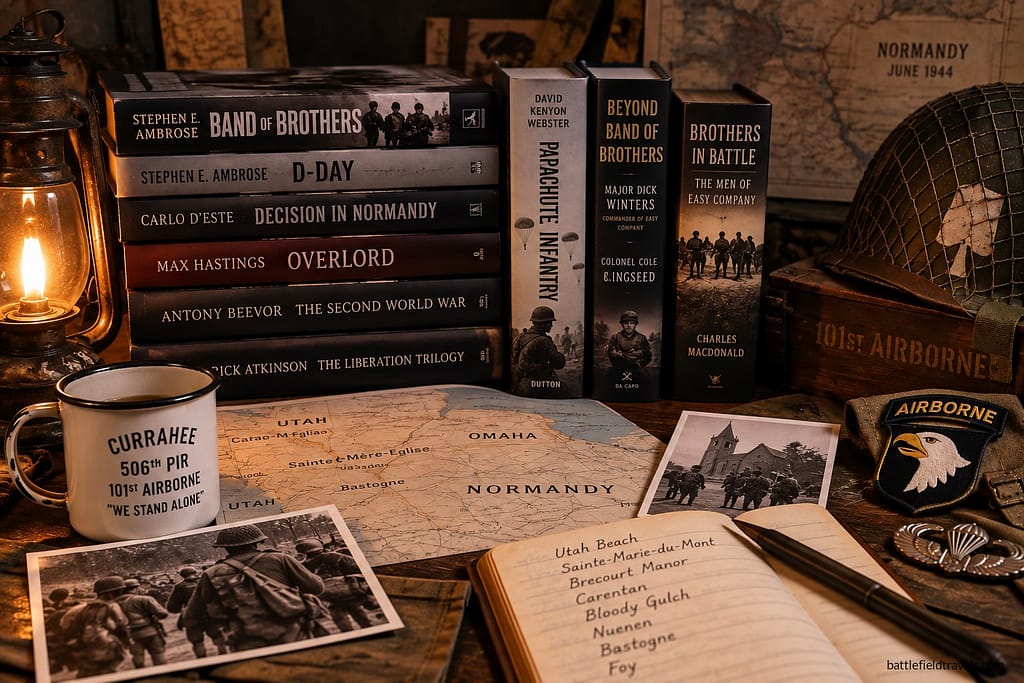
A curated reading list covering the Second World War across all theatres. Explore campaign histories, battlefield studies, biographies, primary accounts and contemporary military writings used in the research behind Battlefield Travels. The list will continue to grow as I publish new studies and draw upon new resources.
❓Easy Company Quiz. Test your ‘Band of Brothers’ knowledge!
Easy Company, 506th Parachute Infantry Regiment, fought from Normandy to the Netherlands, Bastogne and the final advance into Germany and Austria. Test your knowledge with 20 questions covering the men, battles, commanders and campaigns of the real Easy Company.
Here on 6 June 1944, Lieutenant Richard ‘Dick’ Winters, acting company commander for Easy Company, 506th Parachute Infantry Regiment, 101st Airborne Division, led a force of 23 paratroopers in a successful assault on a German force that outnumbered them more than 5 to 1. Easy Company’s action that day was depicted in the Steven Spielberg/Tom…
The Battle of Bloody Gulch was fought on 13 June 1944, just west of Carentan, Normandy. The battle followed immediately after 101st Airborne Division’s capture of Carentan on 12 June. Lightly armed American paratroopers from 506th (PIR) Parachute Infantry Regiment and 501st PIR faced a major armoured counterattack by the 17th SS Panzergrenadier Division and…
After the successful D-Day landings on June 6, the Allies needed to link the Utah and Omaha beachheads, build forces to cut off the Cotentin Peninsula, and be prepared for the expected German counterattack that they knew was coming. The key to all of that was the town of Carentan on the Cotentin – a…
As a former 82nd Airborne Division paratrooper, the town of Sainte-Mere Eglise in the Cotentin Peninsula of Normandy holds a special place for me. In the early hours of 6 June 1944, ahead of the Normandy Beach landings, the US 82nd and 101st Airborne Divisions parachuted into this area. The 82nd was to seize the…
September 2025, Randwijk, Netherlands. I am standing at the “Crossroads” made famous in Band of Brothers Episode 5: Crossroads. On 5 October 1944, a brief battle took place here, east of the village of Randwijk, in the area between the Rhine and the Waal known as “The Island.”
Authored by Mick Prictor, a retired military officer with 40 years’ service, and a military historian specialising in terrain-focused analysis of tactics, doctrine, and command decision-making in land warfare. His work draws on extensive battlefield fieldwork—more than 280 sites worldwide—and one of the world’s largest private collections of historic military arms, uniforms, and equipment. About me
⚔️ Go deeper — Members get exclusive access to the Deep Research Collection, Field Notes, and monthly Research Dispatches. Try membership free for 7 days, cancel anytime. From $9/month.
What battles and locations are covered in the Easy Company collection?
Published studies include Sainte-Mère-Église, Brecourt Manor, Carentan and Bloody Gulch. Forthcoming studies cover Eindhoven, Nuenen, Koevering, Market Garden approaches, “The Island,” Bastogne, Foy and Berchtesgaden.
How does this differ from other Band of Brothers resources?
These studies are grounded in on-site, terrain-focused fieldwork, supported by period maps, unit records and modern reconnaissance — allowing readers to understand the physical context of each battle.
Can readers follow Easy Company’s campaign chronologically?
Yes. The landing page and linked battle studies follow the unit’s real operational sequence from Normandy through Holland, the Ardennes and into Germany.
Are the battlefield locations accessible today?
Many sites — including Brecourt Manor, Carentan, Eindhoven, Bastogne and Foy — preserve key terrain features and can be visited in detail, with local museums and memorials along the route.
Will more Easy Company battlefield studies be added?
Yes. My 2025 and 2024 European reconnaissance trips will allow many additional locations to be documented and published, including Son Bridge, Nuenen, Koevering, the Crossroads, and Eagles Nest.
Subscribe to Battlefield Travels and receive a free E-Book Battlefield Guide
Unlock expert battlefield analysis, campaign reconstructions, and historical insights drawn from firsthand exploration and primary sources.
🗺️ You’ll receive:
🎖️ Exclusive historical insights you won’t find elsewhere
📘 A free eBook: 10 Tips for Exploring Historic Battlefields
📰 New battlefield studies straight to your inbox as they are published
Claim Your Free Battlefield Travel Guide
Get your free e-book, exclusive tips, and updates on new battlefield studies.
Thank you!
You have successfully joined our subscriber list.
⚔️ Go deeper — Members get exclusive access to the Deep Research Collection, Field Notes, and monthly Research Dispatches. Try membership free for 7 days, cancel anytime. From $9/month.
Reconstructing World War Two battles through terrain analysis, primary sources and on-site research
U.S. soldiers of the 55th Armoured Infantry Battalion and a tank of the 22nd Tank Battalion move through a smoke-filled street in Wernberg, Germany, April 22, 1945. US National Archives
🧭🥾 Walking the battlefields of the Second World War
There is no single World War Two landscape. I have walked battlefields ranging from the forests and frozen roads of Finland to the jungle ridges of Guadalcanal and New Guinea, the beaches and bocage of Normandy, the low country of the Netherlands, the wooded hills and villages of the Ardennes, and Hitler’s Eagle’s Nest in the Bavarian Alps. Each presents a different physical problem, and each makes aspects of the fighting apparent that can be difficult to appreciate from maps alone.
What connects these battlefields is the relationship between soldiers and terrain. A narrow road through a Finnish forest, a jungle ridge overlooking Henderson Field, a causeway across flooded Normandy fields, a bridge over a Dutch river or a road junction in the Ardennes could become disproportionately important because the surrounding terrain restricted the alternatives. Walking those places helps explain why commanders made particular decisions, why attacks developed in particular directions, and why apparently minor pieces of ground became the focus of intense fighting.
This collection brings those battlefield studies together while remaining deliberately incomplete. Every battle examined here is a battlefield I have visited. As that fieldwork expands, so too will the World War Two collection.
Operation Market Garden. Walking the site just west of Arnhem where 3 Para ambushed Major General Kussin on 17 September 1944. With author David Buggenum
Second World War – 1939-1945
Conflict Overview
World War Two was a global conflict fought across Europe, Africa, Asia, the Pacific and the world’s oceans between 1939 and 1945. Industrial production, logistics, air and sea power, technological change and the mobilisation of entire societies gave the war an unprecedented scale. The fighting itself took place across radically different environments, from Arctic forests and tropical jungle, to beaches, flooded lowlands, dense hedgerows, mountains and shattered towns and cities. Armies had to adapt their weapons, tactics and doctrine to the ground on which they fought.
This overview does not cover every theatre or campaign of the Second World War. I have walked the ground on every battlefield in this collection, using period maps, wartime photographs, primary and veteran accounts, GIS analysis and field reconnaissance to examine how terrain, weapons, doctrine and command decisions shaped the fighting. There are places and battlefields that I have not yet explored, so my coverage is deliberately uneven. I have researched and explored some campaigns in forensic detail, others in less detail, and some I have not visited at all. They are all on my ‘to-do’ list.
The aim is not simply to retell what happened, but to understand why it happened: how terrain channelled movement, concealed or exposed troops, became vital ground, shaped fields of fire and influenced the decisions available to commanders. Across very different theatres, the same recurring problem remained: soldiers and commanders had to understand the ground and exploit it before their opponents did.
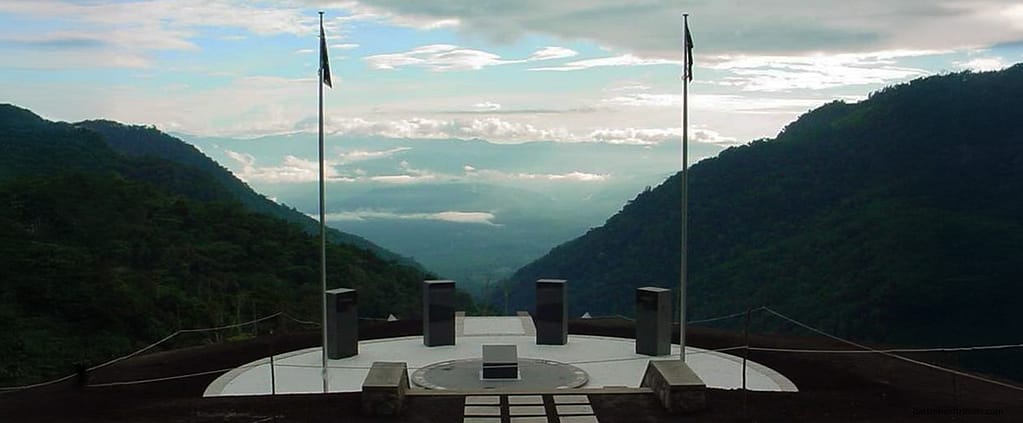
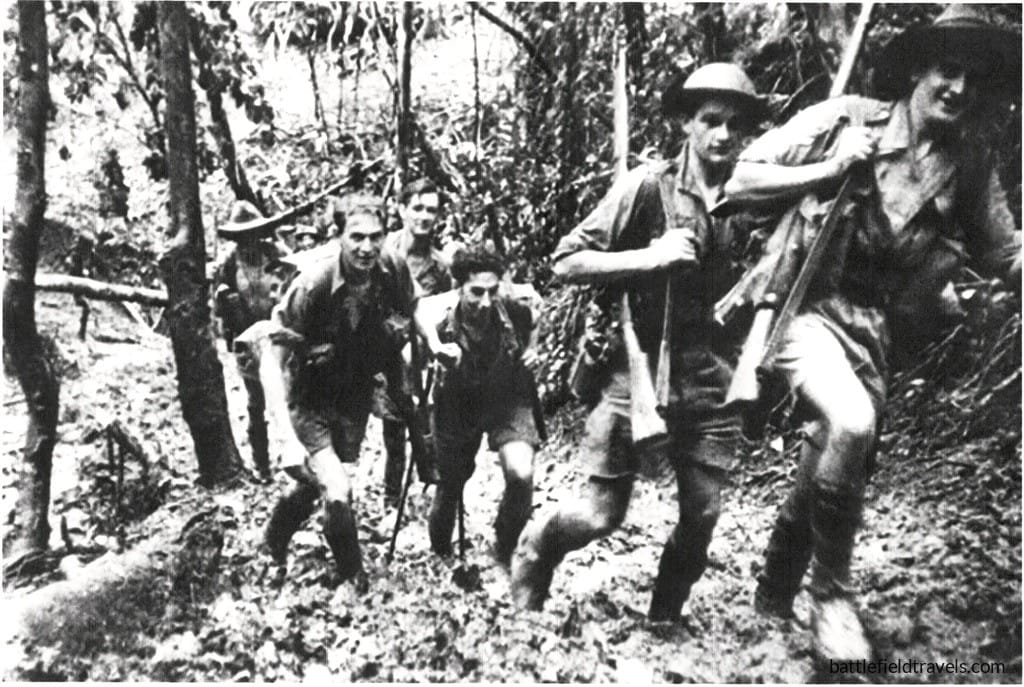
Monument at Isurava, on the Kokoda Track, Papua New Guinea, commemorating the August 1942 battle between Australian forces and the Japanese South Seas Detachment.
Finland and the Winter War, 1939–40
The Soviet invasion of Finland in November 1939 demonstrated how profoundly terrain, climate and tactical adaptation could affect the performance of opposing armies. Soviet forces crossed the frontier with overwhelming superiority in manpower, armour and artillery, but frequently found themselves restricted to narrow roads running through forests, lakes and deep snow.
In central Finland, Finnish troops exploited this environment to isolate and destroy Soviet columns. During the battles of Suomussalmi and the Raate Road, small Finnish units used mobility, local knowledge and dispersed attacks to break much larger Soviet formations into isolated pockets (motti). The campaign became an early demonstration of the importance of adapting organisation and tactics to terrain rather than relying on numerical and material superiority alone.
Winter War – destroyed Soviet vehicles on the Raate-Suomussalmi Road, January 1940
The Pacific War
The Japanese attack on Pearl Harbor in December 1941 brought the United States directly into the war and accompanied a rapid series of Japanese offensives across Southeast Asia and the Pacific. By mid-1942, however, Japanese expansion was beginning to encounter increasingly effective Allied resistance.
In August 1942, US Marines landed on Guadalcanal in the Solomon Islands, beginning the first sustained American ground offensive against Japanese forces in the Pacific. What followed was a six-month struggle on land, at sea and in the air centred on Henderson Field. The Guadalcanal Campaign examines that struggle as a connected campaign, from the initial American landings through Tenaru, Edson’s Ridge, the Matanikau, Henderson Field and Mount Austen to the Japanese evacuation in February 1943.
Farther west, New Guinea presented an entirely different battlefield problem. Mountains, jungle, rivers, disease and extremely limited communications imposed severe constraints on both sides. Fighting across the island repeatedly demonstrated that apparently short distances on a map could represent formidable obstacles on the ground. The fighting around Isurava and the Kokoda Track provides a particularly stark example of infantry combat shaped by narrow tracks, steep ridgelines and restricted visibility.
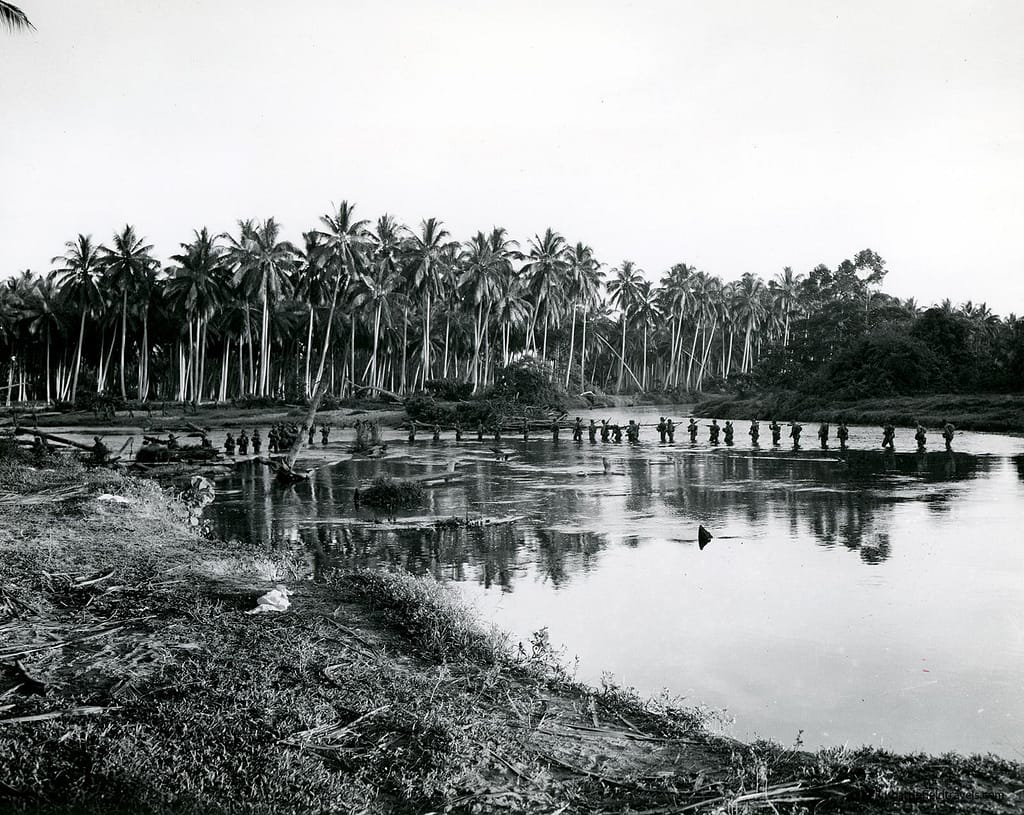
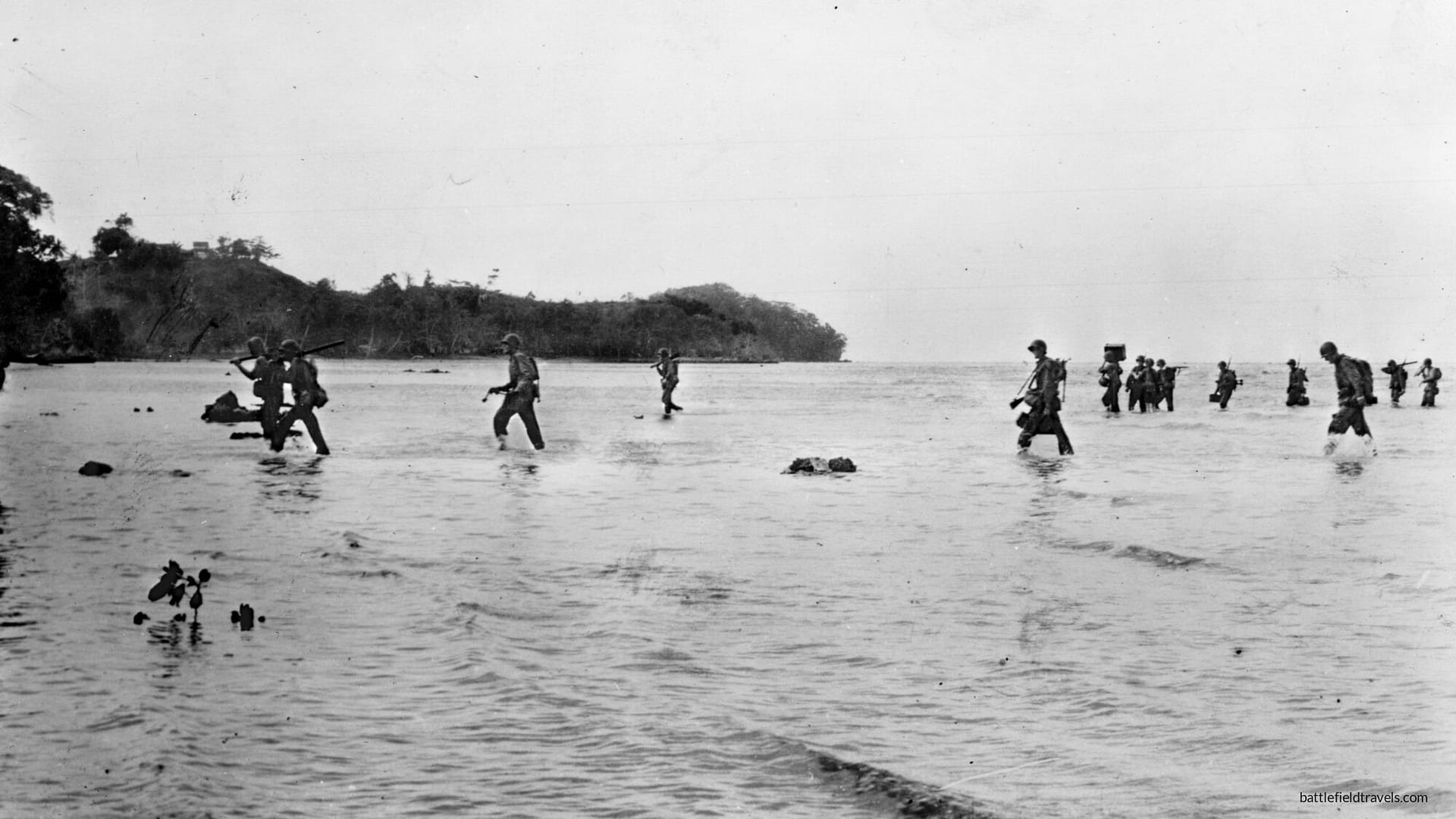
1/1 Marines Patrol Crossing Lunga River, Guadalcanal, circa Sep 1942
North-West Europe, 1944
By 1944, the Western Allies had assembled the forces required to return to occupied France. Operation Overlord combined an enormous amphibious assault with airborne operations, naval gunfire, air power and an elaborate deception campaign intended to establish a secure lodgement in Normandy.
D-Day and Normandy Landings began in the opening minutes of 6 June with British airborne operations at Pegasus Bridge and east of the Orne. American airborne divisions descended behind Utah Beach, while amphibious forces landed across Utah, Omaha, Gold, Juno and Sword Beaches. The fighting continued beyond the beaches as Allied forces struggled to connect and consolidate their lodgements around places such as Carentan.
One small-unit story also provides a continuous thread through several of these campaigns. The Easy Company battlefield series follows the 506th Parachute Infantry Regiment from the Normandy landings through Operation Market Garden, the Battle of the Bulge and the final advance into Germany and Austria.
Once the Allied armies broke out of Normandy, the campaign moved rapidly across France and Belgium. In September, Operation Market Garden attempted to exploit that momentum by seizing a succession of bridges through the Netherlands and establishing a bridgehead across the Lower Rhine at Arnhem. Airborne forces fought around Eindhoven, Nijmegen and Arnhem while the ground advance struggled along a narrow corridor vulnerable to German counterattack.
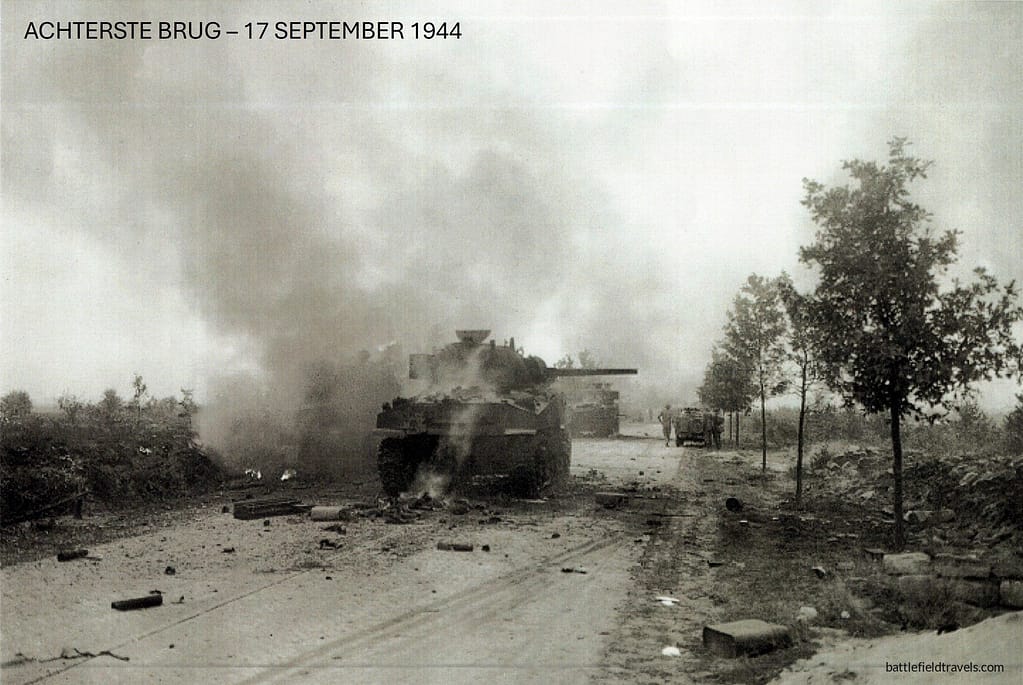
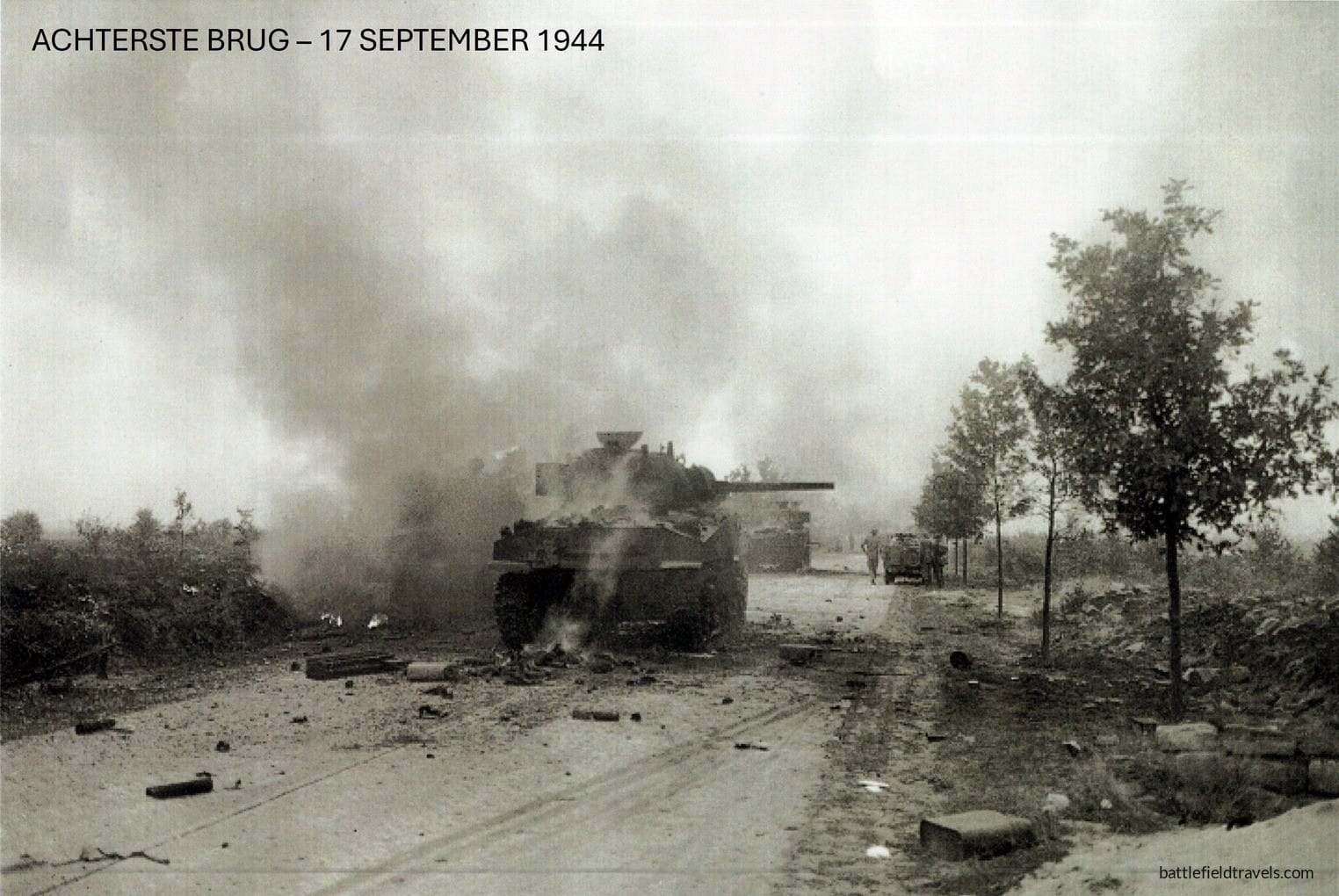
Operation Market Garden, Tanks of teh Guards Armoured Division destroyed at Achterste Brug, 17 September 1944
The German Frontier and the Battle of the Bulge
By late 1944 Allied forces had reached the approaches to Germany, but extended supply lines, difficult terrain and renewed German resistance slowed the advance. In December, Germany launched a major counteroffensive through the Ardennes in an attempt to rupture the Allied front and regain the strategic initiative in the west.
The Battle of the Bulge developed into a series of interconnected battles for roads, villages, ridgelines and communications across difficult winter terrain. Fighting around Elsenborn Ridge, St Vith, Stavelot, Stoumont and Bastogne demonstrated the importance of controlling the limited road network through the Ardennes, while smaller actions such as the fighting around Foy reveal the tactical problems confronting infantry operating in snow, forests and exposed villages.
The failure of the German offensive left Allied forces free to resume their advance into Germany. The final Nazi redoubt in the Bavarian Alps proved less formidable than expected, and Allied troops seized Hitler’s Eagles Nest on 4 May 1945. By 8 May 1945 the war in Europe was over. The Pacific War continued until August, ending a conflict that had transformed warfare and much of the international order.
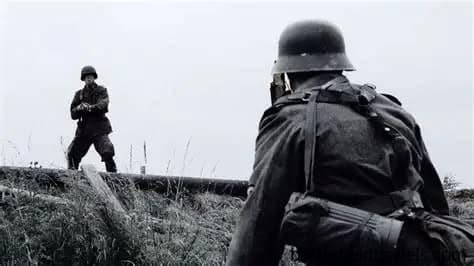
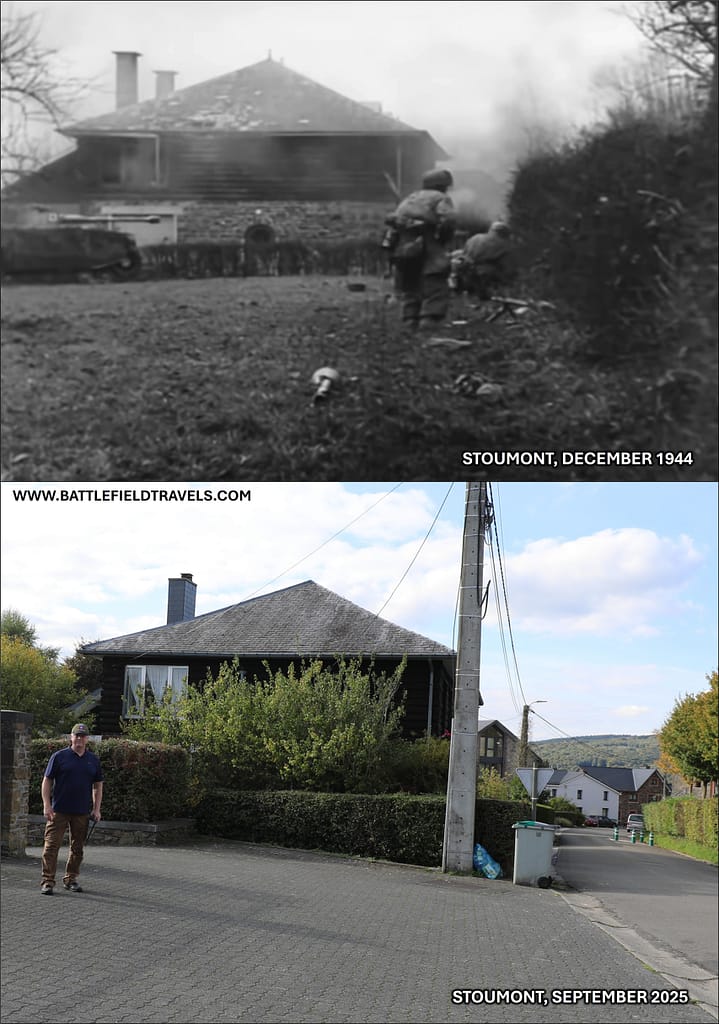
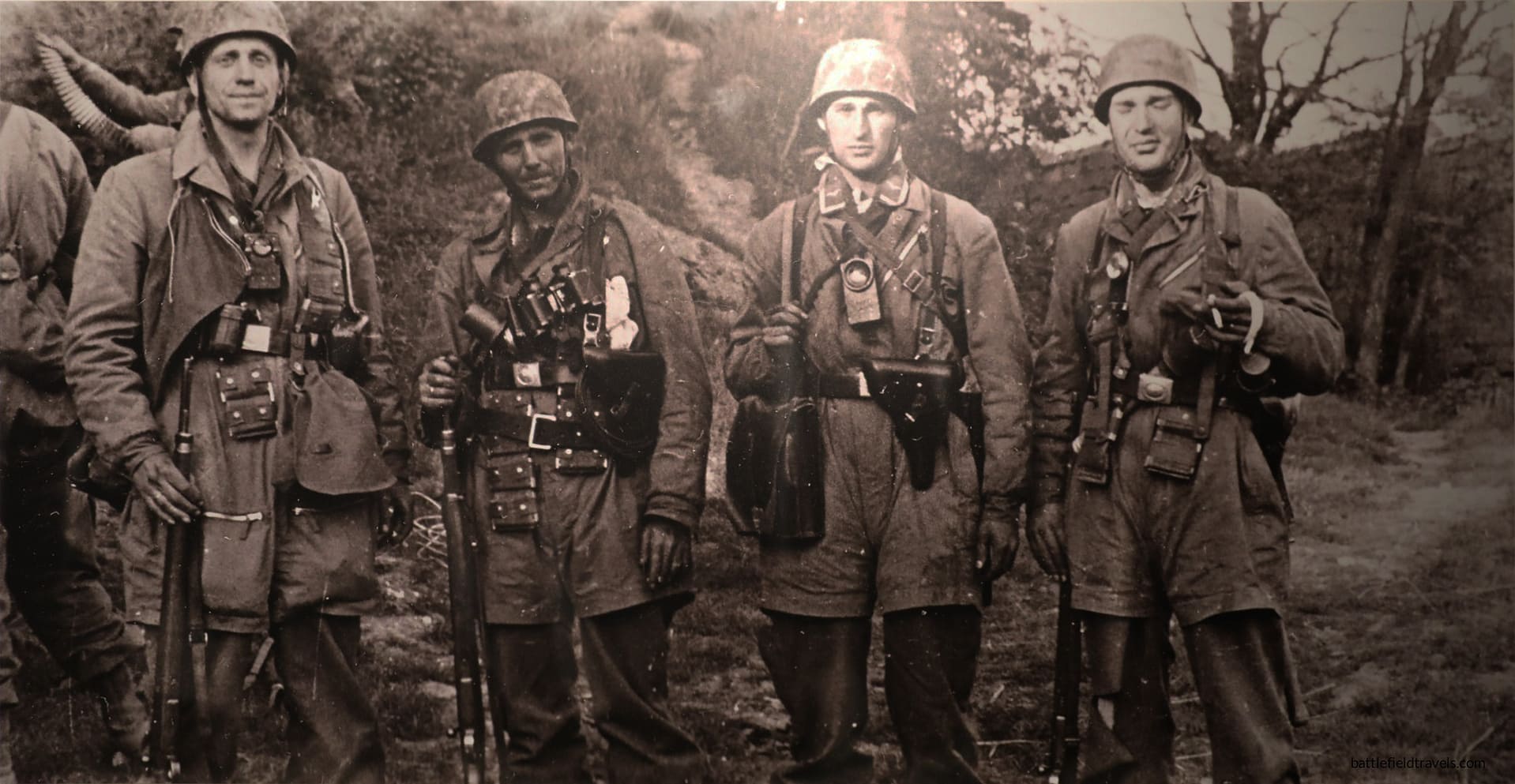
Then and Now. Battle of the Bulge, Stoumont. German paratroopers assigned to Kampfgruppe Peiper attempt to clear positions held by the US 30th Infantry Division, 9 December 1944
Second World War Battlefield Studies
In-depth battlefield analyses based on terrain, primary sources, and on-the-ground exploration.
British 6th Airborne Division’s role on D-Day was multi-faceted. In the opening minutes, glider-borne troops would seize the bridges over the Caen Canal and the River Orne. Soon afterwards, paratroopers would neutralise Merville Battery. Others would destroy key bridges over the Dives and prepare for German counterattacks. The mission was audacious, high risk, and critical…
August 2026, west of Point Cruz, Guadalcanal. I am walking the section of coast known to history as ‘Little Dunkirk’. Here, on 27 September 1942, the 1st Battalion 7th Marines was evacuated under fire by the US Navy and Coast Guard during the 2nd Battle of the Matanikau. This was the only significant American defeat…
August 2026, Edson’s Ridge, south of Henderson Field, Guadalcanal. I am exploring the sites of the 12-14 September 1942 Japanese attack against the Lunga perimeter. The long north-south ridgeline here became known as ‘Edson’s Ridge’ or ‘Bloody Ridge’ after the battle. The Japanese called it ‘The Centipede’. This is one of the best-preserved battle sites…
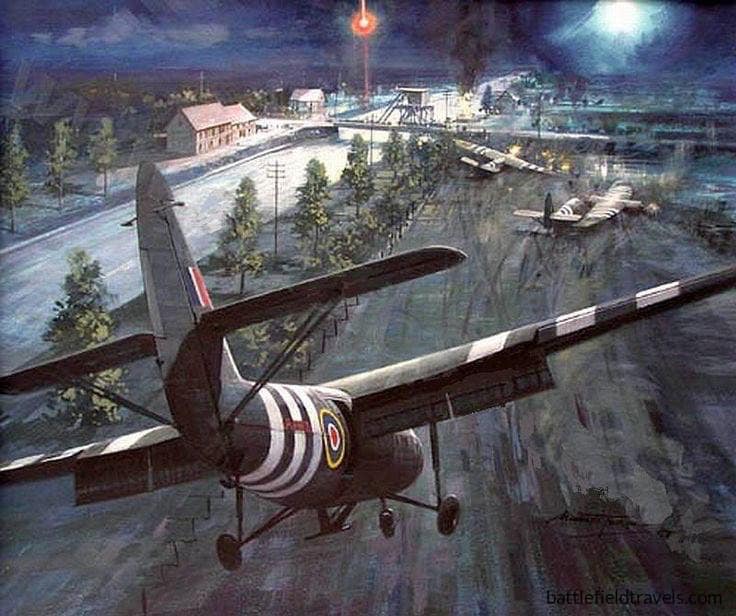
In the opening minutes of D-Day, British airborne troops conducted a glider-borne coup-de-main assault to seize the bridges over the Caen Canal and River Orne. Their mission was simple but dangerous: capture the bridges intact and hold them against German counterattacks, thereby securing the eastern flank of the Normandy landings.
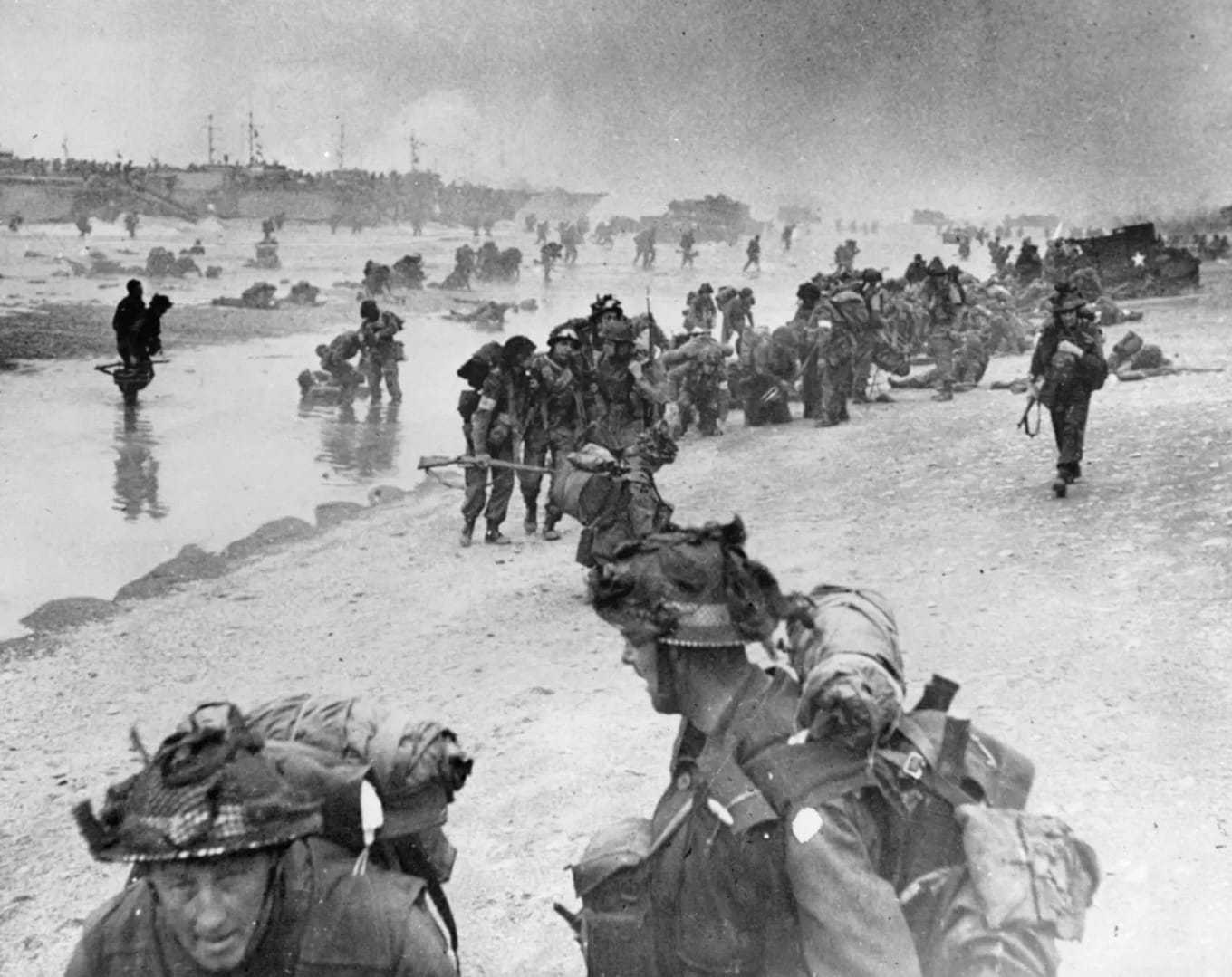
On 6 June 1944, the British 3rd Division, supported by the 1st Special Service Brigade and 79th Armoured Brigade, stormed Sword Beach, the easternmost Allied landing sector in Normandy. Their success secured the D-Day landing Allied left flank, linked with the airborne lodgement at the Orne, and set the stage for the long struggle for…
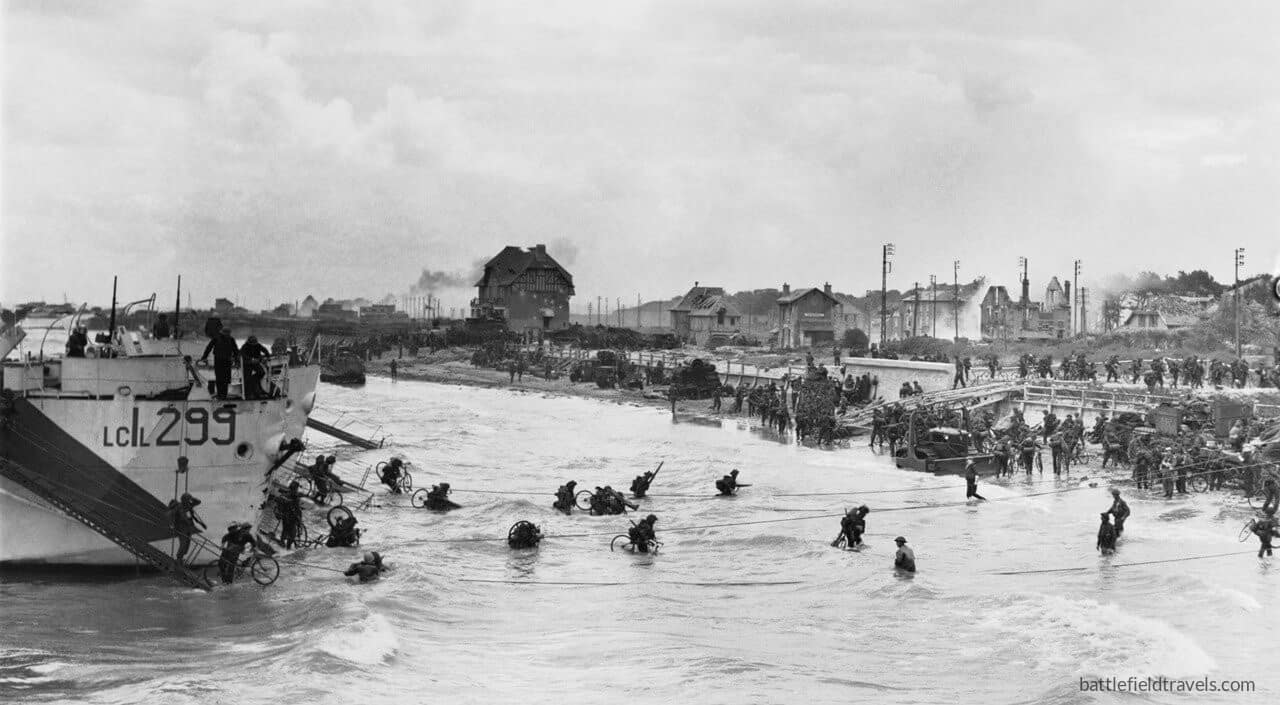
On 6 June 1944, the 3rd Canadian Infantry Division stormed ashore at Juno Beach, facing some of the strongest German defences in Normandy. Their task was to force a landing on the narrow strip of beach between Courseulles, Bernières, and Saint-Aubin, and then drive inland to cut the Caen–Bayeux road before linking up with the…
On 6 June 1944, the British 50th (Northumbrian) Infantry Division landed at Gold Beach, facing fortified villages and determined German resistance. By nightfall, they had secured a foothold, linked with Canadian forces at Juno, and pushed inland toward Bayeux. Within days, the artificial Mulberry harbour was providing vital sustainment to the Normandy campaign.
Omaha Beach makes a powerful impression. When you visit the beach, you know that this is where Robert Capa took those famous photos of American soldiers assaulting through the obstacle belt, and where the dramatic first 20 minutes of Saving Private Ryan was set. It also becomes clear how important the five beach exits were…
Pointe du Hoc, a prominent headland between Utah and Omaha Beaches, was a critical objective on D-Day. The German position was equipped with a battery of 155mm howitzers capable of targeting the American landing beaches. The mission to assault Pointe du Hoc was assigned to the 2nd and 5th Ranger Battalions. The Rangers would scale…
In the early hours of D-Day, 6 June 1944, 13,200 paratroopers of the 82nd and 101st Airborne Divisions landed behind Utah Beach to secure the beach landing sites and prevent German interference. A few hours later, the US 4th Infantry Division stormed ashore on Utah Beach. The amphibious forces landed about 2,000 yards south of…
Here on 6 June 1944, Lieutenant Richard ‘Dick’ Winters, acting company commander for Easy Company, 506th Parachute Infantry Regiment, 101st Airborne Division, led a force of 23 paratroopers in a successful assault on a German force that outnumbered them more than 5 to 1. Easy Company’s action that day was depicted in the Steven Spielberg/Tom…
The Battle of Bloody Gulch was fought on 13 June 1944, just west of Carentan, Normandy. The battle followed immediately after 101st Airborne Division’s capture of Carentan on 12 June. Lightly armed American paratroopers from 506th (PIR) Parachute Infantry Regiment and 501st PIR faced a major armoured counterattack by the 17th SS Panzergrenadier Division and…
After the successful D-Day landings on June 6, the Allies needed to link the Utah and Omaha beachheads, build forces to cut off the Cotentin Peninsula, and be prepared for the expected German counterattack that they knew was coming. The key to all of that was the town of Carentan on the Cotentin – a…
As a former 82nd Airborne Division paratrooper, the town of Sainte-Mere Eglise in the Cotentin Peninsula of Normandy holds a special place for me. In the early hours of 6 June 1944, ahead of the Normandy Beach landings, the US 82nd and 101st Airborne Divisions parachuted into this area. The 82nd was to seize the…
The final act of Steven Spielberg’s 1998 movie ‘Saving Private Ryan’ is set in the fictional French town of Ramelles, as a mixed group of paratroopers defends a bridge over the Merderet River against German armoured counter-attacks. That scene is based on real events that happened right here at La Fiere Bridge. I was a…
When Stalin’s Red Army invaded Finland on 30 November 1939, the two main thrusts were in the south around Lake Ladoga and the Mannerheim Line, and in central Finland focussed on Suomussalmi. In central Finland, the Russian 163rd Rifle Division and an independent tank brigade crossed the border at Juntusranta, and the 44th (Ukrainian) Rifle…
Operation Anthropoid was one of the most significant acts of resistance against Hitler’s regime. Planned and executed by Czechoslovakian operatives in collaboration with the British Special Operations Executive (SOE), Operation Anthropoid targeted Reinhard Heydrich, a high-ranking Nazi official and one of the principal architects of the Holocaust.
August 2026, Ilu River (Alligator Creek). I am exploring the site of the 21 August 1942 Japanese attack against the Marines on the Lunga perimeter. The Japanese ‘Ichiki Detachment’ was a battalion-sized force from the 28th Infantry Regiment, led by the Regimental Commander, Colonel Kiyonao Ichiki. Facing them across the Ilu River was the 2nd…
Matanikau Village site, August 2026. I am exploring the site of the First Battle of the Matanikau, 18-19 August 1942. The battle was the first major battle west of the Matanikau and bears many similarities with the other five or six battles (depending on how you count them) on the Matanikau that would follow, each…
August 2026, at the mouth of the Matanikau River. I am exploring the sites associated with the ill-fated ‘Goettge Patrol’ of 12-13 August 1942. The action happened over a very small area on the beachline west of the Matanikau, near the old village of Matanikau, now overrun by urban sprawl. In 1942 the jungle extended…
Gavutu & Tanambogo Islands, 8 August 2026. I am exploring the site of some of the most bitter fighting of the entire Guadalcanal Campaign, and it happened right here over 7-9 August 1942, While the landings at Beach Red on the big island of Guadalcanal had gone ahead unopposed, the landings at Tulagi and Gavutu…
Tulagi Island, 8 August 2026. I crossed Iron Bottom Sound from Honiara to Tulagi by a dawn high-speed ferry. The trip was roughly two hours long. The date of my battlefield visit also coincided with the official 84th anniversary commemoration of the battle. The commemorative service was held on Blue Beach and was attended by…
August 2026, Beach Red, Guadalcanal, I am walking the ground at Beach Red, site of the 1st Marine Division landings on 7 August 1942. Compared to many other WW2 sites on the island, Beach Red is little changed since 1942. The beach is about four kilometres east of Henderson Field and curves from the Tenaru…
September 2025, Leopoldsburg, Belgium. I am standing on Nicolaylaan Street, on the site of the old Cinema Splendid. On the morning of 15 September 1944, one of the most consequential military briefings of the Second World War took place inside its walls. Lt Gen. Brian Horrocks stood before his subordinate commanders of XXX Corps and…
October 2025, Fort Eben-Emael, Liège, Belgium. I am exploring the great Belgian fortress of Eben-Emael. In May 1940, this was the site of one of the boldest, most dramatic actions in military history. A handful of German glider-borne assault engineers neutralised the most powerful fortress in Europe in under twenty-four hours, using a weapon no…
September 2025, Hell’s Highway, south of Eindhoven, Netherlands. I am exploring Hell’s Highway in the vicinity of Achterste Bridge with author Jack Didden. On 17 September 1944, Sherman tanks of the Guards Brigade led the XXX Corps advance from the Belgian border north towards Eindhoven, Nijmegen and, eventually, Arnhem. Lieutenant Colonel Joe Vandeleur’s Irish Guards…
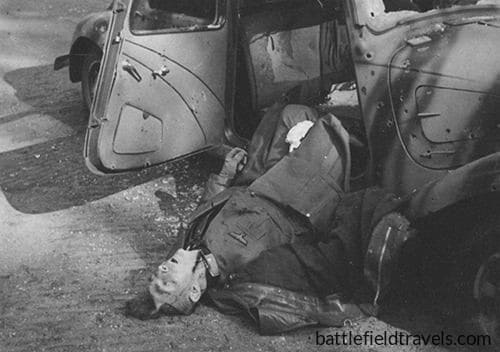
September 2025, Arnhem, Netherlands. I am standing at the intersection of Wolfhezerweg and Utrechtseweg with author David Buggenum, on the site where the local German commander, Generalmajor Friedrich Kussin, was ambushed and killed by members of 3rd Battalion, The Parachute Regiment, on 17 September 1944.
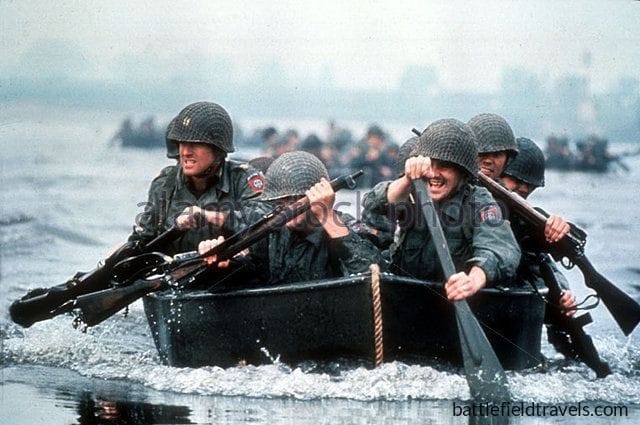
September 2025, Nijmegen, Netherlands. I am standing at the site on the Waal River, where Major Julian Cook led the 504th Parachute Infantry Regiment (504 PIR) of the US 82nd Airborne Division in a dramatic assault river crossing to seize the northern end of the Waal Road Bridge at Nijmegen.
August 2002, Isurava, Papua New Guinea. I explored the Isurava battlefield in August 2002, around the 60th anniversary of the battle, during preparations to open the spectacular new memorial on the Kokoda Track. At the time, I was still serving in the Army back then, and I flew Prime Minister John Howard and veterans of…
September 2025, Randwijk, Netherlands. I am standing at the “Crossroads” made famous in Band of Brothers Episode 5: Crossroads. On 5 October 1944, a brief battle took place here, east of the village of Randwijk, in the area between the Rhine and the Waal known as “The Island.”
Over thousands of years of warfare, armies have sought ways to gain advantage on the battlefield. Sometimes the solution was a new weapon. Sometimes it was a radical new method. Often it was a combination of both. From the disciplined ranks of the Greek phalanx to pike-and-shot warfare to the interlocking machine-gun fire plans of the twentieth century, tactical innovations have repeatedly reshaped how battles are fought.
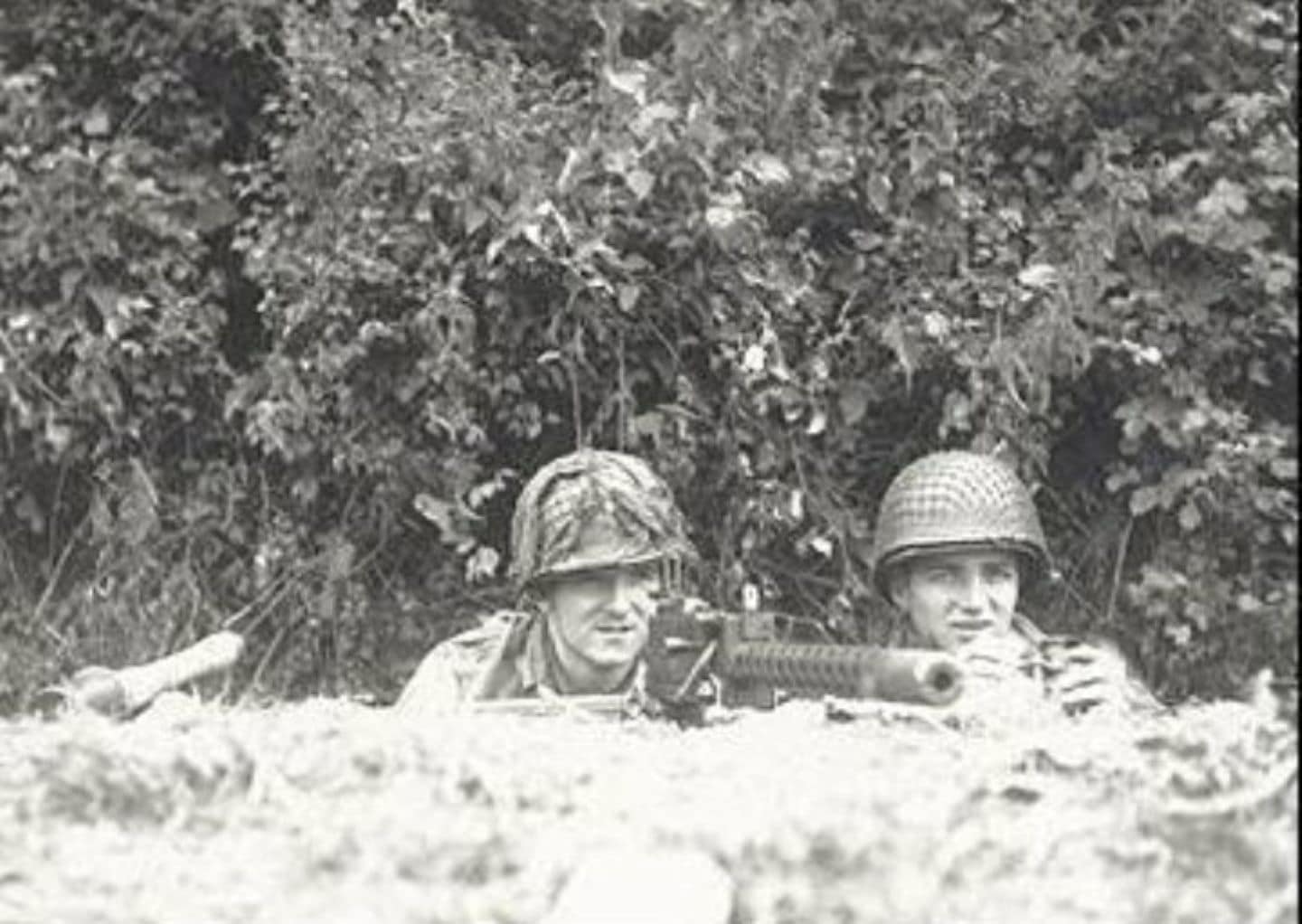
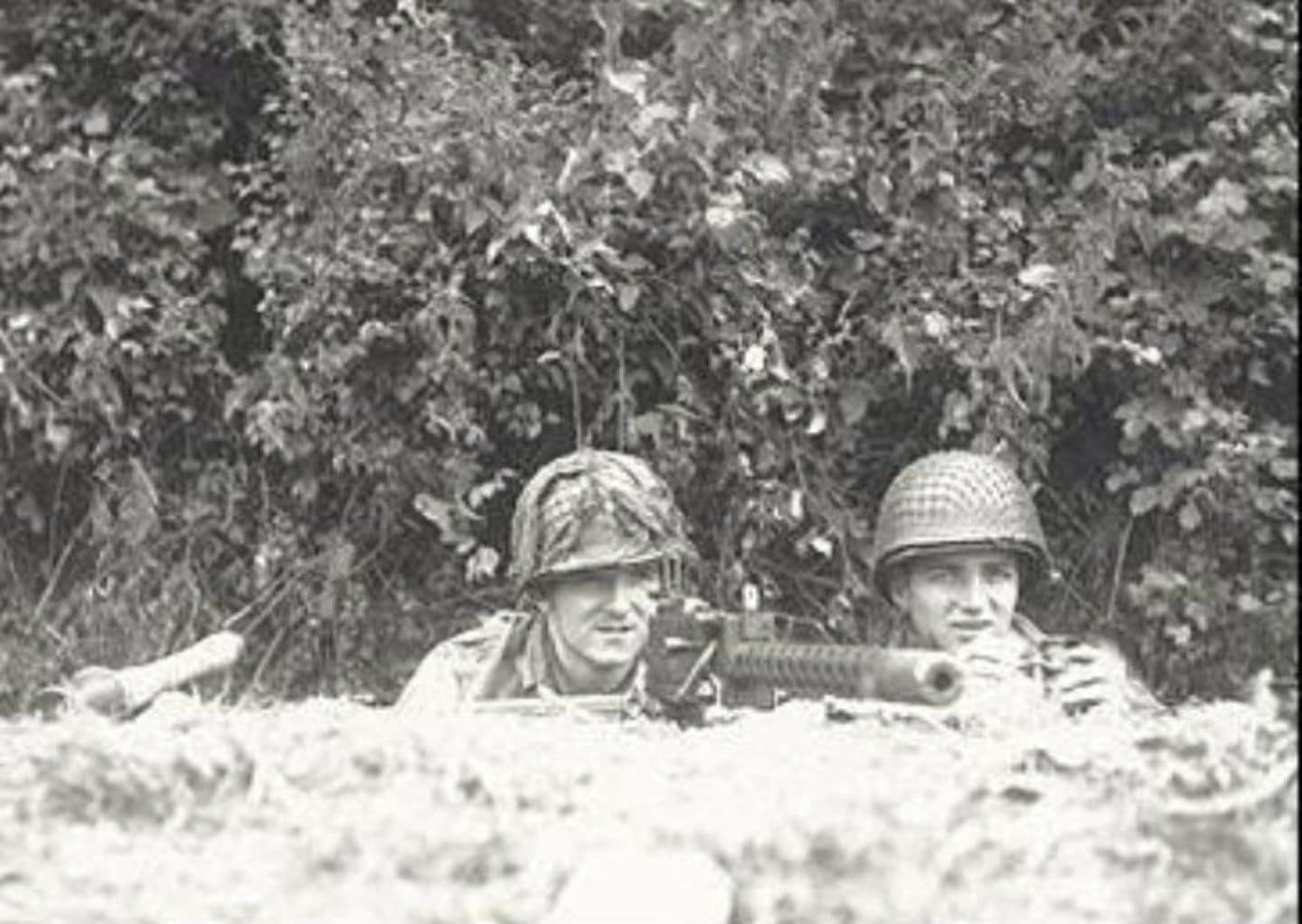
This article explains how machine guns are employed on the battlefield, including the key concepts of cone of fire, beaten zone, grazing fire, enfilade fire, and mutually supporting machine-gun positions. The article forms part of the Tactical Innovations in Warfare series.
Authored by Mick Prictor, a retired military officer with 40 years’ service, and a military historian specialising in terrain-focused analysis of tactics, doctrine, and command decision-making in land warfare. His work draws on extensive battlefield fieldwork—more than 280 sites worldwide—and one of the world’s largest private collections of historic military arms, uniforms, and equipment. About me
⚔️ Go deeper — Members get exclusive access to the Deep Research Collection, Field Notes, and monthly Research Dispatches. Try membership free for 7 days, cancel anytime. From $9/month.
What makes these World War Two battlefield studies unique?
Each study combines terrain analysis, period maps, archival accounts and on-site research to explain how ground, movement and tactical decisions shaped the battle.
Are these WW2 studies focused mainly on D-Day?
The collection includes extensive D-Day and Normandy actions, but also covers Market Garden, airborne operations and other major battles across the European theatre.
Can I visit these World War Two battlefields today?
Yes. Many sites in Normandy, including the landing beaches, remain accessible and are included with travel guidance and ground-level interpretation.
Do the articles include historical sources and maps?
Each study uses period maps, contemporary imagery, veteran testimony and modern GIS overlays to present a clear, terrain-driven view of the battle.
Subscribe to Battlefield Travels and receive a free E-Book Battlefield Guide
Unlock expert battlefield analysis, campaign reconstructions, and historical insights drawn from firsthand exploration and primary sources.
🗺️ You’ll receive:
🎖️ Exclusive historical insights you won’t find elsewhere
📘 A free eBook: 10 Tips for Exploring Historic Battlefields
📰 New battlefield studies straight to your inbox as they are published
Claim Your Free Battlefield Travel Guide
Get your free e-book, exclusive tips, and updates on new battlefield studies.
Thank you!
You have successfully joined our subscriber list.
⚔️ Go deeper — Members get exclusive access to the Deep Research Collection, Field Notes, and monthly Research Dispatches. Try membership free for 7 days, cancel anytime. From $9/month.
Here on 6 June 1944, Lieutenant Richard ‘Dick’ Winters, acting company commander for Easy Company, 506th Parachute Infantry Regiment, 101st Airborne Division, led a force of 23 paratroopers in a successful assault on a German force that outnumbered them more than 5 to 1.
Easy Company’s action that day was depicted in the Steven Spielberg/Tom Hanks series ‘Band of Brothers’ Episode 2 ‘Day of Days’.
The Battle of Bloody Gulch was fought on 13 June 1944, just west of Carentan, Normandy. The battle followed immediately after 101st Airborne Division’s capture of Carentan on 12 June. Lightly armed American paratroopers from 506th (PIR) Parachute Infantry Regiment and 501st PIR faced a major armoured counterattack by the 17th SS Panzergrenadier Division and Fallschirmjäger-Regiment 6. The timely arrival of the American 2nd Armored Division saved the day and turned the battle into an allied victory.
After the successful D-Day landings on June 6, the Allies needed to link the Utah and Omaha beachheads, build forces to cut off the Cotentin Peninsula, and be prepared for the expected German counterattack that they knew was coming. The key to all of that was the town of Carentan on the Cotentin – a port city with major road and rail junctions.
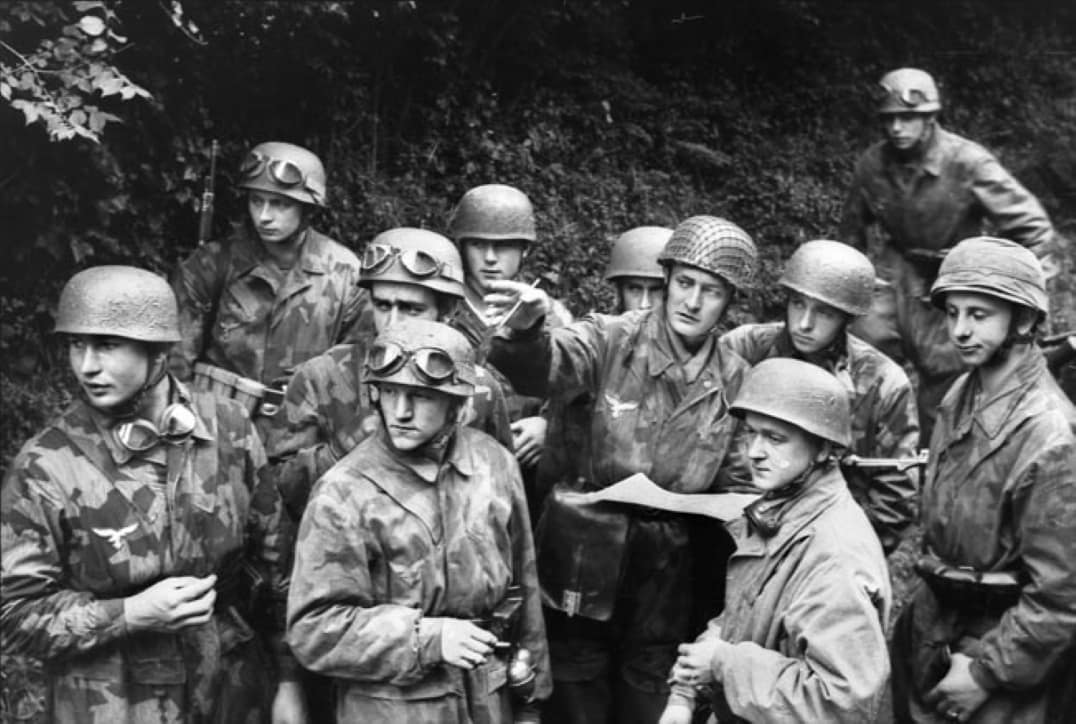
The town was defended by tough German paratroopers from Fallschirmjäger-Regiment 6
As a former 82nd Airborne Division paratrooper, the town of Sainte-Mere Eglise in the Cotentin Peninsula of Normandy holds a special place for me. In the early hours of 6 June 1944, ahead of the Normandy Beach landings, the US 82nd and 101st Airborne Divisions parachuted into this area. The 82nd was to seize the crossings over the Merderet River and the major road junction at Sainte-Mere Eglise, while the 101st was to seize key towns and the four beach exits in support of the landings at Utah Beach.