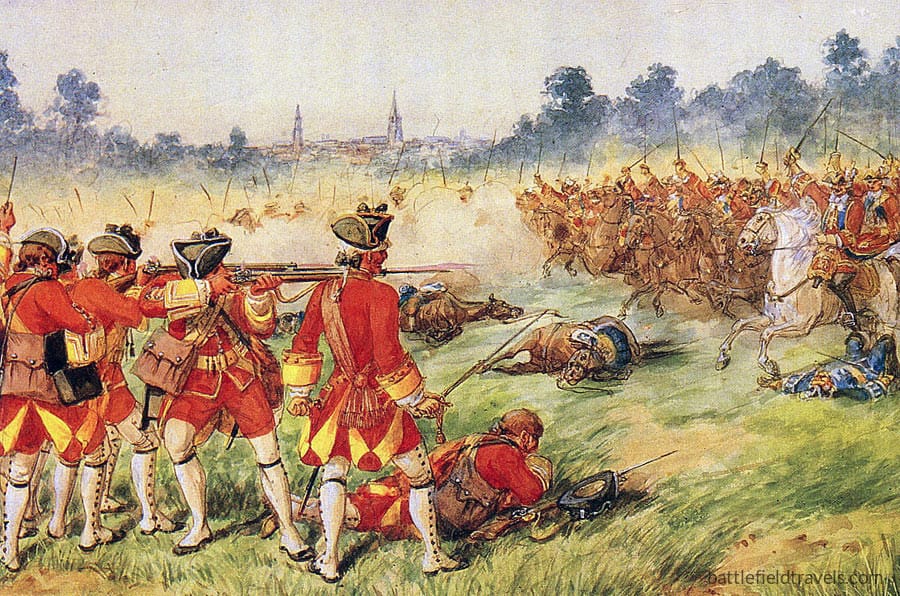
Frederick the Great shaped 18th-century warfare through rapid manoeuvre, oblique-order attacks and battlefield tempo management. His campaigns reveal the interplay of doctrine, troop discipline and terrain exploitation.
The Seven Years’ War, or the French and Indian War as the North American theatre is commonly known, was a truly global conflict. The European great powers and their Indigenous allies clashed across five continents. How much do you really know about the Seven Years’ War?
Test your knowledge with 20 questions randomly selected from a bank of 40,
Think you know your military history?
Put your knowledge to the test with BattlefieldTravels’ military history quizzes — challenging questions drawn from the battles, commanders, armies and terrain explored across this site.
Test Your Military History Knowledge
BattlefieldTravels military history quizzes cover battles, commanders, armies, weapons, strategy and battlefield terrain across more than 2,000 years of warfare.
Back in the day when I was a young infantry soldier, I would routinely create quizzes for the other guys when we had some downtime in the jungle. Decades later, many of those same questions have found their way into this BattlefieldTravels quiz page!
These are not simple trivia quizzes. Questions draw on the research behind the battle studies, fieldwork and military history explored across the site. Many answers also link directly to the relevant BattlefieldTravels article, so the quizzes are another way to explore the research behind the questions.
Each attempt draws a random selection of questions from a much larger bank, with both the questions and answers shuffled. More than 500 questions are already in the collection, with more being added.
Score 60% to pass — and expect a challenge.
Military History Quizzes
❓Military Thinkers, Theorists & Innovators Quiz. Test your knowledge!
Every student of military history knows Clausewitz and Sun Tzu, but how deep does your knowledge really go? For thousands of years, soldiers and theorists have wrestled with the nature of war — how armies should fight, and how technology, politics and society reshape the battlefield.
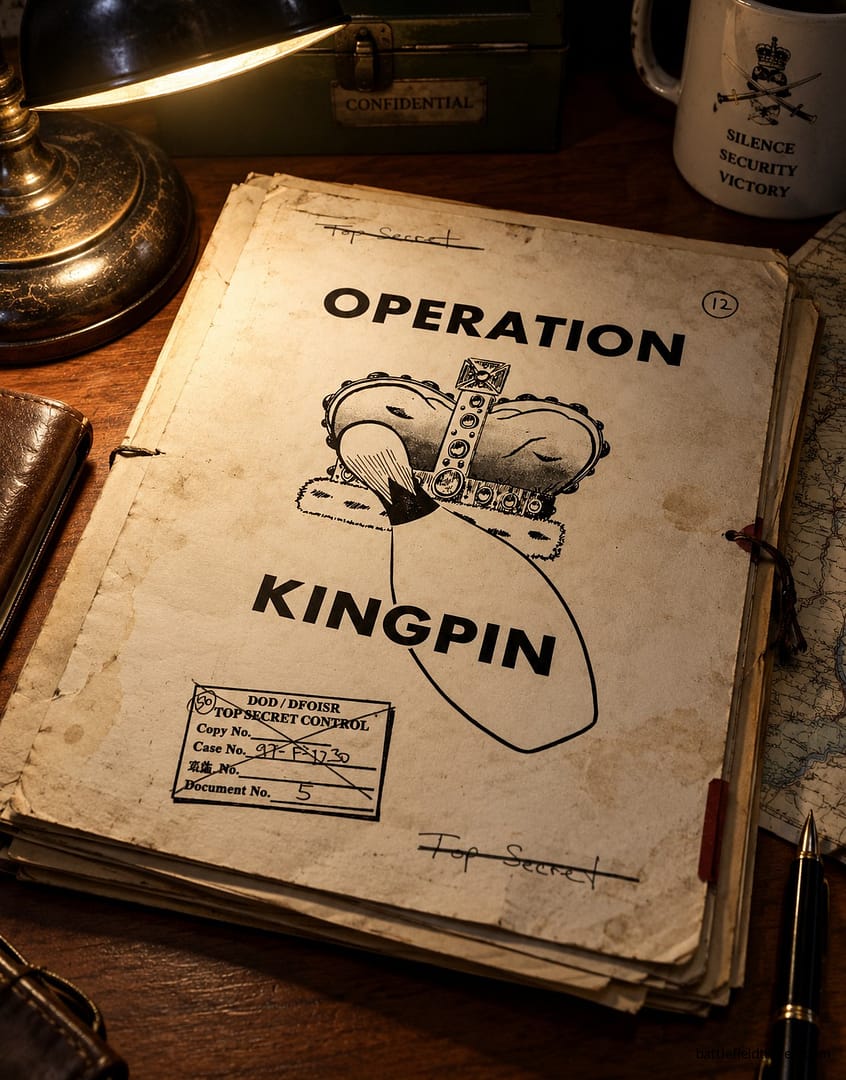
❓Test Your Knowledge of Military Operation Codenames
From OVERLORD and BAGRATION to JAYWICK, and GOTHIC SERPENT, military history is filled with memorable, and sometimes mysterious, operational codenames. Test your knowledge with 20 questions, spanning conflicts around the world.
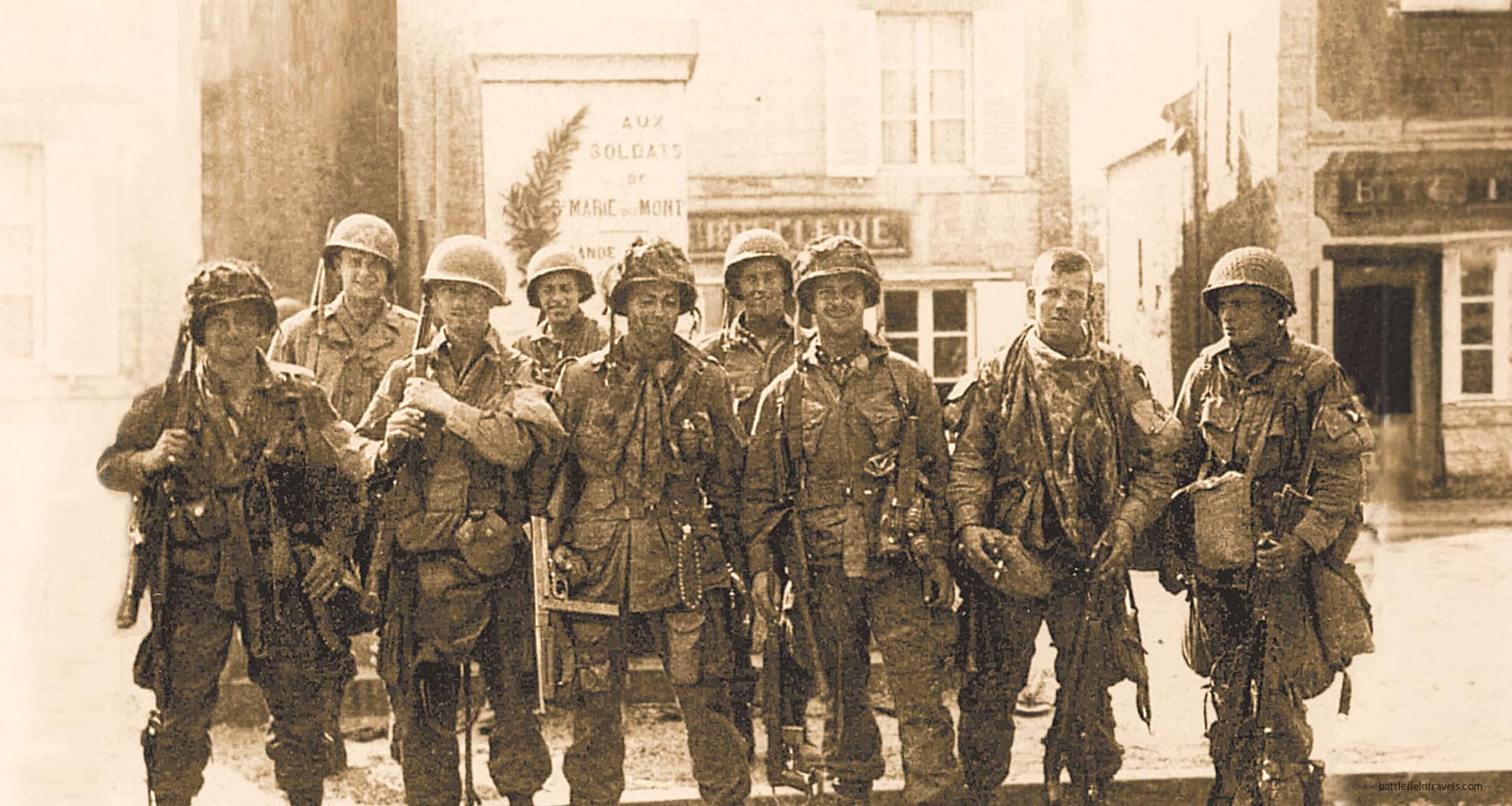
❓Easy Company Quiz. Test your ‘Band of Brothers’ knowledge!
Easy Company, 506th Parachute Infantry Regiment, fought from Normandy to the Netherlands, Bastogne and the final advance into Germany and Austria. Test your knowledge with 20 questions covering the men, battles, commanders and campaigns of the real Easy Company.
The Guadalcanal Campaign centred on the airfield. The Japanese started building it in May 1942, the Americans seized it in August, and the Japanese spent six months trying to take it back. Test your knowledge with 20 questions covering the naval and land battles of the campaign?
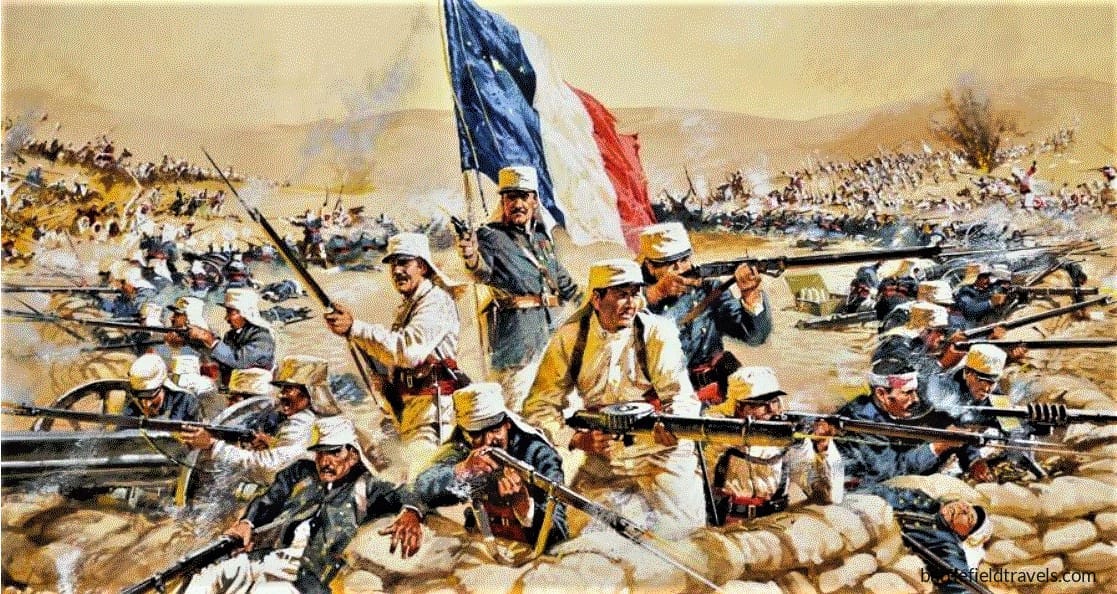
❓French Foreign Legion Quiz: Test your knowledge of Legion history!
For almost 200 years, the Legion has fought in campaigns from Algeria and Mexico to Madagascar, Indochina and France itself. Test your knowledge with 20 questions, spanning the history of the Legion from its founding in 1831 to the modern era.
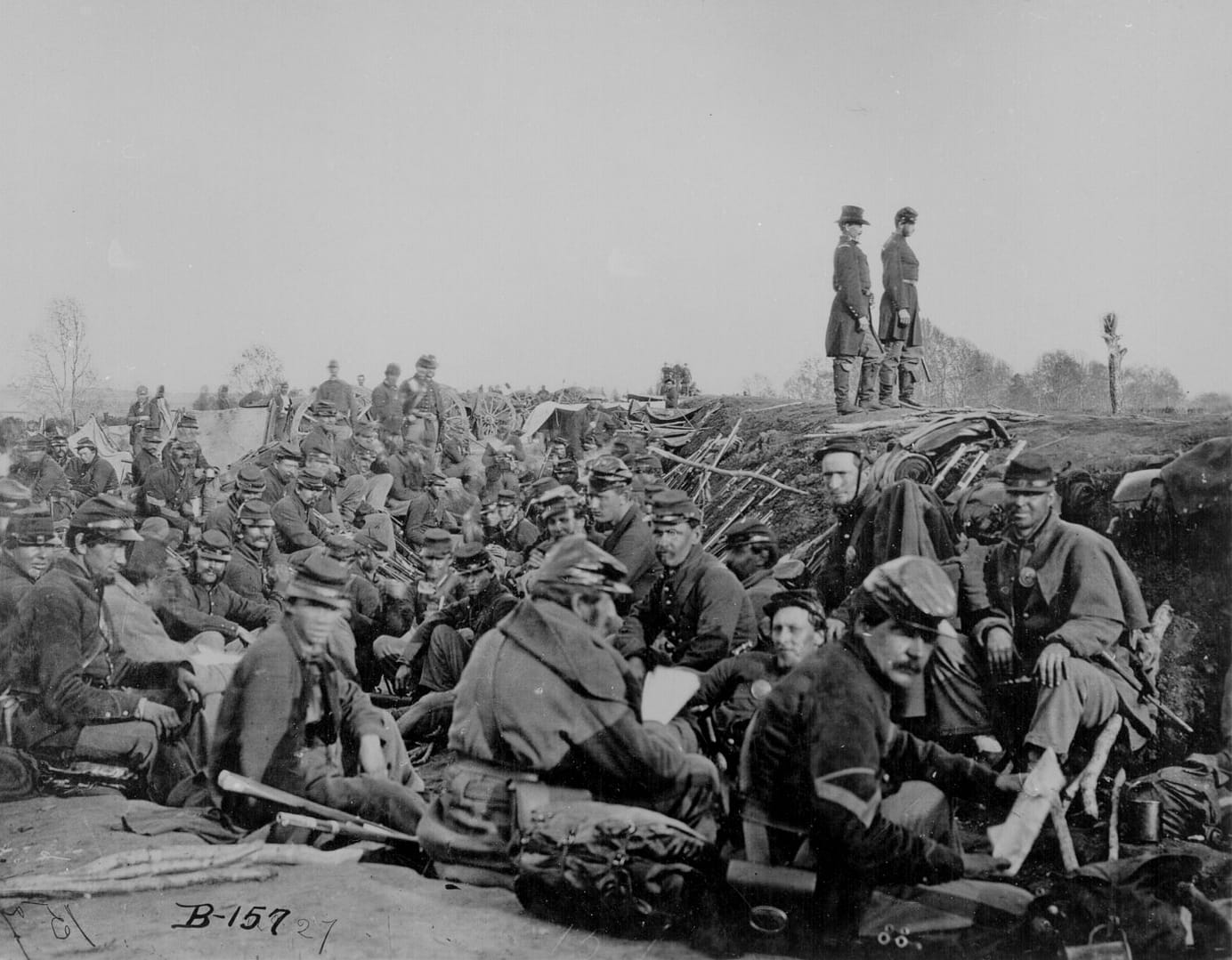
The American Civil War divided the nation, and killed more Americans than any other war in history. Test your knowledge with 20 questions drawn from a bank of 96, spanning all theatres of the war, leaders, battles, and weapons.
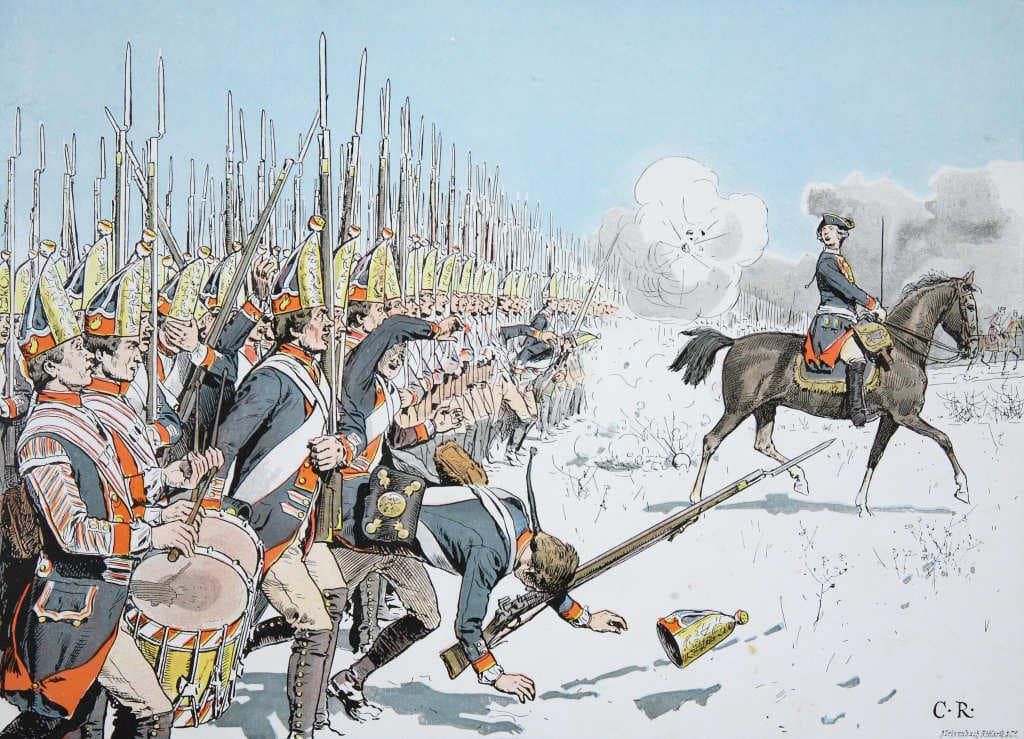
Forty questions spanning the Seven Years’ War and French and Indian War — from Frederick the Great and the struggle for Silesia to Quebec, India, Havana and Manila. Test yourself, challenge your students, or use it as a classroom resource.
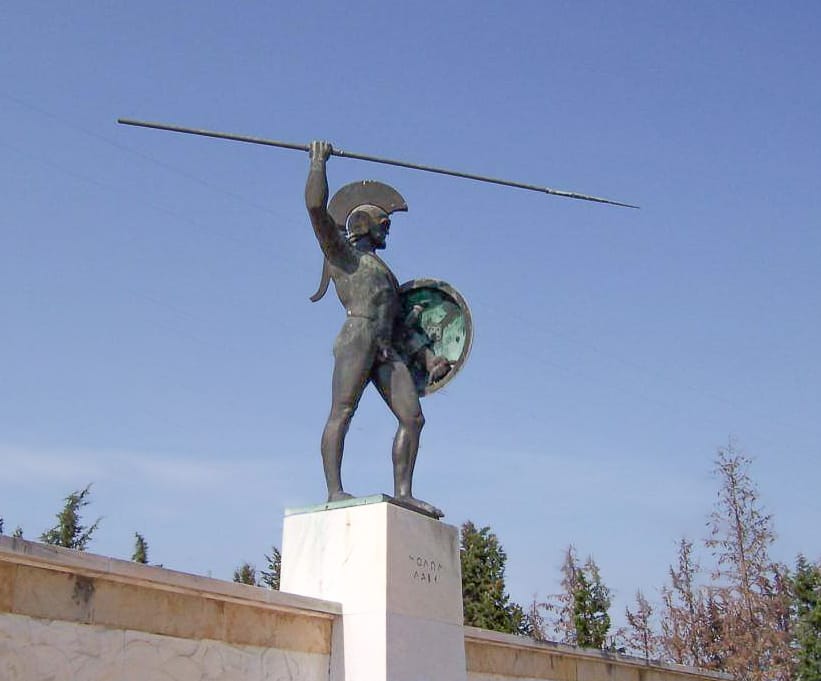
20 questions testing your knowledge of Leonidas, Xerxes, the Greek and Persian forces, commanders, terrain and the three-day battle. Score 60% to pass — but expect a challenge!
❓D-Day Quiz: Test your knowledge of the D-Day landings
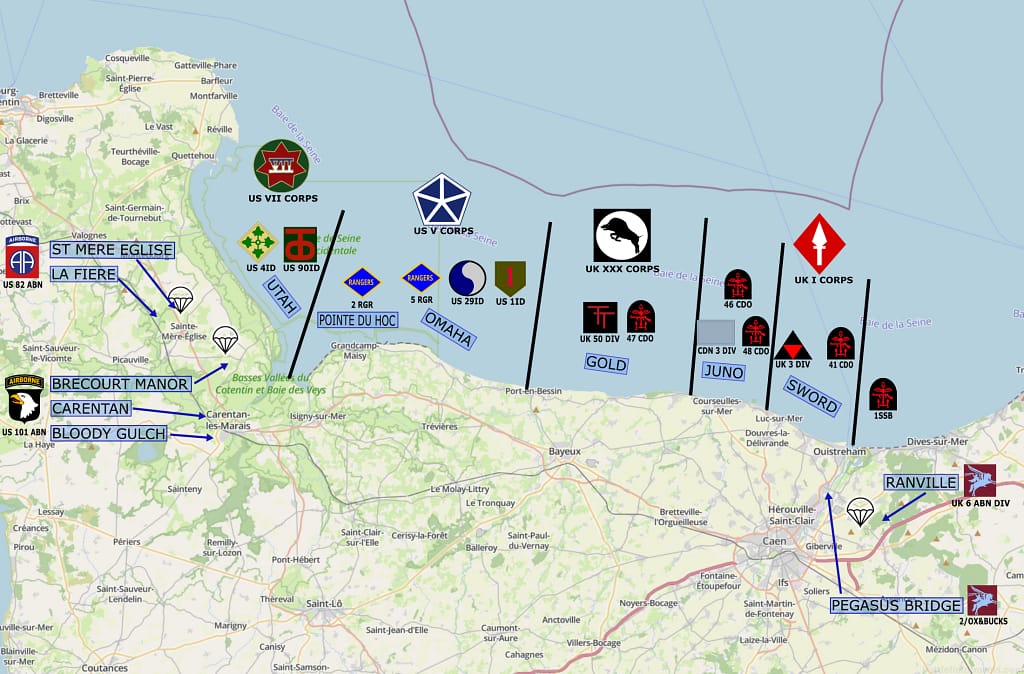
20 questions testing your knowledge of the D-Day landings including the US and British airborne operations, and all five invasion beaches. Score 60% to pass — but expect a challenge!
Enjoyed the challenge? Stay connected with BattlefieldTravels for new battlefield studies, field research and more military history quizzes.
Subscribe to Battlefield Travels and receive a free E-Book Battlefield Guide
Unlock expert battlefield analysis, campaign reconstructions, and historical insights drawn from firsthand exploration and primary sources.
🗺️ You’ll receive:
🎖️ Exclusive historical insights you won’t find elsewhere
📘 A free eBook: 10 Tips for Exploring Historic Battlefields
📰 New battlefield studies straight to your inbox as they are published
Claim Your Free Battlefield Travel Guide
Get your free e-book, exclusive tips, and updates on new battlefield studies.
Thank you!
You have successfully joined our subscriber list.
⚔️ Go deeper — Members get exclusive access to the Deep Research Collection, Field Notes, and monthly Research Dispatches. Try membership free for 7 days, cancel anytime. From $9/month.
The Battle of Chotusitz (17 May 1742) was Frederick the Great’s hardest-won early victory — a chaotic, bloody battle that secured Silesia but exposed deep weaknesses in Prussian command and coordination. Frederick’s maintenance of a fresh reserve to be committed at the decisive moment was a lesson that stayed with him as a commander.
Reconstructing War of the Austrian Succession battlefields through terrain analysis, primary sources and on-site research
Prussian grenadiers advance during the Battle of Hohenfriedburg. 4th June 1745, War of the Austrian Succession
Walking the battlefields of the War of the Austrian Succession 1740-1748
Origins: The Pragmatic Sanction of 1713
The War of the Austrian Succession was a major European conflict triggered by the death of Emperor Charles VI in 1740 and the contested inheritance of the Habsburg monarchy. At its heart lay the Pragmatic Sanction of 1713, a legal settlement intended to guarantee the succession of Charles’s daughter, Maria Theresa, and preserve the unity of the Habsburg lands. Although widely recognised in principle, the Pragmatic Sanction collapsed in practice once Austria appeared diplomatically isolated and militarily vulnerable.
What followed was not simply a dynastic dispute but a struggle over territory, influence, and the balance of power in Europe. France, Bavaria, Spain, and Prussia challenged Habsburg authority, while Britain and the Dutch Republic intervened to prevent French dominance. Fighting spread rapidly across Central Europe, the Low Countries, Italy, and beyond, drawing in nearly every major European power.
Central Europe: The First Silesian War
The most consequential early intervention came from Prussia, led by its young king, Frederick II. In late 1740, Frederick invaded Silesia, exploiting Austria’s weakness and initiating the First Silesian War. Battles such as Mollwitz (1741) revealed both the strengths and limitations of the Prussian army: highly disciplined infantry and effective firepower, but fragile cavalry and inexperienced command. At Chotusitz (1742), Frederick again defeated Austrian forces, forcing Maria Theresa to concede Silesia in order to fight on other fronts.
These campaigns marked Prussia’s emergence as a great power. During the Second Silesian War, Frederick refined his methods, achieving a decisive victory at Hohenfriedberg (1745) that secured Prussia’s hold over Silesia and demonstrated the growing effectiveness of Prussian operational tempo, fire discipline, and battlefield coordination.
Western Europe: battle for the Austrian Netherlands
While Austria fought for survival in Central Europe, the war’s western theatre developed into a major struggle in the Austrian Netherlands. Here, French armies confronted an Anglo-Allied coalition of British, Dutch, Austrian, and Hanoverian troops. The Battle of Fontenoy (1745) became the conflict’s most famous engagement. Despite a formidable Allied infantry advance, French forces—well-positioned and reinforced at the critical moment—halted and broke the attack. Fontenoy illustrated both the power and the limits of linear infantry tactics, and remains one of the defining battles of 18th-century warfare.
North America and India: War of Jenkins’ Ear
The conflict also formed part of a wider imperial struggle. From 1739, Britain and Spain were already fighting the War of Jenkins’ Ear, a maritime and colonial war driven by trade disputes and imperial rivalry in the Americas. When Britain and France entered the Austrian Succession conflict, these colonial hostilities merged into a broader global war, extending fighting to the Caribbean, North America, and India
War of the Austrian Succession – battle studies
Below are all current BattlefieldTravels studies for the Seven Years War, covering key battles, campaign phases and associated sites. New studies are added as further battlefields are walked and analysed.
The Battle of Chotusitz (17 May 1742) was Frederick the Great’s hardest-won early victory — a chaotic, bloody battle that secured Silesia but exposed deep weaknesses in Prussian command and coordination. Frederick’s maintenance of a fresh reserve to be committed at the decisive moment was a lesson that stayed with him as a commander.
The Battle of Fontenoy, fought on 11 May 1745, was a major battle during the War of the Austrian Succession. A French army of ~50,000 under Marshal Maurice de Saxe against a coalition force of ~50,000 British, Dutch, Hanoverian, and Austrian troops led by the Duke of Cumberland. The result was a decisive French victory!.
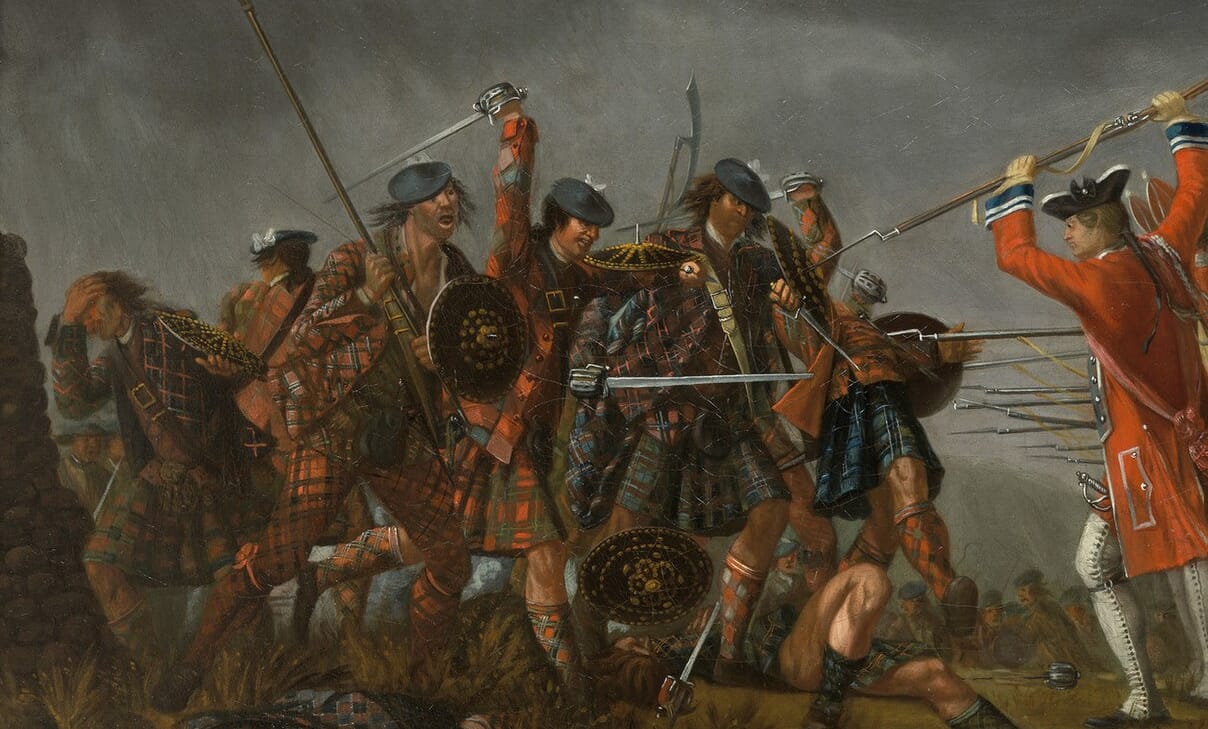
The Battle of Culloden, fought on 16 April 1746, was the final and decisive confrontation of the Jacobite Rising of 1745. The rebellion was the last serious attempt by the Jacobites to restore the Stuart monarchy to the British throne. Led by Charles Edward Stuart ‘Bonnie Prince Charlie’, the Jacobite forces aimed to overthrow the…
Bonnie Prince Charlie landed at Glenfinnan, Scotland in July 1745, aiming to reclaim the British throne for his father, James Francis Edward Stuart. Gathering support from the Highland clans, he advanced towards Edinburgh, capturing the city on 17 September. British General Sir John Cope, who had been gathering government forces in response to the Jacobite…
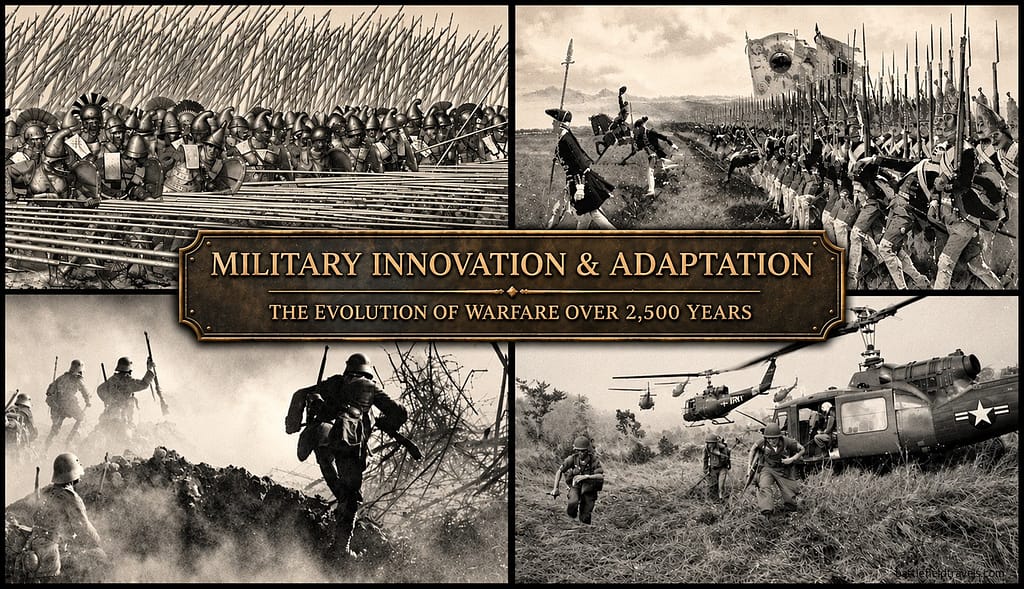
Over thousands of years of warfare, armies have sought ways to gain advantage on the battlefield. Sometimes the solution was a new weapon. Sometimes it was a radical new method. Often it was a combination of both. From the disciplined ranks of the Greek phalanx to pike-and-shot warfare to the interlocking machine-gun fire plans of the twentieth century, tactical innovations have repeatedly reshaped how battles are fought.
How a minor change to the government army’s bayonet drill defeated the Highlander’s battle tactics— and why the critics who dismissed it were asking the wrong question. The weight of evidence establishes beyond reasonable doubt that Cumberland’s army trained in and used a new bayonet drill at Culloden, and that the drill was directed personally…
Authored by Mick Prictor, a retired military officer with 40 years’ service, and a military historian specialising in terrain-focused analysis of tactics, doctrine, and command decision-making in land warfare. His work draws on extensive battlefield fieldwork—more than 280 sites worldwide—and one of the world’s largest private collections of historic military arms, uniforms, and equipment. About me
⚔️ Go deeper — Members get exclusive access to the Deep Research Collection, Field Notes, and monthly Research Dispatches. Try membership free for 7 days, cancel anytime. From $9/month.
The war was triggered by the death of Emperor Charles VI in 1740 and the challenge to his daughter Maria Theresa’s right to inherit the Habsburg lands under the Pragmatic Sanction. Several European powers accepted the settlement in theory but rejected it in practice once Austria appeared weak.
What was the Pragmatic Sanction and why did it fail?
The Pragmatic Sanction of 1713 was a legal agreement intended to ensure the indivisibility of the Habsburg territories and allow female succession. It failed because rival powers prioritised territorial gain and strategic advantage over diplomatic commitments when the opportunity arose.
Why was Frederick the Great so important in this war?
Frederick II of Prussia exploited Austria’s vulnerability by invading Silesia in 1740, triggering the Silesian Wars within the wider conflict. His victories at battles such as Mollwitz, Chotusitz, and Hohenfriedberg secured Silesia and established Prussia as a major European power.
Why is the Battle of Fontenoy so significant?
Fontenoy (1745) was the most famous battle of the war’s western theatre, where a French army defeated a powerful Anglo-Allied force in the Austrian Netherlands. It demonstrated the strengths and limits of linear infantry tactics and highlighted the decisive role of reserves, terrain, and artillery.
How is the War of the Austrian Succession connected to the War of Jenkins’ Ear?
The War of Jenkins’ Ear (1739–1748) began as a colonial and maritime conflict between Britain and Spain. When Britain and France entered the War of the Austrian Succession, these struggles merged, turning a European dynastic war into a broader global conflict.
Subscribe to Battlefield Travels and receive a free E-Book Battlefield Guide
Unlock expert battlefield analysis, campaign reconstructions, and historical insights drawn from firsthand exploration and primary sources.
🗺️ You’ll receive:
🎖️ Exclusive historical insights you won’t find elsewhere
📘 A free eBook: 10 Tips for Exploring Historic Battlefields
📰 New battlefield studies straight to your inbox as they are published
Claim Your Free Battlefield Travel Guide
Get your free e-book, exclusive tips, and updates on new battlefield studies.
Thank you!
You have successfully joined our subscriber list.
⚔️ Go deeper — Members get exclusive access to the Deep Research Collection, Field Notes, and monthly Research Dispatches. Try membership free for 7 days, cancel anytime. From $9/month.
The Seven Years War (1756–1763) was the first truly global conflict—fought simultaneously in Europe, North America, the Caribbean, India and West Africa. No earlier war saw so many armies manoeuvring across such diverse theatres, from the forests and lakes of North America to the sugar islands of the Caribbean and the open plains of central Europe. Although sparked by dynastic tensions, it became a struggle for continental dominance, imperial expansion and control of global trade routes.
Global theatres of the Seven Years War
In Europe, Frederick the Great fought for Prussia’s survival against an encircling coalition of Austria, France, Russia, Sweden and the Reichsarmee. Here, in Silesia and Bohemia, the war unfolded across villages, vineyards, low ridgelines and river valleys—terrain that became the proving ground for mid-18th century manoeuvre warfare. BattlefieldTravels focuses particularly on this theatre, walking the ground at places such as Lobositz, Chotusitz, Kolín, Leuthen, Hohenfriedberg and others, combining period maps, contemporary accounts and modern GIS tools to understand how these battles were fought and why they unfolded as they did.
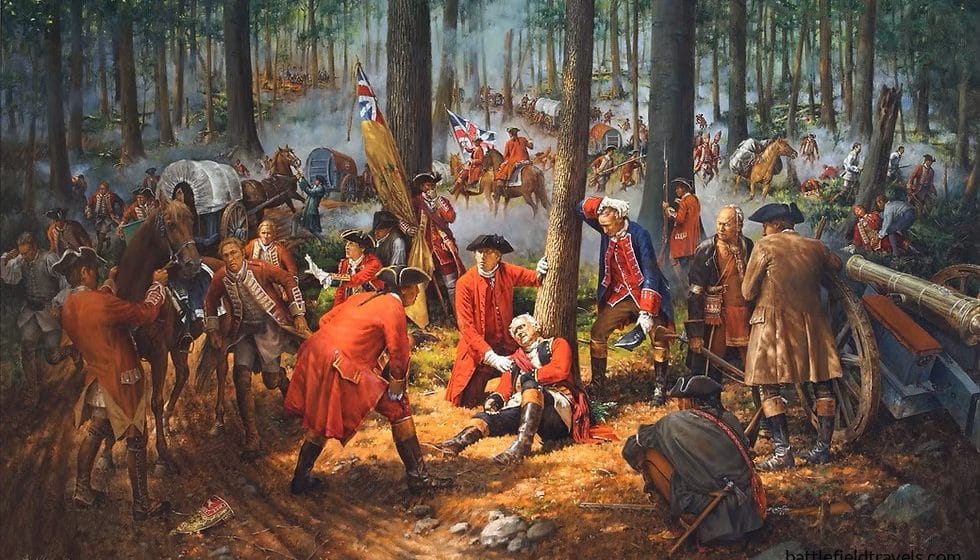
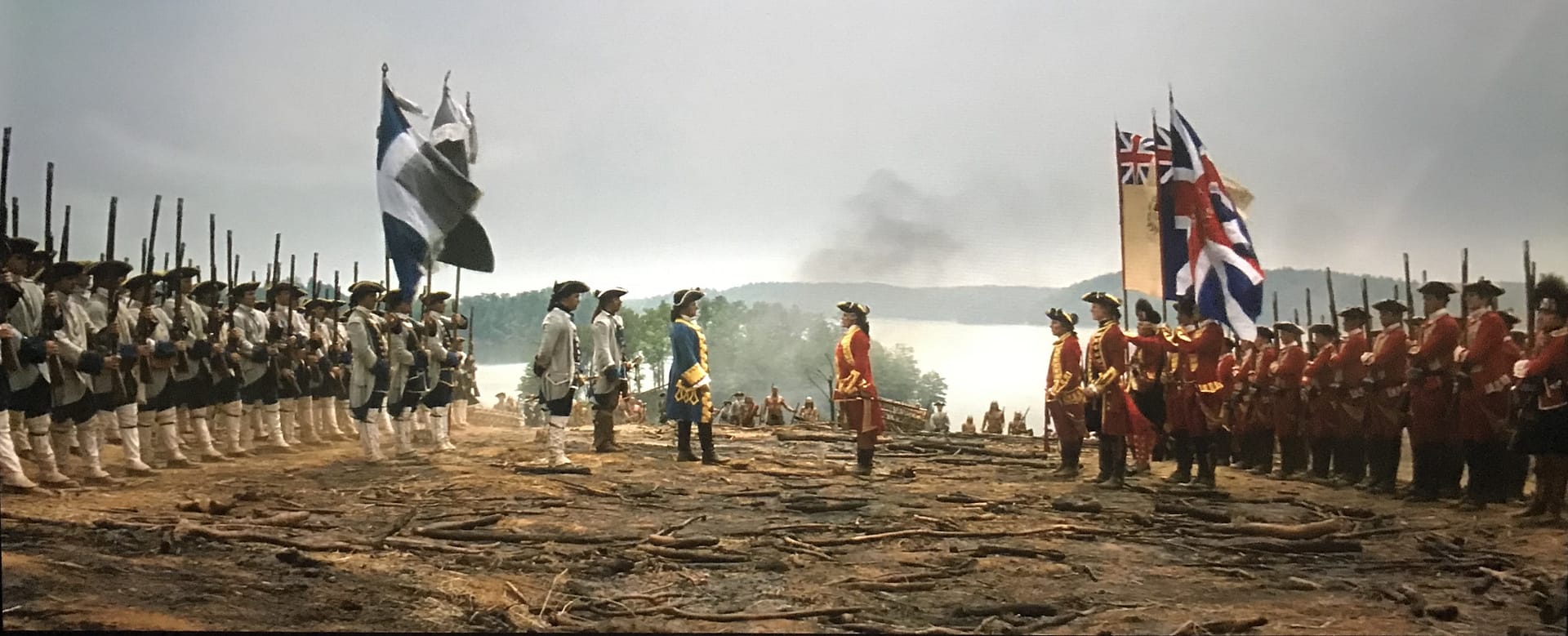
But the Seven Years War was far more than a European struggle. In North America, British, French and Indigenous forces clashed at Fort Necessity, Monongahela, Lake George, Fort William Henry, Ticonderoga, Bushy Run, Oswego, Louisbourg and dozens of frontier positions. I have walked and studied many of these sites, examining how dense forests, waterways, ravines and fortifications shaped tactics and outcomes. These studies explore how European armies adapted (or failed to adapt) to irregular terrain, indigenous fighting methods and long-distance campaigning.
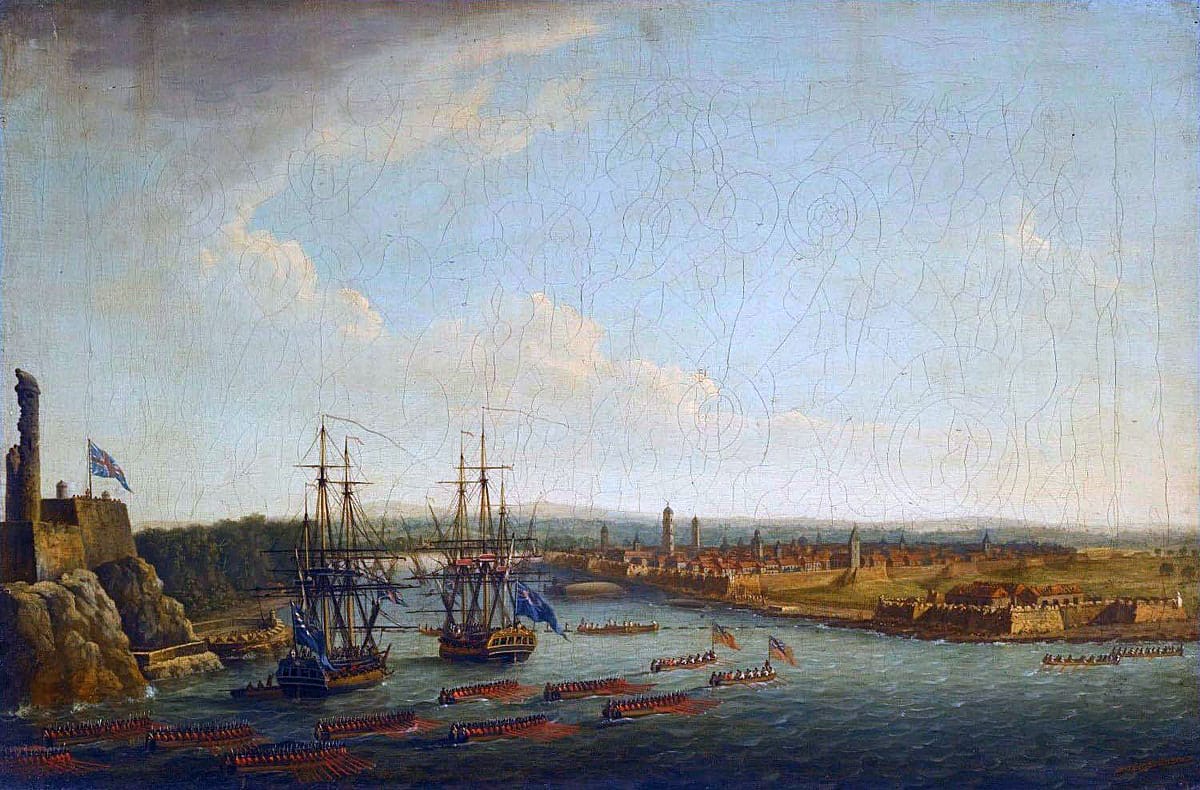
In the Caribbean, sieges and amphibious operations turned fortified harbours such as Fort San Carlos and Fort Charlotte into strategic prizes, while naval and land actions in West Africa formed part of the same contest for maritime supremacy.
Methodology for battlefield analysis
Rather than treating the Seven Years War as a sequence of victories and defeats, the BattlefieldTravels methodology is to examine how organisation, command culture, weapons, doctrine, logistics and terrain interacted across very different environments. Each battlefield study blends on-site photography, annotated maps, 3D terrain visualisations and a wide range of primary and secondary sources, providing not just a narrative of each action but a clear understanding of why events unfolded the way they did.
🏛️Weapons & Equipment: Seven Years’ War
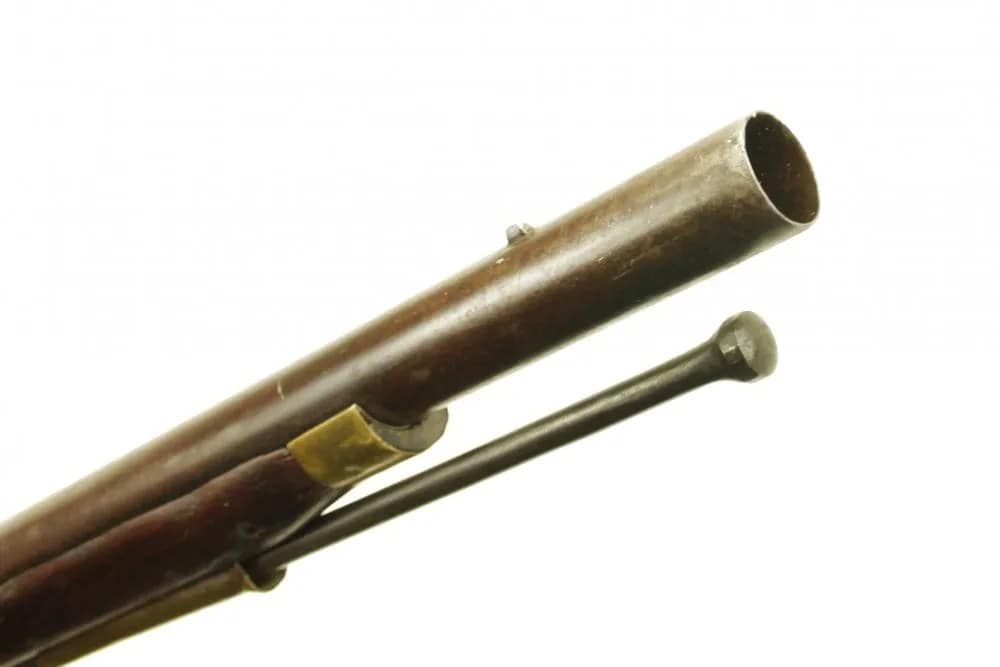
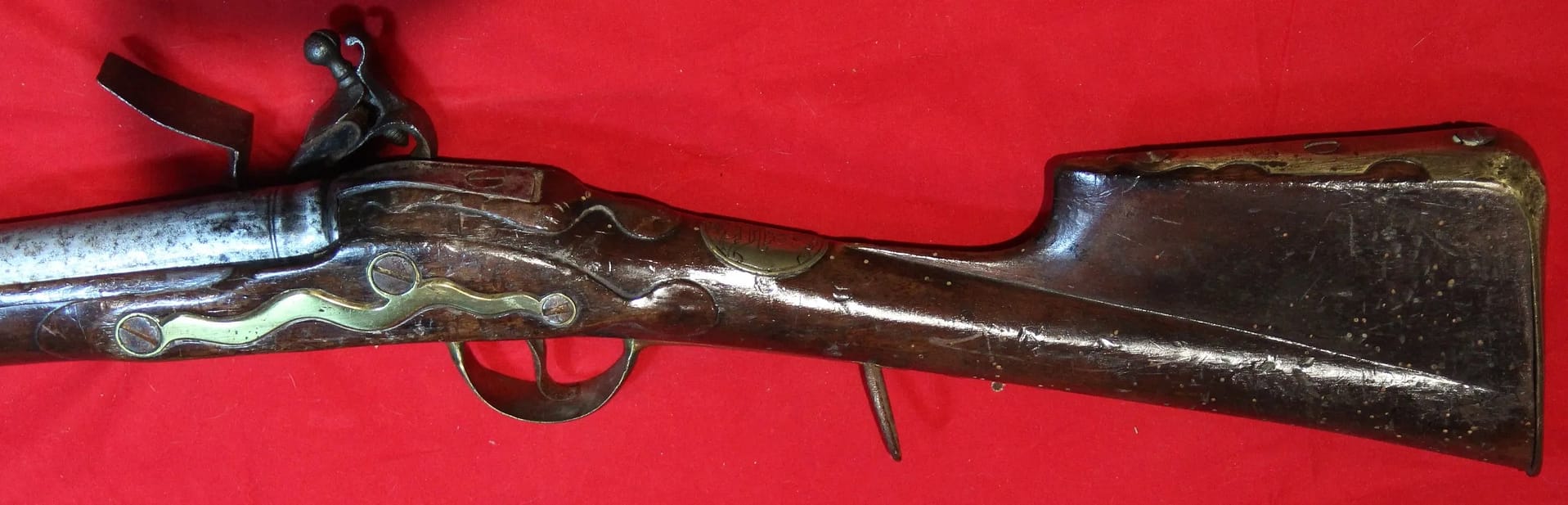
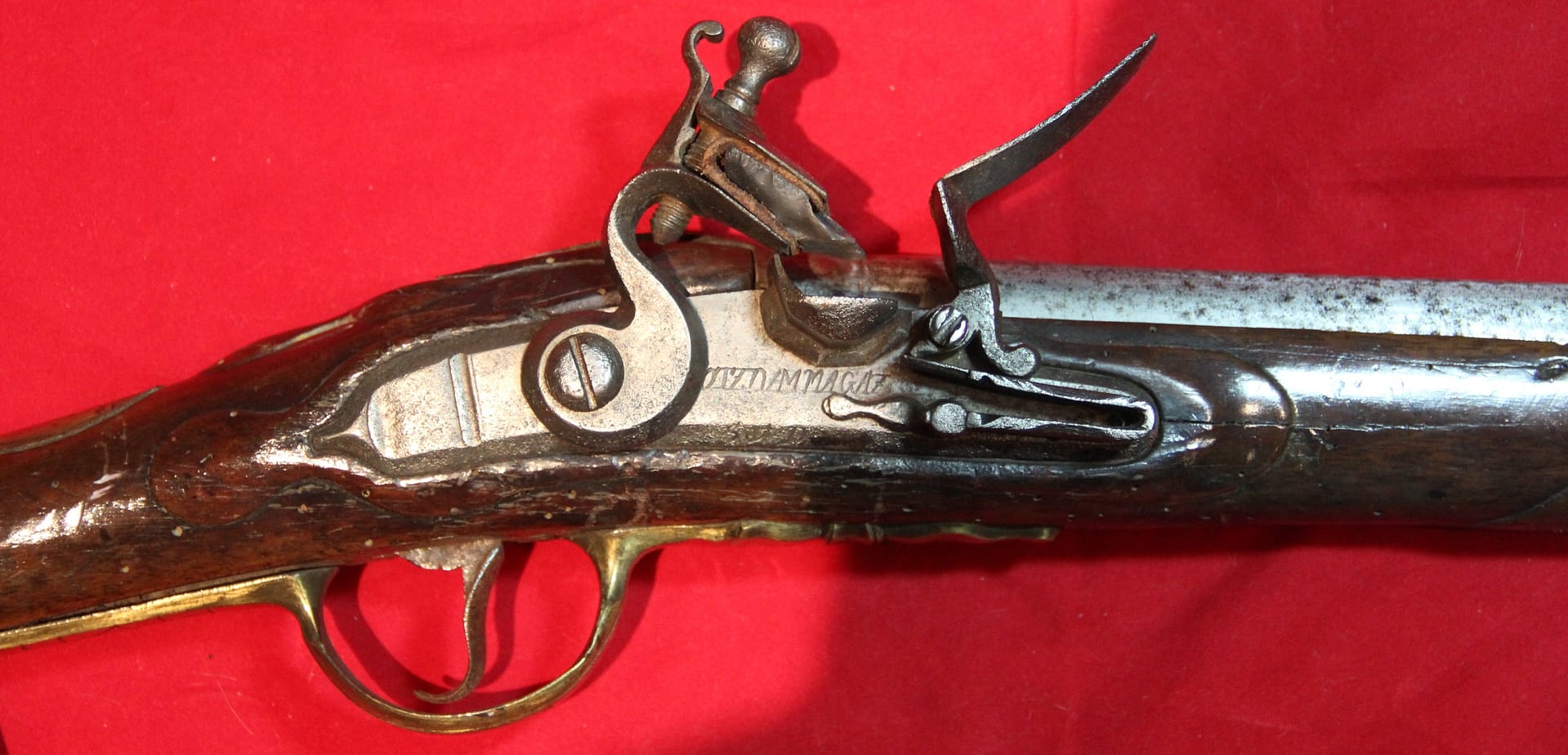
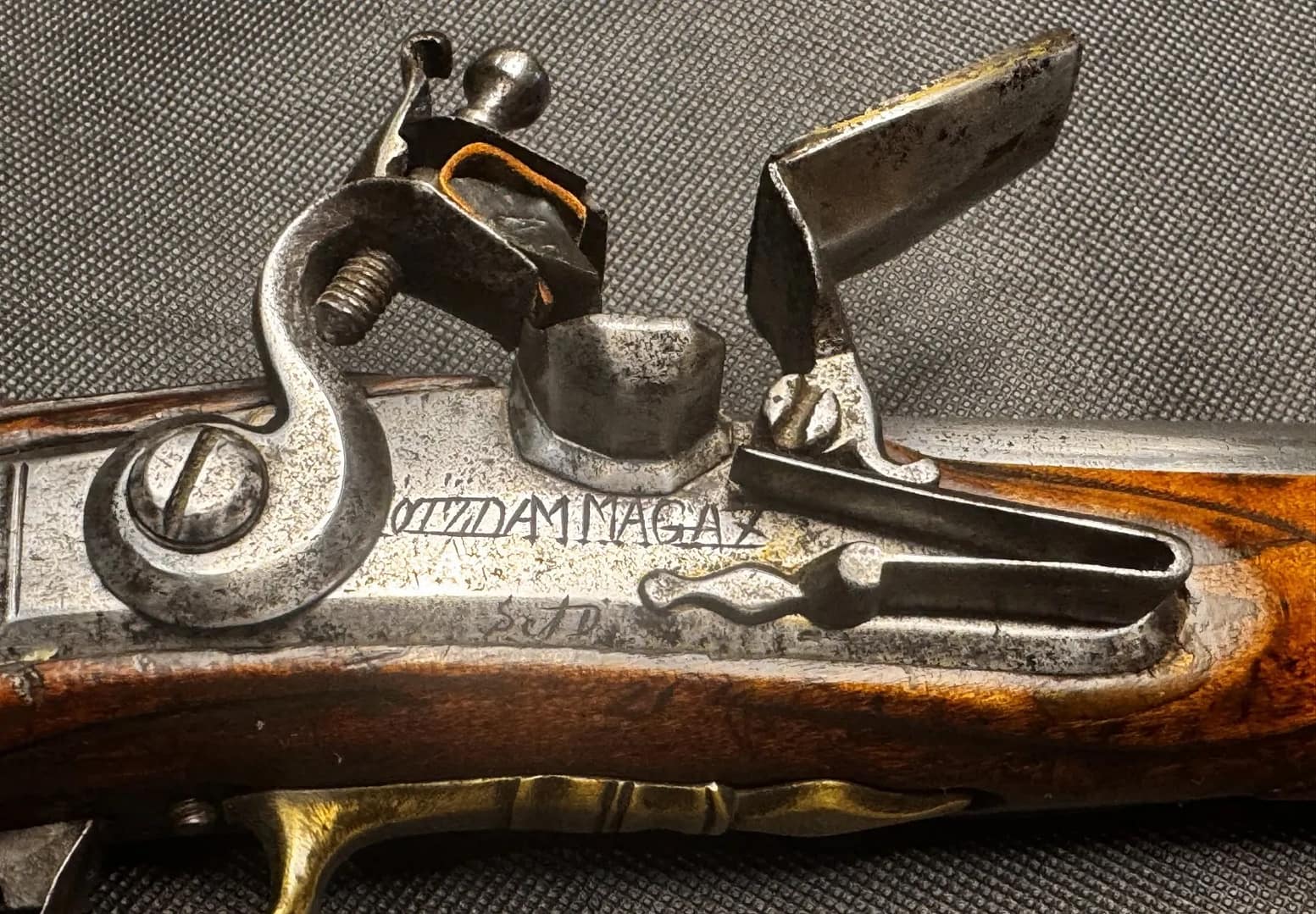
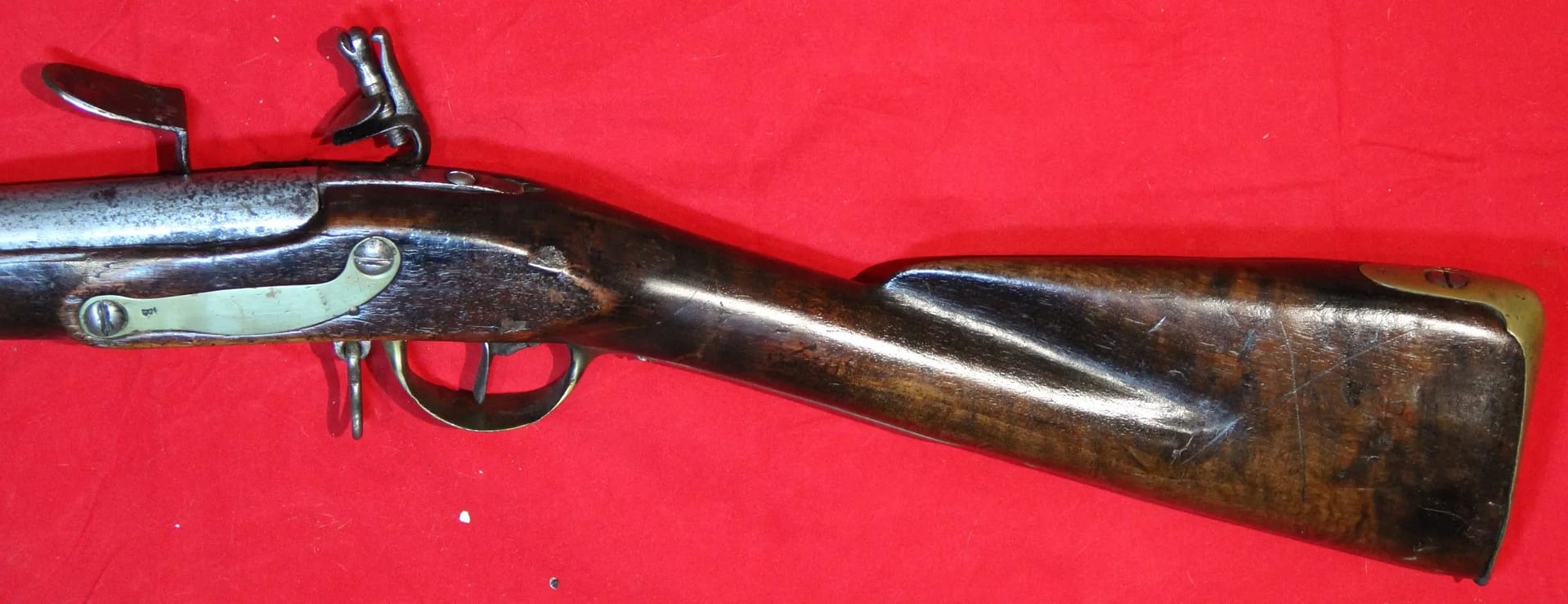
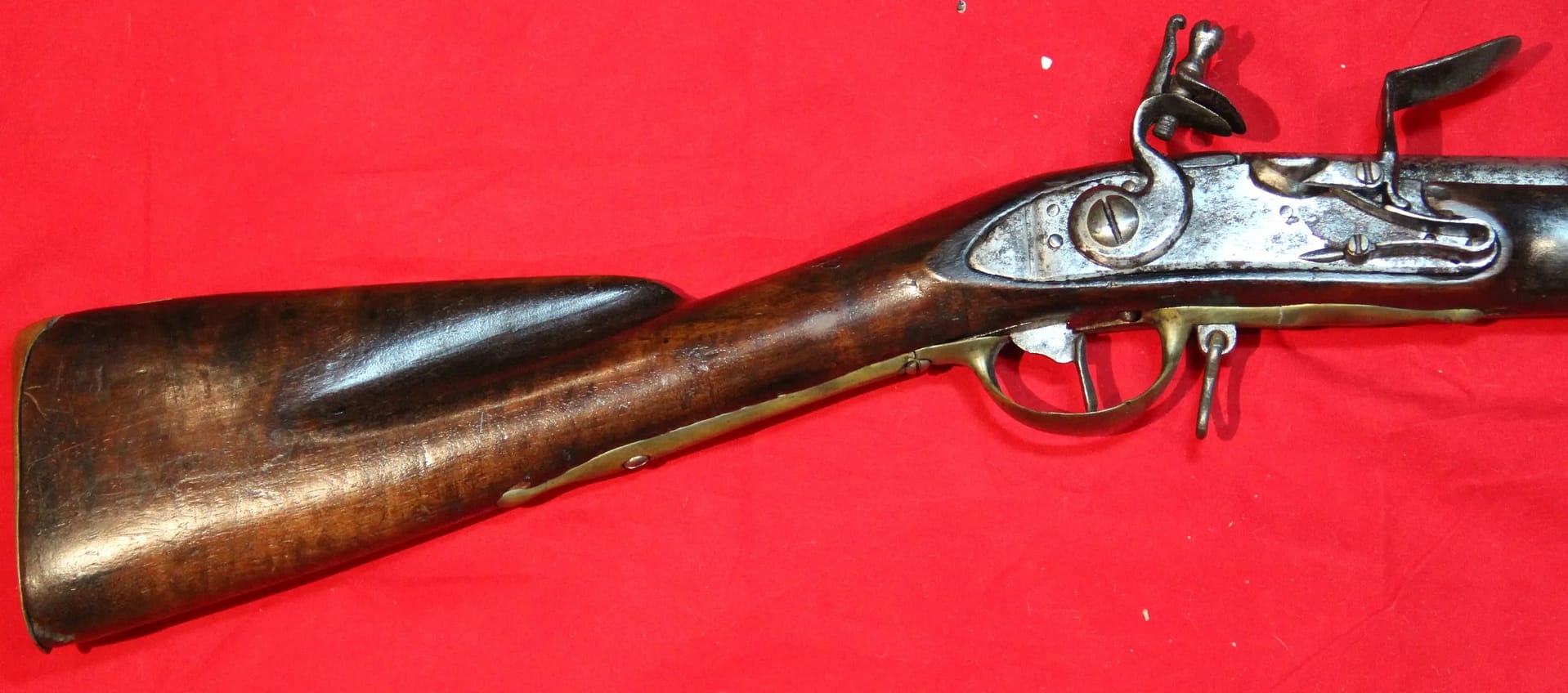
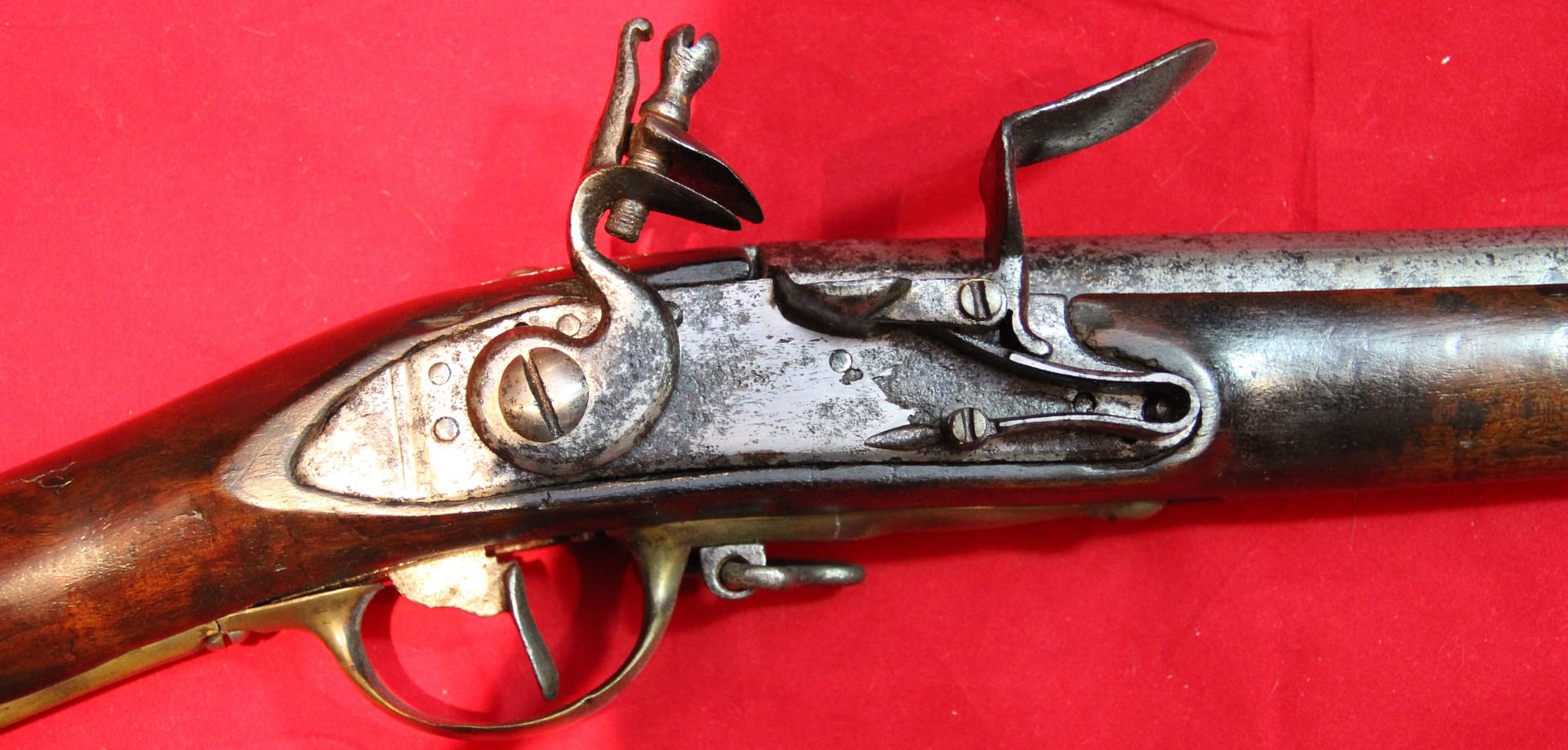
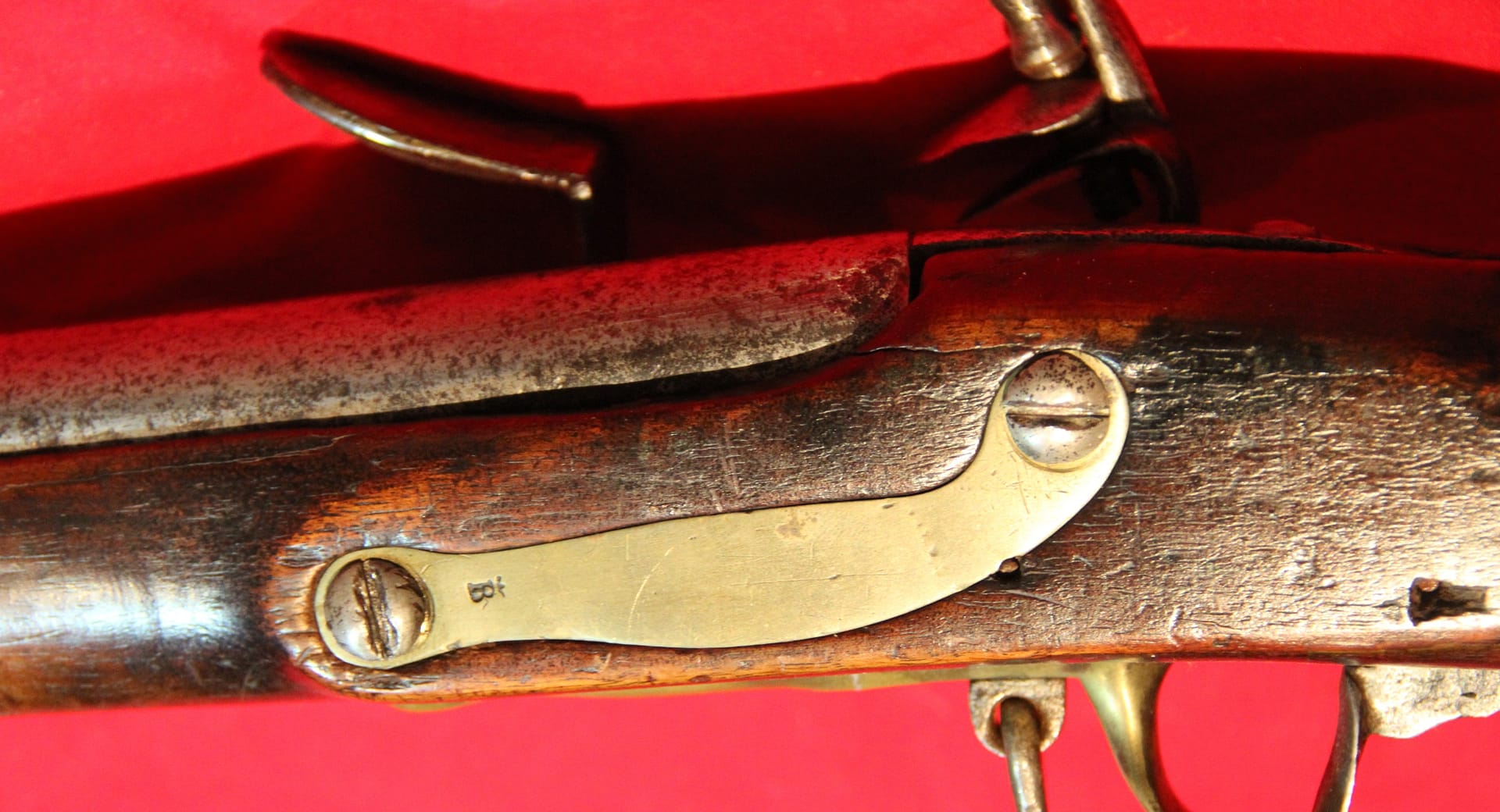
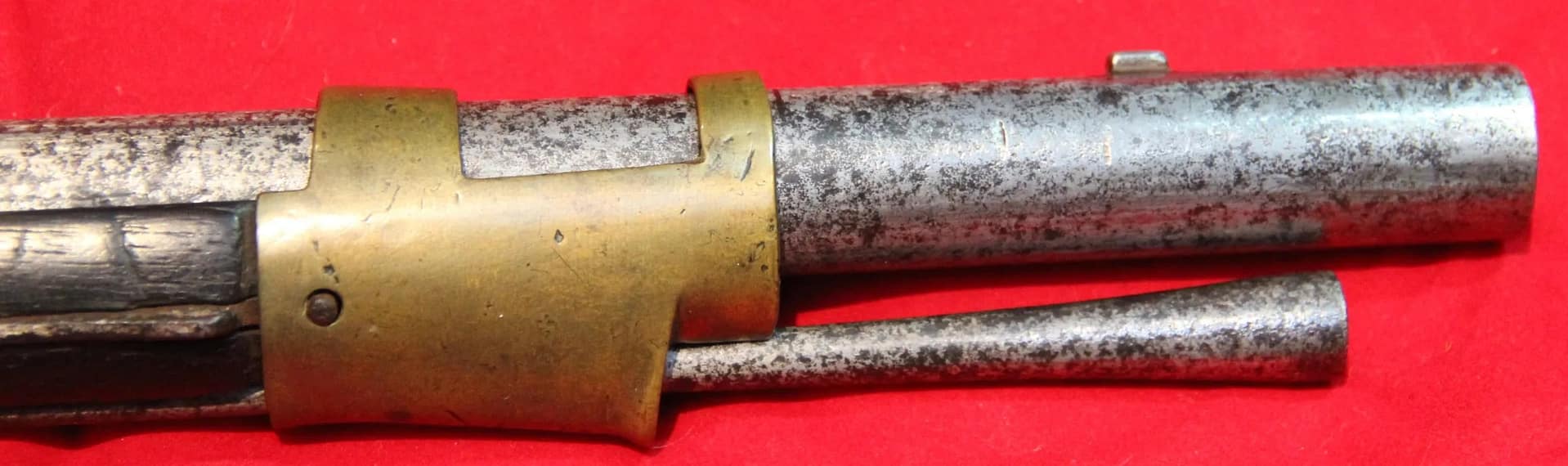
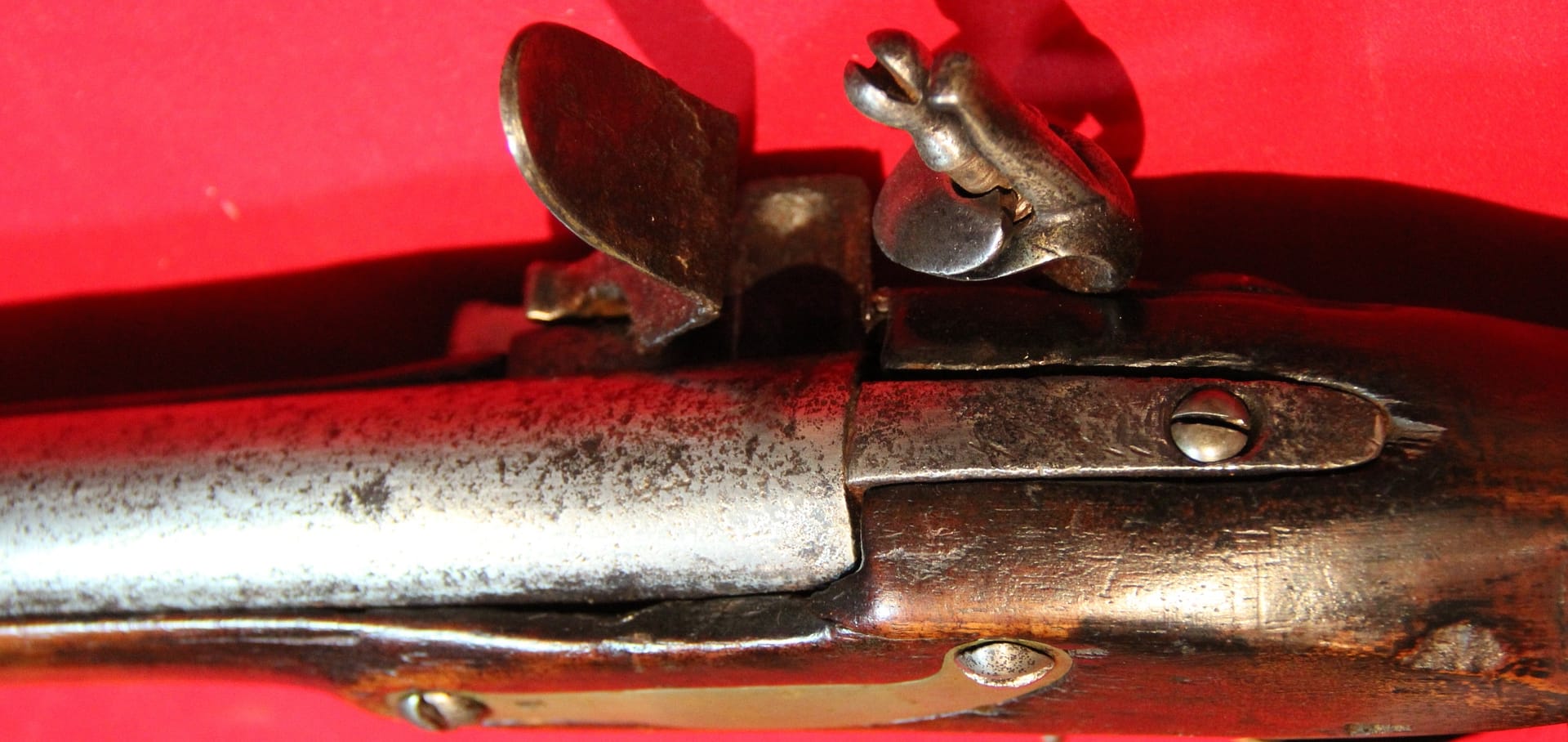
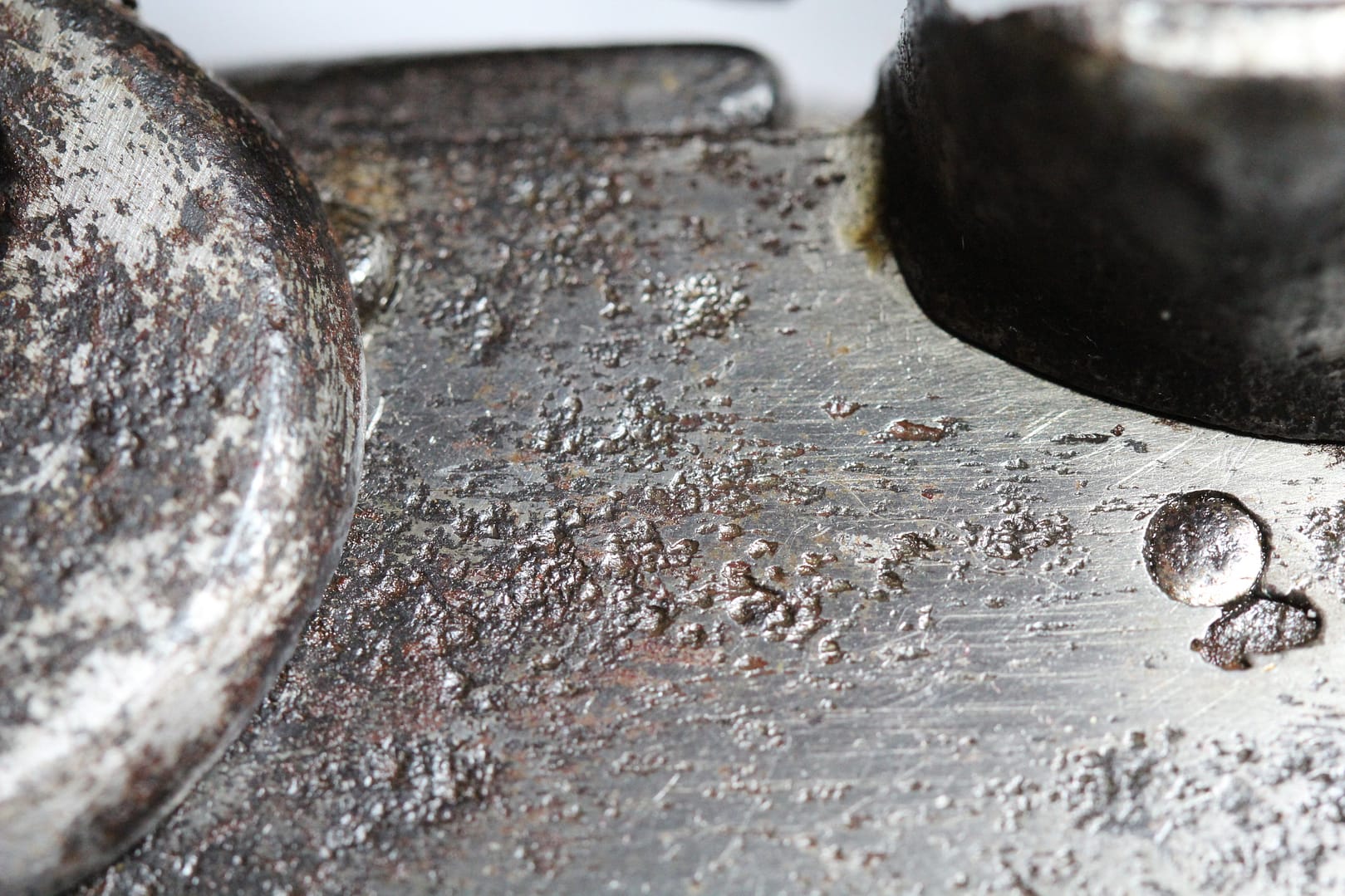
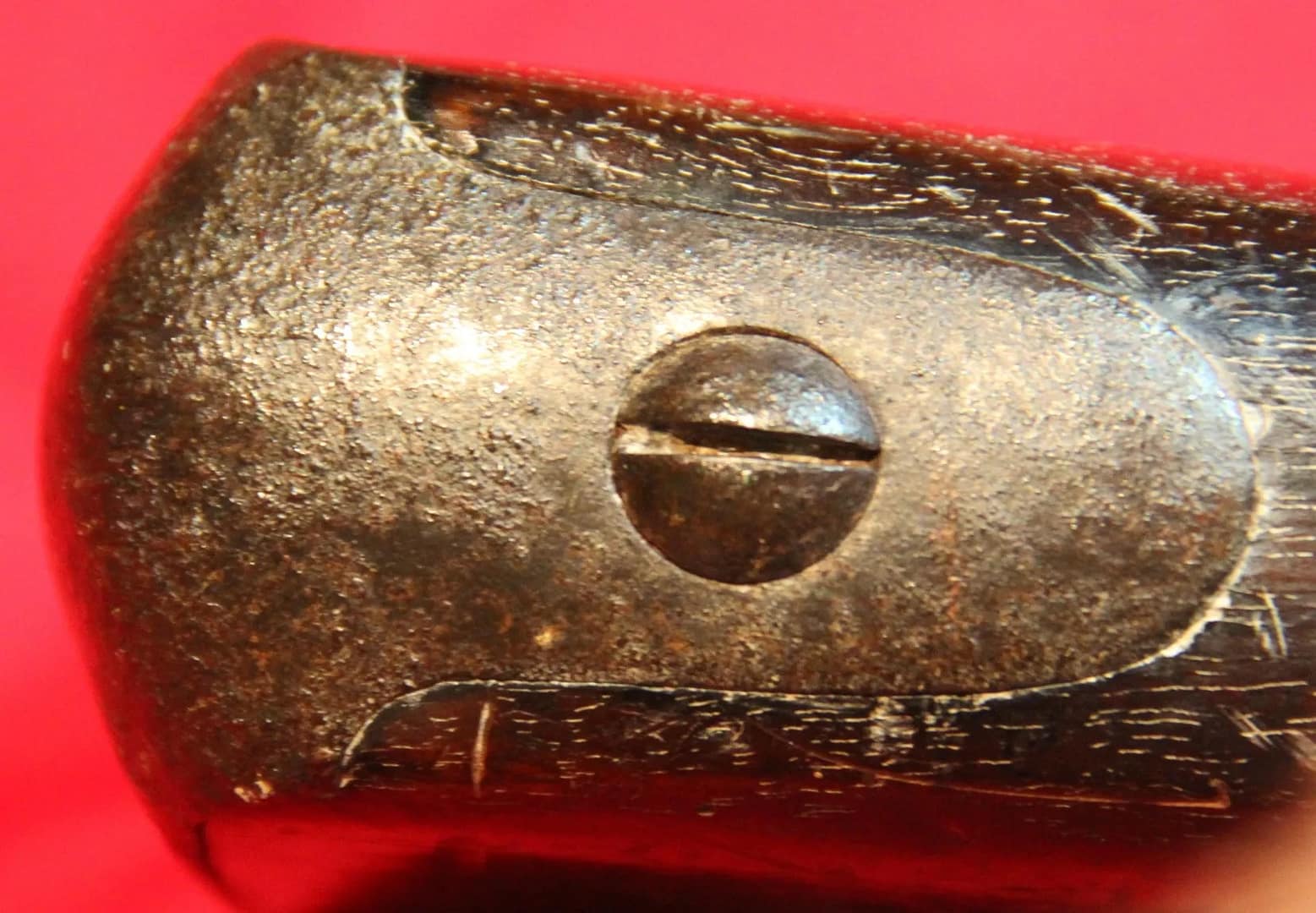
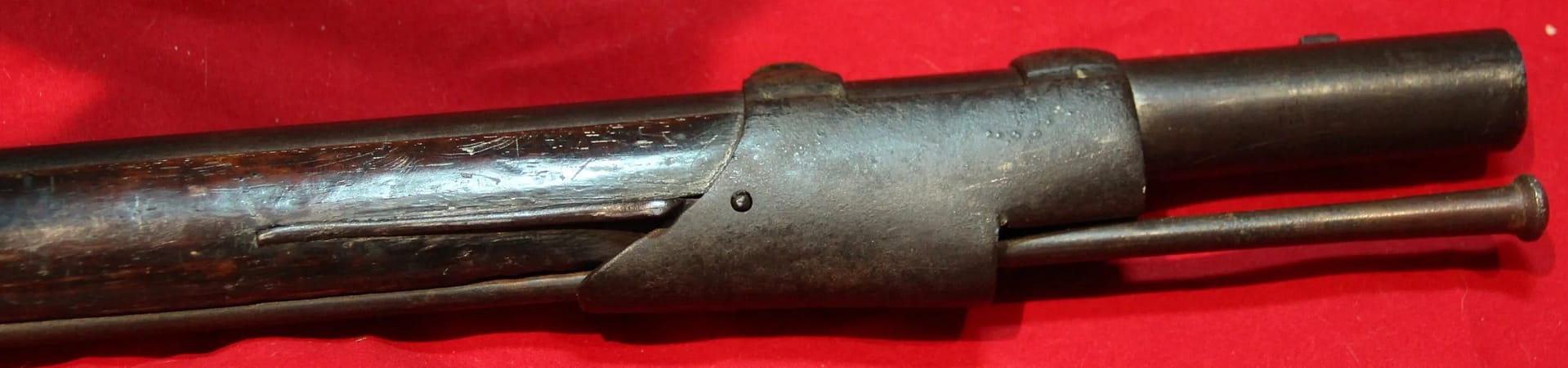
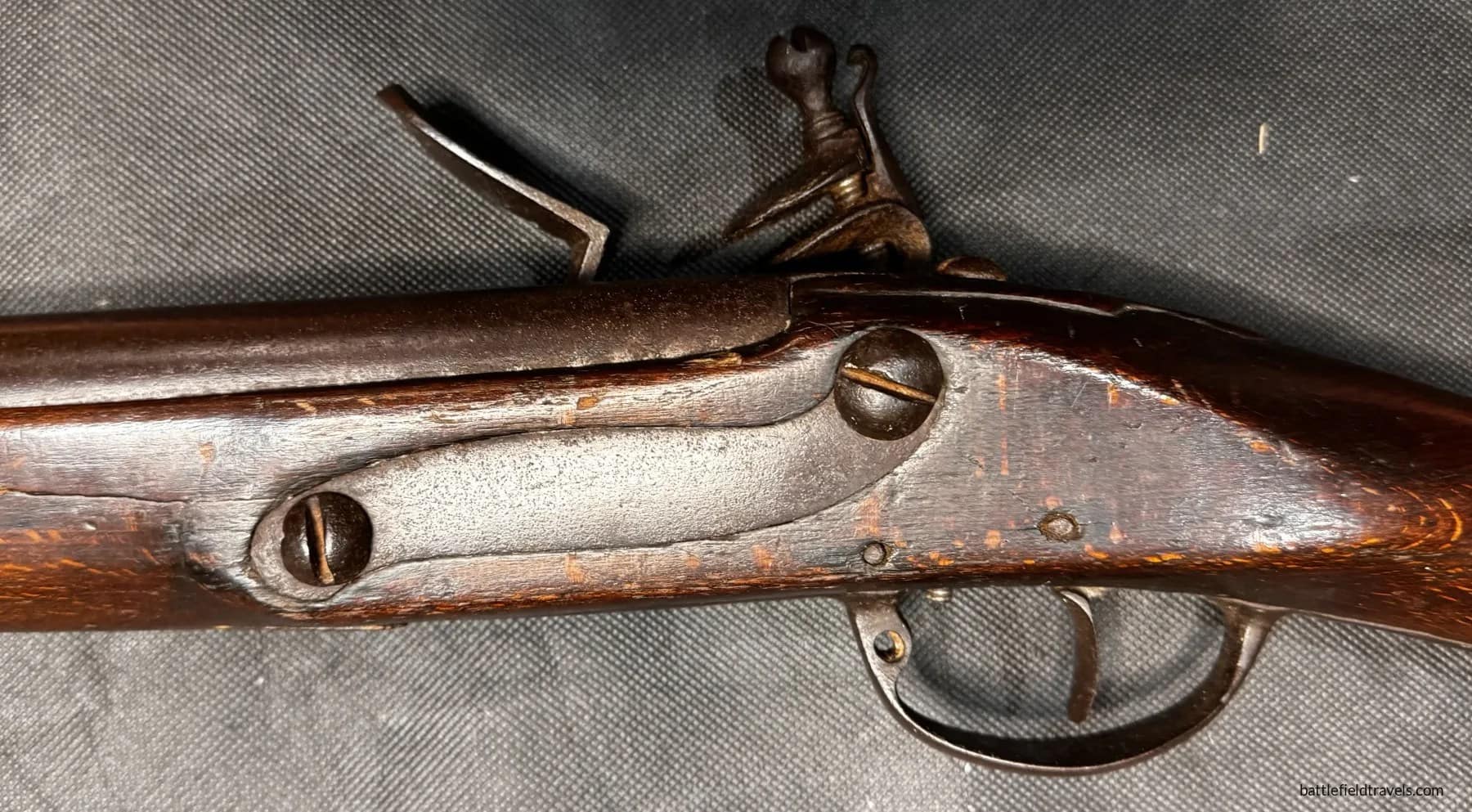
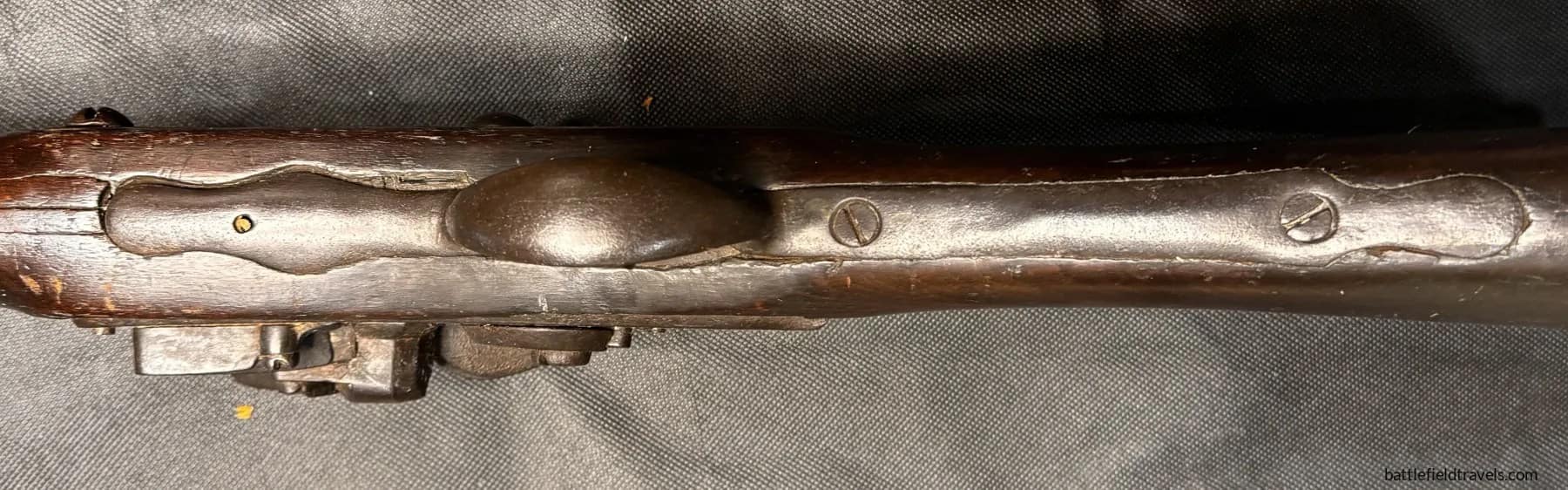
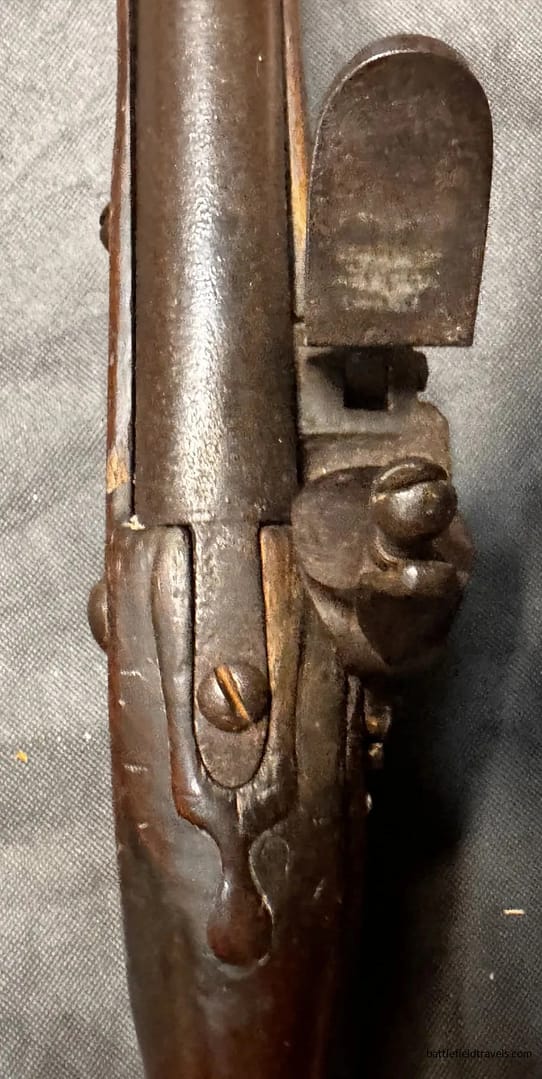
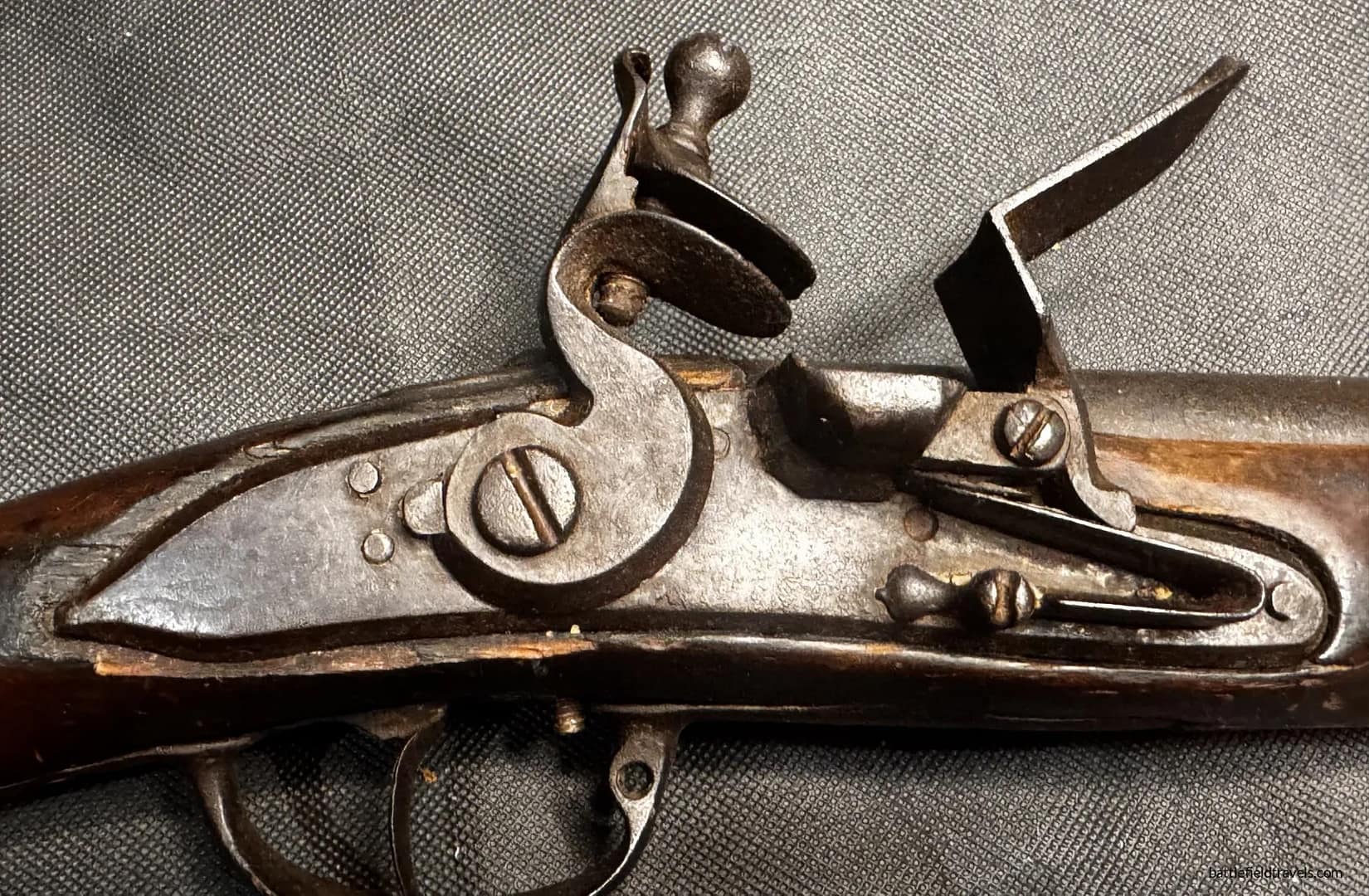
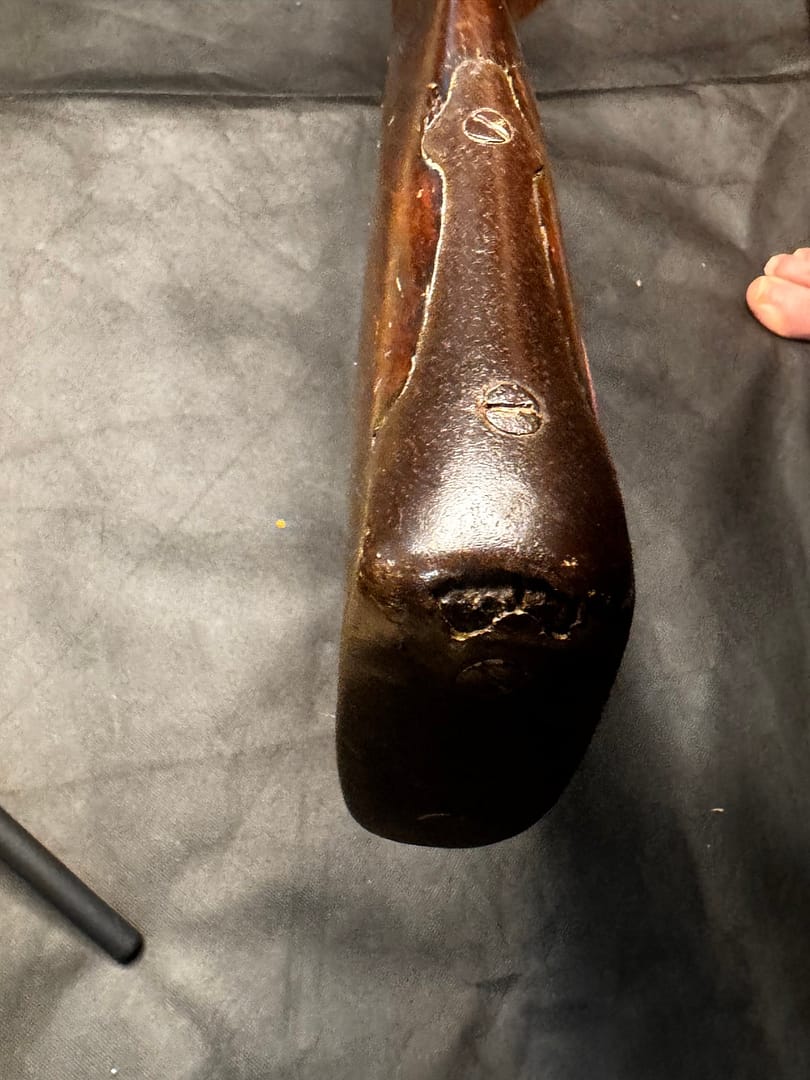
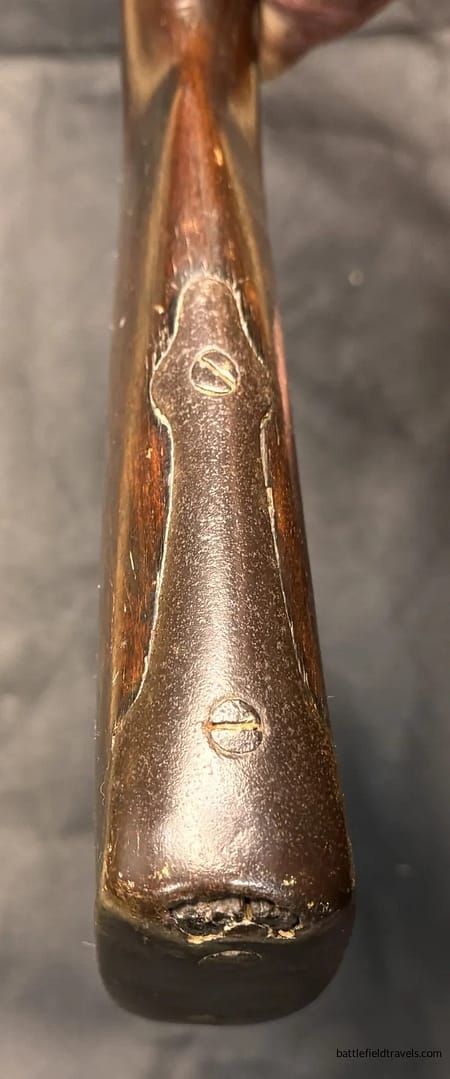
Prussian Model 1740 ‘POTZDAM MAGAZ’ flintlock musket from my personal collection.
Explore original weapons and equipment from the Seven Years’ War (French and Indian War), drawn from my personal collection. Muskets, pistols, swords, bayonets and military equipment from Prussia, Austria, Britain, France, America, the Netherlands and Russia — personally handled, photographed and examined by me.
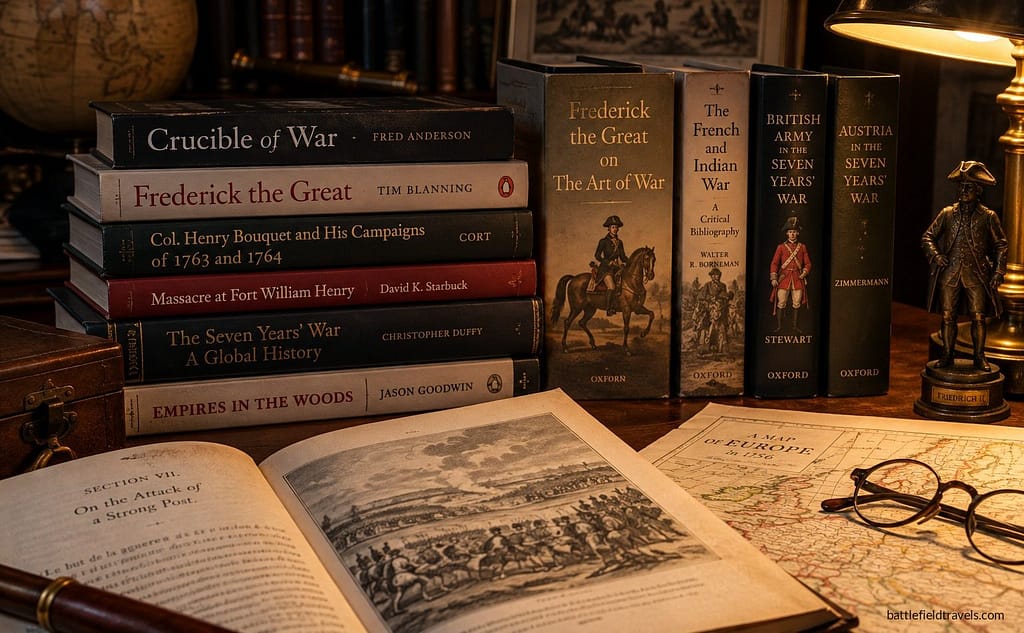
A curated reading list covering the Seven Years’ War across its European, North American and South Asian theatres. Explore campaign histories, battlefield studies, biographies, primary accounts and contemporary military writings used in the research behind Battlefield Travels.
Forty questions spanning the Seven Years’ War and French and Indian War — from Frederick the Great and the struggle for Silesia to Quebec, India, Havana and Manila. Test yourself, challenge your students, or use it as a classroom resource.
Below are all current BattlefieldTravels studies for the Seven Years War, covering key battles, campaign phases and associated sites. New studies are added as further battlefields are walked and analysed.
The Battle of Bushy Run, fought on August 5-6, 1763, was a major engagement during Pontiac’s War, a widespread Native American uprising against British postwar policies in the Great Lakes region following the French and Indian War. The war was named after Pontiac, an Ottawa chief who led a coalition of tribes dissatisfied with British…
Fort William Henry would probably be an obscure footnote in the history of the Seven Years War, except for two events. The first was the massacre of British prisoners at the hands of French-allied indian forces. The second event was the publishing in 1826 of a novel by American author James Fennimore Cooper – ‘The…
The Battle of Leuthen, 5 December 1757, is one of the great battles of history, students of military history would consider it somewhat of a pilgrimage to visit this site. After defeating a Fench/Imperial Army of almost twice its size at the Battle of Rossbach a month earlier, Frederick’s Army had marched 275km in 12…
La Cabaña: Spain’s Response to the Capture of Havana! Built after the British capture of Havana in 1762, the Fortress of San Carlos de la Cabaña (1763–1774) was Spain’s answer to securing the Caribbean. The massive Vauban-style bastion complex dominated Havana harbour, served as a prison and execution ground in later centuries, and today remains…
Authored by Mick Prictor, a retired military officer with 40 years’ service, and a military historian specialising in terrain-focused analysis of tactics, doctrine, and command decision-making in land warfare. His work draws on extensive battlefield fieldwork—more than 280 sites worldwide—and one of the world’s largest private collections of historic military arms, uniforms, and equipment. About me
⚔️ Go deeper — Members get exclusive access to the Deep Research Collection, Field Notes, and monthly Research Dispatches. Try membership free for 7 days, cancel anytime. From $9/month.
What makes these Seven Years War battlefield studies different?
These studies combine terrain analysis, historical mapping, primary sources, and on-site research to reconstruct how commanders saw the ground and why battles unfolded as they did.
Which Seven Years War battlefields are covered?
Key studies include Lobositz, Chotusitz, Leuthen and the wider campaigns across Silesia, Bohemia, North America, the Caribbean, and Northern Europe.
Do these studies focus only on Prussia and Austria?
No. While Central Europe is a major focus, the accompanying research includes battlefields in North America, the Caribbean and other global theatres of the war.
How does terrain analysis help understand Seven Years War battles?
Terrain analysis clarifies lines of sight, avenues of approach, dead ground, and deployment options—revealing why armies chose specific tactics, formations and timings.
Subscribe to Battlefield Travels and receive a free E-Book Battlefield Guide
Unlock expert battlefield analysis, campaign reconstructions, and historical insights drawn from firsthand exploration and primary sources.
🗺️ You’ll receive:
🎖️ Exclusive historical insights you won’t find elsewhere
📘 A free eBook: 10 Tips for Exploring Historic Battlefields
📰 New battlefield studies straight to your inbox as they are published
Claim Your Free Battlefield Travel Guide
Get your free e-book, exclusive tips, and updates on new battlefield studies.
Thank you!
You have successfully joined our subscriber list.
⚔️ Go deeper — Members get exclusive access to the Deep Research Collection, Field Notes, and monthly Research Dispatches. Try membership free for 7 days, cancel anytime. From $9/month.
Selected works on the War of the Austrian Succession
Charge of the Irish ‘Wild Geese’ Brigade at Fontenoy.
Overview of the War of the Austrian Succession
The War of the Austrian Succession (1740–1748) was a major European conflict that erupted following the death of Emperor Charles VI and the contested succession of his daughter, Maria Theresa of Austria. Nearly every major European power became involved, with fighting spreading across central Europe, Italy, the Low Countries, and overseas colonies.
The war pitted Austria and Britain against France, Prussia, Spain, and their allies in a struggle for influence and territory. Among the most significant campaigns was the rise of Frederick the Great, whose invasion of Silesia launched Prussia onto the European stage. Key battles such as Mollwitz (1741), Chotusitz (1742), Dettingen (1743), Fontenoy (1745), showcased evolving 18th-century tactics, with disciplined infantry lines, powerful artillery, and the growing use of cavalry manoeuvre.
For battlefield historians, the War of the Austrian Succession offers a window into the changing face of warfare between the dynastic wars of the 17th century and the global conflicts of the later 18th. The uniforms, weapons, and equipment from this period — muskets with socket bayonets, artillery pieces, and the distinctive dress of French, Austrian, Prussian, British, and other German regiments — reflect both tradition and transition.
The Amazon links on the Reading Room pages are powered by AAWP
Reading
The reference collection below includes the key books and references I have used in preparing for and undertaking battlefield studies all over the world.
Reed S. Browning explores the often-changing war aims of the major belligerents-Austria, France, Great Britain, Prussia, Piedmont-Sardinia, and Spain-and links diplomatic and military events to the political and social context from which they arose.
The Battle of Fontenoy marked a turning point in the War of the Austrian Succession, yet it has rarely been analyzed in depth and the Europe-wide conflict in which it played a part is little understood. James Falkner, in this perceptive and original account, puts the record straight by describing the fighting in graphic detail and setting it in the context of the sequence of wars that determined the shape of Europe during the eighteenth century.
Great Britain with her Austrian and Dutch allies fought to ensure that Maria Theresa of Austria should be able to take the throne of the Holy Roman Empire. Ranged against her interests was the might of Louis XV’s France, which strove to weaken Austria by promoting a Bavarian aspirant to the Imperial throne. On 11 May 1745 at Fontenoy in the Austrian Netherlands the two sides met in a ferocious day-long struggle that changed course of the war.
James Falkner’s narrative gives a fascinating insight into the Battle of Fontenoy itself and more widely into the nature of warfare in Europe 250 years ago.
For tactical and strategic ingenuity, for daring and ruthless determination and the capacity to inspire troops, Frederick the Great was without equal. In this detailed life of Old Fritz, Christopher Duffy, who has written widely on the army of Frederick and on the armies of his adversaries, Austria and Russia, has produced a definitive account of his military genius.
War of the Austrian Succession beyond the continent
Osprey’s study of the most important battle of the Jacobite Risings (1688-1746). The final demise of Jacobitism amid the slaughter of the Highland clans on a cold and damp Culloden Moor in April 1746 is undoubtedly one of the most famous battles in British military history. It has also been, until recently, one of the least understood from both a military and political perspective. In this modern and highly detailed account, this book combines a thorough understanding of 18th century tactics, an intimate knowledge of the battlefield itself and a scandalously underused archive of contemporary material from both sides to provide a detailed, accurate and dramatic account of this controversial battle.
Could the Stuart dynasty have been restored to the throne in 1745? Written by the world’s greatest authority on 18th century warfare, this fast-paced and exciting narrative will completely revise popular opinion about “Bonnie Prince” Charlie, the Duke of Cumberland (“the Butcher”), and the other major players in this historical drama. Christopher Duffy’s original research, from all available archives, reveals evidence of a wider plot against the Hanoverians and more support for the risings in Scotland, than had been suspected before. Filled with numerous maps and a comprehensive guide to the key sites, it provides an eye-opening perspective.
This is the first history of the Jacobite battle fought on September 21, 1745 between the forces of the Hanoverian regime and Prince Charles Edward Stuart, better known as “Bonnie Prince Charles.” Lieutenant-General Sir John Cope, the leader of the English army, has been ridiculed, in song and in history books, for losing the Battle of Prestonpansthe first major battle of the 1745 Jacobite Rising. His defeat led to the invasion of England, in which the Jacobites almost drove King George II from the throne. But was Cope really to blame? The Jacobite Risings occurred after Parliament ousted King James Stuart in 1688 and installed a new dynasty. Stuart loyalists, many of them based in Scotland, took up arms repeatedly in futile attempts to restore James’ descendants. The 1745 Rising, led by Bonnie Prince Charlie, was the last. Martin Margulies traces Scottish history up to “the ’45”, describes the sharply contrasting weapons and tactics of the opposing armies, and follows
Filled with unforgettable characters and maritime adventure, the incredible story of a forgotten war that shaped the fate of the United States—and the entire Western Hemisphere.
In the early 18th century, the British and Spanish Empires were fighting for economic supremacy in the Americas. Tensions between the two powers were high, and wars blossomed like violent flowers for nearly a hundred years, from the War of Spanish Succession (sometimes known as Queen Anne’s War in the Americas), culminating in the War of Jenkins’ Ear.
This war would lay the groundwork for the French and Indian War and, eventually, the War of the American Revolution. The War of Jenkins’ Ear was a world war in the truest sense, engaging the major European powers on battlefields ranging from Europe to the Americas to the Asian subcontinent.
Authored by Mick Prictor, a retired military officer with 40 years’ service, and a military historian specialising in terrain-focused analysis of tactics, doctrine, and command decision-making in land warfare. His work draws on extensive battlefield fieldwork—more than 280 sites worldwide—and one of the world’s largest private collections of historic military arms, uniforms, and equipment. About me
Q: How were the books in this Austrian Succession reading list selected?
A: This list is curated based on long-term research into the War of the Austrian Succession, prioritising works that provide clear analysis of strategy, tactics, command decision-making, and terrain. Selections include both classic historical treatments and specialised studies that illuminate key battles, campaigns, and doctrinal developments of the period.
Q: Is this list a complete bibliography of all books on the Austrian Succession?
A: No. This list is intended as a recommended starting point for readers and researchers rather than an exhaustive bibliography. It focuses on works that are most relevant to understanding the conflict’s operational and battlefield dimensions. Additional specialised or peripheral titles may not be included.
Subscribe to Battlefield Travels and receive a free E-Book Battlefield Guide
Unlock expert battlefield analysis, campaign reconstructions, and historical insights drawn from firsthand exploration and primary sources.
🗺️ You’ll receive:
🎖️ Exclusive historical insights you won’t find elsewhere
📘 A free eBook: 10 Tips for Exploring Historic Battlefields
📰 New battlefield studies straight to your inbox as they are published
Claim Your Free Battlefield Travel Guide
Get your free e-book, exclusive tips, and updates on new battlefield studies.
Thank you!
You have successfully joined our subscriber list.
⚔️ Go deeper — Members get exclusive access to the Deep Research Collection, Field Notes, and monthly Research Dispatches. Try membership free for 7 days, cancel anytime. From $9/month.
The Seven Years’ War (1756–1763) was the first truly global conflict of the modern era, fought simultaneously in Europe, North America, the Caribbean, West Africa, and India. Sometimes described as the “first world war,” it pitted Britain and Prussia against France, Austria, Russia, and Spain, with alliances shifting as the struggle spread across continents.
In Europe, the war was defined by Frederick the Great’s campaigns, where the Prussian army fought for survival against numerically superior enemies. Battles such asChotusitz (1742), Rossbach (1757), Leuthen (1757), and Kunersdorf (1759) demonstrated the discipline, firepower, and tactical innovation that established Prussia as a major power. Britain, meanwhile, waged its own global war at sea and in the colonies, fighting against France in Canada, the Caribbean, and India, including the Battle of Bushy Run (1763) and the Siege of Fort William Henry (1757).
The conflict reshaped the balance of power. Britain emerged as the dominant naval and colonial empire, while Prussia secured its position as a leading European military state. Just as importantly, the war represents the maturity of the 18th-century military system, characterised by professional standing armies, linear tactics, and increasingly standardised weapons and equipment.
Weapons technology
From a technology perspective, the Seven Years’ War represents the mature phase of the smoothbore flintlock era. Armies entered the conflict equipped largely with weapons little changed from earlier wars: smoothbore muskets such as the Brown Bess, socket bayonets, and muzzle-loading artillery formed the backbone of all major armies. Linear tactics, close-order drill, and controlled volleys defined battlefield combat.
By the end of the war, however, most combatants were adapting their weapons and equipment in response to operational experience. British forces shortened the barrels of their muskets after fighting in the forests of North America, improving handling and mobility. Artillery became increasingly important, forming a significantly larger proportion of field forces in 1763 than in 1756. Across Europe, reforms such as those associated with Prince Joseph Wenzel of Liechtenstein in the Austrian artillery arm reflected growing recognition of the decisive role of firepower and mobility.
The uniforms, muskets, artillery, and equipment of this period illustrate both the peak of the linear warfare system and the beginnings of change that would shape later eighteenth-century armies. Studying these artefacts provides insight into how soldiers were equipped, organised, and supplied during one of the defining conflicts of the eighteenth century.
Pattern 1756 Long Land Musket, marked to the 27th Regiment, Enniskillen Fusiliers. From my personal collection.
This Pattern 1756 Long Land musket, marked to the 27th Regiment of Foot (Enniskillen Fusiliers), represents the British Army’s primary infantry weapon during the mid-Seven Years War period. A .75-calibre flintlock with a 46-inch barrel, it incorporated improvements to lock strength, furniture, and bayonet fit over the earlier Pattern 1742. The 27th Foot served extensively in North America—including Louisbourg, Ticonderoga, and Quebec—making marked examples extremely scarce. Regimental branding reflects the period practice of unit-level property control on arms issued for overseas campaigning.
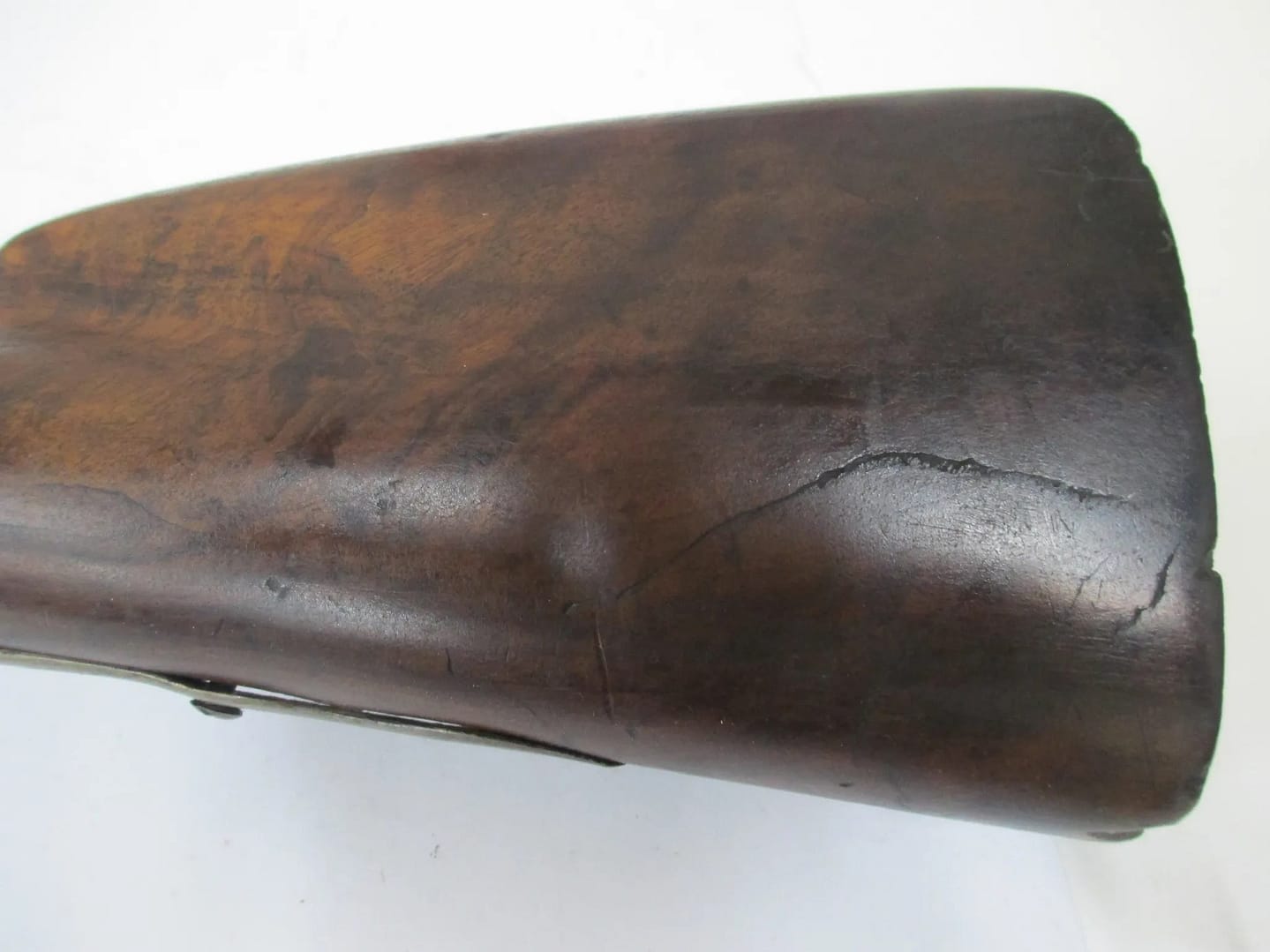
English Long Land Pattern Musket, Pattern 1742, marked Farmer 1748. Probably restocked in beech wood. From my personal collection.
This Pattern 1742 Long Land musket, maker-marked Farmer 1748, represents the principal British infantry firearm of the mid-18th century. A .75-calibre flintlock with a 46-inch barrel, it provided reliable volley fire during the War of Austrian Succession and early Seven Years’ War. Many surviving examples were restocked post-service; this musket shows a later beechwood stock, replacing the original walnut. The Pattern 1742 formed the backbone of British line infantry armament before the evolution of the 1756 and 1769 Brown Bess patterns.
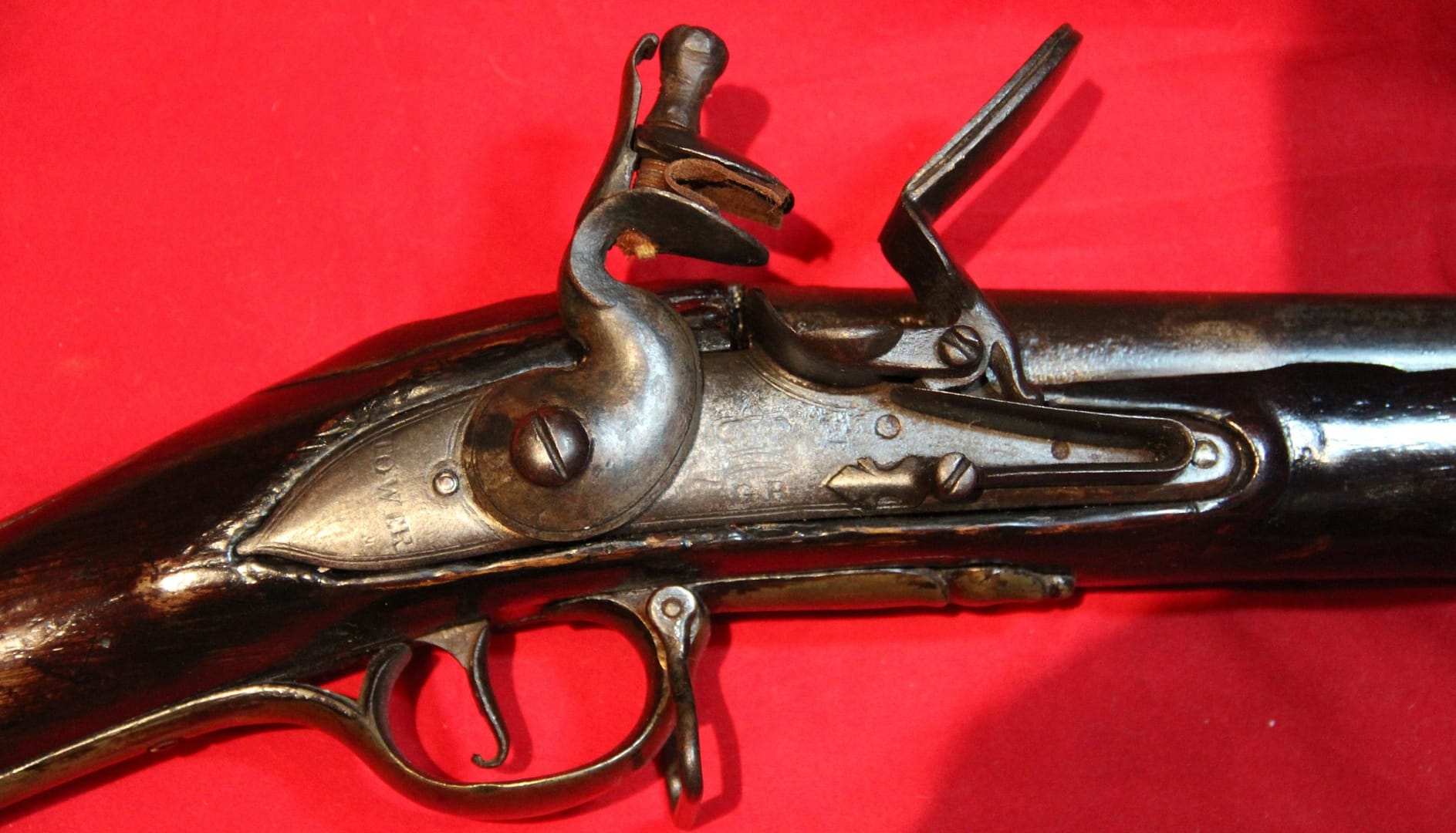
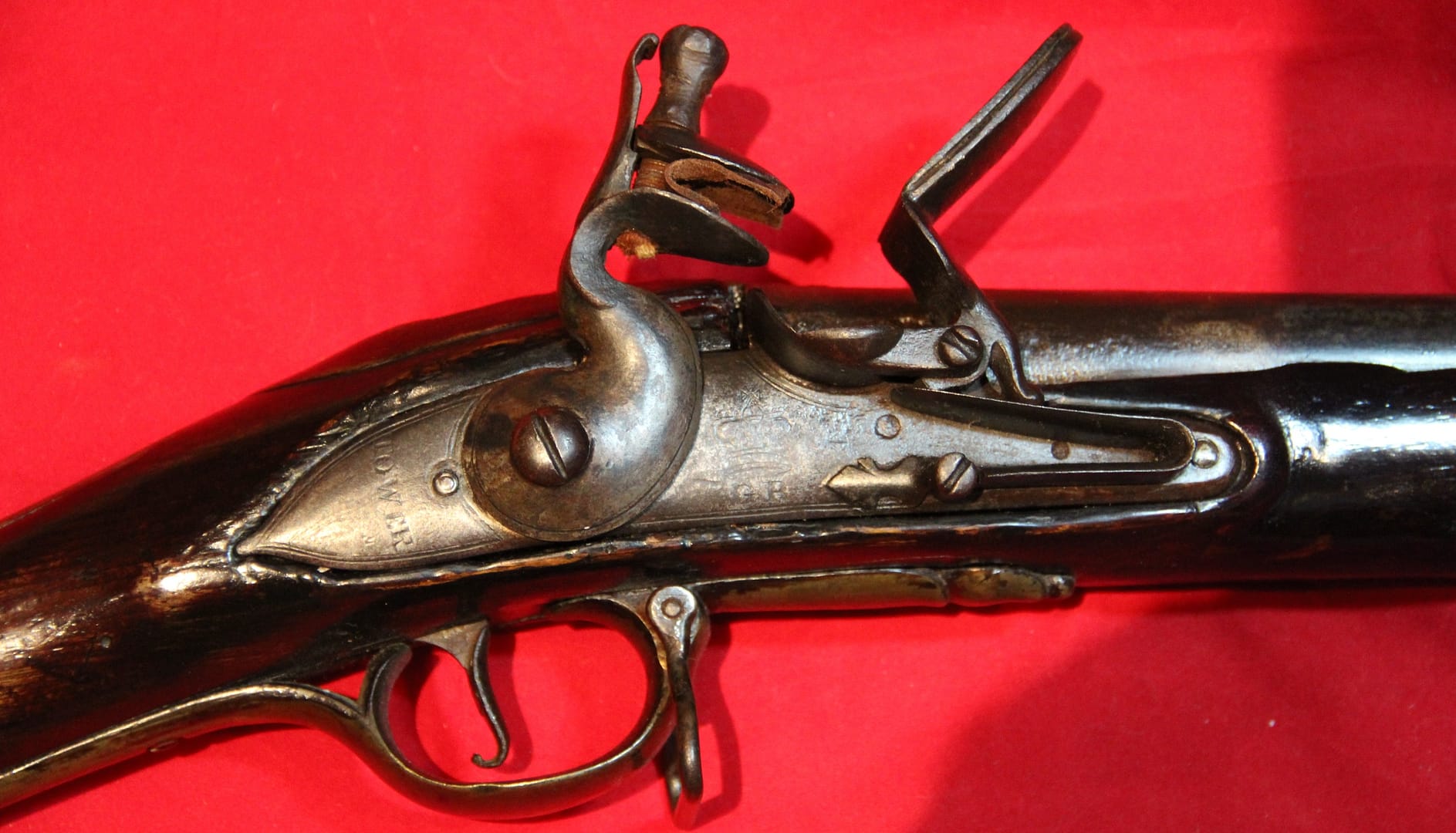
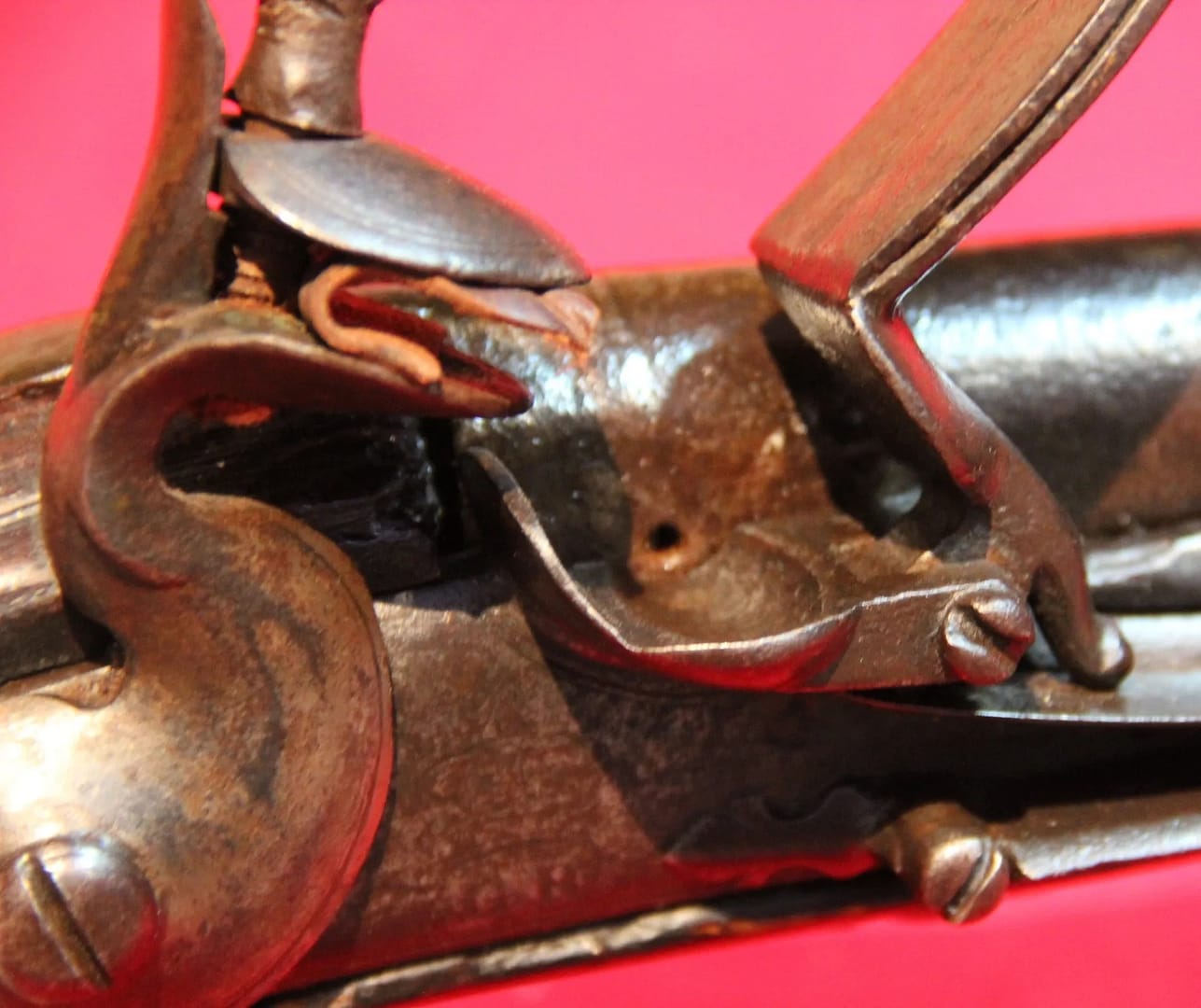
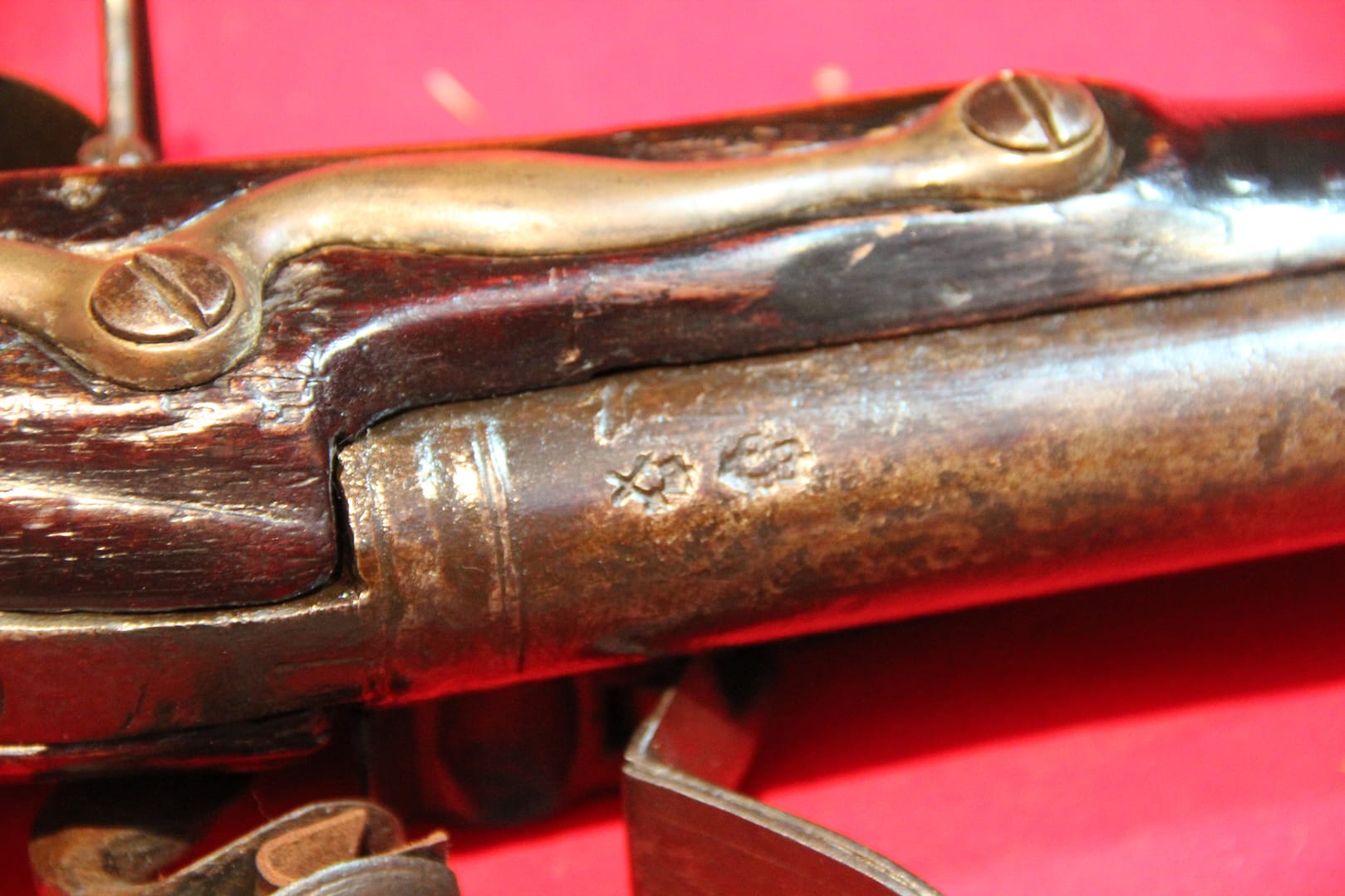
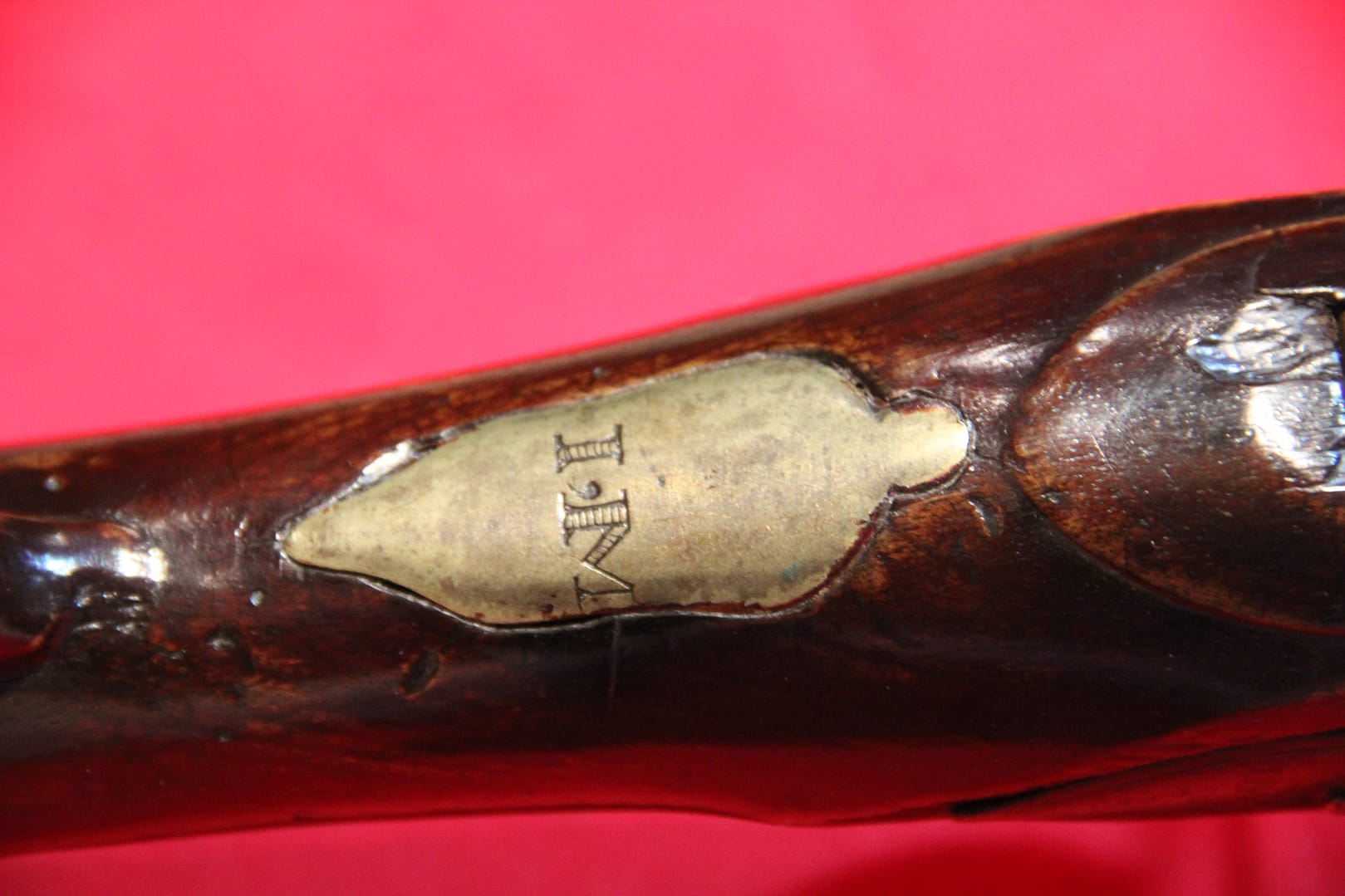
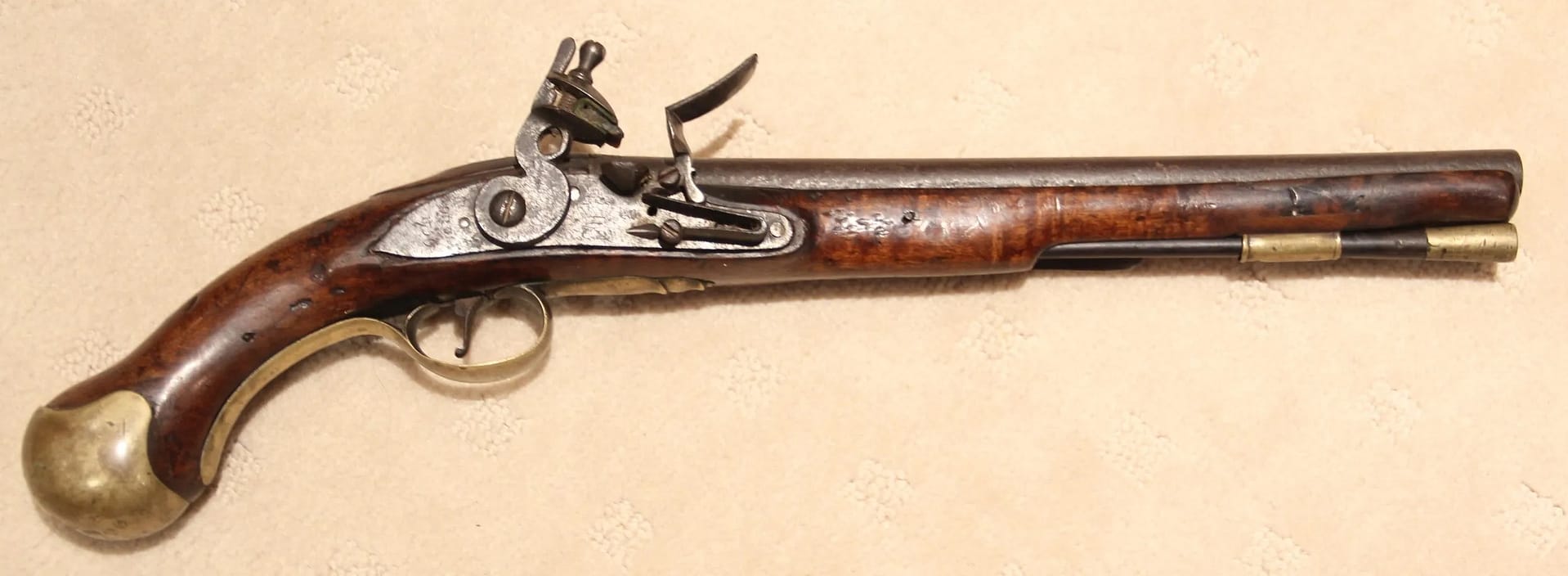
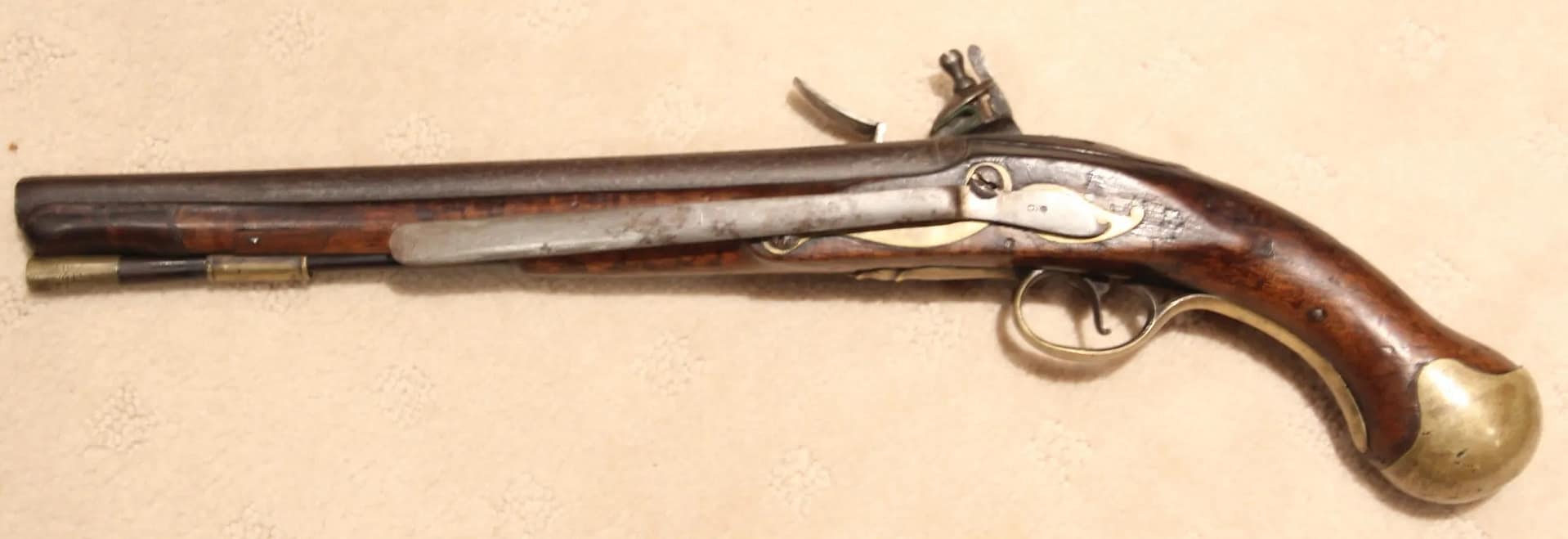
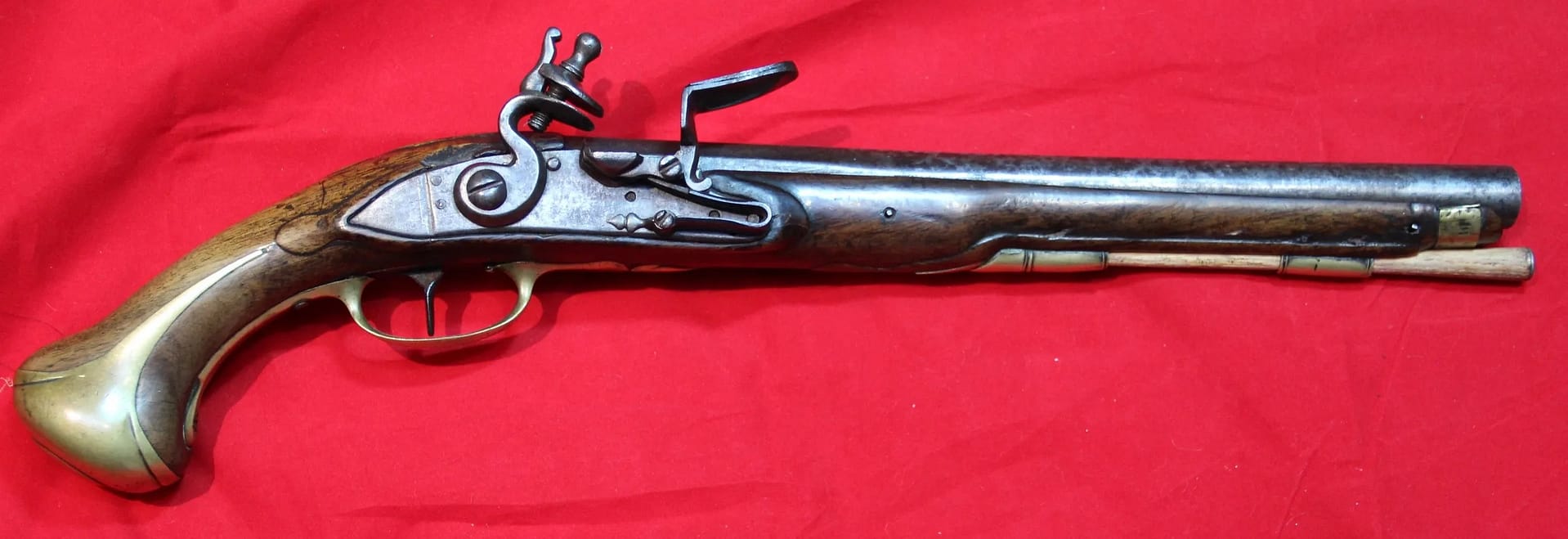
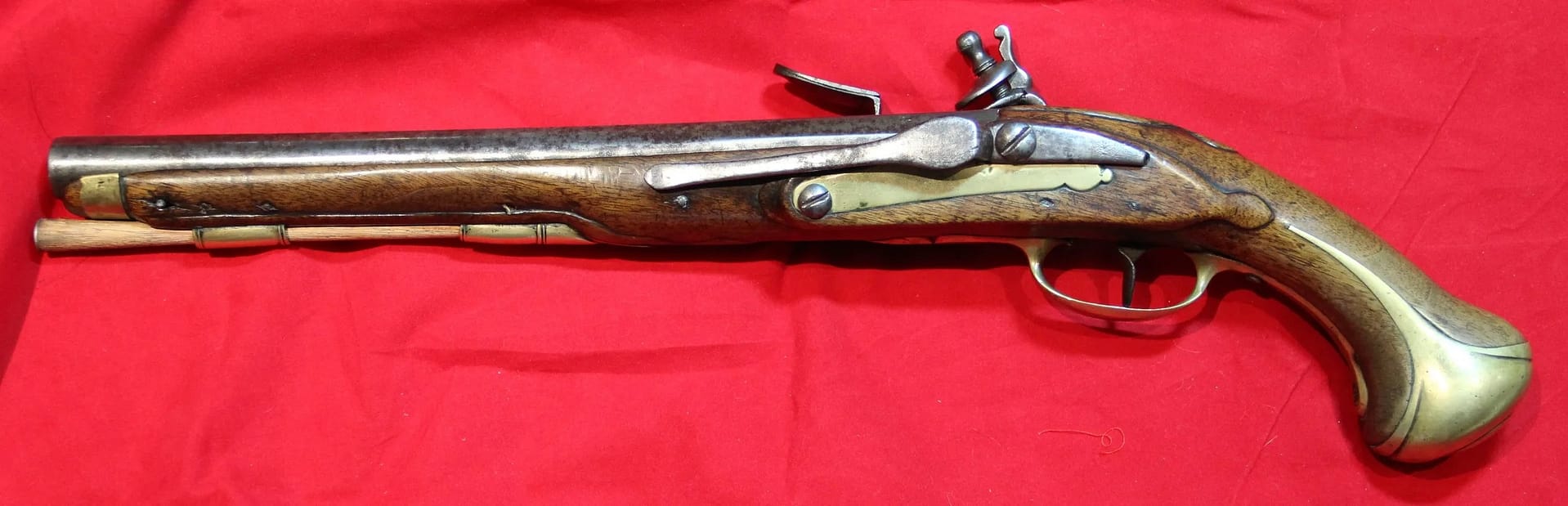
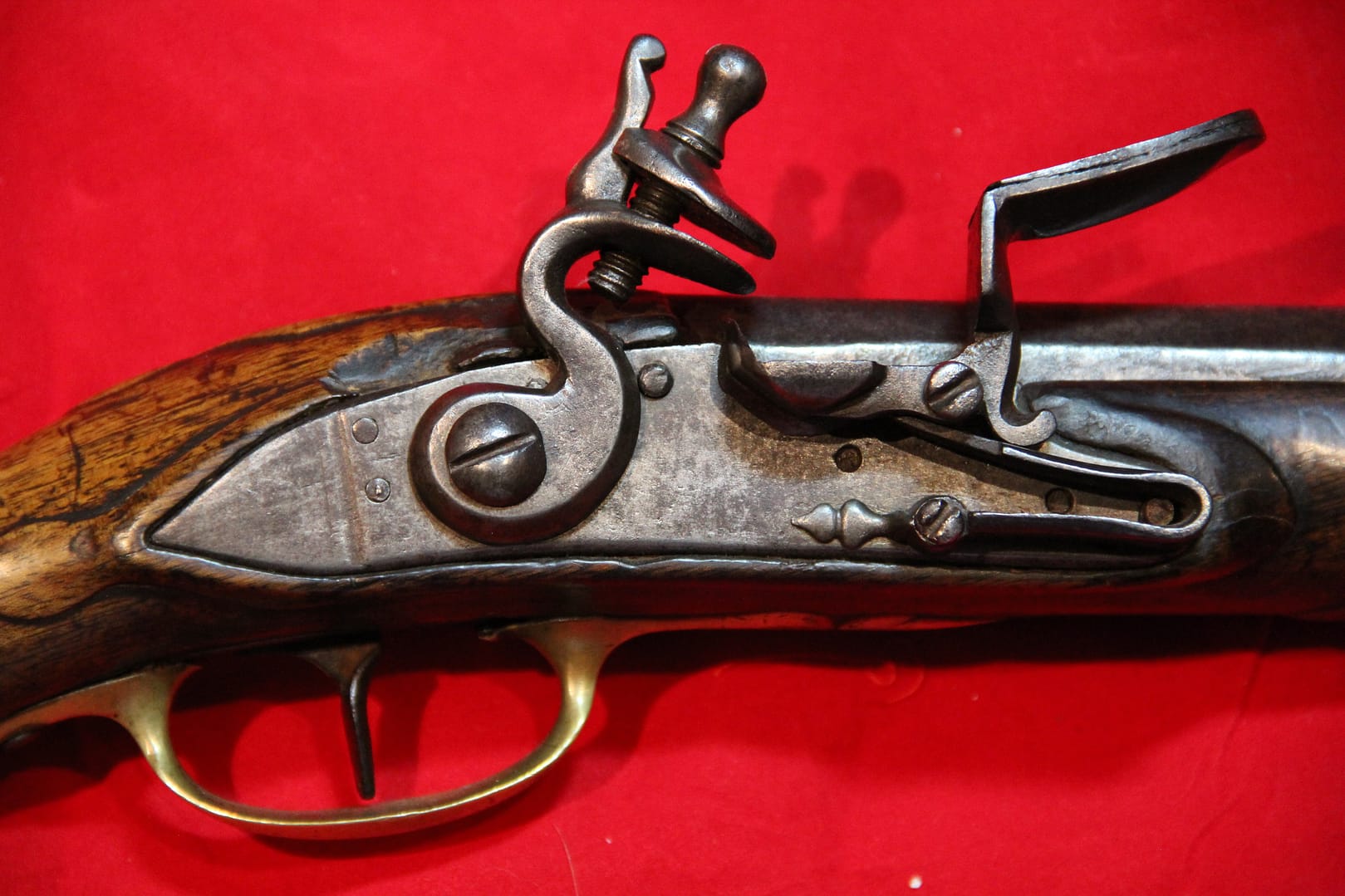
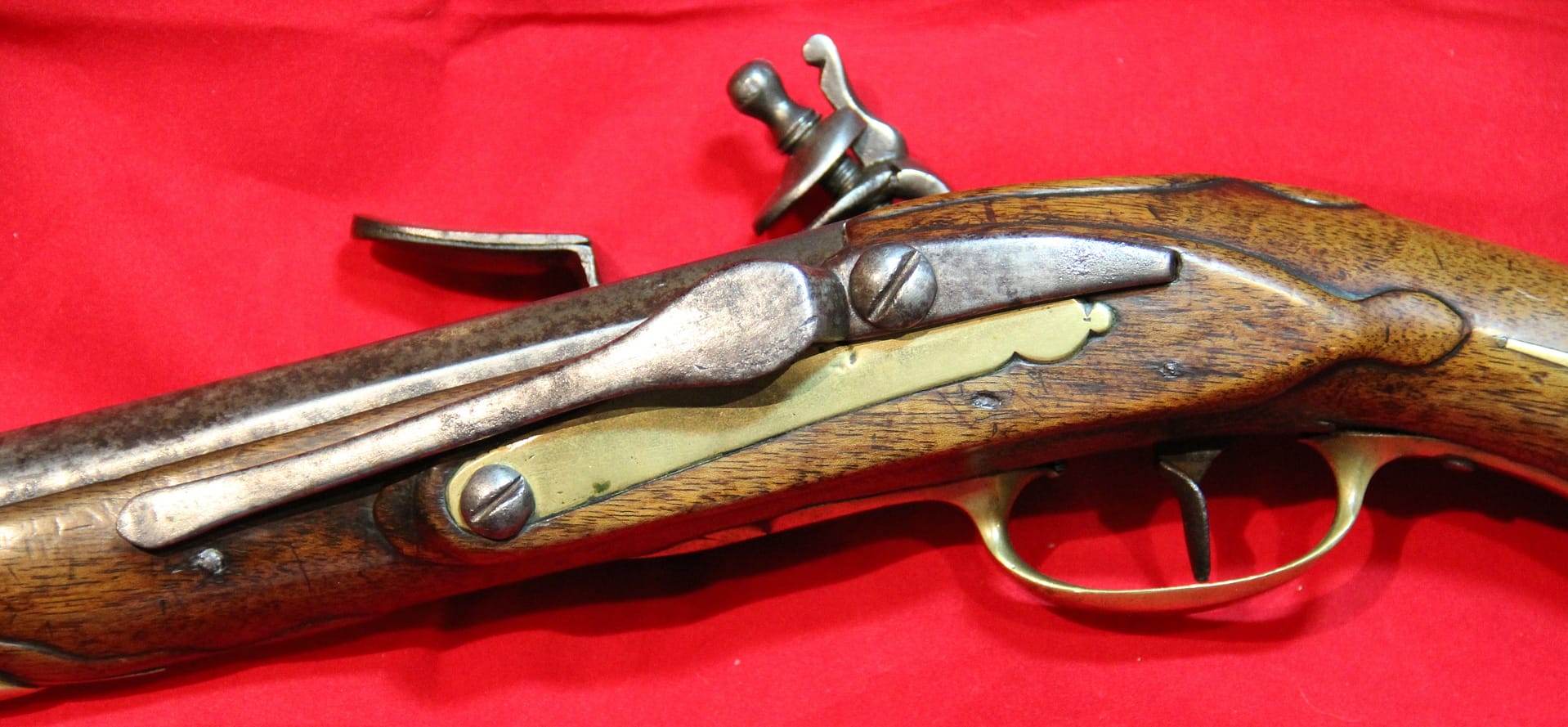
English Model 1756 Long Land Pattern pistol. TOWER. From my personal collection.
The Model 1756 Long Land Pattern pistol was the standard British cavalry and infantry officer’s pistol of the mid-18th century. Marked TOWER, indicating manufacture or assembly at the Tower of London, it featured a large-bore flintlock mechanism, brass furniture, and full walnut stock. Designed for close-range mounted combat, it saw service during the Seven Years War and early American campaigns. Its robust construction made it reliable under field conditions.
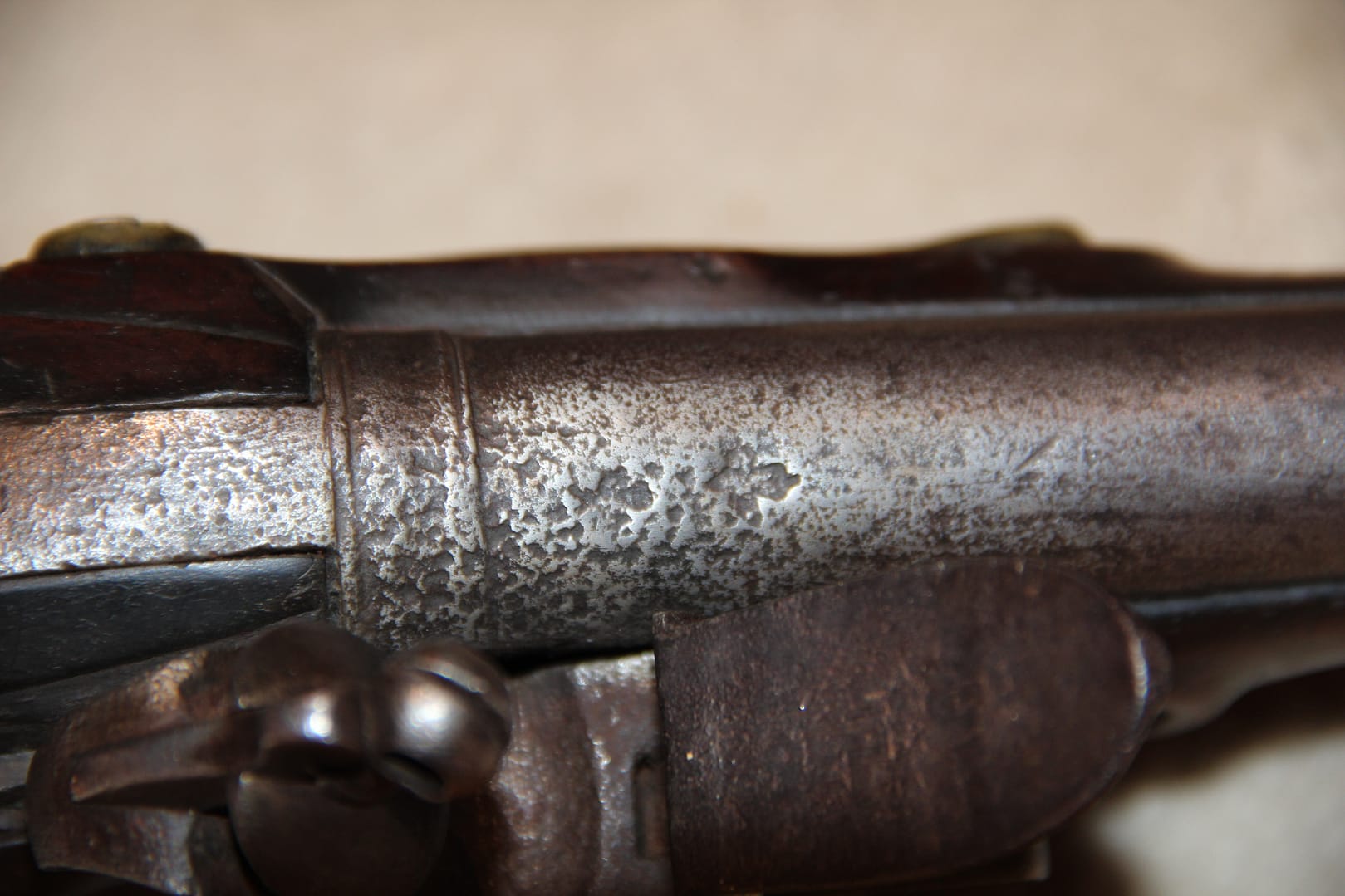
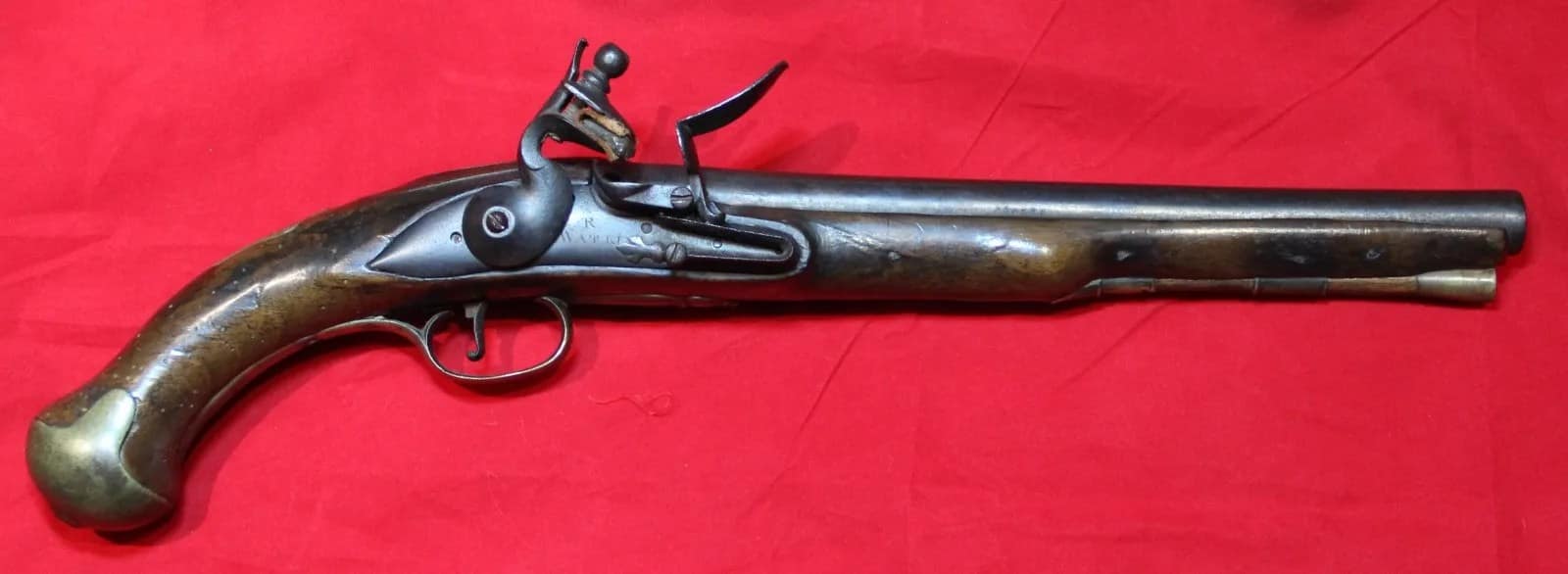
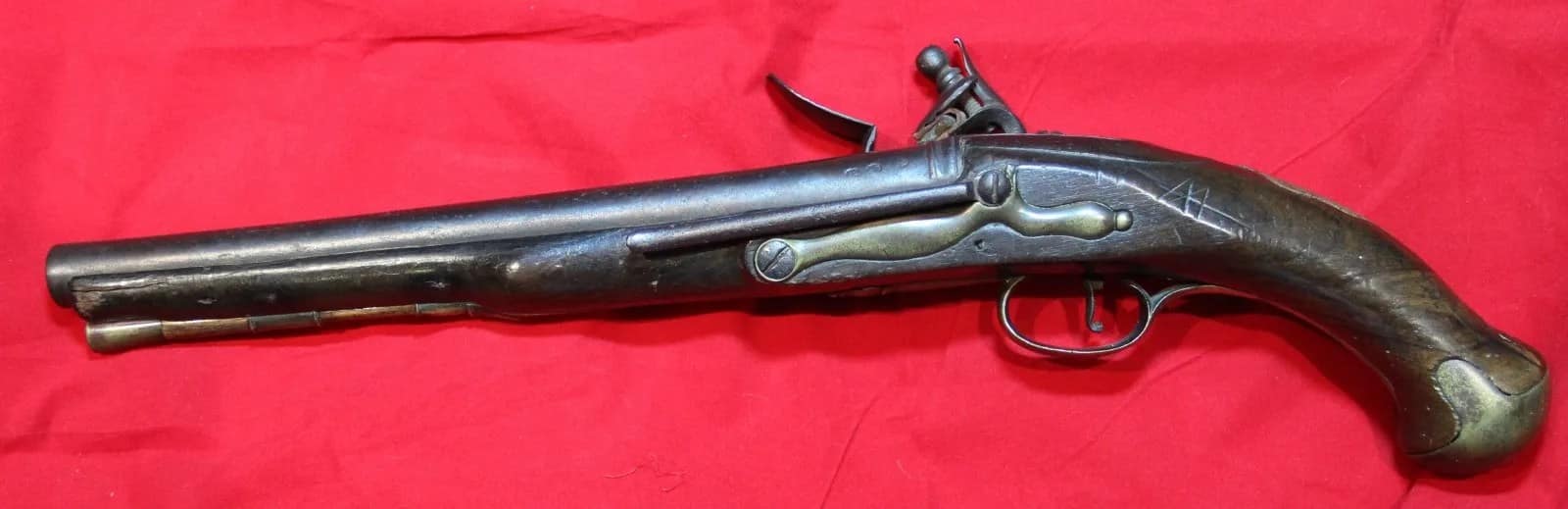
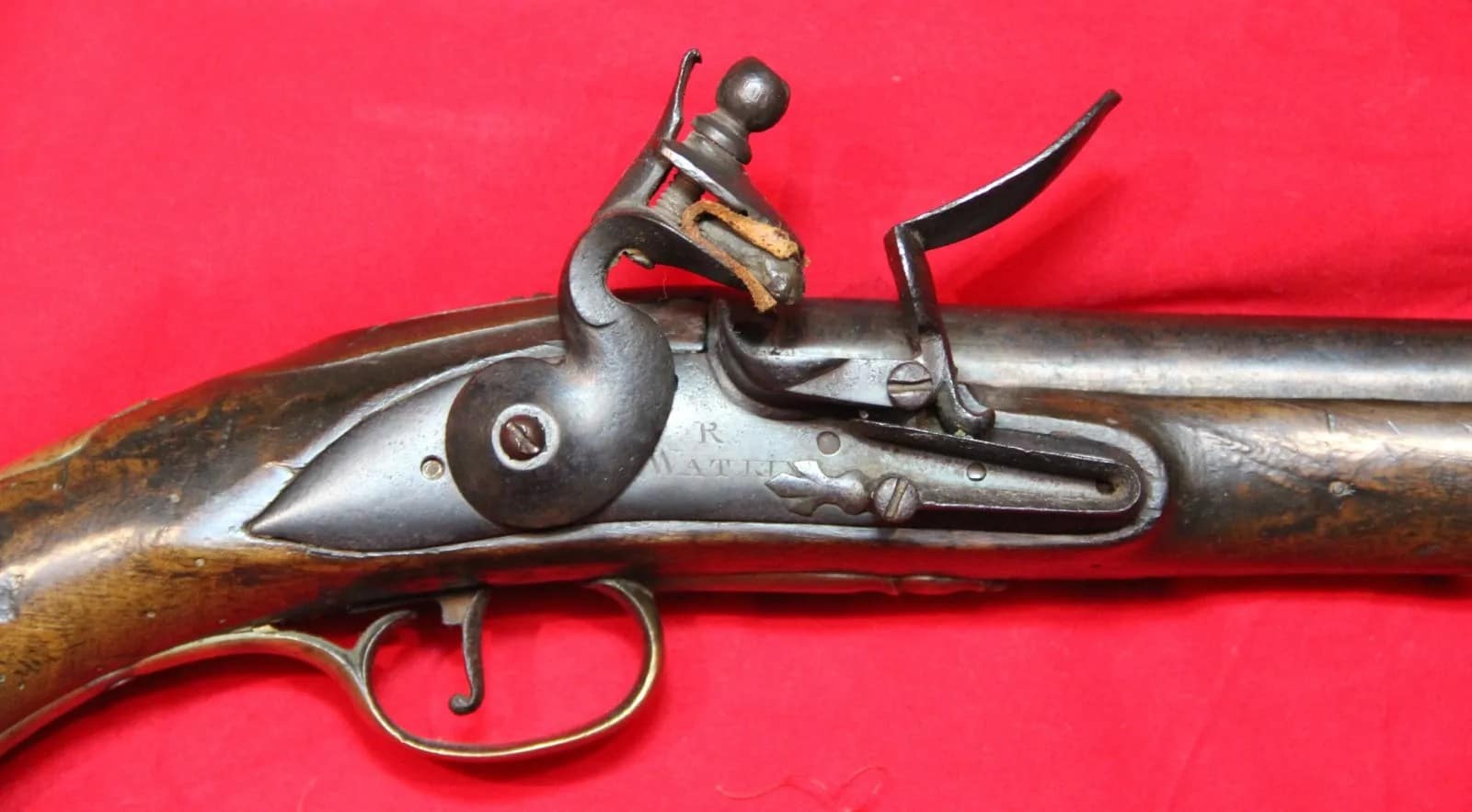
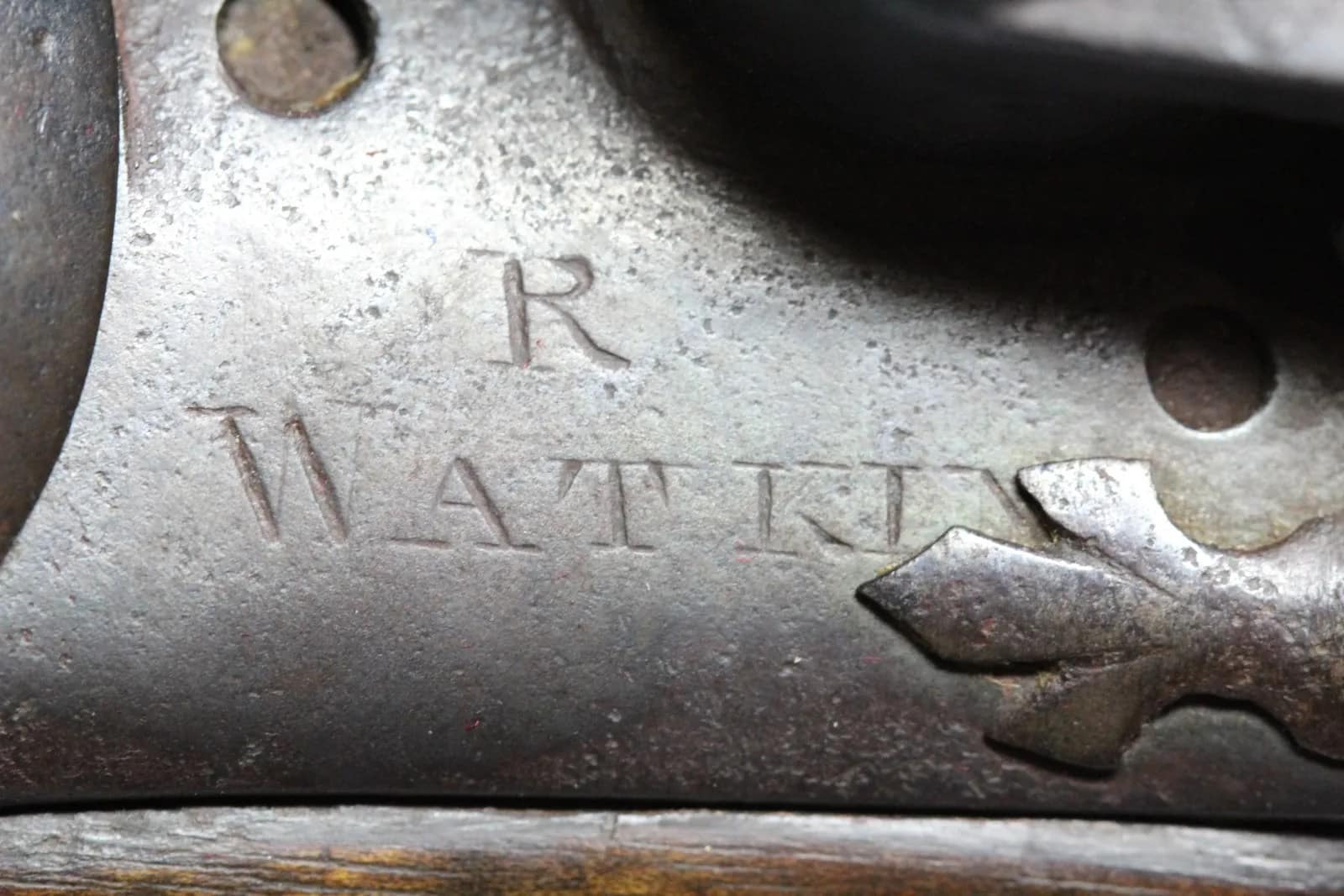
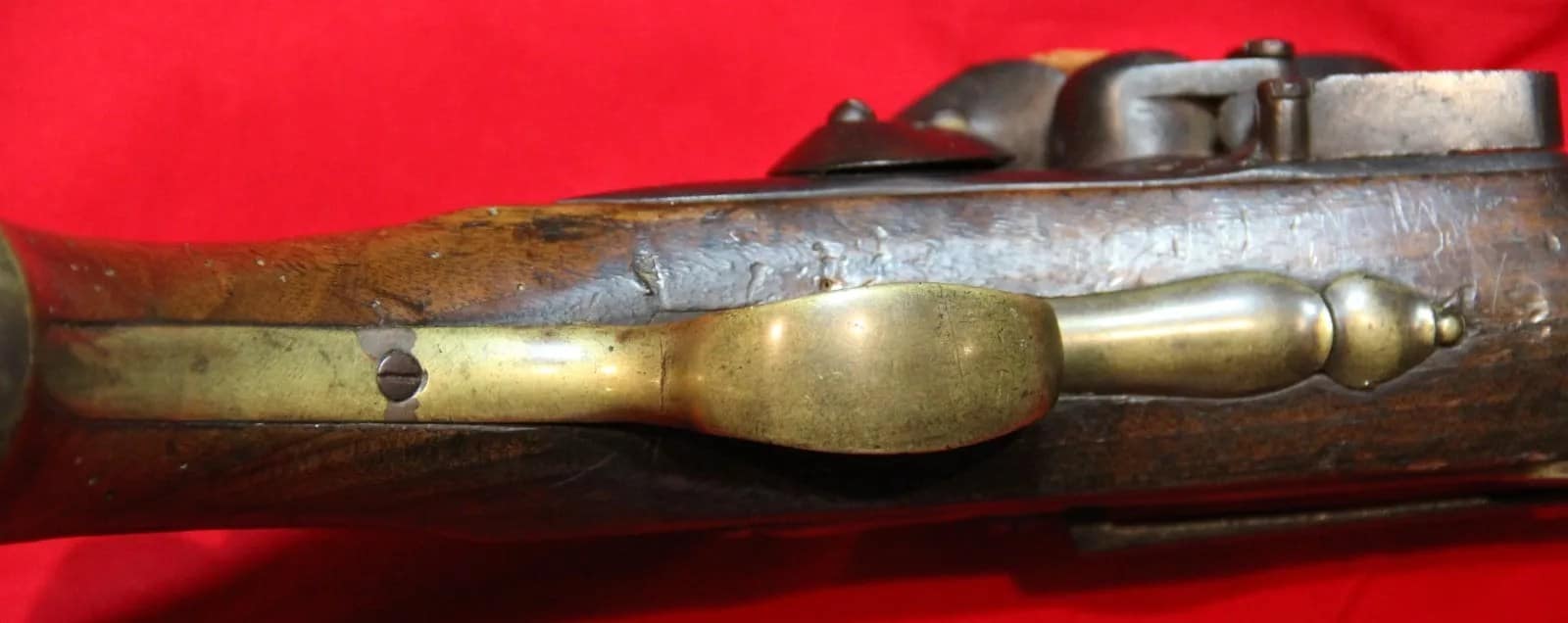
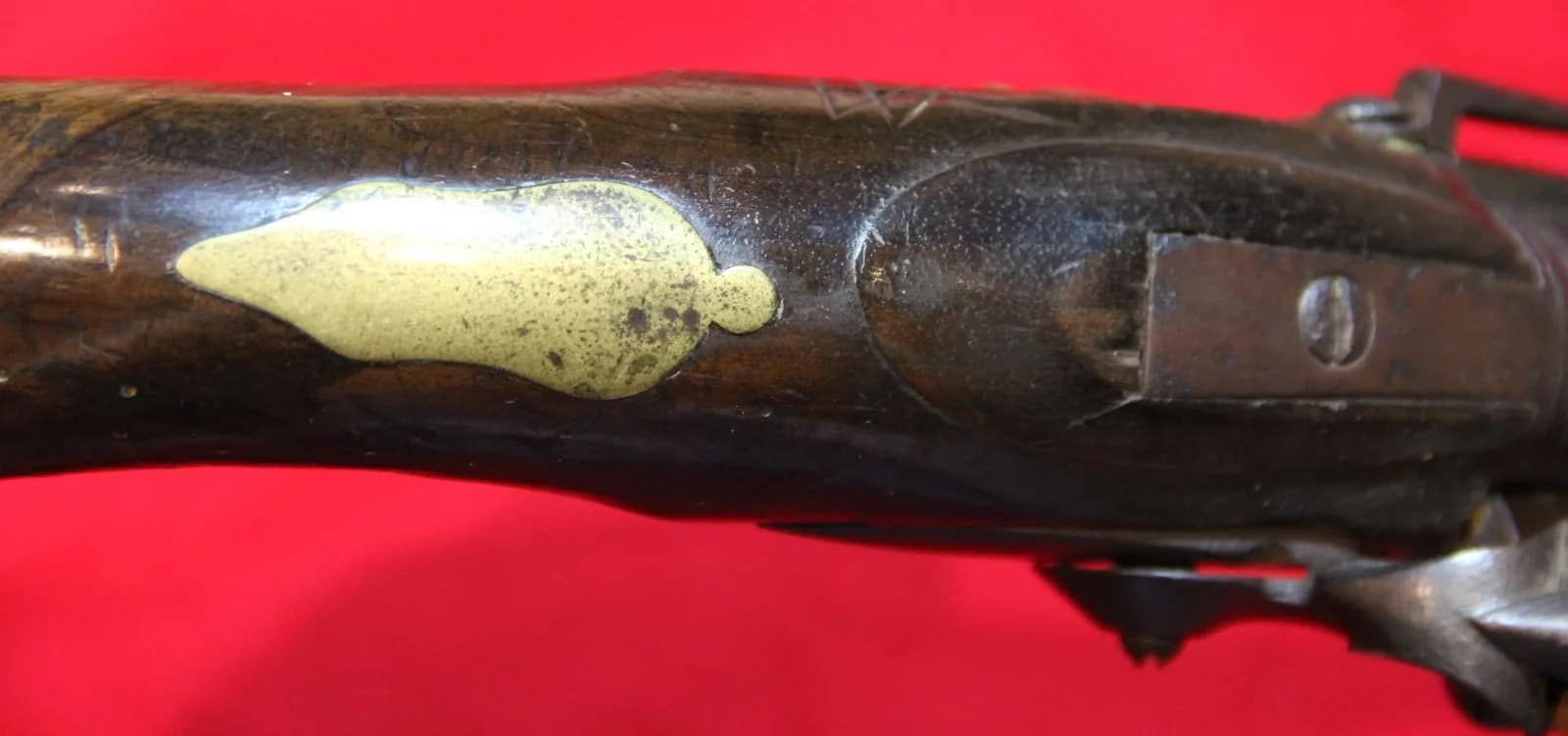
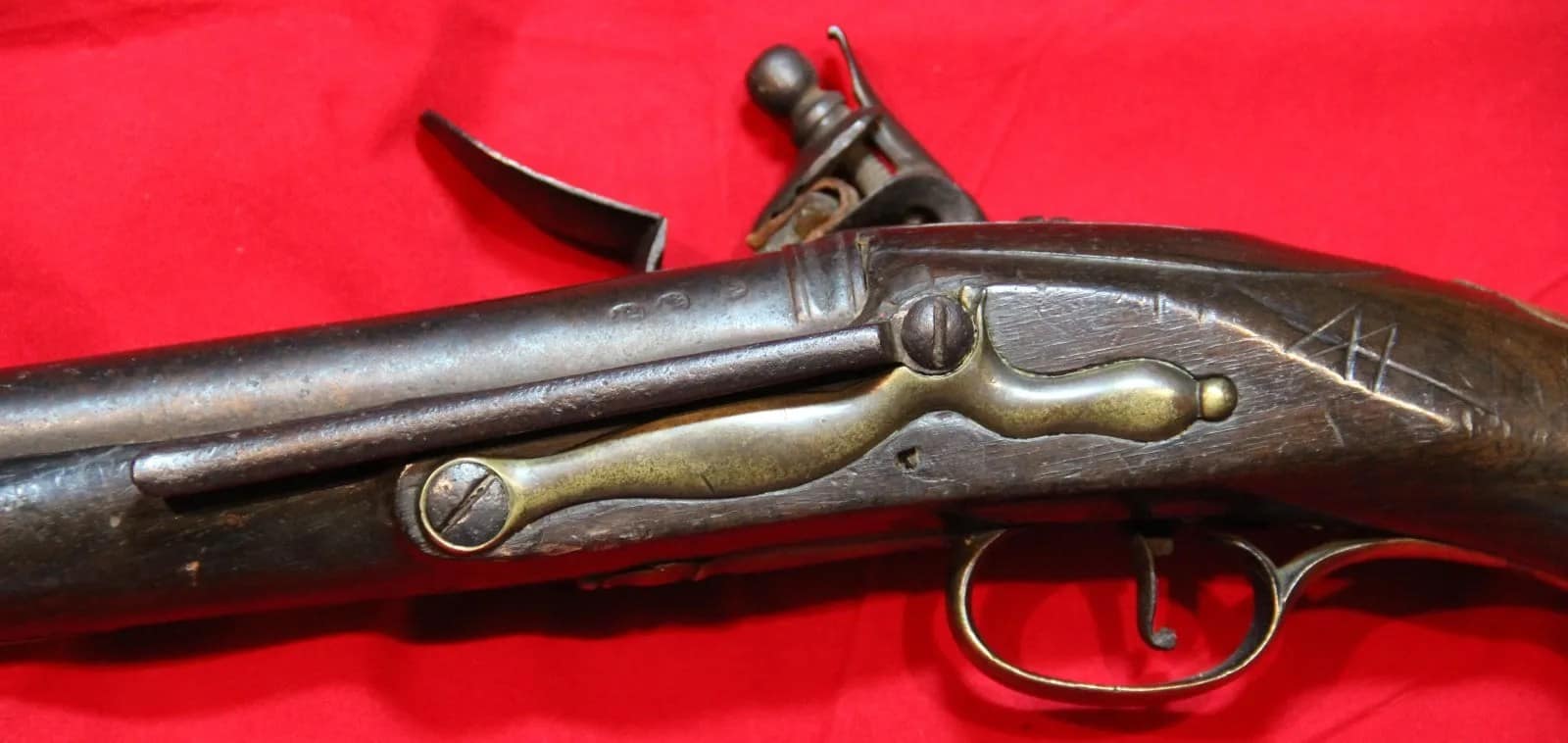
Land Pattern Pistol by Robert Watkin, c.1745. From my personal collection.
This flintlock Land Pattern pistol, made by London gunmaker Robert Watkin around 1745, is associated with the rapid mobilisation of British forces during the Jacobite Rising of 1745. Pistols of this type were produced for cavalry and volunteer units, including the Yorkshire Blues, a regiment raised from loyalist cavalry to defend northern England against the advancing Jacobite army. Typically of large calibre with brass furniture and a robust lock, Land Pattern pistols were designed for mounted service and close combat. This example reflects both the emergency expansion of government forces and the growing standardisation of British military small arms in the mid-18th century.
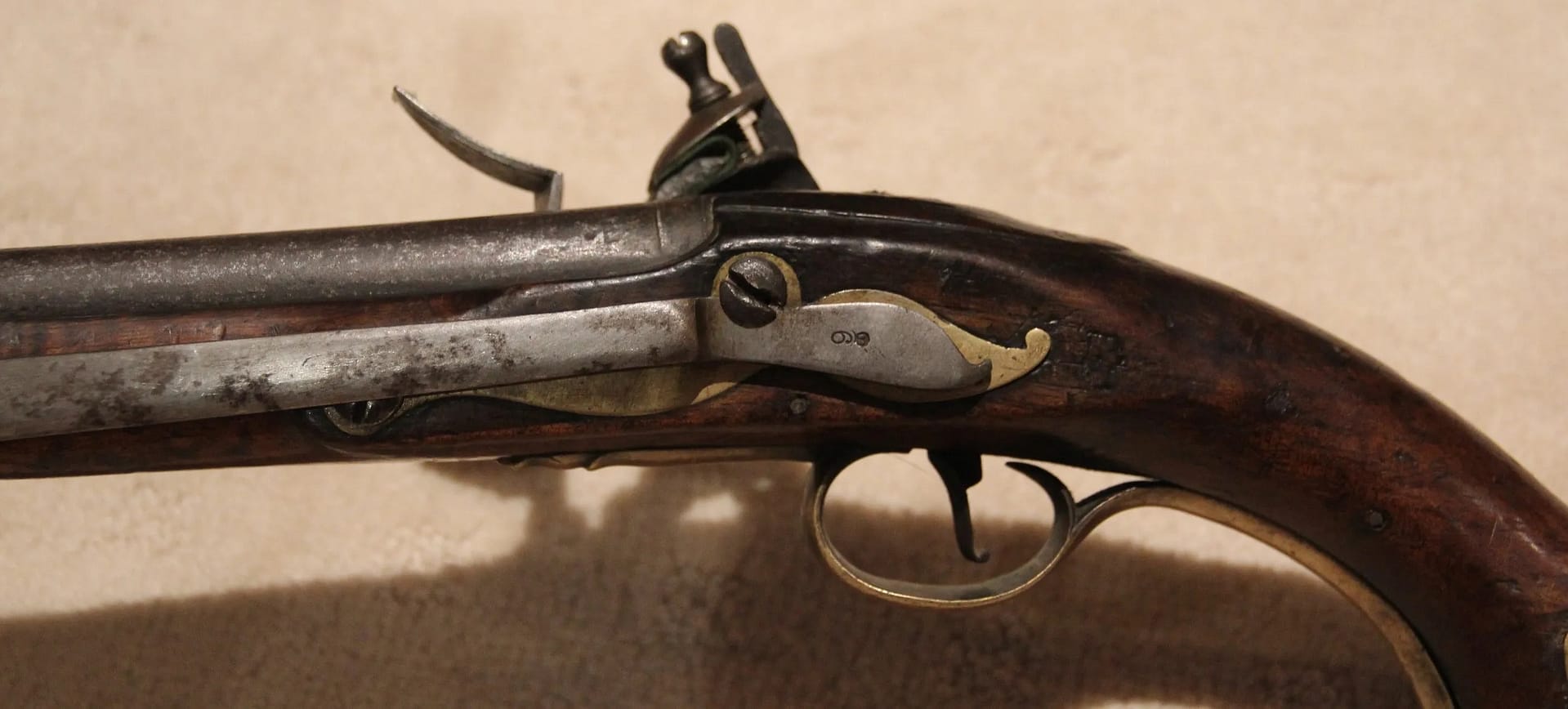
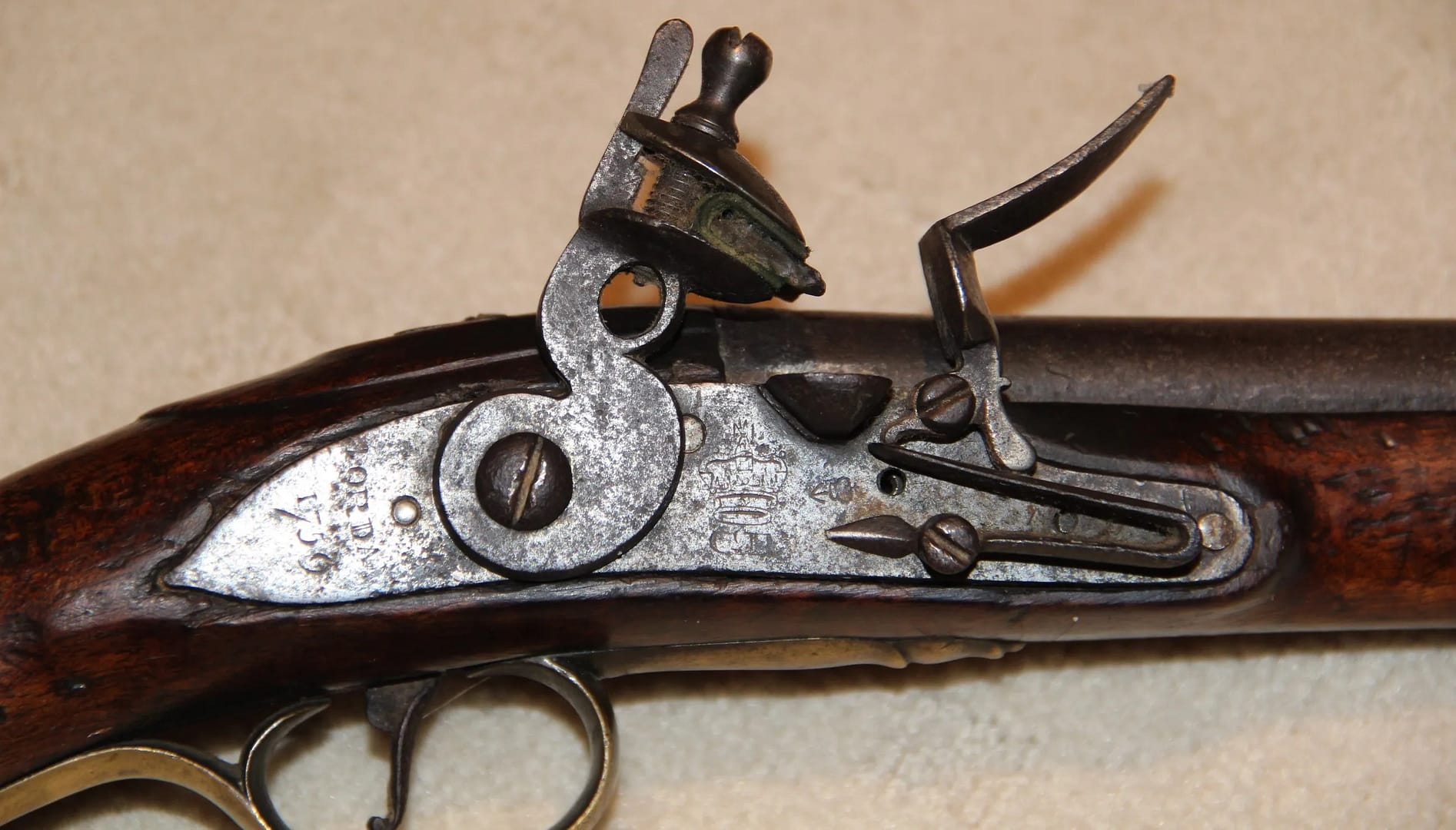
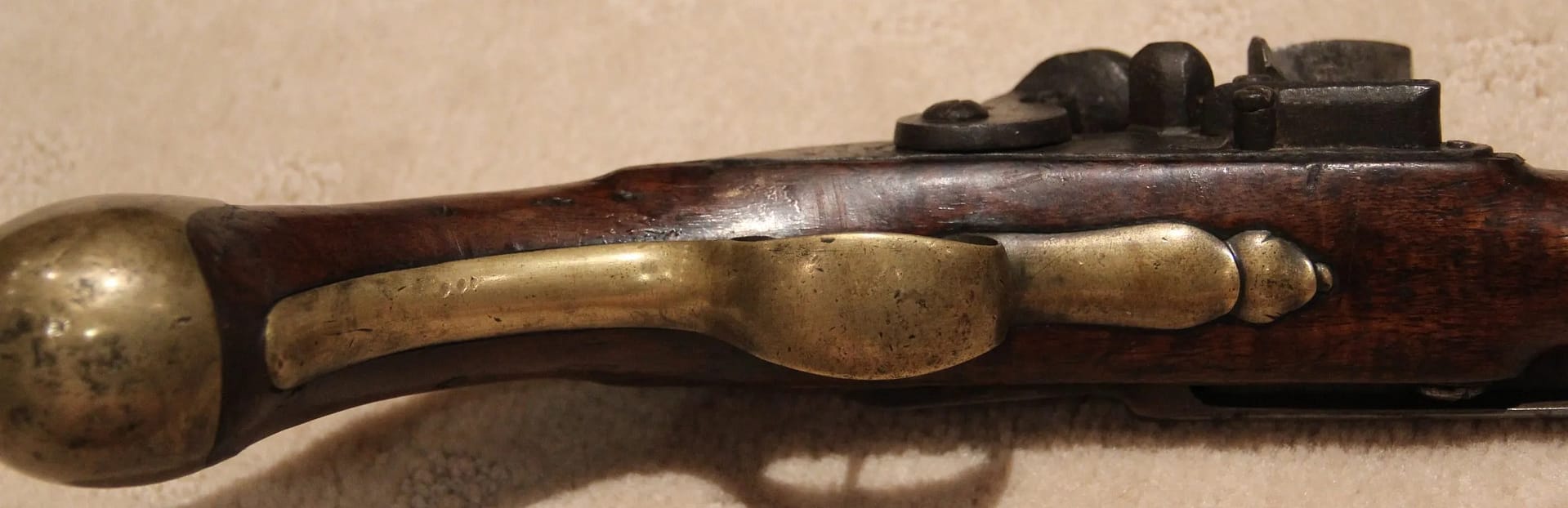
English Pattern 1718 Sea Service Pistol (Manufactured by Jordan, 1759). From my personal collection.
This flintlock Sea Service pistol, produced in 1759 by the contractor Jordan, is an example of the Pattern 1718 design widely issued to the Royal Navy during the mid-18th century. Typically of large calibre and built for durability, these pistols featured robust brass furniture and a simple, sturdy lock suited to the harsh maritime environment. Sea Service pistols were carried aboard warships for close-quarters fighting, boarding actions, and by naval landing parties ashore. Pistols of this type saw service during the global conflicts of the period, including the Seven Years’ War, reflecting the practical demands of naval warfare.
English Basket Hilt Heavy Cavalry Troopers Sword circa 1750. From my personal collection.
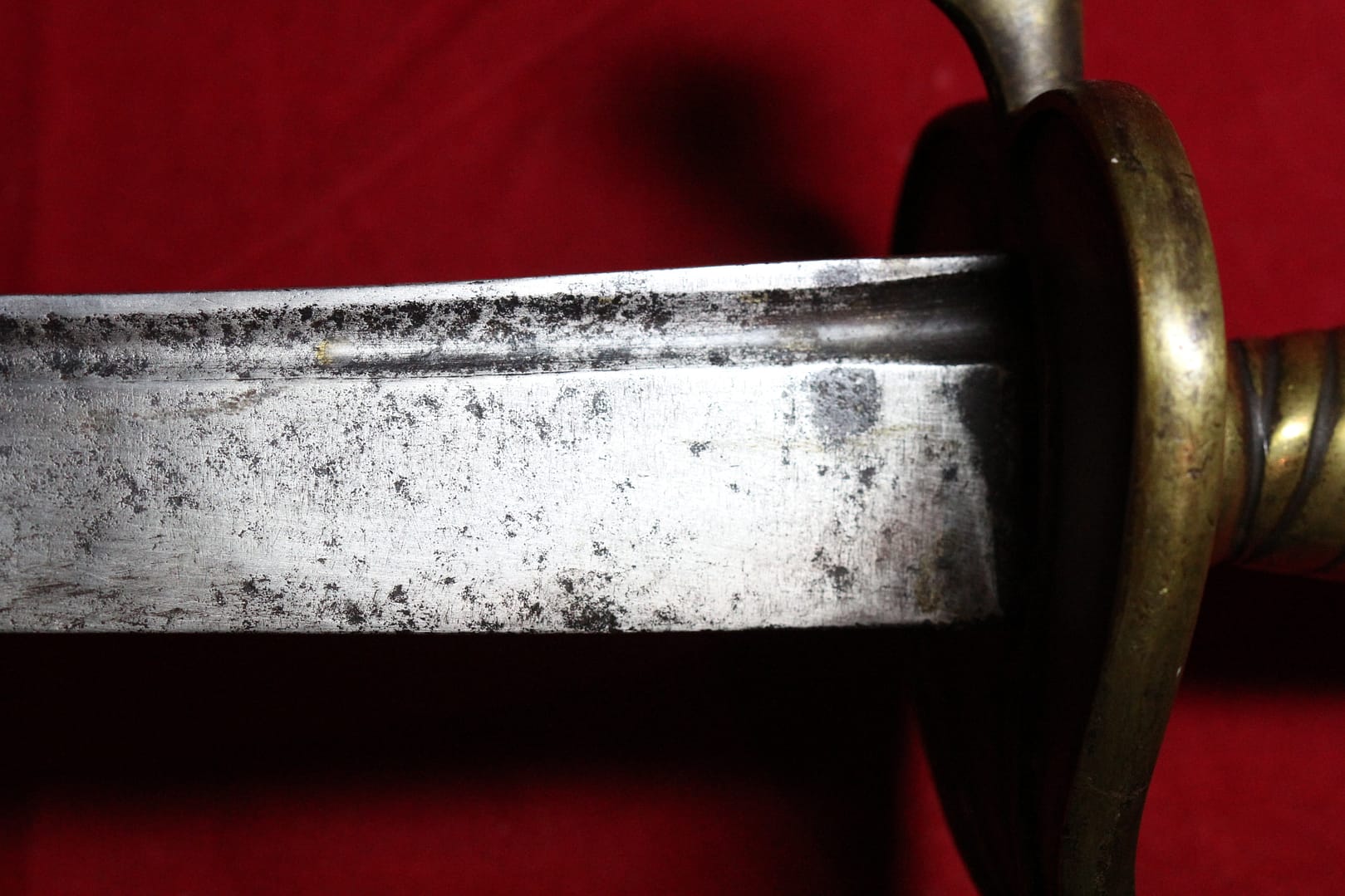
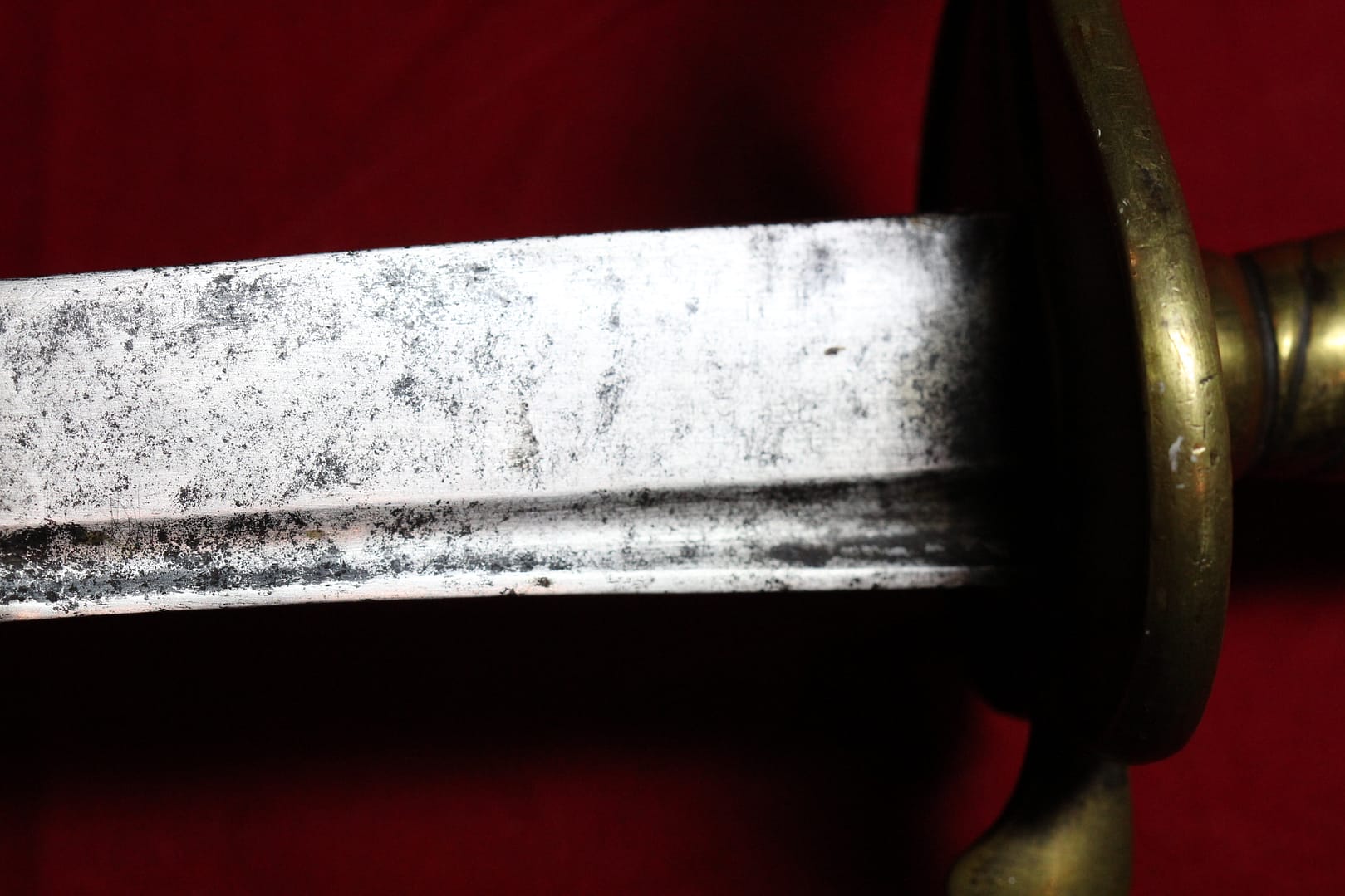
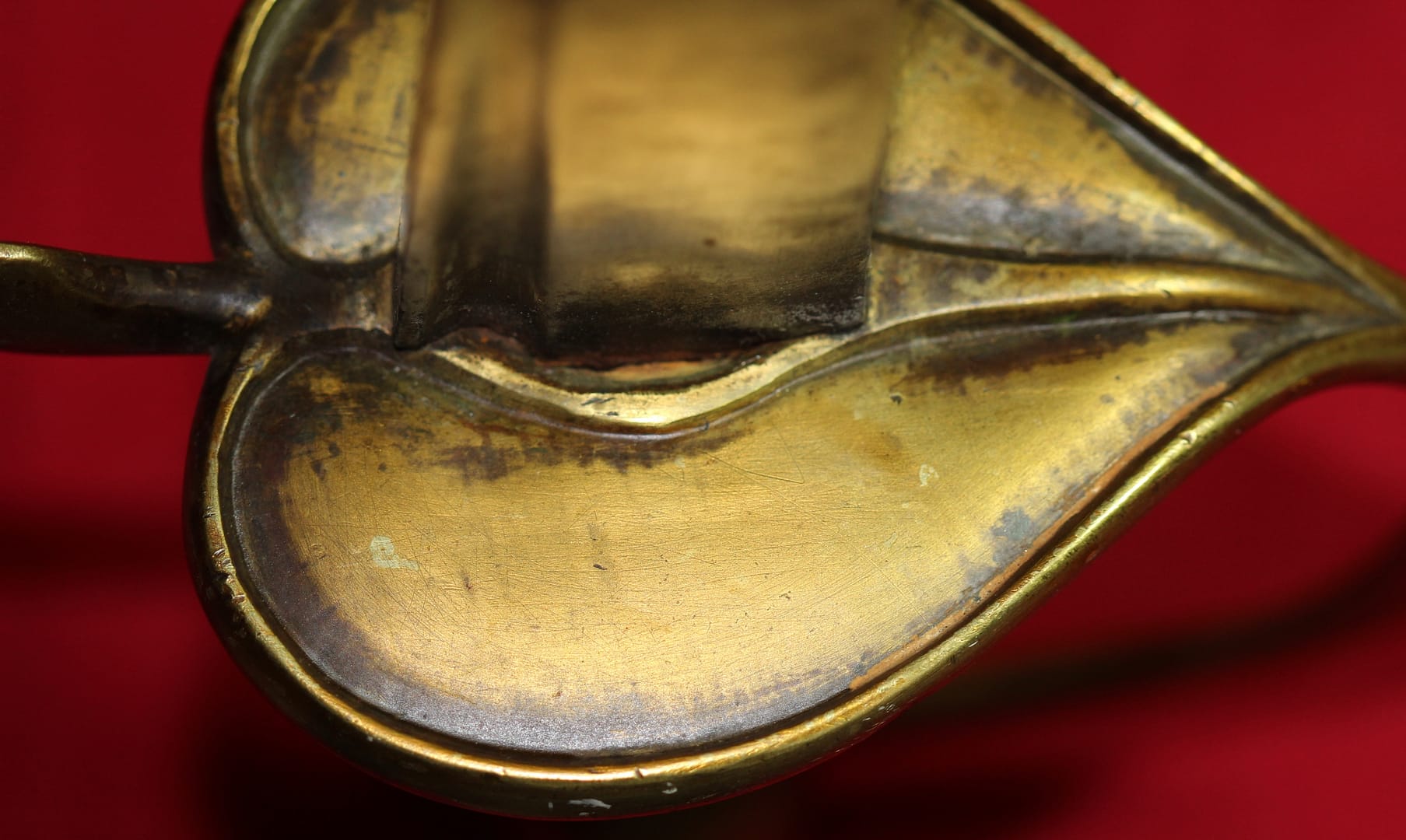
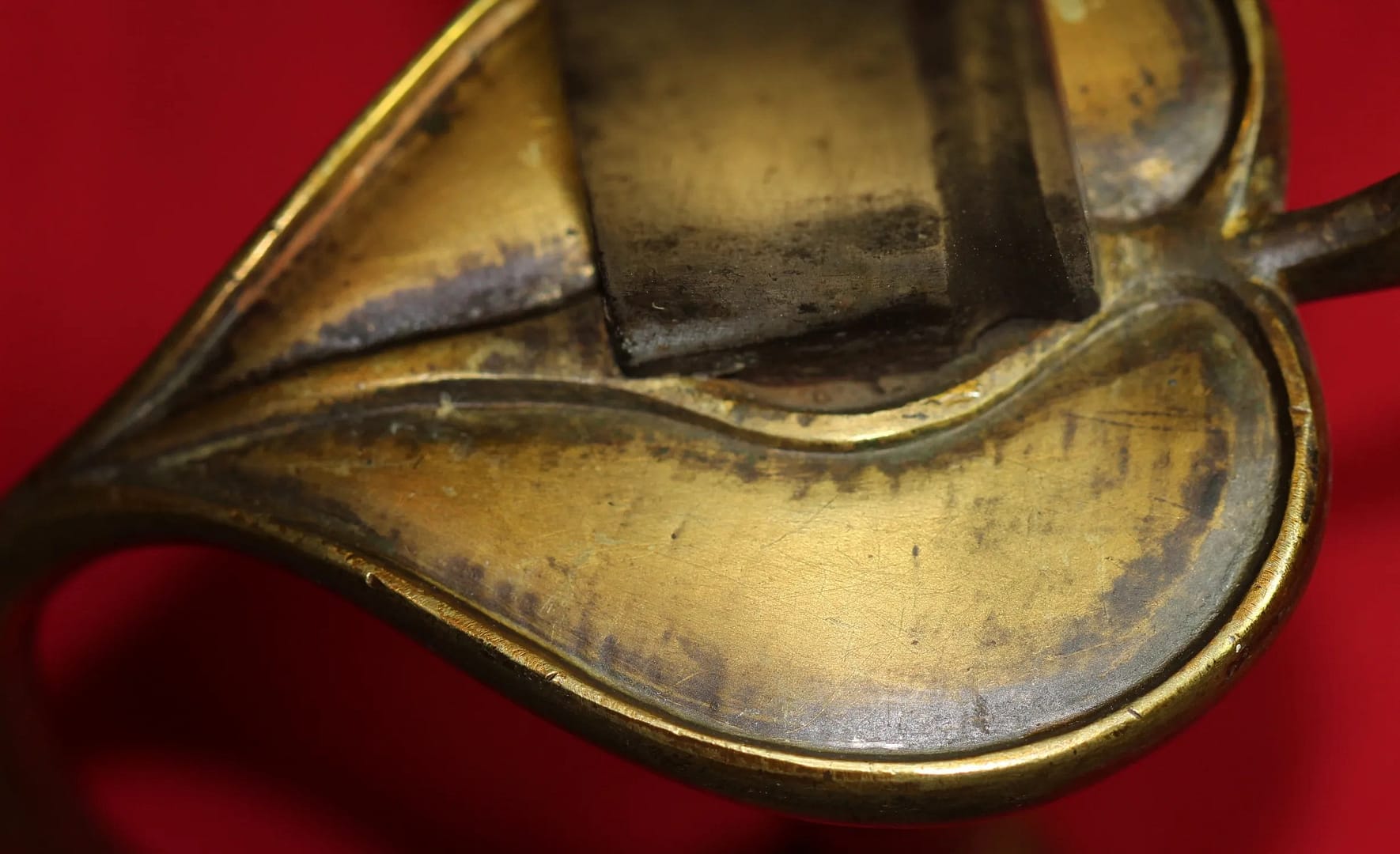
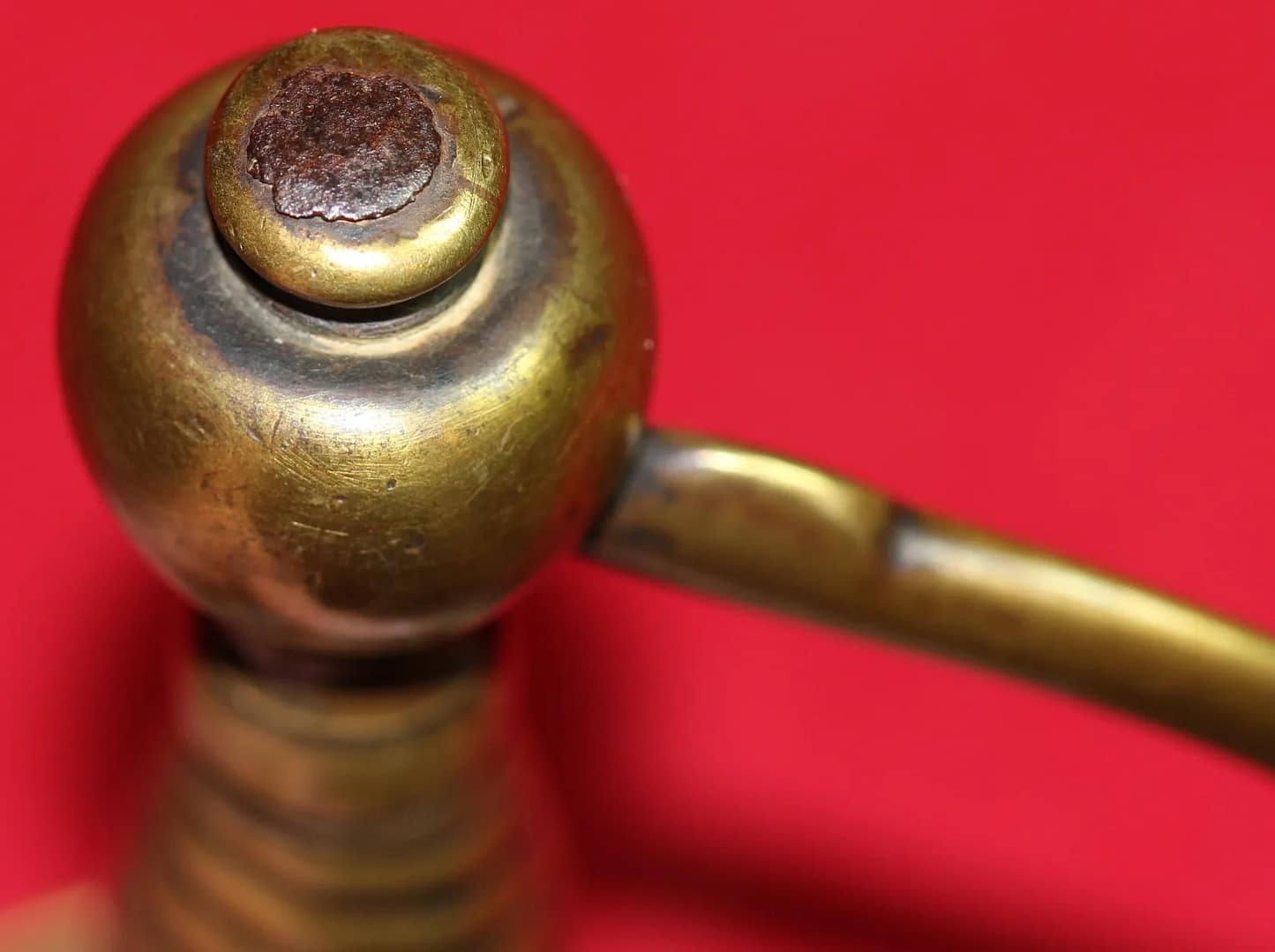
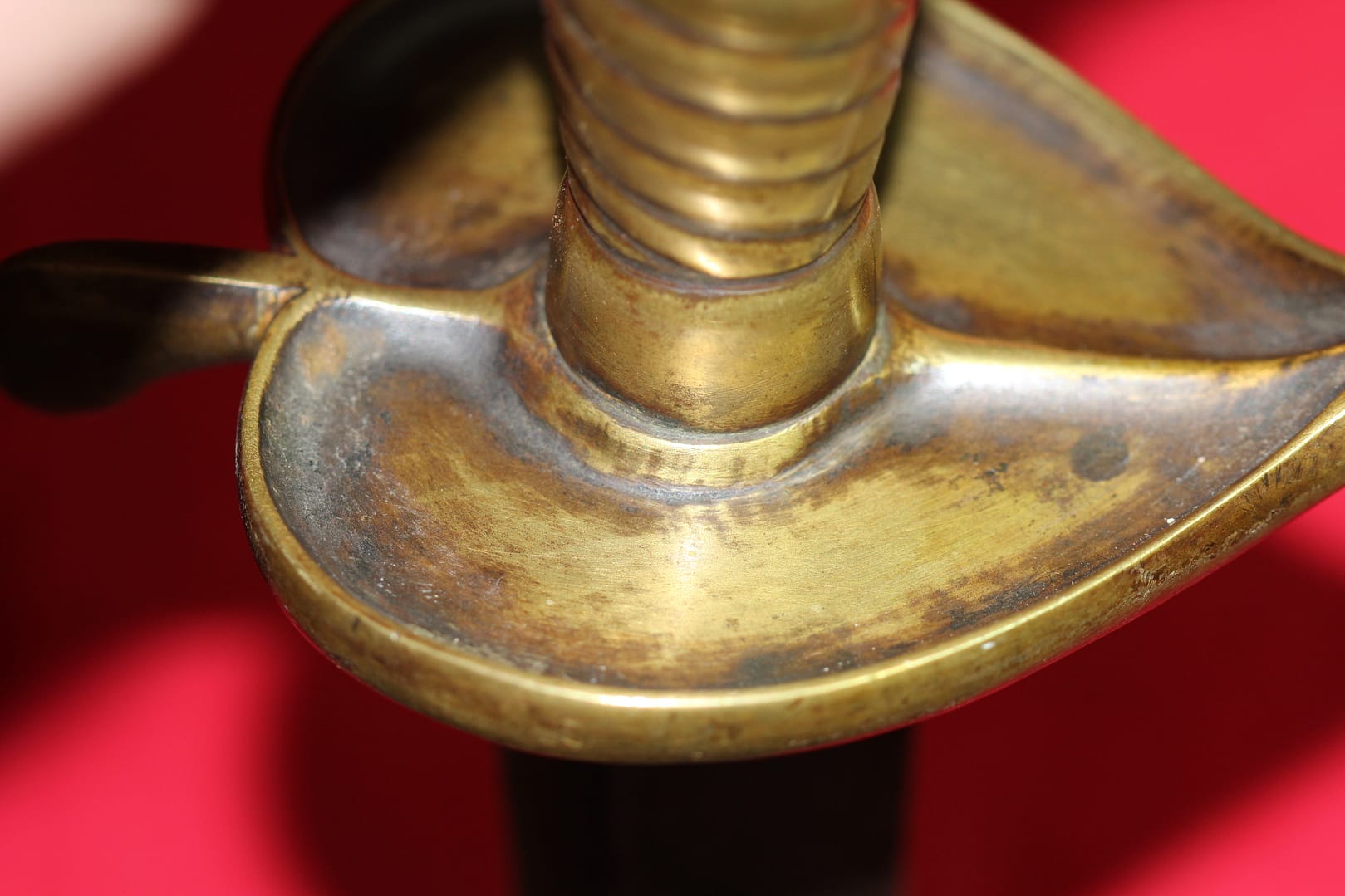
This basket-hilt broadsword, circa 1750, was typical of British heavy cavalry issued weapons before the introduction of more standardised 1780s patterns. Featuring a broad, straight blade optimised for powerful cutting blows, it was paired with an iron basket hilt providing substantial hand protection. Carried by dragoon and horse regiments, the sword reflects mid-18th-century British cavalry doctrine which emphasised close-quarter shock action. Its form continues the long tradition of Scottish and English basket-hilted military swords. Dish shaped hilt 3/4 basket with wide central knucklebow and three curved branches. Ovoid pommel. Described in George Neumann Swords and Blades 253.S English Horseman Sabre circa 1750. 32 inch blade. 38 inch overall. Grip covered in fishskin and brass twist wire. From my personal collection.
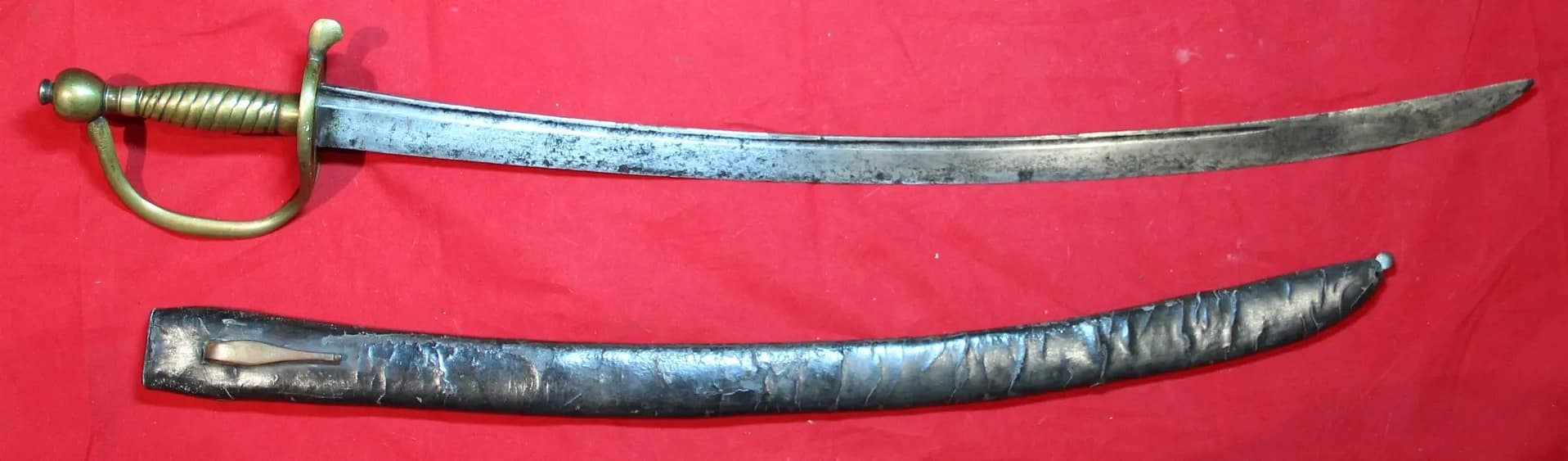
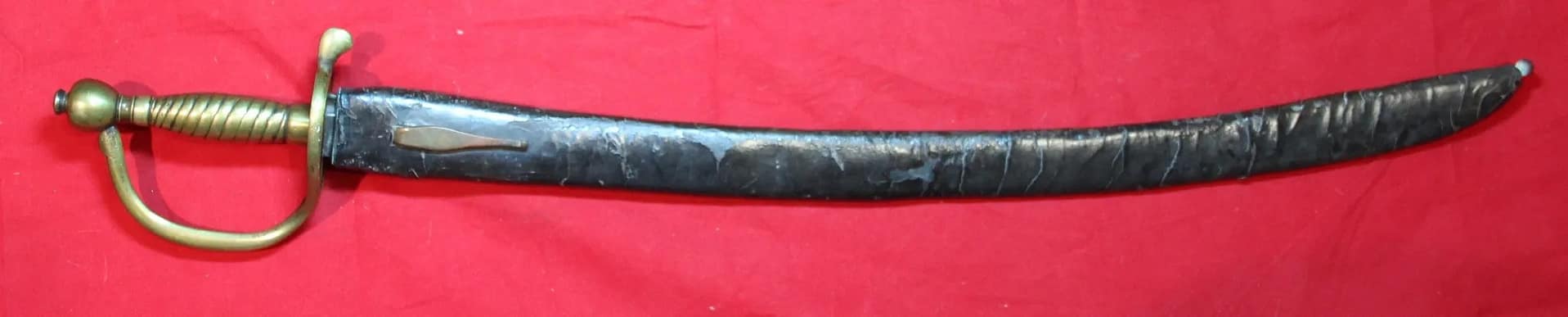
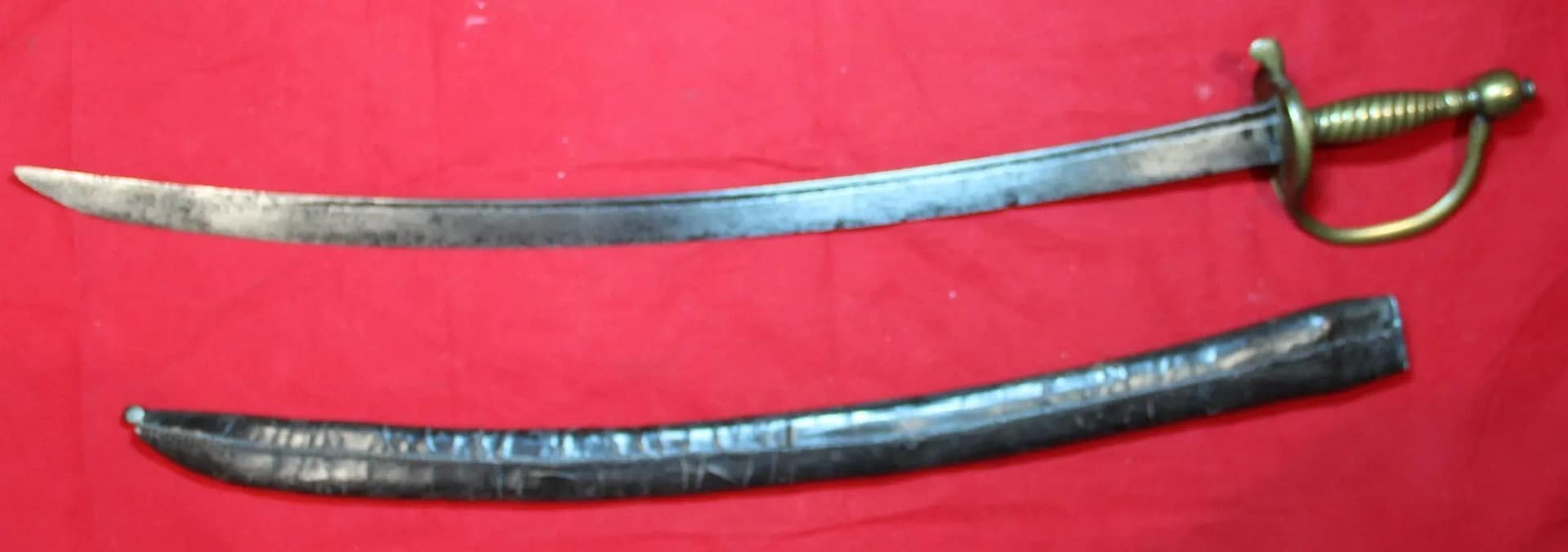
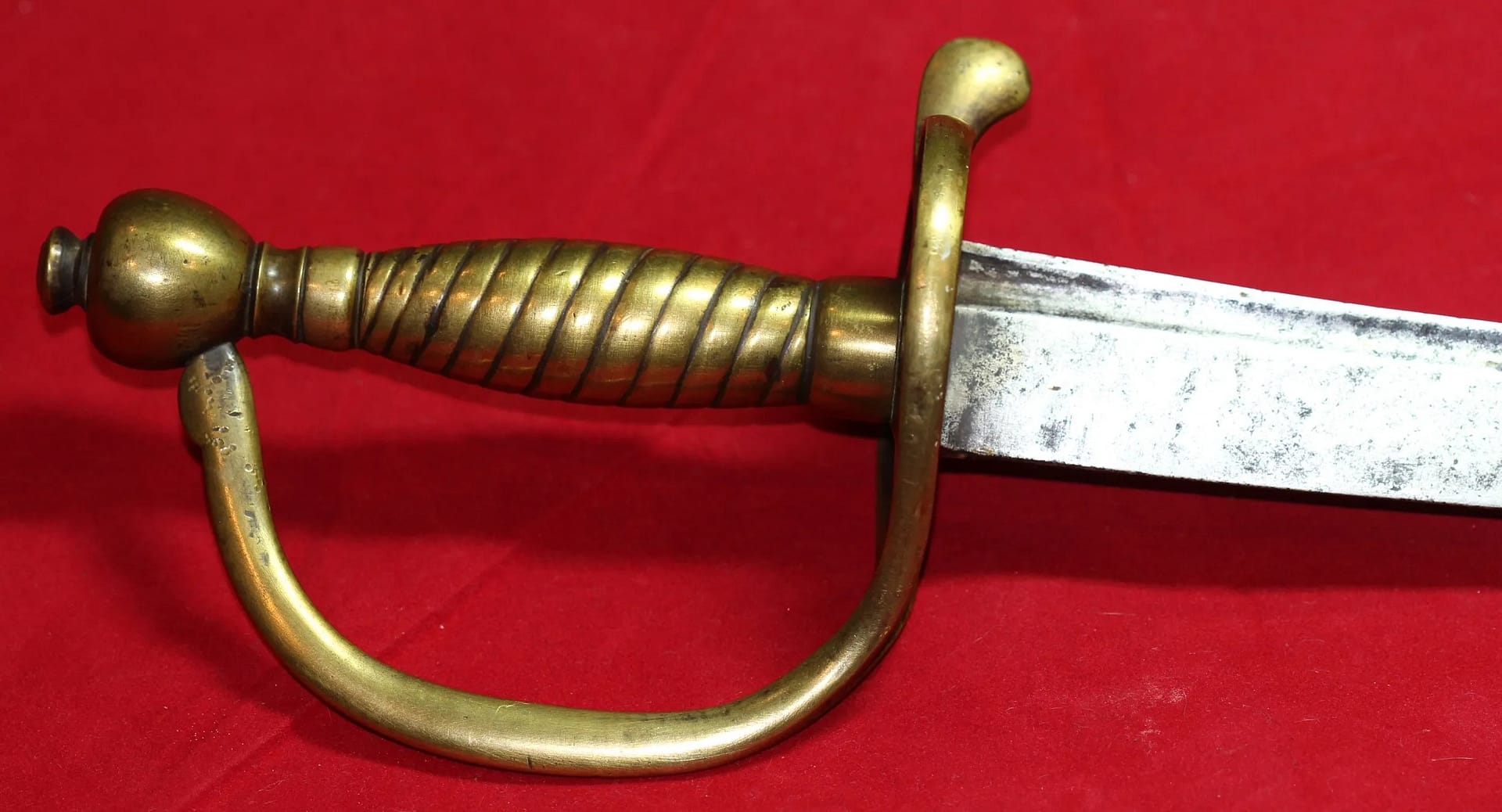
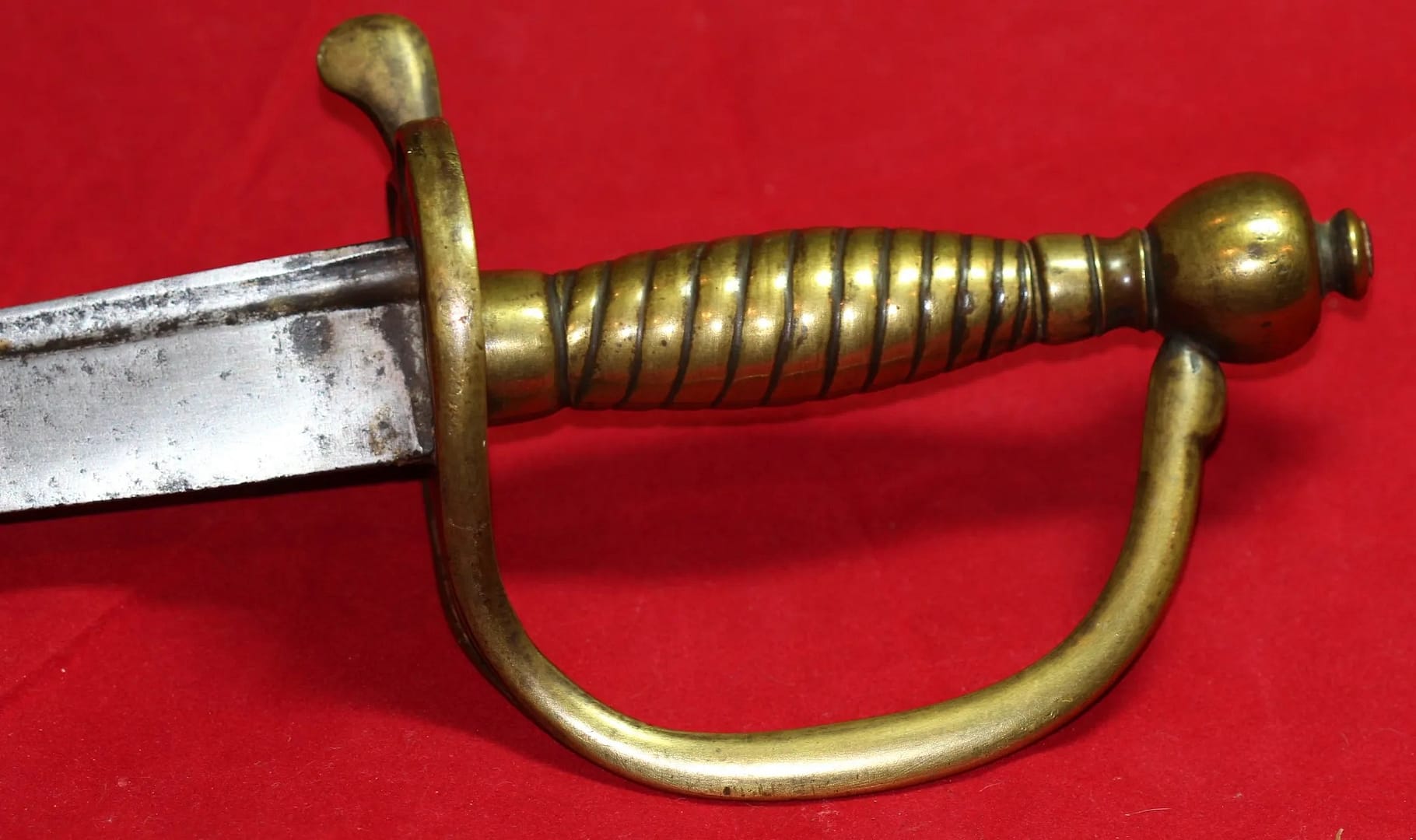
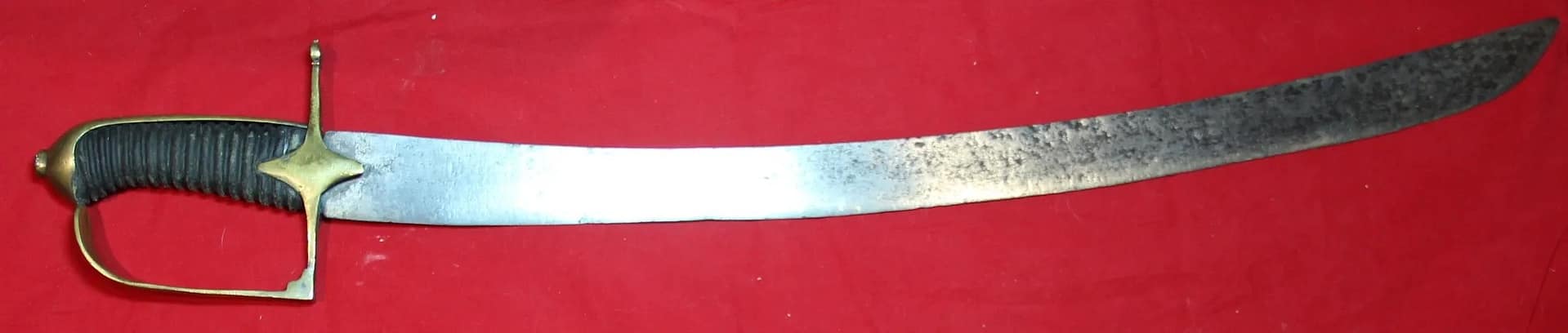
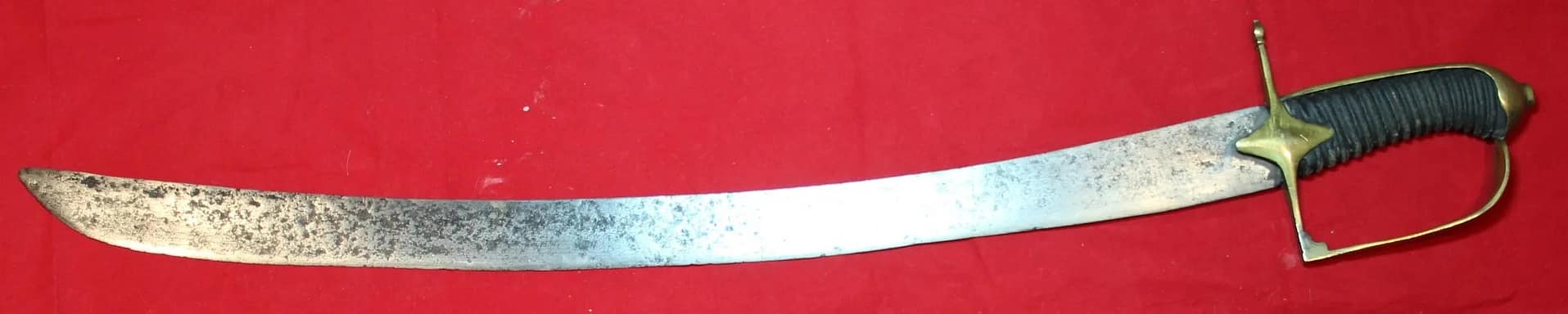
English Pattern 1742 Infantry Hanger. From my personal collection.
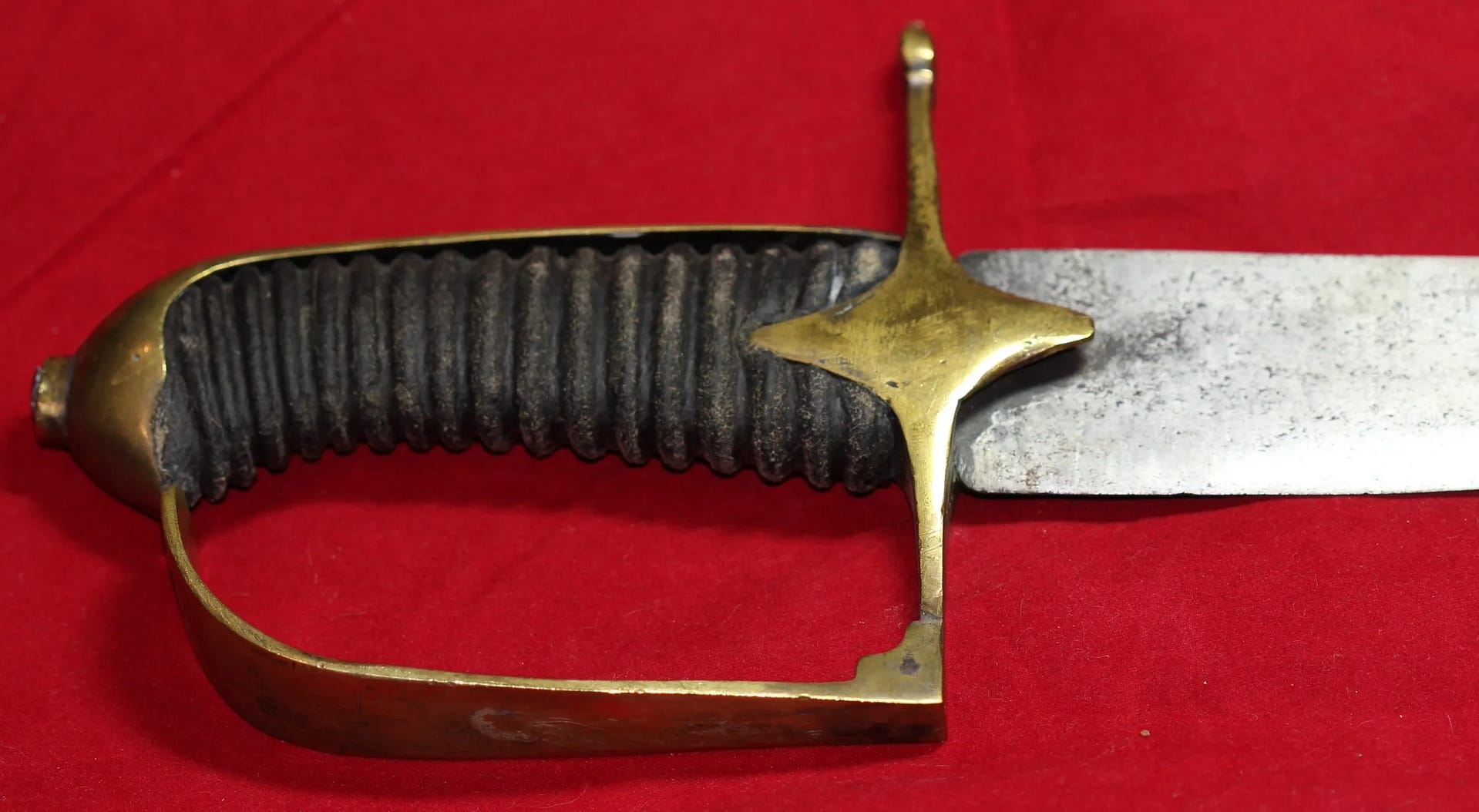
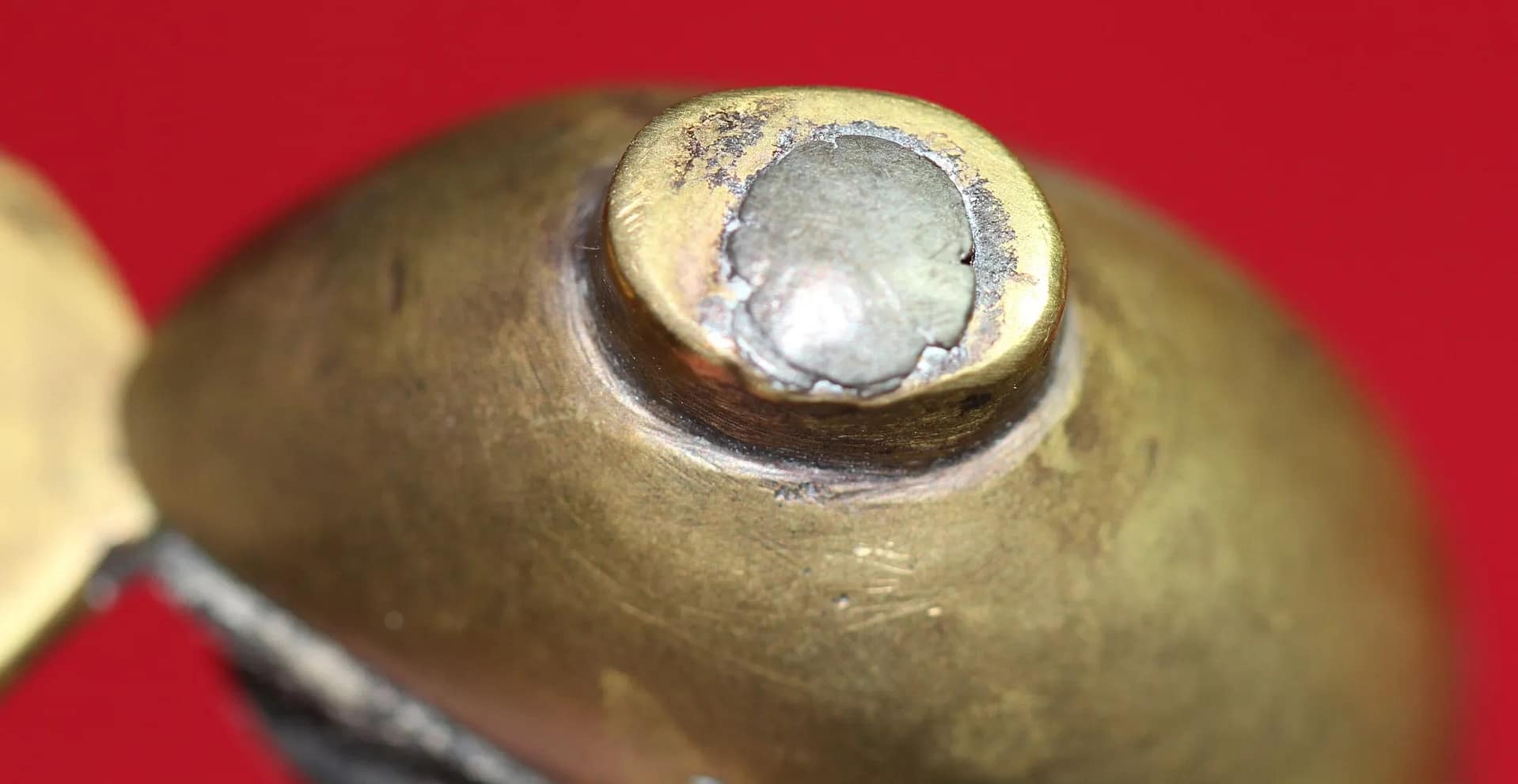
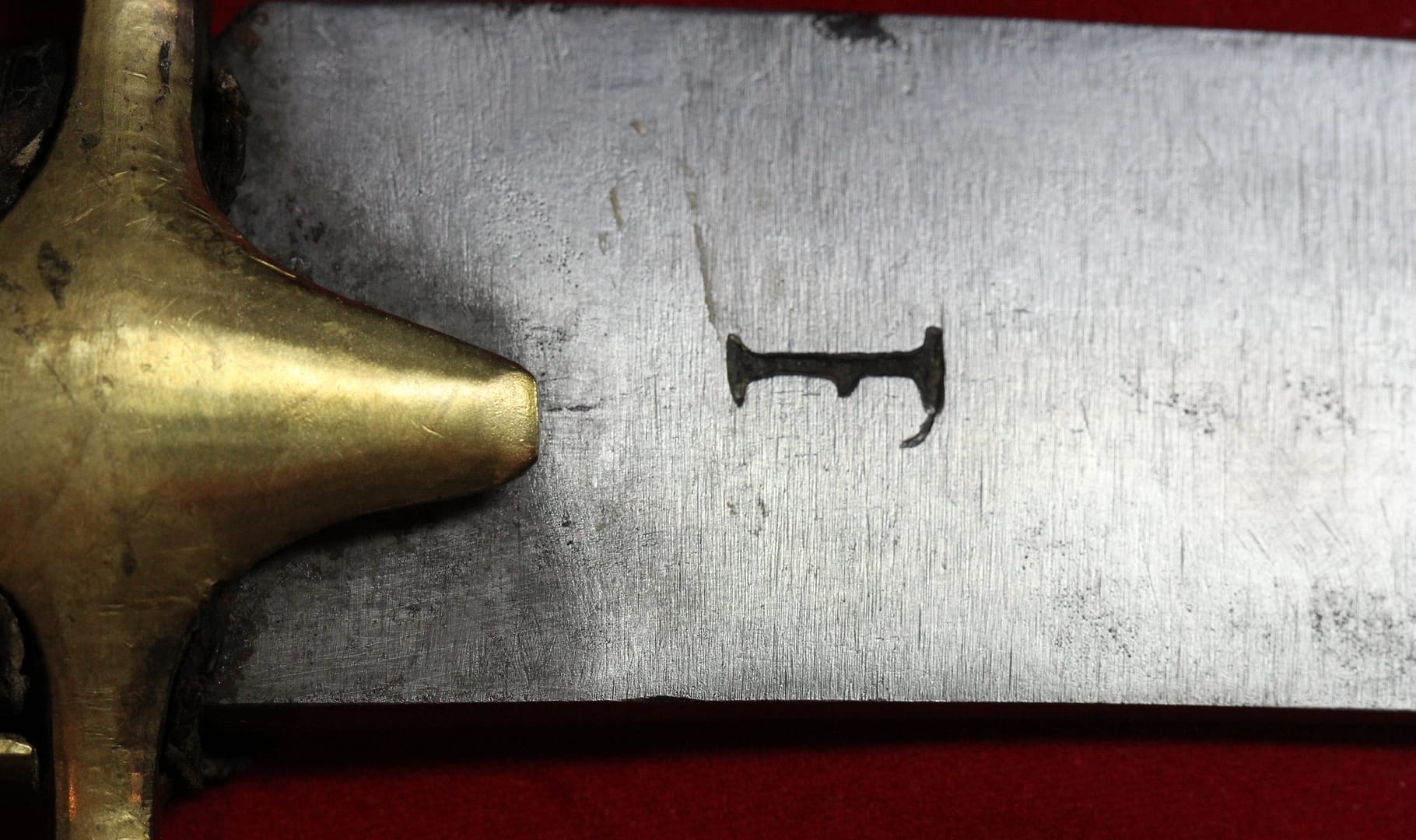
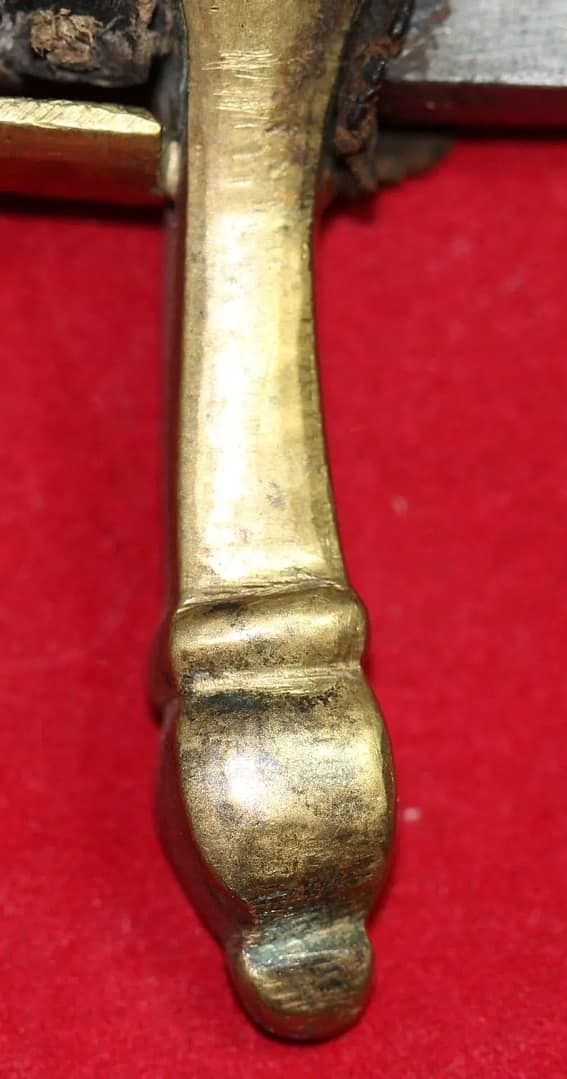
The Pattern 1742 infantry hanger was a short sabre issued to British grenadiers, sergeants, and some line infantry during the mid-18th century. Featuring a curved blade, brass guard, and simple knucklebow, it served as a secondary close-combat weapon complementing the musket and bayonet. Although increasingly superseded by bayonet fighting, hangers remained in service through the Seven Years War. The Pattern 1742 is one of the last widely issued infantry swords in British service.
🧭 From Weapons to Battlefield Use
This page shows weapons and equipment of the Seven Years War. All items are from my personal collection.
But what images and data don’t show is how these weapons were actually used on the ground—how weapon characteristics, tactics, innovation, terrain, and movement shaped their effectiveness in battle.
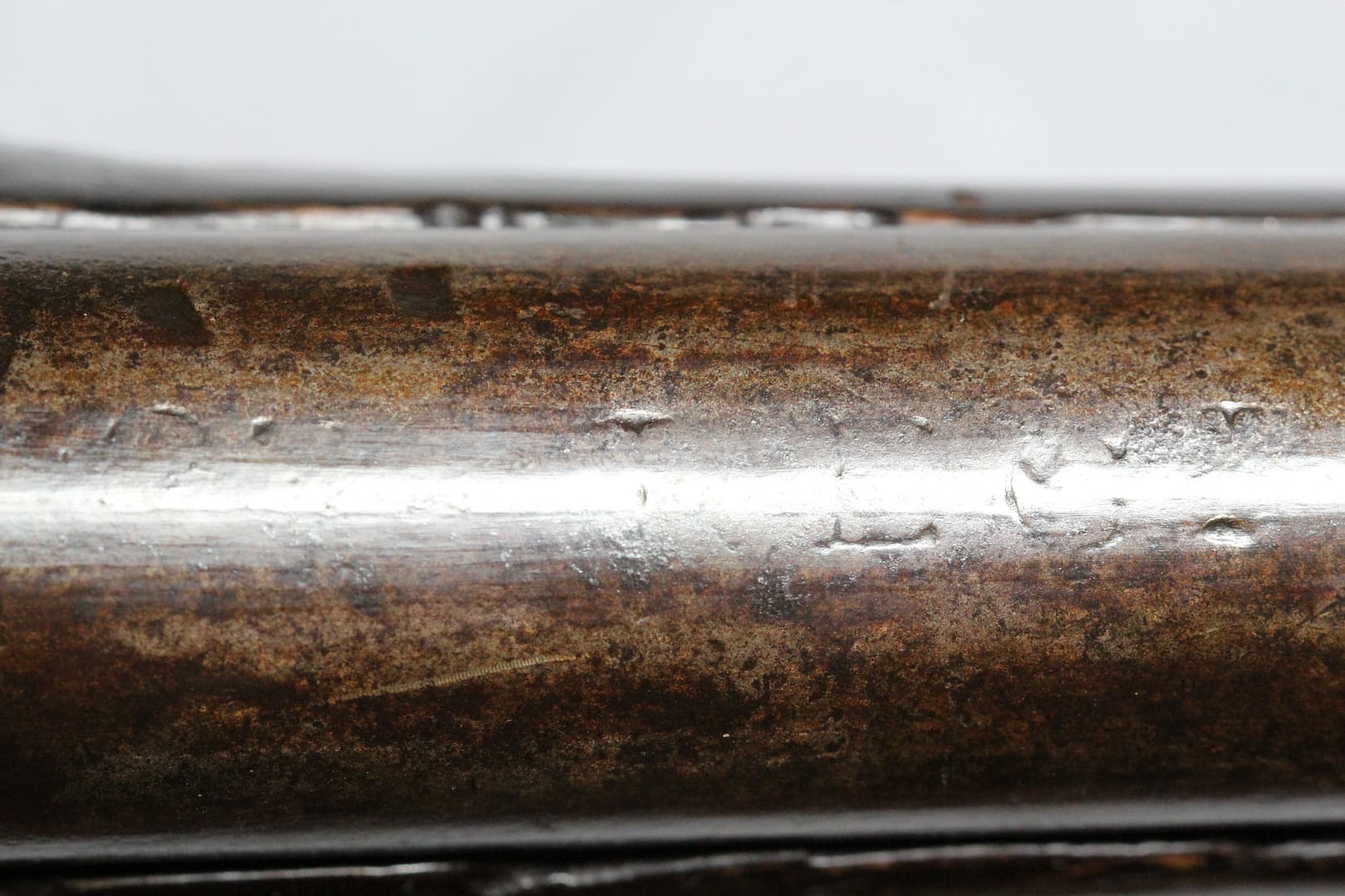
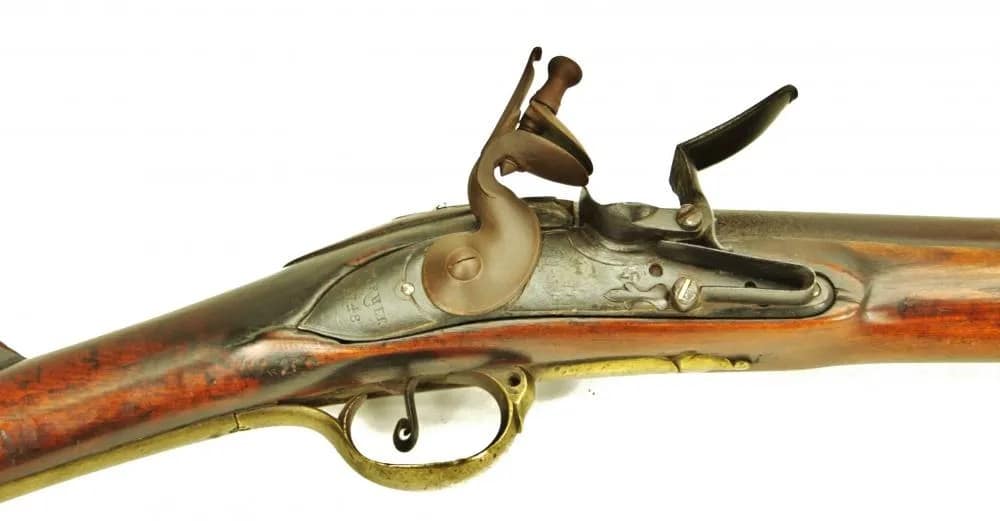
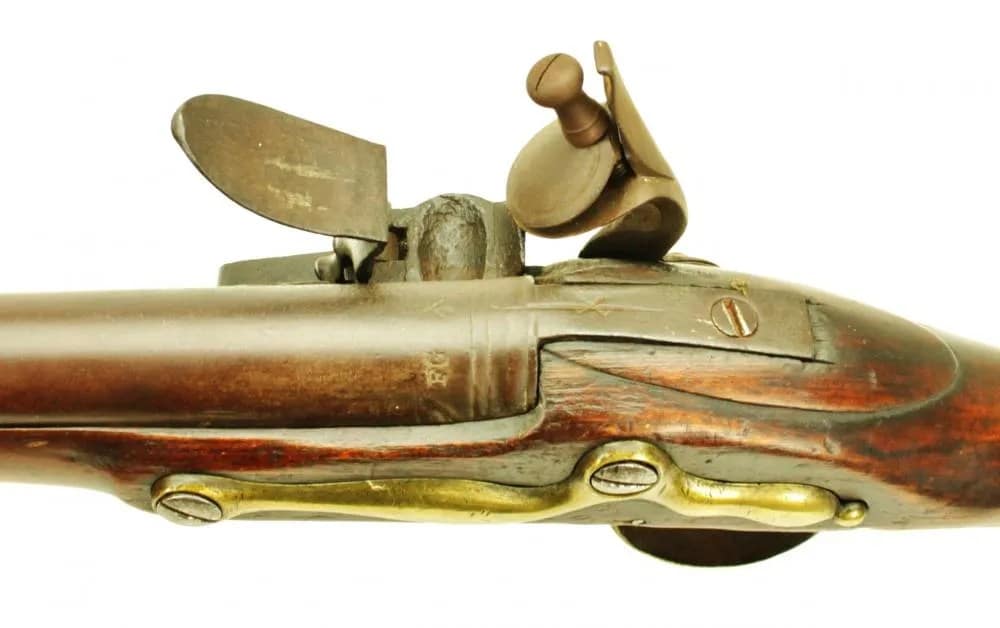
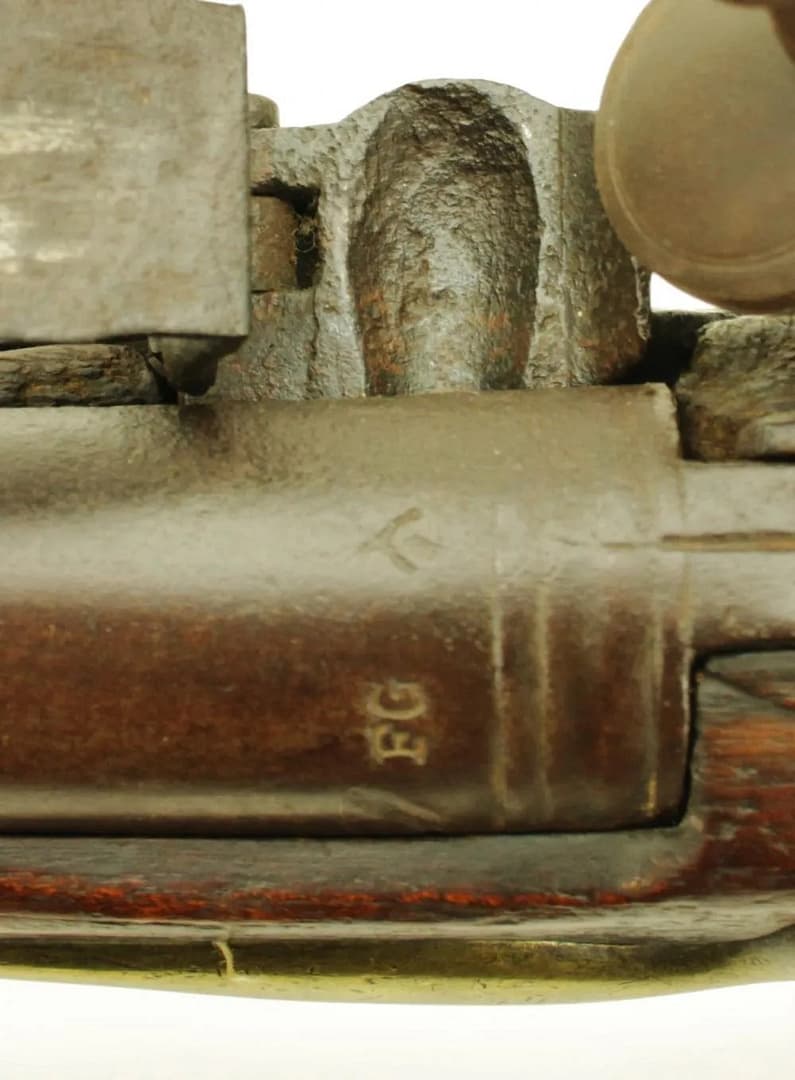
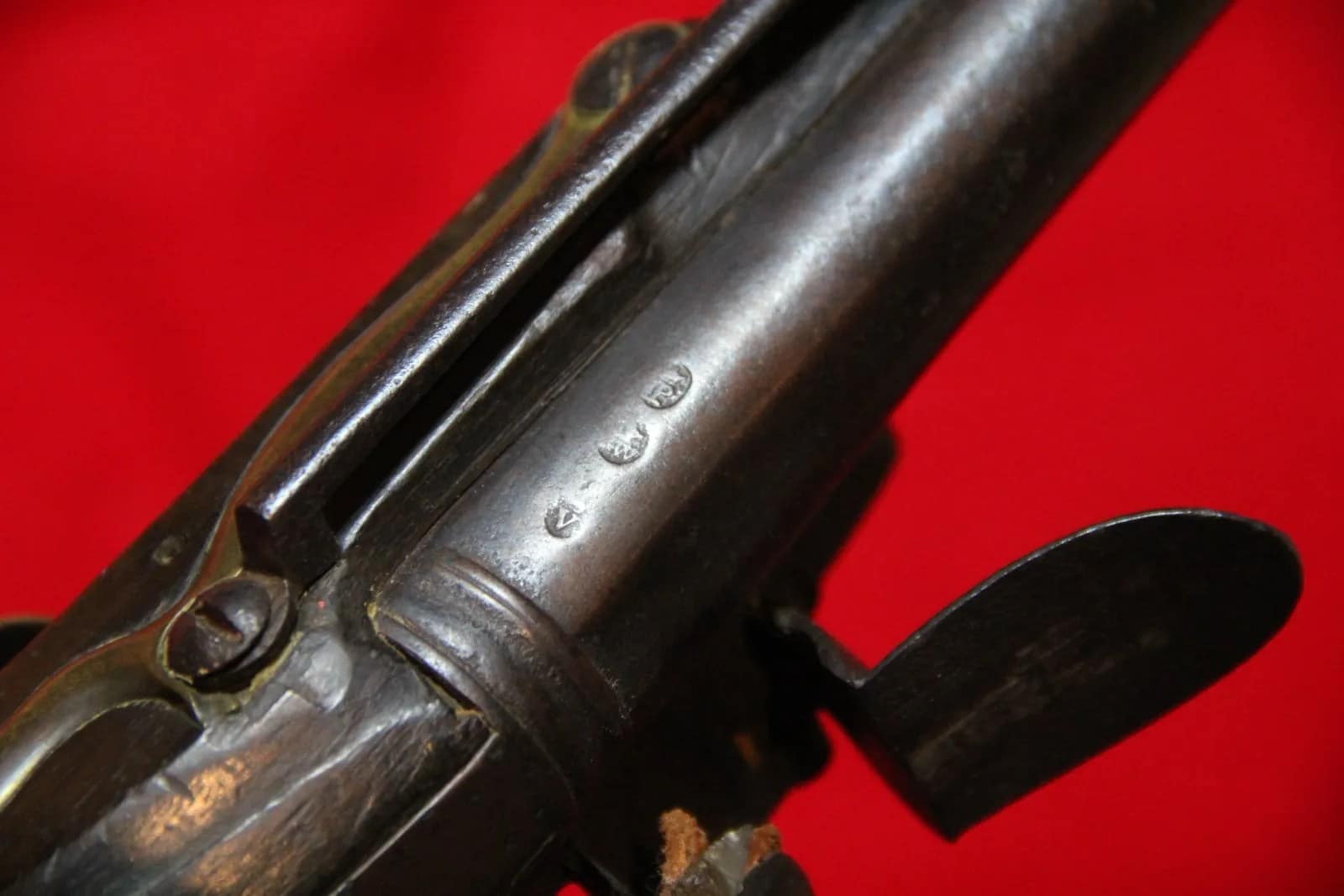
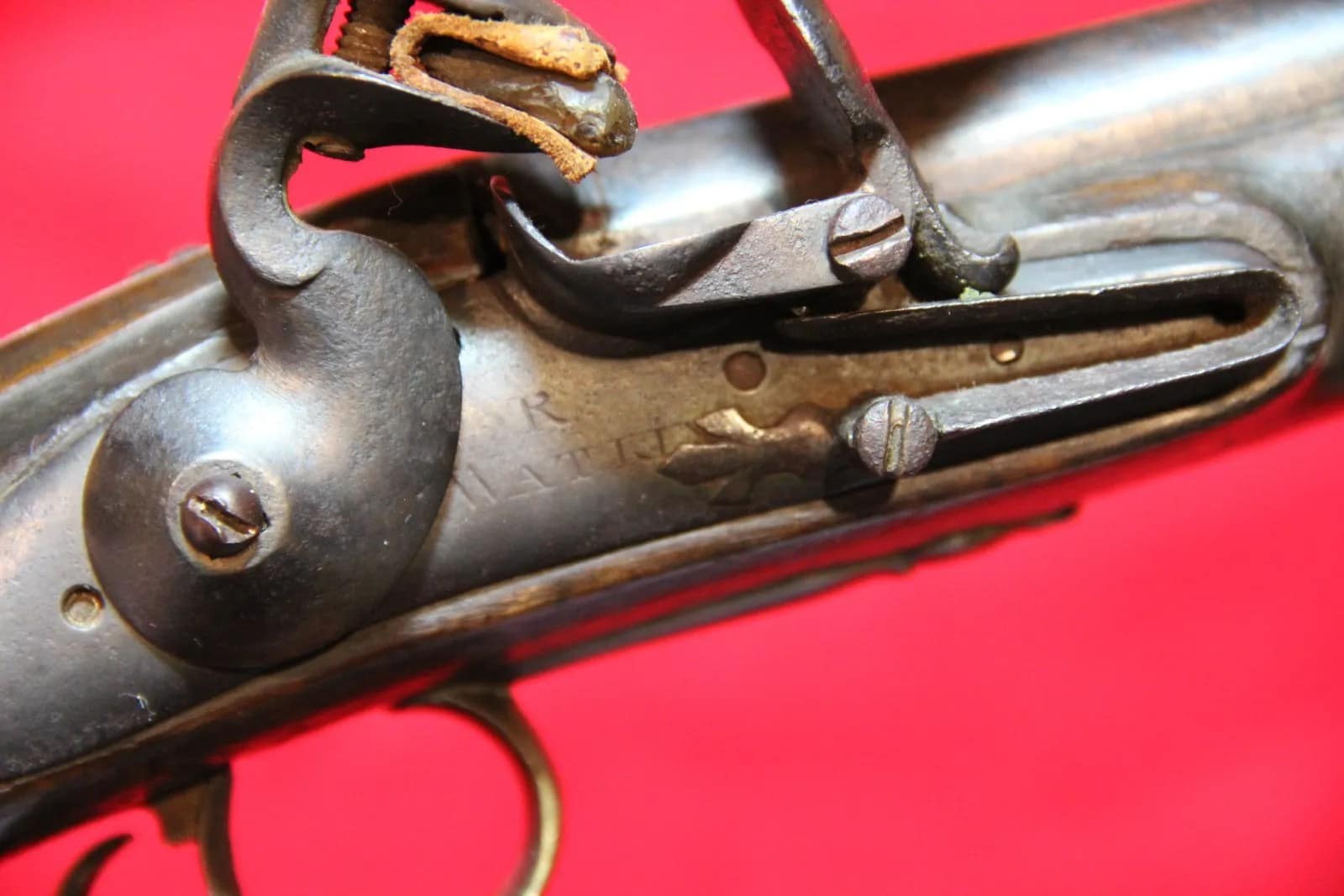
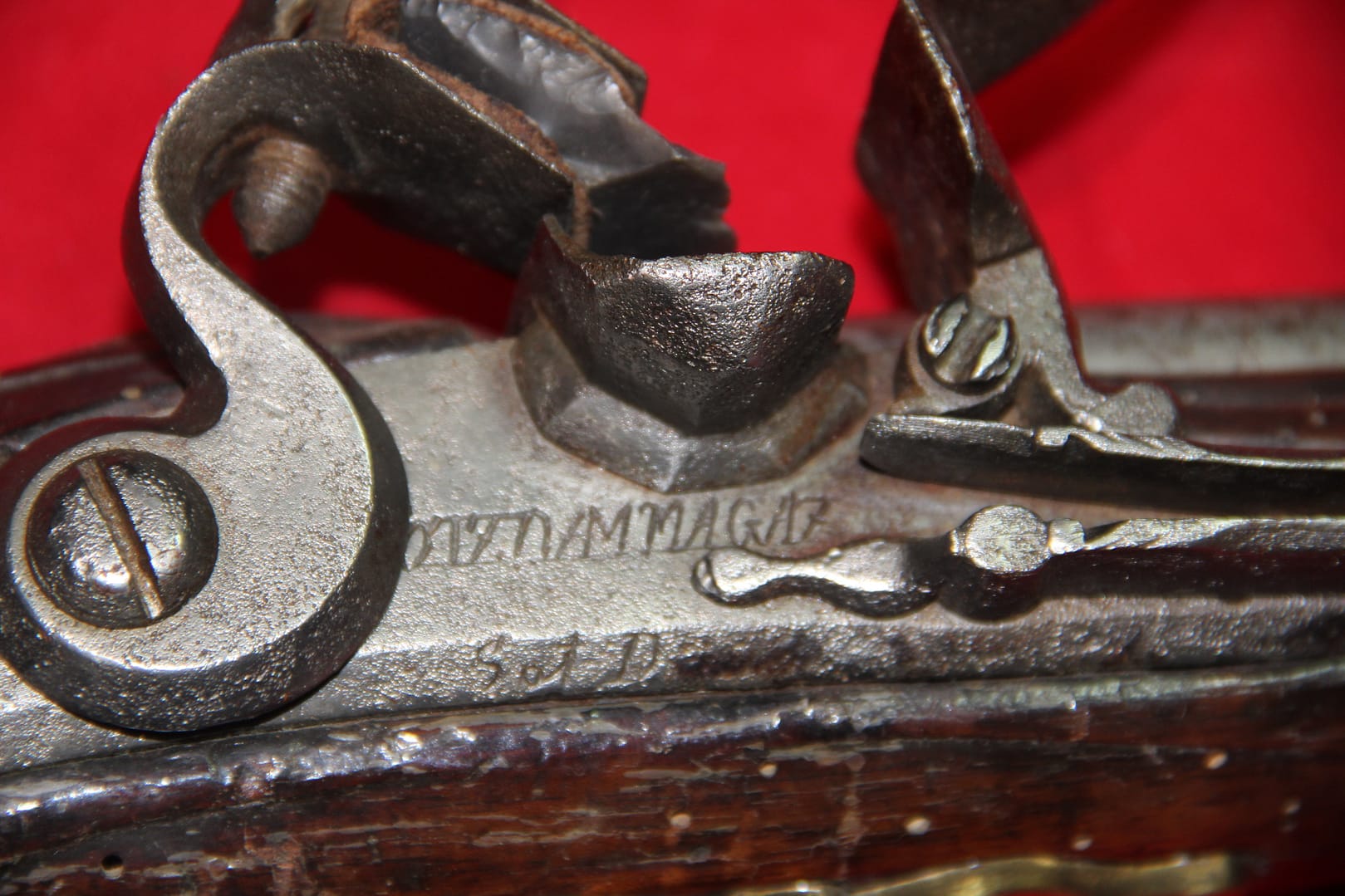
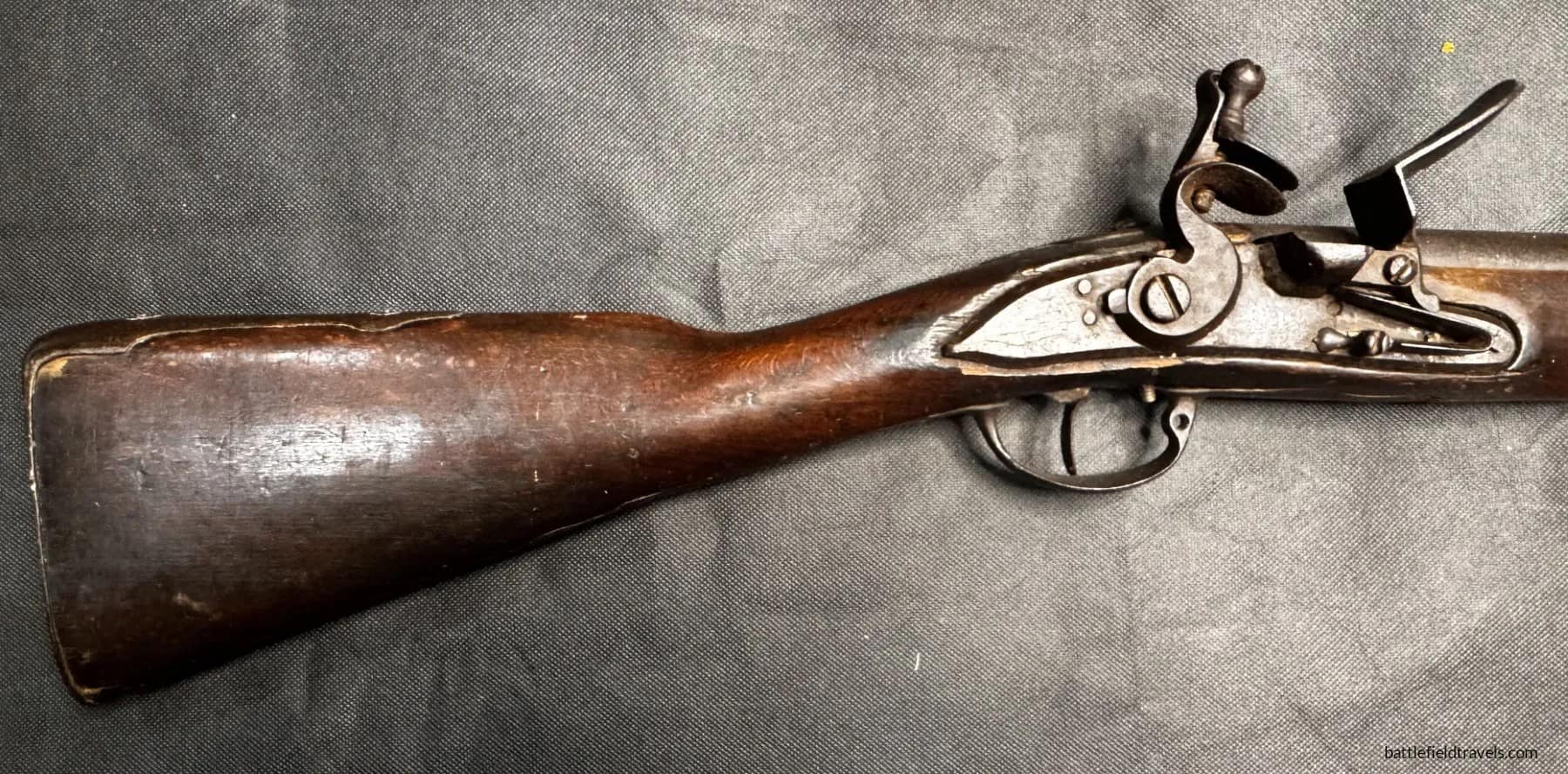
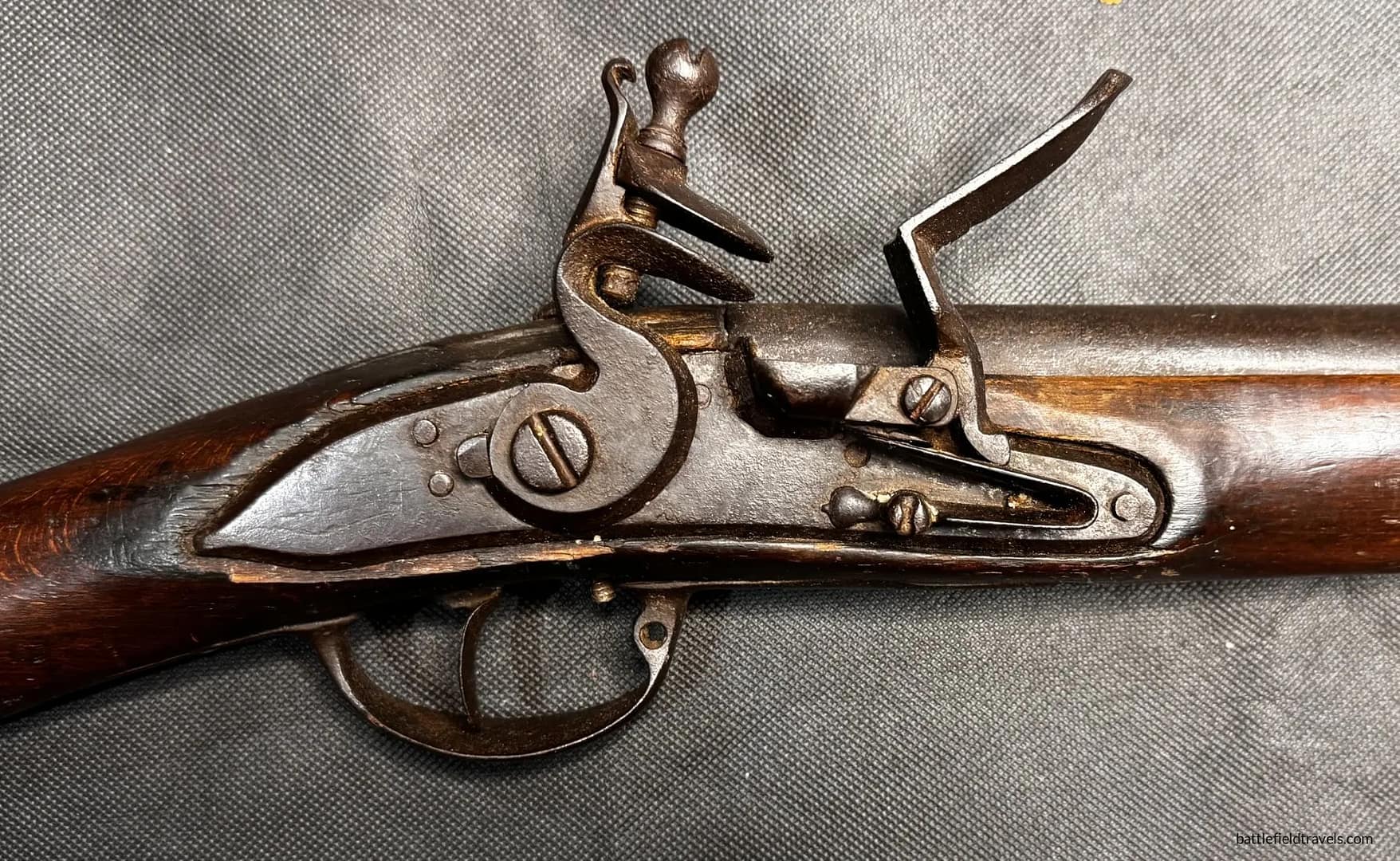
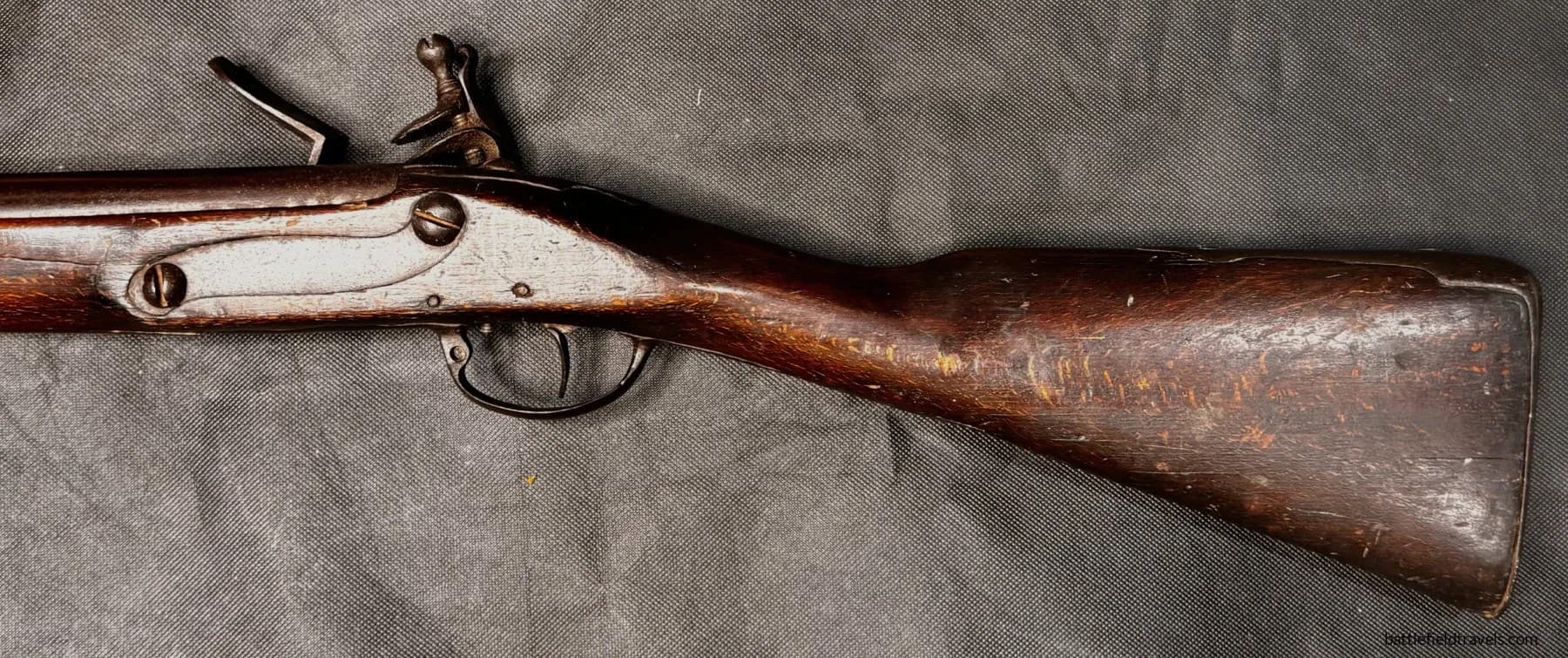
Prussian Model 1740 Musket, marked POTZDAM MAGAZ, inspected by S&D (initials of Splittgerber and Daum, the inspectors at the Royal Arsenal). From my personal collection.
The Prussian Model 1740 musket was a .72–.73 calibre flintlock produced at the Potsdam Arsenal, marked POTZDAM MAGAZ. The “S&D” inspection stamp denotes Splittgerber and Daum, the principal inspectors responsible for Frederick the Great’s early-war small-arms programme. Lighter and handier than earlier Prussian models, the 1740 musket equipped line infantry during the campaigns of the War of Austrian Succession and the early Seven Years’ War. Known for its robust lock and crisp trigger, it was the hallmark weapon of Frederick’s disciplined infantry battalions.
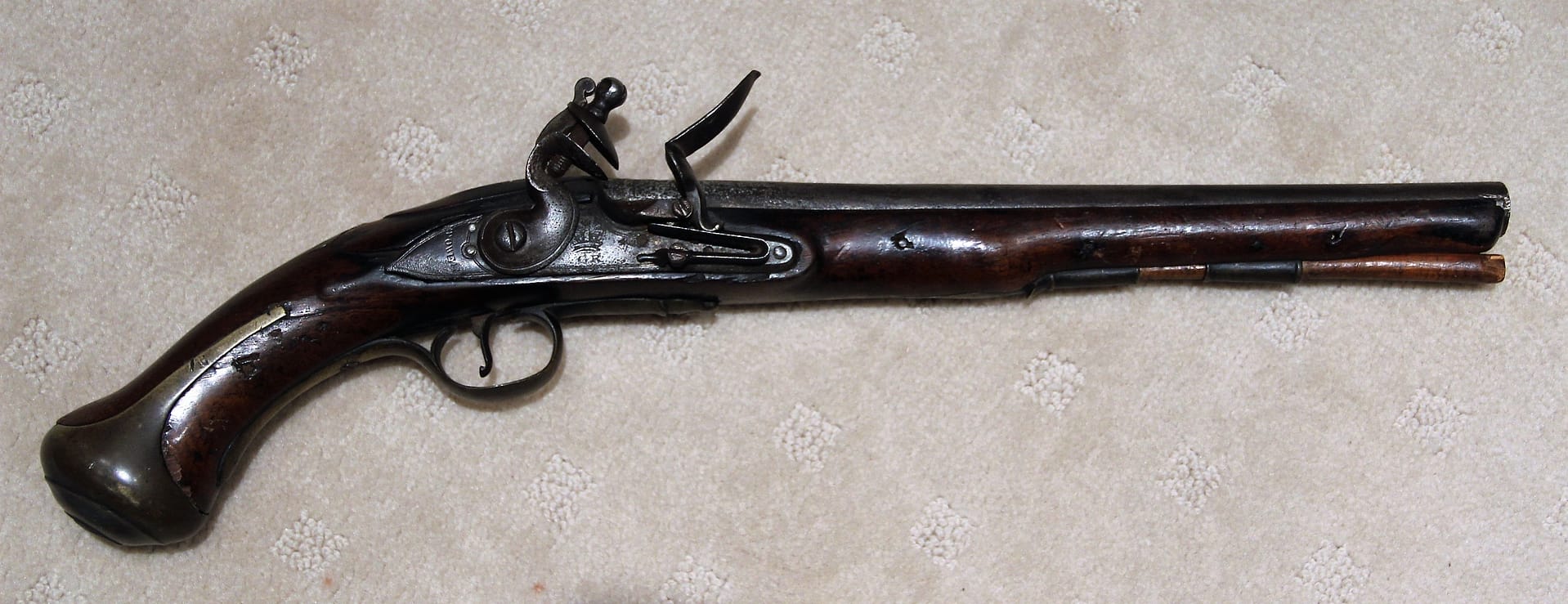
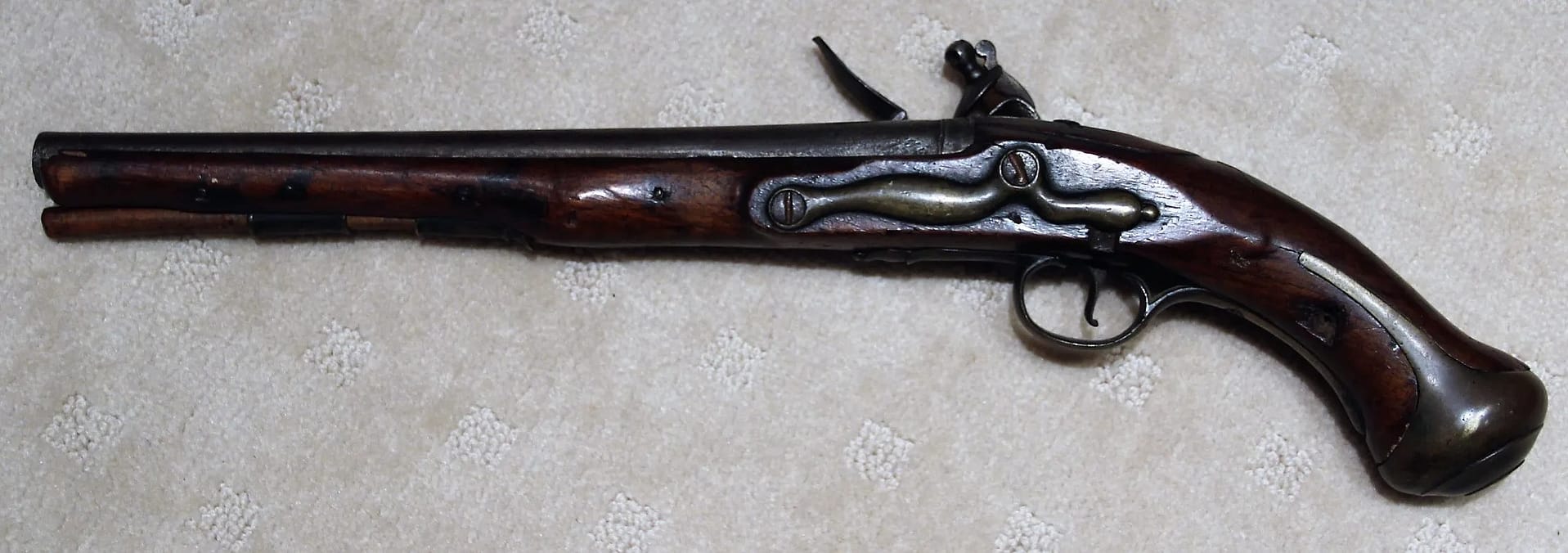
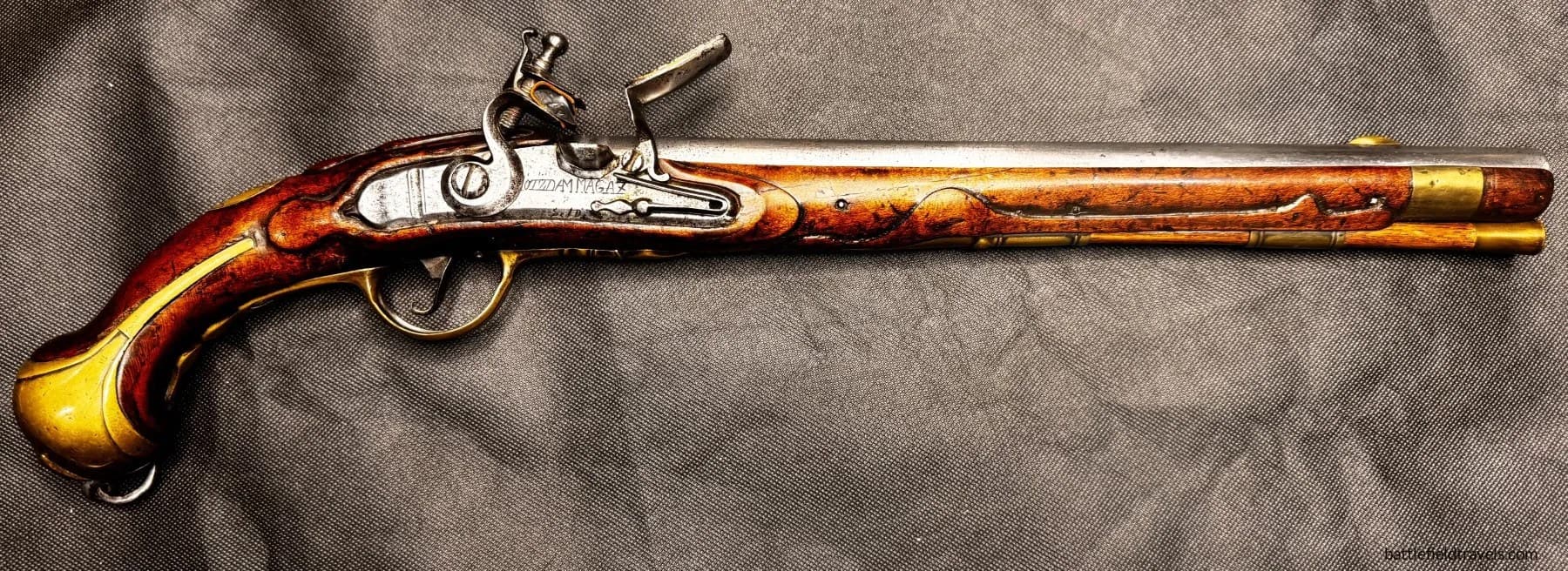
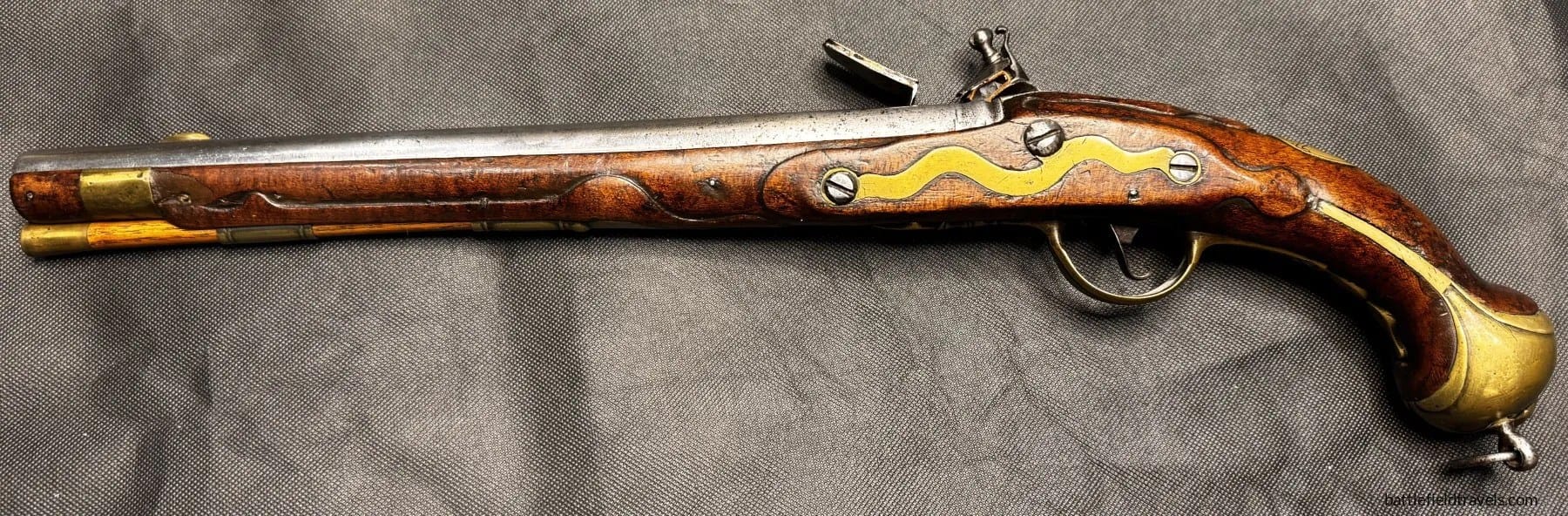
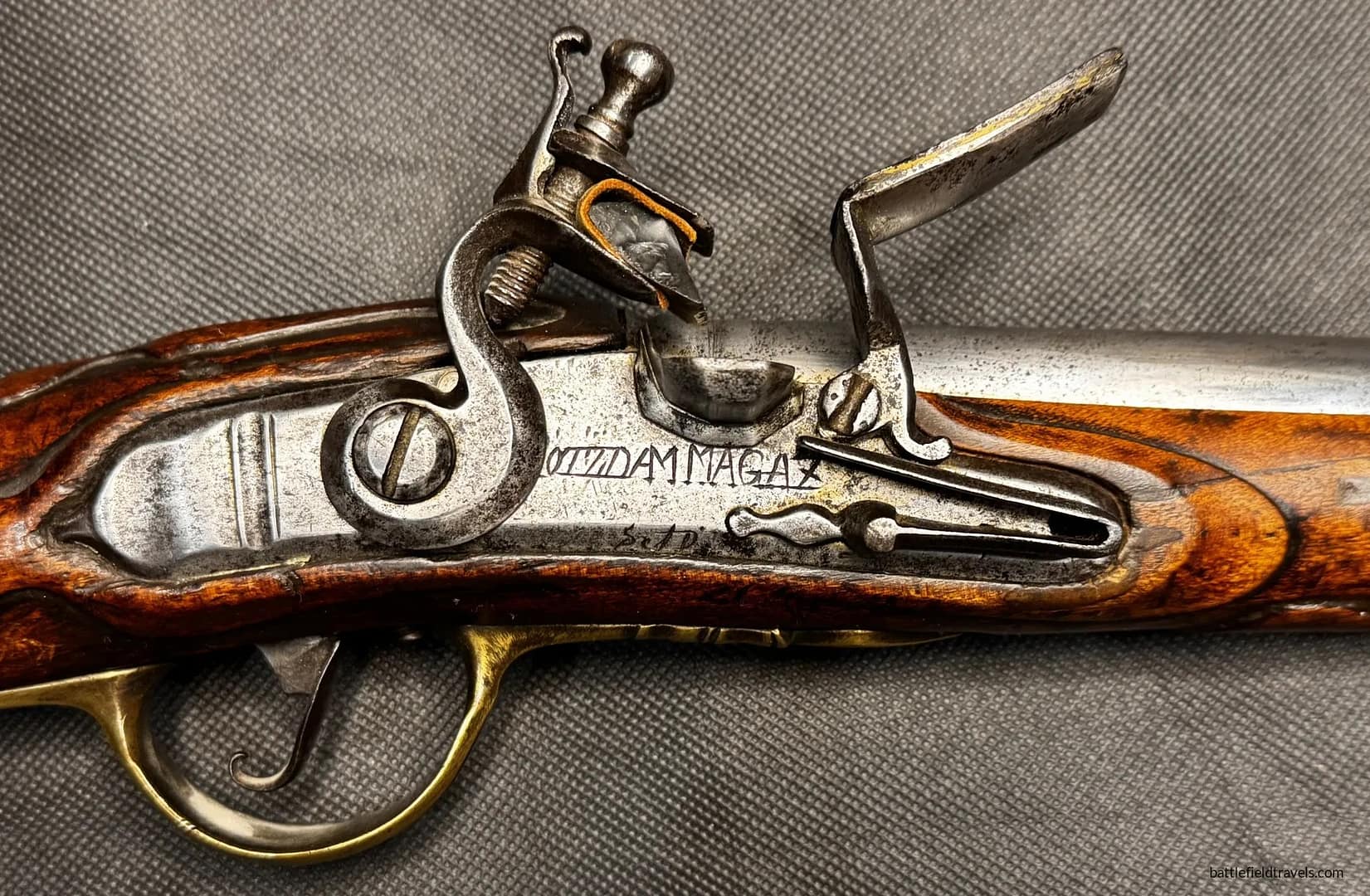
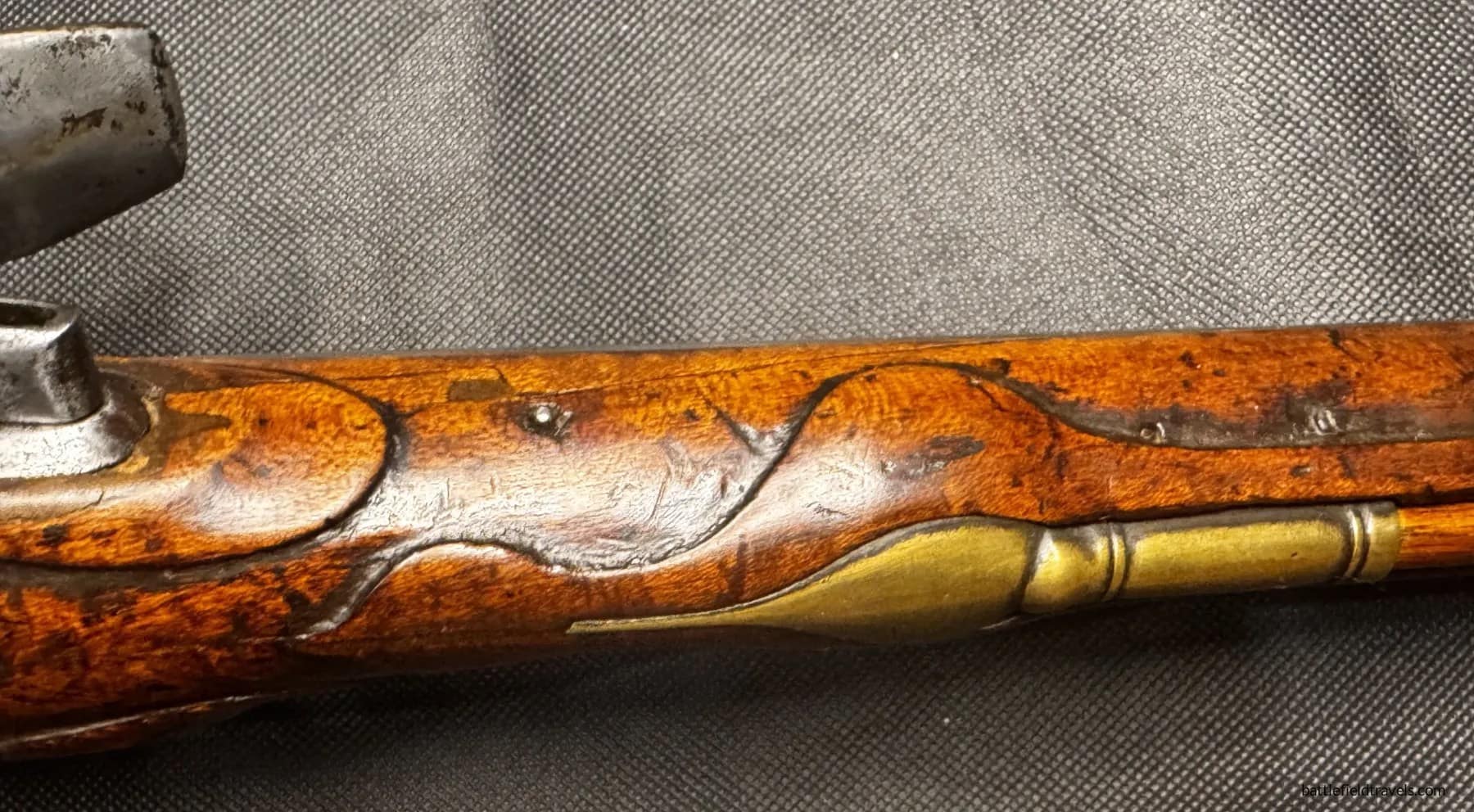
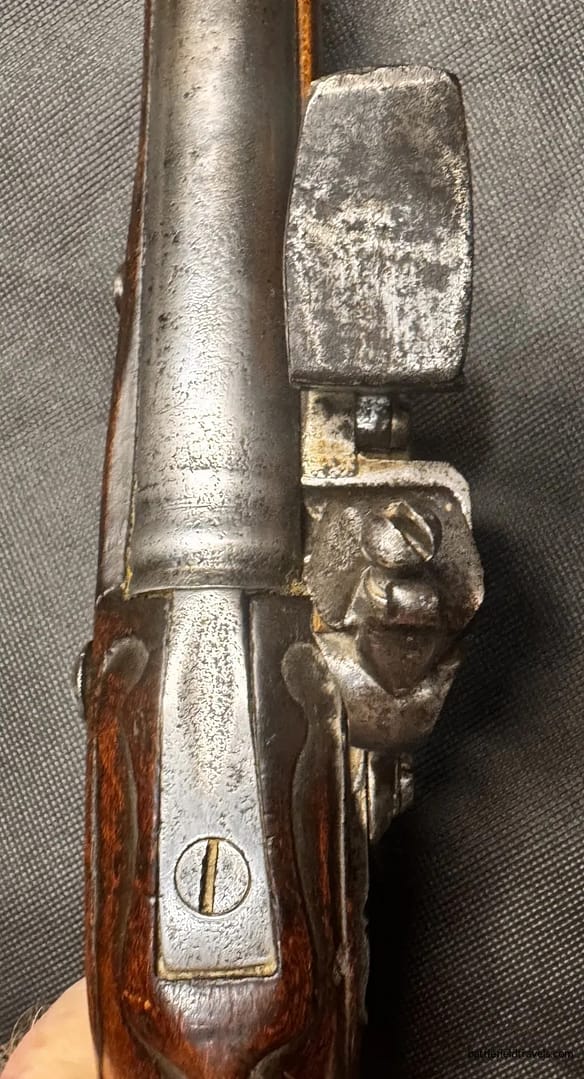
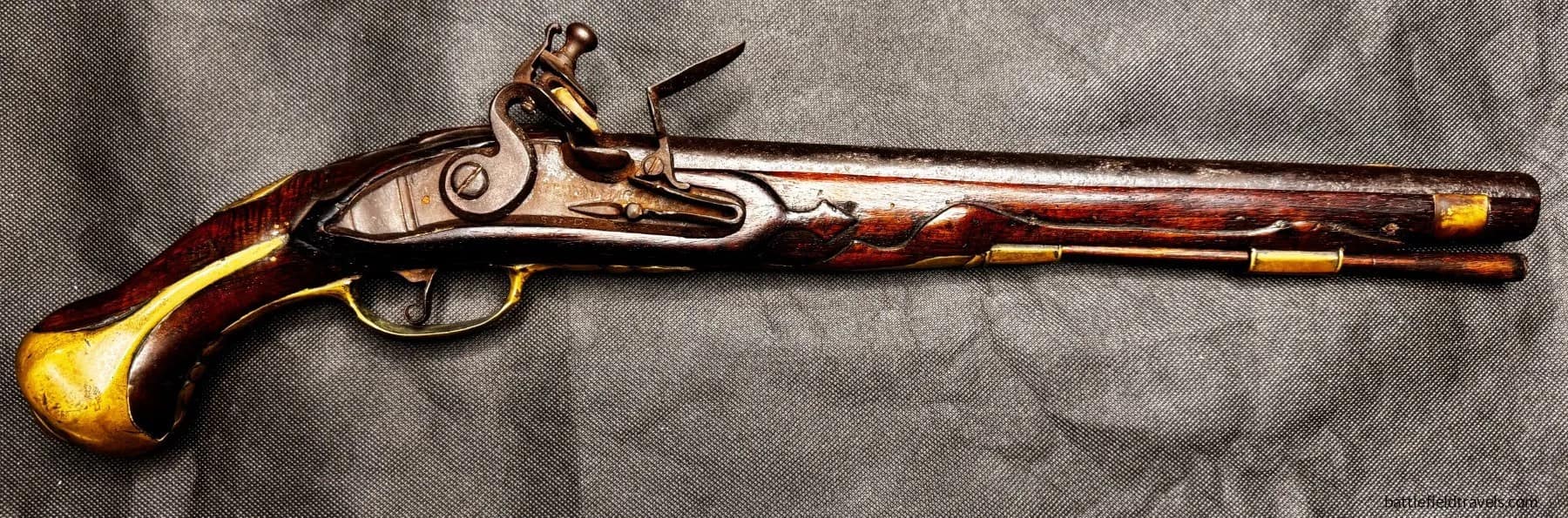
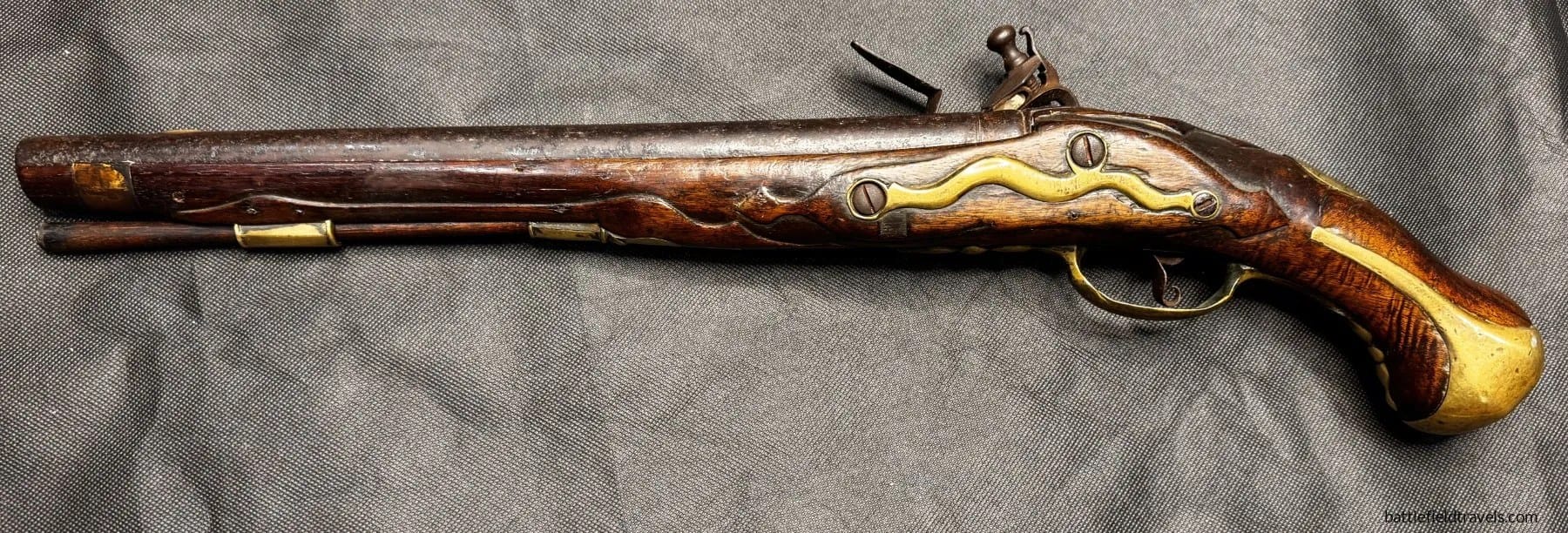
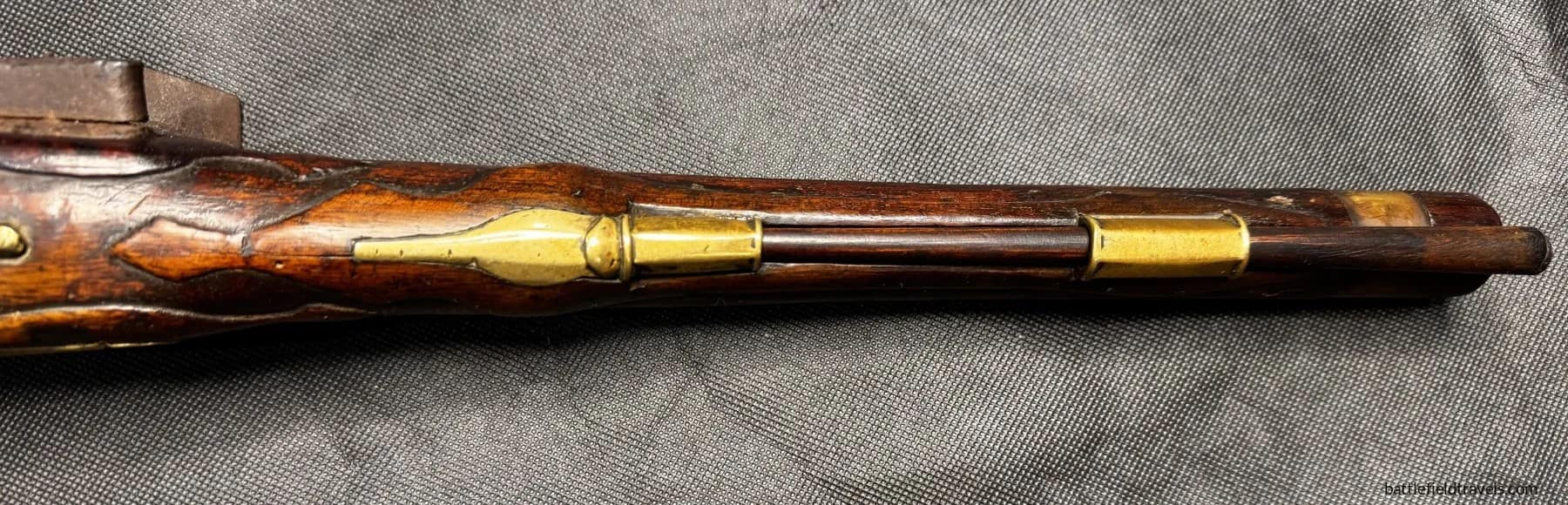
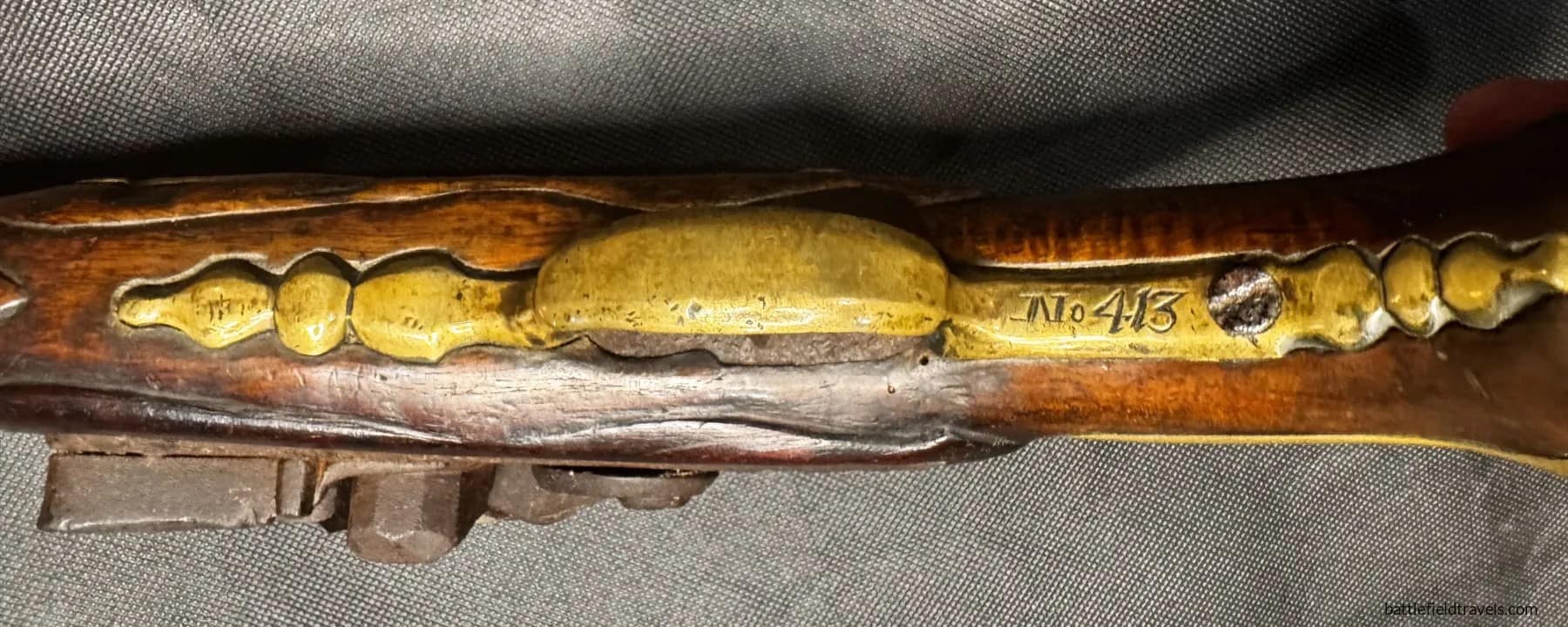
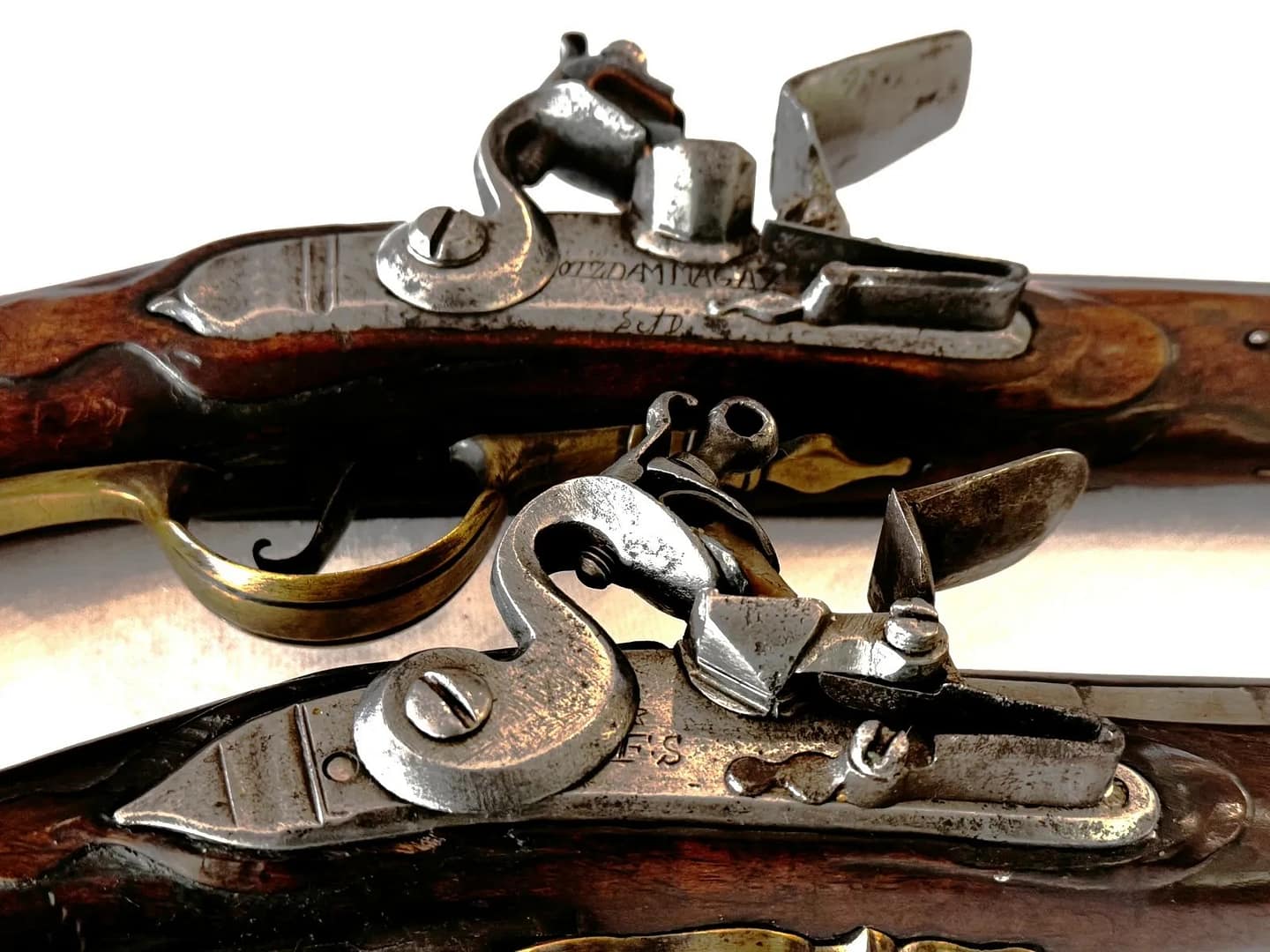
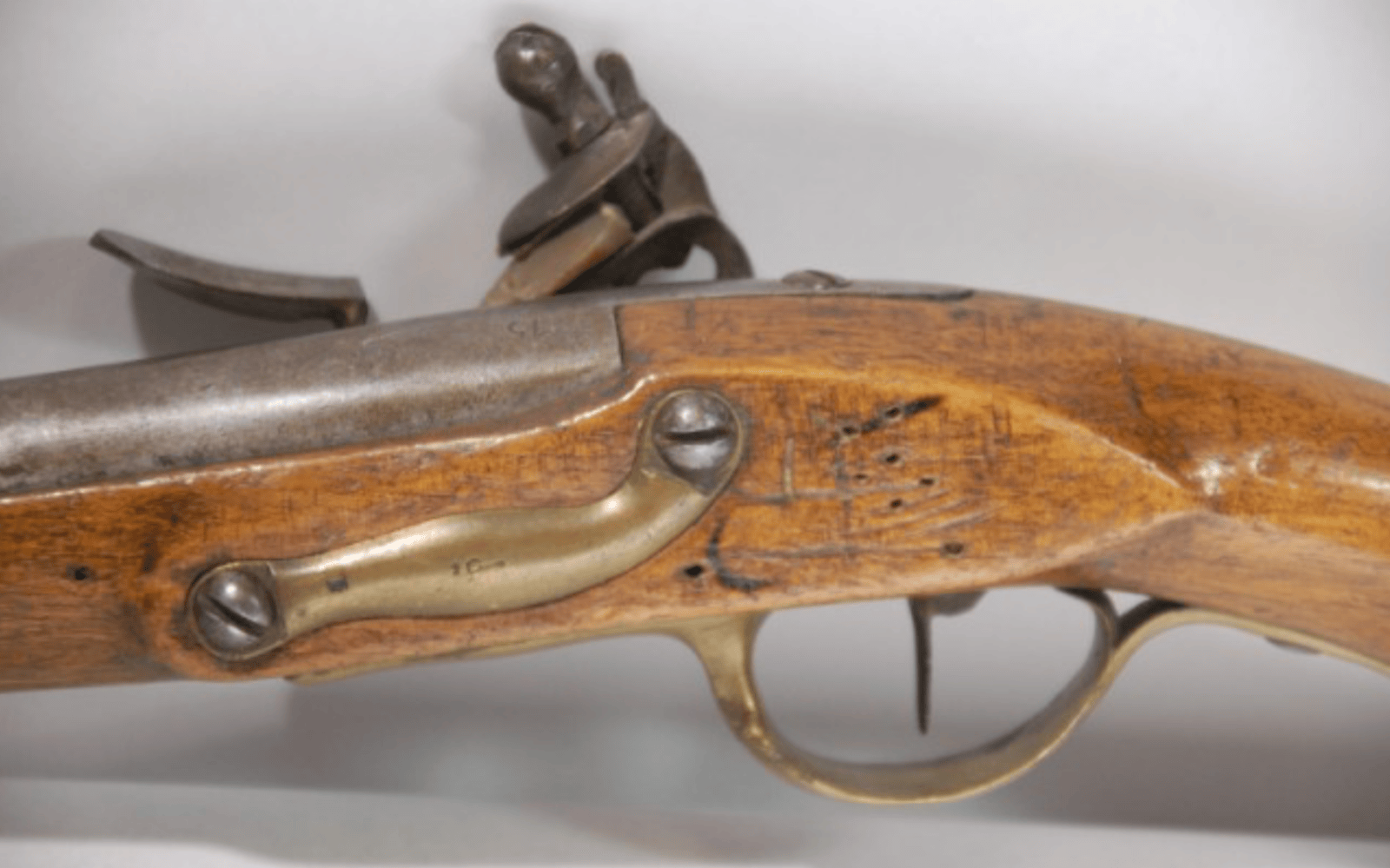
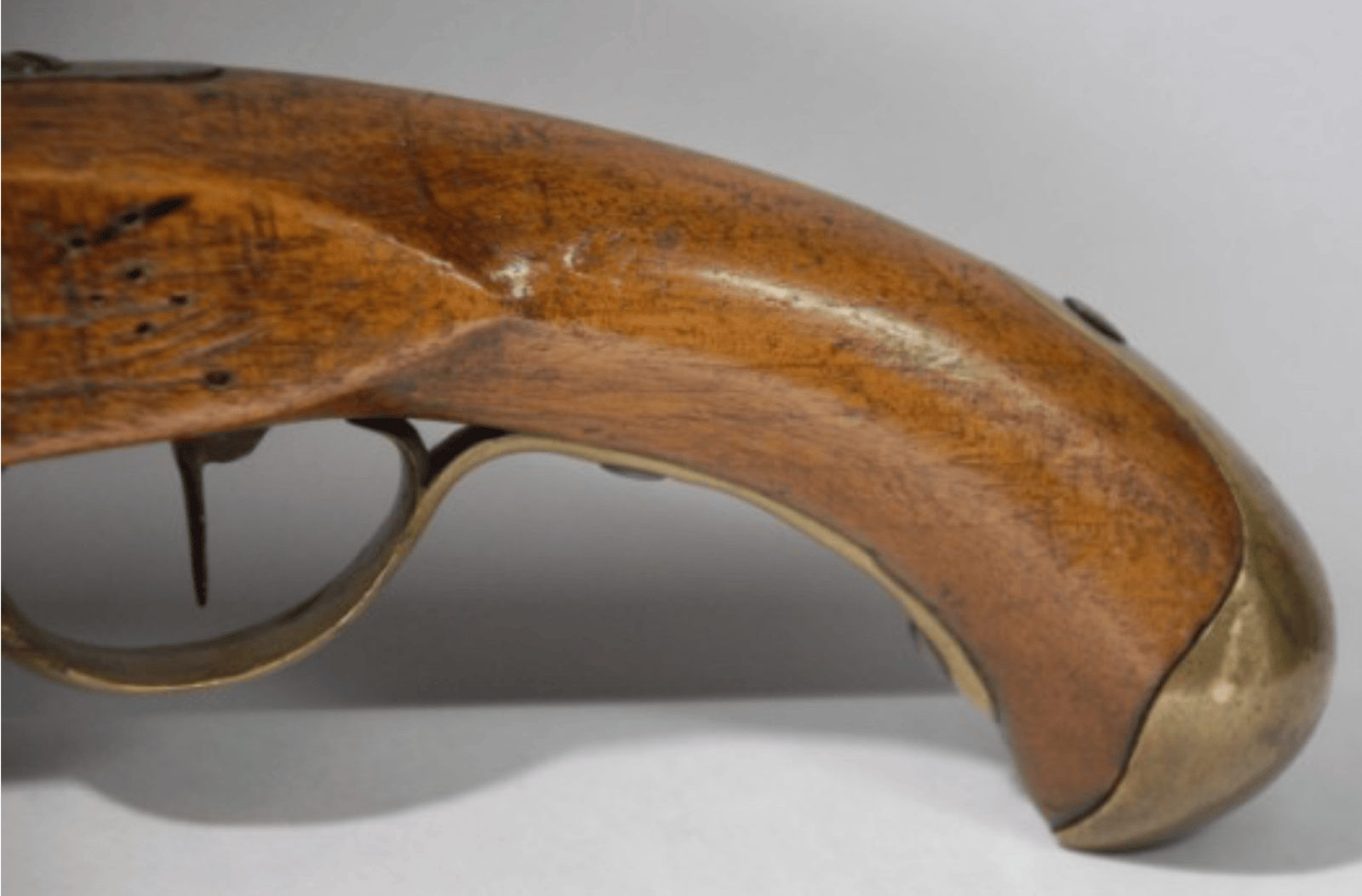
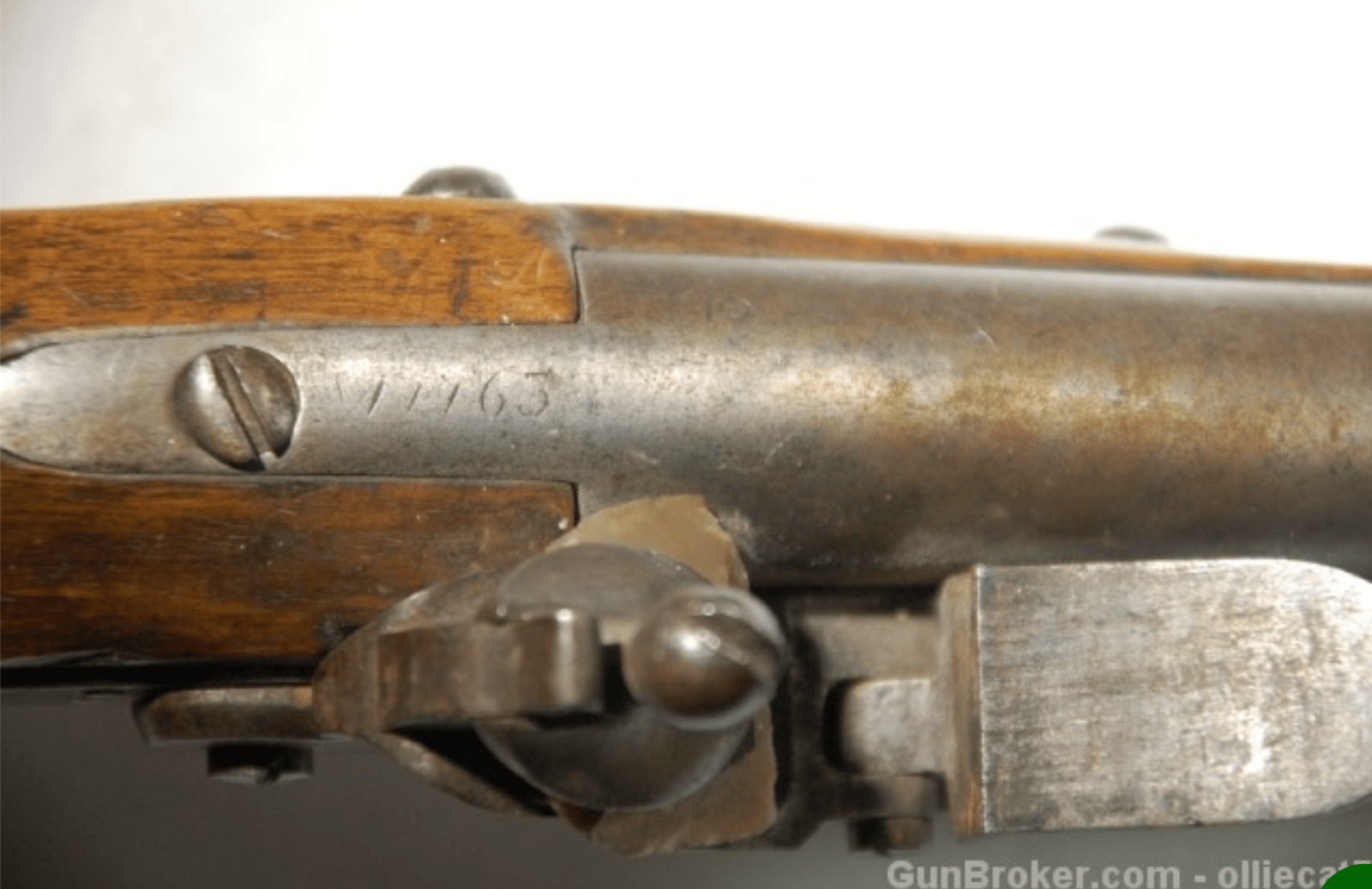
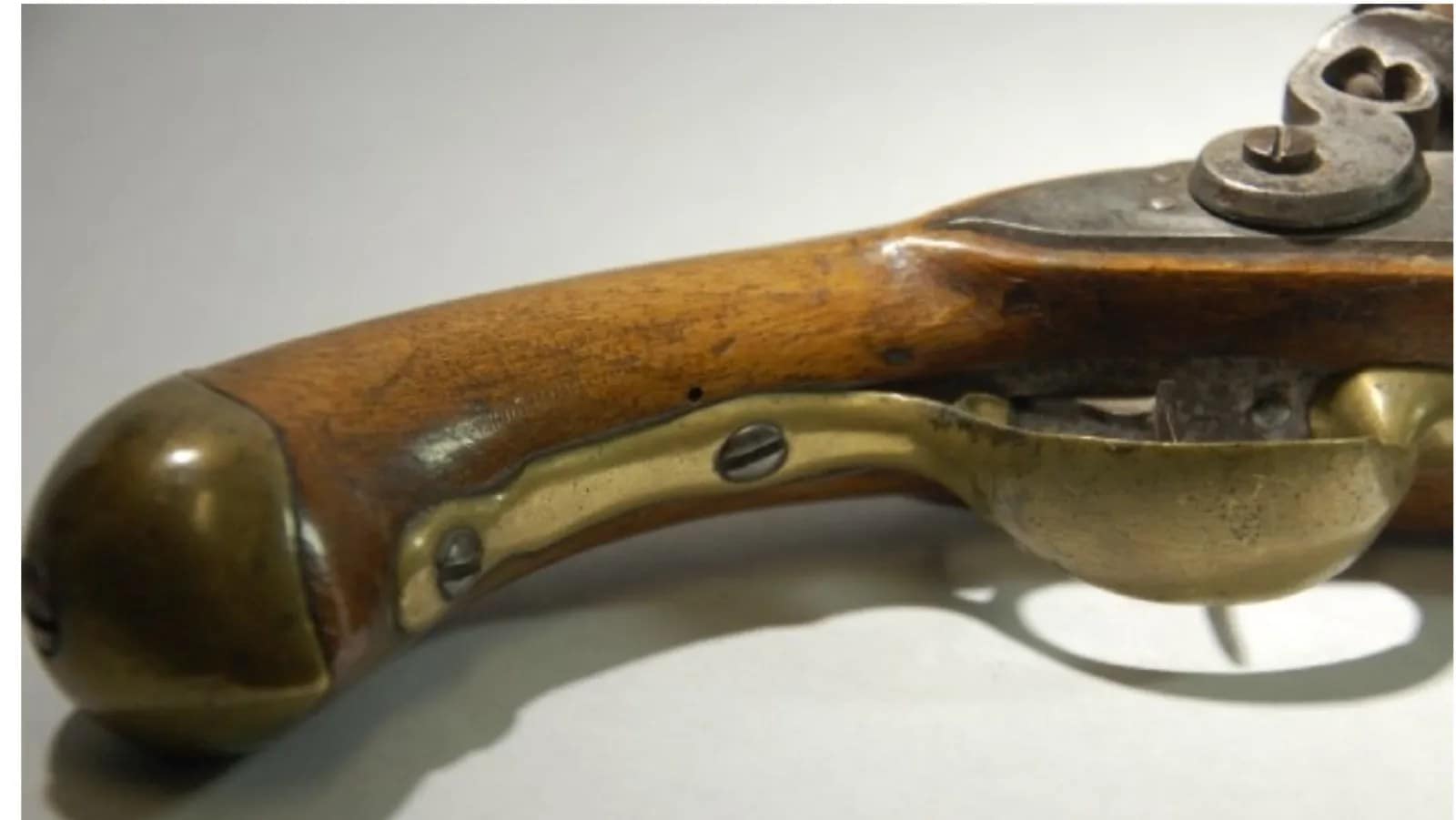
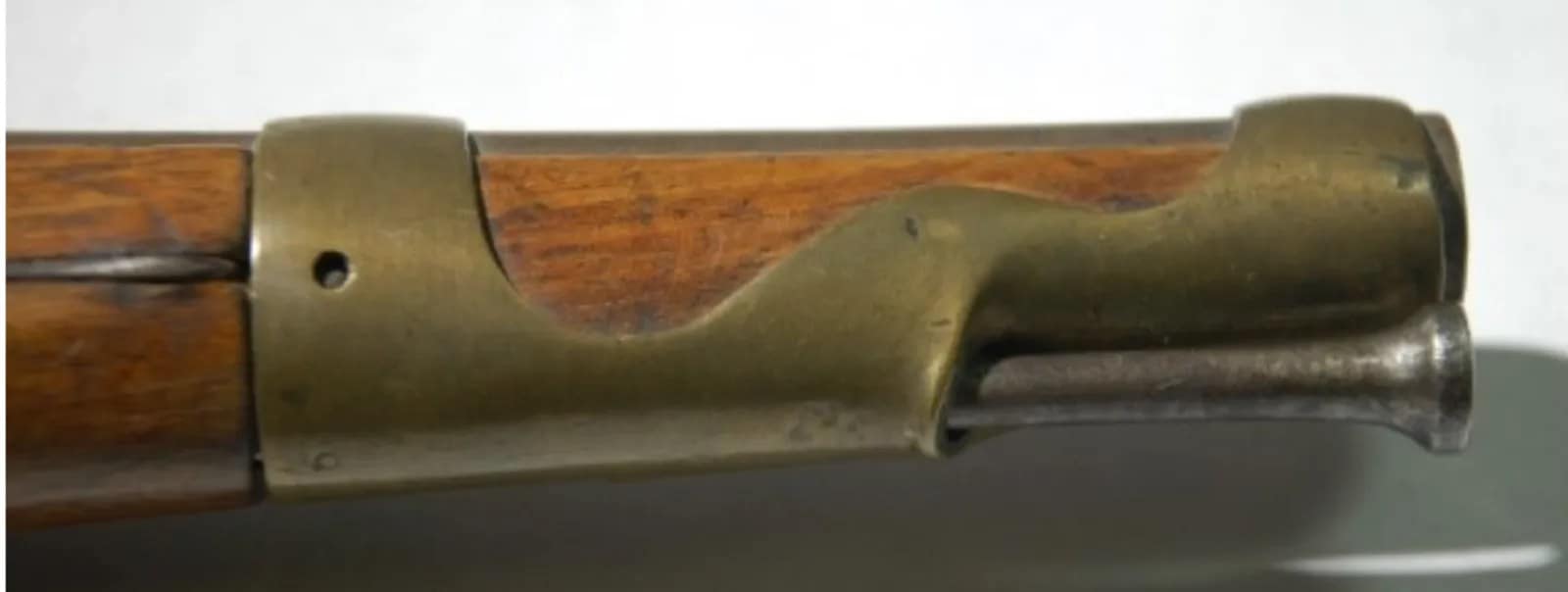
Prussian Model 1742 Hussar Pistol. POTZDAM MAGAZ. From my personal collection.
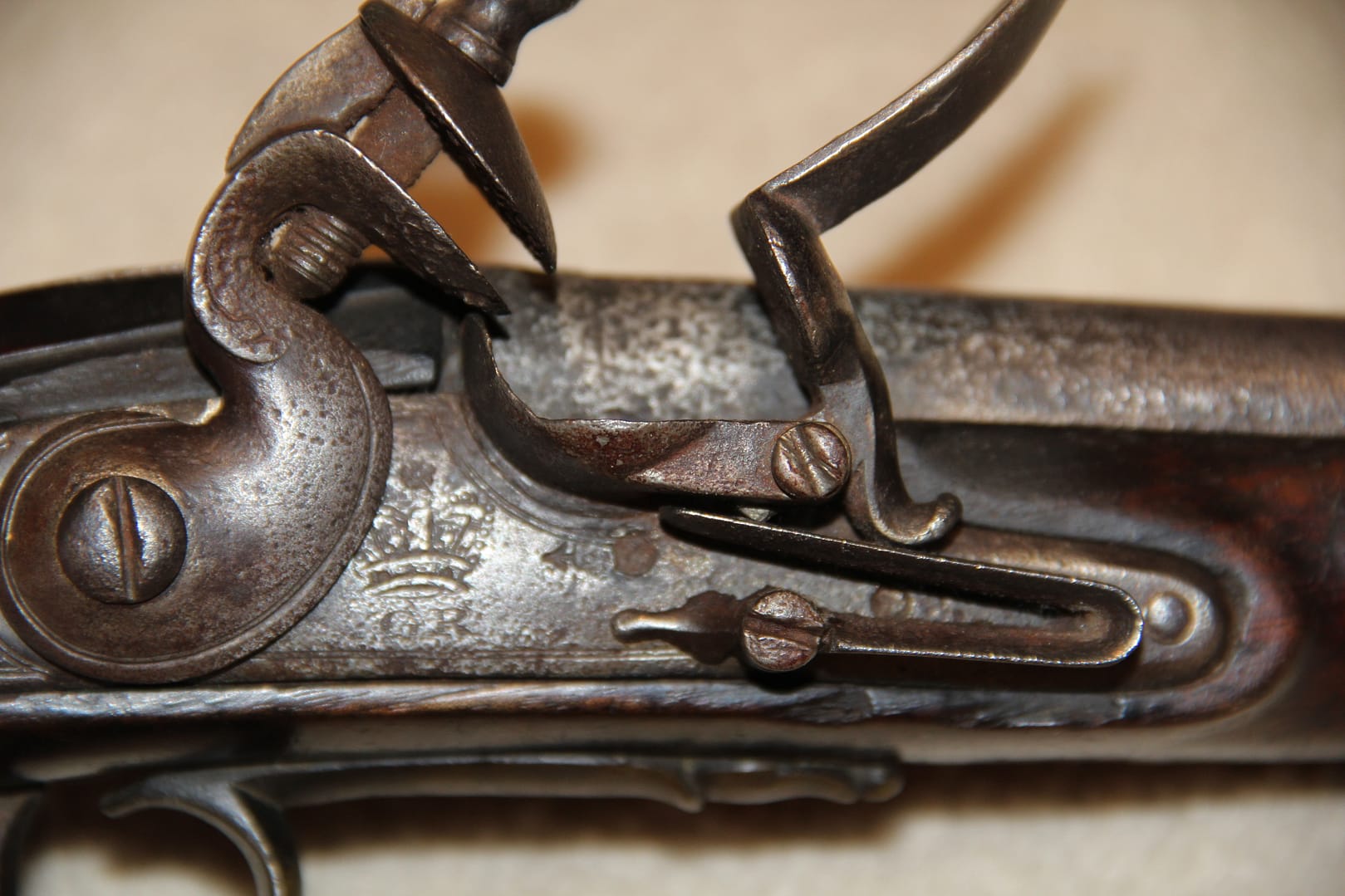
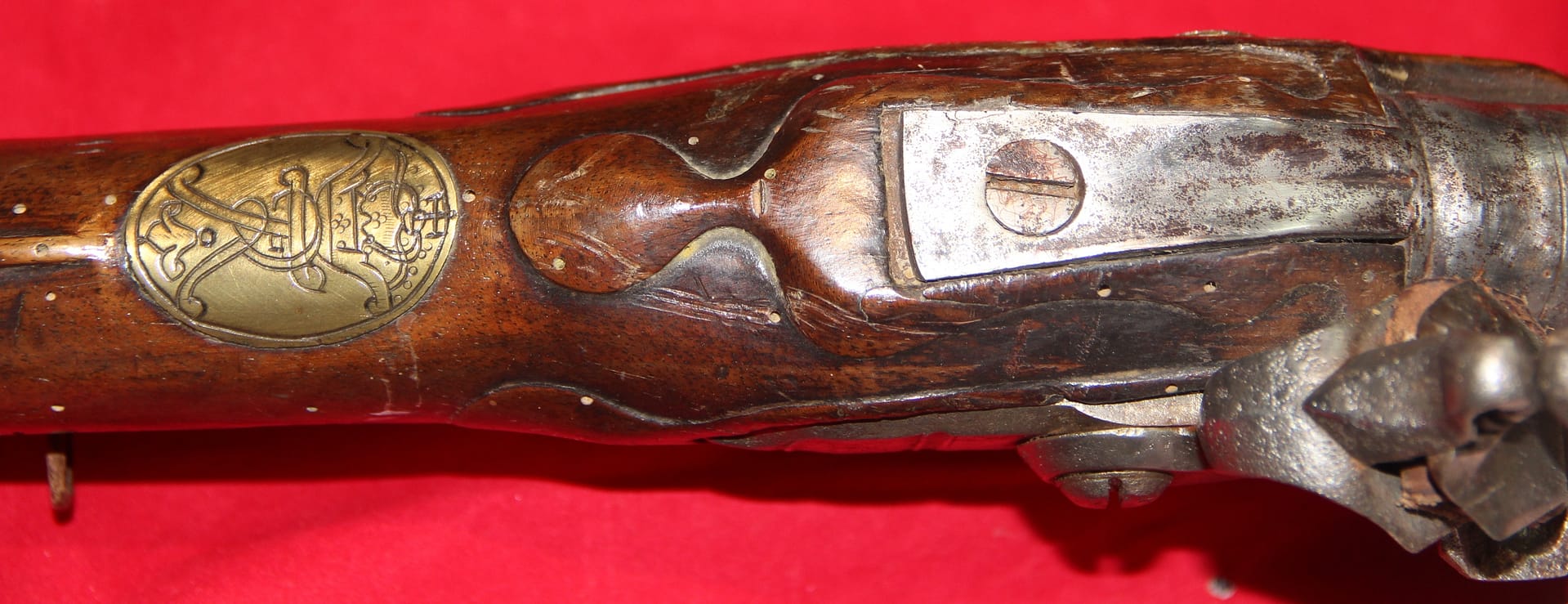
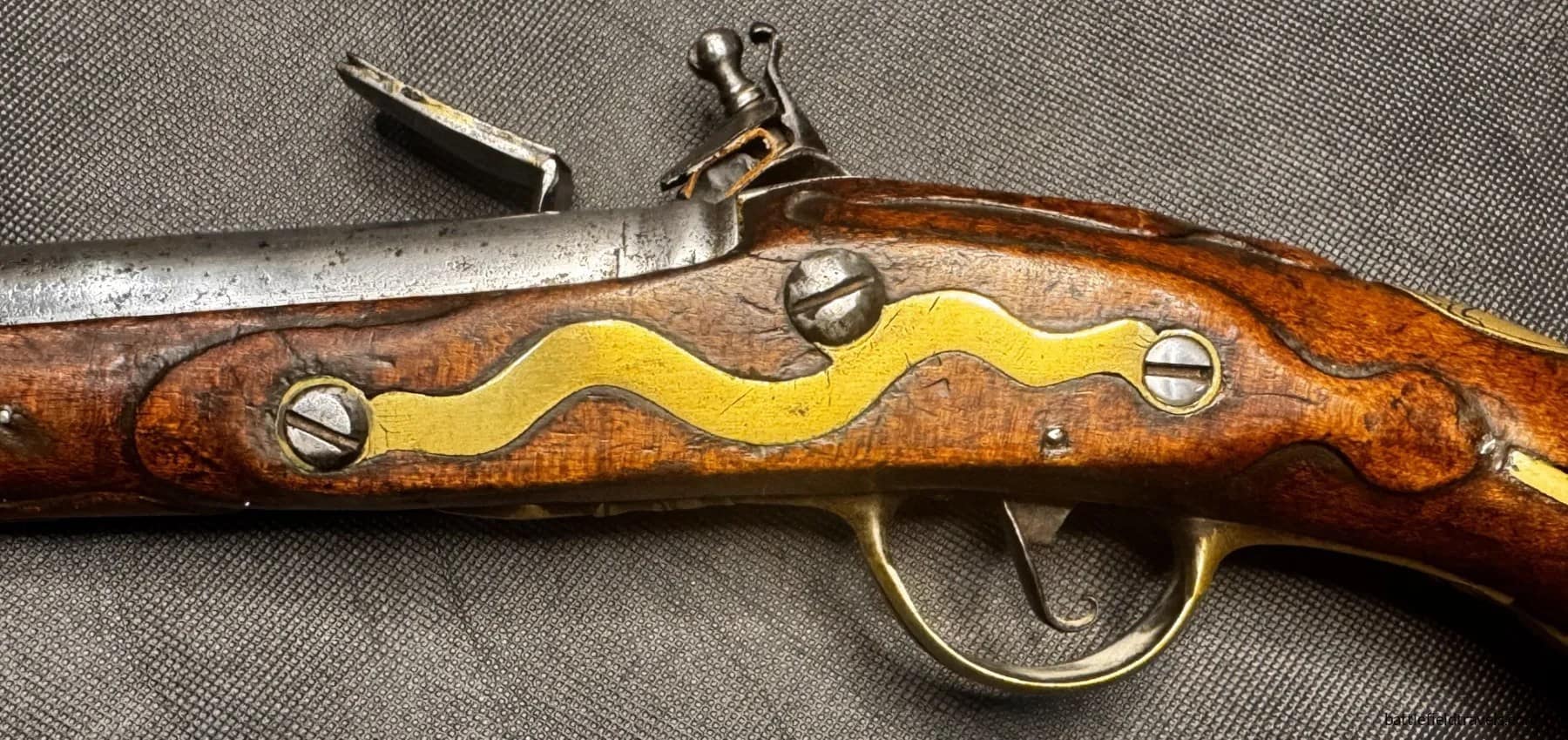
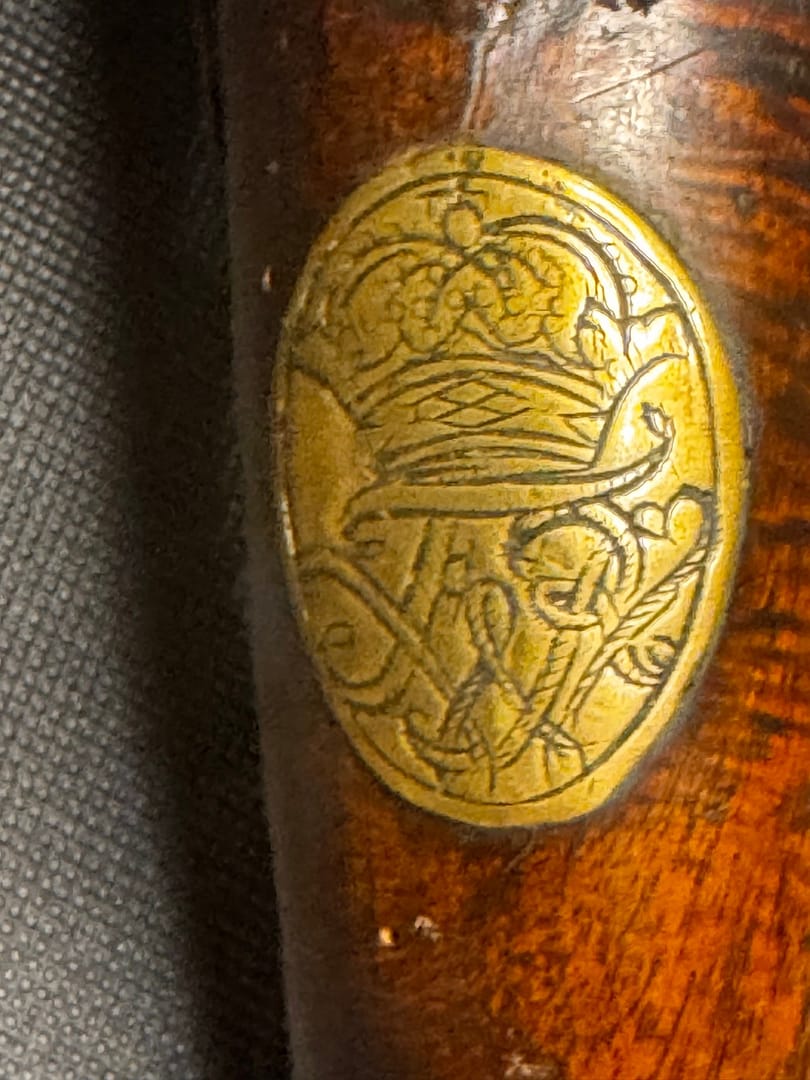
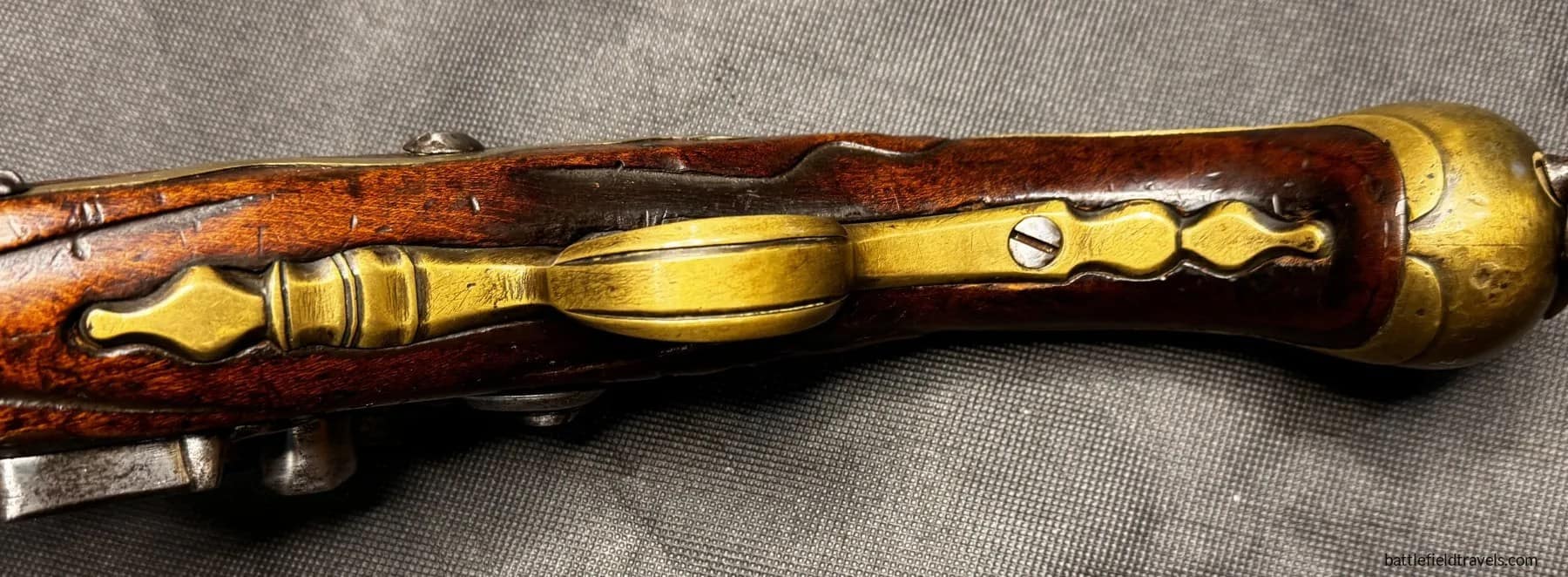
The Prussian Model 1742 Hussar pistol was issued to light cavalry regiments raised during Frederick the Great’s reforms. The escutcheon plate is engaved ‘FR’ for Fridericus Rex. Manufactured at the Potsdam Arsenal and stamped POTZDAM MAGAZ, it featured a large-bore flintlock mechanism, brass furniture, and a sturdy full-stock suitable for mounted use. Carried in saddle holsters, these pistols complemented the curved sabres used in shock charges and skirmish actions. They saw action in Silesia, Bohemia, and Saxony, reflecting Prussia’s increasing reliance on aggressive hussar tactics in the 1740s–1750s.
Prussian Model 1731 Hussar Pistol. POTZDAM MAGAZ. From my personal collection.
The Prussian Model 1731 Hussar pistol was issued to light cavalry regiments raised during Frederick William I’s (Frederick the Great’s father) reign. The escutcheon plate is engaved ‘FWR’ for Fridericus Wilhelmus Rex. Manufactured at the Potsdam Arsenal and engraved POTZDAM MAGAZ, it featured a large-bore flintlock mechanism, brass furniture, and a sturdy full-stock suitable for mounted use. Carried in saddle holsters, these pistols complemented the curved sabres used in shock charges and skirmish actions. They saw action in Silesia, Bohemia, and Saxony, reflecting Prussia’s increasing reliance on aggressive hussar tactics in the 1740s–1750s.
Prussian Model 1742 Officer’s Pistol. From my personal collection.
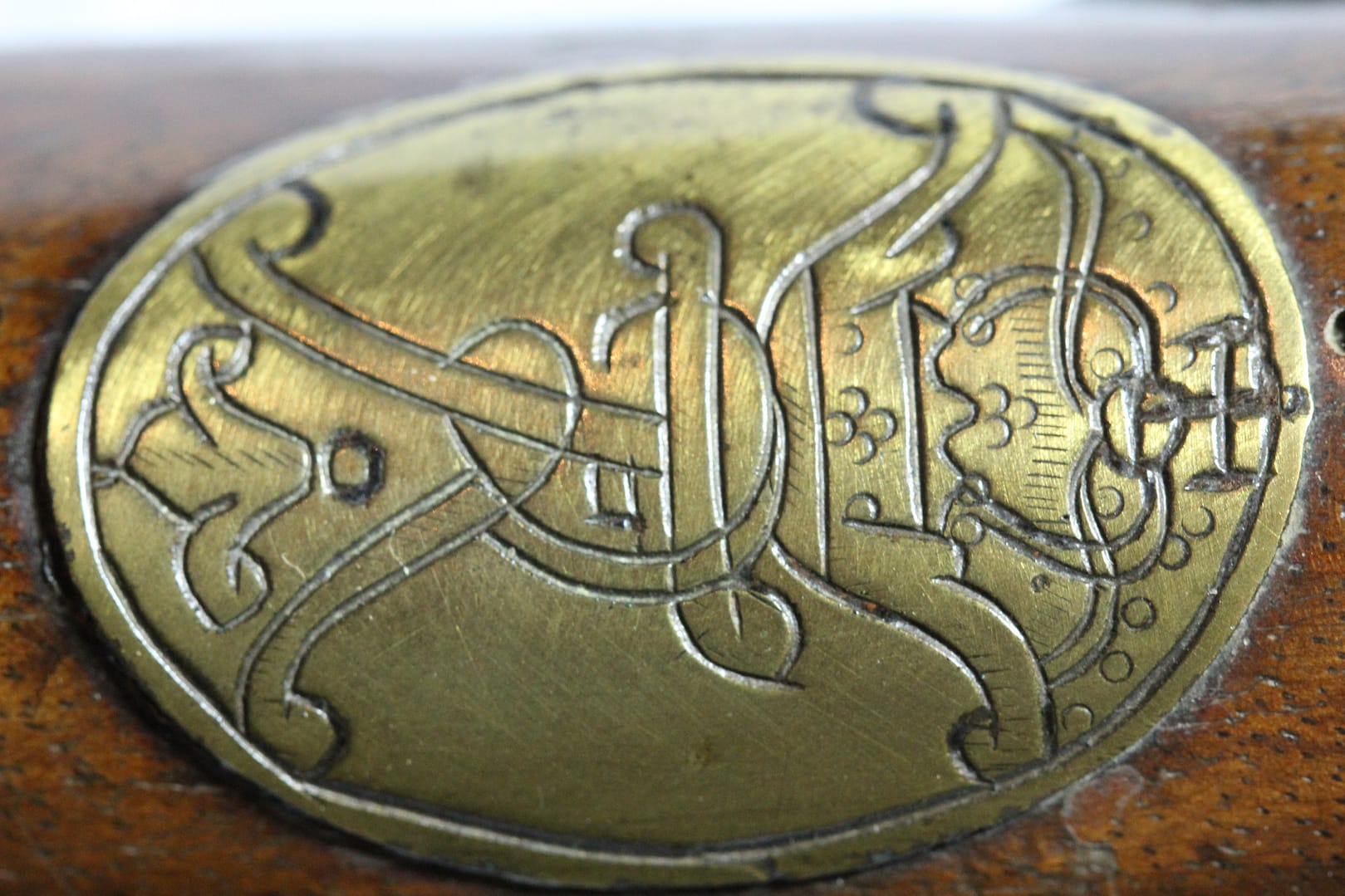
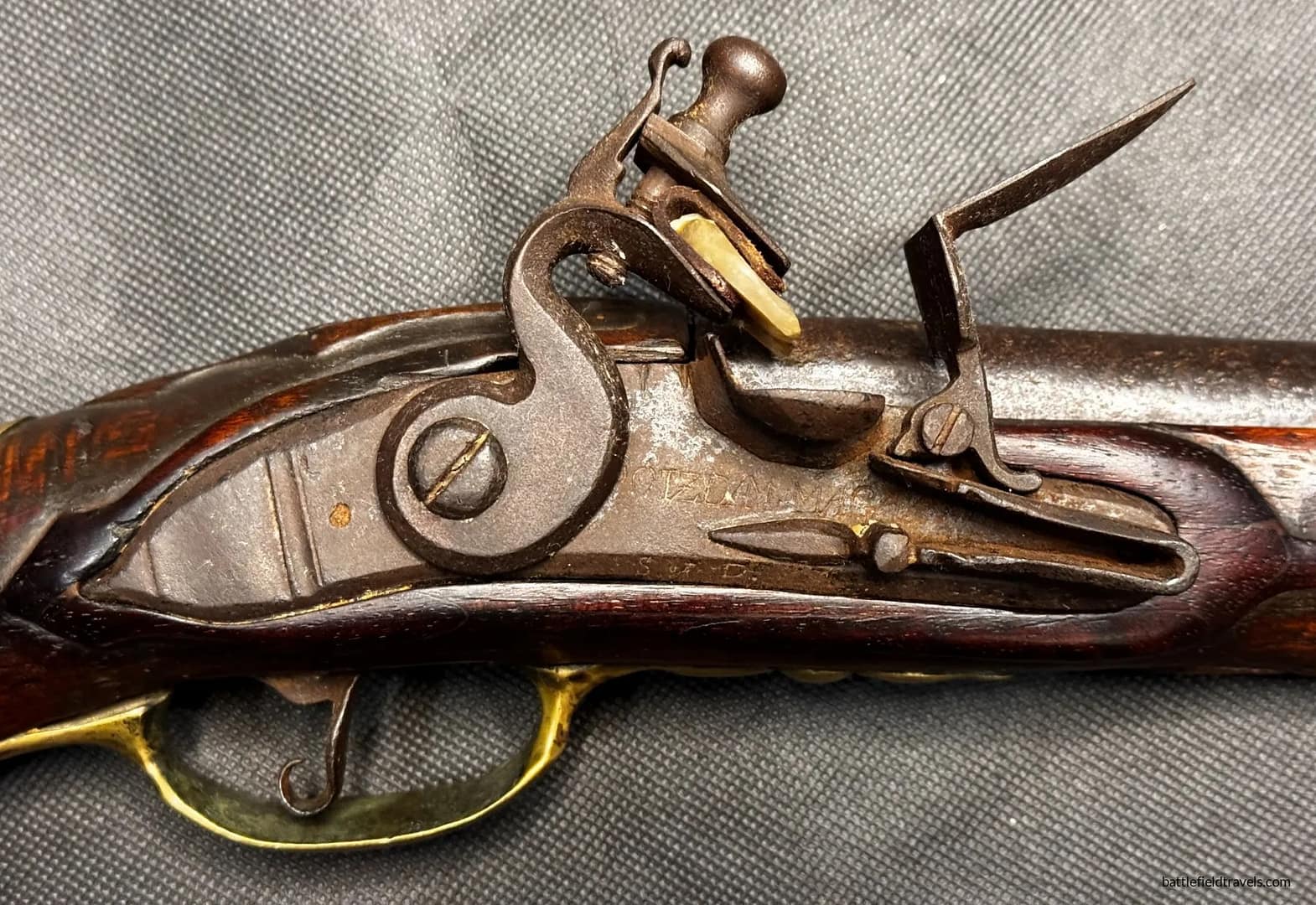
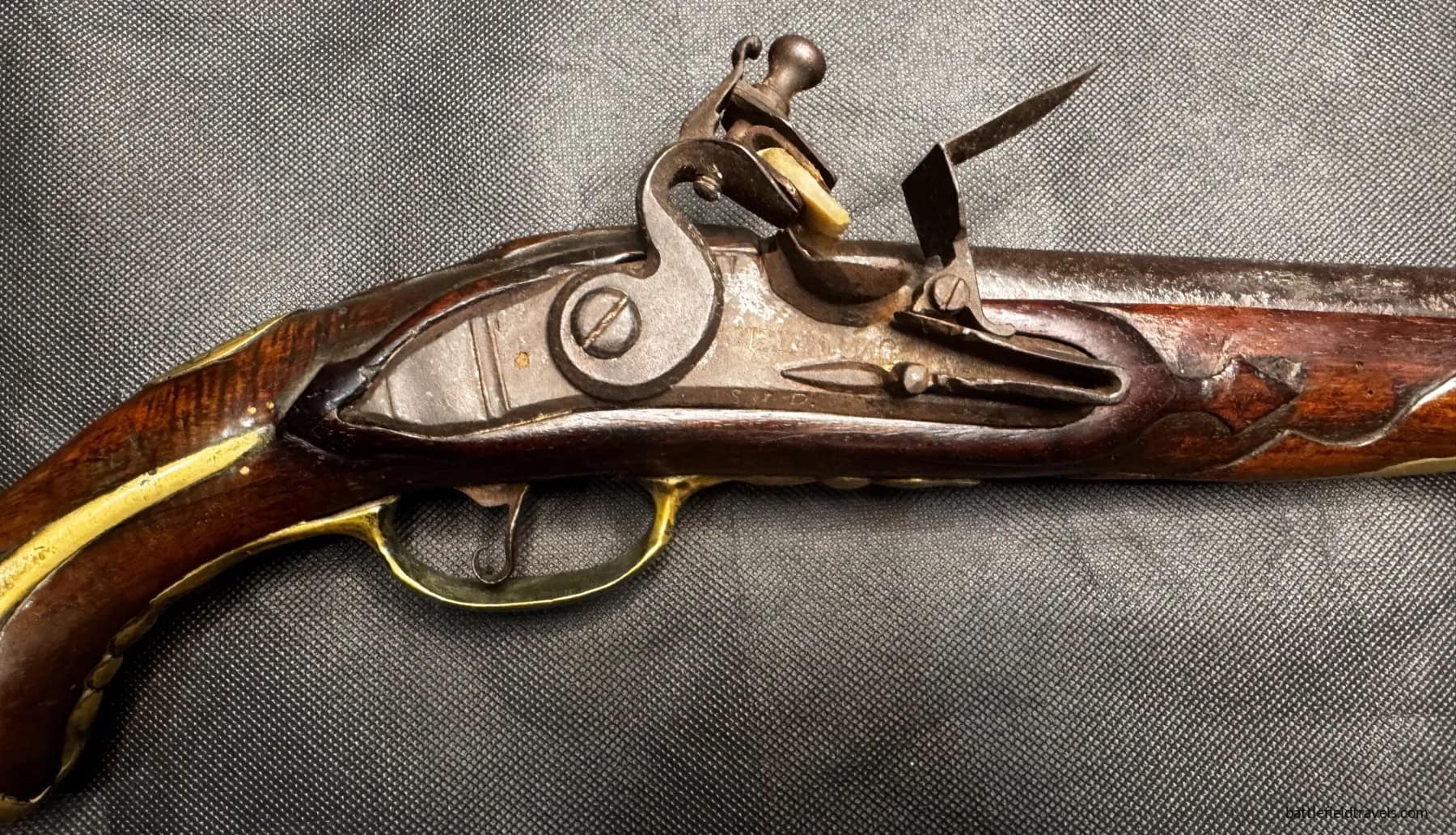
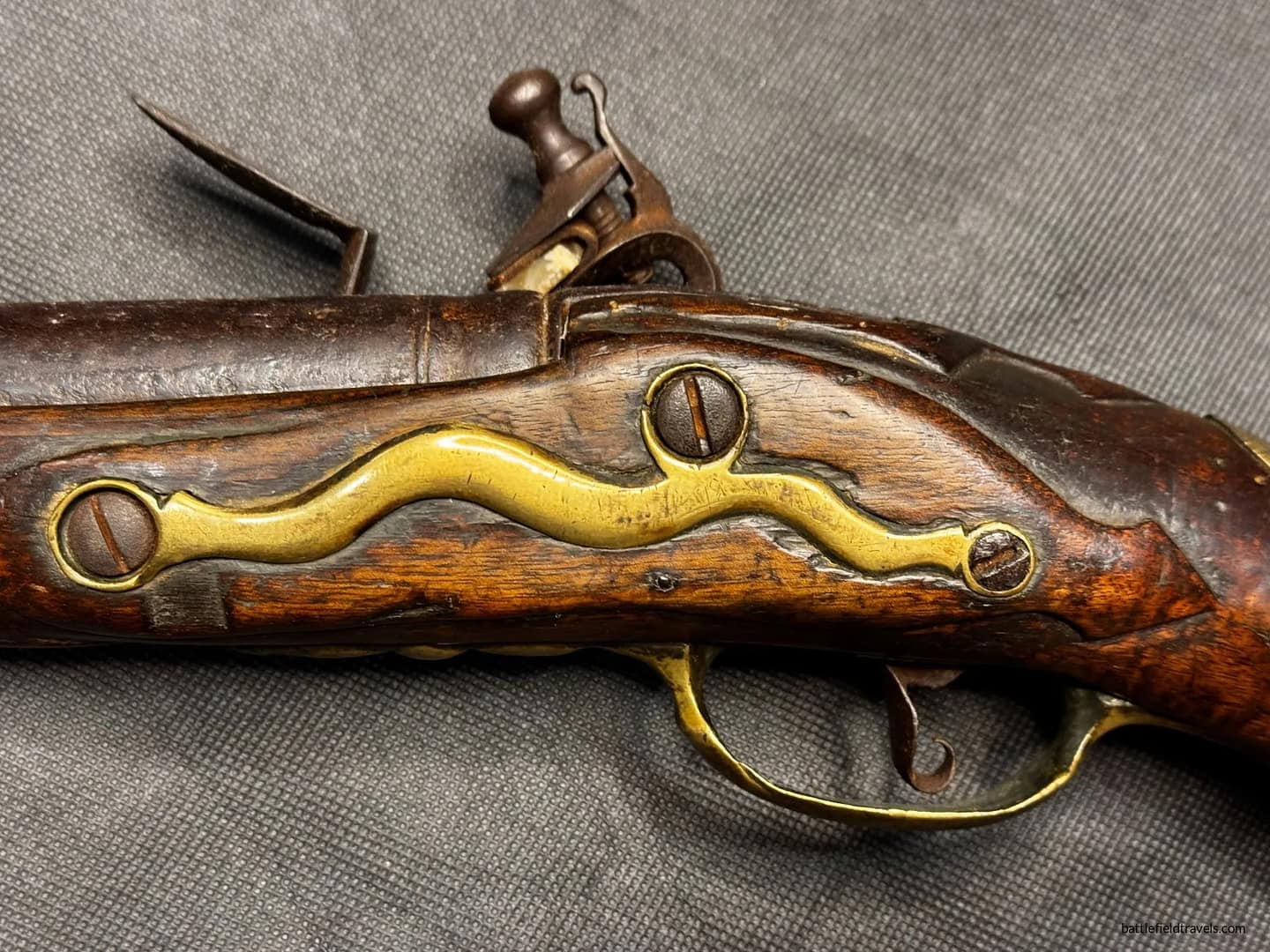
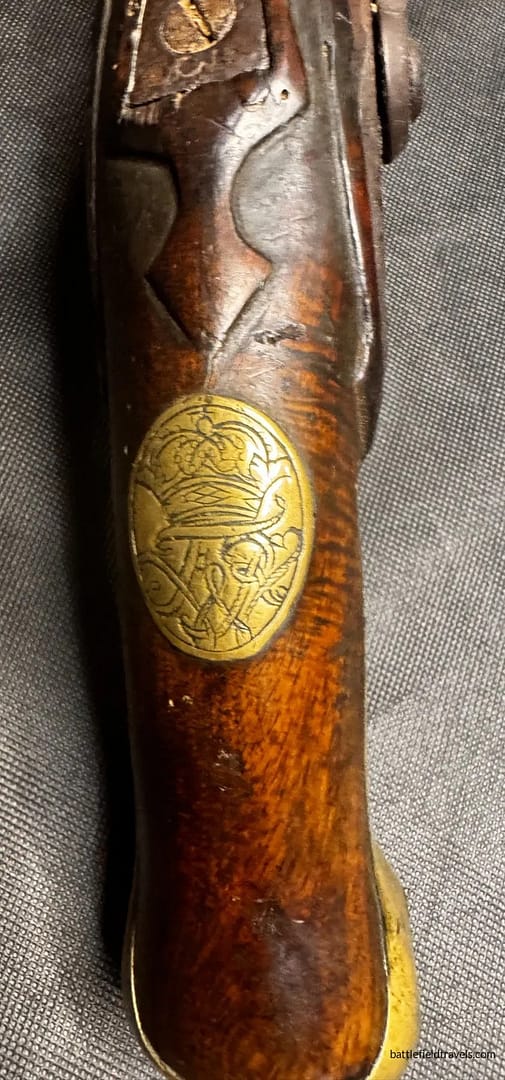
The Prussian officer’s pistol follows the design cues from the Model 1742 Hussar pistol but it is about 2/3 the size, and more finely made. It would have been a privately made pistol for an officer in Frederick the Great’s army. The escutcheon plate is engaved with a symbol that may represent the principality or family. . Lockplate is stamped AFS, it featured a smaller-bore flintlock mechanism, brass furniture, and a sturdy full-stock suitable for mounted use. Carried in saddle holsters, these pistols complemented the curved sabres used in shock charges and skirmish actions. They saw action in Silesia, Bohemia, and Saxony, reflecting Prussia’s increasing reliance on aggressive hussar tactics in the 1740s–1750s.
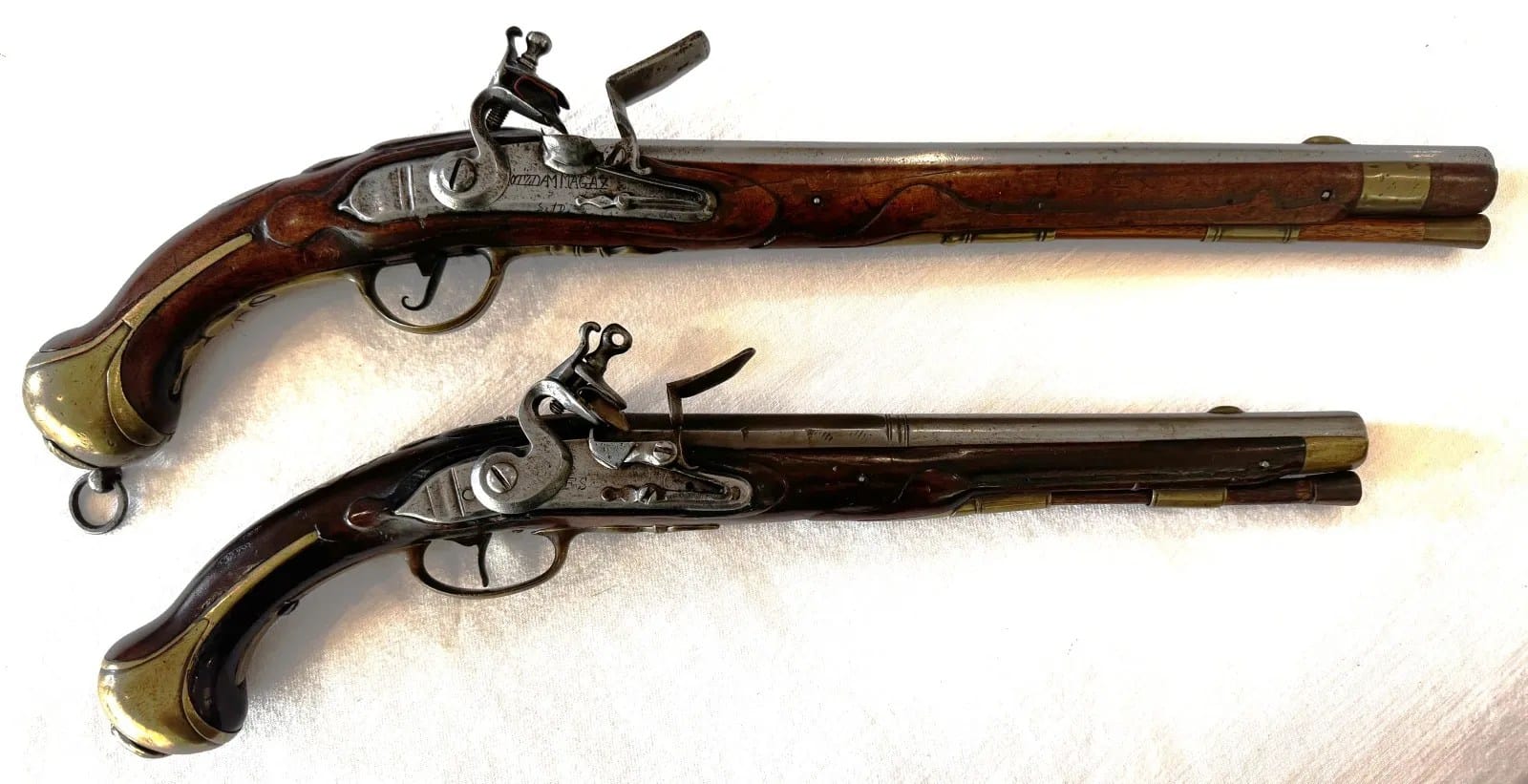
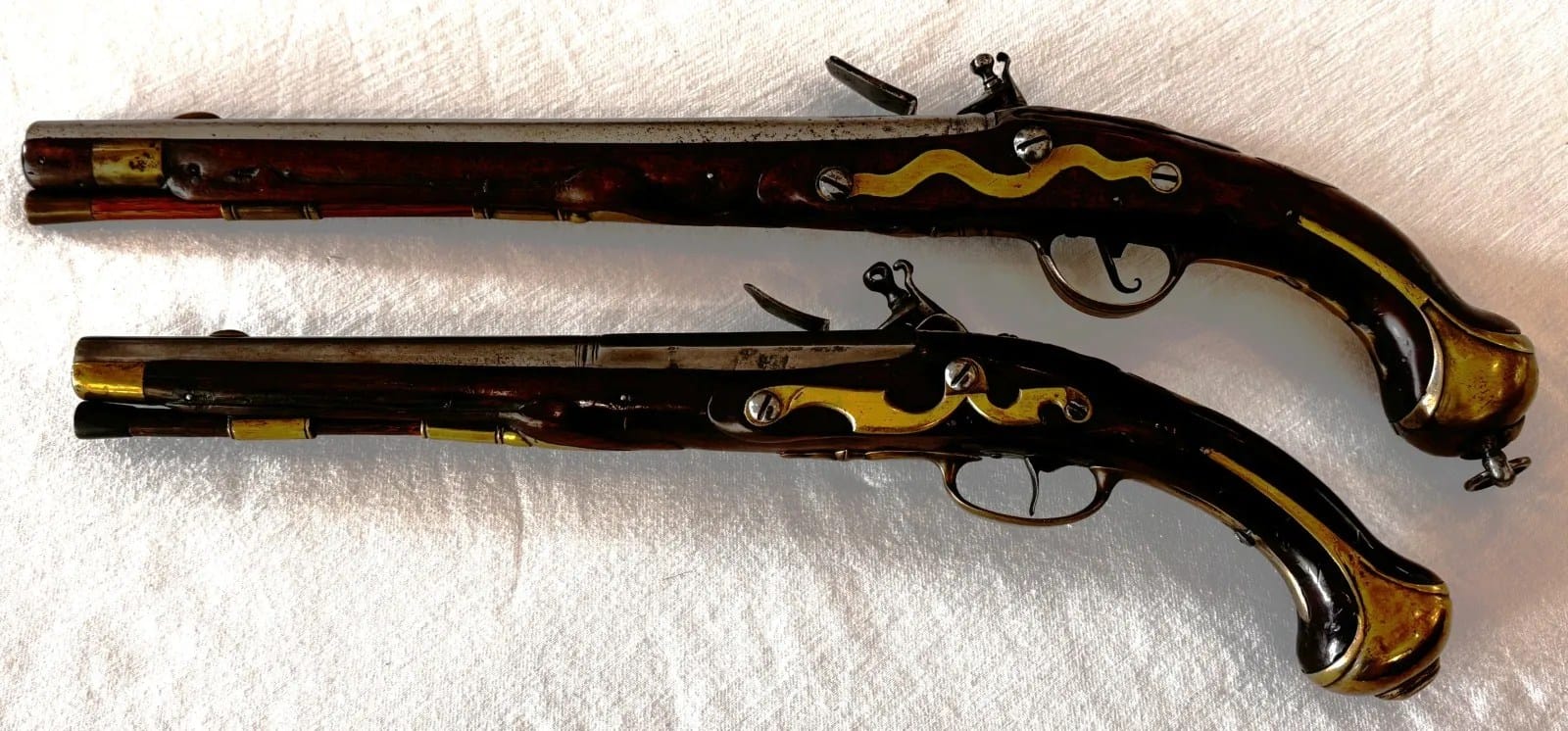
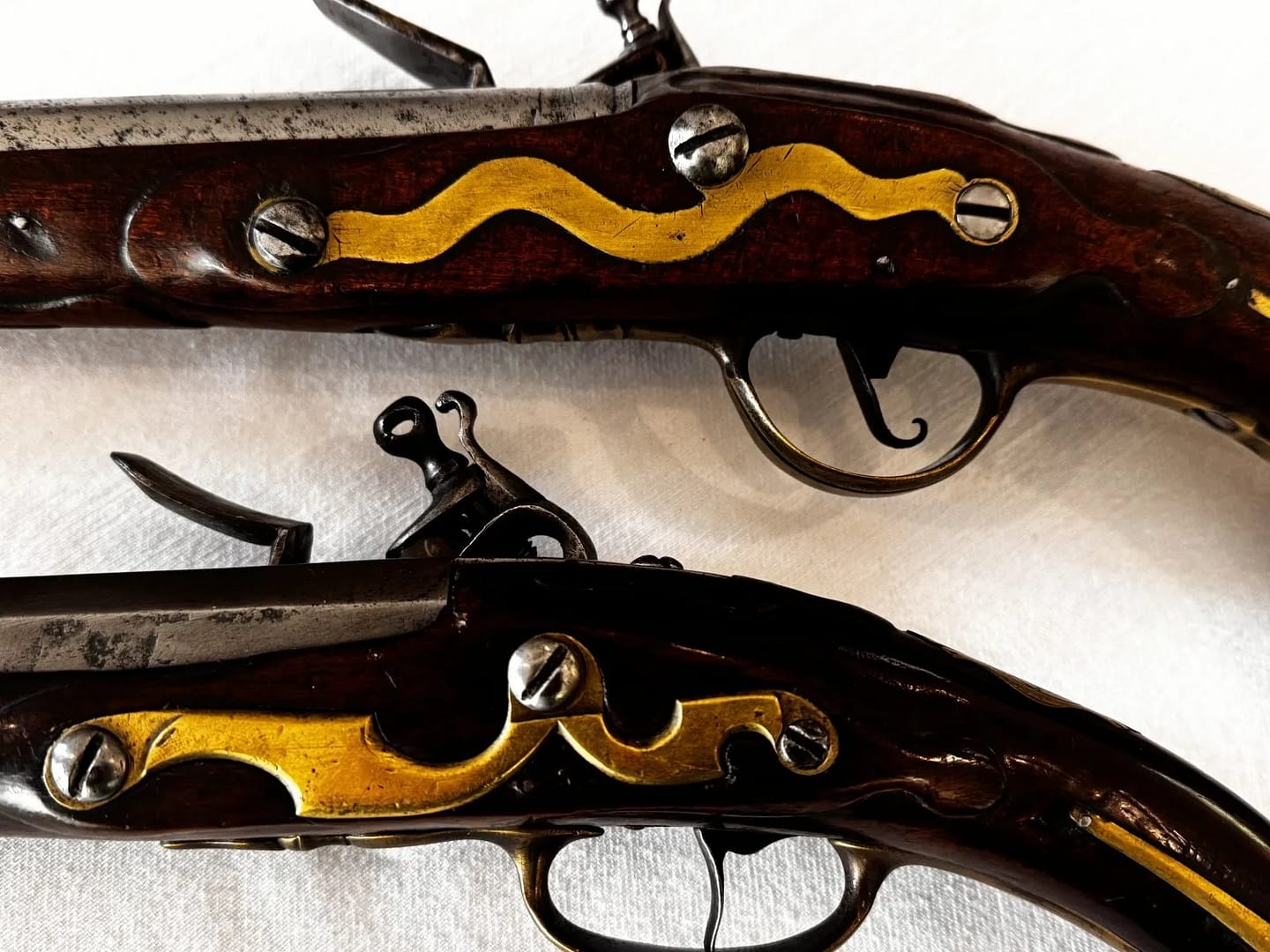
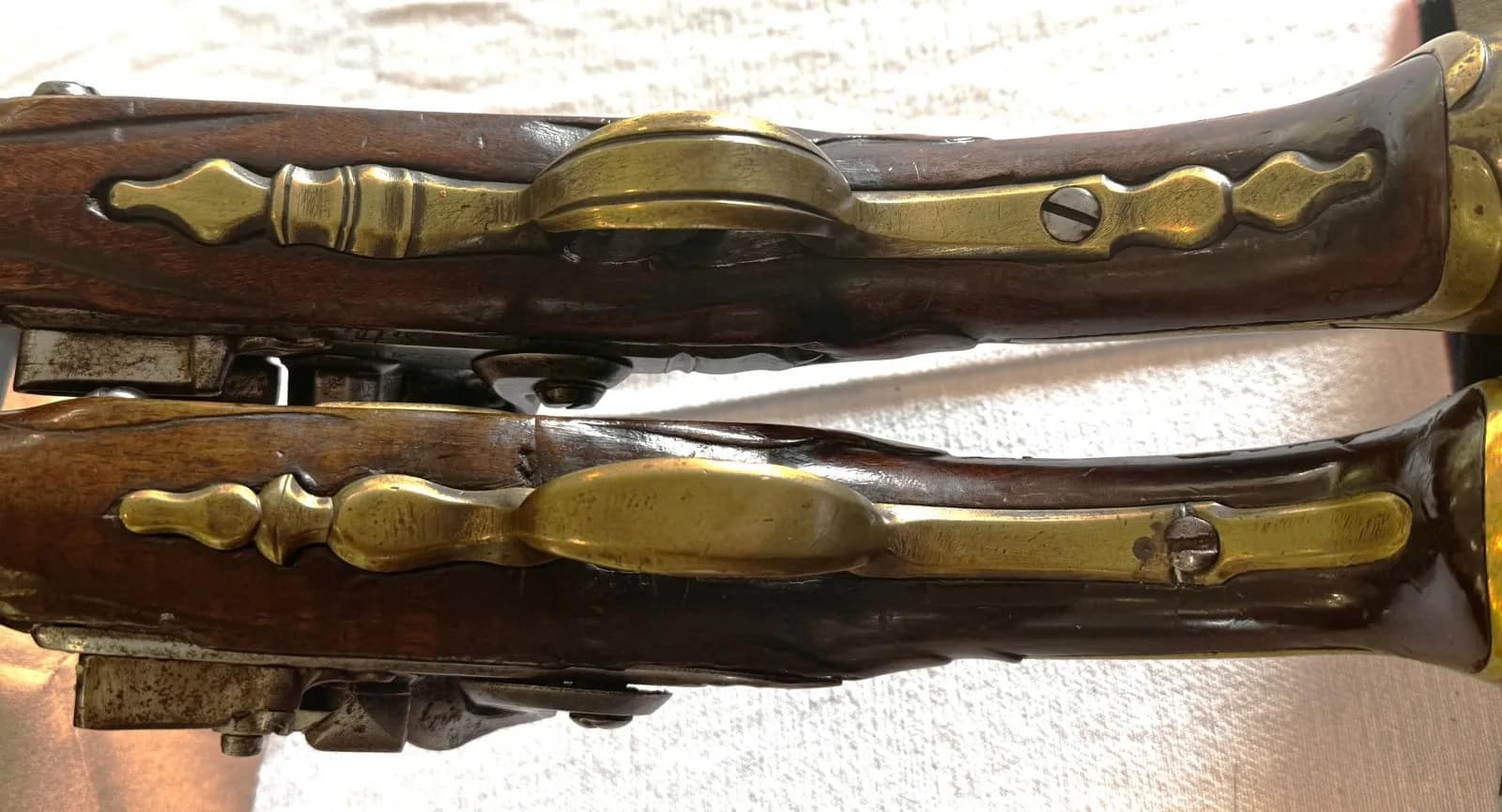
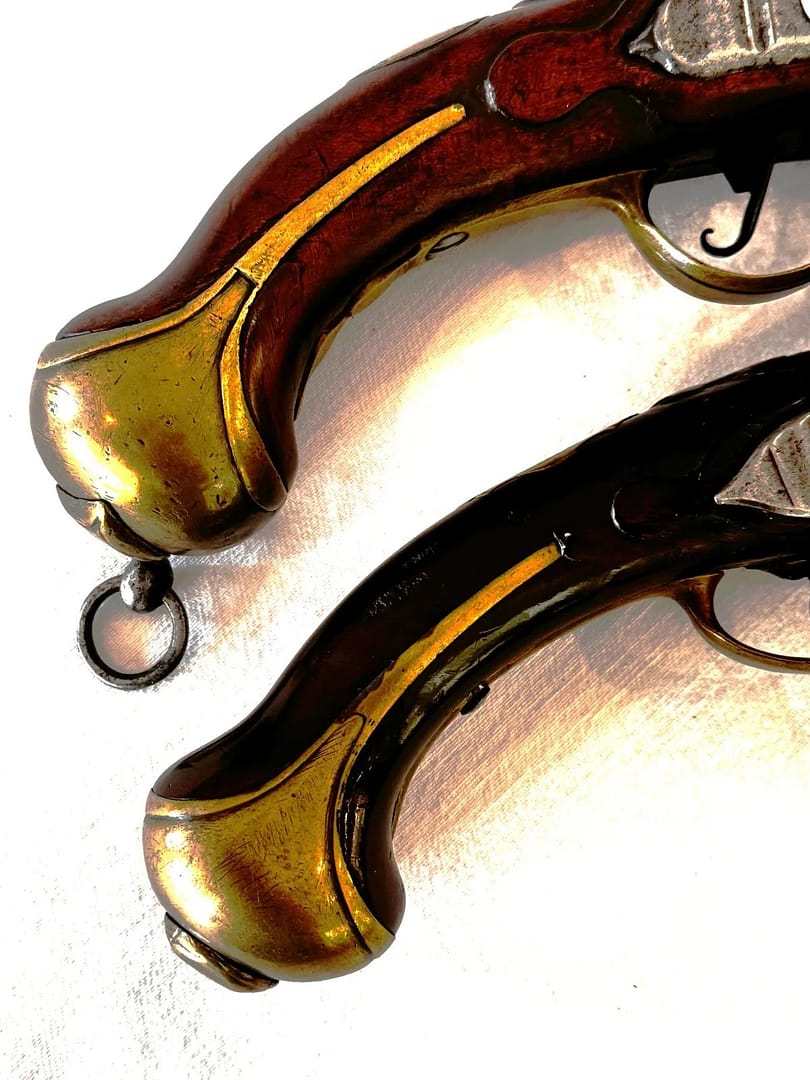
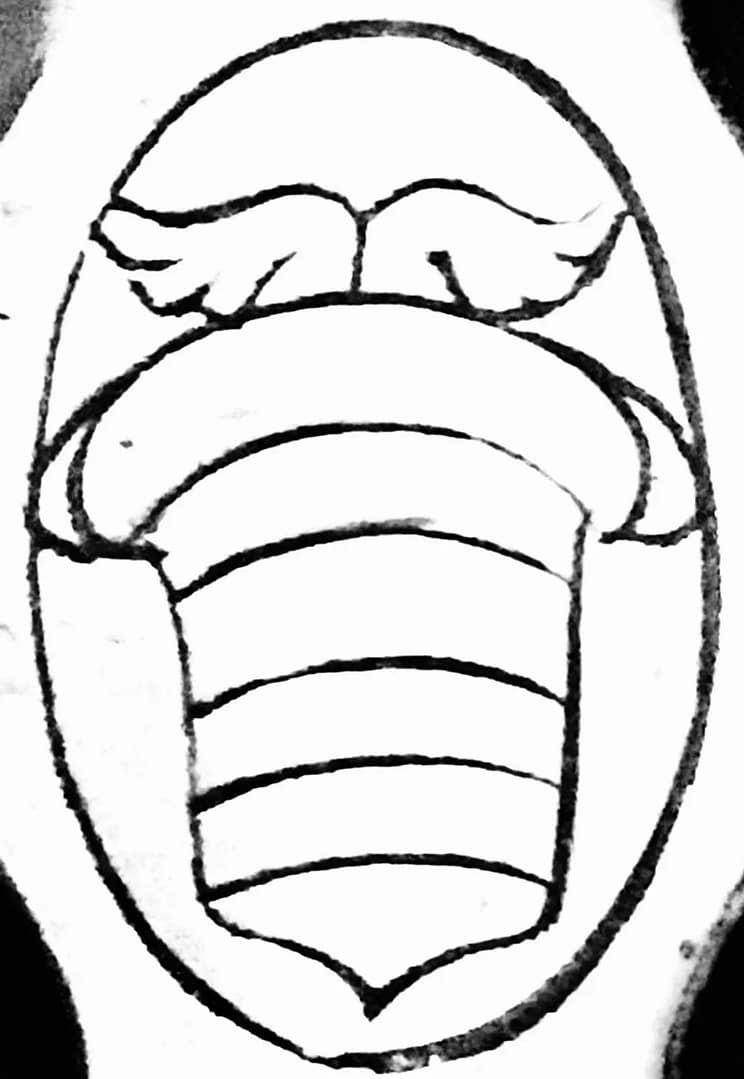
Comparison of the arsenal-issued enlisted soldier’s Prussian Model 1742 Hussar Pistol versus a privately purchased officer’s pistol in the same style. From my personal collection.
This is a comparison of the two pistols displayed immediately above. The Prussian Model 1742 is a well known pattern that served Frederick’s army for more than 47 years prior to being superseded by the very similar-looking Model 1789 (See the Napoleonic weapons page). The escutcheon plate is engaved ‘FR’ for Fridericus Rex. The pistol was manufactured at the Potsdam Arsenal and the lockplate is engraved POTZDAM MAGAZ.
The officer’s pistol follows the design cues—lockplate style, buttcap, decorative stock carving, hammer and frizzen shape, 3-screw sideplate—from the Model 1742 Hussar pistol but it is about 2/3 the size, and more finely made. It would have been a privately made pistol for an officer in Frederick the Great’s army. The escutcheon plate is engaved with a symbol that may represent the principality or family. Lockplate is marked with a star over the initials ‘AFS’. The escutcheon plate is marked with some sort of heraldry symbol that may represent a Princely state, a family symbol, or, less likely, a regimental symbol. What is it? A beehive with wings? A bee? a sheaf of wheat? an updies down hat? If you have any suggestions, please drop me a line or add a comment below.
French Weapons of the Seven Years War
French Model 1754 Marine Musket.
Manufactured circa 1763. Pattern 1754 lockplate and pattern 1763 furniture and stock. Probably one of thousands of guns made in the transition between 1754 and 1763 models in an effort to use ordinance components. Possibly a rebuilt weapon during the Revolution, as broken weapons were reassembled from components. Brass furniture indicates marine use. This musket was found in an attic in Scituate, Massachusetts, about 100 years after the war. Scituate was the site of a garrison of 300 French Marines during the Revolutionary War. The Smithsonian Instituite restored the gun in the 1990s. From my personal collection.
French Model 1766 flintlock musket. From my personal collection.
Although this particular pattern did not see service in the Seven Years War, the French Model 1766 musket was refinement of the earlier 1746, 1754 and 1763 muskets, featuring strengthened furniture, improved lock geometry, and a more robust barrel band arrangement. A .69-calibre weapon with a reputation for reliability, it armed French infantry during the later Seven Years War and formed the basis of weapons supplied to American Continental forces. Its mechanical simplicity and standardisation influenced U.S. musket production well into the early 19th century.
Massive French Fortress Musket, circa 1750. From my personal collection.
This exceptionally large French fortress musket, circa 1750, was designed for static defence and anti-artillery sniping from ramparts. With a bore of approximately 0.80 calibre and an oversized barrel, it fired heavy projectiles intended to disable artillery crews or harass siege works at long range. The stock is signed “Maqueline”, and the lockplate is a pre-1717 unbridled form, indicating production by a private armourer supplying fortress garrisons. Such heavy wall guns were too unwieldy for field use but were valued for accuracy and destructive power in garrison warfare.
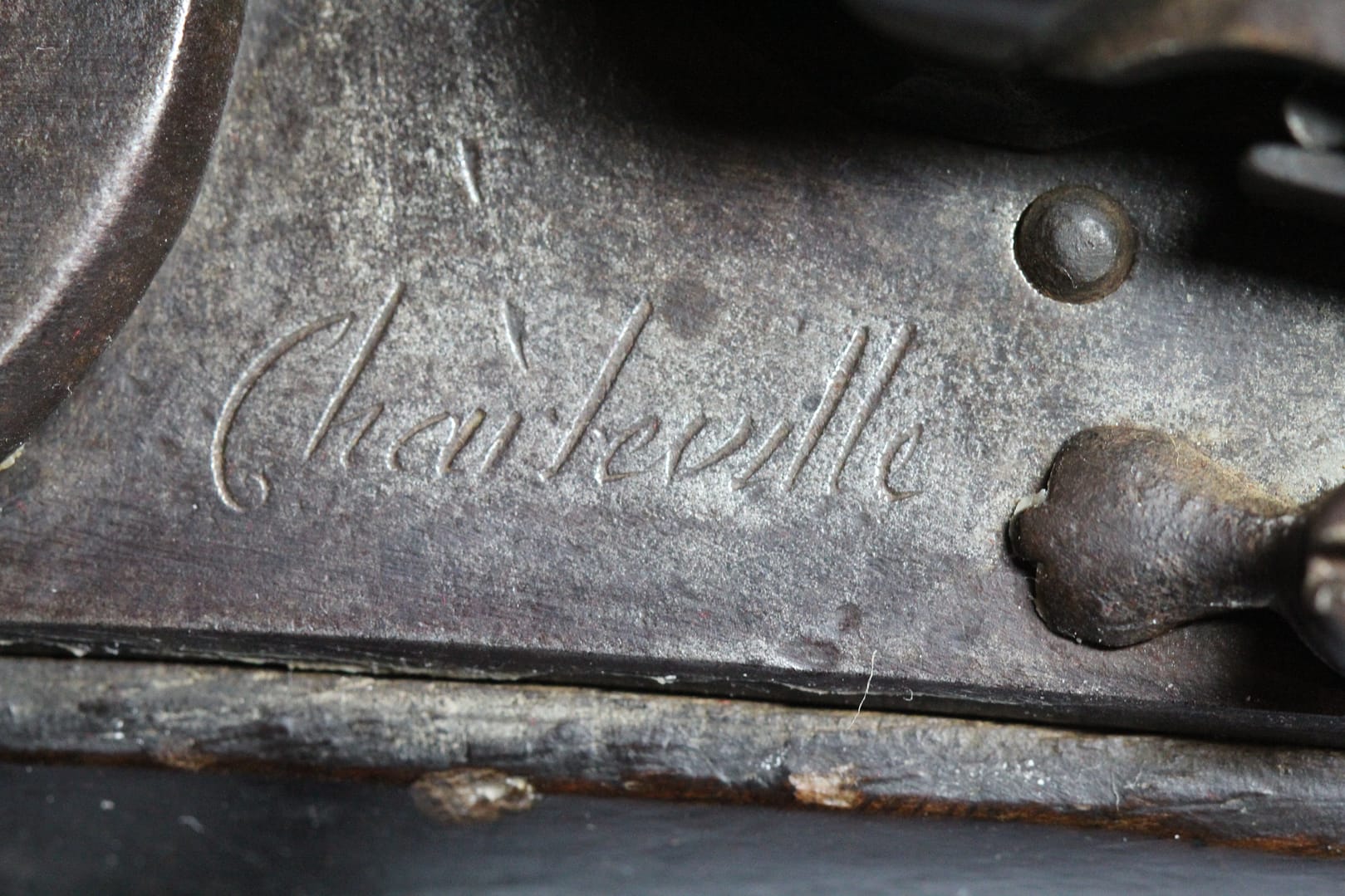
French Model 1733 Cavalry Pistol, the first standard handgun to be adopted by the French military. Jean Fournier, Charleville. From my personal collection.
The French Model 1733 cavalry pistol was the first fully standardised handgun adopted by the French Army. A large-bore flintlock with brass mounts and a robust lockplate, it was carried by heavy cavalry, dragoons, and mounted officers. This example is marked Jean Fournier, Charleville, one of the principal armourers of the royal manufactory. The 1733 pistol introduced production uniformity later seen in the Charleville musket series and became a widely copied pattern across Europe during the mid-18th century.
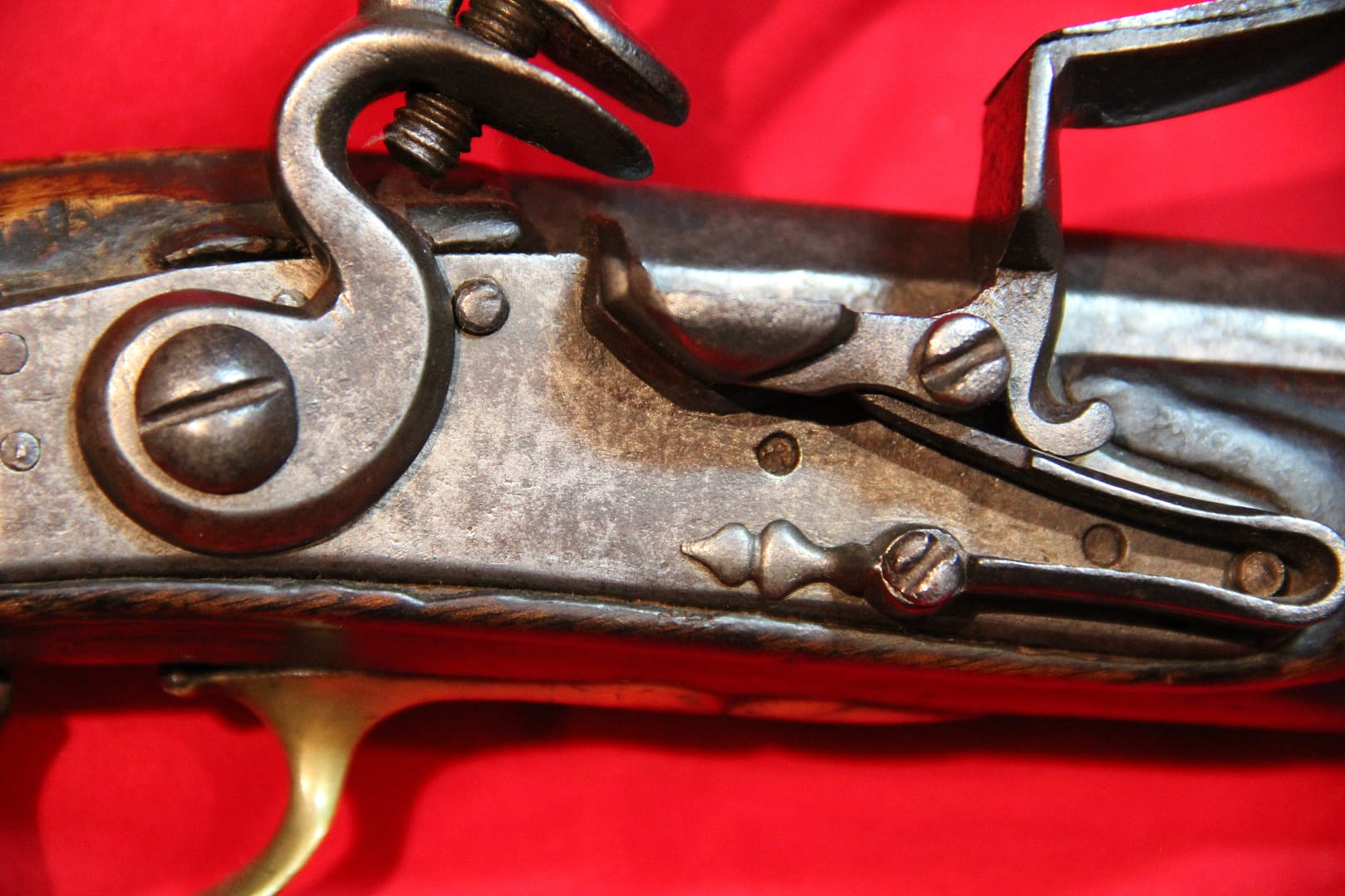
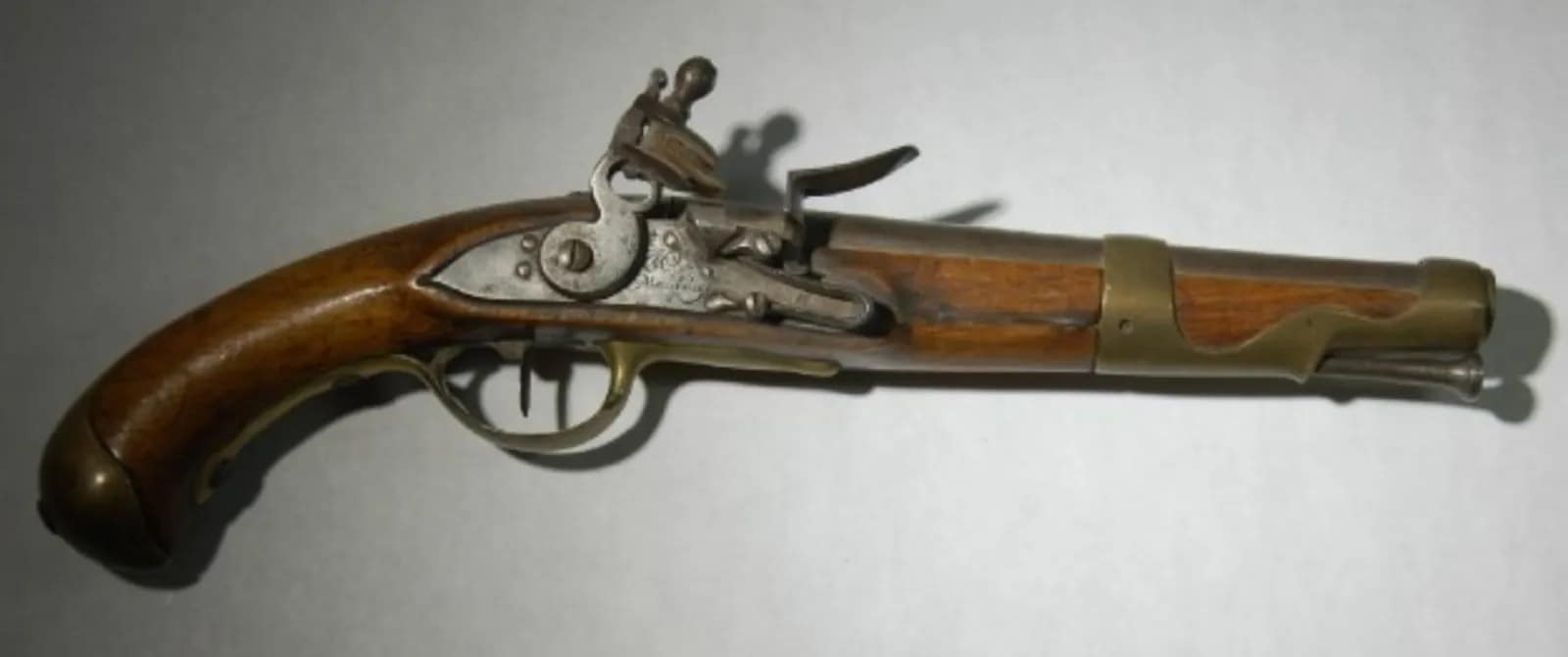
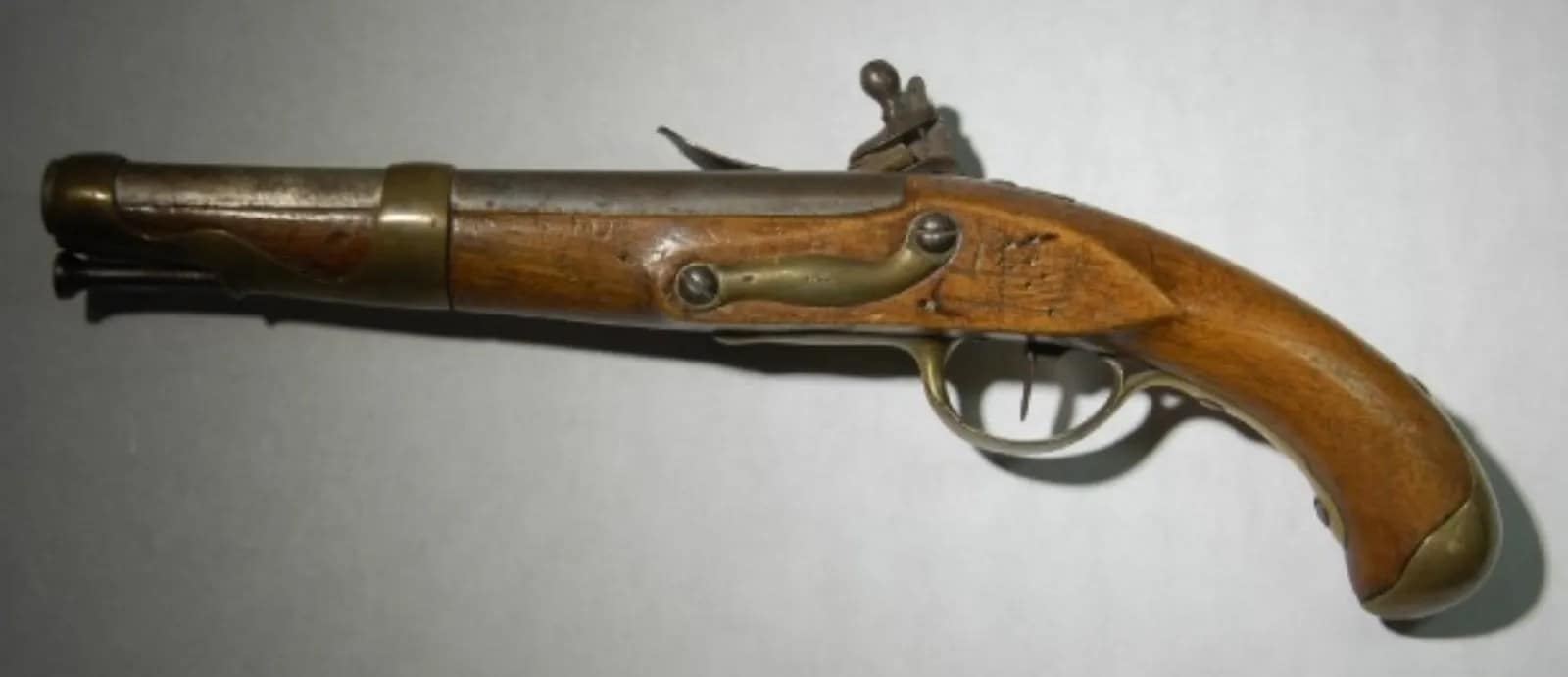
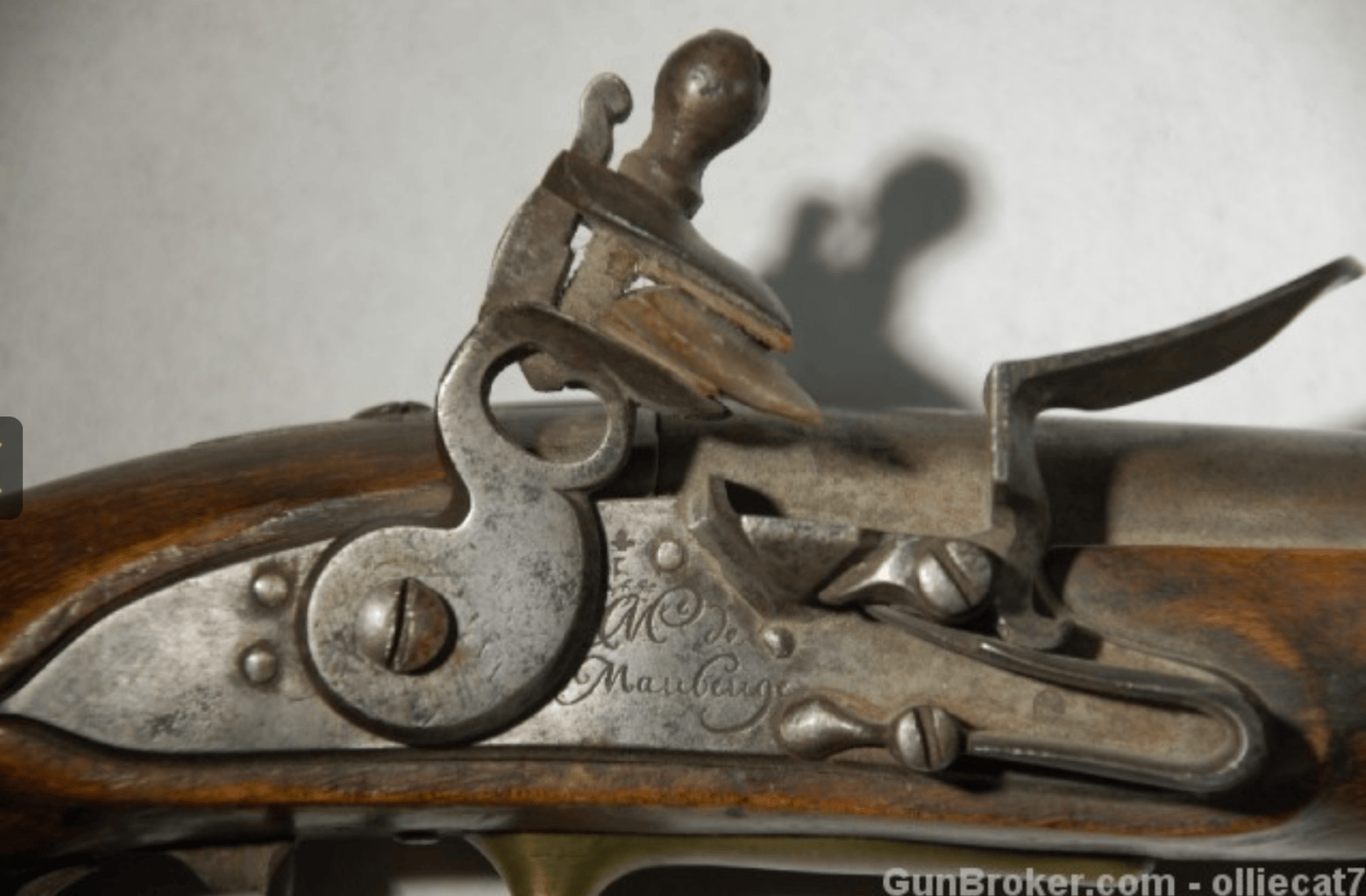
French Model 1763 Flintlock Pistol. Manufactured at the Maubeuge Royal Armoury. From my personal collection.
The French Model 1763 flintlock pistol was introduced to equip cavalry and mounted troops of the Royal French Army at the end of the Seven Years’ War. Manufactured at the Maubeuge Royal Armoury, it was a single-shot, smoothbore pistol of approximately .69 calibre with brass furniture and steel ramrod. Designed for close-range mounted combat, it complemented sabre use during shock action. Lockplates were marked with the royal cypher and manufactory stamp, identifying origin and inspection. The Model 1763 reflects early efforts at standardisation within the Ancien Régime military system and remained in service through the American War of Independence.
Austrian Weapons of the Seven Years War
Model 1754 Austrian musket. From my personal collection.
The Austrian Model 1754 musket was the Habsburg Army’s standard .70-calibre infantry weapon during the War of Austrian Succession and the early Seven Years War. Built at Vienna and regional armouries, it featured a robust lock, wooden ramrod, and long barrel optimised for line-volley fire. Although heavier than contemporary Prussian muskets, it was durable and capable of sustained battlefield use. The M1754 armed the bulk of Austrian infantry battalions in Bohemia, Silesia, and Saxony.
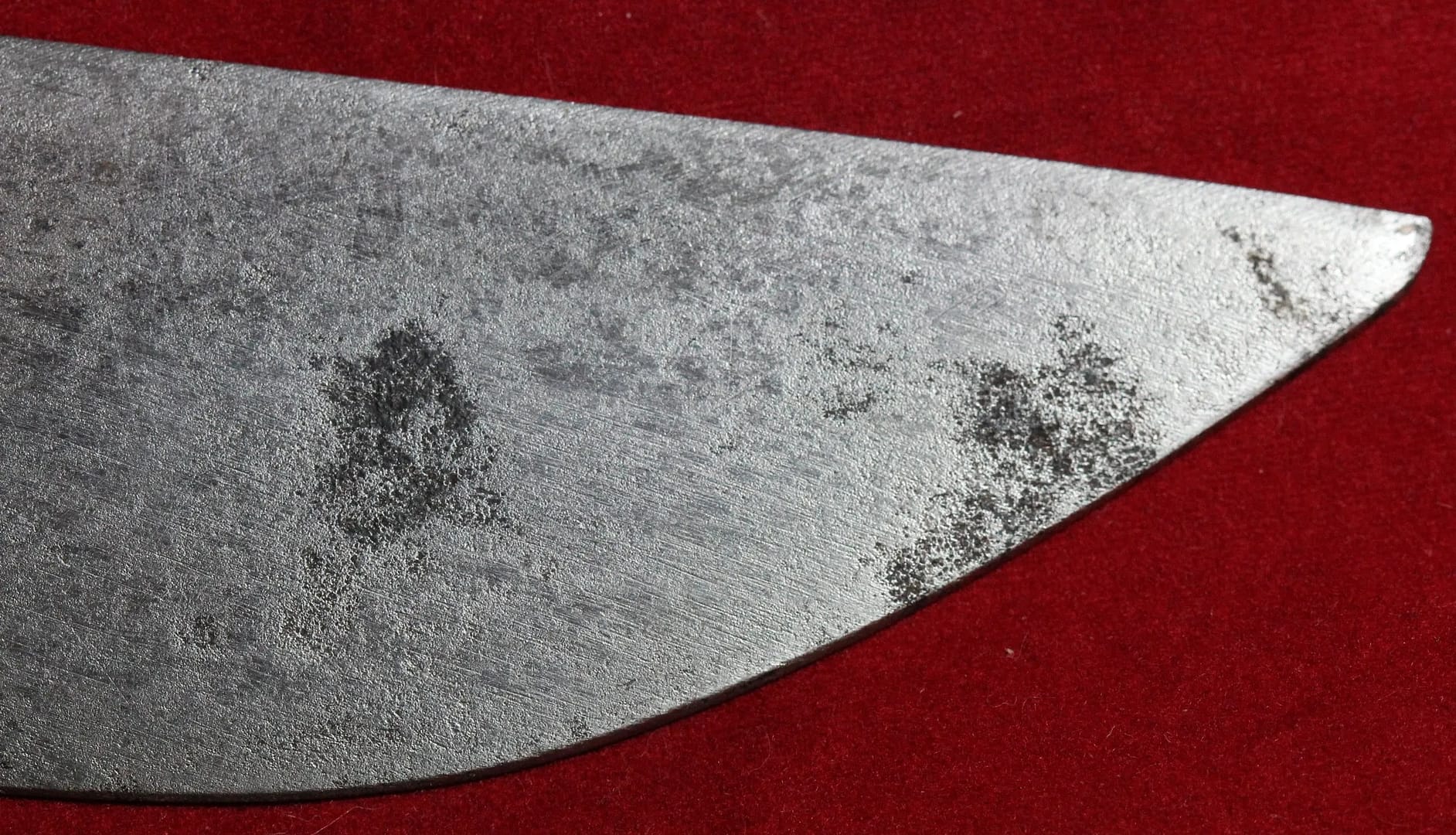
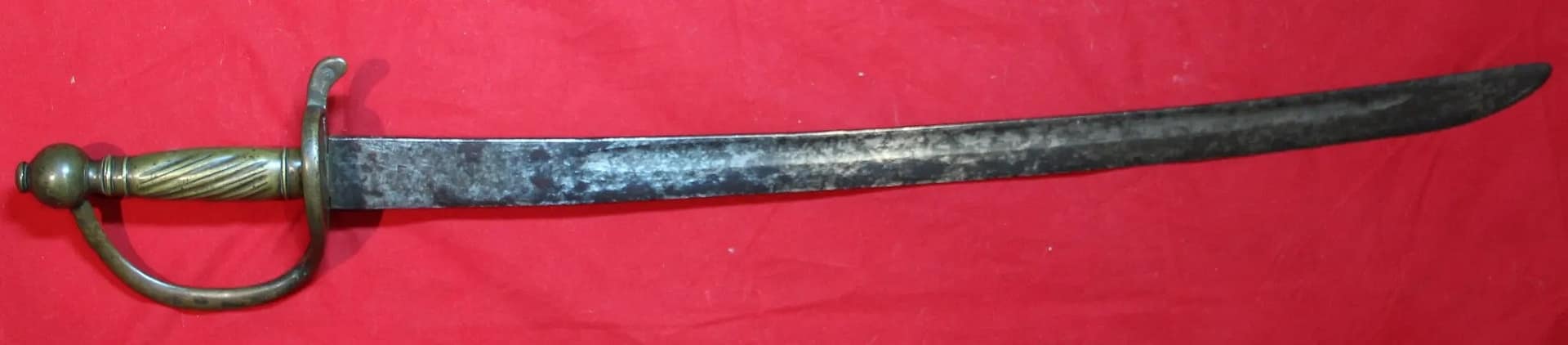
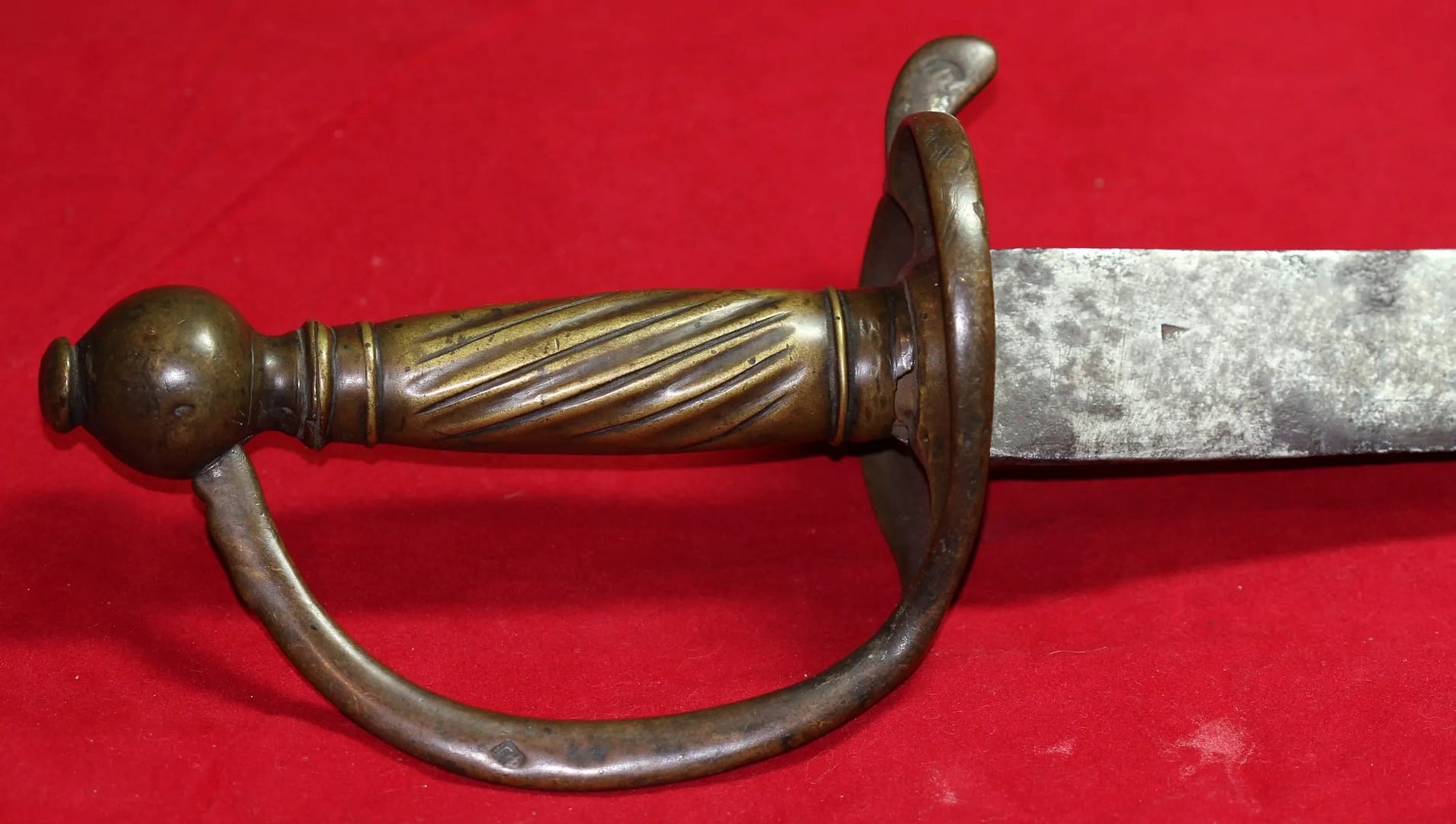
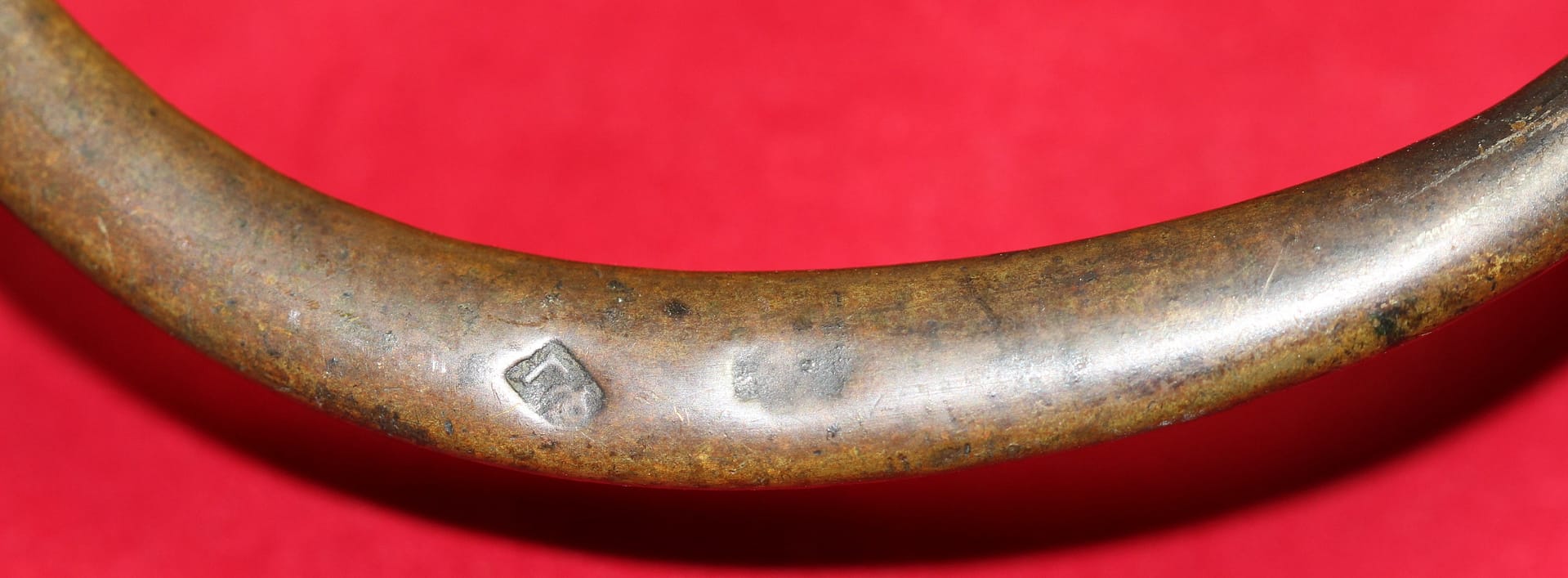
Circa 1760 Austrian Infantry hanger. From my personal collection.
The Austrian infantry hanger of circa 1760 was issued to grenadiers and chosen men during the Seven Years War. Featuring a broad, slightly curved blade and brass hilt with simple knucklebow, it was intended for close-in fighting where long muskets were unwieldy. Austrian hangers followed Germanic military design traditions and complemented the M1754 musket. Though increasingly ceremonial by the late 18th century, they remained practical weapons during the Silesian and Bohemian campaigns.
Russian Weapons of the Seven Years War
Circa 1760 Russian infantry hanger. From my personal collection.
This mid-18th-century Russian infantry hanger features a curved blade and brass hilt in the style used by Elizabethan and early Catherine-era regiments. Carried by NCOs, grenadiers, and line infantry, hangers supplemented muskets during close combat and were used extensively in the Seven Years War against Prussia. Their design reflects Central and Eastern European influences, including Polish sabre traditions and earlier Russian shashka forms.
Found this useful? Buy me a coffee — it helps fund future battlefield research
Authored by Mick Prictor, a retired military officer with 40 years’ service, and a military historian specialising in terrain-focused analysis of tactics, doctrine, and command decision-making in land warfare. His work draws on extensive battlefield fieldwork—more than 280 sites worldwide—and one of the world’s largest private collections of historic military arms, uniforms, and equipment. About me
What weapons were most commonly used in the Seven Years’ War?
The war was fought primarily with smoothbore flintlock muskets such as the Pattern 1742 and 1756 British Brown Bess, French Model 1746, 1754, 1763 Charleville patterns, and Prussian Mod 1740 infantry muskets. These were supported by socket bayonets, muzzle-loading artillery, and cavalry swords. The basic infantry weapons were broadly similar across European armies.
Why are smoothbore muskets important in understanding the war?
Smoothbore flintlock muskets defined how battles were fought, shaping linear tactics, close-order formations, and controlled volleys. Their limited range and accuracy made discipline, drill, and coordinated firepower essential to battlefield success.
Did weapons change during the Seven Years’ War?
Yes. Although armies began the war with established flintlock systems, operational experience led to improvements. British forces shortened musket barrels after fighting in North America, while artillery and logistical reforms reflected the increasing importance of firepower and mobility.
How important was artillery in the Seven Years’ War?
Artillery played a growing role throughout the conflict. By 1763, guns formed a larger proportion of field armies than at the start of the war, reflecting improvements in organisation, mobility, and battlefield integration.
What role did Prince Liechtenstein play in military reforms?
After observing the superior Prussian artillery at Chotusitz and other battles, Prince Joseph Wenzel of Liechtenstein was instrumental in developing Austrian artillery reforms that emphasised standardisation, mobility, and improved organisation, influencing artillery practice across Europe.
Were rifles used during the Seven Years’ War?
Rifles were used in limited numbers, primarily by specialist light infantry units and frontier troops, particularly in North America. However, the vast majority of soldiers were equipped with smoothbore muskets.
How did the Seven Years’ War influence later military development?
The war represents the mature phase of linear warfare and demonstrated the importance of professional standing armies, disciplined firepower, and artillery coordination. Lessons learned influenced military reforms in the late eighteenth century.
What does this collection show about the war?
The artefacts illustrate how soldiers were equipped and supplied during the conflict and highlight the dominance of the flintlock system alongside the growing importance of artillery and logistical organisation.
Subscribe to Battlefield Travels and receive a free E-Book Battlefield Guide
Unlock expert battlefield analysis, campaign reconstructions, and historical insights drawn from firsthand exploration and primary sources.
🗺️ You’ll receive:
🎖️ Exclusive historical insights you won’t find elsewhere
📘 A free eBook: 10 Tips for Exploring Historic Battlefields
📰 New battlefield studies straight to your inbox as they are published
Claim Your Free Battlefield Travel Guide
Get your free e-book, exclusive tips, and updates on new battlefield studies.
Thank you!
You have successfully joined our subscriber list.
⚔️ Go deeper — Members get exclusive access to the Deep Research Collection, Field Notes, and monthly Research Dispatches. Try membership free for 7 days, cancel anytime. From $9/month.
The Battle of Leuthen, 5 December 1757, is one of the great battles of history, students of military history would consider it somewhat of a pilgrimage to visit this site. After defeating a Fench/Imperial Army of almost twice its size at the Battle of Rossbach a month earlier, Frederick’s Army had marched 275km in 12 days to confront the Austrian Army in Silesia. Frederick’s 33,000 troops faced Prince Charles of Lorraine and his 65,000 Austrian troops near the village of Leuthen.
Selected works from classic and modern strategists
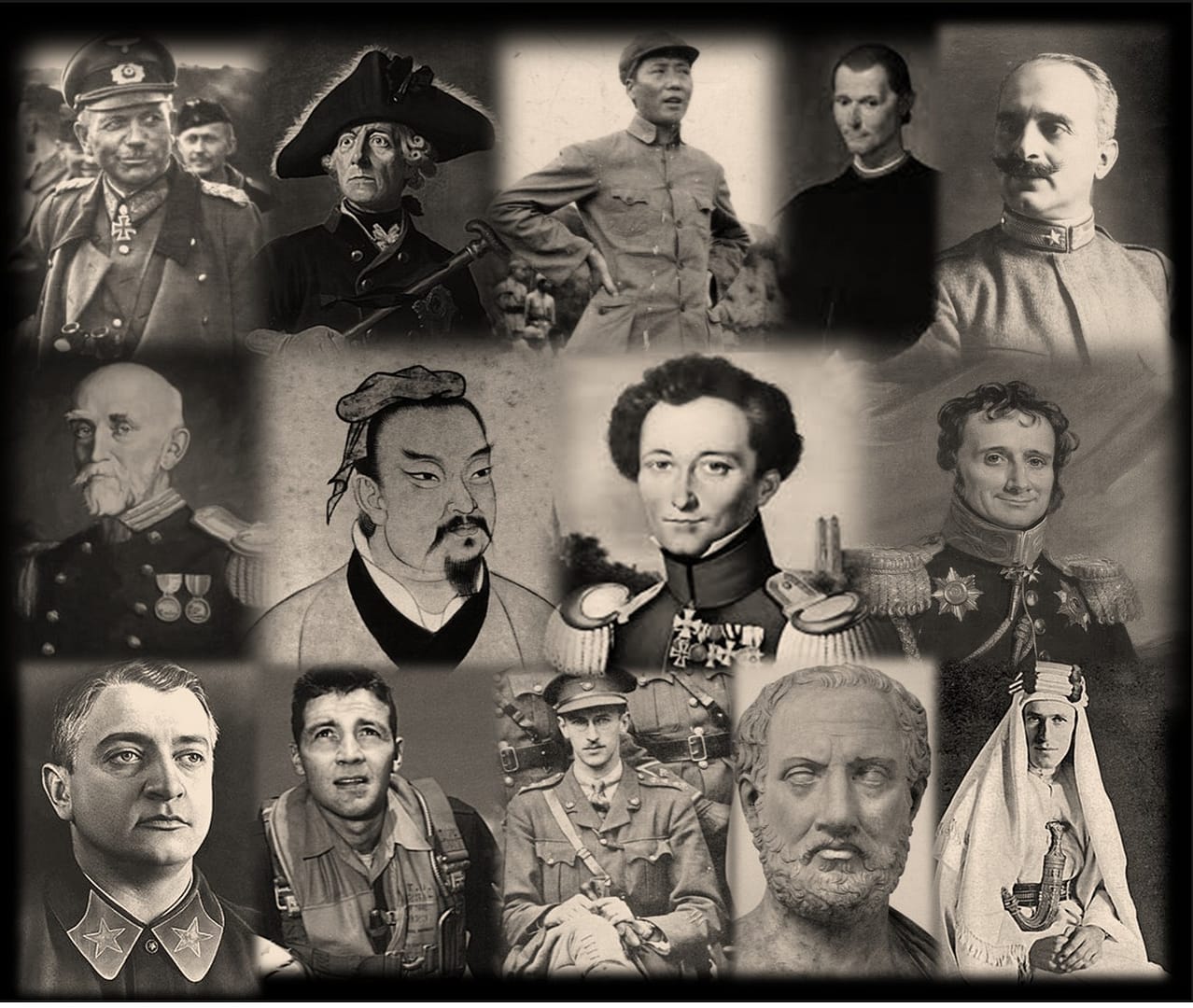
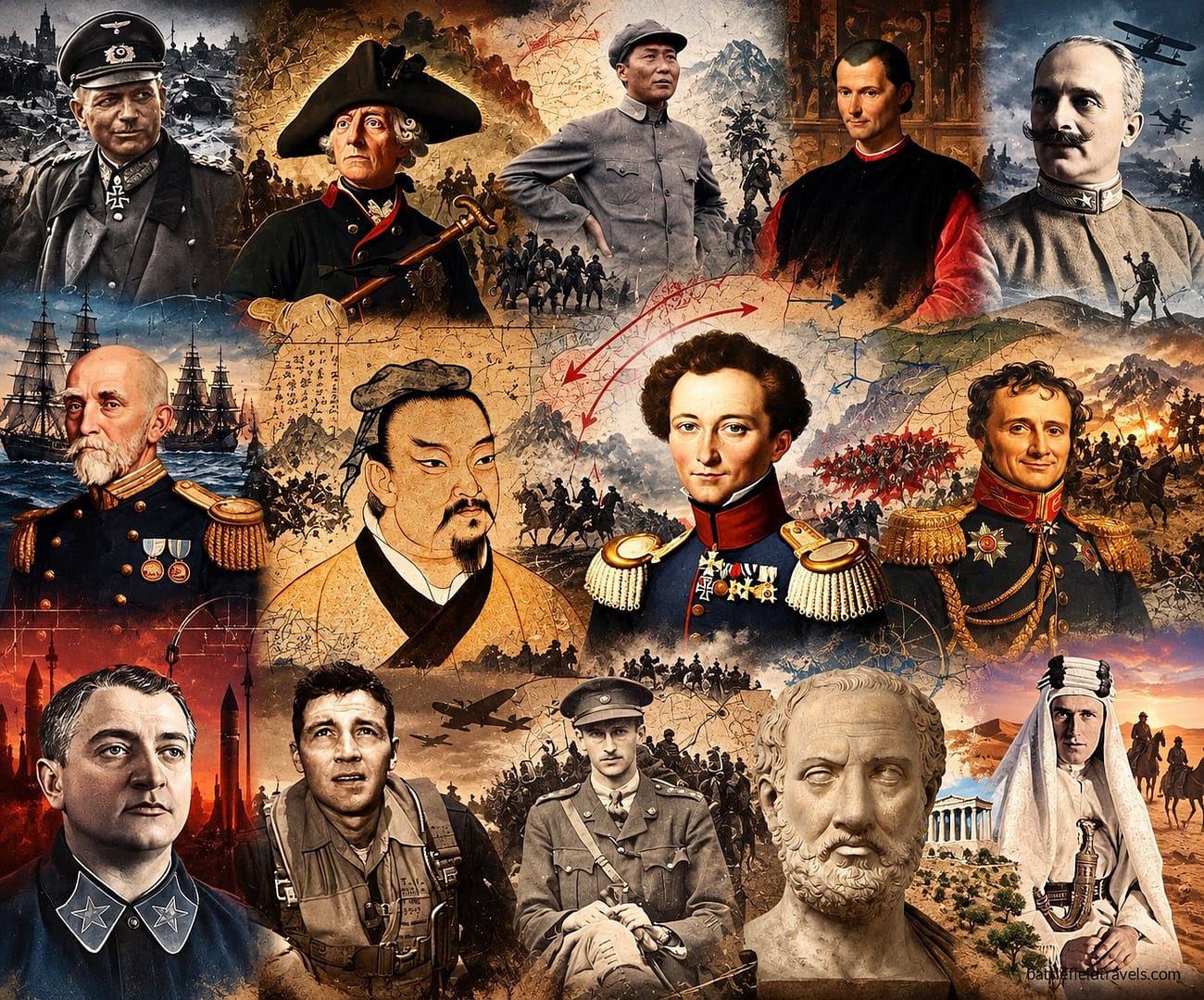
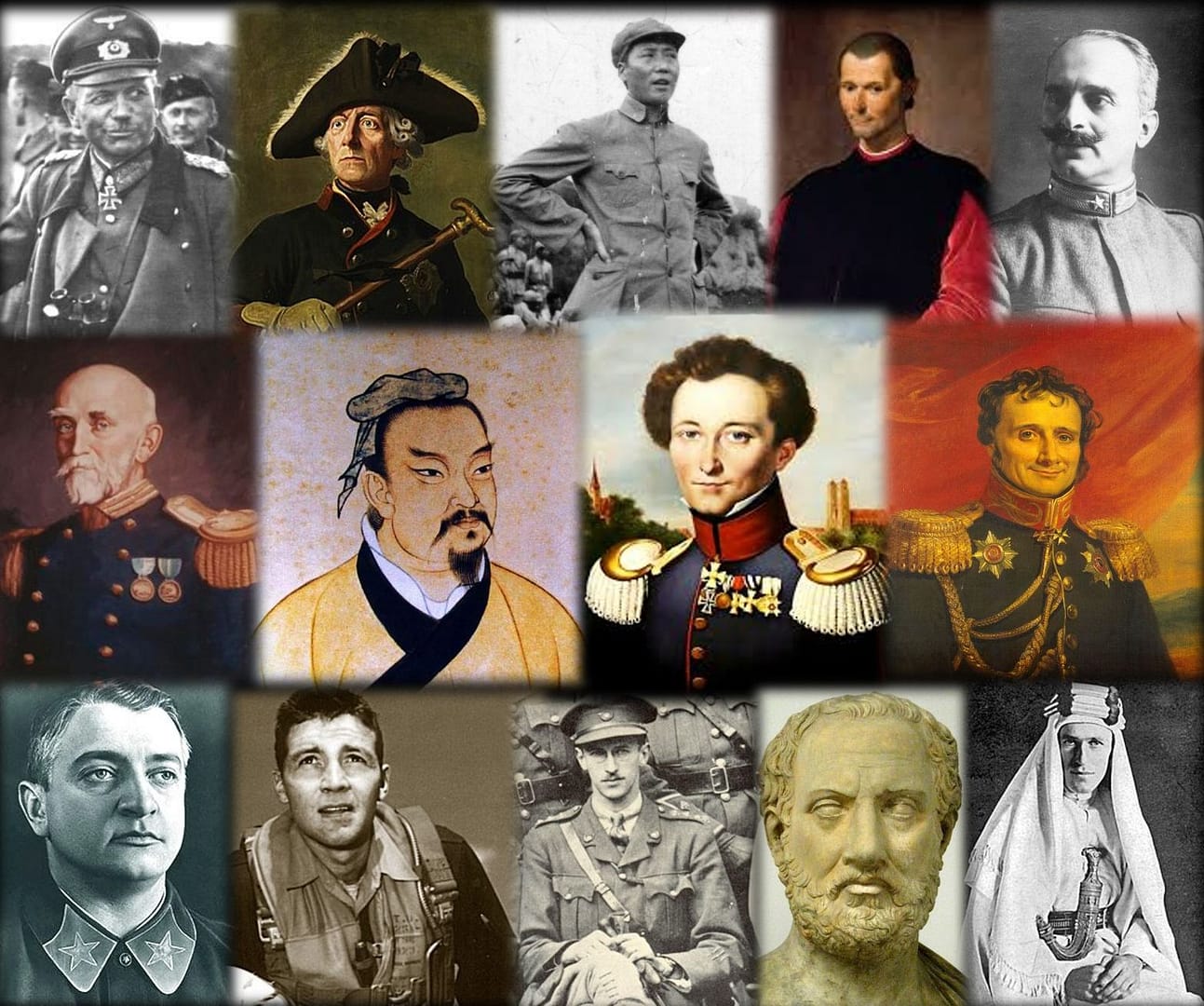
Classic war theorists and strategists – Top Row: Guderian, Frederick, Mao Zedong, Machiavelli, Douhet. Middle Row: Mahan, Sun Tzu, Clausewitz, Jomini. Bottom Row: Tukachevskii, Boyd, Liddell-Hart, Thucydides, T.E. Lawrence
War Theory, Strategy, and Concepts
Understanding battles and campaigns requires more than just describing tactics, troop movements or cataloguing orders of battle. The studies on BattlefieldTravels emphasise how terrain, doctrine, command culture, technology, and strategic intent interact to shape outcomes.
This page gathers the core works of strategic thought that underpin that analytical approach. These books explore why commanders choose certain courses of action, how armies adapt (or fail to adapt), and how states pursue political objectives through military means.
Together, they offer the conceptual framework that supports every battlefield study on this site, from Frederick the Great’s mastery of manoeuvre to the operational crises of Route Coloniale 4, and from Teutoburg Forest’s ambush dynamics to the doctrinal failures at Isandlwana and Chancellorsville.
Jomini’s writings, for example, exerted a powerful influence on nineteenth-century professional military education and provide important context for understanding the operational thinking of American Civil War commanders such as Grant, Lee, McClellan, Sherman and Jackson. In the twentieth century, theorists including J.F.C. Fuller explored the possibilities created by mechanisation, while Heinz Guderian developed ideas about concentrated armoured forces, radio communications and combined-arms operations in Achtung—Panzer!. In the Soviet Union, Mikhail Tukhachevskii and other Red Army theorists developed concepts of operations in depth that contributed to the evolution of Deep Battle and later Soviet operational art.
Use these works not just as reading material, but as tools: lenses through which to interpret decisions, understand miscalculations, and evaluate battles on the ground.
Start with the books below. Explore the thinkers and theories that shaped the conduct of war, then come back to examine how those ideas were translated into battlefield practice — or put your knowledge to the test
💡 Military Innovation & Adaptation Hub
Throughout history, armies have faced the same fundamental challenge: how to defeat an enemy who is trying to do exactly the same thing to them. Weapons change, technology evolves, but the fundamental problems of the battlefield remain remarkably consistent.
Sixty questions spanning more than two thousand years of military thought — from Vegetius and Ardant du Picq, to Mahan, Douhet, Boyd, and nuclear deterrence. Test your knowledge of the thinkers, theories and strategic ideas that influenced how commanders understood, planned and conducted warfare.
The reference collection below includes the key books and references on war theory and strategy I have used in preparing for and undertaking studies of conflicts and campaigns. Many of the older references have passed beyond their copyright (generally 95 years), so are available free via various sources.
Internet Archive – Public-domain editions of Clausewitz, Jomini, and Machiavelli.
Project Gutenberg – English translations of Sun Tzu, Thucydides, and early theorists.
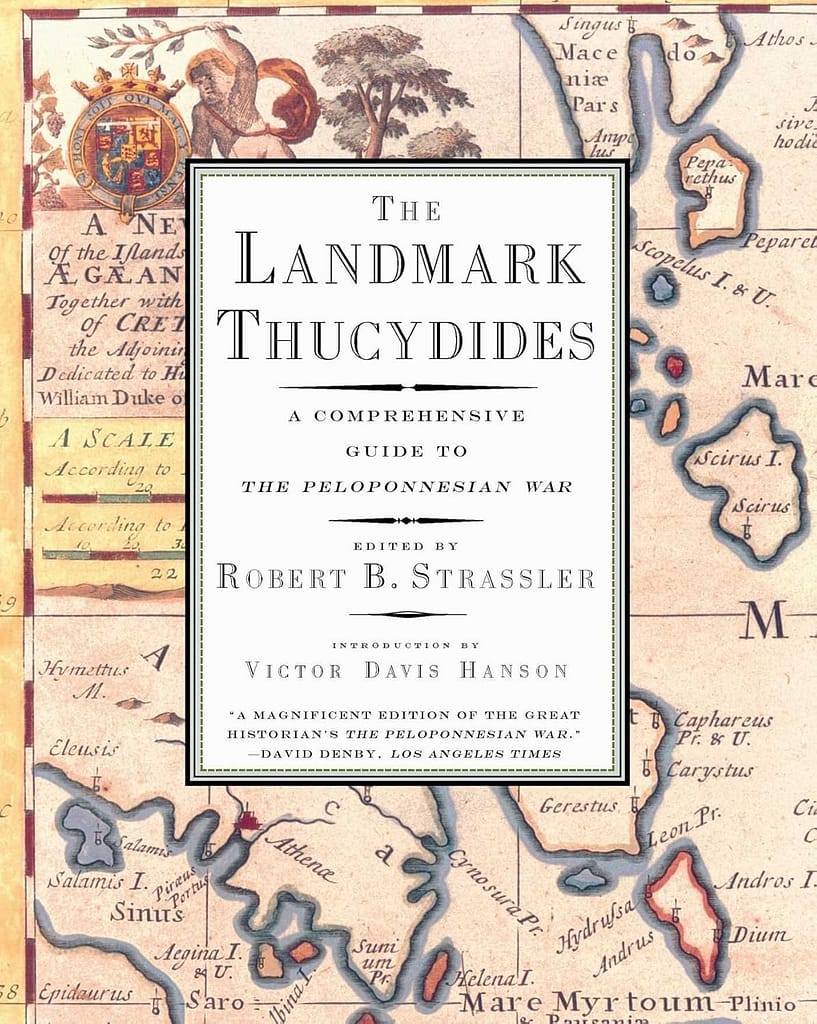
Thucydides’ monumental account of the Peloponnesian War (432BC – 404BC) remains the earliest rigorous analysis of power politics, strategic motivation, leadership failure, and the psychology of conflict. His narrative combines eyewitness detail with a reflective, almost clinical examination of why states go to war and how fear, honour, and interest shape their choices. The famous speeches — Melian Dialogue, Pericles’ Funeral Oration, the Mytilene Debate — reveal how democracies and autocracies rationalise war and grapple with strategic necessity.
Written around 2,500 years ago, The Art of War remains a concise and timeless treatise on deception, intelligence, adaptability, and using an enemy’s weaknesses against them. Sun Tzu focuses on achieving victory with minimal cost, often through indirect approaches, surprise, and careful preparation. Though brief, the work remains widely read across military, political, and business spheres.
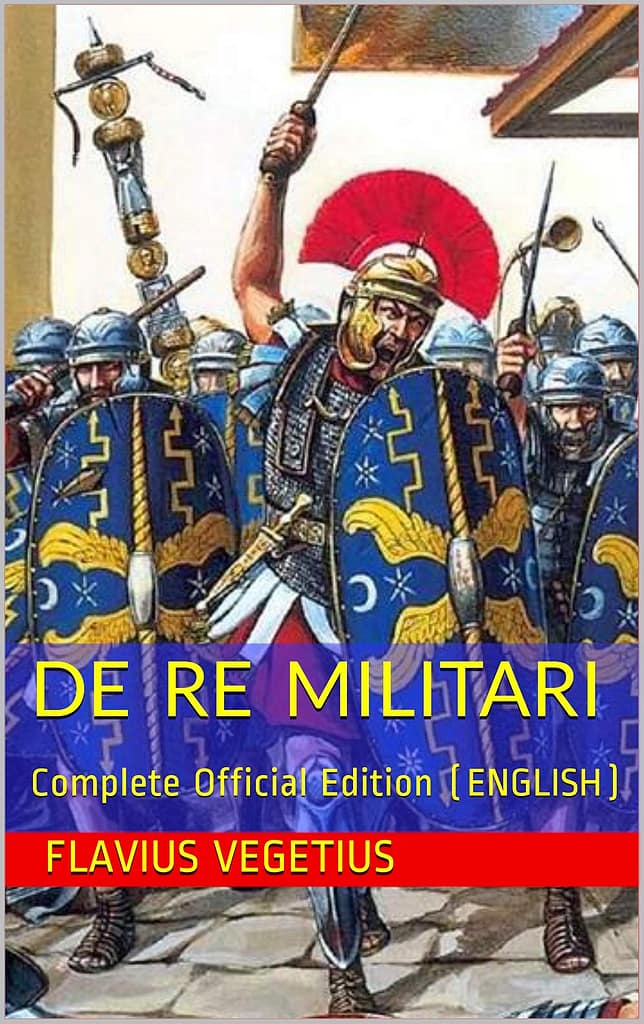
De Re Militari by Vegetius explains how the Romans organized their armies, battles, sieges, and war strategies. De Re Militari is essential to understand European strategy and war due to the fact that, besides describing the military might of Rome in practical terms, it was also used by generals and rulers in the next centuries and the Middle Ages to organize European armies, conduct sieges, reinforce castles, train soldiers, and conquer enemy nations.
Machiavelli’s lesser-known military treatise complements The Prince with a practical examination of armies, discipline, leadership, logistics, and civic virtue. Drawing heavily on Roman precedent, he argues that the character of an army reflects the character of its state, and that citizen militias — disciplined, patriotic, cohesive — provide the firmest foundation for military strength.
Baron Antoine-Henri Jomini was the most influential military theorist of the 19th century, shaping the education, operational thinking, and campaign planning of an entire generation of commanders. Drawing on his service under both Napoleon and Tsar Alexander I, Jomini sought to distil the “science” of warfare into clear, prescriptive rules. Summary of the Art of War outlines his central ideas: lines of operation, bases, decisive points, interior lines, the importance of concentration, and the strategic offensive supported by tactical defensive advantage. Jomini wrote with the confidence of someone convinced that warfare followed predictable, almost geometric principles.
Clausewitz’s unfinished masterpiece remains the cornerstone of modern strategic thought. Drawing on his experience in the Napoleonic Wars, Clausewitz explored the nature of war as a political instrument, shaped by uncertainty, friction, moral forces, and the reciprocal interaction between opposing wills. Far from a simple manual, On War is a philosophical examination of how war is used as an instrument of policy and why wars unfold as they do.
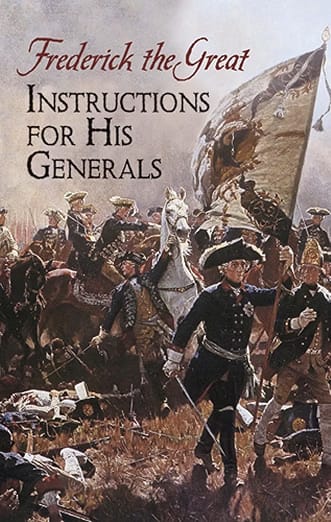
“War is not an affair of chance,” Frederick asserted, adding that “a great deal of knowledge, study, and meditation is necessary to conduct it well.” In this book, he presents the fundamentals of warfare, discussing such timeless considerations as leadership qualities, the value of surprise, and ways to conquer an enemy who possesses superior forces.
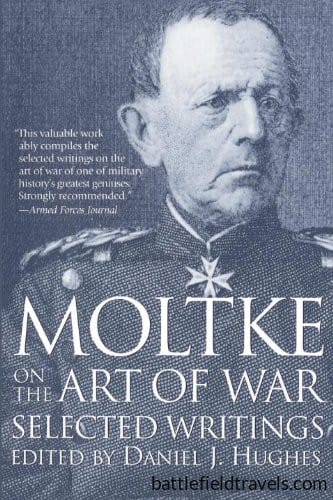
Field Marshal Helmuth Graf von Moltke is best known for his direction of the German/Prussian campaigns against Austria in 1866 and France in 1870-71, yet it was during his service as chief of the General Staff that he laid the foundation for the German way of war which would continue through 1945.
Mahan argued that maritime power — fleets, commerce, naval bases, and sea lines of communication — is the determining factor in national strength. His book reshaped global policy, influencing Britain, Japan, Germany, and the United States.While focused on naval strategy, Mahan’s themes of logistics, projection, and communications have direct application to my battle studies, especially where a sea campaign projects seamlessly into a land campaign as in the D-Day landings in 1944, and other expeditionary and amphibious operations.
Douhet was the first major theorist to argue that airpower could win wars independently by striking directly at an enemy’s population, infrastructure, and morale. He viewed the bomber as an unstoppable strategic weapon that would render surface warfare secondary. While many of his predictions proved exaggerated, his book spurred decades of strategic bombing doctrine and continues to influence airpower theory today.
After first-hand experience of the ‘direct approach’ on the western front in WW1, Basil Liddell Hart believed there must be a better strategy than pitting your own strength against an enemy’s strength. He found his answers in history. He argued that the most successful commanders — from Epaminondas to T.E. Lawrence — used an indirect approach that sought to dislocate rather than destroy the enemy. His sweeping historical survey highlights psychological, operational, and logistical dimensions often overlooked by traditional military historians.
Strategy in the Missile Age first reviews the development of modern military strategy to World War II, giving the reader a reference point for the radical rethinking that follows, as Dr. Brodie considers the problems of the Strategic Air Command, of civil defense, of limited war, of counterforce or pre-emptive strategies, of city-busting, of missile bases in Europe, and so on. The book, unlike so many on modern military affairs, does not present a program or defend a policy, nor is it a brief for any one of the armed services. It is a balanced analysis of the requirements of strength for the 1960’s, including especially the military posture necessary to prevent war.
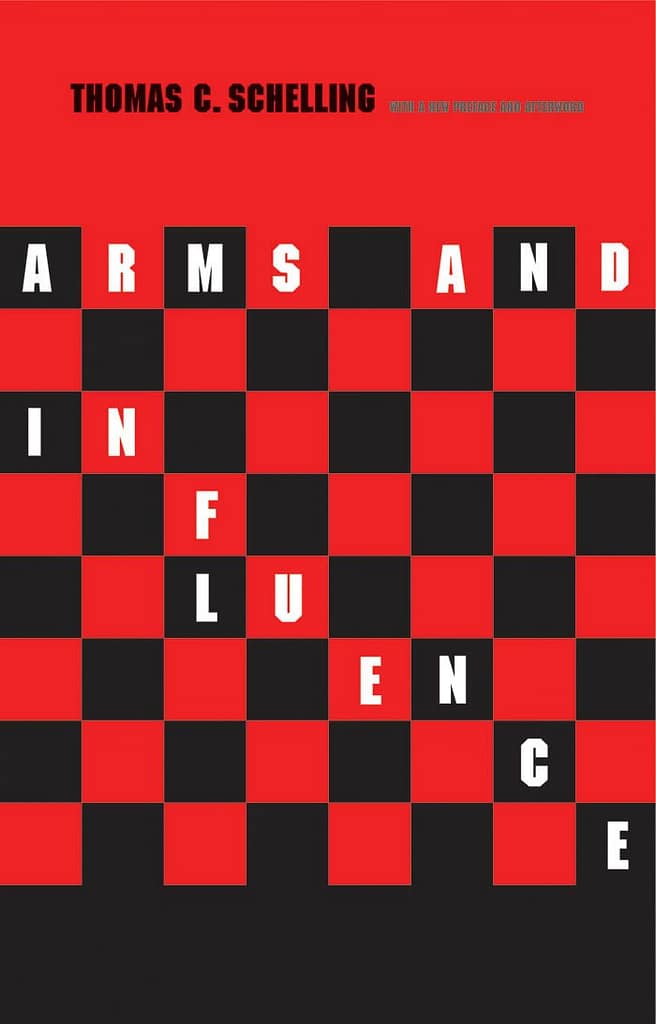
Traditionally, Americans have viewed war as an alternative to diplomacy, and military strategy as the science of victory. Today, however, in our world of nuclear weapons, military power is not so much exercised as threatened. It is,Mr. Schelling says, bargaining power, and the exploitation of this power, for good or evil, to preserve peace or to threaten war, is diplomacy—the diplomacy of violence. He sees the steps taken by the U.S. during the Berlin and Cuban crises as not merely preparations for engagement, but as signals to an enemy, with reports from the adversary’s own military intelligence as our most important diplomatic communications.
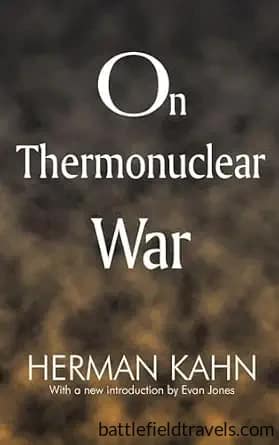
We studied this at Army War College – and the clinical discussion of global annihiliation is deeply disturbing.
On Thermonuclear War was controversial when originally published and remains so today. It is iconoclastic, crosses disciplinary boundaries, and finally it is calm and compellingly reasonable. The book was widely read on both sides of the Iron Curtain. As a result, both sides were better able to avoid disaster during the Cold War. Kahn’s stated purpose in writing this book was simply: “avoiding disaster and buying time, without specifying the use of this time.” By the late 1950s, with both sides H-bomb-armed, reason and time were in short supply.
John Boyd served as a fighter pilot and instructor during the Korean War, and it was in the cockpit that he first developed his uncompromising views on what a true air-combat fighter should be – fast, agile, minimalist, and able to seize initiative in a constantly shifting environment. From this experience, he distilled a model of decision-making that became the foundation of his strategic legacy: the OODA Loop (Observe–Orient–Decide–Act).
Van Creveld examines the evolution of command systems from ancient times to the late 20th century, analysing how information, uncertainty, logistics, and organisational culture constrain or empower commanders. A landmark study in command-and-control theory.
Van Creveld’s insights into the ever increasing demand for information and the ever increasing size of teh headquarters needed to process the information, with all the internal friction that creates, is deeply insightful.
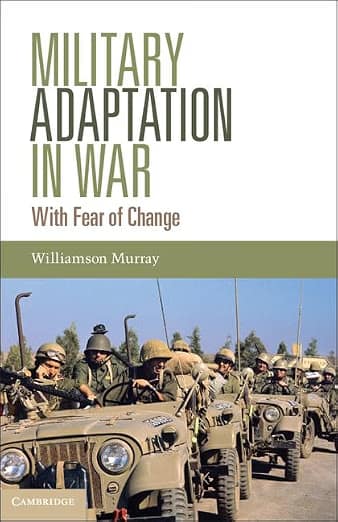
Military Adaptation in War addresses one of the most persistent, yet rarely examined, problems that military organizations confront: namely, the problem of how to adapt under the trying, terrifying conditions of war. This work builds on the volume that Professor Williamson Murray edited with Allan Millett on military innovation (a quite different problem, though similar in some respects).
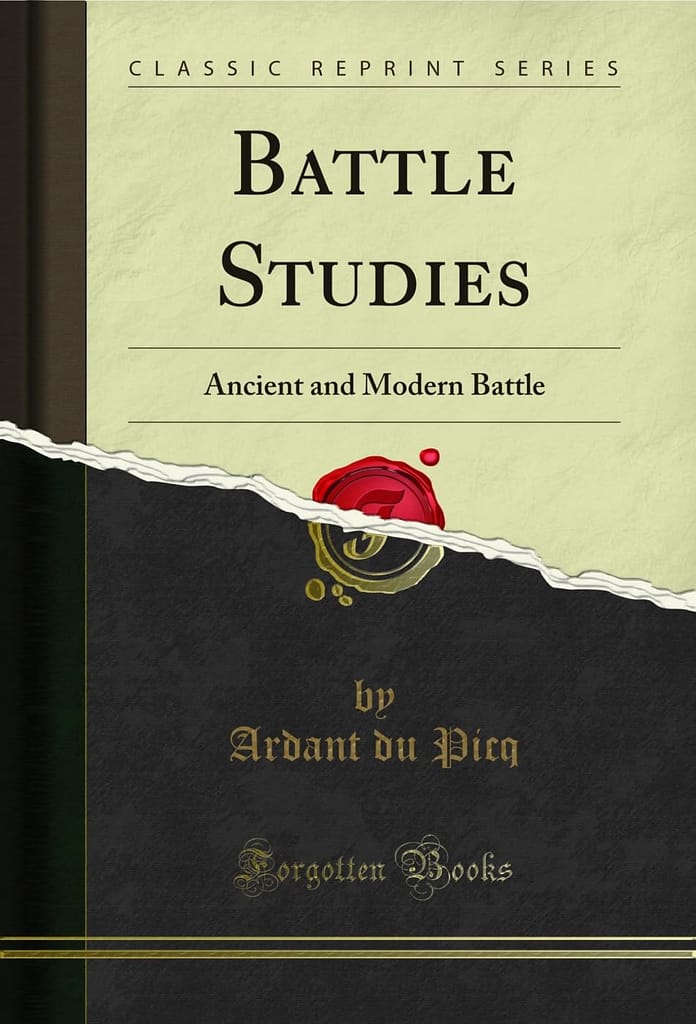
Universal truths of war endure: the human element shapes victory as powerfully as any instrument of battle. In this classic study, Ardant du Picq argues that timeless courage, endurance, and judgment drive outcomes on every field of battle, from antiquity to modern frontlines. This edition makes his penetrating insights accessible to today’s reader, linking past lessons to the realities of warfare across eras.
Fuller was one of the earliest proponents of armoured warfare, arguing that mechanisation would reorder the entire battlefield: tempo, shock, mobility, and operational reach. The Foundations on the Science of War articulates his effort to give warfare a systematic, almost scientific framework. His ideas heavily influenced pre-WW2 armoured theorists on both sides of the Atlantic — and were studied closely in Germany.
After observing the systemic paralysis suffered by the Austro-Hungarian Army during the 1916 Brusilov Offensive, Mikhail Tukhachevskii, along with Triandafillov and Isserson, developed the Soviet doctrine of Deep Battle and Deep Operations, arguing that modern war required simultaneous penetration across the tactical, operational, and strategic depths of an enemy defensive system. His ideas emphasised massive mechanised formations, break-in forces, break-through forces, exploitation forces, air-mechanised forces, tempo, operational shock, and the destruction of an enemy’s system rather than its frontline.
Guderian synthesised the ideas of Fuller, Liddell Hart, and early German mechanisation experiments into a clear argument for armoured concentration, radio-enabled command, and combined arms manoeuvre. Achtung Panzer! outlines the conceptual roots of German Blitzkrieg successes and reflects Guderian’s operational experience and doctrinal evangelism.
Mao’s military writings codified the principles of protracted revolutionary warfare: the integration of political and military struggle, the use of the population as a strategic base, and the idea that guerrilla forces can evolve into conventional armies once conditions allow. His doctrine shaped insurgencies worldwide and remains influential in both military and political science.
Roger Trinquier undertook three tours in Indochina, progressively developing his ideas for defeating a communist inspired insurgency. In his third tour in 1951-53. he led a Groupement de Commandos Mixtes Aéroportés (GCMA) , operating behind enemy lines with locally recruited commandos. He later served multiple tours in Algeria and assumed command of the legendary 3rd Colonial Parachute Regiment when Marcel Bigeard was recalled to France. After leaving the French Army, Trinquer was hired by Moise Tshombe in 1961 during Katanga’s attempted succession from the Congo.
This volume in the Praeger Security International (PSI) series Classics of the Counterinsurgency Era defines the laws of insurgency and outlines the strategy and tactics to combat such threats. Drawn from the observations of a French officer, David Galula, who witnessed guerrilla warfare on three continents, the book remains relevant today as American policymakers, military analysts, and members of the public look to the counterinsurgency era of the 1960s for lessons to apply to the current situation in Iraq and Afghanistan.
My Staff College colleague David Kilcullen analyses modern insurgencies through the lens of anthropology, terrain, culture, and political dynamics. He argues that insurgencies often emerge not from grand anti-Western ideology but from local grievances and accidental alignments. His work blends field experience in Iraq, Afghanistan, Southeast Asia, and Africa into a coherent theory of modern irregular warfare.
S. L. A. “Slam” Marshall was a veteran of World War I and a combat historian during World War II. He stunned the military and civilian world in 1947 by announcing that, in an average infantry company, no more than one in four soldiers actually fired their weapons while in contact with the enemy. His contention was based on interviews he conducted immediately after combat in both the European and Pacific theatres of World War II. Marshall’s work led to fundamental changes in the way armies trained for war, even down to the type of targetry used for range practices. By the time of the Vietnam War, the new training methods had changed the experience of battle.
John Keegan’s groundbreaking portrayal of the common soldier in the heat of battle is a masterpiece that explores the physical, psychological and experiential aspects of warfare. The Face of Battle is military history from the battlefield: a look at the direct experience of individuals at the “point of maximum danger.” Without the myth-making elements of rhetoric and xenophobia, and breaking away from the stylised format of battle descriptions, John Keegan has written what is probably the definitive model for military historians.
Through interviews, historical accounts, and numerous years of research, Richard Holmes examines the behaviour of men in battle through the course of war. In this compelling attempt to explain the nature of war, the experience of a soldier during the days of battle is revealed. Acts of War takes readers through a soldier’s experience from beginning to end—starting with the tribulations of basic training to the terror and exhaustion of battle.
The essays in this volume analyse war, its strategic characteristics, and its political and social functions over the past five centuries. The diversity of its themes and the broad perspectives applied to them make the book a work of general history as much as a history of the theory and practice of war from the Renaissance to the present. Makers of Modern Strategy from Machiavelli to the Nuclear Age takes its title from an earlier collection of essays that became a classic of historical scholarship.
The wars since 9/11, both in Iraq and Afghanistan, have generated frustration and an increasing sense of failure in the West. Much of the blame has been attributed to poor strategy. In both the United States and the United Kingdom, public enquiries and defence think tanks have detected a lack of consistent direction, of effective communication, and of governmental coordination. In this important book, Sir Hew Strachan, one of the world’s leading military historians, reveals how these failures resulted from a fundamental misreading and misapplication of strategy itself.
The range of Freedman’s narrative is extraordinary, moving from the surprisingly advanced strategy practiced in primate groups, to the opposing strategies of Achilles and Odysseus in The Iliad, the strategic advice of Sun Tzu and Machiavelli, the great military innovations of Baron Henri de Jomini and Carl von Clausewitz, the grounding of revolutionary strategy in class struggles by Marx, the insights into corporate strategy found in Peter Drucker and Alfred Sloan, and the contributions of the leading social scientists working on strategy today.
Why do we try to use military force to solve our political problems? And why, when our forces win the military battles, does this still fail to solve those problems? It is because the force lacks utility. From Iraq to the Balkans, and from Afghanistan to Chechnya, over the past fifteen years, there has been a steady stream of military interventions that have not delivered on their promise for peace, or even political resolution. The Utility of Force explains this anomaly at the heart of our current international system.
Found this useful? Buy me a coffee — it helps fund future battlefield research
Authored by Mick Prictor, a retired military officer with 40 years’ service, and a military historian specialising in terrain-focused analysis of tactics, doctrine, and command decision-making in land warfare. His work draws on extensive battlefield fieldwork—more than 280 sites worldwide—and one of the world’s largest private collections of historic military arms, uniforms, and equipment. About me
FAQ – War theory, strategy, and concepts Reading Room
What is the focus of the War Theory and Strategy section?
This section presents foundational and modern works that explain how military thinkers have understood and conducted war, from Sun Tzu and Clausewitz to Liddell Hart, Keegan, and contemporary theorists.
How does this material relate to the battlefield studies?
These texts provide the theoretical framework for interpreting command decisions, doctrine, and operational culture across the campaigns analysed on this site. They supply the “why” behind battlefield outcomes.
Can I purchase or access the listed books online?
Yes. Most titles are linked through Amazon and other digital libraries such as Project Gutenberg and Internet Archive. As an Amazon Associate, this site earns from qualifying purchases at no extra cost to readers.
Subscribe to Battlefield Travels and receive a free E-Book Battlefield Guide
Unlock expert battlefield analysis, campaign reconstructions, and historical insights drawn from firsthand exploration and primary sources.
🗺️ You’ll receive:
🎖️ Exclusive historical insights you won’t find elsewhere
📘 A free eBook: 10 Tips for Exploring Historic Battlefields
📰 New battlefield studies straight to your inbox as they are published
Claim Your Free Battlefield Travel Guide
Get your free e-book, exclusive tips, and updates on new battlefield studies.
Thank you!
You have successfully joined our subscriber list.
⚔️ Go deeper — Members get exclusive access to the Deep Research Collection, Field Notes, and monthly Research Dispatches. Try membership free for 7 days, cancel anytime. From $9/month.
Selected works on the Seven Years War and the campaigns of Frederick the Great
Battle of Leuthen, Prussian Grenadiers assault on the Churchyard
Overview of the Seven Years War
The Seven Years War (1756–1763) was the first truly global conflict of the modern era, fought simultaneously in Europe, North America, the Caribbean, West Africa, and India. Sometimes described as the “world’s first world war,” it pitted Britain and Prussia against France, Austria, Russia, and Spain, with alliances shifting as the fighting spread across continents.
In Europe, the war was marked by Frederick the Great’s campaigns, where the Prussian army fought desperately for survival against numerically superior enemies. Battles such as Lobositz (1756), Rossbach (1757), Leuthen (1757), and Kunersdorf (1759) highlighted the discipline and tactical innovation that made Prussia a major power. Britain, meanwhile, waged its own global war at sea and in the colonies, fighting against France in Canada, the Caribbean, and India, including the Battle of Bushy Run (1763) and the Siege of Fort William Henry (1757).
The Seven Years’ War re-shaped the balance of power. Britain emerged as the dominant naval and colonial empire, while Prussia cemented its role as a central European power. The uniforms, muskets, artillery, and equipment of this period reflect the professionalisation of 18th-century armies, from Prussian grenadiers to French musketeers and British redcoats.
The Amazon links on the Reading Room pages are powered by AAWP
Reading
The reference collection below includes the key books and references I have used in preparing for and undertaking battlefield studies all over the world.
In this engrossing narrative of the great military conflagration of the mid-eighteenth century, Fred Anderson transports us into the maelstrom of international rivalries. With the Seven Years’ War, Great Britain decisively eliminated French power north of the Caribbean — and in the process destroyed an American diplomatic system in which Native Americans had long played a central, balancing role — permanently changing the political and cultural landscape of North America.
Anderson skillfully reveals the clash of inherited perceptions the war created when it gave thousands of American colonists their first experience of real Englishmen and introduced them to the British cultural and class system. We see colonists who assumed that they were partners in the empire encountering British officers who regarded them as subordinates and who treated them accordingly. This laid the groundwork in shared experience for a common view of the world, of the empire, and of the men who had once been their masters. Thus, Anderson shows, the war taught George Washington and other provincials profound emotional lessons, as well as giving them practical instruction in how to be soldiers.
This is a short monograph, only 3200 words, which speaks about the seige of Fort William Henry and the subsequent massacre of the defenders and camp followers after their surrender.
Fort William Henry, located at the south end of Lake George in New York, was the northern-most outpost of British soldiers in the interior of colonial America. This small frontier fort was extemely vulnerable to attack from French and Native American forces. In early August 1757, under the leadership of the Marquis de Montcalm, French forces attacked the fort, and forced a British surrender. Indians attacked retreating British troops on their way to nearby Fort Edward. This attack, known as the “massacre, ” was both memorialized and distorted in James Fenimore Cooper’s The Last of the Mohicans. David R. Starbuck, drawing upon his archeological findings at the site of the fort, offers an engaging and sobering corrective to myths generated by popular depictions of this brutal conflict. Set against a visual backdrop of over 80 historical and contemporary views of the site and its artifacts, he interprets the remains of the tools and weapons of the Native Americans who first settled the region as well as subsequent French and British invaders. Like a modern-day forensic detective, Starbuck sets fact against fiction to expose what really happened prior to, during, and after this most infamous colonial battle.
This book details the French and Indian War massacre by Iroquois of British and colonial troops in the Hudson River Valley that was fictionalized in The Last of the Mohicans.
After the British garrison of Fort William Henry in the colony of New York surrendered to the besieging army of the French commander the Marquis de Montcalm in August 1757, it appeared that this particular episode of the French and Indian War was over. The spirited defence by Lt. Col. Munro of the 35th Regiment secured the British and Colonial troops the full honours of war, allowing them to march away with colours flying.
What happened next became the most infamous incident of the war – the ‘massacre’ of Fort William Henry. As the garrison prepared to march for Fort Edward a flood of enraged Native Americans swept over the column, unleashing an unstoppable tide of slaughter. The incident forms an integral part of James Fenimore Cooper’s classic novel The Last of the Mohicans. It is this version, later dramatically reconstructed in the film versions of the story, that has coloured our view of the incident to this day. But what really happened?
Prior to the American Revolution, the Ohio River Valley was a cauldron of competing interests: Indian, colonial, and imperial. The conflict known as Pontiac’s Uprising, which lasted from 1763 until 1766, erupted out of this volatile atmosphere. Never Come to Peace Again, the first complete account of Pontiac’s Uprising to appear in nearly fifty years, is a richly detailed account of the causes, conduct, and consequences of events that proved pivotal in American colonial history.
When the Seven Years’ War ended in 1760, French forts across the wilderness passed into British possession. Recognizing that they were just exchanging one master for another, Native tribes of the Ohio valley were angered by this development. Led by an Ottawa chief named Pontiac, a confederation of tribes, including the Delaware, Seneca, Chippewa, Miami, Potawatomie, and Huron, rose up against the British. Ultimately unsuccessful, the prolonged and widespread rebellion nevertheless took a heavy toll on British forces.
The author delves into the events leading up to Bouquet’s decisive victory at Bushy Run, examining his tactics, leadership qualities, and diplomatic efforts. Beyond the historical narrative, the book explores the moral dilemmas and ethical considerations that shaped Bouquet’s actions, providing a nuanced understanding of his role in the conflict. Ultimately, this book illuminates the profound impact Bouquet had on the expansion of the British Empire in North America and offers insights into the enduring legacy of his military campaigns.
Frederick the Great (1712-1786), King of Prussia, initiated the Seven Years’ War in 1756; outfought the formidable French, Russian, and Austrian armies aligned against him; and established Prussia as a major power, thereby decisively influencing the next two centuries of European history. He was also a brilliant military thinker whose observations arose from extensive battlefield experience.This volume presents a balanced selection from Frederick’s writings on strategy, tactics, and mobility; the problems of logistics and a two-front war; the combined use of infantry, cavalry, and artillery; the history of the Prussian army; the critical battles of the Seven Years’ War; generalship as an art; and much more. A majority of this material is translated here for the first time in English and available nowhere else. The result is an invaluable glimpse into the inner thoughts of a military genius.
Dr Showalter has written a gem of a book, examining the armies and warfare of the period, and the ways that social, economic and philosophical factors impacted them. This book is full of details, well-documented, and yet reads almost conversationally. This book belongs on the shelf of any 18-19th century military enthusiast. Highly recommended!
For tactical and strategic ingenuity, for daring and ruthless determination and the capacity to inspire troops, Frederick the Great was without equal. In this detailed life of Old Fritz, Christopher Duffy, who has written widely on the army of Frederick and on the armies of his adversaries, Austria and Russia, has produced a definitive account of his military genius.
Osprey’s examination of Prussia’s feats during the Seven Years’ War (1756-1763). By the autumn of 1757 Frederick the Great was beset by enemies on all sides. The French had invaded the territory of his Anglo-Hanoverian allies, a Franco-Imperial army was threatening Saxony, an Austrian army 110,000-strong had marched into Silesia and even the ponderous Russians had moved against him. Then within a month Frederick transformed his fortunes. At Rossbach on 5 November he smashed the Franco-Imperial army in barely 11/2 hours. Force-marching to Silesia he won perhaps his greatest victory exactly a month later, crushing the Austrian Army at Leuthen. The Emperor Napoleon considered Frederick’s lightning campaign ‘a masterpiece of manoeuvre and resolution’.
Authored by Mick Prictor, a retired military officer with 40 years’ service, and a military historian specialising in terrain-focused analysis of tactics, doctrine, and command decision-making in land warfare. His work draws on extensive battlefield fieldwork—more than 280 sites worldwide—and one of the world’s largest private collections of historic military arms, uniforms, and equipment. About me
How were the books in this Seven Years’ War reading list selected?
This reading list is curated to prioritise works that examine the Seven Years’ War through operational analysis, command decision-making, terrain, logistics, and doctrine. Emphasis is placed on studies grounded in primary sources that explain how armies manoeuvred and fought across very different theatres.
Does this reading list focus only on European campaigns?
No. While European operations are central, the list also includes works addressing colonial and maritime theatres, recognising that the Seven Years’ War was a global conflict in which terrain, distance, and logistics shaped outcomes as much as battlefield action.
How important was terrain in the Seven Years’ War?
Terrain was often decisive. Villages, ridgelines, rivers, forests, and road networks shaped deployment, manoeuvre, and fire. Commanders such as Frederick the Great and others repeatedly exploited micro-terrain to offset numerical inferiority or impose tactical disadvantage on their opponents.
Are these books suitable for readers new to the Seven Years’ War?
The list includes a mix of accessible overviews and more specialised operational studies. Readers new to the war may wish to begin with general histories before progressing to detailed campaign or battle analyses.
Is this intended to be a complete bibliography of the Seven Years’ War?
No. This is a selective reading list intended to guide serious study rather than provide exhaustive coverage. Additional works may be added as scholarship and research perspectives continue to develop.
Subscribe to Battlefield Travels and receive a free E-Book Battlefield Guide
Unlock expert battlefield analysis, campaign reconstructions, and historical insights drawn from firsthand exploration and primary sources.
🗺️ You’ll receive:
🎖️ Exclusive historical insights you won’t find elsewhere
📘 A free eBook: 10 Tips for Exploring Historic Battlefields
📰 New battlefield studies straight to your inbox as they are published
Claim Your Free Battlefield Travel Guide
Get your free e-book, exclusive tips, and updates on new battlefield studies.
Thank you!
You have successfully joined our subscriber list.
⚔️ Go deeper — Members get exclusive access to the Deep Research Collection, Field Notes, and monthly Research Dispatches. Try membership free for 7 days, cancel anytime. From $9/month.