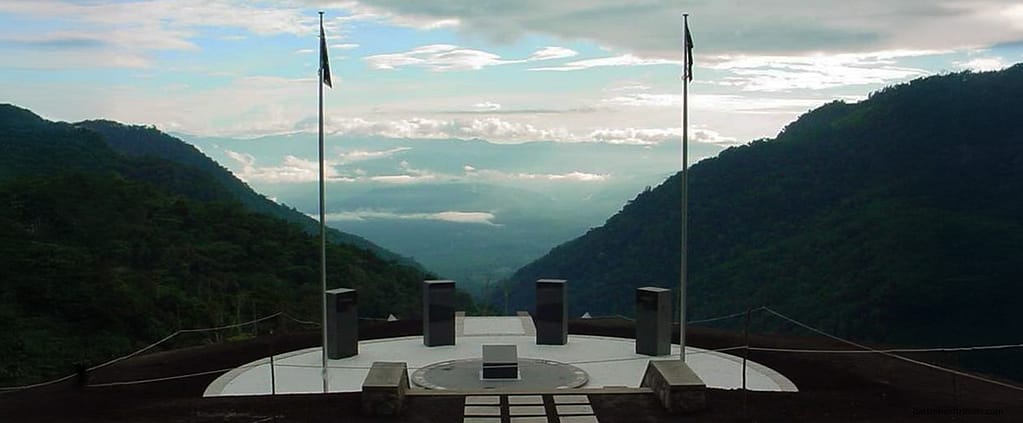
August 2002, Isurava, Papua New Guinea. I explored the Isurava battlefield in August 2002, around the 60th anniversary of the battle, during preparations to open the spectacular new memorial on the Kokoda Track. At the time, I was still serving in the Army back then, and I flew Prime Minister John Howard and veterans of the battle to the memorial site for the official opening.
Reconstructing World War Two battles through terrain analysis, primary sources and on-site research
U.S. soldiers of the 55th Armoured Infantry Battalion and a tank of the 22nd Tank Battalion move through a smoke-filled street in Wernberg, Germany, April 22, 1945. US National Archives
🧭🥾 Walking the battlefields of the Second World War
There is no single World War Two landscape. I have walked battlefields ranging from the forests and frozen roads of Finland to the jungle ridges of Guadalcanal and New Guinea, the beaches and bocage of Normandy, the low country of the Netherlands, the wooded hills and villages of the Ardennes, and Hitler’s Eagle’s Nest in the Bavarian Alps. Each presents a different physical problem, and each makes aspects of the fighting apparent that can be difficult to appreciate from maps alone.
What connects these battlefields is the relationship between soldiers and terrain. A narrow road through a Finnish forest, a jungle ridge overlooking Henderson Field, a causeway across flooded Normandy fields, a bridge over a Dutch river or a road junction in the Ardennes could become disproportionately important because the surrounding terrain restricted the alternatives. Walking those places helps explain why commanders made particular decisions, why attacks developed in particular directions, and why apparently minor pieces of ground became the focus of intense fighting.
This collection brings those battlefield studies together while remaining deliberately incomplete. Every battle examined here is a battlefield I have visited. As that fieldwork expands, so too will the World War Two collection.
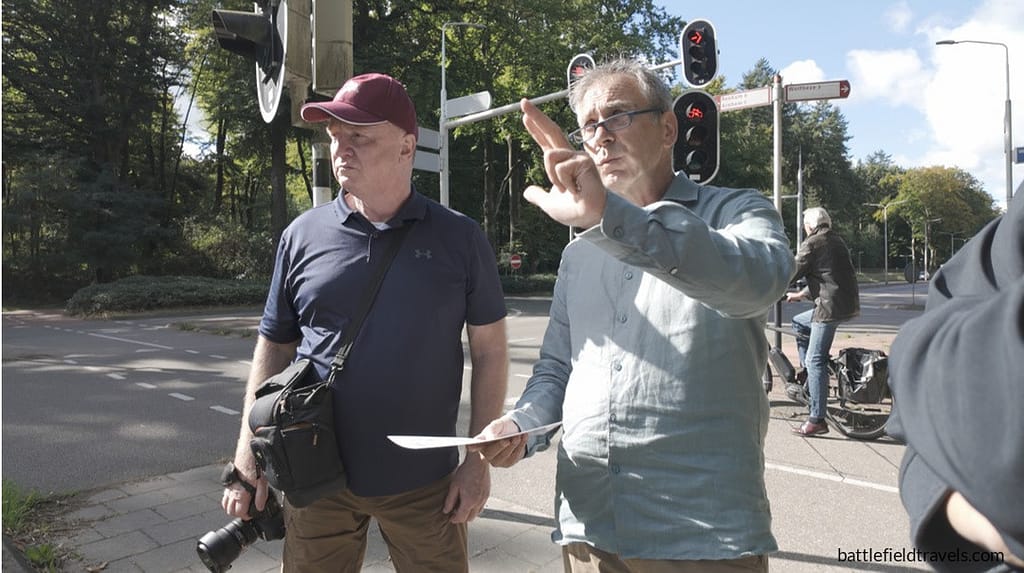
Operation Market Garden. Walking the site just west of Arnhem where 3 Para ambushed Major General Kussin on 17 September 1944. With author David Buggenum
Second World War – 1939-1945
Conflict Overview
World War Two was a global conflict fought across Europe, Africa, Asia, the Pacific and the world’s oceans between 1939 and 1945. Industrial production, logistics, air and sea power, technological change and the mobilisation of entire societies gave the war an unprecedented scale. The fighting itself took place across radically different environments, from Arctic forests and tropical jungle, to beaches, flooded lowlands, dense hedgerows, mountains and shattered towns and cities. Armies had to adapt their weapons, tactics and doctrine to the ground on which they fought.
This overview does not cover every theatre or campaign of the Second World War. I have walked the ground on every battlefield in this collection, using period maps, wartime photographs, primary and veteran accounts, GIS analysis and field reconnaissance to examine how terrain, weapons, doctrine and command decisions shaped the fighting. There are places and battlefields that I have not yet explored, so my coverage is deliberately uneven. I have researched and explored some campaigns in forensic detail, others in less detail, and some I have not visited at all. They are all on my ‘to-do’ list.
The aim is not simply to retell what happened, but to understand why it happened: how terrain channelled movement, concealed or exposed troops, became vital ground, shaped fields of fire and influenced the decisions available to commanders. Across very different theatres, the same recurring problem remained: soldiers and commanders had to understand the ground and exploit it before their opponents did.
Monument at Isurava, on the Kokoda Track, Papua New Guinea, commemorating the August 1942 battle between Australian forces and the Japanese South Seas Detachment.
Finland and the Winter War, 1939–40
The Soviet invasion of Finland in November 1939 demonstrated how profoundly terrain, climate and tactical adaptation could affect the performance of opposing armies. Soviet forces crossed the frontier with overwhelming superiority in manpower, armour and artillery, but frequently found themselves restricted to narrow roads running through forests, lakes and deep snow.
In central Finland, Finnish troops exploited this environment to isolate and destroy Soviet columns. During the battles of Suomussalmi and the Raate Road, small Finnish units used mobility, local knowledge and dispersed attacks to break much larger Soviet formations into isolated pockets (motti). The campaign became an early demonstration of the importance of adapting organisation and tactics to terrain rather than relying on numerical and material superiority alone.
Winter War – destroyed Soviet vehicles on the Raate-Suomussalmi Road, January 1940
The Pacific War
The Japanese attack on Pearl Harbor in December 1941 brought the United States directly into the war and accompanied a rapid series of Japanese offensives across Southeast Asia and the Pacific. By mid-1942, however, Japanese expansion was beginning to encounter increasingly effective Allied resistance.
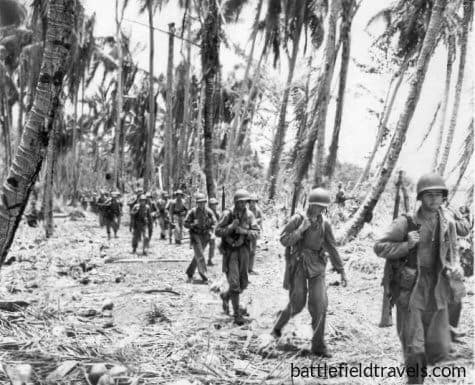
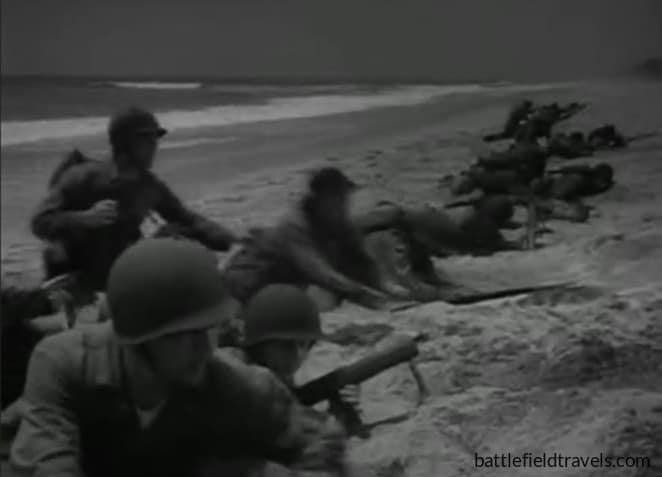
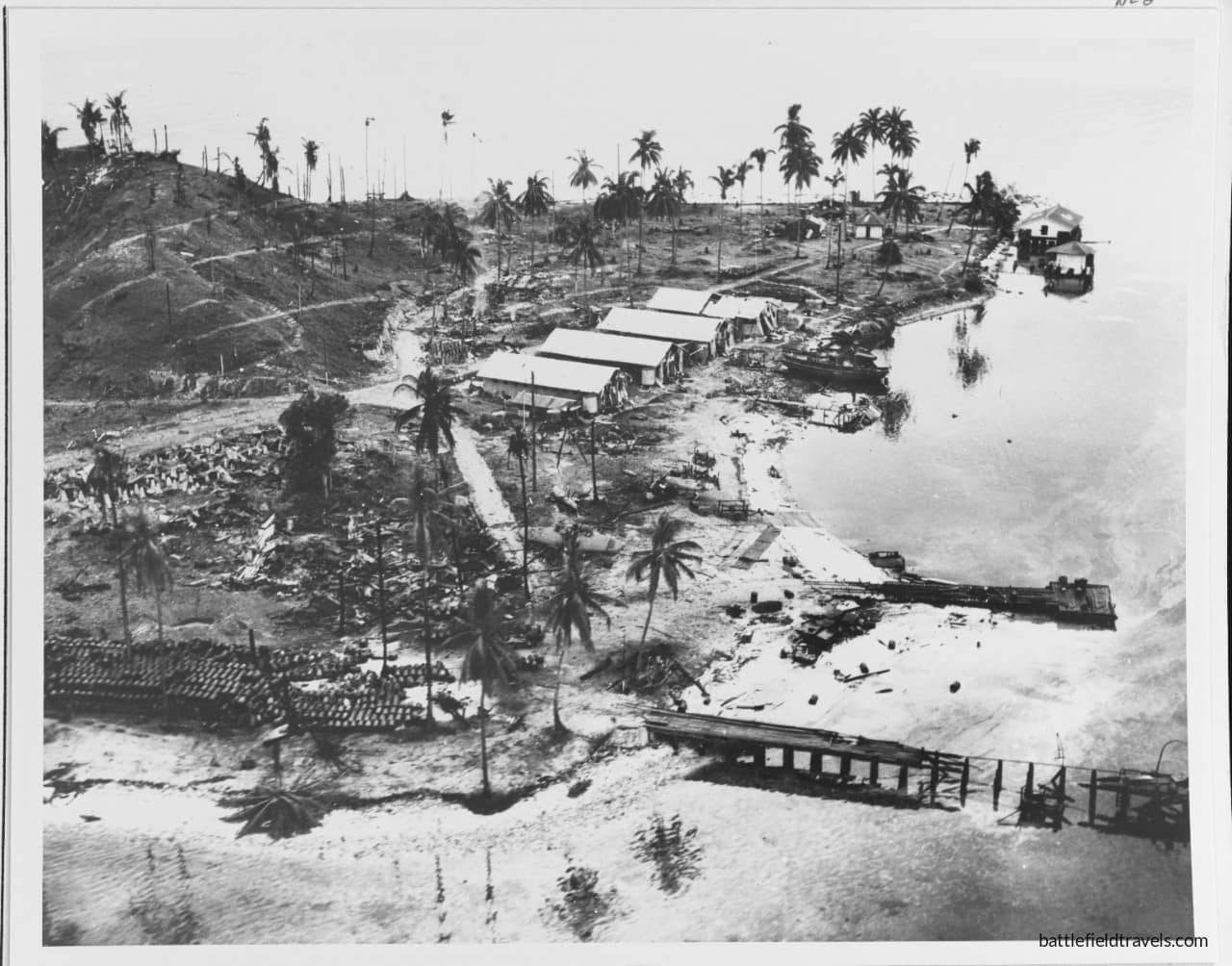
In August 1942, US Marines landed on Guadalcanal in the Solomon Islands, beginning the first sustained American ground offensive against Japanese forces in the Pacific. What followed was a six-month struggle on land, at sea and in the air centred on Henderson Field. The Guadalcanal Campaign examines that struggle as a connected campaign, from the initial American landings through Tenaru, Edson’s Ridge, the Matanikau, Henderson Field and Mount Austen to the Japanese evacuation in February 1943.
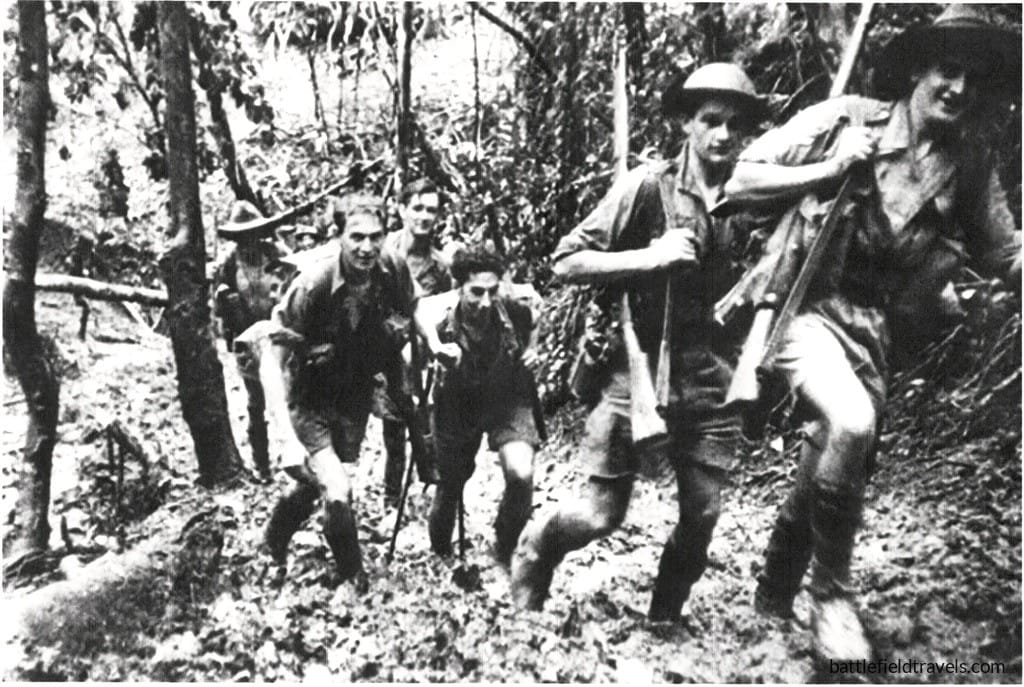
Farther west, New Guinea presented an entirely different battlefield problem. Mountains, jungle, rivers, disease and extremely limited communications imposed severe constraints on both sides. Fighting across the island repeatedly demonstrated that apparently short distances on a map could represent formidable obstacles on the ground. The fighting around Isurava and the Kokoda Track provides a particularly stark example of infantry combat shaped by narrow tracks, steep ridgelines and restricted visibility.
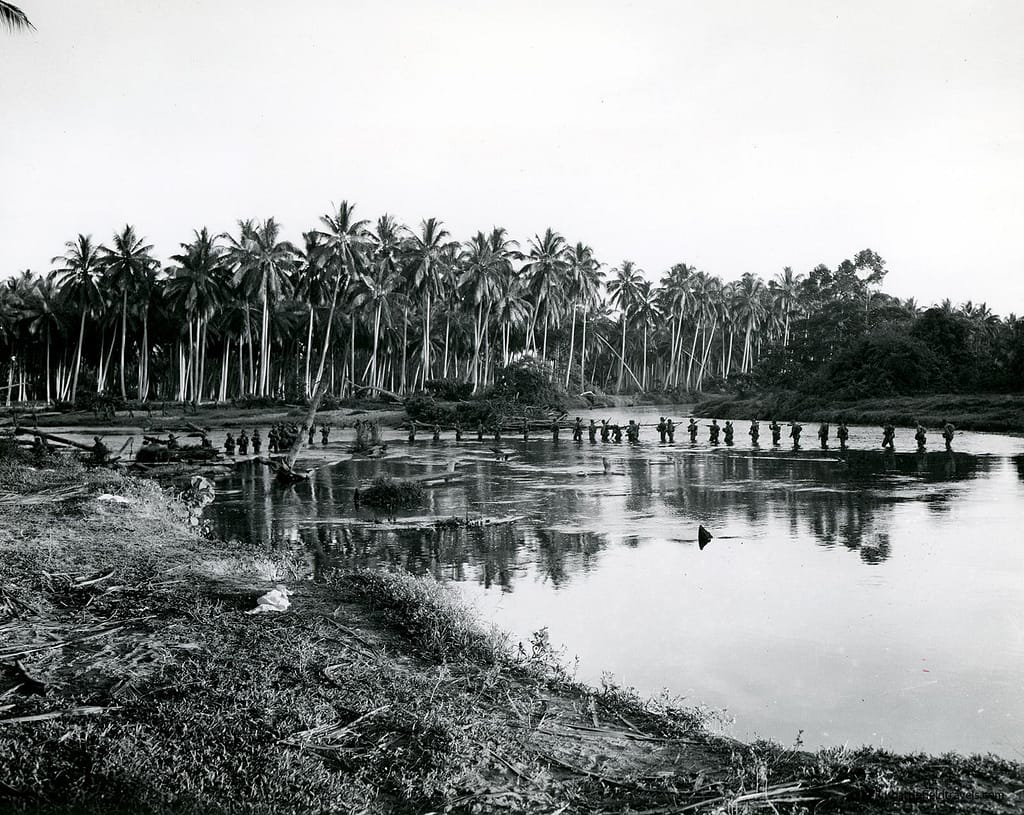
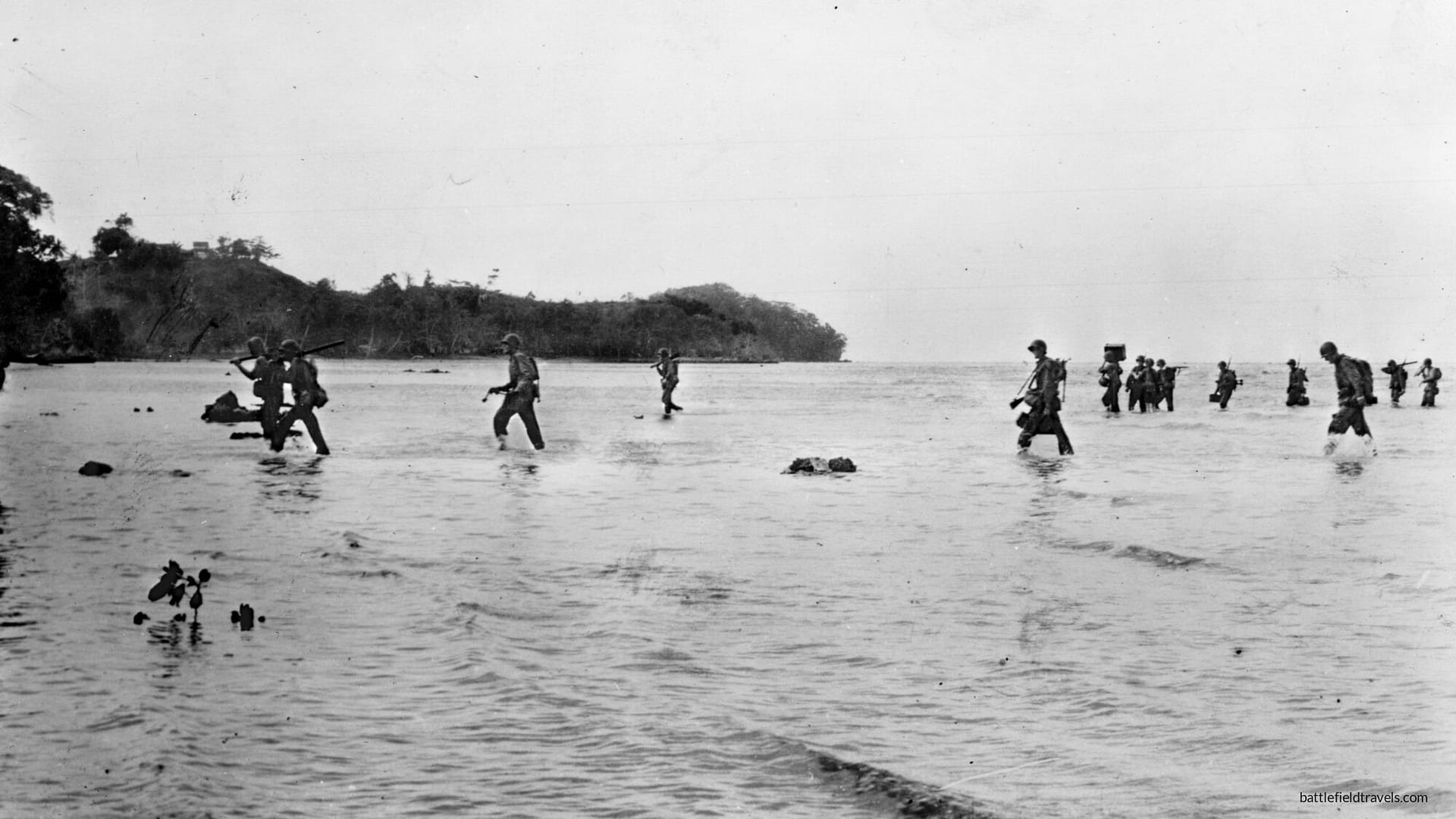
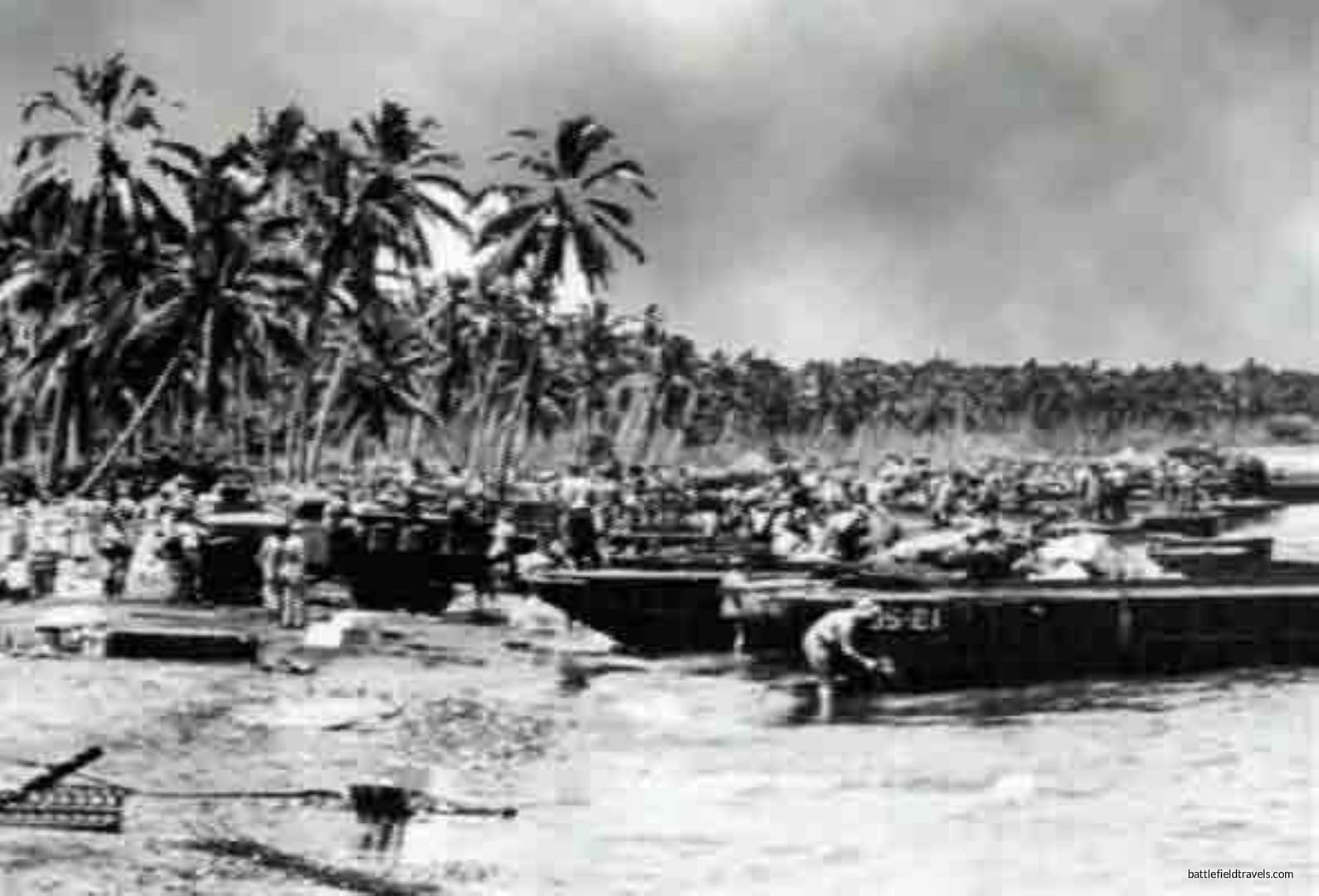
1/1 Marines Patrol Crossing Lunga River, Guadalcanal, circa Sep 1942
North-West Europe, 1944
By 1944, the Western Allies had assembled the forces required to return to occupied France. Operation Overlord combined an enormous amphibious assault with airborne operations, naval gunfire, air power and an elaborate deception campaign intended to establish a secure lodgement in Normandy.
D-Day and Normandy Landings began in the opening minutes of 6 June with British airborne operations at Pegasus Bridge and east of the Orne. American airborne divisions descended behind Utah Beach, while amphibious forces landed across Utah, Omaha, Gold, Juno and Sword Beaches. The fighting continued beyond the beaches as Allied forces struggled to connect and consolidate their lodgements around places such as Carentan.
One small-unit story also provides a continuous thread through several of these campaigns. The Easy Company battlefield series follows the 506th Parachute Infantry Regiment from the Normandy landings through Operation Market Garden, the Battle of the Bulge and the final advance into Germany and Austria.
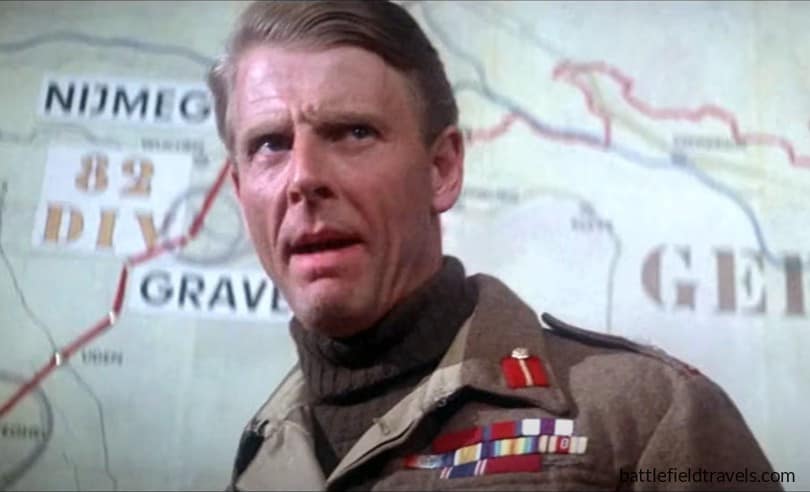
Once the Allied armies broke out of Normandy, the campaign moved rapidly across France and Belgium. In September, Operation Market Garden attempted to exploit that momentum by seizing a succession of bridges through the Netherlands and establishing a bridgehead across the Lower Rhine at Arnhem. Airborne forces fought around Eindhoven, Nijmegen and Arnhem while the ground advance struggled along a narrow corridor vulnerable to German counterattack.
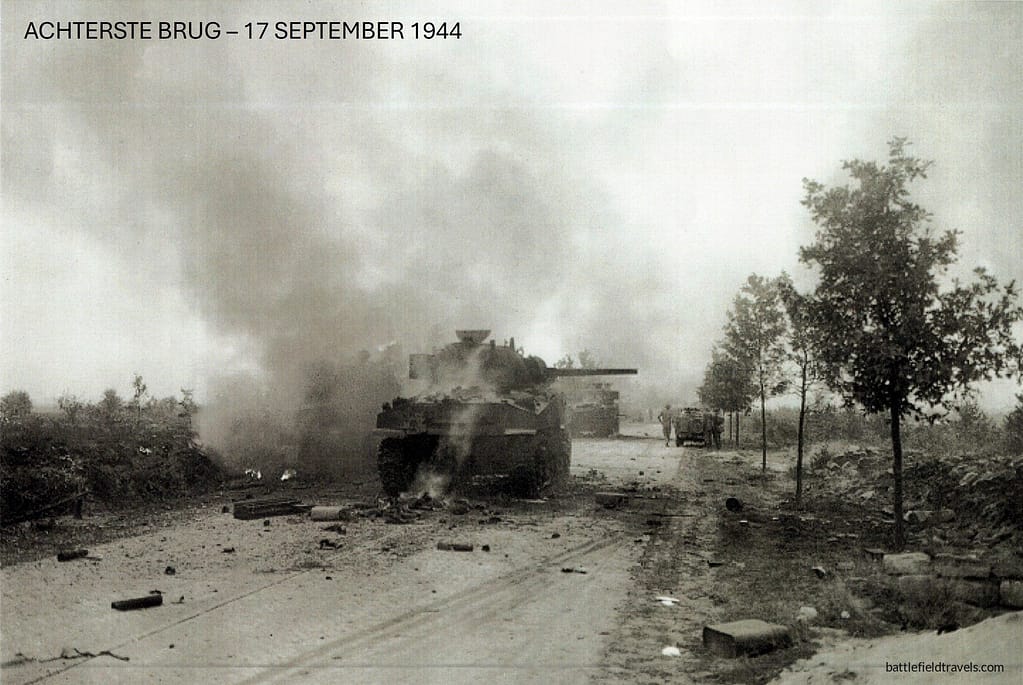
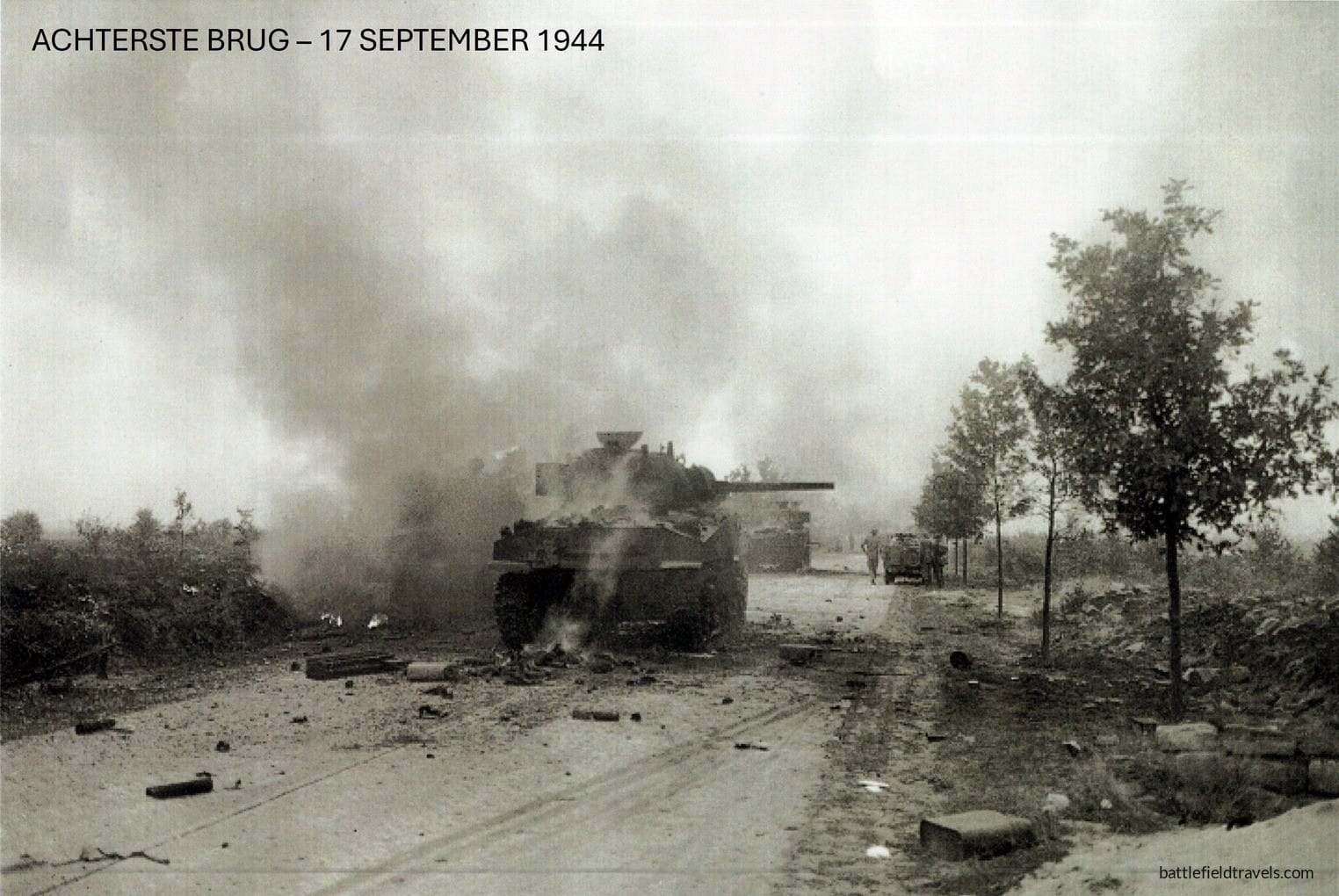
Operation Market Garden, Tanks of teh Guards Armoured Division destroyed at Achterste Brug, 17 September 1944
The German Frontier and the Battle of the Bulge
By late 1944 Allied forces had reached the approaches to Germany, but extended supply lines, difficult terrain and renewed German resistance slowed the advance. In December, Germany launched a major counteroffensive through the Ardennes in an attempt to rupture the Allied front and regain the strategic initiative in the west.
The Battle of the Bulge developed into a series of interconnected battles for roads, villages, ridgelines and communications across difficult winter terrain. Fighting around Elsenborn Ridge, St Vith, Stavelot, Stoumont and Bastogne demonstrated the importance of controlling the limited road network through the Ardennes, while smaller actions such as the fighting around Foy reveal the tactical problems confronting infantry operating in snow, forests and exposed villages.
The failure of the German offensive left Allied forces free to resume their advance into Germany. The final Nazi redoubt in the Bavarian Alps proved less formidable than expected, and Allied troops seized Hitler’s Eagles Nest on 4 May 1945. By 8 May 1945 the war in Europe was over. The Pacific War continued until August, ending a conflict that had transformed warfare and much of the international order.
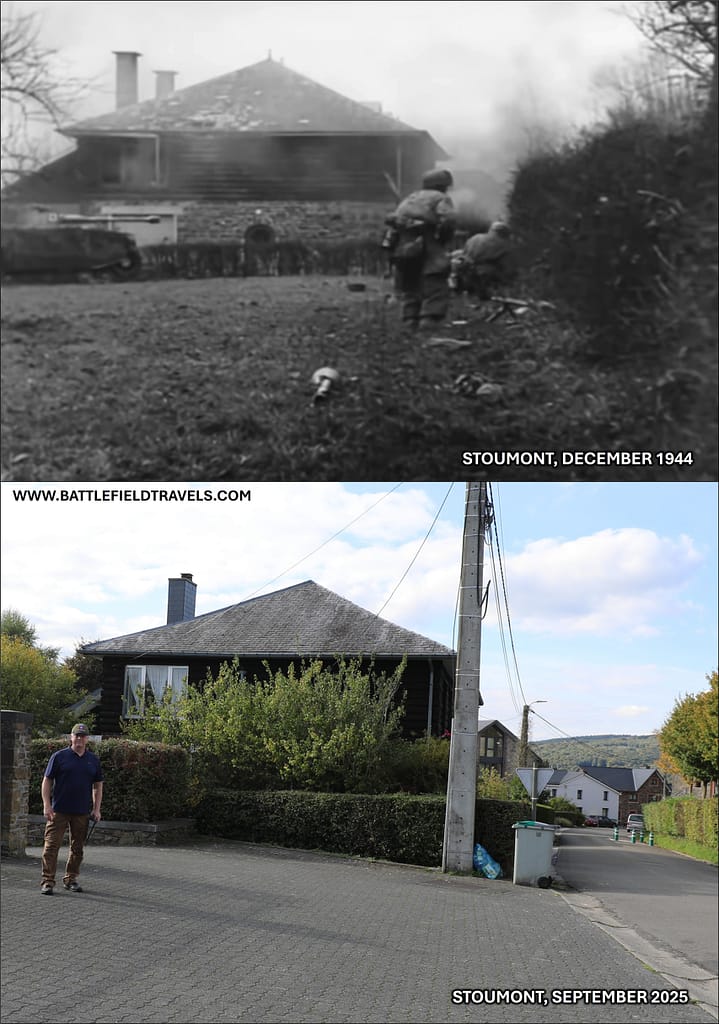
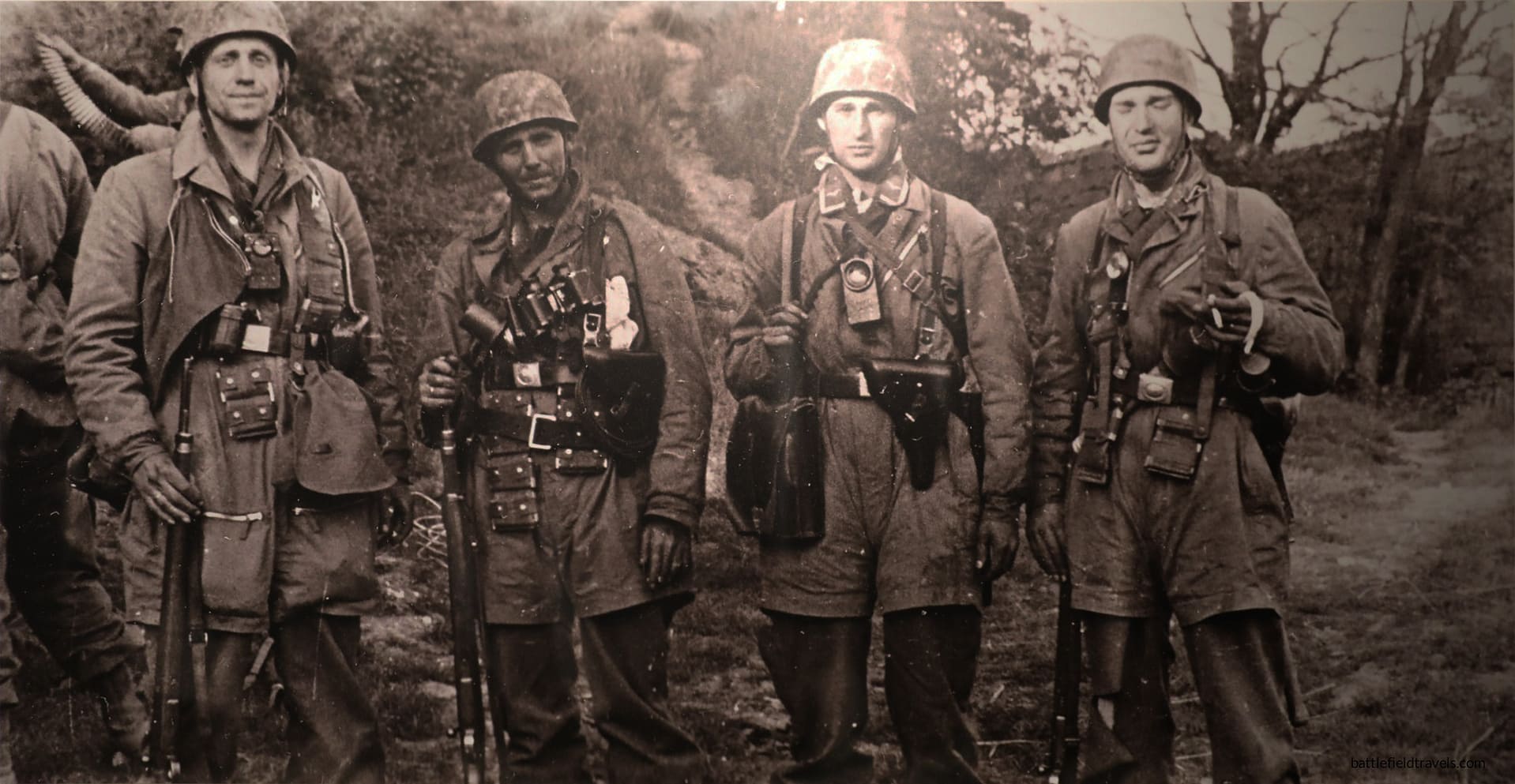
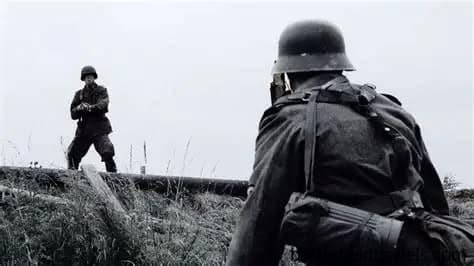
Then and Now. Battle of the Bulge, Stoumont. German paratroopers assigned to Kampfgruppe Peiper attempt to clear positions held by the US 30th Infantry Division, 9 December 1944
Second World War Battlefield Studies
In-depth battlefield analyses based on terrain, primary sources, and on-the-ground exploration.
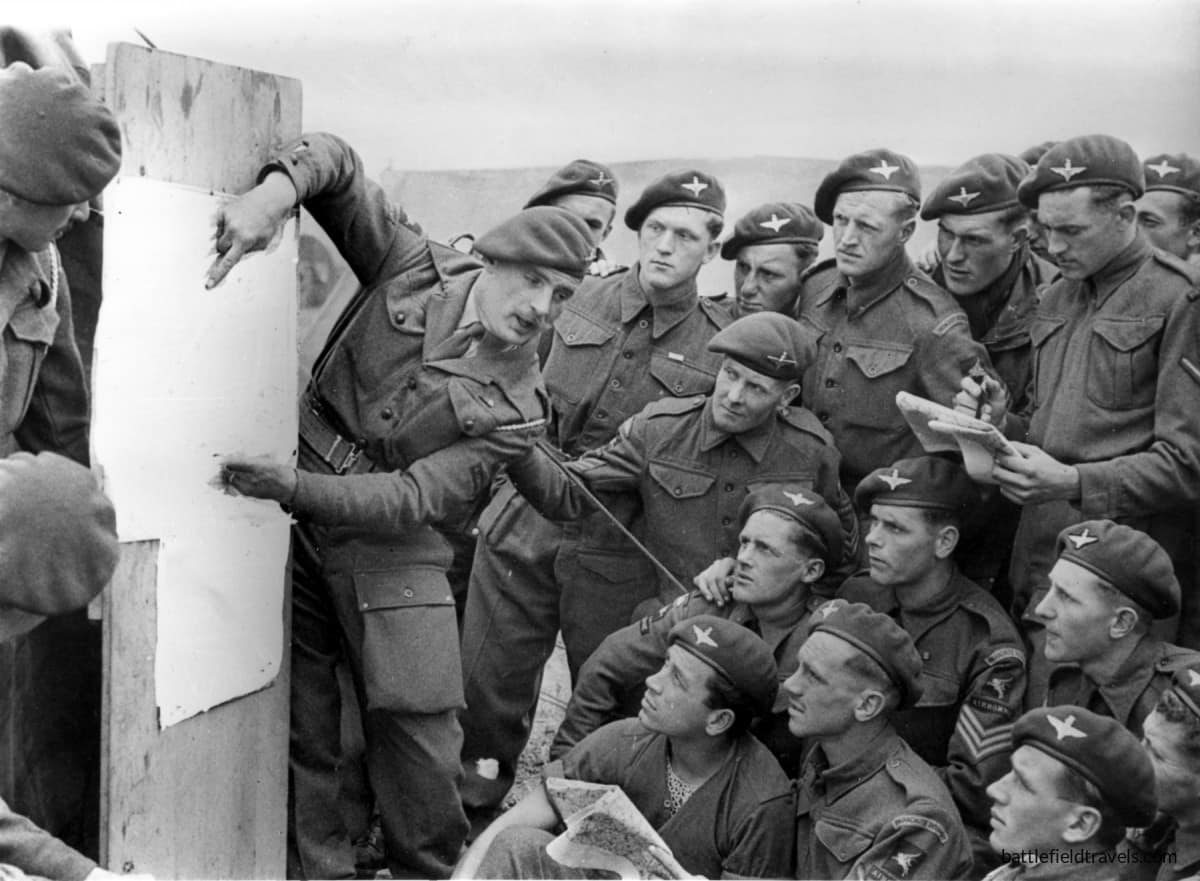
British 6th Airborne Division’s role on D-Day was multi-faceted. In the opening minutes, glider-borne troops would seize the bridges over the Caen Canal and the River Orne. Soon afterwards, paratroopers would neutralise Merville Battery. Others would destroy key bridges over the Dives and prepare for German counterattacks. The mission was audacious, high risk, and critical…
August 2026, west of Point Cruz, Guadalcanal. I am walking the section of coast known to history as ‘Little Dunkirk’. Here, on 27 September 1942, the 1st Battalion 7th Marines was evacuated under fire by the US Navy and Coast Guard during the 2nd Battle of the Matanikau. This was the only significant American defeat…
August 2026, Edson’s Ridge, south of Henderson Field, Guadalcanal. I am exploring the sites of the 12-14 September 1942 Japanese attack against the Lunga perimeter. The long north-south ridgeline here became known as ‘Edson’s Ridge’ or ‘Bloody Ridge’ after the battle. The Japanese called it ‘The Centipede’. This is one of the best-preserved battle sites…
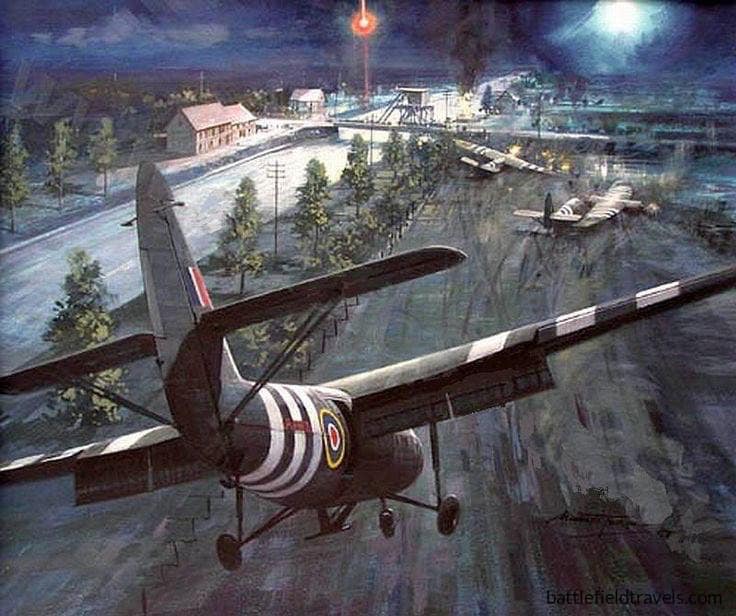
In the opening minutes of D-Day, British airborne troops conducted a glider-borne coup-de-main assault to seize the bridges over the Caen Canal and River Orne. Their mission was simple but dangerous: capture the bridges intact and hold them against German counterattacks, thereby securing the eastern flank of the Normandy landings.
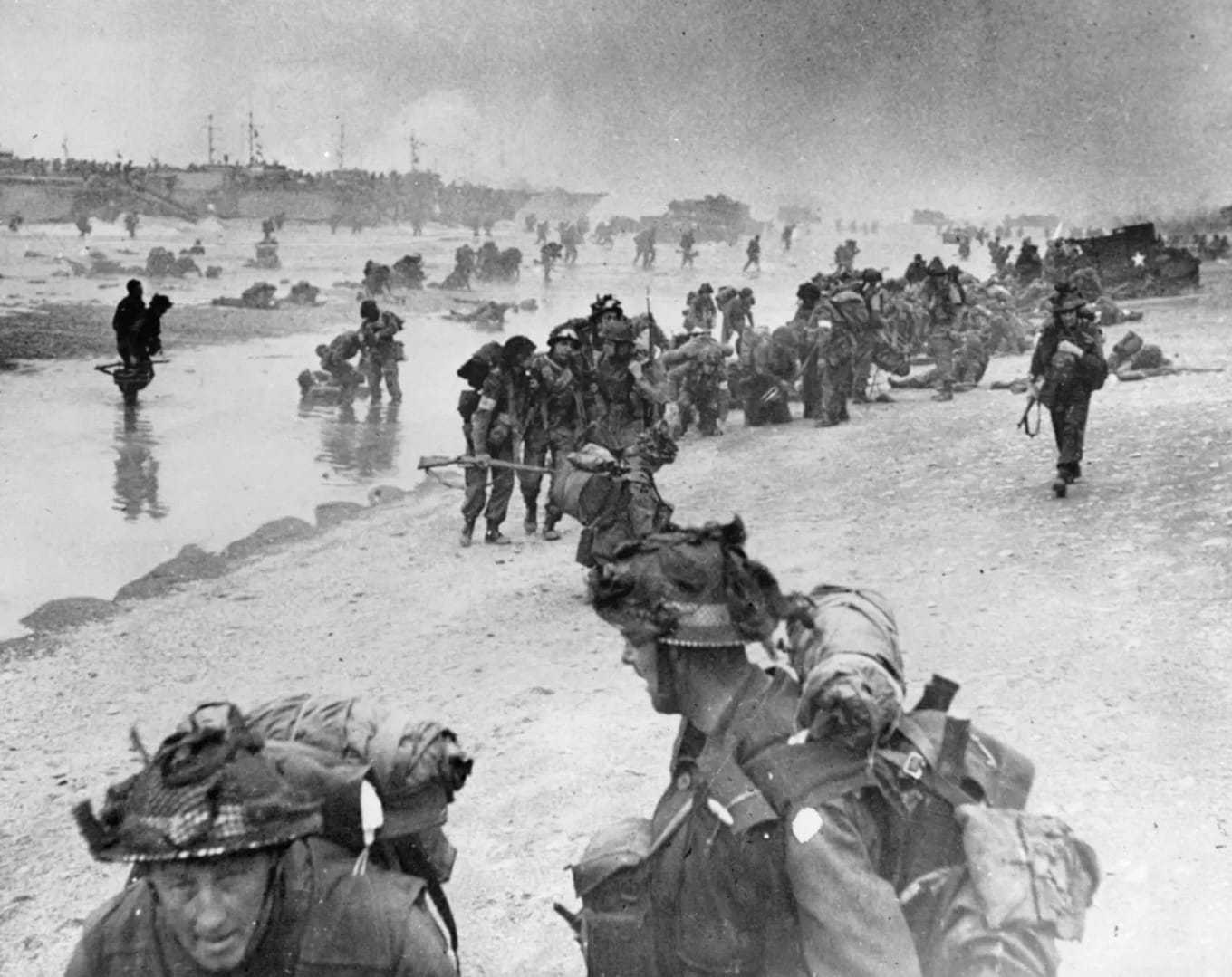
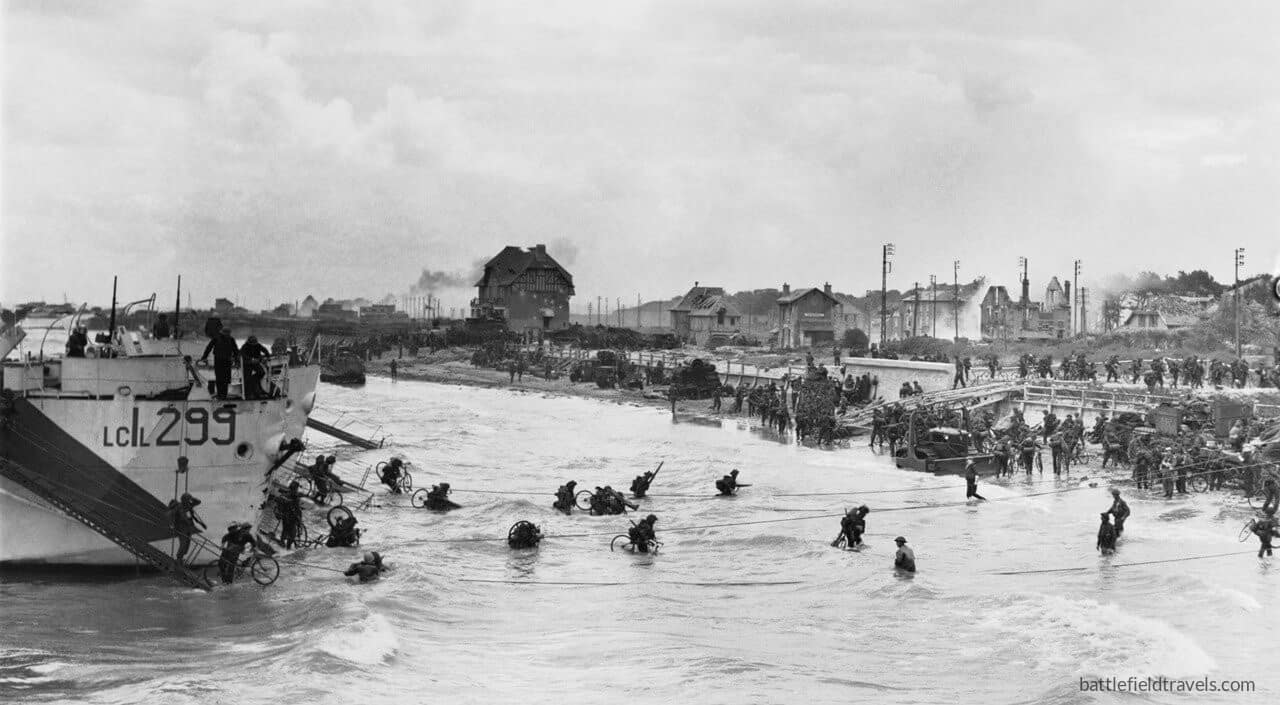
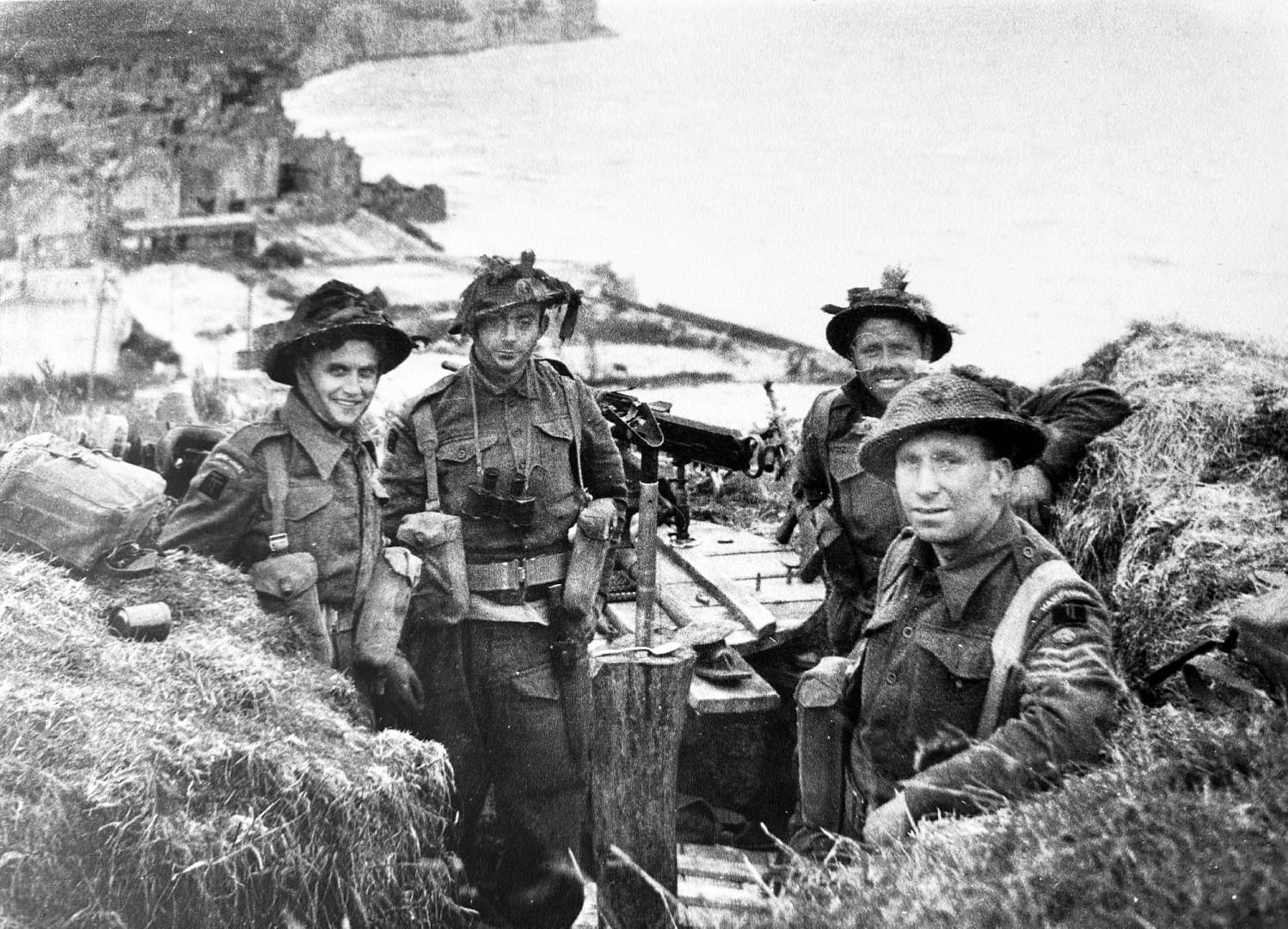
On 6 June 1944, the British 3rd Division, supported by the 1st Special Service Brigade and 79th Armoured Brigade, stormed Sword Beach, the easternmost Allied landing sector in Normandy. Their success secured the D-Day landing Allied left flank, linked with the airborne lodgement at the Orne, and set the stage for the long struggle for…
On 6 June 1944, the 3rd Canadian Infantry Division stormed ashore at Juno Beach, facing some of the strongest German defences in Normandy. Their task was to force a landing on the narrow strip of beach between Courseulles, Bernières, and Saint-Aubin, and then drive inland to cut the Caen–Bayeux road before linking up with the…
On 6 June 1944, the British 50th (Northumbrian) Infantry Division landed at Gold Beach, facing fortified villages and determined German resistance. By nightfall, they had secured a foothold, linked with Canadian forces at Juno, and pushed inland toward Bayeux. Within days, the artificial Mulberry harbour was providing vital sustainment to the Normandy campaign.
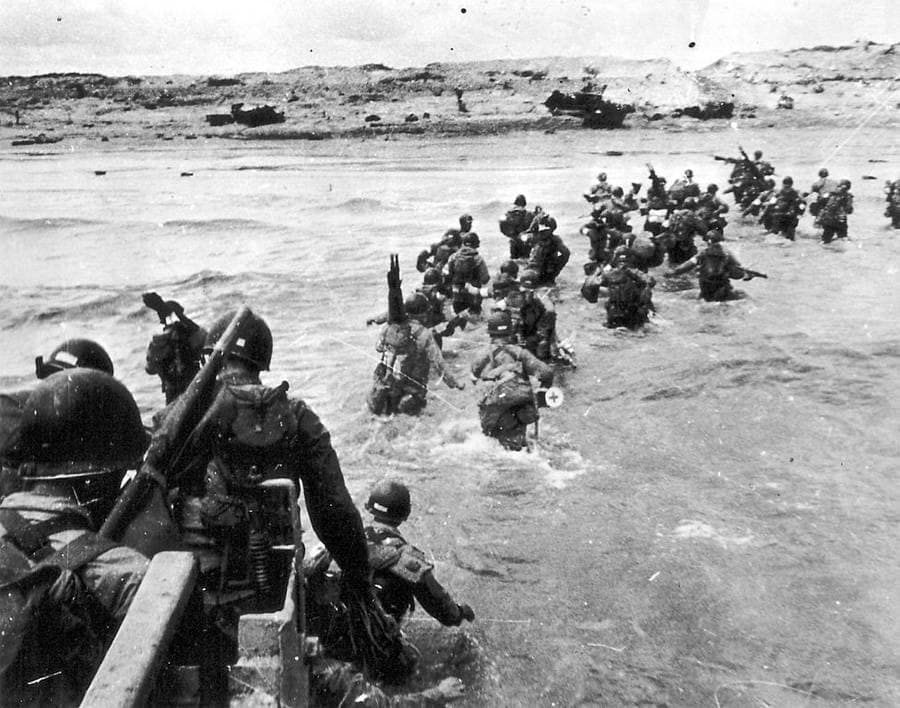
Omaha Beach makes a powerful impression. When you visit the beach, you know that this is where Robert Capa took those famous photos of American soldiers assaulting through the obstacle belt, and where the dramatic first 20 minutes of Saving Private Ryan was set. It also becomes clear how important the five beach exits were…
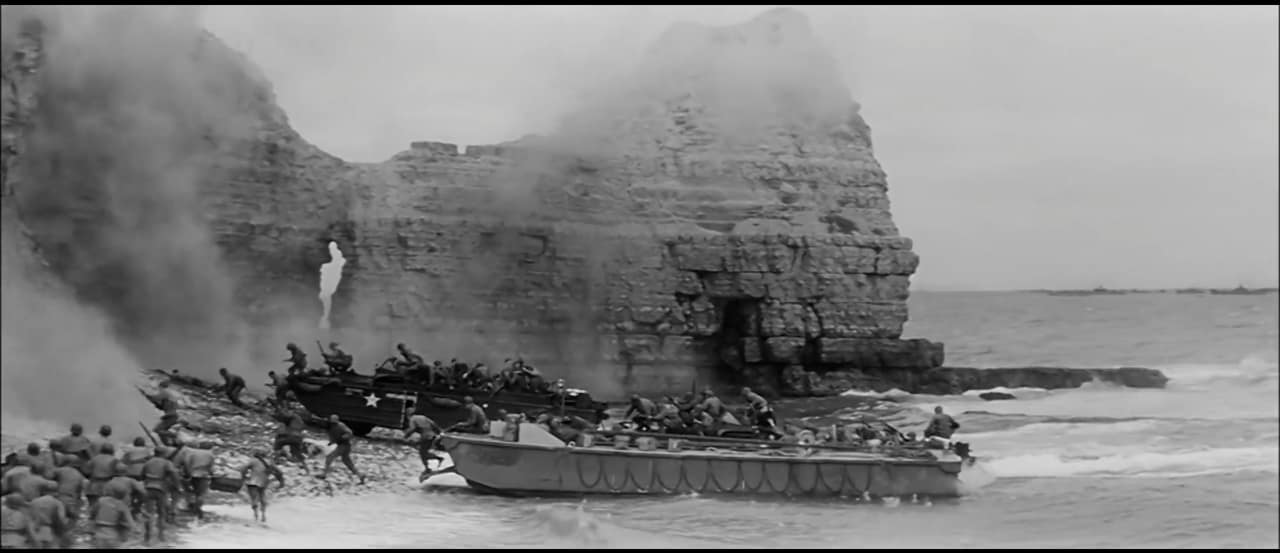
Pointe du Hoc, a prominent headland between Utah and Omaha Beaches, was a critical objective on D-Day. The German position was equipped with a battery of 155mm howitzers capable of targeting the American landing beaches. The mission to assault Pointe du Hoc was assigned to the 2nd and 5th Ranger Battalions. The Rangers would scale…
In the early hours of D-Day, 6 June 1944, 13,200 paratroopers of the 82nd and 101st Airborne Divisions landed behind Utah Beach to secure the beach landing sites and prevent German interference. A few hours later, the US 4th Infantry Division stormed ashore on Utah Beach. The amphibious forces landed about 2,000 yards south of…
Here on 6 June 1944, Lieutenant Richard ‘Dick’ Winters, acting company commander for Easy Company, 506th Parachute Infantry Regiment, 101st Airborne Division, led a force of 23 paratroopers in a successful assault on a German force that outnumbered them more than 5 to 1. Easy Company’s action that day was depicted in the Steven Spielberg/Tom…
The Battle of Bloody Gulch was fought on 13 June 1944, just west of Carentan, Normandy. The battle followed immediately after 101st Airborne Division’s capture of Carentan on 12 June. Lightly armed American paratroopers from 506th (PIR) Parachute Infantry Regiment and 501st PIR faced a major armoured counterattack by the 17th SS Panzergrenadier Division and…
After the successful D-Day landings on June 6, the Allies needed to link the Utah and Omaha beachheads, build forces to cut off the Cotentin Peninsula, and be prepared for the expected German counterattack that they knew was coming. The key to all of that was the town of Carentan on the Cotentin – a…
As a former 82nd Airborne Division paratrooper, the town of Sainte-Mere Eglise in the Cotentin Peninsula of Normandy holds a special place for me. In the early hours of 6 June 1944, ahead of the Normandy Beach landings, the US 82nd and 101st Airborne Divisions parachuted into this area. The 82nd was to seize the…
The final act of Steven Spielberg’s 1998 movie ‘Saving Private Ryan’ is set in the fictional French town of Ramelles, as a mixed group of paratroopers defends a bridge over the Merderet River against German armoured counter-attacks. That scene is based on real events that happened right here at La Fiere Bridge. I was a…
When Stalin’s Red Army invaded Finland on 30 November 1939, the two main thrusts were in the south around Lake Ladoga and the Mannerheim Line, and in central Finland focussed on Suomussalmi. In central Finland, the Russian 163rd Rifle Division and an independent tank brigade crossed the border at Juntusranta, and the 44th (Ukrainian) Rifle…
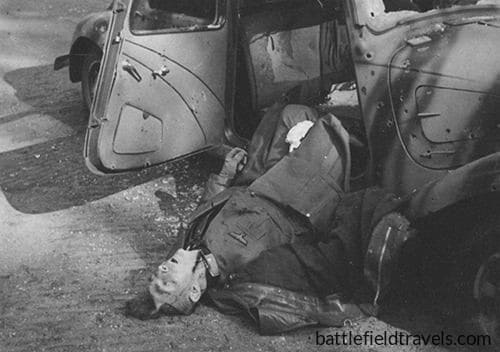
Operation Anthropoid was one of the most significant acts of resistance against Hitler’s regime. Planned and executed by Czechoslovakian operatives in collaboration with the British Special Operations Executive (SOE), Operation Anthropoid targeted Reinhard Heydrich, a high-ranking Nazi official and one of the principal architects of the Holocaust.
August 2026, Ilu River (Alligator Creek). I am exploring the site of the 21 August 1942 Japanese attack against the Marines on the Lunga perimeter. The Japanese ‘Ichiki Detachment’ was a battalion-sized force from the 28th Infantry Regiment, led by the Regimental Commander, Colonel Kiyonao Ichiki. Facing them across the Ilu River was the 2nd…
Matanikau Village site, August 2026. I am exploring the site of the First Battle of the Matanikau, 18-19 August 1942. The battle was the first major battle west of the Matanikau and bears many similarities with the other five or six battles (depending on how you count them) on the Matanikau that would follow, each…
August 2026, at the mouth of the Matanikau River. I am exploring the sites associated with the ill-fated ‘Goettge Patrol’ of 12-13 August 1942. The action happened over a very small area on the beachline west of the Matanikau, near the old village of Matanikau, now overrun by urban sprawl. In 1942 the jungle extended…
Gavutu & Tanambogo Islands, 8 August 2026. I am exploring the site of some of the most bitter fighting of the entire Guadalcanal Campaign, and it happened right here over 7-9 August 1942, While the landings at Beach Red on the big island of Guadalcanal had gone ahead unopposed, the landings at Tulagi and Gavutu…
Tulagi Island, 8 August 2026. I crossed Iron Bottom Sound from Honiara to Tulagi by a dawn high-speed ferry. The trip was roughly two hours long. The date of my battlefield visit also coincided with the official 84th anniversary commemoration of the battle. The commemorative service was held on Blue Beach and was attended by…
August 2026, Beach Red, Guadalcanal, I am walking the ground at Beach Red, site of the 1st Marine Division landings on 7 August 1942. Compared to many other WW2 sites on the island, Beach Red is little changed since 1942. The beach is about four kilometres east of Henderson Field and curves from the Tenaru…
September 2025, Leopoldsburg, Belgium. I am standing on Nicolaylaan Street, on the site of the old Cinema Splendid. On the morning of 15 September 1944, one of the most consequential military briefings of the Second World War took place inside its walls. Lt Gen. Brian Horrocks stood before his subordinate commanders of XXX Corps and…
October 2025, Fort Eben-Emael, Liège, Belgium. I am exploring the great Belgian fortress of Eben-Emael. In May 1940, this was the site of one of the boldest, most dramatic actions in military history. A handful of German glider-borne assault engineers neutralised the most powerful fortress in Europe in under twenty-four hours, using a weapon no…
September 2025, Hell’s Highway, south of Eindhoven, Netherlands. I am exploring Hell’s Highway in the vicinity of Achterste Bridge with author Jack Didden. On 17 September 1944, Sherman tanks of the Guards Brigade led the XXX Corps advance from the Belgian border north towards Eindhoven, Nijmegen and, eventually, Arnhem. Lieutenant Colonel Joe Vandeleur’s Irish Guards…
September 2025, Arnhem, Netherlands. I am standing at the intersection of Wolfhezerweg and Utrechtseweg with author David Buggenum, on the site where the local German commander, Generalmajor Friedrich Kussin, was ambushed and killed by members of 3rd Battalion, The Parachute Regiment, on 17 September 1944.
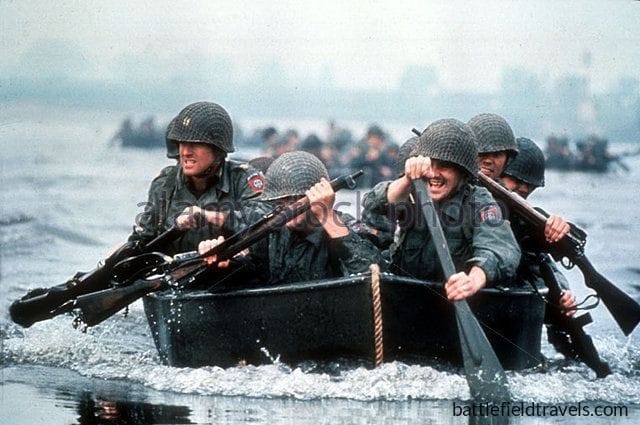
September 2025, Nijmegen, Netherlands. I am standing at the site on the Waal River, where Major Julian Cook led the 504th Parachute Infantry Regiment (504 PIR) of the US 82nd Airborne Division in a dramatic assault river crossing to seize the northern end of the Waal Road Bridge at Nijmegen.
August 2002, Isurava, Papua New Guinea. I explored the Isurava battlefield in August 2002, around the 60th anniversary of the battle, during preparations to open the spectacular new memorial on the Kokoda Track. At the time, I was still serving in the Army back then, and I flew Prime Minister John Howard and veterans of…
September 2025, Randwijk, Netherlands. I am standing at the “Crossroads” made famous in Band of Brothers Episode 5: Crossroads. On 5 October 1944, a brief battle took place here, east of the village of Randwijk, in the area between the Rhine and the Waal known as “The Island.”
Over thousands of years of warfare, armies have sought ways to gain advantage on the battlefield. Sometimes the solution was a new weapon. Sometimes it was a radical new method. Often it was a combination of both. From the disciplined ranks of the Greek phalanx to pike-and-shot warfare to the interlocking machine-gun fire plans of the twentieth century, tactical innovations have repeatedly reshaped how battles are fought.
This article explains how machine guns are employed on the battlefield, including the key concepts of cone of fire, beaten zone, grazing fire, enfilade fire, and mutually supporting machine-gun positions. The article forms part of the Tactical Innovations in Warfare series.
Authored by Mick Prictor, a retired military officer with 40 years’ service, and a military historian specialising in terrain-focused analysis of tactics, doctrine, and command decision-making in land warfare. His work draws on extensive battlefield fieldwork—more than 280 sites worldwide—and one of the world’s largest private collections of historic military arms, uniforms, and equipment. About me
⚔️ Go deeper — Members get exclusive access to the Deep Research Collection, Field Notes, and monthly Research Dispatches. Try membership free for 7 days, cancel anytime. From $9/month.
What makes these World War Two battlefield studies unique?
Each study combines terrain analysis, period maps, archival accounts and on-site research to explain how ground, movement and tactical decisions shaped the battle.
Are these WW2 studies focused mainly on D-Day?
The collection includes extensive D-Day and Normandy actions, but also covers Market Garden, airborne operations and other major battles across the European theatre.
Can I visit these World War Two battlefields today?
Yes. Many sites in Normandy, including the landing beaches, remain accessible and are included with travel guidance and ground-level interpretation.
Do the articles include historical sources and maps?
Each study uses period maps, contemporary imagery, veteran testimony and modern GIS overlays to present a clear, terrain-driven view of the battle.
Subscribe to Battlefield Travels and receive a free E-Book Battlefield Guide
Unlock expert battlefield analysis, campaign reconstructions, and historical insights drawn from firsthand exploration and primary sources.
🗺️ You’ll receive:
🎖️ Exclusive historical insights you won’t find elsewhere
📘 A free eBook: 10 Tips for Exploring Historic Battlefields
📰 New battlefield studies straight to your inbox as they are published
Claim Your Free Battlefield Travel Guide
Get your free e-book, exclusive tips, and updates on new battlefield studies.
Thank you!
You have successfully joined our subscriber list.
⚔️ Go deeper — Members get exclusive access to the Deep Research Collection, Field Notes, and monthly Research Dispatches. Try membership free for 7 days, cancel anytime. From $9/month.
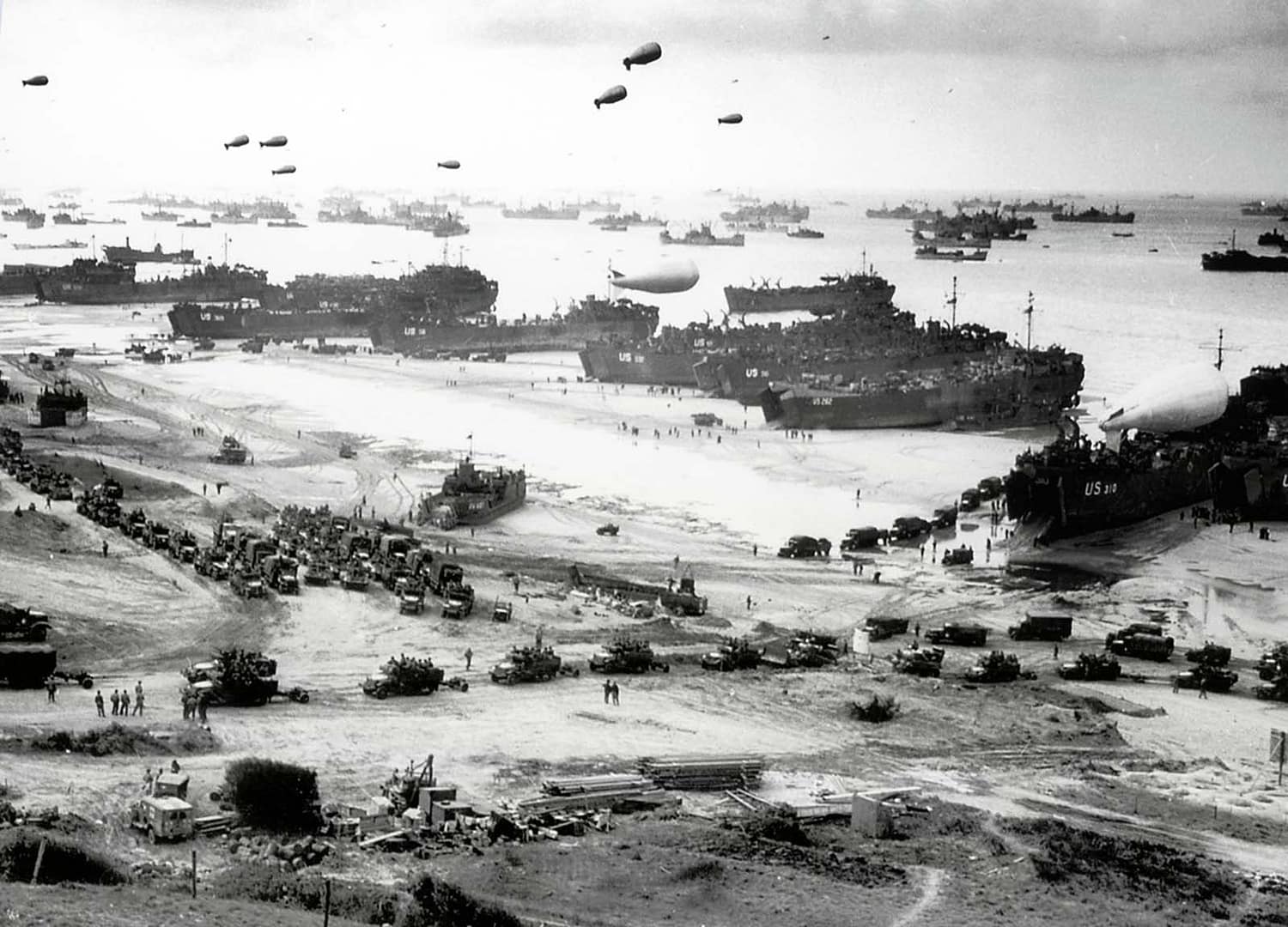
World War Two – Omaha Beach – Fox Red Sector, 6 June 1944
Overview of the Second World War
The Second World War was the largest and most destructive conflict in human history, fought across every continent and ocean between the Axis and Allied powers. It began with Germany’s invasion of Poland on 1 September 1939 and the subsequent declarations of war by Britain and France. Within two years, Axis forces under Hitler, Mussolini, and Imperial Japan had overrun most of Europe, North Africa, and large parts of East Asia.
German blitzkrieg operations brought rapid victories in 1940–41, but the failure to defeat Britain and the invasion of the Soviet Union in June 1941 fatally overstretched the Reich. Japan’s attack on Pearl Harbor in December 1941 drew the United States into a global alliance with Britain, the Soviet Union, and China. From 1942 onwards, the tide turned: the Soviet victory at Stalingrad, Allied success in North Africa, and the destruction of Japanese carrier power at Midway marked the beginning of Axis decline.
Allied strategy combined industrial mobilisation, air and sea control, and coordinated offensives on multiple fronts. Italy collapsed in 1943, France was liberated following the D-Day landings in June 1944, and Germany surrendered unconditionally in May 1945. Behind enemy lines, resistance groups struck back at the occupying powers. The Pacific war ended after the atomic bombings of Hiroshima and Nagasaki and Japan’s capitulation in August.
The war claimed over 60 million lives, redrew national borders, and ushered in the nuclear age and the bipolar world order of the Cold War. Its military, political, and moral consequences continue to shape international relations today.
The Amazon links on the Reading Room pages are powered by AAWP
Reading
The reference collection below includes the key books and references I have used in preparing for and undertaking Second World War battlefield studies. I will update this list as I continue to explore further campains and battles.
From the acclaimed author of A Bridge Too Far comes the unparalleled, classic work of history that vividly recreates the battle that changed World War II—the Allied invasion of Normandy.
The Longest Day is Cornelius Ryan’s unsurpassed account of D-Day, a book that endures as a masterpiece of military history. In this compelling tale of courage and heroism, glory and tragedy, Ryan painstakingly recreates the fateful hours that preceded and followed the massive invasion of Normandy to retell the story of an epic battle that would turn the tide against world fascism and free Europe from the grip of Nazi Germany.
This book, first published in 1959, is a must for anyone who loves history, as well as for anyone who wants to better understand how free nations prevailed at a time when darkness enshrouded the earth.
The author of Eisenhower chronicles the events, politics, and personalities of this pivotal day in World War II, shedding light on the strategies of commanders on both sides and the ramifications of the battle. 100,000 first printing. BOMC & History Main. Reader’s Digest Cond Bks.
On June 6, 1944, American and British troops staged the greatest amphibious landing in history to begin Operation Overlord, the battle to liberate Europe from the scourge of the Third Reich. With gut-wrenching realism and immediacy, Hastings reveals the terrible human cost that this battle exacted.
Moving beyond just the storming of Omaha beach and D-Day, he explores the Alliesâ push inward, with many British and American infantry units suffering near 100 percent casualties during the course of that awful summer. Far from a gauzy romanticized remembrance, Hastings details a grueling ten week battle to overpower the superbly trained, geographically entrenched German Wehrmacht. Uncompromising and powerful in its depiction of wartime, this is the definitive book on D-Day and the Battle of Normandy.
Renowned historian Antony Beevor, author of Stalingrad and The Battle of Arnhem, and the man who “single-handedly transformed the reputation of military history” (The Guardian) presents the first major account in more than twenty years of the Normandy invasion and the liberation of Paris. This is the first book to describe not only the experiences of the American, British, Canadian, and German soldiers, but also the terrible suffering of the French caught up in the fighting. Beevor draws upon his research in more than thirty archives in six countries, going back to original accounts and interviews conducted by combat historians just after the action. D-Day is the consummate account of the invasion and the ferocious offensive that led to Paris’s liberation.
Stephen E. Ambrose’s classic New York Times bestseller and inspiration for the acclaimed HBO series about Easy Company, the ordinary men who became the World War II’s most extraordinary soldiers at the frontlines of the war’s most critical moments. Featuring a foreword from Tom Hanks.
They came together, citizen soldiers, in the summer of 1942, drawn to Airborne by the $50 monthly bonus and a desire to be better than the other guy. And at its peak—in Holland and the Ardennes—Easy Company was as good a rifle company as any in the world.
From the rigorous training in Georgia in 1942 to the disbanding in 1945, Stephen E. Ambrose tells the story of this remarkable company. In combat, the reward for a job well done is the next tough assignment, and as they advanced through Europe, the men of Easy kept getting the tough assignments.
“Tells the tales left untold by Stephen Ambrose, whose Band of Brothers was the inspiration for the HBO miniseries…laced with Winters’s soldierly exaltations of pride in his comrades’ bravery.”—Publishers Weekly
Look for the Band of Brothers miniseries, now available to stream on Netflix!
They were called Easy Company—but their mission was never easy. Immortalized as the Band of Brothers, they suffered 150% casualties while liberating Europe—an unparalleled record of bravery under fire. Winner of the Distinguished Service Cross, Dick Winters was their legendary commander. This is his story—told in his own words for the first time.
On D-Day, Winters assumed leadership of the Band of Brothers when its commander was killed and led them through the Battle of the Bulge and into Germany—by which time each member had been wounded. Based on Winters’s wartime diary, Beyond Band of Brothers also includes his comrades’ untold stories. Virtually none of this material appeared in Stephen Ambrose’s Band of Brothers. Neither a protest against nor a glamorization of war, this is a moving memoir by the man who earned the love and respect of the men of Easy Company—and who is a hero to new generations worldwide.
Includes photos
Tom Hanks introduces the “remarkable” (Publishers Weekly) true story of two inseparable friends and soldiers portrayed in the HBO® miniseries Band of Brothers.
Look for the Band of Brothers miniseries, now available to stream on Netflix!
William “Wild Bill” Guarnere and Edward “Babe” Heffron were among the first paratroopers of the U.S. Army—members of an elite unit of the 101st Airborne Division called Easy Company. The crack unit was called upon for every high-risk operation of the war, including D-Day, Operation Market Garden in Holland, the Battle of the Bulge, and the capture of Hitler’s Eagle’s Nest in Berchtesgaden.
In his own words, Guarnere gives a gripping account of D-Day from the paratrooper’s perspective. Both men vividly re-create dropping into Holland to capture the roads and bridges between Eindhoven and Arnhem, known as Hell’s Highway. Through much of 1944 both friends fought side by side—until Guarnere lost his right leg in the Battle of the Bulge and was sent home. Heffron went on to liberate slave labor and concentration camps and capture Hitler’s Eagle’s Nest hideout.
United by their experience, the two reconnected at the war’s end and were inseparable up until their deaths. Brothers in Battle, Best of Friends is a tribute to the lasting bond forged between comrades in arms under fire and to all the brave men who fought fearlessly for freedom.
Includes photographs
Currahee! A Screaming Eagle at Normandy. Donald R. Burgett is a real Screaming Eagle, who jumped with that famed division at Normandy and survived to tell the tale. His memoir vividly portrays the tragic chaos of war: the blood and sweat, the glory and tears of one of the greatest battles of all time. Currahee! (this was the battle cry and motto of his regiment) begins with jump training and explodes in drama as they are parachuted into Normandy with orders to take and hold the high ground behind the beaches. It contains unforgettable incidents. The author’s almost dispassionate tone goes a long way toward explaining a particular set of psychological defenses which enabled these men to do their duty and-for some of them-to survive with their sanity intact. Currahee! is the only book on World War II that General Dwight D. Eisenhower ever endorsed, calling it “a fascinating tale of personal combat” that “portrays the courage, endurance, initiative and fighting qualities of an American soldier on a European battlefield of World War II.” Currahee! was originally published to critical acclaim in 1967. Donald R. Burgett holds the title of being the first enlisted man to write and publish on the Airborne.
From the author of Fire and Fortitude and Island Infernos, a white-knuckle account of the 1st Infantry Division’s harrowing D-Day assault on the eastern sector of Omaha Beach—acclaimed historian John C. McManus has written a gripping history that will stand as the last word on this titanic World War II battle.
Nicknamed the Big Red One, 1st Division had fought from North Africa to Sicily, earning a reputation as stalwart warriors on the front lines and rabble-rousers in the rear. Yet on D-Day, these jaded combat veterans melded with fresh-faced replacements to accomplish one of the most challenging and deadly missions ever. As the men hit the beach, their equipment destroyed or washed away, soldiers cut down by the dozens, courageous heroes emerged: men such as Sergeant Raymond Strojny, who grabbed a bazooka and engaged in a death duel with a fortified German antitank gun; T/5 Joe Pinder, a former minor-league pitcher who braved enemy fire to save a vital radio; Lieutenant John Spalding, a former sportswriter, and Sergeant Phil Streczyk, a truck driver, who together demolished a German strong point overlooking Easy Red, where hundreds of Americans had landed.
The you-are-there story of one of the most ferocious small-unit combats in US history . . .
As part of the massive Allied invasion of Normandy, three airborne divisions were dropped behind enemy lines to sow confusion in the German rear and prevent panzer reinforcements from reaching the beaches. In the dark early hours of D-Day, this confusion was achieved well enough, as nearly every airborne unit missed its drop zone, creating a kaleidoscope of small-unit combat.
Fortunately for the Allies, the 505th Regimental Combat Team of the 82nd Airborne Division hit on or near its drop zone. Its task was to seize the vital crossroads of Ste Mère Eglise, and to hold the bridge over the Merderet River at nearby La Fière. Benefiting from dynamic battlefield leadership, the paratroopers reached the bridge, only to be met by wave after wave of German tanks and infantry desperate to force the crossing.
The delivery of entire divisions to battlefields behind enemy lines by parachute and glider was a unique feature of World War II.
Failures at D-Day landings necessitated that, in order to avoid severe dispersion of paratroopers, US tactics be rethought and daylight airdrops be implemented.
The new tactics were first put to the test in September 1944, with the landings by the 82d and 101st Airborne divisions as part of Operation Market Garden. Although the US landings were successful, the operation as a whole failed to secure its objectives. Nevertheless, both divisions subsequently played a vital defensive role withstanding the German Ardennes offensive.
Written by one of the world’s leading experts on D-Day, Smashing Hitler’s Guns is a ground-breaking new history of the legendary Rangers’ attack on Pointe-du-Hoc.
The Ranger attack on the German gun batteries at Pointe-du-Hoc in the early morning hours of D-Day is the stuff of legend. The gun batteries were strategically positioned between the two American D-Day landing beaches, and were considered the main threat to the Operation Neptune landings. In spite of the confusion and chaos of the June 6, 1944 mission, the Rangers succeeded in scaling the 100-foot cliffs, but the guns were nowhere to be found.
Spreading out in all directions, a Ranger team managed to find and spike the guns at their hidden location south of Pointe-du-Hoc. For two days, this small force fought off repeated German attacks, until an American relief force finally arrived on 8 June, by which time more than half the Rangers were casualties.
Historian John Buckley offers a radical reappraisal of Great Britain’s fighting forces during World War Two, challenging the common belief that the British Army was no match for the forces of Hitler’s Germany. Following Britain’s military commanders and troops across the battlefields of Europe, from D-Day to VE-Day, from the Normandy beaches to Arnhem and the Rhine, and, ultimately, to the Baltic, Buckley’s provocative history demonstrates that the British Army was more than a match for the vaunted Nazi war machine. This fascinating revisionist study of the campaign to liberate Northern Europe in the war’s final years features a large cast of colorful unknowns and grand historical personages alike, including Field Marshal Sir Bernard Montgomery and the prime minister, Sir Winston Churchill. By integrating detailed military history with personal accounts, it evokes the vivid reality of men at war while putting long-held misconceptions finally to rest.
The first of two books in the 18-volume official British History of the Second World War dealing with D-Day and its consequences: the liberation of German-occupied western Europe in 1944-45. This volume begins by describing the origins and development of Operation ‘Overlord’ – the ambitious Anglo-American plan to invade Normandy. With subsidiary sections on such subjects as the French Resistance, attempts to assassinate Hitler, and new technology, – including the artificial ‘Mulberry’ harbours, – the authors describe D-Day itself with its airborne assaults, naval bombardment and seaborne landings on Gold, Juno, Sword, Utah and Omaha beaches. They narrate the hard fighting as the Allies secure their bridgehead and push inland, capturing Cherbourg and Caen, and enveloping the main German defending armies at the battle of the Falaise Gap. The book culminates with the liberation of Paris at the end of August, and ends with Eisenhower and Montgomery poised to cross the Rhine. Supported by ten appendices on the forces engaged, the book is lavishly illustrated with 5 general maps, 20 situation maps, 26 sketch maps and diagrams, and 63 photographs.
The fourth title in Osprey’s survey of the D-Day landings of World War II (1939-1945). Operation Overlord, the Allied invasion of Normandy, was the greatest sea-borne military operation in history. At the heart of the invasion and key to its success were the landings of British 50th Division on Gold Beach and Canadian 3rd Division on Juno Beach. Not only did they provide the vital link between the landings of British 3rd Division on Sword Beach and the Americans to the west on Omaha, they would be crucial to the securing of the beachhead and the drive inland to Bayeux and Caen. In the fourth D-Day volume Ken Ford details the assault that began the liberation of Nazi-occupied Europe.
With Fields of Fire, Terry Copp challenges the conventional view that the Canadian contribution to the Battle of Normandy was a “failure” – that the allies won only through the use of brute force, and that the Canadian soldiers and commanding officers were essentially incompetent. His detailed and impeccably researched analysis of what actually happened on the battlefield portrays a flexible, innovative army that made a major, and successful, contribution to the defeat of the German forces in just seventy-six days.
Challenging both existing interpretations of the campaign and current approaches to military history, Copp examines the Battle of Normandy, tracking the soldiers over the battlefield terrain and providing an account of each operation carried out by the Canadian army. In so doing, he illustrates the valour, skill, and commitment of the Allied citizen-soldier in the face of a well-entrenched and well-equipped enemy army.
D-Day before dawn. Minute by minute, hour by hour the danger grows…
In the early morning hours of June 6, 1944, a small detachment of British airborne troops stormed the German defence forces and paved the way for the Allied invasion of Europe. Pegasus Bridge was the first engagement of D-Day, the turning point of World War II. This gripping account by acclaimed author Stephen E. Ambrose brings to life a daring mission so crucial that, had it been unsuccessful, the entire Normandy invasion might have failed. Ambrose traces each step of the preparations over many months to the minute-by-minute excitement of the hand-to-hand confrontations on the bridge. This is a story of heroism and cowardice, kindness and brutality – the stuff of all great adventures.
”With his wealth of knowledge and exacting eye for detail, [Fisher”s] book on D-Day is sure to impress a vast audience” Dan Snow
”Stephen Fisher… is a very rare beast – a man who can bring stunning research and scholarship hand-in-glove with the gifts of a fine storyteller” James Holland
”Written with verve and panache… It’s a brilliant evocation of one of the greatest days in history, and Fisher has done it proud. Bravo!” Robert Lyman, author of Victory to Defeat: The British Army 1918-1940
_________
6th June 1944 saw the largest seaborne assault in human history: D-Day. The landings on the five Normandy beaches, Utah, Omaha, Gold, Juno and Sword, will go down in legend as the first footsteps on the journey to end the war in northern Europe.
This spectacular, large format, full color, new book is quite simply the most impressive book of its type we have seen. Packed with over 200 photographs, maps and charts, the book is divided into the sectors associated with the Normandy landings in 1944. What’s more it is extremely reasonably priced.
limited 1,000 copy reprint of an extremely rare WWII memoir. This one of the few memoirs ever written by a former German paratrooper. The Baron was in command of a battalion of paratroopers in Crete, being dropped at zero hour near Canea and seven days later received the surrender of the town. This book is the full exciting account of preparation, landing and seven days of terrifying battle. This is an excellent read and the Baron has a flair with the pen. Captured in 1945 in the Ardennes the Baron was bitterly attacked for his anti-Hitler sentiments as a P.O.W., after the war he became a professor of law at the University of Wurzburg. This book does have a small photo section. Bound in full cloth using an exact copy of original dust jacket published originally in 1958!
At last, a single-source reference book which accurately details the German field forces employed in Normandy in 1944 and their losses. Chapters include: German Combat Organization (overview); Number of Soldiers Employed; Effects of Allied Air Power; German Armor in Normandy; German Losses in Normandy; Combat Efficiency; and, Unit Movements. In addition, there is a capsule history of every major formation employed in Normandy: infantry and Panzer divisions and separate formations; artillery and Werfer (rocket) units; corps and field-army formations and miscellaneous elements which could bring combat power to bear. Dr. Zetterling provides a sobering analysis of the subject matter and debunks a number of popular myths concerning the campaign (the effectiveness of Allied air power; the preferential treatment of Waffen-SS formations in comparison to their army counterparts; etc.). He supports his text with exhaustive footnoting and provides an organizational chart for most of the formations covered in the book. Includes numerous organizational diagrams, charts, tables and graphs.
Before the Germans invade France in 1940, they need to take out a bunker fortress in Belgium. Daring paratroopers are send in by gliders, and you follow them almost minute by minute as they complete their mission. Thoroughly executed attack. The Belgians don’t even see it coming.
In the early morning of 10 May 1940, the sky literally fell on the heads of the defenders of Fort Eben-Emael, considered to be Belgium’s most powerful fortress. This huge structure, with its powerful artillery and infantry weapons, was the key to the Meuse and Albert Canal defences. In the darkness of the pre-dawn, German DFS 230 gliders drifted silently over the southern Netherlands, landing one by one on top of Eben-Emael. Within minutes German Special Forces troops destroyed most of the fort’s weapons and observation capabilities. The following day, the garrison surrendered, and the door to Belgium and France was open.
The source material for HBO series ‘The Pacific’. With the Old Breed and Helmet for My Pillow. Robert Leckie’s classic account of Guadalcanal, Cape Gloucester and Peleliu, and Eugene Sledge’s diary from Peleliu and Okinawa.
This volume, ten years in the writing, recounts the full story of the critical campaign for Guadalcanal and is based on first-time translations of official Japanese Defense Agency accounts and recently declassified U.S. radio intelligence, Guadalcanal recreates the battle—on land, at sea, and in the air—as never before: it examines the feelings of both American and Japanese soldiers, the strategies and conflicts of their commanders, and the strengths and weaknesses of various fighting units.
The Matanikau battles proved to be the critical turning points in the land campaign for Guadalcanal—the campaign’s longest and bloodiest ground fight. A five-month conflict raged along the river and its basin. The real importance of this area has long remained unrecognized, yet the American and Japanese forces that fought over it knew that it was the key to the ultimate prize of Henderson Airfield. In this mile-long bloody tug-of-war from the river across to the hills and ravines were fought seven major battles and countless smaller skirmishes.
When the name Guadalcanal is mentioned, most picture Marines desperately fighting in the dense jungles and the U.S. Navy in dramatic surface battles. That story, though true, tells only part of the campaign. Less well known is the role played by the United States Army. While the Marines landed and fought off several Japanese counterattacks it was the Army’s soldiers who followed and bore a large share of the brutal ground fighting that stretched on for months. These fights were not “mopping up” actions normally associated with the Army, but brutal battles against a determined enemy.
The Battle of Guadalcanal has long been heralded as a Marine victory. Now, with his powerful portrait of the Navy’s sacrifice, James D. Hornfischer tells for the first time the full story of the men who fought in destroyers, cruisers, and battleships in the narrow, deadly waters of “Ironbottom Sound.” Here, in stunning cinematic detail, are the seven major naval actions that began in August 1942, a time when the war seemed unwinnable and America fought on a shoestring,
Richard F. Newcomb is one of the true masters of military storytelling. The Battle of Savo Island is the story of the opening engagement of the Solomon Islands campaign, a unique chapter in naval history. It was the first surface encounter for a coordinated American force in nearly half a century and a very bad start. Courage and will were never lacking, but the Imperial Japanese Navy was about to hand the U.S. Navy the bitterest defeat in its history.
James Jones’ classic novel of the Guadalcanal campaign. Jones himself was a soldier in 2nd Battalion, 27th Infantry and fought in the Battle for Galloping Horse Ridge, depicted in the movie ‘Thin Red Line’.
The Marine Corps is known for its heroes, and Lieutenant General Lewis B. Puller has long been considered the greatest of them all. His assignments and activities covered an extraordinary spectrum of warfare. Puller mastered small unit guerrilla warfare as a lieutenant in Haiti in the 1920s, and at the end of his career commanded a division in Korea. In between, he chased Sandino in Nicaragua and fought at Guadalcanal, Cape Gloucester, and Peleliu.
Unlike some of those on Guadalcanal in the fall of 1942, Richard Tregaskis volunteered to be there. An on-location news correspondent (at the time, one of only two on Guadalcanal), he lived alongside the soldiers: sleeping on the ground, only to be awoken by air raids; eating the sometimes meager rations; and braving some of the most dangerous battlefields of World War II. He more than once narrowly escaped the enemy’s fire, and so we have this incisive and exciting inside account of the groundbreaking initial landing of U.S. troops on Guadalcanal.
Authored by Mick Prictor, a retired military officer with 40 years’ service, and a military historian specialising in terrain-focused analysis of tactics, doctrine, and command decision-making in land warfare. His work draws on extensive battlefield fieldwork—more than 280 sites worldwide—and one of the world’s largest private collections of historic military arms, uniforms, and equipment. About me
How were the books in this Second World War reading list selected?
A: This reading list is curated to prioritise works that examine the Second World War through operational analysis, command decision-making, terrain, logistics, and doctrine. Emphasis is placed on studies that engage with primary sources and explain how armies fought, adapted, and made decisions under varying conditions.
Does this reading list focus on any particular theatre of war?
No single theatre dominates the list. The selection spans multiple theatres and types of warfare in order to reflect the diversity of terrain, forces, and operational problems encountered during the war.
How important was terrain in the Second World War?
Terrain remained a decisive factor despite advances in mechanisation and airpower. Mountains, rivers, urban areas, forests, and infrastructure frequently constrained movement, shaped logistics, and influenced command decisions at tactical and operational levels.
Are these books suitable for readers new to the Second World War?
The list includes a mix of accessible overviews and more specialised studies. Readers new to the subject may wish to begin with the general works before exploring theatre- or campaign-specific titles.
Is this intended to be a complete bibliography of the Second World War?
No. This is a selective reading list designed to guide serious study rather than provide exhaustive coverage. Titles may be added as new scholarship and perspectives emerge.
Subscribe to Battlefield Travels and receive a free E-Book Battlefield Guide
Unlock expert battlefield analysis, campaign reconstructions, and historical insights drawn from firsthand exploration and primary sources.
🗺️ You’ll receive:
🎖️ Exclusive historical insights you won’t find elsewhere
📘 A free eBook: 10 Tips for Exploring Historic Battlefields
📰 New battlefield studies straight to your inbox as they are published
Claim Your Free Battlefield Travel Guide
Get your free e-book, exclusive tips, and updates on new battlefield studies.
Thank you!
You have successfully joined our subscriber list.
⚔️ Go deeper — Members get exclusive access to the Deep Research Collection, Field Notes, and monthly Research Dispatches. Try membership free for 7 days, cancel anytime. From $9/month.
The Second World War was the largest and most destructive conflict in human history, fought across every continent and ocean between the Axis and Allied powers. It began with Germany’s invasion of Poland on 1 September 1939 and the subsequent declarations of war by Britain and France. Within two years, Axis forces under Hitler, Mussolini, and Imperial Japan had overrun most of Europe, North Africa, and large parts of East Asia.
German blitzkrieg operations brought rapid victories in 1940–41, but the failure to defeat Britain and the invasion of the Soviet Union in June 1941 fatally overstretched the Reich. Japan’s attack on Pearl Harbor in December 1941 drew the United States into a global alliance with Britain, the Soviet Union, and China. From 1942 onwards, the tide turned: the Soviet victory at Stalingrad, Allied success in North Africa, and the destruction of Japanese carrier power at Midway marked the beginning of Axis decline.
Allied strategy combined industrial mobilisation, air and sea control, and coordinated offensives on multiple fronts. Italy collapsed in 1943, France was liberated following the D-Day landings in June 1944, and Germany surrendered unconditionally in May 1945. The Pacific war ended after the atomic bombings of Hiroshima and Nagasaki and Japan’s capitulation in August.
The war claimed over 60 million lives, redrew national borders, and ushered in the nuclear age and the bipolar world order of the Cold War. Its military, political, and moral consequences continue to shape international relations today.
Related Battle Studies, Museum Pieces & Reading Resources
WW2 Australian Mk II Brodie Helmet, from my personal collection.
The Australian Mark II Brodie helmet was produced domestically from 1940 and issued widely to 2nd AIF units in the Middle East, Pacific, and home defence forces. Based on the British Mk II pattern, it featured Australian-manufactured steel, a leather liner, and khaki sand-textured paint. The helmet provided limited ballistic protection but was effective against shrapnel and overhead fragmentation. It became an iconic part of Australian uniform imagery in campaigns from Tobruk to Kokoda and Balikpapan.
WW2 Australian wool tunic, from my personal collection.
Early war Australian unforms closely resembled the WW1 woolen uniforms. Troops deployed to teh MIddle East and the Pacific Theatre received more practical cotton uniforms in desert beige or jungle green. Militia units and home defence units continued to wear the old style woolen uniforms.
7 Div Arty miniature patches, large Ordnance Corps patches. Ribbon Bar – BWM, Victory Medal. Tunic dated 1941. This Australian-pattern wool service tunic was worn by personnel of the 7th Division Artillery, 2nd AIF. Constructed from heavy khaki serge and fitted with brass Rising Sun insignia, it reflects early-war Middle East tailoring before tropical dress became standard. The 7th Division Artillery supported operations in Syria–Lebanon, Milne Bay, Buna, Shaggy Ridge, and Balikpapan. The tunic represents the transitional uniform period between traditional British-style battledress and the lighter garments adopted in the Pacific.
UNITED STATES
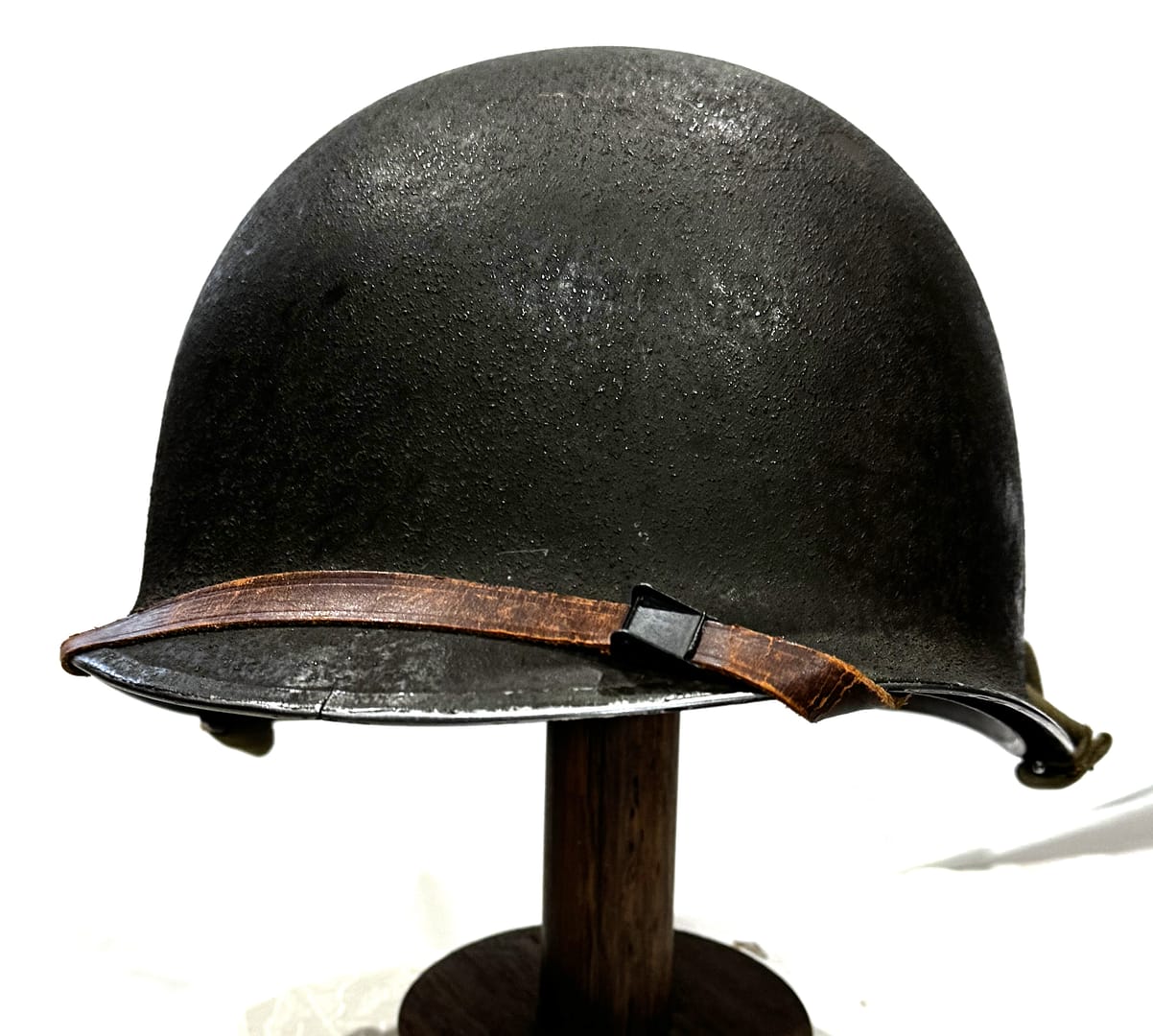
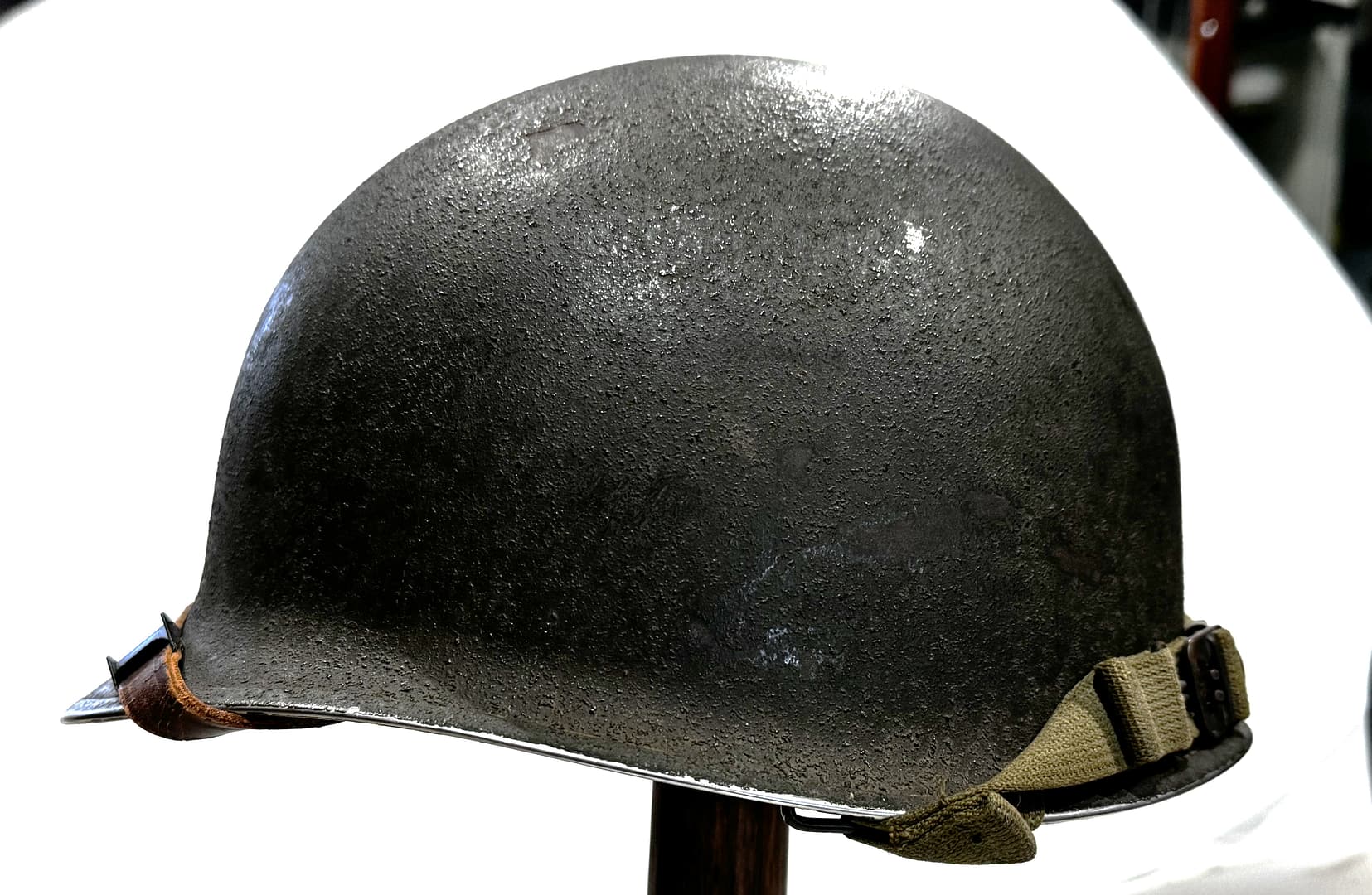
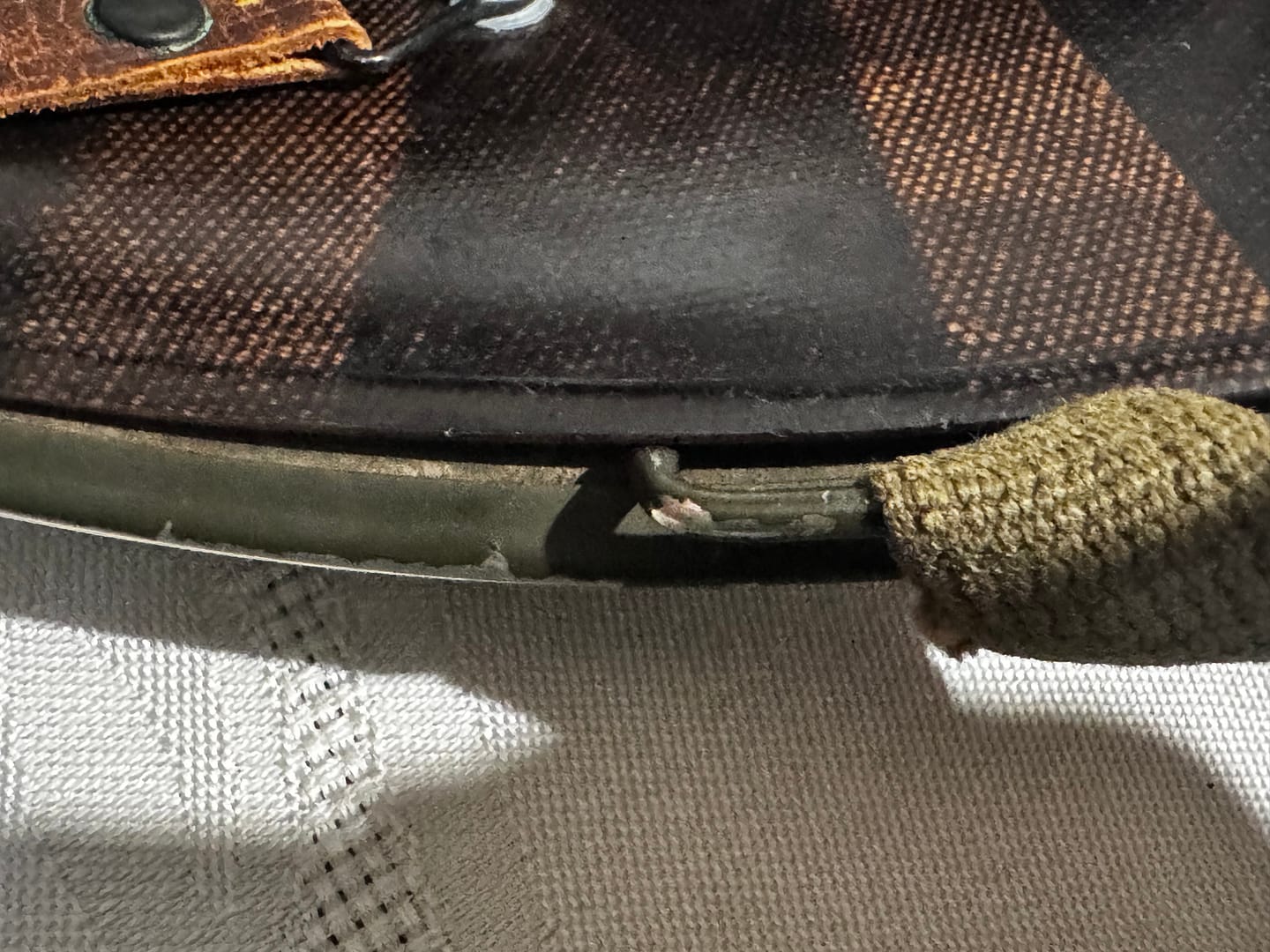
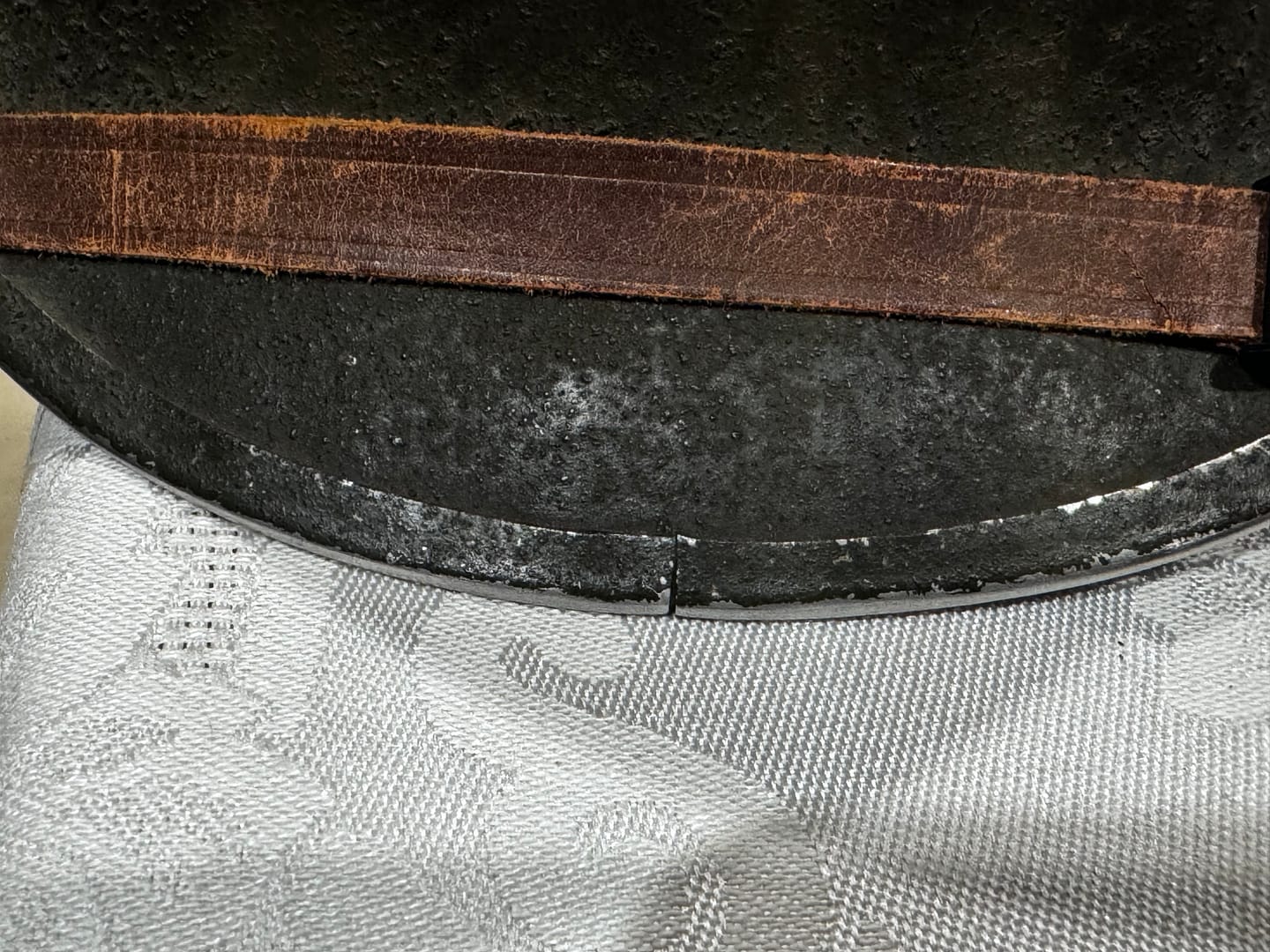
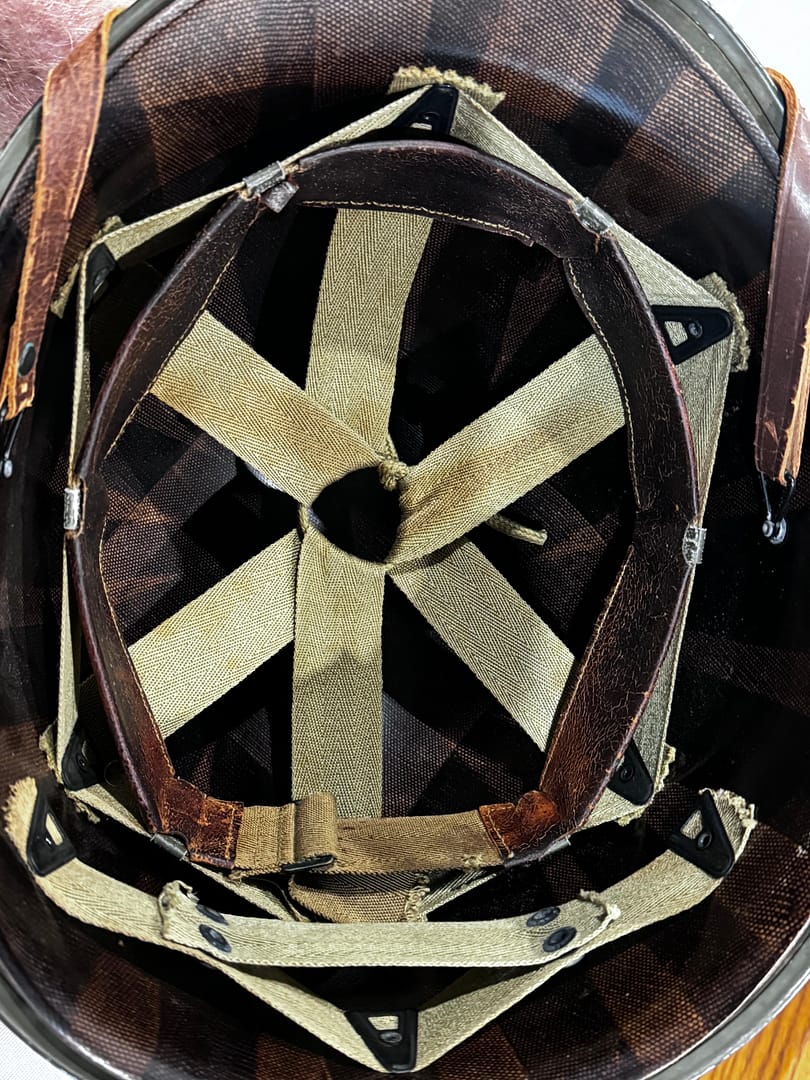
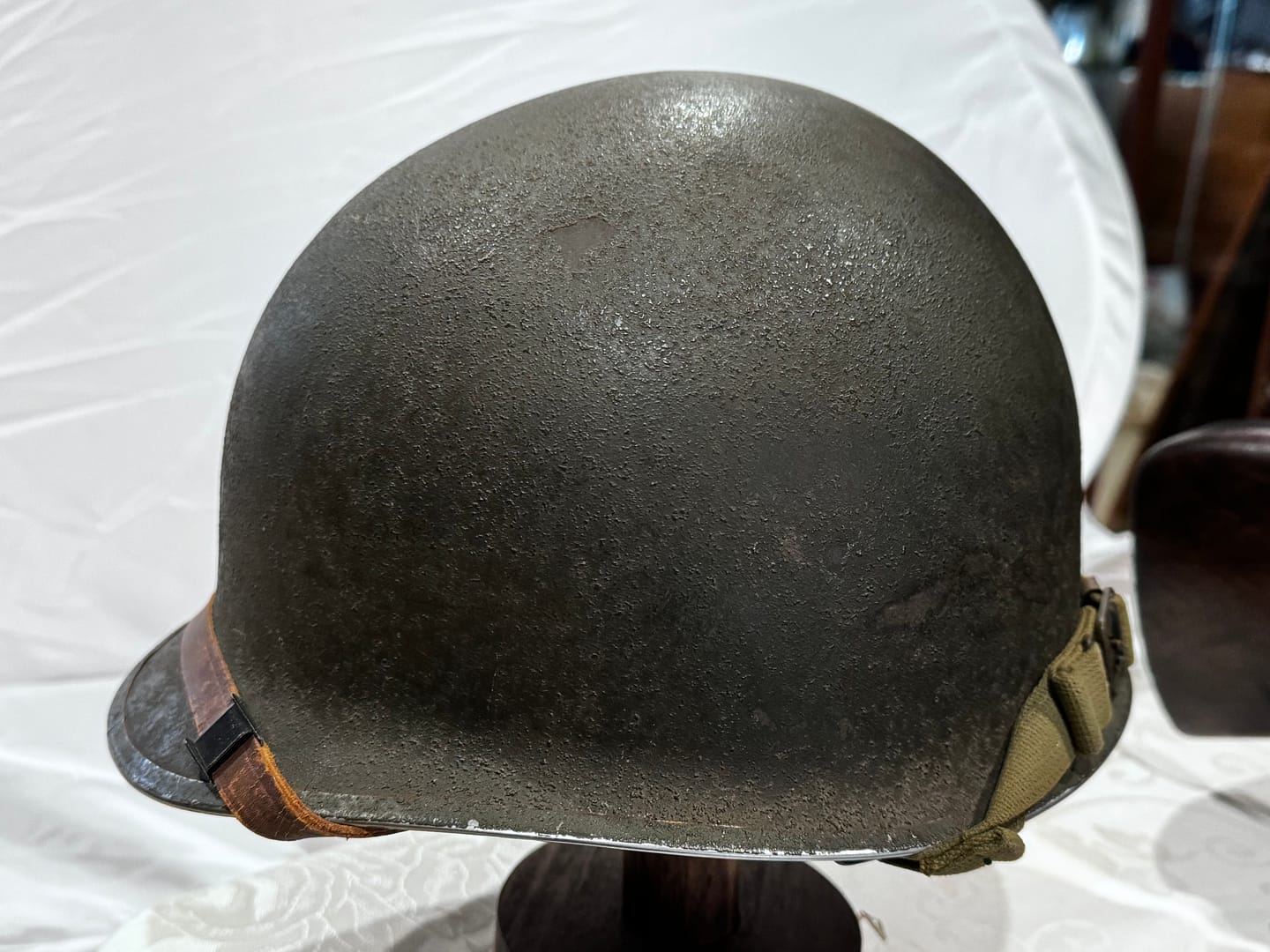
US M1 combat helmet, front seam, fixed bail ~1942, from my personal collection.
This early-war M1 helmet features a front-seam stainless steel rim and fixed chinstrap bails, characteristics of 1941–1943 production. Paired with a high-pressure fibre liner, the M1 offered enhanced ballistic protection compared with earlier U.S. patterns and became the archetypal American helmet of the Second World War. Fixed-bail models saw service in North Africa, Italy, Normandy, and the Pacific, and surviving examples are strongly associated with the first wave of U.S. amphibious and airborne operations.
BRITISH
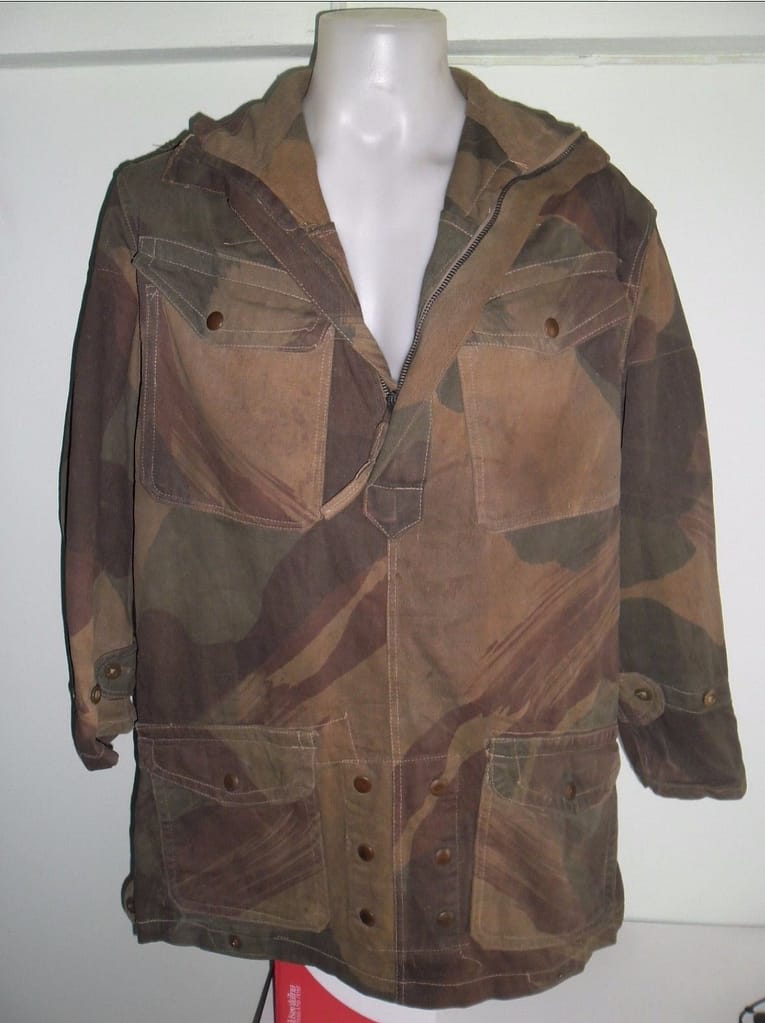
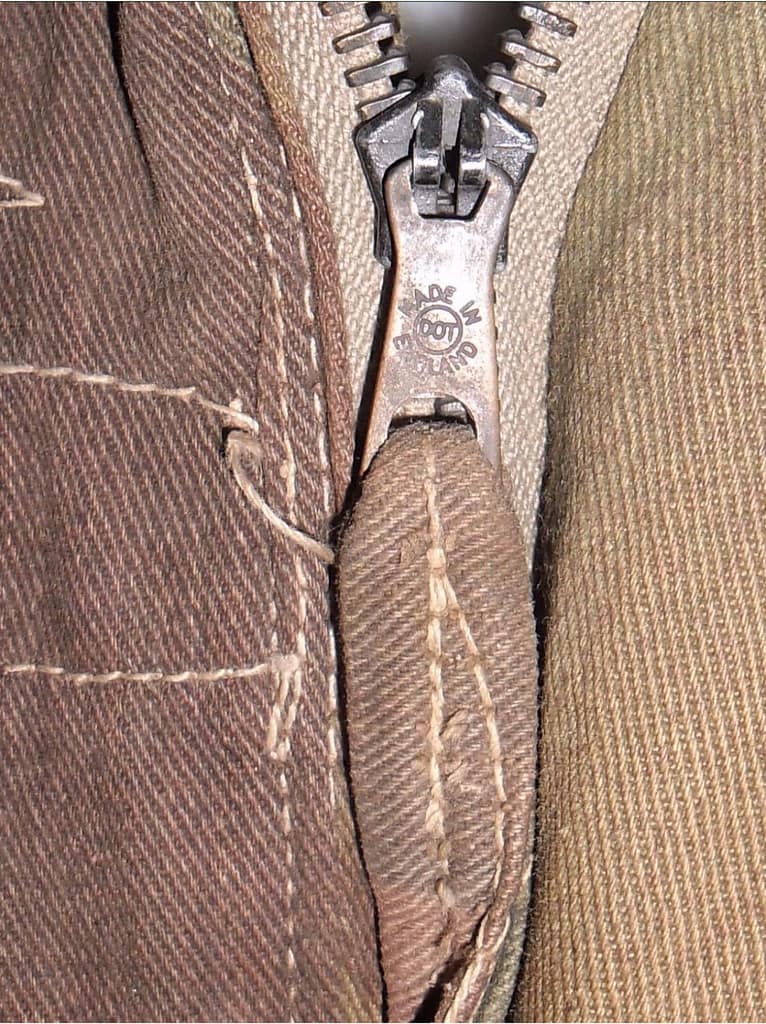
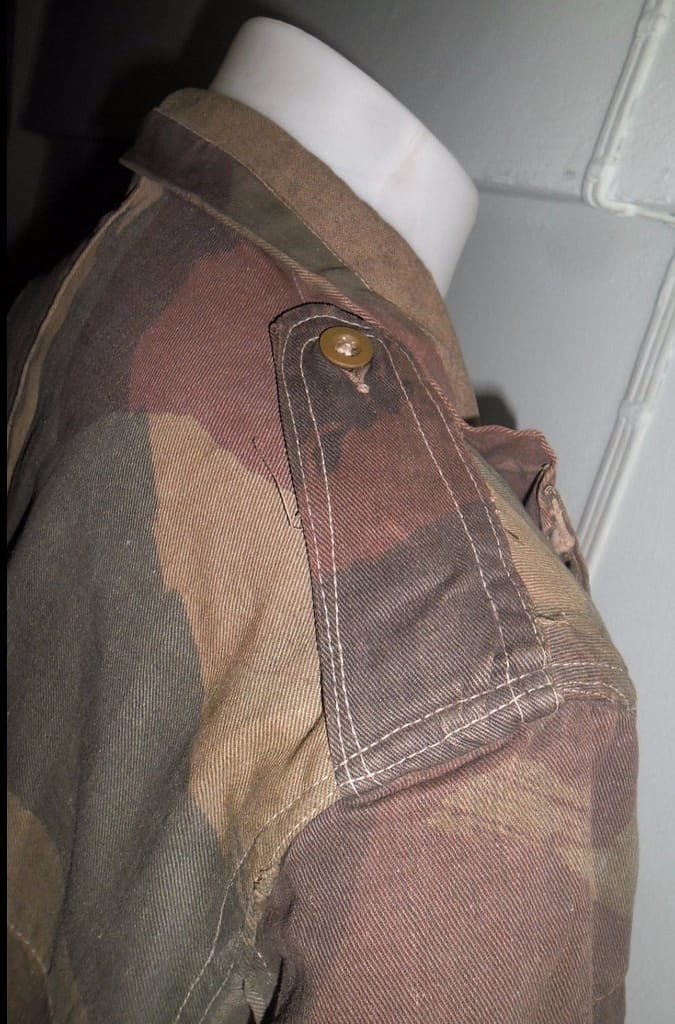
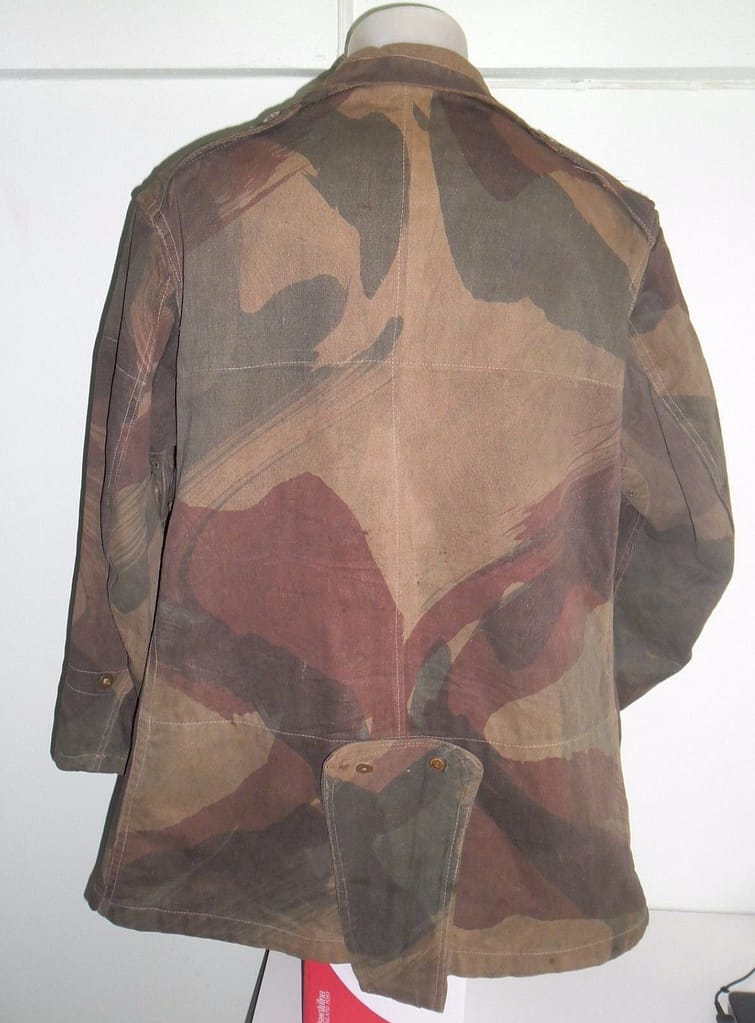
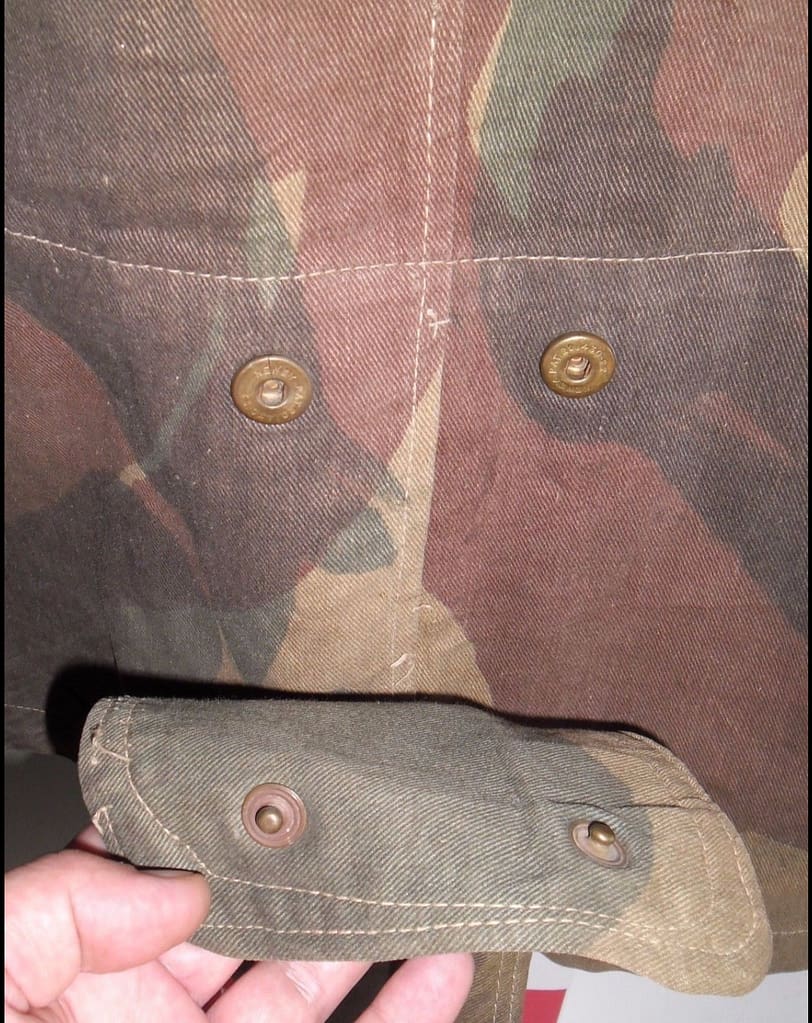
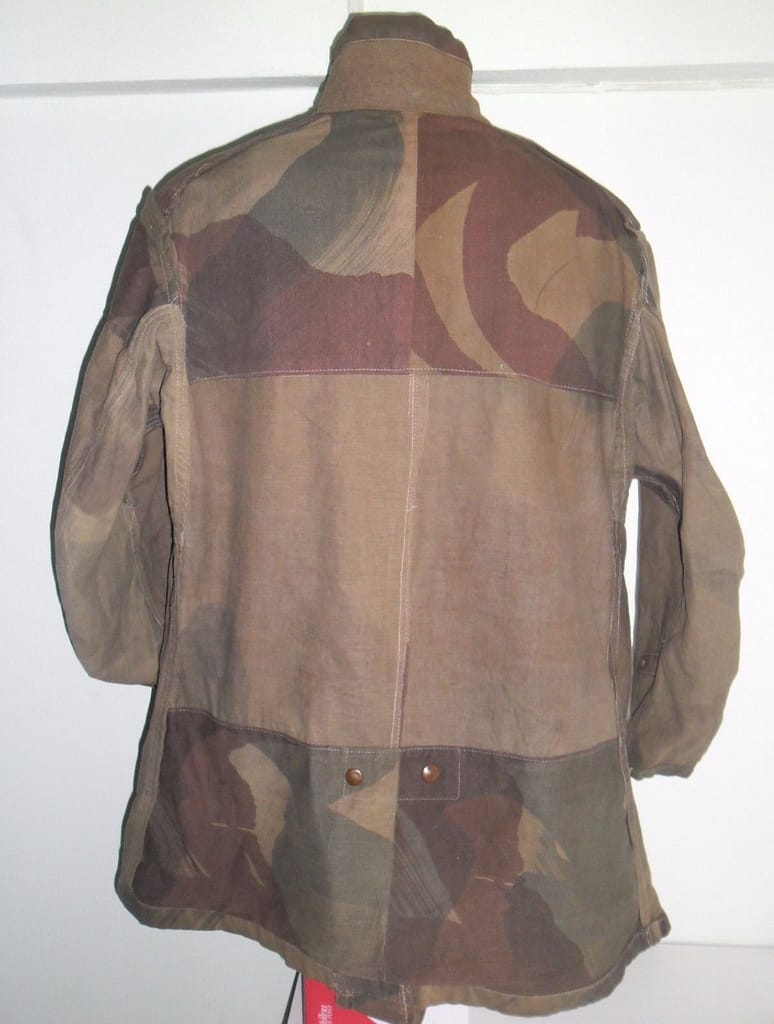
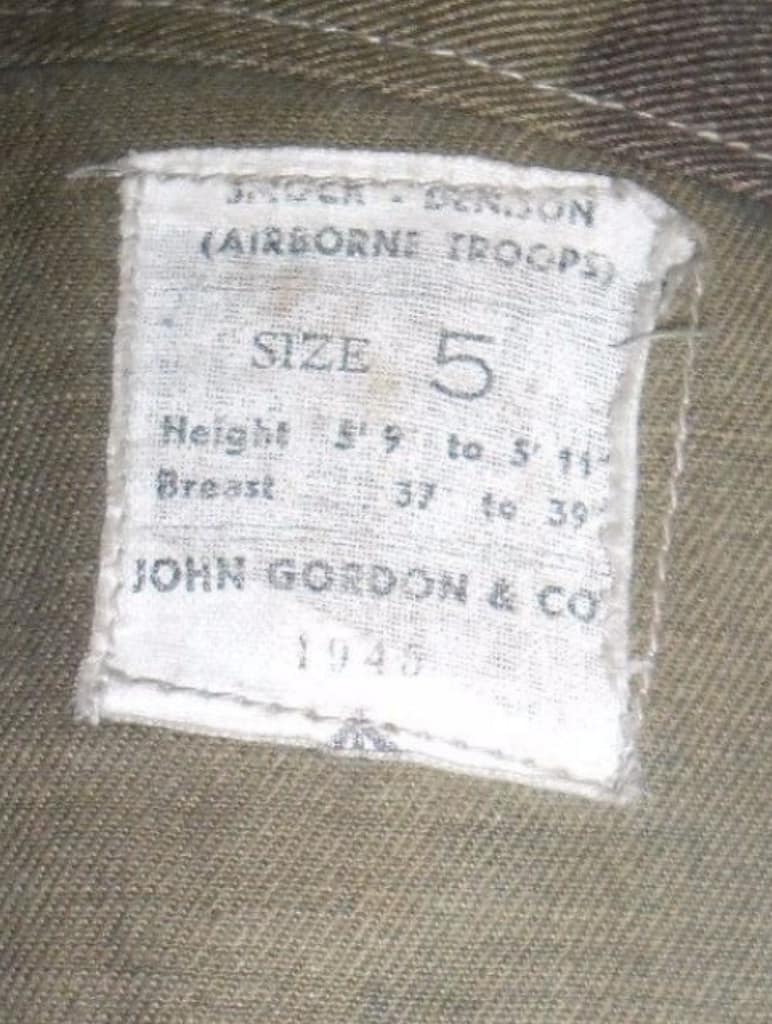
WW2 British Paratrooper ‘Denison Smock’, from my personal collection.
The Denison smock was introduced in 1942 for British airborne troops, including the 1st and 6th Airborne Divisions and the SAS. Constructed from heavy cotton with a distinctive hand-painted camouflage pattern, it was designed for parachute drops and close-quarter fighting. The smock’s beaver-tail crotch flap prevented the garment ballooning during descent. Worn at Bruneval, Sicily, Arnhem, and the Rhine crossings, the Denison remains one of the most recognisable garments of British airborne forces.
SOVIET UNION
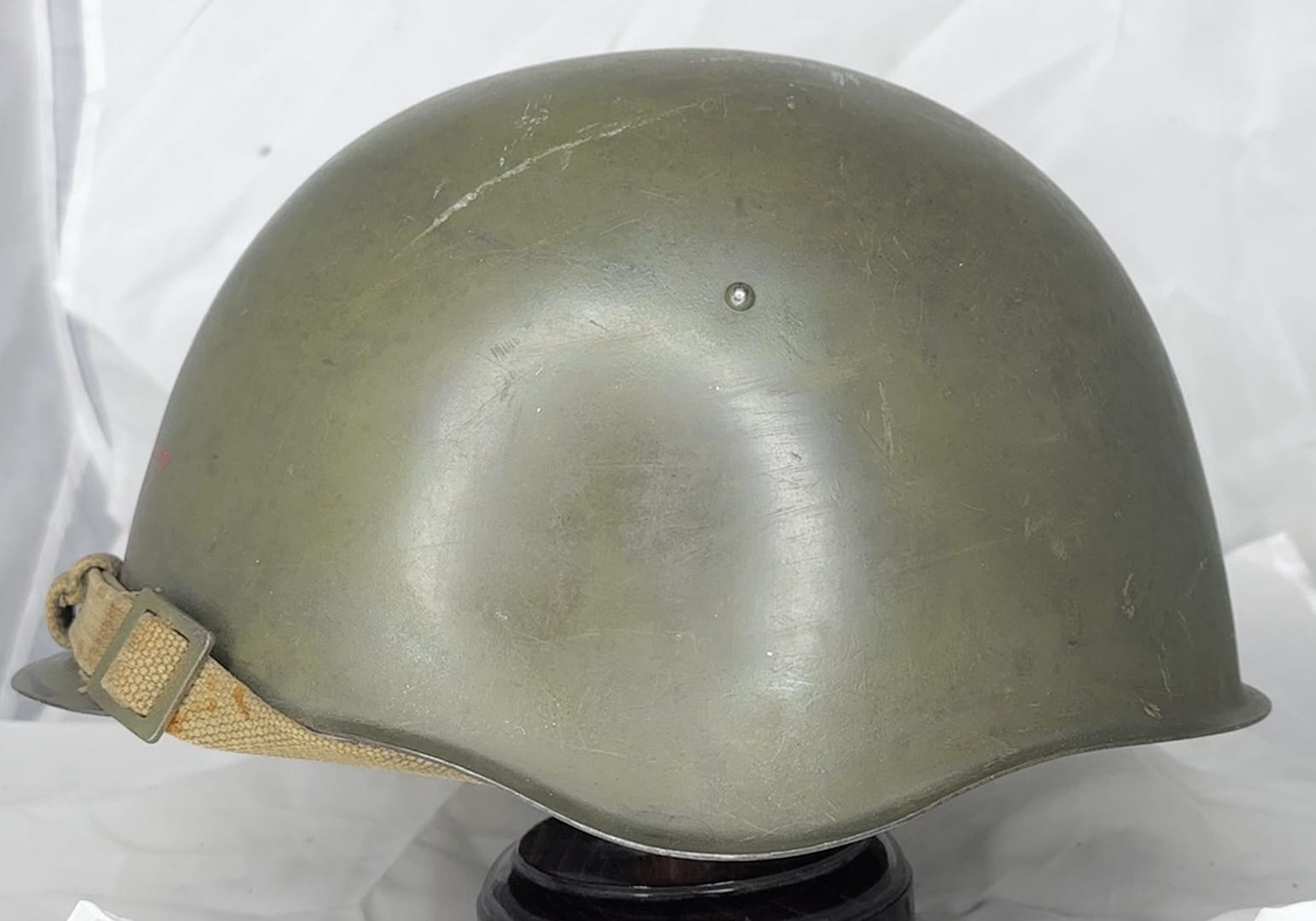
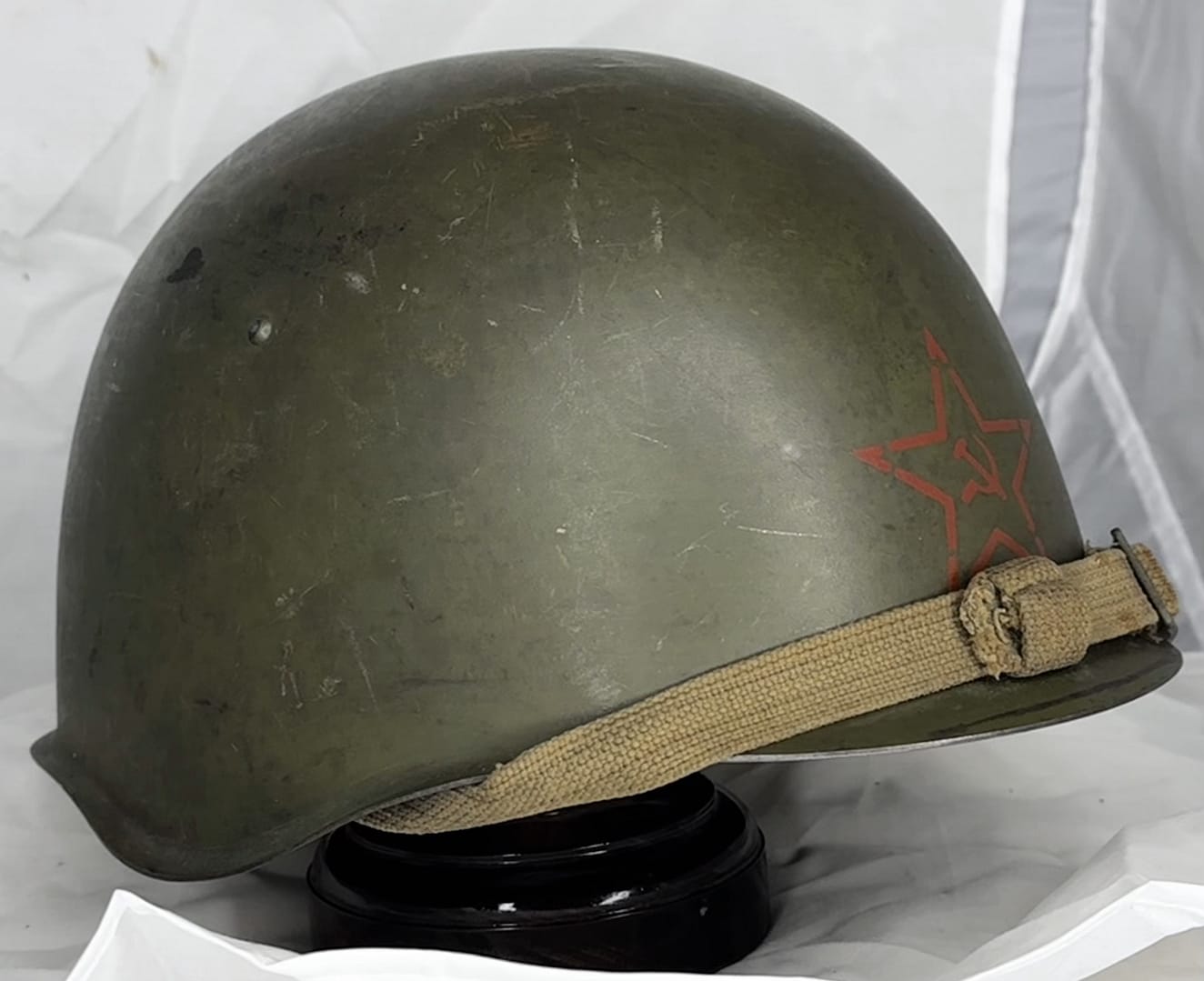
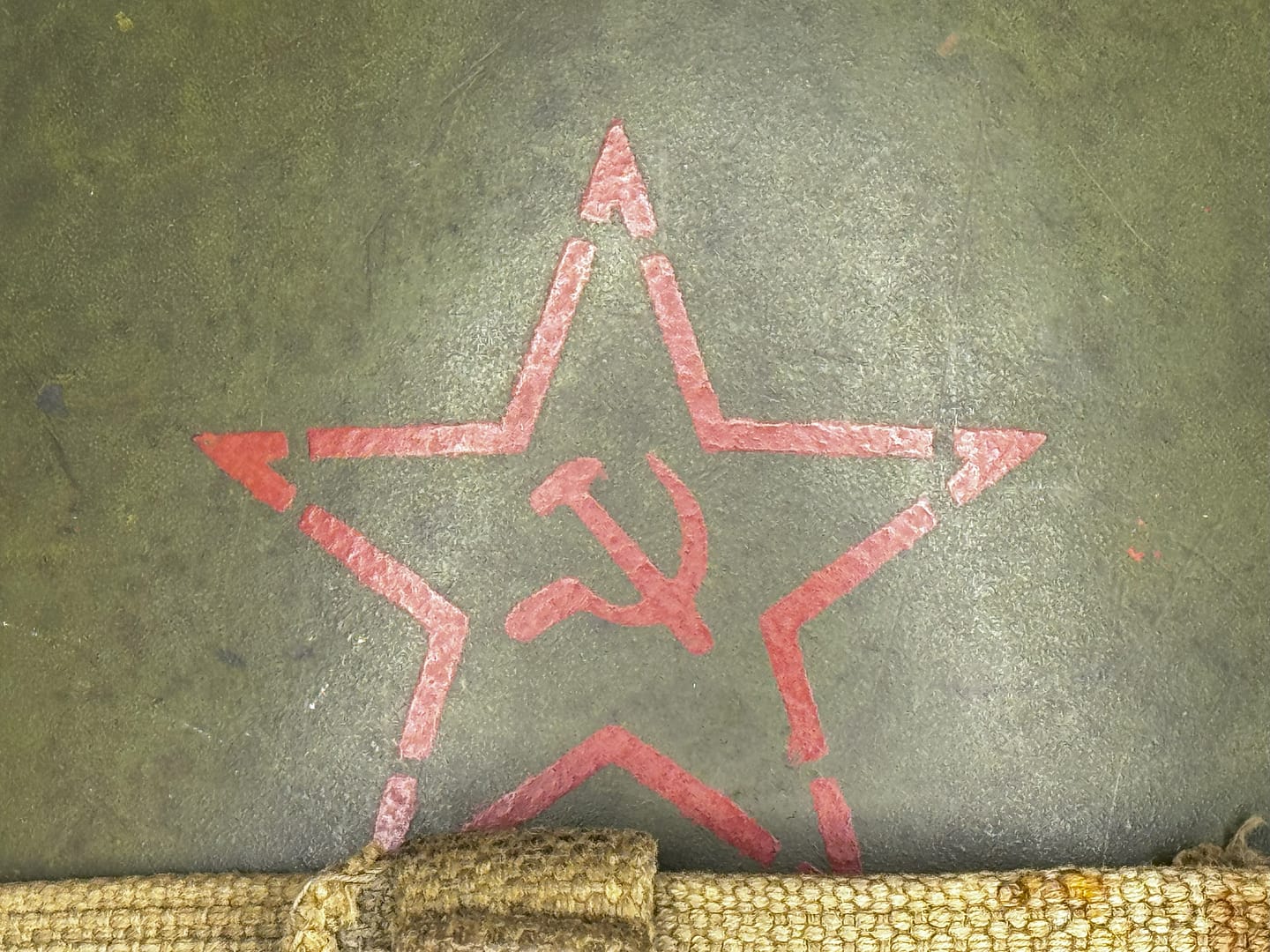
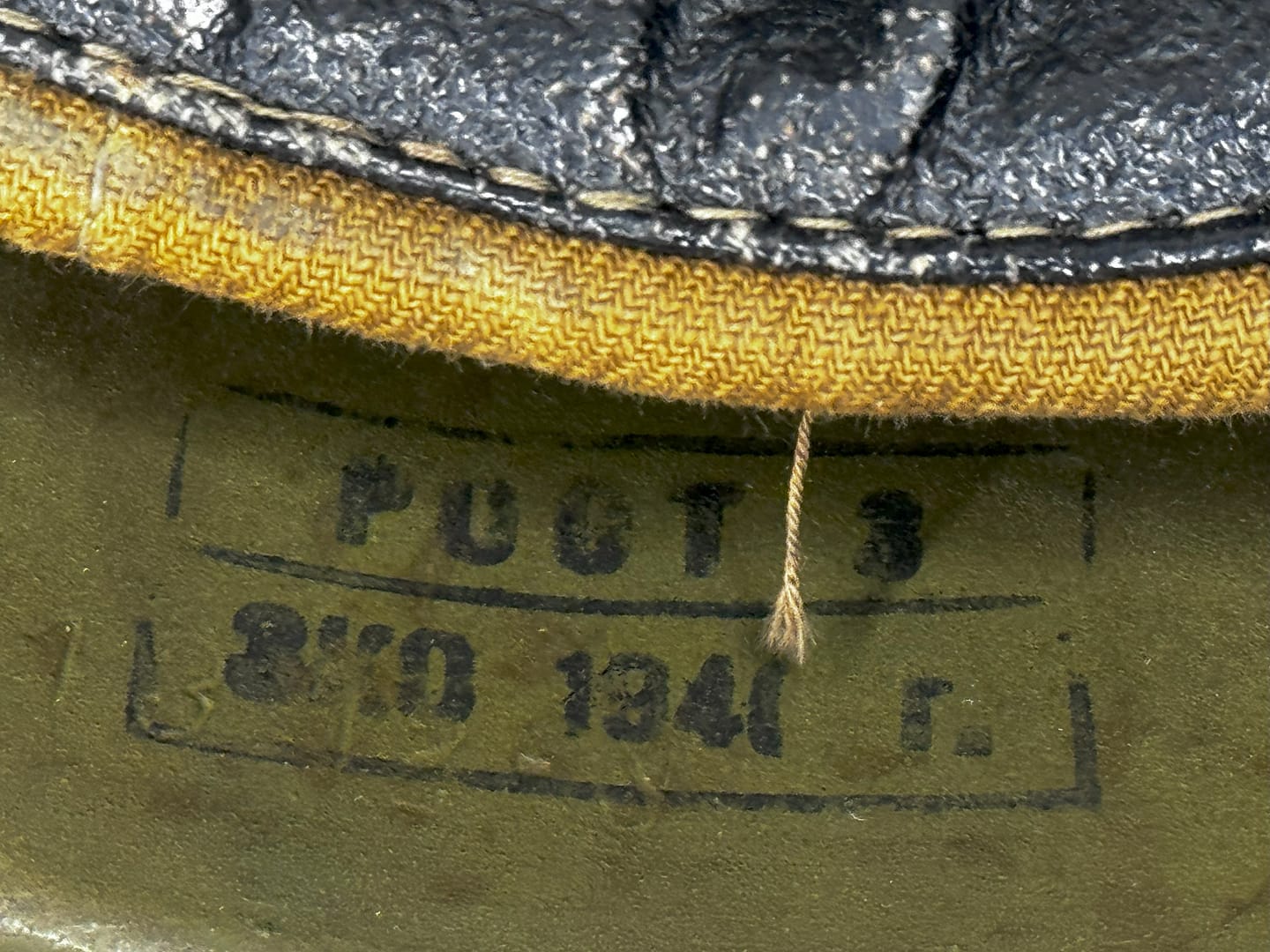
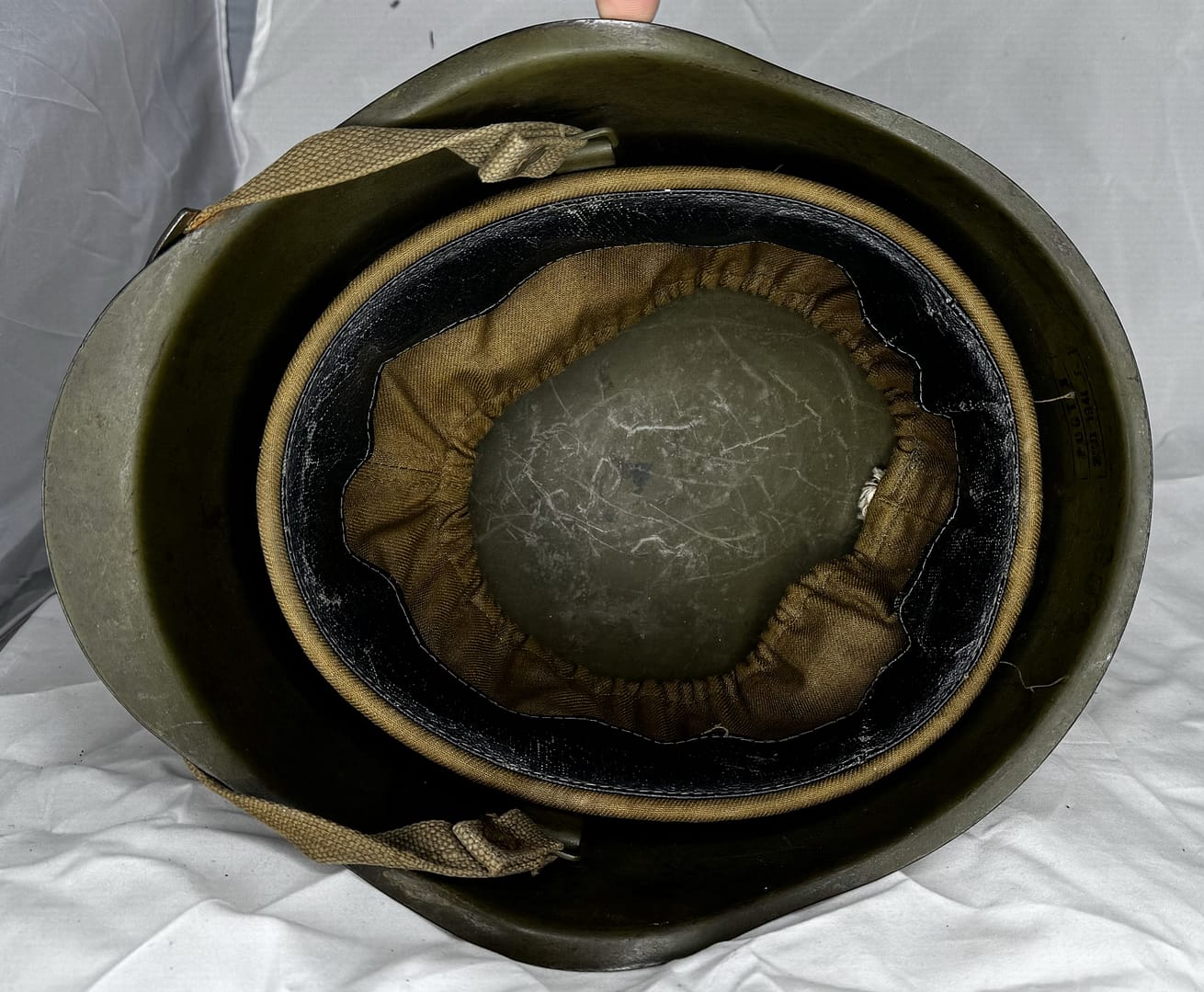
Red Army M1939 helmet, ЗKO 1941 ‘Zavod Krasny Octyabr’ (Red October) factory, Stalingrad, 1941, from my personal collection.
This Soviet M1939 steel helmet was manufactured in 1941 by the ZKO — Zavod Krasny Oktyabr (Red October) plant at Stalingrad. The SSh-39 featured an improved shell profile over earlier designs and a three-pad liner suspended by cloth straps. Produced under wartime pressure and often showing coarse finishing, it equipped Red Army infantry in the early defence battles of 1941–42. Helmets from Stalingrad factories are especially significant due to the city’s later destruction during the 1942–43 campaign.
Soviet Red Army M1941 Summer Weight cotton Gymnastiorka, from my personal collection.
The M1941 gymnastiorka was the standard summer field blouse of the Red Army during the first half of the war. Made from lightweight khaki cotton with stand collar and shoulder boards (added after 1943), it was worn on all fronts from Leningrad to the Caucasus. Its simple pullover design reflected Soviet priorities: rapid production, minimal tailoring, and suitability for mass mobilisation. The M1941 blouse became one of the most recognisable garments of wartime Soviet infantry.
JAPANESE
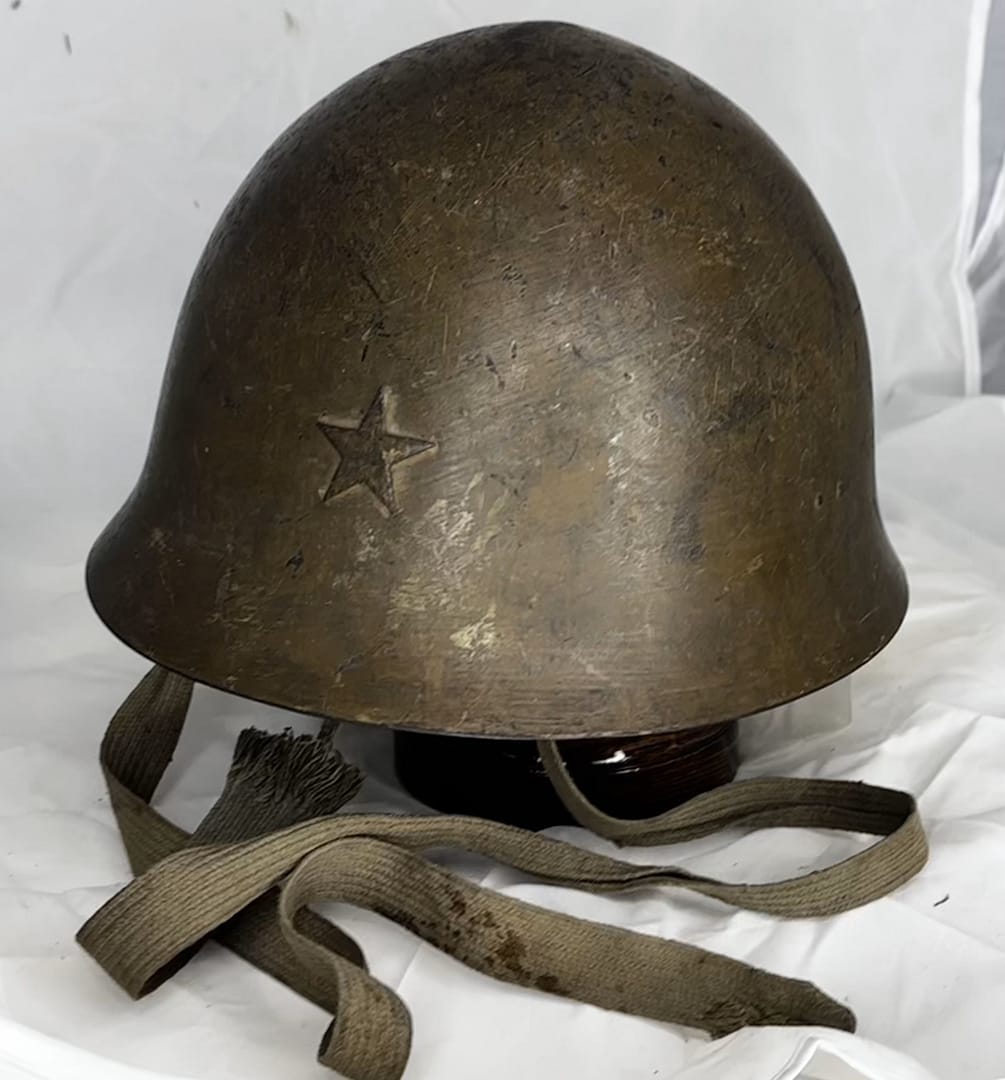
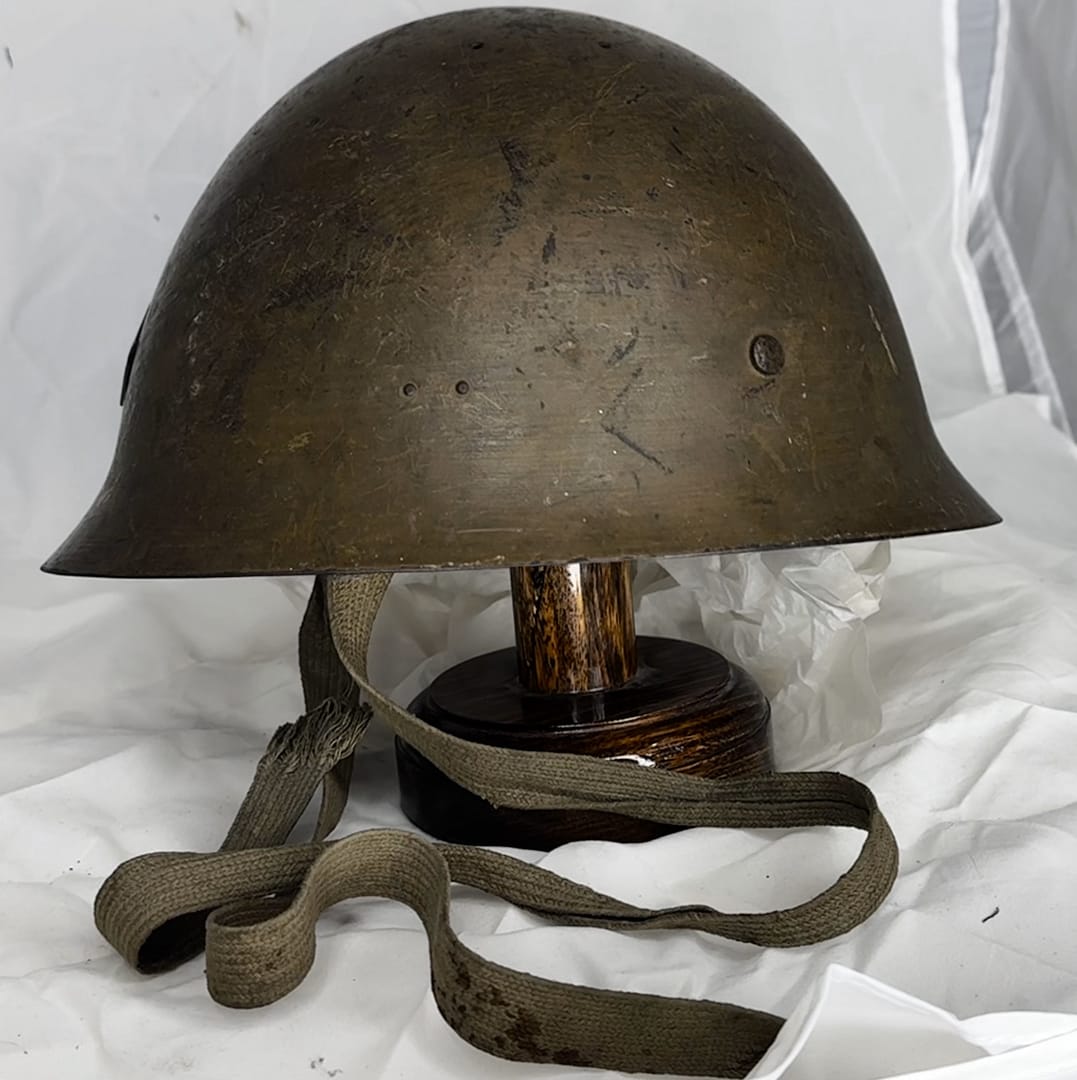
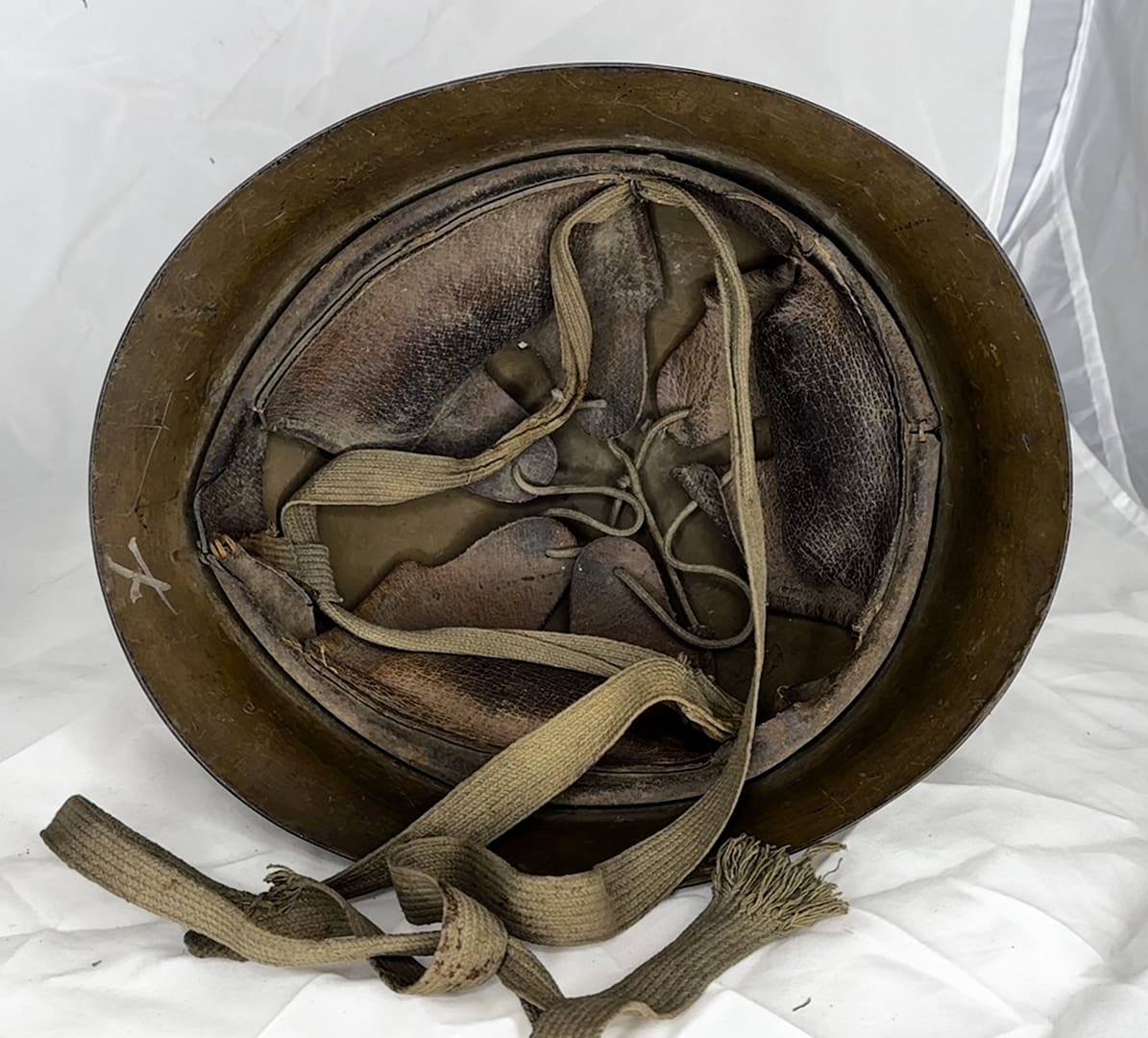
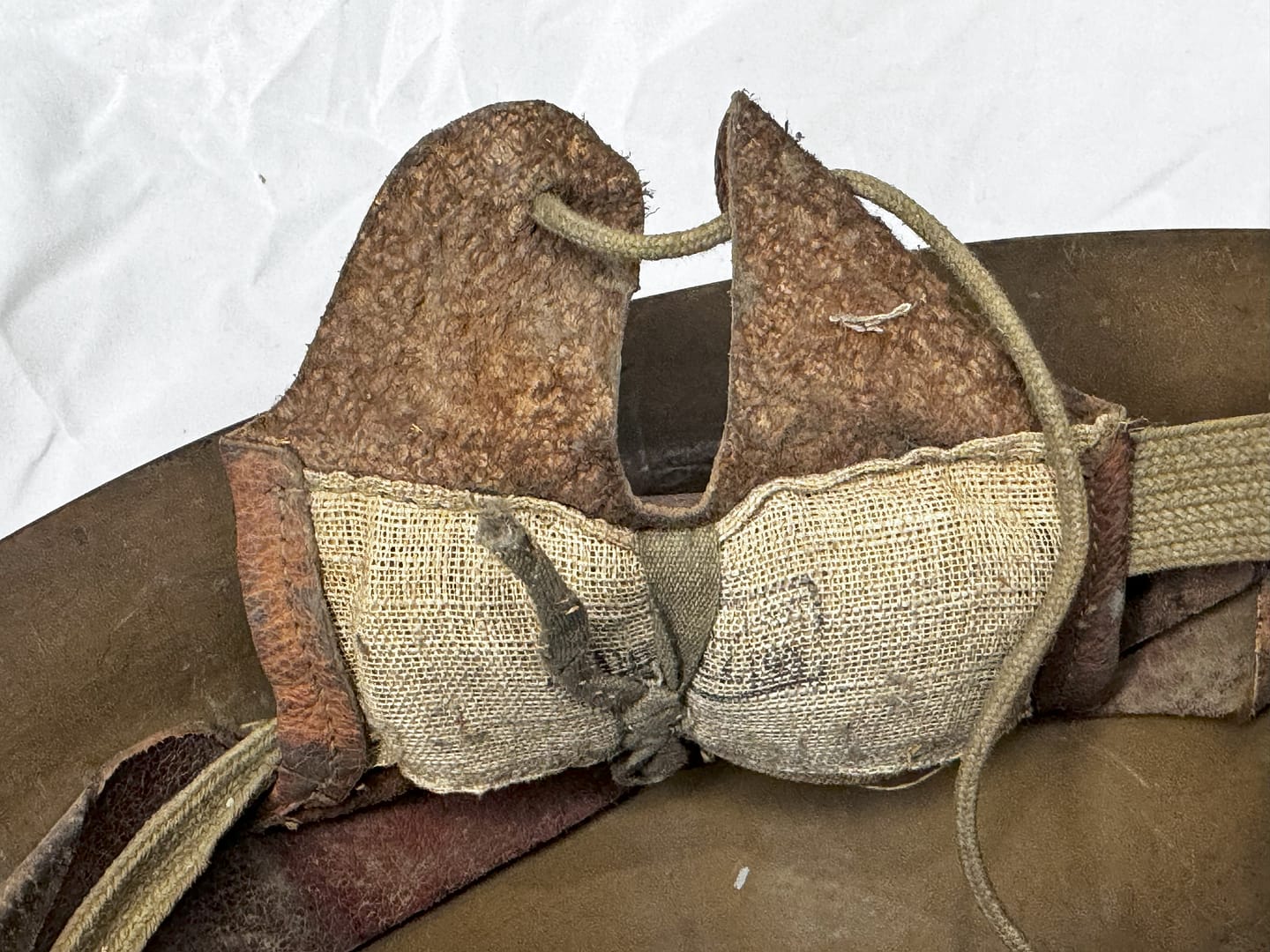
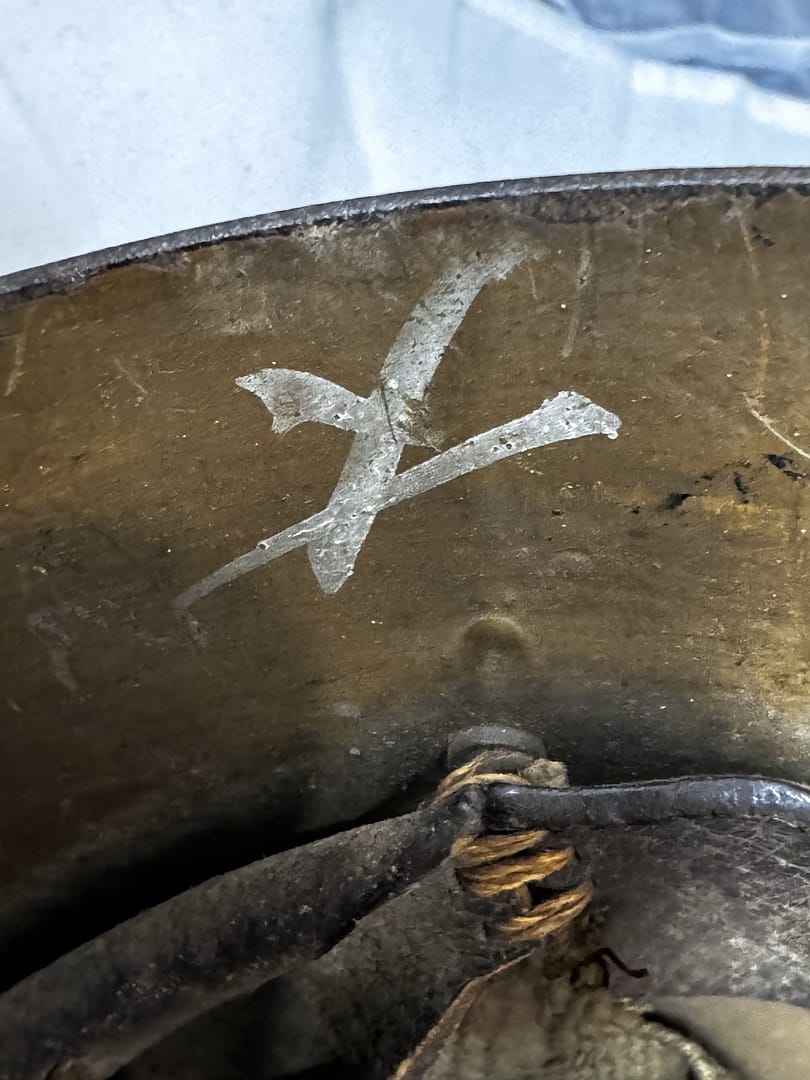
Imperial Japanese Army Type 90 helmet, from my personal collection.
The Type 90 helmet was standard issue for Imperial Japanese Army troops from 1930 to 1945. Formed from pressed steel with a three-pad cloth liner, it offered limited protection but was lightweight and easily produced. Its simple riveted construction and tan-brown finish made it distinct from Western helmets. The Type 90 saw widespread use in China, Malaya, New Guinea, Burma, and the Central Pacific, and is closely associated with Japanese infantry operations throughout the war.
Imperial Japanese Army Model 1930 wool enlisted service tunic. Possibly unissued, from my personal collection.
The Model 1930 tunic was the standard enlisted uniform of the Imperial Japanese Army at the outbreak of the Second World War. Made from olive-brown wool with standing collar, five-button front, and cloth branch insignia, it reflected traditional IJA tailoring before the adoption of tropical garments. Issued in China, Malaya, and New Guinea, the tunic performed poorly in jungle climates but remained in service due to production constraints.
Japanese battle flag, from my personal collection.
Captured at Kia Rivu 12 July 1945, by Australian soldiers of 7 Platoon, A Company, 2nd/7th Battalion Second AIF. This silk Japanese battle flag captured at Kia Rivu by Australian troops of the 2/7th Battalion, 2nd AIF, during operations in the Pacific theatre. Personalised battle flags were often carried by Japanese soldiers as talismans, bearing good-luck messages from family or comrades. Their capture was uncommon due to Japanese battlefield doctrine. This example illustrates the cultural and symbolic significance attached to regimental and personal standards within the Imperial Japanese Army. The flag is marked with the names of all the members of the platoon – deciphered on the image below.
🧭 From Weapons to Battlefield Use
This page shows weapons and equipment of the Second World War. All items are from my personal collection.
But what images and data don’t show is how these weapons were actually used on the ground—how weapon characteristics, tactics, innovation, terrain, and movement shaped their effectiveness in battle.
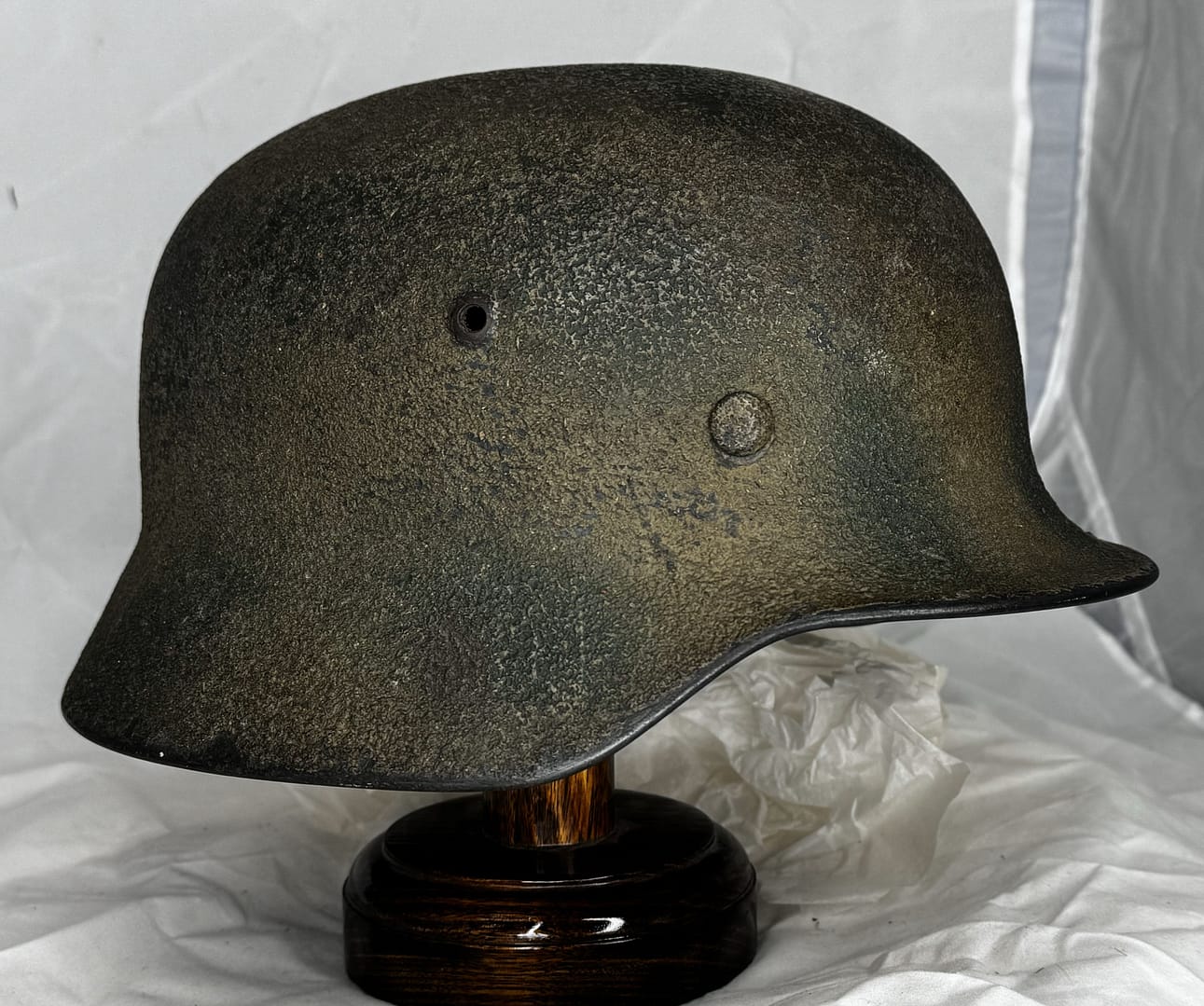
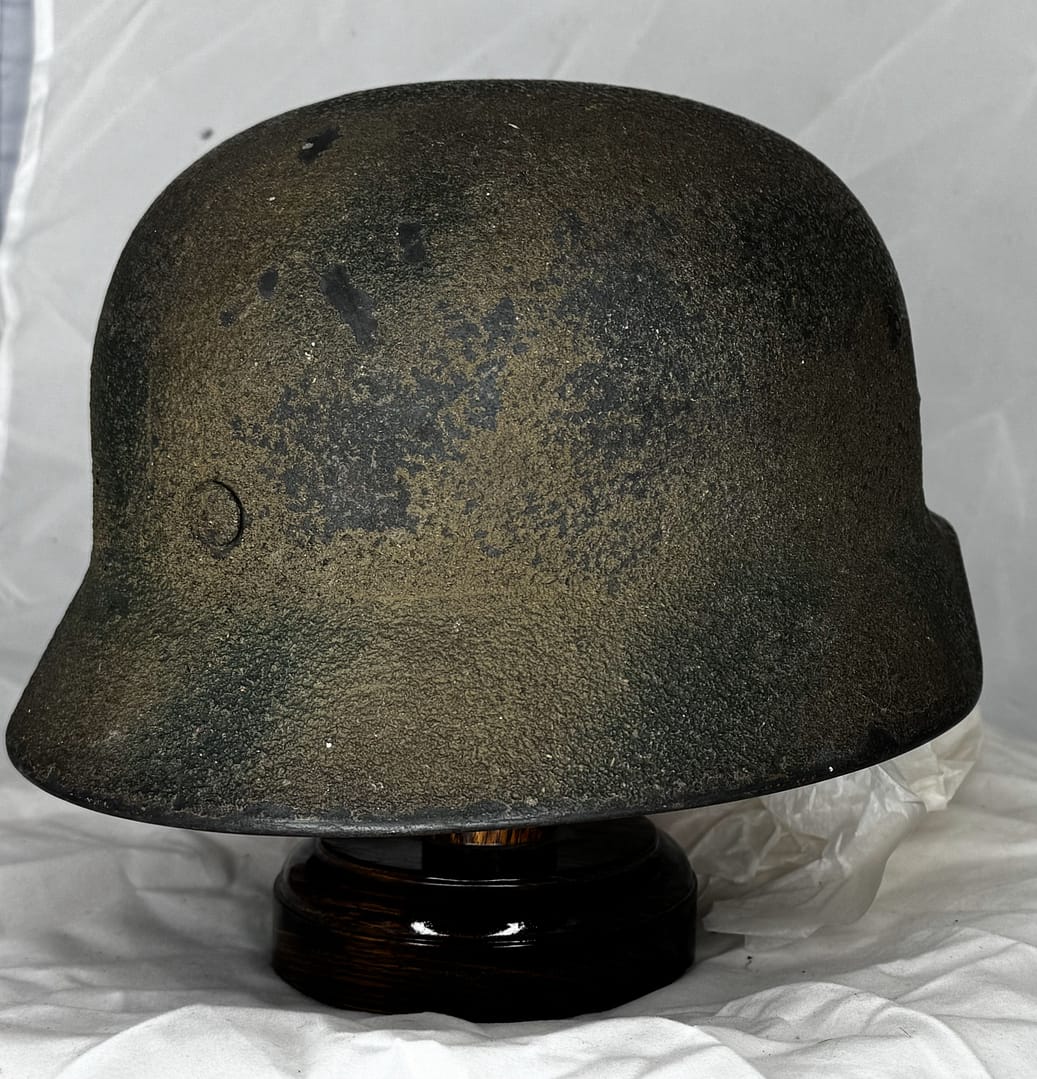
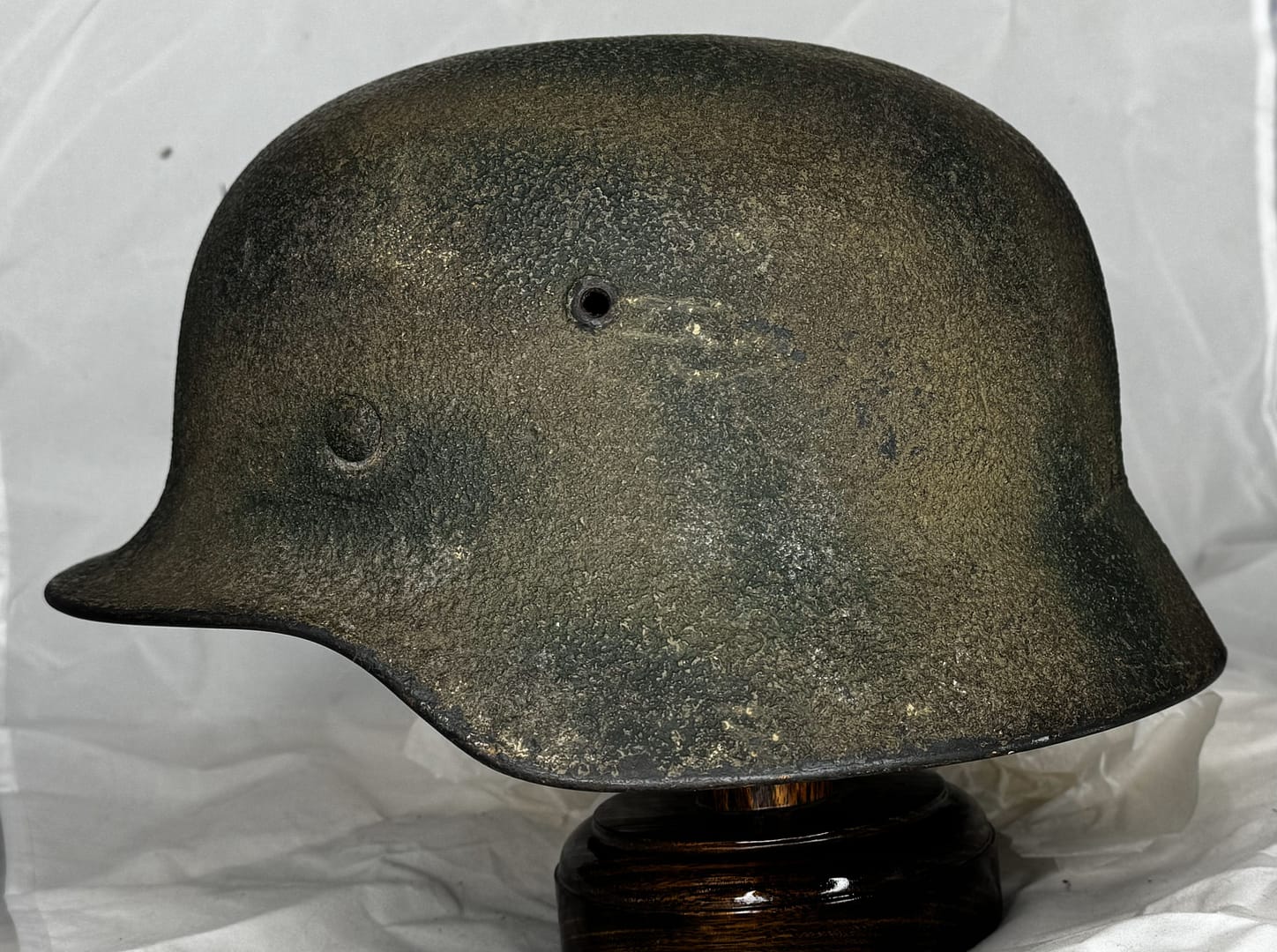
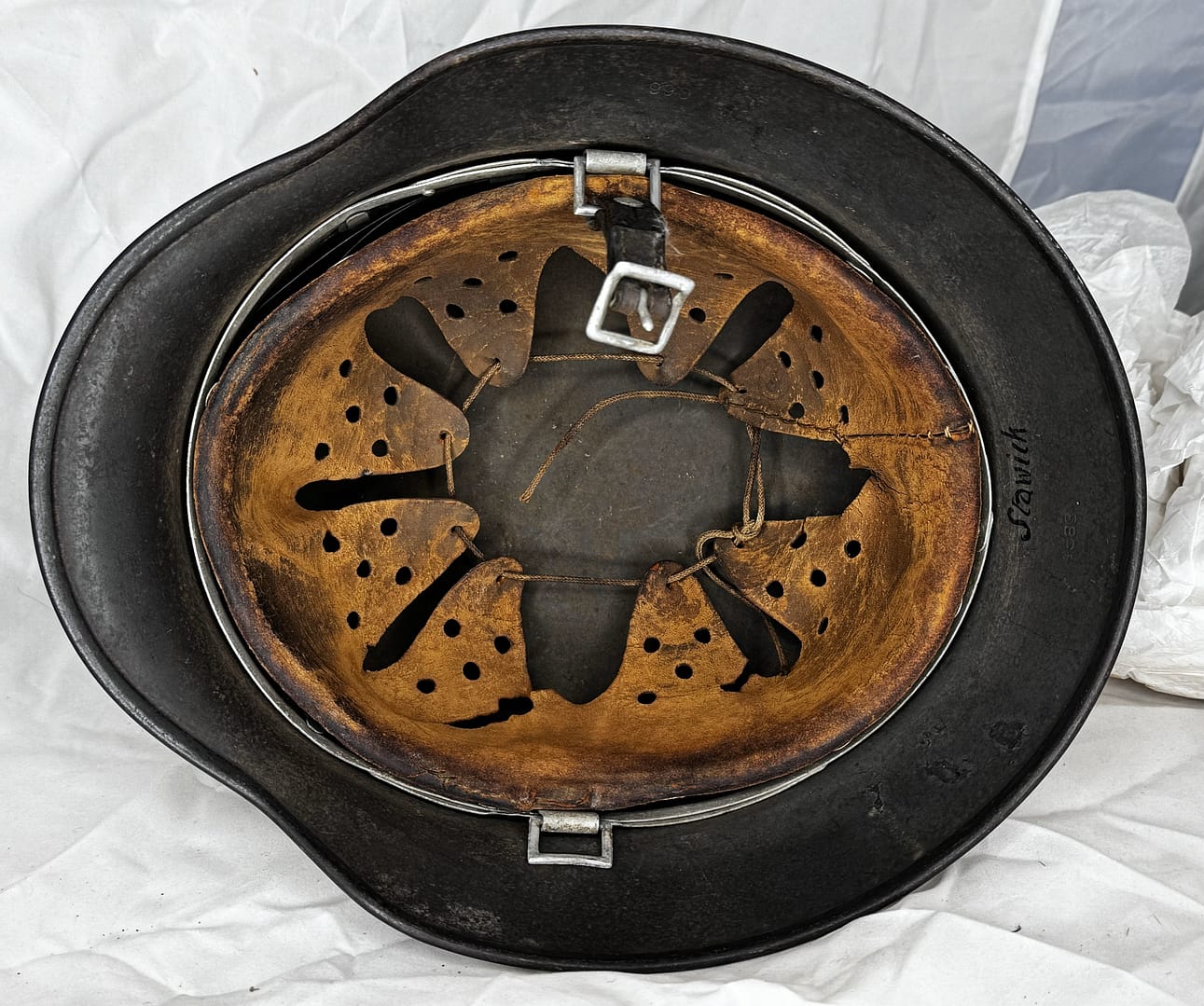
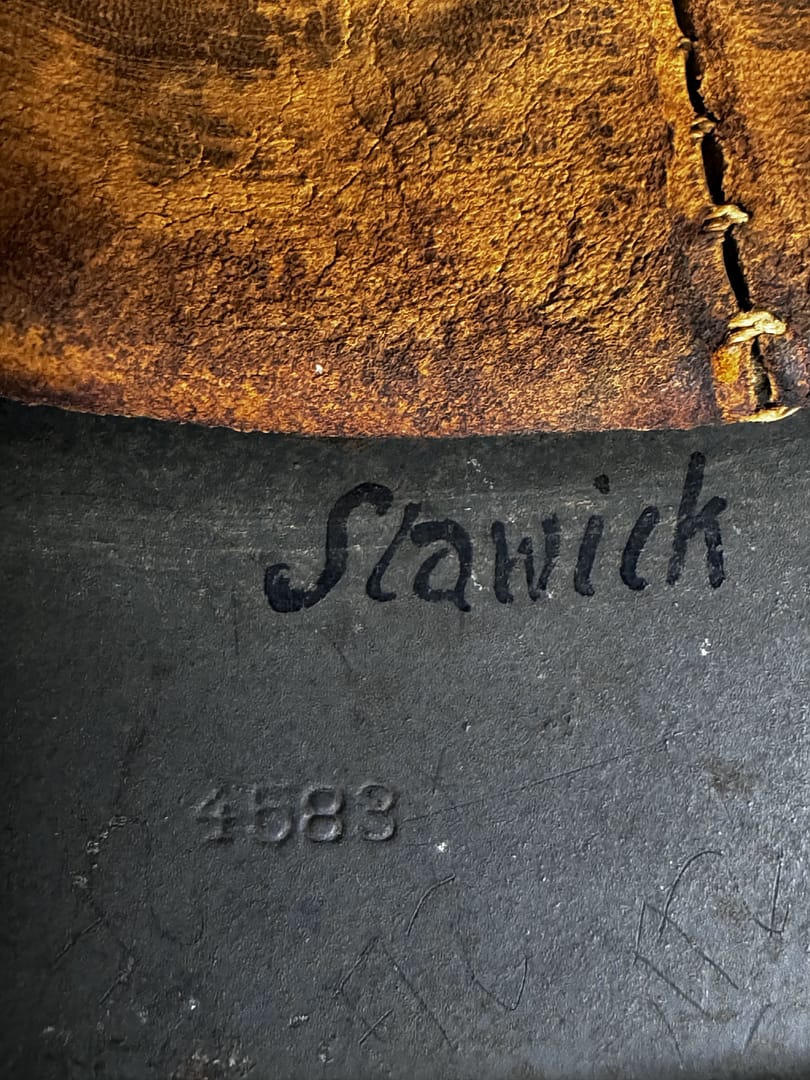
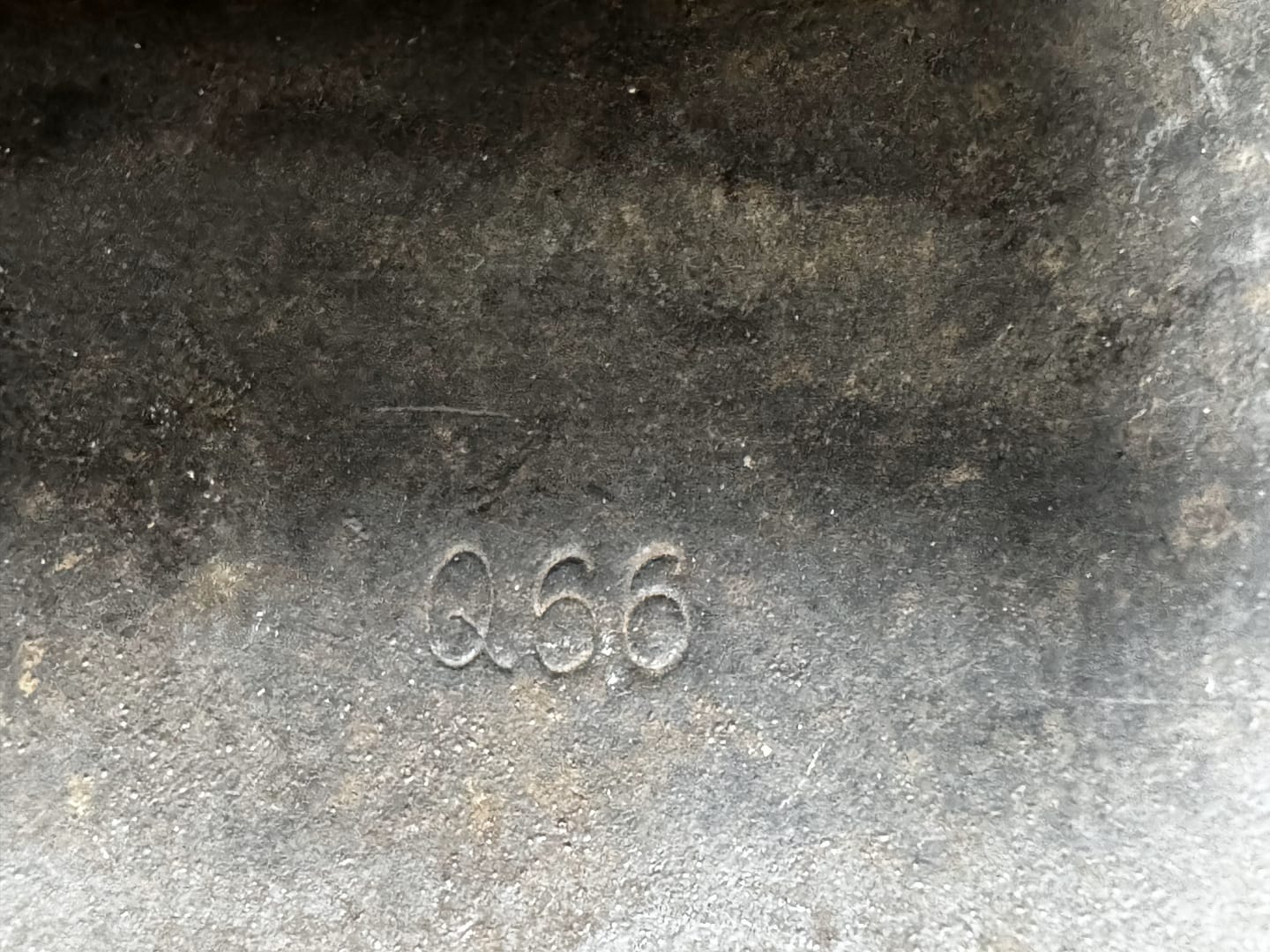
WW2 German M40 woodchip/sawdust ‘Normandy Camouflage’ helmet, Q66, from my personal collection.
This M40 helmet features a hand-applied “woodchip” camouflage pattern typical of German units operating in Normandy in 1944. Using sand, sawdust, or cork granules mixed into paint, the finish provided textured camouflage suited to hedgerow terrain. The M40 shell incorporated stamped ventilation holes and improved manufacturing over earlier models. Field-applied camouflage like this was common among infantry and assault gun crews during the fighting in France.
WW2 German Tropical Pattern Afrika Korps uniform for a Hauptmann (Captain)
This German tropical service uniform reflects the adaptation of the Wehrmacht to the harsh desert conditions of North Africa during the Second World War. Designed for hot climates, the lightweight cotton construction replaced the heavier wool field-grey uniforms used in Europe, improving comfort and practicality in extreme heat. This example bears the insignia of a Hauptmann (Captain), indicating a company-level command role within the Deutsches Afrikakorps. Tropical uniforms quickly developed a faded, worn appearance due to sun and sand exposure, becoming closely associated with desert campaigning. The uniform illustrates both environmental adaptation and the operational demands of mobile warfare in North Africa.
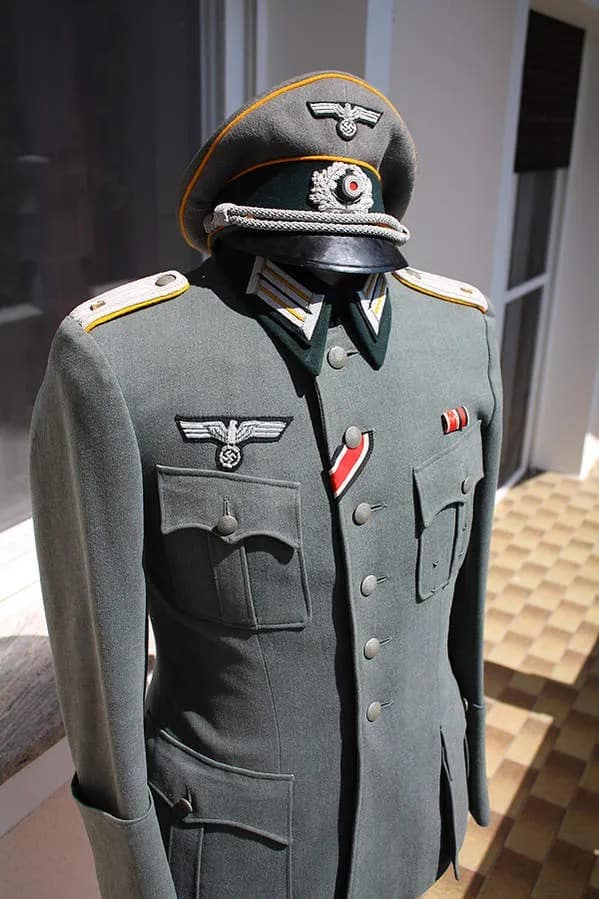
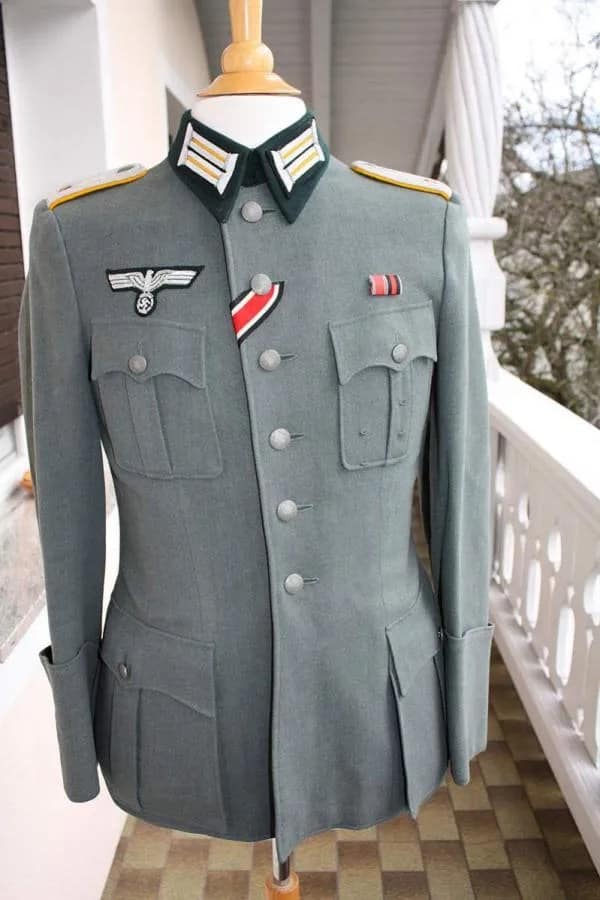
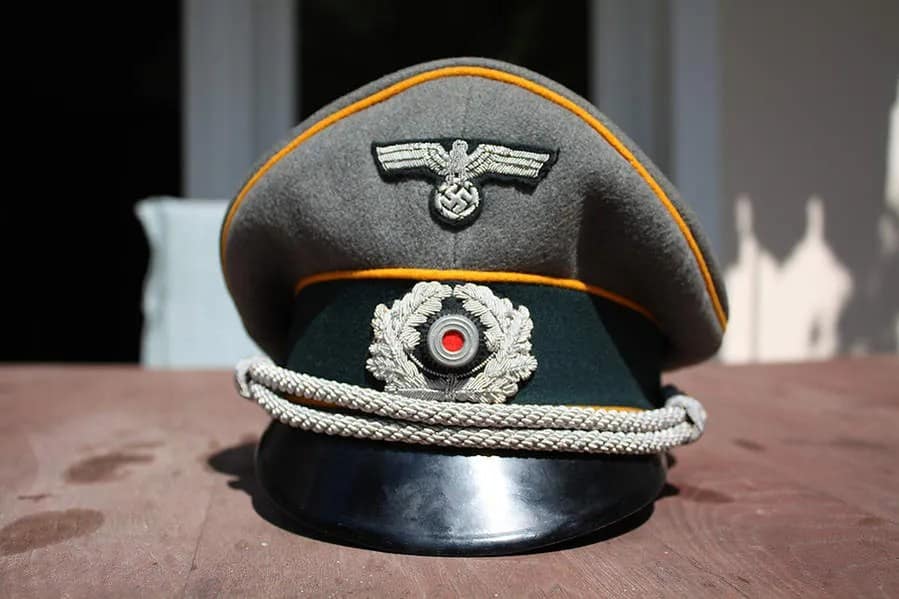
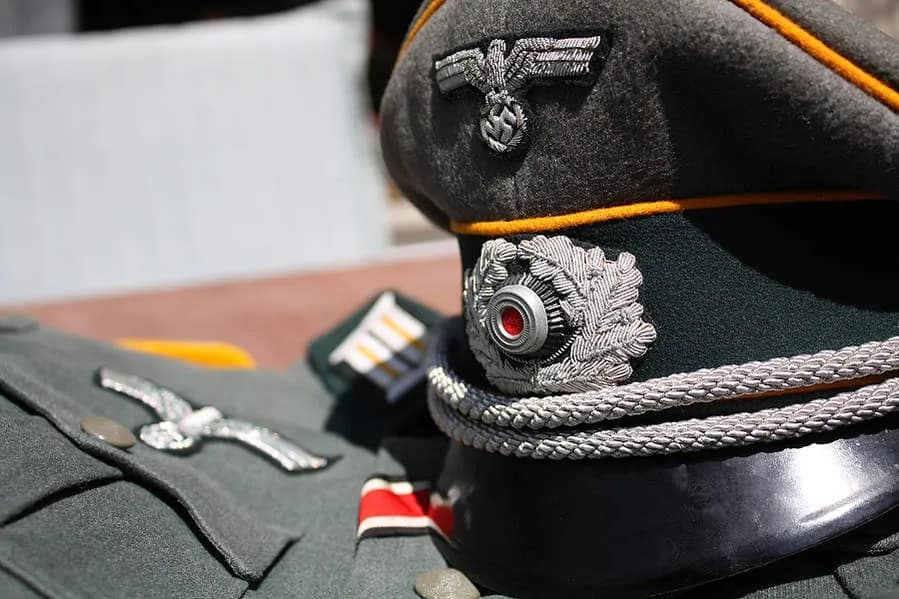
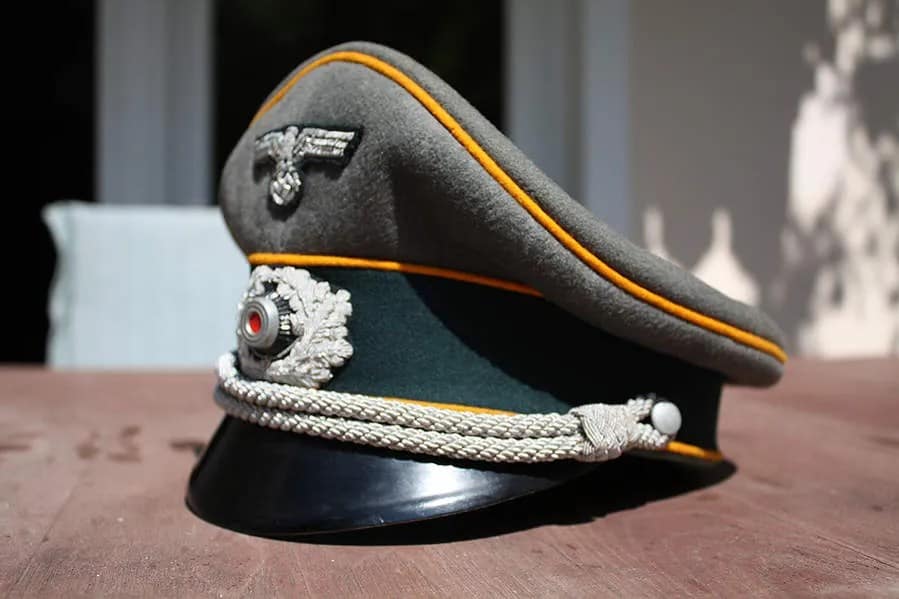
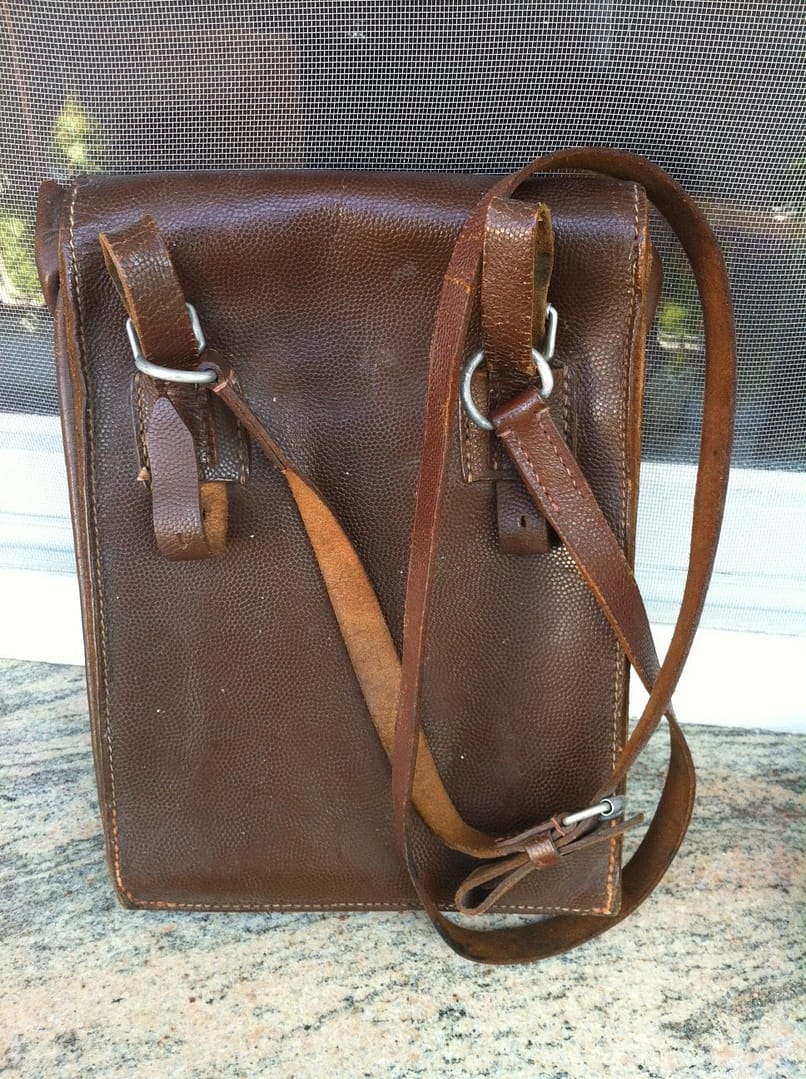
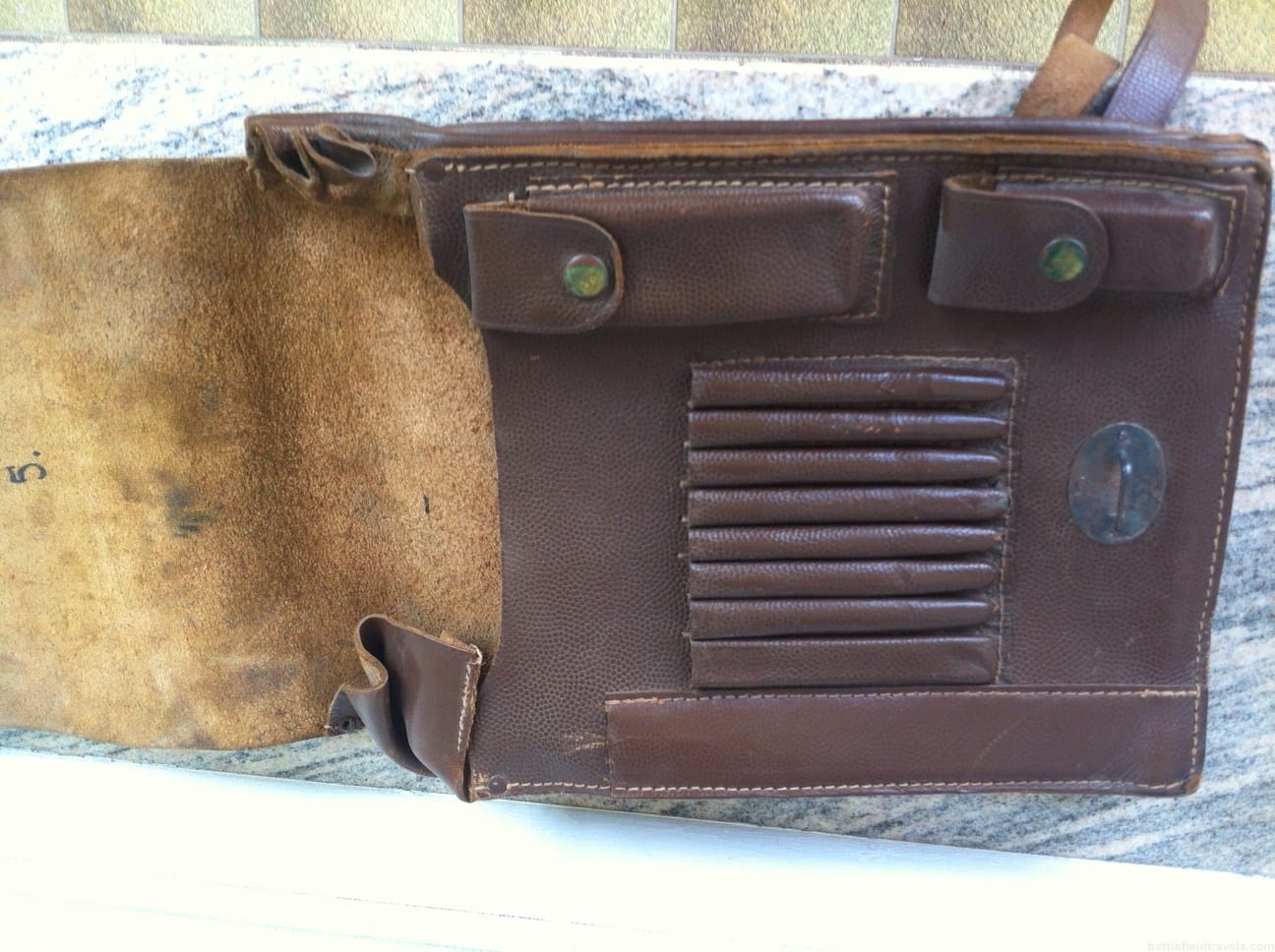
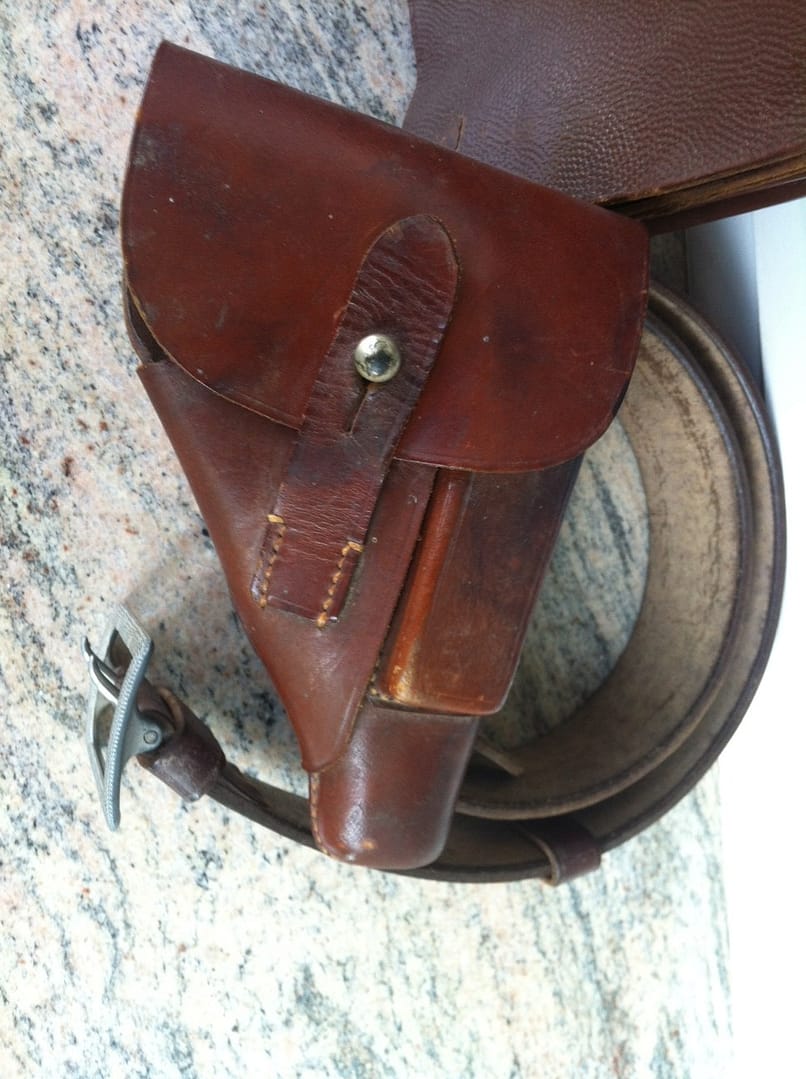
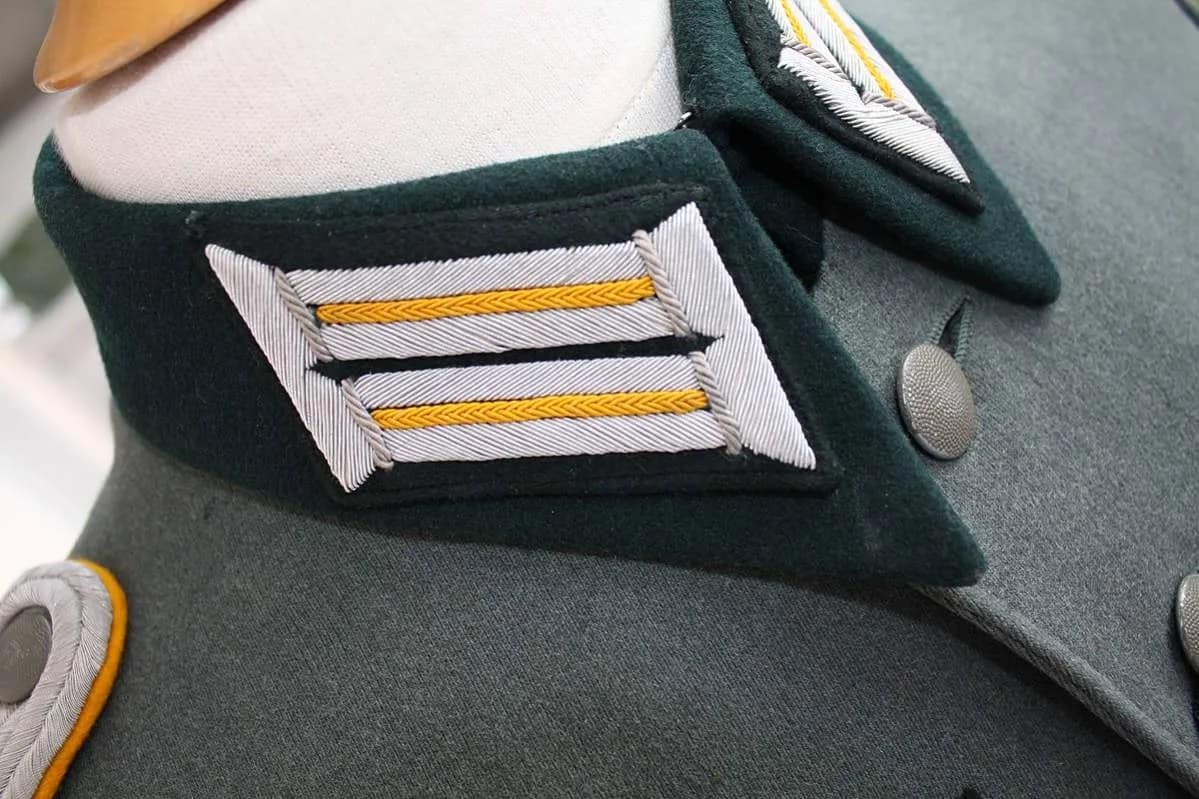
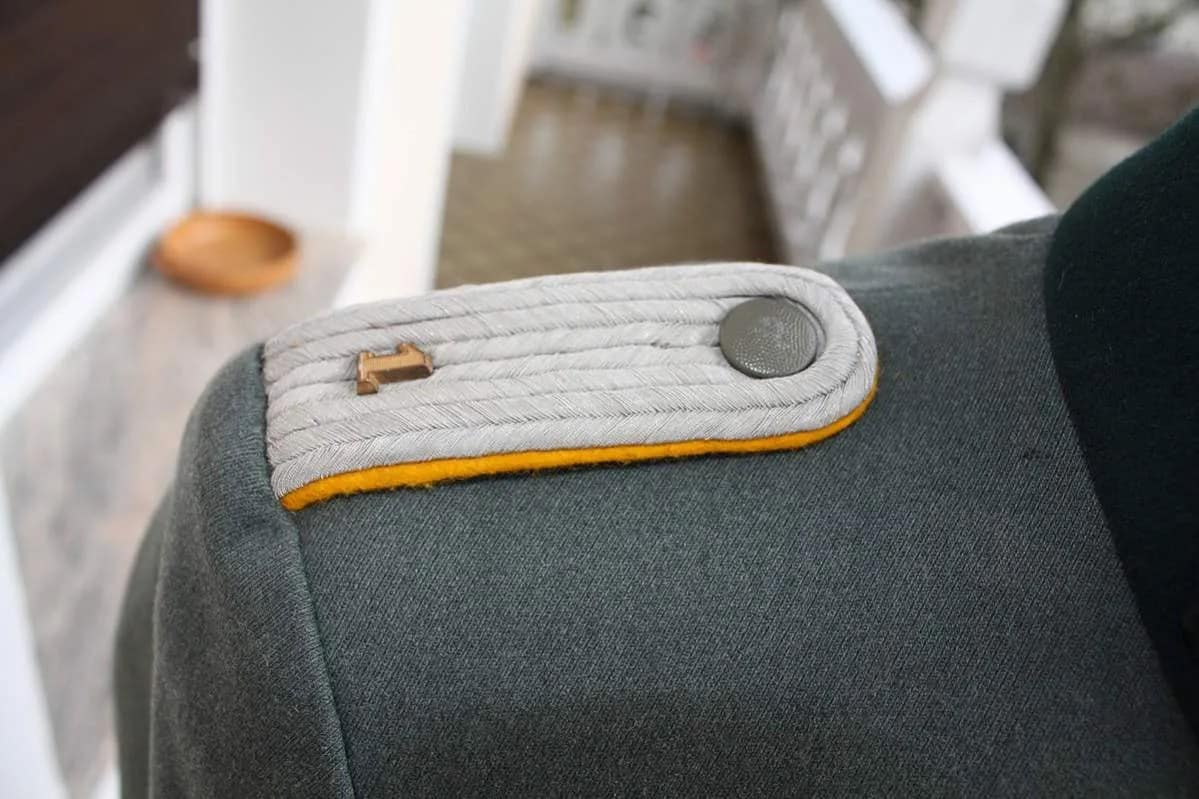
WW2 German Wehrmacht officer group – Lieutenant of the 1st Cavalry Regiment. From my personal collection.
This rare grouping belonged to a Wehrmacht lieutenant serving with the 1st Cavalry Regiment, a formation that combined traditional mounted heritage with increasing motorisation during the early years of the Second World War. The set includes a privately tailored officer’s tunic, officer’s peaked cap, map case, and a holster for a Walther PPK pistol, reflecting both the personal equipment and professional status of a junior officer. Such groupings provide valuable insight into the material culture of German cavalry units and the practical realities of command at troop and squadron level during a period of rapid operational change.
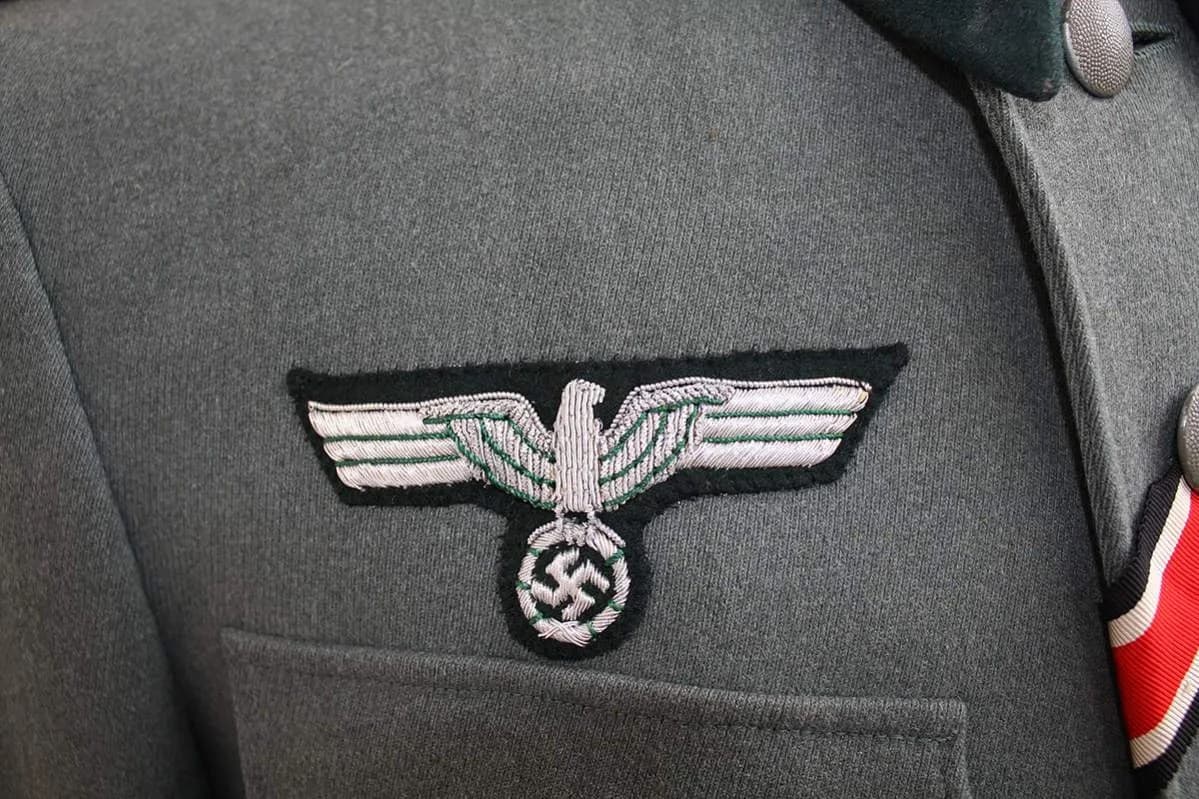
WW2 German M 1936 Feldbluse for an NCO
The pre-war pattern M1936 Feldbluse was the standard field uniform of German soldiers during the early campaigns of the Second World War. Introduced in 1936, it featured a high-quality wool construction in field-grey with dark green collar facings, pleated pockets, and a tailored cut reflecting the pre-war emphasis on smart appearance and durability. This example shows the distinctive insignia of a non-commissioned officer, indicating rank and leadership role within the unit. As the war progressed, material shortages led to simplified patterns, making early M1936 tunics increasingly scarce. The garment illustrates both the professionalism of the early-war German Army and the gradual transition to wartime economy.
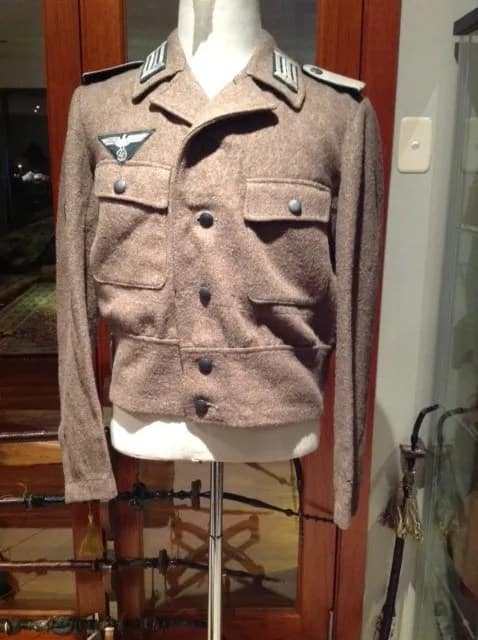
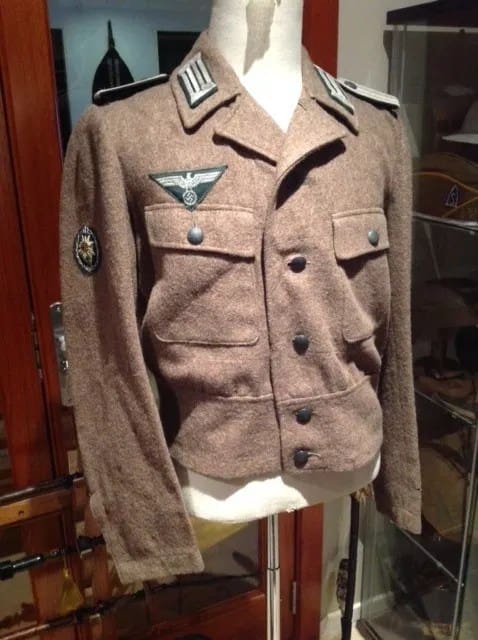
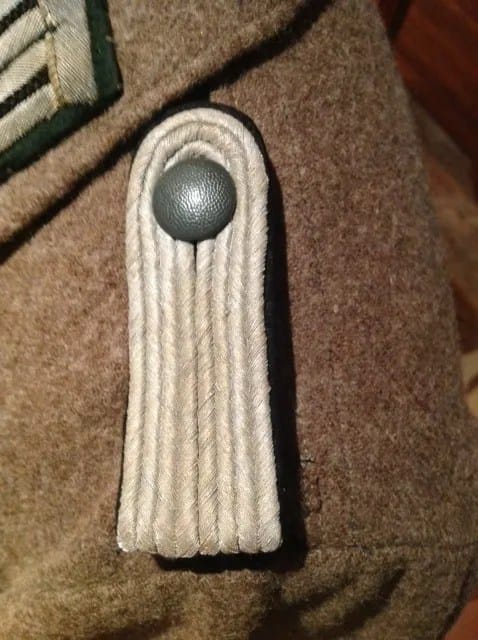
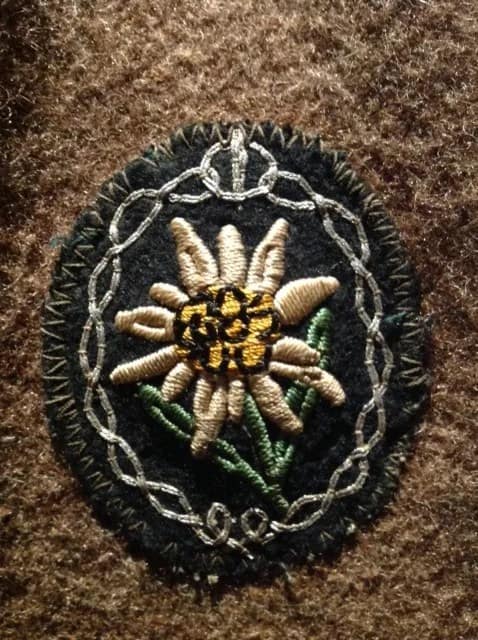
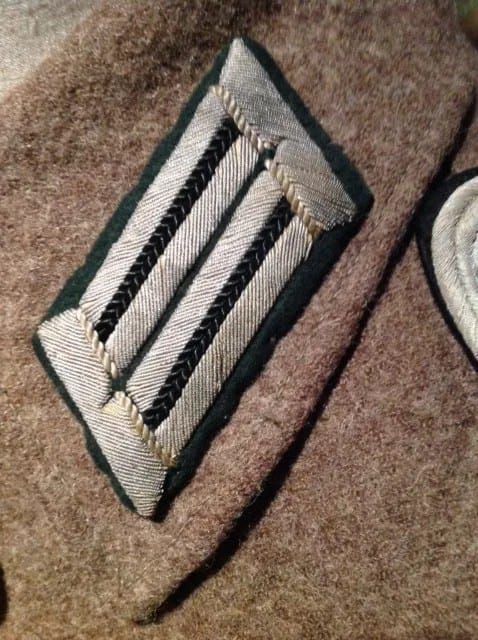
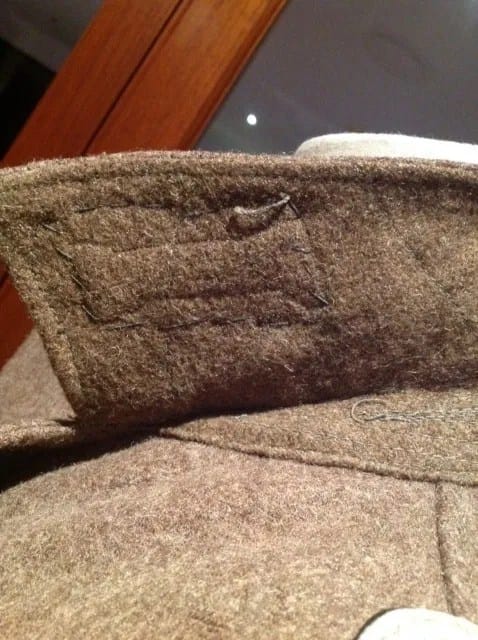
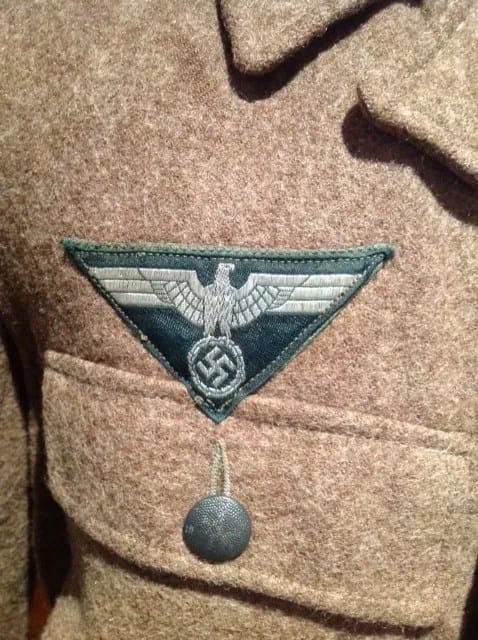
WW2 German Field Blouse Model 1944 for an Alpine Pioneer Leutnant
In late 1944, in order to cut down on tailoring and production costs, the Wehrmacht introduced the M44 pattern uniform. Similar in appearance to the British Battledress or the related US “Ike” jacket, the M44 was unlike any other German pattern uniform, and the first major deviation in uniform design since 1936. The tunic skirt was shortened to waist length, an internal belt was added, and the tunic could be worn with an open or closed collar. The color was the new “Feldgrau 44”, a drab greenish-brown. This M44 Feldbluse shows teh black piping of teh Pioneers, and teh Edelweiss sleeve badge of teh Alpine troops.
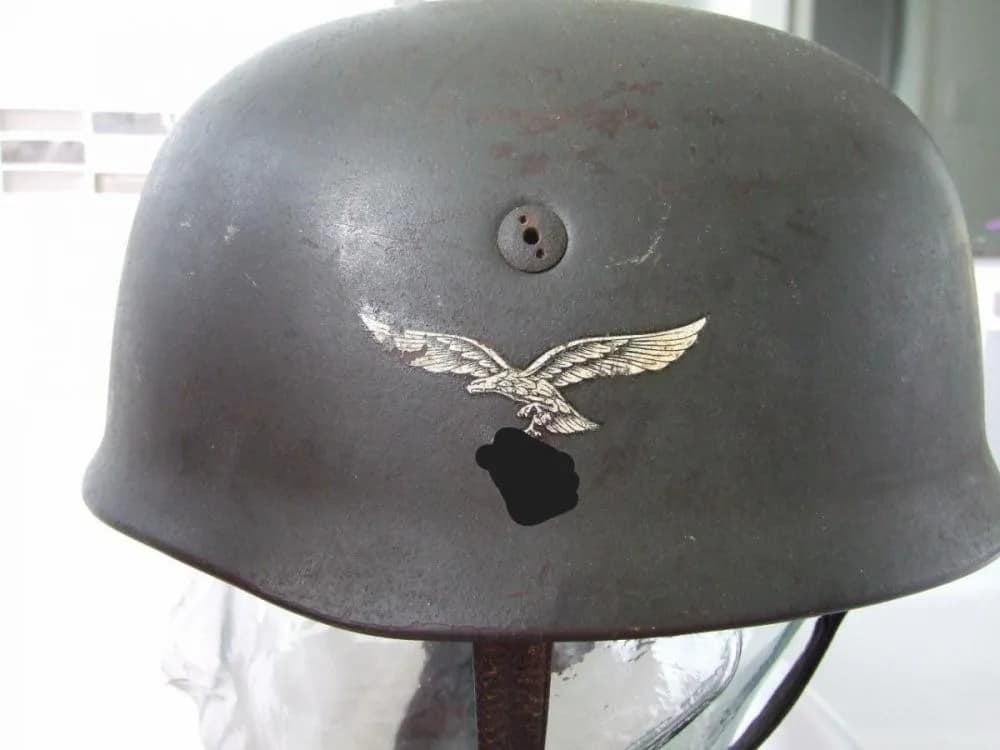
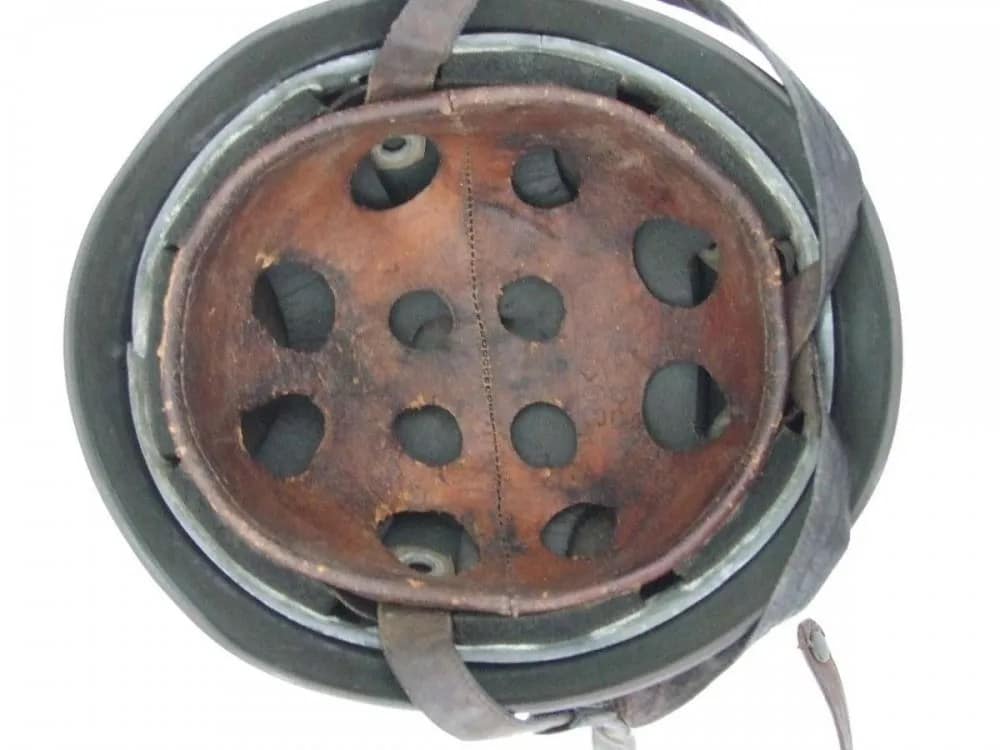
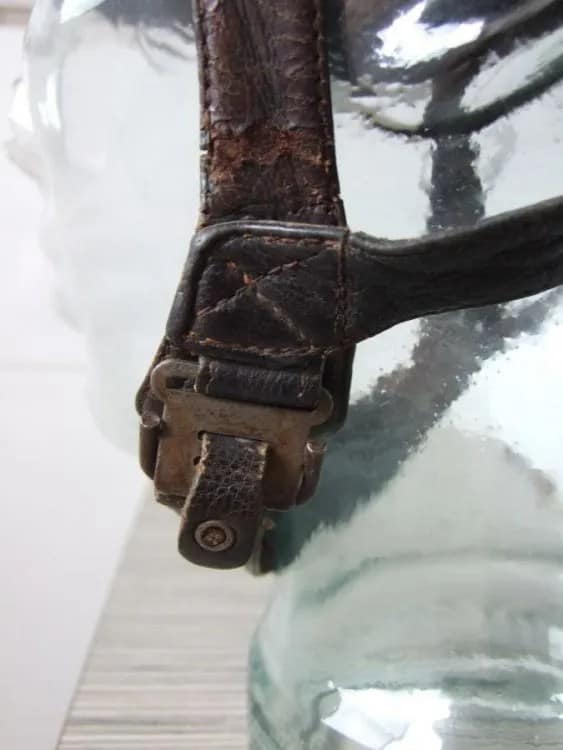
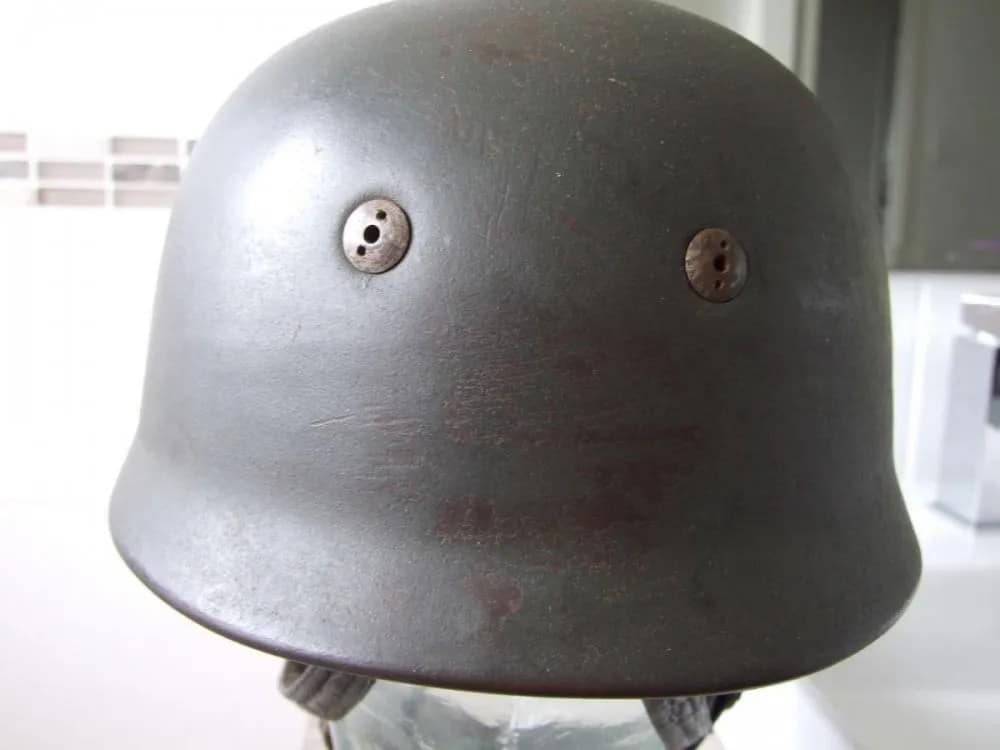
WW2 Luftwaffe M1938 Fallschirmjager (Paratrooper) Helmet, from my personal collection.
The M1938 Fallschirmjäger helmet was specially designed for German airborne forces, featuring a deeper, cut-down shell, rubber pad, leather liner, and four-bolt liner system to reduce injury during parachute descent. Late-war patterns used simplified paint finishes and wartime liners. Worn in Crete, North Africa, Italy, Normandy, and the Ardennes, the M38 is among the most distinctive helmets of the war, reflecting the elite and highly specialised nature of German airborne operations.
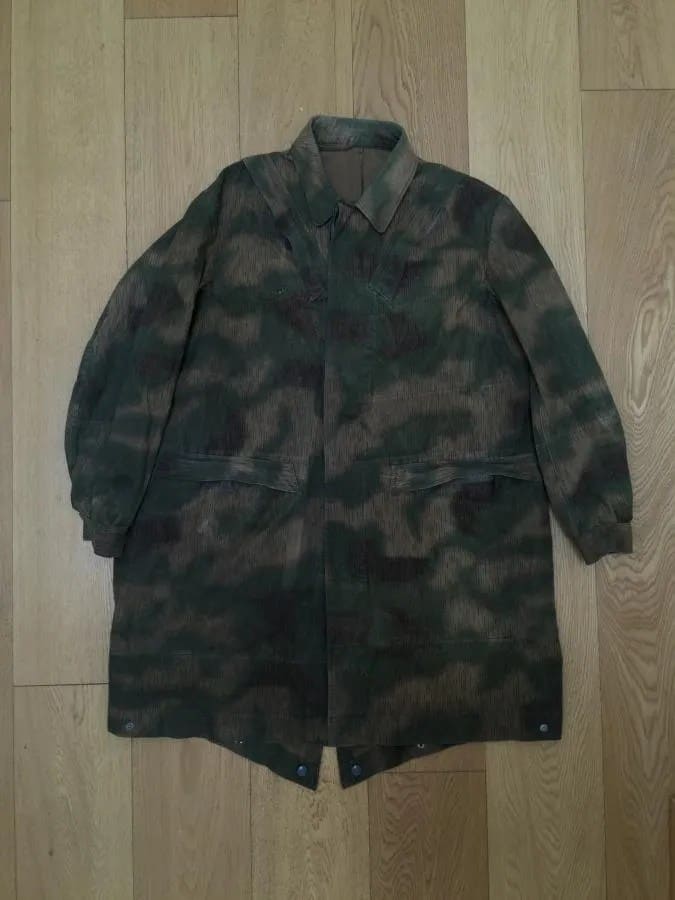
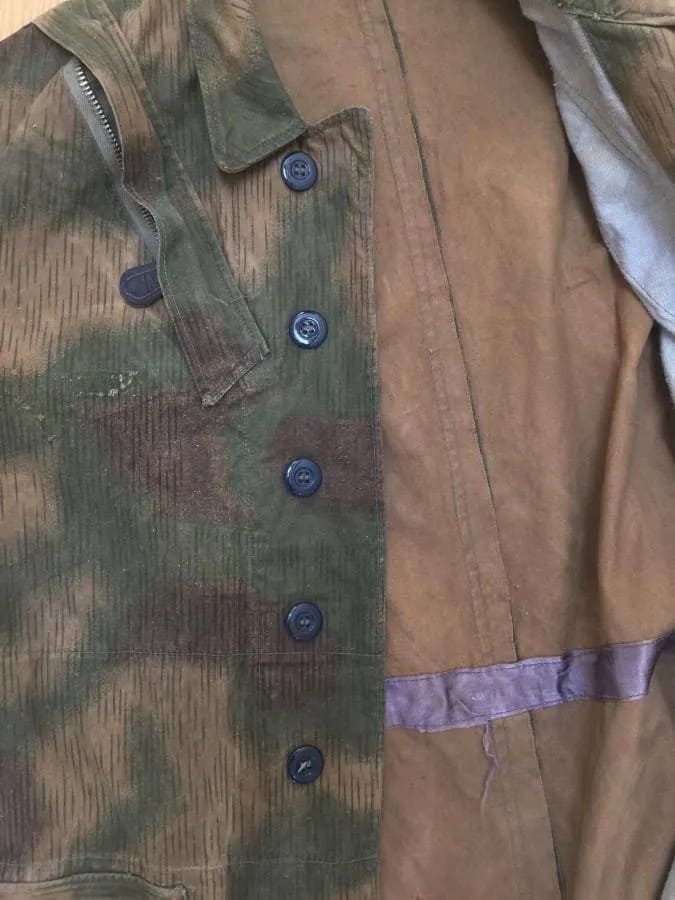
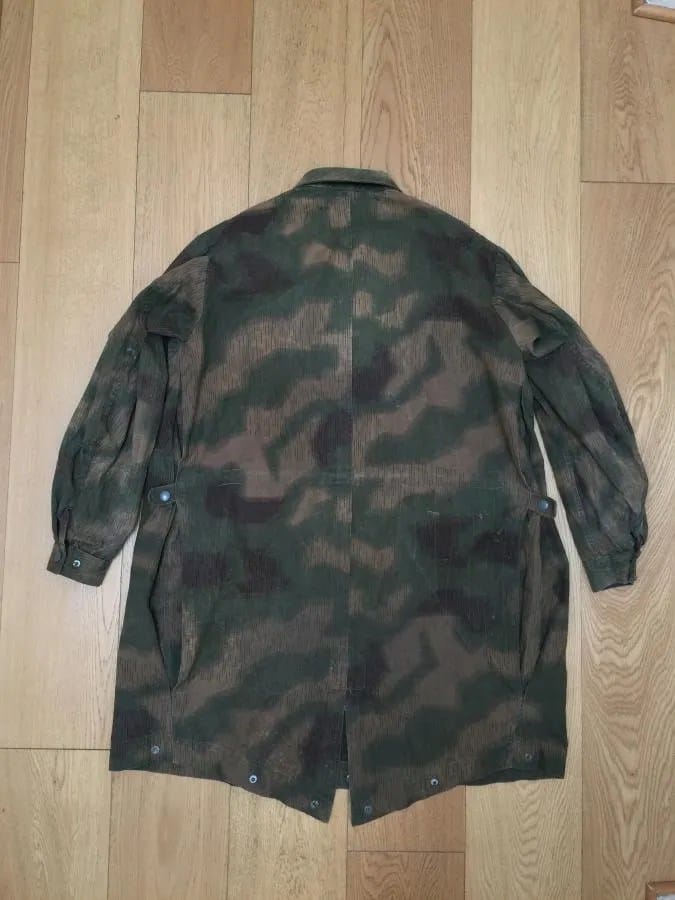
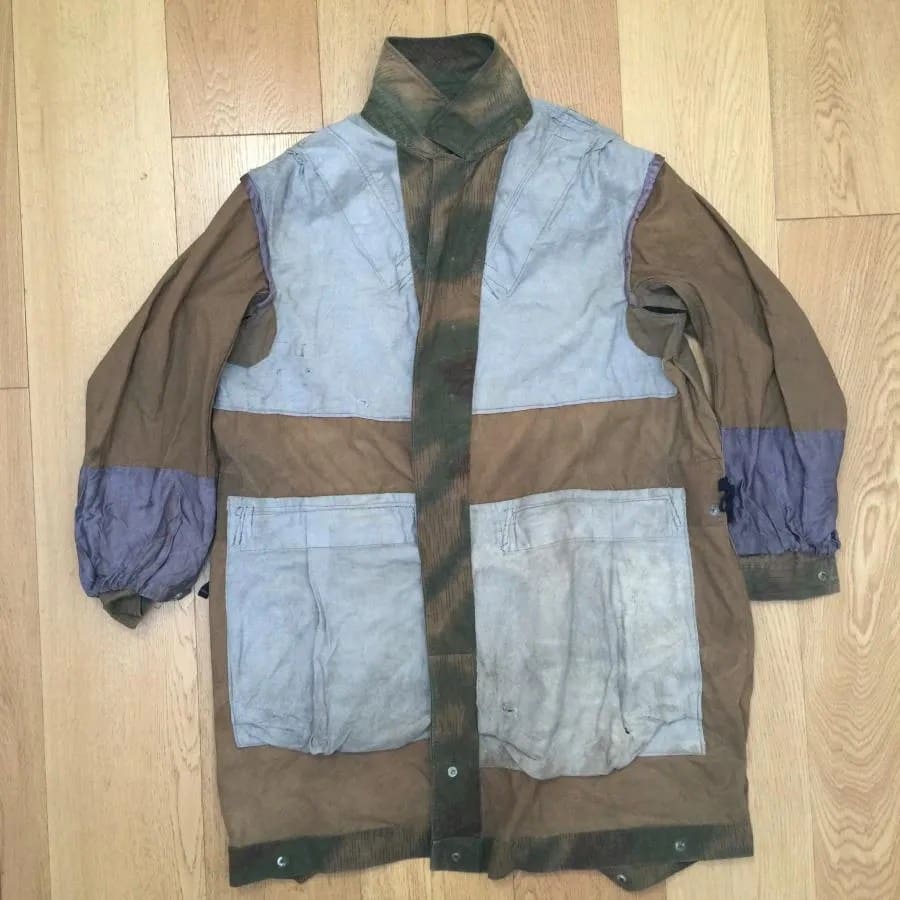
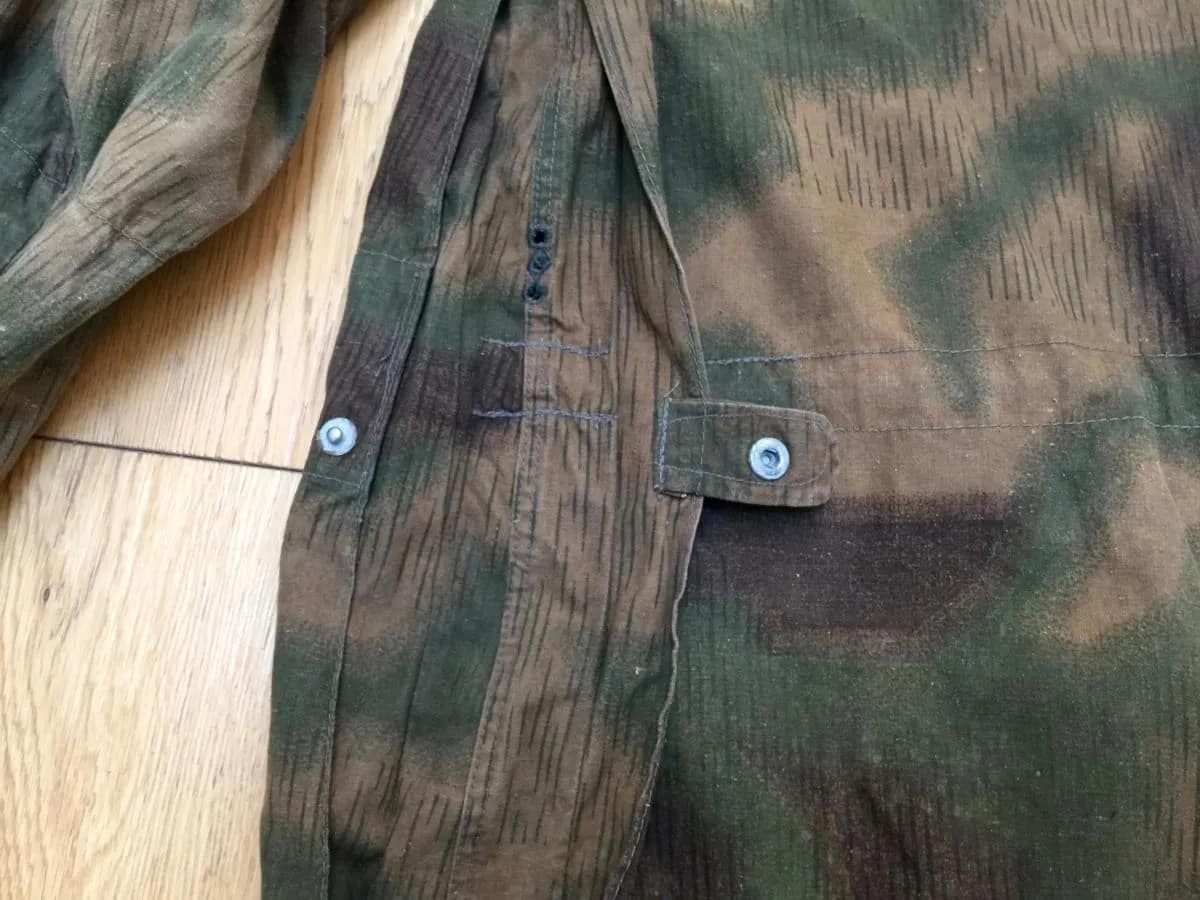
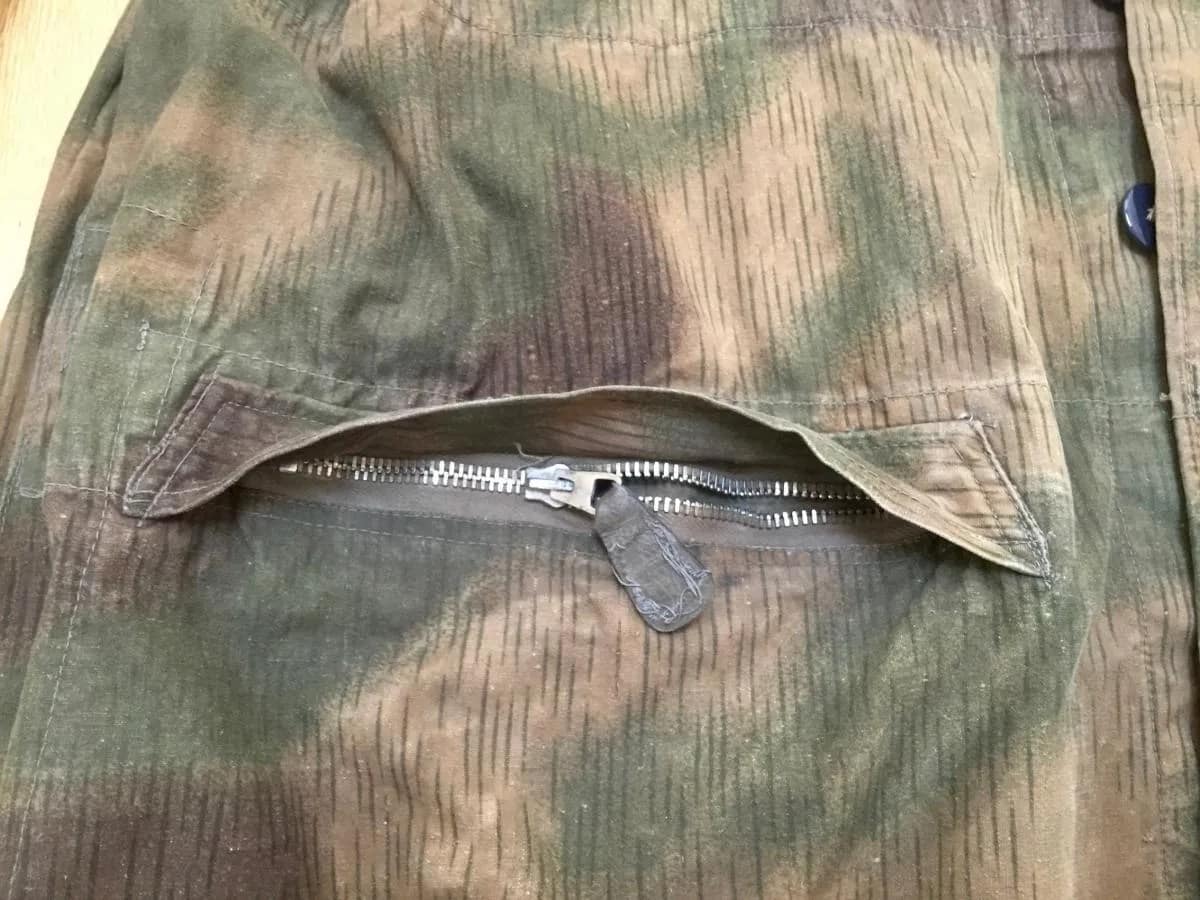
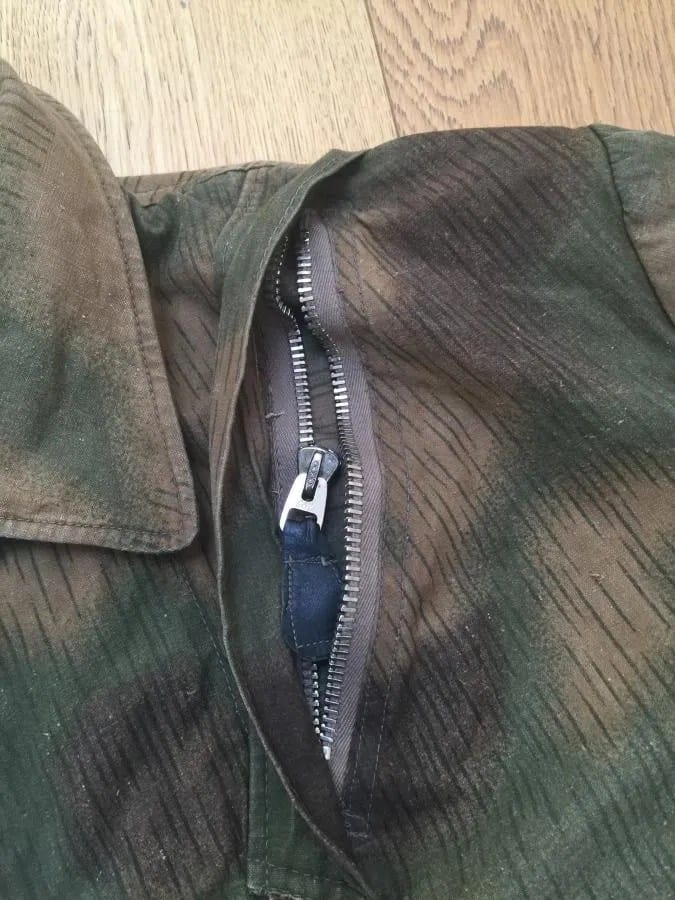
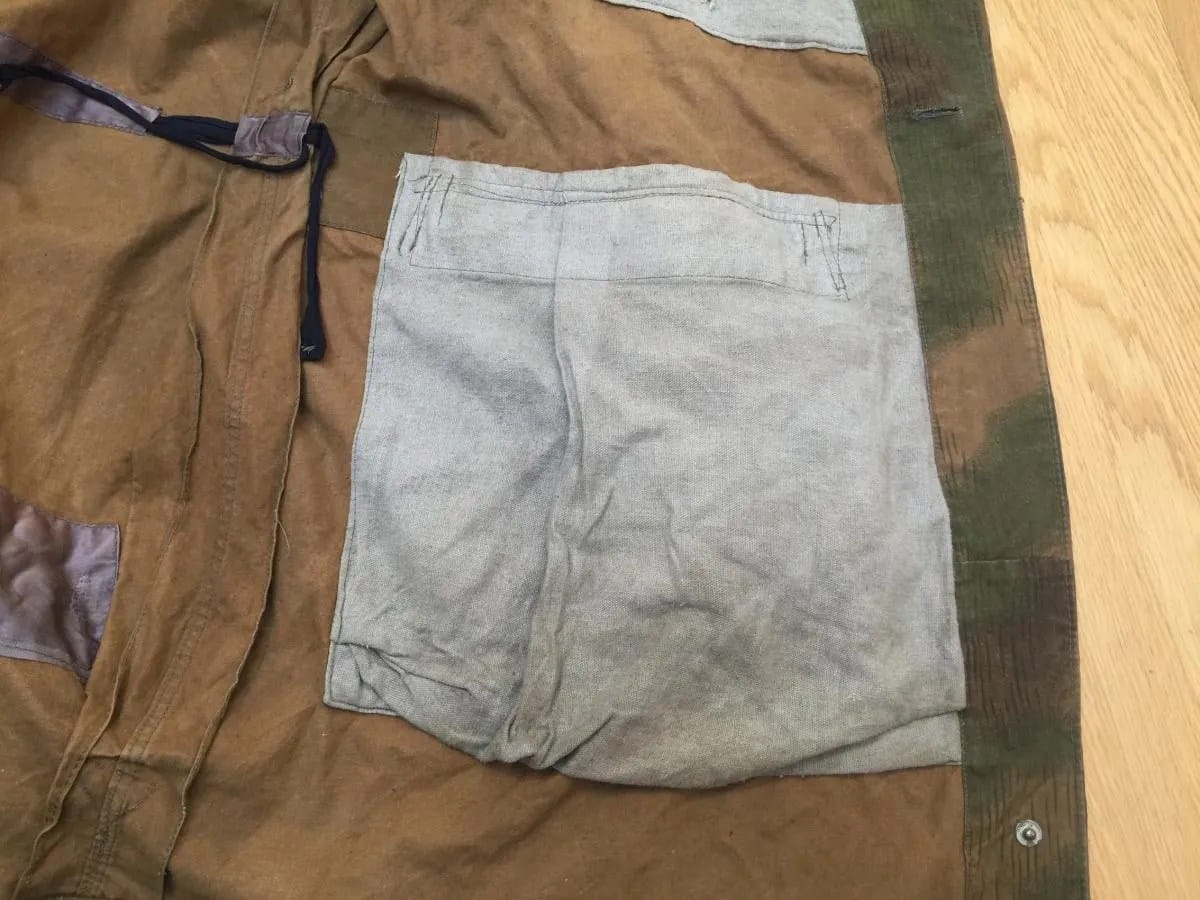
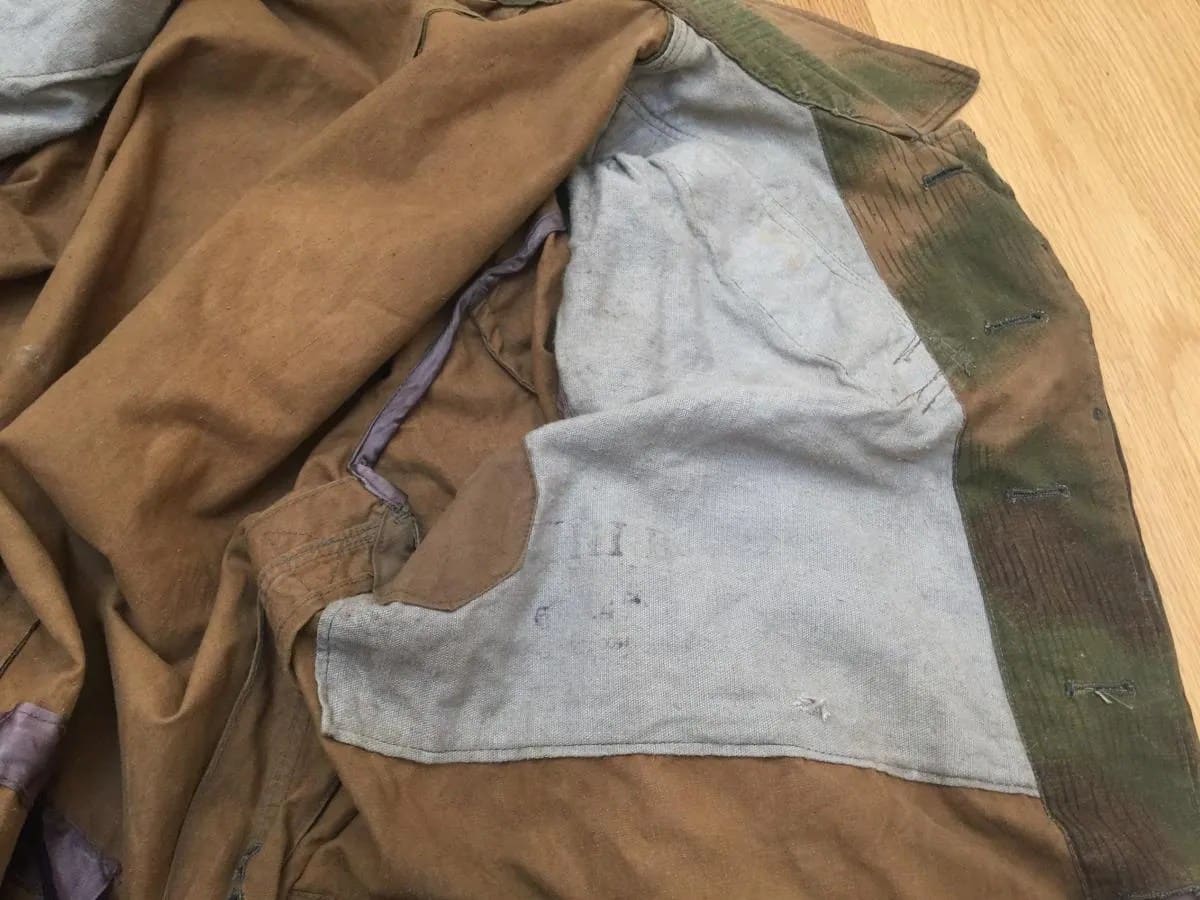
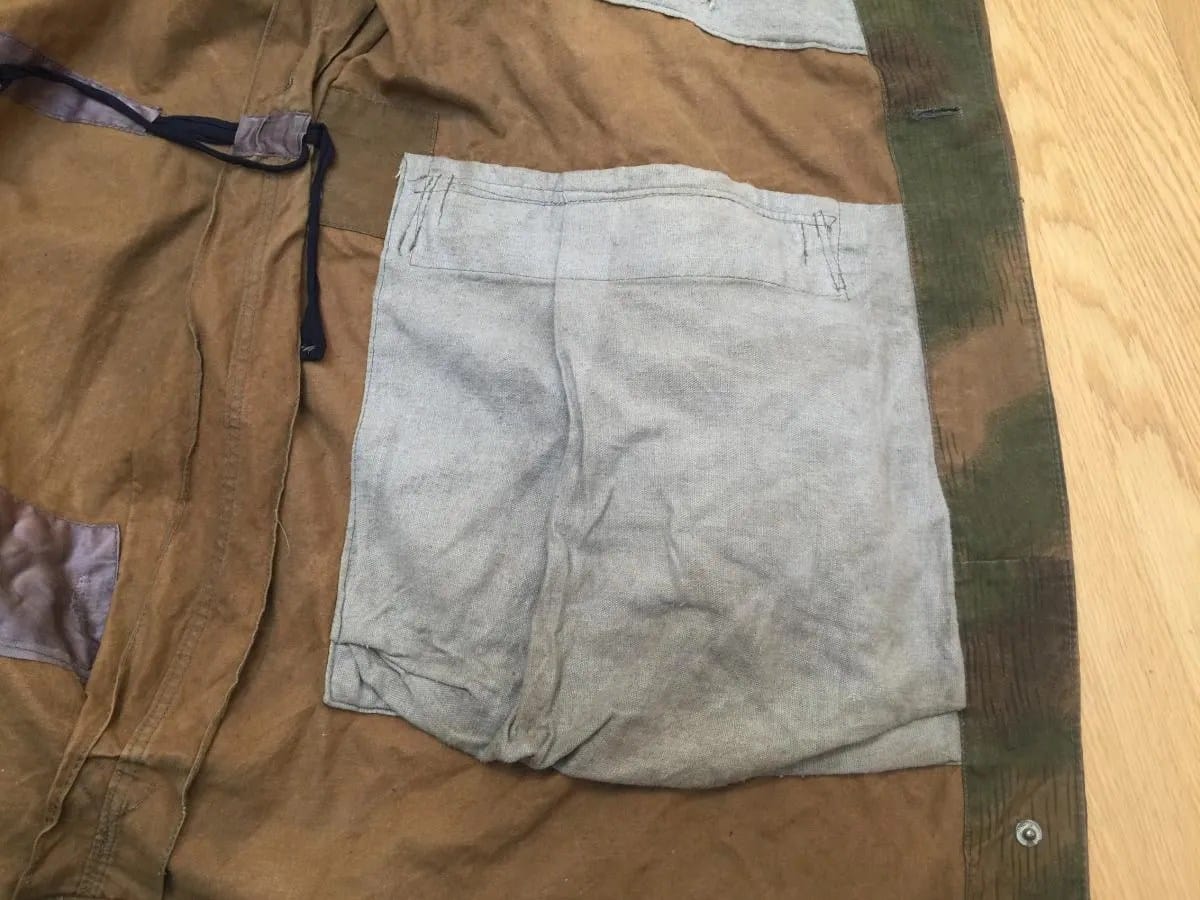
WW2 Luftwaffe M1942 Fallschirmjager Camouflage Paratrooper Smock, Sumpfmuster 43 Water pattern camouflage, from my personal collection.
The M1942 Fallschirmjäger jump smock, nicknamed Knochensack (“bone sack”), was redesigned for combat operations and issued in the Sumpfmuster 43 “marsh pattern” camouflage. Constructed from strong cotton twill with zip closures, it allowed greater freedom of movement and concealed equipment during descent. This pattern saw extensive use in Italy, Normandy, and defensive actions in 1944–45, and is closely tied to late-war German airborne engagements.
WW2 German Wehrmacht complete Reversible Splittertarn / Snow pattern camouflage uniform – parks, padded trousers, hood, mitts. From my personal collection.
This complete reversible camouflage set — parka, trousers, hood, and mittens — features the standard Splittertarn A/B patterns used by German infantry from 1943. Intended for winter and transitional conditions, the parka system provided insulation and concealment, replacing earlier zeltbahn improvisations. It was widely used on the Eastern Front and in late-war defensive operations. The reversible design allowed rapid adaptation between woodland and snow-covered terrain.
ITALIAN
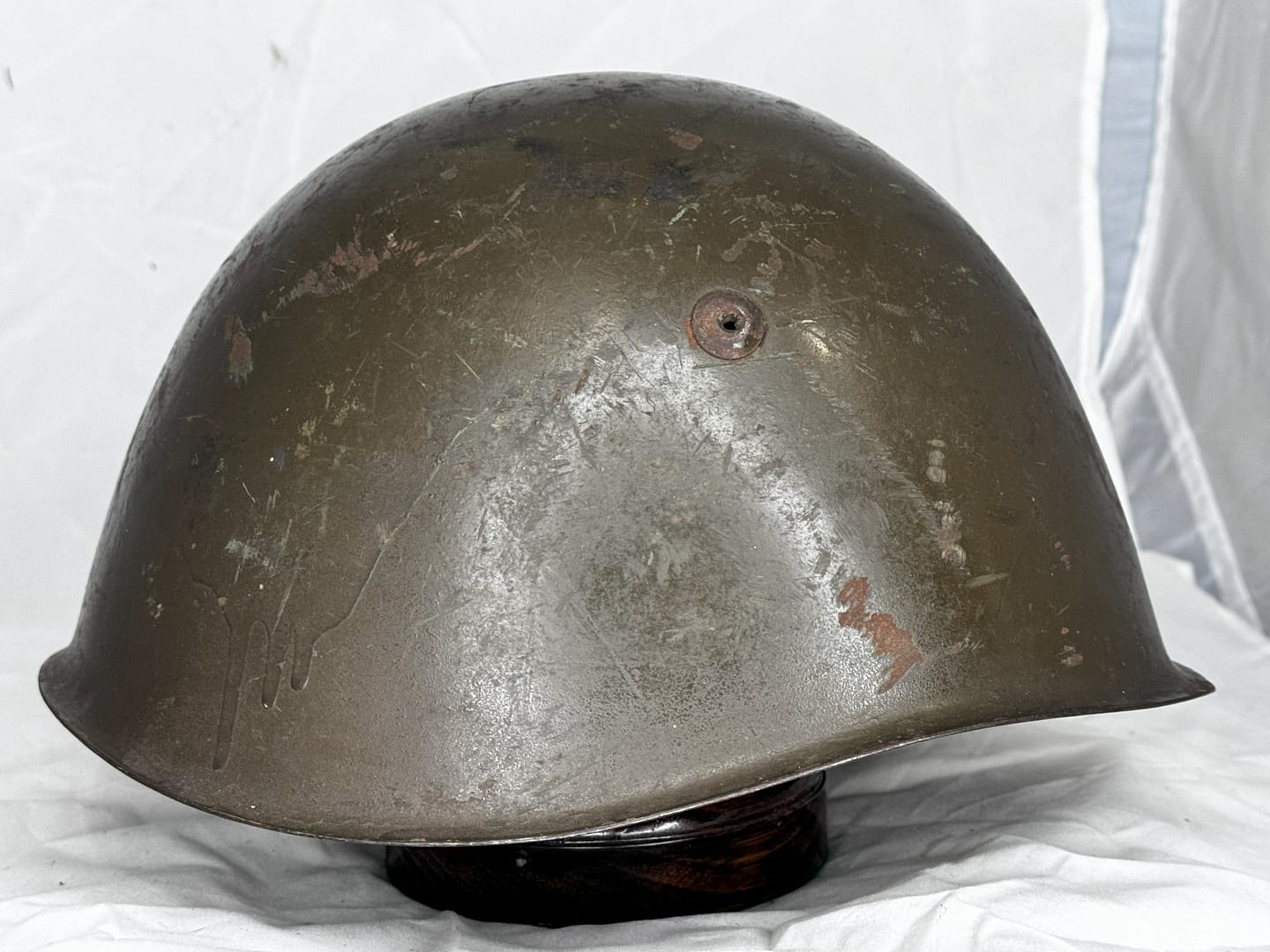
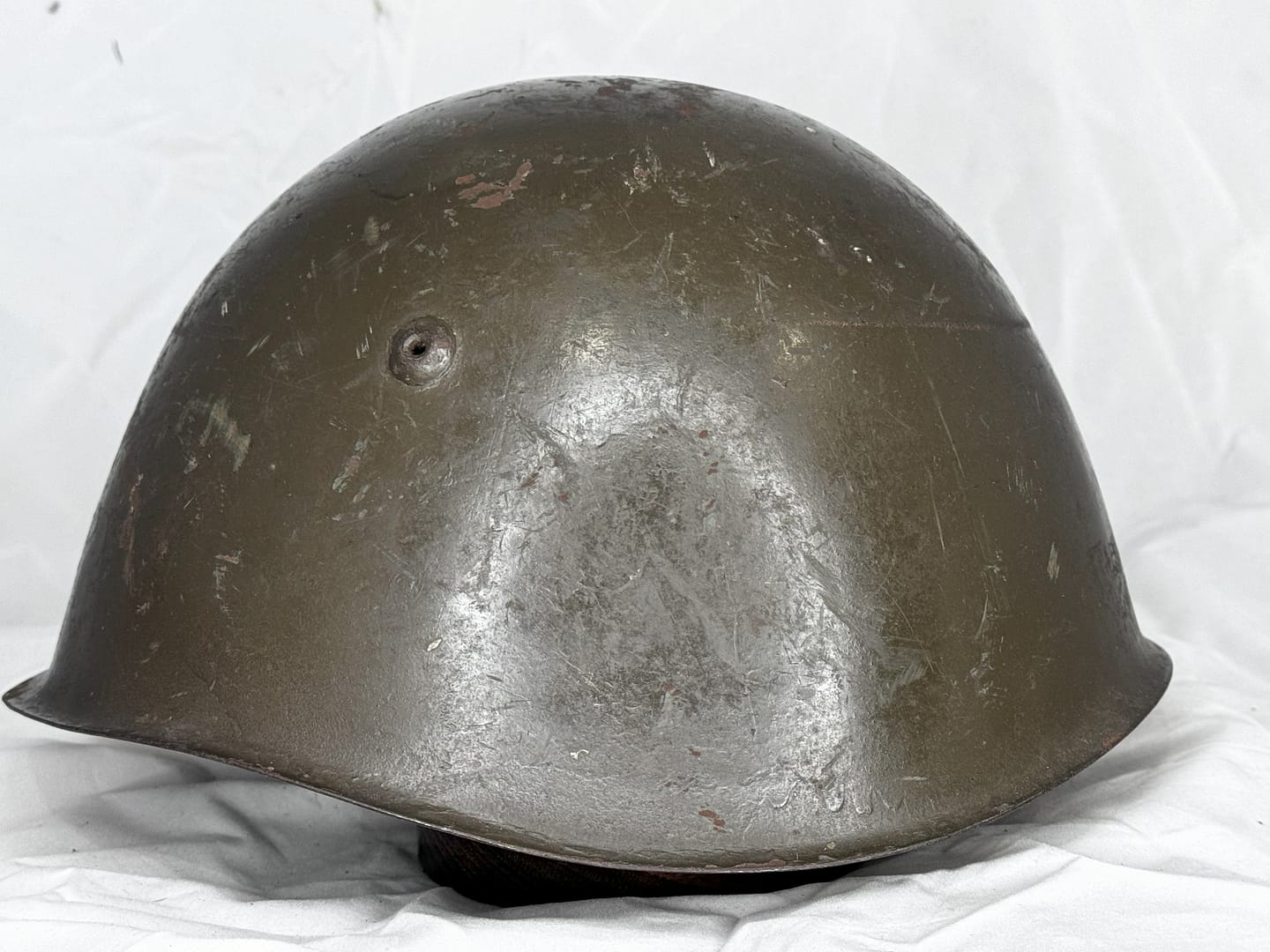
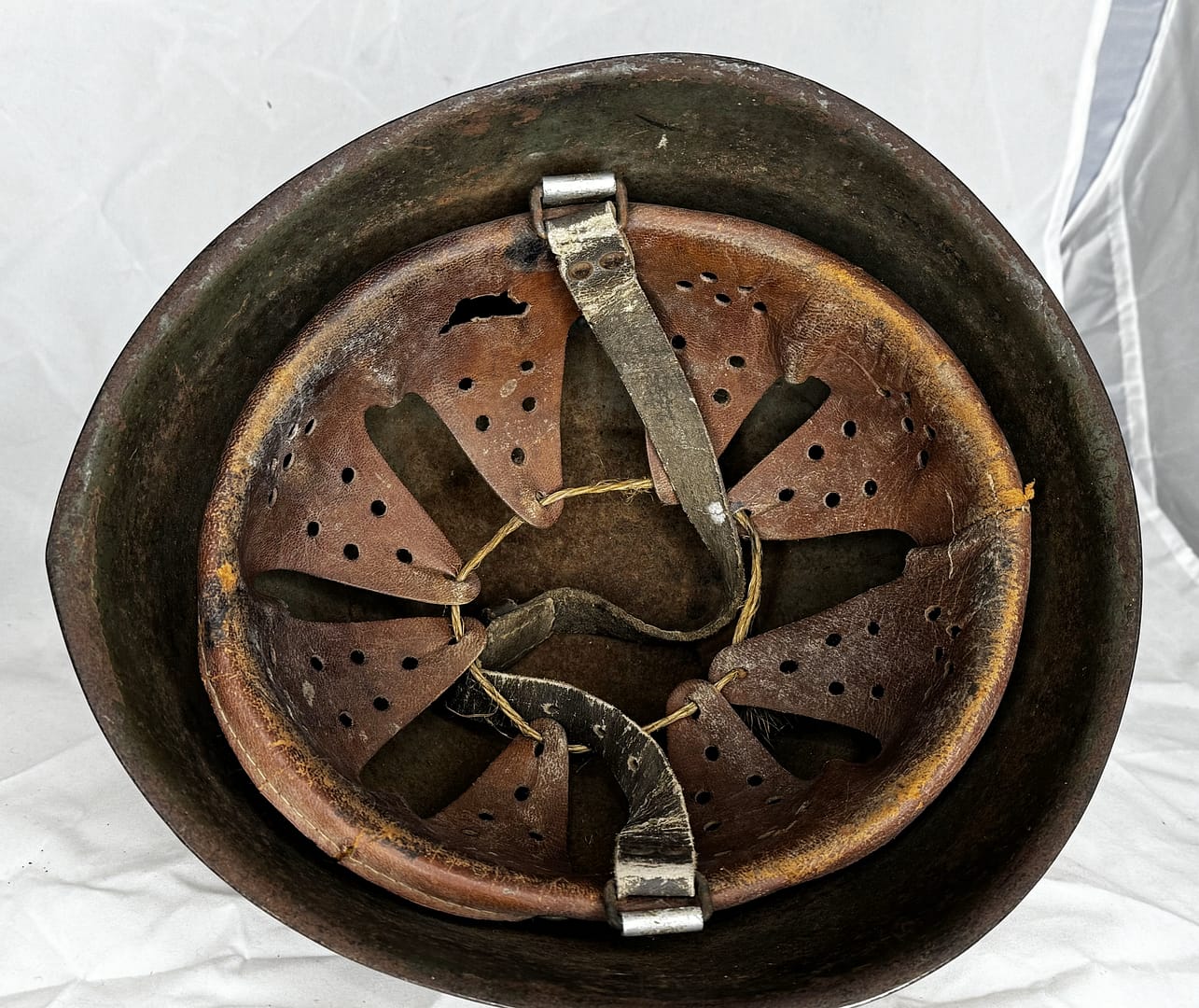
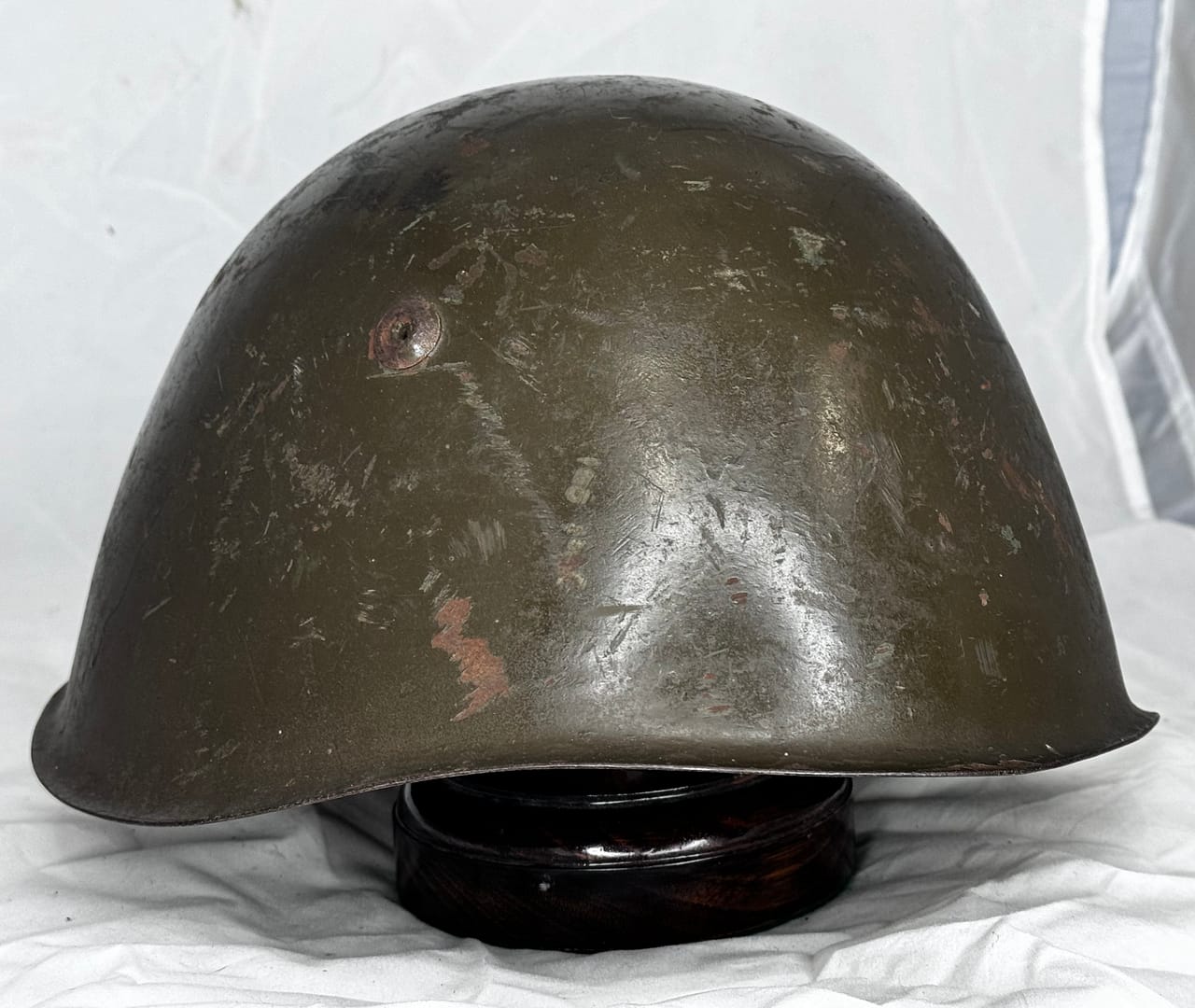
WW2 Italian M33 Combat Helmet, from my personal collection.
Introduced in 1933, the Italian M33 helmet was a modern, lightweight steel helmet with an improved liner and eight-pad suspension. Used across North Africa, East Africa, the Balkans, and Italy, it offered better protection and comfort than many pre-war designs. After the 1943 armistice, both Royalist and RSI forces continued to use the M33, making it one of the longest-serving helmets of the war.
ROMANIAN
WW2 Romanian M39 Camouflaged Combat Helmet, from my personal collection.
The Romanian M39 helmet was produced in Germany for the Romanian Army and based closely on the Dutch M1926 shell. This example features wartime camouflage paint and a German M31 leather liner, reflecting close Axis cooperation. M39 helmets were worn in the Wehrmacht-supported campaigns on the Eastern Front, including actions in Odessa, the Don Bend, and Stalingrad. The M39 represents Romania’s primary combat helmet during its period as an Axis co-belligerent.
Found this useful? Buy me a coffee — it helps fund future battlefield research
Authored by Mick Prictor, a retired military officer with 40 years’ service, and a military historian specialising in terrain-focused analysis of tactics, doctrine, and command decision-making in land warfare. His work draws on extensive battlefield fieldwork—more than 280 sites worldwide—and one of the world’s largest private collections of historic military arms, uniforms, and equipment. About me
Subscribe to Battlefield Travels and receive a free E-Book Battlefield Guide
Unlock expert battlefield analysis, campaign reconstructions, and historical insights drawn from firsthand exploration and primary sources.
🗺️ You’ll receive:
🎖️ Exclusive historical insights you won’t find elsewhere
📘 A free eBook: 10 Tips for Exploring Historic Battlefields
📰 New battlefield studies straight to your inbox as they are published
Claim Your Free Battlefield Travel Guide
Get your free e-book, exclusive tips, and updates on new battlefield studies.
Thank you!
You have successfully joined our subscriber list.
⚔️ Go deeper — Members get exclusive access to the Deep Research Collection, Field Notes, and monthly Research Dispatches. Try membership free for 7 days, cancel anytime. From $9/month.