Skip to content
Home » Pursuit

Pursuit

Pursuit operations exploit battlefield advantage to destroy retreating forces. This tag gathers engagements where momentum, cavalry mobility, or mechanised speed determined outcomes beyond the initial clash.

US Troops of 4th Infantry Division storm ashore at Utah Beach

⚔️ D-Day: Utah Beach landings,
6 June 1944

In the early hours of D-Day, 6 June 1944, 13,200 paratroopers of the 82nd and 101st Airborne Divisions landed behind Utah Beach to secure the beach landing sites and prevent German interference. A few hours later, the US 4th Infantry Division stormed ashore on Utah Beach. The amphibious forces landed about 2,000 yards south of their intended site, but rapidly secured the beachhead and moved inland to link-up with the paratroopers. By the end of D-Day, more than 21,000 troops were ashore at Utah Beach.

title slide

⚔️ Battle of Patay, France,
18 June 1429

In the English-speaking world, the Battle of Agincourt in October 1415 is legendary. But there was a lesser-known battle a few years later where the outcome was reversed. A combat-experienced French army, inspired by Jeanne d’Arc, the Maid of Orleans, launched a lightning campaign that overwhelmed multiple English strongholds before wiping out an entire English army in open combat at the Battle of Patay on 18 June 1429. Mark Twain even wrote about this battle!

The Huns at the Battle of the Catalaunian Fields, 19th-century woodcutThe Huns at the Battle of the Catalaunian Fields, 19th-century woodcut

⚔️🔒Battle of the Catalaunian Fields, France, ~20 June 451 AD

The 451 AD Battle of the Catalaunian Fields (also known as the Battle of Chalons or the Battle of Maurica), between a Romano-Visigothic force and Hunnic-Gothic coalition led by Attila the Hun, was one of the decisive battles in history, and the last major victory for the western Roman Empire before it succumbed to barbarian invasion in 476 AD.

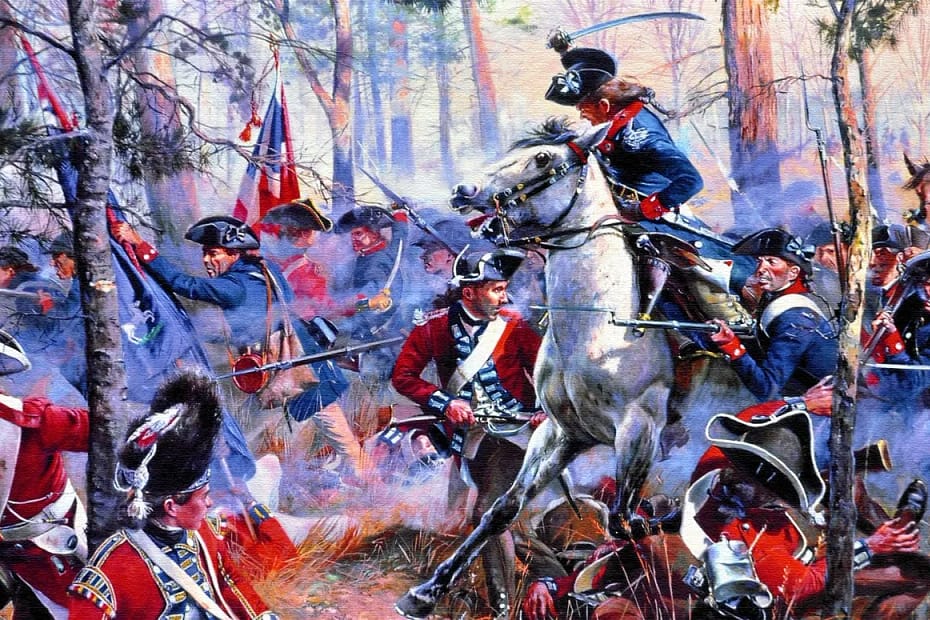
'The Battle of Cowpens' by Don Troiani

⚔️ Battle of Cowpens, South Carolina,
17 January 1781

The Battle of Cowpens, South Carolina, was a relatively small engagement in the American Revolutionary War, but had outsized impact on the trajectory of the war. The American commander, Brigadier-General Dan Morgan, also employed tactical innovations that were adopted for future campaigns.

100th Anniversary of the Dalton Gang Raid on Coffeyville - poster from the Dalton Defenders Museum

⚔️ Dalton Gang Raid on Coffeyville, Kansas,
5 October 1892

The day the Dalton Gang rode into Coffeyville and into the history books! Not actually a battlefield; more of a Wild West shootout. In a place even many of my American friends have never heard of! This little town in southeast Kansas was the scene of one of the great good guy-bad guy confrontations of the Wild West.

26232567_10155944258704477_1540845561015313497_o

⚔️ Battle of Suomussalmi / Raate Road, Finland,
30 Nov 1939 – 8 Jan 1940

When Stalin’s Red Army invaded Finland on 30 November 1939, the two main thrusts were in the south around Lake Ladoga and the Mannerheim Line, and in central Finland focussed on Suomussalmi. In central Finland, the Russian 163rd Rifle Division and an independent tank brigade crossed the border at Juntusranta, and the 44th (Ukrainian) Rifle Division crossed at Raate. Both forces converged on Suomussalmi as their immediate objective. Their ultimate aim was to seize Oulu, and cut Finland in two.

IMG 5409

⚔️ Battle of Leuthen, Silesia (Poland),
5 December 1757

The Battle of Leuthen, 5 December 1757, is one of the great battles of history, students of military history would consider it somewhat of a pilgrimage to visit this site. After defeating a Fench/Imperial Army of almost twice its size at the Battle of Rossbach a month earlier, Frederick’s Army had marched 275km in 12 days to confront the Austrian Army in Silesia. Frederick’s 33,000 troops faced Prince Charles of Lorraine and his 65,000 Austrian troops near the village of Leuthen.

Sher Pur 1879

⚔️ Battle of Kabul, Afghanistan,
11-24 December 1879

The Second Anglo-Afghan War of 1878-1880, was part of the ‘Great Game’ between Great Britain and Russia as both sought greater influence and to undermine the other in Central and South Asia. In 1878, Russia sent a diplomatic mission to the court of Sher Ali Khan, the Amir of Afghanistan. The British mission was refused entry into Afghanistan. Fearing that the Russians had gained an advantage, the British used this as justification to invade Afghanistan, ostensibly to secure India’s northwest frontier.